
Tags
agricultural commodities, alternate energy, Austrian school, banking crisis, banks, bear market, Bollinger Bands, bull market, capitalism, central banks, China, Comex, commodities, communism, Copper, Currencies, currency, deflation, depression, diamonds, dollar denominated, dollar denominated investments, economic, economic trends, economy, financial, Forex, futures, futures markets, gold, gold miners, hard assets, heating oil, India, inflation, investments, Keith Fitz-Gerald, market crash, Markets, mining companies, Moving Averages, natural gas, oil, palladium, Peter Schiff, physical gold, platinum, platinum miners, precious metals, price, price manipulation, prices, producers, production, protection, rare earth metals, recession, risk, run on banks, safety, Saudi Arabia, Sean Rakhimov, silver, silver miners, socialism, sovereign, spot, spot price, stagflation, Technical Analysis, timber, U.S. Dollar, volatility, warrants, Water
The Dollar Gets Slammed – Seeking Alpha
Source: Bespoke Investment Group
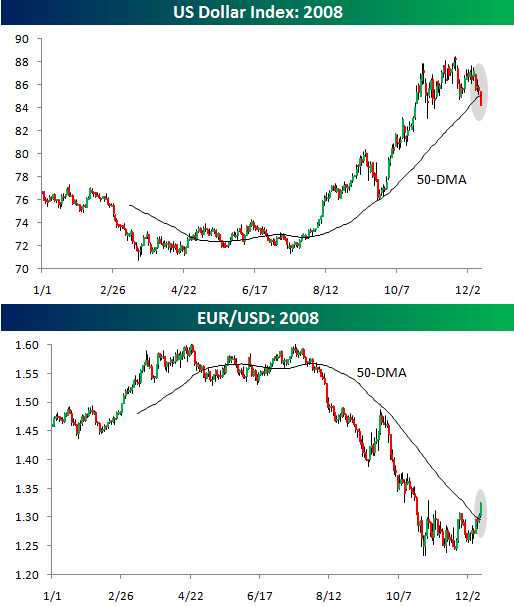
While investors have been focused on the S&P 500 and its attempt to break through its 50-day moving average, the Dollar had no problems breaking through its 50-day. Unfortunately, the break was to the downside. With a decline of 1.5% today, the US Dollar index traded below its 50-day moving average for the first time since late July.
At the same time the Dollar has been falling, the Euro has been rallying, as it broke above its 50-day moving average for the first time in months. Was the negative yield on the three month T-Bill a wake up call to foreign investors that holding cash in Dollars is not a very attractive option?
click to enlarge
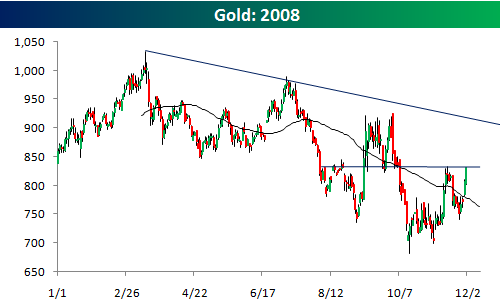
Not surprisingly, Gold is benefiting from the Dollar’s weakness with a gain of 3% today. A look at this chart shows that the commodity is still nowhere near breaking its downtrend. However, it is currently trading right at a short-term resistance level of around $830. How it acts in the weeks and months ahead will be a good indication of how concerned the market is regarding inflation.
==============================================
Confused About Warrants? Using Goldcorp To Explain
By: Dudley Baker of Precious Metals Warrants.com
Warrants are being mentioned more and more in the traditional media as the U.S. government moves to receive warrants in connection with some of the bailout/rescue plans for the Big Three auto manufactures and also with AIG back in September.
Warrants have a long history going back into the 1920s, but the average investor has absolutely no idea what this investment vehicle is all about.

So let’s make this simple and provide you with a brief understanding of warrants and why you should perhaps consider warrants in your investment plans. (After all, this is not rocket science!)
Warrants are a security issued by a company usually in connection with a financing arrangement or a public offering of shares giving the holder the right, but not the obligation, to acquire the underlying security at a specific price and expiring on a specific date in the future. Sounds a lot like a call option, doesn’t it? Yes, very similar but with a few important differences, namely, how they are issued and how they are traded.
While understanding the term warrants is essential, the next most important question is a warrant on what? The underlying company is of utmost importance because if the company does not perform, execute on its business plans and thus the shares price rising in the markets, then the warrants can not be expected to go up and we are all about making money.
A common question from investors is why would I buy a warrant when I just want to own the common shares of the company? Good question and we have a very easy answer. An investor would purchase a warrant because of the expectation of a greater gain than purchasing the common shares and this term is usually referred to as leverage. See our analysis below on Goldcorp (GG). We would normally suggest investors attempt to seek a leverage of 2 to 1, meaning if the common shares rise by 100% we would expect the warrants to increase by 200%. Another benefit of buying the warrant is that it will cost you much less money thus lowering your investment cost and potentially increasing your return on your investment.
Perhaps a detailed example would clarify any questions you may still have on warrants.
Let’s say you are a believer in the return of the long term bull market in the precious metals and commodity sector and you are aware that one of the major gold producers is Goldcorp which trades on the NYSE and the TSX. As you hear many analysts commenting on Goldcorp, you are thinking maybe this would be a good addition to your portfolio. You do some more research (due diligence) and find that Goldcorp, a Canadian company headquartered in Vancouver, Canada, employs more than 9,000 people worldwide has has 16 world class operations and development projects focused throughout the Americas with over 70% of reserves in low risk NAFTA and they do not hedge or sell forward its gold production.
Now you are excited. You have found that Goldcorp meets all of your criteria and you see the potential for the shares to rise perhaps to $70 to $100 due to your bullish views on the precious metals markets within the next 2 years.
This is where we encourage investors, before purchasing the common shares, to ask the question, does Goldcorp (or any other company you are considering in your portfolio) have a long-term warrant which is trading which may provide me with a better return on my investment? We know that Goldcorp does in fact have a warrant which is trading and the issue now becomes, what is the exercise price, when does the warrant expire and does this warrant offer me great upside leverage as the common shares increase in price?
As of the close on Friday, December the 5th, Goldcorp common shares were at C$27.85 and the warrants at C$7.34. The warrants have an exercise price of C$45.75 and will expire on June 9, 2011. At a projected share price of $100 you would have a gain of 259% and with the common at $100, the warrants would have a minimum gain of 639% for a leverage of 2.5 times.
We would like to stress that this is an example and not a recommendation of the Goldcorp warrants. However with the warrant trading on Goldcorp if the answers to your questions are answered satisfactorily the warrant should then be purchased in lieu of the common shares after performing your due diligence and consulting with one’s investment advisor.
Currently there are warrants trading on some of the large producers as well as many of the smaller junior mining companies with expiration dates of 2011 and out to 2017 providing investors with some incredible opportunities
More Info on Warrant Can Be Found Here
============================================
What Does Backwardisation Mean For Gold & Silver Prices?
By: Peter Cooper of Arabian Money.net
Antal E. Fekete, a professor at Intermountain Institute of Science and Applied Mathematics, and frequent writer on precious metals, answers a timely question:
Q: People from around the world keep asking me what advance warning for the collapse of our international monetary system, based as it is on irredeemable promises to pay, they should be looking for.
A: My answer invariably is: ‘watch for the last contango in silver’.
It takes a little bit of explaining what this cryptic message means. Contango is that condition whereby more distant futures prices are at a premium over the nearby. The opposite is called backwardation which obtains when the nearby futures sell at a premium and the more distant futures are at a discount.
When contango gives way to backwardation in all contract spreads, never again to return, it is a foolproof indication that no deliverable monetary silver exists.
Silver price hike
Thank you professor! This is really an extension of the argument on this website dating back to before the summer rout of precious metal prices.
Physical stocks are low and the futures price has been distorted by big hedge fund forced-sales – now we are coming to the day of reckoning when the physical shortage starts to determine the spot price, and not the futures market.
The upside – which should have been there all along – will now come back with a vengeance and smash the few remaining shorts. This is likely to be spectacular – but after the culling of bulls recently not all precious metal fans will be there to benefit.
Backwardation means BIG GOLD Price Rally Coming!
By: Peter Cooper of Arabian Money.Net
Please forgive this late contribution – I have been distracted by the delights of ancient Egypt in Luxor – but this is highly significant.
Professor Emeritus of Mathematics Antal E. Fekete says that Dec 2nd. marked the beginning of the end for paper currencies and wealth based on such currencies.
Since at least 1972, the price of gold futures has been higher than the spot price. But on December 2nd, the futures price went below the spot price – and has stayed there for several days.
Fekete argues that this means that gold owners are hoarding their gold because (1) they’re not confident that they’ll be able to buy it back in the future, and (2) they have lost all faith in paper currency. He says:
Back to the future
‘Once entrenched, backwardation in gold means that the cancer of the dollar has reached its terminal stages. The progressively evaporating trust in the value of the irredeemable dollar can no longer be stopped.
Negative basis (backwardation) means that people controlling the supply of monetary gold cannot be persuaded to part with it, regardless of the bait. These people are no speculators. They are neither Scrooges nor Shylocks.
They are highly capable businessmen with a conservative frame of mind. They are determined to preserve their capital come hell or high water, for saner times, so they can re-deploy it under a saner government and a saner monetary system.
Their instrument is the ownership of monetary gold. They blithely ignore the siren song promising risk-free profits. Indeed, they could sell their physical gold in the spot market and buy it back at a discount in the futures market for delivery in 30 days.
In any other commodity, traders controlling supply would jump at the opportunity. The lure of risk-free profits would be irresistible. Not so in the case of gold. Owners refuse to be coaxed out of their gold holdings, however large the bait may be. Why?
Well, they don’t believe that the physical gold will be there and available for delivery in 30 days’ time. They don’t want to be stuck with paper gold, which is useless for their purposes of capital preservation.’
A big change
PhD economist James Conrad confirms the backwardation of gold:
‘Backwardation is always the first sign that a huge price rise is about to happen. In the absence of backwardation, there is no rational explanation as to why HSBC, Bank of Nova Scotia(BNS), Goldman Sachs, and others are forcing COMEX to make large deliveries.
Things … are changing fast … the first major mini-panic among COMEX gold short sellers happened last Friday. As of Wednesday morning, about 11,500 delivery demands for 100 ounce ingots were made at COMEX, which represents about 5% of the previous open interest.
Another 2,000 contracts are still open, and a large percentage of those will probably demand delivery. These demands compare to the usual ½ to 1% of all contracts.
European central banks no longer want to sell gold. China wants to buy 360 tons of it as soon as humanly possible, and as soon as it can be done without sending the price into the stratosphere. A close look at the Federal Reserve balance sheet tells us that Ben Bernanke eventually intends to devalue the U.S. dollar against gold.
Anyone who reads the written works of our Fed Chairman knows that Bernanke’s long term plan involves devaluing the dollar against gold. This is the exact opposite of most prior Fed Chairmen. He has overtly stated his intentions toward gold, many times, in various articles, speeches and treatises written before he became Fed Chairman.
He often extols the virtues of former President Franklin Roosevelt’s gold revaluation/dollar devaluation, back in 1934, and credits it with saving he nation from the Great Depression. According to Bernanke, devaluation of the dollar against gold was so effective in stimulating economic activity that the stock market rose sharply in 1934, immediately thereafter. That is something that the Fed wants to see happen again.
Huge international banking firms normally do not take metal deliveries from futures markets. They normally buy on the London spot market. The fact that they are demanding delivery from COMEX means one of two things. Either the London bullion exchanges have run out of gold, or these firms are finding it cheaper to buy gold as a ‘future’ than as a spot exchange.
Smart traders at big firms may be buying on COMEX to sell into the spot market, for a profit. This pricing condition is known as backwardation.’
==============================================
 Dare Something Worthy Today Too!