Tags
Austrian school, Bailout News, banking crisis, banks, bear market, Bollinger Bands Saudi Arabia, Brian Tang, bull market, central banks, China, Comex, commodities, Copper, Currencies, currency, deflation, Dennis Gartman, depression, dollar denominated, dollar denominated investments, Doug Casey, economic, economic trends, economy, Federal Deficit, financial, Forex, futures, futures markets, gata, GDX, GLD, gold, gold miners, hard assets, hyper-inflation, India, inflation, investments, Jeffrey Nichols, Jim Rogers, Keith Fitz-Gerald, majors, Marc Faber, market crash, Markets, Michael Zielinski, mid-tier, mining companies, monetization, Moving Averages, palladium, Peter Grandich, Peter Schiff, physical gold, platinum, platinum miners, precious metals, price, price manipulation, prices, producers, production, protection, recession, risk, run on banks, safety, Sean Rakhimov, silver, silver miners, small caps, sovereign, spot, spot price, stagflation, Technical Analysis, TIPS, U.S., U.S. Dollar, volatility, warrants, XAU
As I am writing this post, Gold is taking a breather off $11.00 oz to $937 but still above the all important $930 to $940 level. I would say that we have a definite confirmation of a bull market rally in place should Gold close above $940 for the week. After all everyone deserves a breather once in a while! Today’s articles look at the dollar, gold-silver ratio, and more… Good Investing! – jschulmansr
==============================
===================================
Dollar Rises Gold Stays Up – Seeking Alpha
By: Dr. Duru of Dr. Duru One-Twenty
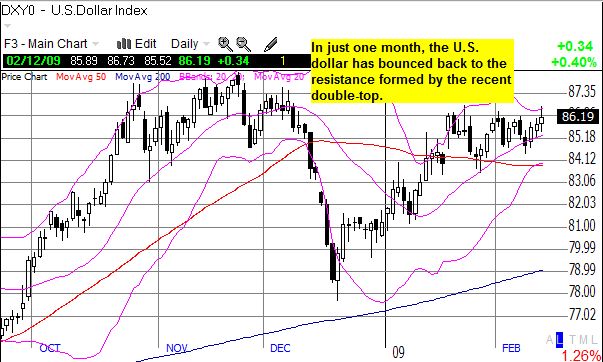
If you had told me late last year that we would soon see both the dollar and gold rally, I would have dismissed you as nuts. But this is exactly what happened after the dollar made a short-term bottom in mid-December. In early December, I suggested that the dollar had formed a double-top making it likely the dollar was headed lower. The dollar did sell-off, but it quickly rallied right back to the resistance formed by the double-top (click on chart to enlarge).
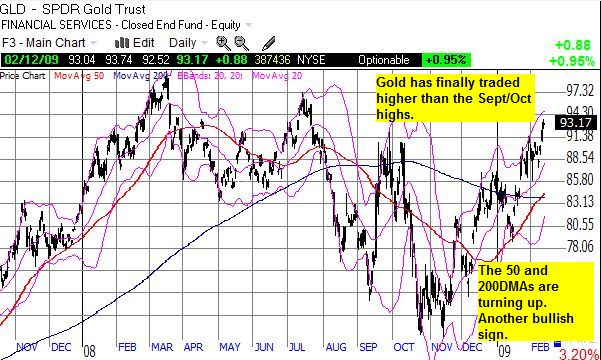
At the same time, gold has finally broken out of the pattern of lower lows and higher highs. It is now up almost 10% for the year. Last year, I said that gold would be my favorite place to be in 2009. So far, so good.
But we are only just getting started. It is nearly impossible to say when inflation will become a problem, only that it will likely be a problem once credit finally gets converted into investment and purchases again to take advantage of all the liquidity facilities being provided by the Federal Reserve. Some point out that Japan is an example where massive liquidity accomplished very little, and the same fate awaits the U.S. But from what I understand about the yen carry trade that took advantage of the low borrowing costs in Japan, Japan essentially EXPORTED inflation to the rest of the globe.
I am focused now on just two other commodity plays for core positions: silver (SLV) and copper (FCX as an approximate proxy). SLV is up 20% this year while Freeport McMoran (FCX) has chopped around in a trading range. Late last year, I was premature in making bets in the falling knives of commodities like copper and steel. I ended up with a lot of profit in puts, but not quite enough to eliminate the pains in the related stocks. I plan to pick my spots for steel very selectively and for shorter-term moves. So far this year, I have liked playing Cliff’s Natural Resources (CLF) and Nucor (NUE) after sell-offs. I thought I would include U.S. Steel (X
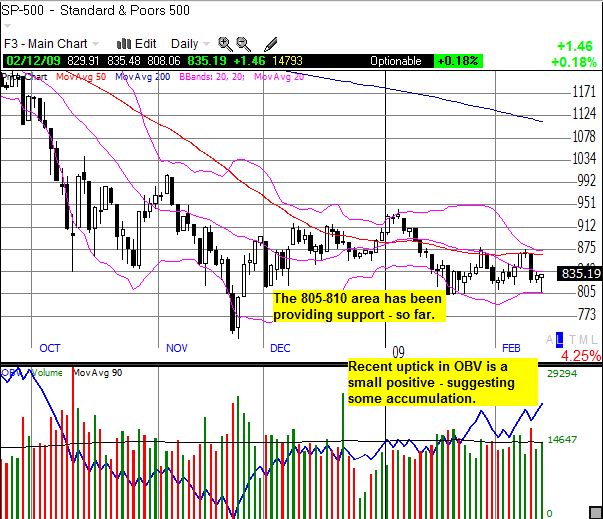
In the past month, we have had three separate high-volume selling events that have attempted to break the support that still holds from the “the December wash.” Each bounce from support seems to produce more hope that we are building a base for a sustainable bottom (click on chart to enlarge). There are also a good number of stocks that have hit fresh highs for the year just in the past week. But once it is clear that a modest recovery in the 2nd half of the year will not make its annually scheduled appearance, the major indices will be sold to fresh lows (I may have to make an exception for the NASDAQ which has proven particularly resilient so far in 2009). In the meantime, the stock market will continue to predict this imminent (soon to be elusive) recovery over and over and over again.
*All charts created using TeleChart
Be careful out there!
=================================
Gold: nothing succeeds like success – MineWeb
Source: MineWeb.com
Listed gold (and silver) stocks continue to deliver price increases at an astounding pace, underpinned by continually robust gold bullion prices.
Author: Barry Sergeant
Posted: Thursday , 12 Feb 2009
CAPE TOWN –
Listed gold stocks continue to lead the attempted recovery in global stock markets, supported on Wednesday by a dollar gold bullion price that moved to seven-month highs, above USD 945 an ounce. Measured on an absolute basis, the market value of gold stocks listed around the world moved to well above USD 200bn, the highest level seen since October 2008, a month after erstwhile Wall Street investment bank Lehman Bros. filed for bankruptcy, triggering yet another stage of the most intense crisis in world credit and equity markets seen in decades.
Seen as a commodity, gold bullion has surrendered the least of its record price, seen in March 2008, and currently trades just 9% below that record price of just short of USD 1,033 an ounce. The ongoing recovery of gold bullion prices -which have moved below USD 700 an ounce since making record highs – has underpinned a recovery in listed stock prices for companies representing the metal, from explorers to miners. The extent of the recovery has left the vast majority of other mining stocks (with the narrow exception of silver stocks), and stocks of any other kind, far behind. While the MSCI Barra dollar index for all global equities has moved 12% above its lows, seen late in 2008, and emerging market stocks have “bounced” up by 26% from lows, gold stocks, measured on the weighted average value of 250 listed names, have risen 128% from low points, seen just months ago.
The Tier II gold stock grouping, led by names such as JSC Polymetal, Centerra, and heavyweights such as Yamana and Agnico-Eagle, has risen by a fantastic 173% from low points, also within just a few months. Silver stocks have outperformed gold stocks as an overall group, with a weighted average increase of 147% from lows, led by the likes of Fresnillo, and Silver Standard.
Spot silver prices are trading 36% below record highs, also seen in March 2008, but listed silver stocks have long traded in sympathy with trends in gold stocks, tending, however, to overshoot on the rise and also on the fall. However, while the global market value of listed gold stocks runs at well above USD 200bn, silver stocks are worth well short of USD 20bn.The majority of silver is produced as a by-product at mines primarily focused on other metals.
Seen as a grouping, listed uranium stocks are also outperforming most mining stocks, with First Uranium among those names that continue to deliver exceptional price increases. Meanwhile, the SPDR Gold Shares exchange traded fund (ETF), a security that holds physical gold on behalf of its investors, continues to attract significant investor inflows. The security, the biggest gold bullion EFT in the world, currently holds nearly 900 tons of physical gold, valued at nearly USD 27bn. In line with the price performance of dollar gold bullion, the SPDR Gold Shares ETF is currently just 8% below its record highs.
| INDICES |
From |
From |
|
|
Points |
high* |
low* |
|
| MSCI world equities USD |
846.42 |
-46.0% |
11.5% |
| MSCI emerging markets USD |
561.38 |
-55.2% |
25.9% |
| S+P 500 |
828.08 |
-42.5% |
11.7% |
| DJ Stoxx 600 |
192.11 |
-42.3% |
7.9% |
| KBW banks |
27.41 |
-69.5% |
9.9% |
| STOCK |
Value |
From |
From |
| GROUPS |
USD bn |
high* |
low* |
| Dow Jones Industrial |
2598.66 |
-42.6% |
17.4% |
| Top 100 miners |
873.36 |
-63.4% |
78.7% |
| Oil stocks |
1998.86 |
-48.4% |
33.2% |
| S + P 500 Energy |
1039.73 |
-46.3% |
33.4% |
| Gold Tier I |
160.36 |
-44.4% |
117.2% |
| Gold Tier II |
41.58 |
-45.3% |
173.3% |
| Gold overall |
225.39 |
-46.7% |
127.7% |
| Silver stocks |
12.46 |
-63.0% |
147.4% |
| World banks (80) |
1713.03 |
-62.6% |
30.1% |
| Uranium stocks |
14.95 |
-58.0% |
81.8% |
| * 12-month | |||
| Source: market data; analysis by Barry Sergeant===================================================Catch the New Bull! – Buy Gold Online – Get 1 gram free! – Buy Safely, quickly, and at low prices, guaranteed! – Bullion Vault.com=======================================
Source: MineWeb.com
|
|||
Silver defies its fundamentals in maintaining a price ratio which relates to gold and the movement in this is taken by many silver investors as a guide to forward prices.
Author: Rhona O’Connell
Posted: Friday , 13 Feb 2009
LONDON –
Back in biblical times gold and silver prices were at parity although by the Roman era the ratio had widened to between 15 and 16. Silver backed major currencies right the way through to the nineteenth century although as economies evolved it tended to become the norm that silver was used for intra-national payments while gold was used for international transactions. India and China were among the last countries to remove the silver backing from their currencies, which is the reason why there have been substantial government sales of the metal from these two nations in particular although these sales have dwindled somewhat over the past two years or so. It is also the primary reason why the markets are uncertain as to the level of silver stocks, private or public, that lie in countries such as these.
Net government sales into the market reached a recent peak of 2,743 tonnes in 2003 (GFMS figures), but had halved by 2007 and it looks as if they halved again in 2008, with further reductions looking likely in the future, although since these sales currently comprise less than 5% of silver supply their further erosion is unlikely to make much of a difference to silver prices per se.
What has been making something of a difference recently is the rejuvenation of gold: silver ratio trading. Technical analysts have been looking favourably on silver since the start of the year and the gold: silver ratio has come increasingly onto the radar screens. Technically-driven trading of the ratio has also been important, with the ten-day and twenty-day moving averages defining the upper boundary of the ratio’s path. Once the ratio had severed support at 72 this trading gained considerable traction and within two days we were at 69, en route for a test of 67, the lowest since late September, when gold was at $740 and silver at just less than $11.
This time the activity in the market brought silver up to $13 while gold was easing from $920 to just below $900 and since then gold has taken up the reins to test $950 while silver has approached $14 then retreated towards $13.40. and the ratio has settled at around 70.
Obviously the ratio, of itself, does not drive markets. It is normally a result of the inter-related moves of both gold and silver, but every now and then it does have an impact on the metals’ prices – much more so on silver than on gold.
What has lain behind the changes in the ratio this time? Certainly not the silver market’s fundamentals in terms of marginal costs of production against the balance between industrial supply and demand (and this includes jewellery demand but not investor interest), which are not looking favourable. Silver may often be regarded as a precious metal by virtue of its historic connection with currencies and its lingering jewellery market but jewellery, silverware and coins+medals between them comprise less than 30% of silver demand as against more like 80% in the gold market); on a purely fundamental basis, therefore, silver belongs in the industrial camp.
Sentiment and perception are important market elements, however and silver’s long-standing relationship with gold is a vital influence on prices and investment activity. Essentially, because of silver’s intrinsically higher volatility than gold, some speculators and investors use exposure to silver as a means of gearing up their exposure to the latter. If gold is going up, silver typically goes up further, so a combination of the two is a stronger performer than gold on its own. This does not work for the whole time, obviously, but it is a well-entrenched mechanism and has been playing an important part in silver’s price performance over the past two months since the gold: silver ratio briefly exceeded 80.
This has been no more evident than in the exchange traded funds and the London ETC. When the gold:silver ratio reached its maximum in mid-December 2008, these funds harboured 7,661 tonnes of silver in their coffers. In the two months since then this has shot up to 8,734 tonnes, an increase of 1,073 tonnes and on annualised basis this is the equivalent of 6,096 tonnes per annum (196 million ounces) or almost 25% of global industrial demand. Over this period the silver price has increased by 21%, from just over $11 to just less than $13.40. Gold has risen by 13% and copper, 12% over the same period.
With this degree of uptake it is not surprising that silver has outshone gold recently and left copper some way behind. Although gold and copper have improved by similar amounts, silver’s correlation coefficient with gold over the period has been a healthy 90%, while that with copper, although still impressive, has been lower at 63%.
Speculative exposure on COMEX over the same period has also been increasing, although it is important to remember that this does not involve physical metal – but it can be very important in terms of price discovery. The net long speculative position rose from 3,849 tonnes on 9th December to 5,158 tonnes on 3rd February (latest available figures), with a goodly size of fresh longs entering the market, and only a small degree of short covering.
There is an old adage in the market that the gold:silver ratio only really counts in two places; the COMEX floor and the Indian market. In India it is by no means unusual for jewellery and investment holders to switch between gold and silver when they perceive that the prices are out of line. Certainly recently there has been a very healthy market in old gold scrap, but silver demand has remained slack in response both to high outright prices and the economic environment.
Silver’s outright fundamentals do not justify prices at these levels, but for as long as the market retains its bullish stance and investors keep coming for the metal then any industrial surplus this year stands a good chance of being absorbed and when investors like the look of gold, some of them will like the look of silver even more. This metal is, however, flying almost as high as Icarus and when that ratio starts to rise, then silver speculators had better be watching very closely.
=======================================
==================================
Will Big Money Interest Propel Gold over Its Final Hurdle? – Seeking Alpha
By: Andrew Mickey of Q1 Publishing
Gold Soars to Highest Since July.
A Wall Street Journal headline proclaims:
Gold is Flirting with $1,000, Again; ‘There’s No Sign of the Market Tiring.’
On Wednesday, gold surged another $30 an ounce, surpassing $930 and now, the mainstream media is getting on board in a big way.
We can spend all day debating whether this is the time gold runs back to $1,000 and beyond, or whether this is just another short-lived bounce which could run out of steam at any moment. Frankly, the exceptional volatility of the gold market has taught me that only time will tell.
What I can tell you is that there has recently been a change in gold – a dramatic change -at least the perception of gold. This change could set gold and gold stocks on a long march higher, yet, the mainstream media have completely glossed over it. Let me explain.
Gold Goes Big
You see, gold’s a funny thing. It elicits such an emotional response. Gold has had a pretty volatile year. In 2007, the yellow metal started attracting a lot of attention when it passed the highs set in the early 80s and has been up and down since, although lately, it has had more ups than downs. Despite all the recent attention, we’re right back where we were a year ago, when gold passed the $900 mark.
Whether you’re an all out “gold bug” who has been waiting a long time for this run, you question the value of gold because it has very little industrial use (ala Warren Buffett), or somewhere in between, you’ve got to take a look at what has happened to gold in the past few weeks.
But here’s the thing, this time around there’s interest from some very big money investors, as it is now considering gold to be a viable investment again. It’s not just the hyperactive, hot money hedge funds batting around gold anymore. Now pension funds, mutual funds, and other institutional investors are betting on gold – in a big way.
That is the big difference this time around. The big money interest hasn’t been there for decades, and it looks like that’s quickly starting to change.
Big Money Bets on Gold
Unprecedented sums of money have been pouring into gold in the past few months. While many funds are licking their wounds from the recent downturn and facing ongoing redemptions, some still have money. Those that do are at least putting some of it, into gold.
Just look at the recent money, which has been put into gold companies across the board. They’re all getting new cash. Major miners looking for extra cash to fund takeovers, exploration, and mine development, along with small gold companies looking for one more financing to put themselves into production, are all getting it. There’s money out there for gold.
For instance, Newmont Mining (NYSE:NEM) is expecting at least $1.7 billion (or more depending on the final terms of agreement) in new cash in its coffers. The cash infusion will come from the sale of stock and convertible notes. That’s billion – with a ‘B.’
Leading the charge in putting this financing together was Citigroup (C), J.P. Morgan (JPM), and the Bank of Montreal (BMO). They’re the big money, and except for BMO, they wouldn’t have given gold the time of day when private equity players were chasing after real estate, Chinese companies, and other “hot” sectors over the past few years.
Of course, it’s not just one big deal though. It’s lots of them. Industrials may be going under because they can’t get financing, but when it comes to gold companies, suddenly, there appears to be plenty of available money. Over the past few months, there have been a slew of financings of gold companies. Yamana (NYSE:AUY), Agnico-Eagle (NYSE:AEM), and Kinross Gold (NYSE:KGC), combined have attracted more than $800 million in new money.
Even gold companies, which were pretty much left for dead during the credit crunch are getting the cash they need. Shares of Osisko Mining [TSX:OSK] dropped well below $2 per share in November amid concerns the company wouldn’t be able to get the cash necessary to move forward with its prospective gold mine. Three months later, its shares are trading above C$4 after hitting highs of over C$5 per share, and it now has the money it needs. NovaGold (AMEX:NG) went through a similar ordeal. Its shares dropped all the way to $0.37 only to climb back to close at $3.52, on Wednesday.
These are just some of the bigger deals. We could highlight the dozens of smaller deals which are or are about to get some new capital, but you get the point. There’s big money backing gold now. In a way, the whole gold situation may have changed.
A “Frightening” Change
Two weeks ago Peter Munk, the Chairman of Barrick Gold (NYSE:ABX) – the world’s largest gold mining company – identified an “unpleasant and frightening” trend. In an interview with Bloomberg, Munk said:
He has received an increasing number of calls from wealthy investors looking for ways to buy bullion. While that is positive for the metal market, it is a “sad part of a civilized society.”
“That’s not where you want to be, it’s alarming. Do I personally believe gold will break through $1,000? It’s not a question of if; it’s a question of how soon.”
You’ve got to remember that Munk is the chairman and founder of a gold company, so he has a lot of experience in gold. He has access to the inner workings of the gold market, and benefits from rising gold prices, as well.
Despite the potential conflict of interest, he is definitely correct in saying that change has taken place.
What Really Matters About Gold
As long time Prosperity Dispatch readers know, I hate talking about gold. When it comes to gold, everyone has an opinion, and it’s usually a very strong one, as there’s very little middle ground when it comes to gold.
Just to be clear though, I’m not a gold bug. I’m not about to predict gold is going to $1,000 before it goes to $800, as there are just too many variables driving gold lately. I think a world with $200 gold is a much better place to live in than a world with $2,000 gold, but the recent big money push into gold could mark a significant change in the prospects for gold.
In the end, it all comes down to whatever the markets believe. Perception is reality, and a lot of money is betting gold will be perceived as more dearly down the road, whether deflation or inflation, wins out.
Over the past few months, deflation vs. inflation has been a popular subject of debate. While $60 trillion of wealth has been wiped out in this downturn, central banks are going all out to print enough new money to prevent the inevitable deflationary effects of the losses. And as we’ve noted before, all speculative bubble-booms end in deflation.
That doesn’t matter now. The current theory is gold will win either way – deflation or inflation, it doesn’t matter. Gold wins during inflation because it’s a store of value, and it wins in deflation as central banks debase their currency. As a result, there’s demand from both the inflation and deflation camps. In the end, the perception of value is what really matters for gold (and every other financial asset for that matter).
For decades, the big money refused to view gold as anything other than something horded by conspiracy theorists. The lack of big money interest was a huge hurdle for gold. Now, with the billions of dollars headed into gold from leading U.S. institutions, it appears the hurdle may have finally been passed.
Disclosure: None
===============================
===============================
ps- Gold is inching back now only down $7.00 to $942
Have a Great Weekend and Happy Valentines Day! – jschulmansr
================================
Even if the velocity of money takes forever and a day to build up to inflationary speeds, I strongly suspect that the Federal government will attempt to inflate its way out of its massive debt. When the bills come home for all the financial repair work being done in this country, there will be little appetite for increasing taxes enough to pay down this debt in any significant way. The economic multiplier from stimulus programs will also not provide sufficient tax revenues. America’s biggest and most cooperative foreign creditor, China, has probably just served us notice that they will not help us more than they already are helping
The fear of deflation and other assorted global economic calamities had everyone focused on taking shelter in U.S. Treasuries and the dollar. But as those fears slowly (very, very slowly) subside, more and more attention has turned to gold.
 Dare Something Worthy Today Too!