• Recommended Sites & Links
  • About

Dare Something Worthy Today Too!

~ FreeCryptoBitCoins, Cryptocurrency, BitCoin, Ethereum, BitCoin Cash, Ethereum Classic, LiteCoin, DogeCoin, Gold & Precious Metals, Investing & Investments, Stocks and Stock Markets, Financial Markets & Market Timing, Technical Analysis, Oil and Energy Markets, Hard Assets Investing, BlockChain, Airdrops, Earn Free Bitcoin…

Dare Something Worthy Today Too!

Category Archives: deflation

Why Oil and Gold Are Headed Much Higher

20 Monday Oct 2008

Posted by jschulmansr in commodities, deflation, Finance, gold, hard assets, inflation, Investing, investments, Latest News, Markets, oil, precious metals, silver, Uncategorized

≈ Comments Off on Why Oil and Gold Are Headed Much Higher

Tags

Austrian school, banking crisis, banks, bear market, bear stearns, bull market, central banks, commodities, deflation, depression, dollar denominated, dollar denominated investments, economic, economic trends, economy, financial, futures, futures markets, gold, gold miners, hard assets, heating oil, inflation, investments, market crash, Markets, mining companies, natural gas, oil, palladium, physical gold, platinum, platinum miners, precious metals, price, price manipulation, prices, producers, production, protection, recession, risk, run on banks, safety, silver, silver miners, sovereign, spot, spot price, stagflation, U.S. Dollar, volatility

Friday, October 17th, 2008

Oil is Headed for $150 a Barrel, Gold for $1,500 an Ounce, Merrill Analysts Predict

By William Patalon III
Executive Editor
Money Morning/The Money Map Report

Gold could reach $1,500 an ounce, since the worldwide plans to bail out the global financial industry are certain to fuel inflation, analysts led by Francisco Blanch at Merrill Lynch & Co. Inc. (MER) wrote in a research report.

The Merrill Lynch analysts also predicted that oil would reach $150 a barrel.

In the research note released earlier this week, the analysts said “the unintended consequence of the ongoing financial bailout will be inflationary pressures to the commodity markets.”

The analysts provided no timetable for their predictions.

The $700 billion U.S. bailout – plus the billions of dollars in capital infusions that have been put in place by governments and central banks all over the world – will be highly inflationary, analysts say. Historically, this type of move has been very bad for the U.S. dollar and highly bullish for oil prices.

“This is a very interesting projection,” said Money Morning Investment Director Keith Fitz-Gerald. “I have no idea what they’re basing their numbers on. But I certainly wouldn’t dismiss it based on everything I know about global trends, and my own proprietary calculations – which continue to suggest far higher prices for oil and hard assets than even Merrill is predicting.”

While Fitz-Gerald said that doesn’t mean there won’t be a continued near-term drop in gold and oil prices, he continues to believe the long-term outlook is for much-higher prices.

Currently, Fitz-Gerald has a multi-year target price of $225 a barrel for oil prices.

Typically, Fitz-Gerald says, analysts put a more-specific timetable on such predictions. But the unprecedented worldwide capital infusions that are part and parcel of the central banks’ bailout plans are dramatically skewing what are normally relatively predictable calculations, he said.

Since peaking at an all-time record of $1,032 an ounce on St. Patrick’s Day, gold has seen its price skid about 19%. Gold futures tumbled more than 4% yesterday (Thursday) to their lowest level in a month, as nervous investors sold futures contracts to raise cash, Marketwatch reported. Gold for December delivery fell $34.50, or 4.1%, to end at $804.50 an ounce on the Comex division of the New York Mercantile Exchange (CME), the lowest closing level since Sept. 17. Earlier, it had fallen more than 5% to $791 an ounce.

Some hedge funds were forced to liquidate their positions to cover losses in stocks and other markets, economists at research firm Action Economics told MarketWatch.

“For the moment, the weight of the deep funk felt in the global markets is keeping gold on the defensive, while would-be buyers … find more comfort sitting on the piles of cash,” Jon Nadler, a senior analyst at Kitco Bullion Dealers, told the financial news service.

Crude oil fell below $70 a barrel, reaching its lowest level since June 2007, and gasoline prices tumbled after a U.S. Department of Energy report showed that stockpiles advanced twice as much as forecast, Bloomberg News reported.

Crude oil for November delivery fell $4.37 a barrel, or 5.9%, to reach $70.17 a barrel, at midday yesterday on the NYMEX. The “black gold” fell as low as $68.57 a barrel, the lowest since June 27 of last year. Prices are down 20% from a year ago. Crude oil peaked at $147.27 on July 11.

Oil prices also dropped on doubts that the bank rescue plan will bolster global economic growth – and with it, fuel use. The Organization of the Petroleum Exporting Countries (OPEC) moved the meeting it had planned for November up to Oct. 24 after the oil-price decline.

“The DOE numbers just added to the downward pressure on the oil market,” Brad Samples, a commodity analyst for Summit Energy Inc. in Louisville, K.Y., told Bloomberg. “The weak economy is translating into rising inventories because nobody wants to burn the stuff.”

Money Morning Contributing Editor Martin Hutchinson – who last October correctly predicted that gold would make a run for record highs – this spring said that gold could reach $1,500 an ounce. At the time, Hutchinson listed three factors, one of which – related to the bailout plans – has moved front and center:

  • Monetary policy: More than for any other investment, gold’s price depends primarily on the world’s monetary policy. When monetary policy is loose, as it was in the 1970s, gold prices soar. When it is tight, as in the 1980s, prices decline sharply. With the global bailout in place, monetary policy is about as loose as it’s ever been.
  • Global Supply and Demand: For most commodities, price rises have an effect on supply and demand; a higher price increases supply and reduces demand, in “price elasticity.” With oil, for example, a 10% rise in price reduces demand by about 1% to 1.5%, meaning that oil has a price elasticity of 0.1 to 0.15.  But oil is priced in dollars, and when the dollar drops, OPEC tends to boost oil prices to keep its revenue steady. The flood of dollars the global bailout plans are going to send washing through the financial system won’t be good for the greenback – meaning the dollar-based price of oil can only go higher. That will more than offset any decline in demand in the near term; in the long run, growing economies in such markets as China, India and other emergent markets will create millions of new consumers who will demand luxuries ranging from jewelry to automobiles.

The upshot: Global demand for oil and gold will escalate – as will their prices.

  • Comparison with past peaks: If gold had increased in price since 1997 by the same percentage as world dollar reserves, it would currently be trading at around $1,280 per ounce, Hutchinson says. And the current speculative appeal of gold, compared to its inactivity 10 years ago, suggests it could go higher than this: The 1980 gold price peak of $875 per ounce intraday is equivalent to more than $2,200 per ounce when inflation is taken into account, he said recently.

Commenting on Merrill Lynch’s gold-and-oil predictions, Dividend.com analysts Tom Reese and Paul Rubillo, this week wrote that “we think the Merrill call is based on solid reasoning, but we’ll wait and see if the market agrees. So far during the meltdown, gold has shown flashes of running but has not broken out.”

They said that the “obvious trade on paper [which isn’t] so obvious to the market at this point” is Newmont Mining Corp. (NEM), which is “sitting just above a 52-week low.” Newmont’s shares, which closed yesterday at $28.85 each, have traded between $27.25 and $57.55 in the last 12 months.


Share this:

  • Click to share on Reddit (Opens in new window) Reddit
  • Click to share on Facebook (Opens in new window) Facebook
  • Click to share on LinkedIn (Opens in new window) LinkedIn
  • More
  • Click to share on X (Opens in new window) X
  • Click to share on Pinterest (Opens in new window) Pinterest
  • Click to share on Tumblr (Opens in new window) Tumblr
  • Click to print (Opens in new window) Print
  • Click to email a link to a friend (Opens in new window) Email
Like Loading...

Silver Could Explode, Says Analyst

20 Monday Oct 2008

Posted by jschulmansr in commodities, deflation, Finance, gold, hard assets, inflation, Investing, investments, Latest News, Markets, oil, precious metals, silver, Uncategorized

≈ Comments Off on Silver Could Explode, Says Analyst

Tags

Austrian school, banking crisis, banks, bear market, bear stearns, bull market, central banks, commodities, deflation, depression, dollar denominated, dollar denominated investments, economic, economic trends, economy, financial, futures, futures markets, gold, gold miners, hard assets, heating oil, inflation, investments, market crash, Markets, mining companies, natural gas, oil, palladium, physical gold, platinum, platinum miners, precious metals, price, price manipulation, prices, producers, production, protection, recession, risk, run on banks, safety, silver, silver miners, sovereign, spot, spot price, stagflation, U.S. Dollar, volatility

SILVER COULD EXPLODE, SAYS ANALYST                          

Hard Assets Investor

By Ted Butler (Butler Research)

Ted Butler is one of the better-known silver analysts (and longtime silver bulls) in the world. The founder of Butler Research, a monthly publication focused on precious metals, Butler has been pounding the table on silver since way back when it was trading for $4/ounce.

For many years now, Butler has been among a vocal cadre of silver bulls who have argued that a select number of Wall Street banks were deliberately manipulating the silver market.

In September, the Commodities Futures Trading Commission confirmed it was formally investigating these accusations. It had previously examined the case, and in May, published a report suggesting that there was not manipulation in the market, and that banks taking short positions were simply acting as legitimate market makers. This summer, however, CFTC data showed that two U.S. banks boosted their short positions in silver futures by 450%, controlling 25% of the open interest, according to The Wall Street Journal. That led to new accusations from the silver bulls, and the SEC agreed to reopen the investigation.

Interestingly, the investigation has shifted from the oversight division to the enforcement division of the CFTC. According to the Journal: “The oversight division performs overall market surveillance. The enforcement division looks at activities in a specific time period.”

Butler wrote about the CFTC investigation in late September; that analysis is printed below. He also spoke briefly with HardAssetsInvestor.com about the latest developments in the silver space.

The editors at HardAssetsInvestor.com don’t necessarily agree with Butler’s views. However, it’s a real theme and discussion in the marketplace, and is worth airing publicly.

Interview With Ted Butler

HardAssetsInvestor.com (HAI): What does the CFTC’s investigation mean for silver?

Ted Butler, Butler Research (Butler): That we’ll only know in time. It should mean, at a minimum, that they think the allegations are credible enough to warrant them looking at it again. I suppose if they thought the allegations were baseless, they would say so and dismiss the subject.

HAI: What’s the likelihood that they’ll take real action in the market?

Butler: That’s anyone’s guess. But if my allegations are accurate, as I believe them to be, the question of them taking action becomes moot. That’s because if the silver retail shortage keeps growing and morphs into a wholesale shortage, the market itself will do what the CFTC has refused to do. Any downward manipulation must, inevitably, end in a shortage. I think they may recognize this.

HAI: What exactly are they looking at?

Butler: That, you will have to ask them, but if they are not looking at the one or two U.S. banks that sold short the equivalent of 20% of the world’s annual production of silver, they are not looking at the right thing.

HAI: Why do you think they finally decided to investigate this situation?

Butler: Because the evidence was clear in the August Bank Participation Report, which I disclosed in my “Smoking Gun” article, that it should be impossible not to see the manipulation.

HAI: What is your overall take on the silver market right now?

Butler: It is structured to explode in price, especially after the recent decline to $12 an ounce.

HAI: Should investors allocate to silver over the next year or two?

Butler: They should allocate now, without delay.

—Butler Research Article from 9/29/08, Reprinted With Permission—

It’s hard to imagine now, but there were times when I worried about having anything fresh to write about silver. Lately it has been choosing from many different topics. This week, the choice was easy. Amid the continuing swirl of major financial crises, one issue rose to the top.

On Thursday, September 25, The Wall Street Journal carried an article announcing that the Commodity Futures Trading Commission (CFTC) had opened a new investigation into allegations of manipulation in the silver market.

Furthermore, on that same day, Commissioner Bart Chilton e-mailed a copy of the Journal story, along with his own comments confirming the investigation, to those who wrote to him about the issue. Both the article and Chilton’s e-mail made special note that the silver investigation was being conducted by the Division of Enforcement, and not the Division of Market Oversight, which had previously investigated the silver market. In simple terms, Enforcement is the muscle.

Whether an entire market, like silver (or gold), is manipulated or not is a matter of utmost importance. In fact, nothing could possibly be more important. Market manipulation is a violation of law and a serious crime. Market manipulation damages everyone in the long run.

Because market manipulation is the number one priority of the CFTC, any revelation that they might be investigating a manipulation in any commodity is big news. So big, in fact, that such investigations are almost always kept strictly confidential while the facts are determined. This is usually so as not to disturb the market. That the CFTC has chosen to openly reveal this silver investigation is almost unprecedented.

Moreover, what makes this silver investigation a rare event is that the allegations are of a manipulation in progress. To my knowledge, all past investigations were revealed after the manipulation itself was concluded. Not only is it rare for the CFTC (or any government agency) to reveal a serious active investigation, it is unheard of to reveal an investigation of a potential crime in progress. If a regulator suspects a crime in progress you would assume the regulator would first end the suspected crime and then finish the investigation. If the regulator didn’t think there was a sufficient evidence of an ongoing crime, then why reveal that an investigation has been opened?

I think this is why there is universal expectation (including by me) that the silver investigation will be a whitewash. I know that silver is manipulated, and I’m glad to see the CFTC investigate. But I can’t help but feel suspicious of their objectivity, because they have adamantly denied such a manipulation for more than 20 years. How can they conduct a fair investigation and not be influenced by their past findings? I have been here and done this many times, and I don’t feel like getting fooled again.

EXPLANATION, NOT INVESTIGATION

Why the CFTC is investigating a silver manipulation is somewhat of a mystery to me. I certainly didn’t ask for an investigation. I did ask you to ask for them to explain the data in their August Bank Participation Report, in my “Smoking Gun” article. This is the report that is directly responsible for the investigation. This is the report at the heart of the matter. But there is a difference between explanation and investigation.

When I first uncovered the data in this report, a little more than a month ago, I couldn’t believe my eyes. I had studied the data in previous Bank Participation Reports for years, but that’s because I’m a silver data junkie. This is usually a nothing report. In all the years I studied this data, it seemed like a waste of time. It was an obscure report that I never heard anyone ever refer to before. But the data in the August report was so disturbing that, in order to make sure I wasn’t imagining things, I asked two trusted associates, Izzy Friedman and Carl Loeb, to review the data with no advance suggestion from me as to its meaning. I wanted their unvarnished opinion.

When they confirmed that this was the clearest case of manipulation possible, I faced a new dilemma. I was inclined to believe that the data was in error. I suspected the CFTC would retract the data. So I was worried about being publicly embarrassed for making a big deal out of what may have been a clerical error. But the more I matched this data against the weekly Commitment of Traders Report (COT) data, I could see the data was accurate. Certainly, if the data was incorrect, the CFTC would have said so by now.

The data is clear – one or two U.S. banks sold short the equivalent of 140 million ounces of silver in one month. That’s more than 20% of world annual mine production. Less than three U.S, banks sold more than 10% of world annual mine production of gold simultaneously. The price of silver and gold then collapsed by an historic amount. These same banks have used the sell-off as an opportunity to buy back as many of their short positions at a giant profit. Those are the facts.

It is important to put these numbers into perspective, in order to appreciate their significance. One way to do that is by comparing what just took place in silver to other commodities. If one or two U.S. banks sold short, in a period of one month, the equivalent of 20% of world annual production of corn, that would equal one million futures contracts. (25 billion bushels x 20% divided by 5000 bushels). Since the entire open interest in corn futures is one million contracts, a sudden short sale of that amount would crush the price.

If one or two U.S. banks sold short 20% of the world annual production of crude oil, that would be the equivalent of 6 million NYMEX futures contracts. (30 billion barrels x 20% divided by 1000 barrels). Since the entire open interest on the NYMEX is around 1 million contracts, a sudden sale of 6 times that amount would drive the price of oil to ten cents a barrel. It would also be market manipulation beyond question.

The CFTC doesn’t need to investigate. They only need to explain why their own data fails to prove manipulation in silver and gold. Save the taxpayer some money and all of us some time. This needn’t take days, weeks, or months. This should take, literally, minutes. Why maintain and publish the data in the Bank Participation Reports if the CFTC won’t recognize an obvious manipulation that is a crime in progress.

THE COTs

The latest COTs confirmed the one thing I was hoping and expecting them to confirm, namely, that the biggest shorts continued to cover their short positions in gold and silver. What makes their short covering most noteworthy is that the buybacks in the most recent report occurred on a sharp rise in price, some $3 in silver and $120 in gold for the reporting week. This tells me that the big short, the U.S. bank(s), is serious about getting out of as much of its massive silver short position as it can.

From the time of the August Bank Participation Report, the big shorts have now covered nearly all of the gold short position put on during July. Therefore, the manipulation in gold was a complete success. In silver, while the manipulation must be considered a success, because the big short has covered an impressive amount, it has not covered all of its manipulative short position. In looking at the structure of the COTs, it does not appear to me that much further liquidation can occur to the downside. To say that the COTs are structured bullishly, would be a gross understatement.

IMAGINE

My mentor, Izzy Friedman, recently asked me to turn the clock back to a year ago, and then try to imagine that we would have a severe retail silver shortage. A shortage that now seems to be spreading to gold. It’s a powerful and profound thought process.

This silver retail shortage is completely underappreciated. I don’t think there could be more clear proof that silver has been manipulated in price. The talk that it’s “only” a retail shortage and not a wholesale shortage is silly. The silver retail shortage is so widespread in scope, it’s only a matter of time before it spreads to the wholesale sector. That’s especially true considering the record inflows into the silver ETFs. When the wholesale silver shortage hits, it will make a mockery of any CFTC investigation into manipulation.

The reason I believe the retail shortage is not truly appreciated is because of the boiling frog syndrome. Put a frog into a pot of cold water and increase the heat gradually to a boil and he won’t jump out. Because the silver retail shortage has been so persistent and gradual for the past year, we have grown accustomed to it. Most dealers have little to sell. Nowadays, it’s news when a dealer gets in a supply of silver, which is invariably sold out quickly. Guess what? That’s not normal, and just because it has been a gradual development doesn’t make it normal.

In fact, the growing and persistent physical silver shortage promises to be with us for a long time. Look around at the financial world. Do you see anything better to hold than real silver? Can you imagine owners of real silver rushing to dump their metal at depressed prices. To do what with the proceeds? Rush to put them in a failing bank?

It pains me to see so much financial peril around. Regular readers know I prefer supply/demand considerations and analysis of market structure. I’ve always considered the flight to quality aspect of silver as a bonus. But I see signs of that flight to quality in the current physical shortage. I don’t think that is going away any time soon. How many reasons does one need to load the boat with silver?

Digg – Silver Could Explode, Says Analyst

Share this:

  • Click to share on Reddit (Opens in new window) Reddit
  • Click to share on Facebook (Opens in new window) Facebook
  • Click to share on LinkedIn (Opens in new window) LinkedIn
  • More
  • Click to share on X (Opens in new window) X
  • Click to share on Pinterest (Opens in new window) Pinterest
  • Click to share on Tumblr (Opens in new window) Tumblr
  • Click to print (Opens in new window) Print
  • Click to email a link to a friend (Opens in new window) Email
Like Loading...

Gold: Beware the Bucking Bull

20 Monday Oct 2008

Posted by jschulmansr in commodities, deflation, Finance, hard assets, inflation, Investing, investments, Latest News, Markets, oil, precious metals

≈ Comments Off on Gold: Beware the Bucking Bull

Tags

Austrian school, banking crisis, banks, bear market, bear stearns, bull market, central banks, commodities, deflation, depression, dollar denominated, dollar denominated investments, economic, economic trends, economy, financial, futures, futures markets, gold, gold miners, hard assets, heating oil, inflation, investments, market crash, Markets, mining companies, natural gas, oil, palladium, physical gold, platinum, platinum miners, precious metals, price, price manipulation, prices, producers, production, protection, recession, risk, run on banks, safety, silver, silver miners, sovereign, spot, spot price, stagflation, U.S. Dollar, volatility

GOLD: BEWARE THE BUCKING BULL

By: Fat Prophets

In our most recent report on gold we recommended accumulating some of the larger gold miners (Newcrest Mining (NCMGY.PK), LGL Group, Newmont Mining (NEM)). Big gold producers are incredibly cheap and given the weakness in the Aussie dollar (and rising Aussie dollar gold price) and pullback in energy prices, profitability should begin improving while most other companies’ margins will come under pressure.

However, recent developments in the gold market point to the potential for near term volatility that Members should be aware of.

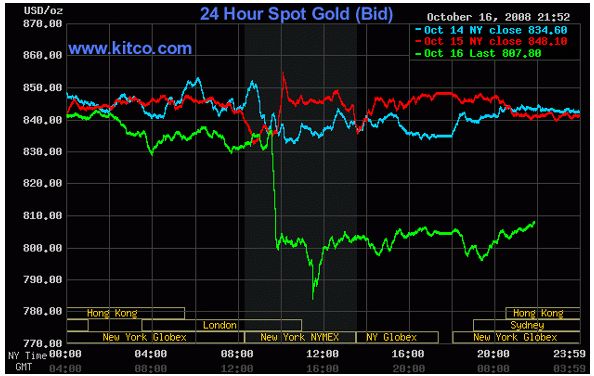
The short term outlook for gold appeared positive while the yellow metal was trading above US$820 an ounce. However, in New York trading on Thursday, gold was hit with a wave of short term selling.

The green line in the chart below shows that gold plummeted just after the New York trading session began, falling nearly US$40 in a very short space of time. More selling pressure emerged soon after but in early Asian trade Friday, gold has recovered some of its gains.

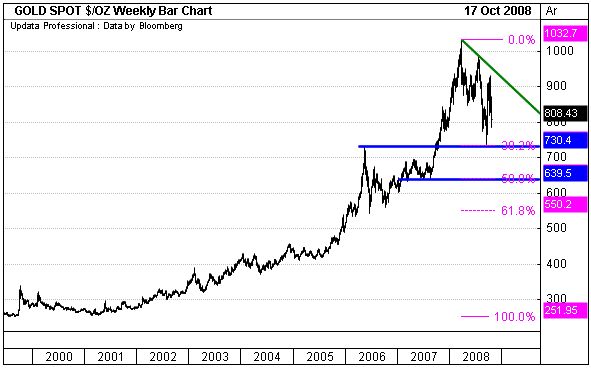
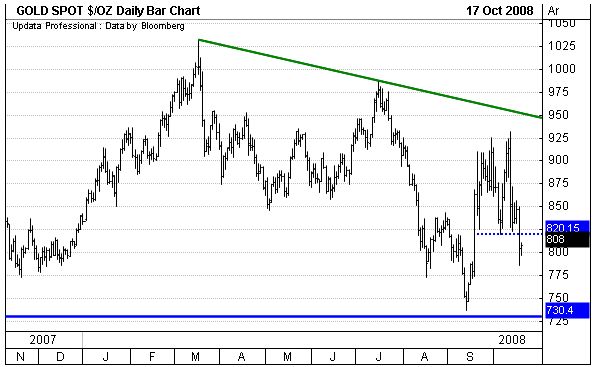
From a purely technical perspective, the break below US$820 indicates the likelihood of near term weakness. It shifts the focus back to the US$735/US$734 support region and away from the potential for a push above $931.84.

The $820 to $860 region now becomes resistance. While prices remain below this region, the risk is that prices will break below $734 and retreat toward the $650/$640 region. This marks the 50% retracement of the entire 1999-2008 advance, plus the next major price support/congestion region on the charts, shown below.

However, such a move is only a possibility, and should prices once again move into the US$820/US$860 region, the near term outlook would improve again.

We remain committed long term bulls on gold. The stimulus being thrown at the global economy is unprecedented and has not yet even begun to work its way through the financial system. The Fed’s program to purchase commercial paper does not get underway until 27 October. The transmission of this money through the system will take some time.

The Fed’s balance sheet expanded another $245 billion last week to $1.7 trillion. Its important to note that the Fed has not sterilised any of the cash injections it has made in the last month or so. Credit had jumped from $880 billion to $1.7 trillion and none of the Fed’s holdings of Treasury securities have been sold to offset the cash injection. Instead, poor quality assets have been added to the balance sheet.

But in the short term gold can do anything, as we witnessed recently when the yellow metal plummeted below US$750, only to reverse that move a few weeks later with an $80 single surge to the upside.

So Members riding the bull should prepare for more short term volatility. Any cowboy will tell you that riding the bull for the full 8 seconds is a very difficult task. This bull market will be no different, but if we’re prepared, we can tighten our grip.

Share this:

  • Click to share on Reddit (Opens in new window) Reddit
  • Click to share on Facebook (Opens in new window) Facebook
  • Click to share on LinkedIn (Opens in new window) LinkedIn
  • More
  • Click to share on X (Opens in new window) X
  • Click to share on Pinterest (Opens in new window) Pinterest
  • Click to share on Tumblr (Opens in new window) Tumblr
  • Click to print (Opens in new window) Print
  • Click to email a link to a friend (Opens in new window) Email
Like Loading...
Newer posts →

Authors

  • jschulmansr's avatar jschulmansr
    • Free Crypto!
    • Free Crypto Currency
    • This is Blessed!
    • Trump Rally Charleston
    • Trump Rally Charleston

Blog at WordPress.com.

Privacy & Cookies: This site uses cookies. By continuing to use this website, you agree to their use.
To find out more, including how to control cookies, see here: Cookie Policy
  • Subscribe Subscribed
    • Dare Something Worthy Today Too!
    • Already have a WordPress.com account? Log in now.
    • Dare Something Worthy Today Too!
    • Subscribe Subscribed
    • Sign up
    • Log in
    • Report this content
    • View site in Reader
    • Manage subscriptions
    • Collapse this bar
%d