• Recommended Sites & Links
  • About

Dare Something Worthy Today Too!

~ FreeCryptoBitCoins, Cryptocurrency, BitCoin, Ethereum, BitCoin Cash, Ethereum Classic, LiteCoin, DogeCoin, Gold & Precious Metals, Investing & Investments, Stocks and Stock Markets, Financial Markets & Market Timing, Technical Analysis, Oil and Energy Markets, Hard Assets Investing, BlockChain, Airdrops, Earn Free Bitcoin…

Dare Something Worthy Today Too!

Category Archives: federal reserve

Can You Sense It? The Calm Before The Storm

03 Tuesday Feb 2009

Posted by jschulmansr in 10 year Treasuries, 20 yr Treasuries, Bailout News, banking crisis, banks, bear market, capitalism, China, Comex, Credit Default, Currencies, Currency and Currencies, deflation, depression, dollar denominated, dollar denominated investments, economic, Economic Recovery, economic trends, economy, Fed Fund Rate, Federal Deficit, federal reserve, Finance, financial, Forex, Fundamental Analysis, futures, futures markets, gold, Gold Bullion, Gold Investments, gold miners, hard assets, How To Invest, How To Make Money, hyper-inflation, India, inflation, Investing, investments, Junior Gold Miners, Latest News, Make Money Investing, market crash, Markets, mining companies, mining stocks, oil, palladium, physical gold, platinum, platinum miners, precious metals, price, price manipulation, prices, producers, production, protection, recession, run on banks, Saudi Arabia, Short Bonds, silver, silver miners, small caps, spot, spot price, stagflation, Stimulus, Stocks, TARP, The Fed, Today, U.S. Dollar, Uncategorized

≈ 2 Comments

Tags

agricultural commodities, alternate energy, Austrian school, Bailout News, banking crisis, banks, bear market, Bollinger Bands, bull market, capitalism, central banks, China, Comex, commodities, communism, Copper, Currencies, currency, deflation, Dennis Gartman, depression, diamonds, dollar denominated, dollar denominated investments, economic, economic trends, economy, Federal Deficit, financial, Forex, futures, futures markets, gold, gold miners, hard assets, heating oil, India, inflation, investments, Keith Fitz-Gerald, Marc Faber, Mark Hulbert, market crash, Markets, mining companies, Moving Averages, natural gas, oil, palladium, Peter Brimelow, Peter Schiff, physical gold, platinum, platinum miners, precious metals, price, price manipulation, prices, producers, production, protection, rare earth metals, recession, risk, run on banks, safety, Saudi Arabia, Sean Rakhimov, silver, silver miners, socialism, sovereign, spot, spot price, stagflation, Technical Analysis, timber, U.S. Dollar, volatility, warrants, Water

Can you sense it? There seems to be an eerie calm in all of the markets. Could this be the calm before the coming financial storm round 2? Since Gold is considered a safe haven investment in times of financial uncertainty, it would seem to tell us something is about to break wide open. As I enter this post Gold is up $5 oz to $912.50. We saw some retracement yesterday but support levels at $900 oz held. It appears that prices are taking a breather. This comes after an approximate $95 dollar an oz rise in just the past 14 days! As I mentioned in my post from a few days ago It’s Official Gold is in a new Bull Market. 

Quick sample of some recent headlines:

  • The Associated Press writes, “Gold Prices Soar as Investors Flee Wall Street.”

  • The Bullion Vault claims, “Gold Prices Poised to Move Higher.”

  • Forbes observes, “Gold Prices Resume Long-Term Uptrend

  • So What’s next? Read on…-Good Investing! -jschulmansr 

    ==================================

    Catch the New Bull! – Buy Gold Online – Safely, quickly, and at low prices, guaranteed! Bullion Vault.com

    ======================================

    Gold Prices Could Hit $1500, fears Merrill Lynch CIO- Business 24/7

    By: Shashank Shekhar of Business 24/7


    Gold prices may hit $1,500 (Dh5,509) an ounce in the next 12 to 15 months, Gary Dugan, the Chief Investment Officer (CIO) of Merrill Lynch, said yesterday.

    Dugan termed his apprehensions of gold striking such a high as a “fear” that may come true. He reasoned that such a price would mean the other commodities and streams of investments have been shunned by investors.

    With confidence in currencies shaken to the core, the yellow metal is increasingly assuming the role of “the most trusted currency”, Dugan said. “We have never seen such a rush to buy gold. It’s bringing in security and it’s still affordable.”

    Merrill Lynch commodity price forecast authored by Dugan showed that gold prices can rise from the currently prevailing $913/oz to $1,100/oz in the first quarter of 2009 and to $1,150/oz in the second quarter. “While demand for gold has been rising production has been declining. South Africa, which accounts for the major share of global gold production, is facing political issues and has energy problems,” Dugan said.

    With reports of declining returns from other investment options, “cash” – keeping money safe in banks and investing in government bonds – is the option in front of investors, Dugan said.

    “Fear” and eventual decline of the greenback are the two factors that will drive gold prices, he said. While commodity markets could also bounce back in the first half of the year, a rebound is likely to be short-lived in the absence of strong US consumer demand.

    Precious metals, led by gold, could enjoy a more sustained rally with gold benefiting from a weakening of the dollar in the second half of the year, Dugan said.

    Dugan said the greenback, which has been strengthening for the past few months, will decline in value by the middle of this year. “That’s when people will begin to realise that President Obama’s policies are not having the desired impact,” he said.

    Investors could also look to private equity, which produced strong returns during the downturns in 1991 and 2001, on an opportunistic basis. Some hedge fund strategies may be worth following but hedge funds should be treated with caution, Dugan said.

    Returns from private equity should remain in single digits in 2009 and a return of beyond 10 per cent should be treated as “fair value”, he said. “Investors should remain cautious. They need to be prepared to take profits. We think any such rally would run out of steam by the second half of the year.”

    Low risk assets could offer private investors the best prospects of attractive returns in 2009 as the world’s leading industrialised nations face recession, Dugan said. With governments around the world striving to tackle the economic crisis, private investors could find value in a cautious approach towards asset allocation. Options include high-grade corporate bonds and high-quality, high-yielding equities in defensive industries.

    “Investors will look to long-term US government bonds as an important barometer of the progress of global recovery,” said Dugan. “Sharply rising bond yields will show that the governments have overspent.”

    While earnings downgrades are likely to dominate the first quarter of 2009, a rally in global equity markets could be on the cards for the first half of the year with consumer and cyclical stocks among the potential beneficiaries, Dugan said.

    Broad equities indices could also offer trading opportunities to private investors. “Equities could outperform as an asset class in 2009 unless there is a serious deflation risk. Our view is that deflation will be avoided,” he added.

    Selective investment in high-grade corporate bonds could also provide attractive returns, Dugan said.

    ==================================

    Catch the New Bull! – Buy Gold Online – Safely, quickly, and at low prices, guaranteed! Bullion Vault.com

    ==================================

    Is a New Cyclical Bull Market on It’s Way? – Seeking Alpha

    By: Simit Patel of Informed Trades.com

     Puru Saxena of Money Matters recently wrote an article entitled ‘Birth of a New Cyclical Bull?‘ in which he offers arguments for why we may see 2009 be a bullish year for equities. His basic points:

     Inflationary actions by the Fed and a declining TED Spread have proven effective in fighting falling asset prices and reducing risk

    • Treasury bonds need to have higher yields or money will go into equities
    • Equities have “overshot” to the downside, thus resulting in excessively low valuations

    I agree with Saxena’s basic premise that the Fed’s actions will be successful in creating inflation in the aggregate; it is only a matter of which asset class will reap the benefits of that inflation, and who will pay for it. The chart below compares various asset classes against one another for the month of January.

    click to enlarge
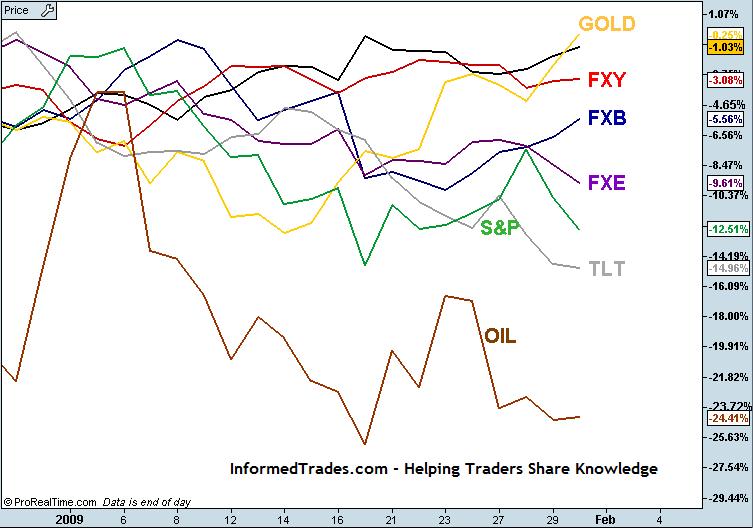
    A key question we may wish to begin asking and examining is just how much inflation the Fed has really created for us, something that will become more apparent as lending resumes and money that is “on the sidelines” returns to the game. I’m of the viewpoint that the global economy is currently improperly structured, and needs a complete restructuring, one that will likely require abandonment of the US dollar as world reserve currency, a corresponding decline in US consumption, and a significant restructuring of the FIRE (finance, insurance, real estate) economy in the United States.

    From that perspective, an equities rally will be unsustainable, unless there is currency debasement to the extent that all markets rise nominally. If that is the case, though, the inflation will result in significant dollar devaluation.

    Trading Implications: The fall in Treasuries was the story for January, and will be of importance so long as it continues. If money comes out of Treasuries and into equities and commodities, it increases the likelihood of seeing consumer price inflation. As I’ve stated before, though, I expect commodities to outperform equities once money comes out of Treasuries and dollar devaluation resumes. And as all currencies around the world are having trouble, gold will rise as fiat currencies continue to struggle.

    Disclosure: Long gold.

    ================================

     Catch the New Bull! – Buy Gold Online – Safely, quickly, and at low prices, guaranteed! Bullion Vault.com

    ===============================

    U.S. Debt Default, Dollar Collapse Altogether Likely – Seeking Alpha

    By: James West of Midas Letter

    The prospect of the United States defaulting on its debt is not just likely. It’s inevitable, and imminent.


    The regulatory black holes into which sanity and reason disappear on a daily basis are soon to collapse under the mass of their sheer size. The circle jerk going on among G7 governments has to end – the steady advance of gold, even in the face of a managed price, exposes the real value of the U.S. dollar, as opposed to its apparent value expressed in the dollar index.

    Is 2009 the year that the United States formally defaults? And with that, will the dollar collapse be rolled back ten for one or more?

    There are a lot of reasons to support that theory. To Wall Street economists, such an event is heresy and therefore unthinkable. Yet Wall Street is the very La-la-land that bred the idea of a perpetually indebted nation in the first place.

    Number one among the indicators favoring this scenario is what is happening in the U.S. Treasuries auction market.

    Last Thursday, an $30 billion auction in five-year notes failed to stir the interest of traditional primary dealers. The auction itself was saved by an anonymous “indirect” bid.

    Buyers are discouraged by the prospect of what is expected to amount to $2 trillion total issuance for the full year of 2009. The further out the maturities on notes, the more bearish the sentiment towards them. The only way to entice buyers is through the increase in yields.

    But with yields at 1.82 per cent, five-year notes were met with a demand for 1.98 times the amount offered – the lowest bid-to-cover ratio since September. A sell-off in treasuries began in earnest upon the conclusion of that auction.

    The U.S. Federal Reserve suggested last week that it was going to step up its treasury-buying activity, and the mainstream media interprets this as a form of market support. What it actually is evidence of growing anxiety and desperation on the part of the Fed as the realization dawns that demand for treasuries is progressively evaporating.

    The increased demand for gold as an investment witnessed throughout the last two weeks that has pushed gold to a 4 month high is further evidence that investors across the board are gravitating more towards gold and away from U.S. debt.

    So what is the catalyzing event that will precipitate outright capitulation?

    I think the spin-controlled version of events will make the collapse of the derivatives market the red herring that facilitates the aw-shucks-we-have-no-choice shoe-gazing moment possible, and that’s exactly the parachute the government needs to retain a veneer of credibility – at least in its own delusional mirror.

    The announcement that the CFTC was about to become the target of a regulatory overhaul supports this theory. Consistent with his unfortunate proclivity to hiring foxes to guard chickens, Barack Obama’s choice for CFTC commissioner Gary Gensler was the undersecretary of the U.S. Treasury when the Commodity Futures Modernization Act of 2000 was passed, and is one of its architects. This was the piece of legislation that was put forth to appease the opposition to “dark market” trading in certain OTC derivatives first noisily derided by CFTC commissioner Brooksley Born in 1998.

    Ignoring Born’s admonishments with this act, it exempted credit default swaps (CDO’s) from regulation, resulting in the somewhere between 58 and 300 trillion dollars in value presently under threat if the positions were to be unwound. Because of their unregulated status, counterparties in the largest transactions can simply “roll forward” contracts, instead of the losing party in the transaction covering their loss with a transfer of money. It is this massive “nominal” value that could be the Achilles heel of what’s left of the U.S. banking system, and by extension, the U.S. dollar.

    I don’t arrive at this conclusion because I like making catastrophic outlandish predictions. Its merely the result of following certain logical paths to their most likely outcome based on what has happened in the past.

    In discussions on this topic with editors of top tier financial publications, such speculation is dismissed out of hand, and the argument to refute the likelihood of such outcomes is never brought forward.

    Gold exchange traded funds (ETFs) are now the largest holders of physical gold, and as a proxy for investors who don’t want to be encumbered with taking delivery of the physical, provide a simple way to participate in the gold market.

    United States citizens should bear in mind, however, that should the banking system be brought down completely by the collapse of the futures market, proxies for gold such as ETF’s and bullion funds could theoretically be targeted by a government desperate for possession of value. The risk from security in holding physical bullion is matched by the risk of confiscation by government in these volatile times. Don’t forget, the government confiscated and outlawed private ownership of gold in 1933 in support of an ill-conceived gold standard, which to some extent, was that era’s spin to halt the flight of gold (and real value) from U.S. soil.

    Don’t think for a minute such drastic events are outside the realm of possibility. If somebody had told you in 1998 that a bunch of angry crazy pseudo-Muslims were going to fly jetliners into the World Trade Center, what would you have said?

    ======================================

    My note: Very Scarey, 10-1 Trade In on Dollars? Gold Confiscated? This is one of the reasons why I use Bullion Vault, check them out for the details…jschulmansr

    Catch the New Bull! – Buy Gold Online – Safely, quickly, and at low prices, guaranteed! Bullion Vault.com

    Good Investing! – Jschulmansr

    =======================================


    Nothing in today’s post should be considered as an offer to buy or sell or as a recommendation for  any securities or other investments, it is presented for informational purposes only. As a good investor, consult your Investment Advisor, Do Your Due Diligence, Read All Prospectus/s and related information carefully before you make any investments. –  jschulmansr
    Share this:

    • Click to share on Reddit (Opens in new window) Reddit
    • Click to share on Facebook (Opens in new window) Facebook
    • Click to share on LinkedIn (Opens in new window) LinkedIn
    • More
    • Click to share on X (Opens in new window) X
    • Click to share on Pinterest (Opens in new window) Pinterest
    • Click to share on Tumblr (Opens in new window) Tumblr
    • Click to print (Opens in new window) Print
    • Click to email a link to a friend (Opens in new window) Email
    Like Loading...

    Gold Taking a Breather but Fundamentals are Stronger!

    02 Monday Feb 2009

    Posted by jschulmansr in 10 year Treasuries, 20 yr Treasuries, banking crisis, banks, bear market, bull market, capitalism, central banks, China, commodities, Copper, Currencies, currency, Currency and Currencies, dollar denominated, dollar denominated investments, economic, Economic Recovery, economic trends, economy, Fed Fund Rate, Federal Deficit, federal reserve, Finance, financial, Forex, Fundamental Analysis, futures, futures markets, gold, Gold Bullion, Gold Investments, gold miners, hard assets, How To Invest, How To Make Money, India, inflation, Investing, investments, Junior Gold Miners, Latest News, Long Bonds, Make Money Investing, market crash, Markets, mining companies, mining stocks, Moving Averages, palladium, physical gold, platinum, platinum miners, precious, precious metals, price, price manipulation, prices, producers, production, SEO, Short Bonds, silver, silver miners, spot, spot price, stagflation, Stimilus, Stimulus, Stocks, TARP, The Fed, U.S. Dollar, Uncategorized

    ≈ Comments Off on Gold Taking a Breather but Fundamentals are Stronger!

    Tags

    agricultural commodities, alternate energy, Austrian school, Bailout News, banking crisis, banks, bear market, Bollinger Bands, bull market, capitalism, central banks, China, Comex, commodities, communism, Copper, Currencies, currency, deflation, Dennis Gartman, depression, diamonds, dollar denominated, dollar denominated investments, economic, economic trends, economy, Federal Deficit, financial, Forex, futures, futures markets, gold, gold miners, hard assets, heating oil, India, inflation, investments, Keith Fitz-Gerald, Marc Faber, Mark Hulbert, market crash, Markets, mining companies, Moving Averages, natural gas, oil, palladium, Peter Brimelow, Peter Schiff, physical gold, platinum, platinum miners, precious metals, price, price manipulation, prices, producers, production, protection, rare earth metals, recession, risk, run on banks, safety, Saudi Arabia, Sean Rakhimov, silver, silver miners, socialism, sovereign, spot, spot price, stagflation, Technical Analysis, timber, U.S. Dollar, volatility, warrants, Water

    Currently Gold is down $14-$15 dollars per oz. around the $914 level. As I wrote in my last post if we hold this level then $950 will be our next target. If it fails here then we may have a test back to $885 – $890. Either way I’m taking the opportunity to buy on dips since long term inflation is certainly due to happen and Gold is where you want to be when that happens.  Personally, I think $900 to $925 is the new base and we have avery real possibility of $1000+ Gold price before the summer truly begins.- Good Investing – Jschulmansr

    ==============================

    Catch the New Bull! – Buy Gold Online – Safely, quickly, and at low prices, guaranteed! Bullion Vault.com

    ==================================

    Update on the Gold Trade – Seeking Alpha

    By: Trader Mark of My Mutual Fund

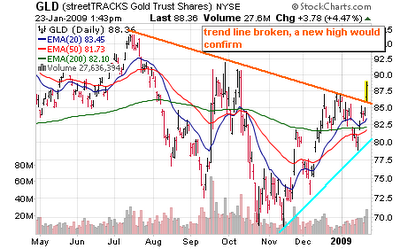
    Last Friday we said gold might finally have it’s real breakout here [Jan 23: Could be the Real Breakout in Gold] I wrote:

    Things to like:
    1) a series of higher lows
    2) the trendline of lower highs has been penetrated

    Things to see for confirmation:
    1) any pullback is bought
    2) price prints over October 2008’s highs, signaling the end of “lower highs”

    This was what the chart looked like at the time:

    Now?

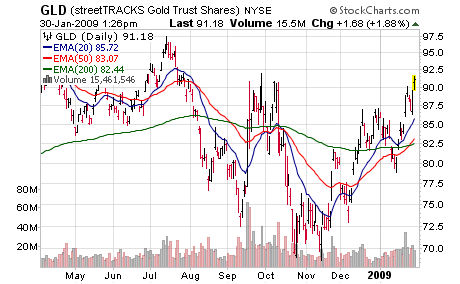
    Without benefit of the orange line – you can see condition #1 has been fulfilled – we “backfilled”, tested the area we broke out of and people were eager to buy. On that, an aggressive trader would be buying. A reader mentioned this outcome last week.

    For someone more conservative in orientation, you want to see #2 “a price point over October 2008’s highs” – then we end our half year of lower highs. We are withing spitting distance here with GLD at $91.40 and the October intraday high at $92.

    It’s hard to get behind gold fully because there is no “earnings” behind it; it’s all about sentiment. But the theory is that as all the world’s troubled countries race to devalue their currencies (print, print,print) to “save the system,” a hard asset should retain its value. Silver is likewise breakout out, although silver has a lot of industrial uses as well.

    I hate to chase a move, but from a technical set up, a lot of institutional money could be set to finally jump in here….

    Now the question of what instrument to use – keep it simple or go with a miner? etc.

    Disclosure: No position

    =================================

    My Note- Great call by Trader Makr but I have to ask, why no position Trader Mark? – jschulmansr

    =================================

    Catch the New Bull! – Buy Gold Online – Safely, quickly, and at low prices, guaranteed! Bullion Vault.com

    =================================

    Fed Monetizes Debt Leading Investors to Embrac Gold – Seeking Alpha

    By: Boris Sobolev of Resource StockGuide.com

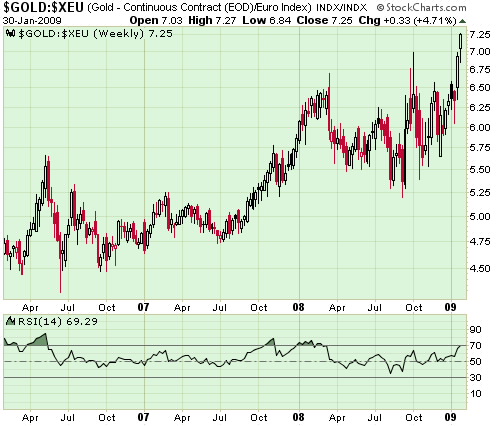
    In January gold rose significantly against all major world currencies. In most currencies except in the US dollar and the Japanese yen, gold actually made an all-time-high.

    January Performance

    GOLD / USD 5.3%

    GOLD / EUR 16.7%

    GOLD / AUD 16.5%

    GOLD / JPY 4.4%

    GOLD / GBP 5.8%

    GOLD / CHF 16.3%

    10-Yr Yield 13.0%

    click to enlarge

    At the same time, most capital markets have been falling.

    January performance

    DOW -11.5%

    S&P -11.4%

    NASDAQ -9.0%

    FTSE -6.4%

    DAX -9.8%

    Nikkei -9.8%

    Shanghai -9.3%

    The governments around the world are trying to take initiative while private capital is sitting on the sidelines, preferring the safety of government bonds and precious metals.

    Investors typically do not trust the governments to implement any effective economic solutions. Moreover, this lack of faith in central planning continues to grow since the US government has no other plan of action than to save the old, compromised and untrustworthy financial system.

    What the Federal Reserve together with the Department of Treasury has shown is that they will inject a vast amount of newly created money into a hugely ineffective financial system.

    While in the fall of last year, in fear of devastating deflation, analysts were competing in downward projections for the price of gold, now the competition is to estimate the amount of losses incurred by the financial institutions around the world. The maximum assessment is now at $4 trillion, with Nouriel Roubini coming in close second at $3.6 trillion.

    But the main problem is not so much in the amount of credit losses or the amount needed for recapitalization efforts but in that the new government is committed to continue to transfer huge capital into the hands of the same group of people who were largely responsible for the world financial crash in the first place. Wall Street, though transformed, will remain in control.

    The lack of trust in the ability of insolvent financial institutions to run the modern financial system is moving investors into gold.

    An even more important gold catalyst was the Federal Reserve. In comparing the two latest Fed statements, two things stand out. Here is the evolution in wording:

    December Statement: “In light of the declines in the prices of energy and other commodities and the weaker prospects for economic activity, the Committee expects inflation to moderate further in coming quarters.”

    January Statement: “In light of the declines in the prices of energy and other commodities in recent months and the prospects for considerable economic slack, the Committee expects that inflation pressures will remain subdued in coming quarters. Moreover, the Committee sees some risk that inflation could persist for a time below rates that best foster economic growth and price stability in the longer term.”

    December Statement: “The Committee is also evaluating the potential benefits of purchasing longer-term Treasury securities.”

    January Statement: “The Committee also is prepared to purchase longer-term Treasury securities if evolving circumstances indicate that such transactions would be particularly effective in improving conditions in private credit markets.”

    First, the FOMC sees a threat of deflation and second it is prepared to counter this threat by purchasing longer-term treasuries.

    Purchases of long term bonds is the most inflationary move that a central bank can undertake because it represents direct monetization of the government debt and hence an unconcealed debasement of national currency. (This is happening at the same time as the new Secretary of Treasury is chastising China – the main US creditor – for currency manipulation.)

    Why did the Fed make such a determined statement, with one member even voting to begin long term treasury purchases immediately? First and foremost, the real estate market is not showing any signs of life. House prices are falling, time required to sell new homes is rising and most importantly, after a steep fall in December, average mortgage rates began to rise again, reaching 5.34% as of last Friday.

    Since mortgage rates are closely tied to the 10-year treasury yield, the Fed stands ready to buy government debt and help make housing more affordable via low mortgage rates. The hope is that such action would help put an end to a decline in asset prices and stop the deflationary spiral.

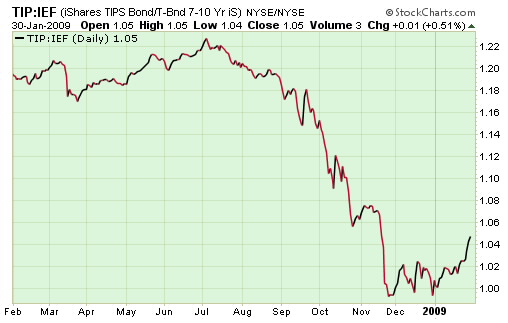
    In fact, the latest Fed balance sheet showed that long term treasury purchases have already started, with around $1 billion in notes (5-10-year maturity) purchased for the week ended January 21st. This is a modest amount, but it is a statement that the Fed is ready to do more than just talk. Traders have indeed sensed this development and Treasury Inflation-Protected Securities (TIPS) (TIP) are also beginning to reflect greater inflation expectations.

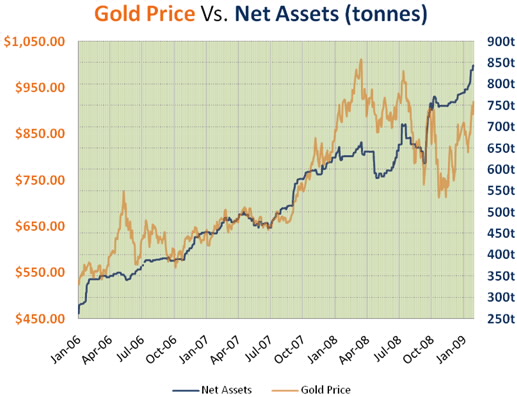
    Gold investors are also sniffing out the coming price reflation as they piled into the SPDR Gold Shares (GLD) at an increasing rate.

    For the month of January, GLD gold holdings rose 8.2% or close to a record setting 63 tonnes. At this rate, GLD will soon surpass Switzerland in its gold holdings, thus becoming the world’s sixth largest gold owner after the US, Germany, the IMF, France and Italy.

    If the Fed continues to purchase long term treasuries, it is clear that there is only one way for gold and gold stocks and it is up.

    ================================

    Catch the New Bull! – Buy Gold Online – Safely, quickly, and at low prices, guaranteed! Bullion Vault.com

    ================================

    Gold as Part of a Portfolio – Seeking Alpha

    By: San Olesky of Olesky Capital Management

    Many investors have been thinking about gold recently. Some have considered it because it has been a relatively strong performer with the iShares COMEX Gold Trust (IAU) closing up 5.4% in 2008. It’s up 2% year-to-date as of Wednesday’s close. The iShares S&P 500 Index ETF (IVV) was down 36.94% in 2008 and is down 6.17% year-to-date as of Wednesday’s close. Other investors or traders have bought or considered gold as a classic safe haven.

    My inclination is to refute the efficacy of buying or holding gold for security either in the form of an ETF or, more so, in the case of gold bullion bars or gold coins. However, as the financial crisis became more severe last year, a couple of clients approached me about adding gold to their portfolios. Rather than diplomatically rejecting the proposal, I told them that I would investigate the historic effects of holding gold in a portfolio. Long story short, I found that adding a small, reasonable allocation to gold reduced portfolio volatility substantially and increased return slightly.

    A simple diversified portfolio consisting of 1/3 S&P 500, 1/3 Real Estate Investment Trusts (REITs), and 1/3 10 year U.S. Treasuries would have produced a compound annual growth rate (CAGR) of 8.47% with 11.15% volatility (standard deviation – SD) from 1993 to 2008. For comparison, the S&P 500 produced a 6.67% CAGR with a 20.16% SD. Although few investors would implement this 1/3 – 1/3 – 1/3 allocation, diversification is proving its strengths here. All of these statistics incorporate rebalancing annually.

    Let’s take the same 1/3 – 1/3 – 1/3 portfolio and alter it to include a relatively small allocation to gold. That allocation will be 30% S&P 500, 30% REITs, 30% Treasuries, and 10% gold. Over the same timeframe the portfolio with gold produced an 8.49% CAGR with a 9.86% SD. The portfolio with gold produced a slightly better CAGR with volatility that was 11.6% lower than the 1/3 – 1/3 – 1/3 portfolio. The diversified portfolio with gold produced a CAGR that was 27.3% higher than the S&P 500 and 51.1% less volatile than the S&P 500. The S&P 500 had 4 losing years with the worst being a loss of 37% last year. The 1/3 – 1/3 – 1/3 portfolio had 3 losing years with the worst being a loss of 18.15% last year. The portfolio with gold had only 2 losing years with the worst being 15.74% last year.

    In constructing sound and productive portfolios we would like to include assets that have high returns, low volatility, and low correlation to the other assets in the portfolio. Looking at gold’s average annual returns, relative volatility, and relevant correlations, one should expect that gold would be a constructive addition to many portfolio allocations. In fact, gold even has a relatively low correlation with commodities in general (S&P Goldman Sachs Commodity Index). However, we should learn from the past but not expect it to repeat itself exactly. There is much to be learned from historic returns, volatilities, and correlations of asset classes. With all due respect to history and math, we must use reason when constructing portfolios. I view gold as a very narrow and idiosyncratic asset. So, I do not feel that it is wise to strategically allocate as much as 10% to the asset although the historic, mathematically optimal amount would be higher in the context of some portfolios.

    What did I do? Based on my tests and observations, I bought a little gold last year for some of my clients. I have incorporated a small allocation to gold into their continuing strategic allocations.

    ====================================

    My Note: This is great news even the Non Gold Bugs are become cautiously bullish!-jschulmansr

    ====================================

    Catch the New Bull! – Buy Gold Online – Safely, quickly, and at low prices, guaranteed! Bullion Vault.com

    ====================================

    Finally and extremely interesting article you want to read! Be sure to click on the chart links too…- jschulmansr

    Economy Watch: What if Stocks Were Priced in Gold?- Seeking Alpha

    By: Paco Ahlgren of Ahlgren Multiverse

    “Everything has its limit — iron ore cannot be educated into gold.”

    — Mark Twain

    Several charts have been floating around the Internet for some time, showing the historical Dow Jones Industrial Average, priced in terms of gold. The simplest explanation entails thinking of the Dow divided by one ounce of gold; if the Dow is at 5000, and gold is at 500, then Dow-to-gold is 10. But it’s important to remember as you’re considering this ratio that the Dow is calculated in terms of dollars. So essentially, when we determine the Dow-to-gold ratio, it’s not just a simple ratio of gold to shares in the Dow, but rather it is a three-part ratio — Dow, expressed in dollars, to an ounce of gold.

    Wouldn’t it just be easier to express gold in terms of dollars, or the Dow in terms of dollars? Well, those are certainly useful ratios — and we use them all the time — but what we’re really going after when we look at a historical Dow-to-gold chart is how well the Dow has performed, relative to the dollar, and relative to gold. What have inflationary pressures done to the Dow, in terms of gold and the dollar, over the past century? How have the three components moved in the various historical boom-bust scenarios? The results are interesting.

    Let’s shift gears for a moment. Just off the top of your head, what would you expect stocks to do in periods of inflation? The dollar loses value rapidly, right? And that means prices of goods and services move higher, presumably with wages. So wouldn’t it stand to reason, intuitively, if corporations were making more money as prices increased, profits would increase too? And if profits increase, shouldn’t share prices go higher in response?

    It turns out that inflationary price increases are bad for the stock market, and no period in history establishes this more concretely than the late 1970s and the early 1980s. Interest rates and prices soared, along with the price of gold, but stocks were flat. I want you to think about what I’m saying here: prices in general were going up, and yet the stock market was not. What this means is while stocks, in nominal terms, looked to be relatively stagnant, in real terms they were getting crushed. This is why the Dow-to-gold ratio is so significant as an indicator of relative value.

    There is an elegant, simple truism that comprises every single transaction between buyers and sellers, and yet most people don’t even think about it: whenever you buy something, you are selling something else. When you buy corn, you are selling dollars. When you buy a Ford, you are selling dollars. If you are in Mexico and you buy a chicken, you are selling pesos. Of course, if you came from the U.S., you first sold dollars, bought pesos, and then sold pesos to buy the chicken. I know most of you already understand this concept, but I’m trying to emphasize that even when currency is used, every transaction is merely a trade; that is to say, the transaction is nothing more than negotiation that results in the exchange of two things — whether goods, services, or currency.

    With that in mind, consider this: when prices rise because of inflation (printing of money), it isn’t so much that goods and services are getting more valuable — rather it’s much more accurate to say the currency is simply getting less valuable relative to everything else. If the dollar collapses, for instance, and the cost of a loaf of bread goes from $1 to $20 at the same time a share of Microsoft (MSFT) goes from $20 to $30, then Microsoft is severely under-performing — in inflation-adjusted dollars. A loaf of bread will cost you 20 times what it used to — not because it is more valuable, but because the dollar is less valuable. Meanwhile Microsoft is worth only 50% more. Relative to the dollar, shares of Microsoft are actually losing money — in a big way.

    If you look at a chart of inflation from 1978 to 1982, you’ll notice a huge spike. If you look at a chart of the Dow Jones Industrial average during the same period, you’ll see that stocks traded sideways in a fairly well-defined range over the same period. But that doesn’t tell the whole story; if you adjust for the meteoric rise in prices during that five-year period, the stock market actually performed much worse than the nominal dollar fluctuations presented in the historical chart. In other words, the price of just about everything was going up dramatically, but stocks were not. So if you adjust prices back to “normal” levels, and adjust stocks accordingly, the picture for equities would have been horrible.

    Now for the pièce de résistance…

    Here is a series of charts of historical nominal gold prices (not adjusted for inflation), in several different currencies — the first of which is U.S. dollars. Take a look at the spike in the price of gold from 1977 to 1981. Now, if we go back to our original chart above, showing the Dow Jones Industrial Average, in direct relation to an ounce of gold (Dow-to-gold), you can see that the ratio went roughly 1:1 in 1980 — at the peak of the inflationary price surges. To clarify, the Dow was at about 750, as was gold.

    But didn’t we say that, relative to rising prices, the Dow actually underperformed dramatically? So if you bought gold in the mid-1970s, not only was your investment skyrocketing, but the stock market — which was flat in nominal dollars — was actually doing very poorly relative to rising prices. Bear in mind that both the Dow and gold were priced in terms of nominal dollars at the time; they essentially “cancel out” — that is to say, relative to rising prices, gold also failed to perform as well as the nominal dollar-price. Still, it did offer an excellent hedge against rising prices, and even outperformed during the period.

    What does all this mean? Well, for starters the average Dow-to-gold ratio over the last century has been about 9.5, and we are currently at about 8.5. So you’re probably thinking we’re oversold and due for a correction. In other words, the Dow-to-gold ratio is probably going higher, right? Well that was my first conclusion too, but actually on closer examination it turns out that’s probably not right at all.

    For much of the last century the dollar was tied to gold, and while the relationship was never perfect — and the U.S. government betrayed the union many times, in many different ways — there was at least some relationship, which helped pull the ratio down. Eventually, excessive inflationary printing caught up with the government in the 1960s, and it became clear it wouldn’t be able to honor redemptions against the dollar at the price it had fixed. Nixon essentially defaulted on the U.S. promise to redeem dollars for gold by taking the U.S. off the standard in the 1970s — and this, more than anything else, allowed inflationary pressure to drive general prices into the stratosphere. This was the moment the Dow-to-gold ratio approached 1:1. To fight rising prices, Paul Volcker, the Fed Chairman at the time, pushed the Fed’s target interest rate past 20% and barely saved the U.S. economy from collapse.

    For most of the next 20 years, gold fell and stock prices rose. Meanwhile, the U.S. government capitalized on the lie it had created and printed more and more money. Who really cared? Everyone was making money in the stock market, and prices remained relatively stable. In fact, every time prices failed to act “correctly,” the Fed simply changed the rate at which it would lend to banks. But the illusion of the monetary policy game couldn’t last forever; people used easy money printed by the government to buy assets they couldn’t afford throughout the economy — especially houses. Finally the pressure was just too much, and everything started unraveling in 2007. But the gold market seemed to understand the game couldn’t last, and around 2000 it started a slow, steady rise.

    Relative to everything, the number of dollars in the system in early 2009 is almost incomprehensible. Once de-leveraging reaches its nadir — and it’s coming soon — those dollars are going to hit the economy and drive prices much higher.

    What have we learned about stocks in such periods of rising prices? Not only do they fail to perform, but adjusted for inflationary price pressures, they actually under perform. General prices and unemployment will continue to rise. The consumer will continue to be unable to consume. Corporate earnings and dividends will continue to collapse as a result. Stocks are going lower — probably much lower.

    And what about the price of gold? It will almost certainly continue to increase — not only because people will flock to its long historical stability and consistency, but also because there are simply so many more dollars (and yen, and rubles, and euros) in the world. Remember, the U.S. isn’t the only country printing innumerable sheets of currency. And in that context, remember also that inflationary price increases have almost nothing to do with increased demand, but rather they are the result of currency devaluation and destruction — through printing.

    I just want to share two more charts with you. The first should give you a little perspective — it is a historical chart of gold, in both nominal and real dollars. Notice the real price of gold in 1980 (in 2007 dollars) was $2272 per ounce. If I’m correct about inflation and the fate of the dollar — and I’m confident I am — then we are nowhere near the historical high in gold. But I don’t think we’re merely going to re-test that high — I think we’re going to blow through it as the dollar loses value.

    In the 1930s, as corporate earnings and dividends disintegrated, the Dow lost nearly 90% of its value from peak to trough. The U.S. was a creditor nation with a huge manufacturing base. The dollar was tied closely to gold. Since its peak in October 2007, the Dow has lost less than 50% of its value. The U.S. is a debtor nation with a relatively small manufacturing base. I can’t say it enough: we borrow profusely, we manufacture very little, and we consume gluttonously. Nonetheless, the consumer has now lost almost all his purchasing power, and corporate earnings and dividends are going to suffer massively as a result.

    In 2007, the Dow peaked at about 14,150. To give you some perspective, an 85% drop in the Dow from peak to trough would put it at about 2100.

    I know it’s easy to imagine the Fed has magical powers. I’ve fantasized about such things myself at times of extreme weakness — that maybe the Fed will “somehow” figure out a way to fight and defeat the unprecedented evil specter of inflation it is foisting on its unsuspecting children. Sometimes I do believe that our Lord and Savior Barack Obama will wave his charmed “unicorn horn of change” and all will be well again. Likewise, at times I feel like I could let Uncle Ben Bernanke take me just about anywhere in his helicopter of prosperity. My faith in the reverend John Maynard Keynes runs deep, as I hope, and hope, and hope. I find myself gleefully clicking my heels together and repeating, “the dollar is almighty, and the Stars and Stripes will prevail.” And when I am in this wonderful place, I have confidence that someday soon, we’ll all be buying houses with no money down, and with no jobs. Our driveways and backyards will once again overflow with boats, motorcycles, and sports cars.

    Then I think about the 1930s. And suddenly I am wide-awake.

    Let me ask you a simple question, and I want you to actually think about it. Do you really think we can’t get to the 1930s again? Do you really think that we’re going to return to the exuberant excess of the past few decades? If so, let me disabuse you of the notion: the United States was in much better shape, economically, going into the Great Depression than it is now. Prosperity is not coming back to the U.S. as we know it. We are in a lot of trouble.

    Is a Dow-to-gold ratio of 1:1 so incomprehensible? Again, it has happened before — several times. But I’ll even take it a step further: what about a Dow-to-gold ratio of .5? Or less? I promise you, if the Fed fails to soak up all the dollars it’s putting in the system, that’s exactly where we’re going. And what, you may ask, does the Fed use to “soak up dollars?”

    I’ll be glad to tell you that too. When the Fed needs to take dollars out of the system, it sells Treasuries (which means it buys dollars). The problem is, the U.S. debt-load is astronomical. Who, exactly, is going to buy that debt from the Fed? And at what interest rate? Remember, if the Fed is desperately trying to take dollars out of the system, there can be only one reason: it is scared of rising prices caused by inflation. But if the Fed floods the market with Treasuries, it will achieve exactly the opposite effect it’s looking for — it will cause rates to rise, probably dramatically. Do you really think the Chinese and the Japanese are going to buy Treasuries at a 2% yield if the Fed is panicking and trying to buy dollars to stop an inflationary price explosion? If so, you’re delusional. Chinese and Japanese people are smart. They’re not going to fund an inflationary dollar at 2%. Ever.

    In the past it might have worked. Of course, in the past, the U.S. money supply was much smaller, and our ability to borrow was much stronger. But those days are gone.

    As if I haven’t terrified you enough, the last thing I’m going to leave you with is really scary. It is a link to an excellent article by Mark J. Lundeen, whose insight into this economic catastrophe has been stupefying since long before all of this even started. Embedded in the article is a chart that shows historical dollars-in-circulation, relative to U.S. gold.

    With that, I think I’ll let you do the rest of the math. Sleep well.

    Disclosures: Paco is long gold.

    Copyright 2009, Paco Ahlgren. All Rights Reserved.

    ==================================

    If you have done the math…

    Catch the New Bull! – Buy Gold Online – Safely, quickly, and at low prices, guaranteed! Bullion Vault.com

    =================================

    That’ it for now – Good Investing – Jschulmansr


    Nothing in today’s post should be considered as an offer to buy or sell any securities or other investments, it is presented for informational purposes only. As a good investor, consult your Investment Advisor, Do Your Due Diligence, Read All Prospectus/s and related information carefully before you make any investments. –  jschulmansr
    Share this:

    • Click to share on Reddit (Opens in new window) Reddit
    • Click to share on Facebook (Opens in new window) Facebook
    • Click to share on LinkedIn (Opens in new window) LinkedIn
    • More
    • Click to share on X (Opens in new window) X
    • Click to share on Pinterest (Opens in new window) Pinterest
    • Click to share on Tumblr (Opens in new window) Tumblr
    • Click to print (Opens in new window) Print
    • Click to email a link to a friend (Opens in new window) Email
    Like Loading...
    Newer posts →

    Authors

    • jschulmansr's avatar jschulmansr
      • Free Crypto!
      • Free Crypto Currency
      • This is Blessed!
      • Trump Rally Charleston
      • Trump Rally Charleston

    Blog at WordPress.com.

    Privacy & Cookies: This site uses cookies. By continuing to use this website, you agree to their use.
    To find out more, including how to control cookies, see here: Cookie Policy
    • Subscribe Subscribed
      • Dare Something Worthy Today Too!
      • Already have a WordPress.com account? Log in now.
      • Dare Something Worthy Today Too!
      • Subscribe Subscribed
      • Sign up
      • Log in
      • Report this content
      • View site in Reader
      • Manage subscriptions
      • Collapse this bar
     

    Loading Comments...
     

      %d