• Recommended Sites & Links
  • About

Dare Something Worthy Today Too!

~ FreeCryptoBitCoins, Cryptocurrency, BitCoin, Ethereum, BitCoin Cash, Ethereum Classic, LiteCoin, DogeCoin, Gold & Precious Metals, Investing & Investments, Stocks and Stock Markets, Financial Markets & Market Timing, Technical Analysis, Oil and Energy Markets, Hard Assets Investing, BlockChain, Airdrops, Earn Free Bitcoin…

Dare Something Worthy Today Too!

Category Archives: Peter Grandich

Can’t Keep A Good Investment Down?

10 Tuesday Feb 2009

Posted by jschulmansr in 10 year Treasuries, 20 yr Treasuries, Bailout News, banking crisis, banks, bear market, bull market, capitalism, central banks, Comex, commodities, Copper, Credit Default, Currencies, currency, Currency and Currencies, dollar denominated, dollar denominated investments, economic, Economic Recovery, economic trends, economy, Fed Fund Rate, Federal Deficit, federal reserve, Finance, financial, Forex, Fundamental Analysis, futures, futures markets, GDX, GLD, gold, Gold Bullion, Gold Investments, gold miners, How To Invest, How To Make Money, hyper-inflation, inflation, Investing, investments, Japan, Jschulmansr, Junior Gold Miners, Latest News, Make Money Investing, market crash, Markets, mining companies, mining stocks, Moving Averages, palladium, Peter Grandich, physical gold, platinum, platinum miners, precious metals, price, price manipulation, prices, producers, production, silver, silver miners, small caps, spot, spot price, stagflation, Stimulus, Stocks, Technical Analysis, TIPS, U.S. Dollar

≈ Comments Off on Can’t Keep A Good Investment Down?

Tags

Austrian school, Bailout News, banking crisis, banks, bear market, Bollinger Bands Saudi Arabia, Brian Tang, bull market, central banks, China, Comex, commodities, Copper, Currencies, currency, deflation, Dennis Gartman, depression, dollar denominated, dollar denominated investments, economic, economic trends, economy, Federal Deficit, financial, Forex, futures, futures markets, gata, GDX, GLD, gold, gold miners, hard assets, hyper-inflation, India, inflation, investments, Jeffrey Nichols, Jim Rogers, Keith Fitz-Gerald, majors, Marc Faber, market crash, Markets, Michael Zielinski, mid-tier, mining companies, monetization, Moving Averages, palladium, Peter Grandich, Peter Schiff, physical gold, platinum, platinum miners, precious metals, price, price manipulation, prices, producers, production, protection, recession, risk, run on banks, safety, Sean Rakhimov, silver, silver miners, small caps, sovereign, spot, spot price, stagflation, Technical Analysis, TIPS, U.S., U.S. Dollar, volatility, warrants, XAU

As I write Gold has come screaming back like a rocket to the moon! Currently Gold is up $20 oz back to $913 an oz. Today we here from Peter Grandich on new all time highs for gold are just around the corner. We’ll take a look at Silver, oh we can’t forget about Platinum too! There’s still time but the Precious Metals Bull Train is about to leave the station-Hop aboard! – Good Investing – jschulmansr

===========================

Gold All Time Highs – Not If But When – Grandich Blog

By: Peter Grandich of Grandich Blog

February 10th, 2009

They say in life only death and taxes are guaranteed. They send you to jail if you guarantee an investment and it fails. With both things in mind, I believe we “should” make a new, all-time nominal high in gold before too long.

After putting a strong bottom in at $700, gold has made a series of higher lows while the $930-$940 area remains resistance. Despite an incredibly strong physical market, the paper market at the Comex seemingly trades to a different “drummer”. That’s okay as physical demand eventually overtakes paper markets.

Gold continues to be my most favorite play, followed by being long the Canadian dollar and then oil. But remember, I was also a NY Jets fan for 35 years.

============================

Catch the New Bull! – Buy Gold Online – Safely, quickly, and at low prices, guaranteed! Bullion Vault.com

===============================

What’s Going on With the Dollar and Gold? – Seeking Alpha

By: Tim Iacono of Iacono Research


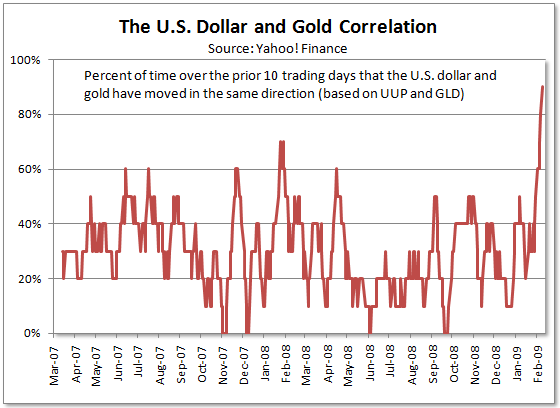
Those of you who have noticed that the U.S. dollar and gold have been moving in the same direction over the last few weeks are not alone. In fact, the two have moved together eight days in a row and nine out of the last ten, something that is quite unusual.
IMAGE When looking at the PowerShares DB U.S. Dollar Index Bullish ETF (PCX:UUP) and the SPDR Gold Shares ETF (PCX:GLD), it’s clear to see how different the last couple weeks have been as compared to earlier in the year.


Based on the data for these ETFs (which, unfortunately only goes back to early 2007 for UUP), the two have moved in the same direction on just 150 out of 490 days – about 30 percent of the time.


As shown in the chart below, the recent surge to much higher levels has not happened in at least two years, probably much longer.
IMAGE

The only other time that something similar happened was back in January of 2008.


What else happened in January of 2008?

Ahhh… How soon we forget…

From the St. Louis Federal Reserve website:

January 11, 2008

Bank of America announces that it will purchase Countrywide Financial in an all-stock transaction worth approximately $4 billion.


January 18, 2008
Fitch Ratings downgrades Ambac Financial Group’s insurance financial strength rating to AA, Credit Watch Negative. Standard and Poor’s place Ambac’s AAA rating on CreditWatch Negative.

January 22, 2008
In an intermeeting conference call, the FOMC votes to reduce its target for the federal funds rate 75 basis points to 3.5 percent. The Federal Reserve Board votes to reduce the primary credit rate 75 basis points to 4 percent.

January 30, 2008
The FOMC votes to reduce its target for the federal funds rate 50 basis points to 3 percent. The Federal Reserve Board votes to reduce the primary credit rate 50 basis points to 3.5 percent.


This was the really steep part of the rate reduction cycle – 125 basis points in just over a week.


Whether any of this has any real significance remains to be seen, but, the fact that, last time around, the gold price then surged to over $1,000 an ounce should not be ignored.

I, for one, will be happy to see the inverse relationship between the dollar and gold go the way of the dodo bird, never to affect twitchy traders again.

As noted here on many occasions before, there is no fundamental reason for this relationship to exist. If the dollar strengthens against the euro, why should that make the gold price go down? Because gold, priced in dollars, has become more expensive in Europe?

Despite hearing that ad nauseum in the financial media, that really doesn’t make any sense when you think about it.


Full Disclosure: Long GLD, no position in UUP
======================================
Catch the New Bull! – Buy Gold Online – Safely, quickly, and at low prices, guaranteed! Bullion Vault.com 

======================================

Silver Surges but Remains Undervalued Compared to Gold – Seeking Alpha

By: Mark O’Byrne of Gold and Silver Investments.com


Gold fell some 1.5% last week as investors tookgl profits with gold having been up some 10% in the previous three 3 weeks. But the short and medium term prospects look sound in the light of strong fundamentals and some important indicators – silver was up by another 4.2% last week and the gold mining indices were also higher (XAU +4.6% and HUI +2.3%). The mining indices are often a leading indicator and silver usually underperforms gold in the early stages of rallies and outperforms in the latter. Silver’s recent strength (up by some 15% since the start of the year) may be a prelude to higher gold prices in the coming weeks.


The recent sharp rally in the US dollar appears unsustainable and the USD Index was down 0.64% last week and US bonds also fell again – the 10-Year bond sold off again and the yield rose another 4.75% (from 2.9% to 2.979%). As ever, the bond market remains of fundamental importance and nervousness about the humongous size of the Obama bailout and stimulus packages and talk of central banks printing money to buy government bonds is not helping sentiment here. And government debt issuance is set to surge in the coming weeks and there is a real concern that there simply will not be enough buyers – meaning that bond prices may fall from their lofty heights and long term yields and interest rates begin to rise again.

The gold/silver ratio has fallen to around 70 ($905oz/$13/oz = 69.6) today from around 80 in mid January. The long term historical average is 15:1 and this is because it is estimated that geologically there are some 15 parts of silver in the ground for every one part of gold. It is important to note that silver, unlike gold, besides being a safe haven investment is also used in industry and it is believed that since the dawn of the industrial revolution some 95% of the world’s silver has been used up in industrial applications. Because of gold’s much higher value, it gets recycled and all the gold mined in the world ever is still with us but photography and other industrial uses makes silver like oil – when used it is gone forever.

The 1970s saw an average gold to silver ratio of around 25:1 and fell below 20:1 when silver rose to over $45/oz nominally. Thus it seems very likely that in the coming years, silver may well return to its long term historical average of closer to 15:1. This means that silver is likely to continue to outperform even gold in the coming weeks and months. Silver may return to its recent highs of over $20/oz in 2009 due to very strong supply demand fundamentals. It is also important to note that the CFTC investigation into artificial manipulation and suppression of the silver market could potentially lead to a massive short squeeze.

All investors should diversify within the precious metals allocation in their portfolio and own silver as well as gold. Gold remains the ultimate safe haven while silver is a safe haven but has the potential for very significant returns and growing wealth in the coming months.

Stock position: None.

==================================

Catch the New Bull! – Buy Gold Online – Safely, quickly, and at low prices, guaranteed! Bullion Vault.com

=================================

Bullish for the Short Term But Consider Gold, Platinum as Well – Seeking Alpha

By: Jeffrey Saut of Raymond James


Excerpt from Raymond James strategist Jeffrey Saut’s latest essay, published Monday (February 9th):


…[I]n last Tuesday morning’s verbal strategy comments we noted that since the inception of the S&P 500 futures contract there have been five instances when the futures slid by 2% (or more) on back-to-back days and then gapped lower by 1%+ the following session. On EVERY one of those occasions the S&P 500 (SPX/868.60) was at, or within one day, of beginning a decent rally. Further, last November we opined that at the November 20, 2008 “price low” the DJIA was 34% below its 200-day moving average [DMA] and consequently very oversold.

According to Susan Berge, of the Berge Report, that reading was greater than the momentum low occurring in October 1974 of 27%, as well as the 24% reading during the 1987 crash. Even after the rally we have experienced since the November “lows” during the recent downside re-test of those November’s “lows” the differential was still a massive 25%. Subsequently, we advised buying the exchange-traded fund [ETF] of your choice, which in our case was the recommendation of the ProShares Ultra S&P 500 (SSO) that is “geared” two-to-one on the upside. We further suggested that the more timid types might want to consider hedging these positions to minimize the downside.

Accordingly, the Dutiful Dow sprinted 141 points in Tuesday’s session, but gave back most of those gains on Wednesday’s wilt (-121). Therefore, in Thursday morning’s strategy comments, we said that if our upside rally “call” was going to play ,the equity markets would need to shake off Thursday’s worse than expected employment claims number, as well as the anticipated worse than estimated employment numbers on Friday. BINGO, for indeed the late week numbers were much worse than expected, yet the DJIA shook them off and rallied. How far the rally will carry is anyone’s guess, for while we are bullish on a short-term basis, it would take a closing price above 8375 on the DJIA to turn us merely “neutral” on an intermediate-term basis.

However, if the DJIA (8280.59) can close above its January 6, 2009 closing high of 9015.10, with a like close by the D-J Transportation Average [DJTA] (3203.70) above its 1/6/09 closing high of 3717.26, it would be a Dow Theory “buy signal” according to our interpretation of Dow Theory; and should be viewed as a pretty bullish occurrence. Moreover, as stated in previous missives, so far what we have seen is a downside non-confirmation, with the DJTA breaking below its November 2008 “low” without a similar breakdown by the DJIA; and, you should read that bullishly.

Meanwhile, there was an interesting rotation last week with the Commodity Research Bureau Index “up,” the Dollar Index “down,” bond prices “down” (read: higher interest rates), and Dr. Copper “up” nearly 11%. This action, if it continues, suggests the potential for the return of inflation and the potential for a stronger economy. If so, in addition to our recommendation on gold, participants might want to consider investments in platinum. Indeed, unlike gold, platinum is not only a precious metal, but is used heavily in industry due to its tensile strength characteristics…

Typically, platinum sells at a substantial premium to gold, but because of the collapse of the auto industry platinum is approaching parity with gold for the first time since the early / mid-1990s. Investors, therefore, might want to consider platinum in addition to their gold positions, for they will be purchasing a relatively “cheap” metal with a “call” on an auto industry rebound. Our vehicle of choice for this theme is the iPath Dow Jones AIG Platinum ETF (PGM).

================================

Catch the New Bull! – Buy Gold Online – Safely, quickly, and at low prices, guaranteed! Bullion Vault.com

================================

Late Breaking Intelligence Report…

MineWeb Gold News – Japan Investors Turn To Gold! – MineWeb

Source: Reuters


TREND SPREADING

Japan investors turn to gold

Online traders are turning to commodities from FX, stocks and gold is the most popular commodity product for online retailers.

Author: Chikako Mogi
Posted:  Tuesday , 10 Feb 2009

TOKYO (Reuters)  – 

Japanese retail investors are stepping up their online gold investment in a trend that is unlikely to be reversed, an executive at a top online commodity trading firm said on Tuesday.

As the country’s retail investors catch up with global trends of asset diversification, they are hunting for alternative investments to enhance returns, and the trend is spreading outwards from the rich to engulf ordinary people.

Japan’s risk-averse retail investors are estimated to hold an eye-popping $16.4 trillion, more than half of it in cash and deposits, Mizuho Bank, the country’s second-largest lender, says.

Although the global financial crisis hit the real economy and battered commodities directly linked to the economy, gold remains unscathed by such declining industrial demand while retaining merit as an asset.

“Given its relatively stable value, interest in gold will persist for a while and the market will remain bullish,” Naoaki Kurumada, chief executive of Dot Commodity, Inc, told Reuters.

“Gold is our main commodity product — by purchasing gold, investors can start including commodities in their portfolios.”

Since its establishment in 2005, the company has grown as Japan’s top online commodity trading firm, with about 20,000 accounts against some 50 initially, and assets of 8 billion yen ($87.45 million) by October. It is also second in the online commodity trading industry in volume terms.

The company is drawing interest from seasoned online traders who are turning to commodities for high returns, as Japanese stocks have plunged and the yen has strengthened.

“I expect online accounts to increase, given the strengthening appetite for asset diversification and more people finding commodity trading interesting,” Kurumada said.

There are two key kinds of investors who use the firm’s services. One of them has experience in trading currency or stocks online and can analyse technical charts or moves in other markets to aim for high returns amid price fluctuations.

“Some are day traders, others more longer term, like a few weeks. They are largely in their 30s and 40s,” Kurumada said.

The other type is non-traders interested in commodity investment who buy gold as a start, he said.

Reflecting the popularity of the yellow metal as an investment, the open interest in the gold mini contract, launched in July 2007, hit a record high 83,428 contracts on Jan. 8, according to Tokyo Commodity Exchange Inc (TOCOM), exceeding that of the standard gold contract.

TOCOM will extend trading hours of all derivatives contracts later this year to boost liquidity after Japan’s main commodity market launches upgraded trading systems in May.

Kurumada said this would help attract more investor interest to commodity investment and trading, as it would allow players to cut losses timely or swiftly react to overseas market moves.

“We hope that the environment will be set so traders can reap profits just like in currency and stocks,” he said.

While Japanese retail investors are waking up to the attraction of commodity investment, the pace of growth may be moderate.

About 20 percent of those investing in gold, for instance, are investing in TOCOM’s gold mini contract and about 10 percent are actively trading. The rest are investing in such products as gold savings plans, Kurumada said.

“Retail investors jumped on the gold mini contract a year after its launch. It takes time for them to catch up,” he said. ($1=91.48 Yen) (Editing by Clarence Fernandez)

© Thomson Reuters 2009 All rights reserved

==================================

Catch the New Bull! – Buy Gold Online – Safely, quickly, and at low prices, guaranteed! Bullion Vault.com

==================================

That’s It for Now- I close with this quote below- Good Investing! – jschulmansr

“Nothing will unnerve the paper gold shorts more quickly and do more to undercut their confidence than to strip them of the real metal and force them to come up with more hard gold bullion to make good on deliveries. “Stand and Deliver or Go Home” should be the rallying cry of the gold longs to the paper gold shorts.” –Trader Dan Norcini

==================================
Nothing in today’s post should be considered as an offer to buy or sell any securities or other investments; it is presented for informational purposes only. As a good investor, consult your Investment Advisor, Do Your Due Diligence, Read All Prospectus/s and related information carefully before you make any investments. –  jschulmansr


Share this:

  • Click to share on Reddit (Opens in new window) Reddit
  • Click to share on Facebook (Opens in new window) Facebook
  • Click to share on LinkedIn (Opens in new window) LinkedIn
  • More
  • Click to share on X (Opens in new window) X
  • Click to share on Pinterest (Opens in new window) Pinterest
  • Click to share on Tumblr (Opens in new window) Tumblr
  • Click to print (Opens in new window) Print
  • Click to email a link to a friend (Opens in new window) Email
Like Loading...

Resurgence! Gold Demand is Picking Up!

06 Friday Feb 2009

Posted by jschulmansr in bull market, China, Comex, Currencies, currency, Currency and Currencies, dollar denominated, dollar denominated investments, economic, economic trends, economy, Forex, Fundamental Analysis, futures, futures markets, GDX, GLD, gold, Gold Bullion, Gold Investments, gold miners, How To Invest, How To Make Money, hyper-inflation, India, inflation, Investing, investments, Latest News, Make Money Investing, Markets, Michael Zielinski, mining companies, mining stocks, Peter Grandich, physical gold, platinum, platinum miners, precious metals, price, prices, producers, production, silver, silver miners, small caps, spot, spot price, stagflation, Stimulus, Stocks, Technical Analysis, Today, U.S. Dollar

≈ 1 Comment

As I write this post Gold is consolidating after another $12 oz rise yesterday, currently off $1.70 at $912.00. Today’s post has some must read articles if you are or are about to invest in Gold. Demand is experiencing a strong resurgence, and all the factors are lining up for a spectacular rally! Time to get aboard the Gold Train! – Good Investing – jschulmansr

======================================

This is where I am buying my Gold Bullion…

Catch the New Bull! – Buy Gold Online – Safely, quickly, and at low prices, guaranteed! Bullion Vault.com

==========================================

Gold Demand Resurges – Seeking Alpha

By: Nicholas Jones of Bourbon and Bayonets

We love to analyze gold in issues of Bourbon and Bayonets, especially with a focus on the macroeconomic issues that are extremely bullish for our favorite yellow metal. The economic crisis and complete lack of competence from our leaders has resulted in a current financial climate that will result in the most fantastic run the price of gold has ever experienced. The quantitative easing around the globe is definitely the greatest single bullish fundamental that will drive gold going forward. It’s not the only reason gold will rise in price, but it definitely carries the most weight.

The thing is, gold is a sort of hybrid investment vehicle. Essentially it’s part commodity part currency. When I discuss things like monetary inflation and the stimulus package, I’m referring to the aspect of gold that acts as a monetary vehicle. I absolutely don’t want to downplay that importance of this notion, but it’s not the whole story. Gold, like all other assets, is affected by supply and demand fundamentals. Monetary issues may be the driving force behind gold, but looking at supply and demand figures can be very telling, especially in the short run. In this article I am going to dig through the recent 3Q global S&D figures released by the World Gold Council. The numbers are very interesting.

Gold Demand Resurges

Gold demand in the 3Q of 2008 was very strong after being weak for several quarters. Identifiable demand was 1,133.4 tonnes. That figure was up 170.1 tonnes or 18% year over year. Valued in U.S. dollars gold demand was $31.8 billion and up 51% year over year. That number is a record and marks a 45% increase from the record numbers set in the 2Q.

The sector experiencing the largest increase was identifiable investment which was up 137.5 tonnes or 56% year over year. Breaking down the identifiable investment, the largest increase in that subset was net retail investment. Net retail investment increased 121% to 232.1 tonnes.

Leading the growth in demand was Switzerland, Germany, India, and the U.S. At this point in the report, the authors made a statement that there were noticeable shortages of bars and coins around the world. We’ve discussed this story extensively at Bourbon & Bayonets. A result of the dealer shortages has been the divergence between the spot and futures price of gold. Please refer to past issues for a more extensive explanation.

Gold ETFs also had a record net quarterly inflow of 150 tonnes. The report mentions that peak inflows occurred after the collapse of Lehman. In the 5 days following the debacle inflows increased by 111 tonnes ($7 billion). Once the treasury market collapses, gold will revert back to its rightful place as the number one flight to safety asset in the world. I would like to put a precaution on using ETFs. When using ETFs to buy gold, you remove one very important element. Physical gold has no counterparty risk. ETFs do. This will become more important going forward from here, but in the mean time just think of what the Hunt Brothers would have to say about PM ETFs.

Moving back to the WGC report, early demand in the 4Q has picked up where it left off in the 3Q. They also mention that gold shortages are expected to continue, de-hedging will continue to abate, and central bank sales will be weak.

[All figures provided by the World Gold Council 3Q Gold Demand Trends report.]

Monetary forces may be the driver in the gold market, but we can use these reports to help with short term expectations. Demand is strong, really strong. There were record figures across the board. On the other side of the story, supplies are tight and will continue to be tight. The players are coming back to the game and this will provide strong underlying support in the gold market going forward. I still hold to my views that gold may test $1000 in the near term, but I believe we’re one correction back to $850 away before we make a run up to $1500.

=================================

My Note: If demand is still increasing then fundamentally upward pressure remains intact. We have probably seen most of the cash starved stock investors, hedge funds, and etc. have already sold their positions to raise cash to offset their losses. Yes, I agree we will see a retest of the $850 level but not until we have made new all time highs in the Gold Markets. Then at that point we will retrace and then I think the next rally will be to $1500 – $2000 oz. level. This is without any major flare-ups in the Middle East or a U.S. debt default. One other potential trouble spot is a small war between China and India over the disputed border areas, especially with India being distracted by growing tensions with Pakistan. If any of those scenarios happen, then Gold can and will easily go to well over $2000-$3000. You heard it here first folks!-jschulmansr

Catch the New Bull! – Buy Gold Online – Safely, quickly, and at low prices, guaranteed! Bullion Vault.com

===================================

Gold’s Performance Relative to Dollar, Yen and Euro – Seeking Alpha

By: Richard Shaw of OVM Group

As gold receives headlines, let’s look at it relative to the three key global currencies – Dollar, Yen and Euro.

Gold is sometimes viewed more as a commodity for jewelry and electronic applications, and at other times more as a quasi-currency. It has an ancient history for both roles. As of late, gold has been taking on more of the alternative currency role.

Paper currencies pay interest, but physical gold does not. As the interest rate on paper currency approaches zero, the short-term opportunity cost of holding gold versus paper currencies becomes minimal (noting, however, that there are storage and security or management costs with gold).

Reasonable proxies for gold and currencies are: gold (GLD), Dollar (UUP), Yen (FXY) and Euro (FXE).

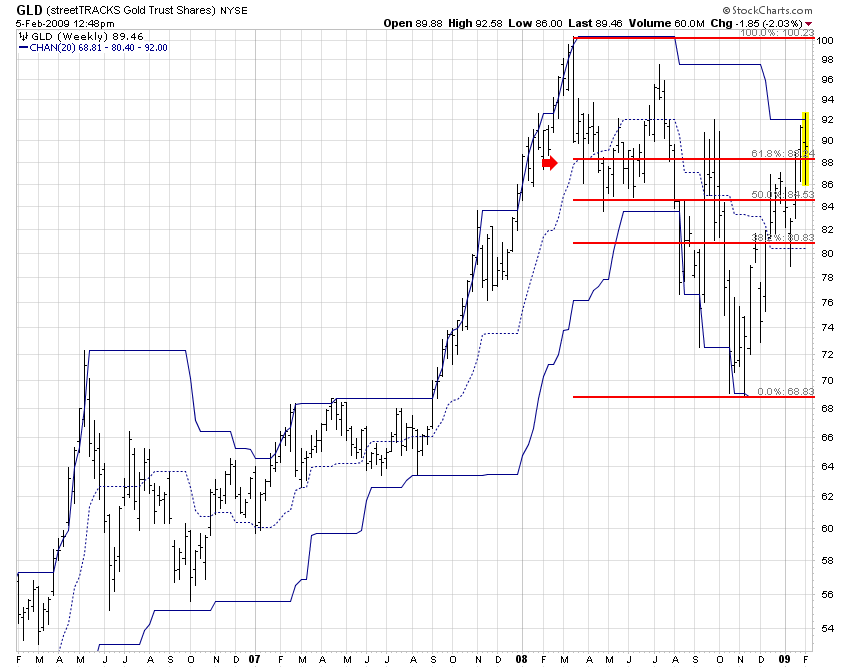
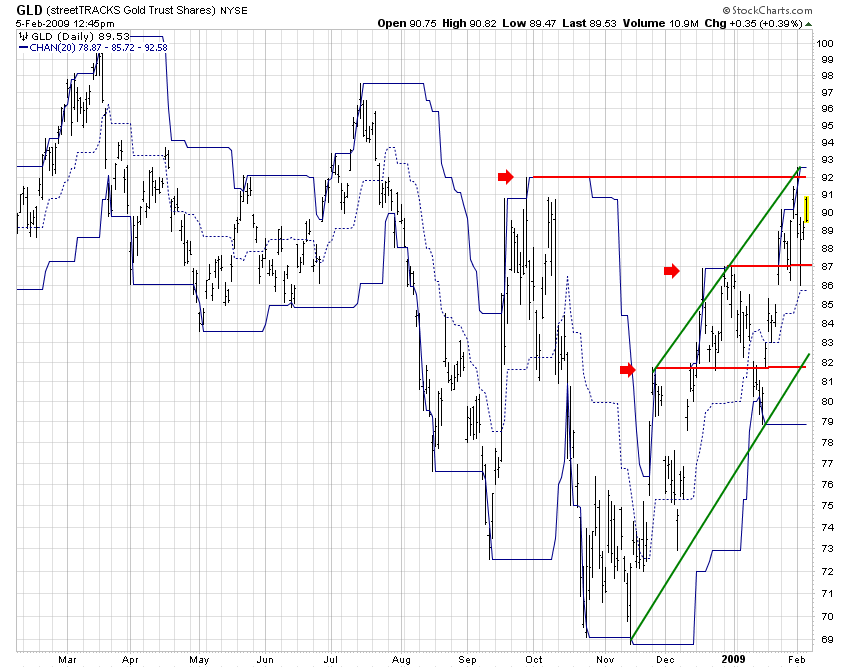
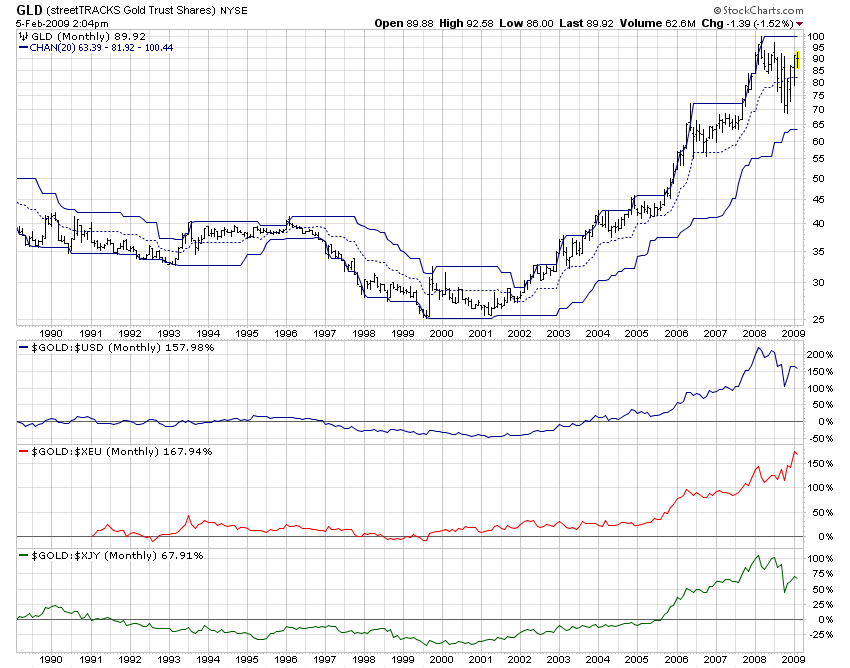
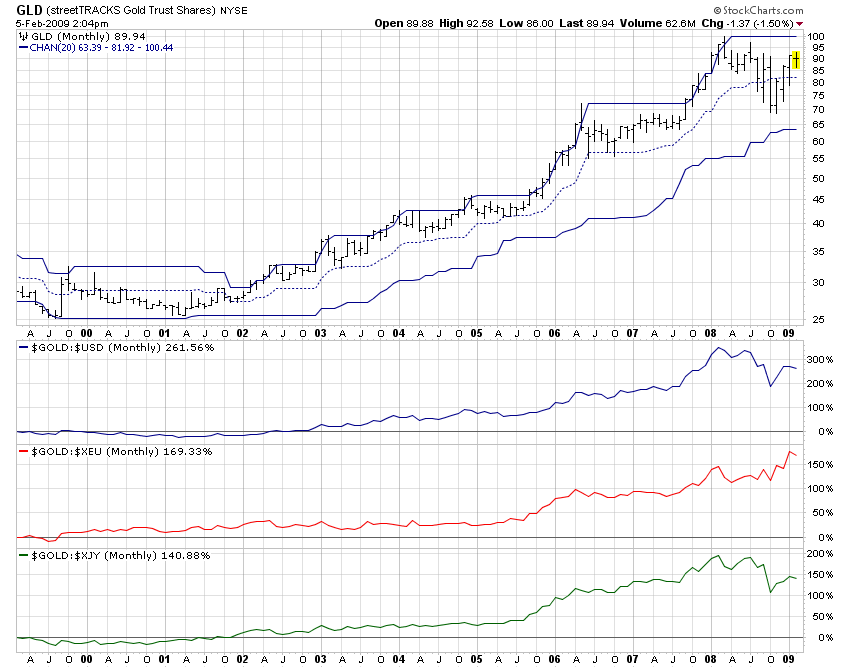
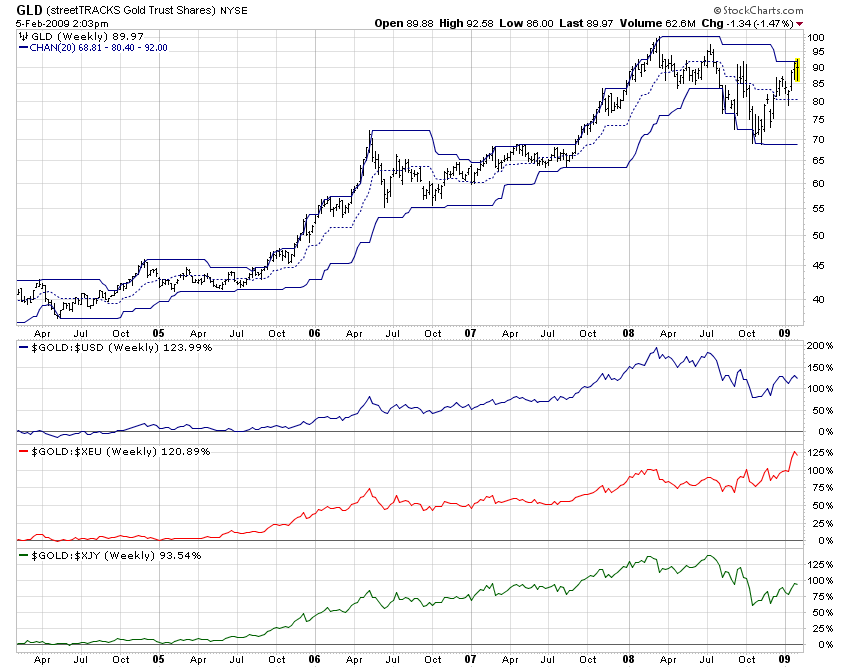
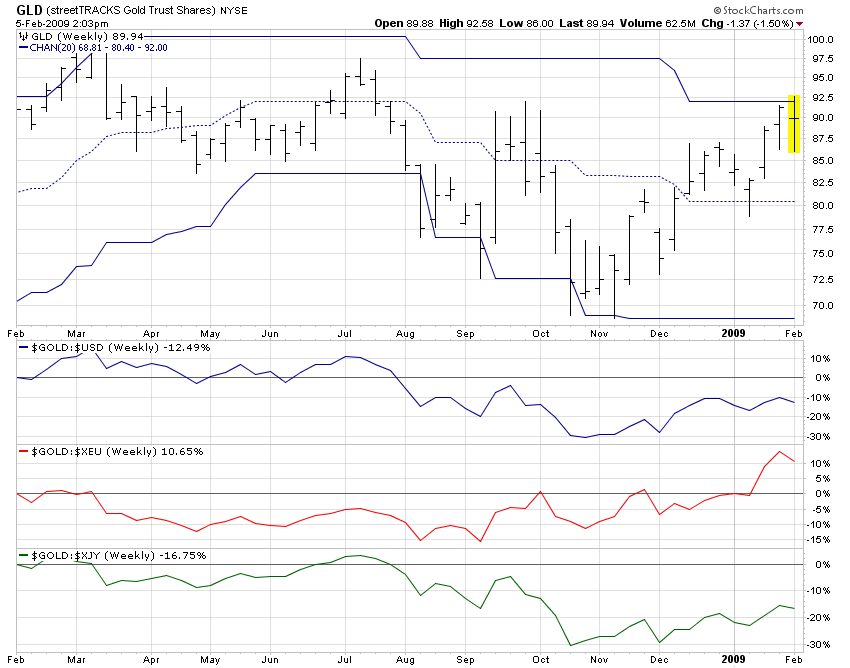
The 3-year weekly chart below uses “price channels” to identify the highest highs and the lowest lows for the twenty prior periods. It also presents a Fibonacci study that essentially marks the levels for an approximate 1/3, 1/2 and 2/3 retracement of the most recent peak-to-bottom price range.

click images to enlarge

3-Year Chart with Fibonacci Study

Theory would say that having retraced 2/3 of the prior peak-to-bottom, the current move is more likely to persevere than not.

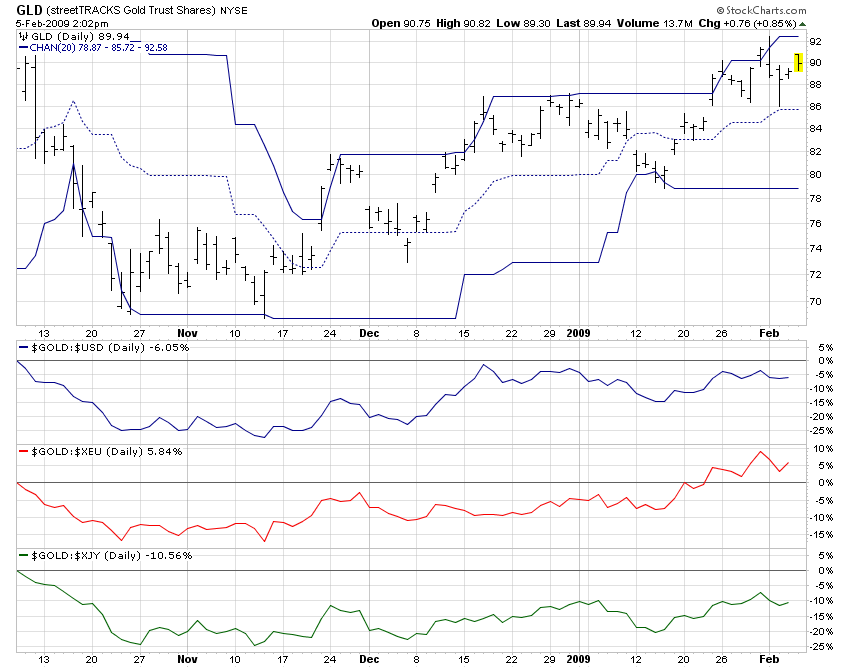
One approach to identifying resistance and support levels is to find prior highs and prior lows. Price channels are one way to have a computer generate visual queues to resistance and support levels automatically. Just be sure the historical period for the price channels is what you want. Note also that prior consolidation areas tend to create resistance or support levels. This daily study uses price channels over 20 trailing periods as does the 3-year weekly chart above.

1-Year Chart with Resistance Levels and Trend Lines

Having pierced two resistance levels and flirting with a third shows great strength. The higher bottoms and higher tops is a favorable indication.

Gold is near twenty-year highs, having pierced several key resistance levels since its slide in Q4 2008. Some predict new highs ahead.

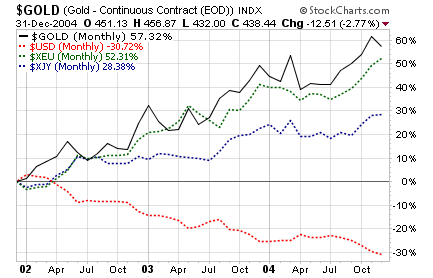
Here is a twenty-year monthly chart showing how gold performed on a percentage basis relative to the Dollar, Yen and Euro.

20 years

Gold may reach new twenty-year highs. A trend is a trend, until it is not a trend. On the other hand, every rubber band can only stretch so far.

Investor sense of success in the multi-national recovery programs may divert investor money flows to other asset categories, possibly slowing or capping the advance of gold. Alternatively, investor sense of failure by recovery programs would likely direct more money flows to gold, possibly extending its advance.

10 years

5 Years

1 Year

4 Months


Sometimes it is more informative to look at discrete periods of time, such as successive individual calendar years or groups of years, rather than cumulative periods of time. That is because of the persistent impact by past periods on cumulative returns, whereas discrete periods start fresh without the quantitative effect of the past.

The following charts show 3-year monthly performance for eight successive discrete periods beginning with 1999. Gold has been the superior performer in seven of the eight periods. The question remains, when has it gone high enough. So much may depend on the conduct of governments in the near-term.


3 Years Beginning 1999

3 Years Beginning 2000

3 Years Beginning 2001

3 Years Beginning 2002


3 Years Beginning 2003

3 Years Beginning 2004

3 Years Beginning 2005

3 Years Beginning 2006

Disclosure: The author holds a small allocation in gold via the ETF, symbol GLD, with a 10% persistent trailing stop.

================================

My Note: Can’t forget Silver!

Long-Term Trend in Investment Demand for Silver – Seeking Alpha

By: Michael Zielinski of Gold and Silver Blog

In a previous post, I reviewed the amount of silver bullion sold by the United States Mint during 2008. With this post, I will take a longer term look at silver demand, which highlights the absolute explosion in demand which has occurred in recent years.

The supporting data for the charts included with this post comes from a new section of Gold and Silver Blog which collects the US Mint Silver Bullion Sales data since the inception of the program in 1986. You can visit the page to find the monthly sales figures for any date from 1986 to present. The section also calculates the approximate silver bullion value of each period’s sales based on the average monthly price of silver.

Silver Bullion Sales in Ounces

Here’s a chart summarizing the total ounces of silver bullion sold by the US Mint each year since 1986. (Click on the chart for a larger version.)

During 2008, the US Mint sold 19,583,500 ounces of silver through its bullion program. As explored previously, this marks an all time high for the program. It represents an increase of more than 98% from the prior year, and an increase of 92% from the previous all time high reached in 2002.

One important thing to note when considering the magnitude of the increase for 2008 is that the number of ounces sold could have been much greater. The US Mint suspended silver bullion sales during February before resuming sales on a rationed basis. When the rationing first began, one dealer claimed that he could have sold 500,000 ounces of silver per week, but was only allocated 100,000 ounces.

2008 Silver Bullion Sales in Dollars

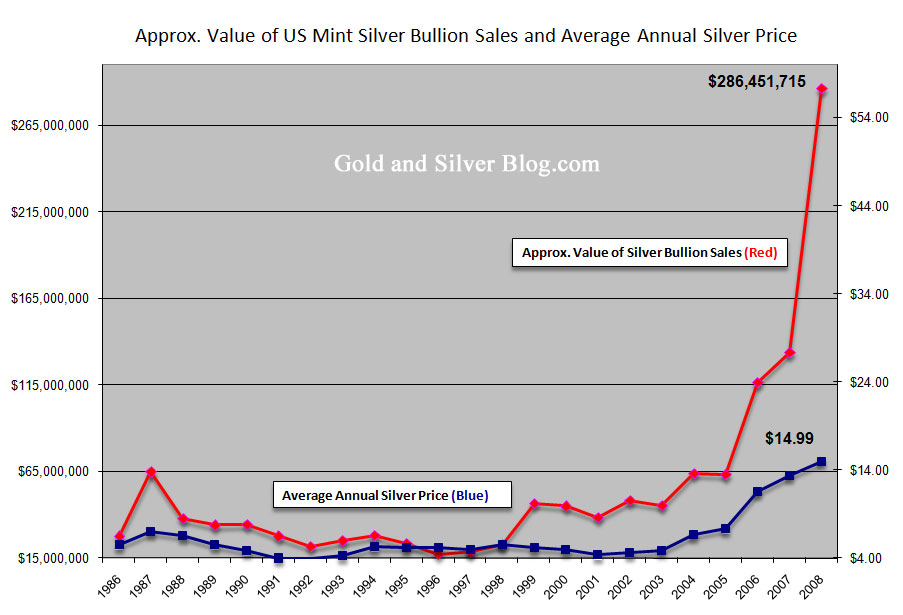
Here’s a second chart which illustrates the explosion in demand for silver in even more dramatic fashion. The chart shows the approximate dollar value of silver bullion sold by the US Mint each year. As mentioned, this was calculated based on monthly silver bullion sales and the average monthly price of silver. (Click on the chart for a larger version.)

Silver Bullion Sales Value Chart

During 2008, The US Mint recorded silver bullion sales of approximately $286,451,715. This marks an all time high and an increase of 114% from the prior year, which was also the prior all time high.

The magnitude of the increase is more pronounced when compared to silver bullion sales from earlier years of the program. Throughout the majority of the 1990’s, the US Mint was selling less than $30 million worth of silver each year. The year for the lowest value of silver bullion sold was 1996 with $17,434,050. During 2008, the US Mint recorded monthly sales exceeding this level for ten out of twelve months.

Silver Bullion Sales and the Price of Silver

But what about the price of silver amidst this explosion in demand?

Here’s a third chart which plots the value of US Mint silver bullion sales from the last chart, together with the average annual price of silver for each year. (Click on the chart for a larger version.)

Silver bullion sales increased from a low of $17,434,050 to last year’s high of $286,451,715 representing an increase of 1,543%. The average annual price of silver increased from a low of $3.95 per ounce to last year’s high of $14.99 representing an increase of 203%. While this is a respectable gain, it pales in comparison to the increase in demand.

Everyone has been waiting for the disconnect between the demand for silver and the price of silver to resolve itself. Will it finally happen in 2009?

Disclosure: Long physical silver.

===================================

My Note: Me too! Long Physical Silver Too!-jschulmansr

Catch the New Bull! – Buy Gold Online – Safely, quickly, and at low prices, guaranteed! Bullion Vault.com

===================================

Now from Peter Grandich:

I spend almost no time on conspiracy theories. However, a couple events today made me feel that 1 + 1 = 3 today.

We start the day with horrific economic news. Retails sales fall sharply and the weekly unemployment number comes in higher than any forecasts. The stock market falls over 100 points in the first hour and once again is testing key support around 7900 (I’ve mention this area as key several times recently). Just when it appears we’re going to break support, Tout-TV “reports” the government may be suspending the “mark to market” rule and there will be a big announcement Monday from the Treasury. The “Don’t Worry, Be Happy” crowd did their thing and Tout-TV filled the air with “Happy” people praising this expectation and how well the market is handling bad news today.

So how did 1 + 1 = 3 today? It was publicly announced that the “Working Group on Financial Markets“, better known as the Plunge Protection Team (PPT) met for the first time today under the new administration. After seeing the horrific economic news and believing tomorrow’s unemployment numbers could be real bad, one could envision a sharp sell off today that could have been followed be another one tomorrow. That could have left the stock market teetering going into Monday’s “big” announcement. Hmmm….

Despite poor economic news, the treasury market continued to weaken. As any one asked how all the governments around the world are going to fund all the debt being created for their bail-outs and stimulus packages? Hmmm…

There are two things you can’t keep down these days, a good man and gold. If we can clear $940 on a closing basis, I think we’re off to the races. Gold rises on up days in the U.S. Dollar and falls on days the dollar is down. Hmmm…

Oil – For three straight weeks we’ve had bad supply numbers for oil but it still manages to keep its head above $40. This has to be frustrating for the bears. Next Wednesday’s inventory number should be big as if we continue to build more than expected, oil may not hold. But if we see a drawdown, we could see a rally of $5 to $10 in rather short order.

U.S. Dollar – Sideways despite rising U.S. interest rates. I love the Canadian dollar (its people but not the Vancouver Canucks).

Northern Dynasty Minerals has run up sharply but is very overbought short term. Some profit-taking and consolidation would be healthy.

======================================

Bipolar Gold – Nichols onGold.com

By: Jeffrey Nichols of NicholsonGold.com

With the price of gold lurching first one way then the other, it looks like the market has been suffering from bipolar disorder.  I expect this split-personality behavior, characterized by extreme price volatility, to continue for some time to come with big swings up and down — but, importantly, around a rising trend with support levels moving up step-wise over time.

goldbars11In short, gold is heading much higher, but not without more struggle and occasional disappointment for those looking for a speedy ascent.  Further out — over the next year or two — I have no doubt that gold will move to new historic highs well above the $1030 level touched a year ago March.

The principal engine of gold’s ultimate ascent is the continuing rapid pace of monetary expansion – in part necessitated by a trillion-dollar stimulus program in the United States — and the acceleration in U.S. price inflation will surely follow sometime in the next year or two.

There are at least three other less certain but entirely possible developments any one of which could touch off a real panic in the gold market and carry the metal’s price to levels most would consider unimaginable:

  • First, another large-scale financial catastrophe in which one or more financial institutions seemingly suddenly need hundreds of billions of dollars more in government bail-out funds.
  • Second, a growing reluctance on the part of foreign central banks and other major investing institutions to continue underwriting the U.S. federal budget deficit without a significant rise in nominal U.S. interest rates.
  • Third, a run on the U.S. dollar, though it is hard to imagine where dollar holders would run since other currency markets (and certainly the gold and other precious metals markets) are not large or deep enough to absorb a major shift in currency preferences and when other major currencies are also losing creditability as reliable stores of value.

History Lesson

It is instructive to examine the forces that held gold back during the past year for clues to the metal’s future path.

Much of gold’s weakness during the past year and its inability to sustain periodic price advances was due to the indiscriminate selling of commodities-related investments by hedge funds, other institutional players and some wealthy families in order to raise cash, increase liquidity, cover big losses in equity and other asset markets.

Often these institutional sellers were not holding individual commodities but baskets or indexes that included gold – so gold got dumped along with everything else.  In other words, gold was sold not because it was singled out as an unworthy holding but because it was a component in the indexed baskets of commodities held by many hedge funds and institutional traders.

In addition, the decline in inflation and inflation expectations due to the fall in oil and other commodities prices and the increasingly gloomy economic outlook dampened demand for gold among some who look to the metal as an inflation hedge.

Despite all of this, one must still acknowledge the yellow metal’s staying power and relative performance as a store of value during a tumultuous period for the world economy and the sizable loss of value in other asset classes.

Indeed, gold has done rather well compared to the $30 trillion loss in world equity market capitalization, the unfathomable loss in real estate values, and the $1.2 trillion of losses and write-downs on worthless assets held by banks worldwide (IMF estimates).  Measured in U.S. dollars, gold is now up a few percent from the end of 2007 – but it is at all-time highs against nearly all of the major currencies.

Bipolar Investment Demand

By late 2008, the wave of commodity disinvestment had come to an end.  Simply put, the commodity holdings of hedge funds and other large-scale players had been largely depleted — and, to the extent that these were actual physical positions, the gold has moved to stronger hands.

Recent data from commodity futures exchanges confirm that the liquidation of long gold futures positions has not only ended but has been replaced with some fresh buying.  In the week ending January 27th the net long position increased by 49 metric tons to reach a total of 564 metric tons (18.1 million ounces).  This compares with a net long position of 516 tons (16.6 million ounces) at the end of last year and a recent low point of 213 tons (6.85 million ounces) in mid-November.

An even more encouraging indicator of gold’s future price is the continuing strength of investor interest among retail investors and conservative institutional investors wishing to hold physical metal.  Importantly, these buyers are not traders looking for quick gains but many are simply scared individuals, families, and prudent institutional investors seeking to protect their wealth, their savings, and their retirement nest eggs (for themselves or their clients).

One need only look at the holdings of exchange-traded funds (or ETFs) such as the SPDR Gold Shares ETF traded on the New York Stock Exchange.  Holdings of gold bullion on behalf of SPDR Gold Shares investors reached an all-time high of 859.5 tons (27.6 million ounces) on February 4th.  This compares with 780.23 tons (25 million ounces) at the end of last year and 630 tons (20.3 million ounces) in early 2008.

Without doubt, the introduction of SPDR Gold Shares just over four years ago (along with a number of smaller exchange-traded gold funds in other global markets) has been an important structural change in the gold market facilitating the participation of individual investors as well as institutions, some of which have prohibitions from direct purchase and ownership of physical metal.  Importantly, ETF gold investors have become a force in the market with total ETF holdings now exceeding the COMEX net long position.

Great Expectations

I remain bullish on gold because — even as the global economic recession deepens — governments will find the only way out of this mess is to print more money.

It’s not just the U.S. monetary authorities pumping up the money supply, though that would be enough to boost the U.S. dollar price of gold.  Their counterparts in every major economy – including the United Kingdom and the Euro zone, China, Russia, Japan and on and on – are doing likewise.

We have never in the history of money seen such an expansion in its supply without, after a period of time, a rapid deterioration in its value.  More than any other factor influencing the gold market, it is the inevitable devaluation of money and the corresponding rise in price inflation that will propel gold skyward in the next few years.

As sure as day follows night, reflationary monetary policies — however necessary — have long-term implications for global inflation.  Typically, monetary creation affects price inflation with a lag of six months to a couple of years or more . . . so it may be some time before inflation is recognized as a serious problem.  But gold prices have shorter lags and, in fact, have already begun moving up long before rising inflation becomes apparent or worrisome.

As I have said before, with the right confluence of economic and geopolitical developments we could see gold break through $1500, then $2000, and possibly still higher round numbers in the next few years.

Not Without Risk

Despite expectations of much higher gold prices this year and beyond, it would be wise to remember that gold remains volatile and vulnerable.  We are in an unprecedented environment with daily evidence of a deteriorating U.S. and global economy, where policy makers are employing powerful, yet untested, tools to repair a broken economy, and politicians cannot be trusted to do all the right things.  In this environment, we could still get a quick sell-off that would bring us back to support levels well below recent prices.

That said, there are some specific factors that could trigger a sizable correction in gold prices in the next few months:

First and foremost, a temporarily stronger U.S. dollar vis-à-vis the euro:  The European Central Bank is a few steps behind the Federal Reserve in lowering short-term interbank lending rates.  As the ECB catches up by lowering interest rates in two or three steps over the next few months, the dollar will likely pop up briefly each time – and, each time, a stronger dollar could precipitate a sell-off in gold as it did in January and several times last year.

Second, weakness in Indian gold demand:  India, the world’s largest gold-consuming country with imports last year of 720 metric tons (23.1 million ounces), has seen a sharp decline in gold imports.  The Bombay Bullion Association reports that gold imports plunged more than 90 percent to roughly 1.8 tons in January from 24 tons a year earlier.  Imports are down largely in response to the record-high rupee-denominated price of gold.   High prices are discouraging demand and eliciting large-scale sales of old jewelry from profit takers, sales that are refined locally into bars and re-enter the market displacing imported metal.

Sources in India say the recent data exaggerates the situation and expect at least a partial recovery as gold buyers adjust to the high and rising price for the yellow metal.  They also say that holiday and wedding-related demand, which is an important component of total consumption should pick up shortly.  In addition, the new government program of offering small gold coins at rural post offices could be a spur to gold buying.

But if Indian buying does not pick up soon, there could be more metal available in world markets to satisfy the rise in U.S. and European investment demand and correspondingly less upward pressure on the price of gold.

Coming Soon to a Blog Near You

In subsequent posts, I will take a look more closely at some of the other variables that could influence gold – for better or worse — in the months ahead: Central bank and IMF gold policies and prospects, the economic and political situations in China, Russia, and Saudi Arabia – and, of course, we’ll continue to comment on the unfolding economic crisis and policy response in the United States.

=============================================

GLD Working While S&P Is Floundering  – OTC Journal

Earlier this week I published two buy recommendations- GLD at $88.47 (the ETF for Gold, which is the easiest way to own it), and EZA- the ETF of the Dow like stocks of South Africa.

My view- GLD is probably headed to $100 in pretty short order, which equates to $1,000 per ounce in gold. EZA should mirror the movement in Gold as South Africa industry is very mining focused, and has the longest established and some of the most prolific producers. And, as importantly, EZA pays a cash dividend of 6%, which significantly enhances your total return opportunity.

The S&P and DOW are both stuck in trading ranges since coming off the November lows. There’s lot of talk about the DOW being skewed. 9 of the 30 DOW stocks are trading below $10 per share which has never happened – courtesy of the financials. Remove the financials from the DOW and the S&P 500, and you have a much healthier picture. Tech is trading up along with Small Cap Value. There is more underlying strength than the major indexes are indicating.

I want to take another look at my published ideas from earlier this week. Here’s a longer term look at GLD, the ETF for Gold. Gold made the $1,000 level last March, and then fell all the way be to $700 as the recession gained strength.

Since making it’s bottom in November along with all the equities, Gold has behaved like a champion. It’s made a serious of higher lows and higher highs for the last 3 months. More importantly, Gold is butting up against the downtrend line from the top made last March. A solid break above $92 would suggest a major breakout, and we’re very close right now.

So, let’s turn to my arbitrage idea if you like Gold. EZA- the South Africa ETF. South Africa is one of the largest and longest established mining centers in the world. Nearly 50% of the holdings in the ETF are basic materials companies. The average PE ratio in the portfolio is 8.79.

EZA is not as close to a breakout relative to GLD, which suggests a bit of a lag factor in the idea. I recommended this South Africa fund made in December at $34. Yesterday, it closed at $34.36, which isn’t bad when one considers both the DOW and S&P 500 took 10% hits in the month of January. Factored into the total return on EZA is the 6% dividend. This idea is starting to work, but hasn’t really broken out yet.

It probably needs to eclipse the $36.50 to really get into breakout mode. As Gold appreciates, I’m hypothesizing EZA will follow it up. Owning EZA gets you both the dividend and the appreciation.

If you like these ideas, but don’t want to pledge the kind of capital it takes to own a $34 stock or a $90 stock, you might want to consider the options. They are much riskier, but offer a lot of leverage for a little money.

For GLD- the April $90 calls are trading at $6.25- it’s a big time premium, but if GLD finds its way to $100 you’re likely to enjoy a 50% to 100% return. The calls trade under the symbol GLD.DL. If you’re more sophisticated and have a lot of capital, you should consider shorting the puts. It’s a bit trickier and takes a lot of money.

For EZA- The April 35 Calls are trading at about $2.25. That’s a pretty reasonable premium. A $2250 investment gets you 10 calls, and you control 1,000 shares. This call trades under the symbol EZA.DG. With EZA, shorting the puts might be a good strategy as well. If you’ve never done it and don’t understand it, now is not the time to educate on this strategy.

Own either or both- in my view money is flowing to Gold. The dollar is losing steam, and the US is going to have to print a lot of money to spend our way out of this recession, which is favorable for gold. Here’s two ways to make money on that trend.

Home Page : www.otcjournal.com
Email Questions or Comments To: editor@otcjournal.com

======================================

Analysts Pile On The Gold Bull – Gold and Silver Blog

By: Michael Zielinski of Gold and Silver Blog

Gold’s recent move above $900 has analysts scrambling to increase their price targets.

The last time I looked at gold price targets from analysts was in early December, when a similar flurry of activity took place. Morgan Stanley got the ball rolling by saying that gold could reach $1,000 in three years, Merrill Lynch followed with a price of $1,500 at an unspecified date, and Citigroup topped them all by mentioning $2,000.

This time around started in the same way with Morgan Stanley making a timid call for $1,075 gold in three years. From their report: “A globally synchronous and aggressive fiscal and monetary stimulus may be needed to re-inflate the global economy, and we think this continues to present significant upside to gold prices.” For their rhetoric, their target price is ridiculous, unless you consider “significant upside” to be an average 6% gain over three years.

Merrill Lynch chimed in next with their Chief Investment Officer reiterating their prediction of $1,500 gold, but this time with a time frame of 12 to 15 months. Quote from the CIO: “With confidence in currencies shaken to the core, the yellow metal is increasingly assuming the role of “the most trusted currency. We have never seen such a rush to buy gold. It’s bringing in security and it’s still affordable.”

A few days following, both UBS and Goldman Sachs updated their previously underwater gold price targets. UBS raised their 2009 price target from $700 to $1,000. Goldman Sachs raised its forecast of $700 to $1,000 within a three month time frame.

As expressed before, I do not think we have reached the point where these periodic analyst pile ons can be used as a contrary indicator for gold. Analysts are still showing restraint, and for the most part raising their targets simply to keep up with the rising price of gold.

======================================

Catch the New Bull! – Buy Gold Online – Safely, quickly, and at low prices, guaranteed! Bullion Vault.com

That’s All for Now- Good Investing! – jschulmansr

Nothing in today’s post should be considered as an offer to buy or sell or as a recommendation for  any securities or other investments; it is presented for informational purposes only. As a good investor, consult your Investment Advisor, Do Your Due Diligence, Read All Prospectus/s and related information carefully before you make any investments. –  jschulmansr


Share this:

  • Click to share on Reddit (Opens in new window) Reddit
  • Click to share on Facebook (Opens in new window) Facebook
  • Click to share on LinkedIn (Opens in new window) LinkedIn
  • More
  • Click to share on X (Opens in new window) X
  • Click to share on Pinterest (Opens in new window) Pinterest
  • Click to share on Tumblr (Opens in new window) Tumblr
  • Click to print (Opens in new window) Print
  • Click to email a link to a friend (Opens in new window) Email
Like Loading...

Are you Secure? and Latest Gold Investing News

04 Wednesday Feb 2009

Posted by jschulmansr in Bailout News, banking crisis, banks, Comex, commodities, computer security, Computers and Computing, Credit Default, Currencies, currency, Currency and Currencies, dollar denominated, dollar denominated investments, economic, Economic Recovery, economic trends, economy, Federal Deficit, federal reserve, Finance, financial, Forex, gold, Gold Bullion, Gold Investments, gold miners, How To Invest, How To Make Money, hyper-inflation, inflation, Investing, investments, Jay Taylor, Junior Gold Miners, Latest News, Make Money Investing, market crash, Markets, mining companies, mining stocks, palladium, Peter Grandich, physical gold, platinum, platinum miners, precious, precious metals, prices, producers, production, security, Security Suites, SEO, silver, silver miners, small caps, spot, spot price, stagflation, Stocks, Technical Analysis, U.S. Dollar

≈ 2 Comments

Tags

agricultural commodities, alternate energy, Austrian school, Bailout News, banking crisis, banks, bear market, Bollinger Bands, bull market, capitalism, central banks, China, Comex, commodities, communism, Copper, Currencies, currency, deflation, Dennis Gartman, depression, diamonds, dollar denominated, dollar denominated investments, economic, economic trends, economy, Federal Deficit, financial, Forex, futures, futures markets, gold, gold miners, hard assets, heating oil, India, inflation, investments, Jay Taylor, Keith Fitz-Gerald, Marc Faber, Mark Hulbert, market crash, Markets, mining companies, Moving Averages, natural gas, oil, palladium, Peter Brimelow, Peter Grandich, Peter Schiff, physical gold, platinum, platinum miners, precious metals, price, price manipulation, prices, producers, production, protection, rare earth metals, recession, risk, run on banks, safety, Saudi Arabia, Sean Rakhimov, silver, silver miners, socialism, sovereign, spot, spot price, stagflation, Technical Analysis, timber, U.S. Dollar, volatility, warrants, Water

Are you secure? If not, you need to be!  It’s a dangerous world out there! An unprotected computer is like leaving your keys in the ignition and walking away! Today’s articles include the latest reviews of Security Suites for your computer and latest Gold news.  Gold yesterday tested the lower end of support at the $885 oz to $895 oz levels. Today Gold has come roaring back up $16 oz to $908.50. I think we are about to retest the $930 level and if we break that then $950. If we clear those hurdles then the next stop will be $1000 + oz. I am buying on any dips and you should be too! – Good Investing! – jschulmansr

==============================

Catch the New Bull! – Buy Gold Online – Safely, quickly, and at low prices, guaranteed! Bullion Vault.com

=================================

The Best Security Suites for 2009 – PC Magazine

by Neil J. Rubenking of PC Magazine

Which suite will be best for keeping you safe and not slowing you down this year? We’ve tested them all, and the answer might surprise you!

The list of available 2009-model security suites is now essentially complete. A running theme in this year’s suites is the promise that these new versions will do more for your security while tying up fewer system resources. It’s about time: Users have had it with suites that offer security but bog down the computer. Several vendors have introduced new “in the cloud” technologies to keep up with the accelerating growth of new malware. And many have redesigned their user interfaces to be more attractive and look lighter and faster. Some are new, innovative, and speedy. Others haven’t kept pace. Which are which? I put them all through grueling tests to find out.

Performance Testing

Starting with the 2009 crop of suites, I added an entire day of performance testing per suite to my already lengthy set of evaluations. I wrote and gathered a collection of batch files, scripts, and freeware components to measure how long a number of common activities take on the computer. I ran the scripts many times on a system with no suite installed and then on that same system with each suite installed. Averaging the results let me see just how much each suite affected system performance.

I get a lot of complaints about how long PCs take to boot up in the morning, and many users blame their security suites for lengthening the process. The first part of my test script, therefore, calculates the time it takes from the start of the boot process (as reported internally by Windows) to the time when the system is completely ready to use. “Ready” is a fluid concept—I defined it as meaning that 10 seconds have passed with CPU usage under 5 percent. I ran this test 50 to 100 times and averaged the results; the test system with no suite installed takes almost exactly 60 seconds to boot. Norton Internet Security 2009 and Kaspersky Internet Security 2009 added only about 15 seconds to the boot time. That’s not bad!

Some of the other suites added significantly to boot time. F-Secure Internet Security 2009 and McAfee Total Protection 2009 nearly doubled it, and BitDefender Total Security 2009 more than doubled it. The timings for Webroot Internet Security Essentials (WISE) averaged even higher—almost 2.5 times the baseline. However, the data set included a number of unexplained instances when booting up took 5 or even 10 minutes. Eliminating those quirky outliers brought the average boot time for WISE (the smallest suite) a bit below that of McAfee (the largest suite)—still not impressive.

Real-time malware scanners can kick in on any kind of file access and can slow ordinary file operations, especially if they redundantly scan the same file more than once during the operation. I set up a series of file move and copy actions using a variety of file types and timed how long it took with and without a security suite. Kaspersky added just 2 percent to the time required for this test, and Trend Micro Internet Security Pro added 6 percent. Norton and Panda Global Protection 2009 came in between those two. On the slow side, the system running ZoneAlarm Internet Security Suite 2009 took half again as long to perform the test.

Another of my new tests zips and unzips large groups of files, and my testing showed that this activity takes more of a performance hit from most security suites than moving and copying do. Panda had the lightest touch here, adding just 8 percent to the baseline time. Norton, Kaspersky, Trend Pro, and Webroot all added in the neighborhood of 25 percent to the time. Under ZoneAlarm the zip test took twice as long, and under BitDefender it took 2.5 times as long. That’s dreadful!

Your suite has to keep careful track of software installations so it can prevent malware from installing. I measured the time required for repeated automatic installation and uninstallation of several large Windows Installer packages. Most of the suites added from 20 to 30 percent to this test’s time. Panda excelled again, adding just 6 percent. ZoneAlarm and WISE caused the most drag, adding 63 percent and 71 percent, respectively.

Acting on some reports of problems with media files, I included a test that times some elaborate media file format conversions. None of the suites slowed this test significantly. Their effects ranged from a negligible 1 percent increase by WISE, Panda, and Norton to a still minor 8 percent hit from ZoneAlarm.

Modern suites look at your browsing activity in a number of different ways. They block drive-by downloads, check for fraud, and perhaps block inappropriate content for your kids. To see whether this analysis slows down the browsing experience, I used an ActiveX control that measures when a page has completely loaded, along with a script that launches dozens of URLs with lots of content.

Norton had the least impact on surfing speed, adding 13 percent to the time required for this test. WISE doesn’t do any page analysis beyond checking a blacklist, but it still added 25 percent. Kaspersky and Panda, which did well on most of my other performance tests, slowed browsing by 64 percent and 92 percent, respectively. But McAfee had the worst impact, more than doubling the time required for the surfing test. Given the amount of time the average person spends surfing the Web, this is a bad test to fail.

Check our security suite performance test chart to get full details on each product’s individual scores. Note, though, that in addition to these tests, I considered various other factors. Does the product make a good impression with a speedy and undemanding install process? Is the scan for malware especially fast or slow? Does the spam filter appreciably slow down the process of downloading mail? Are there special features that demonstrably work to minimize performance impact? All these factors go into the final score. In next year’s round of testing I hope to add even more performance tests. In the meanwhile, I’m very interested in getting your feedback on this year’s tests. —next: Security in the Cloud >

Featured in this Roundup:

BitDefender Internet Security 2009 BitDefender Internet Security 2009

$69.95 direct; 3-pack, $79.95
BitDefender has added a ton of new features—online backup and remote configuration, for example. It includes all the expected security elements, with decent performance from most of them. It’s a reasonable choice if you’re excited by those extra features.

F-Secure Internet Security 2009 F-Secure Internet Security 2009

$75.90 direct; 3-pack, $79.90
F-Secure Internet Security 2009 is easy to use, without complicated settings and extras. But installing it was a nightmare, and it took too long deleting inactive malware. The firewall is old-fashioned, and the antispam and parental-control apps are ineffective. The suite hasn’t kept up with the times.

Kaspersky Internet Security 2009 Kaspersky Internet Security 2009

3-pack, $79.95 direct
Kaspersky Internet Security’s new user interface hides messy security details but leaves them accessible to power users. The new application-filtering feature renders the suite smart enough to make its own decisions without hassling the user. As long as you don’t plan to rely on it for spam filtering or parental control, Kasperksy’s suite is a good choice.

McAfee Total Protection 2009 McAfee Total Protection 2009

3-pack, $79.99 direct
McAfee’s latest suite has improved malware detection, and its spam filter is also much better. But its overabundance of features hasn’t changed at all; its UI is sluggish; and it saps system performance.

Norton Internet Security 2009 Norton Internet Security 2009

3-pack, $69.99 direct
This is definitely the slimmest, most unobtrusive Norton ever. Its protection is top-notch where it counts, though antispam and parental controls are still weak. As the best all-around security suite to date (I’ll be installing it myself), it’s our new Editors’ Choice.

Panda Global Protection 2009 Panda Global Protection 2009

$69.95 direct; 3-pack, $89.95
Except for the new main screen, Panda’s 2009 suite doesn’t look much different. Its collective intelligence promises better protection, but its action is spotty: Spam filtering got much better; spyware protection got worse. And it’s expensive! Wait for next year’s version if you’re thinking of switching to Panda.

Trend Micro Internet Security Pro 2009 Trend Micro Internet Security Pro 2009

3-pack, $69.95 direct
Trend Micro Internet Security Pro v2 is a big improvement over last year’s edition. It’s an effective anti-malware tool, and it’s loaded with Pro features that are truly useful. If you’ve sworn a lifelong grudge against Norton (our Editors’ Choice suite), give Trend Pro a try.

Webroot Internet Security Essentials (2009) Webroot Internet Security Essentials

3-pack, $59.95 direct
WISE omits features that other suites include yet still slows down system performance. Its malware protection is excellent, and it delivers 2GB of online backup, but its firewall component doesn’t do the job. Spend $10 more and get Norton or Trend Pro!

Scheduled Scanning ZoneAlarm Internet Security Suite 2009

$49.95 direct; 3-pack, $69.95
ZoneAlarm is strong on defense. It has a tough firewall and keeps malware totally out of a clean system, but it’s less effective in cleaning up entrenched malware, and some of its features are antiquated. ZoneAlarm is still a fine choice, but I had hoped for a makeover that would be more than skin deep.

CA Internet Security Suite Plus 2009CA logo

5-pack, $79.99 direct
There’s little to love in this Frankenstein’s monster of a suite. Patched together from many separate mediocre tools, it put the biggest drag on system performance of any suite tested. Save ten bucks and get Norton’s suite (or Trend Micro’s) instead.

Comodo Internet Security 3.5Comodo

Free
For free security Comodo’s firewall is still a sound choice, but the antivirus and antispyware parts of this suite just don’t do the job. If you need free security, get the firewall alone and add avast! or AVG for free virus/spyware protection.

Security In The Cloud

The number of different malware threats and variants released every day is increasing exponentially, and with it the size of the signature files needed by security software to detect these threats. Security vendors have handled this problem in part by using heuristic techniques that allow one signature to match multiple threats. This year several vendors have introduced new technology that moves the signature database at least partially off your local computer and into the cloud. All of these technologies require an Internet connection to function, of course.

Panda calls its new cloud security technology collective intelligence. The suite retains a local malware database of the most common threats and threats that can propagate without an Internet connection. For files not identified by the local list, Panda Global Protection 2009 sends a tiny checksum to the online database to see if it matches the checksum for a known bad program. It’s a good idea and may work eventually, but I didn’t see evidence of improved malware detection when testing Panda.

The Artemis technology in McAfee Total Protection 2009 aims to eliminate the gap between detection of a new threat and protection against that threat. When the local McAfee installation detects slightly suspicious behavior in a file that’s not in its local database of threats, it shoots a checksum off to the Artemis database of known good and known bad files. It’s similar to Panda’s system, but, unlike Panda, McAfee showed a marked improvement in its malware detection.

Symantec’s Norton Insight takes a rather different approach. It leverages data collected from over 25 million Norton users to create a database of known programs and uses proprietary statistical analysis to assign a trust level to each. Skipping known trusted programs markedly speeds up scanning. Symantec researchers believe that statistical methods may in time completely replace familiar signature-based malware detection. It’s certainly effective in combination with regular signature-based detection: Norton scored better than any other suite or standalone antispyware utility on the current round of tests. —

next: Makeovers, Shallow and Deep >

Security suite vendors have finally caught on to the fact that most of their users aren’t security geeks. Users want the product to work; they want it to show that it’s working; but they don’t want any interruptions or confusing queries. Judging from what the vendors have done this year, they also want it to look nice. Many of the suites discussed here have significantly changed their main windows since last year. Click on our security suites interface slideshow to see how the suites have changed.

F-Secure and McAfee bucked the makeover trend. Other than a minor change in color palette, F-Secure looks exactly the same, and only the sharpest eye could detect any difference in McAfee’s 2009 edition. The biggest change for Trend Pro is a new My Home Network tab on the main screen; other changes are relatively minor.

Kaspersky moved things around and smoothed out the overall visual effect, but it’s not too different. BitDefender—the quick-change artist of the group—has undergone some big changes. The 2008 edition swapped 2007’s blocky, utilitarian look and red and silver color scheme for a super-simplified big-button view reminiscent of Microsoft’s OneCare, and the 2009 edition of BitDefender is another complete makeover.

ZoneAlarm has changed the most of all. For years, it has used an awkward dual-tab system, which left some users confused about where to find features, and a hodgepodge of bright-colored icons. ZoneAlarm 2009’s interface is much more coherent, both in function and appearance. Norton has made some big changes, too, getting rid of the confusing separate “Norton Protection” tab. Check the slideshow for before and after pictures.

So, do these radical changes in appearance represent big improvements in functionality? In most cases, no. The biggest exception is Norton: In addition to merely cosmetic changes, it has also streamlined its protection and added visuals for performance-related features such as Norton Insight and the handling of security tasks in idle time.

In the past I’ve given each security suite separate ratings for Firewall, Antivirus, Antispyware, Antispam, and Privacy/Parental Control. With this round of suite reviews I’ve added a Performance category and separated Privacy and Parental Control. Of course, some components are more important than others. I give much more weight to the firewall, antivirus, and antispyware components, as well as to the new Performance index. The attached chart pulls together the individual component ratings for the 2009 suites, so you can focus on choosing one that’s strong in the areas you need most.

Norton Internet Security 2009 excelled in the most important areas—firewall, antivirus, and antispyware—and it did so with little affect on performance. Its antispam and parental-control elements are dismal, but many users don’t need those. Norton remains our Editors’ Choice for 2009. Those who’ve sworn off Norton’s suite for life (there are some who can’t get beyond its past performance problems) should consider Trend Micro Internet Security Pro 2009. Its scores are impressive, if not quite as high as Norton’s, and it does well in all areas, including those where Norton falls down. Click the links below for full reviews.

Suites Keep Coming

The number of players in many industries keeps shrinking as small vendors fail or get eaten by bigger ones, especially in the current financial climate. Not so with the makers of consumer-side security suites! Some vendors take a single-focus product, such as an antivirus or a software firewall, and parlay it up into a suite. Others modify their Enterprise-level products hoping to generate a separate revenue stream on the consumer side. These new suites haven’t necessarily settled into the “fall model year” schedule adopted by their existing competitors. In fact several have popped up since my roundup of 2009 suites. The current top suites don’t have to worry about the competition yet-all three of these newcomers need work-but the category as a whole is clearly healthy.

TrustPort is well-known for its Enterprise and gateway products but hasn’t been a force in the consumer market. Recently the company quietly released a consumer version of its TrustPort PC Security 2009. The product has some features not usually found in consumer products-one, an antivirus/antispyware solution runs multiple detection engines, another provides a feature for managing Public Key Infrastructure encryption. But the PKI features really need Enterprise-level support, the virus/spyware protection isn’t top-notch, and the firewall manages to be both obtrusive and ineffective. Not only that, the suite seriously slows system boot time and Web browsing. Consumers want a suite that does the job quietly and without generating problems-this isn’t it.

Comodo added virus and spyware protection to its existing Comodo Firewall Pro-thus was born Comodo Internet Security 3.5, a minimalist suite that doesn’t include antispam, privacy protection or parental control components. It does have the virtue of being free, though. But while the firewall module is admirable, the added virus/spyware protection just doesn’t do the job. The product scored dismally in my malware-removal test, did a poor job of keeping malware out of a clean system, and popped up multiple alerts for many perfectly valid programs. And it had more impact on system performance than I expected for such a lightweight suite. If you need free security, use the Comodo firewall and get your virus and spyware protection elsewhere.

CA (formerly Computer Associates) isn’t new to the security-suite market, but its latest version is significantly changed. Unfortunately, the changes in CA Internet Security Suite Plus 2009 went in the wrong direction. The software is weak in almost every area. Its completely separate virus and spyware scanners scored poorly both at malware removal and at keeping rogue software out of a clean system-only Comodo scored lower. The firewall resists malware attacks but bothers the user with many queries; with its Safeguard features enabled it seriously interferes with many valid programs. This pieced-together collection of security elements offers so-so protection while putting more of a drag on system performance than any other suite I’ve tested

Click here to compare the security suites featured in this roundup

=====================================

My Note: Well there you have it. This year at least I don’t have to run out and buy new Security Software, I use Trend Micro which is ranked second. -jschulmansr

=====================================

Gold and Oil Top Peter Grandich’s Shopping List – Seeking Alpha

Source: The Gold Report

Peter Grandich, creator and producer of The Grandich Letter for a quarter century, allied himself with AGORACOM in October, bringing his well-known and oft-quoted commentaries to a far wider audience than his subscriber base and financial media such as The Wall Street Journal, MarketWatch, CNN, GlobeInvestor, Financial Post and BNN. Breaking away briefly from his recent blogging, the veteran Wall Street watcher and investment advisor tells The Gold Report readers what he likes looking forward—gold (up to $1,000) and oil (between $35 and $40). Also high on his list: uranium (for the nuclear renaissance), junior miners (a select few), and Canadian banks (pretty much all of them). 

The Gold Report: Judging from opinions you’ve expressed in recent newsletters and blogs, you clearly believe we will be testing the November lows during the first quarter this year. What is some of the logic behind why you think that will happen?

Peter Grandich: My belief has been that if and when the U.S. stock market bottoms, along with the economy, it will be an L-shaped bottom, not the V that so many on Wall Street keep talking about. The problems that brought us here persist. In fact, they’ve gotten worse over time, which gives me even more reason to believe that we’re going to bottom eventually but not go far off that bottom once we do. The logical viewpoint for us to take at this point is to look for a market to make at least a double bottom, if you don’t believe it’s a V bottom. Obviously, if it’s a V, you only have one time you’re at that low.

The November lows are, I suspect—as I’ve said recently—are not a question of “if” but “when.” A strong bounce is likely to come off that because the remaining bulls who aren’t totally bloodied would look and hope for that to be an opportunity to get more long if they’re not already 100% long.

The view we’ll have to take after that is watch the bounce, see what type of volume and breadth it has. The problem with rallies we’ve had all through this decline is that neither their volume nor breadth has been half as strong as in the declines; that is always an earmark that the bear market is continuing and that rally is a countertrend. So that’s another thing to look for when and if we catch those lows.

TGR: You mentioned that maybe we should be looking for a double bottom. If we go back and re-test the November lows, is that our double bottom? Or would you expect to go through the November low?

PG: I still suspect we’re going to go through it, but we have to be able to change our views as the markets change. The only way bouncing off that bottom and then turning up past 9000 on the Dow—that would be the only technical factor that would suggest to me that the bear market was over. My feeling is that even if we do hold that November low, we are going to have a very long trading range on the Dow of somewhere between 7500 and the 9000 that we rallied to twice the last year but have failed to go through.

Rather than trying to catch a falling sword and usually getting their hands sliced by it, quite frankly I think what’s best for investors would be to be certain or fairly certain that a bottom is put in and miss the first 10% or 20% to the upside. I think if and when we do break out above those numbers, we’ll also be hearing things on the economic side getting better.

Now, that’s not my bet right now, but I think you always have to have a plan to possibly change your view and be set for it if certain things happen. My most likely scenario continues to be that this economy will be very weak throughout 2009, and not just the first half that the bulls keep talking about. And we don’t have any real hope of a sustained equity bull market at least until 2010 at the earliest.

TGR: Your writing is bullish on oil, though.

PG: Yes. We suggest that people contain any oil purchases between $35 and $40—not above $40 at this point. Oil longer term is far more likely to be higher than that level than equities looking out the same timeframe. If people are still willing to look out three to five years versus three to five days, I think oil is a better risk-reward at this point than the U.S. equity market.

TGR: Are you talking about buying oil as a commodity or purchasing oil equities?

PG: Both. What I do like especially about Exchange Traded Funds now is the ability to have a bunch of oil stocks within them. No-load funds are still a good way to go with equities for those who are very long-term oriented. But ETFs are a better vehicle for investors because you can buy and sell as many times as you want during the day, not just get the end-of-the-day price when you sell your mutual fund. Both are useful. But either way, I think you need to track the actual commodity as well as oil stocks.

TGR: Your blogging suggests that you think precious metals sector also will do well, even in 2009?

PG: Yes, I continue to believe that; in fact, I believe the best investment right now is gold. Not because I think the world’s coming to an end; quite frankly it won’t matter if you have gold if there’s truly an end-of-the-world scenario. And I am not a gold bug; I’ve been bearish on it at times.

Nevertheless, thanks to the credit crisis, which is taking place in all four corners of the world, I do believe people around the globe are realizing that paper money may not be the best safe-haven investment. And although gold did not go up in 2008, it did serve its purpose by being an insurance hedge. Whether they’re professionals or just individual investors, no one I know would mind having been even for 2008 versus the heavy losses they took. So, gold did its job; those who put money in gold didn’t see the losses that everybody else suffered.

But I believe now that we’re going to see capital gains opportunities in gold for 2009 and into the foreseeable future. The market has all the fundamentals that one would want right now. There’s a declining supply, which will decline even further because those who normally look for gold, the junior resource stocks, have been so hammered that we’re not going to see a lot of new exploration for some time.

The few companies that will be going into production will be a premium. The excess supply that used to come into the market, particularly from central banks, has dried up. We’re also seeing tremendous physical demand; in fact, throughout 2008, it was very difficult for people to acquire physical gold. Coins and bars that used to be readily available were in such demand that there became a shortage. In fact, if you wanted to purchase physical bullion, you were paying 10% or more above the spot price.

People say that should have caused a dramatic rise in the gold price. The paper market is still driven by the COMEX, where the futures trade. Unfortunately, some people claim, that market has been manipulated. I can simply say that the paper market has not mirrored the physical market. I believe the physical demand eventually will overrun what is not happening in the paper market. Once that occurs and once we’re above a $1,000 and stay there for more than a week or a month, I think we’re going to see a lot more money pour into gold. I don’t know about $2,000 an ounce for gold, but once that money starts to pour in I still think $1,200 gold and $1,400 gold— even $1,500—is a very variable, useful and likely target.

TGR: For 2009?

PG: More likely in 2010. The only way I see it happening in 2009 is if we really see worse economic conditions and financial Armageddon. Right now thanks to this historical presidential election in the U.S., there is a mild—if misplaced—hopefulness that somehow the new administration can magically do something in a week or a month or a couple of months that the group before couldn’t do in several months, if not years. Once this hopefulness wears off and people realize they face the same difficulties in fixing a horrendous problem, we could see even more pressure in the credit market and in the equity market. If that’s the case, money has to go somewhere.

What’s been most interesting, a couple of weeks back, the Treasury market—where most people ran to in the last downturn—actually started selling off, especially on the longer end. I think part of that money is going to find the gold market.

TGR: Are you looking at gold as a precious metals purchase as in physical gold or ETFs? Or in this case do you see plays to be made in equity shares?

PG: There are equity plays to be made. I think first you want to have some physical bullion. One of the things I learned as a hard lesson—and as many other people did in 2008—sometimes mining shares, particularly the juniors, don’t track gold. During a large-scale liquidity crisis, people sell everything they own, including juniors. Even so, I think we’ve seen the industry destroyed as much as it possibly can be. The companies that have managed to stay around, particularly those that are going into production soon or are already in production, will have a big bounce back. Unfortunately, many of the pure exploration companies that haven’t come close to identifying a mine may not survive—but those failures actually enhance the prospects of the survivors. Money will flow into them long before it flows into the small exploration companies.

TGR: Do you have any favorites as you’re looking at these near-producing or producing companies?

PG: Sure. In fact, we’ve just been engaged by Hawthorne Gold Corp. [TSX.V:HGC] to help with corporate development services. I have to point out that I have a prejudice there simply because I’ve been aware of the management team for years. When I was a fund manager and a hedge fund manager, I purchased and did very well with the companies they were involved with. I am speaking of El Dorado Gold Corporation (EGO) and Bema Gold. Both principals at Hawthorne Gold were founders of those previous companies and helped develop mines. Hawthorne Gold has made a series of acquisitions and is going into production, apparently in 2009. As I said earlier, those are the types of companies that I think are going to be attractive first and are likely to see a big rebound, even though they have suffered in seeing their share price decline.

And Hawthorne has the management team, has the finances, and is mining in an area of the world where they don’t have to worry about political problems. British Columbia, most of Canada, and even the U.S. are probably the safest places to explore and mine right now. And, of course, that’s where they’re concentrated on. So they seem to have all the ducks in order and have the ability to prosper at the expense of some others who are not in the position that they are.

TGR: A big focus now for people who are investing now in equities are the balance sheets, specifically cash in the bank and how long a company can survive without going to the capital markets. Can you speak a bit about that regarding these companies?

PG: There’s no question that financing has all dried up in every sector, and the junior market is no different. The good news is that El Dorado has been able to raise enough capital to see themselves through production. Once production starts, obviously cash flow becomes important. I believe we’ll see a lessening of that tightness in those companies that are looking particularly for gold or precious metals as their main focus because of the expectation that the gold price is going to rise and attract people’s eyes while everything else is seemingly not moving in the world.

So, I think if we look into the second half of 2009 and 2010 when companies like Hawthorne may need to come back to the market, I think the market will be more conducive to raising money than it has been or is now.

TGR: How was El Dorado able to raise money to go through production?

PG: Both Mike Beley and Richard Barclay were senior managers and directors at El Dorado in its early days. (Both Beley and Barclay are Hawthorne Directors; Beley is also Chairman, while Barclay is also President and CEO.) They helped raise a lot of money and bring mines into production. They also were able to do the same thing with Bema, which Kinross Gold Corporation (KGC) eventually bought for something like $3 billion.

When financiers look at companies, they’ve learned that the real important thing in juniors is management. Metals mining has a few different ways to go at it and all, but it’s not very exotic. So the likelihood of seeing their monies do well is really going to fall on the management team’s shoulders. It stands out when you have a management team that has demonstrated at least once—and these gentlemen have done it twice—the ability to develop a company and bring it into production. And let’s not forget that for every little junior that looks for metals and goes into production, 95 or so don’t go the whole nine yards. That stands out. That is always what impressed me about these gentlemen, why I used to be involved, and put money in El Dorado and Bema, and why I would want to associate with their company now. They are clearly standouts as managers in an industry where failure is the norm.

TGR: What do you think about Bravo Venture Group [TSX.V:BVG]?

PG: There is another company that’s made just outstanding discoveries and demonstrated an understanding of the deposits. They continue to put out great drill results—excellent results of deposits that are developing very nicely. And also, it’s a company with the ability to demonstrate that they have enough support out there despite terrible financing conditions. They’ve been able to complete a financing recently that is going to move them forward. And they’re in a very good area of the world; as I said earlier, Canada and America are the safest places to look right now. So Bravo Ventures, too, I believe is one of the companies that will move forward to production. I suspect that they may not want to run the production, though, so there may be a sale or some type of a joint venture.

TGR: How about Bravo’s management team?

PG: Really what got me interested is somebody I worked with in the past and offered me an opportunity to do so again. As I said, I make my bets on management, and even some great management teams still don’t go all nine yards. But just like the quarterback is the most important position on a football team, management is in juniors. I go a long way back with Robert Swenarchuk, who’s head of Bravo’s Corporate Development and a member of Board of Directors. He is the one who made me interested in this and showed me why this deposit could develop. He was right. I’m a people better, and especially in the junior markets, and there again is another reason—because I have such faith in somebody who has an active role in the company.

TGR: You also follow ATW Gold Corp. [TSX.V:ATW].

PG: Just like you find out who your real friends are during tough times, you learn which people really know what they’re doing during tough times. It was easy when everything was flying; even the pigs were flying. ATW was able to secure a very advanced-stage mine that its previous owners had to liquidate because they had financial problems, and then brought in a very top-line management team that had experience in that area. On top of that, several months ago they switched their currency from Australian dollars to Canadian dollars. So they used the currency situation to make a gain of almost $1.5 million and at the same time avoid having to go the market and advance their project.

Here, too, is management. I’ve known Graham Harris, one of ATW’s Directors, for almost 20 years. He’s always been a straight shooter, particularly when he was in the financial arena, and finding a straight shooter in the financial arena is like finding a needle in a haystack. So I’ve always had confidence in his honesty. He was very excited about this project. He brought me in about a year ago; it just keeps being advanced. We should be in production there in short order. If you notice, I’m trying to concentrate on companies that are either close to going into production or are in production now.

And there again, in my opinion, they are going to be a survivor of the juniors’ dismay and then be there when the market eventually rebounds and comes into a bull market again. They will be among the leaders in the juniors segment.

TGR: Do you have any other companies under that umbrella?

PG: My favorite, favorite company—and it is my largest personal holding so I speak from a biased standpoint—is Northern Dynasty Minerals Ltd. (NAK). It has the largest undeveloped copper-gold deposit in the world. It’s in Alaska. The numbers are crazy—94 million ounces of gold, 72 billion pounds of copper. It is currently in a venture with Anglo Gold (AU) where Anglo can purchase 50% of the project by spending up to $1.4 billion. They’ve already spent a couple hundred million in further developing the project and advancing it to a pre-feasibility study.

It also has a 19.9% ownership by Rio Tinto (RTP). It had a 10% ownership by Mitsubishi, but Mitsubishi has been buying shares continuously in the open market lately. I suspect they’re heading to 19.9% ownership too.

If and when the market returns to people interested in precious metals or even base metals, there’s no question that at least one of those companies will want to own at least half, if not the whole deposit. Northern Dynasty’s stock came down a lot because all stocks came down. It is ridiculously priced at few dollars a share, but I believe when this eventually is done it will sell for multiples of where it is now.

TGR: Why wouldn’t Anglo buy it now while the price is depressed?

PG: Like everybody else, they don’t think time is against them. They realize this is a bear market. They also realize that they’re going to need current management’s support. Current management has about 20% of the stock; and as I said, their opposition—which are competitors—Rio has almost 20%. So unless they made a very favorably valued price, they’re not going to be able to buy it at current prices or anything close to that.

Hunter Dickinson, which manages this Northern Dynasty, is one of the biggest players in the junior- to-mid-size producers and exploration companies. They know they have to work with all these potential bidders; so they have not really played one against another—but sooner or later it will be one against another. So no one is rushing to drive the price up, but if Mitsubishi is able to acquire 20%, and Rio and management have 20% each, if and when a bidding war starts, there’s only about a 40% float out there. That will be when we really prosper as a shareholder. You need to sit back and accumulate a stock like this now and go on that expectation of what I said turns out be true.

TGR: So, how close is Northern Dynasty to production?

PG: It’s approaching pre-feasibility. We won’t see production for a few more years at least, but it’s so large. It’s 25% of the copper needs for the United States, and it’s on the top of every major producer’s list. We could still see someone else come out from left field that currently doesn’t have a position, but the ones I’ve mentioned certainly have the lead in potentially acquiring the additional stake. The problem for all three of them is that they know they can’t make a low-ball bid, but when they do make a bid for it, they want a bid that’s not going to cause a battle. Since nothing is moving now, they’re just waiting until someone else makes the first move. That’s the difficult part, but you have to speculate that eventually someone will. And when they do you’re going to get a multiple return on what you’re paying for it now.

TGR: In a worldwide recession, given the price of copper, wouldn’t the copper component discount the gold?

PG: The beauty of having so many million ounces of gold is that you can sell the copper for whatever you get, and you get the gold for almost nothing. It’s such a huge deposit; it’s been described that they still will not find the whole deposit by the time our grandchildren are adults. That’s how huge it is. We’re all living on the expectation that someday things will get better than they are now. If and when they do, the demand for the metal will come back again.

There’s an interesting thing about the base metals and even copper. Despite a tremendous slowdown in the world, copper has managed to still be about twice the price it was at the lows of the last big recessions in the ’80s and ’90s. One of the reasons I think that has happened is that most of the major, highly valued deposits had been discovered and drilled off. So one of the reasons copper is not dropping so much is because the operational costs to develop copper is higher than it was several years ago. We’re probably within 10% or 15% of that absolute bottom. It doesn’t mean you start buying now, because it may be a while before it can raise its head. But we’re closer to the end of the decline in copper than we are in the U.S. stock market.

And I must make the point that even if and when I become bullish on equities again, someone is going to have to be over-weighted in foreign stocks. One of the first things I’m looking to do once I believe markets have bottomed is to buy Canadian banks.

TGR: What is it you like about the Canadian banks?

PG: Of all the banking systems around the world, the Canadian banks (outside of Toronto Dominion (TD)) is the only group of banks that didn’t get heavily involved in all the CDS markets and all these derivatives. So the Canadian banking system is one of the places I think will be fairly safe to enter once the equity market has bottomed. They’re on my shopping list right now to eventually look at, but I think they will continue to decline somewhat until the markets themselves bottom.

TGR: One of your blogs suggests that uranium has bottomed out and we’re going to see it up in triple digits in 24 to 36 months. What about this year?

PG: I don’t know so much about the price in 2009. Uranium has seen its worst days in my view. I do believe we’ve seen the bottom and I believe it can tick up. The real factor will be how much the new U.S. administration is truly going to look at alternative energy. It’s one thing to say it during a campaign, but how much will Obama turn to alternative energy? When oil was hitting $140 and $150 and Congress was hauling in the principals of oil companies at $150, they can’t haul them in any more at $40. So I don’t know if they’re going to do what so many other administrations have done—and that is to kick the can down the road and let somebody else worry about energy concerns.

That said, it seems to be a serious concern of the current administration, and I think people will realize when all is said and done that the most efficient and effective and perhaps fastest way to increase abilities of getting energy outside of fossil fuels is nuclear energy. And it’s certainly happening around the world. Therefore, I think the uranium price will work its way higher, and I also think it’s only a question of when we’re going to see more nuclear plants built in the United States. Not so long ago, people thought we’d never see that.

A Bronx native, Peter Grandich hit Wall Street 25 years ago after starting an investors’ club while working as a warehouse manager and launching his now-famous publication, The Grandich Letter, which grew to become a leading newsletter analyzing the metals and mining sectors within global stock and bond markets. After only three years on Wall Street, Peter was Vice President of Investment Strategy for Philips, Appel and Walden, a top New York Stock Exchange member firm. He was dubbed “the Wall Street Whiz Kid” after he forecast the 1987 stock market crash weeks before it happened. He then predicted that the market would reach a new all-time high within two years. It did. He said that 2000 would see the end of great mega bull market of the ’80s and ’90s. It was. As long ago as 2001, he thought U.S. banks had gone “overboard in making loans that required near-perfect economic conditions in order to avoid substantial bankruptcies” and expressed concern that some of them “seem to have hidden their problems from the average investor.” In October 2007, he warned investors to “man your battle stations” and prepare for the “unprecedented economic tsunami” that would hit America beginning in 2008. Jay Taylor (Gold, Energy & Technology Stocks newsletter publisher) considers Peter “most remarkable for a successful Wall Street pro…unashamedly independent and outspoken about his views, which frequently are anything but politically correct.”

====================================

Catch the New Bull! – Buy Gold Online – Safely, quickly, and at low prices, guaranteed! Bullion Vault.com

===================================

Nothing in today’s post should be considered as an offer to buy or sell or as a recommendation for  any securities or other investments, it is presented for informational purposes only. As a good investor, consult your Investment Advisor, Do Your Due Diligence, Read All Prospectus/s and related information carefully before you make any investments. –  jschulmansr

Share this:

  • Click to share on Reddit (Opens in new window) Reddit
  • Click to share on Facebook (Opens in new window) Facebook
  • Click to share on LinkedIn (Opens in new window) LinkedIn
  • More
  • Click to share on X (Opens in new window) X
  • Click to share on Pinterest (Opens in new window) Pinterest
  • Click to share on Tumblr (Opens in new window) Tumblr
  • Click to print (Opens in new window) Print
  • Click to email a link to a friend (Opens in new window) Email
Like Loading...
Newer posts →

Authors

  • jschulmansr's avatar jschulmansr
    • Free Crypto!
    • Free Crypto Currency
    • This is Blessed!
    • Trump Rally Charleston
    • Trump Rally Charleston

Blog at WordPress.com.

Privacy & Cookies: This site uses cookies. By continuing to use this website, you agree to their use.
To find out more, including how to control cookies, see here: Cookie Policy
  • Subscribe Subscribed
    • Dare Something Worthy Today Too!
    • Already have a WordPress.com account? Log in now.
    • Dare Something Worthy Today Too!
    • Subscribe Subscribed
    • Sign up
    • Log in
    • Report this content
    • View site in Reader
    • Manage subscriptions
    • Collapse this bar
 

Loading Comments...
 

    %d