• Recommended Sites & Links
  • About

Dare Something Worthy Today Too!

~ FreeCryptoBitCoins, Cryptocurrency, BitCoin, Ethereum, BitCoin Cash, Ethereum Classic, LiteCoin, DogeCoin, Gold & Precious Metals, Investing & Investments, Stocks and Stock Markets, Financial Markets & Market Timing, Technical Analysis, Oil and Energy Markets, Hard Assets Investing, BlockChain, Airdrops, Earn Free Bitcoin…

Dare Something Worthy Today Too!

Category Archives: Silver Price Manipulation

The Noose Tightens

26 Thursday Feb 2009

Posted by jschulmansr in 10 year Treasuries, 20 yr Treasuries, Austrian school, Bailout News, banking crisis, banks, bear market, bull market, Comex, commodities, Copper, Currencies, currency, Currency and Currencies, depression, DGP, dollar denominated, dollar denominated investments, Fundamental Analysis, futures markets, GDX, GLD, gold, Gold Bubble, Gold Bullion, Gold Investments, gold miners, Gold Price Manipulation, How To Invest, How To Make Money, hyper-inflation, IAU, inflation, Investing, investments, Jschulmansr, Junior Gold Miners, Latest News, Make Money Investing, manipulation, Market Bubble, market crash, Markets, mid-tier, mining companies, mining stocks, palladium, Peter Grandich, physical gold, platinum, platinum miners, precious metals, price, price manipulation, prices, producers, production, silver, silver miners, Silver Price Manipulation, spot, spot price, stagflation, Stimulus, Stocks, Technical Analysis, The Fed, Tier 1, Tier 2, Tier 3, TIPS, U.S. Dollar, Uncategorized, XAU

≈ 2 Comments

Tags

ANV, Austrian school, AUY, Bailout News, banking crisis, banks, bear market, Bollinger Bands Saudi Arabia, Brian Tang, bull market, CDE, central banks, China, Comex, commodities, Copper, Currencies, currency, deflation, Dennis Gartman, depression, DGP, dollar denominated, dollar denominated investments, Doug Casey, economic, economic trends, economy, EGO, Federal Deficit, financial, Forex, FRG, futures, futures markets, gata, GDX, GG, GLD, gold, gold miners, hard assets, HL, hyper-inflation, IAU, India, inflation, investments, Jeffrey Nichols, Jim Rogers, Keith Fitz-Gerald, majors, Marc Faber, market crash, Markets, Michael Zielinski, mid-tier, mining companies, monetization, Moving Averages, NGC, NXG, PAL, palladium, Peter Grandich, Peter Schiff, physical gold, platinum, platinum miners, precious metals, price, price manipulation, prices, producers, production, protection, recession, risk, run on banks, safety, Sean Rakhimov, silver, silver miners, SLW, small caps, sovereign, spot, spot price, stagflation, Technical Analysis, TIPS, U.S., U.S. Dollar, volatility, warrants, XAU

As I write Gold down $3.00 to $366 oz (April Contract). Things are getting very interesting, Japan’s exports drop a new record level. The Wall Street Journal has a quick article about investors wanting Gold in Hand (taking Delivery). As I wrote a few days ago the fastest way to create a short squeeze is to take delivery. Especially on Comex in both Gold and Silver. Is the noose getting tighter? Gold is in a consolidation pattern getting ready to take off? Some say yes other’s in fact a majority are saying no it’s time for a correction. As I mentioned yesterday when most of the crowd is saying one thing the market usually does exactly the opposite. We will see as I am keeping a very careful eye on the Gold market and will let you know via this blog and Twitter when I am getting out of the Long DGP trade. Finally! Cramer has finally decided to give Gold some coverage after a $200 rally, quick excerp below. Let the fun begin! Good Investing! – jschulmansr

Follow Me on Twitter and be notified whenever I make a new post!

Here is where I buy my Bullion, get one free gram of Gold just for opening an account! Catch the New Bull! – Buy Gold Online – Get 1 gram free just for opening account– just click here and then again on the Gold Bar!, no minimums – Buy Safely, quickly, and at low prices, guaranteed! – Bullion Vault.com

================================

Cramer’s Mad Money- The EGO Has Landed (2/25/09) – Seeking Alpha


Source: SA Editor
Miriam Metzinger

Good As Gold: Agnico Eagle Mines (AEM), Eldorado (EGO), SPDR Gold Shares (GLD), Yamana (AUY), Goldcorp (GG), Newmont (NEM)

In spite of gold’s dip from $1,000 to $950, Cramer thinks the uncertainty in the U.S. and in Europe will be good news for the traditional hedge. The question is how to invest in gold. One way is to buy bullion or gold coins, but Cramer prefers stocks. SPDR Gold Shares is a good way to track the price of gold. Cramer would buy a fourth of a position at $90, another at $88, then $85 and $82. He reminded viewers that gold stocks have unique metrics; production growth, sensitivity of earnings to changes in gold prices and price-to-net-asset value. Two gold stocks worth looking at are Agnico Eagle Mines and Eldorado. Agnico has an impressive 344% growth rate, with Yamana at 56% and Eldorado at 27%. Eldorado keeps production costs very low at $286 per ounce: Goldcorp’s expenses are $397, Yamana $411 and Agnico is $483. Even though Agnico’s production costs are at the top, Cramer says they are going down. However, EGO is less sensitive than gold prices than AEM. According to the price-to-net-asset value, AEM is the most expensive, with EGO and Newmont behind. In short, Agnico has an impressive growth rate, but Eldorado might be a better value.

====================================

Worried Investors Want Gold on Hand – Wall Street Journal

Source: WSJ Online


Some investors are so worried about the prospect of economic collapse that they are buying gold and having it delivered to them, rather than holding the precious metal in the form of futures contracts or other securities.

The global recession and worries about the stability of the financial system have sent the price of gold to $1,000 an ounce. But more surprising is that buyers are taking the unusual and expensive step of taking possession of it.

“We’re having some of our strongest months ever,” said Scott Thomas, president and chief executive of American Precious Metals Exchange, a precious-metals dealer …

=====================================
Oil, Dollar and Gold – Peter Grandich’s Blog
Source:  Peter Grandich’s Blog

One’s bottoming, one’s topping and one’s consolidating. Can you guess which is which?

Give yourself a cigar if you said oil, U.S. Dollar and gold.

The 50-Day Moving Average is just pennies away ($42.50). A close above it could bring in some technical buying. Some early signs of peak supply is showing up and with more people believing OPEC is living up to its quota’s, the mid $30’s look more and more like the bottom.

We’re at one of the more critical technical points in quite some time. We either have a triple top just above 88 or a major breakout above 90. Because I’m so bearish long-term, I’m currently positioned on the short side. A break above 90 will cause me to rethink my position. Stay tuned.

The magical $1,000 level has for now proven to be just a news story. I, myself, received several requests for interviews and comments last Friday on $1,000 gold from media people who don’t normally cover gold. This suggested to me that we got a little ahead of ourselves. The $925-$950 area should be the limit to this consolidation. Don’t be surprised if we shoot above $1,000 in the coming days.

================================

Late Flash: They’re trying to manipulate the Gold market again or else the traders are trying the push. I have been stopped out of DGP @ $958. Nice trade. I will now be looking at my next entry point to jump back in again. Gold currently $943.60 (April Contract). I think the lowest April will correct to will be $925 oz (April Contract) and then we are back to challenging $1000 and the all time highs again. Remember 3’s a charm! Good Investing! – jschulmansr

Catch the New Bull! – Buy Gold Online – Get 1 gram free just for opening account– just click here and then again on the Gold Bar!, no minimums – Buy Safely, quickly, and at low prices, guaranteed! – Bullion Vault.com

Follow Me on Twitter and be notified whenever I make a new post!

====================================

Nothing in today’s post should be considered as an offer to buy or sell any securities or other investments; it is presented for informational purposes only. As a good investor, consult your Investment Advisor/s, Do Your Due Diligence, Read All Prospectus/s and related information carefully before you make any investing decisions and/or investments. –  jschulmansr

Share this:

  • Click to share on Reddit (Opens in new window) Reddit
  • Click to share on Facebook (Opens in new window) Facebook
  • Click to share on LinkedIn (Opens in new window) LinkedIn
  • More
  • Click to share on X (Opens in new window) X
  • Click to share on Pinterest (Opens in new window) Pinterest
  • Click to share on Tumblr (Opens in new window) Tumblr
  • Click to print (Opens in new window) Print
  • Click to email a link to a friend (Opens in new window) Email
Like Loading...

Is the Glitter Fading?

25 Wednesday Feb 2009

Posted by jschulmansr in Austrian school, Bailout News, banking crisis, banks, bear market, bull market, capitalism, China, Comex, commodities, Contrarian, Copper, Currencies, currency, Currency and Currencies, deflation, depression, DGP, dollar denominated, dollar denominated investments, Doug Casey, economic, Economic Recovery, economic trends, economy, Fed Fund Rate, Federal Deficit, federal reserve, Finance, financial, Forex, futures, futures markets, GDX, GLD, gold, Gold Bubble, Gold Bullion, Gold Investments, gold miners, Gold Price Manipulation, hard assets, How To Invest, How To Make Money, hyper-inflation, IAU, India, inflation, Investing, investments, Jschulmansr, Junior Gold Miners, Latest News, majors, Make Money Investing, Market Bubble, market crash, Markets, mid-tier, mining companies, mining stocks, monetization, oil, palladium, physical gold, platinum, platinum miners, precious, precious metals, price, price manipulation, prices, producers, production, run on banks, safety, silver, silver miners, Silver Price Manipulation, spot, spot price, stagflation, Stimulus, Stocks, TARP, Technical Analysis, The Fed, Tier 1, Tier 2, Tier 3, Today, U.S., u.s. constitution, U.S. Dollar, volatility, warrants, XAU

≈ 1 Comment

Tags

ANV, Austrian school, AUY, Bailout News, banking crisis, banks, bear market, Bollinger Bands Saudi Arabia, Brian Tang, bull market, CDE, central banks, China, Comex, commodities, Copper, Currencies, currency, deflation, Dennis Gartman, depression, DGP, dollar denominated, dollar denominated investments, Doug Casey, economic, economic trends, economy, EGO, Federal Deficit, financial, Forex, FRG, futures, futures markets, gata, GDX, GG, GLD, gold, gold miners, hard assets, HL, hyper-inflation, IAU, India, inflation, investments, Jeffrey Nichols, Jim Rogers, Keith Fitz-Gerald, majors, Marc Faber, market crash, Markets, Michael Zielinski, mid-tier, mining companies, monetization, Moving Averages, NGC, NXG, PAL, palladium, Peter Grandich, Peter Schiff, physical gold, platinum, platinum miners, precious metals, price, price manipulation, prices, producers, production, protection, recession, risk, run on banks, safety, Sean Rakhimov, silver, silver miners, SLW, small caps, sovereign, spot, spot price, stagflation, Technical Analysis, TIPS, U.S., U.S. Dollar, volatility, warrants, XAU

     As I write Gold is down $3.00 at $966 (nearest futures month). It is still holding around the $960 to $965 support levels. However, I want to assert this, Gold is in a long term upward trend. The only thing that would change my thinking would be a close under the $880 which represents the bottom level of the long term uprward channel. We may however in the short term see a correction downward to even as low as $900 to $910. I will be watching very closely as this may be a “bear trap” in an upward market. One thing however I am somewhat of a contrarian. Last week almost every analyst under the sun was touting Gold as the ONLY investment. When I see that I get very nervous and know that a correction is about to happen.  For those who remember the day silver hit $50 oz., Walter Cronkite announced on his evening new that “It’s time for everyone to go out and buy some silver”! The very next day the silver market tanked like a lead balloon. So a little downside action here will be a good thing to shake out the “nervous nellies” and “johnny come lately’s” out of the market. Because I have seen it time and time again as soon as that happens “Kaboom” the market takes of and does not look back. I will be watching very carefully here and will let you (those who have subscribed to this blog and are following me on twitter), when I get out of the DGP trade. I got in at $890 oz and think a little patience here will pay off.  Given the current state of things Gold could still easily hit $1050 this week as well as have a price correction. Be sure to subscibe in the top right corner and/or follow me on twitter to be kept up to date…

     The best investment in my opinion right now is to continue accumulating the Junior and Mid-tier Gold and Precious Metals mining companies. Once again there are many still selling at or near book value levels. Remember to choose companies who currently have production or are about to start producing. One exception might be those companies who have made some big strikes,  are sitting on huge “proven” reserves, and have plenty of cash and financing to bring those reserves into production in the future. Another play is to investigate “Warrants” which give you the right to buy a stock at a given price for a certain timeframe. There are many out there which could give your portfolio a couple of “home runs” gains of 2-3000%. Either way do your own good due diligence, check the companies out, their balance sheets, prospectus/s  and consult your own financial advisors before making any trades.- Good Investing! -jschulmansr

==========================

Follow Me on Twitter and be notified whenever I make a new post!


Catch the New Bull! – Buy Gold Online – Get 1 gram free just for opening account– just click here and then again on the Gold Bar!, no minimums – Buy Safely, quickly, and at low prices, guaranteed! – Bullion Vault.com

=============================

Panic=Gold – Seeking Alpha

Source: Hard Assets Investors

It’s axiomatic that gold has a role as safe haven for many investors. That this is largely a matter of collective psychology is irrelevant – it has worked for centuries, and it’s unlikely to stop working tomorrow.

 But lately, gold been more than a mere market hedge; it’s been a panic hedge.

Current Gold

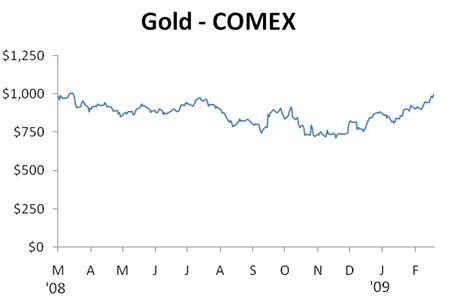
Gold briefly nudged over the $1,000 mark to $1006.43 on Friday, February 20, before settling back down to close at $993.25. It was the first time since last March that gold crossed the insignificant but satisfyingly round $1k level. Technical geeks would point out that it’s still below the high of $1012.55 hit March 18th, but that’s splitting hairs.

Of course, gold didn’t stay above $1,000/ounce for long last March; it quickly reversed course and traded down all year, before bottoming at $712.41 on November 20th. Since then, gold has risen 39.4%; it was up 13.4% in January alone.

The last time I wrote about gold (Demanding Gold) was just before that November bottom. Back then I discussed the underlying demand for gold – because one of the great things about commodities is that ultimately, they’re always about supply and demand. And with the gold-bug’s most important supply and demand report out for 2008, it’s the perfect time to revisit the subject. (The full link to the World Gold Council’s Supply and Demand Statistics for Q4 and Full Year 2008 report is here.)

Looking At Demand

Gold demand can be broken into three main areas of interest – jewellery, which accounted for roughly 58% of identifiable demand in 2008, industrial and dentistry demand, and finally identifiable investment demand.

On the whole, gold saw demand grow 4% from 2007 to 2008, but the picture is a bit more complex than just that.

Not everything was rosy for gold in 2008. As we predicted, jewellery demand was down significantly. In 2007 around 68% of gold demand was attributed to jewellery consumption. In 2008, that number dropped to 58%.

At the end of December, The World Gold Council released a report entitled “What Women Want: Global Discretionary Spending Report 2008“. In it, the WGC details the values and significance different countries attribute to gold jewellery and why people buy it. One new thing the study uncovered is that gold jewellery is now competing with items such as cell phones and other everyday items for discretionary spending.

The report also states that “confidence that gold will hold its value has waned,” reflecting in part the volatility gold prices have experienced in the past year. With gold rising and falling by 30% in a single year, it’s no wonder people are feeling less comfortable with it as a store of value.

Demand on the jewelry front appears to be price elastic. In India, the largest consumer of gold jewellery, demand in the fourth quarter more than doubled compared to Q4 of 2007. While this would seem to buck the year-long numbers, it’s likely due to the fact that lower gold prices occurred precisely at the time of the Diwali festival – a peak gold-buying time in India. In 2007, gold prices were high during the festival, which depressed demand. For the full year of 2008, jewellery demand in India dropped 15%.

China was one of the only countries that posted an increase in demand for jewellery, up 8% from 2007. Much of this demand was for 24-karat jewelry, which commonly implies jewellery purchases that are doubling as investments.

The Big Stick: Gold Bugs

According to the World Gold Council report, gold demand for investment rose from 663.7 tonnes in 2007 to 1090.7 tonnes in 2008 – a somewhat staggering year-on-year increase of 64.3%. Retail investment – things like bar hoarding, official coins, medals/imitation coins and other kinds of retail investment – almost doubled, going from 410.3 tonnes in 2007 to 769.3 tonnes in 2008. That gives some credence to the wide scale anecdotal evidence throughout the year that gold coins were virtually impossible to obtain in many countries.

Exchange-traded funds and similar products also showed a large increase, from 253.3 tonnes to 321.4 tonnes (a 26.9% increase). This trend has continued into 2009. The SPDR Gold ETF (NYSE: GLD) – the largest physical gold trust – now has 1,028.98 tonnes in its vaults. This is a trust that started 2009 with 780.23 tonnes, meaning its gold horde has risen 31.9% in less than two months. To put that in perspective, 249 tonnes is over 10% of the total amount of gold mined in all of 2008. This acceleration happened almost entirely in a dramatic surge mid-February.

Net-net, however, if you offset the huge rush in gold investments with the significant drop in jewelry demand, the net gain in tonnage terms was just 4%.

There is, however, another way to look at things. When viewed through the (occasionally depressing) lens of the dollar, gold demand seems endless:

Gold Supply in Flux

With the demand part of the picture in hand, it’s time to turn to supply. The third quarter of 2008 saw a huge supply deficit with demand far outreaching supply. In the fourth quarter, supply rose 19%, almost entirely due to an increase in gold scrap. Yes, that’s right: Those late night commercials offering to buy your old tangled gold necklaces were on to something, and people were selling.

Scrap sales for 2008 ended up 17% higher than 2007, and that along with slightly higher total mine supply just about offset lower central banks sales so that in the end, 2008 ended the year with only 1% less total supply than 2007 – practically even.

The moral of the story is simple: supply and demand remain incontrovertible laws. The unbelievable demand vs. the stagnant (mine) and dwindling (central bank) supply created a vacuum, and a new source came on line to fill the need. Thus, at least indirectly, gold went from the scrap heap into brand new shiny gold coins, just when the market needed them the most.

Which brings up the question: how long can consumers fill their own demand through scrap? And what price level is needed to support the tremendous scrap levels already in place?

=================================

Catch the New Bull! – Buy Gold Online – Get 1 gram free just for opening account– just click here and then again on the Gold Bar!, no minimums – Buy Safely, quickly, and at low prices, guaranteed! – Bullion Vault.com

==================================

 Five Weeks of Silver Backwardation – Seeking Alpha

By: Trace Mayer of Run to Gold.com

During an interview with Contrary Investors Cafe on 24 February 2009 I discussed both gold backwardation and silver backwardation. After the interview I was asked why more commentators are not discussing this issue. I do not know.

Regarding money there are two competing views: (1) money is determined by the market or (2) chartalism which asserts that ‘money is a creature of law.’ Governments can only manage money if they create it. Obviously, the market determines money because money existed before governments were created.

Regarding gold there are two competing paradigms: (1) gold is a commodity and (2) gold is money. Paradigm (1) asserts that gold is a hedge against inflation and there is no monetary demand for gold. On the other hand, paradigm (2) asserts that gold is a hedge against currency collapse and the primary demand for gold is monetary. I subscribe to the second paradigm and assert that at all times and in all circumstances gold remains money.

WHAT IS SILVER’S ROLE

Under which paradigm does silver fall? Is silver a commodity or is silver money? For a commodity to be money its primary demand must be monetary.

Like gold, for thousands of years silver functioned as money in the market. The term dollar, as used in Article 1 Section 9 Clause 1 and the Seventh Amendment of the US Constitution, is defined as 371.25 grains of fine silver under Section 9 of the Coinage Act of 1792. Governments stockpiled billions and billions of ounces. However, on 24 June 1968 the United States government defaulted on their silver certificates. Over the decades, silver, like gold, has been demonetized in ordinary daily transactions. Supposedly there are large stockpiles of gold in central bank vaults. Unlike gold there are no reported large above ground stockpiles of silver stashed in central bank vaults. Additionally, a large portion of silver demand is industrial as it is used in cell phones, refrigerators, dental equipment, computers, etc.

Therefore, it appears that silver is confused about its role. In other words, silver functions as a commodity and as quasi-money.

FIVE WEEKS OF SILVER BACKWARDATION

While similar, there are differences between future and forward contracts. For example, future contracts are traded on exchanges, use margin and are marked to market daily. In contrast, forward contracts are generally traded over-the-counter (OTC derivatives) and are not marked to market. Therefore, forward contracts are subject to greater counter-party risk than future contracts.

Because the primary reason backwardation arises is counter-party risk and because forward contracts are impregnated with greater counter-party risk than future contracts, therefore it is highly likely that backwardation would appear in the forwards markets before the futures markets.

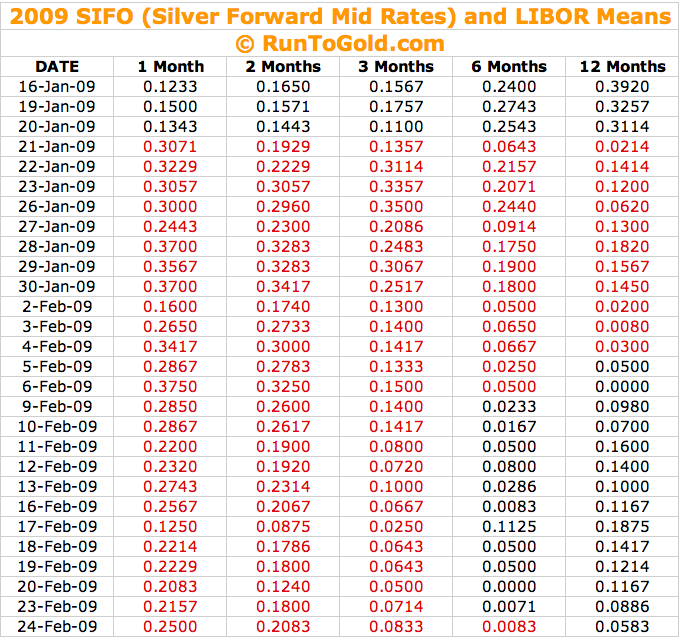
This is precisely what has happened. While the COMEX silver futures contract have not been in backwardation the LBMA Silver Forward Mid Rates have been in backwardation for five consecutive weeks. Of particular interest is the 6 month contract.

SO WHAT?

What does all this mean? Well, I think the backwardation reflects the market’s uncertainty of silver’s role as money. The chronic silver backwardation began on 8 December 2009, the same day I wrote about gold in backwardation, and silver was priced about $9.60. Currently silver is trading about $13.82. Predictably, the gold/silver ratio is narrowing. If the backwardation persists it will be interesting to see if silver’s price in illusory FRN$ continues rising.

In my opinion, as the great credit contraction grinds on and intensifies, the commodity silver will reassert itself as money and eventually currency. As I mentioned during the interview with Contrary Investors Cafe what would be really interesting is if the central banks decide to start hoarding silver!

In the meantime it may behoove those who are bullish towards silver to increase the pressure on physical silver delivery. For example, I purchased some beautiful Austrian philharmonics at the Cambridge House Investment Conference and Silver Summit over the weekend. The beautiful coin cost $20 which was an amazing $5.50 over spot.

While there are cheaper ways to purchase physical silver bullion, like GoldMoney, these huge premiums over spot beg the question: What is the real silver price? With the specter of counter-party risk driving silver into backwardation if there is a failure to deliver then it will likely cause the silver price to shift from the COMEX just like a failure to deliver would cause the gold price to shift from the COMEX.

Bottom line: Do not get caught with your paradigms down!

===============================

Catch the New Bull! – Buy Gold Online – Get 1 gram free just for opening account– just click here and then again on the Gold Bar!, no minimums – Buy Safely, quickly, and at low prices, guaranteed! – Bullion Vault.com

================================

Doug Casey: What to Do in “The Greater Depression” — Seeking Alpha

Source: The Gold Report


Bullion and oil appear in the lineup of power players that Doug Casey thinks investors can count on as the world slips deeper and deeper into what he calls the “Greater Depression.” Despite the raging economic storm and Doug’s doubts that Western civilization’s governments will take the actions needed to quell it, though, the Chairman of Casey Research is nowhere close to calling the game. In fact, he sees silver lining in the clouds of crisis—opportunity—and expresses optimism that technological advances, coupled with capital rebuilding once over-consumption runs its course, will prevail eventually. The Gold Report caught up with the peripatetic author, publisher and professional international investor between polo matches in New Zealand, one of several nation-states he calls home from time to time.


The Gold Report: You’ve been discussing what you’re calling “crisis and opportunity,” and in fact have a summit by that same name coming up in Las Vegas next month. Could you give us a high-level overview of what you foresee?

Doug Casey: We’ve definitely entered what I describe as the Greater Depression. It’s not coming; it’s here. It’s going to get much, much worse as far as I’m concerned and unfortunately, it’s going to last a long time. It doesn’t have to last a long time, but the root cause is government intervention in the economy and everything they’re doing now is not just the wrong thing, it’s the opposite of what they should be doing. It’s almost perverse.

The distortions and misallocations of capital and the uneconomic patterns of production and consumption that have been going on for over a generation need to be liquidated and changed, but everything the government’s doing is trying to maintain these patterns. So it’s going to be horrible. In addition, the government is necessarily directing more power toward itself with all of its actions. If I were you, I’d rig for stormy running for a good long time.

TGR: By “a long time,” do you mean a couple of years, a decade, a generation?

DC: This is, in some ways, uncharted territory. Let me say that for the long run I’m very optimistic. Why? Two things act as the mainsprings of progress. Number one is technology and that’s going to keep advancing, so that’s very good. Second is capital and savings. Individuals will solve their own problems and, therefore, they will stop consuming more than they produce, which is what they’ve been doing for years, and they’ll again start producing more than they consume. The difference is savings; that builds capital.

So technology and capital are going to solve the depression. But the government can do all kinds of stupid things to make it worse. Look at the Soviet Union. They suffered a depression that lasted 70 years from its founding. Look at China. The whole reign of Mao was one long economic depression. That could certainly happen in the U.S., too, where the government misallocates capital in such a way that technology doesn’t advance as it could and people can’t build individual capital the way they would. I’m optimistic, but anything can happen.

TGR: But didn’t China and the Soviet Union have governmental structures very different from those in Western Europe and the U.S., and those structures allowed for more intervention? Are you projecting that we might slip into an era where Western civilization will allow their government to run themselves like the Soviet Union and China did?

DC: It seems to be going in that direction. Of course, Europe is going to be hurt much worse than the U.S. Europeans are much more heavily taxed and much more heavily regulated. The average European is much more reliant upon the state psychologically as well as economically. So it’s all over for Europe and this doesn’t even count the problems that they’re going to have in the continuing war against Islam, which are much more serious for Europe than they are for the U.S. So, no, Europe is fated to be nothing but a source of houseboys and maids for the Chinese in the next generation.

TGR: So do you think that societies in Western Europe—and even the U.S.—will allow themselves to be governed in the same fashion as the Soviet Union and China were during their depressions?

DC: Oh, totally. I don’t see why that would not be the case. Even Newsweek says we’re all socialists now. That seems to be the reigning ideology. In addition, psychologically, the average American—just like the average European—looks to the government to solve things. This is very bad. Most people are unaware that Homeland Security, which is one agency that should be abolished post-haste, is building a 400-acre campus in southeast Washington, D.C., where initially they’re going to put 25,000 employees. That’s as many as the Pentagon has and with 400 acres, Homeland Security has a lot more room to grow. Ironically, the property is at the site of St. Elizabeth’s Hospital, the first federal insane asylum in the United States. Once a bureaucracy has a piece of real estate and builds buildings, it’s game over. They’re just going to accrete and grow and grow, so that’s one indication. The trend is clearly in motion.

It’s all over for the U.S. In fact, let me say this. America doesn’t exist anymore. What is left is not even these United States. That was decided in the 1860s. It’s the United States. America, which is basically an idea, a concept, is dead and gone. The United States is just another of 200 awful little nation-states that have spread across the face of the earth like a skin disease. There’s no longer any difference that I can tell between the U.S. and any other country.

TGR: How would you describe the concept that America was based on that is now gone? And is there another country in the world embracing that concept? Will there be a new America?

DC: No, there is no other place. I’ve been to 175 countries and lived in 12. My feeling is that the best thing that you can do is set your life up so that you’re not to be considered the property of any one government. You might have a passport or several passports and, therefore, that government thinks they own you. But if you don’t spend time in a country, practically speaking, there’s nothing they can do about it.

So, no, there is no real haven for freedom in the world today. The best you can do is go where the governments are so unorganized that they can’t control you effectively. That’s one reason I like to spend time in Argentina. They have an incredibly stupid government, but they’re also very inefficient and ineffective. So it’s wonderful as a place to live. I also spend time in Uruguay, because it’s a tiny little country with no ambitions to conquer the world. The nice thing about New Zealand, where I am now, is that it’s a small country, only 4 million people, lots of open land. It’s got some severe problems, but it’s pleasant. I think the U.S. is going to be the epicenter of a lot of problems in the years to come.

TGR: Few of our readers are probably in positions where they could live in 12 different countries, but they have amassed assets here in the United States. What advice would you give them to safeguard those assets?

DC: The key is to remember that we’re going to have a long and deep depression, so most things that worked well over the last 20 years are unlikely to work well in the future. I’d been predicting the real estate collapse for a long time. It’s still got a way to go, too, because a lot of real estate debt remains that has to be liquidated. There’s a lot of leverage out there and there’s been a huge amount of overbuilding. So it’s far too early to get into real estate, at least in North America or Europe.

It’s also way too early to get into the general stock market, for all kinds of reasons. Dividend yields are still extremely low. Earnings are going to collapse. Government bonds are perhaps the worst single thing to be in, because with the government printing up money literally by the bushel basket, the dollar is going to start losing value radically and interest rates are going to start going up radically at some point. So you have to rule out most stocks.

I’m afraid that the most intelligent thing you can do is to own a lot of gold, preferably gold coins in your own possession. And I think speculation in gold stocks makes sense at this point, because gold stocks are about as cheap as they’ve ever been relative to other assets, really, in history. Now is an excellent time to do that as well. But that’s in terms of speculation.

Investment risk is tough enough, but the biggest problem is political risk. That’s what you have to watch out for. That means you have to diversify internationally. This is harder for most people, harder psychologically, and it takes more assets to make international diversification viable. But if you’re in a position to do it, it’s the most important thing you can do.

TGR: Since you mentioned having coins in your own possession, should we assume you’re not a big fan of the ETFs or some of these other paper gold promises, if you will?

DC: ETFs are okay for the convenience that they offer and for significant amounts of money, but gold coins should be first on your list, no question about that. If you’re only talking about $50,000 or $100,000, or $200,000, coins are fine to keep in your own possession. They won’t take up much room and you can put them in some safe place (which, incidentally, is not a bank safe deposit box).

TGR: Are you recommending putting all of your investment in gold into the bullion or are you also recommending some portion in producing junior and explorations?

DC: Both, but look at the stocks as being speculative. Most of your money should be in gold with a bit of silver, too. Silver is basically an industrial metal, but it has monetary characteristics. Now is the time to be very overweight in the metals and I think owning gold stocks is a good idea. They’re very cheap.

TGR: Anything else investors can do to preserve whatever may remain of their wealth?

DC: Owning real estate in some foreign countries is a very good idea—from a lifestyle point of view, an asset diversification point of view, and a possible capital gains point of view, too. They can’t make you repatriate foreign real estate. Having some U.S. dollar cash while we’re going through this deflationary period is very wise as well, but that’s not going to last. Eventually the U.S. dollar is going to reach its intrinsic value.

TGR: Not that you have a crystal ball, but how would you see the rest of ’09 playing out?

DC: Nothing goes straight up or straight down, but it seems that ’09 is going to see much higher gold prices and much lower stock prices and much lower bond prices, too. But remember, the worst is yet to come.

You haven’t heard an awful lot about people losing their pensions yet, but that’s going to happen because what are pensions invested in? They’re mostly invested in stocks and bonds and commercial real estate. All three of those things are disaster areas, and bonds are the big disaster area yet to come. So I think it’s going to be nothing but bad news in 2009. What happened in 2008 was just an overture to what I think is going to happen in ’09 and ’10.

TGR: Even into 2010?

DC: Yes. This isn’t going to be cured overnight, mainly because of what the government’s doing. As I said, it’s perversely exactly the opposite of what they should be doing, which is abolishing all the agencies and freeing up the economy. They’re passing lots of new regulations, they’re going to have to raise lots of taxes eventually, and they’re inflating the currency. So it has to last, at least into 2010. It’s going to be quite dismal, actually.

TGR: And what happens with the unfunded Medicare liabilities?

DC: They’re not going to be funded. They’re going to be defaulted on and, actually, that’s the best thing that could happen. That’s one of the things that should be done now; the U.S. government should default on its debt. This is shocking for people to hear, but it wouldn’t be the first time the U.S. government has done that. It did that almost at its founding in continental days.

This debt represents a tax liability that’s being foisted off on the next generations who have no moral obligation to pay and should not pay. I think as an ethical point, the U.S. should default on this debt. It’s impossible to pay it back, and it won’t be paid back. It’s more honest to acknowledge that bankruptcy now as opposed to pretend it’s going to be paid back. Defaulting even might forestall runaway inflation in the dollar, which would be a catastrophe of the first order. So it’s the smart and moral thing to do, and it’s going to happen eventually anyway. All the real wealth will still be here; a lot of it will just change ownership. The big losers will be those who lent to the State, thereby enabling its depredations, and they deserve to be punished.

But even a default tomorrow will do no good unless you put the U.S. government into reverse and disband all of these ridiculous, destructive agencies that have grown like a cancer for years. Taxes should be cut 50% to start with, just out of hand. And the defense establishment—it’s a misnomer; it’s not defense at all but rather foments wars around the world—should be cut hugely. Not with a butcher knife; but a chain saw. But none of this is going to happen; in fact, just the opposite. That’s why I’m so pessimistic now that the tipping point’s finally been reached.

TGR: Are we at the tipping point?

DC: Yes, we’ve absolutely gone over the edge. The consumer is no longer in a position to consume. Everybody is going to cut consumption to the bone and hopefully find something to produce instead. It would be better for people to start viewing themselves as producers than consumers. That would be a step in the right direction to get them psychologically more in line with reality.

TGR: In last fall’s meltdown, gold held up, but the stocks didn’t. Quite a few producers and soon-to-be producers, and some companies making discoveries, seem to have bottomed out in November and December. But worry persists in the market. Suppose another shoe drops or another black swan appears? Richard Russell (Dow Theory Letters) and others have been talking about the Dow going down to 5,000. What would that do to the gold stocks?

DC: Gold stocks are also stocks, and the best environment for gold stocks historically has always been when both gold and the stock market are going up. But since the last gold stock bull market came to an end, I think it’s entirely possible to see a bubble develop in gold stocks with all the money being created. I certainly hope so. I’m actually optimistic for gold stocks just because they’re so cheap relative to everything else.

TGR: They have been beaten down.

DC: Yes. And that fact, along with the waves of money being printed around the world and the much higher gold prices we are going to see, could cause a speculative mania to develop in the gold stocks. Nobody’s even thinking about that possibility right now, because they’re so battered. But this is the time to get into the right ones because it’s likely to happen in the future.

TGR: The ’29 crash—which was really the preamble, because ’30, ’31, ’32 and ’33 were certainly bigger—is when gold stocks such as Homestake did their best. How do you see that playing out this time around? Is it different this time or do you expect a similar pattern?

DC: You know what they say, “History doesn’t repeat itself, but it rhymes.” I think that, first of all, the gold mining industry is a much worse industry now than it’s ever been in the past, because just as all the easily defined light sweet oil basically has been discovered, all the easy-to-find high-grade gold basically has been discovered. Most mines that are going into production are low-grade, which means that you have to move a lot of dirt, which means that they’re much more capital-intensive than in the past. So gold mining’s a worse industry from that point of view.

Also, politically speaking, with the rise of the green movement, there are people who don’t want any oil burned, any dirt moved, any trees cut. They don’t want to see anything happen. This makes it much harder to do gold from a permitting and political point of view. We’re in a much higher tax environment than in the past. So it’s a tough industry. It really is. It’s just a 19th century choo-choo train type of industry that interests me only as a speculative vehicle. You’ll notice that gold went from lows of about $300 to highs of about $900 and none of these gold companies are making any money because their costs actually went up faster than the price of gold. So I’m not saying gold mining is a great business. It’s not. It’s a crappy business. Still, we could have a bubble in the stocks. I’m hoping we do.

TGR: Aren’t we going to see a change in that in ’09? Oil, which is one of the large components of that cost, has come down dramatically. A lot of these producers must be locking in oil at these lower prices. Won’t that translate into year-over-year earnings increases for the gold producers?

DC: That’s possible. The producers actually may show increases for the next couple of years. I don’t doubt that. But I don’t think oil will stay where it is. I think oil’s eventually headed back to $150 a barrel or more.

TGR: So why wouldn’t you own oil as well as gold?

DC: It’s a good idea, but we weren’t really talking about oil. I’d say that oil is a good thing to own. Oil is a real buy now. It’s as good a buy at $40 as gold is at $900 right now. Maybe a better buy; who knows?

TGR: If we go into worldwide depression, will oil continue to be a good buy or will it self-regulate around this $40 a barrel?

DC: I am bullish on oil. Although I’m philosophically not very sympathetic to the peak oil theory, I think it’s a geological fact. Also, China and India and the other developing parts of the world don’t use a whole lot of oil now. As they develop, they will to want—and almost need—to use a lot more oil. That’s going to keep pressure up on the demand side. But the supply side actually finally is constrained, so it’s going to mean higher prices. In a depression-type environment, U.S. and Western oil consumption could drop a lot, but the third world would take up most of that slack. So I have to be bullish on oil.

TGR: Are you bullish on any other sectors or commodities?

DC: I’m bullish on agricultural commodities. They ran way up last year and then collapsed again. I think a good case can be made that most of the soft commodities are quite cheap and will go higher, so I’d look at those, too. I think gold definitely, oil in the years to come has the potential to go much, much higher, and the agricultural commodities have a lot of potential.

TGR: Gold appears to be uncoupling from the dollar. Historically, when the dollar was strong, gold would be weak. But we’ve had a couple of recent instances in which both the dollar and gold have been strong. Obviously, we’ve seen a total decoupling of gold from oil. It used to be when oil was running, gold was running and vice versa, but that no longer seems to be the case. Is that just an old wives’ tale or is something going on?

DC: I’ve never seen any necessary relationship between gold and oil, just like there’s no necessary relationship between rice and natural gas, or nickel and soybeans. All these commodities tend to move together, all the currencies tend to move together and stock markets tend to move together, but they all have their own dynamics. I think it makes sense to compare the relative prices of various commodities and see what may be cheap or dear relative to other things based on the fundamentals.

On any given day, somebody may have to buy or somebody may have to sell a huge amount of almost anything. It’s unpredictable and you can’t tell what constraints are out there in the market. I don’t even pay attention to day-to-day fluctuations because they’re just random noise. I watch the big trend. It’s been shown that if you just made one correct trade and stuck with it at the beginning of every decade for the last four decades, you would have realized something like 1,000 times on your money. To me, this is the proper approach to the markets, not to try to second-guess from day-to-day what’s going to happen. That’s foolish because you get chewed up with commissions and bid-ask spreads and double-thinking your own psychology and so forth.

I really just like to look at long-term trends. In terms of long-term trends, you’ve got to be long gold, long silver, long oil; you’ve got to be short bonds. I think that’s really all you need to know. The other things we mentioned such as agricultural commodities and so forth are worthy of attention. But, as I said, I’m not a day-to-day trader. I think that’s very foolish.

TGR: Are these the themes that you and your group of speakers will focus on in Las Vegas?

DC: They are. I certainly want to invite anybody who reads this interview to join us. We put on very small, very classy seminars. They’re not gigantic mob scenes, so it’s possible to get to know individual speakers and fellow attendees in a very collegial atmosphere. I think it’s something that anybody who’s seriously interested in these kinds of things should consider.

The Casey Research Crisis & Opportunity Summit, will be held March 20 – 22, 2009, at the Four Seasons Resort in Las Vegas.

A citizen of the world in more ways than most of us can imagine, Doug Casey, Chairman of Casey Research, LLC, is the international investor personified. He’s spent substantial time in about 200 different countries so far in his lifetime, living in 12 of them (currently New Zealand and Argentina). And Doug’s the one who literally wrote the book on crisis investing. In fact, he’s done it twice. After The International Man: The Complete Guidebook to the World’s Last Frontiers in 1976, Doug came out with Crisis Investing: Opportunities and Profits in the Coming Great Depression in 1979. His sequel to this groundbreaking book, which anticipated the collapse of the savings-and-loan industry and rewarded readers who followed his recommendations with spectacular returns, came in 1993, with Crisis Investing for the Rest of the Nineties. In between, his Strategic Investing: How to Profit from the Coming Inflationary Depression (Simon & Shuster, 1982) broke records for the largest advance ever paid for a financial book. Bill Bonner (The Daily Reckoning) describes Doug as “smart, hard-working, and extremely knowledgeable” with “an instinct about investments that has made him and many of those around him very rich.”

 Doug, who now spends more time as an expatriate than he does on American soil, has appeared on NBC News, CNN and National Public Radio. He’s been a guest of David Letterman, Larry King, Merv Griffin, Charlie Rose, Phil Donahue, Regis Philbin and Maury Povich. He’s been the topic of numerous features in periodicals such as Time, Forbes, People, US, Barron’s and the Washington Post – not to mention countless articles he’s written for his own various websites, publications and subscribers.

 ==================================

Catch the New Bull! – Buy Gold Online – Get 1 gram free just for opening account– just click here and then again on the Gold Bar!, no minimums – Buy Safely, quickly, and at low prices, guaranteed! – Bullion Vault.com

That’s all for Today- Enjoy! jschulmansr

Follow Me on Twitter and be notified whenever I make a new post!

================================== 

Nothing in today’s post should be considered as an offer to buy or sell any securities or other investments; it is presented for informational purposes only. As a good investor, consult your Investment Advisor/s, Do Your Due Diligence, Read All Prospectus/s and related information carefully before you make any investing decisions and/or investments. –  jschulmansr


Share this:

  • Click to share on Reddit (Opens in new window) Reddit
  • Click to share on Facebook (Opens in new window) Facebook
  • Click to share on LinkedIn (Opens in new window) LinkedIn
  • More
  • Click to share on X (Opens in new window) X
  • Click to share on Pinterest (Opens in new window) Pinterest
  • Click to share on Tumblr (Opens in new window) Tumblr
  • Click to print (Opens in new window) Print
  • Click to email a link to a friend (Opens in new window) Email
Like Loading...

Are you going to let them do this?

23 Monday Feb 2009

Posted by jschulmansr in 10 year Treasuries, 20 yr Treasuries, Austrian school, Bailout News, banking crisis, banks, bear market, capitalism, Comex, commodities, Copper, Credit Default, Currencies, currency, Currency and Currencies, deflation, dollar denominated, dollar denominated investments, economic, Economic Recovery, economic trends, economy, Fed Fund Rate, Federal Deficit, federal reserve, Finance, financial, follow the news, Forex, Fundamental Analysis, futures, futures markets, gata, GDX, GLD, gold, Gold Bullion, Gold Investments, gold miners, Gold Price Manipulation, inflation, Investing, investments, Junior Gold Miners, Latest News, Make Money Investing, manipulation, market crash, Markets, monetization, palladium, physical gold, platinum, platinum miners, precious metals, price manipulation, prices, producers, production, run on banks, Short Bonds, silver, silver miners, Silver Price Manipulation, spot price, stagflation, Stimulus, Stocks, TARP, Technical Analysis, Ted Bultler, The Fed, U.S., U.S. Dollar, XAU

≈ Comments Off on Are you going to let them do this?

As I write there is selling pressure or maybe price manipulation on the gold market right now. Are we going to let them do this? Especially with everything else in the markets i.e. the dollar, banks, stock markets in chaos and dissarray? The best way to fight back is to keep buying gold especially on Comex and taking delivery. That would catch them and for once the little guy wins! The Gold price is holding steady at $990 oz after being tested early this morning, Gold bounced right off the $975 – $977 support and is now holding steady. Today’s articles do talk about the manipulation going on in the Gold and Silver markets. To date the largest short positions and majority of the short interest on Comex consists of a few banks who went short in the $750 to $950 range ( I know a large spread but they have been cost averaging their positions). If all the longs would start taking possesion of their gold and silver off of Comex, I am telling you this, we would have one of the largest “Short Squeezes” in history! – Good Investing! -jschulmansr

 =======================================

Catch the New Bull! – Buy Gold Online – Get 1 gram free just for opening account– just click on the Gold Bar!, no minimums – Buy Safely, quickly, and at low prices, guaranteed! – Bullion Vault.com 


“Nothing will unnerve the paper gold shorts more quickly and do more to undercut their confidence than to strip them of the real metal and force them to come up with more hard gold bullion to make good on deliveries. “Stand and Deliver or Go Home” should be the rallying cry of the gold longs to the paper gold shorts.” –Trader Dan Norcini
=======================================

This is an older article which explains the manipulations which have been going on. The same banks still hold teir positions of as last published Comex reports.– jschulmansr

Chris Powell: Gold and Silver Market Manipulation Update – Gold Anti Trust Action Committe GATA

Submitted by cpowell on Fri, 2008-11-14 20:51. Section: Essays

Good afternoon and thank you for being here. It’s an honor to get to speak with so many interested in silver, especially at such an interesting time in history. I’m going to ramble a bit, and try not to get too detailed and save some time for questions where you can get specific.

Remarks by Chris Powell, Secretary/Treasurer
Gold Anti-Trust Action Committee Inc.
New Orleans Investment Conference
New Orleans Marriott Hotel
Thursday, November 13, 2008

A year ago it was still a struggle to persuade some people that the gold and silver markets were being manipulated by Western central banks. Now, after months of financial turmoil around the world and constant central bank intervention in the markets, to believe that the gold and silver markets are not being manipulated by central banks you have to believe that those markets are the only markets not being so manipulated.

Why are the gold and silver markets manipulated by governments and the financial houses that serve as their agents? Because gold and silver are competitive currencies and because their value greatly influences interest rates, which ordinarily governments like to keep low. 

 Last year at this conference I reviewed in detail the official documentations and admissions of the gold price suppression scheme. Those documentations and admissions remain posted at GATA’s Internet site:

http://www.gata.org/node/5654 

Today I’d like to review some evidence that has turned up more recently, as well as some related developments.

Maybe most interesting have been the studies of the U.S. Commodity Futures Trading Commission market reports done by silver market analyst Ted Butler and by Gene Arensberg, a market analyst for ResourceInvestor.com. Butler and Arensberg reported that as of August just two banks held more than 60 percent of the short positions in silver on the New York Commodities Exchange. This was an unprecedented and seemingly illegal concentrated short position, and it implied that the smashing down of silver was very much a manipulation by one or two very rich and powerful market participants, a destruction of the free market. Complaints about this concentrated short position prompted the CFTC to undertake still another investigation of the silver market, this time by a different division of the commission, its enforcement division. Further, CFTC Commissioner Bart Chilton has told GATA that the agency is investigating the gold market as well.

This week Arensberg found that the CFTC’s latest report shows that just three or fewer banks now hold half the short positions in gold on the Comex and more than 80 percent of the silver short positions.

Also this week Butler obtained a copy of a letter from the CFTC to U.S. Rep. Gary G. Miller, R-California, that sought to explain the concentrated short position in silver. The CFTC’s letter implied that this extreme short position resulted from JPMorganChase’s acquisition of Bear Stearns in March. If we construe the CFTC’s letter correctly, that would make MorganChase the big short in silver now and imply that, in financially underwriting MorganChase’s acquisition of Bear Stearns, the Federal Reserve was also underwriting MorganChase’s assumption of that short position in silver.

Of course MorganChase was also the bullion banker to Barrick Gold, the biggest gold shorter over the last decade. In 2003 Barrick told U.S. District Court Judge Helen Berrigan right here in New Orleans that, in shorting gold, Barrick had become the agent of the central banks in regulating the gold market and thus should share their sovereign immunity against lawsuits.

MorganChase is also the world’s biggest issuer of interest-rate derivatives, instruments by which interest rates are suppressed.

All this causes GATA to believe that MorganChase is in effect an agency of the U.S. government, or rather, perhaps, that the U.S. government is an agency of MorganChase. In any case, MorganChase has had an intimate relationship with the U.S. government since the days of J. Pierpont Morgan himself.

Incidentally, Jean Strouse’s 1999 biography of Morgan, which won the Bancroft Prize for American History and Diplomacy, recounts that Morgan’s first big triumph in finance was to corner the gold market in New York in 1863 during the Civil War. Nearly 150 years later there really may be nothing new under the sun.

Also lately raising suspicion about surreptitious government intervention in the precious metals markets has been the refusal of the Federal Reserve and the Treasury Department to release to GATA hundreds of pages of government documents about the disposition of the U.S. gold reserve. The Fed has told GATA’s lawyers that the documents are being withheld in part because their release might compromise information that is proprietary to private companies. Why anything about the U.S. gold reserve should be considered proprietary to anyone is beyond those of us at GATA — unless, of course, the reserve is being used to manipulate markets surreptitiously.

But we at GATA do not feel picked on by the Fed and the Treasury. For the Fed and the Treasury seem to be treating everybody as if the disposition of public assets is nobody’s business but Wall Street’s. This week Bloomberg News Service reported that the Federal Reserve is refusing to disclose how much it has lent to particular banks and exactly what sort of collateral the Fed has accepted for those loans, which have reached hundreds of billions of dollars. For example, is the Fed valuing the same kind of collateral from different borrowers the same way, and lending against it at the same rate? Or is the Fed giving advantages to certain borrowers and not others, depending on their political influence and straitened circumstances? That is, are the Fed and the Treasury Department now being operated as the greatest patronage and market-rigging schemes in history? The government is concealing the evidence.

Since we last gathered here in New Orleans many of us been cowering under the prospect of more official-sector gold sales, particularly gold sales by the International Monetary Fund, which has approved a plan of selling gold to raise cash to replace the income it is no longer getting from interest on loans to developing countries. But despite more than a year of loud talk about it, the IMF has not sold any gold yet, and GATA suspects that the IMF really does not have the 3,200 tonnes it says it has, only a tenuous claim on the gold reserves of its member nations, particularly the United States, which has a veto on any IMF gold sales and has not approved any yet.

Back in April I tried to engage the IMF in a dialogue about its gold and I had an exchange by e-mail with an IMF publicist, Conny Lotze.

My first question was: “Your Internet site says the IMF holds 3,217 metric tons of gold ‘at designated depositories.’ Which depositories are these?”

Conny Lotze of the IMF replied, but not specifically. She wrote: “The fund’s gold is distributed across a number of official depositories,” adding that the IMF’s rules designate the United States, Britain, France, and India as depositories.

My second question was: “If you’d prefer not to identify the depositories for security reasons, could you at least identify the national and private custodians of the IMF’s gold and the amounts of IMF gold held by each?”

Conny Lotze replied, again incompletely: “All of the designated depositories are official.”

My third question was: “Is the IMF’s gold at these depositories allocated — that is, specifically identified as belonging to the IMF — or is it merged with other gold in storage at these depositories?”

Conny Lotze replied, still not very specifically: “The fund’s gold is properly accounted for at all its depositories.”

My fourth question was: “Do the IMF’s member countries count the IMF’s gold as part of their own national reserves, or do they count and identify the IMF’s gold separately?”

Conny Lotze replied a bit ambiguously: “Members do not include IMF gold within their reserves because it is an asset of the IMF. Members include their reserve position in the fund [the IMF] in their international reserves.”

This sounded to me as if the IMF members are still counting as their own the gold that supposedly belongs to the IMF — that the IMF members are just listing the gold assets in another column on their own books.

My fifth question was: “Does the IMF have assurances from the depositories that its gold is not leased or swapped or otherwise encumbered? If so, what are these assurances?”

Conny Lotze replied: “Under the fund’s Articles of Agreement it is not authorized to engage in these transactions in gold.”

But I had not asked if the IMF itself was swapping or leasing gold. I had asked whether the custodians of the IMF’s gold were swapping or leasing it.

This prompted me to raise one more question for Conny Lotze. I wrote her: “Is there any audit of the IMF’s gold that is available to the public? I ask because, if the amount of IMF gold held by each depository nation is not public information, there doesn’t seem to be much documentation for the IMF’s gold, nor any documentation for the assurance that its custody is just fine. Without any details or documentation, the IMF’s answer seems to be simply that it should be trusted — that it has the gold it says it has, somewhere.”

And Conny Lotze … well, she never wrote back to me again. After all, I had uttered the dirtiest word in government service: A-U-D-I-T.

That the International Monetary Fund refuses to account for the gold it claims to have should be potential news for the financial media. It would be nice if the financial media pursued that issue before their next attempt to scare the gold market with stories about IMF gold sales.

But even if such sales by the IMF should be undertaken, they might not be much for gold investors to worry about. For a month ago I happened to attend in New York City the annual fall dinner of the Committee for Monetary Research and Education, and it had an unscheduled speaker, Columbia University Professor Robert Mundell, who, as you may recall, won the Nobel Prize in economics in 1999 and is regarded as the father of the euro. Through great luck I got to sit next to Mundell on the platform and so heard him clearly as he went out of his way to join the discussion of my topic, gold. Mundell remarked that if the IMF sold any gold, China should buy all of it to diversify its foreign exchange reserves. Since Mundell is a consultant to the Chinese government, the Chinese government surely heard this advice from him long before the CMRE meeting did.

You can do a lot of market rigging when you can print legal tender to infinity, pass out huge amounts of it to your friends, and induce them to use derivatives to siphon speculative demand for real stuff away from actual possession of that real stuff. But in the end printing legal tender and contriving promises to deliver real stuff don’t produce real stuff. With infinite legal tender and derivatives you can push the futures price of a commodity below its production costs and below its free-market price for a while, but you risk causing shortages. And of course that’s what we have in gold and silver right now — falling prices for the paper promises of metal even as little real metal is to be had and the spread between the futures price and the real price grows. Last night a GATA supporter in Bangkok, Thailand, who long has been in the silver business e-mailed me that real silver there is priced at $18 per ounce for orders of 1 kilo or more and $23 per ounce for smaller orders. Our friend in Bangkok added that when he shows silver dealers there the New York silver futures price on the Internet, they laugh at him. Shortages can have various causes but generally they are their own cure. When shortages persist, they well may result from government intervention in markets.

Of course prices always have been determined to a great extent by the volume and velocity of money and credit, and so the creation of money and credit is, all by itself, inevitably an intervention into markets. But lately money and credit have been disappearing and reappearing in a flash in the billions and trillions. How can so much come and go so quickly? Maybe because what passes for money and credit today is a bit too ephemeral, having little connection to reality and a lot of connection to politics.

That is why market advice today is more doubtful than ever: Markets have become more politicized than ever. Supply and demand and profitability are no longer the primary determinants of markets. No, the primary determinant of markets is now politics: Which countries will cut interest rates the most? Which countries will subsidize their banks and corporations the most? Which countries will get IMF and World Bank loans? Which countries will be given unlimited currency swap lines and which won’t? Which companies will get bailed out and which won’t? How much more dishoarding of gold will central banks do to keep the price down, and which central banks? When will central banks run out of gold or decide to stop spending it this way? Most importantly, when will the world decide to stop financing the wild irresponsibility of the United States by lending the U.S. money that can never be repaid?

These are all political questions, and only political decisions will answer them. Some of these questions may be answered as soon as this weekend at the international conference in Washington. Answers to some of the other questions probably will be conveyed in advance to certain insiders — like the financial houses that serve as the market agents of the central banks — and those insiders will get richer. As good as this conference is, you will not be hearing from any of those insiders here.

But we may gain some confidence from politics too, since we know that governments are no longer shy about intervening in the markets and since central banking was invented precisely to inflate, to avert debt deflation, to devalue the currency when that is deemed necessary or convenient by those in power — which is most of the time. We know that the world is now drowning in debt, and in a research paper published in May 2006 a British economist, Peter W. Millar — founder of Valu-Trac Research in London, formerly an executive with the Abu Dhabi Investment Authority — forecast that to avert debt deflation and to increase the value of their monetary reserves, central banks would need to increase the value of gold by at least 700 percent and maybe by as much as 2,000 percent. This could be done easily, for to increase the value of their monetary reserves central banks need only to stop selling and leasing gold and to stop subsidizing the sale of gold derivatives by their agents, the financial houses. Revalued high enough, gold could cover all government debts and let the world start over again.

Millar kindly has given GATA permission to post his research paper at our Internet site, and you can find it here:

http://www.gata.org/files/PeterMillarGoldNoteMay06.pdf

When Millar made his forecast about such an upward revaluation of gold — 2 1/2 years ago — gold had just reached $700 per ounce, not far from where it is now. Multiplied by 700 percent, that would mean a gold price of about $5,000 per ounce. Multiplied by 2,000 percent … well, if that happens, we may be able to afford to hire someone to do the math for us — if, of course, those of us who do not live in free countries like China and Russia are allowed to keep our gold. But that is still another political question.

 ==========================


 “Nothing will unnerve the paper gold shorts more quickly and do more to undercut their confidence than to strip them of the real metal and force them to come up with more hard gold bullion to make good on deliveries. “Stand and Deliver or Go Home” should be the rallying cry of the gold longs to the paper gold shorts.” –Trader Dan Norcini
==========================

 Gold’s Assault on the Clueless – Rick’s Picks

By: Rick Ackerman of Rick’s Picks

We’ve been monitoring gold’s vital signs closely, since any foray above $1000 is cause for nervousness. The yellow stuff has always been free to roam, and even to misbehave, below that threshold; but once above $1000, the bankers regard each rally with a glower of malice.  While it is clear that debt deflation’s overwhelming power has rendered the central banks impotent in their efforts to arrest the collapse of the global economy, the bankers still retain the ability to crush any hint of rebellion by gold bulls who would deign to challenge the monetary order. With their relatively large stocks of physical gold, and the complicity of institutional agents such as JP Morgan to help suppress “paper gold” in futures markets, the bankers and the IMF have enough influence over bullion’s price to temporarily suspend the laws of supply and demand.


panic-small


The politicians are on board, of course, although not as conspirators. They are all knee-jerk Keynesians at the moment, either too stupid and/or lacking in imagination to understand why fiscal spending, no matter how much of it, cannot possibly extricate the economy from a deflationary black hole. They have put their trust in eggheads and MBAs to fix things, even if most of us have begun to suspect that throwing yet more trillions of dollars into the maw of deflation will not solve anything. And although our elected leaders might not feel so strongly about gold as Keynes, who was appalled by the popular appeal of “that barbarous relic,” they are nonetheless dumbfounded as to why anyone would prefer gold-backed currency to the Monopoly money that The Government has empowered as legal tender.

 Concerning our immediate outlook for gold, we have identified 1025.20 as the next significant point of resistance for the Comex April contract. The number is yet another in a series of  Hidden Pivots that have told us unequivocally and at each step along the way whether buyers were ready to forge effortlessly higher. So if 1025.20 gives way easily, as other points of resistance already have, we’re ready to infer that the benighted acolytes of Keynes are about to get fragged by investors who are growing increasingly restless, if not to say panicky, about The Government’s apparent powerlessness to ameliorate economic distress.


(If you’d like to have Rick’s Picks commentary delivered free each day to your e-mail box, click

==========================================

Catch the New Bull! – Buy Gold Online – Get 1 gram free just for opening account– just click on the Gold Bar!, no minimums – Buy Safely, quickly, and at low prices, guaranteed! – Bullion Vault.com

 ====================================

Only Seller Left? – Silver Seek

Source: Silver Seek  Author: Ted Butler

Another week, another data release from the CFTC proving manipulation in the silver market. The most recent Commitment of Traders Report (COT) provides additional compelling evidence that the COMEX silver market is manipulated. The new report proves manipulation so clearly, as to make it almost undeniable. In recent weeks and months, it appears that all the additional short sales of COMEX silver futures contracts are coming from one entity. If true, there could be no clearer proof of manipulation.
I am going to try to make this as simple as possible, but it does involve different facts and figures. It is very clear and simple to me, but that is because I have spent decades studying this data. I hope I can make it clear enough for both you and the CFTC to understand. This is not about whether silver is manipulated, as that’s a given. This is about whether I can explain and prove it.

The COT, for positions as of the close of business February 10, the total commercial net short position increased by 1864 contracts for the week. However, the net short position of the 4 largest traders increased by 2832 contracts. This means that of all the commercial traders, the only short selling came from the 4 largest traders, with all other commercial traders (the 5 through 8 largest traders and the raptors, the 9+) buying. This was very unusual, in that the commercials generally operate as one cohesive unit, all buying on the way down in price and selling on the way up.

Even more unusual is that this pattern has persisted back to the December 22, COT report. On an almost $2.50 rise in the price of silver since then, the total commercial net short position has increased by 4357 contracts, yet the big 4 have increased their net short position by 5396 contracts. This means all new short selling in COMEX silver has come from the biggest traders, for the first time in memory. That should be enough for any semi-alert regulator to conclude manipulation, as such concentrated short selling by so few participants should have every alarm and whistle blaring at CFTC headquarters. After all, there could be no clearer motive for such selling – the capping of price for the purpose of protecting already obscenely large short positions.

But even while it is easy to conclude that all new short selling is coming from the same four or less large traders, where do I get off suggesting it is one entity behind all the new silver short selling over the past 7 weeks? Here we have to look at another CFTC data source, the Bank Participation Report. Since the Bank Participation Report (BP) is a monthly publication, while the COT is weekly, we must make appropriate calibrations between the reports. The two most recent BP reports are as of January 6 and February 3. Using those two reports, plus the COTs of the exact same dates, this is what the reports show. Between those two dates, the COT indicates that the total commercial short position increased by 2253 contracts, with the big 4 category increasing by 2256 contracts, once again accounting for more than the entire increase in the commercial category.

The Bank Participation Reports corresponding to January 6 and February 3 indicate that the two U.S. banks increased their net short position by 2500 contracts in that same time period. This proves, at least during this specific period of time, that one or two U.S. banks accounted for more than 100% of all the commercial short selling and all the selling in the big 4 category. One or two entities, accounting for more than 100% of all total short selling for more than a month is manipulation. Period. It can only have occurred to attempt to cap the price and protect the existing short position.

Please remember that while I have been documenting the incremental changes in the concentrated short position of what may be one large trading entity, those changes are small compared to the total short position of this entity, which I estimate to be back above 30,000 contracts, or 150 million ounces. That’s more than 22% of the entire annual world mine production of silver. It is impossible for such a large concentrated short position not to be manipulative.

I’m fed up with the CFTC and their so-called investigation. They claim to be investigating , while the manipulation grows more obvious. I think we’ve passed the point where we can eliminate incompetence as the explanation for their inaction. I have a good idea of what is behind their refusal to right a very obvious wrong, although I won’t get into those details here. Let me just remind them that while they may fear the possible ramifications of a truly free silver market, after decades of manipulation, the greatest damage is their abandonment of the rule of law.

(Editor’s note – here’s a detailed report of Ted Butler’s past and present dealings with the CFTC regarding the silver manipulation –

http://www.investegate.co.uk/invarticle.aspx?id=66705)


====================================

“Nothing will unnerve the paper gold shorts more quickly and do more to undercut their confidence than to strip them of the real metal and force them to come up with more hard gold bullion to make good on deliveries. “Stand and Deliver or Go Home” should be the rallying cry of the gold longs to the paper gold shorts.” –Trader Dan Norcini

====================================

Silver, Past, Present, Future – Phoenix Silver Summit Speech – Silver Seek

Source: SilverSeek.com

By: Theodore Butler


I’d like to acknowledge a few people who are not here that had an awful lot to do with me being here today. First, I’d like to thank Jim Cook, from Investment Rarities in Minneapolis, for his sponsorship of my work for more than eight years. It was this support that enabled me to devote all my time to studying and contemplating everything I could about silver. Thanks, Jim.

Second, I’d like to thank my friend of 25+ years, Israel Friedman. It was Izzy, who back in 1984, issued to me the challenge to prove him wrong in his analysis of silver. Although I had traded and invested in silver for years before his challenge, I admit to never having studied it in depth. Izzy’s claim that the world was and had been consuming more silver than was being produced seemed so at odds with the price at that time, that I took up his challenge. I also admit that I thought it would be easy to prove him wrong, although I was well aware of his buying of silver in the $4 range and then selling it in the $40 range a few years later. When I discovered that he was correct, it set off a thought process that I couldn’t satisfy. I couldn’t reconcile how there could be greater demand for an item than there was current production with prices not moving higher. I’m sure that many had also been deeply perplexed with that puzzle.

For some reason, rather than to simply dismiss and put out of mind something I couldn’t figure out, I thought long and hard about the silver supply/demand/pricing enigma. It was that thought process, plus my background as a commodity broker, that led me to the conclusion that the silver market was manipulated by excessive short selling on the COMEX. The actual Eureka Moment came one day as I reading the Wall Street Journal Commodity Tables. It wasn’t an accidental discovery. I was looking for something wrong. I was looking for anything that was different about silver that could account for it’s very different behavior compared to other commodities. After all, we were all taught that when consumption is greater than production, price must rise. Yet silver didn’t. The light bulb went off in my head when I realized that COMEX open interest, when converted into real world supplies was completely out of line with every other commodity. This meant that the derivatives market in silver was larger than the underlying host market from which it was derived. A complete absurdity. The paper market tail was wagging the physical market dog. This is something that has remained constant in the subsequent 25 years of manipulation.

Much later, I would come to understand the role of leasing in the silver manipulation, which answered a lot of open questions in my mind. It was Izzy who caused me to be bitten by the silver bug, just as I may have, in turn, infected others, who in turn infected still more. The good news about this silver virus is that instead of giving you the flu or killing you, it could make you rich. For introducing me to silver, thanks Izzy

Finally, I’d like to thank my wife, Mila, who has been subjected to my preoccupation of silver for the entire duration. While I have both suffered along the way and enjoyed the journey, it was always my choice to continue or not. I know it was much harder for Mila as a partner, and a I marvel at her ability to persevere where I know I could not, were our roles reversed. Thanks Mila.

The Past.

The silver story goes back, quite literally, for thousands of years. You won’t find many stories of longer duration, except if you’re an archeologist. For those thousands of years, it was prized as money and jewelry and for ornamental objects and as a measurement of wealth. Silver’s history is similar to its precious metals brother, gold. Both precious metals were the cause of exploration and the discovery of new worlds, and instrumental in the development and formation of nations, including war. Both gold and silver were dug out of the ground and held and accumulated throughout the ages. For use as money, governments for hundreds of years assigned a fixed ratio of roughly 15 to 16 ounces of silver being worth one ounce of gold. This made sense, because that ratio was close to the rate at which silver came out of the ground compared to gold. There was a lot more silver accumulated above ground than gold, so it further made sense that 16 ounces of silver was equal to one ounce of gold. In the late 1800’s tremendous new silver production came to market, due to the massive supplies from the Comstock Load in the western US. Coupled with a demonetarization of silver, but not gold, by many world governments the price of silver plummeted and with that the amount of silver needed to buy one ounce of gold rose to 100 ounces in the 1920’s. The world was truly awash in silver.

Coincident with these developments, starting about 100 to 150 years ago, around the same time that the world found itself awash in silver, something else dramatic was occurring. We began to enter the industrial age. Inventions and devices of all kinds began to be introduced, impacting the world as never before. Electricity came into wide use. The automobile was born. Photography was introduced. As dramatic as this overall change was to how people lived, the transformation in silver was even more dramatic. It turned out that the substance that the world was awash in, the substance that had been accumulated for thousands of years, had properties that no one could have contemplated through the vast sweep of history. This largely too abundant material was a perfect fit for the rapidly transforming modern and industrial world. Silver was, and is, the best conductor of electricity, the best heat transfer agent, the best reflector of light, a marvelous lubricant, a versatile catalyst and alloy for a wide range of industrial applications, including medical. Silver was the key ingredient that made photography possible. All these uses, plus abundant supply and cheap prices. It was the perfect consumption set up. And consuming silver is something the world took to in a very big way, until this very day.

It was the push into the modern age that caused a parting of the ways between silver and gold in how they were used. Gold has many potential industrial applications, although not near as many as silver. But because gold was, and is, so high-priced compared to silver, it wasn’t practical to use it in widespread industrial applications. Because silver was so cheap and abundant, it was used extensively. So extensively, that not only did the world begin to consume every ounce of silver that was taken from the ground, it also began to consume the accumulated inventory from the past.

In 1940, there were approximately 10 billion ounces of silver above ground in the world, with half owned by the US Government. At that time, there was about a billion ounces of gold. Ten times more silver existed in the world than gold. After more than 60 years of over-consumption of silver, of drawing down and depleting the inventories built up over hundreds and even thousands of years, the relationship of how much silver exists above ground compared to gold has flipped. Now there is much more gold left in the world than silver. Currently there are up to 5 times more gold in the world than silver, depending on how you define inventory. Silver inventories have declined from 10 billion ounces in 1940 to 1 billion today. The U.S. government, the largest owner of silver in 1940, with over 5 billion ounces, now owns zero ounces. Gold world inventories, including jewelry, have increased from 1 billion ounces in 1940 to 5 billion today, according to all reputable sources like the World Gold Council.

I ask you to think about that for a moment, there being more gold than silver aboveground, as this is one of the most important factors in silver today. It is also one of the least known facts, even though it is easily verifiable and has evolved over such a long time. When people first hear or read it, they instinctively disbelieve it. 99.9% of the people on the planet, to this day, would tell you that it can’t possibly be true that there is more gold than silver in the world. Or even that there is an equal amount of gold and silver. None of this 99.9% has ever taken even a minute to think about it or read or try to verify how much of each remains above ground. They don’t have to. Their verification comes everyday, as it has everyday for decades, from one simple source – the daily price of each. The price of silver and gold is broadcast constantly, to every nook and cranny around the world, that there are 60 to 70 to 80 times more silver in the world than there is gold. That’s what 99.9% of the people in the world think. And I’m not just talking about uneducated people in third world countries. I would include the most sophisticated, wealthy and educated people, who have come to believe that the price doesn’t lie. I do hope 99% of the people here don’t think that.

It is this simple fact, that the relative price of silver compared to gold is so distorted, relative the their respective quantities in existence, that is all anyone needs to know to buy silver. This is not a knock on gold. I will stipulate to and accept as true every bullish argument that anyone could make on gold. You could spend hours or days lecturing me on all the good things that gold has going for it, and I will accept them without dissent. When you are done giving all the bullish gold arguments, I would just add two things. One, all those arguments apply to silver as well, and two, there is less silver than gold.

I’m compressing hundreds and even thousands of years of silver history into a few minutes of time. For many centuries, the world dug up and used silver for money and beauty and wealth. In the last century or so, we discovered incredible new uses for this age-old material and continued to dig it out of the ground, in ever increasing quantities, basically consuming all the newly mined silver plus almost all of the old stuff as well. And even though this is a fairly easy set of facts to verify, only an infinitesimal amount of people are aware of how little silver remains. And in spite of the growing rarity of this age-old cherished and desired material, its price, on any objective measure, is dirt cheap. There is less silver in the world on a per capita basis, than in history, yet the price still reflects super abundance. At the risk of over using a statement I’ve made in the past, I couldn’t make this up if I tried.

The Present

I’m going to include the 5 years or so, maybe even a little longer, as part of the present. Today, thanks to the Internet and other means of communication, including conferences like this, the true silver story is coming out. I think I’ve played some role in that. Investors, in ever growing numbers are grasping the disconnect between the price and the true value existing in silver. It is this disconnect that presents an exciting investment opportunity.

Perhaps the most unique and attractive characteristic about silver is its dual role as a vital industrial material and its history and desirability as an investment asset. No other commodity comes close to silver in this regard. Of course, we need copper and zinc and lead for industrial purposes, but they have never been considered popular investments in their pure metal state. Same with other natural resources, like oil. None of these commodities can be practically held in one‘s personal possession. Gold is the primary investment metal, but its high price prevents widespread industrial use. Platinum and palladium are both precious metals and are used extensively in industrial applications, but have not evolved into broad and popular investment assets.

As the true dual role material, silver stands alone. In its industrial consumption role, silver demand has been so strong for the past 60 years, that it has depleted inventories that took hundreds of years to accumulate. Now that industrial demand has been interrupted by current bleak economic circumstances, investment demand is stepping in to take up the slack. And make no mistake, the evidence clearly indicates that an investment rush is developing in silver.

The introduction of the silver and gold ETF’s (Exchange Traded Funds) has been the single most important factor on the investment side of silver’s dual role. Since the introduction of the first silver ETF, less than three years ago, over 300 million ounces have been absorbed by the various silver ETF’s. That is remarkable and much more than I ever thought they could accumulate. More importantly, these ETF’s will turn out to be, in my opinion, what my friend Carl Loeb has nicknamed, the Death Star, in that they may absorb all the world’s available silver.

Lately, I’ve noticed quite a bit of suspicion and criticism concerning the legitimacy of the ETF’s, particularly the gold ETF’s, with the criticism centered on whether the real metal exists that is said to be on deposit. I’d like to add my two cents. Quite frankly, I don’t understand this criticism. If someone would prefer to own metal in his own possession or control, they should do so. It’s an easy choice. Certainly, this has always been my advice. And it’s not like the ETF’s are beyond criticism, and I have publicly done so in the past when I detected massive unreported short selling in the big silver ETF, SLV. I think that’s fraud, and I think there is currently a big unreported short position in SLV.

But that’s not what the current criticism of the gold ETF’s is all about. The current criticism revolves around allegations that the metal said to be deposited is not really there, even though serial numbers and weights of all bars are listed. It seems some are claiming that the big quantities of gold flowing to the ETF’s are beyond anything reasonable. Where can all this metal be coming from? While I can’t personally guarantee the metal is in the ETF’s, nor do I wish to, I don’t understand this line of thinking. The gold ETF’s have been accumulating gold for more than 4 years. In that time, roughly 50 million ounces have been absorbed by the all the gold ETF’s. That’s one percent of all the gold in the world. Even if you reduce the 5 billion ounce gold inventory by 60%, and say there is 2 billion ounces of gold in good-delivery bullion bar form, the 50 million ounces in gold ETF’s is only 2.5% of that 2 billion ounces. Is it so hard to imagine 2.5% of anything being accumulated over 4 years and with more than a doubling in price? After all, the silver ETF’s have accumulated almost 30% of total world bullion inventories and little is said of that by gold people.

The fact is, for the most part, the investors who buy the silver and gold ETF’s are institutional investors who probably wouldn’t buy the metal if the ETF’s didn’t exist. You would think the gold analysts criticizing the ETF’s would recognize that. The buying in the silver and gold ETF’s are a very big reason behind the doubling in price in a few years. You would think metal people would be cheering the ETF’s on, instead of complaining. Go figure. Look, I understand that investment demand in mining shares has probably suffered as a result of buying in ETF’s, but that’s a different issue and is no reason to claim that the gold ETF’s don’t have the metal. Metals prices wouldn’t have climbed if there was no metal demand from the ETF’s.

Back to silver investment demand. Aside from ETF demand, the past year has seen other compelling evidence of an investment rush into silver. For the first time in any of our lifetimes, we have witnessed a persistent retail investment shortage, characterized by soaring premiums and delays in product delivery. I have to laugh when some people say there is no retail shortage, as the very definition of a shortage is rising premiums and delays in deliveries.

Also, we have witnessed, for twelve straight months, something never seen before. The US Mint, even after doubling its production capacity, hasn’t been able to fully supply Silver Eagles in the quantities demanded, for the first time in the 23 year history of the program. There is no doubt in my mind that my friend Izzy is responsible for kicking off the rush into Silver Eagles with his article in December 2007. I know of no one else who recommended Silver Eagles, then or now.

The current economic collapse has resulted in a sharp drop in industrial consumption of all commodities, including silver. Production, while falling, has not yet fallen as much. It will, given silver’s byproduct production profile. So, temporarily, we have a “surplus” of silver. Unlike other industrial materials, the surplus in silver is being gobbled up as an investment. Instead of being dumped into exchange warehouse inventories, like copper, zinc, or other industrial metals. Once production of all these metals falls sufficiently enough to balance with industrial consumption, as it must, there should be a shortage in silver that will seem unreal.

The economic condition of the world is dreadful. That it came like a thief in the night makes it more ominous. When and how we turn this around, I haven’t a clue. Many of us have worried about this for 30 years or more, hoping it would never come. Despite that hope, the wolf has come to the door. We must deal with it. Fortunately for silver, these scary economic times rev up investment demand. The worse economic conditions become, the more silver investment demand should grow. Silver is positioned well for whatever economic conditions prevail.

The Future

I want you to do me a favor. I want you to play a little game of imagination with me. It may sound silly at first, but try to play along, as I want to make the central point of the day. I want you to imagine that in this room, right there, in the space between you and me, is a giant elephant. Not a regular elephant, mind you, but the biggest elephant ever documented. A 26,000 lbs African Bush Elephant, 14 feet tall in the shoulders, with absolutely massive tusks. I looked this up, so I‘m not misstating the dimensions. Not only is this the biggest elephant ever recorded, it’s loud, agitated and it stinks to high heaven, flapping its ears and swinging its giant trunk. And it’s right there and has been right there the whole time. I want you to imagine that you’ve been sitting there, listening to me talk about silver with this 13 ton elephant right there, interrupting my speech all along and scaring the dickens out of you. And the kicker is that we’re all trying our best to ignore the elephant. Pretending it’s not there, speaking around it. We’re all trying to act like it’s perfectly normal to be in a room speaking about silver with this giant elephant and trying to act like it’s not there, when it clearly is there.

The African Bush Elephant in the room is the silver manipulation. But whereas the elephant is imaginary, the silver manipulation is as real as rain. But like the imaginary elephant, most are doing their best to pretend that the silver manipulation doesn’t exist. Not me, of course, as the manipulation is the most important pricing factor in silver, and I write on it continuously. I sense I have convinced many thousands of readers that silver is manipulated and maybe many in this room. But it is absolutely amazing to me how so few analysts and industry people publicly speak out on the manipulation.

I’m talking of people working for the financial firms and banks whose job it is to follow and write about silver. I’m speaking of those in the mining industry and in particular the Silver Institute. I’m not complaining about this lack of manipulation talk. Maybe at one time it upset me to be so alone, but not anymore. Now it’s just amusing. I read everything there is to read on silver and 95% of what I read never refers to the manipulation in any way. I find that bizarre. I find that to be the real life equivalent to my previous imaginary exercise of the elephant and pretending it’s not in the room.

I’m not demanding that anyone agree with me about silver being manipulated. I’m human and I reserve the right to be wrong. Besides, it’s better for me to be the only making this the main issue. In the past, many did challenge and attempt to refute my allegations of manipulation, especially those in the mining industry, which never made much sense. But as the issue has become so specific as to the documented facts about the concentration, I’m not even hearing lately anyone explaining why I am wrong or answering simple questions, even on the Internet. If there is one thing I have learned about the Internet, because of its shield of anonymity, many love to tell you why you are wrong and they are right, and in generally a rude manner to boot. But I’ve asked the question for 6 months for how can one or two U.S. banks being short 25% of the world silver production not be manipulative, with no response. I was seriously considering running a contest with a reward for every legitimate answer.

Stranger still in the collective avoidance of even talking about a potential market manipulation is that the prime regulator, the CFTC, has initiated a formal investigation into my allegations of manipulation in silver. This is the third silver investigation in less than five years, and the first by their Enforcement Division. This has never occurred in any other commodity. Regardless of the outcome of the investigation, the fact that there is another investigation is extraordinary, in and of itself. Nothing could be a more important issue than whether any market is manipulated or free. You would think that there would be wide discussion on the potential outcome or the merits, pro and con, on the investigation itself. Instead, mum’s the word. That so many establishment analysts and mining and industry people can pretend that everything has been completely aboveboard in silver is more bizarre than my elephant in the room example. Especially now that the CFTC has stated that they are investigating.

Like all manipulations, the silver manipulation has resulted in an artificial price level. Unlike most manipulations, the one in silver is a downward price manipulation. Admittedly, that does make it harder for folks to grasp the issue. But the saving grace to this manipulation is that those not involved in the manipulation can take advantage of the artificially depressed price. The special essence of this manipulation is that outsiders can profit from it in a simple and easy manner. All you have to do is buy and wait.

Like all manipulations, the silver manipulation will end suddenly and the price must move sharply in the opposite direction of the manipulation. In this case, the price of silver will explode upwards, once the manipulation is terminated. Those holding silver when that occurs will be rewarded. This is not complicated.

But what happens if the CFTC’s investigation ends with them, once again, finding that no manipulation exists in silver? It doesn’t matter. The silver manipulation must end, suddenly and violently, to the upside, no matter what the CFTC says or does. I wouldn’t be no naïve as to depend on the CFTC for doing the right thing. The price, having been depressed so low and for so long, must result in a shortage. The shortage has been clearly evident in the retail market for more than a year. Not as clearly, but present nevertheless, are strong signs of a wholesale shortage in the unreported shorting of SLV shares and other wholesale indications. When this shortage hits in earnest, no one will be able to stop the sudden demise of the silver manipulation.

You might further ask, “If the manipulation in silver will end regardless of what the CFTC may or may not do, why do you (meaning me) persist in focusing on this issue? Why not just sit back and let it happen? Well, I have no choice in waiting to let it happen, so I guess the question is whether to keep quiet about it. The answer to that is while the manipulation presents the strongest reason for buying silver, it is a market crime of the highest order. There is no more serious market crime than manipulation. It is the equivalent to Murder One, Treason or kidnapping.

In addition to providing the most compelling reason for buying silver, the manipulation is a crime in progress. As such it offends my sense of what is right and wrong. Being the best reason for buying silver and being a crime in progress are not mutually exclusive. Just like recommending that people buy silver and write to the regulators and lawmakers complaining about the manipulation is mutually exclusive. And I am gratified that so many have taken the time to contact the regulators, as it has really made all the difference in the world.

In conclusion, the supply/demand set up in silver, which has evolved over an incredibly long period of time, has been one continuous process promising to culminate in an explosion in price at some point. Quite simply, we are rapidly approaching that defining moment when there just won’t be enough physical material to go around at anything but rapidly escalating prices. Those escalating prices will encourage and drive others, including industrial consumers, to enter what should become a buying frenzy. Superimpose upon that the sudden destruction of a decades-old downward price manipulation and you have all the necessary ingredients for price event that will be referred to forever.

Thank you and I’d be happy to take any questions you might have.

================================================

 “Nothing will unnerve the paper gold shorts more quickly and do more to undercut their confidence than to strip them of the real metal and force them to come up with more hard gold bullion to make good on deliveries. “Stand and Deliver or Go Home” should be the rallying cry of the gold longs to the paper gold shorts.” –Trader Dan Norcini
=====================================

My Final Note for today: How long are we going to continue to let 1 or a few Banks disctate the prices of Gold and Silver. If you read their short position is 22% MORE than world’s production in Silver! Everyone needs to be contacting Comex, CFTC, FTC, SEC,and the Federal Justice Dept and screaming their outrage at this! Plus it being allowed to continue! The other action step is to take physical delivery! Sooner or later by bringing all these pressures to bear, (no pun intended), we will see the “Short Squeeze of the Century” as these traders/manipulators will be forced to cover their Short Positions. Just how long are we going to let them do this to us? Good Investing – Jschulmansr now you can also follow me on twitter just click here and be notified every time I make a post and the best part it is absolutely free! 

! Catch the New Bull! – Buy Gold Online – Get 1 gram free just for opening account– just click on the Gold Bar!, no minimums – Buy Safely, quickly, and at low prices, guaranteed! – Bullion Vault.com

===================================

Nothing in today’s post should be considered as an offer to buy or sell any securities or other investments; it is presented for informational purposes only. As a good investor, consult your Investment Advisor/s, Do Your Due Diligence, Read All Prospectus/s and related information carefully before you make any investing decisions and/or investments. –  jschulmansr

 

Share this:

  • Click to share on Reddit (Opens in new window) Reddit
  • Click to share on Facebook (Opens in new window) Facebook
  • Click to share on LinkedIn (Opens in new window) LinkedIn
  • More
  • Click to share on X (Opens in new window) X
  • Click to share on Pinterest (Opens in new window) Pinterest
  • Click to share on Tumblr (Opens in new window) Tumblr
  • Click to print (Opens in new window) Print
  • Click to email a link to a friend (Opens in new window) Email
Like Loading...
Newer posts →

Authors

  • jschulmansr's avatar jschulmansr
    • Free Crypto!
    • Free Crypto Currency
    • This is Blessed!
    • Trump Rally Charleston
    • Trump Rally Charleston

Blog at WordPress.com.

Privacy & Cookies: This site uses cookies. By continuing to use this website, you agree to their use.
To find out more, including how to control cookies, see here: Cookie Policy
  • Subscribe Subscribed
    • Dare Something Worthy Today Too!
    • Already have a WordPress.com account? Log in now.
    • Dare Something Worthy Today Too!
    • Subscribe Subscribed
    • Sign up
    • Log in
    • Report this content
    • View site in Reader
    • Manage subscriptions
    • Collapse this bar
 

Loading Comments...
 

    %d