Gold: Beware the Bucking Bull

Tags

, , , , , , , , , , , , , , , , , , , , , , , , , , , , , , , , , , , , , , , , , , , , , , , , , , ,

GOLD: BEWARE THE BUCKING BULL

By: Fat Prophets

In our most recent report on gold we recommended accumulating some of the larger gold miners (Newcrest Mining (NCMGY.PK), LGL Group, Newmont Mining (NEM)). Big gold producers are incredibly cheap and given the weakness in the Aussie dollar (and rising Aussie dollar gold price) and pullback in energy prices, profitability should begin improving while most other companies’ margins will come under pressure.

However, recent developments in the gold market point to the potential for near term volatility that Members should be aware of.

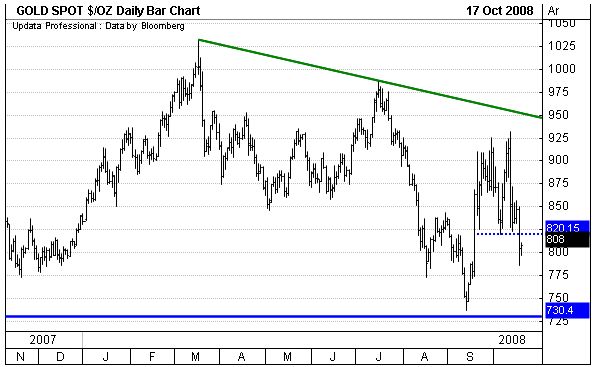
The short term outlook for gold appeared positive while the yellow metal was trading above US$820 an ounce. However, in New York trading on Thursday, gold was hit with a wave of short term selling.

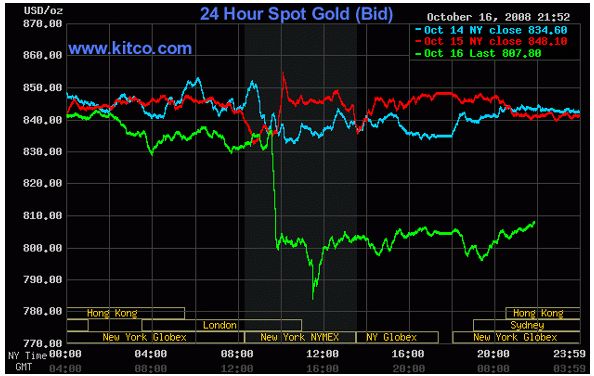
The green line in the chart below shows that gold plummeted just after the New York trading session began, falling nearly US$40 in a very short space of time. More selling pressure emerged soon after but in early Asian trade Friday, gold has recovered some of its gains.

From a purely technical perspective, the break below US$820 indicates the likelihood of near term weakness. It shifts the focus back to the US$735/US$734 support region and away from the potential for a push above $931.84.

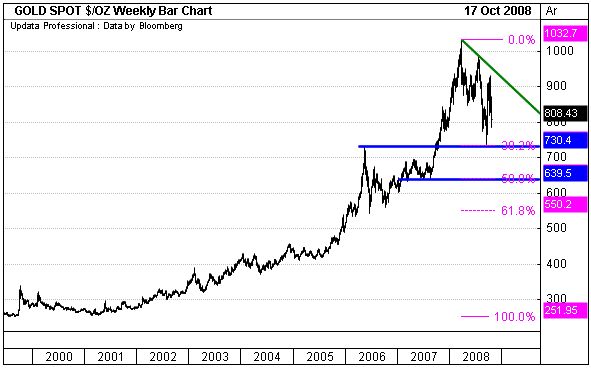
The $820 to $860 region now becomes resistance. While prices remain below this region, the risk is that prices will break below $734 and retreat toward the $650/$640 region. This marks the 50% retracement of the entire 1999-2008 advance, plus the next major price support/congestion region on the charts, shown below.

However, such a move is only a possibility, and should prices once again move into the US$820/US$860 region, the near term outlook would improve again.

We remain committed long term bulls on gold. The stimulus being thrown at the global economy is unprecedented and has not yet even begun to work its way through the financial system. The Fed’s program to purchase commercial paper does not get underway until 27 October. The transmission of this money through the system will take some time.

The Fed’s balance sheet expanded another $245 billion last week to $1.7 trillion. Its important to note that the Fed has not sterilised any of the cash injections it has made in the last month or so. Credit had jumped from $880 billion to $1.7 trillion and none of the Fed’s holdings of Treasury securities have been sold to offset the cash injection. Instead, poor quality assets have been added to the balance sheet.

But in the short term gold can do anything, as we witnessed recently when the yellow metal plummeted below US$750, only to reverse that move a few weeks later with an $80 single surge to the upside.

So Members riding the bull should prepare for more short term volatility. Any cowboy will tell you that riding the bull for the full 8 seconds is a very difficult task. This bull market will be no different, but if we’re prepared, we can tighten our grip.

Why Mining & Metal Investments Could Shine In The Coming Years

Tags

, , , , , , , , , , , , , , , , , , , , , , , , , , , , , ,

Original Post

BY: Daniel Gschwend

Why not start with the most important question. Is it already too late to buy precious metals or commodities in general?

Not at all. Gold and metals generally have very long cycles; ups and downs tend to be for typically 15 to 20 year periods. We are now seven-eight years into the cycle. So depending on which way you look at it, you could be in the one-third or a mid-cycle. In nominal terms (at $900 odd dollars an ounce now) the previous high was $850 in the 1980s. If you take into account inflation then the equivalent price of that now is over $ 2,300. So if you look at where you are in a cycle then it also in some sense reaffirms the direction in which or the potential to where gold can go.

After over 20 years of a persistent bear market in commodities, we have entered a new bull market in 2001 which has still a long way to go. Typically, a bull market peaks with a new high in real terms – which means currently over $ 2,300 per ounce for gold. It’s the same situation for other precious metals such as silver, platinum or palladium.

What else speaks for gold from an investor’s point of view?

The other couple of things that really make a difference to gold are that it is counter cyclical to the US dollar. So, if you expect the US dollar to weaken, then gold moves the other way and appreciates. Gold is also a store of value and therefore is valuable in times of geopolitical stress or calamities in markets or during times of inflation (because of inflation gold price goes up).

You’ve got multiple drivers for why gold is technically a good investment. We are seeing a lot of the above playing out now. Central banks around the world are worried about inflation. There is a lot of financial stress in the system and still some huge time bombs have not been deactivated, such as all the derivatives that may fail and ignite some kind of chain reaction in the financial system.

All these factors make a good case for the gold price to look very attractive. Overall, gold is a good diversifier with reasonably good returns over a long period of time and low correlation to other asset classes.

Are commodities such as precious metals really their own asset class?

If you define an asset class as an independent investment vehicle with its own characteristics, such as bonds, stocks or real estate, than yes. Commodities have unique attributes – no matter if we speak about agriculture, metals or energy – commodities usually rise in times of distinct inflation. Gold has even the tendency to rise in times of deflation since it is more or less the last resort to preserve value.

Commodities have been rediscovered by investors. I’m absolutely not surprised that we have seen such a strong price rally lately. In an environment in which we have negative real interest rates, inflation pressure and depreciation in stocks and real estate because of exaggerations supported by artificially low interest rates and lots of leverage – commodities just have to shine. As for gold, gold is not only a commodity, it is also money – in situations such as today, investors are seeking protection against an overall asset meltdown and buy gold.

What about inflation, is gold really a hedge against inflation?

Gold’s role as a hedge against inflation is unparalleled, though for much of the last 20 years it was challenged in the West on the basis that it wasn’t working. What was being overlooked, of course, was that in Europe and North America at that point inflation had been brought under control and gold was not, at that time, needed as an inflation hedge. In other countries where inflation was running much higher (or out of control – Turkey was a particular case in point), it was doing its job perfectly well.

With the markets now increasingly concerned about inflationary trends, gold has posted its credentials once more. While inflation is nowhere near the levels of the early 1980s (in the first quarter of 1980, inflation in the United States was 14%), inflationary expectations combined with an unprepossessing growth outlook have reinforced gold’s defensive qualities. Only when inflation is really a threat does gold work as a hedge.

What are the main drivers of higher metal prices in the future?

Low inventories in virtually all metals with growing demand and sluggish or even diminishing supply. Investors have not really understood how severe the supply situation actually is. There is only talk about how much a possible US recession or global economic growth slowdown will affect demand.

Demand will remain strong since this cycle has been activated because of structural changes in many developing countries. There are hundreds of millions of people entering the middle class. Entire cities, power plants, streets have to be built – those changes will transform these countries and until all these infrastructure projects – which are not being postponed because of higher copper prices and so forth – are achieved, demand will remain very strong. Unless there is no more supply coming online prices will rise.

But supply is the problem. By way of example: South Africa has a major power problem which probably cannot be solved until 2012 – and SA is still the no. 2 gold producer in the world. Platinum and palladium prices have skyrocketed because of this power disruption and will very likely remain high.

Aside from disruptions because of strikes and maintenance at operations running at or close to capacity, increasing government demands for higher royalties and profit taxes or greater stakes in projects are hampering development in many areas.

Another floor to lower gold prices is rising production costs if gold corrects to 650 $ per ounce many mines would have to shut down. The lack of skilled labour force, particularly geologists, will keep the wages high and also support even higher gold prices. Supply and cost pressure are probably even more important than demand concerns.

While the price of gold has risen very strongly in the recent months, don’t you expect slower demand because of higher prices?

Not really. Higher prices will of course affect jewellery demand negatively at least in the western countries. It’s the opposite in developing countries such as India or China – in these countries we see hundreds of millions of people being able to buy some kind of luxury goods or jewellery for the first time ever. The net effect on jewellery demand will very likely be positive.

Investment demand is growing fast and is not at all affected by the higher prices. It’s actually the opposite. There is some kind of paradigm shift going on in the financial world towards real assets and away from inflated paper assets. Overall we will see very strong demand from jewellery and the industrial and investment side for the years to come.

You mentioned China, how much do you attribute to the China factor?

I believe China is a major factor in the equation of higher prices in the future. But it is not only China, it is the entire Asian region which is experiencing a major structural shift accompanied by strong economic growth. Strong and growing demand is the main driver out of Asia.

As for China, figures from the World Gold Council showed sales of gold jewellery in China hit a record high of 302.2 tons in 2007, up 34 percent on the previous year. China has now overtaken the United States to become the world’s second largest buyer of gold jewellery after India. But behind the remarkable growth lies a deep Chinese traditional appreciation of the precious metal as a hedge against social and economic risks.

Interestingly, so far Chinese consumers are not deterred by rising prices. Rather, they increasingly view gold as not only a means to protect wealth but also as an efficient part of their investment portfolio. The World Gold Council said investment demand for gold at the retail level amounted to 23.9 tons in 2007, a rise of 60 percent compared with 2006.

There is a lot of wealth being created in Asian countries, and India and China have just woken up. Because of the strong economic growth and a appreciating Yuan vs US $ this also makes gold and other commodities traded in US $ cheaper for the Chinese – this is also valid for all other countries with appreciating currencies vs the US $.

There is a lot of talk about central banks or the IMF, aren’t they selling gold, and won’t they keep the prices under control?

Yes, they kept the prices from rising even more, but not under control. Under the current Central Bank Gold Agreement II act, central banks are allowed to sell up to 500 tons of gold per year until the year 2009. Interestingly, even though the price of gold has risen, the maximum quota of 500 tons per year has not been exhausted fully. Some of the participant banks didn’t sell at all or only a fraction. The effect has been minimal – without these sales gold would have risen even more.

As for the IMF, it might sell some of its gold holdings – something around 400 to 500 tons. This news is known and the gold market has not reacted at all. I expect this gold will be sold off market and will be happily absorbed by some institutional investors or central banks in the Asian region.

How about the central banks with huge US $ assets, how will they act in the future?

In contrast to the central banks in the western countries, they will be net buyers of gold very soon. Gold is the only real hedge against a depreciating US $. Since central banks in China, India, Russia or Japan hold huge amounts of their overall reserves in US $ it would be wise to protect these assets against depreciation and also do some more asset diversification. Just imagine, China has over 1,000 billion of US $ reserves and only holds less than 2% in gold – countries such as Germany hold over 60%, France over 55%, Switzerland over 40% or the USA over 75% in gold.

Since paper money is only a derivative to gold – which represents real value – central banks are under a lot of pressure to reallocate some paper assets into gold to preserve their wealth. Let’s play some numbers: if China (1.2%), India (4.1%), Japan (1.8%) and Russia (3.0%) decided to extend their gold holdings to a still very conservative interest of 10% of their overall monetary reserves, they would have to buy over 9,000 tons of gold which is more than 4 years of current worldwide gold production.

There has been a lot of talk about hedge funds buying gold and pushing prices ahead of their fundamentals, what’s your view on this?

There is indeed some speculative momentum in the market, also driven by hedge funds. But more importantly is the realization that gold has again become its own asset class. This has brought many deep pocket players into a comparably small market. Most of these new market players are active on gold futures traded on the COMEX or in ETFs (Exchange Traded Funds). If you look at some of the data, the amount of gold ETFs in the world in October 2003, just 4.5 years ago, was fractional at less than 20 tons of gold. Now it is over 800 tons.

Most of the investors who come into gold ETFs are in the US or the more developed pockets. If you look at the data provided in the weekly Commitments of Trades Report (future & option positions in gold) you will see that long positions in futures held by large speculators are more or less at all time highs. Some analysts see this as a contrarian indicator, but so far the positions remained high and were even growing. Hedge funds and other deep pocket players are very confidant and so am I because of very favorable fundamentals for precious metals.

What’s the role of pension funds and other institutional investors in this commodity bull market?

They actually play a very important and very prospective role. Calpers, the largest US pension fund with around 240 billion $ in assets, decided this February to boost its commodity investments up to 3% of its assets. That’s a 16-fold increase since it started to invest in commodities which was as recently as last year.

There are a lot of very powerful institutional investors entering the commodity sector and this trend has just started. This view is also confirmed by a survey conducted by Barclays Capital published last December. About half of the 150 money managers aimed to expand commodities to more than 10 percent of their total assets. These investors are the so-called deep pocket players, they have a long term strategy and they buy because of very strong fundamentals. Is it wrong for a private investor to do the same? I’d say no. Commodities should be an integral part of everybody’s asset allocation.

Since metal prices have done well, how about mining shares?

Since 2001, when the bull market started, the AMEX Gold Bugs Index (HUI) was at around 35 and is now at 400. In other words, mining shares outperformed metal prices and all other conventional asset classes greatly. Mining shares have a leverage to metal prices since profit margins are rising faster than the underlying spot prices.

In the last few months, this mechanism didn’t work because costs were rising rapidly and neutralized higher revenues. Right now, mining shares vs metal spot prices are at or close to historically low levels and offer a great buying opportunity. Even though spot prices are up, many shares are sharply down because of the sub prime aftershocks which lead to very high credit spreads and huge risk aversion towards all stocks. As an example, junior mining stocks are currently trading relatively lower than when the bull market started in 2001.

We at our fund are taking advantage of this market anomaly and have invested around 30% in the junior market and the remainder in intermediate and senior producers. This strategy was very tough in the last months but should work out very favorably in the near future once the appetite for mining shares returns.

This sounds like you  are growing more optimistic about mining shares in the near future?

Absolutely. Right now there are great buying opportunities in this sector. Fundamentals are strong, but shares are trading with discounts to their NPVs. Nobody can tell you when the market will wake up the next time, but it will wake up.

Historically, moves in the mining sector were always very fast. From an investor’s point of view – diversification is everything.

Buy some physical gold and hold some stocks – either directly or by a fund investment – this strategy should work out perfectly for the next many years. For investors who don’t like to buy a fund, they could buy BHP Billiton (BHP) for base metal and oil exposure and Barrick Gold (ABX) for precious metal exposure. Both stocks are very representative for the mining sector.

Disclosure: Article was originally written for the ‘Precious Metal & Mining Investment Outlook Conference’ in Hong Kong, June 2008. The author is fund manager at a mining & metals fund. The author’s view reflects explicitly his personal opinion. The fund has a position in BHP Billiton and Barrick Gold.

The Countdown of a Manipulated Gold Price Is Running Out

Tags

, , , , , , , , , , , , , , , , , , , , , , , , , , , , , ,

So what
’s wrong with gold? Why has the price not skyrocketed? Do you remember the day when Bear Stearns failed? Do you remember what happened on that day with gold? It spiked up to $1032 per ounce and marked its highest intraday price ever (in nominal price terms – remember, the inflation adjusted high would be in the $2300 per ounce range)…

read more | digg story

Pray and Watch in the Morning Watch

Tags

, , , , , , , , , , , , , , ,

Watch for you Know Not
….The Fourth Watch: The Morning Watch – A New Day Dawning! The Lord instructed us to watch and pray (Mark 14:38). We must be WATCHING! We have entered a time of the maturing of the watchman anointing. “I have set watchmen on your walls, O Jerusalem; they shall never hold their peace day or night…

read more | digg story

Prophetic Alert on the Economy & Urgent Call to Prayer!

Tags

, , , , , , , , , , , , , , ,

The Lord said: ”October 29 was Black Tuesday, the day the stock market crashed, and Satan wants to do it again!”—the economy will crash without effective, fervent intercession. Shaken to the core at this word from the Lord, I knew that I must call the people of God to converge in New York City the week of October 29 for an emergency prayer rally…

read more | digg story

DARE SOMETHING WORTHY TODAY! *** REPENT ***

Tags

, , , , , , , , , , , , , , ,

The Lord has spoken even to us living in the United States of America and He expects us to pay attention to His warnings. But do we? Not so you
’d notice. What a privilege to have been born in America and brought up in a nation of freedom and liberty. Now as America stands at the precipice of time…

read more | digg story

The Best Buying Opportunity Ever? Or the Edge of the Abyss?

Tags

, , , , , , , ,

Our short-term market-timing composite has reached a level rarely seen. It has a maximum value of +1 and a minimum value of -1. The higher the number, the more bullish the reading. The factors that create the composite are sentiment, technical, seasonal and monetary. I
’ve been using this model for many years. It was backtested from the early..

read more | digg story

***Three Steps to Take to Make Sure Your Bank is Safe***

Tags

, , , , , , , , , , , , , , , , , , , , , , , , , ,

Seeing banks such as Wachovia Corp. (WB) get sold or Washington Mutual Inc. (WM) fail is scary for retail banking customers. But there are simple steps you can take to protect your bank assets.

Here are three quick and easy steps you can take that may help you determine if your bank is safe or not…

read more | digg story

Media Reality Check-Gwen Ifill Is Pro-Obama and Anti-Palin!

Friday’s Washington Post carried an ad from PBS touting their two TV debate moderators: “Objective. Impartial. Independent. The NewsHour’s Jim Lehrer and Washington Week’s Gwen Ifill bring PBS’s tradition of integrity to the most important conversations in America – so you can make up your own mind.”

Sadly, that ad is not accurate.

read more | digg story

The Austrian School and the Meltdown

Tags

, , , , , , , , , , , , , , , ,

The financial meltdown the economists of the Austrian School predicted has arrived. We are in this crisis because of an excess of artificially created credit at the hands of the Federal Reserve System. The solution being proposed? More artificial credit by the Federal Reserve.

read more | digg story

U.S. Titanic

Tags

, , , , , , , , , , , , , , , ,

I can’t help but compare our country’s situation to the maiden voyage of the Titanic…The great ship (United States) is sinking. Should we let the band (Hank Paulson) dictate those who get onto the lifeboats first? If we do, we will all face the fate of Jack as he slowly freezes to death in the icy Atlantic.

read more | digg story

How Many Warnings Will It Take?

Tags

, , , , , , , , , , , , , , ,

As Gustav has left destruction in its wake, Hannah lashes its way up the East Coast, Ike charges towards the Gulf of Mexico, and Josephine picks up steam behind it, WHERE ARE THE MEN who can warn President Bush, Dick Cheney and Condoleezza Rice loudly and with enough impacting authority for them to FINALLY get the message and CEASE their tampering

read more | digg story

50 Reasons Why We Are Living In The END Times

Tags

, , , , , , , , , , , , , , ,

The Bible says we cannot know the time of the Lord’s return (Matthew 25:13). But the Scriptures make it equally clear that we can know the season of the Lord’s return (1 Thessalonians 5:2-6): Furthermore, the Scriptures give us signs to watch for — signs that will signal that Jesus is ready to return.

read more | digg story

FDA lists drugs undergoing safety probes

Is your medicine on this list of drugs with a “potential” safety issue?

read more | digg story

The Heavens Declare The Glory of God

Tags

, , , , , , , , , , , , , , ,

Long before there were any written Scriptures of which we are aware, men still needed to know about God and man’s relationship to Him, and in particular, about His plans for their salvation. It is equally possible (and I believe, probable) that God Himself was the Author of this ancient form of revelation. See Genesis 1:14

read more | digg story

Virus Bulletin : News – AV-Test release latest results

Tags

, , , , , , , , ,

Virus Bulletin : News – AV-Test release latest results


<!– –>Test Results: 2009 Anti-Malware Suites Better at Sniffing Out Threats


AV-Test’s latest lab results show improvements in malware detection, without jeopardizing performance


SEPTEMBER 2, 2008 | Finally, some good news about antivirus products: The new 2009 releases of popular antivirus and Internet security suites overall are catching more malware than their previous versions and without major performance hits, according to newly released test results. Independent testing lab AV-Test looked at 33 different anti-malware products that had been updated through Aug. 18 — including 2008 and 2009 versions of F-Secure, Symantec, and Panda’s anti-malware suites as well as Windows Live OneCare 2.5.2900.03, Kaspersky Internet Security 2009, and McAfee Internet Security 2008 — measuring how well they did in detecting malware and spyware, proactively detecting new and unknown malware, responding to new widespread malware, scanning quickly, and generating false positives.

“In most cases, the test results of the different products didn’t change dramatically… [Most] got better when compared with our March 2008 testing and all 2009 editions we’ve reviewed performed better than the current releases,” says Andreas Marx, CEO of AV-Test. “I especially liked that the protection got better while the system performance wasn’t hit that much — the 2009 editions [including beta versions] were faster than the 2008 releases. So it looks like that most vendors have done their homework and instead of adding only new features, they also took care about the system performance.”

Marx noted that many of the ’09 products can or will eventually use “cloud” type services for more comprehensive scans. “If an unknown file has been found on a system and this file appears to be suspicious, the scanner (and guard) will check if it’s a known good or bad application by contacting a server from the AV company,” he says. “This might further increase the detection rates. However, you’d need to be online and accept such connections in order to get this additional protection.”

In the AV-Test research, Symantec’s Norton 2009 beta came out with some of the best ratings in the lab tests, catching over 98 percent of malware, over 95 percent of spyware, and no false positives. The software also found new malware over 95 percent of the time. Marx notes that Symantec is now pushing virus definition updates, known as “pulse updates,” every five to 10 minutes in some cases.

Among the products with the lowest scores were CA Internet Security Suite Plus 2008, ClamWin 0.93.1, Dr.Web for Windows 4.44, Rising Internet Security 2008, and VirusBuster Professional 10.86.1. AV-Test did not test rootkit detection — which has been a weak spot for most anti-malware tools — in this round of testing to give vendors time to improve this detection, which was poor in AV-Test’s April results. (See New Tests Show Rootkits Still Evade AV.)

AV-Test says it used the best available editions of the products, and ran the tests on Windows XP platforms, using over 1.1 million malware samples. “The 2009 [products] seem to be a lot better optimized for the real needs of the customers, and they will not slow down the systems in such a dramatic way like the 2008 editions did,” Marx says.

      Kelly Jackson Higgins, Senior Editor, Dark Reading

http://www.darkreading.com/document.asp?doc_id=162788


AV-Test release latest results

Major test of suite products completed

Independent testing body AV-Test.org has released the results of a major comparative of suite products, with many vendors’ 2009 editions included in the results. The test covers a range of metrics, including detection rates over various types of malware including adware and spyware, false positive rates, scanning speed, proactive detection, and response times to outbreaks.

In terms of pure detection rates in on-demand scanning, a beta version of GDATA‘s AVK 2009 topped the charts for both ‘malware’ (measured against 1,164,662 samples) and ‘ad- and spyware’ (94,291 samples), with Avira‘s Premium Security Suite 2008 a close runner-up in the former category and F-Secure 2009 placing second in the latter. Secure Computing‘s Webwasher gateway product, based on the Avira engine with some in-house heuristics, came third in both categories.

Other areas analysed were scored on a five-point scale from very good to very poor. ‘Proactive’ protection included scanning of files discovered after the freezing of products, and executing unrecognised malware to test behavioural protection. Products rating ‘good’ or better in every category include Avira‘s premium suite (the popular free version has less complete spyware detection), AVK 2009, F-Secure‘s 2009 suite, Symantec‘s Norton I.S. 2009 (still in beta) and Sophos‘s Security Suite 2.5. All products taking part in the test managed to achieve a ‘good’ or better in at least one category.

The test also included keeping a record of the number of updates released over a four-week period. Of course, these numbers on their own cannot be used to measure the quality of the products involved, but were recorded out of interest. The most interesting data to emerge from this measurement was that the 2009 version of Norton topped the table with an impressive 6,202 incremental micro-updates, issued several times per hour, while Kaspersky came a distant second with a mere 696. Half of the 34 products tested had fewer than 100, including those from McAfee (21) and Trend Micro (30).

A summary of the major areas tested is printed below; hover over the product names to see full version information.

Product

malware on demand

adware / spyware on demand

false positives

scan speed

proactive detection

response times

malware on demand

adware / spyware on demand

AntiVir (Avira)

++

++ (4)

+

++

+

++

99.8%

99.0%

Avast! (Alwil)

++

++

+

+

o

o

99.3%

98.3%

AVG

+

(4)

+

+

o

o

95.8%

87.0%

AVK 2008 (G Data) (1)

++

++

o

+

++

99.2%

99.1%

AVK 2009 (G Data) (2)

++

++

+

+

++

++

99.8%

99.8%

BitDefender 2008

+

+

++

+

97.7%

87.8%

BitDefender 2009

+

+

o

++

+

97.6%

88.0%

CA-AV (VET)

++

o

65.5%

68.0%

ClamAV

o

++

88.5%

92.8%

Dr Web

o

o

+

o

84.9%

89.6%

eScan

+

+

o

+

++

97.8%

97.4%

Fortinet-GW

o

o

+

++

+

92.6%

81.9%

F-Prot (Frisk)

o

o

+

+

o

o

94.8%

92.6%

F-Secure 2008

++

++

+

o

++

+

98.2%

98.4%

F-Secure 2009

++

++

+

+

++

++

99.2%

99.6%

Ikarus

++

++

o

+

+

+

99.5%

98.6%

K7 Computing

o

o

o

++

o

92.1%

94.0%

Kaspersky

++

++

o

o

+

++

98.4%

98.3%

McAfee

o

o

++

o

+

93.6%

94.5%

Microsoft

+

+

++

o

97.7%

97.1%

Nod32 (Eset)

o

o

++

++

++

+

94.4%

94.7%

Norman

+

+

+

o

+

o

96.3%

95.8%

Norton 2008 (Symantec)

+

o

++

+

+

o

97.8%

94.6%

Norton 2009 (Symantec)

++

+

++

++

+

++

98.7%

95.4%

Panda 2008

o

+

+

++

o

86.4%

93.4%

Panda 2009

o

+

+

+

++

+

91.8%

95.6%

Rising

+

o

o

o

83.4%

77.5%

Sophos

+

+

+

+

++

+

97.5%

95.0%

Trend Micro

o

+

+

o

+

91.3%

88.5%

TrustPort

++

++

++

++

99.5%

98.4%

VBA32

o

o

o

+

o

90.5%

85.2%

VirusBuster

+

+

o

o

89.0%

85.8%

WebWasher-GW (3)

++

++

o

++

++

++

99.7%

99.2%

ZoneAlarm

+

+

o

o

+

++

97.8%

97.7%

Index

malware on demand

adware / spyware on demand

false positives

scan speed

proactive detection

response times

malware on demand

adware / spyware on demand

++

>98%

>98%

no FP


< 2 h


+

>95%

>95%

1-2 FP


2 – 4 h


o

>90%

>90%

3-4 FP


4 – 6 h


>85%

>85%

5-6 FP


6 – 8 h


<85%

<85%

> 6 FP


> 8 h


Notes
(1) AVK 2008 uses the Avast and Kaspersky scan engines
(2) AVK 2009 uses the Avast and BitDefender scan engines
(3) WebWasher uses the Avira engine and a self-developed heuristic engine
(4) the free (personal) edition does not include ad- and spyware detection, so the results would be

Tags: av-test, comparative, results, testing.     del.icio.us    digg this

Copyright © 2008 Virus Bulletin Ltd  –  Privacy statement | Terms and conditions | pda version

Hacker’s Choice: Top Six Database Attacks – Desktop Security

Tags

, , , , , , , , , ,

It takes the average attacker less than 10 seconds to hack in and out of a database — hardly enough time for the database administrator to even notice the intruder. So it
’s no surprise that many database attacks go unnoticed by organizations until long after the data has been compromised.

read more | digg story

The Seven Deadliest Social Networking Hacks – Desktop Securi

Tags

, , , , , , , , , ,

It started with a stolen Facebook photo attached to an inflammatory profile. It led to online harassment, death threats, and emails to the victim
’s boss questioning the victim’s character. But an online personal attack against Graham Cluley earlier this year is one example of how easy it is to use a social network to damage the identity of…

read more | digg story

Google Redefines Web Browser

Tags

, , , , , , , ,

Google has introduced a new Web browser, called Chrome, aimed at wresting dominance of the browser market from Microsoft’s Internet Explorer. The move takes the Google-Microsoft rivalry to a whole new level. If Google succeeds, it will be a big deal, with major ramifications for the future of the Web. How good is it?

read more | digg story

Treasures In The Psalms

Tags

, , , , , , , ,

The book of Psalms has been a delight and blessing to the people of God for a hundred generations. In more ways than one, it is at the very heart of the Bible. The central chapter of the Bible is Psalm 117, which is the shortest chapter in the Bible. The next chapter contains the central verse of the Bible, Psalm 118:8

read more | digg story