• Recommended Sites & Links
  • About

Dare Something Worthy Today Too!

~ FreeCryptoBitCoins, Cryptocurrency, BitCoin, Ethereum, BitCoin Cash, Ethereum Classic, LiteCoin, DogeCoin, Gold & Precious Metals, Investing & Investments, Stocks and Stock Markets, Financial Markets & Market Timing, Technical Analysis, Oil and Energy Markets, Hard Assets Investing, BlockChain, Airdrops, Earn Free Bitcoin…

Dare Something Worthy Today Too!

Tag Archives: Peter Brimelow

Are you Secure? and Latest Gold Investing News

04 Wednesday Feb 2009

Posted by jschulmansr in Bailout News, banking crisis, banks, Comex, commodities, computer security, Computers and Computing, Credit Default, Currencies, currency, Currency and Currencies, dollar denominated, dollar denominated investments, economic, Economic Recovery, economic trends, economy, Federal Deficit, federal reserve, Finance, financial, Forex, gold, Gold Bullion, Gold Investments, gold miners, How To Invest, How To Make Money, hyper-inflation, inflation, Investing, investments, Jay Taylor, Junior Gold Miners, Latest News, Make Money Investing, market crash, Markets, mining companies, mining stocks, palladium, Peter Grandich, physical gold, platinum, platinum miners, precious, precious metals, prices, producers, production, security, Security Suites, SEO, silver, silver miners, small caps, spot, spot price, stagflation, Stocks, Technical Analysis, U.S. Dollar

≈ 2 Comments

Tags

agricultural commodities, alternate energy, Austrian school, Bailout News, banking crisis, banks, bear market, Bollinger Bands, bull market, capitalism, central banks, China, Comex, commodities, communism, Copper, Currencies, currency, deflation, Dennis Gartman, depression, diamonds, dollar denominated, dollar denominated investments, economic, economic trends, economy, Federal Deficit, financial, Forex, futures, futures markets, gold, gold miners, hard assets, heating oil, India, inflation, investments, Jay Taylor, Keith Fitz-Gerald, Marc Faber, Mark Hulbert, market crash, Markets, mining companies, Moving Averages, natural gas, oil, palladium, Peter Brimelow, Peter Grandich, Peter Schiff, physical gold, platinum, platinum miners, precious metals, price, price manipulation, prices, producers, production, protection, rare earth metals, recession, risk, run on banks, safety, Saudi Arabia, Sean Rakhimov, silver, silver miners, socialism, sovereign, spot, spot price, stagflation, Technical Analysis, timber, U.S. Dollar, volatility, warrants, Water

Are you secure? If not, you need to be!  It’s a dangerous world out there! An unprotected computer is like leaving your keys in the ignition and walking away! Today’s articles include the latest reviews of Security Suites for your computer and latest Gold news.  Gold yesterday tested the lower end of support at the $885 oz to $895 oz levels. Today Gold has come roaring back up $16 oz to $908.50. I think we are about to retest the $930 level and if we break that then $950. If we clear those hurdles then the next stop will be $1000 + oz. I am buying on any dips and you should be too! – Good Investing! – jschulmansr

==============================

Catch the New Bull! – Buy Gold Online – Safely, quickly, and at low prices, guaranteed! Bullion Vault.com

=================================

The Best Security Suites for 2009 – PC Magazine

by Neil J. Rubenking of PC Magazine

Which suite will be best for keeping you safe and not slowing you down this year? We’ve tested them all, and the answer might surprise you!

The list of available 2009-model security suites is now essentially complete. A running theme in this year’s suites is the promise that these new versions will do more for your security while tying up fewer system resources. It’s about time: Users have had it with suites that offer security but bog down the computer. Several vendors have introduced new “in the cloud” technologies to keep up with the accelerating growth of new malware. And many have redesigned their user interfaces to be more attractive and look lighter and faster. Some are new, innovative, and speedy. Others haven’t kept pace. Which are which? I put them all through grueling tests to find out.

Performance Testing

Starting with the 2009 crop of suites, I added an entire day of performance testing per suite to my already lengthy set of evaluations. I wrote and gathered a collection of batch files, scripts, and freeware components to measure how long a number of common activities take on the computer. I ran the scripts many times on a system with no suite installed and then on that same system with each suite installed. Averaging the results let me see just how much each suite affected system performance.

I get a lot of complaints about how long PCs take to boot up in the morning, and many users blame their security suites for lengthening the process. The first part of my test script, therefore, calculates the time it takes from the start of the boot process (as reported internally by Windows) to the time when the system is completely ready to use. “Ready” is a fluid concept—I defined it as meaning that 10 seconds have passed with CPU usage under 5 percent. I ran this test 50 to 100 times and averaged the results; the test system with no suite installed takes almost exactly 60 seconds to boot. Norton Internet Security 2009 and Kaspersky Internet Security 2009 added only about 15 seconds to the boot time. That’s not bad!

Some of the other suites added significantly to boot time. F-Secure Internet Security 2009 and McAfee Total Protection 2009 nearly doubled it, and BitDefender Total Security 2009 more than doubled it. The timings for Webroot Internet Security Essentials (WISE) averaged even higher—almost 2.5 times the baseline. However, the data set included a number of unexplained instances when booting up took 5 or even 10 minutes. Eliminating those quirky outliers brought the average boot time for WISE (the smallest suite) a bit below that of McAfee (the largest suite)—still not impressive.

Real-time malware scanners can kick in on any kind of file access and can slow ordinary file operations, especially if they redundantly scan the same file more than once during the operation. I set up a series of file move and copy actions using a variety of file types and timed how long it took with and without a security suite. Kaspersky added just 2 percent to the time required for this test, and Trend Micro Internet Security Pro added 6 percent. Norton and Panda Global Protection 2009 came in between those two. On the slow side, the system running ZoneAlarm Internet Security Suite 2009 took half again as long to perform the test.

Another of my new tests zips and unzips large groups of files, and my testing showed that this activity takes more of a performance hit from most security suites than moving and copying do. Panda had the lightest touch here, adding just 8 percent to the baseline time. Norton, Kaspersky, Trend Pro, and Webroot all added in the neighborhood of 25 percent to the time. Under ZoneAlarm the zip test took twice as long, and under BitDefender it took 2.5 times as long. That’s dreadful!

Your suite has to keep careful track of software installations so it can prevent malware from installing. I measured the time required for repeated automatic installation and uninstallation of several large Windows Installer packages. Most of the suites added from 20 to 30 percent to this test’s time. Panda excelled again, adding just 6 percent. ZoneAlarm and WISE caused the most drag, adding 63 percent and 71 percent, respectively.

Acting on some reports of problems with media files, I included a test that times some elaborate media file format conversions. None of the suites slowed this test significantly. Their effects ranged from a negligible 1 percent increase by WISE, Panda, and Norton to a still minor 8 percent hit from ZoneAlarm.

Modern suites look at your browsing activity in a number of different ways. They block drive-by downloads, check for fraud, and perhaps block inappropriate content for your kids. To see whether this analysis slows down the browsing experience, I used an ActiveX control that measures when a page has completely loaded, along with a script that launches dozens of URLs with lots of content.

Norton had the least impact on surfing speed, adding 13 percent to the time required for this test. WISE doesn’t do any page analysis beyond checking a blacklist, but it still added 25 percent. Kaspersky and Panda, which did well on most of my other performance tests, slowed browsing by 64 percent and 92 percent, respectively. But McAfee had the worst impact, more than doubling the time required for the surfing test. Given the amount of time the average person spends surfing the Web, this is a bad test to fail.

Check our security suite performance test chart to get full details on each product’s individual scores. Note, though, that in addition to these tests, I considered various other factors. Does the product make a good impression with a speedy and undemanding install process? Is the scan for malware especially fast or slow? Does the spam filter appreciably slow down the process of downloading mail? Are there special features that demonstrably work to minimize performance impact? All these factors go into the final score. In next year’s round of testing I hope to add even more performance tests. In the meanwhile, I’m very interested in getting your feedback on this year’s tests. —next: Security in the Cloud >

Featured in this Roundup:

BitDefender Internet Security 2009 BitDefender Internet Security 2009

$69.95 direct; 3-pack, $79.95
BitDefender has added a ton of new features—online backup and remote configuration, for example. It includes all the expected security elements, with decent performance from most of them. It’s a reasonable choice if you’re excited by those extra features.

F-Secure Internet Security 2009 F-Secure Internet Security 2009

$75.90 direct; 3-pack, $79.90
F-Secure Internet Security 2009 is easy to use, without complicated settings and extras. But installing it was a nightmare, and it took too long deleting inactive malware. The firewall is old-fashioned, and the antispam and parental-control apps are ineffective. The suite hasn’t kept up with the times.

Kaspersky Internet Security 2009 Kaspersky Internet Security 2009

3-pack, $79.95 direct
Kaspersky Internet Security’s new user interface hides messy security details but leaves them accessible to power users. The new application-filtering feature renders the suite smart enough to make its own decisions without hassling the user. As long as you don’t plan to rely on it for spam filtering or parental control, Kasperksy’s suite is a good choice.

McAfee Total Protection 2009 McAfee Total Protection 2009

3-pack, $79.99 direct
McAfee’s latest suite has improved malware detection, and its spam filter is also much better. But its overabundance of features hasn’t changed at all; its UI is sluggish; and it saps system performance.

Norton Internet Security 2009 Norton Internet Security 2009

3-pack, $69.99 direct
This is definitely the slimmest, most unobtrusive Norton ever. Its protection is top-notch where it counts, though antispam and parental controls are still weak. As the best all-around security suite to date (I’ll be installing it myself), it’s our new Editors’ Choice.

Panda Global Protection 2009 Panda Global Protection 2009

$69.95 direct; 3-pack, $89.95
Except for the new main screen, Panda’s 2009 suite doesn’t look much different. Its collective intelligence promises better protection, but its action is spotty: Spam filtering got much better; spyware protection got worse. And it’s expensive! Wait for next year’s version if you’re thinking of switching to Panda.

Trend Micro Internet Security Pro 2009 Trend Micro Internet Security Pro 2009

3-pack, $69.95 direct
Trend Micro Internet Security Pro v2 is a big improvement over last year’s edition. It’s an effective anti-malware tool, and it’s loaded with Pro features that are truly useful. If you’ve sworn a lifelong grudge against Norton (our Editors’ Choice suite), give Trend Pro a try.

Webroot Internet Security Essentials (2009) Webroot Internet Security Essentials

3-pack, $59.95 direct
WISE omits features that other suites include yet still slows down system performance. Its malware protection is excellent, and it delivers 2GB of online backup, but its firewall component doesn’t do the job. Spend $10 more and get Norton or Trend Pro!

Scheduled Scanning ZoneAlarm Internet Security Suite 2009

$49.95 direct; 3-pack, $69.95
ZoneAlarm is strong on defense. It has a tough firewall and keeps malware totally out of a clean system, but it’s less effective in cleaning up entrenched malware, and some of its features are antiquated. ZoneAlarm is still a fine choice, but I had hoped for a makeover that would be more than skin deep.

CA Internet Security Suite Plus 2009CA logo

5-pack, $79.99 direct
There’s little to love in this Frankenstein’s monster of a suite. Patched together from many separate mediocre tools, it put the biggest drag on system performance of any suite tested. Save ten bucks and get Norton’s suite (or Trend Micro’s) instead.

Comodo Internet Security 3.5Comodo

Free
For free security Comodo’s firewall is still a sound choice, but the antivirus and antispyware parts of this suite just don’t do the job. If you need free security, get the firewall alone and add avast! or AVG for free virus/spyware protection.

Security In The Cloud

The number of different malware threats and variants released every day is increasing exponentially, and with it the size of the signature files needed by security software to detect these threats. Security vendors have handled this problem in part by using heuristic techniques that allow one signature to match multiple threats. This year several vendors have introduced new technology that moves the signature database at least partially off your local computer and into the cloud. All of these technologies require an Internet connection to function, of course.

Panda calls its new cloud security technology collective intelligence. The suite retains a local malware database of the most common threats and threats that can propagate without an Internet connection. For files not identified by the local list, Panda Global Protection 2009 sends a tiny checksum to the online database to see if it matches the checksum for a known bad program. It’s a good idea and may work eventually, but I didn’t see evidence of improved malware detection when testing Panda.

The Artemis technology in McAfee Total Protection 2009 aims to eliminate the gap between detection of a new threat and protection against that threat. When the local McAfee installation detects slightly suspicious behavior in a file that’s not in its local database of threats, it shoots a checksum off to the Artemis database of known good and known bad files. It’s similar to Panda’s system, but, unlike Panda, McAfee showed a marked improvement in its malware detection.

Symantec’s Norton Insight takes a rather different approach. It leverages data collected from over 25 million Norton users to create a database of known programs and uses proprietary statistical analysis to assign a trust level to each. Skipping known trusted programs markedly speeds up scanning. Symantec researchers believe that statistical methods may in time completely replace familiar signature-based malware detection. It’s certainly effective in combination with regular signature-based detection: Norton scored better than any other suite or standalone antispyware utility on the current round of tests. —

next: Makeovers, Shallow and Deep >

Security suite vendors have finally caught on to the fact that most of their users aren’t security geeks. Users want the product to work; they want it to show that it’s working; but they don’t want any interruptions or confusing queries. Judging from what the vendors have done this year, they also want it to look nice. Many of the suites discussed here have significantly changed their main windows since last year. Click on our security suites interface slideshow to see how the suites have changed.

F-Secure and McAfee bucked the makeover trend. Other than a minor change in color palette, F-Secure looks exactly the same, and only the sharpest eye could detect any difference in McAfee’s 2009 edition. The biggest change for Trend Pro is a new My Home Network tab on the main screen; other changes are relatively minor.

Kaspersky moved things around and smoothed out the overall visual effect, but it’s not too different. BitDefender—the quick-change artist of the group—has undergone some big changes. The 2008 edition swapped 2007’s blocky, utilitarian look and red and silver color scheme for a super-simplified big-button view reminiscent of Microsoft’s OneCare, and the 2009 edition of BitDefender is another complete makeover.

ZoneAlarm has changed the most of all. For years, it has used an awkward dual-tab system, which left some users confused about where to find features, and a hodgepodge of bright-colored icons. ZoneAlarm 2009’s interface is much more coherent, both in function and appearance. Norton has made some big changes, too, getting rid of the confusing separate “Norton Protection” tab. Check the slideshow for before and after pictures.

So, do these radical changes in appearance represent big improvements in functionality? In most cases, no. The biggest exception is Norton: In addition to merely cosmetic changes, it has also streamlined its protection and added visuals for performance-related features such as Norton Insight and the handling of security tasks in idle time.

In the past I’ve given each security suite separate ratings for Firewall, Antivirus, Antispyware, Antispam, and Privacy/Parental Control. With this round of suite reviews I’ve added a Performance category and separated Privacy and Parental Control. Of course, some components are more important than others. I give much more weight to the firewall, antivirus, and antispyware components, as well as to the new Performance index. The attached chart pulls together the individual component ratings for the 2009 suites, so you can focus on choosing one that’s strong in the areas you need most.

Norton Internet Security 2009 excelled in the most important areas—firewall, antivirus, and antispyware—and it did so with little affect on performance. Its antispam and parental-control elements are dismal, but many users don’t need those. Norton remains our Editors’ Choice for 2009. Those who’ve sworn off Norton’s suite for life (there are some who can’t get beyond its past performance problems) should consider Trend Micro Internet Security Pro 2009. Its scores are impressive, if not quite as high as Norton’s, and it does well in all areas, including those where Norton falls down. Click the links below for full reviews.

Suites Keep Coming

The number of players in many industries keeps shrinking as small vendors fail or get eaten by bigger ones, especially in the current financial climate. Not so with the makers of consumer-side security suites! Some vendors take a single-focus product, such as an antivirus or a software firewall, and parlay it up into a suite. Others modify their Enterprise-level products hoping to generate a separate revenue stream on the consumer side. These new suites haven’t necessarily settled into the “fall model year” schedule adopted by their existing competitors. In fact several have popped up since my roundup of 2009 suites. The current top suites don’t have to worry about the competition yet-all three of these newcomers need work-but the category as a whole is clearly healthy.

TrustPort is well-known for its Enterprise and gateway products but hasn’t been a force in the consumer market. Recently the company quietly released a consumer version of its TrustPort PC Security 2009. The product has some features not usually found in consumer products-one, an antivirus/antispyware solution runs multiple detection engines, another provides a feature for managing Public Key Infrastructure encryption. But the PKI features really need Enterprise-level support, the virus/spyware protection isn’t top-notch, and the firewall manages to be both obtrusive and ineffective. Not only that, the suite seriously slows system boot time and Web browsing. Consumers want a suite that does the job quietly and without generating problems-this isn’t it.

Comodo added virus and spyware protection to its existing Comodo Firewall Pro-thus was born Comodo Internet Security 3.5, a minimalist suite that doesn’t include antispam, privacy protection or parental control components. It does have the virtue of being free, though. But while the firewall module is admirable, the added virus/spyware protection just doesn’t do the job. The product scored dismally in my malware-removal test, did a poor job of keeping malware out of a clean system, and popped up multiple alerts for many perfectly valid programs. And it had more impact on system performance than I expected for such a lightweight suite. If you need free security, use the Comodo firewall and get your virus and spyware protection elsewhere.

CA (formerly Computer Associates) isn’t new to the security-suite market, but its latest version is significantly changed. Unfortunately, the changes in CA Internet Security Suite Plus 2009 went in the wrong direction. The software is weak in almost every area. Its completely separate virus and spyware scanners scored poorly both at malware removal and at keeping rogue software out of a clean system-only Comodo scored lower. The firewall resists malware attacks but bothers the user with many queries; with its Safeguard features enabled it seriously interferes with many valid programs. This pieced-together collection of security elements offers so-so protection while putting more of a drag on system performance than any other suite I’ve tested

Click here to compare the security suites featured in this roundup

=====================================

My Note: Well there you have it. This year at least I don’t have to run out and buy new Security Software, I use Trend Micro which is ranked second. -jschulmansr

=====================================

Gold and Oil Top Peter Grandich’s Shopping List – Seeking Alpha

Source: The Gold Report

Peter Grandich, creator and producer of The Grandich Letter for a quarter century, allied himself with AGORACOM in October, bringing his well-known and oft-quoted commentaries to a far wider audience than his subscriber base and financial media such as The Wall Street Journal, MarketWatch, CNN, GlobeInvestor, Financial Post and BNN. Breaking away briefly from his recent blogging, the veteran Wall Street watcher and investment advisor tells The Gold Report readers what he likes looking forward—gold (up to $1,000) and oil (between $35 and $40). Also high on his list: uranium (for the nuclear renaissance), junior miners (a select few), and Canadian banks (pretty much all of them). 

The Gold Report: Judging from opinions you’ve expressed in recent newsletters and blogs, you clearly believe we will be testing the November lows during the first quarter this year. What is some of the logic behind why you think that will happen?

Peter Grandich: My belief has been that if and when the U.S. stock market bottoms, along with the economy, it will be an L-shaped bottom, not the V that so many on Wall Street keep talking about. The problems that brought us here persist. In fact, they’ve gotten worse over time, which gives me even more reason to believe that we’re going to bottom eventually but not go far off that bottom once we do. The logical viewpoint for us to take at this point is to look for a market to make at least a double bottom, if you don’t believe it’s a V bottom. Obviously, if it’s a V, you only have one time you’re at that low.

The November lows are, I suspect—as I’ve said recently—are not a question of “if” but “when.” A strong bounce is likely to come off that because the remaining bulls who aren’t totally bloodied would look and hope for that to be an opportunity to get more long if they’re not already 100% long.

The view we’ll have to take after that is watch the bounce, see what type of volume and breadth it has. The problem with rallies we’ve had all through this decline is that neither their volume nor breadth has been half as strong as in the declines; that is always an earmark that the bear market is continuing and that rally is a countertrend. So that’s another thing to look for when and if we catch those lows.

TGR: You mentioned that maybe we should be looking for a double bottom. If we go back and re-test the November lows, is that our double bottom? Or would you expect to go through the November low?

PG: I still suspect we’re going to go through it, but we have to be able to change our views as the markets change. The only way bouncing off that bottom and then turning up past 9000 on the Dow—that would be the only technical factor that would suggest to me that the bear market was over. My feeling is that even if we do hold that November low, we are going to have a very long trading range on the Dow of somewhere between 7500 and the 9000 that we rallied to twice the last year but have failed to go through.

Rather than trying to catch a falling sword and usually getting their hands sliced by it, quite frankly I think what’s best for investors would be to be certain or fairly certain that a bottom is put in and miss the first 10% or 20% to the upside. I think if and when we do break out above those numbers, we’ll also be hearing things on the economic side getting better.

Now, that’s not my bet right now, but I think you always have to have a plan to possibly change your view and be set for it if certain things happen. My most likely scenario continues to be that this economy will be very weak throughout 2009, and not just the first half that the bulls keep talking about. And we don’t have any real hope of a sustained equity bull market at least until 2010 at the earliest.

TGR: Your writing is bullish on oil, though.

PG: Yes. We suggest that people contain any oil purchases between $35 and $40—not above $40 at this point. Oil longer term is far more likely to be higher than that level than equities looking out the same timeframe. If people are still willing to look out three to five years versus three to five days, I think oil is a better risk-reward at this point than the U.S. equity market.

TGR: Are you talking about buying oil as a commodity or purchasing oil equities?

PG: Both. What I do like especially about Exchange Traded Funds now is the ability to have a bunch of oil stocks within them. No-load funds are still a good way to go with equities for those who are very long-term oriented. But ETFs are a better vehicle for investors because you can buy and sell as many times as you want during the day, not just get the end-of-the-day price when you sell your mutual fund. Both are useful. But either way, I think you need to track the actual commodity as well as oil stocks.

TGR: Your blogging suggests that you think precious metals sector also will do well, even in 2009?

PG: Yes, I continue to believe that; in fact, I believe the best investment right now is gold. Not because I think the world’s coming to an end; quite frankly it won’t matter if you have gold if there’s truly an end-of-the-world scenario. And I am not a gold bug; I’ve been bearish on it at times.

Nevertheless, thanks to the credit crisis, which is taking place in all four corners of the world, I do believe people around the globe are realizing that paper money may not be the best safe-haven investment. And although gold did not go up in 2008, it did serve its purpose by being an insurance hedge. Whether they’re professionals or just individual investors, no one I know would mind having been even for 2008 versus the heavy losses they took. So, gold did its job; those who put money in gold didn’t see the losses that everybody else suffered.

But I believe now that we’re going to see capital gains opportunities in gold for 2009 and into the foreseeable future. The market has all the fundamentals that one would want right now. There’s a declining supply, which will decline even further because those who normally look for gold, the junior resource stocks, have been so hammered that we’re not going to see a lot of new exploration for some time.

The few companies that will be going into production will be a premium. The excess supply that used to come into the market, particularly from central banks, has dried up. We’re also seeing tremendous physical demand; in fact, throughout 2008, it was very difficult for people to acquire physical gold. Coins and bars that used to be readily available were in such demand that there became a shortage. In fact, if you wanted to purchase physical bullion, you were paying 10% or more above the spot price.

People say that should have caused a dramatic rise in the gold price. The paper market is still driven by the COMEX, where the futures trade. Unfortunately, some people claim, that market has been manipulated. I can simply say that the paper market has not mirrored the physical market. I believe the physical demand eventually will overrun what is not happening in the paper market. Once that occurs and once we’re above a $1,000 and stay there for more than a week or a month, I think we’re going to see a lot more money pour into gold. I don’t know about $2,000 an ounce for gold, but once that money starts to pour in I still think $1,200 gold and $1,400 gold— even $1,500—is a very variable, useful and likely target.

TGR: For 2009?

PG: More likely in 2010. The only way I see it happening in 2009 is if we really see worse economic conditions and financial Armageddon. Right now thanks to this historical presidential election in the U.S., there is a mild—if misplaced—hopefulness that somehow the new administration can magically do something in a week or a month or a couple of months that the group before couldn’t do in several months, if not years. Once this hopefulness wears off and people realize they face the same difficulties in fixing a horrendous problem, we could see even more pressure in the credit market and in the equity market. If that’s the case, money has to go somewhere.

What’s been most interesting, a couple of weeks back, the Treasury market—where most people ran to in the last downturn—actually started selling off, especially on the longer end. I think part of that money is going to find the gold market.

TGR: Are you looking at gold as a precious metals purchase as in physical gold or ETFs? Or in this case do you see plays to be made in equity shares?

PG: There are equity plays to be made. I think first you want to have some physical bullion. One of the things I learned as a hard lesson—and as many other people did in 2008—sometimes mining shares, particularly the juniors, don’t track gold. During a large-scale liquidity crisis, people sell everything they own, including juniors. Even so, I think we’ve seen the industry destroyed as much as it possibly can be. The companies that have managed to stay around, particularly those that are going into production soon or are already in production, will have a big bounce back. Unfortunately, many of the pure exploration companies that haven’t come close to identifying a mine may not survive—but those failures actually enhance the prospects of the survivors. Money will flow into them long before it flows into the small exploration companies.

TGR: Do you have any favorites as you’re looking at these near-producing or producing companies?

PG: Sure. In fact, we’ve just been engaged by Hawthorne Gold Corp. [TSX.V:HGC] to help with corporate development services. I have to point out that I have a prejudice there simply because I’ve been aware of the management team for years. When I was a fund manager and a hedge fund manager, I purchased and did very well with the companies they were involved with. I am speaking of El Dorado Gold Corporation (EGO) and Bema Gold. Both principals at Hawthorne Gold were founders of those previous companies and helped develop mines. Hawthorne Gold has made a series of acquisitions and is going into production, apparently in 2009. As I said earlier, those are the types of companies that I think are going to be attractive first and are likely to see a big rebound, even though they have suffered in seeing their share price decline.

And Hawthorne has the management team, has the finances, and is mining in an area of the world where they don’t have to worry about political problems. British Columbia, most of Canada, and even the U.S. are probably the safest places to explore and mine right now. And, of course, that’s where they’re concentrated on. So they seem to have all the ducks in order and have the ability to prosper at the expense of some others who are not in the position that they are.

TGR: A big focus now for people who are investing now in equities are the balance sheets, specifically cash in the bank and how long a company can survive without going to the capital markets. Can you speak a bit about that regarding these companies?

PG: There’s no question that financing has all dried up in every sector, and the junior market is no different. The good news is that El Dorado has been able to raise enough capital to see themselves through production. Once production starts, obviously cash flow becomes important. I believe we’ll see a lessening of that tightness in those companies that are looking particularly for gold or precious metals as their main focus because of the expectation that the gold price is going to rise and attract people’s eyes while everything else is seemingly not moving in the world.

So, I think if we look into the second half of 2009 and 2010 when companies like Hawthorne may need to come back to the market, I think the market will be more conducive to raising money than it has been or is now.

TGR: How was El Dorado able to raise money to go through production?

PG: Both Mike Beley and Richard Barclay were senior managers and directors at El Dorado in its early days. (Both Beley and Barclay are Hawthorne Directors; Beley is also Chairman, while Barclay is also President and CEO.) They helped raise a lot of money and bring mines into production. They also were able to do the same thing with Bema, which Kinross Gold Corporation (KGC) eventually bought for something like $3 billion.

When financiers look at companies, they’ve learned that the real important thing in juniors is management. Metals mining has a few different ways to go at it and all, but it’s not very exotic. So the likelihood of seeing their monies do well is really going to fall on the management team’s shoulders. It stands out when you have a management team that has demonstrated at least once—and these gentlemen have done it twice—the ability to develop a company and bring it into production. And let’s not forget that for every little junior that looks for metals and goes into production, 95 or so don’t go the whole nine yards. That stands out. That is always what impressed me about these gentlemen, why I used to be involved, and put money in El Dorado and Bema, and why I would want to associate with their company now. They are clearly standouts as managers in an industry where failure is the norm.

TGR: What do you think about Bravo Venture Group [TSX.V:BVG]?

PG: There is another company that’s made just outstanding discoveries and demonstrated an understanding of the deposits. They continue to put out great drill results—excellent results of deposits that are developing very nicely. And also, it’s a company with the ability to demonstrate that they have enough support out there despite terrible financing conditions. They’ve been able to complete a financing recently that is going to move them forward. And they’re in a very good area of the world; as I said earlier, Canada and America are the safest places to look right now. So Bravo Ventures, too, I believe is one of the companies that will move forward to production. I suspect that they may not want to run the production, though, so there may be a sale or some type of a joint venture.

TGR: How about Bravo’s management team?

PG: Really what got me interested is somebody I worked with in the past and offered me an opportunity to do so again. As I said, I make my bets on management, and even some great management teams still don’t go all nine yards. But just like the quarterback is the most important position on a football team, management is in juniors. I go a long way back with Robert Swenarchuk, who’s head of Bravo’s Corporate Development and a member of Board of Directors. He is the one who made me interested in this and showed me why this deposit could develop. He was right. I’m a people better, and especially in the junior markets, and there again is another reason—because I have such faith in somebody who has an active role in the company.

TGR: You also follow ATW Gold Corp. [TSX.V:ATW].

PG: Just like you find out who your real friends are during tough times, you learn which people really know what they’re doing during tough times. It was easy when everything was flying; even the pigs were flying. ATW was able to secure a very advanced-stage mine that its previous owners had to liquidate because they had financial problems, and then brought in a very top-line management team that had experience in that area. On top of that, several months ago they switched their currency from Australian dollars to Canadian dollars. So they used the currency situation to make a gain of almost $1.5 million and at the same time avoid having to go the market and advance their project.

Here, too, is management. I’ve known Graham Harris, one of ATW’s Directors, for almost 20 years. He’s always been a straight shooter, particularly when he was in the financial arena, and finding a straight shooter in the financial arena is like finding a needle in a haystack. So I’ve always had confidence in his honesty. He was very excited about this project. He brought me in about a year ago; it just keeps being advanced. We should be in production there in short order. If you notice, I’m trying to concentrate on companies that are either close to going into production or are in production now.

And there again, in my opinion, they are going to be a survivor of the juniors’ dismay and then be there when the market eventually rebounds and comes into a bull market again. They will be among the leaders in the juniors segment.

TGR: Do you have any other companies under that umbrella?

PG: My favorite, favorite company—and it is my largest personal holding so I speak from a biased standpoint—is Northern Dynasty Minerals Ltd. (NAK). It has the largest undeveloped copper-gold deposit in the world. It’s in Alaska. The numbers are crazy—94 million ounces of gold, 72 billion pounds of copper. It is currently in a venture with Anglo Gold (AU) where Anglo can purchase 50% of the project by spending up to $1.4 billion. They’ve already spent a couple hundred million in further developing the project and advancing it to a pre-feasibility study.

It also has a 19.9% ownership by Rio Tinto (RTP). It had a 10% ownership by Mitsubishi, but Mitsubishi has been buying shares continuously in the open market lately. I suspect they’re heading to 19.9% ownership too.

If and when the market returns to people interested in precious metals or even base metals, there’s no question that at least one of those companies will want to own at least half, if not the whole deposit. Northern Dynasty’s stock came down a lot because all stocks came down. It is ridiculously priced at few dollars a share, but I believe when this eventually is done it will sell for multiples of where it is now.

TGR: Why wouldn’t Anglo buy it now while the price is depressed?

PG: Like everybody else, they don’t think time is against them. They realize this is a bear market. They also realize that they’re going to need current management’s support. Current management has about 20% of the stock; and as I said, their opposition—which are competitors—Rio has almost 20%. So unless they made a very favorably valued price, they’re not going to be able to buy it at current prices or anything close to that.

Hunter Dickinson, which manages this Northern Dynasty, is one of the biggest players in the junior- to-mid-size producers and exploration companies. They know they have to work with all these potential bidders; so they have not really played one against another—but sooner or later it will be one against another. So no one is rushing to drive the price up, but if Mitsubishi is able to acquire 20%, and Rio and management have 20% each, if and when a bidding war starts, there’s only about a 40% float out there. That will be when we really prosper as a shareholder. You need to sit back and accumulate a stock like this now and go on that expectation of what I said turns out be true.

TGR: So, how close is Northern Dynasty to production?

PG: It’s approaching pre-feasibility. We won’t see production for a few more years at least, but it’s so large. It’s 25% of the copper needs for the United States, and it’s on the top of every major producer’s list. We could still see someone else come out from left field that currently doesn’t have a position, but the ones I’ve mentioned certainly have the lead in potentially acquiring the additional stake. The problem for all three of them is that they know they can’t make a low-ball bid, but when they do make a bid for it, they want a bid that’s not going to cause a battle. Since nothing is moving now, they’re just waiting until someone else makes the first move. That’s the difficult part, but you have to speculate that eventually someone will. And when they do you’re going to get a multiple return on what you’re paying for it now.

TGR: In a worldwide recession, given the price of copper, wouldn’t the copper component discount the gold?

PG: The beauty of having so many million ounces of gold is that you can sell the copper for whatever you get, and you get the gold for almost nothing. It’s such a huge deposit; it’s been described that they still will not find the whole deposit by the time our grandchildren are adults. That’s how huge it is. We’re all living on the expectation that someday things will get better than they are now. If and when they do, the demand for the metal will come back again.

There’s an interesting thing about the base metals and even copper. Despite a tremendous slowdown in the world, copper has managed to still be about twice the price it was at the lows of the last big recessions in the ’80s and ’90s. One of the reasons I think that has happened is that most of the major, highly valued deposits had been discovered and drilled off. So one of the reasons copper is not dropping so much is because the operational costs to develop copper is higher than it was several years ago. We’re probably within 10% or 15% of that absolute bottom. It doesn’t mean you start buying now, because it may be a while before it can raise its head. But we’re closer to the end of the decline in copper than we are in the U.S. stock market.

And I must make the point that even if and when I become bullish on equities again, someone is going to have to be over-weighted in foreign stocks. One of the first things I’m looking to do once I believe markets have bottomed is to buy Canadian banks.

TGR: What is it you like about the Canadian banks?

PG: Of all the banking systems around the world, the Canadian banks (outside of Toronto Dominion (TD)) is the only group of banks that didn’t get heavily involved in all the CDS markets and all these derivatives. So the Canadian banking system is one of the places I think will be fairly safe to enter once the equity market has bottomed. They’re on my shopping list right now to eventually look at, but I think they will continue to decline somewhat until the markets themselves bottom.

TGR: One of your blogs suggests that uranium has bottomed out and we’re going to see it up in triple digits in 24 to 36 months. What about this year?

PG: I don’t know so much about the price in 2009. Uranium has seen its worst days in my view. I do believe we’ve seen the bottom and I believe it can tick up. The real factor will be how much the new U.S. administration is truly going to look at alternative energy. It’s one thing to say it during a campaign, but how much will Obama turn to alternative energy? When oil was hitting $140 and $150 and Congress was hauling in the principals of oil companies at $150, they can’t haul them in any more at $40. So I don’t know if they’re going to do what so many other administrations have done—and that is to kick the can down the road and let somebody else worry about energy concerns.

That said, it seems to be a serious concern of the current administration, and I think people will realize when all is said and done that the most efficient and effective and perhaps fastest way to increase abilities of getting energy outside of fossil fuels is nuclear energy. And it’s certainly happening around the world. Therefore, I think the uranium price will work its way higher, and I also think it’s only a question of when we’re going to see more nuclear plants built in the United States. Not so long ago, people thought we’d never see that.

A Bronx native, Peter Grandich hit Wall Street 25 years ago after starting an investors’ club while working as a warehouse manager and launching his now-famous publication, The Grandich Letter, which grew to become a leading newsletter analyzing the metals and mining sectors within global stock and bond markets. After only three years on Wall Street, Peter was Vice President of Investment Strategy for Philips, Appel and Walden, a top New York Stock Exchange member firm. He was dubbed “the Wall Street Whiz Kid” after he forecast the 1987 stock market crash weeks before it happened. He then predicted that the market would reach a new all-time high within two years. It did. He said that 2000 would see the end of great mega bull market of the ’80s and ’90s. It was. As long ago as 2001, he thought U.S. banks had gone “overboard in making loans that required near-perfect economic conditions in order to avoid substantial bankruptcies” and expressed concern that some of them “seem to have hidden their problems from the average investor.” In October 2007, he warned investors to “man your battle stations” and prepare for the “unprecedented economic tsunami” that would hit America beginning in 2008. Jay Taylor (Gold, Energy & Technology Stocks newsletter publisher) considers Peter “most remarkable for a successful Wall Street pro…unashamedly independent and outspoken about his views, which frequently are anything but politically correct.”

====================================

Catch the New Bull! – Buy Gold Online – Safely, quickly, and at low prices, guaranteed! Bullion Vault.com

===================================
Nothing in today’s post should be considered as an offer to buy or sell or as a recommendation for  any securities or other investments, it is presented for informational purposes only. As a good investor, consult your Investment Advisor, Do Your Due Diligence, Read All Prospectus/s and related information carefully before you make any investments. –  jschulmansr

Share this:

  • Click to share on Reddit (Opens in new window) Reddit
  • Click to share on Facebook (Opens in new window) Facebook
  • Click to share on LinkedIn (Opens in new window) LinkedIn
  • More
  • Click to share on X (Opens in new window) X
  • Click to share on Pinterest (Opens in new window) Pinterest
  • Click to share on Tumblr (Opens in new window) Tumblr
  • Click to print (Opens in new window) Print
  • Click to email a link to a friend (Opens in new window) Email
Like Loading...

Can You Sense It? The Calm Before The Storm

03 Tuesday Feb 2009

Posted by jschulmansr in 10 year Treasuries, 20 yr Treasuries, Bailout News, banking crisis, banks, bear market, capitalism, China, Comex, Credit Default, Currencies, Currency and Currencies, deflation, depression, dollar denominated, dollar denominated investments, economic, Economic Recovery, economic trends, economy, Fed Fund Rate, Federal Deficit, federal reserve, Finance, financial, Forex, Fundamental Analysis, futures, futures markets, gold, Gold Bullion, Gold Investments, gold miners, hard assets, How To Invest, How To Make Money, hyper-inflation, India, inflation, Investing, investments, Junior Gold Miners, Latest News, Make Money Investing, market crash, Markets, mining companies, mining stocks, oil, palladium, physical gold, platinum, platinum miners, precious metals, price, price manipulation, prices, producers, production, protection, recession, run on banks, Saudi Arabia, Short Bonds, silver, silver miners, small caps, spot, spot price, stagflation, Stimulus, Stocks, TARP, The Fed, Today, U.S. Dollar, Uncategorized

≈ 2 Comments

Tags

agricultural commodities, alternate energy, Austrian school, Bailout News, banking crisis, banks, bear market, Bollinger Bands, bull market, capitalism, central banks, China, Comex, commodities, communism, Copper, Currencies, currency, deflation, Dennis Gartman, depression, diamonds, dollar denominated, dollar denominated investments, economic, economic trends, economy, Federal Deficit, financial, Forex, futures, futures markets, gold, gold miners, hard assets, heating oil, India, inflation, investments, Keith Fitz-Gerald, Marc Faber, Mark Hulbert, market crash, Markets, mining companies, Moving Averages, natural gas, oil, palladium, Peter Brimelow, Peter Schiff, physical gold, platinum, platinum miners, precious metals, price, price manipulation, prices, producers, production, protection, rare earth metals, recession, risk, run on banks, safety, Saudi Arabia, Sean Rakhimov, silver, silver miners, socialism, sovereign, spot, spot price, stagflation, Technical Analysis, timber, U.S. Dollar, volatility, warrants, Water

Can you sense it? There seems to be an eerie calm in all of the markets. Could this be the calm before the coming financial storm round 2? Since Gold is considered a safe haven investment in times of financial uncertainty, it would seem to tell us something is about to break wide open. As I enter this post Gold is up $5 oz to $912.50. We saw some retracement yesterday but support levels at $900 oz held. It appears that prices are taking a breather. This comes after an approximate $95 dollar an oz rise in just the past 14 days! As I mentioned in my post from a few days ago It’s Official Gold is in a new Bull Market. 

Quick sample of some recent headlines:

  • The Associated Press writes, “Gold Prices Soar as Investors Flee Wall Street.”

  • The Bullion Vault claims, “Gold Prices Poised to Move Higher.”

  • Forbes observes, “Gold Prices Resume Long-Term Uptrend

  • So What’s next? Read on…-Good Investing! -jschulmansr 

    ==================================

    Catch the New Bull! – Buy Gold Online – Safely, quickly, and at low prices, guaranteed! Bullion Vault.com

    ======================================
    Gold Prices Could Hit $1500, fears Merrill Lynch CIO- Business 24/7

    By: Shashank Shekhar of Business 24/7


    Gold prices may hit $1,500 (Dh5,509) an ounce in the next 12 to 15 months, Gary Dugan, the Chief Investment Officer (CIO) of Merrill Lynch, said yesterday.

    Dugan termed his apprehensions of gold striking such a high as a “fear” that may come true. He reasoned that such a price would mean the other commodities and streams of investments have been shunned by investors.

    With confidence in currencies shaken to the core, the yellow metal is increasingly assuming the role of “the most trusted currency”, Dugan said. “We have never seen such a rush to buy gold. It’s bringing in security and it’s still affordable.”

    Merrill Lynch commodity price forecast authored by Dugan showed that gold prices can rise from the currently prevailing $913/oz to $1,100/oz in the first quarter of 2009 and to $1,150/oz in the second quarter. “While demand for gold has been rising production has been declining. South Africa, which accounts for the major share of global gold production, is facing political issues and has energy problems,” Dugan said.

    With reports of declining returns from other investment options, “cash” – keeping money safe in banks and investing in government bonds – is the option in front of investors, Dugan said.

    “Fear” and eventual decline of the greenback are the two factors that will drive gold prices, he said. While commodity markets could also bounce back in the first half of the year, a rebound is likely to be short-lived in the absence of strong US consumer demand.

    Precious metals, led by gold, could enjoy a more sustained rally with gold benefiting from a weakening of the dollar in the second half of the year, Dugan said.

    Dugan said the greenback, which has been strengthening for the past few months, will decline in value by the middle of this year. “That’s when people will begin to realise that President Obama’s policies are not having the desired impact,” he said.

    Investors could also look to private equity, which produced strong returns during the downturns in 1991 and 2001, on an opportunistic basis. Some hedge fund strategies may be worth following but hedge funds should be treated with caution, Dugan said.

    Returns from private equity should remain in single digits in 2009 and a return of beyond 10 per cent should be treated as “fair value”, he said. “Investors should remain cautious. They need to be prepared to take profits. We think any such rally would run out of steam by the second half of the year.”

    Low risk assets could offer private investors the best prospects of attractive returns in 2009 as the world’s leading industrialised nations face recession, Dugan said. With governments around the world striving to tackle the economic crisis, private investors could find value in a cautious approach towards asset allocation. Options include high-grade corporate bonds and high-quality, high-yielding equities in defensive industries.

    “Investors will look to long-term US government bonds as an important barometer of the progress of global recovery,” said Dugan. “Sharply rising bond yields will show that the governments have overspent.”

    While earnings downgrades are likely to dominate the first quarter of 2009, a rally in global equity markets could be on the cards for the first half of the year with consumer and cyclical stocks among the potential beneficiaries, Dugan said.

    Broad equities indices could also offer trading opportunities to private investors. “Equities could outperform as an asset class in 2009 unless there is a serious deflation risk. Our view is that deflation will be avoided,” he added.

    Selective investment in high-grade corporate bonds could also provide attractive returns, Dugan said.

    ==================================
    Catch the New Bull! – Buy Gold Online – Safely, quickly, and at low prices, guaranteed! Bullion Vault.com

    ==================================
    Is a New Cyclical Bull Market on It’s Way? – Seeking Alpha

    By: Simit Patel of Informed Trades.com

     Puru Saxena of Money Matters recently wrote an article entitled ‘Birth of a New Cyclical Bull?‘ in which he offers arguments for why we may see 2009 be a bullish year for equities. His basic points:

     Inflationary actions by the Fed and a declining TED Spread have proven effective in fighting falling asset prices and reducing risk

    • Treasury bonds need to have higher yields or money will go into equities
    • Equities have “overshot” to the downside, thus resulting in excessively low valuations

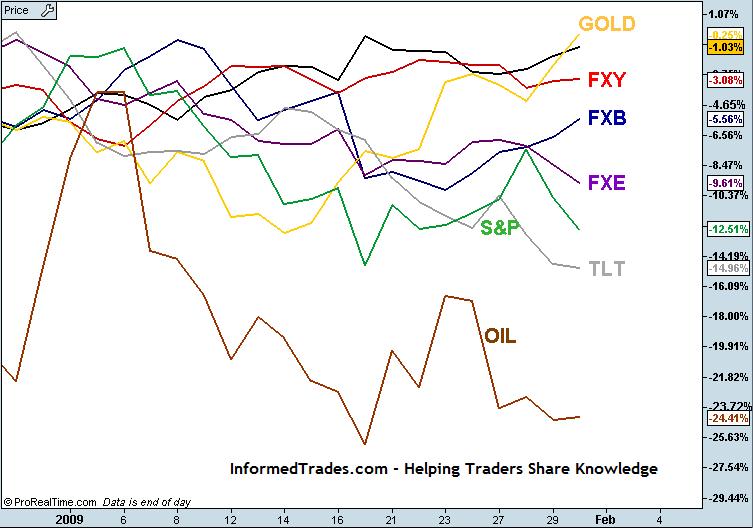
    I agree with Saxena’s basic premise that the Fed’s actions will be successful in creating inflation in the aggregate; it is only a matter of which asset class will reap the benefits of that inflation, and who will pay for it. The chart below compares various asset classes against one another for the month of January.

    click to enlarge

    A key question we may wish to begin asking and examining is just how much inflation the Fed has really created for us, something that will become more apparent as lending resumes and money that is “on the sidelines” returns to the game. I’m of the viewpoint that the global economy is currently improperly structured, and needs a complete restructuring, one that will likely require abandonment of the US dollar as world reserve currency, a corresponding decline in US consumption, and a significant restructuring of the FIRE (finance, insurance, real estate) economy in the United States.

    From that perspective, an equities rally will be unsustainable, unless there is currency debasement to the extent that all markets rise nominally. If that is the case, though, the inflation will result in significant dollar devaluation.

    Trading Implications: The fall in Treasuries was the story for January, and will be of importance so long as it continues. If money comes out of Treasuries and into equities and commodities, it increases the likelihood of seeing consumer price inflation. As I’ve stated before, though, I expect commodities to outperform equities once money comes out of Treasuries and dollar devaluation resumes. And as all currencies around the world are having trouble, gold will rise as fiat currencies continue to struggle.

    Disclosure: Long gold.

    ================================

     Catch the New Bull! – Buy Gold Online – Safely, quickly, and at low prices, guaranteed! Bullion Vault.com

    ===============================
    U.S. Debt Default, Dollar Collapse Altogether Likely – Seeking Alpha

    By: James West of Midas Letter

    The prospect of the United States defaulting on its debt is not just likely. It’s inevitable, and imminent.


    The regulatory black holes into which sanity and reason disappear on a daily basis are soon to collapse under the mass of their sheer size. The circle jerk going on among G7 governments has to end – the steady advance of gold, even in the face of a managed price, exposes the real value of the U.S. dollar, as opposed to its apparent value expressed in the dollar index.

    Is 2009 the year that the United States formally defaults? And with that, will the dollar collapse be rolled back ten for one or more?

    There are a lot of reasons to support that theory. To Wall Street economists, such an event is heresy and therefore unthinkable. Yet Wall Street is the very La-la-land that bred the idea of a perpetually indebted nation in the first place.

    Number one among the indicators favoring this scenario is what is happening in the U.S. Treasuries auction market.

    Last Thursday, an $30 billion auction in five-year notes failed to stir the interest of traditional primary dealers. The auction itself was saved by an anonymous “indirect” bid.

    Buyers are discouraged by the prospect of what is expected to amount to $2 trillion total issuance for the full year of 2009. The further out the maturities on notes, the more bearish the sentiment towards them. The only way to entice buyers is through the increase in yields.

    But with yields at 1.82 per cent, five-year notes were met with a demand for 1.98 times the amount offered – the lowest bid-to-cover ratio since September. A sell-off in treasuries began in earnest upon the conclusion of that auction.

    The U.S. Federal Reserve suggested last week that it was going to step up its treasury-buying activity, and the mainstream media interprets this as a form of market support. What it actually is evidence of growing anxiety and desperation on the part of the Fed as the realization dawns that demand for treasuries is progressively evaporating.

    The increased demand for gold as an investment witnessed throughout the last two weeks that has pushed gold to a 4 month high is further evidence that investors across the board are gravitating more towards gold and away from U.S. debt.

    So what is the catalyzing event that will precipitate outright capitulation?

    I think the spin-controlled version of events will make the collapse of the derivatives market the red herring that facilitates the aw-shucks-we-have-no-choice shoe-gazing moment possible, and that’s exactly the parachute the government needs to retain a veneer of credibility – at least in its own delusional mirror.

    The announcement that the CFTC was about to become the target of a regulatory overhaul supports this theory. Consistent with his unfortunate proclivity to hiring foxes to guard chickens, Barack Obama’s choice for CFTC commissioner Gary Gensler was the undersecretary of the U.S. Treasury when the Commodity Futures Modernization Act of 2000 was passed, and is one of its architects. This was the piece of legislation that was put forth to appease the opposition to “dark market” trading in certain OTC derivatives first noisily derided by CFTC commissioner Brooksley Born in 1998.

    Ignoring Born’s admonishments with this act, it exempted credit default swaps (CDO’s) from regulation, resulting in the somewhere between 58 and 300 trillion dollars in value presently under threat if the positions were to be unwound. Because of their unregulated status, counterparties in the largest transactions can simply “roll forward” contracts, instead of the losing party in the transaction covering their loss with a transfer of money. It is this massive “nominal” value that could be the Achilles heel of what’s left of the U.S. banking system, and by extension, the U.S. dollar.

    I don’t arrive at this conclusion because I like making catastrophic outlandish predictions. Its merely the result of following certain logical paths to their most likely outcome based on what has happened in the past.

    In discussions on this topic with editors of top tier financial publications, such speculation is dismissed out of hand, and the argument to refute the likelihood of such outcomes is never brought forward.

    Gold exchange traded funds (ETFs) are now the largest holders of physical gold, and as a proxy for investors who don’t want to be encumbered with taking delivery of the physical, provide a simple way to participate in the gold market.

    United States citizens should bear in mind, however, that should the banking system be brought down completely by the collapse of the futures market, proxies for gold such as ETF’s and bullion funds could theoretically be targeted by a government desperate for possession of value. The risk from security in holding physical bullion is matched by the risk of confiscation by government in these volatile times. Don’t forget, the government confiscated and outlawed private ownership of gold in 1933 in support of an ill-conceived gold standard, which to some extent, was that era’s spin to halt the flight of gold (and real value) from U.S. soil.

    Don’t think for a minute such drastic events are outside the realm of possibility. If somebody had told you in 1998 that a bunch of angry crazy pseudo-Muslims were going to fly jetliners into the World Trade Center, what would you have said?

    ======================================

    My note: Very Scarey, 10-1 Trade In on Dollars? Gold Confiscated? This is one of the reasons why I use Bullion Vault, check them out for the details…jschulmansr

    Catch the New Bull! – Buy Gold Online – Safely, quickly, and at low prices, guaranteed! Bullion Vault.com

    Good Investing! – Jschulmansr

    =======================================


    Nothing in today’s post should be considered as an offer to buy or sell or as a recommendation for  any securities or other investments, it is presented for informational purposes only. As a good investor, consult your Investment Advisor, Do Your Due Diligence, Read All Prospectus/s and related information carefully before you make any investments. –  jschulmansr

    Share this:

    • Click to share on Reddit (Opens in new window) Reddit
    • Click to share on Facebook (Opens in new window) Facebook
    • Click to share on LinkedIn (Opens in new window) LinkedIn
    • More
    • Click to share on X (Opens in new window) X
    • Click to share on Pinterest (Opens in new window) Pinterest
    • Click to share on Tumblr (Opens in new window) Tumblr
    • Click to print (Opens in new window) Print
    • Click to email a link to a friend (Opens in new window) Email
    Like Loading...

    Gold Taking a Breather but Fundamentals are Stronger!

    02 Monday Feb 2009

    Posted by jschulmansr in 10 year Treasuries, 20 yr Treasuries, banking crisis, banks, bear market, bull market, capitalism, central banks, China, commodities, Copper, Currencies, currency, Currency and Currencies, dollar denominated, dollar denominated investments, economic, Economic Recovery, economic trends, economy, Fed Fund Rate, Federal Deficit, federal reserve, Finance, financial, Forex, Fundamental Analysis, futures, futures markets, gold, Gold Bullion, Gold Investments, gold miners, hard assets, How To Invest, How To Make Money, India, inflation, Investing, investments, Junior Gold Miners, Latest News, Long Bonds, Make Money Investing, market crash, Markets, mining companies, mining stocks, Moving Averages, palladium, physical gold, platinum, platinum miners, precious, precious metals, price, price manipulation, prices, producers, production, SEO, Short Bonds, silver, silver miners, spot, spot price, stagflation, Stimilus, Stimulus, Stocks, TARP, The Fed, U.S. Dollar, Uncategorized

    ≈ Comments Off on Gold Taking a Breather but Fundamentals are Stronger!

    Tags

    agricultural commodities, alternate energy, Austrian school, Bailout News, banking crisis, banks, bear market, Bollinger Bands, bull market, capitalism, central banks, China, Comex, commodities, communism, Copper, Currencies, currency, deflation, Dennis Gartman, depression, diamonds, dollar denominated, dollar denominated investments, economic, economic trends, economy, Federal Deficit, financial, Forex, futures, futures markets, gold, gold miners, hard assets, heating oil, India, inflation, investments, Keith Fitz-Gerald, Marc Faber, Mark Hulbert, market crash, Markets, mining companies, Moving Averages, natural gas, oil, palladium, Peter Brimelow, Peter Schiff, physical gold, platinum, platinum miners, precious metals, price, price manipulation, prices, producers, production, protection, rare earth metals, recession, risk, run on banks, safety, Saudi Arabia, Sean Rakhimov, silver, silver miners, socialism, sovereign, spot, spot price, stagflation, Technical Analysis, timber, U.S. Dollar, volatility, warrants, Water

    Currently Gold is down $14-$15 dollars per oz. around the $914 level. As I wrote in my last post if we hold this level then $950 will be our next target. If it fails here then we may have a test back to $885 – $890. Either way I’m taking the opportunity to buy on dips since long term inflation is certainly due to happen and Gold is where you want to be when that happens.  Personally, I think $900 to $925 is the new base and we have avery real possibility of $1000+ Gold price before the summer truly begins.- Good Investing – Jschulmansr

    ==============================

    Catch the New Bull! – Buy Gold Online – Safely, quickly, and at low prices, guaranteed! Bullion Vault.com

    ==================================

    Update on the Gold Trade – Seeking Alpha

    By: Trader Mark of My Mutual Fund

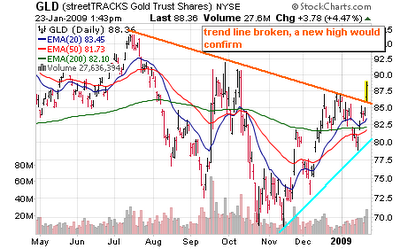
    Last Friday we said gold might finally have it’s real breakout here [Jan 23: Could be the Real Breakout in Gold] I wrote:

    Things to like:
    1) a series of higher lows
    2) the trendline of lower highs has been penetrated

    Things to see for confirmation:
    1) any pullback is bought
    2) price prints over October 2008’s highs, signaling the end of “lower highs”

    This was what the chart looked like at the time:

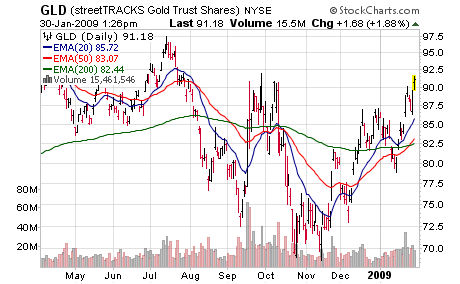
    Now?

    Without benefit of the orange line – you can see condition #1 has been fulfilled – we “backfilled”, tested the area we broke out of and people were eager to buy. On that, an aggressive trader would be buying. A reader mentioned this outcome last week.

    For someone more conservative in orientation, you want to see #2 “a price point over October 2008’s highs” – then we end our half year of lower highs. We are withing spitting distance here with GLD at $91.40 and the October intraday high at $92.

    It’s hard to get behind gold fully because there is no “earnings” behind it; it’s all about sentiment. But the theory is that as all the world’s troubled countries race to devalue their currencies (print, print,print) to “save the system,” a hard asset should retain its value. Silver is likewise breakout out, although silver has a lot of industrial uses as well.

    I hate to chase a move, but from a technical set up, a lot of institutional money could be set to finally jump in here….

    Now the question of what instrument to use – keep it simple or go with a miner? etc.

    Disclosure: No position

    =================================

    My Note- Great call by Trader Makr but I have to ask, why no position Trader Mark? – jschulmansr

    =================================

    Catch the New Bull! – Buy Gold Online – Safely, quickly, and at low prices, guaranteed! Bullion Vault.com

    =================================

    Fed Monetizes Debt Leading Investors to Embrac Gold – Seeking Alpha

    By: Boris Sobolev of Resource StockGuide.com

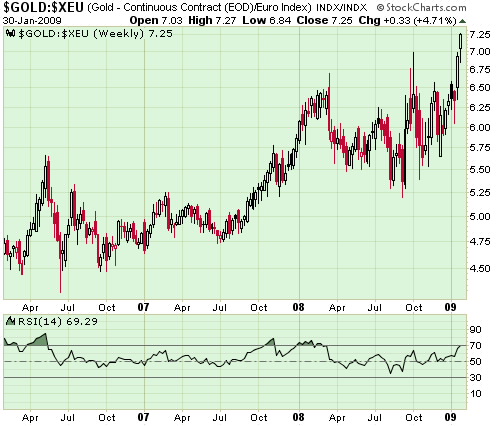
    In January gold rose significantly against all major world currencies. In most currencies except in the US dollar and the Japanese yen, gold actually made an all-time-high.

    January Performance

    GOLD / USD 5.3%

    GOLD / EUR 16.7%

    GOLD / AUD 16.5%

    GOLD / JPY 4.4%

    GOLD / GBP 5.8%

    GOLD / CHF 16.3%

    10-Yr Yield 13.0%

    click to enlarge

    At the same time, most capital markets have been falling.

    January performance

    DOW -11.5%

    S&P -11.4%

    NASDAQ -9.0%

    FTSE -6.4%

    DAX -9.8%

    Nikkei -9.8%

    Shanghai -9.3%

    The governments around the world are trying to take initiative while private capital is sitting on the sidelines, preferring the safety of government bonds and precious metals.

    Investors typically do not trust the governments to implement any effective economic solutions. Moreover, this lack of faith in central planning continues to grow since the US government has no other plan of action than to save the old, compromised and untrustworthy financial system.

    What the Federal Reserve together with the Department of Treasury has shown is that they will inject a vast amount of newly created money into a hugely ineffective financial system.

    While in the fall of last year, in fear of devastating deflation, analysts were competing in downward projections for the price of gold, now the competition is to estimate the amount of losses incurred by the financial institutions around the world. The maximum assessment is now at $4 trillion, with Nouriel Roubini coming in close second at $3.6 trillion.

    But the main problem is not so much in the amount of credit losses or the amount needed for recapitalization efforts but in that the new government is committed to continue to transfer huge capital into the hands of the same group of people who were largely responsible for the world financial crash in the first place. Wall Street, though transformed, will remain in control.

    The lack of trust in the ability of insolvent financial institutions to run the modern financial system is moving investors into gold.

    An even more important gold catalyst was the Federal Reserve. In comparing the two latest Fed statements, two things stand out. Here is the evolution in wording:

    December Statement: “In light of the declines in the prices of energy and other commodities and the weaker prospects for economic activity, the Committee expects inflation to moderate further in coming quarters.”

    January Statement: “In light of the declines in the prices of energy and other commodities in recent months and the prospects for considerable economic slack, the Committee expects that inflation pressures will remain subdued in coming quarters. Moreover, the Committee sees some risk that inflation could persist for a time below rates that best foster economic growth and price stability in the longer term.”

    December Statement: “The Committee is also evaluating the potential benefits of purchasing longer-term Treasury securities.”

    January Statement: “The Committee also is prepared to purchase longer-term Treasury securities if evolving circumstances indicate that such transactions would be particularly effective in improving conditions in private credit markets.”

    First, the FOMC sees a threat of deflation and second it is prepared to counter this threat by purchasing longer-term treasuries.

    Purchases of long term bonds is the most inflationary move that a central bank can undertake because it represents direct monetization of the government debt and hence an unconcealed debasement of national currency. (This is happening at the same time as the new Secretary of Treasury is chastising China – the main US creditor – for currency manipulation.)

    Why did the Fed make such a determined statement, with one member even voting to begin long term treasury purchases immediately? First and foremost, the real estate market is not showing any signs of life. House prices are falling, time required to sell new homes is rising and most importantly, after a steep fall in December, average mortgage rates began to rise again, reaching 5.34% as of last Friday.

    Since mortgage rates are closely tied to the 10-year treasury yield, the Fed stands ready to buy government debt and help make housing more affordable via low mortgage rates. The hope is that such action would help put an end to a decline in asset prices and stop the deflationary spiral.

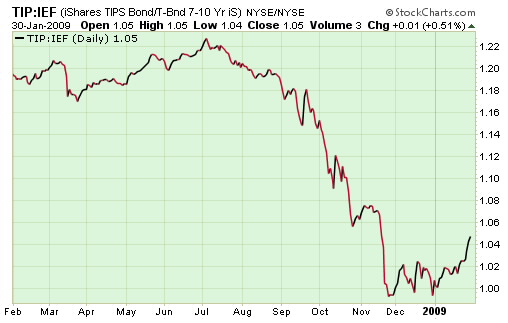
    In fact, the latest Fed balance sheet showed that long term treasury purchases have already started, with around $1 billion in notes (5-10-year maturity) purchased for the week ended January 21st. This is a modest amount, but it is a statement that the Fed is ready to do more than just talk. Traders have indeed sensed this development and Treasury Inflation-Protected Securities (TIPS) (TIP) are also beginning to reflect greater inflation expectations.

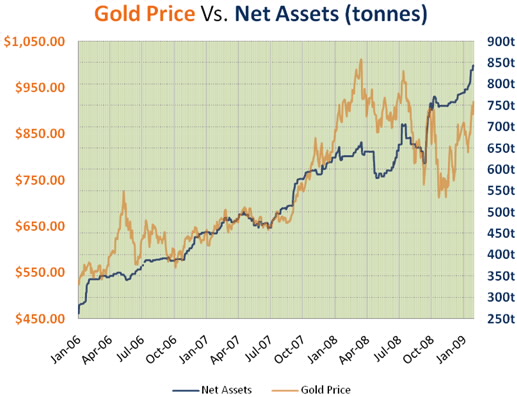
    Gold investors are also sniffing out the coming price reflation as they piled into the SPDR Gold Shares (GLD) at an increasing rate.

    For the month of January, GLD gold holdings rose 8.2% or close to a record setting 63 tonnes. At this rate, GLD will soon surpass Switzerland in its gold holdings, thus becoming the world’s sixth largest gold owner after the US, Germany, the IMF, France and Italy.

    If the Fed continues to purchase long term treasuries, it is clear that there is only one way for gold and gold stocks and it is up.

    ================================

    Catch the New Bull! – Buy Gold Online – Safely, quickly, and at low prices, guaranteed! Bullion Vault.com

    ================================

    Gold as Part of a Portfolio – Seeking Alpha

    By: San Olesky of Olesky Capital Management

    Many investors have been thinking about gold recently. Some have considered it because it has been a relatively strong performer with the iShares COMEX Gold Trust (IAU) closing up 5.4% in 2008. It’s up 2% year-to-date as of Wednesday’s close. The iShares S&P 500 Index ETF (IVV) was down 36.94% in 2008 and is down 6.17% year-to-date as of Wednesday’s close. Other investors or traders have bought or considered gold as a classic safe haven.

    My inclination is to refute the efficacy of buying or holding gold for security either in the form of an ETF or, more so, in the case of gold bullion bars or gold coins. However, as the financial crisis became more severe last year, a couple of clients approached me about adding gold to their portfolios. Rather than diplomatically rejecting the proposal, I told them that I would investigate the historic effects of holding gold in a portfolio. Long story short, I found that adding a small, reasonable allocation to gold reduced portfolio volatility substantially and increased return slightly.

    A simple diversified portfolio consisting of 1/3 S&P 500, 1/3 Real Estate Investment Trusts (REITs), and 1/3 10 year U.S. Treasuries would have produced a compound annual growth rate (CAGR) of 8.47% with 11.15% volatility (standard deviation – SD) from 1993 to 2008. For comparison, the S&P 500 produced a 6.67% CAGR with a 20.16% SD. Although few investors would implement this 1/3 – 1/3 – 1/3 allocation, diversification is proving its strengths here. All of these statistics incorporate rebalancing annually.

    Let’s take the same 1/3 – 1/3 – 1/3 portfolio and alter it to include a relatively small allocation to gold. That allocation will be 30% S&P 500, 30% REITs, 30% Treasuries, and 10% gold. Over the same timeframe the portfolio with gold produced an 8.49% CAGR with a 9.86% SD. The portfolio with gold produced a slightly better CAGR with volatility that was 11.6% lower than the 1/3 – 1/3 – 1/3 portfolio. The diversified portfolio with gold produced a CAGR that was 27.3% higher than the S&P 500 and 51.1% less volatile than the S&P 500. The S&P 500 had 4 losing years with the worst being a loss of 37% last year. The 1/3 – 1/3 – 1/3 portfolio had 3 losing years with the worst being a loss of 18.15% last year. The portfolio with gold had only 2 losing years with the worst being 15.74% last year.

    In constructing sound and productive portfolios we would like to include assets that have high returns, low volatility, and low correlation to the other assets in the portfolio. Looking at gold’s average annual returns, relative volatility, and relevant correlations, one should expect that gold would be a constructive addition to many portfolio allocations. In fact, gold even has a relatively low correlation with commodities in general (S&P Goldman Sachs Commodity Index). However, we should learn from the past but not expect it to repeat itself exactly. There is much to be learned from historic returns, volatilities, and correlations of asset classes. With all due respect to history and math, we must use reason when constructing portfolios. I view gold as a very narrow and idiosyncratic asset. So, I do not feel that it is wise to strategically allocate as much as 10% to the asset although the historic, mathematically optimal amount would be higher in the context of some portfolios.

    What did I do? Based on my tests and observations, I bought a little gold last year for some of my clients. I have incorporated a small allocation to gold into their continuing strategic allocations.

    ====================================

    My Note: This is great news even the Non Gold Bugs are become cautiously bullish!-jschulmansr

    ====================================

    Catch the New Bull! – Buy Gold Online – Safely, quickly, and at low prices, guaranteed! Bullion Vault.com

    ====================================

    Finally and extremely interesting article you want to read! Be sure to click on the chart links too…- jschulmansr

    Economy Watch: What if Stocks Were Priced in Gold?- Seeking Alpha

    By: Paco Ahlgren of Ahlgren Multiverse

    “Everything has its limit — iron ore cannot be educated into gold.”

    — Mark Twain

    Several charts have been floating around the Internet for some time, showing the historical Dow Jones Industrial Average, priced in terms of gold. The simplest explanation entails thinking of the Dow divided by one ounce of gold; if the Dow is at 5000, and gold is at 500, then Dow-to-gold is 10. But it’s important to remember as you’re considering this ratio that the Dow is calculated in terms of dollars. So essentially, when we determine the Dow-to-gold ratio, it’s not just a simple ratio of gold to shares in the Dow, but rather it is a three-part ratio — Dow, expressed in dollars, to an ounce of gold.

    Wouldn’t it just be easier to express gold in terms of dollars, or the Dow in terms of dollars? Well, those are certainly useful ratios — and we use them all the time — but what we’re really going after when we look at a historical Dow-to-gold chart is how well the Dow has performed, relative to the dollar, and relative to gold. What have inflationary pressures done to the Dow, in terms of gold and the dollar, over the past century? How have the three components moved in the various historical boom-bust scenarios? The results are interesting.

    Let’s shift gears for a moment. Just off the top of your head, what would you expect stocks to do in periods of inflation? The dollar loses value rapidly, right? And that means prices of goods and services move higher, presumably with wages. So wouldn’t it stand to reason, intuitively, if corporations were making more money as prices increased, profits would increase too? And if profits increase, shouldn’t share prices go higher in response?

    It turns out that inflationary price increases are bad for the stock market, and no period in history establishes this more concretely than the late 1970s and the early 1980s. Interest rates and prices soared, along with the price of gold, but stocks were flat. I want you to think about what I’m saying here: prices in general were going up, and yet the stock market was not. What this means is while stocks, in nominal terms, looked to be relatively stagnant, in real terms they were getting crushed. This is why the Dow-to-gold ratio is so significant as an indicator of relative value.

    There is an elegant, simple truism that comprises every single transaction between buyers and sellers, and yet most people don’t even think about it: whenever you buy something, you are selling something else. When you buy corn, you are selling dollars. When you buy a Ford, you are selling dollars. If you are in Mexico and you buy a chicken, you are selling pesos. Of course, if you came from the U.S., you first sold dollars, bought pesos, and then sold pesos to buy the chicken. I know most of you already understand this concept, but I’m trying to emphasize that even when currency is used, every transaction is merely a trade; that is to say, the transaction is nothing more than negotiation that results in the exchange of two things — whether goods, services, or currency.

    With that in mind, consider this: when prices rise because of inflation (printing of money), it isn’t so much that goods and services are getting more valuable — rather it’s much more accurate to say the currency is simply getting less valuable relative to everything else. If the dollar collapses, for instance, and the cost of a loaf of bread goes from $1 to $20 at the same time a share of Microsoft (MSFT) goes from $20 to $30, then Microsoft is severely under-performing — in inflation-adjusted dollars. A loaf of bread will cost you 20 times what it used to — not because it is more valuable, but because the dollar is less valuable. Meanwhile Microsoft is worth only 50% more. Relative to the dollar, shares of Microsoft are actually losing money — in a big way.

    If you look at a chart of inflation from 1978 to 1982, you’ll notice a huge spike. If you look at a chart of the Dow Jones Industrial average during the same period, you’ll see that stocks traded sideways in a fairly well-defined range over the same period. But that doesn’t tell the whole story; if you adjust for the meteoric rise in prices during that five-year period, the stock market actually performed much worse than the nominal dollar fluctuations presented in the historical chart. In other words, the price of just about everything was going up dramatically, but stocks were not. So if you adjust prices back to “normal” levels, and adjust stocks accordingly, the picture for equities would have been horrible.

    Now for the pièce de résistance…

    Here is a series of charts of historical nominal gold prices (not adjusted for inflation), in several different currencies — the first of which is U.S. dollars. Take a look at the spike in the price of gold from 1977 to 1981. Now, if we go back to our original chart above, showing the Dow Jones Industrial Average, in direct relation to an ounce of gold (Dow-to-gold), you can see that the ratio went roughly 1:1 in 1980 — at the peak of the inflationary price surges. To clarify, the Dow was at about 750, as was gold.

    But didn’t we say that, relative to rising prices, the Dow actually underperformed dramatically? So if you bought gold in the mid-1970s, not only was your investment skyrocketing, but the stock market — which was flat in nominal dollars — was actually doing very poorly relative to rising prices. Bear in mind that both the Dow and gold were priced in terms of nominal dollars at the time; they essentially “cancel out” — that is to say, relative to rising prices, gold also failed to perform as well as the nominal dollar-price. Still, it did offer an excellent hedge against rising prices, and even outperformed during the period.

    What does all this mean? Well, for starters the average Dow-to-gold ratio over the last century has been about 9.5, and we are currently at about 8.5. So you’re probably thinking we’re oversold and due for a correction. In other words, the Dow-to-gold ratio is probably going higher, right? Well that was my first conclusion too, but actually on closer examination it turns out that’s probably not right at all.

    For much of the last century the dollar was tied to gold, and while the relationship was never perfect — and the U.S. government betrayed the union many times, in many different ways — there was at least some relationship, which helped pull the ratio down. Eventually, excessive inflationary printing caught up with the government in the 1960s, and it became clear it wouldn’t be able to honor redemptions against the dollar at the price it had fixed. Nixon essentially defaulted on the U.S. promise to redeem dollars for gold by taking the U.S. off the standard in the 1970s — and this, more than anything else, allowed inflationary pressure to drive general prices into the stratosphere. This was the moment the Dow-to-gold ratio approached 1:1. To fight rising prices, Paul Volcker, the Fed Chairman at the time, pushed the Fed’s target interest rate past 20% and barely saved the U.S. economy from collapse.

    For most of the next 20 years, gold fell and stock prices rose. Meanwhile, the U.S. government capitalized on the lie it had created and printed more and more money. Who really cared? Everyone was making money in the stock market, and prices remained relatively stable. In fact, every time prices failed to act “correctly,” the Fed simply changed the rate at which it would lend to banks. But the illusion of the monetary policy game couldn’t last forever; people used easy money printed by the government to buy assets they couldn’t afford throughout the economy — especially houses. Finally the pressure was just too much, and everything started unraveling in 2007. But the gold market seemed to understand the game couldn’t last, and around 2000 it started a slow, steady rise.

    Relative to everything, the number of dollars in the system in early 2009 is almost incomprehensible. Once de-leveraging reaches its nadir — and it’s coming soon — those dollars are going to hit the economy and drive prices much higher.

    What have we learned about stocks in such periods of rising prices? Not only do they fail to perform, but adjusted for inflationary price pressures, they actually under perform. General prices and unemployment will continue to rise. The consumer will continue to be unable to consume. Corporate earnings and dividends will continue to collapse as a result. Stocks are going lower — probably much lower.

    And what about the price of gold? It will almost certainly continue to increase — not only because people will flock to its long historical stability and consistency, but also because there are simply so many more dollars (and yen, and rubles, and euros) in the world. Remember, the U.S. isn’t the only country printing innumerable sheets of currency. And in that context, remember also that inflationary price increases have almost nothing to do with increased demand, but rather they are the result of currency devaluation and destruction — through printing.

    I just want to share two more charts with you. The first should give you a little perspective — it is a historical chart of gold, in both nominal and real dollars. Notice the real price of gold in 1980 (in 2007 dollars) was $2272 per ounce. If I’m correct about inflation and the fate of the dollar — and I’m confident I am — then we are nowhere near the historical high in gold. But I don’t think we’re merely going to re-test that high — I think we’re going to blow through it as the dollar loses value.

    In the 1930s, as corporate earnings and dividends disintegrated, the Dow lost nearly 90% of its value from peak to trough. The U.S. was a creditor nation with a huge manufacturing base. The dollar was tied closely to gold. Since its peak in October 2007, the Dow has lost less than 50% of its value. The U.S. is a debtor nation with a relatively small manufacturing base. I can’t say it enough: we borrow profusely, we manufacture very little, and we consume gluttonously. Nonetheless, the consumer has now lost almost all his purchasing power, and corporate earnings and dividends are going to suffer massively as a result.

    In 2007, the Dow peaked at about 14,150. To give you some perspective, an 85% drop in the Dow from peak to trough would put it at about 2100.

    I know it’s easy to imagine the Fed has magical powers. I’ve fantasized about such things myself at times of extreme weakness — that maybe the Fed will “somehow” figure out a way to fight and defeat the unprecedented evil specter of inflation it is foisting on its unsuspecting children. Sometimes I do believe that our Lord and Savior Barack Obama will wave his charmed “unicorn horn of change” and all will be well again. Likewise, at times I feel like I could let Uncle Ben Bernanke take me just about anywhere in his helicopter of prosperity. My faith in the reverend John Maynard Keynes runs deep, as I hope, and hope, and hope. I find myself gleefully clicking my heels together and repeating, “the dollar is almighty, and the Stars and Stripes will prevail.” And when I am in this wonderful place, I have confidence that someday soon, we’ll all be buying houses with no money down, and with no jobs. Our driveways and backyards will once again overflow with boats, motorcycles, and sports cars.

    Then I think about the 1930s. And suddenly I am wide-awake.

    Let me ask you a simple question, and I want you to actually think about it. Do you really think we can’t get to the 1930s again? Do you really think that we’re going to return to the exuberant excess of the past few decades? If so, let me disabuse you of the notion: the United States was in much better shape, economically, going into the Great Depression than it is now. Prosperity is not coming back to the U.S. as we know it. We are in a lot of trouble.

    Is a Dow-to-gold ratio of 1:1 so incomprehensible? Again, it has happened before — several times. But I’ll even take it a step further: what about a Dow-to-gold ratio of .5? Or less? I promise you, if the Fed fails to soak up all the dollars it’s putting in the system, that’s exactly where we’re going. And what, you may ask, does the Fed use to “soak up dollars?”

    I’ll be glad to tell you that too. When the Fed needs to take dollars out of the system, it sells Treasuries (which means it buys dollars). The problem is, the U.S. debt-load is astronomical. Who, exactly, is going to buy that debt from the Fed? And at what interest rate? Remember, if the Fed is desperately trying to take dollars out of the system, there can be only one reason: it is scared of rising prices caused by inflation. But if the Fed floods the market with Treasuries, it will achieve exactly the opposite effect it’s looking for — it will cause rates to rise, probably dramatically. Do you really think the Chinese and the Japanese are going to buy Treasuries at a 2% yield if the Fed is panicking and trying to buy dollars to stop an inflationary price explosion? If so, you’re delusional. Chinese and Japanese people are smart. They’re not going to fund an inflationary dollar at 2%. Ever.

    In the past it might have worked. Of course, in the past, the U.S. money supply was much smaller, and our ability to borrow was much stronger. But those days are gone.

    As if I haven’t terrified you enough, the last thing I’m going to leave you with is really scary. It is a link to an excellent article by Mark J. Lundeen, whose insight into this economic catastrophe has been stupefying since long before all of this even started. Embedded in the article is a chart that shows historical dollars-in-circulation, relative to U.S. gold.

    With that, I think I’ll let you do the rest of the math. Sleep well.

    Disclosures: Paco is long gold.

    Copyright 2009, Paco Ahlgren. All Rights Reserved.

    ==================================

    If you have done the math…

    Catch the New Bull! – Buy Gold Online – Safely, quickly, and at low prices, guaranteed! Bullion Vault.com

    =================================

    That’ it for now – Good Investing – Jschulmansr


    Nothing in today’s post should be considered as an offer to buy or sell any securities or other investments, it is presented for informational purposes only. As a good investor, consult your Investment Advisor, Do Your Due Diligence, Read All Prospectus/s and related information carefully before you make any investments. –  jschulmansr

    Share this:

    • Click to share on Reddit (Opens in new window) Reddit
    • Click to share on Facebook (Opens in new window) Facebook
    • Click to share on LinkedIn (Opens in new window) LinkedIn
    • More
    • Click to share on X (Opens in new window) X
    • Click to share on Pinterest (Opens in new window) Pinterest
    • Click to share on Tumblr (Opens in new window) Tumblr
    • Click to print (Opens in new window) Print
    • Click to email a link to a friend (Opens in new window) Email
    Like Loading...

    It’s Official- The New Gold Rally Has Begun!

    30 Friday Jan 2009

    Posted by jschulmansr in Austrian school, Bailout News, banking crisis, banks, bear market, capitalism, central banks, China, Comex, Copper, Currencies, currency, Currency and Currencies, deflation, dollar denominated, dollar denominated investments, economic, Economic Recovery, economic trends, economy, Federal Deficit, Finance, financial, Forex, futures, futures markets, gold, Gold Bullion, Gold Investments, gold miners, How To Invest, How To Make Money, India, inflation, Investing, investments, Junior Gold Miners, Latest News, Make Money Investing, market crash, Markets, mining companies, mining stocks, palladium, physical gold, platinum, platinum miners, precious metals, price manipulation, prices, producers, production, Prophecy, resistance, Siliver, silver, silver miners, spot, spot price, stagflation, Stocks, TARP, Today, U.S. Dollar

    ≈ Comments Off on It’s Official- The New Gold Rally Has Begun!

    Tags

    agricultural commodities, alternate energy, Austrian school, Bailout News, banking crisis, banks, bear market, Bollinger Bands, bull market, capitalism, central banks, China, Comex, commodities, communism, Copper, Currencies, currency, deflation, Dennis Gartman, depression, diamonds, dollar denominated, dollar denominated investments, economic, economic trends, economy, Federal Deficit, financial, Forex, futures, futures markets, gold, gold miners, hard assets, heating oil, India, inflation, investments, Keith Fitz-Gerald, Marc Faber, Mark Hulbert, market crash, Markets, mining companies, Moving Averages, natural gas, oil, palladium, Peter Brimelow, Peter Schiff, physical gold, platinum, platinum miners, precious metals, price, price manipulation, prices, producers, production, protection, rare earth metals, recession, risk, run on banks, safety, Saudi Arabia, Sean Rakhimov, silver, silver miners, socialism, sovereign, spot, spot price, stagflation, Technical Analysis, timber, U.S. Dollar, volatility, warrants, Water

    As it write this Gold is up $22.50 oz to $929.00! It absolutely smashed thru the $920 resistance! If we hold here $950 -$975 is the next level.  Barrick Gold CEO Munk says China to be a big buyer of gold as confidence is lost in the U.S. Dollar. The treasuries bubble is starting to burst and money is pouring into gold!- Good Investing! – jschulmansr

    ====================================

    Catch the New Bull! – Buy Gold Online – Safely, quickly, and at low prices, guaranteed! Bullion Vault.com

    =========================================

    Source: MineWeb.Com

     WORLD ECONOMIC FORUM

    Munk forecasts currency, economy fears will send gold to new record highs

    Whether it’s the currency effect or a reaction to a feeling of uncertainty, Barrick Gold Chairman Peter Munk says gold is more likely to go up than down.

    Author: Barbara Lewis
    Posted:  Friday , 30 Jan 2009

    DAVOS, Switzerland (Reuters) – 

    Gold is likely to hit new record highs, spurred by serious concern about the U.S. currency and doubt about the state of the world economy, the chairman of Barrick Gold Corp. said on Thursday.

    There was even a possibility, although not a probability, central banks, including China’s, might start to switch from dollar holdings to gold, which could cause the metal’s price to treble or more.

    From a gold producers’ perspective, one negative is that the cost of bringing on production has remained high, even as other raw materials, including base metals and energy, have slumped.

    “Gold is at record levels in every currency except dollars. Even within dollar terms it is within a few percentage points of an all-time high at a time when all the other major commodities are falling,” Peter Munk told Reuters at the World Economic Forum meeting in Davos.

    “Whether it’s the currency effect or a reaction to a feeling of uncertainty, gold in my opinion is more likely to go up than down,” the chairman and founder of the world’s largest gold mining company said.

    Spot gold was at $902.80/904.80 at 1817 GMT. It hit a record high of $1,030.80 an ounce in March last year.

    Munk stressed he was merely weighing the odds.

    “It would be stupid to assume commodities prices can only go one way,” he said, adding physical demand for gold jewellery was not high during the economic downturn.

    Gold has been one of the best-performing assets of late, rising in value by nearly 17 percent since late October.

    Investors have bought heavily into physical bullion in the form of coins and bars and physically-backed assets such as exchange-traded funds as a safe store of value at a time of increased volatility in other asset prices.

    Munk said downward pressure on the dollar, partly because of massive U.S. spending to stimulate the economy, would increase gold’s attractions as an investment further.

    Gold usually moves in the opposite direction to the dollar, as it is often bought as a hedge against weakness in the U.S. currency.

    “My personal feeling is that with the rescue packages calling for trillions, not billions… the value of the (U.S.) currency has to go down,” said Munk.

    DUMB TO HEDGE

    His company did not hedge its output for now — meaning it does not use derivatives to insure against a fall in price — and relied instead on the price climbing. In the past its successful hedging allowed it to make the acquisitions that helped to make it the world’s biggest gold miner.

    “It would be dumb to hedge,” Munk said of the current climate.

    His bullishness was underscored by the possibility central banks, including that of major dollar asset-holder China, might start buying gold.

    “If they decide to diversify, we assume into gold, then we start to talk about a trebling or quadrupling of the gold price. It could be followed by Russia or Kuwait.

    “I don’t think it’s likely, but it’s more likely. I would not have said it two years ago …I’m not a gold bug …but it’s more likely than it was two years ago.”

    A strong price climate has meant ongoing investment in bringing on new gold, Munk said.

    “In every other mining area, people are cancelling mines.”

    But declines in other commodities have yet to have a major impact on cost.

    “Marginally yes, but substantially no. For some reason cash costs are tending to continue to increase,” he said, when asked whether investment costs were falling.

    “Energy costs have gone down. It does help, but labour costs are consistently increasing.”

    The one way to reduce production costs is to invest in efficient new mines, Munk said, citing two major new projects in Nevada and the Dominican Republic and a smaller one in Tanzania.

    (Reporting by Barbara Lewis, additional reporting by Jan Harvey in London; editing by Anthony Barker)

    © Thomson Reuters 2009 All rights reserved

    =============================

    Catch the New Bull! – Buy Gold Online – Safely, quickly, and at low prices, guaranteed! Bullion Vault.com

    =============================

    Hedge Fund to Measure Returns in Gold Rather Than Currency – Seeking Alpha

    By: Todd Sullivan of Value Plays

    This is a pretty stunning move. What is even more alarming is the reasoning given.
    From the FT:

    A hedge fund has begun offering investors the chance to have their investment denominated in gold, as worries grow over governments debasing their currencies by printing money.

    Osmium Capital Management, a $178m hedge fund manager based in Bermuda, is launching a new share class allowing investors to hold shares measured as troy ounces of the fund, rather than U.S. dollars, sterling or euros.

    The move follows a surge in investor demand for small gold (GLD) bars and coins held by individuals and gold-backed exchange-traded funds that are holding a record amount of bullion.

    Chris Kuchanny, Osmium chief executive and a former London ABN Amro trader, said he was putting almost all his personal wealth into the new share class: “Investors have voiced concerns that they’re overly exposed to the major fiat [paper] currencies in an environment where the fundamentals of those currencies are clearly deteriorating with governments assuming more debt and having lower revenue and more expenditure.

    This shows a stunning lack of confidence in currencies. It also says that the fund is anticipating inflation to rear its ugly head in a scary way. When it does, the value of the currencies will plummet and gold will rise.

    What is to watch now is whether or not other funds begin to follow. If this becomes a movement rather than an individual act, the crash in currencies could be expedited in a nasty way. Stay tuned…

    Disclosure: No position in gold… yet.

    ====================================

    Catch the New Bull! – Buy Gold Online – Safely, quickly, and at low prices, guaranteed! Bullion Vault.com

    ====================================

    My Disclosure: Long Gold , Gold Etf’s, Gold Miners/Producers, Long Silver, Silver Miners/Producers, Platinum and Paladium Miners/Producers- jschulmansr

    More to follow later today…

    Nothing in today’s post should be considered as an offer to buy or sell any securities or other investments, it is presented for informational purposes only. As a good investor, consult your Investment Advisor, Do Your Due Diligence, Read All Prospectus/s and related information carefully before you make any investments. –  jschulmansr

    Share this:

    • Click to share on Reddit (Opens in new window) Reddit
    • Click to share on Facebook (Opens in new window) Facebook
    • Click to share on LinkedIn (Opens in new window) LinkedIn
    • More
    • Click to share on X (Opens in new window) X
    • Click to share on Pinterest (Opens in new window) Pinterest
    • Click to share on Tumblr (Opens in new window) Tumblr
    • Click to print (Opens in new window) Print
    • Click to email a link to a friend (Opens in new window) Email
    Like Loading...

    Are You Ready For This? – It’s Back and Ready To Rally!

    29 Thursday Jan 2009

    Posted by jschulmansr in Bailout News, banking crisis, banks, bear market, bull market, capitalism, central banks, China, Comex, commodities, Copper, Currencies, currency, Currency and Currencies, deflation, dollar denominated, dollar denominated investments, economic, Economic Recovery, economic trends, economy, Federal Deficit, Finance, financial, Forex, Fundamental Analysis, futures, futures markets, gold, Gold Bullion, Gold Investments, gold miners, How To Invest, How To Make Money, India, inflation, Investing, investments, Jim Rogers, Jim Sinclair, Latest News, Make Money Investing, Marc Faber, Mark Hulbert, market crash, Markets, mining companies, mining stocks, palladium, Peter Brimelow, physical gold, platinum, platinum miners, precious, precious metals, price, price manipulation, prices, producers, production, protection, run on banks, safety, Saudi Arabia, security, silver, silver miners, spot, spot price, stagflation, Stimulus, Stocks, TARP, Technical Analysis, Today, U.S. Dollar

    ≈ Comments Off on Are You Ready For This? – It’s Back and Ready To Rally!

    Tags

    agricultural commodities, alternate energy, Austrian school, Bailout News, banking crisis, banks, bear market, Bollinger Bands, bull market, capitalism, central banks, China, Comex, commodities, communism, Copper, Currencies, currency, deflation, Dennis Gartman, depression, diamonds, dollar denominated, dollar denominated investments, economic, economic trends, economy, Federal Deficit, financial, Forex, futures, futures markets, gold, gold miners, hard assets, heating oil, India, inflation, investments, Keith Fitz-Gerald, Marc Faber, Mark Hulbert, market crash, Markets, mining companies, Moving Averages, natural gas, oil, palladium, Peter Brimelow, Peter Schiff, physical gold, platinum, platinum miners, precious metals, price, price manipulation, prices, producers, production, protection, rare earth metals, recession, risk, run on banks, safety, Saudi Arabia, Sean Rakhimov, silver, silver miners, socialism, sovereign, spot, spot price, stagflation, Technical Analysis, timber, U.S. Dollar, volatility, warrants, Water

    Are You Ready For This! You are asking yourself “am I ready for what?””What’s ready to Rally?” Gold my friend is the answer! As I write Gold is consolidating right around the $900 level. If you had listened to me you would be sitting on profits of $50- $100 oz. already! Well don’t worry Gold still has plenty of room to move as you will see in today’s post. – Good Investing! – jschulmansr

    ======================================

    Catch the New Bull! – Buy Gold Online – Safely, quickly, and at low prices, guaranteed! Bullion Vault.com

    =====================================

    Gold Price Could Double – World Gold Council

    Source: World Gold Council

    The value of gold could soar due to increased demand following the global financial crisis, it has been suggested.

    According to Citigroup, the price of gold could double by the summer, the Daily Mail reports.

    “We continue to remain unequivocally bullish on the medium to long-term view on gold and still believe that we can ultimately see levels in excess of $2,000 (?1,398),” the firm told the paper.

    Such levels would mean the price of gold would more than double its current value.

    The paper notes that since September, the value of the precious metal has already risen by $122.

    Citigroup added that price rises will either come via inflation following liquidity injections by governments around the world, or by continuing investment from those who view gold as a safe haven.

    In related news, a recent poll conducted by Bloomberg showed that 28 of 31 traders, investors and analysts questioned said now is a good time to purchase gold.
    =================================

    Catch the New Bull! – Buy Gold Online – Safely, quickly, and at low prices, guaranteed! Bullion Vault.com

    =================================

    $850B Stimulus Plan Signals Gold Take-Off – Seking Alpha

    By: Peter Cooper of Arabian Money.net

    Last night the US passed its much anticipated $850 billion Obama stimulus package, representing another huge monetary expansion. Countries all around the world have been at it, and the volume of money in circulation is increasing at a record level.

    Meantime, gold prices have been perky and past $900 earlier this week. Now gold has fallen back a little. The gold chart has completed an almost perfect inverse head-and-shoulders pattern which should mark the reversal of the falling trend that started at $1,050 an ounce last March.

    Gold technicals

    Aside from the technicals of the gold chart, let us also get back to fundamentals: the supply of gold and silver is pretty much fixed. Money supply is undergoing huge and unprecedented expansion.

    At present, governments are printing money like fury and little is happening to their economies because banks, companies and individuals are hoarding cash. But eventually pulling on this string will work, and money will flood into the economy in an uncontrollable way.

    It is at this point that gold prices will go ballistic. That should not be more than nine months to a year away based on past precedent.

    However, before that golden age occurs there will be increasing speculation about the future of the gold (and silver) price. More and more investors will read articles like this one and be impressed by the argument – which is far sounder than trying to come up with a new bull market for equities, bonds or real estate.

    Bond crash

    Sometime soon the bond markets of the world are also going to weaken much further, and that will give precious metals another reason to rise in value as an alternative safe haven class.

    For investors in precious metals then it is just a matter of holding on and taking advantage of price dips to stock up with bullion and shares, although it is surely arguable that the best buying opportunities are behind us now as the price trend is about to head back up.

    Trying to time the market exactly or using borrowed money is not a clever approach in volatile markets, but a diversified precious metals portfolio is going to be a winner over the next two years.

    ===============================

    Catch the New Bull! – Buy Gold Online – Safely, quickly, and at low prices, guaranteed! Bullion Vault.com

    ==============================

    Gold $2200: What’s in a number? – Seeking Alpha

    By: Adrian Ash of Bullion Vault

    Gold must hit $2,200 an ounce to match its real peak of Jan. 1980. Or so everyone thinks…

    WHAT’S IN A NUMBER…? Ignoring the day-to-day noise, more than a handful of gold dealers and analysts reckon gold will hit $2,200 an ounce before this bull market is done.

    Why? Because that’s the peak of 1980 revisited and re-priced in today’s US dollars.

    Which sounds simple enough. Too simple by half.

    First, betwixt spreadsheet and napkin, there’s often a slip. Several targets you’ll find out here on the net put the old 1980 top nearer $2,000 in today’s money. Another Gold Coin dealer puts the figure way up at $2,400 an ounce.

    Maybe they got the jump on this month’s Consumer Price data. Maybe $200 to $400 an ounce just won’t matter when the next big gold top arrives. But maybe, we guess here at BullionVault, an extra 20% gain (or 20% of missed profits) will always feel crucial when you’re looking to buy, sell or hold. Perhaps that’s the problem.

    Either way, having crunched (and re-crunched) the numbers just now, even we can’t help but knock out a target…

    To match its inflation-adjusted peak of $850 an ounce – as recorded by the London PM Gold Fix of 21st Jan. 1980 – the price of gold should now stand nearer $2,615.

    Second, therefore, the lag between current Gold Prices and that old nominal high scarcely looks a good reason to start piling into gold today. “Ask the investor who rushed out to Buy Gold precisely 29 years ago, at $845 an ounce, about gold as an inflation hedge,” as Jon Nadler – senior analyst at Kitco Inc. of Montreal, the Canadian dealers and smelters – said on the 29th anniversary of gold’s infamous peak last week.

    “They could sell it for about $845 today…[but] they would need to sell it for something near $2,200 just to break even, when adjusted for inflation.”

    This lag, of course, can be turned any-which-way you like. For several big-name Gold Investment gurus, including Jim Rogers and Marc Faber, it mean gold has got plenty of room left to soar, compared at least with the last time investors began swapping paper for metal in a bid to defend their savings and wealth.

    But for the much bigger anti-gold-buggery camp – that consensual mob of mainstream analysts, op-ed columnists, news-wire hacks and financial advisors – gold’s inflation-adjusted “big top” just as easily stands as a great reason not to Buy Gold. Ever.

    “An investor in gold [buying at the end of 1980] experienced a reduction in purchasing power of 2.4% per annum,” notes Larry Swedroe, a financial services director at BAM Services in Missouri, writing at IndexUniverse.com and recommending Treasury inflation-protected TIPs instead.

    “[That was] a cumulative loss of purchasing power of about 55%…Even worse, that does not consider the costs of investing in gold…[and] while gold has provided a slightly positive real return over the very long term, the price movement is far too volatile for gold to act as an effective hedge against inflation.”

    Volatility in Gold can’t be denied. Indeed, it’s the only thing we ever promise to users of BullionVault. (They can judge our security, cost-efficiency and convenience for themselves.) Traditionally twice as volatile as the US stock market, the price of gold has become five times as wild since the financial crisis kicked off. But price volatility has also leapt everywhere else, not least in the S&P 500 index – now 8 times wilder from the start of 2008. The Euro/Dollar exchange rate is more than four times as volatile as it was back in Aug. ’07, when the banking meltdown began. Even Treasury bonds have gone crazy, making daily moves in their yield more vicious still than even the Gold Price or forex!

    So putting sleepless nights to one side (you may need to ask your pharmacist), the key point at issue remains “long term” inflation.

    This chart shows the value of Gold Bullion – measured in terms of purchasing power, as dictated by the official US consumer price index – since the data series begins, back in 1913. (Hat-tip to Fred at the St.Louis Fed; the current CPI calculations and headline rate might bear little resemblance to personal experience of retail inflation, but for long-run data where else can we go?)

    Starting at 100, our little index of gold’s real long-term value has then averaged 97.8 over the following 96 years…pretty much right where it began. As you can see, however, that long-term stability includes wild swings and spikes. And whether gold is tied to official government currency (as it was pre-1971) or allowed to float freely on the world’s bullion market, volatility looks the only sure thing.

    The starting-point, 1913, just happens to be when the Federal Reserve was first founded. It was given the easy-as-pie challenge of furnishing the United States with an “elastic currency”.

    Okay, so it ain’t quite made of rubber just yet. But the Dollar’s own value in gold – by which it used to be backed, pre-1971 – just keeps brickling and bouncing around like it’s being used to play squash.

    What the chart above offers, however, is a picture of gold’s real long-run value outside of Dollar-price fluctuations.

    “With the right confluence of economic and geopolitical developments we should see gold break through $1,500 and then $2,000 and then possibly still higher round numbers in the next few years,” said Jeffrey Nichols, M.D. of American Precious Metals Advisors, at the 3rd Annual China Gold & Precious Metals Summit in Shanghai last month – “particularly if we get the type of buying frenzy or mania that often occurs late in the price cycles of financial and commodity markets.”

    “This is hardly an audacious forecast when looked at relative to the upward march in consumer prices over the past 28 years. After all, the previous high of $875 an ounce in January 1980, when adjusted for inflation since then, is today equivalent to more than $2,200.”

    Audacious or not, as Nichols points out, the thing to watch for would be a “buying frenzy” – a true “mania” amongst people now Ready to Buy Gold that sent not only its price but also its purchasing power shooting very much higher.

    Because for gold to reach $2,200 an ounce in today’s money (if not $2,615…) would mean something truly remarkable in terms of its real long-run value.

    • Inflation-adjusted, that peak gold price of 21 Jan. 1980 saw the metal worth more than 5 times its purchasing power of 1913;
    • In March 2008, just as Bear Stearns collapsed and gold touched a new all-time peak of $1,032 in the spot market, the metal stood at its best level – in terms of US consumer purchasing power – since December 1982;
    • Touching $2,200 an ounce (without sharply higher inflation undermining that peak), gold would be worth almost 6 times as much as it was before the Federal Reserve was established in real terms of domestic US purchasing power.

    “I own some gold,” said Jim Rogers, for instance, in an interview recently, “and if gold goes down I’ll buy some more…and if gold goes up I’ll buy some more.

    “Gold during the course of the bull market, which has several more years to go, will go much higher.”

    But “much higher” in nominal Dollar terms is not the same as “much higher” in terms of real purchasing power, however. More to the point, that previous peak of $850 an ounce – as recorded at the London PM Gold Fix on 21 Jan. 1980 – lasted hardly two hours.

    Defending yourself with gold is one thing, in short. Assuming gold is the perfect inflation hedge is quite another. And taking peak profits in gold – as with any investable asset – is surely impossible for everyone but the single seller to mark that very top price.

    That doesn’t diminish gold’s real long-term value to private investors however, as we’ll see in Part II – to follow.

    Catch the New Bull! – Buy Gold Online – Safely, quickly, and at low prices, guaranteed! Bullion Vault.com

    ==============================

    Is Gold Really Pausing? – MarketWatch

    By: Peter Brimelow of MarketWatch.com

     Will Mark Hulbert’s recent column, pointing out that the Hulbert Gold Newsletter Sentiment Index (HGNSI) was over-extended, signal an important top? Or just a ripple? See Hulbert’s Jan. 27 column.

    Either way, there will be a group of angry readers. Of the 220 comments about the column, as I write, the furious bulls outnumber the fanatical bears about 3 to 1.
    But both sides are pretty riled up. This is only money, people!
    Early Monday in New York, gold cleared $915. But Wednesday evening, it was down $30-plus from its high. And the US$ 5×3 point and figure chart kindly supplied by Australia’s The Privateer service has turned down. See chart.
    There is a possibility that the action around the weekend was a false breakout.
    If it turns out to be a bull trap, GoldMoney’s James Turk will turn out to have been wise in his latest Freemarket Gold & Money Report. Turk accepts the radical thesis that the price of gold is manipulated by an alliance of private and public sector actors.
    He writes: “Gold must still contend with the gold cartel and its ongoing efforts to cap the gold price. It may try to ‘circle the wagons’ above $900, which would seem a logical point for them to make another stand now that $850 has been exceeded. If the gold cartel is successful in stopping gold for any length of time, new longs may get discouraged by the lack of progress and take profits. That selling, along with new shorts by the gold cartel, could begin a cycle of selling that gains momentum and drives gold back to its last level of support, which is $850.” See GoldMoney Web site.
    Will gold stumble? In favor of the bears, oddly enough, is the section of Bill Murphy’s radical goldbug LeMetropoleCafe Web site that follows India. The Indians are definitely out of the world gold market, it appears. On downswings, their support is usually crucial. See LeMetropoleCafe Web site.
    But the radical gold bugs think strange things are happening. Murphy’s site noted Tuesday that the extraordinary premiums being paid in the West for gold items did not go away on this month’s rise. And the Comex gyrations, closely examined, continue to suggest the presence of large, determined buyers.
    For perspective on Mark Hulbert’s HGNSI, look at MarketVane’s Bullish Consensus for gold. This surveys futures traders. It peaked at 74% on Monday, and came in tonight at 72%.
    Sometimes gold peaks do occur with this reading in the 70s. That happened at the turn of the year, and again last September.
    But the normal behavior, especially before a big sell-off, is for the upper 80s at least to be reached. Last February/March, as gold attempted $1,000, the Bullish Consensus spent no less than four weeks in the 90s. See MarketVane Web site.
    So the radical gold bugs conclude that gold may pause. But it’s not seen a major blow-off yet. End of Story
    ===============================
    Catch the New Bull! – Buy Gold Online – Safely, quickly, and at low prices, guaranteed! Bullion Vault.com

    ===============================

    Gold headed south for the short term?- MarketWatch

    By: Mark Hulbert of MarketWatch.com

    ANNANDALE, Va. (MarketWatch) — Gold certainly deserved a rest Wednesday.
    After all, it had mounted an impressive rally over the previous two weeks, gaining some $100 per ounce. So we can definitely excuse gold bullion  for forfeiting $9 in Wednesday trading.
    The more crucial question, however, is whether the decline was merely the pause that refreshes, or the beginning of a more serious drop.
    Unfortunately for those hoping gold’s recent rally to continue, the conclusion of contrarian analysis is that the metal’s short-term trend is more likely to be down.
    Consider the latest readings of the Hulbert Gold Newsletter Sentiment Index (HGNSI), which reflects the average recommended gold-market exposure among a subset of short-term gold-timing newsletters tracked by the Hulbert Financial Digest. As of Tuesday night, the HGNSI stood at 60.9%.
    This is identical to where the HGNSI stood at the end of December, when I last devoted a column to gold sentiment. ( Read my Dec. 29 column.)
    Over the two weeks following that column, of course, bullion dropped by around $70 an ounce.
    Contrarian concern about gold’s short-term trend isn’t just based on this one data point, however. I have more than 25 years of daily data for the HGNSI, and rigorous econometric tests show that the inverse correlation between HGNSI levels and the gold market’s subsequent short-term direction is statistically significant at the 95% confidence level.
    This is why the HGNSI’s current level is so ominous.
    To put it in context, consider that this sentiment gauge’s average reading over the last five years has been 32.6%, only slightly more than half where it stands now. Over the last five years, furthermore, the HGNSI has been higher than where it is now just 13% of the time.
    This does not mean gold can’t go higher from here. But it does suggest that the odds are against it doing so.
    Lest I incur undeserved gold-bug wrath by writing that, let me hasten to add that this bearish conclusion applies to just the next several weeks. Sentiment affects the short-term trend of the market, not the long term.
    So my conclusion is entirely consistent with gold being in a major, long-term bull market.
    But even if it is, the implication of my contrarian analysis is that gold is not ready, at this very moment, to commence on that march upward. End of Story
    Mark Hulbert is the founder of Hulbert Financial Digest in Annandale, Va. He has been tracking the advice of more than 160 financial newsletters since 1980.
    =============================
    My Note- While feeling that Gold price make take a breather here consolidate and maybe even drop a little, both Mark Hulbert and Peter Brimlow agree; Gold is in a long term Bull Market! Any dips in price should be taken as an opportunity to buy more gold!…

    Catch the New Bull! – Buy Gold Online – Safely, quickly, and at low prices, guaranteed! Bullion Vault.com

    That’s all for now, hit the subscribe button to keep up with all the latest Gold, Market News and more…Enjoy! – jschulmansr
    Nothing in today’s post should be considered as an offer to buy or sell any securities or other investments, it is presented for informational purposes only. As a good investor, consult your Investment Advisor, Do Your Due Diligence, Read All Prospectus/s and related information carefully before you make any investments. –  jschulmansr

    Share this:

    • Click to share on Reddit (Opens in new window) Reddit
    • Click to share on Facebook (Opens in new window) Facebook
    • Click to share on LinkedIn (Opens in new window) LinkedIn
    • More
    • Click to share on X (Opens in new window) X
    • Click to share on Pinterest (Opens in new window) Pinterest
    • Click to share on Tumblr (Opens in new window) Tumblr
    • Click to print (Opens in new window) Print
    • Click to email a link to a friend (Opens in new window) Email
    Like Loading...

    Authors

    • jschulmansr's avatar jschulmansr
      • Free Crypto!
      • Free Crypto Currency
      • This is Blessed!
      • Trump Rally Charleston
      • Trump Rally Charleston

    Blog at WordPress.com.

    Privacy & Cookies: This site uses cookies. By continuing to use this website, you agree to their use.
    To find out more, including how to control cookies, see here: Cookie Policy
    • Subscribe Subscribed
      • Dare Something Worthy Today Too!
      • Already have a WordPress.com account? Log in now.
      • Dare Something Worthy Today Too!
      • Subscribe Subscribed
      • Sign up
      • Log in
      • Report this content
      • View site in Reader
      • Manage subscriptions
      • Collapse this bar
     

    Loading Comments...
     

      %d