• Recommended Sites & Links
  • About

Dare Something Worthy Today Too!

~ FreeCryptoBitCoins, Cryptocurrency, BitCoin, Ethereum, BitCoin Cash, Ethereum Classic, LiteCoin, DogeCoin, Gold & Precious Metals, Investing & Investments, Stocks and Stock Markets, Financial Markets & Market Timing, Technical Analysis, Oil and Energy Markets, Hard Assets Investing, BlockChain, Airdrops, Earn Free Bitcoin…

Dare Something Worthy Today Too!

Category Archives: Finance

Is Hyperinflation on the Horizon? – Seeking Alpha

14 Friday Nov 2008

Posted by jschulmansr in capitalism, commodities, Copper, deflation, Finance, gold, hard assets, inflation, Investing, investments, Latest News, Markets, mining stocks, oil, precious metals, silver, U.S. Dollar, Uncategorized

≈ Comments Off on Is Hyperinflation on the Horizon? – Seeking Alpha

Tags

agricultural commodities, alternate energy, Austrian school, banking crisis, banks, bear market, bear stearns, bull market, capitalism, central banks, China, Comex, commodities, communism, Copper, deflation, depression, diamonds, dollar denominated, dollar denominated investments, economic, economic trends, economy, financial, futures, futures markets, gold, gold miners, hard assets, heating oil, India, inflation, investments, market crash, Markets, mining companies, natural gas, oil, palladium, physical gold, platinum, platinum miners, precious metals, price, price manipulation, prices, producers, production, protection, rare earth metals, recession, risk, run on banks, safety, silver, silver miners, socialism, sovereign, spot, spot price, stagflation, timber, U.S. Dollar, volatility, Water

Is Hyperinflation on the Horizon? – Seeking Alpha

By Jason Hamlin of Gold Stock Bull

Many gold investors have lost confidence as the metal has failed at several attempts to regain the $1,000 mark and is currently languishing in the $700-$750 range. This 30% decline caught many gold bugs by surprise as the widespread liquidation of assets has hit all sectors and deflation fears rule the moment.

But the total bailout tab, estimated by Forbes to be $5 trillion thus far, will undoubtedly lead to a hyper-inflationary scenario. When this will happen is anyone’s guess, but some analysts are predicting it could take place within the next 3 months and push gold to somewhere between $1,500-$2,000 and oil to the $200-$300 range. I don’t see it happening that quickly and with such magnitude, but I am certain this scenario will indeed manifest eventually. Whether it is in the next few months or next few years, I think precious metals and energy are offering very attractive entry points at the moment. Fire up the printing presses. The bailouts have just begun, with everyone from automakers to airlines getting in line for a government handout of taxpayer dollars.

I am currently short the dollar, long precious metals, long agriculture and long energy. Commodities are oversold and when they whip back to the upside I expect the move to be extremely powerful. Don’t miss it by sitting on the sidelines with cash that is rapidly losing value.

Steve Watson of Infowars.net wrote the following article which was published on Thursday, Nov 13, 2008:

Economic experts have predicted that rampant inflation caused by government stimulus packages will soon take hold of the economy and force precious commodity prices to all time highs.

Johann Santer, MD at Superfund Financial Hong Kong told CNBC that he expects to see gold climb from its current position at $710 to a whopping $1500-$2000 an ounce within the next three months.

“Should money be going into cash, paper?” asked CNBC anchor Martin Soong, to which Santer replied in the negative:

“Not necessarily, we see that for the time being this remains the right strategy to be in, of course people are quite nervous, but once we start to understand again that it will not really protect us from inflation, which most likely will come in the long run, because of all the stimulus packages, I would assume that we should also start looking at the gold price at the moment and find opportunities there.”

Santer explained that deflation is not going to protect us from what he sees as inevitable heavy inflation in the long run caused by the huge amounts of money being pumped into the market in the name of saving the economy.

Santer predicted that we may even see double digit inflation.

“We better get prepared right away and start to look at real assets, for example gold could be really attractive at the moment, trading at $710.” Santer added.

“At the moment there is a major sell off in everything, people are really looking at cash and treasury bills but in the long run, we will not escape from inflation so we have a medium to long term target of $1500 within the next three months.”

Johann Santer’s prediction mirrors that of numerous other fund managers and top investors such as Jim Rogers, Robin Griffiths and Jurg Kiener who are now predicting that global central banks’ insistence on printing their way out of economic turmoil is setting the stage for a hyperinflationary holocaust, a knock-on effect of which will be gold’s acceleration towards $2,000, as demand for precious metals outstrips supply.

Meanwhile another investor, Puru Saxena, CEO of Puru Saxena Wealth Management, has told CNBC that within the next four to five years he sees oil prices skyrocketing to up to $300 a barrel.

“Over the last few months we have seen widespread liquidation of all assets, nothing has been spared, commodities, corporate bonds, real estate, equities in the emerging markets, the Dow Jones the FTSE, everything has been sold because of distressed liquidation. However, if you look at the supply and demand dynamics of most of the natural resources, whether it’s energy or food or mining companies, they are still very very bullish.” Saxena stated.

He explained that he feels people are only looking at one side of the equation at the moment with regards to the decline in the value of oil, which is currently hovering around the $55 per barrel mark.

Saxena predicts that we are going to see a huge rebound in resources in the next couple of years due to increased demand and reduced supply.

“Obviously no one has a clue where the market will be in two or three years from now, or indeed the price of oil, but over the next four or five years I suspect it will go to over two or three hundred dollars a barrel.” Saxena added.

With OPEC continually cutting oil output it is not surprising to hear such predictions emerging from investors. We have been continually warned that the sharp decline in oil prices is a temporary respite only.

We have previously reported on the corporate elite’s efforts to hike oil prices up to the $200 mark. Earlier this year, a report by Goldman Sachs Group Inc. forecasted that oil prices will reach $150 to $200 dollars a barrel within 2 years. JPMorgan Chase & Co have also predicted that prices could rise to $200 a barrel. Such levels would set the stage for a possibly catastrophic post industrial revolution.

“If the American people ever allow private banks to control the issue of their currency, first by inflation, then by deflation, the banks and the corporations that will grow up around them will deprive the people of all property until their children wake-up homeless on the continent their fathers conquered.”
– Thomas Jefferson

Share this:

  • Click to share on Reddit (Opens in new window) Reddit
  • Click to share on Facebook (Opens in new window) Facebook
  • Click to share on LinkedIn (Opens in new window) LinkedIn
  • More
  • Click to share on X (Opens in new window) X
  • Click to share on Pinterest (Opens in new window) Pinterest
  • Click to share on Tumblr (Opens in new window) Tumblr
  • Click to print (Opens in new window) Print
  • Click to email a link to a friend (Opens in new window) Email
Like Loading...

Lower Prices Now- Massive Inflation Later? – Seeking Alpha

13 Thursday Nov 2008

Posted by jschulmansr in commodities, Copper, deflation, Finance, gold, hard assets, inflation, Investing, investments, Latest News, Markets, mining stocks, precious metals, silver, Uncategorized, uranium

≈ Comments Off on Lower Prices Now- Massive Inflation Later? – Seeking Alpha

Tags

agricultural commodities, alternate energy, Austrian school, banking crisis, banks, bear market, bear stearns, bull market, capitalism, central banks, China, Comex, commodities, communism, Copper, deflation, depression, diamonds, dollar denominated, dollar denominated investments, economic, economic trends, economy, financial, futures, futures markets, gold, gold miners, hard assets, heating oil, India, inflation, investments, market crash, Markets, mining companies, natural gas, oil, palladium, physical gold, platinum, platinum miners, precious metals, price, price manipulation, prices, producers, production, protection, rare earth metals, recession, risk, run on banks, safety, silver, silver miners, socialism, sovereign, spot, spot price, stagflation, timber, U.S. Dollar, volatility, Water

Lower Prices Now- Massive Inflation Later? – Seeking Alpha

By Richard Shaw of QVM Group

The global economy is declining. As a result, prices of important kinds of “stuff” is falling. Governments are pouring money onto the markets to solve a problem that may have been caused by easy money originally.

If you party too much and awake the next day with a hangover, taking a shot of alcohol may take the immediate pain away.  However, it only delays and probably increases the pain when you finally decide to stop drinking, or become so sick you can’t drink any more. Taking that morning after drink is referred to as taking a “hair of the dog that bit you”.

Some people are concerned that the US and perhaps some other countries, particularly the UK, may be in the economic functional equivalent of taking a hair of the dog that bit them.

So What?

If that perspective makes sense, then what would be the consequence?

The original easy money caused an asset bubble. The absence of easy money caused a deflation in asset prices (commodities, real estate, stocks and most bonds) — pretty much everything but short-term sovereign debt.

Once the money being poured on begins to move, asset prices will begin to rise again. Then the question is whether all the extra money will make a new asset bubble, leaving governments without remaining tools to deal with a subsequent crisis? Either way inflation, not deflation will be the situation.

Investment coping strategies during inflation are different than during deflation. Investors need a plan to deal with the eventual change in circumstance. If hyperinflation were to occur, which some fear, all bets are off.  If the more likely “normal” or high inflation (not hyperinflation) occurs, shifts in asset class weights are appropriate.

Asset Class Rotation Based on Conditions


Note: We have stated before that we deviated from our core asset allocation, non-market timing approach this summer for assets we control by going substantially to cash before the current unpleasantness. We think standing aside as a train wreck is coming straight at you is not the same as market timing, which we do not practice — it’s self-preservation.  We think rebalancing a diversified set of asset classes works better than market timing under normal circumstances. This discussion is about re-weighting a fully invested and diversified portfolio, not about going entirely to one class or the other.


Monitoring Prices for Deflation or Inflation

If you are concerned about turning points between deflation and inflation, the CPI is not a good place to look.  It’s well known to be limited in scope and may also be managed to some degree by the government, which not only is a player (with indexed entitlement programs and inflation indexed bonds), but is also the scorekeeper and the final court of appeals.

The place to look for price level changes is directly at the prices of key items themselves.  They’ll let you know whether we are in deflation or inflation.

The rate of change of prices (shape of the curve) as well as absolute price levels will inform you.

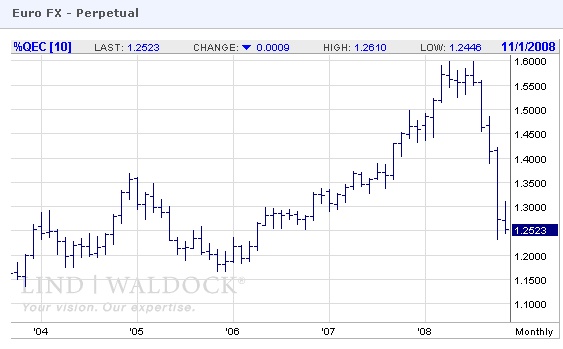
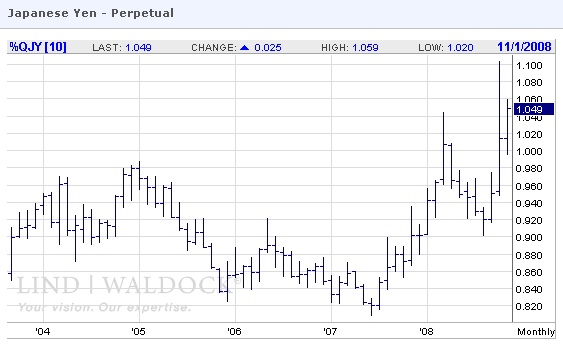
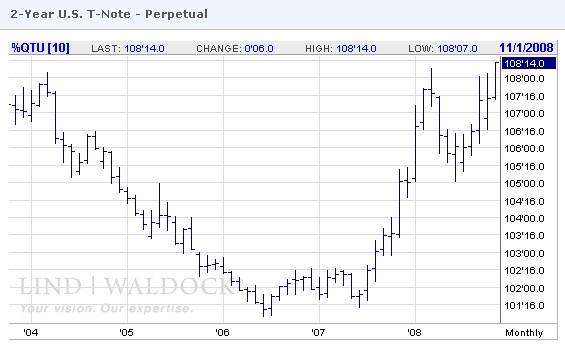
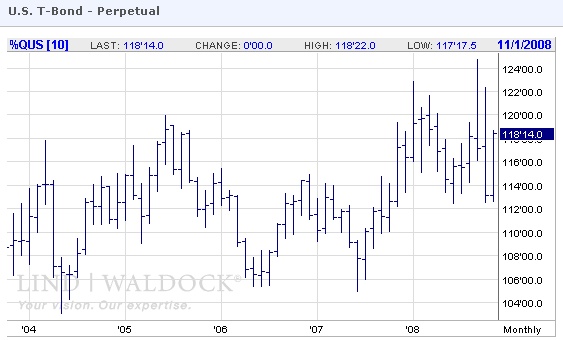
We would suggest following this basket:

  • oil (USO)
  • copper (JJC)
  • gold (GLD)
  • soybeans (JJG for grains)
  • EUR/USD fx (FXE)
  • USD/JPY fx (FXY)
  • 2-Year Treasuries (SHY for 1-3 yr T’s)
  • 10-Year Treasuries (IEF for 7-10 year T’s)
  • 30-Year Treasuries (TLT for 20+ year T’s)

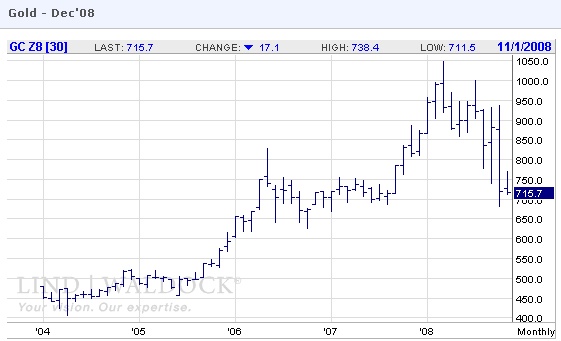
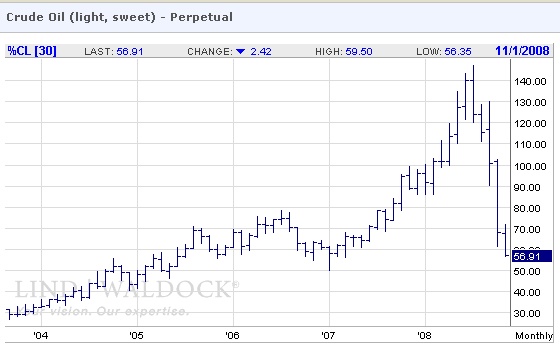
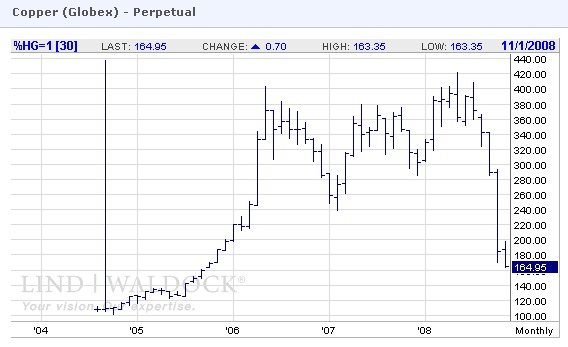
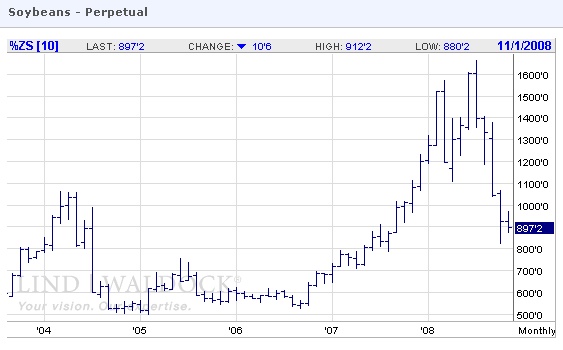
The charts below are for five-year, monthly, perpetual near-month futures contracts, but stock investors can get a similar view by observing the ETF or ETN listed after each category (not all perfect matches, but reasonably useful if you don’t have spot or futures prices available).

Current Situation

There is no inflation, except in the price of Treasuries, particularly short dated Treasuries, as investors flee risk and prize liquidity.  The price premium on Treasuries will melt when investors once again move to riskier assets for yield and gain.

We are in a deflationary period.  No signs of inflation in these charts.


click images to enlarge

Gold

Oil

Copper

Soybeans

Euro
(Dollars per Euro)

Yen
(Yen per Dollar)

2-Year Treasuries
(up means lower interest rate)

10-Year Treasuries

30-Year Treasuries

This article has 2 comments:

  • freeAgent
  • 15 Comments

Nov 13 08:50 AM

I think it all boils down to MV=PY. V dropped off a cliff. M is blowing up. If/when V rises, we’re going to be in for quite a bit of inflation.
JSCHULMANSR- Look for Gold to trade between $650 – $850 until the deflation period ends (barring any middle east flare-ups). Once inflation sets in 1st stage of next leg of the market will take us to $1500 – $2000oz. I do think however, this time the miners will be first out of the gate in the next leg up. In my opinion now is the time to load up. My disclosure I am long many gold, silver, platinum, palladium mining companys. As a side note I also think Uranium Miners are also good for the long term view and yes, I am long many of those too. This is my humble opinion, as always do your own research and consult with your own qualified investment and financial consultants.

Share this:

  • Click to share on Reddit (Opens in new window) Reddit
  • Click to share on Facebook (Opens in new window) Facebook
  • Click to share on LinkedIn (Opens in new window) LinkedIn
  • More
  • Click to share on X (Opens in new window) X
  • Click to share on Pinterest (Opens in new window) Pinterest
  • Click to share on Tumblr (Opens in new window) Tumblr
  • Click to print (Opens in new window) Print
  • Click to email a link to a friend (Opens in new window) Email
Like Loading...

Gold Bugs Beware – Seeking Alpha

13 Thursday Nov 2008

Posted by jschulmansr in Copper, deflation, Finance, gold, hard assets, inflation, Investing, investments, Latest News, Markets, mining stocks, precious metals, silver, Today, U.S. Dollar, Uncategorized

≈ Comments Off on Gold Bugs Beware – Seeking Alpha

Tags

agricultural commodities, alternate energy, Austrian school, banking crisis, banks, bear market, bear stearns, bull market, capitalism, central banks, China, Comex, commodities, communism, Copper, deflation, depression, diamonds, dollar denominated, dollar denominated investments, economic, economic trends, economy, financial, futures, futures markets, gold, gold miners, hard assets, heating oil, India, inflation, investments, market crash, Markets, mining companies, natural gas, oil, palladium, physical gold, platinum, platinum miners, precious metals, price, price manipulation, prices, producers, production, protection, rare earth metals, recession, risk, run on banks, safety, silver, silver miners, socialism, sovereign, spot, spot price, stagflation, timber, U.S. Dollar, volatility, Water

Gold Bugs Beware – Seeking Alpha

By: Adam Katz of Plus EV

I hope that all the gold bugs are preparing for the next leg down. Although risk does exist on both sides, the path of least resistance is down.

Then and Now

When researching gold prices, it is common practice to use historical quotes to give some indication of where prices may go. In my opinion that is a very bad strategy. ‘Inflation adjusted highs’ is simply a fancy way of saying that the price was here, we multiplied by some factor and so the inflation adjusted high is X. Therefore with more inflation the price MUST take out that previous high. That’s like saying that Yahoo shares traded for $100 in the past and since earnings have expanded since then, we must ultimately breach that price – ignoring the P/E ratio buyers are willing to pay and by that I mean demand.

You see, just how a lack of viable (good companies) alternatives led to Yahoo’s high price due to the price multiple, it was a similar case with gold in the 70s. A lack of alternatives and poor inter-connectivity in global markets made gold the only truly acceptable global inflation hedge and safe haven. Now things are different both fundamentally and structurally. One structural example is the increased use of derivatives and the use of treasuries to act as margin for these contracts. This has led to treasuries significantly outperforming gold as margin calls and safe haven buying have led to escalating purchases of treasuries.

Another problem with using a historical reference is that we have never experienced such a high level of de-leveraging – due to the excessively high credit buildup, that up until earlier this year fueled gold’s rise. Essentially the market is correcting the imbalances, exactly what the bugs were calling for, except it’s working against them. The size of the de-leveraging is dwarfing the capital that has been injected into the economy.

Gold ETFs

I read a great article on gold ETFs the other day and apologize to the author for not referencing it here as I cannot find it. Please post it as a comment if anyone knows what I am referring to.

The author was arguing that the landscape is very difference in the gold market because of the existence of the streetTracks Gold ETF (GLD) and the prices at which retail investors originally bought in at. The author argued that a lot of the purchases were made at prices above $600, and those investors may be tempted to sell if the price reaches their entry level. We may see a squeeze of sorts on the gold market, should that ETF be forced to liquidate sizable holdings at a fast pace to meet redemptions. Should that occur at the same time as the IMF or a central bank selling gold to meet short term expenses, there could be a structural crash in the price of gold.

The IMF and Central Banks

Institutions setup to pump liquidity into the system at crucial times can come under strain when their balance sheets are stretched and they are forced to raise capital. This is definitely not the largest risk to gold, but it does exist. The reason that the risk is minimal is that gold represents a relatively small percentage of the IMF and most countries’ reserves. Things would have to get really bad to force gold selling by these institutions.

New Demand

It’s hard to imagine a source of new demand entering the picture. While consumers globally are stretched, expensive jewellery is the last thing on your shopping list. With the majority of gold demand coming from jewellery, it’s unlikely that we seen a strong increase in net demand. You can make an even stronger argument by looking at some evidence of gold being pawned worldwide and demand for jewellery being even lower than published statistics.

Then there’s gold coin demand. This is retail investment demand and if history has taught us anything, it’s that betting against retail speculators is a good strategy. Many dealers are reporting shortages due to the higher demand for gold coins by retail purchasers. This has led many an unsophisticated investor to conclude that there is a shortage of gold and price must go up. As this group of investors continues to load up on coins, this contrarian speculator continues to get more bearish.

Supply

Gold miners just got huge production cost cuts. Mining is an energy intensive business, with tons upon tons of rock needed to find just a little gold. As their core costs come down, their margins increase relative to the market price. However, this is not a market in which to expect rising profit margins. This will enable the miners to decrease the price for the raw metal and try to make sales in a time of falling demand. Lower production costs may also stimulate supply in the short term as miners try to benefit from the lower energy prices and wider margins they are currently seeing.

What About Future Inflation?

What about it? I take two approaches here:

  1. The current trend is falling prices, a shortage in supply of credit globally, and weakening physical demand. You can try to catch a falling knife or claim that commodities aren’t in a bear market, but that is risky business.
  2. The reflationary trade will likely result in gold prices moving up at some point in the future, but outperforming equities? I don’t think so. At least not from the lows that we ultimately reach. But the government stimulus is inflationary! While that may be true, where is that stimulus going? Take Caterpillar (CAT) for example, who would have to increase in value by 150% to reach its previous highs. This isn’t a dotcom company with no real business behind it, this is the leader in global infrastructure. So when global fiscal stimulus picks up and that money finds its way to the market, credit is expanded, but the net benefit that a company like CAT realizes far exceeds the dilution effects of expanding the money supply. Also, companies own lots of real assets which will adjust up in value on top of the contracts they will receive which will expand their bottom line. Cost cutting is another avenue where good managers can increase value. It’s almost a nice excuse to clean house, then when things start moving again, they can be prudent and try to get technology to replace labor where possible.

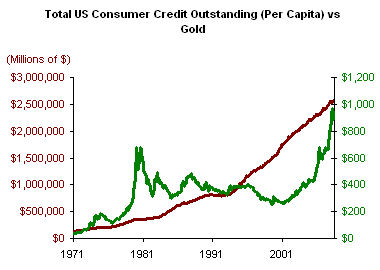
(Please note that the above chart is dated July.)

What the chart above shows is a graphical interpretation of my argument. Firstly, gold rose far more significantly than consumer credit in the 70s. To hit the inflation adjusted high, gold would have to outpace the growth in consumer credit by a large margin which I don’t think is happening. In fact, I see consumer credit having low or negative growth for the next 12-18 months as mortgage, credit card and auto loan terms get stricter. As you can see in the chart, this happened in the early 90s as consumer credit didn’t grow. Gold price remained relatively flat and then dropped significantly (in percentage terms), once credit started rising again. Why?

In recoveries, the expectation is decreasing risk and an eventual boom. In that environment, the opportunity cost of holding gold increases significantly and money rushes out of cash, gold, and treasuries and into equities. Although this causes a drop in gold price in the medium term, constantly rising credit will still result in a higher gold price as the cycle plays out, but from trough to peak, equities will outperform gold. It is during the second half of the credit boom that investors are advised to shift out of equities and increase gold holdings.

Gold’s Status as a Safe Haven

So has gold’s position as a safe haven been threatened? In a way, yes. It’s not that the fundamentals of gold aren’t attractive, but rather the existence of alternative safe havens. As far as the fundamentals go, gold’s biggest strength is also its biggest weakness. The limited supply of gold is often argued to be the reason for its great store of value, but that limited liquidity also makes it subject to volatile swings, usually into overvalued territory. As word of gold’s safe haven status has spread over the decades, worrying times bring a rush of people into gold, often more demand than the metal can handle. For that reason we see spikes that leave buyers at the peak feeling like they’ve been cheated.

Access to global markets changes the entire landscape, and the nature of a safehaven can change. Whether it’s unfairly beaten down equities, raw land in a politically stable country, or fiscally sound sovereign debt, the global markets present a wide variety of safehaven alternatives. In general, these investments require more sophistication to identify bargain prices and thus don’t have the same over crowding problem as gold.

As an example, Buffett’s 10% preferreds implicitly (in my opinion) backed by the government in the case of Goldman (GS) and with a solid company like GE, these investments may in fact be lower risk than gold and on an adjusted return basis should significantly outperform gold over the next 5 years, even though he may have acted too early.

Gold’s Performance

That being said, gold has outperformed since the peak and YTD – so it’s safe haven status isn’t totally destroyed – it just has competition. That being said, other investments like Japanese Yen have far outperformed gold.

Conclusion

The gold trade was over crowded and is likely going to continue to unwind as commodity prices have retreated signfiicantly and might continue to do so. Structural issues such as ETFs which have never experienced liquidation strain may become a big piece of the puzzle. Although gold will likely be at a higher price than today’s at some point in the future, speculators should brace for lower prices in the interim. Then, once prices turn around, investors should take careful note of trough equity valuation before dumping their funds into gold.


Disclosure: Trading with a bear bias


Related Articles

  • Gold Bugs Beware Nov 13, 2008
  • Attention Gold Bugs: Hyperinflation or Deflation? Nov 13, 2008
  • Keeping an Eye on the Dollar, Gold Nov 13, 2008
  • Gold and Silver Are Not Proven Inflation Hedges Nov 13, 2008
  • Dwindling Cash Position Doesn’t Help Unfortunate Situation at Katanga Mining Nov 13, 2008

Related Stocks:

  • GDX, GLD
Free E-Newsletters

The Macro View Stocks & Sectors Global Markets We don’t spam

This article has 4 comments:

    Register or Login to rate comments »
  •  
0 0
  • mr.g
  • 99 Comments

Nov 13 09:05 AM

Your analysis is great -except for one thing. You dont take into account the goldbug(just as many permabears in equity markets think the dow should be at much much lower levels fundamentally speaking but fail to take bulls into account) -The goldbugs are true bulls -many are dollar cost averaging and the price whether up or down, it signals buy -buy- buy . I think you may ruffle some of their feathers with this article-being they are goldbugs – The spread between physical prices and paper is where you will here it most
Reply |Report abuse
  •  
  • 0 0
    • Marp
    • 1 Comment

    Nov 13 09:09 AM

    So many words… All you need to know is USD down means gold up,and vice versa
    Reply |Report abuse


  •  
    0 0
    • Moses
    • 44 Comments

    Nov 13 09:10 AM

    I’m sitting tight with my gold mining stocks waiting for the USD to tank. When that happens gold will explode to the upside.
    Reply |Report abuse
  •  
    0 0
    • Adam Katz
    • 22 Comments
    • My Website

    Nov 13 09:49 AM

    mr.g,

    I do take goldbugs into account (I’m not a fan of gold bugs). The truth is that being a gold bug is such a weak investment strategy that although they are fairly large in numbers (and very loud), they don’t collectively have enough capital to really affect the market. What happens with jewelery demand and industrial use is far more important. At present the amount of fund liquidation far exceeds the dollar cost averaging going on. Take a look at the gold COT’s.

    Marp,

    That kind of simplistic analysis is exactly why the gold space gets crowded and overvalued. All goldbugs do is preach value (with regards to inflation), yet don’t care what price they’re buying gold at. Take a look at this chart and tell me that there’s no basis risk in that strategy www.plusev.ca/gold-usd…/. Gold has strengthened far more than the dollar has weakened.

    Moses,

    I agree with that strategy.. I think that gold stocks will beat gold price out of the gate when the time comes. Energy costs come down 2/3rds and if gold only comes down 1/2 then theres lots of extra cushion on their margins

  • Jschulmansr- I too think gold stocks will beat gold prices out of the gate which is why I am loading up at these low levels (many companies under book value). See previous posts…
  •  

    Share this:

    • Click to share on Reddit (Opens in new window) Reddit
    • Click to share on Facebook (Opens in new window) Facebook
    • Click to share on LinkedIn (Opens in new window) LinkedIn
    • More
    • Click to share on X (Opens in new window) X
    • Click to share on Pinterest (Opens in new window) Pinterest
    • Click to share on Tumblr (Opens in new window) Tumblr
    • Click to print (Opens in new window) Print
    • Click to email a link to a friend (Opens in new window) Email
    Like Loading...

    An Interview With Peter Cardillo: Part I & 2- Features and Interviews – Hard Assets Investor

    12 Wednesday Nov 2008

    Posted by jschulmansr in capitalism, commodities, deflation, Finance, gold, inflation, Investing, investments, Latest News, Markets, precious metals, U.S. Dollar, Uncategorized

    ≈ Comments Off on An Interview With Peter Cardillo: Part I & 2- Features and Interviews – Hard Assets Investor

    Tags

    agricultural commodities, alternate energy, Austrian school, banking crisis, banks, bear market, bear stearns, bull market, capitalism, central banks, China, Comex, commodities, communism, Copper, deflation, depression, diamonds, dollar denominated, dollar denominated investments, economic, economic trends, economy, financial, futures, futures markets, gold, gold miners, hard assets, heating oil, India, inflation, investments, market crash, Markets, mining companies, natural gas, oil, palladium, physical gold, platinum, platinum miners, precious metals, price, price manipulation, prices, producers, production, protection, rare earth metals, recession, risk, run on banks, safety, silver, silver miners, socialism, sovereign, spot, spot price, stagflation, timber, U.S. Dollar, volatility, Water

    An Interview With Peter Cardillo: Part I & 2 – Features and Interviews – Hard Assets Investor

    Written by HardAssetsInvestor.com   

    Part 1 

    Mike Norman, HardAssetsInvestor.com (Norman): Hello everybody, and welcome to HardAssetsInvestor.com. I’m Mike Norman, your host. Today my guest is Peter Cardillo, chief market economist at Avalon Partners.

    Peter, nice to see you; thanks a lot for coming on the show. Look, you’ve been in the business a long time, Peter, you’ve been in the business a very long time. Tell us your thoughts about what we have gone through recently, particularly this enormous market plunge, not just in stocks but in all asset classes. Have you seen anything like this in your career?

    Peter Cardillo, chief market economist, Avalon Partners (Cardillo): Percentagewise yes, of course, but you know, in such a short period of time, the answer is absolutely no.

    I have not gone through anything like this before in terms of market declines, of the market losing 20% in one week; that never happened before, and of course the reason for that is, obviously what we had out there was a fear factor that was gripping everyone, and of course, with the credit market seizing up, that just added even more fear out there, and then of course the blowing up of a lot of hedge funds didn’t help either. That’s probably one of the reasons why we saw this market dive the way it did.

    Usually the markets always discount, and this market has discounted a lot of things, just recession, and probably even a recession is going to be a little bit more severe than we previously were contemplating, but nevertheless, as I said, the way the market dropped, you might say, fast market action that we had, and the volatility that we had was all due to this unwinding of assets, whether they were equities, bonds or hard assets, commodities, you name it; it went all down at one time.

    Norman: Except for the highest quality, like Treasuries. Where are we, do you think, in this whole process? You sort of alluded to perhaps that the smoke may be clearing. We’ve discounted a lot, we’ve discounted perhaps a very, very deep recession, and as you mentioned, investors have pulled out of assets of all classes with the exception of the safest, most liquid. Where are we now, in your mind, in this process? Are we in the middle, are we still in the early stages, or are we closer to the end?

    Cardillo: I think we’re closer to the end of the crisis as we know it. In terms of economic activity, I think it’s going to be at least two or three quarters of some real tough going here. We’ll probably see unemployment climb above 7.5% and we’ll probably see inflation really fall off a cliff.

    Now there’s a positive side to that, and of course there’s a negative side to that. In fact, I think if you read between the lines, if you heard today Mr. Bernanke, obviously you know he’s for another stimulus package; why is he for that? Very simple: Because he knows that we’re in for some rough times here in terms of economic activity, and the greatest fear out there – although I believe it was avoided – was a deflationary period. Yeah, I think that was avoided; I really do.

    Norman: Through the actions taken by the Fed and the government and other central banks, you mean?

    Cardillo: Absolutely; there’s no doubt in my mind that if we didn’t have those actions, this market could have been really down even another 20%, 30%, maybe 40% from these levels.

    Norman: Some say that the government intervention in all its forms – the central bank and the federal government – is a negative thing. Do you agree or disagree with that?

    Cardillo: No, I think it’s a positive, but it does have some negative implications. Obviously somewhere along the line, when we do get back on track, the government, the Fed, is going to have to fight inflation and not disinflation or deflation. You’re printing money, you’re creating deficits that have gone into orbit, and that’s not a positive, that’s always a negative.

    But as I said before, right now they needed to avert a serious deflationary spiral within the economy, and I think they’ve done that, not only here domestically, but on a global scale as well. Look, you saw the numbers out of China; growth is at 9%. Now 9% is pretty strong, but by the same token, for an emerging market, that was almost at 11%, 12% – it’s down rather sharply.

    Norman: A big surprise there, no question about it. OK, folks; that concludes my first interview with Peter Cardillo. Stay tuned at this Web site because we’ll be having the second interview with my guest and much more to come. We’ll see you soon, take care.

    Watch The Video Part 1

    Part 2  

    Mike Norman, HardAssetsInvestor.com (Norman): Hi everybody, and welcome back to the second part of my interview with Peter Cardillo, chief market economist at Avalon Partners.

    Peter, in our last interview, you were talking about the Fed and other central banks and actions by the government that have prevented a deflation. Now leading up to this, over the past five or six years, the big concern has been inflation. Indeed, we’ve seen materials prices rising across the board, a lot of concern about inflation, we’ve seen a fall in the exchange value of the U.S. dollar. All this happened very quickly, this sudden idea or notion of a deflation

    Peter Cardillo, chief market economist, Avalon Partners (Cardillo): Well, obviously, you know, when you have the credit markets seizing up and no one is willing … when the banks are not willing to lend to each other, that’s a serious problem. Look, what we went through … there were signs of what happened in the early 1930s, there’s no question about that. However, I think that the governments certainly have learned the lesson now in terms of avoiding a deflationary era, and that’s why I think the fact that they came out with all these stimulus packages, rescue packages – whatever you want to call them – basically is the right thing at the right time.

    Now, grant you, maybe the Federal Reserve and the Treasury were a little bit asleep at the wheel in the sense that they should have seen this brewing, because we had excessive real estate speculation. And unfortunately, the former maestro who created this – Mr. Greenspan that’s right, who basically is somewhat responsible for this – up until his last months in office he always said, well, we have a slight bubble in the real estate market in certain areas of the country, but we don’t have a real bubble.

    Obviously that is not the case and we did have a bubble. But the problem is that no one knew the extent and the depth of the problem until it finally nearly collapsed the system.

    Norman
    : Now prior to this implosion, some of the best-performing asset markets were raw materials, commodities … this idea that we have a lot of emerging new economies, developing economies; you mentioned China, India for example. Those have been some of the hardest-hit markets on the way down. With the efforts now by the Fed and other central banks and governments to sort of reflate the system to avert a deflationary collapse, will these markets and these countries resume as the leaders?

    Cardillo:
    I think they will, but it’s going to take some time. I think we can see the equity markets regain over a short period of time. I wouldn’t be a bit surprised to see us recapture Dow 10,000 very shortly, but this bear market that we’re in – and this is a global bear market, it’s certainly not only domestic, that’s for sure – is going to take a while. This bear grip that we have is not going to let loose, but we’ll see an improvement. I think we’ll see an improvement not only in prices but in psychology, and the key is confidence, restoring confidence, and we’re beginning to see that.

    If you look at the overnight interbanking lending, you’ll see that the spreads are beginning to narrow, and once we get them down to levels where you’ll see the credit market unclog and banks begin to lend again, that will be the key; the confidence restored in the credit markets.

    Norman:
    Do you think what has transpired will lead to sort of a fundamental change in the way we view markets, away from this sort of free-market fundamentalism, as it’s called, to where you have markets much more regulated and managed by authorities, governments, central banks, whatever?

    Cardillo:
    Well, if you’re asking me do I think capitalism is dead, the answer to that is no. Are we going to have a shift; are there going to be a lot of regulations? Yes, but I think this so-called small part of socialism that we may have entered will not be long-lasting; I think it will be short-lived.

    Norman
    : All right, thank you very much Peter. Well, you heard it here: Capitalism is not dead, folks, so stick around here, come back; we’re going to have a lot more on this interview series. Thanks for stopping by. This is Mike Norman; see you next time.

    Watch The Video Part 2

    Share this:

    • Click to share on Reddit (Opens in new window) Reddit
    • Click to share on Facebook (Opens in new window) Facebook
    • Click to share on LinkedIn (Opens in new window) LinkedIn
    • More
    • Click to share on X (Opens in new window) X
    • Click to share on Pinterest (Opens in new window) Pinterest
    • Click to share on Tumblr (Opens in new window) Tumblr
    • Click to print (Opens in new window) Print
    • Click to email a link to a friend (Opens in new window) Email
    Like Loading...

    Brent Cook: Rocks ‘n’ Stocks – The Gold Report

    11 Tuesday Nov 2008

    Posted by jschulmansr in commodities, Copper, deflation, Finance, gold, hard assets, inflation, Investing, investments, Latest News, Markets, mining stocks, precious metals, silver, Uncategorized

    ≈ 1 Comment

    Tags

    agricultural commodities, alternate energy, Austrian school, banking crisis, banks, bear market, bear stearns, bull market, capitalism, central banks, China, Comex, commodities, communism, Copper, deflation, depression, diamonds, dollar denominated, dollar denominated investments, economic, economic trends, economy, financial, futures, futures markets, gold, gold miners, hard assets, heating oil, India, inflation, investments, market crash, Markets, mining companies, natural gas, oil, palladium, physical gold, platinum, platinum miners, precious metals, price, price manipulation, prices, producers, production, protection, rare earth metals, recession, risk, run on banks, safety, silver, silver miners, socialism, sovereign, spot, spot price, stagflation, timber, U.S. Dollar, volatility, Water

    Brent Cook: Rocks ‘n’ Stocks -m The Gold Report

    By Brent Cook of Exploration Insights

    Source: The Gold Report  11/11/2008


    With feet planted on the ground and eyes trained on balance sheets, Brent Cook has earned a reputation for recognizing which juniors have the best chance of beating the odds and where rocks have the greatest potential for producing profit. An experienced professional geologist who has examined properties in more than 60 countries and learned the investment side of the business from master Rick Rule, Brent inherited investor/analyst editor Paul van Eeden’s newsletter in February. He repurposed it into Exploration Insights, and in this exclusive interview, shares some of his insights with The Gold Report readers.

    The Gold Report: You talk about capital preservation as a key tenet of Exploration Insights, and you focus on the juniors. With the markets having gone totally crazy and practically everyone experiencing depreciation rather than preservation or appreciation, what do you see on the horizon for juniors? And how far out is that horizon?

    Brent Cook: It’s really tough for the juniors right now, but let me talk about capital preservation because that is a really important aspect of what I try and do in Exploration Insights. I don’t take a shotgun approach to investing. Rather I prefer to take careful and selective aim on targets. Right now we have about seven stocks in the portfolio and that’s it. I don’t ever anticipate having more than 20. I’m so selective because I’ve learned that is the best way not to lose money. That’s Rule No. 1: Don’t lose money. In this junior sector you can lose it awfully fast if you are not very selective on your purchases. More often than not in the junior sector it’s what you don’t buy that’s more important than what you do. Although to be honest, over the past six months even our stocks have been hammered.

    I’m very cautious in what I buy and I’ve been preaching or suggesting that people save their cash for the opportunities coming up. We’re starting to see some of those now. That’s what I mean by capital preservation—very, very selectively buying something that you are confident in the value of the assets and, that you’re getting at less than net asset value. Also, and this is Rule No. 2: If your investment thesis is proven wrong, sell. Once you’re investment thesis goes from certainty to hope, you’ve already lost your money.

    TGR: But from certainty to hope in this market environment, you could lose money and still be invested in viable short- and long-term companies. How do you reconcile that?

    BC: You don’t lose until you sell. An example of a stock that is down considerably but we haven’t sold is Altius Minerals Corp. (TSX.V:ALS). They have about $180 million of cash, in the bank, which equates to about $6.40 per share and you can buy it for around $4.20 or $4.30. Altius is run by a very smart and committed group who will do smart things with the money. Selecting companies like that, to me, represents a means of long-term capital preservation.

    TGR: But doesn’t the cash-versus-cost comparison depend on the burn rate?

    BC: Exactly right. Altius’s burn rate is basically zero. With their revenue from a royalty stream on Voisey’s Bay, a number of other smaller royalties and cash payments from other projects they have joint ventured out, it means they are hardly spending any of their cash at all—maybe a few million bucks a year at most when they have $180 million sitting in the bank.

    But you’re right. I see people coming out with recommendations that you should buy a company selling for less than cash in the bank just because it represents a discount. But if you look at what most of these companies are doing with their cash; next year they may be broke. Buying a company that is drilling a project that doesn’t have or offer any value is not buying something for less than cash. Make sure the cash stays put and is used for something intelligent.

    TGR: So basically Altius can survive a long time because it has a nice revenue stream. But why would we expect it to go up, given that the royalty stream is basically an annuity? Why would it go above the cash in the bank?

    BC: At this point in the market, Altius has the opportunity to invest in projects and companies that are severely undervalued. They can do that at a real discount to NAV or some other metric and make money that way.

    TGR: So you look at them as smart management. Is there a history of finding projects like this or investing in companies like this that we should know about?

    BC: Yes. Their model is one in which they generate conceptual exploration and business ideas and venture them out to other companies with a lot more money or the ability to take on more risk and do the hard work. As you know, most exploration projects go bust, so these guys generate the ideas and vend them out. Somebody else spends the money and, by and large, they go bust. That costs Altius hardly anything and they maintain their business of generating ideas and turning them out until one works. One transaction that worked very well was a uranium project they ventured out to Aurora Energy in Labrador. Aurora found a uranium deposit, spent tens of millions proving it up, and it looked like a very legitimate deposit. Altius was able to make $130 million or so out of an initial investment of about $600,000 by selling shares of Aurora, which represented their interest in the project.

    TGR: That’s nice.

    BC: Yeah. That’s the type of guys they are, just taking advantage of whatever the market offers. So you’ve got a lot of cash, you’ve got low burn, you’ve got a small income stream, and you’ve got smart guys at a discount to cash. That’s pretty good.

    TGR: That’s a nice blend. As you look at your other juniors, either in your portfolios or ones you know about in general, are these viable if gold sticks in the $700 to $800 range?

    BC: Most of the juniors don’t have any gold; they have the hope of finding gold. Rationally speaking, it doesn’t make any difference to them what the gold price is if they don’t have any gold. Of course, they’re hoping to find something that has gold, and obviously, a higher gold price would be better for them if they do.

    But there are companies out there now who have gold resources in the ground and they are selling for less than the net asset value of their deposits. Likewise, there are a number of companies that, although they don’t have a compliant gold resource, they have released enough data that I can work up my own resource estimate, then what it will cost to build it, mine it, etc. and show they are selling for considerably less than that value. You can buy those sorts of companies right now really cheap, assuming a $700 or $800 gold price of course.

    The juniors that don’t have a lot of cash in their pockets and no discoveries on the horizon are in serious trouble. I see this going on for a couple of years, to be honest. I see a serious shakeout coming. The first question you want to ask any company is “How much money do you have and how long is it going to last?” If they don’t have two years’ worth of cash and something seriously legitimate to work on, they have problems.

    TGR: If gold sticks to $700, how difficult will it be to get projects joint ventured out?

    BC: To a major mining company, $700 is not a bad price. A Barrick or Goldcorp that makes decent money at $700 gold can afford to do a joint venture with a company that has—and this is really key, Rule No. 3 if you will—a large target. So the project or concept being joint ventured has to offer a major discovery. It can’t be something small and I’m afraid from my experience most companies are really peddling small targets.

    It also has to offer good margins with cash production costs of maybe $350 or $400 an ounce or less. That’s what the majors are looking for. Also, when evaluating the project you always have to view the economics using the gold price in local currency. Plus, I think we’re going to see capital and labor costs start coming down. In fact I am seeing it now virtually across the board.

    TGR: Are such large targets out there?

    BC: Oh, yes. One I like a lot is MAG Silver Corp. (TSX:MAG) (NYSE:MVG). They’ve made a major discovery in Mexico adjacent to the world’s richest silver deposit, Fresnillo. It was owned by Peñoles, and spun it out into a public company, Fresnillo LLC, which is now MAG Silver’s joint venture partner. The asset is probably the highest-grade silver discovery in decades. It averages over a kilo a ton, it has some 240 million ounces of silver, and it’s open to further discoveries. Plus there’s gold and base metals.

    I figure that MAG Silver’s 44% is worth on the order of $15 a share to MAG Silver if silver is $10. MAG Silver is selling for about $5 a share. Fresnillo has been creeping up their holdings of MAG Silver; they own about 19% now; and MAG Silver’s 44% is worth a lot more than $5 to Fresnillo. So I see that as a takeover scenario coming at some price appreciably in excess of $5. That’s one instance of a high-grade deposit that a major is definitely coveting.

    TGR: Is there a 43-101 on this deposit?

    BC: It was put out in December. It comes in at about 240 million ounces of silver grading a bit over one kilogram per ton silver, about 2.2 grams per ton gold, plus base metals. MAG has 44% of that. Once you take out recovery and dilution, it’s about $350 a ton rock in the ground. It’s going to cost on the order of $60 a ton to mine and mill it, so there’s a lot of money to be made there. It’s adjacent to Fresnillo’s operating mine, they’ve got plans to go in and bring this into production. Everything’s set up. No political issues, no technical issues.

    TGR: It seems a little bit too easy.

    BC: It does. Those deals are few and far between, but you don’t need many of those.

    TGR: We’re hearing a lot of money on the sideline is going to start coming back into the market selectively. As it does, will it go into the precious metals with the less-than-optimistic returns experienced over the last two years?

    BC: I hear that as well, but I don’t know how much money there really is on the sidelines. I work with a number of funds in North America and Europe that really don’t have much cash to invest, particularly in illiquid juniors. About $400 billion has come into the resource sector since 2003, much of it in commodities. The $30 billion that came in to the Toronto Stock Exchange through private placements, which mostly came from funds, has been wiped out—and these guys are looking at redemptions coming again at the end of the year. So there’s not much money there that I see.

    In terms of individuals, it’s tough. Net worth for most people I know has been halved or worse. I don’t see a lot of money on the sidelines. There’s some, certainly, and I suspect we’re going to see the first thing people migrate into is the large gold companies because they’re liquid. They’ve been decimated as well and that’s the intelligent thing to do. But on the junior side, it’s a long time before we see much come in. You see people putting out fantastic drill results with no effect. Take a company like Hathor Exploration Ltd. (TSX.V:HAT), which has a uranium discovery in the Athabasca Basin. They’re trading about where they were when they first made this discovery, and since then they’ve drilled 30-odd holes with grades of something like 46 meters grading 3.1% uranium. That’s incredible. That’s $3,000 rock, I think. Yet the stock has backed off from $4.50 to $1.50 despite that news.

    TGR: But is it that news or is it the price of uranium? It’s gone down so dramatically in the past year.

    BC: That’s hurt it, but a deposit like this is one-of-a-kind. Cameco’s and Areva’s mills are desperate for ore, and this deposit sits within trucking distance of both. And a key point with Hathor’s deposit, as well as MAG’s and others I am looking at, is that the deposits offer the possibility of very high margin mines. Regardless of the metal prices or global economy we are still using metals and profitable mines will always be coveted.

    TGR: So this a situation in which they have permits, no political issues and infrastructure available nearby.

    BC: There are always political and permit issues with uranium deposits, but less so here. This deposit’s being drilled out right now. There’s no 43-101 resource yet, but it certainly is a discovery that could be significant in an area where people are mining uranium—and the world’s two largest uranium producers have underutilized mills next door. This is another instance where people who have the money could buy this asset. This could be a serious discovery.

    TGR: When is the quantification—the 43-101—expected?

    BC: The discovery is under a lake to some degree, so they need to come in this winter and drill through the ice to really prove it up. Whenever it freezes, they’ll start drilling. I’m guessing we’ll see a resource estimate probably by early summer.

    TGR: Can they drill only in the winter?

    BC: They drilled this summer, but once the lake freezes, they can get on top of it and get a better handle of what the deposit looks like and come up with a resource estimate. It’s not a deep lake, 10 or 15 meters deep, so it’s easy enough to drain and start the mine. It won’t be an issue in that respect; it’s just a matter of proving it up first.

    TGR: You suggested that when individual investor money comes back into the market, it probably will come back in to the large gold producing companies. Not long ago Kerry Smith, an analyst at Haywood Securities, basically recommended investing in large gold producers over the juniors because the seniors are trading at such low multiples. What’s your advice to our individual investors?

    BC: I don’t see any problem buying majors and waiting for the market to turn and then moving down into the smaller companies. That’s a smart way to go about it. It’s not what I’m doing, because I believe I can select the few juniors’ stocks that have real assets that a major is going to buy. Right now it’s a matter of picking the few assets that are high enough quality that a major will want to buy—that will give me a lot more leverage than waiting for Barrick to go up 20% or 30%.

    TGR: Then the thrust of your investment portfolio advice for the next several years is acquisitions.

    BC: Yes. I’ve been following three investment scenarios. One is buying a few companies like Altius that are significantly capitalized, smart guys, trading less than cash value. The second is going for the acquisitions, the people drilling out or with deposits that are high enough margin and quality that a major would want to buy. And the third is going after a couple of very speculative companies that are pure exploration plays, but the risk-to-reward is huge if they’re successful.

    For these very high-risk plays everything I’ve seen in the geology and results so far tells me they have a decent shot—a long shot but a decent long shot—at hitting. If they hit, we’re looking at a tenfold increase. So those are the three things I focus on. I’m not buying small companies selling for less than cash or that sort of thing. And definitely not any companies with what I perceive to be small targets. There are a lot of those out there and they’re very good at getting rid of that cash.

    TGR: But if it’s less than cash and either an acquisition target or a high risk-reward given its geology and location, you’ll look at it?

    BC: That’s right.

    TGR: Does your view of the juniors change if the U.S. and then the world go into a recession?

    BC: No. I’m assuming that happens anyway.

    TGR: So you expect the resources sector to still be in demand.

    BC: Selectively. I do believe we’re heading into a global recession and it’s going to be a damper on commodity prices. The credit crisis or liquidity crisis right now is going to severely limit money coming into the sector as well as money coming in to build new mines. At the same time, the major companies have to replace the resources we’re depleting—and they have to replace them with high-grade resources—regardless of what the metal prices do.

    I’ll give you an example. We’re producing 15 million tons of copper a year; which is about the amount of copper ever mined from the Bingham copper deposit in Utah. This is one of the biggest in the world. So on a yearly basis we’re depleting one major copper deposit. Same with gold. We’re running through about 80 million ounces of gold a year. That’s all the gold ever produced from the Carlin Trend in Nevada. That’s the dichotomy here: Nobody wants resources but everybody wants them.

    TGR: Would you comment on any specific companies? How about Miranda Gold Corp. (TSX.V:MAD)?

    BC: Great company. Great management. Great geologists. Selling for cash just about. Actually, I was just on their project in Nevada in mid-October. They’ve got a number of joint ventures with major and junior companies. I don’t know that they have a discovery in their hands, but they’re smart. This is one of these joint venture companies that come up with the ideas and then bring in the major companies to test them.

    TGR: So they fit into your first investment scenario, selling for less than cash with the potential of a find?

    BC: I would say so. I think they have about $11.5 million in the bank and their market cap’s about that too. They have Newcrest just finishing a drill program on Horse Mountain. Who knows what’s going to come out of it, but if they discover what they’re looking for, it’s huge.

    TGR: That’s true of everybody, though.

    BC: Not necessarily. Most people I run into are not really looking for big deposits. They may claim they are, but the geology isn’t right.

    TGR: How about Virginia Mines Inc. (TSX:VGQ)?

    BC: Another great company. André Gaumond is one of the most honest, ethical guys in the business and he’s followed the joint venture model as well. He’s had a bit of problem because the discovery he has with Breakwater is a base metal deposit and base metals haven’t done too well. But in terms of a company, that’s a great one. You can definitely trust your money with them.

    TGR: Rimfire Minerals Corp. (TSX.V:RFM).

    BC: Another great company. They’re selling for almost cash too. Same thing. Joint venture model. Very, very smart guys who understand not just geology, but the business of exploration. They’re involved in Western Canada and Australia and a bit in Nevada as well. Actually, I own all three of those you just mentioned—Miranda Gold, Virginia Gold and Rimfire.

    TGR: How about AuEx Ventures Inc. (TSX:XAU)?

    BC: I was just on their project in Nevada as well. Long Canyon, which they joint-ventured out to Fronteer, is an interesting property. They may actually be on to a new legitimate gold discovery in Nevada. It’s in the eastern part of the state, off of the main Carlin and Cortez Trends, but similar style and mineralization to Carlin type deposits. Fronteer has done an excellent job of figuring out the geology. They have four drill rigs plugging away and they hope to have a resource estimate out by early next year. And AuEx, again, smart guys and another company that follows this joint venture model.

    TGR: When you say legitimate new gold discovery, what makes it special?

    BC: So I guess by “legitimate” I mean real. A lot of people claim to find a major discovery, but usually that’s not the case. This is really what I think could be a new gold trend.

    TGR: Earlier you talked about the key being to find the companies that are about to find or announce a discovery, and as you pointed out, by no stretch of the imagination do all of the juniors have that potential.

    BC: Right. I’ve been doing this for a long time and I look at most of these projects and see the ultimate potential—if they’re successful in drilling out what they think they’ve got—is not worth much. It doesn’t make any difference if you find something nobody cares about, which most of the several thousand junior companies are doing. There’s no point investing in any junior exploration company if you don’t see the chance for a 10-for-1 increase in your stock price.

    TGR: The tenfold increase in the stock price is a little bit easier today than it was a year ago.

    BC: Yeah, 20-to-1 is even better at this point. But let’s talk about 10-for-1 potential for a moment. Diamonds North Resources (TSX.V:DDN) raised money at $1.08 and is now trading at about 30 cents. Very, very smart group. Intelligently explored up in Nunavut. Early analysis of the kimberlites showed a good diamond count, good quality diamonds, and now they’ve gone back in and taken some bulk samples. The results should be out within a month or so. If they show large diamonds, this is potentially a 10-bagger.

    TGR: So there’s real potential here to be the 10-bagger; in fact they may find large diamonds.

    BC: They need to find the whole spectrum of diamonds. So far the samples they’ve taken have been mostly micro diamonds. It wasn’t a big enough sample to evaluate the diamond size distribution. Now they’ve taken large enough samples that if they have indications that the diamond size range goes up into the larger sizes, this is potentially a diamond mine. This is the sort of thing that BHP or DeBeers would be looking at.

    TGR: Tell us a little bit about Exploration Insights.

    BC: I’d been working with a number of the newsletter writers—Doug Casey, Brien Lundin, Bob Bishop, Paul van Eeden—and started contributing more and more to Paul’s newsletter. Over the previous two years I generally followed specific stocks while Paul covered the macroeconomic scenario. When he shut down his newsletter in February, I took it over. So it has changed to my newsletter and I basically talk about geology and stocks with an emphasis on what they are actually worth.

    There is a Stock Talk section and a Rant section to the letter. In the stock talk section I specifically talk about stocks we own or are following. Most of my subscribers are fairly involved in doing their own analysis as well so I try to provide numbers, costs and geological interpretations from which they can draw their own conclusions. I also comment on stocks in the news or ones that I get a lot of emails from subscribers asking about. If a stock doesn’t make it into the Exploration Insights portfolio I am not afraid to say why. Generally, in the rant section I give people useful insights into what is happening in the mining and exploration sector as a whole. Also what to look for, how to value properties, mines, deposits, that sort of thing. And we sometimes cover some politics, economics and everything else, too.

    TGR: This is a weekly letter?

    BC: It comes out pretty much weekly. I’m on the road at least half the year but I still manage to get it out most weeks.

    TGR: Your site visits. You get out there and kick the tires, meet management, the whole thing.

    BC: That’s key. I’ve been doing this for 25-plus years and the only edge I’ve got over anyone is that I’ve seen so much that I can recognize a good versus a not-so-good project. The only way to do that is to really go on the ground. Things always look different on the ground, sometimes better but most often worse.

    TGR: And you’re a trained geologist?

    BC: Yes. It helps when you’re looking at geology.

    TGR: Rick Rule speaks pretty highly of you. He says you are a “no nonsense ‘boots on the ground’ geo, not one of the ‘desk explorers’ who cost the investment community so many millions.”

    BC: Yes, I worked with Rick for six years and made him a lot of money, I did OK too. He is probably the smartest investor I’ve come across. I learned a lot from him. I knew geology before I got into this, but I learned about investing from him and how to make money.

    TGR: Rick says easily 80% of the juniors are not worth investing in. And with the other 20% you still have to look at the balance sheets and that will be the real key. He’s a big resource bug; in order for the world to keep going, you need the resources. He’s saying it’s going to be ugly here for the short term, but then the opportunities will start showing themselves.

    BC: I believe he’s right. It seems to me there are a lot of problems to work out of the global financial system still and we could go way past ugly. But further out, the quality mineral deposits and exploration companies you can and will be able to buy now will certainly look like bargains in the rear view mirror.

    Brent Cook, who launched his Exploration Insights newsletter in February 2008, brings more than 25 years of experience to his role as geologist, consultant and investment adviser. His knowledge spans all areas of the mining business from the conceptual stage through to detailed technical and financial modeling related to mine development and production. His hallmarks include applying rigorous factual analysis to the projects and companies he examines, and augmenting his analysis with on-site field evaluations.

    Share this:

    • Click to share on Reddit (Opens in new window) Reddit
    • Click to share on Facebook (Opens in new window) Facebook
    • Click to share on LinkedIn (Opens in new window) LinkedIn
    • More
    • Click to share on X (Opens in new window) X
    • Click to share on Pinterest (Opens in new window) Pinterest
    • Click to share on Tumblr (Opens in new window) Tumblr
    • Click to print (Opens in new window) Print
    • Click to email a link to a friend (Opens in new window) Email
    Like Loading...

    U.S. Mint Makes Drastic Cuts to Its Collector Gold & Platinum Coin Offerings – Seeking Alpha

    11 Tuesday Nov 2008

    Posted by jschulmansr in deflation, Finance, gold, hard assets, inflation, Investing, investments, Latest News, Markets, precious metals, silver, Uncategorized

    ≈ Comments Off on U.S. Mint Makes Drastic Cuts to Its Collector Gold & Platinum Coin Offerings – Seeking Alpha

    Tags

    agricultural commodities, alternate energy, Austrian school, banking crisis, banks, bear market, bear stearns, bull market, capitalism, central banks, China, Comex, commodities, communism, Copper, deflation, depression, diamonds, dollar denominated, dollar denominated investments, economic, economic trends, economy, financial, futures, futures markets, gold, gold miners, hard assets, heating oil, India, inflation, investments, market crash, Markets, mining companies, natural gas, oil, palladium, physical gold, platinum, platinum miners, precious metals, price, price manipulation, prices, producers, production, protection, rare earth metals, recession, risk, run on banks, safety, silver, silver miners, socialism, sovereign, spot, spot price, stagflation, timber, U.S. Dollar, volatility, Water

    U.S. Mint Makes Drastic Cuts to Its Collector Gold & Platinum Coin Offerings – Seeking Alpha

    By: Michael Zielinski of 8 Stock Portfolio

    Yesterday the United States Mint announced some sweeping cuts to the number of products that it will offer to coin collectors. The deepest cuts take place in the US Mint’s offerings of collectible versions of gold and platinum bullion coins.

    Most people know about the US Mint’s bullion coin offerings. American Eagle coins composed of gold, silver, and platinum are sold to the public through a network of authorized bullion dealers. In recent years, American Buffalo Gold coins were added to the lineup. These coins are bought and sold primarily as a means of investing in precious metals.

    Since 2006, the US Mint has also offered so-called “collectible” versions of the popular bullion coins for sale directly to the public. The coins have been available in fractional denominations, four coin sets, and one ounce sizes. They are differentiated from the “non-collectible” bullion versions by carrying a “W” mint mark. The coins are also struck on specially burnished blanks and come in custom Mint packaging.  In addition, the US Mint has offered proof versions of bullion coins, which have been sold to collectors for many years.

    The US Mint’s discontinued products (via Mint News Blog) will include:

    • American Buffalo Uncirculated Gold Coins – These are the collectible versions offered by the US Mint. All fractional denominations, 4 coin set, and the one ounce coin will be discontinued.
    • American Buffalo Proof Gold Coins – The fractional 1/2 oz, 1/4 oz, 1/10 oz coins and 4 coin set will be discontinued.
    • American Platinum Eagle Uncirculated Coins – These are the collectible versions offered by the US Mint. All fractional denominations, 4 coin set, and the one ounce coin will be discontinued.
    • American Platinum Eagle Proof Coins – The fractional 1/2 oz, 1/4 oz, 1/10 oz coins and 4 coin set will be discontinued.
    • American Gold Eagle Uncirculated Coins – These are the collectible versions offered by the US Mint. The fractional 1/2 oz, 1/4 oz, 1/10 oz coins and 4 coin set will be discontinued.

    Why are these products being discontinued?

    The US Mint would likely cite low sales figures for the offerings, but that doesn’t get to the root of the problem. Basically, the US Mint has had a disastrous time selling the products over the past few years. This was due in large part to the way the US Mint was required to set prices combined with the extreme fluctuations of precious metals prices over the past few years.

    The US Mint is required to publish prices for upcoming collectible coin products in the Federal Register. This process seems to take about 30 days. As a result, every time these pseudo-bullion coins went on sale, prices were based on precious metals values from up to 30 days ago.  Any time the US Mint wanted to change prices, coin sales had to be suspended for at least 30 days while the publication process took place.

    Throughout 2006 and 2007, sales of these “collectible” bullion coins were suspended numerous times as precious metals prices climbed. Premiums above the precious metal value were in constant flux, since coin prices were fixed and precious metals changed. Typically, premiums would be high at the start of sales, but then lower as precious metals prices climbed. If you timed your purchases right, you could buy the coins for around the same price as the regular bullion coins.

    During 2008, the “collectible” bullion offerings were priced early in the year when precious metals prices were at their highs. As precious metals prices dropped from their peaks, coin prices remained the same, making premiums extraordinarily high. For example, the 2008-W 1 oz. Uncirculated American Gold Eagle is currently priced at $1,119.95 (see US Mint website).  Compare this to the gold value of $742. This premium is ridiculously high for a product slightly better than a bullion coin.

    The only prices that were actually lowered this year were for the platinum products. Following nearly two months of suspension, platinum coins returned with prices approximately halved. Even after the reduction, prices still reflected huge premiums. The 2008-W 1 oz. Uncirculed Platinum Eagle is priced at $1,214.95 (see US Mint website). Compare this to the platinum value of $837. Another ridiculously high premium.

    On the upside, this represents the end of a bad experiment in precious metals products from the US Mint. On the downside, this represents one less way for people to acquire precious metals.

    Disclosure: Long physical gold and platinum.

    Share this:

    • Click to share on Reddit (Opens in new window) Reddit
    • Click to share on Facebook (Opens in new window) Facebook
    • Click to share on LinkedIn (Opens in new window) LinkedIn
    • More
    • Click to share on X (Opens in new window) X
    • Click to share on Pinterest (Opens in new window) Pinterest
    • Click to share on Tumblr (Opens in new window) Tumblr
    • Click to print (Opens in new window) Print
    • Click to email a link to a friend (Opens in new window) Email
    Like Loading...

    Bob Moriarty: Laying Out a Feast for Bears and Gold Bugs-Gold Report

    07 Friday Nov 2008

    Posted by jschulmansr in commodities, Copper, deflation, Finance, gold, hard assets, inflation, Investing, investments, Jschulmansr, Latest News, Markets, mining stocks, oil, precious metals, silver, Uncategorized

    ≈ 1 Comment

    Tags

    agricultural commodities, alternate energy, Austrian school, banking crisis, banks, bear market, bear stearns, bull market, capitalism, central banks, China, Comex, commodities, communism, Copper, deflation, depression, diamonds, dollar denominated, dollar denominated investments, economic, economic trends, economy, financial, futures, futures markets, gold, gold miners, hard assets, heating oil, India, inflation, investments, market crash, Markets, mining companies, natural gas, oil, palladium, physical gold, platinum, platinum miners, precious metals, price, price manipulation, prices, producers, production, protection, rare earth metals, recession, risk, run on banks, safety, silver, silver miners, socialism, sovereign, spot, spot price, stagflation, timber, U.S. Dollar, volatility, Water

    Bob Moriarty: Laying Out a Feast for Bears and Gold Bugs
    Source: The Gold Report  11/07/2008

     In this exclusive interview with The Gold Report, 321gold.com founder Bob Moriarty provides abundant food for thought about the continuing U.S. financial debacle. Unlike many other observers, he foresees a short-term rally in the stock market but paints a bleak longer-term picture. He expects the ship of state to sink like the Titanic, with precious metals holdings and other “things” the only safety nets on board. Not one to whitewash his opinions, Bob seems to be right more often than not but also freely admits it when he makes mistakes. As he puts it, “When my theories don’t match the facts, I revise my theories.” We conducted the interview over a week ago and all of his predictions seem to be coming true. So far.

    The Gold Report: When you talked to us in early August, you correctly predicted the market crashing in October. But we’ve also seen gold go since then. When do you think gold and the market will turn around?

    Bob Moriarty: In terms of the Australian dollar, the British pound and the Canadian dollar, gold has been hitting new record highs, so gold still has its function as the security of last resort. We’ve had so much deleveraging, with giant hedge funds selling everything they could sell and the only thing left was gold. But the next move in gold is going to be a major move and it’s going to be up.

    TGR: When do you see that happening?

    BM: October is always a really disastrous month for the market, but I think we’ve seen the bottom in the general stock market, in gold and in gold shares.

    TGR: Are you saying that we’re going to see physical gold, gold shares and the market all increase simultaneously?

    BM: Correct.

    TGR: Wow. At the same rate?

    BM: I don’t think so. There’s been something like $3.2 trillion poured into the system. When people think back—I mean, this is an absolute disaster. We have taken the entire banking system, Fannie Mae and Freddie Mac and AIG, out of the hands of the fools on Wall Street who were running them and handed control over to the fools in Washington. That’s the scariest thing I’ve ever heard. If Wall Street couldn’t run Fannie Mae, why does Washington, DC think it can?

    TGR: Given that sentiment, why would you expect the stock market to increase?

    BM: You constantly run from one extreme to another. You have extremes of emotion on both the bull side and the bear side. If you look back to 1929, there was a giant crash the end of October. The market recovered 50% of what it lost and then continued down through 1932. The market goes up and it goes down. From the gold and gold shares point of view, the decline is entirely artificial. There are probably 100 gold juniors selling for less than the cash they have on hand. They could close the doors and you’d make a profit.

    TGR: One of the things we’re reading as part of the reason gold has fallen is that, amazingly enough, the U.S. dollar has actually been the currency of choice.

    BM: It has been, but you have to understand why the dollar is going up. I’ll go back to my favorite figure—$596 trillion in derivatives. Maybe 9,000 hedge funds were operating in derivatives as if it was a giant casino and they were using Monopoly money. Once things turned south and interest rates started going up and mortgages started defaulting, they had to deleverage. This meant selling all of the positions they could and paying off the loans. But to do that, they need dollars.

    So it’s entirely artificial. If you look at the rise in the dollar since September 27, it increased 12% or 13% in one month. Nobody can conduct business when the currency you use goes either up or down that much in a month’s time. That’s disastrous to business.

    TGR: But it made a fairly rapid downturn earlier in the year. Is going back up now a correction?

    BM: The correction is going to be that it will go back down, and I think it’s going to be a catastrophic decline. Barron’s had a piece recently talking about Taiwan now selling Fannie Mae and Freddie Mac bonds and Treasury bonds. If that continues or if other countries start doing it, it will be catastrophic for the dollar. I think the U.S. is going to default entirely within the next nine to 10 months. Here’s the situation. The U.S. is bankrupt. As anybody who looks at our debts and obligations should be aware, sooner or later we’re going to have to declare bankruptcy.

    TGR: Why wouldn’t we just print more money to pay our way out of it?

    BM: If you go into a store and put down $100 bill and the guy says, “We don’t take $100 bills,” what do you do?

    TGR: You pull out your credit card.

    BM: What if he doesn’t take your credit card? Here’s the flaw and there’s some really scary things going on that nobody thinks about. The U.S. government incurred about $3.2 trillion worth of obligations in the last month and to my knowledge, not a single person asked the really simple question: “Where’s the money going to come from?” There are only three choices. You take it from the taxpayer in taxes and that’s not an alternative. Or you borrow it from the Chinese and that’s not an alternative. Or you print it—but you can only print it as long as people are willing to accept it. The Middle East has already started to talk about not wanting to use the U.S. dollar anymore in currency transactions. It’s too dangerous. So we’re a lot closer to a default than anybody in government wants to admit.

    TGR: If we default, what’s the impact on the worldwide market?

    BM: Strangely enough, the worldwide market’s going to be fine. The U.S. can become a third-world nation. Everybody acts as if U.S. consumers are the only consumers in the world. Well, the Chinese can consume and the Japanese can consume and the Europeans can consume. For the last 60 years, since Bretton Woods, we in the U.S. have been able to consume by writing checks that we had no intention whatsoever of paying and the rest of the world has woken up to the fact that they’re paying for our excess. We’re waging a $3 trillion war in Iraq; we don’t pay for it; the rest of the world does. We borrowed every cent. And will never pay it back.

    TGR: If the U.S. defaults, though, and so many of our bonds are held offshore, those then become illiquid or worth nothing. Wouldn’t that have an impact on the worldwide economy?

    BM: Yes, but it will be a temporary thing. If your brother-in-law is a crack addict, doesn’t have a job and his home goes into foreclosure, it’s bad. But it happens. Businesses go bankrupt and countries go bankrupt. Essentially, Iceland went bankrupt a few weeks ago.

    TGR: And some of the South American countries have waived their debt entirely.

    BM: Argentina did it in 2002. They’re on the verge of doing it again. Believe it or not, Switzerland and Kuwait are on the verge of going bankrupt. It is really bizarre. And it all goes back to derivatives being totally out of control and everyone believing that it was $596 trillion worth of value when, in fact, it was a giant shell game.

    TGR: Given your prediction, how does that jibe with the stock market increasing? Are we going to rise through the next nine months until we go bankrupt or what?

    BM: Yes. Bonds are paper assets, nothing but a promise of payment. Stocks are not paper assets; when you own a stock, you own a real percentage of a company that hopefully is doing something productive. Inflation is not prices increasing, which is what we’ve been led to believe for many years. Inflation is actually an increase in the money supply. When you start increasing money supply the way the U.S. government has over the last month, it results in higher prices for real goods. So you can have this situation where the stock market is increasing in nominal terms but could actually be losing in real terms. Governments always have two different ways to destroy their currency. They can do it through deflation, which is what we’re going through right now, or they can do it through inflation. The government’s doing their best to inflate the dollar and it will go into hyper-inflation. That is just bizarre to me. A $3.2 trillion increase in money supply in a month. That’s a lot.

    You have to deal with a real currency under real rules and real management and provide real products to people who really intend to pay for them. When you get away from that, you create maladjustments or “mal-investments.” There was an enormous investment in U.S. real estate because real interest rates were actually negative. You could borrow 100% of the value of a home. Everybody in the system encouraged people to do this, so they did it. Then instead of getting rid of some of that mal-investment, the U.S. government comes in and says, “We’ll take the very worst cases of management, like Fannie Mae and Freddie Mac and AIG, and reward them for doing stupid things.” Well, that doesn’t make any sense; it just makes it worse. Everybody on Wall Street’s still going to be getting their Christmas bonus this year, but now it’s courtesy of the American taxpayer.

    TGR: If you have anything left in your portfolio, how do you begin to prepare for the scenario you’re laying out, a potential default by the U.S. government?

    BM: You stay away from U.S. obligations entirely. A lot of people like Richard Russell (Dow Theory Letters) have recommended for years that in times of calamity you go for T-bills and gold. T-bills will be totally worthless someday. No fiat currency lasts forever. They’re not real. I’m suggesting that the financial chaos we’re in now is far worse than anybody can anticipate, even me. And a default by the U.S. government actually would be a good thing because then we could and sit down and say, “Okay, 1) what caused this in the first place? And 2) what do we need to prevent it from happening again?” The solution is quite simple. That’s to go back to a gold standard. But if you go back to a gold standard, you have to have much less government. That would be a really good thing.

    TGR: Given that we’re already on a fiat currency and can print more, will our ship just go down with the presses rolling or will it extend itself longer—a slow sinking as opposed to diving straight to the bottom?

    BM: There’s a really good chance of a catastrophic failure with some of the things that are happening in the Middle East now. There could be a catastrophic freeze-up of the banking system and they could just close the banks worldwide and say, “Okay, we’ll shut everything down for two weeks and sort it out.” There’s a lot of pressure from France and China to fix the problem. I find it very encouraging that people are calling for a new Bretton Woods because that is the solution, to go back and fix what Bretton Woods didn’t do correctly in the first place—and that was to provide an honest gold system.

    TGR: Refresh us a bit on Bretton Woods.

    BM: In 1944 representatives of the 44 free countries in the Allies sat down to establish some financial system for economic post-war rebuilding. They met in Bretton Woods, New Hampshire. Their agreement tied the U.S. dollar to gold and all of their currencies to the dollar in fixed exchange rates. It made the dollar literally as good as gold, so all of the other currencies were as good as gold as long as the dollar was good. But then we started inflating the currency because we could. We also exported our inflation to other countries. And then the Vietnam War came along and in 1971 Richard Nixon told foreign governments they could no longer exchange dollars for gold. What they should have done at Bretton Woods was have everybody go to a gold currency and instead of issuing pesos or francs or reals or dollars, issue units in terms of grams of gold. That way, everybody’s one gram note would be a gram of gold and you would have had total interchangeability among currencies.

    TGR: If we could have a do-over of Bretton Woods, is there currently even enough gold anywhere to be able to tie it the world’s currencies?

    BM: Everybody makes the mistake of thinking that you need a lot of gold for a gold standard. The only thing gold does in a gold standard is give the currency discipline, but that’s why it’s so valuable. If you have discipline with the currency, you don’t have the kind of chaos we have today. Without discipline, you end up with $596 trillion worth of derivatives and nobody in either finance or government saying, “Hey, by the way, that’s a really bad idea.”

    TGR: If it’s not tied to physical gold and we rely on people to show discipline, aren’t we setting ourselves up for the same thing happening again?

    BM: No. I’m not saying you wouldn’t use gold. To restore confidence in the system, you have to use gold. But let me give you an idea of how out-of-control the system is today. If you took the 80 tons of gold that the U.S. supposedly has on deposit in Fort Knox and West Point, that would be $200 billion worth. We have created $3.2 trillion in paper money, 16 times as much, in just the last month. That means it might take a gold price of $50,000 to $250,000 an ounce to actually clear the system, but we do have to clear the system. We have to go back to honest money. If you’ve ever played poker, and somebody sits down and pulls out a Sears credit card, he’ll bet on every card because he isn’t playing with real money.

    TGR: And that’s effectively what’s been going on. So you’re saying you see a rally coming in the Dow, which strangely enough we’re hearing from other people, too, but it’s a short-term rally.

    BM: We’re not going to go to new highs. The problem with variable-value currencies is the value of the currency changes every day. The Dow won’t go to new highs in real dollar terms. It will go higher just because it’s way oversold right now in terms of gold and gold stocks. Historically they are the cheapest they’ve ever been. Gold stocks are trading at the same value that they would trade if gold was $200 today. There’s one particular silver stock I know that’s selling for 20 cents on the dollar.

    TGR: Who’s that?

    BM: Silver Bear Resources Inc. (SBR:TSX). It closed at 20 cents today. It has a market cap of $7.6 million and $32.6 million in the bank. It’s selling at 430% over market cap. I’ve got Triex Minerals at 338% of market cap, International Nickel at 331% of and Uravan Minerals, 300%. These are just unbelievable. Back in 2001, a few stocks—maybe 10 or 20 stocks—sold for less than the cash they had on hand, but now 100 of them selling for less than cash on hand. The value of these stocks is not based on their economic value, but on the fact that everybody’s dumping them like crazy. Look at ATW Gold Corp. (TSX.V:ATW). They have two mines and two mills in Australia, are going into production in March and will produce 50,000 to 100,000 ounces a year and you can buy the gold for about $3 an ounce. That’s nuts.

    TGR: So you recommend investors get real gold. Do you like ETFs at this point?

    BM: Actually, I’m anti-ETF, whether gold or silver. The financial situation is so dangerous that it’s no longer an issue of market risk, nor of whether they have the physical metal. It’s an issue of counterparty risk; that’s the danger today. Is the institution issuing the ETF going to exist if gold goes up $100 a day? Physical gold in hand, not in the safety deposit box, not where governments can get their hands on it, is an insurance policy. It’s still working today even though gold is cheap. Resource stocks and physical holdings are what you want as we head into hyper-inflation.

    TGR: Would you avoid even the Central Fund of Canada (CEF:AMEX)?

    BM: No, the CEF is brilliant. I do like that and that is not an ETF. There’s no counterparty risk there that doesn’t exist with any stock. I would even recommend investors have shares in multiple brokerage companies because it’s entirely possible for one of them (like Lehman Brothers) to go bankrupt. You might still have the assets; you just can’t touch them for six months or a year.

    TGR: When do you see gold climbing? You say it’s at the bottom now, so it could go any day.

    BM: I believe so. It’s going to surprise everybody because it’s been hammered so much, but it’s totally artificial. The price of gold has nothing to do with supply and demand. It’s been hammered by the hedge funds closing their positions and buying dollars to pay off their loans. As soon as the hedge funds let up in their buying, the dollar will tank and gold will go up. A lot of money sitting on the sidelines is looking for a safe place to go. When people start understanding you can buy $100 million worth of mining company for $50 million, they will start doing that.

    TGR: So that’s the specific catalyst. It’s not that the hedge funds will stop buying, but will stop selling.

    BM: Correct. I think they will do that. The last couple of trading days in October tend to be very positive, so it looks as if we sneaked through the worst of it. If we’re not at the bottom yet, we’re very close to it.

    TGR: Some are speculating that the downtrend will continue through the fourth quarter as people readjust for 2008 results.

    BM: The reason there are horse races is everybody has opinions. I’m not giving you fact. I didn’t walk down a mountain with it. It isn’t carved on tablets. It’s my opinion and I could be wrong and I’ve been wrong in the past. Just not very wrong. And not very often.

    TGR: Would you care to comment on a few of our sponsors? How about Animas Resources (TSX.V:ANI)?

    BM: Animas has an entire mining district in Mexico, a very important mining district, and will be releasing assay results any day now. The stock is a third of what it was a month ago and the company’s twice as good as it was a month ago. They will recover. I was encouraging them a year ago was to accelerate plans for getting into production and given today’s environment, I’m sure they’re thinking about that.

    TGR: How about Miranda Gold Corp. (TSX.V:MAD)?

    BM: I was out there two weeks ago. Miranda Gold is in a very big district in the Cortez Trend in Nevada. If they were a pure exploration company, I would be leery, but they’re not. They use the JV model, so they don’t spend their own money. They have JVs with five or six different major companies who spend the money, so Miranda has the ability to have a piece of the big find, but they’re not spending their money. And they have $9 million in cash and a market cap of $6 million. I told them, “Look, guys, you actually are not using your money wisely. Sitting in Canadian dollar T-bills is dangerous. You need to start buying up some of the juniors that are good plays and you need to start buying your own stock.” But you can buy dollar bills from Miranda for 66 cents.

    TGR: How about Rare Element Resources (TSX.V:RES)?

    BM: Rare Element’s an interesting situation. Somebody I know who is the expert in rare elements says there are two plays there. An alkaline gold deposit is being drilled by Newmont, who’s the major partner—and again, Rare Element is not spending its own money; Newmont is spending the money. And Rare Element is drilling a rare element deposit that could be economic, with the emphasis on the “could be.”

    TGR: When will they know?

    BM: Soon, very soon. Rare elements is really a spooky area; the chemistry, the mineralogy—just all kinds of issues. It’s a very difficult field. Even though the demand for rare earths is going through the roof, just because you’ve got a deposit doesn’t mean you have an economic deposit. I can’t say it’s economic, but they’re bringing in the guy I think knows more about rare elements than anyone else in the world, and he will be able to say whether it’s economic. Rare Element is another company that’s real good, well cashed up, and has Newmont spending the money.

    TGR: How about Pediment Exploration Ltd. (TSX.V:PEZ) (PEZFF:OTCBB)?

    BM: Pediment has three or four really good projects. They’ve got a deposit in the Baja that is absolutely a production story and I’ve been beating on Gary (Freeman) to get this damn thing in production. I think they have about $18 or $20 million in cash, so they’re very well cashed-up. They have another deposit up in the Sonora district, a mine and a mill that I think will be getting into production, too.

    TGR: Do they also use the JV model?

    BM: They do on some of the projects. They have JVs on two or three deposits that we don’t hear that much about but that have significant potential The project down in the Baja they’re doing strictly themselves, and also the project at La Colorada, although they might use contract miners to put it into production.

    TGR: Any comments on First Majestic Silver Corp. (TSX:FR) (PK SHEET:FRMSF)?

    BM: One of the best-run, soon-to-be mid-tier silver companies in Mexico and I happen to really like silver and I happen to really like Mexico. First Majestic is a great company.

    TGR: One of the companies coming across our radar screen a lot just because people are following it is Great Panther Resources (TSX.V:GPR).

    BM: Great Panther. I love them. I was the first newsletter writer to visit the project; I saw it literally as Bob Archer was negotiating for it. They are another good, soon-to-be mid-tier silver producer. They have two or three producing projects there now. They’re increasing their resources, well cashed-up, excellent management, and the same thing’s true of Endeavor Silver.

    TGR: What about Evolving Gold Corp. (TSX.V:EVG) (OTCBB:EVOGF)?

    BM: Interesting situation. They will be coming out with assays in the next week or two on an alkaline deposit up in Wyoming. It’s a diatreme, which is a fairly predictable volcanic structure and they’ve already had some excellent drill results. If the new drill results confirm the old drill results, they probably have a pretty good size deposit. Alkaline systems like Cripple Creek in Colorado tend to be very big.

    Evolving Gold went out and got financed a year ago based on a theory that they had an extension of the Getchell Trend and the Carlin Trend in Nevada. They really over-promoted it, but they did get cashed-up and they brought some new management in. The new management said the problem there in Nevada is that they are very deep and expensive holes. One hole out of 20 actually hits something, but when it hits something, it’s a monster deposit. They decided they would be better off with a JV model on that.

    TGR: Do they have a joint venture partner in mind?

    BM: Actually, they put the Nevada project on the back burner. They’re doing some drilling, but the deep drilling—sometimes 3,000 or 4,000 feet—is very difficult from a technical point of view and very expensive. They have drilled some holes this year and are still waiting for results, but I would far rather see that as part of a JV.

    TGR: When we talked a few months ago, looking forward to see what sectors would emerge or survive, you indicated energy and focused specifically on oil. What do you think today, and where do renewables and alternative energy fit in?

    BM: Alternative energy is viable. I had mentioned oil only because our entire system is based around oil. Like natural resources or gold or silver or metals, any energy investment should be safe for the future. Peak oil is very real and the Chinese are expanding like crazy and using more energy all the time. Natural gas is good, coal is good, nuclear is good. Renewables, unfortunately, are a 3% solution. Wind power’s another 3% solution. It’s never going to be anything but a 3% solution. Guys like Boone Pickens can spend millions encouraging people to invest in wind power, but our current infrastructure will not support it. It’s not just a question of investing in the wind power; you have to invest in the infrastructure as well and nobody ever wants to talk about that.

    TGR: Where’s a comfortable range for oil?

    BM: Somewhere in the $80 to $110 range. But that will be increasing because peak oil, in fact, is real. Oil production peaked in May of 2005 and peak oil also means peak food.

    TGR: So you’d say this is a time to hunker down.

    BM: It is time to hunker down, but I would like to say there are some very encouraging things. The Fourth Turning, written about 10 years ago, actually forecast this chaos that’s coming. And the fellow’s point of the book was that better times are coming. You go to absolutely insane extremes—which I think everybody can agree we have—and then you go back to sanity. Even during the depression, families came closer together because they had time for each other. They may have not had money to do things they were doing before, but it did bring the families closer together. Money is the journey; not the destination.

    Bob Moriarty and his wife, Barb, launched 321gold.com as a private website seven years ago, when they were convinced gold and silver were at a bottom and wanted to help others understand what they needed to know about investing in resource stocks. Since then, they’ve introduced a second resource site, 321energy.com. Bob travels to dozens of mining projects a year. He was one of the first analysts to write about NovaGold, Northern Dynasty, Silver Standard, Running Fox and YGC Resources, among others. Prior to his Internet career, Bob was a Marine F-4B pilot at the age of 20 and a veteran of over 820 missions in Viet Nam. Becoming a Captain in the Marines at 22, he was one of the most highly decorated pilots in the war.

    Share this:

    • Click to share on Reddit (Opens in new window) Reddit
    • Click to share on Facebook (Opens in new window) Facebook
    • Click to share on LinkedIn (Opens in new window) LinkedIn
    • More
    • Click to share on X (Opens in new window) X
    • Click to share on Pinterest (Opens in new window) Pinterest
    • Click to share on Tumblr (Opens in new window) Tumblr
    • Click to print (Opens in new window) Print
    • Click to email a link to a friend (Opens in new window) Email
    Like Loading...

    Emerging Metal Miners Attractive to Value Investors – Seeking Alpha

    07 Friday Nov 2008

    Posted by jschulmansr in commodities, Copper, deflation, diamonds, Finance, gold, hard assets, inflation, Investing, investments, Latest News, Markets, mining stocks, precious metals, silver, Uncategorized

    ≈ Comments Off on Emerging Metal Miners Attractive to Value Investors – Seeking Alpha

    Tags

    agricultural commodities, alternate energy, Austrian school, banking crisis, banks, bear market, bear stearns, bull market, capitalism, central banks, China, Comex, commodities, communism, Copper, deflation, depression, diamonds, dollar denominated, dollar denominated investments, economic, economic trends, economy, financial, futures, futures markets, gold, gold miners, hard assets, heating oil, India, inflation, investments, market crash, Markets, mining companies, natural gas, oil, palladium, physical gold, platinum, platinum miners, precious metals, price, price manipulation, prices, producers, production, protection, rare earth metals, recession, risk, run on banks, safety, silver, silver miners, socialism, sovereign, spot, spot price, stagflation, timber, U.S. Dollar, volatility, Water

    Emerging Metal Miners Attractive to Value Investors – Seeking Alpha

    By: Mike Niehuser of Beacon Rock Research

    There appears to be an enhanced investment opportunity for long-term value investors in emerging producers selling near cost of investment or book value. We see the mining sector gaining in interest for value investors as they screen for companies selling at 52-week lows, below book value, and with potential to expand margins and earnings. Wholesale redemptions by investors, along with tax loss selling in both the U.S. and Canada, are creating opportunities for value investors looking to acquire companies with both real assets and the potential for increasing production.

    Reduced global lending and investment, which caused a shortage of liquidity, has resulted in a deflationary environment unfavorable to commodities, including precious and base metal prices. Recent actions by governments and central banks are largely inflationary, which should lead to higher gold and silver prices as banks begin to lend and invest. A reduction in credit risk should spur a resumption of global growth, increasing demand for commodities and leading to higher base metal prices. While this cycle appears inevitable to long-term investors, this scenario may be delayed by credit markets or anti-growth policies including protectionism, higher taxes, and increased regulation.

    It follows that deflation in the near term should be favorable for companies that have cash or the ability to operate profitably at current metal prices. Clearly, the inflationary environment in the mining industry in 2007 has reversed and costs of labor, materials and supplies are moderating or declining. Recent declines in the price of fuel lifts a burden on both operating profits and the barrier to resumption of economic growth. As this situation persists, should metal prices rebound, margins will also expand, leading to potentially significant appreciation for emerging producers above current levels.

    China continues to be important for sustained economic growth through wealth accumulation and investment in infrastructure. Despite concerns over declining rates of growth, China still maintains near double-digit annual growth rates. The ongoing demand for precious metals as a store of value, and base metals for the production of goods and infrastructure, remains immense. China’s 1.3 billion people consumed $1.2 trillion last year, while America’s 300 million consumed $9.7 trillion. While China is criticized for a lack of domestic markets, this situation may be revered as financed by its central bank’s reserves, largely composed of U.S. treasuries.

    NovaGold’s market cap is significantly less than the sum of the book value of its three major projects: 

    NovaGold Resources Inc.’s (NG) market cap is currently about $317 million, which is only slightly higher than the book value of its Rock Creek gold mine including property, plant, and equipment, plus development costs. This would imply that the market is currently attributing no value for NovaGold’s share of its 50% ownership in its two world-class projects, the partnership with Barrick Gold Corporation (ABX) on the Donlin Creek gold project and with Teck Cominco Ltd. (TCK) on the Galore Creek copper-gold project. NovaGold’s share of the total investment in property, plant, and equipment plus development costs at Donlin Creek is $238 million, with $360 million on the Galore Creek project, for a total of $868 million on these three main assets. NovaGold’s market capitalization is about one third of its share of the capitalized investment in these projects.

    NovaGold Gold Pour, Rock Creek Mine, Nome, Alaska

    Source: NovaGold

    We understand that Barrick is working toward completion of a Feasibility Study on Donlin Creek by 1Q09. This would mean that a majority of NovaGold’s 50% ownership of this gold resource of 31.7 million Measured and Indicated ounces should move into the reserve category and allow for the start of the permit process. In addition, Teck Cominco is anticipated to provide an update on a new design plan for the Galore Creek project, which would be the basis for an updated Feasibility Study and initiation of permitting. Continued development by Barrick and Teck Cominco should assure markets, leading to NovaGold’s market cap appreciating toward total book value.

    NovaGold is in the process of commissioning its Rock Creek gold mine in Nome, Alaska, and has recently completed its first gold pour. NovaGold is scheduled to produce 100,000 ounces annually, generating an estimated $25-$35 million in 2009, at an average cash cost of $500 per ounce. NovaGold is working to increase the resource to extend the mine life to ten years. Management estimates that production from the Rock Creek mine, plus cash on hand and proceeds of other non-core assets, should provide funds for planned activities for the next twelve months. NovaGold remains a viable company with significantly undervalued and unrecognized assets.

    Etruscan’s market cap is less than the book value of its Youga gold mine which does not include the development potential of projects in West Africa:

    Etruscan Resources Inc.’s (ETRUF.PK) market cap is currently about $73 million, which is less than its investment in property, plant, and equipment, plus development costs for the Youga Gold project of about $109 million. The Youga Gold Mine produced 7,450 ounces of gold in October; this was about 14% above September production of 6,572 ounces of gold, and 11% above estimated average monthly production. We suspect that with further optimization, production may continue to exceed published scheduled production, important to build its treasury to fund further development. Cash costs should improve through project stabilization to an estimated $450 per ounce for the life of the mine. The project includes a program to limit price exposure of the gold price on the downside to $629 per ounce.

    The current market cap does not appear to reflect Etruscan’s other assets. Etruscan may have the largest land position of any mining company in West Africa. We are looking for additional reports on their Bitou project about 35 kilometers from the Youga Gold Mine and new discoveries in southwest Ghana. We are also quite keen on further developments on its recently announced rare earth deposit in Namibia. As the market cap of the company is now less than the construction cost or book value of the Youga Gold Mine, value investors have the upside to increasing gold prices, as well as exploration in West Africa, Namibia, and its diamond assets in South Africa.

    Minefinders’ market cap is close to book value and half base case economic study of Dolores mine:

    Minefinders Corporation Ltd. (MFN) has a market cap of about $250 million, slightly above the book value of its Dolores gold-silver mine in Chihuahua, Mexico. Current book value of the Dolores mine, including property, plant, and equipment plus development costs, totaled $203 million as of the end of June 2008. The total budget for the project is $191 million, which includes about $10 million for contingency, with available cash and credit to complete construction. Incidentally, Minefinders recently negotiated an additional $10 million in credit for additional working capital.

    Minefinders recently began leaching ore, a major milestone, and anticipates its first gold and silver production in the next few weeks. Previously they had targeted producing 10,000 ounces of gold and 350,000 ounces of silver in the remainder of 2008. They report crushing at a rate of 15,000 tpd, close to the design capacity of 18,000 tpd. Estimated operating cost for gold equivalent during ramp up may range from $400 to $450 per gold equivalent ounce, declining to $297 per gold equivalent ounce over the average life of the mine, scheduled for 15 years.

    The Dolores open pit mine currently has 99.3 million tonnes of Proven and Probable reserves, containing 2.44 million ounces gold and 126.6 million ounces of silver. The most recent economic study estimated an NPV at a discount rate of 3% to be $563 million (metal assumptions of $675 gold and $13 silver). The study did not include the potential benefit of adding a 3,000 tpd flotation circuit to increase recoveries of gold and silver in the pit, or located in a high-grade gold-silver resource below and parallel to the identified reserve. As Minefinder’s market capitalization is close to the book value of its investment, and less than one half of its base case economic study, we also consider the company to be significantly undervalued and of interest to value investors.

    Mercator’s market cap is less than almost half book value and profitable at significantly lower metal prices:

    Mercator Minerals Ltd.’s (MLKKF.PK) market cap is currently about $72 million. As of June 30, 2008 the book value of its Mineral Park mine near Kingman, Arizona, including property, plant, and equipment and development costs was over $141 million. The original budget for both phases of the 50,000 tpd facility ($128 million for stage one and $62 million for stage two) is about $200 million. Mercator is completing commissioning and anticipates production in the near term and has completed and paid for about 40% of stage two.

    The first stage of the Mineral Park mine was financed by debt. The balance of the second phase will be paid out of cash flow from the first phase, remaining cathode copper production, and cash from the sale of its silver stream to Silver Wheaton Corp. (SLW). The mine has an estimated life of 25 years, and with a strip ratio of only 0.18, the project has good economics. Cost of production, assuming a 50-50 split for production of copper and molybdenum (net silver credits from Silver Wheaton), is estimated at $1.28 per pound and $6.49 per pound, respectively.

    Their pre-feasibility study, assuming metal prices of $1.53 copper, $10.16 molybdenum, and $7.50 silver (prior to the sale to Silver Wheaton), estimated an after-tax IRR of 51% and NPV of $426 million with a 1.8 year payback of capital. As Mercator’s market capitalization is about one-quarter the estimated value of the pre-feasibility study and one-half the book value of the Mineral Park mine, the company should be of interest to risk averse value investors.

    Acadian’s market cap is less than Scotia mine book value and replacement value not including significant gold assets:

    Acadian Mining Corporation’s (ADGLF.PK) market cap is about $14 million. This is less than one-half book value of their Scotia Mine operation in Nova Scotia, including property, plant, and equipment plus development costs of approximately C$30 million. This includes the cost to acquire the mothballed Scotia Mine and bring it into production. Management estimates the replacement cost of the Scotia Mine to be about C$100 million.

    Acadian brought the operation into production in 2007 on time but faced challenges in early 2008 due to difficult weather conditions. This was followed by declining zinc and lead prices. Management estimates an operating breakeven rate of $0.55 per pound zinc-lead, and overall company breakeven of $0.59 per pound zinc-lead. This was prior to the decline in the Canadian Dollar to the U.S. Dollar, which benefited Acadian, as their costs are in Canadian Dollars. Prior to declining metal prices, management implemented an aggressive cost reduction program, with plans to resume development of its gold assets in 2009.

    Acadian has a gold resource in Nova Scotia of about 1.6 million ounces. When Acadian acquired the Scotia Mine it was expected to centrally process gold resources. Record zinc and lead prices accommodated restart of the mine as previously designed. Should base metals stabilize at lower levels, we expect management to revisit the original concept of processing gold ore. We estimate this could be accomplished in six to eight months at a cost of C$5 to C$10 million.

    Disclosure: The author is long NG, ETRUF.PK, MFN, and ADAIF.PK. An affiliate of the author’s employer provides corporate advisory services to NG, ETRUF.PK, MFN, MLKKF.PK and ADAIF.PK.

    My Note: I am also long NG and am looking at the others-jschulmansr

    Share this:

    • Click to share on Reddit (Opens in new window) Reddit
    • Click to share on Facebook (Opens in new window) Facebook
    • Click to share on LinkedIn (Opens in new window) LinkedIn
    • More
    • Click to share on X (Opens in new window) X
    • Click to share on Pinterest (Opens in new window) Pinterest
    • Click to share on Tumblr (Opens in new window) Tumblr
    • Click to print (Opens in new window) Print
    • Click to email a link to a friend (Opens in new window) Email
    Like Loading...

    Junior Gold Miners Are Dirt Cheap – Seeking Alpha

    06 Thursday Nov 2008

    Posted by jschulmansr in commodities, Copper, deflation, diamonds, Finance, gold, hard assets, inflation, Investing, investments, Latest News, Markets, mining stocks, precious metals, silver, Uncategorized

    ≈ Comments Off on Junior Gold Miners Are Dirt Cheap – Seeking Alpha

    Tags

    agricultural commodities, alternate energy, Austrian school, banking crisis, banks, bear market, bear stearns, bull market, capitalism, central banks, China, Comex, commodities, communism, Copper, deflation, depression, diamonds, dollar denominated, dollar denominated investments, economic, economic trends, economy, financial, futures, futures markets, gold, gold miners, hard assets, heating oil, India, inflation, investments, market crash, Markets, mining companies, natural gas, oil, palladium, physical gold, platinum, platinum miners, precious metals, price, price manipulation, prices, producers, production, protection, rare earth metals, recession, risk, run on banks, safety, silver, silver miners, socialism, sovereign, spot, spot price, stagflation, timber, U.S. Dollar, volatility, Water

    Junior Gold Miners Are Dirt Cheap- Seeking Alpha

    By: Graham Summers of GPS Capital Research

    Wrong again!

    Numerous pundits have made a big deal of stocks’ recent rally and gold’s plunge. Some even went so far as to claim that gold has lost its “safe haven” status. They’re horribly mistaken.

    For one thing, gold has held up incredibly well compared to both stocks AND commodities this year. Stocks have fallen 32% in 2008 thus far. Oil is down 26%. Zinc is down 58%. Gold is only down 16%.

    In simple terms: Had you put all of your money in gold at the beginning of 2008, you would have outperformed virtually every asset class in existence. It’s also worth considering that much of the downward pressure in gold has come predominantly from the “paper” market.

    As I’ve written on these pages before, the physical or bullion market in gold is extremely tight due to unprecedented demand. The US Mint has stopped producing several coins because it cannot keep up with investors’ appetite for bullion. Indeed, most bullion dealers are now charging premiums of 8-9%. This time last year premiums were only 2-3%.

    However, due to institutional liquidations and outright manipulation in the paper market, gold struggles to clear even $800 an ounce. And while the paper market for gold has been hit pretty hard, gold mining stocks, particularly the juniors, have been absolutely creamed.

    It’s not hard to see why.

    An individual gold mining junior might have a daily dollar volume of $5-$10 million. Even smaller hedge funds ($50 million in assets) could crush one of these with a $1-2 million sale (never mind intentional crushing from shorts).

    The result is that gold mining stocks are at historic lows relative to the price of gold. If you go back to 1984, mining stocks have only been this cheap relative to the price of gold two other times: 1986 and 2001, both of which were around the END of BEAR markets.

    In fact, today, numerous gold juniors are so cheap that they’re trading below book value. Let me put this in perspective: at these levels these companies are cheaper than their mining assets alone. By buying today you are essentially getting the gold reserves for FREE. Below is a screen I ran last week. The data comes from Yahoo! Finance.

    Company Name Symbol Market Cap Total Cash Total Debt Price/ Book
    NEVSUN RESOURCES
    NSU
    41.0M
    59.9M
    0
    0.966
    RICHMONT MINES
    RIC
    37.2M
    25.2M
    0
    0.801
    KIMBER RESOURCES
    KBX
    27.2M
    5.5M
    0
    0.799
    ALLIED NEVADA GOLD
    ANV
    107.2M
    51.6M
    2.2M
    0.709
    ENTREE GOLD
    EGI
    47.0M
    61.9M
    0
    0.698
    VISTA GOLD NEW
    VGZ
    32.0M
    33.4M
    22.4M
    0.601
    KEEGAN RES
    KGN
    13.1M
    10.2M
    0
    0.547
    CENTRAL SUN MINING
    SMC
    7.2M
    4.7M
    0
    0.177
    OREZONE RES
    OZN
    57.1M
    13.2M
    0
    0.165

    The most common accusation leveled against gold juniors is that the credit crisis will stop them from receiving the credit necessary to fund their operations. However, as the above table shows, many of these companies are already sitting on substantial cash hoards. In addition, some that are already producing gold throw off enough cash to fund their operations without additional loans or credit.

    I can’t tell you when gold will finally break to new highs again. And I certainly cannot vouch for the above companies as being great investments (I haven’t done nearly enough research to formally recommend any of them). But one thing I can tell you is that taken as a whole, gold mining stocks are at extremely cheap levels relative to the price of gold. If you’re looking for value in today’s market, this is a great place to start.

    My Note: I have a long position in all of these stocks and am adding to them-jschulmansr


    Share this:

    • Click to share on Reddit (Opens in new window) Reddit
    • Click to share on Facebook (Opens in new window) Facebook
    • Click to share on LinkedIn (Opens in new window) LinkedIn
    • More
    • Click to share on X (Opens in new window) X
    • Click to share on Pinterest (Opens in new window) Pinterest
    • Click to share on Tumblr (Opens in new window) Tumblr
    • Click to print (Opens in new window) Print
    • Click to email a link to a friend (Opens in new window) Email
    Like Loading...

    What’s happening with Gold? « The Economics Journal

    06 Thursday Nov 2008

    Posted by jschulmansr in capitalism, commodities, deflation, Finance, gold, hard assets, inflation, Investing, investments, Latest News, Markets, mining stocks, precious metals, silver, U.S. Dollar, Uncategorized

    ≈ Comments Off on What’s happening with Gold? « The Economics Journal

    Tags

    agricultural commodities, alternate energy, Austrian school, banking crisis, banks, bear market, bear stearns, bull market, capitalism, central banks, China, Comex, commodities, communism, Copper, deflation, depression, diamonds, dollar denominated, dollar denominated investments, economic, economic trends, economy, financial, futures, futures markets, gold, gold miners, hard assets, heating oil, India, inflation, investments, market crash, Markets, mining companies, natural gas, oil, palladium, physical gold, platinum, platinum miners, precious metals, price, price manipulation, prices, producers, production, protection, rare earth metals, recession, risk, run on banks, safety, silver, silver miners, socialism, sovereign, spot, spot price, stagflation, timber, U.S. Dollar, volatility, Water

    What’s happening with Gold? « The Economics Journal

    By: Balaji Viswanathan of The Economics Journal

    Gold had the biggest monthly drop since 1983, last month. It dropped 18% in that month to about $700/ounce (1 troy ounce approximately equals 31 grams). It seems counterintuitive given the fact that crisis generally increases the price of gold, and October is the month of peak credit crisis.

    One of the biggest factors causing this is the fading of inflation fears from the mind of investors. Inflation always pushes people to look for hard assets and after a year of inflation worries, the central banks are breathing easy that the oil drop has taken at least one of the worries from their backs. 

    image

    Performance of GLD – one of the main ETF’s for gold, in October.

    Another factor is because of the drop in interest from speculators who have been selling all profitable assets to make good for their losses elsewhere. Suppose you are an institutional investor who wants to maintain a constant allocation of 80% in stocks, 20% in gold, you would have lost 40% of the value in stocks since the start of the year, while your gold worth would have increased, skewing your portfolio heavily towards gold in the process. This will force you to sell gold at this time and re-balance your portfolio.  Marketwatch writes that:

    Speculators reduced their buy positions by 8,313 contracts on the Comex while increasing their sell positions by 12,574 in the week ended Oct. 28, according to latest data from the Commodity Futures Trading Commission. One contract represents 100 ounces of gold.

    The Gold report gives another reason for this drop:

    It has been central bank gold loans, even more so than official gold sales, that have really pulled the rug out from under gold. Gold loans by central banks are an alternative, and invisible, means of injecting liquidity into the banking system. These gold loans to banks and bullion dealers by the leading central banks are probably a significant multiple of outright official sales.

    In simple terms, a central bank may lend or deposit gold with a banker or bullion dealer who simultaneously sells forward. Even with the recent substantial increase in gold-lending rates, at the end of the day the dealer receives cash in the transaction at a cost that may be advantageous to short-term money-market borrowing costs. Central banks have great freedom to lend gold outside their government-mandated rescue programs and these lending activities are typically hidden by their accounting practices…

    Why is gold a good buy right now?

    1. Gold is very good hedge given its low/negative correlation with stocks and bonds as you can see from the chart below from World Gold Council. More likely, gold will stay neutral or move slightly opposite to your rest of the portfolio giving you a good risk balance. image
    2. Gold is a bet against all currencies – and a good inflation hedge. As nations the world over keep turning on their money spigots, all the currencies get weaker. By the end of this crisis, there is a good probability that the central banks would have pumped in far more money than the money supply contraction caused by deleveraging, and that could cause a severe inflation. Gold is historically good with inflation. 
    3. People in developing nations like India and China traditionally turn over to gold in times of trouble – as they don’t have too much trust in their equivalent of Treasury bills. Given the performance of their stock markets (loss > 50-60%) and asset classes, it is expected that they might turn toward the asset class known to them for 1000s of years instead of the stock or bond markets that are still nascent by Western standards.
    4. The thawing of credit markets is pretty superficial. There are still deep problems down there and they will take years to solve. So, even if the current situation looks calm and serene, turmoil and volatility might turn any time. Whenever people lose trust in banking system they tend to fall back towards gold.

    However, take note that gold over the long term under performs other asset classes like equities and bonds and you should not weigh too much of your assets in gold. If you are a long term investor think gold more like an insurance, and you could keep a small amount of it to give better risk tolerance to your portfolio and don’t assume it to take care of your retirement. The best gold investments come over the short term to medium term, in times like these. Here is the 15 year gold price chart from the WGC. Gold has significantly outperformed most other asset classes in the last 6 years.

    image

    Read More:

    Gold Council report for Quarter 2, 2008

    Disclosure: Long position in GLD.

    My Note and Disclosure, I am Long GLD – jschulmansr


    Share this:

    • Click to share on Reddit (Opens in new window) Reddit
    • Click to share on Facebook (Opens in new window) Facebook
    • Click to share on LinkedIn (Opens in new window) LinkedIn
    • More
    • Click to share on X (Opens in new window) X
    • Click to share on Pinterest (Opens in new window) Pinterest
    • Click to share on Tumblr (Opens in new window) Tumblr
    • Click to print (Opens in new window) Print
    • Click to email a link to a friend (Opens in new window) Email
    Like Loading...

    What Obama’s Presidency Could Do for Gold

    05 Wednesday Nov 2008

    Posted by jschulmansr in 2008 Election, Barack Obama, commodities, deflation, Finance, gold, hard assets, inflation, Investing, investments, Latest News, Markets, precious metals, Uncategorized

    ≈ Comments Off on What Obama’s Presidency Could Do for Gold

    Tags

    agricultural commodities, alternate energy, Austrian school, banking crisis, banks, bear market, bear stearns, bull market, capitalism, central banks, commodities, communism, Copper, deflation, depression, diamonds, dollar denominated, dollar denominated investments, economic, economic trends, economy, financial, futures, futures markets, gold, gold miners, hard assets, heating oil, inflation, investments, market crash, Markets, mining companies, natural gas, oil, palladium, physical gold, platinum, platinum miners, precious metals, price, price manipulation, prices, producers, production, protection, rare earth metals, recession, risk, run on banks, safety, silver, silver miners, socialism, sovereign, spot, spot price, stagflation, timber, U.S. Dollar, uranium, volatility, Water, yellowcake

    What Obama’s Presidency Could Do for Gold
    By Gold World Staff | Wednesday, November 5th, 2008


    Democrat Barack Hussein Obama II has been elected to become the forty-fourth President of the United States of America.

    And some gold bugs couldn’t be happier.

    Why?

    Because the biggest gold bull market in modern history peaked amid a political landscape that is now similar to today’s.

    Gold and Politics

    The political balance of power in the United States has regularly tilted back-and-forth since the country was first founded 232 years ago. This state of constant change can not be said about! gold prices.

    Between 1792 and 1971, gold prices were set in the U.S. by the federal government at a fixed price. This fixed priced was changed three only times in the 179-year history of federal gold price fixing.

    On August 15, 1971, Richard Nixon unilaterally canceled the Bretton Woods system and stopped the direct convertibility of the United States dollar to gold. As a result, the U.S. dollar was decoupled from gold, and gold prices could fluctuate like any other commodity.


    So the data is very limited when comparing the performance of gold prices as they relate to the political affiliation of the President of the United States. However, there are some striking similarities between the performance of gold prices during the great gold bull market of the 1970s and today’s gold bull market and how the Presidential political affiliation was and is tilted.

    Take a look at the chart below. It shows the inflation-adjusted average annual price of gold as they relate to presidential political affiliations.

    20081106_gold_price_chart.png
    Advertisement
    Buy Gold Now

    Just like we told you back in 2001… buy gold! Since the Fed and government has intervened on the economic situation and made matters worse, this is the exact time to own gold.

    A rise in junior gold stocks is just around the corner.

    Gold, silver, and many other commodities are getting ready to skyrocket. It’s gearing up to what could be the biggest buying opportunity for junior gold and silver stocks ever and Greg McCoach’s service, the Mining Speculator can help you.

    Click here for more information.


    Republicans Richard Nixon and Gerald Ford controlled the US Presidential office during the first half of the great gold bull market of the 1970s. During this time gold prices increased a modest 217% as the value of the US dollar dropped and gold’s investment appeal heightened under their administrations.

    During the first half of today’s gold bull market, Republican President George Bush has controlled the Oval Office. During this time gold prices have increased approximately 204% (to date) for the exact same reasons.

    The similarities here are extraordinary to say the least.

    The Final Peak of the Great Gold Bull Market of the 1970s

    In the 1976 presidential election, Democratic Governor Jimmy Carter defeated Republican incumbent Gerald Ford with a campaign promising comprehensive government reorganization.

    During Carter’s tenure as President, the great gold bull market of the 1970s peaked. Gold prices climbed as much as 526% in Carter’s first three years in office.

    So, with a new democratic President will today’s gold bull market peak while Obama is in office?

    Unfortunately, there’s no surefire way to tell. But if prices were to increase as much as they did while Carter was in office, gold could almost reach a whopping $5,000 an ounce.

    Good Investing,

    Gold World Staff

    Share this:

    • Click to share on Reddit (Opens in new window) Reddit
    • Click to share on Facebook (Opens in new window) Facebook
    • Click to share on LinkedIn (Opens in new window) LinkedIn
    • More
    • Click to share on X (Opens in new window) X
    • Click to share on Pinterest (Opens in new window) Pinterest
    • Click to share on Tumblr (Opens in new window) Tumblr
    • Click to print (Opens in new window) Print
    • Click to email a link to a friend (Opens in new window) Email
    Like Loading...

    Gold and The Lessons of History

    05 Wednesday Nov 2008

    Posted by jschulmansr in commodities, Copper, deflation, Finance, gold, hard assets, inflation, Investing, investments, Latest News, Markets, mining stocks, precious metals, silver, Uncategorized

    ≈ Comments Off on Gold and The Lessons of History

    Tags

    agricultural commodities, alternate energy, Austrian school, banking crisis, banks, bear market, bear stearns, bull market, capitalism, central banks, commodities, communism, Copper, deflation, depression, diamonds, dollar denominated, dollar denominated investments, economic, economic trends, economy, financial, futures, futures markets, gold, gold miners, hard assets, heating oil, inflation, investments, market crash, Markets, mining companies, natural gas, oil, palladium, physical gold, platinum, platinum miners, precious metals, price, price manipulation, prices, producers, production, protection, rare earth metals, recession, risk, run on banks, safety, silver, silver miners, socialism, sovereign, spot, spot price, stagflation, timber, U.S. Dollar, uranium, volatility, Water, yellowcake

    Gold and The Lessons of History

    Today’s comment is by John Pugsley, Chairman and Co-Founder of The Sovereign Society

    “Lenin said the day would come when gold would serve to coat the walls and floors of public toilets.” -Premier Nikita S. Khrushchev

    Ancient, mysterious gold is being pushed to the forefront of investors’ minds these days, as the inflationary policies of the worlds’ central banks meet uneasily with the deflationary pressures of the housing industry’s collapse. Most expected this year’s air of uncertainty to push gold prices into the stratosphere, and all seem to be relatively shocked by the yellow metal’s lackluster performance thus far.

    But for me it’s all just déjà vu…perhaps for you too. We’ve been here before. Not just during the great gold bull market of the 1970s, but way back in the 1920s, and the 1860s, and the…well, let’s not go back to Ancient Rome.

    Since gold and freedom have had a long, torrid, and often clandestine affair, the market’s current attraction to the yellow metal makes it apropos that gold looms large in our discussions here at The Sovereign Society.

    We hear predictions of US$1,000 or even US$2,000 an ounce. Well…before you or I are swept along in the excitement, let us analyze this euphoria through the lens of economic principles, and ponder the lessons of history.

    You may have profited, as I did, in the tumultuous gold bull market of the 1970s. It was heralded in advance by my late friend Harry Browne, who saw it coming and showed investors how to get rich in his prophetic best-seller, How to Profit From the Coming Devaluation. I, too, joined the ranks of “gold-bugs,” writing enthusiastically about the metal’s glory…along with Jim Dines, Doug Casey, Howard Ruff, and many others.

    With hindsight, and with gold prices currently stagnating, can we learn anything from history? Tracking the ‘real’ price of gold offers some clues.

    In 1915, the dollar was defined as one-twentieth of an ounce of gold. Paper currency consisted of gold certificates that could be exchanged for gold on demand. The ‘double eagle,’ the US$20 gold piece, was one ounce of gold.

    In 1915, US$20 would buy a lot. Wages were 35 to 75 cents an hour, or US$500 to US$1,000 per year. A man’s tailor-made suit cost US$25-$30 (with two pairs of trousers), while a Sears & Roebuck ready-made, but stylish pure-wool worsted suit sold for US$16.50. A movie ticket cost 15 cents (10 cents for kids).

    Adjusted by the CPI, what cost US$20 in 1915 would hypothetically cost over US$450 today. Meanwhile, an ounce of gold that equaled US$20 in 1915 would cost US$726 as of this writing.

    What happened? It’s known as fiat money creation.

    What Happens When Paper IOUs Replace Solid Metal Currency

    The prices of goods and gold diverged because the newly created Federal Reserve gave banks free reign to expand loans, massively inflating the quantities of gold certificates in circulation, with no increase in the banks’ gold reserves. As the gold IOUs flowed into the economy, boom times arrived. Prices rose and stocks and real estate soared.

    Sadly, as the masses discovered, the “roaring twenties” were fueled by paper promises. In 1929, the stock market crashed, unemployment rose, people became fearful of banks, and the public began turning in their bank notes for the gold they had deposited. Of course, most banks didn’t have enough gold to cover the outstanding notes, one by one they failed, and the economy plunged into the Great Depression.

    The bankers and politicians were quick to blame the free market, greed, and gold itself. Roosevelt, elected in 1933, closed the banks to stem a rising wave of bank failures, abruptly revalued gold to US$35 ounce (depreciating everyone’s dollars by 75%), and outlawed ownership of gold by U.S. citizens.

    It was easy to rob American citizens at gunpoint by confiscating their gold, but what about foreigners? They could still choose between U.S. dollars and gold. The answer was to play the same game the Fed had played 30 years earlier: promise to redeem dollars in gold. In 1944, at the historic United Nations Monetary and Financial Conference at Bretton Woods, New Hampshire, every participating country pledged to keep its currency within a percentage point or two of an agreed dollar value providing the U.S. indemnified foreign central banks against a depreciating U.S. dollar by backing the dollar with Treasury gold. The dollar became the world’s reserve currency.

    Credit Swells and Gold Freezes

    The credit expansion began again, and the price of gold remained frozen at US$35 an ounce for another 27 years. Again, as happened in the 1920s, consumer prices began to rise. But just as worried Americans had begun to run to the banks in the 1930s, the rest of the world began a run on U.S. Treasury gold. In 1971, with Treasury holdings perilously low, Nixon abrogated the Bretton Woods agreement and gold, free of government chains at last, soared to US$800 an ounce in 1980.

    At that price, it was wildly above its historic exchange value with other goods, so it was inevitable that the lines would converge again, and they did.

    Politicians depend on fiat currency to fund wars and giveaway programs, and therefore always disparage gold. In 1924, in the euphoria of the Federal Reserve money bubble, John Maynard Keyes denigrated sound-money advocates by calling the gold standard a “barbaric relic.” Even after a half century of turmoil caused by fiat money, in 1975, Secretary of the Treasury William Simon continued to argue against gold due to its “destabilizing effects” on the world monetary system. The IMF formally sought ways to “insure that the role of gold in the international monetary system is gradually reduced.” Gold sales by both the IMF and the Treasury were undertaken to suppress the price and discourage investors.

    Gold is a commodity…a tangible, useful mineral extracted from ore and refined for use. The very fact of its unique properties (divisibility, durability, scarcity, and its recognizable luster) make it an unmatched medium of exchange, and also a safe haven for citizens. Thus, it will always be a threat to the creators of fiat money.

    What’s Next for Gold?

    History teaches that gold will hold its value relative to other goods. In terms of inflating currencies, all goods, including gold, will hold their relative value to each other, and rise relative to currency. Right now, for the last 6 years the price of gold has risen more rapidly than other prices, and is now higher than the norm.

    Since 1980, consumer prices have risen by almost 150%. Many analysts today assume that gold will repeat the price pattern that occurred in the decade of the 1970s, and argue that gold could go as high as US$2,000…or higher.

    Warren Buffett once said that what we learn from history is that people don’t learn from history. Thus, it’s probable that the current bull market in gold is not over in spite of the fact that gold’s dollar price relative to goods is higher than the historical norm. The public has yet to discover just how much world currencies, and particularly the U.S. dollar, have been inflated in recent months and years. As this becomes apparent, dollar holders will, as they did in the 1930s, and again in the 1970s, try to redeem those dollars for tangible goods. Price inflation will return with a vengeance, and probably soon.

    What are the best ways to own gold?

    For myself, owning physical gold in the form of coins and bullion for conservation of purchasing power, and seeking out the shares of undervalued and overlooked gold mining companies for investment and speculative growth are the best choices.

    In addition, to promote a return to sound money and to enjoy its benefits to every extent possible in the meanwhile, you should begin using “electronic” gold. The most reliable and safest purveyor of this new technology is Goldmoney. Check them out at www.goldmoney.com/?gmrefcode=sovsoc.

    I opened this essay with a quote by Lenin, who argued that gold should be assigned to the toilet. Not only was Lenin an economic ignoramus, he was the ultimate enemy of individual sovereignty. Ancient, mysterious gold is the ultimate antidote to fiat money, and we can be certain that mankind’s love affair with this lustrous commodity will never end.

    JOHN PUGSLEY,
    Chairman of The Sovereign Society

    Share this:

    • Click to share on Reddit (Opens in new window) Reddit
    • Click to share on Facebook (Opens in new window) Facebook
    • Click to share on LinkedIn (Opens in new window) LinkedIn
    • More
    • Click to share on X (Opens in new window) X
    • Click to share on Pinterest (Opens in new window) Pinterest
    • Click to share on Tumblr (Opens in new window) Tumblr
    • Click to print (Opens in new window) Print
    • Click to email a link to a friend (Opens in new window) Email
    Like Loading...

    The Perversion of American Capitalism

    05 Wednesday Nov 2008

    Posted by jschulmansr in capitalism, commodities, Copper, deflation, Finance, gold, hard assets, inflation, Investing, investments, Latest News, Markets, precious metals, silver, socialism, Uncategorized

    ≈ 1 Comment

    Tags

    agricultural commodities, alternate energy, Austrian school, banking crisis, banks, bear market, bear stearns, bull market, capitalism, central banks, commodities, communism, Copper, deflation, depression, diamonds, dollar denominated, dollar denominated investments, economic, economic trends, economy, financial, futures, futures markets, gold, gold miners, hard assets, heating oil, inflation, investments, market crash, Markets, mining companies, natural gas, oil, palladium, physical gold, platinum, platinum miners, precious metals, price, price manipulation, prices, producers, production, protection, rare earth metals, recession, risk, run on banks, safety, silver, silver miners, socialism, sovereign, spot, spot price, stagflation, timber, U.S. Dollar, uranium, volatility, Water, yellowcake

    The Perversion of American Capitalism

    By: Naufal Sanaullah of Dorm Room Derivatives

    The United States does not rely on industry for growth. Its economic backbone is money. America finances the globe’s corporations and emerging markets, its dollar is the world’s preeminent reserve currency, and its citizens’ puchasing power allows for the monstrous consumption that accounts for over 60% of the world’s largest GDP.

    It is sad, then, that this nation faces a liquidity crisis out of all possible economic scenarios. The United States economy is based on international reliance for its financing, and a global credit crunch greatly diminishes that leverage.

    Since the 1970s, America has gradually shifted from being an industrial production superpower to a consumption-based financial center, concurrently going from a significant creditor nation to debtor nation. It was able to do this because of the leverage it had on the rest of the world’s economies. Trade deficits were allowed and even encouraged because of the supreme strength of the US Dollar, being the world’s most important reserve currency. Newly capitalist post-Cold War economies stemming from the Soviet Union’s collapse offered huge new markets that America financed and invested in, again providing leverage for debt. The United States was the safest investment in the world, with its strong currency, economy, and liquidity.

    Then came Greenspan.

    As Federal Reserve Chairman, Alan Greenspan manufactured a credit bubble in the 1990s through a series of interest rate cuts. Because of an extremely inaccurate new methodology of inflation calculation introduced by Bill Clinton, interest rates were manipulated to aritifically ease credit, which grossly misdirected capital and created a series of bubbles, in information technology, dot-coms, equity markets, real estate, and credit in general. The 90s were a period of ridiculous economic growth in America, but it was substantially artificial, as overconsumption pervaded the perceived growth. This overconsumption was financed by borrowing using artificially free credit. True purchasing power was significantly below perceived wealth, and thus asset values shot up and, now, are shooting back down twice as hard and twice as quick.

    Now that the credit market has collapsed (as well as credit-dependent markets, namely housing and automobile), purchasing power is going to begin a quick descent to real terms. Americans are going to lose wealth quickly, especially through their invested capital in mutual funds and pensions funds, as well as their homes. To ease the flow of credit to get Americans borrowing again and consequently consuming, propping back up the American economy, the Fed has been lowering interest rates again, but this time there is an added problem– inflation.

    The recalculation of inflation is now manifesting itself in a weakening dollar, and eventually valuations will finally come to represent true inflationary levels, most likely around 8% already. The problem is the American government is trying to stimulate consumption once more by re-liquifying banks by buying out bad mortgage-related assets, especially derivatives. Consumption does not drive economic growth on the long term, capital investment does. Capital spurs technology, adds liquidity, and increases output, something America has not experienced since its back on industry. America has enjoyed strong inflows of foreign capital because of its equity markets and strong currency, but neither of those are incentives for investment any longer. The government’s plan to buy defaulted credit assets to bailout big banks is in fact worse for its long-run economic growth, because it weakens the dollar even further. The US dollar is now essentially backed by bad mortgage debt, and the only thing propping it up right now is temporary relative strength as the rest of the world experiences its own credit crises and the dollar remains the fundamental reserve currency. But for how long?

    American national debt is the last bubble to collapse, and in fact it is still inflating and will continue to until a weakened global economy will force nations to call in their debts outstanding from the United States. This will be the coming of age for the next wave of economic titans: Singapore, Hong Kong, India, China, Australia, and Russia. This will be the downfall of the American Dollar and its replacement as the world’s pervasive reserve currency. This will be the true liquidity crisis, as the United States will essentially be forced into bankruptcy with no surplus to pay off debts and no way of financing through an illiquid banking structure.

    This will be the end of capitalism in America. Socialist programs of the ’60s and ’70s foreshadowed the economic collapse, Alan Greenspan ushered it in, George Bush and his debt-financed wars worsened it, and Barack Obama and his socialist taxpayer-funded big government programs and bailouts will make it a perfect storm. I see in the future the possibility of an economy characterized by free credit but no demand and no purchasing power based on ridiculous inflation. Sounds eerily similar to 1930s Germany. Who will be America’s demagogue?

    Buy precious metals now to save yourself. Venture capitalists are gone, there are no new IPOs, there is no industry, the currency is going to be worthless, hyperinflation may kick in, and there is no demand curve growth in sight. Buy precious metals.

    America’s only hope? After four years of Obama, Barry Goldwater is resurrected from the dead to preach Austrian School capitalism and libertarian social policy.

    Long recommendations: GLD, SDS, SKF, QID

    Author’s Disclosure: I am long none of these ETFs, but will be after the current countertrend bear rally finishes (expecting around February-March).

    Share this:

    • Click to share on Reddit (Opens in new window) Reddit
    • Click to share on Facebook (Opens in new window) Facebook
    • Click to share on LinkedIn (Opens in new window) LinkedIn
    • More
    • Click to share on X (Opens in new window) X
    • Click to share on Pinterest (Opens in new window) Pinterest
    • Click to share on Tumblr (Opens in new window) Tumblr
    • Click to print (Opens in new window) Print
    • Click to email a link to a friend (Opens in new window) Email
    Like Loading...

    Gold Report: Brien Lundin: Is Gold Holding a Wild Card?

    05 Wednesday Nov 2008

    Posted by jschulmansr in Alternate Fuel Sources, commodities, Copper, deflation, Finance, gold, hard assets, inflation, Investing, investments, Latest News, Markets, mining stocks, Nuclear Energy, oil, precious metals, silver, U.S. Dollar, Uncategorized

    ≈ Comments Off on Gold Report: Brien Lundin: Is Gold Holding a Wild Card?

    Tags

    agricultural commodities, alternate energy, Austrian school, banking crisis, banks, bear market, bear stearns, bull market, capitalism, central banks, commodities, communism, Copper, deflation, depression, diamonds, dollar denominated, dollar denominated investments, economic, economic trends, economy, financial, futures, futures markets, gold, gold miners, hard assets, heating oil, inflation, investments, market crash, Markets, mining companies, natural gas, oil, palladium, physical gold, platinum, platinum miners, precious metals, price, price manipulation, prices, producers, production, protection, rare earth metals, recession, risk, run on banks, safety, silver, silver miners, socialism, sovereign, spot, spot price, stagflation, timber, U.S. Dollar, uranium, volatility, Water, yellowcake

    Brien Lundin: Is Gold Holding a Wild Card?
    Source: The Gold Report  11/04/2008

    As difficult as it may be for precious metals investors to sit on their hands, that may be the best “action” for surviving this hazardous transition from deflationary to inflationary times. In this exclusive interview with The Gold Report, Gold Newsletter Editor Brien Lundin explains why it is absolutely inevitable that inflation will trigger a rise in gold and hints that a December “surprise” could end the waiting game. While his advice is to let this round of deleveraging and deflation end before making any serious plays, he names a few bargains that stand out even in a downturn.

    The Gold Report: Gold and the Dow are both going down. Shouldn’t they be decoupling and if they do, what would it take to make that happen?

    Brien Lundin: There’s a fancy word out there – deleveraging – that’s being bandied about almost as much as the word depression. All the pundits and the analysts are talking about deleveraging. What that really means is that market participants are selling hand over fist because they have to. The prices we’re seeing for assets now, whether it’s stocks, commodities, or gold, do not reflect the underlying value of those assets. People are selling them simply because they have to—whether because of margin calls or redemptions from hedge funds or what have you, the assets have to be sold. That’s why anything with a bid, anything that can be sold in volume is being sold. Underlying trends have nothing to do with it.

    I do think we’ll see stocks and gold decoupling. We’ll see all of these asset classes start to establish their own trends based on economic fundamentals, once some stability returns to the market. First we have to get past these great down drafts driven by the need for liquidity.

    TGR: When do you see that happening?

    BL: That’s a difficult call. Some predict the bailout plan will have an impact soon—over the coming few weeks. I think that enough damage has been done to last for the rest of this year. Simply having gotten through October will bring a big psychological boost. It was such a hazardous month and had earned such a well-deserved reputation for being treacherous for equity investors.

    At this point, everyone who doesn’t have to sell, who isn’t on margin, or doesn’t need the liquidity, should just sit back, keep their heads low and wait until the New Year.

    TGR: But when do you expect some stability?

    BL: It’s hard to say how much more selling will occur. A lot of money has certainly flown out of the commodities sector and the stock market. We’ve lost $3 trillion in wealth in the stock market alone since the bailout. And yet, while there’s already been a tremendous amount of selling, there is still some money on the sidelines. It’s just impossible to predict when stable markets, much less an uptrend, will come.

    TGR: What do you think of the fact that the value of the U.S. dollar has increased against most other currencies? What’s causing that given all this financial turmoil?

    BL: A couple of things. First off, assets are being sold to raise dollars to meet margin calls and redemptions. Until the margin clerks and fund investors start accepting gold in payment, then we’re not going to see gold rising in such an environment.

    Secondly, the dollar has been in a bit of a short squeeze. A number of European banks have had to buy dollars to fund redemptions from clients with accounts based in U.S. dollars. The pressure resulting from redemptions and withdrawals forced them to buy dollars at virtually any cost to redeem these calls. That short squeeze has elevated the relative value of the dollar over the near term. This situation won’t last. But typically, when a rebound from a short squeeze occurs, there will be a dramatic move in the opposite direction.

    TGR: By dramatic, do you mean fast?

    BL: A lower dollar, a weaker dollar. And yes, in fairly quick fashion.

    TGR: A weaker dollar would push up the value of physical gold.

    BL: Absolutely. And over the longer term, that will happen eventually. Trillions of dollars of are being created to bail out financial institutions and local economies. This will have a dramatic effect on inflation. But for now, this deleveraging process is highly deflationary. We’re getting a stronger dollar and relatively lower values for anything the dollar will buy. But ultimately, all these newly created dollars and all of this new fiat currency worldwide will result in much higher inflation.

    TGR: You are predicting we are headed for an inflationary environment?

    BL: Oh, absolutely. Even if the currency that has been created or promised thus far proves insufficient to engender an inflationary environment, the financial authorities will create whatever amount it takes to bring about inflation. That’s only way to stop deflation. They cannot transition gradually from a deflationary environment to one with low inflation. The pendulum will have to swing hard in the other direction.

    TGR: Will the pendulum swinging bring the end of deleveraging? You said earlier that as the deleveraging process completes itself, that the asset classes will now reestablish themselves on their own merits.

    BL: Yes.

    TGR: Once this deleveraging ends, inflation begins?

    BL: Yes, but once we pass through a difficult transition period from a deflationary environment into an inflationary one. We’re probably living through it right now. There’s no telling when the pendulum has reached bottom, and when it’s going to start swinging the other way. Every time we think we’ve hit a bottom in the stock market, we test a new one. Every time we think the last shoe has dropped, another one falls. This uncertainty and fear of what lies ahead really bothers the market.

    For so long we didn’t realize that the market was barreling along with blindfolds on. Suddenly these obstacles are hitting us with great force and we don’t know what or where the next stumbling block will be. And that’s scary.

    TGR: But in that uncertainty lies opportunity.

    BL: Absolutely, but it takes more than insight to see opportunity. It also takes guts to act on it. We all recognize that this is opportunity, but it’s the proverbial falling knife syndrome. When do you step in? I’ve pecked away at a few irresistible bargains myself and in some cases those irresistible bargains are now trading for half of what I paid for them.

    So it’s hard to find the bottom, but there is value here. I’m advising my readers not to over-extend themselves. Wait for a trend to establish itself, give up some of these early gains before you jump in wholeheartedly. With that said, it’s not a bad time to peck away at some bargains here and there.

    TGR: Do you have some bargains you can share with us?

    BL: Yes, I do. All are extremely undervalued and selling for small fractions of their peak prices. The key is to find companies with real assets and the financial wherewithal to survive this down market.

    NovaGold Resources (NG:AMEX)(NG:TSX), at these levels, is a tremendous bargain. There’s been a lot of concern about NovaGold and what’s going to happen at Galore Creek, but I think that’s going to end up being a bigger, more profitable project than anyone is currently imagining. Inter-Citic Minerals (ICI.TO) is another great company with a tremendous gold project in China. It’s trading for around 30 cents—a fraction of what this project is worth even at today’s prices. It’s a multi-million ounce project with considerable growth potential. Keegan Resources Inc. (AMEX.KGN) is another one. I think they’ll end up with close to 3 million ounces in their West African projects. Keegan sells for 75 cents with about a $22 million market cap.

    On the uranium front, I like Hathor Exploration (HAT: TSX.V). This company is one of the only bright spots in today’s junior stock market. They have a tremendous high-grade uranium discovery in the Athabasca Basin and have only explored about a third of the structure that hosts the uranium mineralization. Roughly outlined, they’ve probably got close to 40 million pounds—once that’s drilled out to a compliant resource, it’s probably worth about $300 million even in today’s market. But Hathor’s trading for well under half that value right now, and the deposit should grow much larger. So I really like Hathor as a stock that almost assuredly will trade for considerably higher prices down the road.

    TGR: You follow uranium quite closely. Can you just give us an overview? What’s the outlook for uranium juniors?

    BL: Uranium is a great long-term story, but when prices reached $110 to $120 a pound, it did get very much ahead of itself. Since then, we’ve come back to earth, and hard. A lot of that drop in price can be attributed to the diminishing outlook for the global economy. But a significant part of the decline has to do with the fact that hedge funds were speculating in uranium on the long side and they have obviously deleveraged. Some of them no longer exist.

    The bottom line is that a lot of the uranium positions—not just the companies, but actually the metal itself—have been sold down. Uranium’s long-term story remains bullish, but it’s not going to develop as quickly as everyone had hoped during the ‘urani-mania’ a couple of years ago. We’re going to have to see China grow considerably, for example. A lot of the uranium forecasts were based on the number of nuclear reactors that China was going to build as well as the rest of the world. But it takes a long time to build a nuclear power plant, even in China. The long-term trend is up, but along the way there will be bumps and corrections like those we’re experiencing right now.

    TGR: So even a recommendation like Hathor, which has been pounded down by the market in general along with the drop in the price of uranium, would take awhile to bounce up?

    BL: Hathor is such an exciting, high-grade story that its prices are being driven by its exploration success, making it largely independent of the short-term uranium price. Granted, some analysts have made rough calculations of its net asset value and then, rather than assign a price target that’s a multiple of its NAV, end up with a target that’s just half of its NAV. Unfortunately, that’s a function of today’s uranium market. But Hathor will be driven by drill results over the next three to six months, while the rest of the sector will remain pretty moribund. Most uranium explorers need a price over $80, because a lot of uranium in the ground becomes economic around that level. And we’ll need sustained prices around $100 before lower-grade uranium projects become viable and lead the representative stocks to rise.

    TGR: At what point will existing nuclear facilities begin to consume enough to push the price up?

    BL: When uranium was trading for over $100, everyone agreed that was the time. Now that uranium is in the mid-$40s, I just don’t think that anyone can predict when we’re going to sustain those higher prices again. The decline in the broader commodities market and the corresponding strength in the dollar are having an effect here. Again, I think we need to get through this temporary deflationary phase and the stronger dollar. A weakening dollar will start to bring up commodity prices. That’s when uranium will creep back. But it could be late 2009 before we can see that happen.

    TGR: Do you cover any of the rare minerals in the Gold Newsletter?

    BL: Not too closely. It’s difficult for those rare mineral projects to get much attention in this market. Gold is what really drives a bullish environment for resource stocks. You really need a very broad commodity bull market before those more obscure metals and elements get noticed. One exception is Rare Element Resources Ltd. (RES:TSX.V). It’s the best of the rare earth plays, ironically, because of its gold project, Sundance, joint ventured with Newmont. Sundance will drive RES, while the rare earth component is more of a backdrop to the gold story.

    TGR: Interesting. So even though there’s demand for rare earth minerals from many different areas, that won’t be enough to move Rare Element Resources forward?

    BL: No, I don’t think so. I think that’s a gold story.

    TGR: You have a conference coming up in New Orleans, from November 13-17. How would investors interested precious metals and/or uranium benefit from your conference?

    BL: Investors will get the latest thinking from leading experts in mining and resource stocks—from some of the very people who predicted this downturn. I am referring to Rick Rule, Dave Coffin, Lawrence Roulston, Brent Cook, Greg McCoach and others, who do very well finding the bargains that will survive. Investors will also hear from some of the biggest names and the most respected experts in geopolitics and economics. We take great pride in presenting the most celebrated leaders in the world, who not only take a look at the big picture but also drill down to the details.

    TGR: Steve Forbes will be there.

    BL: Yes, and Fred Thompson will give us look at the geopolitical angle. Our conference takes place right after the U.S. presidential and congressional elections, and investors need to gain a clear understanding of how the elections will impact the economy, investments and tax strategy. So in addition to Thompson and Forbes, we’ll also hear from Stephen Moore, a noted economist affiliated with the Cato Institute and the Wall Street Journal. James Carville, a well known political operative, will tell us what the fallout of this election will be for the American investor.

    And Doug Casey, representing libertarians, will have his annual debate with a conservative and a liberal, i.e., with Thompson and Carville. That’s a real crowd pleaser with a lot of fireworks.

    TGR: That’s got to be lively.

    BL: People always pack the halls for that one.

    TGR: Any last thoughts on where gold will be by the end of the year?

    BL: I think I will beg off on that one. Frankly, I don’t want to jinx it, but I think we could see a December surprise. One of the potential wild cards is the emergence of an effort to get people take delivery on December gold and silver contracts, which may or may not end up depleting the warehouse stocks to any significant degree. Just the possibility of that happening could be enough to trigger some short-term upward movement in the gold and silver price.

    Brien Lundin, with over 20 years of experience in investment analysis and publishing, serves as president of Jefferson Financial and editor of Gold Newsletter . In Gold Newsletter, he covers not only resource stocks, but also the world of investing, from small-caps of every type to macroeconomics and geopolitical issues.

    My Note: This article is good enough for a repeat especially now that Barak Obama is our newly elected President. – jschulmansr

    Share this:

    • Click to share on Reddit (Opens in new window) Reddit
    • Click to share on Facebook (Opens in new window) Facebook
    • Click to share on LinkedIn (Opens in new window) LinkedIn
    • More
    • Click to share on X (Opens in new window) X
    • Click to share on Pinterest (Opens in new window) Pinterest
    • Click to share on Tumblr (Opens in new window) Tumblr
    • Click to print (Opens in new window) Print
    • Click to email a link to a friend (Opens in new window) Email
    Like Loading...

    Rare Earth Metals: Not So Rare, But Still Valuable – Features and Interviews – Hard Assets Investor

    04 Tuesday Nov 2008

    Posted by jschulmansr in commodities, Copper, deflation, Finance, gold, inflation, Investing, investments, Latest News, Markets, mining stocks, precious metals, silver, U.S. Dollar, Uncategorized

    ≈ Comments Off on Rare Earth Metals: Not So Rare, But Still Valuable – Features and Interviews – Hard Assets Investor

    Tags

    agricultural commodities, alternate energy, Austrian school, banking crisis, banks, bear market, bear stearns, bull market, capitalism, central banks, commodities, communism, Copper, deflation, depression, diamonds, dollar denominated, dollar denominated investments, economic, economic trends, economy, financial, futures, futures markets, gold, gold miners, hard assets, heating oil, inflation, investments, market crash, Markets, mining companies, natural gas, oil, palladium, physical gold, platinum, platinum miners, precious metals, price, price manipulation, prices, producers, production, protection, rare earth metals, recession, risk, run on banks, safety, silver, silver miners, socialism, sovereign, spot, spot price, stagflation, timber, U.S. Dollar, volatility, Water

    Rare Earth Metals: Not So Rare, But Still Valuable – Features and Interviews – Hard Assets Investor

    Rare Earth Metals: Not So Rare, But Still Valuable
    Written by Tom Vulcan   
    Tuesday, 04 November 2008 12:47
    Page 1 of 4


    The rare earth metals are, in fact, not that rare!

    The most commonly occurring rare earth metals – cerium, lanthanum, neodymium and yttrium – are actually more common in the Earth’s crust than lead. And even silver.

    While cerium, the most abundant rare earth metal, is more prevalent (60 parts per million (ppm)) than copper, even lutetium (0.5 ppm) and thulium (0.5 ppm), the least abundant, are to be found in the Earth’s crust in greater quantities than antimony, bismuth, cadmium and thallium. (The outlier is promethium, which, it appears, is not to be found in the Earth’s crust, and which is only used in compound form, of which, to date, some 30 have been prepared.)

    Abundance of Elements In The Earth’s Crust


    Note: Abundance (atom fraction) of the chemical elements in Earth’s upper continental crust as a function of atomic number.

    Many of the elements are classified into (partially overlapping) categories: (1) rock-forming elements (major elements in green field and minor elements in light green field); (2) rare earth elements (lanthanides, La-Lu, and Y; labeled in blue); (3) major industrial metals (global production > ~3×10⁷ kg/year; labeled in bold); (4) precious metals (italic); and (5) the nine rarest “metals” – the six platinum group elements plus Au, Re, and Te (a metalloid).

    Source: USGS


    So, why are they called the “rare earth” metals? Probably from the uncommon oxide-type minerals, or earths, from which they were originally extracted. The corollary to their abundance is, however, the fact that, to date, their “discovered minable concentrations are less common than for most other ores.”


    What Are The Rare Earth Metals?

    The rare earth metals (aka, REM, rare earth elements (REE) or, sometimes, just rare earths) are a group of 15 chemically similar elements (grouped separately in the periodic table) known as lanthanides. Commercially, the rare earth grouping usually also includes scandium and yttrium, both of which are actually elements above lanthanum in the periodic table.


    In more physical terms, these metals range in color from shiny silver to iron gray. As the USGS describes them, they “are typically soft, malleable, ductile and usually reactive, especially at elevated temperatures or when finely divided.” At the lower end, cerium has a melting point of 798° C and, at the upper, lutetium has a melting point of 1,663° C.

    It will come as no surprise that the unique properties (catalytic, chemical, electrical, metallurgical, nuclear, magnetic and optical) of the REM, and, in particular, both their specificity and versatility, have led to their being used for a wide variety of purposes.

    From relative obscurity, they are now important economically, environmentally and technologically.


    What Are They Used for?

    The range of applications in which they are used is extraordinarily wide, from the everyday (automotive catalysts and petroleum cracking catalysts, flints for lighters, pigments for glass and ceramics and compounds for polishing glass) to the highly specialized (miniature nuclear batteries, lasers repeaters, superconductors and miniature magnets).


    The Rare Earths And Some Of Their End Uses

    Name

    Symbol

    Some End Uses

    Cerium

    Ce

    Catalysts, Ceramics, Glasses, Misch Metal*, Phosphors and Polishing Powders
    Dysprosium‡

    Dy

    Ceramics, Phosphors and Nuclear Applications
    Erbium‡

    Er

    Ceramics, Glass Dyes, Optical Fibers, Lasers and Nuclear Applications
    Europium‡

    Eu

    Phosphors
    Gadolinium‡

    Gd

    Ceramics, Glasses, Optical and Magnetic Detection and Medical Image Visualization
    Holmium‡

    Ho

    Ceramics, Lasers and Nuclear Applications
    Lanthanum

    La

    Automotive Catalysts, Ceramics, Glasses, Phosphors and Pigments
    Lutetium‡

    Lu

    Single Crystal Scintillators
    Neodymium

    Nd

    Catalysts, IR Filters, Lasers, Permanent Magnets and Pigments
    Praseodymium

    Pr

    Ceramics, Glasses and Pigments
    Promethium

    Pm

    Phosphors and Miniature Nuclear Batteries and Measuring Devices
    Samarium

    Sm

    Microwave Filters, Nuclear Applications and Permanent Magnets
    Scandium

    Sc

    Aerospace, Baseball Bats, Nuclear Applications, Lighting and Semiconductors
    Terbium‡

    Tb

    Phosphors
    Thulium‡

    Tm

    Electron Beam Tubes and Medical Image Visualization
    Ytterbium‡

    Yb

    Chemical Industry and Metallurgy
    Yttrium‡

    Y

    Capacitors, Phosphors (CRT and Lamp), Radars and Superconductors

    Groups: yttrium and lanthanide (Scandium falls into neither category)‡ Heavy REM

    * Misch Metal is an alloy of rare earth metals used not only for lighter flints, but also, probably more importantly, in purifying steel by removing oxygen and sulfur.

    Separately, or as compounds, various rare earth metals are used also in the production of superalloys

    REM are now especially important, and used extensively, in the defense industry. Some of their specific defense applications include: anti-missile defense, aircraft parts, communications systems, electronic countermeasures, jet engines, rockets, underwater mine detection, missile guidance systems and space-based satellite power.

    USGS figures for 2006 indicate that the three main uses of REM in the U.S. were: automotive catalytic converters (25%), petroleum refining catalysts (22%) and metallurgical additives and alloys (20%).


    Source: USGS


    In many of these applications, the REM are used in the form of low-cost compounds. As oxides, they are used extensively in the ceramics and glass industries and, in addition, for various metallurgical uses. Indeed, it has been estimated that only 25% of mined REM-bearing materials are actually processed to extract individual metals.

    The REM most commonly used as separated metals are: cerium, europium, gadolinium, neodymium, samarium and terbium.


    Rare Earth Metals Supply

    From having been a major producer (and consumer) of REM (from the Mountain Pass mine in the Mojave Desert, Calif.) until the mid-80s, the U.S. now no longer mines any REM. The world’s major producer is China (particularly from its Bayan Obo mining operation in Inner Mongolia), with considerably lesser amounts coming from Brazil, India and Russia. Since 2000, domestic REM consumption in China (which now accounts for over half of the country’s overall REM products) has exceeded that of the U.S.


    Global Rare Earth Metal Oxide Production – 1950-2006 (‘000s Tonnes)

    Source: Russian Journal of Non-Ferrous Metals (from USGS)


    While REM deposits in China and the U.S. are primarily to be found in the mineral bastnäsite (80-90% of all raw materials produced), elsewhere – and in particular in Australia, Brazil, India, Malaysia, South Africa, Sri Lanka and Thailand – they are usually to be found in the mineral monazite. (There are also monazite resources both in China and the U.S.) Mining monazite can, however, be a little tricky, as the ore tends to contain the radioactive elements thorium (see Cobalt: More Than Just Blue) and radium.

    In addition, there are also REM-containing ion-absorption ores in the south of China. Importantly, these last contain around 80% of the world’s known resources of the less-widespread heavy, yttrium group, metals.


    World Mine Production (Tonnes)

    Country

    2006

    2007

    China

    119,000

    120,000

    India

    2,700

    2,700

    Brazil

    730

    730

    Malaysia

    200

    200

    Thailand

    –

    –

    Australia

    –

    –

    U.S.

    –

    –

    Other Countries

    NA

    NA

    Total (rounded)

    123,000

    124,000

    Source: USGS


    Although it mines no REM of its own, in 2007, the U.S. remained a major importer, exporter and consumer. From 2003-2006, China accounted for some 94% of its REM-related imports.

    While not yet actually recommencing mining operations (for environmental, regulatory and market reasons), toward the end of 2007, Molycorp Inc. (wholly-owned by Chevron) resumed operating its rare earth separation plant at Mountain Pass. The company continues to sell bastnäsite concentrates and REM intermediaries, together with refined products, from its existing mine stocks. Permits to recommence mining are still pending.


    Rare Earth Metals Demand

    Domestic demand in the U.S., as well as the demand for REM globally, remained strong in 2007, and have continued so in 2008. This has been true both for mixed rare earth compounds and the metals and their alloys. According to the USGS: “The trend is for a continued increase in the use of rare earths in many applications, especially automotive catalytic converters, permanent magnets, and rechargeable batteries.”


    Forecast Growth Of Rare Earth Metals Usage

    Element

    Application

    Consumption

    (Tonnes p.a. of REO)

    Growth Rate

    (% p.a)


    2006

    2012


    Ce, La, Nd, Pr

    Battery Alloy

    17,000

    43,000

    17

    Dy, Nd, Pr, Sm, Tb

    Magnets

    20,500

    42,000

    13

    Eu, Tb, Y

    Phosphors

    8,500

    14,000

    9


    Ceramics

    5,500

    9,000

    9


    Others

    8,000

    13,000

    8

    Ce, Nd, La

    Catalysts

    21,500

    32,000

    7

    Ce, La, Pr

    Polishing Powder

    14,000

    21,000

    7

    Ce, Er, Gd, La, Nd, Yb

    Glass Additives

    13,000

    14,000

    1


    Total

    108,000

    188,000

    10

    REO = rare earth oxide

    Source: Roskill HK Rare Earth Conference, November 2007

    The prices of most REM rose in 2007, and with the exception of neodymium and praseodymium (both metal and oxides) and terbium (oxide), the prices of most REM (metals and oxides) have either remained the same, or continued to rise in 2008.


    Price – US$/Kg

    Name

    Oxide

    Metal


    End-2007

    End-Oct 2008

    End-2007

    End-Oct 2008

    Cerium

    3.60

    3.80

    7.10

    10.50

    Dysprosium

    94.00

    118.00

    125.00

    153.00

    Erbium

    35.00

    35.00

    N/A

    N/A

    Europium

    368.00

    525.00

    560.00

    700.00

    Gadolinium

    N/A

    N/A

    25.00

    28.00

    Lanthanum

    4.60

    8.00

    6.00

    13.00

    Lutetium

    550.00

    550.00

    N/A

    N/A

    Neodymium

    30.00

    20.00

    40.00

    29.00

    Praseodymium

    28.00

    20.00

    37.00

    29.00

    Samarium

    4.40

    4.40

    14.00

    26.00

    Terbium

    633.00

    621.00

    750.00

    793.00

    Ytterbium

    55.00

    55.00

    N/A

    N/A

    Yttrium

    12.00

    12.00

    29.00

    42.00

    Misch Metal (48% Ce)

    6.00

    8.00

    Misch Metal (25% La)

    12.00

    14.00

    Source: Tianjiao International


    With such strong domestic demand for REM in China, there are now controls on production and exports (tariffs and quotas). And in some places, because of environmental concerns, among other things, there are both mining restrictions and mining quotas.

    According to Roskill‘s 2007 report on the economics of rare earths and yttrium, this has “brought fundamental change to the global industry, taking it from oversupply to demand shortages.”

    Indeed, in its report, Roskill envisaged that, with demand growth for rare earths forecast at 8-11% per annum, and should China’s strict control persist, there will be a significant need for “new non-Chinese capacity in the next 3 to 4 years.”


    2007 – Supply/Demand Forecast

    Source: Roskill


    Opportunities In Rare Earths

    As with the minor metals, there are no exchanges on which REM are traded. Both the physical metals and their different oxides can, however, be bought from various specialist rare earth companies.

    It seems reasonable to assume that there will always be demand for rare earths metals. While there are substitutes, these are usually not as effective. Since no REM are currently mined in the U.S., and Molycorp is a wholly-owned subsidiary of Chevron, no direct investment in any significant U.S. mining operations for these metals is possible. Looking overseas, there are, however, some opportunities for exposure.

    India, unfortunately, is out, as all three rare earth production companies are government-owned.

    A recent news snippet about the Japanese chemical group Showa Denko (Bloomberg Ticker – SHWDF:US) was of particular interest on two counts. Not only did it state that the company had set up a joint venture to extract dysprosium in Vietnam, but also that it was doing so because it wanted to secure a “stable supply” of rare earth magnetic materials as, currently, it relies on China – where, indeed, it currently has two subsidiaries (Baotou and Ganzhou).


    China

    If, however, the world’s largest REM producer is of interest, then, among the Chinese companies mining REM in Bayan Obo, is the quoted Inner Mongolia Baotou Steel Rare-Earth Hi-Tech Co Ltd (Baogang) (Bloomberg Ticker – 600111:CH).

    Quoted companies mining REM elsewhere in China include: China Rare Earth Holdings Ltd (Bloomberg Ticker – CREQF:US), Aluminum Corporation of China (aka Chinalco) (Bloomberg Ticker – ACH:US), Neo Material Technologies (Bloomberg Ticker – NEM:CN).

    Recently, however, the mines in Sichuan were shut down, and there are strict quotas in places in Fujian, Guangdong, Hunan and Jiangxi, where there has been severe environmental damage.


    Australia

    In Australia, there are currently a number of rare earth mining projects at various stages of development.

    According to an ASX announcement at the beginning of July this year, the “Demonstration Pilot Plant” at Alkane Resources‘ (Bloomberg Ticker – ALK:AU) Dubbo Zirconia project was set to go 24/7 in late July, and it stated that “(l)aboratory scale testing for recovery of the rare earth elements is scheduled to commence in July.”

    Arafura Resources (Bloomberg Ticker – AFAFF:US) expects the rare earths processing plant at its Nolans Project in the country’s Northern Territory to be in production in 2011.

    Based on November 2005 figures, the company compared its Nolans resource with some others around the world.


    Source: Arafura Resources Limited


    At its Mount Weld project in Western Australia, Lynas Corporation (Bloomberg Ticker – LYSCF:US) completed its first mining “campaign” in May. Based on figures updated in March this year, the company believes its resources at the project now amount to some 12.24 million tonnes at 9.7% rare earth oxide, which will produce some 1,124,000 tonnes of REO.


    Canada

    In addition to Neo Material Technologies out of Toronto, with its operation in China, there are three other Canadian companies involved, to a greater or lesser extent, in REM in Canada itself.

    Avalon Ventures Ltd (Bloomberg Ticker – AVL:CN) has its Thor Lake Project near Yellowknife in Canada’s Northwest Territories with, according to the company, “[e]xceptional enrichment in Neodymium & Heavy REE.”

    VMS Ventures (Bloomberg Ticker – VMS:CN), out of Vancouver, has its Eden Lake Carbonatite Complex in Manitoba, where REM were discovered in 2003.

    Great Western Minerals Group (Bloomberg Ticker – GWG:CN), out of Saskatoon in Saskatchewan, has its Hoidas Lake Rare Earth Project which, in the words of the company, “…is North America’s most advanced Rare Earth Element (REE) property in development…” and “…has the potential to supply at least 10% of North America’s consumption of REE for many years.”

    Finally, Canada’s Rare Element Resources (Bloomberg Ticker – RES:CN), has not only gold on its Bear Lodge, Wyo., property, but also, in its words, “significant high-grade rare-earth elements.”

    For those interested in looking “downstream,” there are a number of REM producers internationally, especially in Japan. In the U.S., however, apart from Chevron’s Molycorp, both France’s chemical company Rhodia (Bloomberg Ticker – RHA:FP), and WR Grace‘s (Bloomberg Ticker – GRA:US) Grace Davison division are actively involved in processing rare earths.


    Afterwords

    First, it has been estimated that current global consumption of REM now accounts for around 70-75% of their total production. This leads one to believe that considerable quantities of mined REO remain, as yet to be processed.

    Second, the mineral ore resources currently mined to produce REM contain different groups of metals, not just particular, individual, metals in isolation. So, instead of some of these metals being by-products of other metals, as, say, rhenium is of moly, and moly is of copper, they are essentially “co-products” – mine for one and the others come free!

    The corollary to this, however, is that the economics of mining on such a “volume” basis could lead to it just not being viable to mine such ore resources for one or two REM alone, especially if the other metals contained in the REO do not “pay their way.” In future, therefore, the composition of a mine’s REO resources – as opposed just to the volume of ore it can produce – may well become critical to that mine’s economic viability.

    Third, even though rare earth metals are classified as critical minerals in the U.S. National Academies’ “criticality matrix,” the U.S. National Defense Stockpile at present contains none.


    Resources

    The National Academies

    Roskill

    Russian Journal of Non-Ferrous Metals

    Tienjiao International

    U.S. Geological Survey (USGS)

    jschulmansr: My Note I currently have a long position in Lynas Corp.

    Share this:

    • Click to share on Reddit (Opens in new window) Reddit
    • Click to share on Facebook (Opens in new window) Facebook
    • Click to share on LinkedIn (Opens in new window) LinkedIn
    • More
    • Click to share on X (Opens in new window) X
    • Click to share on Pinterest (Opens in new window) Pinterest
    • Click to share on Tumblr (Opens in new window) Tumblr
    • Click to print (Opens in new window) Print
    • Click to email a link to a friend (Opens in new window) Email
    Like Loading...

    The Gold Report- Brien Lundin: Is Gold Holding a Wild Card?

    04 Tuesday Nov 2008

    Posted by jschulmansr in commodities, Copper, deflation, Finance, gold, hard assets, inflation, Investing, investments, Latest News, Markets, mining stocks, precious metals, silver, Uncategorized

    ≈ Comments Off on The Gold Report- Brien Lundin: Is Gold Holding a Wild Card?

    Tags

    agricultural commodities, alternate energy, Austrian school, banking crisis, banks, bear market, bear stearns, bull market, capitalism, central banks, commodities, communism, Copper, deflation, depression, diamonds, dollar denominated, dollar denominated investments, economic, economic trends, economy, financial, futures, futures markets, gold, gold miners, hard assets, heating oil, inflation, investments, market crash, Markets, mining companies, natural gas, oil, palladium, physical gold, platinum, platinum miners, precious metals, price, price manipulation, prices, producers, production, protection, recession, risk, run on banks, safety, silver, silver miners, socialism, sovereign, spot, spot price, stagflation, timber, U.S. Dollar, volatility, Water

    The Gold Repport

    Brien Lundin: Is Gold Holding a Wild Card?

    Source: The Gold Report  11/04/2008

    As difficult as it may be for precious metals investors to sit on their hands, that may be the best “action” for surviving this hazardous transition from deflationary to inflationary times. In this exclusive interview with The Gold Report, Gold Newsletter Editor Brien Lundin explains why it is absolutely inevitable that inflation will trigger a rise in gold and hints that a December “surprise” could end the waiting game. While his advice is to let this round of deleveraging and deflation end before making any serious plays, he names a few bargains that stand out even in a downturn.

    The Gold Report: Gold and the Dow are both going down. Shouldn’t they be decoupling and if they do, what would it take to make that happen?

    Brien Lundin: There’s a fancy word out there – deleveraging – that’s being bandied about almost as much as the word depression. All the pundits and the analysts are talking about deleveraging. What that really means is that market participants are selling hand over fist because they have to. The prices we’re seeing for assets now, whether it’s stocks, commodities, or gold, do not reflect the underlying value of those assets. People are selling them simply because they have to—whether because of margin calls or redemptions from hedge funds or what have you, the assets have to be sold. That’s why anything with a bid, anything that can be sold in volume is being sold. Underlying trends have nothing to do with it.

    I do think we’ll see stocks and gold decoupling. We’ll see all of these asset classes start to establish their own trends based on economic fundamentals, once some stability returns to the market. First we have to get past these great down drafts driven by the need for liquidity.

    TGR: When do you see that happening?

    BL: That’s a difficult call. Some predict the bailout plan will have an impact soon—over the coming few weeks. I think that enough damage has been done to last for the rest of this year. Simply having gotten through October will bring a big psychological boost. It was such a hazardous month and had earned such a well-deserved reputation for being treacherous for equity investors.

    At this point, everyone who doesn’t have to sell, who isn’t on margin, or doesn’t need the liquidity, should just sit back, keep their heads low and wait until the New Year.

    TGR: But when do you expect some stability?

    BL: It’s hard to say how much more selling will occur. A lot of money has certainly flown out of the commodities sector and the stock market. We’ve lost $3 trillion in wealth in the stock market alone since the bailout. And yet, while there’s already been a tremendous amount of selling, there is still some money on the sidelines. It’s just impossible to predict when stable markets, much less an uptrend, will come.

    TGR: What do you think of the fact that the value of the U.S. dollar has increased against most other currencies? What’s causing that given all this financial turmoil?

    BL: A couple of things. First off, assets are being sold to raise dollars to meet margin calls and redemptions. Until the margin clerks and fund investors start accepting gold in payment, then we’re not going to see gold rising in such an environment.

    Secondly, the dollar has been in a bit of a short squeeze. A number of European banks have had to buy dollars to fund redemptions from clients with accounts based in U.S. dollars. The pressure resulting from redemptions and withdrawals forced them to buy dollars at virtually any cost to redeem these calls. That short squeeze has elevated the relative value of the dollar over the near term. This situation won’t last. But typically, when a rebound from a short squeeze occurs, there will be a dramatic move in the opposite direction.

    TGR: By dramatic, do you mean fast?

    BL: A lower dollar, a weaker dollar. And yes, in fairly quick fashion.

    TGR: A weaker dollar would push up the value of physical gold.

    BL: Absolutely. And over the longer term, that will happen eventually. Trillions of dollars of are being created to bail out financial institutions and local economies. This will have a dramatic effect on inflation. But for now, this deleveraging process is highly deflationary. We’re getting a stronger dollar and relatively lower values for anything the dollar will buy. But ultimately, all these newly created dollars and all of this new fiat currency worldwide will result in much higher inflation.

    TGR: You are predicting we are headed for an inflationary environment?

    BL: Oh, absolutely. Even if the currency that has been created or promised thus far proves insufficient to engender an inflationary environment, the financial authorities will create whatever amount it takes to bring about inflation. That’s only way to stop deflation. They cannot transition gradually from a deflationary environment to one with low inflation. The pendulum will have to swing hard in the other direction.

    TGR: Will the pendulum swinging bring the end of deleveraging? You said earlier that as the deleveraging process completes itself, that the asset classes will now reestablish themselves on their own merits.

    BL: Yes.

    TGR: Once this deleveraging ends, inflation begins?

    BL: Yes, but once we pass through a difficult transition period from a deflationary environment into an inflationary one. We’re probably living through it right now. There’s no telling when the pendulum has reached bottom, and when it’s going to start swinging the other way. Every time we think we’ve hit a bottom in the stock market, we test a new one. Every time we think the last shoe has dropped, another one falls. This uncertainty and fear of what lies ahead really bothers the market.

    For so long we didn’t realize that the market was barreling along with blindfolds on. Suddenly these obstacles are hitting us with great force and we don’t know what or where the next stumbling block will be. And that’s scary.

    TGR: But in that uncertainty lies opportunity.

    BL: Absolutely, but it takes more than insight to see opportunity. It also takes guts to act on it. We all recognize that this is opportunity, but it’s the proverbial falling knife syndrome. When do you step in? I’ve pecked away at a few irresistible bargains myself and in some cases those irresistible bargains are now trading for half of what I paid for them.

    So it’s hard to find the bottom, but there is value here. I’m advising my readers not to over-extend themselves. Wait for a trend to establish itself, give up some of these early gains before you jump in wholeheartedly. With that said, it’s not a bad time to peck away at some bargains here and there.

    TGR: Do you have some bargains you can share with us?

    BL: Yes, I do. All are extremely undervalued and selling for small fractions of their peak prices. The key is to find companies with real assets and the financial wherewithal to survive this down market.

    NovaGold Resources (NG:AMEX)(NG:TSX), at these levels, is a tremendous bargain. There’s been a lot of concern about NovaGold and what’s going to happen at Galore Creek, but I think that’s going to end up being a bigger, more profitable project than anyone is currently imagining. Inter-Citic Minerals (ICI.TO) is another great company with a tremendous gold project in China. It’s trading for around 30 cents—a fraction of what this project is worth even at today’s prices. It’s a multi-million ounce project with considerable growth potential. Keegan Resources Inc. (AMEX.KGN) is another one. I think they’ll end up with close to 3 million ounces in their West African projects. Keegan sells for 75 cents with about a $22 million market cap.

    On the uranium front, I like Hathor Exploration (HAT: TSX.V). This company is one of the only bright spots in today’s junior stock market. They have a tremendous high-grade uranium discovery in the Athabasca Basin and have only explored about a third of the structure that hosts the uranium mineralization. Roughly outlined, they’ve probably got close to 40 million pounds—once that’s drilled out to a compliant resource, it’s probably worth about $300 million even in today’s market. But Hathor’s trading for well under half that value right now, and the deposit should grow much larger. So I really like Hathor as a stock that almost assuredly will trade for considerably higher prices down the road.

    TGR: You follow uranium quite closely. Can you just give us an overview? What’s the outlook for uranium juniors?

    BL: Uranium is a great long-term story, but when prices reached $110 to $120 a pound, it did get very much ahead of itself. Since then, we’ve come back to earth, and hard. A lot of that drop in price can be attributed to the diminishing outlook for the global economy. But a significant part of the decline has to do with the fact that hedge funds were speculating in uranium on the long side and they have obviously deleveraged. Some of them no longer exist.

    The bottom line is that a lot of the uranium positions—not just the companies, but actually the metal itself—have been sold down. Uranium’s long-term story remains bullish, but it’s not going to develop as quickly as everyone had hoped during the ‘urani-mania’ a couple of years ago. We’re going to have to see China grow considerably, for example. A lot of the uranium forecasts were based on the number of nuclear reactors that China was going to build as well as the rest of the world. But it takes a long time to build a nuclear power plant, even in China. The long-term trend is up, but along the way there will be bumps and corrections like those we’re experiencing right now.

    TGR: So even a recommendation like Hathor, which has been pounded down by the market in general along with the drop in the price of uranium, would take awhile to bounce up?

    BL: Hathor is such an exciting, high-grade story that its prices are being driven by its exploration success, making it largely independent of the short-term uranium price. Granted, some analysts have made rough calculations of its net asset value and then, rather than assign a price target that’s a multiple of its NAV, end up with a target that’s just half of its NAV. Unfortunately, that’s a function of today’s uranium market. But Hathor will be driven by drill results over the next three to six months, while the rest of the sector will remain pretty moribund. Most uranium explorers need a price over $80, because a lot of uranium in the ground becomes economic around that level. And we’ll need sustained prices around $100 before lower-grade uranium projects become viable and lead the representative stocks to rise.

    TGR: At what point will existing nuclear facilities begin to consume enough to push the price up?

    BL: When uranium was trading for over $100, everyone agreed that was the time. Now that uranium is in the mid-$40s, I just don’t think that anyone can predict when we’re going to sustain those higher prices again. The decline in the broader commodities market and the corresponding strength in the dollar are having an effect here. Again, I think we need to get through this temporary deflationary phase and the stronger dollar. A weakening dollar will start to bring up commodity prices. That’s when uranium will creep back. But it could be late 2009 before we can see that happen.

    TGR: Do you cover any of the rare minerals in the Gold Newsletter?

    BL: Not too closely. It’s difficult for those rare mineral projects to get much attention in this market. Gold is what really drives a bullish environment for resource stocks. You really need a very broad commodity bull market before those more obscure metals and elements get noticed. One exception is Rare Element Resources Ltd. (RES:TSX.V). It’s the best of the rare earth plays, ironically, because of its gold project, Sundance, joint ventured with Newmont. Sundance will drive RES, while the rare earth component is more of a backdrop to the gold story.

    TGR: Interesting. So even though there’s demand for rare earth minerals from many different areas, that won’t be enough to move Rare Element Resources forward?

    BL: No, I don’t think so. I think that’s a gold story.

    TGR: You have a conference coming up in New Orleans, from November 13-17. How would investors interested precious metals and/or uranium benefit from your conference?

    BL: Investors will get the latest thinking from leading experts in mining and resource stocks—from some of the very people who predicted this downturn. I am referring to Rick Rule, Dave Coffin, Lawrence Roulston, Brent Cook, Greg McCoach and others, who do very well finding the bargains that will survive. Investors will also hear from some of the biggest names and the most respected experts in geopolitics and economics. We take great pride in presenting the most celebrated leaders in the world, who not only take a look at the big picture but also drill down to the details.

    TGR: Steve Forbes will be there.

    BL: Yes, and Fred Thompson will give us look at the geopolitical angle. Our conference takes place right after the U.S. presidential and congressional elections, and investors need to gain a clear understanding of how the elections will impact the economy, investments and tax strategy. So in addition to Thompson and Forbes, we’ll also hear from Stephen Moore, a noted economist affiliated with the Cato Institute and the Wall Street Journal. James Carville, a well known political operative, will tell us what the fallout of this election will be for the American investor.

    And Doug Casey, representing libertarians, will have his annual debate with a conservative and a liberal, i.e., with Thompson and Carville. That’s a real crowd pleaser with a lot of fireworks.

    TGR: That’s got to be lively.

    BL: People always pack the halls for that one.

    TGR: Any last thoughts on where gold will be by the end of the year?

    BL: I think I will beg off on that one. Frankly, I don’t want to jinx it, but I think we could see a December surprise. One of the potential wild cards is the emergence of an effort to get people take delivery on December gold and silver contracts, which may or may not end up depleting the warehouse stocks to any significant degree. Just the possibility of that happening could be enough to trigger some short-term upward movement in the gold and silver price.

    Brien Lundin, with over 20 years of experience in investment analysis and publishing, serves as president of Jefferson Financial and editor of Gold Newsletter . In Gold Newsletter, he covers not only resource stocks, but also the world of investing, from small-caps of every type to macroeconomics and geopolitical issues.

    Share this:

    • Click to share on Reddit (Opens in new window) Reddit
    • Click to share on Facebook (Opens in new window) Facebook
    • Click to share on LinkedIn (Opens in new window) LinkedIn
    • More
    • Click to share on X (Opens in new window) X
    • Click to share on Pinterest (Opens in new window) Pinterest
    • Click to share on Tumblr (Opens in new window) Tumblr
    • Click to print (Opens in new window) Print
    • Click to email a link to a friend (Opens in new window) Email
    Like Loading...

    Supreme Court Asked To Halt Tuesday’s Election!

    03 Monday Nov 2008

    Posted by jschulmansr in 2008 Election, Barack Obama, Finance, id theft, Investing, investments, Joe Biden, John McCain, Latest News, Markets, Politics, Presidential Election, Sarah Palin, U.S. Dollar, Uncategorized

    ≈ 3 Comments

    Tags

    2008 Election, Barack Obama, birth certificate, citizenship, District Court, kenya, legally qualified, Presidential Election 2008, qualified, Supreme Court, U.S. Citizen, u.s. constitution

    ELECTION 2008
    Supremes asked to halt Tuesday’s vote
    Constitutional crisis feared over Obama’s ‘qualifications’


    Posted: October 30, 2008
    11:00 pm Eastern© 2008 WorldNetDaily


    The U.S. Supreme Court is being asked to help the nation avoid a constitutional crisis by halting Tuesday’s election until Democratic presidential nominee Barack Obama documents his eligibility to run for the top office in the nation.

    Democratic attorney Philip Berg had filed a lawsuit alleging Obama is ineligible to be president because of possible birth in Kenya, but as WND reported, a federal judge dismissed the complaint claiming Berg lacks standing to bring the action.

    The 34-page memorandum that accompanied the court order from Judge R. Barclay Surrick concluded ordinary citizens can’t sue to ensure that a presidential candidate actually meets the constitutional requirements of the office.

    Instead, Surrick said Congress could determine “that citizens, voters, or party members should police the Constitution’s eligibility requirements for the Presidency,” but that it would take new laws to grant individual citizens that ability.

    “Until that time,” Surrick says, “voters do not have standing to bring the sort of challenge that Plaintiff attempts to bring.”

    Berg has maintained that uncertainty about how the U.S. does enforce the requirements of presidency may result in a constitutional crisis should an ineligible candidate win the office.

    In a statement today, Berg said he is applying to Justice David Souter for an “Immediate Injunction to Stay the Presidential Election of November 4, 2008.”

    “I am hopeful that the U.S. Supreme Court will grant the injunction pending a review of this case to avoid a constitutional crisis by insisting that Obama produce certified documentation that he is or is not a “natural born” citizen and if he cannot produce documentation that Obama be removed from the ballot for president,” Berg said.

    “We must legally prevent Obama, the unqualified candidate, from taking the office of the presidency of the United States,” Berg said.

    The issue of Obama’s eligibility first got traction among Internet bloggers and later was heightened when several campaigns were launched to determine whether a “certificate of live birth” posted on the Internet by the Obama campaign was valid.

    The issue gained more attention when Berg told radio talk show icon Michael Savage he had an admission from Obama’s grandmather that she was at his birth – in Kenya.

    “This is a question of who has standing to stand up for our Constitution,” Berg told Jeff Schreiber of America’s Right blog. “If I don’t have standing, if you don’t have standing, if your neighbor doesn’t have standing to ask whether or not the likely next president of the United States – the most powerful man in the entire world – is eligible to be in that office in the first place, then who does?”

    As WND reported, Berg filed suit in U.S. District Court in August, alleging Obama is not a natural-born citizen and is thus ineligible to serve as president of the United States. Berg demanded that Obama provide documentation to the court to verify that the candidate was born in Hawaii, as Obama contends, and not in Kenya, as Berg believes.

    Share this:

    • Click to share on Reddit (Opens in new window) Reddit
    • Click to share on Facebook (Opens in new window) Facebook
    • Click to share on LinkedIn (Opens in new window) LinkedIn
    • More
    • Click to share on X (Opens in new window) X
    • Click to share on Pinterest (Opens in new window) Pinterest
    • Click to share on Tumblr (Opens in new window) Tumblr
    • Click to print (Opens in new window) Print
    • Click to email a link to a friend (Opens in new window) Email
    Like Loading...

    Golden Opportunities? – Hard Assets Investor

    03 Monday Nov 2008

    Posted by jschulmansr in commodities, Copper, deflation, Finance, gold, hard assets, inflation, Investing, investments, Latest News, Markets, mining stocks, oil, precious metals, silver, U.S. Dollar, Uncategorized

    ≈ Comments Off on Golden Opportunities? – Hard Assets Investor

    Tags

    agricultural commodities, alternate energy, Austrian school, banking crisis, banks, bear market, bear stearns, bull market, capitalism, central banks, commodities, communism, Copper, deflation, depression, diamonds, dollar denominated, dollar denominated investments, economic, economic trends, economy, financial, futures, futures markets, gold, gold miners, hard assets, heating oil, inflation, investments, market crash, Markets, mining companies, natural gas, oil, palladium, physical gold, platinum, platinum miners, precious metals, price, price manipulation, prices, producers, production, protection, recession, risk, run on banks, safety, silver, silver miners, socialism, sovereign, spot, spot price, stagflation, timber, U.S. Dollar, volatility, Water

    Golden Opportunities? – Brad’s Desktop – Hard Assets Investor

    Written by Brad Zigler   

    Brad’s moderating a panel discussion at today’s Inside Commodities Conference. Technical problems prevented the production of this week’s market recap podcast. Following is a transcript of the audio file.

    You’ll be forgiven if all the recent selling has you exhausted. Perhaps you’ll be comforted to know that the selling itself may be exhausted, at least for some commodities.Let’s not get ahead of ourselves, though. First, let’s look at last week’s key markets.

    COMEX spot gold finished 2% lower at just under $717 an ounce and near the week’s lows. The deeply oversold market tipped some technical indicators toward the bullish side, but a close above $796 would still be needed to establish the presence of a short-term low. For the active December contract, add a couple of dollars to that price threshold.

    The gold market’s been liquidating at an increasingly torrid pace over the past month. As the per-ounce cost of gold shed nearly $150, net long interest in COMEX futures held by hedge funds and other large speculators was pared by more than a third. That bearishness, however, shows some signs of exhaustion. Commercial net short positions have been whittled by more than 41% as hedging interest seemed to dry up like water droplets in a hot skillet in the past two reporting weeks.

    The interest picture, in fact, looks a lot like August 2007, and we all know what happened to gold prices then. That said, follow-through this week will be pivotal for gold bulls.

    While bullion price action was lackluster last week, gold mining stocks, tracked by the Market Vectors Gold Miners exchange-traded fund, sparkled. The stocks in the ETF’s underlying index have been battered for months, but they reversed course and rose an impressive 18% last week, forcing the bullion-to-mining stock ratio below its 20-day moving average for the first time since September. That’s another reason this week should be decisive. Are miners finally cheap enough to attract sustainable buying interest? We’ll see. And we’ll touch on this subject again a little later.


    SPDR Gold Shares (GLD)/Market Vectors Gold Miners ETF (GDX) Ratio

    SPDR Gold Shares (GLD)/Market Vectors Gold Miners ETF (GDX) Ratio


    Another ratio that was closely watched last week was the gold/silver ratio. The white metal probed the market – the London morning fixing, that is – under the $9 level, and found reactive buying interest which pushed the white metal to taste the air briefly just above $10. In the end, though, the gold/silver ratio returned to its starting point for the week at 78-to-1. The ratio topped out at 84-to-1 in mid-October.


    Gold/Silver Ratio

    Gold/Silver Ratio


    Enough about yellow gold. What about black gold? What about crude oil?

    Well, after starting weakly, spot crude ended the week about 6% higher. Commercial hedging interest, though, picked up, indicating growing concerns about future price weakness. At the same time, there was a substantial build in futures’ open interest to levels not seen since mid-September, signaling a respite in liquidations.

    Early in the week, as crude oil prices ratcheted lower, refining margins were at the 8% level, but by week’s end, dipped back below 6%. Friday was Hallowe’en, a day that last year marked a seasonal bottom in the crack spread. A crack spread, if you’re not familiar with the term, refers to the potential profit that can be earned by selling refined products such as gasoline and heating oil after paying for crude oil feedstocks. The spread typically improves over winter. After all the tricks and treats last year, refining margins doubled to over 13% by mid-December as crude prices eased and product prices firmed. There may soon be treats for this year’s crop of spreaders. If you want to learn more about the spread and how to use it as an investment barometer, read the Hard Assets Investor article titled “Time For Crack Spreads?“.


    NYMEX Spot Crude Vs. Refining Margins

    NYMEX Spot Crude Vs. Refining Margins


    Last week’s uptick in oil prices was accompanied by an even bigger gain in natural gas prices. Nearby Henry Hub futures rose nearly 9% for the week as the crude oil energy premium weakened to new seasonal lows – less than half its pre-Labor Day level. There’s another very reliable spread opportunity you can learn about in a Hard Assets Investor article named “Spreading Oil And Natural Gas“.

    All this action took place as the dollar took a deflationary breather. At Hard Assets Investor, we’ve got a real-time gauge of monetary inflation that ticked back up to a 9% annual rate, nearly a half-percentage point higher than the previous week’s reading. It may be a little early to call for a reflation, but that’s the biggest break in the deflationary trend we’ve seen since mid-September.


    U.S. Monetary Inflation Vs. Gold

    U.S. Monetary Inflation Vs. Gold


    By week’s end, the dollar cheapened against the euro by 2 cents, but only after reaching a new high for the year on Wednesday. Banks traded euros at an average price between $1.30 and $1.31 on Friday. Back on Independence Day – just four months ago – the euro was worth more than $1.58.

    Now back to gold; something that’s constantly on the mind of Van Eck portfolio manager Joe Foster. Last week, we recapped a talk we had with him about the yellow metal’s prospects. Foster believes gold fundamentals will reassert themselves as soon as the current crisis phase runs its course. Then, he figures, the market’s love affair with the greenback will grow cold. The protracted nature of the banking and housing crisis is ultimately bullish for gold, he says, since it will prompt the Fed to maintain an easy money policy to prop up the economy. The government’s on a debt binge that’ll eventually be monetized, says Foster.

    Foster’s taking a long-range view, though, by looking at the gold market as a sequence of phases: first, a crisis mode and a deflationary scare for a year or two, then, as the economy starts to recover, an inflationary period that could rival that of the 1970s.

    Gold’s prospects during the crisis phase are murky. We’re clearly in new territory here. Remember, the last time we had a chance to gauge gold’s performance in a deflationary environment was during the Great Depression, and back then, the price was artificially fixed.

    It’s in the inflationary phase that gold’s performance seems more predictable. Foster’s not putting a price target out, but he does feel the inflationary period will be long-lived.

    As for when we move out of the deflationary scare into inflation mode, our real-time indicator can help us. According to the indicator, dollar deflation looks like it actually started in March. If Foster’s right, we could see reflation begin as soon as 2009’s second quarter.

    So somewhere in here, says Foster, is a buying opportunity for gold bullion or, most especially, gold mining stocks. He’s particularly keen on well-managed producers with good cash flow such as Kinross Gold Corp. (NYSE: KGC), now about 40% below its 200-day moving average price.

    Share this:

    • Click to share on Reddit (Opens in new window) Reddit
    • Click to share on Facebook (Opens in new window) Facebook
    • Click to share on LinkedIn (Opens in new window) LinkedIn
    • More
    • Click to share on X (Opens in new window) X
    • Click to share on Pinterest (Opens in new window) Pinterest
    • Click to share on Tumblr (Opens in new window) Tumblr
    • Click to print (Opens in new window) Print
    • Click to email a link to a friend (Opens in new window) Email
    Like Loading...

    The Gold Report | Lemieux: Gold’s Behavior Flies In The Face Of Every Theory

    31 Friday Oct 2008

    Posted by jschulmansr in commodities, Copper, deflation, diamonds, Finance, gold, hard assets, inflation, Investing, investments, Latest News, Markets, mining stocks, precious metals, silver, U.S. Dollar, Uncategorized

    ≈ Comments Off on The Gold Report | Lemieux: Gold’s Behavior Flies In The Face Of Every Theory

    Tags

    agricultural commodities, alternate energy, Austrian school, banking crisis, banks, bear market, bear stearns, bull market, capitalism, central banks, commodities, communism, Copper, deflation, depression, diamonds, dollar denominated, dollar denominated investments, economic, economic trends, economy, financial, futures, futures markets, gold, gold miners, hard assets, heating oil, inflation, investments, market crash, Markets, mining companies, natural gas, oil, palladium, physical gold, platinum, platinum miners, precious metals, price, price manipulation, prices, producers, production, protection, recession, risk, run on banks, safety, silver, silver miners, socialism, sovereign, spot, spot price, stagflation, timber, U.S. Dollar, volatility, Water

    Eric Lemieux: Gold’s Behavior Flies in the Face of Every Theory

    Streetwise’s The Gold Report

    Eric Lemieux: Gold’s Behavior Flies in the Face of Every Theory
    Source: The Gold Report  10/31/2008


    In an exclusive interview with The Gold Report, Eric Lemieux, metals and mining analyst with Laurentian Bank Securities, describes gold’s inexplicable descent as a violation of market fundamentals. Eventually the worsening supply deficit will energize the precious metals sector and when it does, he believes the junior explorers will be well positioned to benefit. He focuses on the emerging mineral wealth of the James Bay area of Quebec and discusses his favorite explorers.

    TGR: You cover 25 to 30 mineral exploration properties, primarily in the James Bay area, owned by four exploration companies. Although there are 20 to 30 exploration and mining companies are in the area, you focus on only a few of those companies. Why the James Bay area, and why these companies: Midland Exploration Inc. (TSX.V:MD), Virginia Mines Inc. (TSX:VGQ), Eastmain Resources Inc. (TSX:ER) and Sirios Resources Inc. (SOI) (TSX.V:SOI)?

    EL: Let’s start with “Why James Bay?” In the 1970s, Hydro Québec wanted to harness the rivers to build hydroelectric power stations in the James Bay area. As part of its due diligence, the company hired consultants to assess the geological potential of the area. The report came back stating that there was very little potential. This proved not to be the case, but by then the perception had already been created that the area had low mineral potential. James Bay was considered the little brother of Abitibi—the poor little brother. Then in 2004 Virginia Mines made a major discovery, the Éléonore deposit. This is a world-class, perhaps 6-million-ounce plus deposit currently being developed by Goldcorp Inc. (TSX:G) (NYSE:GG) —and it wasn’t supposed to be there.

    TGR: And it’s in an area where, thanks to Hydro Québec, there’s good infrastructure.

    EL: That’s right. Hydro Québec built roads and airports providing access in the James Bay area. When you consider the infrastructure, plus the discovery of the Éléonore deposit, the area becomes very interesting. In addition, the Québec government is favorable to the mining industry. Also, James Bay is located in the Cree First Nations area and, unlike the situation in other jurisdictions in Canada, there is a 40-year history of partnerships between Hydro-Québec and the Cree as well as other participants. And then, of course, there’s the question of electrical power. The hydroelectric dams and power stations are already there. Any company that requires electricity for a long period of time can negotiate with Hydro Québec, which has a reputation for providing cheap electricity for sound industrial development. When you add it all up, the area has promising mineral potential, a good social framework, existing infrastructure, and a favorable permitting environment.

    TGR: There’s also access to a skilled work force because Abitibi is just south of there.

    EL: Exactly. The Abitibi has a rich mining heritage. So the proximity means you have access to that work force as well as a depth of knowledge. That’s a tremendous advantage.

    TGR: What do you think are the prospects for another discovery the size of the Éléonore deposit?

    EL: This is an underexplored area, so I think it’s just a matter of time. It’s been four years since the discovery of the Éléonore deposit. We’re just starting to scratch the surface and there could be some surprises in the years ahead.

    TGR: Does the fact that existing infrastructure makes exploration in the James Bay area less costly give mining companies operating there an edge in today’s market?

    EL: I think so, depending of course on how far commodities drop. If you can find high-grade deposits in this area, all of the advantages we discussed help offset lower commodity prices. In the current financial crisis, projects that require huge capital investments will be almost impossible to finance. That’s a huge handicap compared with smaller, high-grade projects that require less capital, and have a high payback or a quick payback time. So I think projects in the James Bay area are well positioned in today’s economic climate. Equally, exploration costs are less as road and dam infrastructure provides access and adds to beneficial logistics.

    TGR: That explains why you like the geography. Let’s return to the second part of the question—why just these few companies out of the 30 or so that have property in this area?

    EL: Based on the criteria I use, these companies are the best. The first criterion is the quality of the management team. If you have solid management, everything else falls into place. Then I assess the quality of the projects, the geological potential, and the share price.

    TGR: Given the financial turmoil, do you think the junior companies you’re focusing on can withstand this downturn?

    EL: The companies I’ve selected have what I call a partnership approach. They farm out part of their property to a JV partner who finances the exploration. Midland Exploration uses this model. Of course, the financial health of the partners is also important, because if the partners are not healthy, the work will not get done. Three of my four companies have great financial health, so they’ll be able to continue through the downturn. Some of them were able to finance last spring when the market was rather favorable. For example, Eastmain Resources did a $16 million financing that puts them in a strong financial position. And Virginia’s business model has always included a very large treasury, which stands at about $45 million. Plus the company has structured its agreement with Goldcorp to include an advanced royalty on the Éléonore deposit that will start bringing in US$100,000 per month in April 2009.

    TGR: Who is Midland’s JV partner?

    EL: Midland has several partners. One of them is Agnico-Eagle Mines (TSX:AEM), a major Canadian gold producing company. It’s in a good financial position and has a good asset base. Another is Breakwater Resources Ltd. (TSX:BWR), which was struggling a little even before the recent financial crisis, so that’s a bit of an unknown. My understanding is that Breakwater is still living up to its commitments. Midland has more than $4 million in its treasury, so it will be able to weather the storm. Keep in mind that in addition to looking at a company’s financial strength, you also have to review its obligations. A company may have cash, but if it has entered into agreements that require it to do work and spend money, it doesn’t have the freedom to just sit on its money in a downturn. In evaluating these companies, it’s important to examine how their agreements are structured.

    TGR: Is Eastmain also following the JV concept?

    EL: Eastmain, which has a sizeable portfolio of properties, has a few agreements with partners, including Barrick Gold Corp. (ABX). But for the most part, Eastmain owns 100 percent of its properties, which gives it the advantage of being able to step back and preserve cash. So I think both Eastmain and Midland are in very good positions. Virginia is probably the best one as a junior mining exploration companies because it has a great financial position, has strong management and has developed the expertise required to be successful in any economic environment.

    TGR: Do Virginia, Midland, Sirios and Eastmain have contiguous properties? So if one of them makes a substantial discovery, we could expect the others to follow suit?

    EL: That’s only partially true. They have a few contiguous properties, but also some that are very separate. I think each one possesses a different expertise, and is focused on a different area. That said, if there were another major discovery, it would put benefit the whole area and any property there will gain some indirect value.

    TGR: When do you think the market will return to a supply-and-demand dynamic and what will it take to get the prices of well-positioned juniors back up?

    EL: At the first sign of an economic downturn, investors pull their money out of the most speculative stocks. That’s why the junior explorers started to decline at the end of 2007, before the rest of the market. It’s a bit like the canary in the coal mine. The downfall started much earlier than September of this year and I think that’s unfortunate because it’s been a slow, agonizing downward process. The situation has been compounded by the fact that we’re having this huge financial economic crisis that appears to be spiraling out of control. I think we’ll eventually hit bottom, and then the markets will stabilize and start picking up again. When it does, I think the junior exploration industry will be well positioned. Why? The supply imbalance existed before the downturn and this deficit can only get worse. At some point, people will realize that we have to invest in the commodities and that will energize the industry.

    TGR: It’s difficult for most of us to understand why, given the supply imbalance, commodity prices—especially gold—have declined so much recently. What’s your take on this?

    EL: The decline in gold prices flies in the face of every theory. The U.S. dollar has been appreciating and the U.S. economy is going through a recession. Gold should be increasing in value in the face of all this uncertainty. To see the price of gold going down right now is almost unexplainable in my opinion. It begs the question, is this due to some type of manipulation, either directly or indirectly?

    Eventually people will realize that you can’t sustain both very low commodity prices and a very high U.S. dollar because it violates certain fundamentals. Back in February 2002, an article in The Economist talked about a potential crisis resulting from businesses using financial instruments that they didn’t understand (credit risks). But everyone just turned their backs and carried on. I think it’s a matter of restoring common sense to the market. I am, in particular, in agreement with a written statement made by the general manager of the Québec Mineral Exploration Association, that says that markets must return to their original mission—to finance economic development and not speculation.

    TGR: Hedge funds and money markets have had to liquidate, which is causing a lot of turmoil. Once that settles out, won’t supply and demand start to play a stronger role again?

    EL: Agreed. And when that happens, I think the metals commodities industry will be in a strong position to benefit.

    TGR: When do you think this might happen? Three months? Six months? A year?

    EL: I estimate six months.

    TGR: When we get back to supply and demand as the market drivers, and the commodities come back, what range do you think gold and copper will trade in?

    EL: I think they’ll return to the levels we saw at the beginning of 2008, and I think these were fair prices. I don’t like skyrocketing prices because that’s not good for the long-term viability of the industry. I think gold was trading around $850-$920 in January. It may have touched $1,000 later in March. Good companies are able to make money when gold is in that $850 range. Copper was trading around $3.50, a price that made sense in terms of the supply and demand. These are viable long-term prices. There will be fluctuations and I wouldn’t be surprised if we see a huge spike when the markets initially rebound. But for the overall health of the industry, as long as it is a normal price, everyone comes out a winner.

    TGR: To what extent do speculators play a role in these huge spikes?

    EL: I think much of it is due to speculators. Having said that, I think speculators have their right to be there. I think it makes the market more fluid. Unfortunately, as we’ve seen with the financial crisis, when there’s excessive abuse, it’s unhealthy. I think we’re in the mess we’re in now because Wall Street really went to an extreme, to total deregulation.

    TGR: So you think the market will regain equilibrium over time.

    EL: Yes. I believe we’re experiencing the results of probable financial industry fraud. Time will tell who was responsible. I hope we will hold the perpetrators accountable. Unfortunately, I think certain elements are trying to sweep all this under the rug.

    When I was young, banks were always viewed as being very conservative. They were the blue chips. Now that we’ve witnessed fraud and abuse in the banking and insurance industry, I hope people will see that banks are not necessarily the best, safest investment. And perhaps this will change their perception of a speculative market or industry, like mining, and they will be able to invest in these markets knowing that a dollar spent there will be a dollar well spent.

    I hope the perception of the mineral exploration industry will change because I think there are a lot of good players and, fundamentally, people are trying to discover, develop, or produce a tangible asset. In this day and age, I think something that is tangible has its worth. Once people get to know the industry they will realize that it does have value and maybe has been undervalued for many years. At the very least, I hope that people will be more diligent in regards to what was regarded as a conservative industry (financial) and realize that the mining and mineral exploration industries have made much progress and deserve a better appreciation.

    Éric Lemieux, MSc, P. Geo., is a Mining Analyst who joined Laurentian Bank Securities (“LBS”) in January 2008. Prior to joining LBS, Eric worked for nine years as a consultant responsible for applying Regulation NI 43-101- for the Autorité des marches financiers (“AMF”) as well for the New Brunswick Securities Commission. Eric had previously worked at the Montreal Exchange and prior to that had managed exploration projects for Cambior, Noranda and Soquem. Eric holds two master’s degrees, one in Mineral Economics from the Colorado School of Mines (1997) and in another in Metamorphic-Structural Geology from Laval University in Quebec City (1992). Eric hold a B. Sc. in Geology from Laval University (1989).

    Share this:

    • Click to share on Reddit (Opens in new window) Reddit
    • Click to share on Facebook (Opens in new window) Facebook
    • Click to share on LinkedIn (Opens in new window) LinkedIn
    • More
    • Click to share on X (Opens in new window) X
    • Click to share on Pinterest (Opens in new window) Pinterest
    • Click to share on Tumblr (Opens in new window) Tumblr
    • Click to print (Opens in new window) Print
    • Click to email a link to a friend (Opens in new window) Email
    Like Loading...

    Gold Fundamentals Are ‘Extremely Appealing’ – Hard Assets Investor

    31 Friday Oct 2008

    Posted by jschulmansr in deflation, Finance, gold, inflation, Investing, investments, Latest News, Markets, precious metals, Uncategorized

    ≈ Comments Off on Gold Fundamentals Are ‘Extremely Appealing’ – Hard Assets Investor

    Tags

    agricultural commodities, alternate energy, Austrian school, banking crisis, banks, bear market, bear stearns, bull market, capitalism, central banks, commodities, communism, Copper, deflation, depression, diamonds, dollar denominated, dollar denominated investments, economic, economic trends, economy, financial, futures, futures markets, gold, gold miners, hard assets, heating oil, inflation, investments, market crash, Markets, mining companies, natural gas, oil, palladium, physical gold, platinum, platinum miners, precious metals, price, price manipulation, prices, producers, production, protection, recession, risk, run on banks, safety, silver, silver miners, socialism, sovereign, spot, spot price, stagflation, timber, U.S. Dollar, volatility, Water

    Gold Fundamentals Are ‘Extremely Appealing’ – Features and Interviews – Hard Assets Investor

    Written by HardAssetsInvestor.com   

    Joe Foster, portfolio manager of the Van Eck International Investors Gold Fund, is one of the world’s leading authorities on gold bullion and gold shares. He spoke recently with the editors of HardAssetsInvestor.com to explain why gold has traded the way it has over the past five months … and where it’s going over the next five years.


    HardAssetsInvestor.com (HAI): The gold market has been very volatile over the past six months, and the market’s been behaving oddly. What’s driving the price of gold recently?

    Joe Foster, portfolio manager of the Van Eck International Investors Gold Fund (Foster): The fundamentals have not been driving it; that’s clear. Ever since mid-July, when Fannie Mae and Freddie Mac started to collapse, the markets have really started to go haywire … all the markets, gold included.

    We are going through a period right now that we have never experienced in history. What we thought would be a normal reaction in these circumstances just doesn’t hold right now. We’re getting massive liquidation across all asset classes, with a huge deleveraging going on among institutions, hedge funds, etc. People are selling everything regardless of fundamentals, and gold is caught up in that. It’s dropped lower than you ever thought it would.

    HAI: Where did you expect to see the bottom?

    Foster: In a crisis like this, you would expect gold would perform well. It hasn’t done that. It’s dropped lower than I ever thought was possible at this stage of the cycle. We’re still at a period of time when you can’t rely on fundamentals. This panic will run its course before we can get back to fundamentals.

    We’ll have to talk in stages. The first stage is the current stage, the crisis stage. I don’t think it’s over yet, but no one knows when it will be over. Then we can talk about the post-crisis stage, when fundamentals will reassert themselves and we can consider what the environment will look like at that point.

    HAI: How far along are we in the crisis? Do we have any visibility on how much de-leveraging we have already seen in the commodities space?

    Foster: The sellers of gold throughout this have been mainly institutions, hedge funds, pension funds and other institutions invested in the commodity indexes. When they sell off a basket of commodities, gold is a component of that and so it gets sold off as well. We’ve been hearing that the de-leveraging and forced selling could go on through the end of the year, but it is an opaque situation. Nobody knows.

    HAI: Once we do get past the crisis, what are the long-term fundamentals? What should investors do right now with gold? Is now a good time to buy, or should they wait?

    Foster: Somewhere in here is a great buying opportunity. We might be there today. Given the dramatic fall in the price of gold, and specifically if you look at gold stocks, which have fallen even harder than gold has, it gets interesting. If you want to take a long-term view, now is a great time to get into the gold game. When we get out of this crisis mode, the fundamentals will be and are extremely appealing for gold and gold shares.

    I think several things will go in gold’s favor in the future. We’re seeing this tremendous strength in the dollar right now. That is what is different in this current crisis: The dollar has become the safe haven asset, instead of gold. I think that will unwind eventually. And that’s one of the key reasons that gold is doing so poorly right now: We’re seeing this incredible increase in the dollar.

    The second thing is that we are going into an economic scenario that is fraught with risk. The level of risk has risen to new highs and I think it will be with us for a long time. I believe we are going into a tough recession. I think we’ll see continued banking problems, even after we get out of the crisis mode. It will take a long time for the housing market to turn around. These kinds of things create a good environment for gold

    HAI: One of the things we’ve been monitoring is the battle between the forces of inflation, such as the massive injections of liquidity by the Fed, and the forces of deflation, such as the massive de-leveraging by the banks. How do those two combine, and what is the outcome for gold?

    Foster: I see both of those forces playing a role right now. The way I think it will play out is that we’ll go through a disinflationary period, and I think the Fed will be very worried about deflation as they were in 2001 and 2002. I think we’ll see very easy Fed monetary policies, and have negative real interest rates because of those policies. That’s an environment gold thrives in. Look at what the Fed was doing in 2001-2002: The market was heading lower, gold was heading higher and the Fed was trying to pump up the economy. I think we’re back into that mode.

    First we’ll go through a weak economy and deflationary scare, which will be favorable for gold. How long will that last? Probably a year or two. Following that, once the economy starts to recover, we could be facing an inflationary episode that could rival the 1970s. We’re going to see these extremely easy borrowing policies, and a tremendous amount of government borrowing. The federal government is taking on a tremendous amount of risk by taking stakes in insurance companies and banks, and its balance sheet is exploding. Eventually, they’ll have to monetize those liabilities, and the way they do that at the end of the day is by printing money. That’s hugely inflationary.

    If the economy gets back on track, we’ll see the same supply issues we were facing a year ago in all the commodities – Metals, Ags, etc. That will feed into an inflationary cycle on top of the Fed monetizing their debt. I see this morphing into an inflationary episode several years out that could be very painful.

    HAI: That’s an ugly picture of the economy, but a pretty picture for gold. How could it turn out differently?

    Foster: One of my jobs as a gold fund manager is to point out the risks in the economy and the way investors can protect themselves. It may not play out exactly as I’m describing, but it may be something similar to that, which means your portfolio will really benefit if it has some gold in there.

    HAI: Do you favor gold or gold shares here?

    Foster: Gold shares have never been this cheap relative to the gold price. They have been indiscriminately sold over the past several months. If you wanted to go with gold companies, I would look at the producing companies with good cash flow. We could enter a period of very tight capital markets for a couple of years, which will make it very tough on the smaller companies developing projects with no cash flow. The companies that are producing gold right now … for those companies, with prices at $700/ounce, they are making good cash flow and will get through this crisis well.

    Beyond that, we like companies that have growth. Global gold production is in decline right now, so we look for companies that are well-managed and have growth and can fund that growth. Kinross Gold is one example.

    HAI: Any other words of advice for investors?

    Foster: If it’s any consolation, if you look at the performance of gold versus other metals or oil, gold has outperformed just about everything else, I think. It’s down, but I think it’s still performed better than other asset classes.

    And if you look at gold in other currencies, gold actually reached all-time highs recently in euros, British pounds, Australian dollars, Swiss francs. It hasn’t been that bad of an investment, relative to everything else. It speaks to gold as a unique asset class, and I think that might be missed in all this selling. Relative to other things, especially in local currencies, it has actually done OK.

    HAI: One last question: How big a portion of a portfolio should be in gold?

    Foster: I use this myself, and also recommend it to clients: 10% of your portfolio diversified in gold and gold shares is appropriate.

    Share this:

    • Click to share on Reddit (Opens in new window) Reddit
    • Click to share on Facebook (Opens in new window) Facebook
    • Click to share on LinkedIn (Opens in new window) LinkedIn
    • More
    • Click to share on X (Opens in new window) X
    • Click to share on Pinterest (Opens in new window) Pinterest
    • Click to share on Tumblr (Opens in new window) Tumblr
    • Click to print (Opens in new window) Print
    • Click to email a link to a friend (Opens in new window) Email
    Like Loading...
    ← Older posts
    Newer posts →

    Authors

    • jschulmansr's avatar jschulmansr
      • Free Crypto!
      • Free Crypto Currency
      • This is Blessed!
      • Trump Rally Charleston
      • Trump Rally Charleston

    Blog at WordPress.com.

    Privacy & Cookies: This site uses cookies. By continuing to use this website, you agree to their use.
    To find out more, including how to control cookies, see here: Cookie Policy
    • Subscribe Subscribed
      • Dare Something Worthy Today Too!
      • Already have a WordPress.com account? Log in now.
      • Dare Something Worthy Today Too!
      • Subscribe Subscribed
      • Sign up
      • Log in
      • Report this content
      • View site in Reader
      • Manage subscriptions
      • Collapse this bar
     

    Loading Comments...
     

      %d