• Recommended Sites & Links
  • About

Dare Something Worthy Today Too!

~ FreeCryptoBitCoins, Cryptocurrency, BitCoin, Ethereum, BitCoin Cash, Ethereum Classic, LiteCoin, DogeCoin, Gold & Precious Metals, Investing & Investments, Stocks and Stock Markets, Financial Markets & Market Timing, Technical Analysis, Oil and Energy Markets, Hard Assets Investing, BlockChain, Airdrops, Earn Free Bitcoin…

Dare Something Worthy Today Too!

Category Archives: Finance

Premiums Paid for 100 Ounce Silver Bars – Seeking Alpha

30 Thursday Oct 2008

Posted by jschulmansr in commodities, Copper, deflation, Finance, gold, hard assets, inflation, Investing, investments, Latest News, Markets, precious metals, silver, Uncategorized

≈ Comments Off on Premiums Paid for 100 Ounce Silver Bars – Seeking Alpha

Tags

agricultural commodities, alternate energy, Austrian school, banking crisis, banks, bear market, bear stearns, bull market, capitalism, central banks, commodities, communism, Copper, deflation, depression, diamonds, dollar denominated, dollar denominated investments, economic, economic trends, economy, financial, futures, futures markets, gold, gold miners, hard assets, heating oil, inflation, investments, market crash, Markets, mining companies, natural gas, oil, palladium, physical gold, platinum, platinum miners, precious metals, price, price manipulation, prices, producers, production, protection, recession, risk, run on banks, safety, silver, silver miners, socialism, sovereign, spot, spot price, stagflation, timber, U.S. Dollar, volatility, Water

Premiums Paid for 100 Ounce Silver Bars – Seeking Alpha

By: Michael Zielinski 8 Stock Portfolio.com

There has been much recent coverage of the rising premiums being paid to purchase physical gold and silver bullion. This has been cited as a consequence of the extreme demand for precious metals and evidence of the growing disconnect between market prices and physical prices.

I decided to look at some data to calculate exactly what kind of premiums are being paid and see if any trend or patterns in the data could be determined.

Specifically, I looked at selling prices for 100 ounce silver bars on eBay (EBAY). I decided to use this as a source of data since 100 ounce silver bars have historically been a low premium method to acquire silver.  Also, bars of silver are relatively undifferentiated. Bullion coins from different countries or with different dates often carry premiums based on those differences.

I used eBay data because it was accessible. Completed auction records can be obtained for the prior two weeks or more. Also, I believe that eBay represents a real time, liquid market of buyers and sellers who discover prices through a bidding process. Quoted dealer prices may be for delivery at a later date and may not represent actual available supplies.

There are some possible flaws with this method. It does not take into account potential premiums for different manufacturers. I don’t know if people pay more for different makes of bars. Also, shipping costs are not included in the price data used. Some auctions may carry higher shipping charges which would impact the final selling prices. And lastly, some auctions were “true auctions” which start at a minimal opening bid while others were fixed price listings.

Data was available from October 13 to yesterday’s date. I did not include data for yesterday or October 13, since it may represent partial data. I determined the average price for each day’s auctions which closed with a sale. I compared this to the closing market price of silver for each day.

Here is a summary of the data:

Average Price for 100 Ounce Silver Bars on eBay Compared to Market Price of Silver

Date Bars Sold Ave Price Market Price Premium Premium %
14-Oct 12 $1,557.17 $10.89 $468.17 42.99%
15-Oct 10 $1,524.70 $10.92 $432.70 39.62%
16-Oct 29 $1,465.07 $9.99 $466.07 46.65%
17-Oct 19 $1,427.68 $9.56 $471.68 49.34%
18-Oct 28 $1,422.00 $9.56 $466.00 48.74%
19-Oct 46 $1,419.04 $9.56 $463.04 48.44%
20-Oct 21 $1,431.76 $9.79 $452.76 46.25%
21-Oct 17 $1,391.94 $9.86 $405.94 41.17%
22-Oct 19 $1,428.11 $9.84 $444.11 45.13%
23-Oct 25 $1,382.84 $9.34 $448.84 48.06%
24-Oct 37 $1,367.78 $8.88 $479.78 54.03%
25-Oct 13 $1,389.31 $8.88 $501.31 56.45%
26-Oct 33 $1,329.91 $8.88 $441.91 49.76%
27-Oct 15 $1,337.33 $9.01 $436.33 48.43%


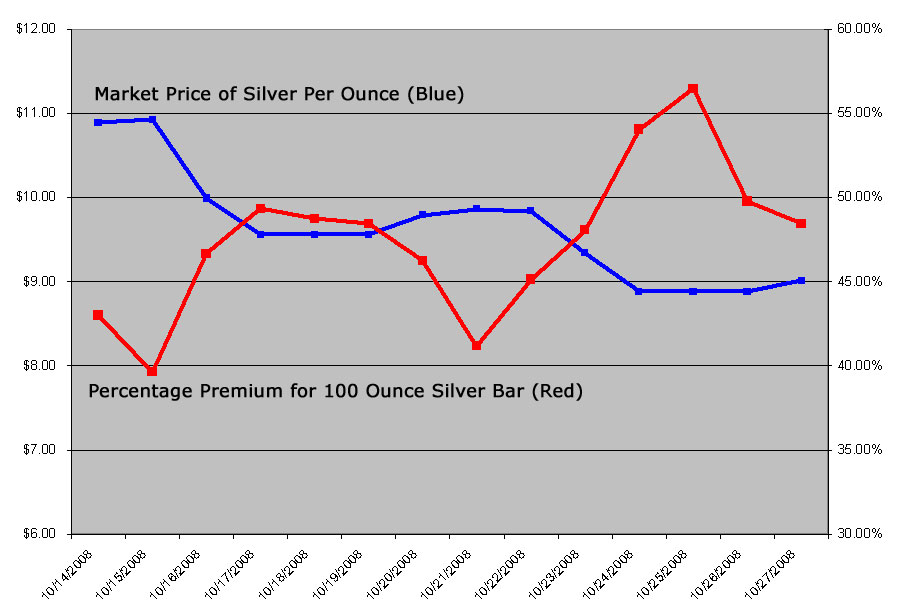
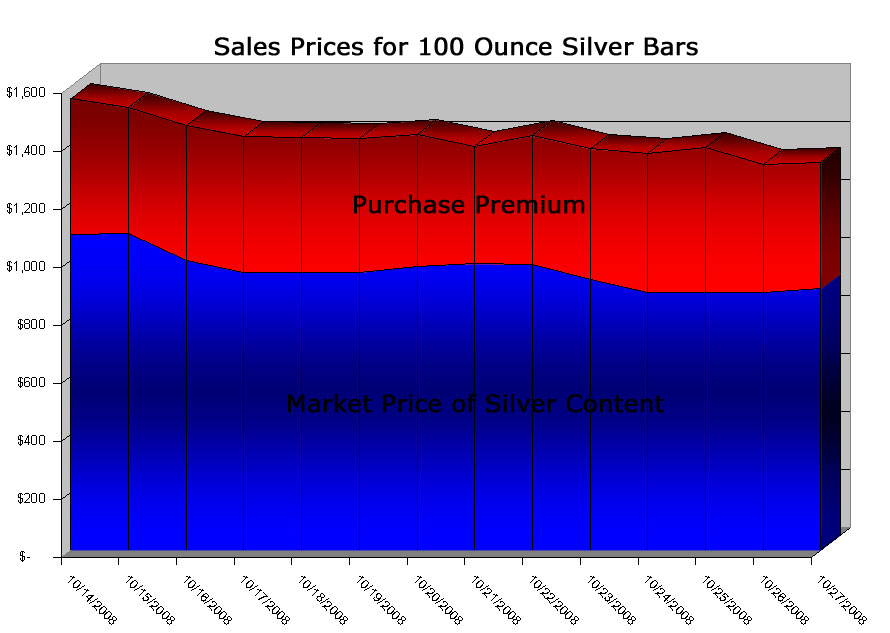
Some charts based on this data appear below. The data is only for a limited time frame, but it does spur some interesting observations (click to enlarge images).

The premium paid for a 100 ounce silver bar has ranged from 39.62% to 56.45%. The premium represents the amount paid in excess of the so-called “market price” of silver. People are clearly paying astounding premiums to acquire physical silver.

On October 15 and 22, the market price of silver dropped. In each instance this caused the percentage premium to rise. This lends some evidence to the anecdotal observation that a decline in market price only spurs greater demand for the physical metal.

Two distinct prices for silver seem to exist. The paper price for the contractual right to acquire future silver, and the physical price to acquire real silver, in hand. How and when will this situation resolve itself?

There have been several recent reports of bullion buyers seeking to take physical delivery of silver and gold from the COMEX. This would allow buyers to purchase real silver at the heretofore “fictional” paper price. If these deliveries take place and become a dependable source of purchasing physical silver, premiums for 100 ounce bars and other physical silver would likely begin to subside.

On the other hand, some are voicing the possibility that since the COMEX only has small coverage of physical metal for outstanding contacts, if enough contact holders demand delivery they will be forced to default and settle in cash. If this occurs, the likely result would be soaring market prices for silver and potentially greater premiums as the argument for physical scarcity gains another leg of support.

Disclosure: Author owns physical gold and silver.

Related Articles

  • China’s Greatest Trade Ever Oct 30, 2008
  • Credit Suisse Expects Gold Miners to Disappoint Oct 30, 2008
  • Lubricated Global Banking Machine Still Sputters Oct 30, 2008
  • Premiums Paid for 100 Ounce Silver Bars Oct 30, 2008
  • Newmont Mining Corp. Q3 2008 Earnings Conference Call Transcript Oct 29, 2008

Related Stocks:

  • SLV
Free E-Newsletters

The Macro View Stocks & Sectors Global Markets

This article has 9 comments:

  •  
  • diehlr1
  • 1 Comment

Oct 30 07:52 AM

That was a very nice, simple, understandable analysis. I’m a little curious as to whether this is actually becoming the same problem as naked shorting. Basically for the market prices, it includes a significant amount of repeated selling of product that the seller doesn’t own.
Reply |Report abuse
  •  
    • sakata
    • 8 Comments

    Oct 30 07:57 AM

    Premiums have been steadily rising all summer on all forms of silver. For silver eagles is it now around 80-90%. However, some dealers do occasionally have silver available for immediate delivery and it is still possible to buy it at a lower premium from them.

    All manufacturers are not equal. Bulliondirect’s nucleo auction site has Engelhard and JM bars for about a 50% premium but other brands at 36% premium. Last week there were 200 bars auctioned at seekbullion.com. Historical data is not available but I seem to remember a premium of about 30-35% for Engelhard bars. This morning Apmex has them for about a 30% premium for delivery in 4 weeks. That is not immediate, but they are reputable and I have bought from them frequently.

    Ebay may be an easy place to check the prices but it is not the only place to look and it is not the first place I look when trying to buy. Plus, their fees are ridiculous (up to 15%) so it is not a good place to judge what you could sell your silver for. Other sites produce more reliable data.

    I do agree with you about the high premiums, but don’t think they are uniformly as high as you claim.

    Reply |Report abuse


  •  
    • QuasiYoda
    • 13 Comments

    Oct 30 08:02 AM

    Nice piece, though the “fictional” Silver or Gold price is available to who have the sufficient capital to take delivery from the Comex. So not really fictional just limited access. The more people who take advantage of this price decrepancy the less supply will be available and the faster our profits will rise

    Also various Precious Metal PM dealers are buying 1000 oz silver bars from the comex and selling them individually. Tulving.com is selling 1000 oz Silver bars at a 7% premium or .69 over spot. Although the US Silver Eagles are going for 6.99 over spot about 70% premium with other silver items having premiums from 25% on up. The Smart money is selling Gold and Buying Silver as you can get almost 80 oz Silver for 1 oz Gold. Trade back when the ratio reaches 40 or 20. At 20 Gold to Silver ratio you would then receive 4 oz Gold for your 80 oz Silver. A nice 400% gain and you got to keep your PM’s the whole time.

    Reply |Report abuse
  •  
    • sakata
    • 8 Comments

    Oct 30 08:21 AM

    I don’t think we will see a ratio of 20 again in our lifetime. But I agree with the principal. I plan on trading some of my silver for gold when it gets back back below 50. Until them I am holding about 3 times as much silver as gold.
    Reply |Report abuse
  •  
    • User 30121
    • 251 Comments

    Oct 30 09:06 AM

    Nice article Mike. Thank you!

    I’m continuing to buy silver and gold as I find it.

    Hey, sakata, WHERE do you look FIRST when you are buying? Thanks.

    Reply |Report abuse
  •  
    • sakata
    • 8 Comments

    Oct 30 09:12 AM

    Bulion Direct is my favorite but they rarely have anything any more. Apmex is my second choice but they also rarely have much. Bullion is just getting hard to find anymore. Seekbullion is a new auction site which is much better than Ebay but it is just getting started and you have to be a dealer to sell there right now.
    Reply |Report abuse
  •  
    • User 288596
    • 1 Comment

    Oct 30 09:12 AM

    I have the JM 100 ozt silver bars. I had about 200 of them & put them up for sale on Creags list here in NY. I put them up about 5 weeks ago for $4.00
    above spot. I only sold about 20 of them. So I’m not so sure if this shortage is really real. E-bay is just way to expansive.
    If anyone is intersted you can e-mail me. I have an office in midtown NY
    kahanj at optonline.net
    Reply |Report abuse
  •  
    • sakata
    • 8 Comments

    Oct 30 09:16 AM

    Selling 20 of them in Craigslist is pretty good. People just don’t go there looking for bullion. I have heard of people who listed it there and got no response.
    Reply |Report abuse
  •  
    • bearfund
    • 472 Comments

    Oct 30 10:27 AM

    The premiums on 100 oz bars frankly make no sense to me. 100 oz bars are not particularly convenient either for storing wealth or for use as a medium of exchange. One ounce gold coins and bars have comparable purchasing power but are much more convenient. 1000 oz silver bars trade at much lower prices. I can only assume that the people buying the 10 and 100 oz products are simply looking for whatever’s available.

    There’s another very important factor at work here, however. Because you are looking at eBay, you must extract the live.com 25% discount. When Microsoft began offering cash back on purchases at certain merchants to boost their search engine’s market share, eBay was, and remains as far as I can tell, part of the program. At that time, canny sellers of metals products immediately added a similar amount to their prices. In effect, 2500bp of that premium is being paid by Microsoft. But this still does not explain the 20-25% premiums on 100 oz silver products.

    The real reason to buy silver is to have a convenient medium of exchange for ordinary goods in a scenario in which the dollar or other fiat money is no longer valued or accepted at anything like its current price. Gold has too much purchasing power for this purpose, so one needs somewhere between a few dozen and a few hundred one ounce silver coins, or perhaps a similar amount of old coin of the realm containing silver. 100 ounce bars do not serve this purpose at all, so the premium is inexplicable

  • Share this:

    • Click to share on Reddit (Opens in new window) Reddit
    • Click to share on Facebook (Opens in new window) Facebook
    • Click to share on LinkedIn (Opens in new window) LinkedIn
    • More
    • Click to share on X (Opens in new window) X
    • Click to share on Pinterest (Opens in new window) Pinterest
    • Click to share on Tumblr (Opens in new window) Tumblr
    • Click to print (Opens in new window) Print
    • Click to email a link to a friend (Opens in new window) Email
    Like Loading...

    Safe Haven Investments: Imminent Danger and Opportunities – Seeking Alpha

    29 Wednesday Oct 2008

    Posted by jschulmansr in commodities, Copper, deflation, Finance, gold, hard assets, inflation, Investing, investments, Latest News, Markets, mining stocks, precious metals, silver, U.S. Dollar, Uncategorized

    ≈ Comments Off on Safe Haven Investments: Imminent Danger and Opportunities – Seeking Alpha

    Tags

    agricultural commodities, alternate energy, Austrian school, banking crisis, banks, bear market, bear stearns, bull market, capitalism, central banks, commodities, communism, Copper, deflation, depression, diamonds, dollar denominated, dollar denominated investments, economic, economic trends, economy, fiat currency, financial, futures, futures markets, gold, gold miners, hard assets, heating oil, inflation, investments, market crash, Markets, mining companies, natural gas, nickle, oil, palladium, physical gold, platinum, platinum miners, precious metals, price, price manipulation, prices, producers, production, protection, recession, risk, run on banks, safety, silver, silver miners, socialism, sovereign, spot, spot price, stagflation, timber, U.S. Dollar, volatility, Water

    Safe Haven Investments: Imminent Danger and Opportunities – Seeking Alpha

    By Marc Anthony

    When people see danger in the market, their natural response is to liquidate everything and move everything into cash in order to ride out the storms. The conventional wisdom is “Cash is King.” However, conventional wisdom doesn’t work anymore, as this is unconventional time. If you are fully loaded in cash or U.S. Treasury Bonds, this news, first noted by Karl Denninger, should completely shock you out of your shell:

    According to an October 19 article in Investment News, $2.29 Trillion Dollars US Treasury Bonds Failed To Deliver.

    Note that it is $2.29 TRILLION, with a T for Trillion! I never heard that one could short U.S. Treasury Bonds, let alone naked shorting of U.S. T-Bonds! The T-Bonds are considered some of the safest investments, with the full faith and credit of the U.S. government guaranteeing the principal, and you get an interest payment. So shorting U.S. T-Bonds is virtually guaranteed to lose money, as you will have to pay back the principal plus the interest. You do NOT short U.S. T-Bonds, let alone naked shorting, let alone as much as $2.29 Trillion.

    That is UNLESS you are a really BIG player and you clearly see imminent danger of the collapse of the U.S. T-Bonds, and of the U.S. dollar, itself. I have previously written that Warren Buffet saw extreme danger in U.S. Treasury Bonds, and as a result,  was completely out of the bonds and fully into the equities market. Of course, people should respect and follow this person’s wisdom. However, small potatoes like Warren Buffet could not have naked shorted $2.3 Trillion U.S. T-Bonds. Someone much bigger, and who knows this market better, did it. I will not speculate, but read Karl Benninger’s comment, in order to gain some insight into the matter.

    Money created out of thin air is NOT King! The current Kings are precious metals. Never mind the fact that the dollar staged a shocking rally and precious metals plummeted. The dollar rally is nothing but a bubble, while current precious metal prices, especially platinum and palladium, is nothing but absurdity. Physical commodities MUST be priced above their production cost, or the supply will simply dry out, as no one can continue produce metals at a loss. So, if I am sitting on my precious metals, I am pretty much guaranteed that they will soon appreciate in terms of real purchasing power. On the other hand, if you are sitting on trillion of dollars of the fiat currency, and the currency falls, the only guarantee you will have is they will continue to fall further down, until eventually, they reach zero.

    The general market always manages to fool most people most of time, and causes more people to lose more money in unexpected way. It only rewards the select few who have the wisdom and the determination to stick to their wisdom. The current global crisis necessarily means an astronomical amount of fortune must be totally wiped out. What could be a better, cleaner and quicker way of wiping out trillions of dollars of fortune instantly, then to first herd the sheep into holding nothing but cash, and then having the currency suddenly collapse? Of course, the U.S. dollar rallies big time if every one is herded into buying dollars. A bubble is something pumped up to a valuation much higher than where it should be.

    Fiat money is completely at odds with the economy basics of supply and demand. For anything physical, equilibrium can be reached as the price impact positively on supply and negatively on demand. Higher price encourages more production while low price suppresses the supply. When the price falls below cost, supply dries up as no one can continue to produce and sell something at loss. On the demand side, the price has exactly the opposite effect. High price suppresses demand while low price encourages consumption.

    Fiat money acts in exactly the opposite way. The less valuable a currency becomes, the more is being produced out of thin air. The cheaper the currency becomes, the less people desire to own and keep them, and the faster people want to get rid of them. When people want to get rid of their paper money as fast as possible, it speed up the velocity of money, and cause the value of the currency to plummet even more, forcing the government to print more money. The vicious cycle continues until the currency is totally destroyed. Throughout civilized history of mankind, every single experiment of fiat currency has failed. There are no exceptions.

    In Chinese, the word CRISIS contains two characters, DANGER and OPPORTUNITY. We are in extreme danger but also with extremely good investment opportunities. The opportunities are made even better because every one runs away from them and run towards a gigantic death trap with a sign “Cash Is King.” Remember one thing; safe havens must be small, with narrow spaces that accommodate only a few refugees.

    It reminds me of the Bible story of Noah’s Ark. People ridiculed Noah as he was building his ark, thought it had never rained a single drop for a year, how could the flood come? The flood did come as Noah expected. Had these people listened to Noah and seek refuge in his Ark, would it make a difference? No! The Noah’s Ark was still only big enough to contain just one pair of each kind of animals. It wouldn’t be a Noah’s Ark if it was made any bigger. Likewise, today’s financial safe haven wouldn’t be a safe haven, but a death trap if it was big enough to allow every one in!

    Although we do not see a drop of rain yet, trillion dollars of wealth will soon be flushed away by the coming financial flood of hyperinflation. Have you built your Noah’s Ark yet? There is definitely NOT enough material to build a big enough Noah’s Ark to save every one.

    I can’t understand it! There are tons of investment opportunities in commodities right now. You can buy a few metric tons of nickel or copper or cobalt or a number of other things. You know they are priced far below their production cost right now. Therefore, it is absolutely a guarantee they must appreciate to at least the fair price of their cost. Can you find any better investment, with such absolute certainty of making double, triple and quadruple the money in the next few months, regardless of the demand? How could people be so blind and not see the opportunities? They all rush to cash and T-Bonds waiting to be slaughtered, and they actually thought it was safe to be with the biggest group of mobs?

    Nickel is now less than 1/6 its May 2007 price. Hello?

    ENOUGH IS ENOUGH! When enough is enough, the eruption is fierce!

    On Monday, the third largest nickel producer in Russia, Ufaleynickel, which is responsible for slightly less than 1% of global supply, announced that it was shutting down production, because the price of nickel is just too low. The company needs to see at least $26,000 per metric ton in order to break even.

    Instantly nickel shot up to touch $5.00 a pound, from Friday’s $4.00. That’s a 25% rally in just one day, and probably the biggest one-day rally of any commodity in history. Removing 1% of the global supply doesn’t really change supply/demand that much. However, the price was suppressed too much so the bounce had to be fierce. Had you bought nickel at $4, you have made 25% profit in just a day. People are still rushing to buy U.S. T-Bonds to earn 3% annual interest while waiting to be slaughtered in the looming implosion of the bonds market.

    Do you want to make a 10-fold return in two months, and maybe two weeks? Then, buy some palladium metal – any palladium metal you can find. Once the Russian Checkmate plays out, the price of Palladium could go from $170 per ounce to $1700 per ounce in no time,

    The Russian Checkmate event will be if Norilsk Nickel (NILSY.PK) shuts down production. It is the No. 1 nickel producer in Russia. The number 3 producer has already shut down production. Would No. 1 be far away? If Norilsk shuts down, and 45% of global palladium supply is gone, I can’t even start to predict where palladium price could go up to, with 45% of supply removed instantly. In 2000/2001, one false rumor from Russia was enough to send palladium up to $1100. It would be fun to watch the effect of 45% of palladium supply removed.

    Of course, you can get better leveraged gain investing in the palladium stock Stillwater Mining (SWC) and North American Palladium (PAL).

    Will Norilsk shut down? It is facing a severe liquidity squeeze. In first half of 2008, Norilsk group reported a profit of $2.682B, at 32% profit margin. If you look up metal prices as of Oct. 24, 2008, and re-run the numbers, the company would have to write down -$4.594B of sales revenue for the whole group, or $3.634B for the main Norilsk Mine, resulting in heavy losses. The cash drain will be nearly $2B per half year.

    The Norilsk group had $4.8B cash as of end of June 2008. The main Norilsk mine probably had $4B in cash. The company spent $2B in a recent stock buyback, a senseless decision that Mr. Mikhail Prokhorov denounced as “capable of putting the company on the verge of bankruptcy.” Operation loss since June probably costs them another $1B. The company has a debt payment of $400M due in November. Does it have any cash left? Can it continue to operate the mine at heavy loss? Why would the company continue to operate with heavy losses until bankruptcy?

    The bullish case for palladium cannot be disputed if you understand just how bad Norilsk Nickel‘s shape is today.

    Monday’s news of Ufaleynickel shut down mentioned OM Group ( and reminded me that OMG is the best cobalt play, because it dominates the chemical sector involving cobalt. I consider cobalt as a better metal to buy than silver, with the potential of 10-fold appreciation in a short period of time. Check out news on Minor Metals. If the speculation of Katanga Mining shut down plays out, cobalt price should fly soon. You can buy cobalt from BHP Billiton (BHP)..

    There are so many beaten down silver and gold mining shares now. All are very good buys: Pan American Silver Corp. (PAAS), Silver Standard Resources Inc. (SSRI), Apex Silver Mines Inc. (SIL), Hecla Mining Co. (HL), Newmont Mining Corp. (NEM), Yamana Gold Inc. (AUY), Northern Dynasty Minerals (NAK), Ivanhoe Mines (IVN), and NovaGold Resources Inc. (NG). There are so many to name. Even Southern Copper (PCU), my very first commodity play, is now back below where I first bought in late 2005. These days, anything in mining is good. I would not touch Silver Wheaton (SLW) though, because of counter party risks. Also, forget about any coal player now. I continue to call for selling James River Coal Company (JRCC), Arch Coal Inc. (ACI), Alpha Natural Resources Inc.  (ANR), Peabody Energy Corp. (BTU), or CONSOL Energy Inc. (CNX), at any rally.OMG) 

    The U.S. coal market is a local market and is now bearish. Watch Dry Ships’ (DRYS) share movement, as it is an important indicator of the health of the global economy. I might even consider buying some DRYS stock as the valuation has become so attractive. However, I first need to get a conformation that cross-ocean shipping activity is recovering.

    I will keep a portion of my portfolio in iShares Silver Trust (SLV). I will not buy gold or SPDR Gold Shares (GLD). I believe gold is adequately priced at current level. The money spent on gold is better spent on something else. Even buying a ton of nickel or copper is better than gold.

    However, the best of all is still palladium, and the only two pure palladium plays, SWC and PAL. We are witnessing a singularity event unfolding in the palladium market, as Norilsk Nickel will inevitably shut down, to protect its own best interest. What is singularity? A singularity is the kind of extremes like what you get when you try to divide a number by zero!

    Full Disclosures: The author is heavily invested in SWC, PAL, has considerable stake in OMG and SLV, and will continue to buy some select silver shares including SSRI, HL, PAAS and SIL. I am also looking for opportunity to buy DRYS soon.

    Share this:

    • Click to share on Reddit (Opens in new window) Reddit
    • Click to share on Facebook (Opens in new window) Facebook
    • Click to share on LinkedIn (Opens in new window) LinkedIn
    • More
    • Click to share on X (Opens in new window) X
    • Click to share on Pinterest (Opens in new window) Pinterest
    • Click to share on Tumblr (Opens in new window) Tumblr
    • Click to print (Opens in new window) Print
    • Click to email a link to a friend (Opens in new window) Email
    Like Loading...

    Obama Economics: The Future of Investments & The Economy Under a President Obama

    28 Tuesday Oct 2008

    Posted by jschulmansr in 2008 Election, Barack Obama, commodities, Copper, deflation, Finance, gold, hard assets, inflation, Investing, investments, Joe Biden, John McCain, Latest News, Markets, mining stocks, oil, Politics, precious metals, Presidential Election, Sarah Palin, silver, Today, U.S. Dollar, Uncategorized

    ≈ Comments Off on Obama Economics: The Future of Investments & The Economy Under a President Obama

    Tags

    agricultural commodities, alternate energy, Austrian school, banking crisis, banks, bear market, bear stearns, bull market, capitalism, central banks, commodities, communism, Copper, deflation, depression, diamonds, dollar denominated, dollar denominated investments, economic, economic trends, economy, financial, futures, futures markets, gold, gold miners, hard assets, heating oil, inflation, investments, market crash, Markets, mining companies, natural gas, oil, palladium, physical gold, platinum, platinum miners, precious metals, price, price manipulation, prices, producers, production, protection, recession, risk, run on banks, safety, silver, silver miners, socialism, sovereign, spot, spot price, stagflation, timber, U.S. Dollar, volatility, Water

    Obama Economics: The Future of Investments & The Economy under a President Obama

    By: Robert Nabloid of Nabloid.com

    At the time of writing this, Obama has not yet been elected, but that is only because the vote has yet to take place. In just a few weeks (on Tuesday November 4, 2008), Obama will become the first half-minority man to be President of the United States of America. The US, and the World, will cheer and it will all happen under much fanfare. We all know of Obama by now. We know he makes great speeches and talks a whole lot about change. But what change does he have in mind? The problem I have noticed is that not many of his supporters seem to understand all the changes he intends to make. Obama often speaks about a world that almost sounds utopian… but how does he intend to build this utopia? How does he intend to pay for this utopia? The devil is often in the details.

    The changes Obama implements will have an affect on both the economy (your jobs) and your investments (your retirement). I believe many of the changes he implements will also change American society forever (long after he is gone) by creating a society that believes it deserves a good living by default, instead of a society that works hard to earn a good living. So pay attention to Obamanomics. The most important changes Obama will implement deal with the economy; without a strong economy, Obama will not have the finances in place to afford many of his other social programs. So, I will focus this article on his economic and tax policies which will have an enormous affect on the economy and your investments, as well as the government coffers.

    Before I start, remember why the USA became a free nation to begin with… due to the taxes imposed on Americans by the British Throne, which became excessive and caused a revolt. In the last century, the USA became the greatest nation on Earth. It has its share of problems, but it still became #1 on the planet! A commoner could become its wealthiest and most successful with enough hard work, determination and a little bit of luck. This ability to transcend social classes from being poor to being rich, has made America ripe with opportunities. Millions of immigrants, often highly educated and motivated, come from around the world to the USA in order to make a better life for themselves. Many come from 3rd world nations, dictatorships and socialist/communist countries, so they can live in a free market country that affords them many opportunities for a better life. This freedom is precious and critical in creating a healthy environment for economic development and prosperity.

    I must ask you a few questions now: If you lived in a country where more than half of your earnings go to the government automatically or you’re jailed, would you consider yourself free? If you lived in a country where you are unable to protect yourself, are you free? If you won the lottery and you’re government automatically took MORE THAN HALF, would you consider yourself free?

    Okay, so by now you’re just itching for me to get down to it. I think the American work ethic and creativity helped create one of the finest societies on the planet. I also think Obama will wage a war on the American work ethic and a war on successful people. Please read “The Audacity of Deceit: Barrack Obama’s War on American Values”. It’s funny that many parents want their kids to go to medical school or law school, to get good jobs. Why bother? Under Obama these professionals will suffer and be discouraged with tax rates above 50%! Why go through all the extra effort (and debt for schooling), only to be punished by your hard work and success with punitive taxes that leave you with less than half of what you actually earned?

    Below is a great list of ten tax changes Obama wishes to implement, quoted from “The Audacity of Deceit: Barrack Obama’s War on American Values”. Below each change, I have left my comment.

    1) Increase the top individual tax rate from 35 percent to 39.6 percent.

    It could cost the economy billions! This still takes money out of the pockets of successful people and puts it into Obama’s hand so he can spend it, because government doesn’t spend enough money? I think people should be entitled to keep their hard earned dollars and 35% is more than enough for the government to take. Remember, that money would be spent on assets of one type or another (like investments in the economy or houses/boats/consumer goods/etc) and it DOES get circulated back into the economy in an efficient manner by consumers! This is why capitalism has worked so well! The government often waists money in poorly run social programs and money grabs for special interest groups. This will decrease efficiency in the economy and is nothing more than a government transfer of wealth. Let’s create more inefficiencies?!? C’mon… but it gets much worse.

    2) Raise the capital gains tax rate from 15 percent to 28 percent.

    This is an absolutely horrible idea! Capital gains taxes are incurred on investments! Many millions of Americans have a plan to retire. They have put money into investments so the investments could go up in value enough to afford the luxuries of retirement, without depending on social security. Now only 72% of your profits are actually profits. If you needed $1 million to retire, you will now need your investment returns to be even higher to afford retirement! Do we not want people to be successful and self-sufficient? This is impeding the ability of many to be self-sufficient.

    Many companies may not invest in the USA as much because of the inherent capital gains. This will also hurt the stock market. We should be encouraging people to save money and invest, not discourage them! I believe a 0% tax rate on capital gains would spur a LOT of investment in the USA, and a lot of jobs!

    3) Increase the stock dividends rate from 15 percent to 39.6 percent.

    This is just plain dumb! Stock dividends are one of the primary ways retiree’s earn money! If a retiree was able to find investments yielding 10% per year in dividends, than the retiree would only need a portfolio of $250,000 to earn $25,000 in dividends. Of that amount the retiree would get to keep $21,250 after taxes. Under Obama, that same retiree is all of a sudden forced to take a massive pay cut and live off of $15,100! This hurts the stock market, retirees, and the economy in general. This is really stupid. We should encourage people to invest in companies, not discourage them! This is only discouraging investment in America, once again.

    4) Raise the percentage of Americans who pay no federal income tax from 40 percent to 50 percent.

    Why, in a time with massive deficits, should more burden be placed on fewer Americans? The social programs are not free! Someone must work for, earn, and pay for these social programs. The same low and lower-middle class families that are voting FOR these programs should bear some of costs! If they believe so highly in the programs, they should be willing to put their money where their mouth is and take it on the chin, especially if its such a good idea and helps people out!

    5) Impose a 10 percent surtax on all incomes above $250,000 per year.

    Surtaxes on success? My, oh my. Shit, I think we should impose a heavy surtax on anyone who earns less than $15,000… pretty quickly I bet you would see a whole lot of people earning more than $15,000 that didn’t use to… that might actually help more people than it hurts! Want an efficient economy? Placing surtax on success is stupid.

    6) Raise the death tax rate to 55 percent for any income past the first $1 million exemption.

    With many homes being worth over a million (at least by the time many of us die they probably will be if you think about inflation!), a 55% tax rate is almost abusive. Once again, why save money if it’s going to be heavily taxed when you die? This is one of the worst, as it will cause many successful families to move A LOT of assets OFFSHORE to avoid taxes altogether. Why invest in the USA when it looks like it’s going in the wrong direction? Before there was a little bit of stigma attached to rich people moving assets offshore to avoid taxes. Under a heavy taxes (above 50%!) it would only be smart to move all assets offshore, and there might be a stigma for those that don’t! (Why wouldn’t they, do you think they are stupid? If they want to give money to charity, I’m sure many of them worked their entire lives for that money, and would like the ability to choose (democracy!) where there money goes). I assure you, many families will move assets off shore to avoid the wacky Obama taxes altogether.

    Many other nations will now try and lure these wealthy families to come to (and invest in) their nations. If America doesn’t appreciate the middle class, middle-upper class, and upper class, I assure you, another nation will!

    7) Raise the minimum wage from $6.55 to $9.50.

    Inflation anyone? The cost of everything will rise to pay for this increase. It’s almost a zero sum game for the minimum wage earners and it can only hurt the rest of society with inflation. We don’t need this because American workers aren’t competitive enough on the world stage as it is. LOL, So let’s raise the minimum wage even more, so we can’t compete on ANYTHING. Hopefully all businesses and capital (money) will move elsewhere.

    8 ) Raise social security payments by 4 percent for individuals, businesses, or anyone who makes $250,000 per year.

    Why even comment on this? More social security? If people don’t earn it, they shouldn’t get it. I agree with having social security for those tough times when people lose jobs/get sick, etc. But should we allocate even more money to social security? We should want social security to help put food on the table, but not give each person a life so comfortable they don’t attempt to go out and get a job if they are able to do so! It should be an uncomfortable time when a person is not productive, and the discomfort should be great enough that the person strives to do all he/she can do to become productive to society once again!

    9) Increase the top tax rate from 37.9 percent to 54.9 percent for self-employed taxpayers (who already pay ordinary income taxes as well as self-employment taxes).

    Why be self-employed or go out and create a business? There’s just no point to risking your money to start a business. Not only are you hit with massive taxes on earnings, but if you do happen to create a business and eventually decide to sell, the capital gains taxes take a large chunk of the value of the business you created. It’s a massive disincentive to create businesses based in the USA. Now how are American businesses supposed to effectively compete with foreign competitors (with wage slaves) when much of the profit is sucked away to government coffers instead of re-invested into the business? Businesses normally either re-invest the profits into the business or give the dividends to shareholders, but with less actual profits… less spending on new technologies, expansion, job creation, etc.

    10) Increase the tax rate on Sub-chapter S corporations (small businesses) by up to 15.3 percent (from a top rate of 35 percent to 50.3 percent).

    Another tax rate above 50%. Instantly, almost overnight, many corporations will have to reduce any expansion plans they did have, as much of the profit they were going to re-invest is now in the government coffers instead of the corporations bank accounts. All this WHILE there is a credit crunch? C’mon, I thought Obama would want MORE jobs, not less. Why should companies even put a head office in the USA anymore? It doesn’t make sense anymore with disincentives like this.


    How can the USA consider itself a free country when it has lost so many of its constitutional rights? Now the right for a person to work hard and enjoy the fruits of his/her labour may disappear under heavy taxes. When more than 50% of your hard earned dollars go to the government, it is NOT a free country! I contend that in a free nation, a government does not take MORE THAN HALF of your earned dollars.

    I thought this was interesting: Even Russia is doing a better job at some things than the US. If I didn’t tell you what country it is that is doing the below tax rates, you would never guess:

    • The tax system in Russia underwent a comprehensive reform in the year 2001. This reform is designed, in principle, to ease the tax burden on individuals and companies and to simplify the classes of payments for national insurance.
    • Russia has a uniform rate of tax on the income of individuals. As of 2008 tax in Russia is payable at the rate of 13% for an individual on most income. (non-residents 30%). Russian residents pay 9% on dividend income. (Deduction at source). Non-residents pay 15% on dividend income.
    • Exemptions are granted to certain income earners.
    • The standard rate of Russia corporate tax in 2008 is 24%.
    • http://www.worldwide-tax.com/russia/russia_tax.asp

    If American’s don’t appreciate their successful citizens and the government’s real role in society, there will be consequences. The government has made most of the major problems, including the legislation that ultimately created the housing bubble. Governments can seldom manage their own finances, and yet they want to take MORE of your money out of your hands and “efficiently” transfer the wealth around? It doesn’t work that way, especially when they plan on transferring wealth from productive peoples to unproductive ones… that in and of itself creates inefficiencies.

    Here’s what I think will happen. Obama will introduce all his new taxes during a recession. He will make things worse, but will get no blame for it, as most people will blame the previous government for the entire recession. Businesses will get hurt by higher minimum wages (and HIGH inflation!!) which make them even less competitive with other nations around the world, further increasing the need for outsourcing. The businesses that do manage to remain profitable will get slammed by higher taxes, which means less profit to re-invest in the business, the economy, and the owners pockets (shareholder’s often include pension funds, and individual investors retirement accounts!). A lot of baby boomer’s that wanted to retire will no longer be able to do so, due to higher taxes on their investments, income and combined with lower stock prices thanks to both the tax policies and the recession.

    Obama will then go on to introduce many of his social programs that will create an entire generation of Americans who expect the government to take care of them. So as government is bringing in less money due to a recession and stupid tax policies, it will begin to spend more. The dollar will suffer. National debt will continue to sky rocket into the stratosphere. America will be less competitive.

    Meanwhile, the rest of the world will be split. Some nations will follow the lead of the Americans and create very socialist societies, while the other nations that see the errors, will capitalize (pun intended) on America’s mistakes and try and lure the capital, head offices, and assets of American families and corporations. If America doesn’t want the corporations and wealthy families, another nation will. All this will occur, because as many people forget, government did not make the USA powerful and successful, it merely laid the foundation for the PEOPLE to make it successful. Other nations can lay that same foundation and corporations and people will move!

    I love America, but I hate the road its going down and can no longer invest my money in America until this socialist agenda is stopped. That’s right. I will NO LONGER invest in America as long as things are headed down such a bumpy road. I hope to one day be able to begin investing in America again, but that won’t happen until America goes back to the constitution and realizes what governments role should be.

    Take the Obama Test and see if you agree or disagree with Obama’s policies. He does great speeches on change, and change can be good (or bad)… but change has to be defined!! Right now most American’s badly want change, but I fear they will vote for a change they do not fully understand. At least take a look at the specific changes he will implement before voting, then make an informed decision about whether he is going to implement the changes you want or not. Oh, what’s the use… we already know he won the second he showed his face, regardless of his policies. At least this article might show some of the consequences to his economic policies. Obama is a socialist, bad for business, investments and the middle class.

    Share this:

    • Click to share on Reddit (Opens in new window) Reddit
    • Click to share on Facebook (Opens in new window) Facebook
    • Click to share on LinkedIn (Opens in new window) LinkedIn
    • More
    • Click to share on X (Opens in new window) X
    • Click to share on Pinterest (Opens in new window) Pinterest
    • Click to share on Tumblr (Opens in new window) Tumblr
    • Click to print (Opens in new window) Print
    • Click to email a link to a friend (Opens in new window) Email
    Like Loading...

    Don’t Be Fooled – Inflation is Coming – Seeking Alpha

    28 Tuesday Oct 2008

    Posted by jschulmansr in Copper, deflation, Finance, gold, hard assets, inflation, Investing, investments, Latest News, Markets, mining stocks, precious metals, silver, U.S. Dollar, Uncategorized

    ≈ Comments Off on Don’t Be Fooled – Inflation is Coming – Seeking Alpha

    Tags

    agricultural commodities, alternate energy, Austrian school, banking crisis, banks, bear market, bear stearns, bull market, capitalism, central banks, commodities, communism, Copper, deflation, depression, diamonds, dollar denominated, dollar denominated investments, economic, economic trends, economy, financial, futures, futures markets, gold, gold miners, hard assets, heating oil, inflation, investments, market crash, Markets, mining companies, natural gas, oil, palladium, physical gold, platinum, platinum miners, precious metals, price, price manipulation, prices, producers, production, protection, recession, risk, run on banks, safety, silver, silver miners, socialism, sovereign, spot, spot price, stagflation, timber, U.S. Dollar, volatility, Water

    Don’t Be Fooled – Inflation is Coming – Seeking Alpha

    By: Robert Nabloid of Nabloid.Com

    Many people are using this latest weakness in the price of various resources (gold, silver, oil, and other commodities) to claim that the commodity boom is over. They’re wrong. Resource prices have been declining for a variety of reasons, but all of them appear to be temporary. These same people then point to the recent strength in the USD. I contend that the strength is temporary. How often in history does an economy that’s going into recession, with a policy of lowering interest rates, undergo massive increases in the value of its underlying currency? Only time will tell, but I’m willing to bet my money that this isn’t the last of the commodity boom. I’ll put my money where my mouth is and continue to buy undervalued resource companies at extremely attractive levels as I’m expecting inflation in the long-term. Short-term I do see strength in the USD, but not because it’s fundamentally strong. I could never see any long-term strength in any fiat currency due to inflation.

    In regards to recent USD strength (and gold weakness), we’ve been witnessing the de-leveraging and unwinding of many hedge funds. Many of these hedge funds were invested in anything but the USD, and as such, when they are required to sell their assets, they are repatriating them into USD’s to give money back to investors and pay off debt. This buying of USD’s in mass is creating extreme strength when the dollar should be showing signs of weakness.

    There also seems to be something fishy going on with the gold price on the Comex. Is it manipulation? Yes! On paper you can buy gold in abundance and relatively cheaply. In real life it is actually hard to find a gold/silver dealer that will sell you gold or silver for anywhere near the Comex spot price. The Fed doesn’t want gold to be too strong or they run the risk of losing people’s trust in the fiat currency, and trust is the only way a currency works. So could governments be manipulating the paper prices of gold? Of course, but we all know it isn’t the price or value of gold going up, but the debasement of fiat currencies, that they are attempting to mask by putting a lid on gold.

    One of the primary reasons oil is headed lower right now seems to be driven by fear of a deep recession. This fear has merit. An economy financed completely on debt is not a stable or sustainable one. As U.S. consumers are finding out, you must actually pay back debts by cutting discretionary spending, and if you’ve gone too far, declare bankruptcy. With consumers tightening their purse strings, a recession was bound to happen. Now consumers aren’t all rushing to buy half million dollar homes at the same time and the economy is beginning to feel it. Even with a recession, oil is still being used at an alarming rate and drilling is actually down quite a bit! This might catch up with the oil price increasing during a recession! A large number of additional vehicles are being added to the world’s roads each year. Yes, the days of oil energy reliance are limited, but for now it’s still an essential resource.

    Regardless of what you believe in politics, I don’t think any independent economist actually believes dramatically raising taxes on corporations will help the recession or the standard of living for those down the line. It probably won’t help the USD either. But for a variety of reasons, tax rates on corporations will undergo extreme changes upwards in the coming years. Combine that with the dramatic rise in minimum wages, and inflation is bound to happen even at a time when the economy may not be running on all cylinders. Outsourcing may continue to make the situation worse. These factors may only further impair the value of the USD.

    The government shows no signs of cutting back on spending anytime soon. Massive deficits are forecast for years and years to come, with no signs of slowing or stopping! This is dangerous. An individual, corporation and country can only handle so much debt. If the country does intend to ever pay back these insanely high and still growing debts, there is only one way out; it’s called inflation. Inflation in the future will cause all of these debts to be much easier to pay down, but inflation doesn’t come without a price to the Middle Class.

    There isn’t just fear of a recession, but also of deflation, which is affecting the price of commodities. The Fed has said they will do everything they can to avoid deflation, and they will, but at the cost of causing inflation. Flooding the system with capital will cause inflation, eventually.

    Regardless of what people think, BRIC countries will slow down and they will feel the recession, but even with BRIC countries slowing, there are millions of additional people being added to the world economy and these people will increase the demand on the world’s resources. This will occur at the same time that fiat currencies are pumping money into the system. The result is an increase in a seemingly infinite resource (the ability to print unlimited amounts of money) to buy things that are finite (like resources).

    Traditionally, when the resource sector booms, capital is supposed to flow into the system and many new mines are built. The supply eventually catches up with the demand and the prices fall back and level out. That isn’t happening this time. Resource prices have slipped before many mines were constructed, and now with the big credit crunch, many mines are being put on hold and many exploration companies are cutting back on drilling. This deficit of new mines and resource supplies will be felt, eventually. I’m preparing for a deep recession (not depression) and EXTREME inflation. Inflation will be a bigger issue than the recession. Inflation may well be the big story for the next century. There’s going to be a lot of people running around with an abundance of fake dollars (fiat currency) trying to buy up finite resources

    Share this:

    • Click to share on Reddit (Opens in new window) Reddit
    • Click to share on Facebook (Opens in new window) Facebook
    • Click to share on LinkedIn (Opens in new window) LinkedIn
    • More
    • Click to share on X (Opens in new window) X
    • Click to share on Pinterest (Opens in new window) Pinterest
    • Click to share on Tumblr (Opens in new window) Tumblr
    • Click to print (Opens in new window) Print
    • Click to email a link to a friend (Opens in new window) Email
    Like Loading...

    Share the Wealth / Wealth Redistibution – A New Definition!

    27 Monday Oct 2008

    Posted by jschulmansr in 2008 Election, Barack Obama, commodities, deflation, Finance, gold, hard assets, inflation, Investing, investments, Joe Biden, John McCain, Jschulmansr, Markets, mining stocks, oil, Politics, precious metals, Presidential Election, psychology, Sarah Palin, silver, U.S. Dollar, Uncategorized

    ≈ Comments Off on Share the Wealth / Wealth Redistibution – A New Definition!

    Tags

    agricultural commodities, alternate energy, Austrian school, banking crisis, banks, bear market, bear stearns, Biden, bull market, capitalism, central banks, commodities, communism, Copper, deflation, depression, diamonds, dollar denominated, dollar denominated investments, economic, economic trends, economy, Election 2008, financial, futures, futures markets, gold, gold miners, hard assets, heating oil, inflation, investments, market crash, Markets, mccain, mining companies, natural gas, obama, oil, Palin, palladium, physical gold, platinum, platinum miners, precious metals, Presidential Election, price, price manipulation, prices, producers, production, protection, recession, risk, run on banks, safety, Share The Wealth, silver, silver miners, socialism, sovereign, spot, spot price, stagflation, timber, U.S. Dollar, volatility, Water, wealth, Wealth Redistribution

    Subject: Redistribution of Wealth

    Today on my way to lunch I passed a homeless guy with a sign that read
    “Vote Obama, I need the money.”… I laughed.
       

    Once in the restaurant my server had on a “Obama 08” tie, again I laughed
    as he had given away his political preference… just imagine the coincidence.
    When the bill came I paid cash but decided not to tip the server and explained
    to him that I was exploring the Obama redistribution of wealth concept. He stood
    there in disbelief while I told him that I was going to redistribute his tip to someone
    who I deemed more in need (the homeless guy outside).
    The server angrily stormed from my sight.
    I went outside, gave the homeless guy $10 and told him to thank the server inside
    as I decided you could use the money more than him. The homeless guy was happy…
    and I felt like a successful politician.
     At the end of my rather unscientific redistribution experiment I realized
    the homeless guy was grateful for the money he did not earn,
    but the waiter was pretty angry that I gave away the money he did earn
    even though the recipient clearly needed money more than him.


    I guess redistribution of wealth is easier to swallow in concept than in
    practical application!


    LOL TOO FUNNY! – jschulmansr

    Share this:

    • Click to share on Reddit (Opens in new window) Reddit
    • Click to share on Facebook (Opens in new window) Facebook
    • Click to share on LinkedIn (Opens in new window) LinkedIn
    • More
    • Click to share on X (Opens in new window) X
    • Click to share on Pinterest (Opens in new window) Pinterest
    • Click to share on Tumblr (Opens in new window) Tumblr
    • Click to print (Opens in new window) Print
    • Click to email a link to a friend (Opens in new window) Email
    Like Loading...

    Ten Reasons Why Gold Isn’t Above $1,000 – Seeking Alpha

    27 Monday Oct 2008

    Posted by jschulmansr in commodities, Copper, deflation, Finance, gold, hard assets, inflation, Investing, investments, Latest News, Markets, mining stocks, oil, precious metals, silver, U.S. Dollar

    ≈ Comments Off on Ten Reasons Why Gold Isn’t Above $1,000 – Seeking Alpha

    Tags

    agricultural commodities, alternate energy, Austrian school, banking crisis, banks, bear market, bear stearns, bull market, capitalism, central banks, commodities, communism, Copper, deflation, depression, diamonds, dollar denominated, dollar denominated investments, economic, economic trends, economy, financial, futures, futures markets, gold, gold miners, hard assets, heating oil, inflation, investments, market crash, Markets, mining companies, natural gas, oil, palladium, physical gold, platinum, platinum miners, precious metals, price, price manipulation, prices, producers, production, protection, recession, risk, run on banks, safety, silver, silver miners, socialism, sovereign, spot, spot price, stagflation, timber, U.S. Dollar, volatility, Water

    Ten Reasons Why Gold Isn’t Above $1,000 – Seeking Alpha

    By Michael Zielinski, 8 Stock Portfolio

    Gold reached its all time high price above $1,000 per ounce a few days after the shocking Bear Stearns bailout. In the following months, gold often experienced sharp declines and has stubbornly refused to reattain the key $1,000 level despite more shocking bailouts, bank failures, and bankruptcies.

    Reporters, analysts, and bloggers have cited a variety of reasons why gold has not exploded higher amidst the ongoing turmoil. Some of the reasons are more valid than others, but all are worth examining. Without further ado, the Gold and Silver Blog brings you the Top Ten Reasons Gold Is Not Above $1,000:

    1) Dollar Strength

    Against nearly every world currency, the US dollar has been strengthening. The dollar’s path higher has accelerated in recent weeks. Gold is thought of as a weak dollar play. With the dollar strengthening, selling gold is simply the other side of the trade.

    2) Commodity Collapse

    Since the summer months, commodities have been on the rapid decline. Oil has fallen by more than half from its peak price of $147. Base metals and precious metals have experienced similar if not more drastic declines. While gold has been holding up well on a relative basis, the weakness in commodities may be keeping any price appreciation at bay.

    3) Deleveraging

    After years of using excessive leverage in an attempt to maximize returns, firms are rediscovering the notion of risk. Massive deleveraging is taking place as firms sell any asset available to pay down debt. As an asset class, gold is not immune to such sales.

    4) Speculative Selling

    With the dollar rallying and gold breaching key technical levels, traders may be taking speculative short positions in gold, anticipating that prices will continue to move lower. This speculative selling compounds the impact of selling taking place for other reasons.

    5) Recession

    Fears of a worldwide economic slowdown and deep domestic recession will have a big impact on consumer discretionary purchases. This would likely hold especially true for luxury items such as jewelry.  Since jewelry production is the largest non-investment use for gold, any slowdown would put a drag on demand.

    6) Deflation

    While some fear inflation, others fear deflation. If prices decline across the board, some believe that all asset classes will be dragged down, including gold. Notably some people take the exact opposite position about gold and deflation.

    7) Hedge Funds and Mutual Funds

    Some people feel that hedge funds had a hand in driving the price of gold from below $300 to above $1,000. Now that fortunes have turned for their other investments, hedge funds are being forced to unmercifully liquidate large positions in gold. Mutual funds are also being forced to liquidate positions in gold to meet redemptions.

    8) “George Costanza Trade”

    On Seinfeld, George Costanza realized that every decision he ever made has been wrong. He discovered if he did the exact opposite of what his instincts told him to do, he would be successful. In relation to investing, when everyone believes that a certain trade or investment philosophy is certain to work, oftentimes with uncanny precision the exact opposite happens. This year, a growing number of people began to believe with absolute certainty that gold would move higher. While the opinion was far from universal, was the opinion widespread enough to invoke George Costanza?

    9) Government Manipulation

    There is a growing camp which believes that the primary reason that gold has not moved higher in a big way is due to government manipulation. If gold prices skyrocketed, the public at large would lose faith in fiat currencies and start to panic. It would be in the government’s best interests if this did not happen.

    10) These Things Take Time

    Some of the forces mentioned above are going head to head with the economic realities that should be driving the price of gold higher. Eventually we will reach a tipping point when demand for physical gold is enough to overwhelm all other factors. Once we reach that point, the price of gold will rise in leaps and bounds.

    Share this:

    • Click to share on Reddit (Opens in new window) Reddit
    • Click to share on Facebook (Opens in new window) Facebook
    • Click to share on LinkedIn (Opens in new window) LinkedIn
    • More
    • Click to share on X (Opens in new window) X
    • Click to share on Pinterest (Opens in new window) Pinterest
    • Click to share on Tumblr (Opens in new window) Tumblr
    • Click to print (Opens in new window) Print
    • Click to email a link to a friend (Opens in new window) Email
    Like Loading...

    Goldcorp: Implosion Offers Shiny Opportunity – Seeking Alpha

    27 Monday Oct 2008

    Posted by jschulmansr in commodities, Copper, deflation, Finance, gold, hard assets, inflation, Investing, investments, Latest News, Markets, mining stocks, precious metals, silver, U.S. Dollar, Uncategorized

    ≈ Comments Off on Goldcorp: Implosion Offers Shiny Opportunity – Seeking Alpha

    Tags

    agricultural commodities, alternate energy, Austrian school, banking crisis, banks, bear market, bear stearns, bull market, capitalism, central banks, commodities, communism, Copper, deflation, depression, diamonds, dollar denominated, dollar denominated investments, economic, economic trends, economy, financial, futures, futures markets, gold, gold miners, hard assets, heating oil, inflation, investments, market crash, Markets, mining companies, natural gas, oil, palladium, physical gold, platinum, platinum miners, precious metals, price, price manipulation, prices, producers, production, protection, recession, risk, run on banks, safety, silver, silver miners, socialism, sovereign, spot, spot price, stagflation, timber, U.S. Dollar, volatility, Water

    Goldcorp: Implosion Offers Shiny Opportunity – Seeking Alpha

    By: Mark Krieger

    Goldcorp (GG) has been heading one way lately: down.

    Since its August high of $52, the shares have lost more than 70% of their value. Gold’s early Friday drop below $700 prompted a potential GG capitulation, as the shares fell below $14, only to put on an impressive intraday reversal that not only erased the day’s losses, but tacked on a 10% gain, closing at $17. The stock  recorded a $3 positive swing as gold rallied 8% off its lows to close near the $734 mark.

    Disconnect between gold and GG: The last time the shares were this low, nearly five years ago, gold was trading at about $400 ounce. Even though gold is 30% off its highs, it is still 75% higher than 2004 levels. It is perplexing why GG’s shares are now priced at the very same levels, as they were when gold was trading at $400. The stock is extremely oversold and has dropped too much in too short of a time. This is a classic case of the,  “baby being thrown out with the bath water”.

    Panic selling is the culprit: This stock has been crushed by a “sell first and ask questions later” mentality,  but it’s not alone, as the entire mining  sector has also been decimated. It is obvious that selling pressure has intensified as hedge and mutual funds are forced to liquidate their holdings to satisfy redemption requests. Their relentless selling along with excessive short selling, margin calls and overall economic paranoia have created a recipe of disaster for the share price. Most investors are looking to buy wholesale and sell retail, but this massive overreaction offers investors the opportunity to acquire shares actually below cost.

    All is not lost: The sudden collapse in the stock price creates an attractive buying opportunity for bargain hunters. The stock is dirt cheap at only 17 times 2009 earnings estimates of $1.00, and the balance sheet is squeaky clean, featuring a  $1.2  billion stockpile of  cash  and no debt. The shares are trading 10% below the company’s book value of $18.50.  The company pays an annual 18 cent cash dividend, yielding a nonimpressive 1.2%, but it’s certainly better than nothing. GG’s short position of 10 million shares is relatively small in comparison with its 700 million shares outstanding, however it could potentially be beneficial, as a short covering squeeze might come into play at the development of any favorable news.

    Analyst take: The last three analyst actions all have been positive as HSBC Securities, RBC Capital Markets and Davenport have all upgraded their opinions and still maintain a average $40 one year price target.

    Bottom line: This stock could run back up just as fast as it fell, but logic would dictate not opening a position until the shares show signs of stabilization. They say to buy when there is “blood in the streets”, and no doubt we have seen plenty of carnage, but picking a bottom is difficult. It would be more advantageous, before buying, to wait for validation of a positive trend in the share price, such as the stock closing above $20 for five consecutive sessions. You certainly don’t want to fall into the trap of “throwing good money after bad”.

    Disclosure: Author holds a long position in GG

    Share this:

    • Click to share on Reddit (Opens in new window) Reddit
    • Click to share on Facebook (Opens in new window) Facebook
    • Click to share on LinkedIn (Opens in new window) LinkedIn
    • More
    • Click to share on X (Opens in new window) X
    • Click to share on Pinterest (Opens in new window) Pinterest
    • Click to share on Tumblr (Opens in new window) Tumblr
    • Click to print (Opens in new window) Print
    • Click to email a link to a friend (Opens in new window) Email
    Like Loading...

    Gold Miners: Amazingly Cheap – Seeking Alpha

    27 Monday Oct 2008

    Posted by jschulmansr in commodities, Copper, deflation, Finance, gold, inflation, Investing, investments, Latest News, Markets, mining stocks, precious metals, security, silver, U.S. Dollar

    ≈ Comments Off on Gold Miners: Amazingly Cheap – Seeking Alpha

    Tags

    agricultural commodities, alternate energy, Austrian school, banking crisis, banks, bear market, bear stearns, bull market, capitalism, central banks, commodities, communism, Copper, deflation, depression, diamonds, dollar denominated, dollar denominated investments, economic, economic trends, economy, financial, futures, futures markets, gold, gold miners, hard assets, heating oil, inflation, investments, market crash, Markets, mining companies, natural gas, oil, palladium, physical gold, platinum, platinum miners, precious metals, price, price manipulation, prices, producers, production, protection, recession, risk, run on banks, safety, silver, silver miners, socialism, sovereign, spot, spot price, stagflation, timber, U.S. Dollar, volatility, Water

    Gold Miners: Amazingly Cheap – Seeking Alpha

    By: Graham Summers, GPS CAPITAL RESEARCH

    Do you own bullion yet?

    During the last market rout, the price of gold plunged from $900 an ounce to $690 an ounce. The talking heads, seeing this, announced that gold is no longer a safe haven or a storehouse of value.

    They’re wrong.

    The idea that gold has somehow lost its safe haven qualities due to a temporary drop in price is beyond idiotic. To claim this is to ignore the role gold has played for well over five millennia. What are the odds that this has suddenly changed?

    No, this recent drop in gold has come almost entirely from downward pressure in the “paper” gold markets — the COMEX and Gold ETF (GLD). And this downward pressure has come from two trends:

    • Institutional liquidations
    • The dollar’s rally

    Hedge funds, pension funds, and even mutual funds have been slammed with redemptions in the last year — mutual funds alone have experienced $967 billion in redemptions since the beginning of 2008.

    In order to meet these redemptions, funds have resorted to liquidating portions of their portfolios. Gold — which the stock-centric crowd never really believed in anyway — was one of the first items to go. And since the “paper” gold market is relatively small — the total value of gold on the Commodity Exchange in New York (COMEX) is roughly $5 billion — it doesn’t take much capital to crush gold in the “paper” markets.

    As for the dollar’s rally, the Feds’ interventions and hyperinflationary money printing will put an end to this sometime in the not so distant future. You can’t add $6 odd trillion in liabilities to the US balance sheet, start trading in unsecured commercial paper markets — as the Fed did with its TARP facility — and increase the monetary supply at an annualized rate of more than 300% — the pace of money printing maintained by the Feds during the last month — and NOT kick the dollar in the face.

    No, the dollar rally will end sooner rather than later. When it does, the last obstacle standing between a raging Bull market in gold and gold mining shares will have been removed.

    Speaking of miners…

    While gold has been hammered, gold mining stocks, particularly juniors, have been truly creamed. The explanation here is much the same as for gold: liquidations. However, while the gold paper market may be roughly $5 billion, gold juniors as individual plays are even smaller. So it takes even less money to beat these stocks down.

    Because of this, today, gold mining stocks are currently trading at levels you only see at the end of BEAR markets. Taken as a whole, the sector is at its second cheapest level relative to the price of gold since 1984.

    It’s an absurd situation. Gold is undergoing a correction during a bull market… while gold miners — basically real estate companies sitting atop gold — are trading as if they just ended a bear market in gold. This won’t last forever. At some point both the institutional liquidations and the dollar’s rally will end. When they do, gold miners will explode upwards.

    Share this:

    • Click to share on Reddit (Opens in new window) Reddit
    • Click to share on Facebook (Opens in new window) Facebook
    • Click to share on LinkedIn (Opens in new window) LinkedIn
    • More
    • Click to share on X (Opens in new window) X
    • Click to share on Pinterest (Opens in new window) Pinterest
    • Click to share on Tumblr (Opens in new window) Tumblr
    • Click to print (Opens in new window) Print
    • Click to email a link to a friend (Opens in new window) Email
    Like Loading...

    Gold Report: investment coverage of gold and other precious metals

    24 Friday Oct 2008

    Posted by jschulmansr in commodities, Copper, deflation, Finance, gold, hard assets, inflation, Investing, investments, Latest News, Markets, precious metals, silver, U.S. Dollar

    ≈ 1 Comment

    Tags

    agricultural commodities, alternate energy, Austrian school, banking crisis, banks, bear market, bear stearns, bull market, capitalism, central banks, commodities, communism, Copper, deflation, depression, diamonds, dollar denominated, dollar denominated investments, economic, economic trends, economy, financial, futures, futures markets, gold, gold miners, hard assets, heating oil, inflation, investments, market crash, Markets, mining companies, natural gas, oil, palladium, physical gold, platinum, platinum miners, precious metals, price, price manipulation, prices, producers, production, protection, recession, risk, run on banks, safety, silver, silver miners, socialism, sovereign, spot, spot price, stagflation, timber, U.S. Dollar, volatility, Water

    Gold Report: investment coverage of gold and other precious metals (free newsletter emailed semi-weekly)

    Jon Nadler: Where Might Gold Go?
    Source: The Gold Report  10/24/2008


    Jon Nadler, Kitco’s well-known senior investment products analyst, elicits both criticism and acclaim for opinions that some characterize as contrarian. In this installment of an exclusive interview with The Gold Report, he brings his three decades of experience to bear (no pun intended) on the outlook for gold, promoting the precious metal as a key asset in a balanced portfolio, as well as for its intrinsic value and “insurance” attributes.

    The Gold Report: Economic theory tells us gold should be taking off, given all the uncertainty in the marketplace. But we haven’t seen that happen. What is going on?

    Jon Nadler: Well, as you may have heard, even Alan Greenspan found a glitch in his formerly “reliable” economic models during this crisis. Gold certainly will continue to have its volatile days, but the bigger trend is probably more important overall. To a certain extent, the metal got ahead of itself as a legacy of the huge infusion of speculative fund money that came into the commodities complex as a whole, and of course gold is part of that, aside from its role as money. This phenomenon goes back at least two years.

    It accelerated last September when the Fed first started to cut rates, and then we got into a position between March and July where the ever-weakening U.S. dollar started things looking like a bubble of major proportion—not just in gold, but in most industrial metals and in oil. It got to the point where oil became so visible that regulators started making all sorts of unpleasant noises toward speculators.

    So we saw the exodus from the commodities complex of a good part of that hot money from hedge funds. Of maybe $300 billion that had come in, we don’t quite know how much got up and left. We certainly know that some $50 billion left oil, which had close to $60 billion in it. That’s a significant proportion just sucked out of those markets. Of course, prices collapsed in the wake of that, along with the credit crisis unfolding on the front burner. That piece of the puzzle really didn’t become visible untila few weeks ago, whereas the exit of hedge funds from commodities was well underway back in late June.

    TGR: Are we now out of that exit phase?

    JN: I think it is continuing because some of the funds simply failed, like Ospraie just last month. Ospraie had a lot of bad bets in oil and gas contracts. We see others with stock positions being wiped out in this debacle. If you have profitable positions in gold or oil, you’re going to be forced to sell them to raise cash to meet your equity margin call. To some degree, that continues. It has wiped some $200 off the gold price in the last 30 days alone.

    TGR: If hedge funds and speculators are still exiting, when do you see that flushing itself through and gold reacting more as one would expect, given the financial turmoil?

    JN: We may not see that for some time. If deflationary pressures really take hold, we may have a case of “reverse hedge” developing, whereby gold might still fall to the mid-$600s or even as low as the low $500s, but still fall less in percentage terms than other assets might. In that case, investors would still be better off holding some gold and lots of cash rather than equities or real estate and such. Hopefully we don’t head into that deflationary spiral because that could hurt a lot of higher-priced producers of gold. Certainly a lot of the mining companies would have to reconsider what projects to mothball if that happens.

    If we don’t go into that vortex and confidence returns by whatever means, things could stabilize. Stability in gold would imply a trading range between $650 and $850. It’s definitely a blow to the doomsday newsletter writers, who thought the circumstances we are seeing now were the ideal scenarios they’d dreamt of as far back as we can recall. They know, however, that the world of $2,000 gold is not one they would want to live in.

    The fact that in July gold had trouble surpassing $930, (not even matching the March highs when Bear Stearns failed), was definitely a big wake-up call as to what was going on. And of course what’s going on is that a lot of people had already bought gold starting at $252 and all the way up to $400 and $600. When this big crisis hit, if they spotted their 401(k) accounts off by 38% and their gold holdings ahead by 50% or 60% or much more, it wasn’t a hard decision to make. They liquidated that which was profitable in order to mitigate their losses. That’s why they’d bought their gold to begin with.

    So the latecomers, those who were rushing in, having put off their gold purchases until it became a burning issue, basically got caught trying to buy into this “runaway train” scenario. The few people who tried cost-averaging higher-level purchases of $900 to $1,000-plus were the freshest of buyers during these past couple of weeks. The difference we spotted in retail transaction patterns is that this particular cycle in the gold market brought out quite a few sellers, along with new buyers. So there’s very good two-way activity going on in the physical market.

    TGR: The gold bullion coins appear to have a very high premium over the gold spot price, so there still seems to be some fear out there, or is it shortages?

    JN: Some issues in the physical market are really grossly misinterpreted. Observers are not doing anyone any favors. My perception is that we have a contingent of pundits who are extremely panicked that this is a very poor reaction by gold to the crisis, and it will make them look bad. It already has. Now they’re trying to manufacture this global stampede into gold by panicking investors and by scaring them with stories of supplies running out. No one will argue that there are higher levels of individual investor interest, but it’s nothing “unprecedented.” They’re trying to make it out as unprecedented, and that’s simply not the case. Perhaps it says more about how short a time such pundits have spent in these markets.

    TGR: Just how real is the shortage in coins, then?

    JN: Specifically, what’s going on with the coins is that most of the mints of the world do not operate on a “produce-then-wait-and-see” basis. They don’t pre-mint hundreds of thousands of coins and put them on the shelf waiting for buyers to materialize. They basically operate on a mint-to-demand policy.

    Because of the prolonged bear market in the ’80s and ’90s, most of them had slimmed down to bare essentials and, in fact, a lot farm out some components of the coin manufacturing process, such as blanking. The U.S. Mint is one of them. They ran into some blank coin quality problems in silver back in March, with about half a million silver blank rejects. That put them behind the production schedules, and when demand indeed kicked in for physical small coins, they were unable to fulfill commitments on a timely basis. This does not mean they ceased production. In fact, most of these mints consider small-item production quite profitable, which implies that they have added shifts, are finding new suppliers of blanks and new refiners for material, and augmenting production to meet the demand. Inventory build-up is one of their top current priorities.

    Look back in recent history at the classical gold rushes, if you will. During the first one, in that inflationary period in the late ’70s and early ’80s, some 16 million Krugerrands were sold globally. The market events of 1987 brought on the next wave of buying, and that is when the U.S. Mint sold more than 1.25 million ounces of gold. Nor should we lose sight of the fact that in the ’91 recession, just a few short years later, they only sold a quarter million ounces. And then we go to about 1999 before Y2K. Again, they suspended sales of certain products like silver rounds, which were being hoarded by people expecting the end of the world. Next would be May of 2006, with the North Korean and Iranian political tensions. Again, very good robust sales, but nothing of the magnitude of ’80 or ’87, and similar to what we’ve had since last year. But at best, I think this year the U.S. Mint will sell about 750,000 or 800,000 ounces. It’s not the level of 1987’s stampede or panic, so I don’t see why they’re trying to make it out to be something bigger than it is.

    TGR: Why is there such a premium, though? Just because they’re undersupplied?

    JN: Yes, once the retail shops saw the Mint selling coins on an allocation basis, with some restrictions to build up inventories, the retailers started raising premiums on coins that they couldn’t basically get to fulfill previously sold orders. They raised their bids; they also raised their offer. It’s really limited to items like the silver rounds and some of the smaller fractional coins.

    But in terms of Kitco getting supplies, basically we took the attitude that if we could not get a commitment from our distributors and suppliers as to a firm premium and/or a delivery date or both, we simply removed the items from the order pages in the online store. Those order pages are limited to items we are confident we can deliver at a decent price within a decent number of days. I know that the list is looking pretty slim, but we do have product to sell, and our pool accounts have never had any shortage of underlying material to secure; namely, 1,000-ounce bars of silver and 400-ounce bars of gold. We continue to offset 100% of all pool account purchases for the peace of mind of our clients.

    And we’re adding back a lot of the items that had been removed. For instance, we just got several tens of thousands in gold coins and about a quarter million in silver coins from the Royal Canadian Mint. We’re getting Austrian gold and silver coins in very soon, and I’m sure that the U.S. will restart its sales to distributors once they switch dates on the coins to 2009. This is, coincidentally, the period when mints cease producing old (current year) dating and start with the new ones, and the switchover generally creates a bit of a glitch, too. At any rate, there will be product. We have eggs, thus we will have the omelet as well.

    TGR: So it would be prudent to wait a bit.

    JN: Absolutely. People are not good consumers if they go out and pay $5 over spot on $10.50 silver just to secure something that they think they’re going to have to barter at the grocery store. First of all, that likelihood is not there. Second, the liquidity of such items for such a situation would be questionable. When the supplies do come out, they will be priced at the previous norm. The Mint is not selling the New Olympic Silver Maple Leaf at more than the $1.50 they normally charge. That means they shouldn’t retail for more than $2.50 anyway. If people want to go on eBay and pay $5—well, as I said, try to be a good consumer.

    Another thing some of our clients have done is that if they like a particular price that gold or silver reaches on a given day, they simply lock in that price and buy ounces of gold or silver in the Kitco or Royal Canadian Mint pool accounts, and then plan to take advantage of a conversion to physical coins or bars when their supplies and premiums return to earth. It could be just a matter of a few weeks overall.

    TGR: Earlier you suggested that in a deflationary period or one just slightly inflationary, gold might be somewhere in the $500-$600 range. But over the longer term, you think it is more likely to stabilize somewhere between $650 and $850?

    JN: I think that’s what we’re looking at in order to reflect current levels of supply and demand, basically make the mining community reasonably happy and keep India buying, which it’s currently not. Anything over $850 is just too much as far as they’re concerned, and they’ve demonstrated that stance for most of this year.

    We’re in Indian Festival season and they’re lamenting about very poor sales. We just learned in mid-October, for instance, that the World Gold Council is apprehensive about sales levels of bullion in India, the largest consuming nation of the metal. Not only did they change their gold promotion campaign roughly in June or July, the campaign was switched to something very emotional, with raw appeal to long-standing cultural concepts. They really came down to the nitty-gritty to remind Indians that this is part of their cultural and spiritual life. The previous campaign had a happy, luxurious, light-hearted approach.

    But more than that, they launched a program whereby people can actually buy gold coins through India’s post offices. It’s a huge distribution network, particularly well-suited to sales in very small increments, such as one‑gram or five‑gram coins. They recognize that urban buyers are not very gold-friendly anymore and that rural buyers continue to be the ones looking at gold as an alternate form of savings.

    So your little one‑gram coin for $30 or so provides direct access to a lot of people. It’s a brilliant marketing scheme in terms of convincing the refiners to make small material. I think in part that’s one of the things that delayed supplies from Valcambi, one of the refiners in Switzerland, which is probably trying to focus on ramping up to send a gazillion one‑gram coins throughout India. Let’s see how it’s received; hopefully all these little grams will add up to something real in terms of overall tonnage. So far, the 800 or 900 or 1,000 tons that experts estimated for India to take from the market this year is definitely not there. It wasn’t there last year; it’s not there this year.

    TGR: Any other significant factors at play in that scenario?

    JN: Investment demand, robust as it may have been, has really been competing with a fairly healthy supply of scrap metal from secondary sources. In fact, last year it ended up almost a wash, where scrap suddenly had amounted to 1,000 tons in the market and investment was about 1,200 tons. So again, at high prices, gold finds its way into the market and we haven’t seen this sort of global man-in-the-street stampede to gold. It’s still competing with cash at this point, where people are really nervous about what they do with the money they take out of the bank.

    TGR: Given that, if we’re looking at gold as insurance against the financial markets and cash, why wouldn’t gold go up? Why would it stabilize around $650 to $850?

    JN: By and large it has already proven its insurance attributes by virtue of the fact that it outperformed the S&P just sitting around stable. It basically functions that way. If it stays in the $845 and $945 range, as it has this year—the overshoot was a blip—maintenance of these levels has already enabled those who hold some percentage of gold to mitigate the under-performance of the S&P and the Dow and everything else in their mutual funds. In that sense, it’s certainly done its job.

    Gold doesn’t need to go to $1,200 or $2,200, as all of the doomsayers were saying, to prove itself. That would be more like proof that something has gone extraordinarily wrong in the global system and it’s a scenario you really don’t want to wish for. Should it come to that, you can pretty much be assured that other assets have totally vanished—not just a major damage hit, but you can write them off. That’s not desirable and the G7 and G12 seem prepared to do anything at their disposal to prevent a scenario where you would see both the Dow and gold at $4,000. That’s not what people are gearing up for, obviously, considering the social disruption and violence and all that it might engender. So stability is preferable.

    Yes, I think some things are not going to go smoothly. There will be more pain, and more banks will still fail, and you will have occasional runs and blips where gold takes off out of the gate, but the bigger picture really says that this is about it. There’s no valid reason for it to really go up much, much, higher because a lot of the pressure now is on the deflationary side. With all the money that’s been thrown into the system, there are many people expecting a Weimar Republic-style hyper-inflation to become the necessary result. However, as in many previous instances, a lot of this excess liquidity is expected to be mopped up out of the system on an orderly basis when things stabilize.

    Among the unknowns, of course, are the effects of de facto partial bank nationalization by the U.S., and issues such as which types of participants will be able to play in the commodity markets, and to what extent. Reading between the lines of what Bernanke said in mid-October, it’s pretty clear that they don’t intend to have asset bubbles going forward because of the pain involved in deflating these bubbles. So I think values will not be allowed to get out of hand once again. I’m not talking about gold price suppression here. Far from it. I’m just saying that asset bubbles in general that make for these kind of outcomes probably will be regulated away, or at least in large part.

    TGR: So do you see anything pleasant on the horizon?

    JN: Not exactly. We can expect another two years of real turmoil in terms of difficulties in GDP and retail sales, and consumer spending. It’s going to be a difficult proposition for the industrial metals to make a good go of it—silver, platinum, palladium—because their primary users are: a) unable to get credit or b) scaling back production on lower expectations of demand or c) like the automakers, who are at best, willing to buy only a little bit for inventory because they still have unsold inventory to address first. We’ve seen copper take a big hit, just based on global demand destruction expectations. Same with oil, which is definitely reflecting the same demand versus supply situation.

    TGR: Gold is something that can react on fear. Do you anticipate fear to drive it up?

    JN: The way to avoid that is probably to not be focused so much on price performance, because most people ought to be buying gold as the allocation device that it really is, and then mobilize it only when absolutely needed, rather than buying because they think they’ll “make money.” That’s not in the cards, really. If you try to trade these markets, you get chopped up. We’ve seen that clearly. Anybody who has tried to trade these gold markets recently was just chewed up and spat out. It was impossible. When you have to stand in the way of these runaway trains that fund liquidations present, or one-off stampedes that some other funds might present on a given day when they set their mind to buying, that’s just not going to work for the smaller trader. The long-term 10% life-insurance type of allocation is the key here for many.

    TGR: What’s your thinking about the U.S. dollar these days?

    JN: The dollar still has surprises left in it, obviously, because everybody had called for its demise about a year ago. By March they had also buried it and sang its last rites. And sure enough, after July when push came to shove, a lot of people said, “You know what, okay, I’ll sit on dollars.” And there you had your shortage of dollars.

    Not everything is fathomable today. We have elections in the U.S. in November, which could mean some interesting change in the national psyche as to which way we go forward, what programs get put into place, who’s the new Fed chairman or Treasury boss. A lot of questions are still unanswered. One of the fundamentals—one that readers shouldn’t ignore—is that whatever the government has put into motion in recent weeks may take upwards of 14 months to really show up. People expect instant gratification, and part of the wild swings is just frustration. “Where is the immediate result? How come we’re not roaring ahead?” These are not easy-going, fast-result types of processes.

    TGR: You offer a logical, level-headed perspective that should be of some comfort to our readers in these highly emotional times.

    JN: If I tried to convince you that it’s a one-way street and it can only go that way and buy now, beat the rush, two years from now you might not want to talk to me. I would have lost credibility. It’s not about being right on price forecasts, although I don’t think I’m too far off on those either. It’s not about making hype out of it; at the end of the day that’s really going to smell like you have an agenda. It’s more about seeing what’s going on in the underlying market and gauging the consumers’ pulse.


    Jon Nadler, an oft-quoted industry spokesman in financial media worldwide, is Senior Investment Products Analyst for Kitco Bullion Dealers. Jon has devoted some 30 years to the precious metals market and on its related investment products. A graduate of UCLA, he established and ran precious metals operations at major financial institutions (Deak-Perera, Republic National Bank, and Bank of America) and has consulted on marketing and product development issues to government mints, precious metals retailers, and trade and membership organizations such as the World Gold Council.


    Share this:

    • Click to share on Reddit (Opens in new window) Reddit
    • Click to share on Facebook (Opens in new window) Facebook
    • Click to share on LinkedIn (Opens in new window) LinkedIn
    • More
    • Click to share on X (Opens in new window) X
    • Click to share on Pinterest (Opens in new window) Pinterest
    • Click to share on Tumblr (Opens in new window) Tumblr
    • Click to print (Opens in new window) Print
    • Click to email a link to a friend (Opens in new window) Email
    Like Loading...

    Gold In A Credit Crisis – Features and Interviews – Hard Assets Investor

    24 Friday Oct 2008

    Posted by jschulmansr in commodities, Copper, deflation, Finance, gold, hard assets, inflation, Investing, investments, Latest News, Markets, precious metals, silver, U.S. Dollar

    ≈ Comments Off on Gold In A Credit Crisis – Features and Interviews – Hard Assets Investor

    Tags

    agricultural commodities, alternate energy, Austrian school, banking crisis, banks, bear market, bear stearns, bull market, capitalism, central banks, commodities, communism, Copper, deflation, depression, diamonds, dollar denominated, dollar denominated investments, economic, economic trends, economy, financial, futures, futures markets, gold, gold miners, hard assets, heating oil, inflation, investments, market crash, Markets, mining companies, natural gas, oil, palladium, physical gold, platinum, platinum miners, precious metals, price, price manipulation, prices, producers, production, protection, recession, risk, run on banks, safety, silver, silver miners, socialism, sovereign, spot, spot price, stagflation, timber, U.S. Dollar, volatility, Water

    Gold In A Credit Crisis – Features and Interviews – Hard Assets Investor

    Written by HardAssetsInvestor.com   
    Friday, 24 October 2008 15:10

    Jon Nadler, senior analyst for Kitco Bullion Dealers (Montreal), is known for a fresh, clear-eyed perspective on the gold markets … one that neither tilts too far into the gold bugs camp nor ignores the positive attributes of gold as a store of value.

    He spoke recently with the editors of HardAssetsInvestor.com about recent trading in gold and the outlook for gold, silver, platinum and palladium.


    HardAssetsInvestor.com (HAI): A lot of people are confused by the gold market right now. On the one hand, we have conditions that should be ideal for gold: the Federal Reserve printing money, tremendous turmoil in the market, etc. But gold is trading down sharply, and there is talk of deflationary forces in the market. What’s going on?

    Jon Nadler, senior analyst, Kitco Bullion Dealers – Montreal (Nadler): I think the first thing you have to do to answer that question is step back a bit and look at it from a broader perspective. There is hardly any historical precedent to evaluate gold’s presumptive behavior in a deflationary cycle. The only example we have is 1929-1933, and we didn’t have a floating gold price back then; it was fixed.

    Gold did fall less than other assets back then, as the quest for cash became a question of survival. But it wasn’t extraordinary.

    From that perspective, I think that it’s a decent possibility that gold will act as a reverse hedge here. It might fall, down to $600/ounce or even $500/ounce, but at the end of the day, it will likely fall less than other assets.

    HAI: You don’t see gold soaring as investors rush to it as a safety valve?

    Nadler: You’ve certainly had a lot of doom-and-gloom newsletters telling us that this crisis is the big one … the one that would push gold not just to $1,000/ounce, but to $5,000/ounce.

    We’ve always said: Be careful what you wish for. Do you really want to live in a world were gold is $5,000/ounce? It’s not a desirable scenario. Where would the rest of your portfolio be with gold at $5,000/ounce?

    The newsletters told us people would be bartering gold at the 7-11 stores. But for the second time in three decades, gold has disappointed on that front. First it disappointed back when we had 16% inflation, because people came along and raised interest rates and lowered taxes. And now it’s disappointing during the recent financial crisis.

    At this point, you have to ask, what will it take to move gold to thousands of dollars an ounce? If gold couldn’t budge past $930/ounce when Lehman Brothers and the whole house of cards was falling down, what will it really take?

    HAI: So are we past the worst of the credit crisis?

    Nadler: The crux of the matter is the still inflated real estate prices in the U.S. Prices are still at inflated levels, despite the 20%-30% pullback. Until that changes, we cannot get to the real bottom.

    There are signs that the credit crisis is thawing. But the fall in equity markets reflects very tenuous conditions for the next year or two.

    What bothers me is the one-off events we’ve seen this month, with Iceland and Hungary melting away, and Argentina looking like it will default. If those kinds of things start to look less abnormal and more like a simmering reality, you’ll probably start to see loss of faith in all foreign currencies.

    HAI: We’ve already seen the dollar respond positively in recent weeks.

    Nadler: And then some. We’ve seen not just a resurrection of the dollar, but a second coming. That’s surprised every single pundit in the book.

    It’s not internal vigor that the dollar is benefitting from, however. It was oversold, and there is simply a lack of alternatives, particularly with the sickly euro and the new infighting in the European Union.

    Then you have these Russian meltdowns, and South Korea also. People are saying, you know what, the dollar may be a crappy currency up to now, but it’s not going to lose its position entirely as a dominant reserve currency. If we have to sit on something, it might as well be this.

    I don’t think we’re going into a Weimar-Republic-style hyperinflation in the U.S. One thing the Federal Reserve has learned is how to inject currency and then also how to mop it up. That’s one of the key reasons that recessions since World War II have been half as long and half as deep as they were previously.

    HAI: What other factors are at work in the gold and commodity markets?

    Nadler: Two big items. The first is the post-election psyche among investors and institutions in the U.S. Whatever change there is, there will be change, and how people reflect on it will be important.

    The other is hedge funds. We saw some $300 billion to $400 billion injected into the relatively small and concentrated commodities space over the past few years, which pushed some situations completely out of order. And once prices started stretching away from reality, it became a question of when the party would stop. I think it stopped around July 4, when people started hearing talk in Congress about intervention in the oil markets: speculative limits, profits taxes, etc. Once the hedge funds saw that, they saw the writing on the wall and said, well, you know, we’ve had a beautiful run for eight years and an unbelievable one for two … what are we waiting for? So they pulled out. And now, in the credit crisis, they started to move into the dollar.

    HAI: So what do you see in the future for the major precious metals: gold, silver, platinum and palladium?

    Nadler: The industrial white metals will reflect the health or lack thereof in the demand for each of them.

    Silver is still probably the best play among the white metals, given its low costs. Palladium might be as well, since it can substitute for gold and platinum at high prices, and people may look to cut costs. Both of those have been quite a bit oversold, and one can expect some relative strength there.

    I think you’re scraping the bottom of the barrel at $750/ounce platinum and $150/ounce palladium. Silver is probably almost there already: $7.50-$8.50/ounce would be a bargain for silver.

    We’re seeing in India this week that the festival season might turn into a silver festival rather than a gold festival, and Indians are quite happy buying silver below $10/ounce. The upside, however, for gold, silver and palladium is limited.

    We don’t normally make projections except twice a year, but I should think platinum has no trouble coming back to $950-$1,250/ounce range, with palladium in the $210-$280/ounce area.

    As for silver, if we can get back to $13-$14/ounce area by the middle of next year, that would be great. I’m not one who puts much stock in the theory that the gold/silver ratio should be 60-to-1 or 80-to-1, but 25-to-1 sounds more reasonable.

    That doesn’t imply gold can’t go its own way. People are wishing for a decoupling of gold from other commodities and a reattribution of its monetary attributes. I’m not sure I expect that, given its recent performance over the past three months or so. Some stability in a decent range of $650-$850/ounce is OK; it’s nothing to lament. If everything else is falling, and falling a lot, gold staying put is OK. It’s not the hyper end-of-the-world scenario people get so revved up about, but it’s OK.

    Share this:

    • Click to share on Reddit (Opens in new window) Reddit
    • Click to share on Facebook (Opens in new window) Facebook
    • Click to share on LinkedIn (Opens in new window) LinkedIn
    • More
    • Click to share on X (Opens in new window) X
    • Click to share on Pinterest (Opens in new window) Pinterest
    • Click to share on Tumblr (Opens in new window) Tumblr
    • Click to print (Opens in new window) Print
    • Click to email a link to a friend (Opens in new window) Email
    Like Loading...

    From The Vault: The Special Case For Gold – Features and Interviews – Hard Assets Investor

    24 Friday Oct 2008

    Posted by jschulmansr in Alternate Fuel Sources, commodities, Copper, deflation, Finance, gold, Green Energy, hard assets, inflation, Investing, investments, Latest News, Markets, oil, precious metals, silver, U.S. Dollar, Uncategorized, Water

    ≈ Comments Off on From The Vault: The Special Case For Gold – Features and Interviews – Hard Assets Investor

    Tags

    agricultural commodities, alternate energy, Austrian school, banking crisis, banks, bear market, bear stearns, bull market, capitalism, central banks, commodities, communism, Copper, deflation, depression, diamonds, dollar denominated, dollar denominated investments, economic, economic trends, economy, financial, futures, futures markets, gold, gold miners, hard assets, heating oil, inflation, investments, market crash, Markets, mining companies, natural gas, oil, palladium, physical gold, platinum, platinum miners, precious metals, price, price manipulation, prices, producers, production, protection, recession, risk, run on banks, safety, silver, silver miners, socialism, sovereign, spot, spot price, stagflation, timber, U.S. Dollar, volatility, Water

    From The Vault: The Special Case For Gold – Features and Interviews – Hard Assets Investor

    Written by Tom Vulcan   
    Friday, 24 October 2008 10:18
    Page 1 of 2


    [Editor’s Note: From The Vault is a new HAI feature that periodically highlights some of the best and most timeless content on our site. In light of recent market turmoil, Tom Vulcan’s gold piece seemed appropriate.] 


    “Water is best, but, shining like fire blazing in the night, gold stands out supreme of lordly wealth.”

                                Pindar – First Olympian Ode


    Since the Greek poet Pindar described gold in these glowing terms in 476 BCE, its identification with wealth has changed very little over the ages.

    Indeed, priced as it is now and viewed against both the increasingly ragged backdrop of the U.S. economy and current credit crunch, its association with wealth, secure (or “lordly”) wealth, is particularly strong.

    Why Buy Gold?

    Three of the most fundamental reasons for buying gold are the following:

    • For economic security
    • For physical security
    • Against contingencies


    For Economic Security

    Gold is an excellent long-term hedge against inflation.

    In the very long term, and despite sometimes quite significant short-term price fluctuations, gold has been shown to maintain its store of value in terms of real purchasing power.1 In other words, as the value, i.e., purchasing power, of the dollar falls (and inflation goes up), so the price of gold rises.

    Unlike any of the world’s currencies, each of which represents debt incurred by the relevant issuing government, gold is not a liability. And since it is not a liability, it can neither be repudiated, nor its value undermined by inflation. This stands in stark contrast to the world’s paper currencies that, printed as they are, by “fiat,” always lose value in the long term (this can, and does, also happen in the short term.)

    In addition, gold has been shown not only to provide a strong hedge against a declining dollar2 (when gold is traded throughout the world it is always bought and sold in U.S. dollars, i.e., it is nominally priced in U.S. dollars), but also to be a better hedge against the dollar than other commodities.3

    For Physical Security

    Gold is a secure asset.

    In the past, when there was a gold standard, governments banned individuals from holding gold – preventing those individuals, in effect, from holding (and preserving) their wealth beyond the control of government. As the young Alan Greenspan put it in 1966: “In the absence of the gold standard, there is no way to protect savings from confiscation through inflation. There is no safe store of value. If there were, the government would have to make its holding illegal, as was done in the case of gold.” Now, however, it can be freely held.

    Held as an asset, not only is gold liquid, but it is also subject neither to the freezes nor to the imposition of exchange controls that can, at times, threaten other asset classes and currencies. As, once again, Mr. Greenspan put it back in 1966: “It [gold] stands as a protector of property rights.”4 It has a physical security not associated with any number of other assets.


    Against Contingencies

    Gold is an excellent “crisis” hedge.

    Undisputed worldwide as a store of value, gold can be a form of “insurance” both in times of crisis and when there are extreme untoward movements in other asset classes. For example, during the period of hyperinflation in Germany from 1918-24, gold maintained its purchasing power while the value of bonds and stocks were catastrophically diminished.

    Set apart as it is from other commodities because of its acceptability, portability, homogeneity and indestructibility, the market in gold is both universal and highly liquid. You can buy and sell gold around the globe. Even James Bond in “From Russia with Love,” traveled with some 50 British gold sovereigns hidden in his briefcase – just in case!

    What Place Should It Have In My Portfolio?

    Holding gold as a strategic asset can help you diversify your portfolio.

    A long-term asset portfolio needs to be diversified. Diversification helps reduce both risk and volatility. The key to diversification is a choice of assets with returns as little correlated to each other as possible. Essentially, each of your asset classes needs to march to a different tune: Movement in one should be reflected as little as possible in the movement of any other.

    Since there is little correlation (it is, in fact, low to negative) between the returns on gold and on financial assets, such as equities, gold can help provide just such diversification (i.e., when financial markets fall, the price of gold tends to rise, and vice versa).

    Recent research5 into the difference between gold and other assets has demonstrated that, in the long term, there is no important correlation between changes in inflation, interest rates and GDP and the returns on gold. In contrast, such macroeconomic variables are strongly correlated with returns on such financial assets as bonds and equities.

    The same research has also shown that changes in such macroeconomic variables have a much greater effect on the returns on other commodities (particularly non-ferrous metals and oil) than they do on gold.

    A general market decline, therefore, will not be reflected in a general decline in the price of gold. Gold will, in fact, provide protection against such declines.

    In addition to reducing risk, improving a portfolio’s diversification will also help to reduce its volatility. Reducing its volatility will, in turn, often result in higher compound rates of return.

    While it is more usual to look at different asset classes when building a portfolio, in the case of gold, it is certainly worth considering it as an asset class in and of itself (rather than as an individual security within the commodities asset class) and, consequently, investing in it directly.

    How much gold you should add to your portfolio, however, will depend upon the risk profile of your portfolio. If, on the one hand, you have a low-risk portfolio, the inclusion of gold can help enhance its performance. On the other hand, if you have a high-risk, high-return portfolio, gold’s strong lack of correlation to the equity and bond markets could help bring stability in times of either economic turmoil or falling markets.


    Conclusion

    Since timing the market is impossible and your investment in gold is for the long run, the important thing – many people believe – is that you buy it, not when you buy it.

    While the recent surge in gold prices has brought speculators into the market, and has increased the short-term correlation between equities and gold, it has done little to rattle the long-term position of the metal as a good portfolio diversifier and a safe store of value.


    NEXT UP: Base Metals

    Precious metals are pretty, but base metals are where the real action happens.  Or see below…


    ENDNOTES

    1. Harmston, S. (1998) Gold as a Store of Value, London, World Gold Council.
    2. Capie, F., Mills, T. & Woods, G. (2004) Gold as a Hedge against the US Dollar, London, World Gold Council
    3. Kavalis, N., (2006) Commodity Prices and the Influence of the US Dollar, London, GFMS Limited
    4. Greenspan, A. (1966) Gold and Economic Freedom, The Objectivist.
    5. Lawrence, C. (2003) Why is gold different from other assets? An empirical investigation, London, World Gold Council.


    LINKS FOR MORE INFORMATION
    Doug Casey: The Case For Gold
    Resource Investor
    Gold Investing 101

    Industrial Metals
    Written by HardAssetsInvestor.com   
    Sunday, 04 November 2007 13:13
    Gold and silver may get all the glory, and look pretty, but when you want to build an economy, it’s the industrial (or base) metals that steal the show. As such, base metals have emerged as a key way for investors to tap into the rapid development of emerging economies like China. As China builds new apartment buildings and factories, it needs iron for the trusses, copper for the pipes and aluminum for the appliances.For investors just getting started, here are the most widely used base metals in the world, in order of global consumption.Steel (Iron)

    The granddaddy of metals for most of the last millennium has been iron. Iron, by itself and as the major component in steel, is the most widely used metal in the world.

    That would make it a great tool for investors interested in tapping into economic growth, except for one thing: There is no direct way to trade it. Unless you want to buy a few freight cars’ worth of I-beams, there’s no direct way to get exposure. This is likely to change, as the London Metal Exchange (LME) is currently working on plans for futures and OTC contracts tied to steel, but there are serious hurdles to overcome.

    For starters, there are a huge variety of steel types in the market. What kinds of steel would the contracts cover? Carbon or alloy? Galvanized sheets? Cut plates? Fine grain? Atmospheric resistance? Fundamentally, a futures contract has to be based on a commodity definition that will be useful to suppliers and customers … and steel producers have been dead set against the development of a steel futures contract.

    Until the LME and the producers figure it out, the best way for investors to access the steel markets is through steel-producing equities. Key players include Rio Tinto (RTP), Cia Vale do Rio Doce (RIO), Mittal Steel (MT) and Nucor (NUE).

    Investors can also access the broad steel equities market through the Market Vectors – Steel (AMEX: SLX) ETF, which tracks the AMEX Steel Index, which includes 36 steel-related stocks.

    Aluminum

    After steel, aluminum is the most widely used metal on the planet. It is one of the key ingredients in the rapid expansion of infrastructure around the world, and demand for aluminum is growing.

    What is aluminum? It’s light, pliable, rust-resistant and has high conductivity. Those features make it an incredibly important metal for industrial use, particularly for the transportation industry. Your car is mostly aluminum (and plastic), from the body to the axles and maybe even the engine. And that airplane you flew on your last business trip? Without aluminum, you wouldn’t have gotten off the ground. Even those cans of soda and beer the flight attendants passed around (if you were lucky) were made from aluminum: almost a full quarter of the aluminum produced today goes into those handy little containers.

    Primary aluminum is mined out of the ground as bauxite ore, changed into alumina or aluminum oxide, and then finally smelted into aluminum. Bauxite deposits are mainly found in Australia, Guinea, Brazil and Jamaica. (At least, that was the order of production in 2000, the most recently available data.) The whole process is hugely energy-intensive, which means that the price of aluminum has some tie to the price of energy. Typically, smelters are located in areas with cheap energy.

    Primary (new) aluminum trades on the New York Mercantile Exchange (NYMEX) with the ticker “AL,” and on the London Metals Exchange (LME) as “Primary Aluminum.” Recycled aluminum is traded as “Aluminum Alloy.”

    Many investors, however, find it easier to access this market through equity plays. Key players include Alcoa (AA), Aluminum Corp. of China Ltd. (ACH), Kaiser Aluminum Corp (KALU).

    Copper

    Our friend copper has been around for ages. Everyone from the early Egyptians to your neighborhood plumber has relied on copper to make the world work. Today, copper is everywhere, from the coins in your pocket to the plumbing in your house to the power lines and the electrical plant down the way. Even the cell phone in your pocket relies on copper for its intricate circuit board.

    The largest market for copper is building construction (pipes and wires), followed by electronics and electrical products, transportation, industrial machinery and consumer products. Because of the huge demand from construction, copper prices tend to fluctuate on economic indicators such as U.S. housing starts, Chinese GDP growth and other macroeconomic reports. In 2006, China accounted for about 20% of the world’s consumption1 of copper, and that percentage is expected to grow. In other words, reports from The Wall St. Journal of even the smallest shifts in Asian economies can push copper prices around substantially.

    Where’s it come from? Chile is the big dog, producing four times the volume in copper of the No. 2 group, the United States. Peru, Australia, Indonesia, Russia are also big players, but more than anything, you need to think about Chile.2 In 2006, global mine production was less than expected because of production problems and labor disruptions in Chile, and this kept copper at record highs. Hiccups like this are increasingly being offset by recycling, but even with the U.S. pulling 30% of its copper from recycling plants, copper futures remain hugely volatile.3 Copper spot prices rose from $0.75/lb in March 2002 to over $3/lb in March 2007.

    Plastic pipes anyone?

    Copper trades under the ticker “HG” on the NYMEX.

    Substitutions/Copper: Aluminum can be used for electrical equipment, power cables and automobile radiators. For heat exchangers, titanium and steel are used. In plumbing applications, plastics are the common substitute.4

    Key Players:

    Freeport McMoran Copper and Gold (FCX), BHP Billiton (BHP)

    Zinc

    The fourth most popular metal in the world’s industrial beauty pageant is zinc. Like aluminum, zinc comes in two flavors: primary (coming from mines, about two-thirds of what’s used) and secondary (scrap and residues).

    Most zinc is used as a galvanizing agent to prevent corrosion in iron and steel – those rough gray nails you used to put down your deck, your galvanized steel fishing boat, etc. The rest of the zinc (about 25 percent) is used as zinc compounds in all sorts of other stuff: paint, agricultural products, plastics, rubber and as a raw chemical in medicines and supplements. That “copper” penny in your pocket is, at least if it was minted after 1982, mostly zinc.

    Really, zinc is a condiment in the industrial metals world, like salt in the kitchen. It hardly ever gets used by itself, but it spices up other metals and makes them better. Because of that, it has historically followed the price fluctuations of base metals at large, particularly copper. That may, however, be changing: In 2006, zinc saw rapid price increases due to low stocks at the LME, increased world demand and tight world supply.

    China, which exports a great deal of zinc, continues to wield the big stick in the market, followed by Australia, Peru and North America. Zinc can be traded on the NYMEX (LZ), at the LME (Zinc) and (as of March 26, 2007) at the Shanghai Futures Exchange (TA).

    Substitutions/Zinc: When looking at substitutions for zinc, you’re looking to replace what zinc helps make. Plastics, steel & aluminum substitute for galvanized sheet. For corrosion protection, paint, plastic coatings and other alloy coatings are used. There are many elements that substitute for zinc in the chemical, electronic and pigment fields.

    Key Players:

    BHP Billiton (BHP), Teck Cominco Ltd. (TCK).

    LeadLead, as anyone who’s picked up a car battery knows, is very heavy and dense. It is also a soft and corrosion-resistant metal. While it’s been abandoned in many applications due to environmental and health concerns, it’s still a major metal in global industry. The greatest use of lead is in Sealed-Lead-Acid batteries, which has seen continued growth, particularly in uses such as uninterruptible power supplies for computer applications and in machinery (like your car). Lead is also used in lots of smaller applications: ammunition, oxides for glass and ceramics, casting metals, sheet lead, solders, coverings and caulkings.

    Lead was the best-performing commodity through the first nine months of 2007.

    Nickel

    Behind lead is nickel. Nickel’s primary use is as an additive to make stainless steel. The aerospace and power generation industries use it in combustion turbines because of its corrosion resistance, and it finds a home in batteries, coins and other applications as well.

    Nickel has been much in the news recently due to sharply rising prices and supply constraints at the LME. The LME actually intervened in the nickel markets in 2006 when supplies got too tight to meet demand, a rare occurrence for any well-functioning market. Surging demand for stainless steel in China has caused the Chinese to fire up nickel pig iron processors, which (at a relatively high cost) can create stainless steel without true nickel.

    Tin

    Lastly, there’s lowly tin. Tin’s been around forever and is mined around the world, but almost half of what’s used now comes from Southeast Asia. Tin is used mostly as an alloy with other metals, but also has uses as a protective coating.

    Tin hit an 18-year high on the LME in 2007, as rising demand and slow-growing supply caused a classic short squeeze on the markets. The tin market continues to be tight.

    Accessing The MarketsAside from buying the futures or individual company stocks, there are a few approaches investors can take to the base metals market. For steel, there’s the aforementioned Steel ETF (AMEX: SLX) from Van Eck. For aluminum and the rest, European investors can buy individual commodities futures ETFs from ETF Securities, or baskets of base metal securities as well.

    Stateside, investors have an increasing number of choices as well. The best-established base metals futures basket is the PowerShares DB Base Metals ETF (AMEX: DBB), which includes exposure to copper, aluminum and zinc. Newer iPath ETNs offer focused exposure to Copper (AMEX: JJC), Nickel (AMEX: JJN) or a basket of industrial metals (AMEX: JJM), including copper, aluminum, zinc and nickel. The ELEMENTS Rogers International Commodity Index ETN (RJZ) offers the most diversified basket of coverage, combining precious and base metals in an ETN and holding aluminum, palladium, tin, nickel, platinum, copper, gold, zinc, silver and lead.

    On the equities side, the SPDR Metals & Mining ETF (AMEX: XME) lumps in everything from steel to aluminum, gold, energy, manufacturing and other issues. The top holdings are U.S. Steel, Freeport McMoran Copper and Gold, Titanium Metals and Consol Energy.

    Conclusion

    Base metals aren’t glamorous. They don’t make headlines outside of the commodities markets, and aside from Jim Rogers, you aren’t going to hear pundits on CNBC talking about what a great investment lead is. But here’s the dirty little secret about base metals: They have been by far the best-performing sector of the commodities markets over the past three, five and 10 years. Best by a mile.

    NEXT UP: Agricultural Commodities

    Exploring the softer side of the commodities market.

    LINKS FOR MORE INFORMATION

    The argument for base metals
    The argument against base metals
    How iron works
    Copper Development Network
    All About Aluminum
    Lead Soldiers On

    Agricultural Markets

    Timber Markets: Strong As An Oak

    Water: The Ultimate Commodity

    Alternative Energy: Can It Compete?

    Share this:

    • Click to share on Reddit (Opens in new window) Reddit
    • Click to share on Facebook (Opens in new window) Facebook
    • Click to share on LinkedIn (Opens in new window) LinkedIn
    • More
    • Click to share on X (Opens in new window) X
    • Click to share on Pinterest (Opens in new window) Pinterest
    • Click to share on Tumblr (Opens in new window) Tumblr
    • Click to print (Opens in new window) Print
    • Click to email a link to a friend (Opens in new window) Email
    Like Loading...

    The Favorable Outlook for Gold – Seeking Alpha

    24 Friday Oct 2008

    Posted by jschulmansr in Copper, deflation, Finance, gold, hard assets, inflation, Investing, investments, Latest News, Markets, oil, precious metals, security, silver, U.S. Dollar, Uncategorized

    ≈ 1 Comment

    Tags

    Austrian school, banking crisis, banks, bear market, bear stearns, bull market, capitalism, central banks, commodities, communism, Copper, deflation, depression, diamonds, dollar denominated, dollar denominated investments, economic, economic trends, economy, financial, futures, futures markets, gold, gold miners, hard assets, heating oil, inflation, investments, market crash, Markets, mining companies, natural gas, oil, palladium, physical gold, platinum, platinum miners, precious metals, price, price manipulation, prices, producers, production, protection, recession, risk, run on banks, safety, silver, silver miners, socialism, sovereign, spot, spot price, stagflation, U.S. Dollar, volatility

    The Favorable Outlook for Gold – Seeking Alpha

    By: J. Christoph Amberger

    Spot gold prices bounced off a $700 low yesterday morning. “Gold’s recent slump bewilders investors,” headlines MarketWatch.

    “An ugly, unmitigated disaster, this,” writes Jon Nadler of Golbug Central Kitco.com.

    Despite of valuation drops that seem to rival those of certain emerging markets, some die-hards still see the glass as half full.

    Adrian Ash actually found a ratio that makes gold look good:

    You might like to know, if you put store by such things, that the US stock market just sank to a 14-year low against gold. (…) So the Dow/Gold Ratio – which simply divides the one by the other, thus pricing the Dow Jones Industrial Average in ounces of gold – fell to a little above ten, making the 30 stocks of the DJIA cheaper in Gold Bullion terms than at any time since January 1995.

    Jim Turk celebrates new gold price records — “against the Australian dollar, Canadian dollar, Indian rupee, South African rand and British pound.” Not against the U.S. dollar, mind you, the currency gold is supposed to hedge against. But against the currencies that hard money internationalists considered the Dr. Jekyll to the greenback’s Hyde just eight weeks ago!

    O quae mutatio rerum… how things have changed, as the German student song bitter-sweetly complains.

    The Daily Reckoning‘s Bill Bonner wrote yesterday morning:

    Money is pouring into the gold coin market. Apparently, dealers can’t keep up with the demand. Of course, financial analysts tend to view the gold coin market as a place for nuts and kooks. ‘If the world really does fall apart, you’d be better off buying ammunition,’ said one analyst. But it depends on how apart the world falls. If commerce were still done peaceably, gold coins would be a good thing to have in your pocket. But, he’s right; when things really fall apart, you’d be better off packing heat than Krugerrands. But we’re not worried about that kind of world — it is too wild and too unpredictable.

    Big Gold‘s Jeff Clack goes futuristic in his outlook, writing an article from the vantage point of “a news release I brought back with me from the future that reveals the price of gold”: “It’s with nothing but unabashed excitement that I republish an article that I saw cross the AP wires on January 21, 2012….Gold rockets past $5,000 in heavy trading.”

    Those of us stuck in the here and now, however, breathed a sigh of relief as gold clawed back to $720.

    What is going on?

    As far as Doomsday predictions go, it’s hard to imagine anything that could beat a 30% drop in the Dow to fuel panicked gold buying.

    And let’s make no mistake about it: People are buying gold like there’s no tomorrow. Shout “Fire!” at a gold bug convention, and people will ooze toward the exits like garlic butter from escargot as their pockets are weighed down with pounds of precious metals. One expert wrote, “At the London Gold Bullion Traders Conference in Kyoto, I was amazed to find the magnitude of the shortage of gold and silver coins. In Germany, they aren’t having the crisis we’re having here, but Germans were lining up to buy gold. They have gold in the kilo bars. Everything is sold as soon as they get it.”

    With dollars, pounds, euros and yen already pouring into physical gold at humongous premiums… what could possibly be the catalyst for that long-overdue break-out that heaves gold past $1,000?

    During the gold bull market, gold investors liked to point at China as the looming demand catalyst. To them, ancient concepts of wealth would turn China into a virtual hotbed of aurophilia. (Apparently, 50 years of Communisms, the Cultural Revolution, and the VW Jetta (the #1 selling car in China in January 2008!) had no effect on Chinese perceptions at all.)

    But how much can we really expect from Beijing?

    “Due to a lack of gold reserves, it will be very difficult for China to respond to any proposal put forward for reconstructing the Bretton Woods system,” wrote Xu Yisheng of ChinaStakes.com just yesterday morning. And the Chinese consumer? Chinaview.cn says that per-capita disposable income was recorded at 4,140 yuan (605.6 U.S. dollars) in rural areas. According to Forbes.com, per-capita disposable income of urban residents was 13,786 yuan. Less than $2,000. Per year. Per capita.

    Even at $700 an ounce, the nouveau riche Chinese may have other ideas to spend that money than converting it on rapidly depreciating gold coins. Maybe on a down payment for a Jetta, a Buick Excelle (#4 best-selling car), or the Ford Focus (#9)… a solar electricity unity for hot shower water… or rice and pork in case he happens to be one of the tens of thousands Chinese who’ve been laid off by shuttered factories.

    How about those gung-ho gold buyers in India? Those who “traditionally” see gold as a store of value? Here’s a sound-byte straight out of India. “The global crisis has definitely affected the sale of gold and silver. Though I do not have the exact figure, but the business has been 50 per cent of what it was last year,” the president of the Ahmedabad Jewelers’ Association, Shanti Patel, said on OutlookMoney.com yesterday morning.

    What I find most concerning at this point is that Indians aren’t buying right now. Think about it. Gold is selling at a 30% “discount” from its 2008 high. Hard money advisories are urging readers to use this “last opportunity to buy below $1,000”. Gold should be a back-up-the-truck bargain right now.

    But the deferral of buying in India means only one thing:

    Prospective buyers expect prices to fall even further!

    One reason for this is the epic trend reversal in the U.S. dollar. The euro is now trading below $1.30 for the first time since February 2007. The British pound fell to the weakest level against the dollar in five years. The U.S. economy make be in no great shakes right now… but neither is anyone else’s. Worse, the liquidation of foreign assets and portfolios has sparked a veritable rush into greenbacks.

    “The fact that gold did not head higher during the current leg of the crisis seems to reflect a combination of the rise in the dollar, deleveraging of commodity positions, sales to meet margin calls, and the unwinding of the long gold, short dollar trade,” wrote Natalie Dempster, an analyst at the WGC, in a research report released yesterday.

    In my humble opinion, we cannot look to Asian or American buying to create a strong, sustained bullish catalyst for bullion. To make things even worse, crude oil prices keep falling — increasing the downside pressure on gold. Even the prospect of an output cut in by OPEC cartel, was only good to raise light sweet crude for December delivery to $69.05 dollars per barrel, after oil had traded as low as 65.90 dollars — a level last seen on June 13, 2007.

    Brent North Sea crude for December had hit a low of $63.96 Wednesday, a price level last seen in March 2007. Amateur speculators have abandoned oil at this point. With the bubble pressure gone, nothing is standing in the way of another 50% drop in crude oil prices!

    Here’s my Holiday Season prediction: Oil will go up to $65 thanks to Turkey Day automotive traffic by late November. Gold will be trading below $700 by Halloween. The dollar will be trading at $1.20 per euro by the time they’re turning on the Christmas lights on the Washington Monument in Downtown Baltimore.

    If you hold any gold in your portfolio — especially if you bought even an ounce of gold since 2004 — it is high time to buy some insurance against this rout! My colleagues and I have put together a simple investment strategy that translates gold’s current downside into cold, hard profits for you… without you having to sell as much as a single Krügerrand!


    My Note: My opinion/recomednation is keep slowly adding to your precious metals positions both mining stocks and physical gold. Protect yourself by purchasing some cheap put options in case market goes down even further. This way if we do get a blow up in the middle east or elswhere you’ll be positioned at or close to the bottom. I think we’ll have stiff resistance or a floor at $650-$675 for gold. -jschulmansr

    Share this:

    • Click to share on Reddit (Opens in new window) Reddit
    • Click to share on Facebook (Opens in new window) Facebook
    • Click to share on LinkedIn (Opens in new window) LinkedIn
    • More
    • Click to share on X (Opens in new window) X
    • Click to share on Pinterest (Opens in new window) Pinterest
    • Click to share on Tumblr (Opens in new window) Tumblr
    • Click to print (Opens in new window) Print
    • Click to email a link to a friend (Opens in new window) Email
    Like Loading...

    Roubini Sees Crisis Worsening, Hurting Emerging Markets- Bloomberg

    23 Thursday Oct 2008

    Posted by jschulmansr in commodities, Copper, deflation, diamonds, Finance, gold, hard assets, inflation, Investing, investments, Latest News, Markets, oil, precious metals, silver, Today, U.S. Dollar, Uncategorized

    ≈ Comments Off on Roubini Sees Crisis Worsening, Hurting Emerging Markets- Bloomberg

    Tags

    Austrian school, banking crisis, banks, bear market, bear stearns, bull market, capitalism, central banks, commodities, communism, Copper, deflation, depression, diamonds, dollar denominated, dollar denominated investments, economic, economic trends, economy, financial, futures, futures markets, gold, gold miners, hard assets, heating oil, inflation, investments, market crash, Markets, mining companies, natural gas, oil, palladium, physical gold, platinum, platinum miners, precious metals, price, price manipulation, prices, producers, production, protection, recession, risk, run on banks, safety, silver, silver miners, socialism, sovereign, spot, spot price, stagflation, U.S. Dollar, volatility

     Roubini Sees Crisis Worsening, Hurting Emerging Markets October 23 (Bloomberg) — Nouriel Roubini, the New York University economics professor who two years ago predicted the financial crisis, speaks at a conference in London about the prospect of further market turmoil and the risk of a protracted global recession. (Source: Bloomberg)

    This is the guy who correctly predicted the financial crisis two years ago – Definitely worth a listen/view


    To watch the whole report go here Bloomberg  click on the watch now link to story.

    Share this:

    • Click to share on Reddit (Opens in new window) Reddit
    • Click to share on Facebook (Opens in new window) Facebook
    • Click to share on LinkedIn (Opens in new window) LinkedIn
    • More
    • Click to share on X (Opens in new window) X
    • Click to share on Pinterest (Opens in new window) Pinterest
    • Click to share on Tumblr (Opens in new window) Tumblr
    • Click to print (Opens in new window) Print
    • Click to email a link to a friend (Opens in new window) Email
    Like Loading...

    Gold tumbles to below $700 as fund liquidation continues – MarketWatch

    23 Thursday Oct 2008

    Posted by jschulmansr in commodities, Copper, deflation, Finance, gold, hard assets, inflation, Investing, investments, Latest News, Markets, precious metals, silver, U.S. Dollar

    ≈ Comments Off on Gold tumbles to below $700 as fund liquidation continues – MarketWatch

    Tags

    Austrian school, banking crisis, banks, bear market, bear stearns, bull market, capitalism, central banks, commodities, communism, Copper, deflation, depression, diamonds, dollar denominated, dollar denominated investments, economic, economic trends, economy, financial, futures, futures markets, gold, gold miners, hard assets, heating oil, inflation, investments, market crash, Markets, mining companies, natural gas, oil, palladium, physical gold, platinum, platinum miners, precious metals, price, price manipulation, prices, producers, production, protection, recession, risk, run on banks, safety, silver, silver miners, socialism, sovereign, spot, spot price, stagflation, U.S. Dollar, volatility

    Gold tumbles to below $700 as fund liquidation continues – MarketWatch


    By Moming Zhou, MarketWatch
    Last update: 10:54 a.m. EDT Oct. 23, 2008
    Comments: 39
    NEW YORK (MarketWatch) — Gold futures fell Thursday, at one point tumbling 5% to below $700 an ounce for the first time in 13 months, as fund liquidation and the U.S. dollar’s rise continued to pound the precious metal for a third straight session. Copper dropped more than 3%.
    Gold for December delivery slumped to $695.20 an ounce earlier, trading below $700 for the first time since September, 2007. It pared some of its losses recently, down $13.60, or 1.9%, at $721.60 an ounce on the Comex division of the New York Mercantile Exchange.
    “Speculative selling continues to hammer commodity prices,” said James Moore, an analyst at TheBullionDesk.com. Meanwhile, gold was also “under pressure as the dollar rallied.”
    Gold is often seen as an investment safe haven whose prices tend to rise when the economy falls into troubles, but its recent slumps have defied conventional wisdom. Gold has fallen 10 out of the past 11 sessions since Oct. 8 and has lost more than $200 an ounce. See related story.
    “The fact that gold did not head higher during the current leg of the crisis seems to reflect a combination of the rise in the dollar, deleveraging of commodity positions, sales to meet margin calls, and the unwinding of the long gold, short dollar trade,” wrote Natalie Dempster, an analyst at the World Gold Council.
    The U.S. dollar continued its rally Thursday, putting more pressures on gold. A rising dollar tends to reduce gold’s appeal as an investment alternative.
    In exchange-traded funds, gold in the SPDR Gold Trust, the largest gold ETF, stood at 755.64 tons Wednesday, according to the latest data from the fund. Gold at SPDR hit record high of 770.64 tons on Oct. 10.
    The SPDR Gold Trust (GLD:

    Elsewhere, December copper dropped 5.9 cents, or 3.2%, to $1.8065 a pound. The metal has dropped 40% so far this year, heading for the biggest yearly percentage drop since 1988, when trading data first became available on the Nymex.
    Copper is heavily used in cars, homes and appliances and is seen as an economic barometer.
    December silver rose 2.1% to $9.66 an ounce. January platinum tumbled 4.5% to $818.50 an ounce, and December palladium fell 3.8% to $173.30 an ounce.
    In spot trading, the London gold-fixing price — used as a benchmark for gold for immediate delivery — stood at $726 an ounce Thursday morning local time, down $18 from Wednesday afternoon.
    On the equities side, the Amex Gold Bugs Index
    HUI 171.59, +3.23, +1.9%) rose 3.9% to 174.93 points.
    IShares Gold Trust  
    IAU 71.23, -0.73, -1.0%) slid 0.9% to $71.29,

    while the iShares Silver Trust ETF
    SLV 9.52, +0.07, +0.8%) rose 0.5% to $9.50.
    The Market Vectors-Gold Miners ETF
    GDX 18.69, +0.20, +1.1%) added 3% to close at $19.04.
     End of Story
    Moming Zhou is a MarketWatch reporter, based in San Francisco.

    spdr gold trust gold shs
    News, chart, profile, more
     Last: 71.04-0.67-0.93%
     dropped 0.7% to $71.17 on the New York Stock Exchange.

    Share this:

    • Click to share on Reddit (Opens in new window) Reddit
    • Click to share on Facebook (Opens in new window) Facebook
    • Click to share on LinkedIn (Opens in new window) LinkedIn
    • More
    • Click to share on X (Opens in new window) X
    • Click to share on Pinterest (Opens in new window) Pinterest
    • Click to share on Tumblr (Opens in new window) Tumblr
    • Click to print (Opens in new window) Print
    • Click to email a link to a friend (Opens in new window) Email
    Like Loading...

    Gold’s recent slump bewilders investors – MarketWatch

    23 Thursday Oct 2008

    Posted by jschulmansr in commodities, deflation, Finance, gold, hard assets, inflation, Investing, investments, Markets, precious metals, silver, U.S. Dollar, Uncategorized

    ≈ 1 Comment

    Tags

    Austrian school, banking crisis, banks, bear market, bear stearns, bull market, capitalism, central banks, commodities, communism, deflation, depression, diamonds, dollar denominated, dollar denominated investments, economic, economic trends, economy, financial, futures, futures markets, gold, gold miners, hard assets, heating oil, inflation, investments, market crash, Markets, mining companies, natural gas, oil, palladium, physical gold, platinum, platinum miners, precious metals, price, price manipulation, prices, producers, production, protection, recession, risk, run on banks, safety, silver, silver miners, socialism, sovereign, spot, spot price, stagflation, U.S. Dollar, volatility

    Gold’s recent slump bewilders investors – MarketWatch


    Gold’s recent slump bewilders investors

    World Gold Council points to fund liquidation, stronger dollar, stock markets

    By Moming Zhou, MarketWatch
    Last update: 9:46 a.m. EDT Oct. 23, 2008
    Comments: 260
    NEW YORK (MarketWatch) — Gold is often seen as an investment safe haven whose price tends to rise when the economy falls into troubles, but its recent slumps have defied conventional wisdom.
    Gold futures hit a historic high above $1,000 an ounce a few days after Bear Stearns was taken over by J.P. Morgan Chase & Co. on Mar 14th. But in the recent round of crises triggered by the collapse of Lehman Brothers Holdings Inc. gold has fallen to below $700 for the first time in 13 months. The metal has so far lost more than $180 in October.

    ‘Investors worldwide are selling everything, including the kitchen sink, and gold is no exception.’

    — Peter Grandich, Agoracom

    The reason, according to analysts at the World Gold Council, is that the latest bout of the credit crisis has been deeper and more far reaching. Funds were forced to sell desired assets such as gold to meet margin calls, while weakness in European economies lifted the U.S. dollar, which then pushed dollar-denominated gold prices lower.
    “The fact that gold did not head higher during the current leg of the crisis seems to reflect a combination of the rise in the dollar, deleveraging of commodity positions, sales to meet margin calls, and the unwinding of the long gold, short dollar trade,” wrote Natalie Dempster, an analyst at the WGC, in a research report released Thursday.
    Unlike in March, banks and investment funds were facing an increasingly tight credit market recently. The overnight dollar London interbank offered rate, the rate banks charge each other known as Libor, hit a record high of 6.88% earlier this month. The rate was at around 3% in March.
    Stocks also stood higher in March, with the Dow Jones Industrial Average  trading around 12,000. The Dow has slumped to below 9,000 this month.
    “The current crisis has seen much more pressure on gold as an ‘asset of last resort,’ where it has been sold to meet margin calls when there have simply been so few other viable options available,” Dempster said.
    Trading in the over-the-counter gold market, where big institutions trade with each other directly in large orders, weakened in the third quarter due to the rise in counterparty risk and the lack of investment capitals, according to GFMS, a London-based precious metal consultancy.
    A wave of liquidations occurred in September as funds were forced to raise cash in the face of margin calls and massive investor redemptions, according to GFMS.
    The London gold-fixing price — used as a benchmark for gold’s OTC trading – has dropped $160 this month. It stood at $726 an ounce Thursday morning.
    Gold trading in futures markets also went through a similar declining trend. In the two major global gold futures markets in New York and Tokyo, speculators’ buy positions have been falling, while their sell positions have been rising.
    Some investment funds were forced to sell even their “most desired assets such as precious metals,” said Peter Spina, president of GoldSeek.com. There could be “more victims of the fund collapse and more forced liquidations.”
    Gold futures traded on the Comex division of the New York Mercantile Exchange have fallen in 10 of the past 11 sessions since Oct. 8 and have lost more than $200 an ounce. Futures slumped 5% Thursday to below $700 for the first time since September, 2007. See Metals Stocks.
    “Investors worldwide are selling everything, including the kitchen sink, and gold is no exception,” said Peter Grandich, chief commentator at Agoracom, an online marketplace for the small-cap investment community.
    Dollar’s rise
    The U.S. dollar also played an important role in gold prices, as the greenback and the yellow metal often move in the opposite direction.
    During the Bear Stearns crisis, the dollar continued its long secular decline, with the euro trading above $1.50.
    The dollar, however, has seen a steep rise since late September, with the euro trading below $1.30 Wednesday for the first time since February 2007. The British pound fell to its weakest level against the dollar in five years. See Currencies
    A stronger dollar reduced gold’s appeal as an investment alternative. “Investors unwound leveraged short dollar, long gold positions, mindful of the long standing negative correlation between gold and the dollar,” said the WGC’s Dempster.
    Some analysts, however, said that in the long term, the U.S. rescue plans to inject liquidity into banks will stir inflation and a devaluation of the dollar — something that would be bullish for gold prices.
    “An extraordinary amount of liquidity has been pumped into the system this year,” said Peter Grant, senior analyst at USAGOLD. “I anticipate further debasement of all currencies, including the dollar, which will ultimately drive gold prices higher.” End of Story
    Moming Zhou is a MarketWatch reporter, based in San Francisco.

    Share this:

    • Click to share on Reddit (Opens in new window) Reddit
    • Click to share on Facebook (Opens in new window) Facebook
    • Click to share on LinkedIn (Opens in new window) LinkedIn
    • More
    • Click to share on X (Opens in new window) X
    • Click to share on Pinterest (Opens in new window) Pinterest
    • Click to share on Tumblr (Opens in new window) Tumblr
    • Click to print (Opens in new window) Print
    • Click to email a link to a friend (Opens in new window) Email
    Like Loading...

    Startup Turns CO2 Into Fuel | Autopia from Wired.com

    22 Wednesday Oct 2008

    Posted by jschulmansr in Achievement, Alternate Fuel Sources, Finance, Green Energy, Investing, investments, Markets, Uncategorized

    ≈ 1 Comment

    Tags

    Alternate Fuel Sources, alternative Energy, Carbon Sciences, co2, ethane, global warming, green, Green Energy, greenhouse gas, methane, propane

    Startup Turns CO2 Into Fuel | Autopia from Wired.com

    Researchers developing alternatives to fossil fuels are working with everything from algae to babassu oil to corn, but a California company says it can recycle carbon dioxide into fuel.

    Carbon Sciences claims it has developed a way of using the CO2 emitted during the combustion of coal, oil and other hydrocarbons to create transportation fuels like gasoline and jet fuel. Should Carbon Sciences — or any of the other firms working on similar projects — accomplish this on a large scale, it could bring a reduction in CO2 emissions as well as an abundant supply of renewable fuel.

    “We are very excited about our novel process to transform CO2 into fuel,” says company CEO Derek McLeish. “Based on our research to date, we believe that we will be able to demonstrate our technology within the next several months with a prototype that can convert a stream of CO2 into an immediately flammable liquid fuel.”

    Fossil fuels are comprised of chains of hydrogen and carbon atoms called, appropriately, hydrocarbons. The more carbon atoms in the chain, the greater its energy content. Gasoline, for example, has seven to 10 carbon atoms, while jet fuel has 10 to 16. When those hydrocarbons are burned, they release carbon dioxide. Theoretically, the carbon dioxide could be split and its carbon atoms used to make more hydrocarbons. But CO2 is very stable and breaking it up requires so much heat and pressure that it has not been economically viable. Carbon Sciences says it has solved that problem. “We’re very excited by what we’ve seen in the lab,” McLeish told CNN. “We’ve had some promising results.”

    The company says its “C02-to-Fuel” technology uses CO2 to create ethane, propane and methane, three run-of-the mill hydrocarbons used to make high-grade gasoline and other fuels. The key to the process is biocatalysis, a process where natural catalysts are used to perform chemical reactions. Biocatalysis is a more energy efficient and cost-effective way to break down CO2, making the possibility of a large-scale ramp up economically feasible.

    The approach uses a low energy biocatalytic hydrolysis process that splits water molecules into hydrogen atoms and hydroxide ions, says Dr. Naveed Aslam, the company’s chief technology officer and inventor of the process. The hydrogen is used to create hydrocarbons, while the free electrons in the hydroxide are used to fuel the biocatalytic process, he says. The process “is based on natural organic chemistry processes that occur in all living organisms where carbon atoms, extracted from CO2, and hydrogen atoms extracted from H2O, are combined to create hydrocarbon molecules using biocatalysts and small amounts of energy.”

    As for collecting the CO2, Carbon Sciences won’t just erect a big filter in the sky and hope for the best. The idea is to set up shop alongside oil refineries and and coal plants and capture the CO2 such facilities generate.

    Carbon Sciences isn’t the only outfit seeking viable ways to recycle carbon dioxide. Scientists at Sandia National Laboratory have developed a way to use sunlight to convert CO2 into fuel. Newcastle University researchers can use CO2 to create chemical compounds called cyclic carbonates. The compounds are used in many solvents and also could be used as an additive to make gasoline burn more efficiently.

    The potential benefits of this technology should not be understated. Not only would it capture greenhouse gases otherwise released into the atmosphere, but it would create a renewable source of fuel. “This is about closing the cycle,” Ellen Stechel, manager of Sandia’s Fuels and Energy Transitions department, told us earlier this year as she discussed the lab’s Sunlight to Petrol project. “Right now our fossil fuels are emitting CO2. This would help us manage and reduce our emissions and put us on the path to a carbon-neutral energy system.”

    Michael North, a professor of organic chemistry at Newcastle University, notes that renewable sources of hydrocarbons would benefit much more than the transportation sector. “People don’t seem to realize that ten percent of everything that comes out of an oil well doesn’t go to the fuel industry — it drives the chemical industry,” he tells CNN. “Not only are we facing a fuel crisis, but the entire chemical industry is likely to cease to exist. So we desperately need to find ways of making chemical materials out of CO2.”

    Share this:

    • Click to share on Reddit (Opens in new window) Reddit
    • Click to share on Facebook (Opens in new window) Facebook
    • Click to share on LinkedIn (Opens in new window) LinkedIn
    • More
    • Click to share on X (Opens in new window) X
    • Click to share on Pinterest (Opens in new window) Pinterest
    • Click to share on Tumblr (Opens in new window) Tumblr
    • Click to print (Opens in new window) Print
    • Click to email a link to a friend (Opens in new window) Email
    Like Loading...

    When Inflation Erupts, Gold Will Take Off!

    22 Wednesday Oct 2008

    Posted by jschulmansr in commodities, deflation, Finance, gold, inflation, Investing, investments, Latest News, Markets, oil, precious metals, security, silver, Uncategorized

    ≈ Comments Off on When Inflation Erupts, Gold Will Take Off!

    Tags

    Austrian school, banking crisis, banks, bear market, bear stearns, bull market, capitalism, central banks, commodities, communism, deflation, depression, diamonds, dollar denominated, dollar denominated investments, economic, economic trends, economy, financial, futures, futures markets, gold, gold miners, hard assets, heating oil, inflation, investments, market crash, Markets, mining companies, natural gas, oil, palladium, physical gold, platinum, platinum miners, precious metals, price, price manipulation, prices, producers, production, protection, recession, risk, run on banks, safety, silver, silver miners, socialism, sovereign, spot, spot price, stagflation, U.S. Dollar, volatility

    Frank Holmes: “When Inflation Erupts, Gold Will

    Take Off!”


    Source: The Gold Report  10/21/2008


    Expect short-term hesitancy in the upward movement of the gold price until liquidity returns to the markets, says Frank Holmes, CEO and chief investment officer at U. S. Global Investors and co-author of the new book “The Goldwatcher:Demystifying Gold Investing” (John Wiley & Sons). In this exclusive interview with the Gold Report, he predicts gold will go to $1,000, even $2,000, over the next two years. A growing money supply due to a change in government policies will help lift some juniors out of their misery, too. Holmes advises selective nibbling until conditions improve and names a few companies to consider.

    TGR: Can you start off by telling us what’s going on?

    FH: Based solely on global economic indicators, commodities should be in a cyclical bear market with no bottom in sight. But there’s intense pressure on policymakers to fill the deflationary vacuum that’s been created by both Main Street and Wall Street. Main Street’s plummeting housing prices stretched the limits of the financial system, but lawmakers in an election year will find it easier to blame Wall Street than Main Street.

    TGR: Both sides are at fault.

    FH: The abuse of leveraging is the biggest culprit. Mike Milken spoke at a conference I attended last week in Hong Kong. He said that at the height of his career he was leveraged 4-to-1. Goldman Sachs now is leveraged 20 times, so a 5% mistake would wipe them out. The combined impact of Sarbanes-Oxley, FAS 157 (mark-to-market regulations) and leverage abuse has cost New York its position as the world’s financial capital. No one expected this escalation of write-downs.

    When Warren Buffett bought General Re Insurance in 2002 he warned about notional valuations because he tried to sell some of the derivatives, and lost billions of dollars. He called derivatives “weapons of mass financial destruction.” Everyone ignored him, and the derivative market increased 500% in five years.

    TGR: Wow.

    FH: If you make a 2% mistake in the $500 trillion derivative market, that’s $10 trillion. What’s $10 trillion? Well, the world’s total GDP is $50 trillion. The total amount of U. S. dollars in circulation is roughly $15 trillion. A 2% mistake wipes out 20% of the world’s GDP.

    We’re actually experiencing huge deflation—in housing and on Wall Street. It’s not inflationary yet. The Paulson package is a stopgap measure that could lead to inflation. This meltdown is just like 1974 or the Depression of the 1930s, not the 1987 quick crash. It continues to destroy confidence. Another thing that propelled this meltdown to more disastrous proportions was the rule that removed the uptick rule for short-selling.

    TGR: What will fix this situation?

    FH: That’s a good question. Adding untested regulations is dangerous, and the law of unexpected consequences is often negative. The combination of Sarbanes-Oxley, FAS 157 and the no uptick rule for shorting basically became toxic and led to the destruction of Lehman Brothers and Bear Stearns. Also, “ideas” like printing more money and the debasement of currency do not solve the credit crisis and are not good long-term solutions.

    The dollar’s not going to collapse due to loss of Asian support. All countries will support the dollar. The reason is that they can’t afford for it to fall too far because then suddenly the U. S. would be exporting products and not importing. All the currencies will slowly debase themselves against gold and keep the dollar as the currency for global trade.

    It appears we are now going through that inflection point moving from deflationary forces to an inflationary cycle. We had a little bit of run-up in inflation when oil ran to $150 a barrel, which was very excessive. What didn’t make sense was the fact that gold didn’t rise along with oil. On the historic 10-to-1 ratio, gold should have gone to $1400 to $1500. That leads to suspicions that a few people were manipulating the price of oil because gold failed at $1,000 per ounce. On another note, it is important to remember policymakers will do everything in their power to create liquidity and, historically, liquidity is bullish for commodities. However, our research suggests it’ll take several quarters before this will affect commodity prices.

    TGR: Will the market stagnate until this liquidity flows through and moves the commodities up?

    FH: You’ll have to be a very selective buyer for another couple of quarters. The price correction should lose downward momentum and create a “U” shaped bottom as the capital markets begin to reflect the policies being implemented.

    TGR: When you say the price correction will lose its downward momentum, do you mean this wholesale sell-off of everything?

    FH: Right.

    TGR: We saw yesterday that Goldcorp (TSX:G) (NYSE:GG) was down 16%.

    FH: That downward momentum will start to slow.

    TGR: When you say commodities, do you mean gold?

    FH: Asian economic activity has a big influence on the purchase of gold. At the London Gold Bullion Traders Conference in Kyoto, I was amazed to find the magnitude of the shortage of gold and silver coins. In Germany, they aren’t having the crisis we’re having here, but Germans were lining up to buy gold.

    TGR: Do they have supplies?

    FH: No, but they have gold in the kilo bars. Everything is sold as soon as they get it.

    TGR: I tried to buy some Swiss 20 Francs today and couldn’t find any.

    FH: People are paying a large premium for small coins, and the purchase of safety deposit boxes is on the rise. People have been actually stuffing dollars in them, along with gold. It’s not really a 1980-style mainstream panic. People are continuing to buy. The growth of gold ETFs attests to that. Now let me try to explain some of these huge price swings in commodities, equities and emerging markets.

    Your readers might be interested to know that banks all have this software called VAR, or Value At Risk. It triggers an alarm indicating a need for more capital due to escalating debt defaults. You’d think that banks would go to their prime brokerage arm and rein in hedge funds trading mortgages and de-leverage them because that’s where the risk is. Your business model says, “I have defaulting mortgages, so I need to be sure our hedge fund and prime brokers aren’t having similar problems.”

    TGR: Right.

    FH: Well, the banks reacted by calling every hedge fund and de-leveraging all asset classes, equities, banks and commodities. So, starting August 12, 2007, some of the S&P stocks moved 15% in a day internally. This same margin call has now taken place about four times this past year. U.S. banks in Japan yanked loans to small cap companies, so those guys were scrambling to replace those loans. Situations like that are happening everywhere and they illustrate the long reach of this credit crisis.

    A lot of emerging marketing investors got their noses bloodied when the U.S. called for its loans to be repaid. They will not be so quick to repeat that mistake. This ripple effect is hurting businesses. That is a concern that I heard over and over. Fortunately, the governments of emerging markets have huge surpluses and are better equipped to handle this crisis than they were in the 1990s.

    All of this is good for commodities and gold rises in step with commodities. When inflation erupts everywhere, then gold will take off on its own with a bigger move.

    TGR: When will that happen exactly?

    FH: Over the next two years gold will be well over a $1,000, maybe running up to $2,000. The number-one Asian analyst, Chris Wood, is advocating a 30% gold exposure to institutions. Now, this is the number-one brokerage firm in Asia and their research is excellent.

    TGR: What’s the name of the firm?

    FH: CLSA-Asia Pacific Markets. It recommends a portfolio allocation of 30% gold:15% gold bullion and 15% unhedged gold stocks. When an analyst of his stature advises putting 30% of your portfolio into gold, you have to take note. We tell our clients to put a maximum of 5% into bullion and no more than 5% toward gold equities.

    TGR: Doug Casey’s latest missive rounded it up to 30% too.

    FH: The significance here is that the institutional side is getting on board with gold. That’s a big deal.

    TGR: Because the gold market is so small compared to the market caps these institutions deal with, even a small change in percentage would make a huge difference.

    FH: All the brokers are getting their marching orders simultaneously. What happens is that non-correlated assets begin to correlate as people seek liquidity. So everyone’s saying, “I have to get cash.” It’s important to remember that brokers were leveraged 20 times and low-income house buyers were leveraged 99 times. This creates a chain reaction and knocks down the commodities. Several of these hedge funds have blown up, and if our holdings are similar to theirs, they’ve hurt us.

    We went into this correction with a big cash position back in June, and we never expected such a huge correction, but our models were showing that it should be 20% to 25% cash. Then we start to nibble as things get clobbered, but they continue to get clobbered.

    TGR: Yes.

    FH: Last week the markets hammered every stock with liquidity. Many funds have been hit by this problem. Margin calls are driving this. It has nothing to do with the demand for gold or the supply and discoveries.

    TGR: But that should work itself out fairly quickly by the end of the year.

    FH: It was estimated that by the end of the year there would be $22 billion of resource stocks coming out.

    TGR: Do you mean coming out of the hedge funds?

    FH: Yes. Hedge funds have been forced to shut down. It’s really interesting to look at the TSE Venture Index. When the asset-backed paper problems happened last summer, retail sponsorship dropped dramatically. The U. S. went through something similar in February when suddenly the small caps and mid-caps started losing liquidity. What we noticed was that the auction rate paper is exactly ten times the size of Canada’s asset build paper crisis—$330 billion versus $33 billion. It was just before tax season, so a lot of American investors had to scramble for cash by redeeming their equity funds to pay their taxes.

    TGR: Do you follow Richard Russell’s Dow Theory Letters?

    FH: You mean regarding the relationship between the Transports and the Dow Industrials?

    TGR: Yesterday both were down so Dow Theory now confirms that we are in a bear market.

    FH: Yes.

    TGR: What happens to gold stocks in a bear market?

    FH: Whether you have big deflation or big inflation driving the bear market, gold does well. If it’s just a normal cyclical inventory recession or whenever interest rates are above the CPI rate, gold doesn’t do well. Today, the Fed’s funds are below the CPI rate and the printing presses are busy.

    TGR: So, what are we in now?

    FH: I think we’re at the tipping point moving from deflation to inflation.

    TGR: So, we’ve been on the negative side of that.

    FH: We saw gold run to $1,000 twice because of deflation, not inflation. Massive liquidations are deflationary. Collapsing housing prices are deflationary. The price of oil running up was inflationary but it was triggered by the dollar deflation and gold moved with it. In the ’30s, when you had a big deflationary cycle, gold was the best asset class. In the ’70s, when you had a big inflationary cycle, gold was the best asset class.

    TGR: Right.

    FH: In the ’90s when there was no big inflation or deflation, gold just meandered along.

    TGR: So when do you think we will reach that tipping point from deflation to inflation?

    FH: The money supply has basically been flat for the past three months. The correlation of commodity price action and emerging market money supply has an R-squared value over 80—highly correlative. We track the G-7 countries versus the E-7 (the seven most populated emerging countries in the world with available data) and track their money supply. The money supply has not been growing rapidly. We need to get the money supply up and this will happen with the $700 billion bailout. So, we’re going through a transition over the next couple of months.

    TGR: When will gold respond?

    FH: There’s been a six-week lag with the money supply, the same with NASDAQ. If the money supply spikes, there’s a 70% probability that within six weeks the NASDAQ will start to rise.

    TGR: Why would an increase in the money supply impact NASDAQ?

    FH: People have more cash to spend.

    TGR: So they’re moving into the NASDAQ?

    FH: Yes. The money supply has one of the highest correlations to the gold commodity as a whole. When you look at stocks individually, the number-one driver is the production per share growth. After that, it’s cash flow, and then reserves. You can eliminate 80% to 90% of all the noise by calculating production and the cash flow.

    TGR: What would you tell someone who has just inherited a million dollars?

    FH: I’d put 5% into gold bullion and 5% into unhedged gold stocks.

    TGR: Unhedged producers?

    FH: Yes, and if you want to go down to the smaller caps like Jaguar (JAG. TO), that’s where you get your biggest potential returns.

    TGR: Can you share a few names on your list of unhedged gold producers?

    FH: We like companies that have a royalty business, such as Royal Gold (RGLD). We also look at those with the strongest per-share-growth rates coming over the next 12 – 18 months. That list includes Agnico-Eagle Mines (TSX:AEM), Kinross Gold (KGC-NYSE; K-TSX), and Goldcorp—all of which have very healthy growth profiles relative to the Newmonts of the world. Goldcorp isn’t a pure gold play, because it also produces a high percentage of base metals. But we expect that within two years those base metals will really start taking off.

    TGR: Is that prediction based on anticipated growth in China?

    FH: Yes. China has structurally gone through a quiet phase, but the government has policies in place that are designed to invigorate growth. As that growth starts to pick up steam over the next six months, you’re going to see increased demand for the basic commodities. Of course, the economy is spending a lot of money for infrastructure right now, and that might put a temporary lag on commodities.

    TGR: But you believe China’s growth will drive the commodities market higher?

    FH: Yes. The credit crunch created by the collapse of U. S. financial institutions will slow things down for a while, but ultimately, China will grow.

    TGR: What other companies do you like?

    FH: Unless they have two grams of gold (per ton) or a million ounces, junior explorers have been drifting lower and lower. Historically in situ reserves have traded at one-tenth of an ounce of gold. So, if gold is $600, then your reserves are worth $60 per ounce. When gold was $300, they were worth $30. That was the model for determining a fair market cap for junior explorers. With gold at $850, these companies should be worth $85 per ounce of reserves, but they’re not. This amazes us. And when one of these companies is bought out, it’s usually paid more than the ten times ratio. But valuations are now drifting down to $40 and $35 per ounce. So the market is basically valuing a company that has 8 million ounces as if it had only 4 million ounces.

    TGR: This is a short-term phenomenon, right?

    FH: Yes.

    TGR: So, when this situation changes, how quickly will producers and majors start buying up the juniors?

    FH: That’s a different point. The seniors are going to buy only those juniors that have two grams of gold per ton or a million ounces. The other juniors will just work their way out of the system or go bankrupt.

    TGR: What other criteria do you use to evaluate juniors?

    FH: We ask some simple questions:Is the CEO technically competent? That is, is he a geologist? If not, that may be okay, but does he have a broad network to make up for that lack of technical knowledge? Does he know the newsletter writers, like Doug Casey, for instance? Does he know the investment bankers?

    We’ve found that if the CEO does not know the Street, and doesn’t know the newsletter writers, it doesn’t matter if he’s a geologist or an engineer. There’s going to be no liquidity in the company’s stock, unless there is a multimillion ounce discovery with a grade of greater than 2 grams per ton. But if you have a company whose CEO knows lots of newsletter writers, gets lots of coverage, knows the value in the Street and gets research for it, that company is going to have a higher price-to-book valuation, which makes it a much more attractive investment.

    TGR: Anything else you look for?

    FH: Financing is crucial. Companies that are rapidly spending money are going to run out of cash in about six months. The market undervalues them until they have financing in place.

    TGR: Can you give us a few companies on your list that meet your criteria?

    FH: Moto Goldmines (TSX:MGL), which is in the Congo, is in that category, though they face geopolitical risks. The company has more than 10 million ounces and more than five grams per ton. Another one is Gabriel Resources (GBU:TO), which has a large asset in Romania.

    TGR: Both of these companies have some geopolitical risks associated with them.

    FH: They do. But if they satisfy the criteria, these are the ones that the big mining companies will be acquiring.


    To learn more about investing in natural resources, you might want to take a look at industry veteran Frank Holmes’ new book, The Goldwatcher: Demystifying Gold Investing. Holmes is CEO and Chief Investment Officer of U.S. Global Investors, Inc., a registered investment adviser that managed more than $5 billion in 13 no-load mutual funds and for other advisory clients as of June 30, 2008. U.S. Global specializes in the natural resources, emerging markets and global infrastructure sectors. Its funds have received numerous awards and honors during Holmes’ tenure, including more than two dozen Lipper Fund Awards and certificates. Holmes is a much-sought-after keynote speaker at national and international investment conferences. He is also a regular commentator on the financial television networks CNBC and Bloomberg, and has been profiled by Fortune, Barron’s, The Financial Times and other publications. In addition, Holmes was selected as the 2006 mining fund manager of the year by Mining Journal, a leading publication for the global natural resources industry.

    Share this:

    • Click to share on Reddit (Opens in new window) Reddit
    • Click to share on Facebook (Opens in new window) Facebook
    • Click to share on LinkedIn (Opens in new window) LinkedIn
    • More
    • Click to share on X (Opens in new window) X
    • Click to share on Pinterest (Opens in new window) Pinterest
    • Click to share on Tumblr (Opens in new window) Tumblr
    • Click to print (Opens in new window) Print
    • Click to email a link to a friend (Opens in new window) Email
    Like Loading...

    Is This the Gold Buying Opportunity of a Lifetime?

    22 Wednesday Oct 2008

    Posted by jschulmansr in deflation, Finance, gold, hard assets, inflation, Investing, investments, Latest News, Markets, precious metals, silver

    ≈ 1 Comment

    Tags

    Austrian school, banking crisis, banks, bear market, bear stearns, bull market, capitalism, central banks, commodities, communism, deflation, depression, diamonds, dollar denominated, dollar denominated investments, economic, economic trends, economy, financial, futures, futures markets, gold, gold miners, hard assets, heating oil, inflation, investments, market crash, Markets, mining companies, natural gas, oil, palladium, physical gold, platinum, platinum miners, precious metals, price, price manipulation, prices, producers, production, protection, recession, risk, run on banks, safety, silver, silver miners, socialism, sovereign, spot, spot price, stagflation, U.S. Dollar, volatility

    From: SeekingAlpha.com

    Is The the Gold Buying Opportunity of a Lifetime?…

    By: Robert Perrego  StockTradingCards.com

    Everyone has been saying how gold is going through the roof, right? All those predictions of massive inflation and that gold was the only safe place to hide. What happened you might ask? Why is it not working? Well, here is one answer and should it be right, this is the last best chance to catch the gold bus!

    I am one of those that bet on gold and gold miners. How is it working out so far? Well, not so well. What am I doing? Buying more and this is why.

    I saw the problem with the mortgages coming and the economy going south while inflation was being jacked higher by the retarded green-movement inspired ethanol subsidies and regulations that inflated the cost of food, the worldwide oil and commodity demand explosion caused by expanding populations and the entrance of the Chinese and Indian masses into the fast early economic growth stage while the worldwide printing presses were churning out more and more paper money. Does this make me a genius? No. Did this foresight even make me rich on this trade? No. What happens next and the important question is, ‘What are you going to do now?’ This is always the most important question a trader faces.

    The mortgage mess did implode the financial system and the market crashed. The funny thing is that the dollar rallied, the market crashed and gold still did not break out as the inverse relationship to the dollar held it down like holding a beachball under water.

    Lets start with the dollar. Gold and the dollar trade with a strong inverse relationship. This is because gold is a real asset in short supply that was the worlds first currency (and unfortunately I think someday it might be its last) and money. All currencies used to be backed by gold as a fiat currency for gold. That linkage was broken decades ago with the Bretton-Woods Agreement. Basically the more paper currency that you have in relation to something that people hold dear and real and difficult to get, the more paper money you have to trade to get it. Now lets say this ‘it’ is shiny, does not corrode or oxidize and is buried deep in the ground, and then throw on top of all this the fact that you can make things out of it that are pretty and helps a guy get the girl and people will start to value this ‘it’ a whole lot. Let’s call this ‘it’ gold.

    The dollar is the world’s dominant currency. This is a result of the Marshall Plan that was launched after World War II when the United States provided Europe with a lot of dollars to rebuild. Europe’s economic infrastructure was destroyed, as was Russia’s and Japan’s. The U.K. and France were a little less blown up but I think you get the idea. The only country with factories and productive assets that were not destroyed by the bombing and warring was the United States and thus the only unit of currency that had productive assets and value behind it was the dollar. With the Bretton-Woods Agreement the dollar became a fiat currency not tied to gold but tied to the economic productivity of that country. So enter stage right Mr. King Dollar.

    The world has quite a few currencies from the pound to the yen to the euro to the Dollar. If you noticed I did not capiltalize all but the Dollar as the Dollar is still King. Oil and gold are traded in dollars and for good reason – the United States still has the most productive assets and the largest economy in the world and on top of that, for a long time we have been selling debt to all the other countries that print the other currencies.

    Now this selling of debt gets people all very nervous, but in reality it was and is a sneak attack. Ask yourself how much the yen would be worth if all those Dollars the Japanese are holding were worth less? Ha ha – you got it. They hold all our debt and in a perverse manner their currency is reliant on our currency staying strong or the dollar assets they hold are worth less and they are not as rich and their currency is worth less. Also, should they start selling the dollar and it goes down, the dollars they still have are worth less. We have successfully co-opted the world into our own good fortune. Now use this same logic with the Chinese yuan, the euro and the Middle Eastern petrodollars. This is not even to mention all the lovely factories Toyota (TM) built in the United States but that is a whole different subject. We go broke – you go broke. Period! Have a nice day.

    But I digress…

    The tech/internet bubble and resulting market crash was solved by making credit and money easy. Interest rates were slashed and every clown in the country was given access to easy money through dubious mortgage lending and government policies. The natural human desire to keep up with the Joneses and the feeling that ‘Hey, I was rich and now I am poor as that internet company I invested in that shipped fifty pound bags of dog food turned out to be a dud’ turned the populace into greedy pigs wanting more. So what did all these newly awakened traders start doing? They started trading real estate saying ‘They are not making any more land are they?’ and ‘Real estate never goes down.’ Newsflash – sand found on beach – what goes up too fast must come down too fast.

    This positivity and group-think that real estate could not go down had the people dealing in it lose all trace of caution and voila! Another bubble!

    How did we get out from under the rubble of the tech bubble crash? We made credit more available and printed money. How do you think we are going to get from under this one?

    The United States Government just passed a $700 billion bailout plan. In actuality it was bigger, but what’s another $150 billion? The European governments have done the same. Russia even pumped its petro-rubles into its fledgling stock market as it crashed day after day. All this means is there is a whole lot more fiat currency floating around representing a not as fast growing worldwide economy and still pretty much the same amount of gold.

    The dollar has rallied as the market crashed as foreign investors took the Concorde flight to safety – the safest asset on the planet – United States Treasury Bonds. In order to do this first a foreign investor has to swap out of the currency they are holding into the dollars to buy the Treasuries. This drives up the demand for dollars and the dollar goes up relative to the currencies they are selling. You ask ‘Why don’t they just use the dollars they already have?’ Well this is because these dollars are already invested in Treasuries and they want to buy more.

    So the market has crashed and the dollar has run up. Now what?

    That huge bailout bill money has not been pumped into the economy yet. From what I hear this will start happening this week. You getting wise yet? All that paper money the United States Government has been printing will start hitting the mainstream this week. The whole $700 billion won’t be spent on Tuesday or Wednesday but it is starting. A huge amount of the credit default swaps on Lehman Brothers came due yesterday. Events like these, a lot of times, mark reversals in various markets. I believe this to be the beginning of the bottoming process in gold.

    Over the past weeks we have seen every asset class drop but Treasuries and the dollar. Stocks plunged, commodities got taken apart and corporate bonds got smoked. What has been happening is a massive deleveraging (not a real word but it is now) across the financial markets. I just read that over 350 hedge funds have gone out of business recently. When the guys are at the door to repossess the office furniture (and in the markets this is called a ‘margin call’) you sell everything – your winners, your losers – everything. This deleveraging is what has caused what was supposed to be a big winner, gold, to decline.

    So what we are looking for is when will all this deleveraging end. First of all, the government pumping those $700 billions in is a good start. The Lehman settlement event will also give the market a better grip on the size of that calamity and that means less uncertainity and the market hates uncertainity. Will this be enough to slow or stop the deleveraging? Also, if the stock markets start to look better around the world, the money that ran to the safety of Treasuries will reverse flow and start back into equities. If this selling of Treasuries also causes foreign investors to decrease their exposure to the dollar that means selling in the dollar and the dollar goes down and gold goes up.

    What makes me right or wrong in this matter is whether or not the world experiences deflation or inflation now. I pick inflation. The financial price deflation has done damage across most all asset classes. For a decade now every country on the planet has been running its printing presses and the world’s most voracious consumers (U.S.) have been taking on debt to buy things. The amount of paper/fiat currency has been growing at dangerous levels and I have faith that all the worldwide governments can do to get out from under this mess is to keep printing and spending.

    No government wants a depression. During depressions citizens get pissed off and start thinking that whomever is running the goverment should not be. That reaction can be as extreme as a revolution or a voting revolution. Politicians certainly don’t want that – they like to keep their jobs so they can take money from lobbyists. They will run the printing presses overtime and let the inflation genie out of the bag.

    Throw on top of all this the possiblity of a socialist hitting the White House with an agenda of ‘spreading the wealth around’ and that means more inflation. ‘Spreading the wealth around’ has been an economic disaster throughout the annals of history as it diverts money from productive assets to non-productive assets. One has only to look at the productivity decline of the Venezeulan and Mexican oil industries to see the latest prime examples of this ill-guided policy.

    I think gold is cheap here. I think the politicians are going to inflate the economy to get out from under this mess. I think inflation is going to ramp up from here and gold is going to be the next bubble.

    Want to get in early on this ride or would you like to buy the top again?

    We all love bubbles until they pop in our faces.

    Share this:

    • Click to share on Reddit (Opens in new window) Reddit
    • Click to share on Facebook (Opens in new window) Facebook
    • Click to share on LinkedIn (Opens in new window) LinkedIn
    • More
    • Click to share on X (Opens in new window) X
    • Click to share on Pinterest (Opens in new window) Pinterest
    • Click to share on Tumblr (Opens in new window) Tumblr
    • Click to print (Opens in new window) Print
    • Click to email a link to a friend (Opens in new window) Email
    Like Loading...

    Gold Vs Miners

    21 Tuesday Oct 2008

    Posted by jschulmansr in commodities, Finance, gold, hard assets, Investing, investments, Latest News, Markets, precious metals, silver

    ≈ 1 Comment

    Tags

    Austrian school, banking crisis, banks, bear market, bear stearns, bull market, capitalism, central banks, commodities, communism, deflation, depression, diamonds, dollar denominated, dollar denominated investments, economic, economic trends, economy, financial, futures, futures markets, gold, gold miners, hard assets, heating oil, inflation, investments, market crash, Markets, mining companies, natural gas, oil, palladium, physical gold, platinum, platinum miners, precious metals, price, price manipulation, prices, producers, production, protection, recession, risk, run on banks, safety, silver, silver miners, socialism, sovereign, spot, spot price, stagflation, U.S. Dollar, volatility

    Gold Vs. Miners
    Written by Julian Murdoch   
    Tuesday, 21 October 2008 11:20
    Page 1 of 3


    In times of economic crisis – such as the plummeting stock market of fall 2008 – the idea of holding gold is attractive. But the status of the market also opens up opportunities for investment in the pick-and-shovel enterprises that bring us that gold.

    If you haven’t yet read our piece, Spot, Stock Or Future, you may want to check it out before reading further. In that article, we outline the basic differences between physical ownership (or more realistically, owning physical gold through an ETF gold trust, like GLD), futures and equities. The purpose of this article is to get beneath the surface of the mining sector – pardon the pun.


    Indexing Gold

    The easiest way to make the miner bet is to just buy them all. But just like every other sector, you have a choice of ETFs and underlying indexes to choose from, and they’re not all identical. Amex currently sponsors two: the Amex Gold Miners Index (GDM) and the Amex Gold BUGS Index (HUI). The Philadelphia exchange has long sponsored their own version, the Gold & Silver Sector Index (XAU). While there is a lot of overlap, there are some differences.

    First up, the Amex Gold Miners Index comprises public companies primarily mining gold and silver. It is a modified market-cap-weighted index that can be invested in via Market Vectors Gold Miners ETF (GDX). As of October 15, the index contained 33 companies from all over the world. A current list of constituents and their weightings can be found on Van Eck’s Index overview site. (Note: Van Eck is a sponsor of HardAssetsInvestor.com.)

    Amex’s second option is their Gold BUGS Index (HUI). There are two rather enormous philosophical differences between the two. The first difference is that BUGS is a “modified equal” weight index. The quote marks are there because while the equal-weighting sounds good, Newmont, Goldcorp and Barrick are still all above 10%, with the other dozen companies each making up between 4 and 5 percent at the time of this writing. The more important difference is that HUI is made up of companies which explicitly do not use long-term hedging (defined as hedging gold prices for a period of greater than one and a half years.)

    Some of the companies included do no hedging of their gold production at all, instead selling everything on the open market, or theoretically warehousing excess. Thus, they’re completely exposed to any gains or losses in the price of gold. One of the biggest examples of a nonhedger example is Newmont Mining Corp. (NYSE: NEM), which in 2007 closed its hedging book, taking a pretax loss of $531 million to get out of its futures contracts. CEO Richard O’Brien released the following statement in the press release about the strategy change:


    “With the elimination of our gold hedge book, we have renewed our commitment to maximizing gold price leverage for our shareholders.”


    The advantage of this type of no-hedge philosophy is the ability to take advantage of high and rising market prices. And if you believe that gold has nowhere to go but up, this strategy makes sense – after all, futures aren’t free. The other advantage of this type of strategy means that when you invest in a nonhedger, you’re investing directly in how well that company runs its primary business – getting gold out of the ground – and not its ability to hedge correctly. However, a no-hedging philosophy also leaves a company like Newmont completely exposed to downturns in gold price. And gold’s price is influenced by far more than day-to-day supply and demand. As a monetary proxy, how much gold really costs, in terms of Newmont’s bottom line, is based on the strength of the dollar, the strength of the global economy and the breeding patterns of European ferrets. It seems like pretty much anything can swing the price of gold.

    There’s no quick and dirty ETF on HUI.

    The Philadelphia Gold & Silver Sector Index (XAU) is another miners index, and one that often gets the quotes in mainstream newspapers. It is a capitalization-weighted collection of currently 16 companies involved in mining precious metals, hugely concentrated. At the time of this writing, over 20% of the index was in Barrick Gold, with Freeport McMoRan, Goldcorp and Newmont making up another 45%.

    No quick and dirty ETF on XAU either.

    One of the newest kids on the block is the NASDAQ OMX Global Gold & Precious Metals Index (QGLD), a modified market-cap-weighted index that began in just August of 2008. At the time of this writing, this index has only been in existence for two months, too short a time to see how it stacks up against the indices currently in play.


    Gold Miner Indices vs. Gold


    Despite these differences, the reality is that they’re all fishing from the same pond. Consequently they move almost in lockstep with each other. Even XAU, though showing lower returns, still moves in tandem with the other indices. Only gold goes on its own way. The interesting thing to note is that even though the Amex Gold BUGS Index (HUI) is made up of companies that are primarily unhedged, the index doesn’t do much better capturing gold’s return in the long term.

    It doesn’t look all that different when you zoom in either:


    Miner Indices vs. Gold


    This chart illustrates that while gold and the companies which pull it out of the ground are tied together, gold has clearly been the winner – and in fact, a safe haven when the stock market has gone south.


    The Miner Conundrum

    Of course, investing in mining companies brings with it some questions. Like most companies, a miner’s profits are derived from the price of goods sold minus cost to produce those goods. Companies with high profits are the ones that are able control those costs, while getting the highest price they can. There are many areas in which mining companies need to exercise cost controls, but some things can’t be skimped on: keeping the lights on, keeping your workers alive and finding new gold.


    Energy

    Crude Oil vs. Gold Miners Index


    Mining is energy-intensive, using diesel fuel and electricity for most operations. It’s just a cost of doing business, subjecting mining companies, like the rest of the world, to rising costs. How directly do rising energy costs impact mining companies? In one example, Barrick Gold estimates in its 2007 MD&A report that 35% of its total energy costs can be attributed to electricity. Some they produce themselves, and some they purchase from local power companies. When they looked ahead to 2008, they estimated that a 10% increase in the cost of electricity would translate into an increase of production costs of $4 per ounce, or $28 million. That’s just electricity. With 3.5 million barrels of diesel oil used by the company, it’s no wonder that while they gave up hedging gold, they’re in energy hedging in a big way. If you look at the chart, perhaps it’s not so coincidental that miners traded down just as oil went on a tear this spring.

    Safety

    Safety at mining companies is a big deal for practical, if not humane reason. If mines are unsafe, gold doesn’t come out. Industry safety has vastly improved over the years, but it’s still a dangerous endeavor. For example, while the number of deaths in South African mines has been coming down, there are over 200 deaths per year. Back in July, Gold Fields (NYSE: GFI) was cited as having the worst safety record in South Africa, responsible for around 50% of the 85 deaths that had occurred by that point in the year. The company has embarked on a companywide safety education program and is performing much-needed maintenance and equipment modernization. In fact, it made the topic of June’s earnings report, with this kickoff from Gold Fields CEO, Nick Holland:


    “After a particularly difficult start to the quarter, with the accident at the South Deep Gold Mine in which nine of our colleagues tragically lost their lives, the people of Gold Fields rallied together to show their mettle. Galvanized by my statement that “we will not mine if we cannot mine safely,” they took control of the safety situation on all of our mines, where a new safety culture is rapidly taking root.”


    Despite this summer’s rallying cry, during the week of October 13, Gold Fields had to close two of its largest mines in South Africa after two accidents that resulted in fatalities. The company had been expecting lower production, and lower earnings during its first quarter of FY’09, which began July 1, due to scheduled mine improvement projects. Analysts had expected Q2 to see production increase, but with the latest mine closures, that may not be the case. In a Reuters article, it was reported that CEO Nick Holland said past Gold Fields’ production was down about 700 kg a quarter because of safety stoppages.


    Keeping The Gold Flowing

    Exploration is a hot topic for miners, just as it is in the oil industry. Gold is a finite resource that is getting harder to locate and reach. And sometimes, even if you find a deposit, environmental issues and public sentiment can keep a company from accessing the ore. Junior mining companies are the most vulnerable to this issue, having fewer resources to exploit and less money to spend. One such case is that of Atna (TSE: ATN) and the property delightfully known as “Seven Up Pete.” Pete’s a gold venture in Montana that has been the topic of much media coverage, lawsuits and even a documentary movie. After 17 years of trying to get the rights to mine the property, or at least compensation for not mining, Atna finally had to throw in the towel after the Supreme Court refused to hear the case in early October 2008.

    And if you can’t find new gold, managing waning resources can lead to some seemingly counterintuitive mining practices. For example, it is common practice in the industry to stop mining the easy-to-get gold when gold prices are high. Instead of increasing profit per ounce, companies will focus their energies on mining gold that is more costly to produce, preferring to “get it while they can” and switch back to the easier gold when gold price dips. Practices such as these are designed to extend the functional life of gold mines at the expense of short-term profits. After all, no company wants to mine itself out of existence. Though because gold is finite, prices are bound to go up eventually, as “peak gold” is reached and production begins to decline.


    Stock Or Gold?

    There’s little question that gold miners – like oil companies – are only loosely tied to the price of their underlying commodity. It’s axiomatic that over any meaningful time horizon, what’s good for gold will be good for miners. But just as with any pool of companies, there are winners and losers. We cover the horse race regularly around here, and ultimately, it always comes down to the same thing – which companies get the business part right, and which companies can’t seem to get out of their own way.

    A bet into the miners instead of into the metal is fundamentally (and obviously) a bet that the miners are undervalued relative to their metal. As such, the most interesting trade might actually be the long/short pair.


    Gold Price/GDM


    Because the implication of this little chart – the ratio of the price of gold to the value of the Amex Gold Miners Index (GDM), the gold miners are cheaper than they’ve been in years.


    P.S. The Other Option: Physical Gold

    Beyond buying a Krugerrand and sticking it under your mattress, or buying through an online broker and having them store it for you, recent years have seen new options for investing in gold – ETFs and ETNs. There’s not a tremendous amount to say about these products – they provide reasonably accurate pure gold exposure-with the caveat that they all charge something, and that just because a gold ETF sounds easy to run, there’s no guarantee your particular investment is going to peg the LME PM fix every day.


    Return


    Ticker

    Exp. Ratio

    1 Mo

    3 Mo

    YTD

    SPDR Gold Trust

    GLD

    0.40

    6.14

    -5.02

    5.41

    PowerShares DB Gold Fund

    DGL

    0.50

    5.49

    -5.66

    3.00

    iShares COMEX Gold Trust

    IAU

    0.40

    2.38

    -5.70

    4.40

    ELEMENTS MLCX Gold Mtl ETN

    GOE

    0.38

    5.55

    -5.83

    N/A

    E-TRACS UBS CMCI Gold

    UBG

    0.30

    5.56

    -5.87

    N/A

    DB Gold Short ETN

    DGZ

    0.75

    -5.41

    5.37

    N/A

    Share this:

    • Click to share on Reddit (Opens in new window) Reddit
    • Click to share on Facebook (Opens in new window) Facebook
    • Click to share on LinkedIn (Opens in new window) LinkedIn
    • More
    • Click to share on X (Opens in new window) X
    • Click to share on Pinterest (Opens in new window) Pinterest
    • Click to share on Tumblr (Opens in new window) Tumblr
    • Click to print (Opens in new window) Print
    • Click to email a link to a friend (Opens in new window) Email
    Like Loading...

    Gold – Spot, Stock or Future

    21 Tuesday Oct 2008

    Posted by jschulmansr in deflation, Finance, gold, hard assets, inflation, Investing, investments, Latest News, Markets, precious metals

    ≈ Comments Off on Gold – Spot, Stock or Future

    Tags

    Austrian school, banking crisis, banks, bear market, bear stearns, bull market, capitalism, central banks, commodities, communism, deflation, depression, diamonds, dollar denominated, dollar denominated investments, economic, economic trends, economy, financial, futures, futures markets, gold, gold miners, hard assets, heating oil, inflation, investments, market crash, Markets, mining companies, natural gas, oil, palladium, physical gold, platinum, platinum miners, precious metals, price, price manipulation, prices, producers, production, protection, recession, risk, run on banks, safety, silver, silver miners, socialism, sovereign, spot, spot price, stagflation, U.S. Dollar, volatility

    Spot, Stock Or Future
    Written by HardAssetsInvestor.com   
    Tuesday, 09 October 2007 17:21
    Commodities aren’t like stocks or bonds; there are many different ways to approach the commodities markets, and each has its pros and cons.

    This article will examine the three main “buckets” of exposure — spot exposure, equity exposure and futures-based exposure. Later, we’ll explore different kinds of financial products — ETFs, ETNs, mutual funds, etc. — and figure out which is best for different situations.

    So You Want To Buy…

    Let’s say that you’ve decided you want exposure to gold. We could just as easily choose crude oil, or corn, or even a diversified commodity index, but we’ll use gold to make it simple.

    You think gold is going up. Great … I hope you’re right. But how do you cash in on that idea?

    Well, here are your options…


    “The simplest way to buy gold is to walk down to your local bank and pay them for a 1 ounce American Buffalo coin.”


    Buy The Physical Commodity:

    The easiest way to gain exposure to gold? Just go buy it.

    Buying gold bullion gives you, by definition, 100 percent correlation with that magical gold price you hear about on the evening news. The only risks you face are physical theft (if you hold the gold) or financial shenanigans (if you store it with a custodian).

    The simplest way to buy gold is to walk down to your local bank and pay them for a 1 ounce American Buffalo coin. That gets you a nice walk, and a chance to say hi to your banker … but that’s pretty much it.

    The disadvantages pile up. On any given day, expect to pay 5 to 10 percent more than the spot price for your shiny coin. And if you misplace that coin, or mistake it for a Sacagawea dollar and use it to buy a cup of coffee … well, that’s a $700 cup of coffee, my friend.

    Fortunately, there are smarter ways to own the hard stuff. Online metals dealers like Kitco will sell you coins and bars at thin markups. And gold pools — there are thousands of them — will let you buy a stake in a pile of gold for about 1 percent more than the spot price.

    But now, thanks to exchange-traded funds (ETFs), we can do better than that. ETFs are mutual funds that trade like stocks, and increasingly, they are moving into the commodities space.

    There are currently two U.S. ETFs that hold gold bullion as their sole asset: the streetTRACKS Gold Fund (AMEX: GLD) and the iShares COMEX Gold fund (NYSE: IAU). These funds store gold in a vault — that’s all they do — and when you buy a share of the ETF, you’re buying a share of that gold. You can even see pictures of the gold bars on line. The cost? Just 40 basis points (0.40%) per year in expenses, plus your brokerage fee.

    The downside is that there are only bullion ETFs for gold and silver; for other commodities, you’re out of luck. And that raises an important point: While holding physical gold or silver may make sense, holding oil or corn doesn’t. What are you going to do with a barrel of oil, anyway?

    Taxes

    One big disadvantage of physical bullion is that the Internal Revenue Service (IRS) doesn’t consider it an investment. It calls gold and silver “collectibles” and slaps a 28 percent tax on any profits. That compares to a 15 percent long-term capital gains tax rate on equity investments. And yes, that tax rate applies to the ETF as well as physical bullion. One way around this is (theoretically) to buy exchange traded notes such as the Deutsche Bank series, which come in leveraged and short flavors. For the moment, it looks like these will be taxed as capital gains when sold.  But pay attention, because that’s an issue still open for debate.

    Buy The Equities


    “You may know a little bit about gold, but the guy running a gold mining company knows a lot about gold.”


    Alternative #2? Buy the shares of gold mining companies.

    The thinking goes like this: You may know a little bit about gold, but the guy getting paid millions of dollars to run a gold mining company knows a lot about gold. So why not cast your lot with him?

    In some cases, it can make sense. But it’s important to know that equity investments and spot commodity investments aren’t the same thing. While the two returns are correlated much of the time, there are important differences.

    For one, when you buy a stock, you’re buying a company. And like any company, there are lots of things that can go wrong with a gold mining firm (or other commodity producer). The company can be mismanaged; the managers can be crooks; there can be environmental disasters, labor strikes or lawsuits.

    Complicating things further is the fact that many companies hedge their exposure to commodity price swings. After all, it’s hard to plan a business when you’re not in control of pricing. So gold miners and other commodity producers use futures contracts to lock in price for their product. That means that, even if commodity prices rise, your company may not benefit.

    Of course, equity investments have their advantages, too. For one, companies can make smart decisions, discover new mines or cut costs and boost profits.

    Also, companies often take out loans to pursue big projects. That effectively leverages your investment, giving you more bang for your investment buck. In fact, that’s often how commodity equities perform: They act like leveraged exposure to the underlying commodities, with their prices swinging 2-3 times as much as the underlying commodity.

    As with any equity market, there are mutual funds and ETFs that provide exposure to commodity-focused companies, including gold-focused shares.

    Taxes

    Equity investors get all the breaks: Long-term capital gains are set at just 15 percent.

    Buy The Futures


    “What is a future? It is a promise between two investors.”


    Options #3? Invest in futures.

    Futures are where many serious commodity investors find a home.

    What is a future? It is a promise between two investors. If you buy a gold futures contract, for instance, you promise to buy gold from someone at a certain price at a certain time in the future; they, in turn agree to sell it to you at that price. When the time comes, if the price of gold has gone up, you’ll feel like the smartest guy in the room.

    Here’s how it works. The most popular gold contract in the world is the COMEX Gold Contract. Let’s say spot gold is trading for $725/ounce today, and the COMEX Gold contract for June 2008 is priced at $750/ounce. Each contract covers 100 ounces, so the June contract costs $75,000. By buying the contract, you promise to pay someone $750/ounce for 100 ounces of gold on the third Friday in June. If gold goes up above $750 by June, you’ll make out handsomely. If not, watch out…

    The real beauty of the futures market is leverage. These are big contracts: $750/ounce X 100 ounces = $75,000. Fortunately, no one expects you to put up all that cash. In fact, for each contract, there’s a set amount of money you have to set aside as collateral. For the COMEX Gold contract, that amount is just $2,500 (although your broker may demand more).

    Leverage is a double-edged sword, of course. If you put down $2,500 and the price goes up $100/ounce, you’ve made $10,000 on a $2,500 investment. But if the price falls $100/ounce, you’re in trouble. (And you can expect a call from your broker, asking you to post more cash to your account.)

    Like any leveraged investment, this makes directly owning futures both exciting and terrifying. But remember: You don’t have to actually do all this buying and selling of futures; there are mutual funds and ETFs that will do the heavy lifting for you.

    Taxes

    Futures contracts get unusual tax treatment by the IRS. Sixty percent of any gains are taxed as long-term capital gains (with a 15 percent maximum tax rate), while 40 percent are taxed as short-term gains (with tax rates topping out at 35%). That creates a maximum blended tax rate of 23 percent (less if you’re not in the top income bracket).

    The kicker with futures is that you have to pay each year: holdings are “marked-to-market at year-end.” That means that any gains you accumulate during the year are taxed, and cannot be deferred.

    Next Up? More About Futures

    If you think a futures investment will track the price you hear about on the evening news, think again.

    Share this:

    • Click to share on Reddit (Opens in new window) Reddit
    • Click to share on Facebook (Opens in new window) Facebook
    • Click to share on LinkedIn (Opens in new window) LinkedIn
    • More
    • Click to share on X (Opens in new window) X
    • Click to share on Pinterest (Opens in new window) Pinterest
    • Click to share on Tumblr (Opens in new window) Tumblr
    • Click to print (Opens in new window) Print
    • Click to email a link to a friend (Opens in new window) Email
    Like Loading...
    ← Older posts
    Newer posts →

    Authors

    • jschulmansr's avatar jschulmansr
      • Free Crypto!
      • Free Crypto Currency
      • This is Blessed!
      • Trump Rally Charleston
      • Trump Rally Charleston

    Blog at WordPress.com.

    Privacy & Cookies: This site uses cookies. By continuing to use this website, you agree to their use.
    To find out more, including how to control cookies, see here: Cookie Policy
    • Subscribe Subscribed
      • Dare Something Worthy Today Too!
      • Already have a WordPress.com account? Log in now.
      • Dare Something Worthy Today Too!
      • Subscribe Subscribed
      • Sign up
      • Log in
      • Report this content
      • View site in Reader
      • Manage subscriptions
      • Collapse this bar
    %d