• Recommended Sites & Links
  • About

Dare Something Worthy Today Too!

~ FreeCryptoBitCoins, Cryptocurrency, BitCoin, Ethereum, BitCoin Cash, Ethereum Classic, LiteCoin, DogeCoin, Gold & Precious Metals, Investing & Investments, Stocks and Stock Markets, Financial Markets & Market Timing, Technical Analysis, Oil and Energy Markets, Hard Assets Investing, BlockChain, Airdrops, Earn Free Bitcoin…

Dare Something Worthy Today Too!

Category Archives: hard assets

IAMGOLD: Expect a Move Higher – Seeking Alpha

08 Monday Dec 2008

Posted by jschulmansr in capitalism, commodities, Copper, Currency and Currencies, Finance, Fundamental Analysis, gold, hard assets, inflation, Investing, investments, Latest News, Markets, mining stocks, Moving Averages, precious metals, silver, small caps, Stocks, Technical Analysis, Today, U.S. Dollar, Uncategorized

≈ 1 Comment

Tags

agricultural commodities, alternate energy, Austrian school, banking crisis, banks, bear market, Bollinger Bands, bull market, capitalism, central banks, China, Comex, commodities, communism, Copper, Currencies, currency, deflation, depression, diamonds, dollar denominated, dollar denominated investments, economic, economic trends, economy, financial, Forex, futures, futures markets, gold, gold miners, hard assets, heating oil, India, inflation, investments, Keith Fitz-Gerald, market crash, Markets, mining companies, Moving Averages, natural gas, oil, palladium, Peter Schiff, physical gold, platinum, platinum miners, precious metals, price, price manipulation, prices, producers, production, protection, rare earth metals, recession, risk, run on banks, safety, Saudi Arabia, Sean Rakhimov, silver, silver miners, socialism, sovereign, spot, spot price, stagflation, Technical Analysis, timber, U.S. Dollar, volatility, warrants, Water

IAMGOLD: Expect a Move Higher – Seeking Alpha

By: Glenn Cutler of The Winners Forum.com

IAMGOLD Corp (IAG) is a Canadian based mining company that participates in worldwide exploration and development of mineral resources and produces roughly 1 million ounces of gold annually from eight property locations on three continents: North America, South America and Africa. The company boasts the largest cash flow ratio on investment in the entire industry and is second among top mining companies in terms of achieving earnings per $1000 invested. Revenue, adjusted net earnings and cash flow have all risen sharply through the first 9 months of 2008.

IAG MAINTAINS STRONG FINANCIAL POSITION

Given recent concerns about the economy and in particular, debt and leverage, stocks which are most likely to attract investor attention are those of companies that have bullet proof balance sheets, stable or growing cash flow and access to capital. IAG is a gold star candidate, with a low Debt/Equity Ratio and recent liquid assets as published in their 2008 TWP Presentation document as follows:

  • CASH and CASH EQUIVALENTS – $153 million
  • GOLD BULLION (at market value) – $154 million
  • 5-YEAR UNDRAWN CREDIT FACILITY – $140 million
  • TOTAL FUNDS AVAILABLE – $447 million
  • YTD 9 MONTH OPERATING CASH FLOW – $189 million

GOLD PRODUCTION/GEOGRAPHIC DIVERSIFICATION – This company produced 253,000 ounces, a 5% increase in the latest quarter. They are on track to produce 950,000 ounces in 2008. Production costs are $476/ounce slightly below the estimated $480-490 range. Geographic diversification is another important factor for investors. IAG has production at 8 different facilities which breaks down as 51% (Africa), 30% (Suriname) and 19% (Quebec). Its current goal is to double total production to 1.8 million ounces in 2012.

RESERVES and RESOURCES

Mines Proven & Probable Measured & Indicated* Inferred
Rosebel 3,233,000 8,283,000 79,000
Doyon Division* 206,000 662,000 576,000
Mupane 311,000 792,000 7,000
Tarkwa 2,307,000 2,752,000 733,000
Sadiola 394,000 1,609,000 325,000
Yatela 200,000 234,000 103,000
Damang 274,000 468,000 266,000
Total 6,925,000 14,800,000 2,089,000

IAMGOLD Acquires 71.6% of EURO RESSOURCES S. A. (EUR.TO) for $1.20 / Reopens Offer

On December 3rd, IAMGOLD Corp announced results of its $1.20/share tender offer for French company Euro Ressources S.A. That company’s principal asset is a 10% royalty interest in the Rosebel Gold Mine in Suriname which is operated by IAMGOLD. This mine which is estimated to have 10 million ounces, achieved record throughput and the $44 million expansion and optimization project in on target for completion in early 2009. According to the CEO of IAMGOLD, this strategic purchase will reduce cash costs by about $45 per ounce produced at this specific property.

With the recent decline in the foreign exchange rate of the Euro currency, IAG was able to move quickly to purchase Euros and lock in the transaction cost at an average rate of 1.27, approximately 15% below the 1.47 exchange rate the date they announced the deal. Regulations require the offer be reopened for an additional 10 days at the same price, until December 17th.

IAG STOCK – Recent Price Activity

Typical of most mining stocks, IAG has been in a steady downtrend over the past year. Shares were banging around $10 when the year began and then gradually declined. The price stair-stepped its way down, spending time in each support zone before breaking down to the next area where buyers would regroup. The $5-6 range held from April through most of September, and then when financial markets cracked the price tumbled hard and fast to print a recent new low around $2.22 a share. Shares have been trending modestly higher since hitting their lows, and it’s possible we could see a new pattern of higher lows and higher highs on a recovery.

Given its outstanding balance sheet and strong positive cash flow, downside investment risk is small. Technical patterns indicate a high probability for shares to move up into their recent congestion zone between $5.50 and $6.50, where there will be overhead supply to work through before the stock could continue higher. As with all mining stocks, performance relates directly to how the underlying precious metals perform, so it’s critical that gold move in either a sideways manner where mining stocks can consolidate and base build or trend modestly higher. Or, if the gold market can rally strong, there is no doubt shares of mining stocks will also rise nicely.

Based on a multi-decade chart of gold, there is reason to believe a move higher is not far off. A more detailed discussion of the technical outlook for gold is available in a published report at TheWinnersForum.com – Cutler’s Stock Market Blog.

OTHER FUNDAMENTAL FACTORS – Considerations for Investment

UNDERVALUED MARKET VALUATION VERSUS PEERS – The slide in the share price to below $4 now values the entire company at $1.2 billion, which is now only 1.5x trailing 12-month revenue, far below industry peers. To compare: Agnico-Eagle Mines (AEM) trades at 10x, Kinross Gold (KGC) trades at 6.5x, Newmont Mining (NEM) trades at 2.2x and Barrick Gold (ABX) trades at nearly 3x revenue.

RECENT ACQUISITION OF DOYON ROYALTY – In July, with a focus on reducing cash costs, the firm acquired the participation royalty in the Doyon/Westwood Property located in Quebec from Barrick Gold for $13 million. The acquisition eliminated royalty payments which was 25% of gold prices above $375 an ounce. The savings was about $140 an ounce. The participation royalty also extended to the Westwood Development Project, about 2 kilometers from the Doyon mine. Westwood production was also freed from royalty obligations.

Other Mining Activities / Projects

Niobium Mine in Quebec – Through its Niobec Mine in Quebec the company mines a lesser known metal called Niobium. Originally known as Columbium, this 41st element is a paramagnetic metal which has a high melting point and low density. One of its noteworthy characteristics is that it is corrosion resistant. It has superconductivity properties. It is used as an alloy in the steel industry because it increases the toughness strength and weldability of steel. It is also used in producing commemorative coins. According the company, the addition of $4 of niobium can reduce the weight of mid-sized cars by 100kg which save .05l/100 km in fuel consumption. It is also used in construction and land based turbine and jet engines. They company forecast to produce 4300 tons in 2008.

Quimsacocha gold Project in Ecuador – A new constitution took effect in Ecuador in October which received 64% of a referendum vote. This is a positive development that will enable a new mining law to allow responsible mining in the country. The 100% owned 3.5 million ounce Quimsacocha Project will complete its feasibility study in 2009.

Share this:

  • Click to share on Reddit (Opens in new window) Reddit
  • Click to share on Facebook (Opens in new window) Facebook
  • Click to share on LinkedIn (Opens in new window) LinkedIn
  • More
  • Click to share on X (Opens in new window) X
  • Click to share on Pinterest (Opens in new window) Pinterest
  • Click to share on Tumblr (Opens in new window) Tumblr
  • Click to print (Opens in new window) Print
  • Click to email a link to a friend (Opens in new window) Email
Like Loading...

Obama Birth Certificate-Latest News-My Obama Watch-Jschulmansr

03 Wednesday Dec 2008

Posted by jschulmansr in 2008 Election, Barack Obama, capitalism, commodities, Electoral College, Finance, Free Speech, hard assets, id theft, inflation, Investing, investments, Joe Biden, John McCain, Latest News, Markets, Politics, Presidential Election, Sarah Palin, socialism, Today, u.s. constitution, U.S. Dollar, Uncategorized

≈ Comments Off on Obama Birth Certificate-Latest News-My Obama Watch-Jschulmansr

Tags

2008 Election, Barack Obama, citizens, Currency and Currencies, Electoral College, Faith2Action, Finance, Free Speech, grassfire.org, grassroots, id theft, Indonesian Citizenship, Investing, investments, Joe Biden, John McCain, Latest News, Markets, Oath of Allegiance of the President of the United State, opposed, Phillip Berg, Politics, Presidential Election, psychology, resistance, Sarah Palin, Share The Wealth, socialist agenda, Today, u.s. constitution, U.S. Dollar, Uncategorized, United States Justice Foundation, we the people foundation, World Net Daily

Obama Birth Cerificate-Latest News-My Obama Watch-Jschulmansr

Latest News: My Obama Watch – Jschulmansr

Democrats Ask Supremes To Halt Electors

Source: World Net Daily

Obama lets deadline slip by without responding to petition,

so attorney takes next step:


After President-elect Barack Obama and the Democratic National Committee let a Dec. 1 deadline slip by without responding to Pennsylvania attorney Philip J. Berg’s petition for writ of certiorari demanding Obama produce a legitimate birth certificate, the attorney is now filing a motion to stop Obama from taking office in January.

Berg has filed an emergency motion for immediate injunction, America’s Right blogger and legal writer Jeff Schreiber reports. Berg is asking the court to stop state certification of electors to keep the Electoral College from meeting Dec. 15 and casting votes for Obama. He is also seeking to postpone the official vote count Jan. 6 until the court reaches a decision on his appeal.

Where’s the proof Barack Obama was born in the U.S. and thus a “natural-born American” as required by Article 2, Section 1 of the Constitution? If you still want to see it, sign WND’s petition demanding the release of his birth certificate.

“It is my firm belief, my one thousand percent firm belief,” Berg told Schreiber, “that he does not meet the natural born qualifications, that he should not be voted for by the electors, and that he should not be sworn in this January unless he shows his credentials … which he of course cannot, simply because he does not have them.”

Berg filed his petition Oct. 30, and according to procedure, a response from the defendants was due yesterday. While the Federal Election Commission waived its right to respond to the complaint Nov. 18, there has been no word from Obama or the DNC.

The parties are not legally required to respond, and Berg said he doesn’t expect them to do so. He believes the defendants will argue that he lacks standing.

“If they were going to respond, I get the feeling that it would have been in there by now,” Berg told Schreiber. “The feeling may be that, if they respond, they could hold themselves out for perjury later on when we’re successful. That’s why, in the lower court, they just relied on a motion to dismiss based on standing. Here, they may not want to file an actual, specific response in the Supreme Court for fear they’ll be held to it later.”

Berg referenced nationwide efforts to demand Obama produce an original birth certificate.

“We’re finding that there is a great interest across the United States,” Berg said. “I’ve been on talk show after talk show, and the more the case is discussed, the more people are made aware of it and are disgusted by the fact that Obama just won’t simply produce the credentials showing he’s qualified. Hopefully, some authority will demand it.”

Print, TV Ads Demand Citizenship Proof From Obama
Concerned Americans look to media to compel president-elect to release documents…

Source: World Net Daily By Chelsea Schilling

Concerned citizens have taken yet another step to compel Barack Obama to release documentation proving he is a natural-born citizen – by funding a full-page “Open letter to Obama” in tomorrow’s issue of the Chicago Tribune

American donors have contributed tens of thousands of dollars to the  We the People Foundation to sponsor the advertisement. It appeared in the main news section of the newspaper and is scheduled to run again this morning.

The letter, signed by Chairman Robert L. Schulz, is a petition for redress of what the group claims is a violation of the natural-born citizen clause of the Constitution (Article II, Section 1):

No Person except a natural born Citizen, or a Citizen of the United States, at the time of the Adoption of this Constitution, shall be eligible to the Office of President; neither shall any person be eligible to that Office who shall not have attained to the age of thirty five Years, and been fourteen Years a Resident within the United States.

“Dear Mr. Obama,” the letter begins. “Representing thousands of responsible American citizens who have also taken an oath to defend the Constitution of the United States of America, I am duty bound to call on you to remedy an apparent violation of the Constitution. Compelling evidence supports the claim that you are barred from holding the Office of President by the ‘natural-born citizen’ clause of the U.S. Constitution.”

Where’s the proof Barack Obama was born in the U.S. and thus a “natural born American” as required by Article 2, Section 1 of the Constitution? If you still want to see it, sign WND’s petition demanding the release of his birth certificate.

Schulz lists the following reasons citizens are concerned about Obama’s status:

  • You have posted on the Internet an unsigned, forged and thoroughly discredited, computer-generated birth form created in 2007, a form that lacks vital information found on any original, hand signed Certificate of Live Birth, such as hospital address, signature of attending physician and age of mother.
  • Hawaii Dept of Health will not confirm your assertion that you were born in Hawaii.
  • Legal affidavits state you were born in Kenya.
  • U.S. Law in effect in 1961 denied U.S. citizenship to any child born in Kenya if the father was Kenyan and the mother was not yet 19 years of age.
  • In 1965, your mother legally relinquished whatever Kenyan or U.S. citizenship she and you had by marrying an Indonesian and becoming a naturalized Indonesian citizen.

We the People said it chose the Chicago Tribune because it is the principal newspaper in president-elect’s hometown with more than a half-million readers. Obama is said to be one of them.


The letter states Obama is “under a moral, legal and fiduciary duty to proffer such evidence” and that he may invite a “national crisis that would undermine in domestic peace and stability of the Nation” if he assumes office as a “usurper” without meeting natural-born citizenship requirements. It claims Obama would not be entitled to allegiance, obedience or support from U.S. citizens, the armed forces or civilians in the executive branch if he “usurps” the office – rendering legislation requiring his signature and his orders “legally void.”We the People requests that Obama provide its team of forensic scientists with his original birth certificate on Dec. 5, 6 and 7. The foundation is currently raising $20,000 to cover the expenses of employing the forensic team in Hawaii. The letter also demands delivery of documentary evidence of Obama’s citizenship before the group’s scheduled press conference in Washington, D.C., on Dec. 8.
The petition concludes with a warning:

All state Electors are now on Notice that unless you provide documentary evidence before December 15, that conclusively establishes your eligibility, they cannot cast a vote for you without committing treason to the Constitution.

Another newspaper advertisement

The Chicago Tribune letter is the second high-profile newspaper advertisement of its kind. Another ad challenging Obama’s natural-born citizen status appeared on Page 5 of the Nov. 17 edition of the Washington Times.


Pennsylvania attorney Philip J. Berg, a Democrat who is pursuing the issue by petitioning the U.S. Supreme Court, posted a full-page ad requesting donations and posing the following questions:

“Was Barack Obama born in Kenya?”
“Is he really a citizen of Indonesia?”
“Does the Constitution still matter?”

The ad states, “Obama says he’s qualified. But, Berg, multiple legal suits and a growing number of American citizens are saying: ‘Prove it.’ A basic, vital and Constitutional request.”

Television commercial

Now Illuminati Pictures, the same company that produced the video of expert Ron Polarik, has filmed its own 60-second television commercial regarding Obama’s citizenship.


WND columnist Janet Porter of Faith2Action, is working on funding the new ad for release on television. Her website is accepting contributions for the project until Dec. 15.

“These are the facts,” she wrote. “The Constitution requires the president to be a natural born citizen. Obama’s grandmother said she was there when Barack was born in Kenya. Obama refuses to release his original birth certificate. Instead of a birth certificate, Obama’s campaign posted a certification given to those born abroad. Experts have called even that document an ‘obvious forgery.'”

Porter said $12,000 buys a national 60-second ad on Fox News between 5 and 6 p.m.

“I say let’s buy a few of those and publicize it so the rest of the world finally hears about the constitutional crisis we’re in,” she wrote. “Then, the Bill O’Reillys, Sean Hannitys and Rush Limbaughs may decide to cover the story of the century.”

Next: New “Grassroots” Resistance of American Citizens Opposed to Obama’s Socialist Agenda!

Source: Grassfire.Org   Sign the Petition Now!

Obama’s nation

has begun.

Join the

                                  (Patriotic, Resilient, Conservative)

Resistance

Welcome to Obama’s nation…


The “transformational” figure who will “change the world” is now in charge, and he’s on a

mission. Emboldened by an overwhelming electoral victory and a near-supermajority in

Congress, President-elect   Obama and his allies are preparing to implement his liberal,

“post-American” agenda. Simply put, what President-elect Obama and the Pelosi-Reid

Congress have in store has the potential to rapidly move America to the socialist Left.  
 

1 million citizens resisting…


Who can stop the Obama agenda? Only an unprecedented idea-based Resistance

from freedom-loving citizens can prevent the full implementation of Obama’s march

to the Left. That’s why Grassfire.org is seeking to identify and mobilize grassroots

citizens who will Join The Resistance— an alliance of patriotic, resilient and

determined conservatives who will not forsake their principles. Our goal?

One million citizens joining together by Inauguration Day, January 20, 2009.

The Resistance States:


As an American citizen, while I will show respect to President-elect Obama,

I oppose the far-Left and socialistic elements that comprise the centerpiece

of his agenda. I recognize that it will take a patriotic and resilient

Citizen Resistance to block implementation of this agenda and

I join with others who oppose these threats to our liberties.

Specifically, I Resist:

Socialistic wealth redistribution including any and all tax increases and big-government welfare programs.


Silencing conservatives through the Fairness Doctrine and other efforts that restrict free speech.


Open border anarchy including amnesty for illegal aliens and promotion of multi-nation “unions”.


Government-run health care that weakens our system and imposes more tax burdens on citizens.


Weakening of our military through rapid pullback from Iraq, defunding our troops and overall disarmament.


Social liberalism including radical pro-abortion agenda, the end of marriage and the homosexual agenda.


Liberal court activism that undermines faith, family and liberties while expanding government control.


Post-American globalism that diminishes our global role and threatens our national sovereignty.


Environmental extremism, the CO2 tax,
undermining coal and nuclear, and bans on
exploration.

Sign The Petition – Join The Resistance!


Weakening the 2nd Amendment through unconstitutional gun laws that take away or penalize us for owning firearms and our right to defend our family, our property, and ourselves.

Sign The Petition – Join The Resistance!


Electoral College scam:

Where dead people vote!

Lawyer challenging eligibility seeks investigation of process

By Bob Unruh
© 2008 WorldNetDaily

A lawyer playing a major part in a California lawsuit urging officials to prevent the state’s 55 Electoral College votes from being recorded for Barack Obama until questions about his citizenship are resolved has written to county clerks around the state, seeking an investigation into a process that has allowed a dead woman to be listed as an official elector.

According to Gary Kreep, executive director of the United States Justice Foundation, the clerks have been advised about the “irregularity” in the list of electors provided by the Democratic Party in California.

“In the 28th Congressional District (Congressman Howard Berman), situated in Los Angeles County, Ilene Huber is listed as the presidential elector designated in that district. However, as shown in the attached certified statement of Dean C. Logan, registrar-recorder/county clerk of the county of Los Angeles, state of California, there is no Ilene Huber listed as a registered voter in the County of Los Angeles. A statewide search of public records has revealed only one Ilene Huber in the state of California, and she is deceased-a copy of her certificate of death is attached hereto as well,” the advisory said.

“Further, according to Chris Myers, director of research for the California Democratic Party, who submitted the list of presidential electors for the Democratic Party to the office of the California secretary of state, there are additional, undisclosed, ‘errors’ in the list of electors. This admission was made in a telephone conversation with a representative of the American Independent Party on or about November 20, 2008,” the letter continued.

“It is therefore respectfully suggested to you that an investigation be made by each of your respective offices into the accuracy and validity of the list of presidential electors submitted for the ballot in your respective counties. It is believed that an attempt will be made to ‘revise’ the list of such electors so that those named individuals that were selected by the voters will be replaced by other names. Such ‘revisions’ will, in all likelihood, result in litigation being filed to challenge such attempts to alter the ballot post election, and may result in your county being included as a defendant therein,” it said.

Kreep said the integrity of elections in the U.S. needs to be maintained, or “the vote of the people becomes merely something that can be ignored by those who hold the reins of political power at the moment.”

Kreep previously told WND that because of the lack of proof of Obama’s U.S. citizenship and the consequent questions over his ability to meet the Constitution’s requirement that only a “natural born citizen” can be president, the Obama administration will be considered by some to be fraudulent.

“We will file lawsuits on his actions, every time. As long as we have money , we will keep filing lawsuits until we get a decision as to his citizenship status,” he previously told WND. “We’re already talking to groups who are willing to be plaintiffs.”

As WND reported, Kreep filed a legal challenge in California with presidential candidate Alan Keyes as a plaintiff questioning Obama’s birthplace.

The complaint urges the California secretary of state to refuse to allow the state’s 55 Electoral College votes to be cast until the issue of Obama’s eligibility to hold office is resolved.

The case is one of more than a dozen legal challenges brought over Obama’s citizenship. The cases all cite Obama’s clouded history and the U.S. Constitution’s requirement that a president be a natural born citizen.

Join more than 145,000 others in signing WND’s online petition calling for release of Barack Obama’s birth certificate and verifying beyond any shadow of a doubt his constitutional eligibility for office.

There have been allegations Obama was born in Kenya, not Hawaii as his campaign has reported, that he could be considered a British subject because of his father’s residency in what then was a British protectorate that later became Kenya, and that the “Certificate of Live Birth” posted on his website simply shows his mother registered his birth in Hawaii after he was born, but does not document a location of birth.

There also have been questions raised about his travels as a youth, including the years he spent registered as a Muslim in an Indonesian school, and his later travels to Pakistan at a time when U.S. passports weren’t welcome in that nation.

WND senior reporter Jerome Corsi traveled to Kenya and Hawaii prior to the election to investigate issues surrounding Obama’s birth. But his research and discoveries only raised more questions.

The biggest question remains why Obama, if a Hawaii birth certificate exists, simply hasn’t ordered it made available to settle the rumors.

The governor’s office in Hawaii said there is a valid certificate but rejected requests for access and left ambiguous its origin. Obama’s half-sister, Maya Soetoro, has named two different Hawaii hospitals where Obama could have been born, while a video posted on YouTube features Obama’s Kenyan grandmother Sarah claiming to have witnessed Obama’s birth in Kenya.

The California action was filed on behalf of Keyes, as well as Wiley S. Drake and Markham Robinson, both California electors.

“Should Senator Obama be discovered, after he takes office, to be ineligible for the Office of President of the United States of America and, thereby, his election declared void, Petitioners, as well as other Americans, will suffer irreparable harm in that (a) usurper will be sitting as the President of the United States, and none of the treaties, laws, or executive orders signed by him will be valid or legal,” the action challenges.

U.S. State Department officials declined to respond to WND inquiries about the process for keeping a U.S. citizenship while attending schools in Indonesia, or the possibility of a U.S. citizen keeping that status while traveling on another nation’s passport.

But several online “fact” sites have contended that the concerns over Obama’s citizenship are much ado about nothing.

Factcheck.org, for example, has posted an image described as Obama’s “birth certificate.” But within the image can be seen the words “Certificate of Live Birth,” which is not the same document. In Hawaii at the time Obama was born the state issued a “Certificate of Live Birth” to a parent registering a birth, but it does not indicate the location of the birth.

“FactCheck.org staffers have now seen, touched, examined and photographed the original birth certificate,” the group said in a statement accompanying the image of the “Certificate of Live Birth.”

The website Snopes.com also attested to Obama’s U.S. citizenship, citing information from the campaign.

However, WND columnist Janet Porter, who has investigated the dispute, wrote in her column that there are too many questions to ignore.

“In Hawaii, a Certification of Live Birth is issued within a year of a child’s birth to those who register a birth abroad or one that takes place outside a hospital,” she said.

“There’s the matter that Obama traveled to Indonesia, Pakistan, Southern India and Kenya in 1981. He said he went to Indonesia to see his mother. This seemed plausible, except for the fact that his mother returned to Hawaii in August of 1980 to file for a divorce from her second husband, Lolo Soetoro. Unless she went back to pal around with the man she divorced, she wasn’t there at the time of Obama’s visit,” Porter wrote.

“There’s another problem. No record of Obama holding an American passport prior to the one he received once becoming a U.S. senator has been found. If he traveled to Pakistan with an American passport, he wouldn’t have been allowed in – since Pakistan was in turmoil in 1981 and under martial law. It was also on the State Department’s travel ban list for U.S. citizens,” she wrote.

“If he couldn’t get into Pakistan with a U.S. passport, perhaps he went there with an Indonesian passport. But the only way you can get one of those is if you are an Indonesian citizen,” she wrote.

All I Can Say Is “UNBELIEVABLE!” We CAN NOT Let This Continue! – jschulmansr

Share this:

  • Click to share on Reddit (Opens in new window) Reddit
  • Click to share on Facebook (Opens in new window) Facebook
  • Click to share on LinkedIn (Opens in new window) LinkedIn
  • More
  • Click to share on X (Opens in new window) X
  • Click to share on Pinterest (Opens in new window) Pinterest
  • Click to share on Tumblr (Opens in new window) Tumblr
  • Click to print (Opens in new window) Print
  • Click to email a link to a friend (Opens in new window) Email
Like Loading...

Gold Report: Sean Rakhimov: Stock Market Will Recover; Economic Crisis Far from Over

02 Tuesday Dec 2008

Posted by jschulmansr in commodities, Copper, Currency and Currencies, Finance, Fundamental Analysis, gold, hard assets, inflation, Investing, investments, Latest News, Markets, mining stocks, precious metals, silver, Stocks, Technical Analysis, Today, U.S. Dollar, Uncategorized

≈ Comments Off on Gold Report: Sean Rakhimov: Stock Market Will Recover; Economic Crisis Far from Over

Tags

agricultural commodities, alternate energy, Austrian school, banking crisis, banks, bear market, Bollinger Bands, bull market, capitalism, central banks, China, Comex, commodities, communism, Copper, Currencies, currency, deflation, depression, diamonds, dollar denominated, dollar denominated investments, economic, economic trends, economy, financial, Forex, futures, futures markets, gold, gold miners, hard assets, heating oil, India, inflation, investments, Keith Fitz-Gerald, market crash, Markets, mining companies, Moving Averages, natural gas, oil, palladium, Peter Schiff, physical gold, platinum, platinum miners, precious metals, price, price manipulation, prices, producers, production, protection, rare earth metals, recession, risk, run on banks, safety, Saudi Arabia, Sean Rakhimov, silver, silver miners, socialism, sovereign, spot, spot price, stagflation, Technical Analysis, timber, U.S. Dollar, volatility, warrants, Water

Gold Report: Sean Rakhimov Stock Market Will Recover; Economic Crisis Far From Over

Souce: The Gold Report

By: Sean Rakhimov of Silver Strategies.Com


As SilverStrategies.com editor Sean Rakhimov tells us in this exclusive interview with The Gold Report, the economic crisis may go on for a generation but the market is a separate animal that will stir back to life sooner. He expects physical gold and silver to lead the parade, with base metals lagging 12-18 months behind, followed by share price recovery for the majors and on down the line. When picking stocks to buy now, he says investors have to decide for themselves whether a company will survive the washout; it may be tough going from here to there, but sticking with survivors should prove beneficial in the long run.The Gold Report: Let’s start with your take on where are we today, what has happened, and where we’re going from here.

Sean Rakhimov: Basically we’re in a situation that we’ve long expected. We all anticipated a big financial crisis, all sorts of problems, an end-of-the-world type of scenario—not literally, but the world as we know it. And I think we’re there. This is the big one and it’s for real. Where we go from here is largely a function of what the powers-that-be will do. We have some idea of what they will do; they will do all the things that will make it worse. I go by the theory that they will always do the right thing, but only after they exhaust all other options.

TGR: When you say the big one, how much further are you expecting both the markets and the international financials to erode?

SR: The markets are a separate story. Don’t confuse what the markets will do with the general crisis or economic situation. Markets are a different animal; they can do all kinds of things that do not fit into your thinking or should not have happened given the economy or the political situation, or what-have-you. I want to be clear on that so that people don’t assume that if I say, “Oh, this is going to last a while, that automatically means the market is going to not recover for a long time.” The economic crisis, I think, is going to last for a generation. I foresee a twofold crisis here, or maybe three stages. The first one is what we’re going through right now – a debt crisis.

At some point down the line we’re going to have a currency crisis, where the dollar will stop being the reserve currency of the world. I don’t know how long before that happens. It’s a matter of whoever runs first to the door, basically. I was just reading some articles. Iran is converting their foreign exchange reserves into gold. China is trying to do some of that. It only takes a few of these until there’s a domino effect and when that happens, things should play out quickly.

TGR: What do you mean “play out quickly”?

SR: This crisis, I think, has been a good example, where within three months we ended up in a completely different environment. If the dollar stops being the reserve currency of the world tomorrow, I expect things to happen quickly. It may take a decade until it gets started, but once it starts, I expect things to unravel quickly. The reason for that is we have maybe 20 to 30 major players in the world that can make a difference. I’m talking about countries and maybe some other entities such as sovereign funds. And I believe it’s going to be very difficult to bring everybody to the table and get them to agree on a plan that everybody would sign on to. Even if they did sign on, I think it’s going to be very difficult to make sure everybody sticks with it.


As soon as they break ranks, I think within six months the whole thing is going to break apart. Whatever accord they come up with, if it’s going to be Russia or China or somebody of that size, things are going to happen even quicker. If it’s going to be a smaller player like Iran or Venezuela, that may take a bit longer. The significance of it may be downplayed for a period of time. But ultimately I think most people understand the dire straits we’re in. At some point it’s going to be “everybody for themselves” and that’s when I think the current system is going to fall apart.

TGR: You’re suggesting the dollar will stop being the world currency and countries will make some attempt to come together to create the new world currency. Might that be gold or precious metals?

SR: I don’t think the adoption of gold or a derivative thereof as a reserve currency is going to come from governments, at least not voluntarily. Eventually, I think they will be forced to.

TGR: Wasn’t that the original part of the Bretton Woods agreement?

SR: Yes, it was, where the U.S. dollar was as good as gold and was convertible to gold, but we know how that ended.

TGR: You said this crisis could go on for a generation. That’s a long time.

SR: I foresee maybe several stages of this crisis unraveling and that’s why I say it’s going to take about a generation. As I said, the first one is the big debt crisis we have now. Maybe an extension of it will be some sort of a currency crisis. It’s not just a dollar that won’t be worth anything, but most other currencies as well. And then I believe what’s going to really, really change the environment and exacerbate the situation will be an oil crisis. I do expect oil to hit a new all-time high, say, by 2011. So within two to three years I would think that’s going to happen.

TGR: How low will we see oil go this time around?

SR: I don’t have a number on that because I don’t “buy these prices” on anything. These prices are largely a function of paper transactions, and yes, some transactions are taking place at these prices. Look at your Blackberry; a pound of copper is a brick that size. How much work, how much effort, how much energy goes into that and you can buy it for $1.50 or something in that range. Think to yourself, what else can you buy for $1.50? I was in Europe a few weeks ago. You can buy a bottle of water for €3, which is about $4. A cup of coffee costs that or more. I don’t know what you can get for $1.50 anymore; whereas you can get a piece of copper the size of your Blackberry for $1.61 today. The prices today are completely, absolutely bogus. Companies have to mine and sell their products at these prices. But if you recall our conversation in the last go-round, I said at some point I expect a complete reevaluation of most things, but commodities in particular. (Go to http://seekingalpha.com/article/84220-sean-rakhimov-3-digit-silver-ahead)

TGR: When you say commodities, are you doing base metals, precious metals?

SR: Everything. Everything that has an intrinsic value. Here’s the situation. Suppose three of us represent countries. One has oil, the other has wheat, and I have copper. If I want to buy your oil, I go back to my printer and print up as much money as I can and buy your oil. Well, the one with the wheat will do the same thing, print up as much money as possible and try to buy your oil. At some point people will stop accepting these currencies, whatever they are, because there’s no limit to them. Money is printed like leaflets. There’s no backing to it. When we get to the stage where there isn’t enough to go around—like you go to a gas station and you can’t get all the gas you need—the reevaluation will be forced on the market and will be forced on all the players. So, unless you have something else to offer, something of substance other than your paper money, I don’t think you’re going to get any of whatever it is you’re looking for.

So I do expect some time in the next decade that the oil market will fall apart. Whenever the deficit between production and consumption reaches a level where it’s going to start to have severe impact on availability and price, I think countries will go to direct contracts. That would be nothing new; such markets exist today, say, in uranium, where direct contracts are the main market and the futures market is basically an addendum. It’s more of a financial management tool for participants, rather than the market that determines anything significant.

TGR: At what level might the supply deficit trigger direct contract transactions in oil?

SR: Right now the supply and demand is about 85 million barrels a day supply against 87 million roughly in consumption. Suppose those numbers get to 90 and 95 (million barrels a day of consumption). At some point the shortage will become so severe that it’s going to wreak havoc in the marketplace. Those who have the oil will start to choose who they sell it to and in exchange for what. And I don’t think it’s going to be paper. That’s my longer term outlook.

TGR: What should investors be doing?

SR: It depends on the timeframe. If you’re talking about stocks, investors should take a hard look at their portfolios and ask themselves one question. Go through each stock and say, “Is this company going to be around on the other side of this financial crisis?” It may take six months; it may take three years for all I know. But if the company survives this current situation, I believe the benefits are going to be tremendous. Unfortunately, getting from here to there will be tough. It is already very, very difficult to get any kind of financing. And as we know, the mining (exploration) sector lives by it for the most part. A lot of these projects require large capital expenditure, either for exploration or development. Otherwise, they can’t do it.

TGR: Have you gone through your grid and come up with a list of companies that make the grade?

SR: I would be reluctant to discuss specific companies, particularly because investing is about the investor. If you want a simple version, stick with the major blue chips—but even then, survival is not a given. For instance, a company like Teck Cominco Ltd. (TSX:TCK.A) (TSX:TCK.B) (NYSE:TCK) is in a serious situation and the stock has plunged dramatically; it’s been one of the blue chips for the longest time and they’re a very conservative company.

TGR: Any other suggestions?

SR: If you need a guideline, the way I expect the market to play out going forward is for gold and silver to come back first. Base metals will probably lag behind by about a year to 18 months. When I say “come back,” I mean this downtrend in their price in the marketplace will reverse. Within two or three quarters after that, majors such as Newmont Mining Corp. (NYSE:NEM) and Barrick Gold Corp. (NYSE:ABX) will start making profits, good profits, large profits. Through that, I think their share price will come back and then they will turn around and buy juniors that survive this crisis on the cheap to justify those share prices. That’s the basic scenario I’m going by.

TGR: So you say first the bullion itself.

SR: First the bullion itself. You can never go wrong with that.

TGR: Despite the pullback we’ve encountered? Both gold and silver suffered during this asset devaluation.

SR: Well, yes and no. In retrospect in a perfect world it would have been wise to sell our gold and silver and their stocks and go into cash and try to buy them later on the cheap. In the real world, it doesn’t work like that. One thing to remember is gold and silver are the only markets that are driven by fear. We saw a good manifestation of that a couple of months ago, when gold shot up $90 in one day. We’ll see more days like that. In fact, it could be tomorrow for all I know, or the day after.

TGR: Do you see a specific catalyst for this?

SR: Not specific. It can be anything—war with Iran; some big banks going under; another country defaulting on its obligations. It can be a major investor like a sovereign wealth fund going to 50% gold or something. It can be absolutely anything. Now the trick here is gold and silver markets are not based on large amounts of buying. Let’s say tomorrow Warren Buffet says he’s going to buy $10 billion worth of gold. Immediately the supply is going to dry up. People who have gold will say, “Wait a minute, we’re not selling. The price is going up.” So the effect of a single event like that in the gold and silver space can reach far beyond what it would in any other market.

It is important to remember you don’t want to be in and out of assets of this type on a whim. Even if it takes a year, even if you have corrections like this, for my investment strategy I do not believe that gold and silver are amenable to buying and selling as are assets in other markets. Better to treat them like insurance, where you have it in good times and bad times. It won’t take a lot of buying to push these metals back up. And even though the metal prices have come down, if anything, demand for gold and silver has increased.

TGR: Evidenced by trying to find some coins.

SR: Absolutely and on any level. A week or two ago I was talking to a gentleman in London who runs a business that basically allows people to invest in gold. He told me that the gold he has in storage for his investors has reached some 11.5 tons in about 2.5 years. This is just one market participant out of who-knows-how-many and he deals mostly with retail investors. I believe the demand is there now and is only going to increase. Our current situation is going to add to that, not subtract from it.

Today’s metals prices are absolutely bogus, as is the price for oil. Yes, you can buy it at that price, but that is not what it’s worth. Right now oil is trading much, much cheaper than water, maybe one-third of the price of water. It should not be possible. I don’t believe in the rational market theory. I think the market is always wrong in the short term.

TGR: If people are looking at rolling money back into investments once the craziness stops, you say a logical sequence is to put some in bullion first and wait a little bit, buy some majors and wait a little bit, and then look at the juniors?

SR: That’s always been the theory. My views have not changed. If you asked me a year ago, I would have told you the exact same thing, so this is not trying to adjust my position based on current developments in the market. But in my opinion, that progression is how the market is going to move forward.

TGR: Doug Casey’s current philosophy is one-third cash, one-third bullion, one-third stocks. Would you agree, or are you saying to get it all in bullion for right now? Let’s say you have a high tolerance for speculation, risk taking. Where would you be?

SR: If you can get bullion at anything close to spot prices, you should buy as much as you plan to buy. I don’t endorse investors paying 50% premium, but I do believe in percentage terms the premiums will shrink at some point.

TGR: So would you buy Central Fund of Canada (AMEX:CEF)? Maybe half physical and half stock?

SR: Yes, I would, absolutely. And as far as stocks are concerned, it goes back to asking yourself that one question: “Is this company going to be around on the other side of this financial crisis?” If it is, by all means, buy some. I would recommend—as always, this is nothing new for me—dollar cost averaging. Whether you want to buy 1,000 shares or 10,000 shares, split it into five or six segments and buy one part every month or so.

The other thing is to reexamine your outlook or your investment horizon. You have to be prepared to not make any money for maybe about three years at least. I’m not saying that’s what’s going to happen, but you have to be prepared for that. Going in, you have to believe in this. I often use marriage as an example. You marry for the rest of your life, even if you end up getting divorced next year.

TGR: Things can change.

SR: Things can change. You can learn things you didn’t know. You may have other factors to deal with that don’t have to do with your position. But ultimately you have to believe in the company or the investment you’re making, and you have to give yourself at least three years to sit on it and maybe take some severe losses.

TGR: Speaking of severe losses, seeing billions evaporate this year has been a humbling experience.

SR: It is and it isn’t.

TGR: Tell us about the “isn’t.” We know about the “is.”

SR: The “isn’t” part is we all knew big problems would be coming down the line. And we knew why. Some of us discussed doomsday scenarios. I think where we went wrong is we did not prepare accordingly. A couple of months ago I wrote an article to that effect. It was called The Trouble with Forecasting. Basically the argument I was making is we knew that things would get bad, really bad. We should have believed our own predictions. There would have been no downside if we had been more conservative, more careful.

TGR: Can you give us any names based on various categories—senior producers, junior producers, exploration?

SR: I can flip that and tell you which companies I own. I own a good position in Pan American Silver Corp. (Nasdaq:PAAS) (TSX:PAA). I own a position in Silver Wheaton Corp. (NYSE:SLW), Hecla Mining. Those three I am comfortable will survive this crisis. One step down in terms of size and presence in the market, I own shares of First Majestic, IMPACT Silver and Minera Andes. Then if you go one step down below from that, companies with no production, I own shares of Esperanza and Silvercrest. I’ll leave it at that. Obviously, I own a lot of other different stocks, but I am trying to protect potential investors so I’m trying to be conservative here.

TGR: Tell us first about the one you mentioned last. What do you like about Silvercrest Mines Inc. (TSX.V:SVL)?

SR: The best thing about Silvercrest is management. And they do have a sizeable deposit, something on the order of 100 million ounces in Mexico. They have advanced studies, including, I believe, a feasibility study. They do need to build a mine. I don’t think it’s going to be an overly expensive mine and they don’t need too much lead time. They probably can be in production sometime in 2010, or maybe even sooner. But management is the key. I did buy that stock at well over $1. It’s probably half that today, maybe lower. But this is the type of company I believe will survive this crisis, come out on the other side and be one of the beneficiaries of whatever turnaround we see.

TGR: Esperanza Silver Corp. (TSX.V:EPZ)?

SR: Esperanza is a similar story. I like the management, very conservative. This is a pure exploration company. They do not plan to be in production, not that I know of. They have discovered two deposits: one in Peru and one in Mexico. I think the deposit in Mexico is about a million ounces of gold. In Peru, which should be roughly three quarters of a million ounces of gold, they have a JV with Silver Standard. That one is a higher grade. This is a grassroots exploration company, they like finding deposits. They found two in the recent past, so I expect more good things from them.

TGR: Minera Andes Inc. (TSX:MAI) (OTCBB:MNEAF)?

SR: Minera Andes is one of the companies that doesn’t have a high profile, but one of my favorites. It’s been my favorite for about five years now. Again, very good management, very low key. They focus on getting things done and not talking big, not too promotional. They have a mine in production that’s joint-ventured with Hochschild Mining (LSE:HOC) (which is a large silver producer) in Argentina. They have another project that they recently put out a resource calculation for—a copper project, which is a joint venture with Xstrata. Xstrata is a very large company, so this is another team that knows how to come up with good assets. I think they’ll also survive this crisis and will benefit from whatever upside in the future.

TGR: What about Minera Andes makes it one of your favorites?

SR: The management. Again, the management is very conservative, very low key, very non-promotional, very down to business. You just get a feeling for people; you see them so many times, talk to them, see how they go about their business and how they deliver. If they get where they plan to get and what they do to get there, it gives you a level of comfort. Minera Andes is one of those that has been through thick and thin and I think they’re definitely out of the woods in terms of whether they’re going to survive.

TGR: IMPACT Silver (TSX.V: IPT). What’s the story there?

SR: I should mention that I am somewhat biased, in that I am a consultant to the company. But on the flip side, I like them for reasons other than that. It’s one of my largest silver holdings. They’re in production in Mexico, very conservative management. They have a good cash position, one of the lowest costs of production. It’s a small producer, at this time. They produce about a million ounces of silver equivalent. But management is seasoned, been around for quite some time and they know how to operate a mine. Their motto is: “a business has to make money, otherwise it’s a hobby”. They bought an old mine in Mexico, and been profitable from day one. They’re still profitable, even in this environment, and I also believe they are going to be one of the ones that will come through this.

TGR: I’ve been hearing a lot about First Majestic (TSX:FR) (PK SHEET:FRMSF).

SR: First Majestic, I think, is one that has the highest chances of surviving this crash or this downturn, however you want to call it. I also think this is one that will get bigger, either through acquisitions or organic growth. I know the gentleman who started this company, Keith Neumeyer, very well, known him for years. Very ambitious and aggressive in executing his business plan. This company should produce on the order of about 5 million ounces of silver equivalent this year, maybe just under that. This has been accomplished in about four years. It’s no small task to get from zero to 5 million ounces in about four years. I also like First Majestic’s other principal, Ramon Davila, who is the most dynamic mining executive I’ve seen by far. He is the one who oversees the operations in Mexico, and is the one who built up Mexican operations for Pan American Silver in the past.

TGR: He’s got experience.

SR: Experience, knowledge and contacts; a very, very successful mining executive. First Majestic is going to be around for quite some time unless, of course, it’s going to be taken over by a major, which would be a compliment to get to a point where you are an attractive target to a major. For juniors that’s often of the ultimate goal. I’m not saying that’s the goal for First Majestic, but it’s like Rick Rule says, you build a company to keep and somebody else will want it. So I think First Majestic is going places.

TGR: And they’ve got the capital to weather the storm.

SR: I believe they have about $26 million in the bank. It’s a well established company in terms of production and operations. They have about 300 million ounces in resources. They’ve done their drilling, they’ve got four mines in production right now. They’re undertaking a major expansion at one of the projects in Northern Mexico. They’re basically going about their business according to plan. Maybe they’re making some minor adjustments to cut costs here and there, but ultimately this company is going to grow.

TGR: What’s going on with Hecla Mining Company (NYSE:HL)? Is it just silver and the industrial metal and, therefore, demand is off and prices are off?

SR: All of the above, but I think one of the reasons that is not well understood is that Hecla is one of the very few companies in this space that’s listed on the New York Stock Exchange. So it’s one of the more visible ones and I think they take it on the chin harder than the rest, particularly because of that listing. The way mainstream investors work is, “Everything is going down, so let’s short commodities. What do we have to play with?” And Hecla inevitably pops up on that list. I think that’s part of the reason it’s been beaten down so badly. Hecla is one of the best underground mine operators, so I think they will survive. The company’s been around for 100 years, so I’m sure they can weather this one—at least that’s the way I’m betting. If I’m wrong, then so be it.

This is why I am reluctant to discuss specific companies. If you’re investing in the mining sector, you have to be prepared to make mistakes and you will definitely make mistakes in many of them. The question is, of course, in the grand scheme of things, are you making progress or not, are you making money or not. So long as your portfolio is growing, you could do much, much worse than Hecla.

TGR: Wouldn’t you think the darling of the sector would hold up better?

SR: It works both ways. It would have been darling in good times and I think it will be again. At some point they will benefit from that New York Stock Exchange listing. But in bad times, they take it on the chin harder than the rest.

TGR: Another company that’s getting some conversation is Silver Recycling Company(TSX.V:TSR), which is a different play than mining. What do you know about them?

SR: Silver Recycling has been another favorite of mine. The businesses they currently control are profitable and they’re still doing okay. This has been one of the attractions when we first looked at it. Unfortunately, they’ve been one of the victims of the current credit environment. While they do have self-sustaining operations, they need to raise capital to make acquisitions. If they are successful in that task, and I have to believe they will be, it’s going to be a very, very pleasant surprise. It’s beaten down with the rest of the sector right now, but the business plan is sound. I am still optimistic about this company. In fact, I’m trying to help them get through this. By the way, chances are you can buy some silver from them because they’ve responded to the market demand and produce 100-ounce silver bars and silver rounds, which they sell to investors.

TGR: Right. At a premium to spot, right?

SR: Yes, at a premium to spot, I bought some myself, so I don’t think the premiums are outrageous at all or out of line with the market.

Not all of Sean Rakhimov’s dot-com dabblings paid off, with at least one important exception. He traces his interested in financial markets to that era, when he joined a software development company in 1996. In the years that followed, he designed financial systems to support different areas of the investment banking business. He seized the opportunity to learn about options trading, securities lending, payments processing, clearing and settlement, fixed income securities and margin transactions. He’s not only been putting those learnings to work ever since, but also sharing them with others, with writings published on such internet portals as Le Metropole Café, 321Gold.com, SilverMiners.com and—of course—The Gold Report. Sean, who has been involved in a number of research projects for renowned silver guru and newsletter writer David Morgan, now publishes and edits his own website, SilverStrategies.com.

Share this:

  • Click to share on Reddit (Opens in new window) Reddit
  • Click to share on Facebook (Opens in new window) Facebook
  • Click to share on LinkedIn (Opens in new window) LinkedIn
  • More
  • Click to share on X (Opens in new window) X
  • Click to share on Pinterest (Opens in new window) Pinterest
  • Click to share on Tumblr (Opens in new window) Tumblr
  • Click to print (Opens in new window) Print
  • Click to email a link to a friend (Opens in new window) Email
Like Loading...

Don’t Give Up on Gold Just Yet!+ Peter Schiff Bonus!

02 Tuesday Dec 2008

Posted by jschulmansr in capitalism, commodities, Copper, Currency and Currencies, deflation, Finance, Fundamental Analysis, gold, hard assets, inflation, Investing, investments, Latest News, Markets, mining stocks, Moving Averages, oil, precious metals, silver, Stocks, Technical Analysis, Today, U.S. Dollar, Uncategorized

≈ Comments Off on Don’t Give Up on Gold Just Yet!+ Peter Schiff Bonus!

Tags

agricultural commodities, alternate energy, Austrian school, banking crisis, banks, bear market, Bollinger Bands, bull market, capitalism, central banks, China, Comex, commodities, communism, Copper, Currencies, currency, deflation, depression, diamonds, dollar denominated, dollar denominated investments, economic, economic trends, economy, financial, Forex, futures, futures markets, gold, gold miners, hard assets, heating oil, India, inflation, investments, Keith Fitz-Gerald, market crash, Markets, mining companies, Moving Averages, natural gas, oil, palladium, Peter Schiff, physical gold, platinum, platinum miners, precious metals, price, price manipulation, prices, producers, production, protection, rare earth metals, recession, risk, run on banks, safety, Saudi Arabia, silver, silver miners, socialism, sovereign, spot, spot price, stagflation, Technical Analysis, timber, U.S. Dollar, volatility, warrants, Water

Don’t Give Up on Gold Just Yet – Seeking Alpha

By: Keith Fitz-Gerald of Monday Morning

If you were counting on gold to boost your returns this year, chances are you’ve been cruelly disappointed. In fact, when it comes to gold-related investments, virtually every category is down, making this one of the worst years in history for gold investors.

So, why is it that the largest of the large futures traders have some of the lowest net short positions in years? And what does this tell us about gold prices in the near future?

I’ll get to that in a minute. But first …

What Went Wrong?

In my analysis, I’ve identified the three missteps most investors made. First, investors did what they’d been told to do. But in their panic, they flocked to gold on the assumption that the yellow metal would perform as advertised. They forgot the “safety first” strategy that we’ve emphasized this year – one that included a safer, more-conservative way of buying gold.

Strike one.

Adding insult to injury, very few investors (Money Morning readers aside) failed to understand that the massive “de-leveraging” process that’s been part and parcel of the global financial crisis would put downward pressure on virtually every asset class at the same time. And that includes gold. As we’ve seen in the last few months, during times of global panic, investors around the world want the safety of U.S. dollars – and a lot of them – even more than they want gold right now.

Strike two.

But, above all else, most investors failed to realize that gold, just like any other asset, produces the best returns when it is attractively priced. So most investors made the classic mistake of piling in on the basis of performance. In other words, they bought in at the top.
Strike three.

What’s Changed?

During times of crisis, investors have been taught to latch onto those asset classes with the highest relative stability – including gold and precious metals. More often than not, investors who have followed these time-proven practices have been handsomely rewarded for doing so.

This time around, however, the parameters have changed, as the increased use of such “derivative” securities as “credit default swaps” has exacerbated the fallout from the global financial crisis, and touched off the aforementioned de-leveraging process. As asset markets have melted down, hedge funds, financial institutions worldwide, and even government-controlled sovereign wealth funds have taken heavy losses, forcing them to deal with unprecedented margin calls and redemption requests. Because this has never before been part of their crisis-management process, institutional investors have engaged in a massive, concerted effort to sell anything that’s at all liquid – including gold.

Making matters worse, the so-called “carry trade” unwound with a vengeance, forcing offshore investors to buy U.S. dollars in order to offset the sell-off of dollar-denominated assets. In contrast to what you’re hearing on the news, this really is not a sign that the dollar is any stronger than other currencies. Instead it signifies that the greenback is still the global currency of choice – much to the chagrin of Russia, Venezuela and others who begrudgingly tie themselves to it.

It also highlights something that most investors forget, or perhaps never knew in the first place. For better or worse, the dollar is the most liquid of the world’s reserve currencies. Part of that’s because many assets – especially oil – are still predominately traded in dollars.

The problem is that the dollar’s healthy appearance may be just that – an appearance that covers up an inner ill health. These still-hidden maladies have been worsened by the recent machinations of “Bailout Ben” – U.S. Federal Reserve Chairman Ben S. Bernanke – and U.S. Treasury Secretary Henry M. “Hank” Paulson Jr., whose fix-it programs have created a financial Frankenstein that will chase American taxpayers for years.

When the dollar was rallying back in May, and many experts were lauding the move as a turnaround in the making for the long-languishing U.S. currency, we warned investors not to be taken in by the market’s head fake. There were just too many underlying problems for the dollar’s rally to be sustainable. Ultimately, that rally sputtered, and the dollar reversed course and continued its decline.

This time, we again suspect that the dollar is rising too far too fast and that the spike we’ve seen in recent months may be nothing more than a flameout in the making.

However, given the relationship between the greenback and the yellow metal, this leads us to believe that gold could move higher next year if investors lose faith that the dollar merits their nearly exclusive attention right now.

Two pieces of closely related information appear to support this theory:

First, even though gold prices have tanked – a reality that under ordinary circumstances would mean more supply is available – dealers of gold bullion have experienced widespread physical shortages during the third quarter, according to the World Gold Council, a top trade association for the gold-mining industry. That, in turn, led dealers to both charge more and pay more than the spot price would indicate. Particularly strong demand was noted in China, India and the Middle East.

According to a Nov. 19 press release, the World Gold Council also noted that identifiable investment demand for gold in the third quarter was up $10.7 billion to 382 tons – double the levels of a year ago. At the same time, retail investment demand rose 121% to 232 tons, with especially for gold bars and gold coins reported in the Swiss, German and U.S. markets.

At the same time, the SPDR Gold Trust (GLD) – the largest exchange-traded fund (ETF) that invests in the yellow metal – noted that it now holds 755.06 tons of gold in trust, up 6.12 tons from the prior week. This is significant because authorized market participants like GLD have to add metal and increase their trading float when buying pressure is higher than selling pressure. This suggests that gold may be reaching the end of its downside run and that it may behave more like investors expect it to in the months ahead.

Second, we find it especially interesting that the largest of the commercial futures traders now hold the smallest net short positions they have held in several years. According to the U.S. Commodities Futures Trading Commission (CFTC), large commercial traders combined net short positions reflect only 71,116 contracts net short, one of the lowest net short positions the CFTC has reported since January 2006.

Historically, low net short positions have proven to be bullish influences. And net short levels of less than 30% total open interest have proven to be especially bullish.

The wild card here, of course, is that the markets are working through a de-leveraging process that’s far from over, meaning that normal supply and demand relationships are out of whack. Longer-term, however, everything we know about those relationships still appears to be intact.

That’s why we suggest that investors make gold a part of their investment program – if for no other reason than we are approaching levels typically associated with higher, rather than lower, returns.

But we can’t just pile in.

Short-term market conditions will transform anything other than a measured approach into a hazardous foray.

That’s why, when it comes to gold, we’ve repeatedly recited the market mantra: “Gold works over time, but not all the time.” [For insights on actual gold-investing strategies, check out the Money Morning special investment research report, “The Best Way to Use Gold to Protect Your Portfolio and Profit.” The report is free of charge.]

[Editor’s Note: Money Morning Investment Director Keith Fitz-Gerald is one of the top investment commentators in the global marketplace today. A noted columnist and a highly sought after speaker, Fitz-Gerald is also a gifted forecaster. Indeed, he’s especially distinguished himself during the current financial crisis, having told investors to expect historic levels of market volatility and having accurately predicted such crisis “aftershocks” as the big spike in energy and commodity prices that took place earlier this year. A new Money Morning report identifies five such aftershocks that are still to come, and explains how savvy investors can employ such “trigger events” as potential gateways to major profits. To read this report, which details all five of the aftershocks to expect, please click here. And don’t forget to check out Fitz-Gerald’s recently published 2009 stock market forecast, part of Money Morning’s ongoing “Outlook 2009” economic forecast series.]

=====================================================

Dare Something Worthy Today Too! Bonus! Peter Schiff

Peter Schiff Was Right!

Peter Schiff Analogies


$2000 Gold in 2009 says Peter Schiff

Share this:

  • Click to share on Reddit (Opens in new window) Reddit
  • Click to share on Facebook (Opens in new window) Facebook
  • Click to share on LinkedIn (Opens in new window) LinkedIn
  • More
  • Click to share on X (Opens in new window) X
  • Click to share on Pinterest (Opens in new window) Pinterest
  • Click to share on Tumblr (Opens in new window) Tumblr
  • Click to print (Opens in new window) Print
  • Click to email a link to a friend (Opens in new window) Email
Like Loading...

Golden Choice For Bailout Inflation Protection – Forbes.com

28 Friday Nov 2008

Posted by jschulmansr in Bollinger Bands, capitalism, commodities, Copper, Currency and Currencies, deflation, Finance, gold, hard assets, inflation, Investing, investments, Latest News, Markets, mining stocks, Moving Averages, oil, precious metals, silver, small caps, Stocks, Technical Analysis, Today, U.S. Dollar, Uncategorized

≈ 1 Comment

Tags

agricultural commodities, alternate energy, Austrian school, banking crisis, banks, bear market, Bollinger Bands, bull market, capitalism, central banks, China, Comex, commodities, communism, Copper, Currencies, currency, deflation, depression, diamonds, dollar denominated, dollar denominated investments, economic, economic trends, economy, financial, Forex, futures, futures markets, gold, gold miners, hard assets, heating oil, India, inflation, investments, market crash, Markets, mining companies, Moving Averages, natural gas, oil, palladium, physical gold, platinum, platinum miners, precious metals, price, price manipulation, prices, producers, production, protection, rare earth metals, recession, risk, run on banks, safety, Saudi Arabia, silver, silver miners, socialism, sovereign, spot, spot price, stagflation, Technical Analysis, timber, U.S. Dollar, volatility, warrants, Water

Golden Choice For Bailout Inflation Protection – Forbes.com

John Dobosz, 11.26.08, 11:50 AM EST

Gold and gold miners have taken flight in recent days as the world begins to focus on an inflationary future.

Since the problems associated with the current financial crisis began to take on a particular menace last summer, the response of our monetary institutions has involved moves that most students of economics would call inflationary, like aggressive reduction in targeted short-term lending rates and credit creation at a feverish pace.

Thanks to the deflationary forces that accompanied the unwinding of leverage in the financial system and in the flagging economy at large, the dollar actually rallied and gold suffered big time. From a post Jimmy Carter high of $1,011 in March, spot gold tumbled 30% down to $712 an ounce.

Now, however, investors seem to be awakening to the inflationary impact of the moves by the Federal Reserve and the Treasury Department. Over the past three weeks, gold has staged a rally, and over just the past week, it has looked more like a lift-off. Spot gold was above $830 for much of this holiday-shortened trading week, a gain of more than 15% from lows earlier this month, with most of that coming just since Thursday.

Moving higher more rapidly than gold bullion itself are shares of gold miners. The Philadelphia Gold and Silver Mining Index (XAU) added nearly 43% in just the past three days. This could indicate simply that the miners were more deeply oversold, or, if it persists, it could mean that investors are looking for escalating gold prices down the line. Either way, it looks like gold and the miners are staging a decent rally that could last until the first quarter of next year, according to Curt Hesler, editor of Professional Timing Service.

Hesler has several mining stocks that he likes for playing the new buoyancy in gold shares, from blue chips like Goldcorp (nyse: (GG) – news – people ) to smaller names like Yamana Gold (nyse: (AUY) – news – people ) and the tiny like US Gold Corp. (amex: (UXG) – news – people ). For smaller investors, perhaps it’s best to buy a basket of miners and jump on the train.

A great way to get into gold miners is through the Fidelity Select Gold (FSAGX) fund, a diversified grab bag that holds a small amount of gold bullion and a long roster of mining companies. Its biggest holdings are in Barrick Gold (nyse: (ABX) – news – people ), Goldcorp and Newmont Mining (nyse: (NEM) – news – people ) and Agnico Eagle (nyse: (AEM) – news – people ).

The expense ratio of FSAGX is one of the things to like most about this fund. At 0.81% it’s nearly half the 1.47% charged by most precious metals funds. Another nice feature is that it trades throughout the day, and you can get in and out when you like and even use limit orders when buying.

Lately the fund has been volatile, but it’s going in the right direction for the bulls. It’s up 40% in the past month. Of course, prior to that, it lost half of its value from late September through late October, overshooting even the steep correction in gold. Many advisers recommend an allocation of 5% to 10% in your portfolio to inflation hedges, like gold.

Click here to sign up to receive Stock of the Week next Monday morning.

Share this:

  • Click to share on Reddit (Opens in new window) Reddit
  • Click to share on Facebook (Opens in new window) Facebook
  • Click to share on LinkedIn (Opens in new window) LinkedIn
  • More
  • Click to share on X (Opens in new window) X
  • Click to share on Pinterest (Opens in new window) Pinterest
  • Click to share on Tumblr (Opens in new window) Tumblr
  • Click to print (Opens in new window) Print
  • Click to email a link to a friend (Opens in new window) Email
Like Loading...

Smart Money Is Starting to Pour into Gold Stocks- Seeking Alpha

24 Monday Nov 2008

Posted by jschulmansr in commodities, Copper, Currency and Currencies, deflation, Finance, gold, hard assets, inflation, Investing, investments, Latest News, Markets, mining stocks, precious metals, silver, U.S. Dollar, Uncategorized

≈ 1 Comment

Tags

agricultural commodities, alternate energy, Austrian school, banking crisis, banks, bear market, Bollinger Bands, bull market, capitalism, central banks, China, Comex, commodities, communism, Copper, Currencies, currency, deflation, depression, diamonds, dollar denominated, dollar denominated investments, economic, economic trends, economy, financial, Forex, futures, futures markets, gold, gold miners, hard assets, heating oil, India, inflation, investments, market crash, Markets, mining companies, Moving Averages, natural gas, oil, palladium, physical gold, platinum, platinum miners, precious metals, price, price manipulation, prices, producers, production, protection, rare earth metals, recession, risk, run on banks, safety, Saudi Arabia, silver, silver miners, socialism, sovereign, spot, spot price, stagflation, Technical Analysis, timber, U.S. Dollar, volatility, warrants, Water

Smart Money Is Starting to Pour into Gold Stocks- Seeking Alpha 

By: Boris Sobolev of Resource Stock Guide.com

In our last update, we expected short term weakness in gold followed by an upward reversal.

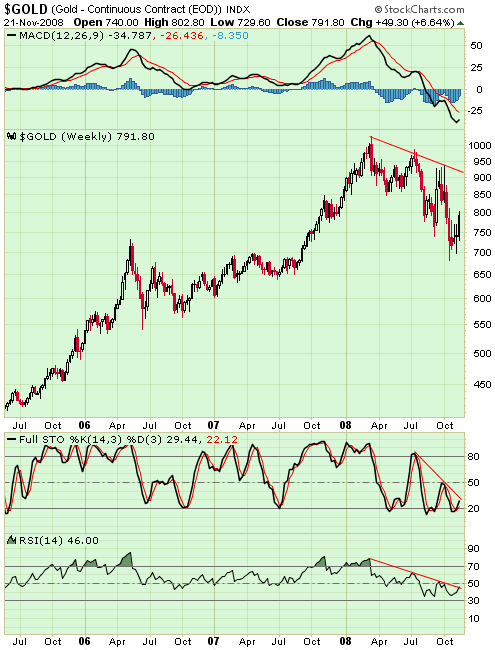
In the short term, in order to avoid seeing gold close below $700, it must move above resistances of $780-810 relatively quickly and stabilize close to that range.

And we got exactly what was needed, although the metal is yet to stabilize near the $800s. Gold briefly touched $699, making a higher low, and continued to consolidate between $720 and $750. On Friday, gold spiked 57 points or almost 8% to its first resistance of $800.

While there is some resistance near $825-$850 for the short term, the weekly chart for gold is starting to look promising. But before the downtrend line (now between $900 and $920) is penetrated, we cannot say that the correction in gold is over and that the new stage of the gold bull market has begun.

Fundamentals remain exceptionally bullish on all fronts. Real interest rates are negative while inflation expectations have little room to go lower. A huge wave of fiscal stimulus is on the way.

The independent research house GFMS Ltd. had the following to say about gold demand:

Dollar demand for gold reached an all-time quarterly record of US$32bn in the third quarter of 2008. Tonnage demand was also 18 percent higher than a year earlier.

Identifiable investment demand, which incorporates demand for gold through exchange traded funds (ETFs), bars and coins, was the biggest contributor to overall demand during the quarter; it was up to US$10.7bn (382 tonnes), double the amount from a year earlier.

Retail investment demand rose 121 percent to 232 tonnes in Q3, with strong bar and coin buying reported in Swiss, German and US markets. The quarter also witnessed widespread reports of gold shortages among bullion dealers across the globe, as investors searched for a safe haven. During the quarter, Europe reached an all-time record 51 tonnes of bar and coin buying and France became a net investor in gold for the first time since the early 1980s.

Consumer demand for gold jewellery was also at a record with buyers coming back in to the market at lower price levels than previously, around and below $800. India (traditionally the world’s largest gold jewellery consumer, with an average over the past five years of 21% of world jewellery demand), staged a strong recovery during the quarter, with the dollar value of gold in jewellery rising by 65% year-on-year.

These changes in “identifiable demand” were offset by outflows in “inferred investment”. With recessionary fears looming, hedge funds liquidated investment positions in gold as they were forced to raise cash, and institutions liquidated commodity index investments, including gold. The trend largely reflects gold’s better performance relative to other assets and also explains why the gold price did not perform better during the quarter in the face of very strong demand.

Gold sales by central banks are at their lowest levels since 1999.

Total global gold production contracted 0.4% in 2007, to an eleven-year low. In the last four months, several companies have announced that they are curtailing production or delaying projects, and all companies are at least reviewing their spending plans. Randgold Resources (GOLD) expects global gold production to decline by between 15% and 20% in the next three or four years, as unprofitable operations are squeezed out and difficult market conditions delay the development of new mines.

While this is a difficult process, the whole PM industry will come out of this slump stronger and more resilient. Companies that survive will do exceptionally well.

Unlike most stock indices which made lower lows last week, all gold indices made higher lows. This positive divergence gives us reason to believe that smart money is starting to pour funds into gold stocks – pointing to the evidence of the first sector rotation in this bear market.

Friday saw one of the biggest up-days on HUI, which climbed 46 points or 27.5%. Gold was by far the best performing sector in the entire stock market. We believe that these are all signs that the sector rotation to precious metals and related stocks is underway.

If gold continues to hold up strongly and the stock market rebounds or at least stabilizes, the $HUI index could quickly recover to 275-325 levels.

However, gold stocks continue to underperform the metal. In order for the bullish scenario outlined above to come to fruition, we need to see the downtrend line in the $HUI & Gold ratio be taken out to the upside.

We believe that this should happen in the coming days or weeks. This point of view is based on the fact that the Gold/Oil ratio and the Gold/Industrial Metals ratio have soared to the best levels for gold producers in the past 10 years. This allows us to expect substantial reduction in costs of production and capital expenditures for most mining companies.

Paired with the strong gold price, margins for gold producers should start to improve. We do not know of any other sector in the equity market which is expected to see increases in profit margins.

While the above is directly beneficial for the producers, for juniors, the latest round of acquisition activity gives us reason to believe that the juniors are finally bottoming out.

From a negative point of view, continuing tax selling pressure before the year end could temporarily weaken these positives.

Those investors who are considering putting money in the gold sector should consider the following low-risk, cash generating producers: See RSG Newsletter.

Share this:

  • Click to share on Reddit (Opens in new window) Reddit
  • Click to share on Facebook (Opens in new window) Facebook
  • Click to share on LinkedIn (Opens in new window) LinkedIn
  • More
  • Click to share on X (Opens in new window) X
  • Click to share on Pinterest (Opens in new window) Pinterest
  • Click to share on Tumblr (Opens in new window) Tumblr
  • Click to print (Opens in new window) Print
  • Click to email a link to a friend (Opens in new window) Email
Like Loading...

Demanding Gold – Hard Assets Investor

24 Monday Nov 2008

Posted by jschulmansr in capitalism, commodities, Copper, Currency and Currencies, deflation, Finance, Fundamental Analysis, gold, hard assets, inflation, Investing, investments, Latest News, Markets, mining stocks, precious metals, silver, Technical Analysis, Today, U.S. Dollar, Uncategorized

≈ Comments Off on Demanding Gold – Hard Assets Investor

Tags

agricultural commodities, alternate energy, Austrian school, banking crisis, banks, bear market, Bollinger Bands, bull market, capitalism, central banks, China, Comex, commodities, communism, Copper, Currencies, currency, deflation, depression, diamonds, dollar denominated, dollar denominated investments, economic, economic trends, economy, financial, Forex, futures, futures markets, gold, gold miners, hard assets, heating oil, India, inflation, investments, market crash, Markets, mining companies, Moving Averages, natural gas, oil, palladium, physical gold, platinum, platinum miners, precious metals, price, price manipulation, prices, producers, production, protection, rare earth metals, recession, risk, run on banks, safety, Saudi Arabia, silver, silver miners, socialism, sovereign, spot, spot price, stagflation, Technical Analysis, timber, U.S. Dollar, volatility, warrants, Water

Demanding Gold – Hard Assets Investor

Written by Julian Murdoch of Hard Assets Investor 

Friday night’s headlines were straightforward: “Gold surges to top $800 on safe-haven buying.” And most of the analysis followed a familiar pattern:

  • The price of gold has declined as a result of liquidity selling
  • Once everyone sells the gold, the market will stabilize
  • The price will rally as investors seek a safe haven in the face of monster money-printing by the U.S. government

It’s a convenient story, and one that makes some prima-facie sense. But like any Monday morning quarterbacking (including my own), there’s rarely a way to actually know exactly why something goes up and down. Except, of course, for supply and demand. It’s always about supply and demand.

Which is why I was planning on writing about gold this week even before we saw the metal pop almost 6% Friday, to close at $801.60 (NY Spot), and before we saw the big gold miners like Barrick have monster days, with that company closing up 31%. Pops like that are enough to make anyone sit up and take notice, despite our general concerns about buying miners vs. metals.

Hence my plan to cover gold. The third week in November, you see, is when the World Gold Council releases the supply-and-demand numbers that carry us through the end of the year. And the astonishing thing isn’t so much the numbers, but that they seem to have gone largely unnoticed by the press in describing the rally. Let’s take a look at the charts.


There are a few points to note here. First, this measures demand in tonnes, not in dollars. We’ll get to dollars in a second.

But the big thing to note here is that the 2008 number is an estimate that we’ve created by applying last year’s Q3-to-Q4 trends to 2008. From Q3 to Q4 2007, gold demand dropped an unexpected 15% on a tonnage basis. The chart above suggests that, even if gold demand falls again, total tonnage demand for 2008 will equal 2007. If Q4’08 demand instead remains steady heading into the end of the year, total 2008 demand will be the biggest in the last five years.

Regardless, however, the strong continued demand, particularly from the investment community, is even more dramatic in dollar terms.


Gold Demand ($, Billions


In dollar terms, gold is experiencing tremendous demand growth. There’s no rocket science here: The average price of gold in 2007 was just under $700. The average price of gold in 3Q 2008 was $871, down from the first-quarter average of $924. All that means is that that same physical demand is coming at a time of rising prices (or a weak dollar, depending on your perspective).

Gold - London PM Fix 2000 - present


To put the demand in perspective, here’s the juicy tidbit direct from the World Gold Council press release:


“Dollar demand for gold reached an all-time quarterly record of US$32bn in the third quarter of 2008 as investors around the world sought refuge from the global financial meltdown, and jewelry buyers returned to the market in droves on a lower gold price. This figure was 45% higher than the previous record in Q2 2008. Tonnage demand was also 18% higher than a year earlier.”


This dollar demand is driven almost entirely by increased demand from exchange-traded funds and physical coin investments, offsetting a decline in jewelry demand.


Gold Demand (Share)


To be fair, this continued demand wasn’t entirely unexpected, nor was it completely unreported. Most of the weekend paper hyperbole about the gold rally did pay homage to demand, albeit without citing the nice hard figures we have from the World Gold Council. But what seems really underreported is that the actual supply demand deficit is frankly staggering.


Gold Surplus/Deficit

The reasons for this deficit are fairly straightforward: The quarterly demand is high, and one of the major sources of supply over the last few years has dried up – sales by central banks. The Central Bank Gold Agreement, which set limits on gold sales in 1999 to stabilize the market after the foundation of the euro, is set to run its course in 2009, but the 2008 limits on CBGA sales (500 tonnes per year) aren’t even close to being reached, and the reality is that European central banks may simply be done offloading their excess gold reserves.

If true, that means a major source of supply is simply going away. It’s easy to visualize a pathway from the central banks into the hands of investors-a shift in ownership. But that shift in ownership may be complete, and thus, if investor demand continues, it will rely on other traditional sources of gold-namely mines-to get at the stuff.

That would set the stage for continued deficits, higher prices and busy miners. It strikes me that that’s the real story of last week’s rallies.

MY NOTE: Inother simpler words, demand up and increasing = prices increasing!

Disclosure: Long Precious Metals and Stocks

jschulmansr

Share this:

  • Click to share on Reddit (Opens in new window) Reddit
  • Click to share on Facebook (Opens in new window) Facebook
  • Click to share on LinkedIn (Opens in new window) LinkedIn
  • More
  • Click to share on X (Opens in new window) X
  • Click to share on Pinterest (Opens in new window) Pinterest
  • Click to share on Tumblr (Opens in new window) Tumblr
  • Click to print (Opens in new window) Print
  • Click to email a link to a friend (Opens in new window) Email
Like Loading...

Peter Schiff on Fast Money Calls $2,000 Gold in 2009–Gold Stock Bull

24 Monday Nov 2008

Posted by jschulmansr in capitalism, commodities, Copper, Currency and Currencies, deflation, Finance, Fundamental Analysis, gold, hard assets, inflation, Investing, investments, Latest News, Markets, mining stocks, precious metals, silver, Technical Analysis, Today, U.S. Dollar, Uncategorized

≈ Comments Off on Peter Schiff on Fast Money Calls $2,000 Gold in 2009–Gold Stock Bull

Tags

agricultural commodities, alternate energy, Austrian school, banking crisis, banks, bear market, Bollinger Bands, bull market, capitalism, central banks, China, Comex, commodities, communism, Copper, Currencies, currency, deflation, depression, diamonds, dollar denominated, dollar denominated investments, economic, economic trends, economy, financial, Forex, futures, futures markets, gold, gold miners, hard assets, heating oil, India, inflation, investments, market crash, Markets, mining companies, Moving Averages, natural gas, oil, palladium, physical gold, platinum, platinum miners, precious metals, price, price manipulation, prices, producers, production, protection, rare earth metals, recession, risk, run on banks, safety, Saudi Arabia, silver, silver miners, socialism, sovereign, spot, spot price, stagflation, Technical Analysis, timber, U.S. Dollar, volatility, warrants, Water

Peter Schiff on Fast Money Calls $2,000 Gold in 2009–Gold Stock Bull

By Jason Hamlin of Gold Stock Bull
 
Mr. Schiff was mocked for calling the market collapse before it happened, correctly predicted that gold would reach $1,000 in 2008 and recently schooled the CNBC crew at Fast Money as he predicts the market has much further to drop and gold will hit $2,000 in 2009. If you’ve been a subscriber to Gold Stock Bull for a while, you know we have been making similar calls and are aligned with his views. 2008 may prove to be the last time you will be able to get gold under $1,000 or silver under $10. The liquidation and deleveraging has created a short-term buying opportunity across all commodities and for precious metals in particular. Get some while you still can because when the floor falls out from beneath the dollar, the party is over.


Share this:

  • Click to share on Reddit (Opens in new window) Reddit
  • Click to share on Facebook (Opens in new window) Facebook
  • Click to share on LinkedIn (Opens in new window) LinkedIn
  • More
  • Click to share on X (Opens in new window) X
  • Click to share on Pinterest (Opens in new window) Pinterest
  • Click to share on Tumblr (Opens in new window) Tumblr
  • Click to print (Opens in new window) Print
  • Click to email a link to a friend (Opens in new window) Email
Like Loading...

Peter Schiff: Gold Will Rise, Dollar Will Collapse – Hard Assets Investors

19 Wednesday Nov 2008

Posted by jschulmansr in commodities, Copper, Currency and Currencies, deflation, Finance, gold, hard assets, inflation, Investing, investments, Latest News, Markets, mining stocks, precious metals, silver, U.S. Dollar, Uncategorized

≈ Comments Off on Peter Schiff: Gold Will Rise, Dollar Will Collapse – Hard Assets Investors

Tags

agricultural commodities, alternate energy, Austrian school, banking crisis, banks, bear market, Bollinger Bands, bull market, capitalism, central banks, China, Comex, commodities, communism, Copper, Currencies, currency, deflation, depression, diamonds, dollar denominated, dollar denominated investments, economic, economic trends, economy, financial, Forex, futures, futures markets, gold, gold miners, hard assets, heating oil, India, inflation, investments, market crash, Markets, mining companies, Moving Averages, natural gas, oil, palladium, physical gold, platinum, platinum miners, precious metals, price, price manipulation, prices, producers, production, protection, rare earth metals, recession, risk, run on banks, safety, Saudi Arabia, silver, silver miners, socialism, sovereign, spot, spot price, stagflation, Technical Analysis, timber, U.S. Dollar, volatility, warrants, Water

Peter Schiff: Gold Will Rise, Dollar Will Collapse – Features and Interviews – Hard Assets Investors 

Written by Administrator –  Hard Assets Investor


Norman: Let’s see the performance from this point forward; we’ll look back at this again and we’ll revisit this issue.

Let’s talk about something else, something that you have also … and I just mentioned it … the U.S. dollar. You were very, very negative. In the last month, we have seen unprecedented actions by the U.S. Fed in terms of expansion of the monetary basis; in other words, printing money … what you call printing money … and despite that, the dollar has remained incredibly strong.

How do you explain that according to your logic?

Schiff: Everything the government is doing is inherently negative for the dollar, and all of this…

Norman: It’s not playing out that way.

Schiff: It will; you’ve got to give it time.

I remember when I was on television talking about the subprime and people were telling me it’s no big deal, and I said, just wait a while; give it time.
Look, everything that we’re doing – all the bailouts, all the stimulus packages – this is all being financed by inflation. It’s inherently terrible for the dollar.

Norman: But you just said yourself that everything is deflating.

Schiff: But right now, Mike, you’re getting this de-leveraging, and this is benefitting the dollar, so despite the horrific fundamentals for the dollar, it’s going up anyway.
But ultimately, when this phony rally runs out of steam, the dollar is going to collapse, and that’s when we’re going to have a much greater crisis because now you’re going to have a collapsing dollar, which is going to push long-term interest rates up, commodity prices up.

Norman: I still don’t understand why the dollar is going to collapse. So you’re saying that the Fed is just going to allow … or leave this enormous amount of liquidity in there, that at some point down the road, if we recover, they’re not going Scto take it out?

Schiff: Look, they have no control over it. The Fed is trying to artificially reflate our phony economy, right?

We had this economy that was based on Americans borrowing money and then spending it on products. We have this huge debt finance bubble which is collapsing, and it’s being supported by foreigners.

But when this artificial demand for Treasuries goes away, the Fed is going to try to print a lot of money and the dollar is going to get killed.

Norman: All right; I’m going to ask you to hold on. Folks, check back because we’re going to do the second part of my interview with Peter Schiff, so check back to this site. This is Mike Norman; bye for now.

Mike Norman, HardAssetsInestor.com (Norman): Hello everybody, and welcome back for another installment of HardAssetsInvestor.com’s interview series. I’m Mike Norman, your host. Well, he’s back. Mr. Doom and Gloom is here … Peter Schiff, president of Euro Pacific Capital and author of the new book just out, “Bull Moves in Bear Markets.”Peter Schiff, president of Euro Pacific Capital (Schiff): “The Little Book …”Norman: “The Little Book …”; it’s in The Little Book Series. Well look … the last time you were here, things were kind of going your way, but it looks like things have turned upside down.
All kidding aside, I know your big thing over the last seven or eight years has been gold. We’re very supportive of gold on this show; we think that probably people should have some gold as part of their overall portfolio mix. But let’s just look at what happened.Several weeks ago, the U.S. stock market had its worst week in history … even going back to the 1930s … worst week in history. I saw a breakdown of various assets – all assets really – stocks, bonds, gold, commodities, oil. Gold was at the bottom of the list. The top-performing asset, and something that you hate, was the U.S dollar.So how do you explain that? If we are going through the worst economic and financial crisis in history – precisely what gold is supposed to protect against – why would it perform so bad?Schiff: Well, I think it will perform very well; you got to give it a little bit more time.Norman: More time or more decimation?

Schiff: No, what’s happening right now, Mike, is just de-leveraging, and so gold is going down for the same reason a lot of stocks are going down, a lot of commodities are going down. There’s a lot of leverage in this system, there’s a lot of margin calls, a lot of liquidation; a lot of people are having to sell whatever they own to pay off their debts.

Norman: But look at where the money is going … the money is going into U.S. sovereigns, Treasuries … it’s going into the U.S. dollar.

Schiff: For now.

Norman: Why for now?

Schiff: Right now there’s some perception of safety there, but it’s the opposite of the leveraging. If you’re selling your assets, you’re accumulating dollars; but ultimately right now, it’s like there’s been this gigantic nuclear explosion in the United States, and everybody is running toward the blast. Pretty soon they’re going to figure out they’re going in the wrong direction.

Norman: You always talk about gold as a currency, and we have seen currencies appreciate – the yen, for example, the dollar tremendously, for example, but gold has not held up.

Schiff: Well, if you actually look at gold versus other currencies, in the last couple of weeks gold has made new record highs in terms of the South African rand, the Canadian and Australian dollars … so gold was not doing as poorly as many of the currencies, and I think this is all short term.

I think you’re going to see a lot of money moving into gold, and if you look at how much gold has gone down from the peak, the peak was about a thousand … it’s off about 25%. Stocks are off 40%. Gold is still up during this year against the Dow.

Stay Tuned for Part II<!—-> of our interview with Peter Schiff.
 

Share this:

  • Click to share on Reddit (Opens in new window) Reddit
  • Click to share on Facebook (Opens in new window) Facebook
  • Click to share on LinkedIn (Opens in new window) LinkedIn
  • More
  • Click to share on X (Opens in new window) X
  • Click to share on Pinterest (Opens in new window) Pinterest
  • Click to share on Tumblr (Opens in new window) Tumblr
  • Click to print (Opens in new window) Print
  • Click to email a link to a friend (Opens in new window) Email
Like Loading...

Dudley Baker: “It’s either the end of the world or a fabulous buying opportunity”

18 Tuesday Nov 2008

Posted by jschulmansr in commodities, Copper, deflation, Finance, gold, hard assets, inflation, Investing, investments, Latest News, Markets, mining stocks, precious metals, silver, Uncategorized

≈ Comments Off on Dudley Baker: “It’s either the end of the world or a fabulous buying opportunity”

Tags

agricultural commodities, alternate energy, Austrian school, banking crisis, banks, bear market, bear stearns, Bollinger Bands, bull market, capitalism, central banks, China, Comex, commodities, communism, Copper, Currencies, currency, deflation, depression, diamonds, dollar denominated, dollar denominated investments, economic, economic trends, economy, financial, Forex, futures, futures markets, gold, gold miners, hard assets, heating oil, India, inflation, investments, market crash, Markets, mining companies, Moving Averages, natural gas, oil, palladium, physical gold, platinum, platinum miners, precious metals, price, price manipulation, prices, producers, production, protection, rare earth metals, recession, risk, run on banks, safety, Saudi Arabia, silver, silver miners, socialism, sovereign, spot, spot price, stagflation, Technical Analysis, timber, U.S. Dollar, volatility, warrants, Water

Dudley Baker: “It’s either the end of the world or a fabulous buying opportunity”

Source: The Gold Report  11/18/2008


His pitch is irresistible: “Buy a basket of juniors with warrants and it could be the easiest 500% you’ll ever make.” In this exclusive look at one of the most overlooked and misunderstood investment vehicles, Dudley Baker of PreciousMetalsWarrants.com explains to The Gold Report exactly what warrants are and how they increase the odds of winning vastly higher returns. With a little arm-twisting, Baker even reveals some of his most prized “unbelievable” opportunities.”

The Gold Report: Could you start by explaining what a warrant is and how it differs from a futures contract?

Dudley Baker: A warrant is basically a security. It gives the holder the right, but not the obligation, to purchase the underlying stock at a specific price within a specific period of time. It sounds very similar to a call option except that it really is a security and a warrant will trade in much the same way as common shares. A warrant is assigned a symbol and will trade on the exchange or, in the U.S., it will have U.S.-assigned symbol where it can be traded over-the-counter.

TGR: Are all the warrants traded in the over-the-counter market?

DB: No, no. Most will always be private. Many precious metals investors know ‘warrants’ because they are frequently issued in a private placement. But most of those warrants never trade on any exchange and they’re not transferable. On my website only cover those warrants that are trading, the ones you and I could go out and buy. For example, Warren Buffet conducted a private transaction with General Electric and Goldman Sachs. There will never be a market for those. That’s the distinction, whether it’s a warrant with a private placement or an initial public offering. In rare cases a company can get the warrants listed if they were issued in connection with a private placement.

TGR: So Buffet purchases the stock and then is awarded the warrants. Is it GE or Buffet who decides to make those warrants transferable?

DB: In this case it probably would be Buffet. Since he actually owns those warrants it’s his decision.

TGR: Let’s to back to the private placement example. Aren’t warrants used as a sweetener for a private placement investment? In that case, who makes the decision as to whether those warrants are transferable?

DB: The company will make that decision. In Warren Buffet’s case, let’s say that he’s the only holder of the Goldman Sachs and GE warrants. Even if the company said we want these to trade, there’s nobody to trade them because there’s only one guy, Buffet, who owns them and he’s probably not going to trade them. The chances are that he would just convert the warrants or the company would buy them back at some point. But in the case of the private placement of a mining company, there may be hundreds or even a thousand participants. If the company decides to list those warrants, those 500 to 1,000 individuals could decide to trade them. So now we’ve got some liquidity. And we always need that liquidity. So there are a lot of opportunities even for the bigger companies that have warrants trading.

TGR: So when warrants are initially issued, they could be privately placed, or publicly traded.

DB: Right.

TGR: Are most of the warrants that are publicly traded related to financial transactions other than mergers?

DB: They could be issued in connection with the financing for an initial public offering. A lot of warrants start with the private placements, the initial public offerings, and mergers. So warrants that are trading come about through a number of different circumstances.

TGR: Given the current stock market and the merger and acquisition environment, would you expect increased interest in the purchase of warrants?

DB: You mean what is the future for warrants?

TGR: Yes.

DB: Let’s put it this way. The most important thing is to have a solid understanding of the underlying fundamentals of the company. Do they have a good story? Is there potential for the stock to greatly increase in value? And then we have to ask, maybe before we buy the commons shares: will trading a warrant give us a lot more leverage? If so, what is the remaining life of that warrant? It is especially important in this environment to have as long a life on a warrant as possible. Many of the warrants in our database have three years or more of a remaining life, which is really great. Some of them have four or five years. One actually has an 8-1/2 years going out to 2017. I see great opportunities going forward.

Are we going to blast off in a rally this week, next week, next month? I don’t know. But I’m very confident that in the coming months and years that gold and the junior mining shares are going much, much higher. So I’m very comfortable buying warrants in the juniors. It is critical to have as long a life as possible. I cannot stress enough how important it is to look at that underlying common stock. If the company’s common stock does not go up, there’s no way the warrants are going up. So we have to be confident that the company will be able to execute its business plan. Then we hope for a skyrocketing market here in the coming months and years.

TGR: So the real advantage of a warrant as opposed to the common shares is the leverage.

DB: Exactly and that’s why we’d start looking at a warrant. It gives us a lot more bang for our buck, a lot more leverage. I’m always looking for a minimum of two times the leverage. So if we’re looking for a common stock to go up 100%, I’m leveraged to make at least 200% by buying the warrant.

TGR: How would you compare a warrant to a call option?

DB: Good question. A call option is just going to trade on the Chicago Board Options Exchange, whereas a warrant is actually going to trade like a common stock on the TSX. The main difference we’ve got is time and we always want as much time as possible. There are so many call options out there on the mining shares, but maybe they’ve got 90 days or 180 days, one year at most. That’s not enough time for me. In this treacherous market environment that we’ve had over the last two years, options are really just speculating. I like to think that if we can find a long-term warrant on a good company that has a two-year minimum life—if not three years or more— now we’re investing. This way, time is on my side. On my website I’ve got some examples of my trades and the common denominator of those that generated roughly 1,000% or more return was the fact that all of those warrants had over a three year remaining life when I bought them. Time is the key to my success with warrants.

TGR: I would think time really plays very well right now with the market being at 52-week, if not 5-year, if not 30-year lows.

DB: Incredible, yes.

TGR: It probably can’t go much lower in the next three years.

DB: That’s exactly how I see it. You can make a blanket statement that nearly all of the juniors and warrants are off by at least 90% in value. Either you believe this is the end of the world and the game is over or this is just a fabulous buying opportunity. I was buying this morning. I’ve usually do several transactions each week, so I just continue to build inventory, accumulate mining shares and warrants, which I’ll sell in the future at substantially higher prices. So, if we can find a warrant that, say, has a three-year or longer remaining life, it’s going to be hard to imagine how high it might go in a few years. It used to be that if a stock were trading for less than 10 cents, you’d be crazy to consider it. In this environment, a lot of juniors are selling for less than 10 cents; good companies with cash in the bank. The opportunities out there today are truly incredible.

TGR: You have some mid-market producers trading under a dollar and they have cash flow.

DB: It’s just unbelievable. I’m probably one of the more optimistic guys. I am very positive about where we’re going. It may not be next week, but in the coming two to five years it’s going to be a totally different game. We are just building inventory getting set here for what’s coming.

TGR: How do our readers discover what warrants are out there, particularly in precious metals?

DB: I would suggest that they visit my website, PreciousMetalsWarrants.com. I’ve put together a learning center over the last several months. After I created the database listing all of the companies in the natural resource sector that have warrants trading in the U.S. and in Canada, I realized that a lot of people don’t even know what warrants are. So I built the learning center to answer a lot of basic questions.

Warrants actually go back to the 1920s, so they’ve been around for a long time. Options and futures have gotten all the publicity in the past five to ten years. I’m dusting off the term ‘warrants’ again and bringing it back into play so that investors can see the possibilities. Now that Warren Buffet has reintroduced the word ‘warrant’, it’s great for me. The more people we educate about warrants, the better it is for all of us.

TGR: More liquidity, more traders.

DB: Exactly, exactly.

TGR: Can you share with us some of the companies that you particularly like who are trading warrants?

DB: Let me start with some that are your sponsors. I’m not too knowledgeable about the companies and the leverage fluctuates, so we always have to take a look. I like to think that’s why subscribers need me. I’ve got some special leverage calculations that I do. What may be a good deal tomorrow is not necessarily a good deal next week. I calculate the pricing and the relationship of the warrant to the common shares.

Franco Nevada Corp. (FNV.TO), a royalty and investment company, has a warrant extending to 2012. I’m not suggesting that you run out and buy this warrant, but it does look interesting. Do your own due diligence. See what the leverage looks like and whether you want to get involved. Another one—I don’t know of another analyst that follows this and I have minimal knowledge myself—is Colossus Minerals Inc. (TSX:CSI). It has a warrant out to 2011. So that’s quite a few years. They have gold properties in Brazil. The situation looks interesting.

I like Piedmont Mining Co. (OTCBB :PIED). It’s a small junior exploration company and all of its properties are in Nevada. Robert Shields is president and I feel very comfortable with the management. The price has been decimated, as has most of the sector. But I believe it will be a great opportunity. Another one that you don’t hear much about is Vangold Resources (TSX.V:VAN). It is amazing. I’ve got a small position in it myself. It’s got gold, oil and gas, and beryllium. Again it’s selling literally for pennies and you’ve just got to scratch your head and ask how can this be. A lot of your sponsors are great companies and I just have to believe that virtually all of them present buying opportunities.

The last one is Great Panther Resources (TSX.V:GPR). I love the company and its location. I live in Mexico – just outside of Guadalajara, so it’s about a 3-1/2 hour drive from my home. This is one of my favorite silver companies. I’ve visited Bob Archer, the president, several times and have seen the properties. They’re going to be mining silver way after all of us are gone from this planet. It’s a great operation selling for 10% of its all time high. There are so many wonderful stories out there that will become incredible opportunities in the coming months and years. You just hope that investors realize what they’re looking at because it’s going to be unbelievable. I always say buying a basket of the juniors today or a basket of the long-term warrants is probably the easiest 500% you’ll ever make in your life.

TGR: I liked the idea that warrants allow a company the time to grow because no one really knows when to call the bottom. Is it going to be this quarter, next quarter; will it turn around in 2009? But everyone’s saying in a couple of years we’re going to look back and say, wow, that was cheap back then.

DB: There’s one warrant that just started trading. I bought it for 10 cents. It has over a 4-1/2 year remaining life. I plan on selling it for dollars, many dollars. It’s almost like a giveaway. Maybe it’s just my attitude. I have such strong beliefs about where we’re going. Yes, the draw down that we’ve got right now bothers me, but I’m focused on the longer term. So this is just giving us opportunities to continue to buy at these ridiculously low prices.

TGR: Can you share with us this ridiculously low-priced warrant you bought today?

DB: You’re going to put me on the spot, huh? Okay, the name is Gold Wheaton Gold Corp. (GLWGF) (TSX.V:GLW). Everybody knows Silver Wheaton. This is a totally different company with totally different management but essentially the same business model. Gold Wheaton stock is probably trading around 33 cents. The exercise price is one dollar.

So you ask why in the world would I want to buy this warrant that has a one-dollar exercise price when the common stock is now selling for, say, 30 to 35 cents? The reason is that we’ve got a 4-1/2 year remaining life and the leverage is going to return much better than a 2:1. I have my database and I’ve got leverage calculations on another spreadsheet showing different price points going forward. This is how I look at a warrant. I ask how is this warrant going to perform if the common stock doubles, triples, quadruples, or goes up ten times? I’m looking at the underlying leverage. Is that going to give me my 2:1 or better opportunity? So this morning the Gold Wheaton warrant just started trading. It looks good to me. Who knows? It could go down a little bit more from where what it started trading. But we’re somewhere around the 10 to12 cents range, which just sounds unbelievable when we’ve got a 4-1/2 years or more remaining life. So you buy it, you put it away, and know it’s going to be easy money.

TGR: Dudley, this has been very interesting.

The Gold Report has worked out a special deal with Dudley Baker of Precious MetalsWarrants.com to offer our readers a free 30-day look at his database—full access to his personal portfolio—or what he calls a “Look Over My Shoulder.” You can see everything he owns and get an email any time he does a transaction. Sign up now.

Share this:

  • Click to share on Reddit (Opens in new window) Reddit
  • Click to share on Facebook (Opens in new window) Facebook
  • Click to share on LinkedIn (Opens in new window) LinkedIn
  • More
  • Click to share on X (Opens in new window) X
  • Click to share on Pinterest (Opens in new window) Pinterest
  • Click to share on Tumblr (Opens in new window) Tumblr
  • Click to print (Opens in new window) Print
  • Click to email a link to a friend (Opens in new window) Email
Like Loading...

Precious Metals Will Depose Cash from Its Temporary Throne

18 Tuesday Nov 2008

Posted by jschulmansr in capitalism, commodities, Copper, Currency and Currencies, deflation, Finance, Fundamental Analysis, gold, hard assets, inflation, Investing, investments, Latest News, Markets, mining stocks, precious metals, silver, Technical Analysis, Today, U.S. Dollar, Uncategorized

≈ 2 Comments

Tags

agricultural commodities, alternate energy, Austrian school, banking crisis, banks, bear market, bear stearns, Bollinger Bands, bull market, capitalism, central banks, China, Comex, commodities, communism, Copper, Currencies, currency, deflation, depression, diamonds, dollar denominated, dollar denominated investments, economic, economic trends, economy, financial, Forex, futures, futures markets, gold, gold miners, hard assets, heating oil, India, inflation, investments, market crash, Markets, mining companies, Moving Averages, natural gas, oil, palladium, physical gold, platinum, platinum miners, precious metals, price, price manipulation, prices, producers, production, protection, rare earth metals, recession, risk, run on banks, safety, Saudi Arabia, silver, silver miners, socialism, sovereign, spot, spot price, stagflation, Technical Analysis, timber, U.S. Dollar, volatility, Water

Precious Metals Will Depose Cash from Its Temporary Throne

By: Peter Cooper of  Arabian Money.net

‘We have just been in Bahrain and everybody is cashed up!’ one banker told me today. My reply was that if everybody is now in cash, then it just has to be the wrong place to be. There are some very good reasons to worry about a large cash position.

Quite apart from the contrarian argument that the crowd is always wrong, you have to consider what is happening to the supply of cash. We know that with the sell-offs in global capital markets there is plenty of demand for cash, but what about the supply?

Money supply out of control

Another banker today showed me a chart of US money supply growth over the past few months, and highlighted a 111% increase. This compared with something like 15% money supply growth in the early 1930s as the US authorities grappled with the Great Depression.

There is an absolute tsunami of money coming into the system. What happens when the supply of something exceeds the demand? The price drops. And that is exactly what is going to happen to the US dollar – the authorities are about to inflate away their debt problem.

It is so simple: The debt stays at the same nominal amount, you print more money and the real value of the debt falls. Of course, in the real world that also means a bond market collapse as inflation will make both the coupon and real value fall.

I wonder how long it will be until cash is deposed as king of the investment world? My guess is that it will not be long after the sell-off ends. How long will that take? It could be at the end of the year as the hedge funds attempt to square their positions, or it might be next spring after another lurch downwards in stock prices.

The bottom for stocks will be the top for cash and treasury bonds. Then inflation will start to emerge and depose cash from its temporary throne. Who will be the new king?

Gold and silver

Step forward precious metals to take a bow. Everybody knows that gold is inversely correlated to the US dollar and that silver is leveraged against the gold price. But why have precious metals taken so long to claim their crown in this financial meltdown?

The straight answer is that hedge funds have been selling assets across the board and turning gold into dollars, or at least the paper gold of futures contracts into greenbacks. The physical demand for gold and silver has been growing strongly all the time, hence the silver coin shortage and the $3.5 billion Saudi gold purchase.

Once the hedge funds stop selling (you always do eventually run out of assets to sell), then gold and silver prices will rally, and the rush out of cash and into precious metals will do something pretty spectacular to the price. Gold and silver stocks, languishing at a 40-year low, should jump and deliver phenomenal performance for new investors and repay the patience of long-term holders.


This article has 9 comments:

  •  
    0 0
    • socrateazz
    • 7 Comments

    Nov 17 08:31 AM

    storms are brewing in the finacial markets. The gales have produced a few waves and troughs. I think the real storm is coming! Unfortunately I think the actions seen so far have mostly added steam to the storm! I see folks finding safe harbor or riding the waves. I see little effort in actually weakening the storm. to weaken the storm one must weaken the cause. What caused the current financial situation? Is it the same things which made life soo good for so long? was it the laziness of many? Was it ignorance of those who think they know? was it greed of those with wealth? was it greed of those who wanted the wealth? was it ignorance of truth? Was it ignorance in beliefs? Was it power abuse? Was it abuse of force? was it special intererest abuse? was it general interest abuse? I could go on A small part ofan ovious problem has been recieving enormous thought while most of the problem is ignored with little concideration of the reasons which can not be blamed on somebody else.
    Reply |Report abuse
  •  
    0 0
    • Diabolo
    • 8 Comments

    Nov 17 08:56 AM

    i think we’ve already seen the worst – from now on, we wont have more high-profile bank failures – already had bear, lehman with merrill, aig, fnme, fdmc saved…

    Reply |Report abuse

    the govt will need to keep pumping these with cash – which at some point will lead to hyperinflation – gold is a great long-term investment… as for short-run, im still bullish dollars… when shit hits the fan, investors flock to dollar and yen!


  •  
    0 0
    • bobbobwhite
    • 44 Comments

    Nov 17 12:20 PM

    Gold and platinum are great longer term investments, but most people want more liquidity and shorter term results. However, we are harshly finding out that it is difficult to impossible to gain both at the same time in the same vehicle, but people still seek that nearly impossible(and lazy) dream and lose countless billions in the process.

    Reply |Report abuse

    My advice is to never, ever try to get the same investment advantages in one investment vehicle. Does not work. Have one for one purpose, one for another, etc. For example, gold and cash; stocks, gold and cash; bonds, cash and real estate, real estate, stocks and cash, etc., etc. in many combinations that work right for you(Cash means CD’s or MMF).

  •  
    0 0
    • OilyGasMiner
    • 43 Comments
    • My Website

    Nov 17 01:36 PM

    Peter, it seems our thoughts appear to align very well. Is it no surprise that the money supply is up over 100% over the past few months? According to Obama, TARP has already spent some $300B of the $750B. Hence money is being pumped at a RAPID pace into our withering economy.

    Reply |Report abuse

    I fully agree that this action coupled with the US debt increasing each day, will only result in furthe devaluation of the US. Dollar.

    We must recall that the massive sell offs in hedge funds aren’t usually voluntary and fund managers are being FORCED to sell because many investors believe that they are forced to sell. For example in Canada, investors with RRIFs, must pay taxes on at least $10,000 of their investment. However this value was determined at the start of the year, and with some portfolio’s down by over 50%. They are now actually paying taxes on 20% of their current portfolio. Due to the lack of transparent investment advice, we will continue to sell these massive sell offs take its toll on already undervalued equities. It is only a matter of months IMO before we see a commodity correction.

    And as we know “Concurrently, the U.S. Government runs large operating deficits in circumstances where its National Debt approximated $9.6 trillion at July 31, 2008, up from $9 trillion at December 31, 2007 and $6.2 trillion at December 31, 2006.”
    Quote Source: www.stockresearchporta…/

    The question is with the money supply increasing, debt increasing, unemployment increasing, foreclosures increasing, consumer confidence on the decline. How worse can things really get?

  •  
    0 0
    • User 30121
    • 269 Comments

    Nov 17 02:00 PM

    Sonofabitch! An article that TELLS IT LIKE IT IS! Oohhh, are you gonna catch hell from the nay sayers (anti-goldbugs). Thanks for saying it!
    Reply |Report abuse
  •  
    0 -1
    • Pangaea
    • 71 Comments

    Nov 17 02:13 PM

    A couple of problems with this article.

    Reply |Report abuse

    “The bottom for stocks will be the top for cash and treasury bonds.”

    At that eventual point, it might indeed be good for gold, but by definition it would also be attractive for stocks.

    Also, by any measure of money supply that I follow, it has been stagnant in recent months, not growing at all. This is what the Fed is trying to fight – shrinkage in the supply and velocity of money.

    research.stlouisfed.or…

    www.nowandfutures.com/…

    So until these trends end (money supply stagnation with deflation in all asset classes plus USD and Treasury strength), cash will remain king.


  •  
    0 0
    • theoilwizard
    • 1 Comment
    • My Website

    Nov 17 03:49 PM

    “In my opinion, commodity prices can possibly hit new lows in the upcoming months as the recession is still going on. There are a lot of uncertainties that are still at bay and till they have been cleared up, the economy will still be going downhill. Questions pertaining to increasing unemployment? Will the Govt bailout the US Automakers? How much are Corp taxes going to increase next year when Obama is in power? These uncertainties need to be solved before the market actually is stable for investors.

    Reply |Report abuse

    Hopefully you had found my insight helpful, I usually use the following website as a tool to gather all my data. Best of luck to all investors:
    www.stockresearchporta…;

  •  
    0 0
    • Marc Courtenay
    • 66 Comments
    • My Website

    Nov 17 09:16 PM

    We enjoy your articles and more importantly they help us keep things in their proper perspective. Keep them coming Peter, and thank you!!
    Reply |Report abuse
  •  
    0 0
    • huskerbob
    • 49 Comments

    Nov 18 02:18 AM

    pangaea: the coming bottom in the stock market doesn’t necessarily mean a bull market for equities.  The market could bounce along the bottom for the next decade or two (as it did before the last great bull market) while we deal with the consequences of this mess.
    And the Fed and it’s European counterpart are openly trying to weaken their respective currencies. It’s a struggle right now, but they will succeed mightily at some point!
    Gold is the enemy of inflation, and the gold market recognizes this. That is why central banks and their allies continue to fight the gold price, as all central banks must.
    Do yourself a favor and buy some artificially cheap gold. Get out of dollars while the gettin’s good!
    Reply |Report abuse

Share this:

  • Click to share on Reddit (Opens in new window) Reddit
  • Click to share on Facebook (Opens in new window) Facebook
  • Click to share on LinkedIn (Opens in new window) LinkedIn
  • More
  • Click to share on X (Opens in new window) X
  • Click to share on Pinterest (Opens in new window) Pinterest
  • Click to share on Tumblr (Opens in new window) Tumblr
  • Click to print (Opens in new window) Print
  • Click to email a link to a friend (Opens in new window) Email
Like Loading...

All the Gold in Saudi Arabia – Seeking Alpha

18 Tuesday Nov 2008

Posted by jschulmansr in commodities, Currency and Currencies, deflation, Finance, gold, hard assets, inflation, Investing, investments, Latest News, Markets, mining stocks, precious metals, silver, Today, U.S. Dollar, Uncategorized

≈ Comments Off on All the Gold in Saudi Arabia – Seeking Alpha

Tags

agricultural commodities, alternate energy, Austrian school, banking crisis, banks, bear market, bear stearns, Bollinger Bands, bull market, capitalism, central banks, China, Comex, commodities, communism, Copper, Currencies, currency, deflation, depression, diamonds, dollar denominated, dollar denominated investments, economic, economic trends, economy, financial, Forex, futures, futures markets, gold, gold miners, hard assets, heating oil, India, inflation, investments, market crash, Markets, mining companies, Moving Averages, natural gas, oil, palladium, physical gold, platinum, platinum miners, precious metals, price, price manipulation, prices, producers, production, protection, rare earth metals, recession, risk, run on banks, safety, Saudi Arabia, silver, silver miners, socialism, sovereign, spot, spot price, stagflation, Technical Analysis, timber, U.S. Dollar, volatility, Water

All the Gold in Saudi Arabia – Seeking Alpha

By: Tim Iacono

Tim’s blog: The Mess That Greenspan Made

There was a story out last week in the Gulf News about unprecedented gold buying in Saudi Arabia during the first half of November. According to the report, 13 billion Saudi riyals worth of the metal have been purchased in recent weeks – about $3.5 billion or roughly 140 tonnes at today’s prices.

A quick check of the SPDR Gold Shares ETF (NYSEArca:GLD) shows no similar buying over this time. In fact, the world’s most popular gold ETF has been noticeably quiet during this period, with just 0.3 tonnes exiting the trust earlier in the month, barely noticeable in the chart below.

It also looks like there’s another little wedge pattern forming at around $740 an ounce.
IMAGEThis report by Peter Cooper at ArabianMoney.net, which also appears at Seeking Alpha, lends some credibility to the story in the Gulf News, one of the leading English-language newspapers in the region:

I cannot verify the source but all I can say is that this has the hallmarks of a genuine story, based on my 25 years in financial journalism. First, it was buried on an inside page and the amount was given in UAE currency later in the story – hardly the action of somebody looking to manipulate the gold price, more an indication that the sub-editors did not understand the importance of this story.

Second, this is how the best stories emerge from Saudi Arabia – the market is not very transparent but insiders do notice big changes and pass this information on, and it surfaces as well sourced rumor. I am afraid this is about as good as it gets in the Middle East.

With local stock markets faltering badly and the property market in Dubai and elsewhere beginning what might be a truly spectacular fall, it makes sense that wealthy individuals would seek out more secure assets during this time of uncertainty.

Curious to see what this two-week purchase would look like when laid up against the inventory at the Gold ETF which, incidentally, just celebrated its four year anniversary, the chart below was created with the recent Saudi purchases indicated in yellow.
IMAGE

The 140 tonnes recently purchased in Saudi Arabia amount to about one-fifth the inventory that took four years to accumulate at the Gold ETF.

That’s a lot of gold in a very short period of time.

Full Disclosure: Long GLD at time of writing

Share this:

  • Click to share on Reddit (Opens in new window) Reddit
  • Click to share on Facebook (Opens in new window) Facebook
  • Click to share on LinkedIn (Opens in new window) LinkedIn
  • More
  • Click to share on X (Opens in new window) X
  • Click to share on Pinterest (Opens in new window) Pinterest
  • Click to share on Tumblr (Opens in new window) Tumblr
  • Click to print (Opens in new window) Print
  • Click to email a link to a friend (Opens in new window) Email
Like Loading...

Five Ways to Invest in Bottom-Basement Gold – Seeking Alpha

17 Monday Nov 2008

Posted by jschulmansr in commodities, Copper, Currency and Currencies, deflation, Finance, gold, hard assets, inflation, Investing, investments, Latest News, Markets, mining stocks, oil, precious metals, silver, Technical Analysis, Today, U.S. Dollar, Uncategorized

≈ 1 Comment

Tags

agricultural commodities, alternate energy, Austrian school, banking crisis, banks, bear market, bear stearns, Bollinger Bands, bull market, capitalism, central banks, China, Comex, commodities, communism, Copper, Currencies, currency, deflation, depression, diamonds, dollar denominated, dollar denominated investments, economic, economic trends, economy, financial, Forex, futures, futures markets, gold, gold miners, hard assets, heating oil, India, inflation, investments, market crash, Markets, mining companies, Moving Averages, natural gas, oil, palladium, physical gold, platinum, platinum miners, precious metals, price, price manipulation, prices, producers, production, protection, rare earth metals, recession, risk, run on banks, safety, silver, silver miners, socialism, sovereign, spot, spot price, stagflation, Technical Analysis, timber, U.S. Dollar, volatility, Water

Five Ways to Invest in Bottom-Basement Gold – Seeking Alpha

By Mike Caggeso  of Monday Morning

By Mike Caggeso

Gold hit two historic milestones in 2008.

First, in early March, the “yellow metal” hit its all-time high of $1,030 an ounce.

Just three months later, the price of gold for December delivery had plummeted to $681 an ounce, a 21-month low and 33.9% drop from its record high.

Most gold bugs were equal parts puzzled and brokenhearted. The world’s stock markets tanked, as did some of its biggest economies. In such an environment, they thought, gold should have risen. After all, gold is widely considered to be a safe-haven investment when everything else is spiraling south. 

However, Money Morning Contributing Editor Martin Hutchinson understood perfectly what other investors did not.

“Gold is not a safe haven against recession,” said Hutchinson. “It’s a safe haven against inflation.”

In the past year, commodities prices skyrocketed – across the board. That was especially true of oil, which hit a record high $147 a barrel. Corn, wheat, and soybeans all hit record highs, as well.

That price escalation tightened household and corporate budgets, and was a primary reason why the U.S. economy posted a gross-domestic product (GDP) decline of 0.3%. With that negative growth, the third quarter was the beginning of what many experts believe will be the nation’s first recession since 2001.

However, the inflation epidemic has waned significantly, as global demand for raw materials has plummeted. Price for such staple foods as corn, soybeans and wheat have all come down from their record highs – in near-lockstep fashion.

Corn futures are down nearly 50% from their summer high of $8 per bushel. The same is true of soybeans and wheat, with each having lost roughly half their value. In fact, wheat hit a 16-month low in mid-October.

As most of us noticed, gas prices have fallen 48% from their July 17 high of $4.114 a gallon.

And not coincidentally, gold has fallen 22% in that same time frame.

However, this report examines the pending commodities rebound – a projected slow-and-steady increase in commodity prices that will reverse the breakneck plunge below fair value that commodities have experienced for much of this year.

Our objective now: To chart the expected path of gold prices in the New Year.

This report also reveals another wild card inflationary indicator that Hutchinson believes will carry gold prices to $1,500 an ounce by the end of 2009.

Two Catalysts For Gold’s Climb

The U.S. Department of Agriculture’s Oct. 10 Crop Production Report said acreage for a handful of staple food commodities has shrunk:

  • Corn acreage fell 1.2%.
  • Soybean acreage dropped 1.4%.
  • Canola acreage dropped 1.9%.
  • Sunflower acreage shrank 0.8%.
  • And acreage of dry edible beans fell 0.7%.

That naturally translates to higher prices because it squeezes the supply of the particular commodity. And it does so at a time when demand continues to escalate from populations in China, India and Latin America. And higher prices equal inflation.

But Hutchinson – who correctly predicted this last run-up in gold prices – says there’s another catalyst that’s right now inherent in the U.S. economy that could help vault gold prices to $1,500 an ounce by the end of 2009. And it has to do with the much-ballyhooed $700 billion rescue plan.

The philosophy behind the rescue plan is elegantly simple: By providing a portion of the $700 billion to foundering U.S banks, the Treasury Department believed it could provide banks with badly needed capital, and get them to start lending money once again – jump-starting the economy in the process.

Since September 2007, U.S. Federal Reserve policymakers have cut the benchmark Federal Funds target rate nine times – from 5.25% down to the current 1.0% rate – to increase bank-to-bank lending and bank-to-consumer lending.

“The government is pumping money in so many banks, and that money has to come out somewhere,” Hutchinson said.

Right now, banks aren’t boosting lending. Instead, they are using the cash to finance buyouts of other banks. Even so, that money will “come out” into the economy in the form of higher stock prices for banks. That will make consumer/investors wealthier, and could make them more confident in the economy. If they’re more confident, they will spend. As that happens, food prices should begin ticking upward, adding another set of thrusters to gold prices.

“Everybody thinks that because we’re having a horrible recession, we’re not going to have inflation. I think that’s probably wrong,” Hutchinson said. “I think gold has quite good hidden-store value.”

As gold prices increase, count on more investors leaving the sidelines to invest, too, causing the surge in gold prices to accelerate and steepen.

“As gold goes up, it gets more popular and investors start piling into it,” Hutchinson said.  

And if gold gets anywhere near the $1,500 mark, sell. Prices that high will likely fall back or plateau as the Federal Reserve begins raising interest rates and strengthening the U.S. dollar, Hutchinson said.

Five Ways to Play Bottom-Basement Gold

Before we get too far ahead of ourselves, let’s first look at five ways to play bargain-basement gold prices.

The SPDR Gold Trust ETF (GLD) – formerly StreetTracks Gold – is a fund whose shares are intended to parallel the movement of gold prices. Since gold prices started falling along with gas prices, SPDR Gold Trust has stayed within a 0.5% margin of gold prices. This exchange-traded fund (ETF) eliminates any investor concern over storage and delivery while giving them exactly what they want – gold.

Toronto-based Barrick Gold Corp. (ABX) has 27 mines, mostly in North America and South America, and is developing or exploring 11 more. With a market cap of more than $20 billion, it has considerably more liquidity than most mining companies. Barrick is primarily a gold miner, but it also has copper and zinc mining operations. As far as investors are concerned, there are two ways to look at that: It’s not a pure play, per se, but then again, this is a company stock, not a bar of bullion. Also, having operations other than gold can help stabilize the company’s bottom line in case problems arise at a gold mine.

Denver-based Newmont Mining Corp. (NEM) is primarily a gold producer with operations in the United States, Australia, Peru, Indonesia, Canada, New Zealand and Mexico. Its reserves are hovering around 86.5 million ounces. Like Barrick, this is a mining stock play, and is subject to market swings – as well as fluctuations in gold prices. That can be a significant tailwind, especially if you believe the stock market has bottomed out or is close to doing so. Hutchinson – forever a value-oriented investor – warned that Newmont might be a little too pricey now. Investors may want to wait for the company’s stock price to settle before getting in.

Hutchinson thinks the best value for a gold mining stock can be found in Yamana Gold Inc. (AUY), another Toronto-based company that’s small now, but has rapidly expanding production. 

But for investors who just want gold – not an ETF or stock – the best avenue is an EverBank Select Metals Account: EverBank accounts has a minimum deposit that is 98% lower than its competitors, and its commission costs are up to 86% lower than other metals’ brokers and bullion banks. It offers two types of gold accounts: Unallocated (your purchased gold is pooled with that of other investors, eliminating storage and maintenance costs; the minimum deposit is $5,000), and Allocated (you directly own the gold you purchase, held in your own private account; $7,500 is the minimum deposit here).

Both types of accounts can be set up 24/7 online. But if you prefer the phone, call 866-326-6241, and be sure to give them the code 12608 when setting up an account.

We should point out that the publisher of Money Morning has a marketing relationship with EverBank, but that’s because its products are among the best in class.

Original post

Share this:

  • Click to share on Reddit (Opens in new window) Reddit
  • Click to share on Facebook (Opens in new window) Facebook
  • Click to share on LinkedIn (Opens in new window) LinkedIn
  • More
  • Click to share on X (Opens in new window) X
  • Click to share on Pinterest (Opens in new window) Pinterest
  • Click to share on Tumblr (Opens in new window) Tumblr
  • Click to print (Opens in new window) Print
  • Click to email a link to a friend (Opens in new window) Email
Like Loading...

Simple Moving Averages Make Trends Stand Out

17 Monday Nov 2008

Posted by jschulmansr in Bollinger Bands, commodities, Copper, Currency and Currencies, deflation, Finance, gold, hard assets, inflation, Investing, investments, Latest News, Markets, mining stocks, Moving Averages, oil, precious metals, silver, Technical Analysis, Today, U.S. Dollar, Uncategorized, uranium, Water

≈ Comments Off on Simple Moving Averages Make Trends Stand Out

Tags

agricultural commodities, alternate energy, Austrian school, banking crisis, banks, bear market, bear stearns, Bollinger Bands, bull market, capitalism, central banks, China, Comex, commodities, communism, Copper, Currencies, currency, deflation, depression, diamonds, dollar denominated, dollar denominated investments, economic, economic trends, economy, financial, Forex, futures, futures markets, gold, gold miners, hard assets, heating oil, India, inflation, investments, market crash, Markets, mining companies, Moving Averages, natural gas, oil, palladium, physical gold, platinum, platinum miners, precious metals, price, price manipulation, prices, producers, production, protection, rare earth metals, recession, risk, run on banks, safety, silver, silver miners, socialism, sovereign, spot, spot price, stagflation, Technical Analysis, timber, U.S. Dollar, volatility, Water

Simple Moving Averages Make Trends Stand Out

By: John Devcic of BK TRADER FX    The 5 Things That Move The Currency Market

Moving averages are one of the most popular and often-used technical indicators. The moving average is easy to calculate and, once plotted on a chart, is a powerful visual trend-spotting tool. You will often hear about three types of moving average: simple, exponential and linear. The best place to start is by understanding the most basic: the simple moving average (SMA). Let’s take a look at this indicator and how it can help traders follow trends toward greater profits.

Trendlines
There can be no complete understanding of moving averages without an understanding of trends. A trend is simply a price that is continuing to move in a certain direction. There are only three real trends that a security can follow:

  • An uptrend, or bullish trend, means that the price is moving higher. 
  • A downtrend, or bearish trend, means the price is moving lower.  
  • A sideways trend, where the price is moving sideways.

The important thing to remember about trends is that prices rarely move in a straight line. Therefore, moving-average lines are used to help a trader more easily identify the direction of the trend. (For more advanced reading on this topic, see The Basics Of Bollinger Bands and Moving Average Envelopes: Refining A Popular Trading Tool.)

Moving Average Construction
The textbook definition of a moving average is an average price for a security using a specified time period. Let’s take the very popular 50-day moving average as an example. A 50-day moving average is calculated by taking the closing prices for the last 50 days of any security and adding them together. The result from the addition calculation is then divided by the number of periods, in this case 50. In order to continue to calculate the moving average on a daily basis, replace the oldest number with the most recent closing price and do the same math.

No matter how long or short of a moving average you are looking to plot, the basic calculations remain the same. The change will be in the number of closing prices you use. So, for example, a 200-day moving average is the closing price for 200 days summed together and then divided by 200. You will see all kinds of moving averages, from two-day moving averages to 250-day moving averages.

It is important to remember that you must have a certain number of closing prices to calculate the moving average. If a security is brand new or only a month old, you will not be able to do a 50-day moving average because you will not have a sufficient number of data points.

Also, it is important to note that we’ve chosen to use closing prices in the calculations, but moving averages can be calculated using monthly prices, weekly prices, opening prices or even intraday prices. (For more, see our Moving Averages tutorial.)

Figure 1: A simple moving average in Google Inc.
Source: StockCharts.com

Figure 1 is an example of a simple moving average on a stock chart of Google Inc. (Nasdaq:GOOG). The blue line represents a 50-day moving average. In the example above, you can see that the trend has been moving lower since late 2007. The price of Google shares fell below the 50-day moving average in January of 2008 and continued downward.

When the price crosses below a moving average, it can be used as a simple trading signal. A move below the moving average (as shown above) suggests that the bears are in control of the price action and that the asset will likely move lower. Conversely, a cross above a moving average suggests that the bulls are in control and that the price may be getting ready to make a move higher. (Read more in Track Stock Prices With Trendlines.)

Other Ways to Use Moving Averages           
Moving averages are used by many traders to not only identify a current trend but also as an entry and exit strategy. One of the simplest strategies relies on the crossing of two or more moving averages. The basic signal is given when the short-term average crosses above or below the longer term moving average. Two or more moving averages allow you to see a longer term trend compared to a shorter term moving average; it is also an easy method for determining whether the trend is gaining strength or if it is about to reverse. (For more on this method, read A Primer On The MACD.)

Figure 2: A long-term and shorter term moving average in Google Inc.
Source: StockCharts.com

Figure 2 uses two moving averages, one long-term (50-day, shown by the blue line) and the other shorter term (15-day, shown by the red line). This is the same Google chart shown in Figure 1, but with the addition of the two moving averages to illustrate the difference between the two lengths.

You’ll notice that the 50-day moving average is slower to adjust to price changes, because it uses more data points in its calculation. On the other hand, the 15-day moving average is quick to respond to price changes, because each value has a greater weighting in the calculation due to the relatively short time horizon. In this case, by using a cross strategy, you would watch for the 15-day average to cross below the 50-day moving average as an entry for a short position.

Figure 3: A three-month
Source: StockCharts.com

The above is a three-month chart of United States Oil (AMEX:USO) with two simple moving averages. The red line is the shorter, 15-day moving average, while the blue line represents the longer, 50-day moving average. Most traders will use the cross of the short-term moving average above the longer-term moving average to initiate a long position and identify the start of a bullish trend. (Learn more about applying this strategy in Trading The MACD Divergence.)

Support and Resistance
Support and resistance, or ceilings and floors, refer to the same thing in technical analysis.

  • Support is established when a price is trending downward. There is a point at which the selling pressure subsides and buyers are willing to step in. In other words, a floor is established.  
  • Resistance happens when a price is trending upward. There comes a point when the buying strength diminishes and the sellers step in. This would establish a ceiling. (For more explanation, read Support & Resistance Basics.)

In either case, a moving average may be able to signal an early support or resistance level. For example, if a security is drifting lower in an established uptrend, then it wouldn’t be surprising to see the stock find support at a long-term 200-day moving average. On the other hand, if the price is trending lower, many traders will watch for the stock to bounce off the resistance of major moving averages (50-day, 100-day, 200-day SMAs). (For more on using support and resistance to identify trends, read Trend-Spotting With The Accumulation/Distribution Line.)

Conclusion
Moving averages are powerful tools. A simple moving average is easy to calculate, which allows it to be employed fairly quickly and easily. A moving average’s greatest strength is its ability to help a trader identify a current trend or spot a possible trend reversal. Moving averages can also identify a level of support or resistance for the security, or act as a simple entry or exit signal. How you choose to use moving averages is entirely up to you.

For further reading on moving averages, check out Simple Moving Averages And Volume Rate-Of-Change and Basics Of Weighted Moving Averages.

by John Devcic, (Contact Author | Biography)

John Devcic is a freelance writer, market historian and private speculator. After investing in a mutual fund right out of high school and losing his initial investment of $350, Devcic began to believe he could do better with his money then the so-called experts could. Over the years a healthy and sometimes unhealthy obsession with how the markets work and how they worked in the past has made Devcic a true market historian. He reminds himself at all times that the market – while ever-changing – always seems to repeat itself.

Share this:

  • Click to share on Reddit (Opens in new window) Reddit
  • Click to share on Facebook (Opens in new window) Facebook
  • Click to share on LinkedIn (Opens in new window) LinkedIn
  • More
  • Click to share on X (Opens in new window) X
  • Click to share on Pinterest (Opens in new window) Pinterest
  • Click to share on Tumblr (Opens in new window) Tumblr
  • Click to print (Opens in new window) Print
  • Click to email a link to a friend (Opens in new window) Email
Like Loading...

Happy Birthday GLD: Gold ETF Excels Four Years Out – Seeking Alpha

17 Monday Nov 2008

Posted by jschulmansr in commodities, deflation, Finance, gold, hard assets, inflation, Investing, investments, Latest News, Markets, precious metals, Uncategorized

≈ 1 Comment

Tags

agricultural commodities, alternate energy, Austrian school, banking crisis, banks, bear market, bear stearns, bull market, capitalism, central banks, China, Comex, commodities, communism, Copper, deflation, depression, diamonds, dollar denominated, dollar denominated investments, economic, economic trends, economy, financial, futures, futures markets, gold, gold miners, hard assets, heating oil, India, inflation, investments, market crash, Markets, mining companies, natural gas, oil, palladium, physical gold, platinum, platinum miners, precious metals, price, price manipulation, prices, producers, production, protection, rare earth metals, recession, risk, run on banks, safety, silver, silver miners, socialism, sovereign, spot, spot price, stagflation, timber, U.S. Dollar, volatility, Water

Happy Birthday GLD: Gold ETF Excels Four Years Out – Seeking Alpha

By Adam Hamilton of Zeal Speculation and Investment

Amidst our seemingly endless slog through today’s dark sentiment wastelands plaguing the markets, we have a birthday to celebrate. Four years ago this week, a revolutionary ETF was launched that forever changed trading dynamics within the global gold market. Known today as the SPDR Gold Shares, GLD has been wildly successful by any measure.

GLD’s rise to fame has not been easy. While a few contrarians loved the idea of a gold ETF as a way to broaden investor participation in this gold bull, many investors were very skeptical. Some were downright hostile. Although rehashing all these obstacles GLD has faced is beyond the scope of this essay, I wrote about a gold ETF in 2002 years before GLD hit the market and also GLD itself in early 2006, late 2006, and late 2007. These past essays can still fill you in on GLD’s history and dispel many myths surrounding it.

GLD has overcome much to become not only a juggernaut in the gold world, but in the entire ETF world as well. Last week, GLD was the 3rd largest ETF on the planet with $18b worth of net assets (physical gold bullion in its vaults)! Only the (SPY) S&P 500 ETF and the (EFA) large-cap foreign stocks ETF were larger. GLD is bigger than the famous (QQQQ) NASDAQ 100 ETF, the (DIA) Dow 30 ETF, the (XLF) S&P 500 financial stocks ETF, and the (XLE) S&P 500 energy stocks ETF. GLD is huge!

In order to become the 3rd largest ETF in the US out of a universe now exceeding 800, GLD’s custodians have had to execute on their mission exceedingly well. GLD is simply designed to track the price of gold. It grants stock traders an easy and efficient way to add gold exposure to their portfolios. As I’ve discussed extensively in my past GLD essays, it is not a substitute for physical gold coins as the foundation for a long-term investment portfolio. But it’s not meant to be. It is for mainstreamers not well-versed in gold.

GLD’s advantages to traders are legion. It can be bought and sold instantly in any standard stock account, for trivial stock-trading commissions. It can be shorted if one expects a gold correction. A high-volume and highly liquid GLD options market has also sprung up, providing more sophisticated traders with excellent tools to exploit projected gold moves via stock options. GLD is inarguably the easiest and quickest way to get gold exposure.

And GLD’s contribution to this gold bull has been massive as well, driving the gold price higher for all gold investors whether they own GLD or not. It radically widened investor participation in this gold bull, creating a direct conduit for vast pools of stock-market capital to chase gold. And chase gold it has. As of this week, GLD held an amazing 749 tonnes of physical gold bullion in trust for its investors!

This is a staggering amount of the yellow metal and difficult to understand without context. Traditionally, the largest gold holders are the national central banks of the world. Around 100 countries own gold bullion. If you put GLD in this list of elite central banks, it holds more gold today than all but 7! And after it merely grows another 2.1%, GLD will overtake Japan to become the 7th largest gold holder on the planet.

But although GLD is massive in the world of gold, it remains very small relative to the financial markets. With its $18b market cap last week, 118 individual companies in the S&P 500 are each bigger than it. This is even more impressive considering these companies’ market caps were considered from severely depressed end-of-October levels. The top 20% of the S&P 500, the elite S&P 100 companies, collectively had a $5935b market cap at the end of last month. So GLD has plenty of room to grow despite its size.

By acting as a conduit between stock-market capital and physical gold itself, GLD has really changed the dynamics of the world gold trade. There are many other gold ETFs around the world, but GLD has something like 85% of the total assets of all the world’s gold ETFs. It is the only individual gold ETF that really matters. So in this series of essays I have been studying GLD’s ongoing market impact since its launch.

This first chart plots GLD’s holdings since its birth on November 18th, 2004. I like to compare GLD’s gold bullion held in trust with the performance of the price of gold, slaved to the right axis. Not only is multiplying its initial holdings by 94.3x as of mid-October utterly remarkable, but the way these gold holdings have grown is fascinating. They have been far more stable than even GLD’s most optimistic proponents, including me, originally expected at launch.

While GLD’s holdings have indeed contracted modestly from time to time, its strategic growth trajectory has been tremendously impressive. GLD’s gold has climbed in a somewhat stair-stepped fashion. Of course when gold is surging in a powerful upleg, interest in gold investment is high and GLD grows rapidly. But provocatively, even when gold is not surging, GLD still tends to grow moderately on balance.

If you carefully examine every sharp correction suffered by gold above, within them GLD’s holdings really don’t fall all that much on a percentage basis. I would have expected much larger declines during gold corrections when GLD was born. Also interesting is GLD’s behavior during the long, grinding, sideways consolidations in gold that bleed away enthusiasm. It still exhibited moderate growth during these slow times. This performance is stellar, GLD is truly a rock star.

To understand why, consider how tracking ETFs work. To match percentage moves in the price of its underlying asset, a tracking ETF has to see similar supply-and-demand pressures. But supply and demand for GLD shares from stock traders doesn’t necessarily match that of gold futures from futures traders. So in order for GLD to fulfill its mission, GLD’s custodians must actively augment or retard GLD supply to ensure this ETF tracks its underlying asset’s moves tightly. This isn’t easy.

If stock traders demand relatively more GLD than futures traders are buying gold, GLD’s price will decouple from gold to the upside. GLD’s custodians have to vent this excess demand into the physical gold market in order to equalize the demand pressure differential. So when GLD demand exceeds gold demand, they issue new GLD shares and use the proceeds to buy physical gold bullion. This works simultaneously on two fronts. Increasing GLD share supply absorbs the outsized ETF buying pressure and then buying gold with the resulting stock-market capital forces its price to rise more in line with GLD.

So whenever you see GLD’s bullion holdings rise in these charts, it means stock traders were buying GLD at a faster rate than futures traders were buying gold. And as you can see, outside of a few minor pullbacks, GLD’s holdings have grown relentlessly. This means GLD is becoming ever-more popular and stock traders are buying it up at a faster rate than underlying gold demand. So GLD must issue shares and buy gold to ensure this ETF keeps tracking gold closely.

Now shunting stock-market capital directly into gold is wonderful when ETF demand is expanding. It has accelerated this secular gold bull. But the massive pools of stock-market capital having access to gold is a sharp double-edged sword. If stock traders ever start selling GLD at a faster rate than gold futures selling, GLD will be forced to contract its holdings. If it doesn’t, GLD will decouple from gold to the downside and fail its mission.

If excessive GLD shares are being dumped on the market and it is falling faster than gold, GLD’s custodians have to buy back this excess supply. Where do they get the cash? By selling gold bullion. This works two ways as well. Selling physical gold forces stock-market selling pressure on GLD into the physical market to equalize the differential. And then using the resulting proceeds to buy back GLD shares neutralizes the excessive ETF selling pressure and keeps GLD tracking gold.

So when (not if) a big disproportionate sustained GLD selloff happens in the future, it will lead to gold falling much faster and farther than it would have if stock-market capital wasn’t deployed in it. Personally I’m glad stock investors can get gold exposure via GLD. Yes, it increases upside and downside volatility. But this is typical as secular bulls evolve. The higher a price goes, the more capital gets interested in chasing it. The more capital flooding into a market, the more volatility it generates. Even without GLD, gold volatility would still gradually increase.

But rather impressively, so far we haven’t seen the massive unwinding of GLD positions that many gold investors understandably fear. GLD’s holdings have grown steadily and relentlessly for 4 years running now. And this has happened through mighty uplegs, wickedly fast and brutal corrections, and long grinding consolidations. As long as demand for GLD continues to grow faster than demand growth for gold itself, GLD will have to continue ramping up its vast holdings.

And with GLD’s holdings running at just 0.2% of the market cap of the S&P 500 at the end of last month, there is lots of room to grow. As more stock investors realize the importance of having some gold exposure in their portfolios, many will buy some GLD shares. At 1% of US portfolios, GLD would have to grow 5x bigger from here. This is not an aggressive or unrealistic expectation within a secular gold bull. At 3% of US portfolios, it would have to expand by 15x. This would make it the world’s largest gold holder by far.

Many hardcore physical-gold-coin investors, including me, have long wondered how GLD owners’ resolve would weather a severe correction in gold. Would they panic and dump GLD, exacerbating the decline in gold? Or would they hold steady? Since GLD is such a trivial part of the aggregate portfolio of all US investors, maybe it is just too inconsequential to bother selling. At any rate, this past year was a great test for GLD owners. Gold was crushed, yet GLD still didn’t see disproportional selling. This chart zooms in.

When gold powered from around $750 in October 2007 to just over $1000 in mid-March, it is no surprise GLD’s holdings were growing. Everyone, especially non-contrarian mainstreamers, loves a hot investment. GLD’s holdings grew to an all-time high of 664 metric tons. But gold cracked on a Fed rate cut surprise (75bp instead of the 100bp expected) in mid-March and plunged 15.3% by early May. Did this spook GLD owners? Darned right it did! Check out the sharp drop in GLD’s holdings over this period.

Since GLD owners were selling this ETF at a faster rate than the futures guys were hitting gold itself, GLD’s holdings fell 12.6% over this span. Having this giant ETF release 1/8th of its physical bullion into the market certainly exacerbated this correction. But interestingly as soon as gold stabilized, so did GLD’s holdings. They held flat near 600t until mid-June when gold started rallying again. Remember that as long as GLD’s supply-and-demand trends match gold’s, no changes in holdings are necessary.

From mid-June to mid-July as Fannie Mae and Freddie Mac were failing, gold powered 12.6% higher. Even though gold itself couldn’t best its $1005 mid-March high, GLD’s holdings easily surged well above their March levels to new records. Over this same 5-week span GLD’s gold bullion held in trust soared by 17.5%! Stock traders were buying GLD far faster than gold itself was rising, so this ETF’s custodian shunted this excess demand into physical gold.

From mid-July to mid-September, gold took a massive 23.8% beating. It was brutal, the worst correction of this gold bull. If there was ever a time for the “weak hands” owning GLD to panic, this was it. And while GLD selling was indeed excessive so its custodians had to sell gold bullion to buy back GLD shares to maintain tracking, GLD’s holdings still only fell 12.5%. This is about half as much as gold fell, not too bad. GLD owners didn’t get as scared as I thought they would in such a massive gold correction.

Gold rallied strongly out of its mid-September lows. In fact, on September 17th it rocketed 11.1% higher on a single trading day! It was one of gold’s biggest daily gains ever in percentage terms. This extraordinary move happening on a day when the S&P 500 fell 4.7% drove tremendous interest in GLD. Stock investors flooded into it at a much faster rate than futures traders were buying gold. That day alone GLD bought 36 tonnes of gold, growing its hoard by 5.9%!

In early October as the financial panic hit, gold got sucked into it. Everything was sold due to margin calls, forced fund redemptions, deleveraging, and fear. Sadly gold was sold as well. I recently wrote an essay on this curious selloff if you are interested. From early October until this week, gold plummeted another 22.4%. If this didn’t terrify GLD owners, nothing will. Here we had a once-in-a-generation financial-market panic and gold failed to soar as expected. Its selloff was a terribly depressing development.

But GLD owners didn’t panic. Their resolve was very impressive. At worst, GLD only had to shed 3.1% of its holdings during this steep gold selloff! Even afterwards this week, GLD’s bullion was still merely near 6-week lows and not far from its all-time high achieved in mid-October. If GLD investors were tough enough not to panic in 2008, a year of extraordinarily brutal and recurring gold selloffs, then I doubt they are a big threat in a more normal gold correction not driven by an exceedingly rare global financial panic.

The net result of all this? Check out the trends on this chart. Gold itself has been in a miserable downtrend since mid-March. It even fell under support in August, September, October, and November. Even long-time hardcore gold investors have had a tough time dealing with this psychologically. Yet despite such a rotten price and sentiment environment, GLD’s holdings have been in an uptrend this past year! Indeed GLD’s holdings soared to new all-time highs twice even after gold had started correcting aggressively.

In recent weeks, GLD’s holdings have been discussed in contrarian circles. If gold fell below a certain price, would GLD owners exit en masse? If they did, gold would plummet of course. GLD would have to shed gold fast to buy excessive GLD share supply. In a worst-case panic scenario, GLD could conceivably dump hundreds of tonnes of gold onto the markets in a matter of weeks. Some have likened it to a “rogue central bank” due to this dire potential.

Is this GLD-as-a-rogue-central-bank-like-selling-vehicle possible? Sure, anything is possible in the markets. But is it likely? Certainly not if 2008’s strong GLD holdings performance truly reflects GLD owners’ resolve. And this makes sense. Despite GLD’s large size relative to gold, it is trivial relative to stocks. An average mainstream investor owns so little GLD that it isn’t even worth worrying about for that particular investor. GLD owners passed 2008’s tough tests with flying colors.

Another way I’ve watched GLD evolve over the years is through its trading volume. The more popular it gets, the more its volume grows. This is true both in terms of absolute share volume and capital volume. Capital volume is price multiplied by share volume. Trading 10m shares of GLD in the $40s is not the same as trading 10m shares of GLD in the $80s. Traders’ interest in and usage of GLD is soaring.

In addition to the raw daily GLD share volume in red, this time I added a quarterly-average-volume line in yellow. This yellow line distills out a lot of the random noise and shows the steady growth of absolute daily volume in GLD. Interestingly it even continued growing on balance in Q2 and Q3 2008 in the midst of gold’s latest correction. Growing volume is a sign of a healthy bull capturing the attention of more and more traders. And of course capital volume is growing even faster than share volume due to gold’s higher prevailing prices over the lifespan of this ETF.

Provocatively, GLD had one giant volume spike that wouldn’t fit on this chart. On September 17th it rocketed to 66m shares and the next day it remained incredible at 61m shares. As you can see, this is way beyond GLD’s precedent. What drove this superspike? In past GLD essays, I’ve observed that big gold selloffs can lead to outsized GLD volume spikes. Gold plunges on a given day, GLD traders get scared, and they sell aggressively.

But in mid-September 2008, it was a monster rally that drove GLD volume rather than a selloff. That was the day that gold soared 11.1% in its biggest daily rally in 28 years. This offers another important glimpse into GLD owners’ psyches. When gold soared, enough traders knew about GLD to buy it aggressively. This probably reflects a lot of latent interest in this gold bull among stock traders that is usually overlooked. GLD’s custodians’ performance in keeping GLD tracking gold through such a big and fast surge in demand is very impressive.

This last chart explores the variance between gold itself and GLD. While it seems silly now after 4 years, back in the initial months of GLD’s life naysayers warned it would fail in tracking gold. They thought no one could be nimble enough to actively shunt stock-market capital into and out of gold fast enough to keep an ETF tracking this metal. Thankfully time has proven these fears unfounded, just like most of the other fears surrounding this unique trading vehicle.

Over its entire lifespan, GLD’s daily correlation r-square with gold has run a staggering 99.98%! And yes, this is the r-square and not the raw correlation coefficient itself. It simply could not be any higher. From a stock trader’s perspective, for all intents and purposes GLD’s performance was identical to gold’s. It has fulfilled its mission of tracking gold’s movements perfectly. GLD is a great trading proxy for gold itself.

Early on, GLD tracked gold’s absolute levels more tightly than it does today. The yellow line above is the GLD price multiplied by 10, since each GLD share represents a tenth of an ounce of gold held in trust. As you can see above, this yellow line is falling farther behind the blue gold line as GLD ages. This is totally normal and reflects GLD’s expense ratio. All ETFs charge a small fee for their services, and in GLD’s case this is 0.4% per year.

In return for providing the excellent trading vehicle that GLD has proven to be, its custodians have the right to earn a reasonable profit from their hard work. So each year they sell 0.4% of this ETF’s gold to cover their expenses and earn a profit. This management fee is evident in GLD’s tracking of gold. The red downtrend above shows the 5-day moving average of GLD’s daily variance to gold itself. Its generally tight downtrend proves GLD’s custodians have been doing an excellent job in keeping GLD aligned with gold.

This variance downtrend is the direct result of that 0.4% expense ratio. If you go out 1 year after inception, this downtrend is centered near -0.4%. At 2 years, it is around -0.8%. Not only is 0.4% a year very reasonable for running GLD, there haven’t been any surprises. Like all ETFs, GLD’s net-asset value per share is shrinking slightly every year. But GLD is still deftly fulfilling its mission of tracking gold and providing easy and efficient access to gold exposure for stock-market capital.

Whether GLD is something you own, want to own, or wouldn’t touch with a ten-foot pole because you favor other forms of gold, ultimately it has been very good for this gold bull. All gold investors, regardless of their own investment preferences, want more capital to follow them into gold. We don’t care where this capital comes from, we just want the buying pressure. By creating a conduit between the stock markets and physical gold, GLD has succeeded in radically broadening investor participation in just 4 years.

And as long as this secular gold bull remains intact, GLD should only help gold on balance. The financial panic has driven up investment demand for gold, as GLD’s soaring holdings amidst a falling gold price vividly illustrate. And global mined gold supplies were already falling for years even before gold started correcting and the financial crisis hit. With gold miners’ decimated stock prices and the insurmountable difficulties in getting debt and equity financing today, gold mined supplies’ contraction will accelerate.

On top of this, according to Forbes the US government alone is on the hook for $5 trillion in bailouts so far! Much of this bailout money will be created by the Fed out of thin air and eventually filter into the real economy. And when it does, boy inflation is going to skyrocket. If you think GLD has been popular for the past 4 years, imagine how much more it will be over the next 4 if headline CPI inflation doubles or triples thanks to these asinine socialist bailout schemes? GLD should grow many times over from here.

At Zeal we have long been strategic investors and speculators unswayed by irrational paranoia. Cold hard facts are all that matter, not the endless permutations of wild conspiracy theories. Years before any gold ETF existed, I wrote about how great one would be to broaden gold participation into the mainstream. And since GLD launched, I have fought the many silly myths used to scare investors away from this innovative trading vehicle. GLD has been great for this gold bull!

Today more than ever, investors and speculators need clear thinking and sound analysis untainted by the shrill emotions ruling the day. While the markets are illogical now, they won’t be for long. Panics never persist, but they drive great once-in-a-lifetime bargains that shrewd investors and speculators can capitalize on. If you are tired of being ruled over or unduly influenced by the shifting tides of popular sentiment, join us today. Subscribe to our acclaimed monthly newsletter to grow your market wisdom!

The bottom line is GLD has been a smashing success. By excelling in its mission of tracking gold and providing an easy and efficient way to grant gold exposure to mainstream stock investors, it has grown into the 3rd largest ETF on the planet. And this is even more impressive considering the heavy skepticism and withering attacks on GLD launched from fringe factions within the traditionally pro-gold community.

Whether you or I would own GLD personally or not is irrelevant. The point is many nontraditional gold investors have flocked to GLD and this trend should only accelerate. Broader participation in this gold bull, more capital from more origins bidding up gold, greatly benefits all gold investors. And as 2008 has shown, GLD owners aren’t anywhere near as skittish in a gold selloff as many assumed they would be.

Disclosure: Long GLD.

Share this:

  • Click to share on Reddit (Opens in new window) Reddit
  • Click to share on Facebook (Opens in new window) Facebook
  • Click to share on LinkedIn (Opens in new window) LinkedIn
  • More
  • Click to share on X (Opens in new window) X
  • Click to share on Pinterest (Opens in new window) Pinterest
  • Click to share on Tumblr (Opens in new window) Tumblr
  • Click to print (Opens in new window) Print
  • Click to email a link to a friend (Opens in new window) Email
Like Loading...

Governments Reflate and Gold Will Rise!

14 Friday Nov 2008

Posted by jschulmansr in capitalism, commodities, Copper, deflation, Finance, gold, hard assets, inflation, Investing, investments, Latest News, Markets, mining stocks, oil, Politics, precious metals, silver, Today, U.S. Dollar, Uncategorized, uranium

≈ Comments Off on Governments Reflate and Gold Will Rise!

Tags

agricultural commodities, alternate energy, Austrian school, banking crisis, banks, bear market, bear stearns, bull market, capitalism, central banks, China, Comex, commodities, communism, Copper, deflation, depression, diamonds, dollar denominated, dollar denominated investments, economic, economic trends, economy, financial, futures, futures markets, gold, gold miners, hard assets, heating oil, India, inflation, investments, market crash, Markets, mining companies, natural gas, oil, palladium, physical gold, platinum, platinum miners, precious metals, price, price manipulation, prices, producers, production, protection, rare earth metals, recession, risk, run on banks, safety, silver, silver miners, socialism, sovereign, spot, spot price, stagflation, timber, U.S. Dollar, volatility, Water

Governments Reflate and Gold Will Rise!

Source: GoldForecaster.com   and The Gold Report 11/14/2008

 
A long and deep recession, possibly a depression is being forecast across a broad front. But the real picture is different. Governments and central banks are not only committed to doing all in their power to resurrect growth and give their different economies ‘traction’ but have begun the vigorous implementation of reflation. They will do “whatever it takes” to get growth and confidence re-established globally. In essence, the crisis appeared quickly and devastatingly out of greedy lending by banks loaning to uncreditworthy individuals on a broad front. It has to be rectified just as quickly because banks control the lifeblood of liquidity in the economy and they will place their financial health well before that of the broad economy and their customers. They have been saved by central banks to date, but it is resumption of growth and confidence, not healthy banks, that must be achieved first. In the major economic blocs of the world actions are underway, to differing degrees, to force the banks to lend or be bypassed, so that the damage they can inflict on growth, through congealed debt and their instruments, is neutralized. The banks have made it opaquely clear, that they will not lend in such a way as to rectify the underlying crises of a dropping housing market and its ‘ripple’ effects on consumer spending. Governments do see banks as an obstacle to the resuscitation of growth and confidence, so their powerful influence over the state of the economy has to be reduced considerably before this can be done. And it has to be done before any semblance of recovery can be achieved again. The longer the process takes the more difficult and lengthy the solution will be.

Just take a look at the world’s three main economic bloc’s efforts at stimulating growth again:-

  • China said it would spend an estimated $586 billion over the next two years, roughly 7% of its gross domestic product each year, to construct new railways, subways and airports and to rebuild communities devastated by the May 2008 earthquake in the southwest. Their reasoning is as follows, “Over the past two months, the global financial crisis has been intensifying daily,” the State Council said. “In expanding investment, we must be fast and heavy-handed.” But in China, much of the capital for infrastructure improvements comes not from central and local governments, but from state banks and state-owned companies that are told to expand more rapidly. China maintains far more control over investment trends than the U.S. does, so they can unleash investments to counter a sharp downturn. The Chinese government said the stimulus would cover 10 areas, including low-income housing, electricity, water, rural infrastructure and projects aimed at environmental protection and technological innovation, all of which could incite consumer spending and bolster the economy. The State Council said the new spending would begin immediately, with $18 billion scheduled for the last quarter of this year. In addition, China has already announced a drastic increase of the minimum purchasing price for wheat from next year, by as much as 15.3%. There is also going to be a substantial increase of the purchasing prices for rice, said the National Development and Reform Commission. In the meantime, they also announced plans to stabilize prices for fertilizers and other agricultural means of production, to ensure that the grain price increase will not be eaten away by input making the price increases real income gains for farmers. This will shore up domestic demand and head off any social unrest in the rapidly growing economy. The government there sees its task to harness all sides of the economy to produce growth while they pull their 1.4 billion people out of poverty. Their recent history confirms their ability to succeed!
  • In Europe, with a more Socialist environment than the U.S.A., [meaning greater central government control over the economy], we believe that after bailing out so many European banks, a very heavy pressure will be put on banks to vigorously lend down to street level again. President Sarkozy’s threat to seize banks that don’t lend gives meat to this forecast. In Britain, nationalization lies ahead of suffering banks and the end of senior executive careers, if they don’t lend freely. Despite the lack of the same effective management [ignoring politics and commerce and other capitalist principles] of the economy in Europe as in China, governments will act in the same way as the Chinese are, eventually, to make growth and confidence happen again. They are committed to this, at last. So 2009 will be the year of reflation in the face of deflation.
  • In the U.S.A., such synthesis of national institutions in fighting deflation is unlikely as the cooperation of banking, commerce, etc to focus on the underlying economic crisis would barge into so many valued principles fought for, over time. However, we have no doubt that the intransigence of such principles in the face of a decaying economy will produce overwhelming pressures on the system to revitalize the consumer and restore his spending. The government has now seen the banks follow the “profit and prudence” principles after their bailouts and their holding back on lending to safeguard themselves, first. Secretary Paulson has now faced off with them and redirected efforts to make government provided financial relief go direct to the consumer. But he is only at the beginning of this process, which must be across the entire spectrum of consumers, not simply a portion of clients of the largest mortgage providers, Fannie Mae and Freddie Mac. Indeed, the slow nature of this solution as it wends its way through political and financial obstacles, could produce a near revolutionary climate, until sufficient action is taken to re-finance the economy from consumer upwards. After all, day-by-day, solid U.S. citizens are being impoverished by the financial sector problems, not their own. As slow as the pace of support becomes, the more degenerative impact it will have on uncertainty and confidence. We have no doubt that 2009 will be remembered as the year of reflation in the face of deflation. Already, house-owning households are likely to receive direct financial aid, if their mortgages are more than 38% of income. If this is applied to all U.S. households in this position we fully expect to see hope lead to confidence, then spending, then growth. These and the suggested support of the consumer on car finance and credit cards will re-kindle spending and the economy. Such moves must convince the U.S. consumer and stop him thinking like a victim. [In the Depression of the early thirties the U.S. used, as part of its battery of tactics, paying people to dig holes and fill them in again, just to get money flowing from ground level up]. This can be implemented in the next few months and impact on the broad economy by the end of the first half of 2009, if applied properly, as government implies it wants to. If it is, then the first 100 days of President Obama will indeed be a honeymoon.


The Importance of Growth

Mr. Ben Bernanke and the governments of the U.S., the Eurozone and China have recognized in no uncertain way that confidence must be regained before growth gains traction and becomes self-sustaining. It appears that they have got the message now and will do whatever it takes to ensure the credit crisis is replaced by confidence in credit. That the banks should suffer for their indiscreet past behavior is just, for a lender should carry the same risk as a borrower.

Inflation and Gold and Silver Prices

  • Reflation is vigorously being implemented across the globe, but inevitably it will come with inflation. It is impossible to say just how much money needs to be printed to counter deflation, but for sure it will be more than needed and will keep flowing until the financial sun is shining again. 2009 will probably not see inflation rise to dangerous levels, because of its absorption by deflation. But as the money fills deflationary holes, it will spread far and wide and eat into the value of debt, so bringing relief to troubled debtors in addition to direct governmental support. This will be found to be politically acceptable and will delay, if not remove, the pernicious impact of bad debt that we are seeing now. Growth and confidence are considerably more important problems than inflation. Banks have been given debt relief already and so will the consumer, because that is the only solution to the credit crunch. It will be accompanied by the cheapening of money, leading to far higher gold and silver prices than we are even contemplating now. As this is slowly realized by an ever-widening audience across the globe, gold will re-enter the mainstream of investments as an anchor to monetary values if only at individual levels. Thereafter institutions and perhaps central banks, will appreciate it fully?
  • Governments have to act very fast to stop the confidence-eating impact of deflation from becoming a way of life, just as borrowing was, over the last thirty years. Consequently expect global stimulation to be put in place before the end of the first quarter of 2009. In that time we fully expect forced selling of all assets to slow to a trickle. Thereafter a positive tone will benefit gold and silver in the long-term, as well as short-term.


Let’s be clear though, there is no historic precedent to what we are about to see.

We expect gold to thrive in an atmosphere of hope, against a threatening backdrop, with the gold price realistically discounting the diminishing buying power of paper currencies.

Gold Forecaster regularly covers all fundamental and Technical aspects of the gold price in the weekly newsletter. To subscribe, please visit www.GoldForecaster.com

Legal Notice / Disclaimer:
This document is not and should not be construed as an offer to sell or the solicitation of an offer to purchase or subscribe for any investment. Gold Forecaster – Global Watch / Julian D. W. Phillips / Peter Spina, have based this document on information obtained from sources it believes to be reliable but which it has not independently verified; Gold Forecaster – Global Watch / Julian D. W. Phillips / Peter Spina make no guarantee, representation or warranty and accepts no responsibility or liability as to its accuracy or completeness. Expressions of opinion are those of Gold Forecaster – Global Watch / Julian D. W. Phillips / Peter Spina only and are subject to change without notice. Gold Forecaster – Global Watch / Julian D. W. Phillips / Peter Spina assume no warranty, liability or guarantee for the current relevance, correctness or completeness of any information provided within this Report and will not be held liable for the consequence of reliance upon any opinion or statement contained herein or any omission. Furthermore, we assume no liability for any direct or indirect loss or damage or, in particular, for lost profit, which you may incur as a result of the use and existence of the information, provided within this Report.

Share this:

  • Click to share on Reddit (Opens in new window) Reddit
  • Click to share on Facebook (Opens in new window) Facebook
  • Click to share on LinkedIn (Opens in new window) LinkedIn
  • More
  • Click to share on X (Opens in new window) X
  • Click to share on Pinterest (Opens in new window) Pinterest
  • Click to share on Tumblr (Opens in new window) Tumblr
  • Click to print (Opens in new window) Print
  • Click to email a link to a friend (Opens in new window) Email
Like Loading...

Are We There Yet? Finding that Elusive Bottom – The Gold Report

14 Friday Nov 2008

Posted by jschulmansr in capitalism, commodities, Copper, deflation, Finance, gold, hard assets, inflation, Investing, investments, Latest News, Markets, precious metals, silver, Today, U.S. Dollar, Uncategorized, uranium

≈ Comments Off on Are We There Yet? Finding that Elusive Bottom – The Gold Report

Tags

agricultural commodities, alternate energy, Austrian school, banking crisis, banks, bear market, bear stearns, bull market, capitalism, central banks, China, Comex, commodities, communism, Copper, deflation, depression, diamonds, dollar denominated, dollar denominated investments, economic, economic trends, economy, financial, futures, futures markets, gold, gold miners, hard assets, heating oil, India, inflation, investments, market crash, Markets, mining companies, natural gas, oil, palladium, physical gold, platinum, platinum miners, precious metals, price, price manipulation, prices, producers, production, protection, rare earth metals, recession, risk, run on banks, safety, silver, silver miners, socialism, sovereign, spot, spot price, stagflation, timber, U.S. Dollar, volatility, Water

Are We There Yet? Finding that Elusive Bottom

Source: The Gold Report  11/14/2008


David Skarica, author of the Addicted to Profits newsletter, gives The Gold Report an exclusive preview of coming market attractions including double-digit inflation, a super pop in gold stocks, and the demise of an empire. A financial advisor who earned his reputation as a contrarian before he turned 30 by predicting the dot.com bust, Skarica was the youngest person ever to pass the Canadian Securities Course. He incorporates technical analysis, historical precedent, demographics and investor behavior into his forecasts and names some likely beneficiaries of the next market move.

The Gold Report: Have we finally hit the bottom? Are things turning around?

David Skarica: I’ve studied the panics that have occurred over the past 100 years and discovered that there’s a similar trading pattern when you reach the true bottom. A panic like we saw this September through October is typically followed by a reaction rally similar to what we have now. That rally will take the market 20% to 30% off its lows and last for about a month and then you’ll get a retest. Maybe not an all-out retest, but a repeat of that rally over the next month or two. For example, in ’87 and ’74, after a big 30% or 35% decline, you got a rally into November, then this decline into October and then the market held, the lows took off and launched a bull market for a couple of years.

Once this rally plays out, the key thing to watch is a pullback into December that could very well be “the low.” You’ll know it’s the low because you’ll see non-confirmations. You won’t get as many new lows in the market; the fear gauges like the VIX (Chicago Board Options Exchange Volatility Index) won’t hit such extremes. A lot of the industries that led us down, such as the banks or the airlines, will hold well above their lows. That will be the bottom. In a worst-case scenario like 1929 or 2001, when you had big sell offs, there were rallies for four to six months before the market rolled over and hit new lows. If the market continues rallying into January or February, that would be a very negative signal. I want to see that retest. One positive thing is that we already saw one retest in late October and now we’re seeing this secondary rallying. In 2001, there was no retest. The market sold off real bad for three or four days after 9/11 and then kept rallying.

Gold stocks are at an all-time low in terms of P/Es, and their price relative to the price of gold. The dollar rallied during all the de-leveraging but at some point, the dollar is going to roll over. If you look at the currencies that got killed— the Canadian dollar and the Australian dollar—fundamentally, those countries are still stronger. They’re not running huge deficits. Canada’s deficit will only be a couple of percentage GDP, unlike the U.S. with a deficit of nearly 10% of the GDP. The Canadian banks are fine; none of them need a bailout.

TGR: European banks and Japanese banks are bailing out their banking systems too. Why would U.S. currencies do worse against other currencies?

DS: I don’t think the dollar will totally tank in the short term because Europe —not just the Euro but also all the other European countries thrown in with Euro—have something like 70% of the dollar index. These countries have problems as well. Milton Friedman said he never thought the Euro would survive its first severe recession because you’d never get consensus among the different countries. How are you ever going to get the British, Italians, Germans, and French to agree on anything? The dollar rallied because people thought that the U.S. at least had a policy. I don’t see the dollar collapsing in the short term. Unless we’re going into a total worldwide depression—I don’t think that’s going to happen. I really believe the rest of the world will distrust the U.S. financial system.

Wall Street packaged all this fraudulent stuff and then sold it to everyone. These guys were dumb and greedy for buying it but they were defrauded. So Asian banks won’t be buying anymore Fannie and Freddie bonds; they’re going to say the heck with it and invest in China, India and other emerging nations. Capital flow will shift away from the U.S. After the crash of 1929 the world’s financial center shifted from the U.K. to the U.S. This crash will shift the financial centers from Wall Street to Singapore, Dubai, Mumbai, and Bombay. Japanese banks are pretty solid right now and so are a lot of Asian banks. They’re involved in lawsuits because they own some of these toxic assets, but, again, you’re not seeing mass bailouts over there and Australian banks are strong, too.

There will be growth going forward in emerging economies. Meanwhile, in the U.S. the baby boomers are retiring. In technical analysis we talk about overhead supply and that’s when the stock goes way up and comes way down. The problem that stocks are going to have is the people who bought at much higher levels are going to sell into any rally to cut their losses. Baby boomers are retiring, so they’re selling into any rally. In the 1970s and 1980s they were in their 30s and 40s, so they bought stocks. Over the next ten years they will be sellers.

TGR: What about the echo boomers? They’re getting out of college now. The biggest group is starting college.

DS: They’re getting out of college, but won’t reach their peak earning years until they are in their 40s and 50s.

TGR: Yes.

DS: Echo boomers probably won’t invest significant amounts of money for 10 or 15 years. This is interesting because I do a lot of cycle research and 10 to 20 year cycles are common. In the market, cycles run for 17 or 18 years. For example, we had a bull market from 1949 to 1966, but a bear market from 1966 to 1982 and then another bull market from 1982 to 2000. Now we’re in the midst of a long-term bear market. When that next generation really starts to invest heavily coincides with the time that the baby boomers will have sold out.

As I said, I think we might bottom here; we might have a one or two-year bull market like we had from 1975 to 1976 after the bad bear market in 1973 to 1974. But I think we’re still in what’s called a secular bear market, which lasts for 15 to 20 years. One of the underlying causes is the printing of all this money. I think interest rates are going way up. The next bubble to burst will be the U.S. bond market. You will see high rates in the coming years because right now the U.S. money supply is 38%. That is unbelievable. Even in Y2K, it went to only about 15%.

TGR: The big debate is are we going into a deflationary or inflationary cycle?

DS: I think hyper-inflationary—not like Weimar Republic but like the 1970s. We’ve already started that cycle. Look at the SGS (Shadow Stats – http://www.shadowstats.com), which calculates inflation the way they did in the 70s and 80s. They changed that formula in about 1990 allegedly because the old method overstated inflation. I think the current method understates inflation. When oil was $150, everyone agreed that inflation was higher than the reported 5% or 6%. Using the old method, we were at 10% to 12% this summer when resources were at their highest. So even if you split the difference between the old and the new way of calculating inflation, we were in the range of 8% to 10% this summer.

Anytime they print this much money anywhere, it always led to inflation. One of Bernanke’s big things is to avoid cutting the money supply like the Federal Reserve did from 1929 to 1932. He is doing the opposite. All that liquidity he’s introducing will result in inflation. Typically you don’t go from a period of inflation to deflation. The CPI in the 1920s was going down. They had deflation then and went to ultra deflation in the early 1930s. So usually you go from high inflation to the higher inflation. We’re on a pure fiat currency right now. There’s no gold standard; there’s nothing. Pure fiat currencies usually end in inflation, not deflation.

Take Japan in 1990s and the U.S. in the 1920s—both were creditor nations. People saved. The governments were net creditors going into those downturns, so they could afford to take on debt. Roosevelt only ran one or two deficits before World War II. Obviously, during the war he ran up big deficits. So when you’re a debtor nation, you can’t afford deflation because the amount that you owe goes up in value, right? You’ve got to inflate that away. Some would argue that the whole system is based on credit. No matter how much money the U.S. government prints, no one’s going to lend, and no one will take out loans. That will cause prices to go down. Deflation is a decrease in money supply and in the price of goods. Over the next year or two, go to the store. Is the price of your beer going to go down? Gas prices are lower now than they were in the summer, but they’re a hell of a lot higher than they were six years ago. During a deflationary cycle, you’re going to start seeing deflation on the grocery shelf. The price of your cereal is going to go down; everything’s going to go down in price but that’s not happening. Right now we have asset deflation. I don’t think we’re going to have deflation in the entire economy.

TGR: What’s going to beat the higher interest rates?

DS: Higher interest rates will be (governed by?) supply and demand. Look at the yield of the ten-year bond. The low of that yield got to about 3.2% from 2002 to 2003. The low during this ultimate panic, the worst crash we’ve seen since 1987, has only happened six or seven times in the last 100 years. In 2008, the bond yield only got down to about 3.8%. So we didn’t see this huge influx of money into the bond market. If you were really moving into deflation, the bond market would tell you. The bond market would be going down to a 1 to 2% yield and telling you, okay, everything’s going to come down. But, instead, the bond rates are around 4% right now. To get back to supply and demand, they’ve got to issue $550 billion worth of bonds this quarter to pay for the bailout and they’ll probably have big deficits over the next year or two because it’s going to be a pretty bad recession. Issuing more bonds will probably mean the buyers of those bonds are going to ask for a higher return.

TGR: How high do you think interest rates will go?

DS: That’s really difficult. There’s no reason you can’t get back to at least 7 to 9% on the ten-year bond, which is where we were in the late 1990s. It’s not exactly a heady level, but we could reach low double digits. Here’s the thing no one’s talking about. If you read about the decline and the fall of the Roman Empire or the U.K., the U.S. has made all the same mistakes they made. They tried to police the world with an overly aggressive foreign policy and they spent all your money on war. They went to a pure fiat currency. The U.S. is a super power in decline. It could take a generation, but I think it will happen. In 1913 the U.K. ruled the world. Thirty-five years later after two world wars, the U.S. had to bail them out. These things can change quite quickly. Ultimately people will demand higher returns on that debt, so I see interest rates reaching 10% or higher and I’m being conservative. At the secular top you might get back to where you were in the late 1970s.

TGR: Where would you expect the inflation rate to go once hyperinflation kicks in?

DS: It will be 10 to 15%. Gas was up 10% today; oil’s up 10%. I’m an inflationary guy. Watch someone like Jim Rogers. He’ll talk about how it’s not just a demand thing with China and India or the U.S. dollar going down. His point is that there’s no oil supply coming on the market and alternatives like solar and wind will take a long time to replace fossil fuels. So, I expect double-digit inflation. Now they may only report it as 7% or 8%, but it’ll probably be 15% to 16%, maybe even 18% or 19% higher than that. Look at the way they calculated inflation in 1980. Using that formula, inflation actually got up to 10% to 12% this summer. Now it’s probably down to about half of that because of the drop in commodity prices.

But here’s an interesting note. Commodity prices started falling apart in September during de-leveraging when people were dumping everything. The PPI, the producer price index, in September still went up. Even with huge commodity price declines, you still had an increase in the PPI. I think that’s due to the fiat currency effect. It’s very difficult to get inflation. Remember, even from 1980 to 1982 when they upped rates to 20% to kill inflation, inflation slowed down from 20% to 4% or 5%, but we never went into deflation. People just get mixed up because they think that when stocks go down or real estate goes down that’s deflation. In fact, that’s asset deflation. Deflation is actually a decrease in money supply and decrease in the price of goods. Look at your electricity bill. You won’t see it going down that much.

TGR: As you said, oil was up 10% today.

DS: Oil is $70 now. Oil never hit $70 until a few years ago. People act like, oh, it’s gone down from $140 to $70. But remember, oil was only $25 to $30 when the Iraq war began in 2003. People act like this is deflationary, but oil is just pulling back. To Jim Rogers ‘This is the fourth decline of 40% or greater in the price of oil since the bull market began in 1998.’ I think we’re in a big commodity secular bull market that started in 2001. Commodities are very volatile. They can fall 50% and still be in a bull market. In 1975 to 1976 gold went from $200 to $110 after it went from $35 to $200. Everyone thought the gold market was over and then in the next four years it jumped to $800. Gold can go to $600 and still be in a bull market. People just don’t get that because they don’t think long term.

TGR: So if you’re saying the commodity bull market started in 2001 and that these cycles take 15 to 18 years, we are about half way through this then.

DS: Yes.

TGR: Commodities are volatile, but will the last two-thirds of this bull market grow exponentially faster? Or will it grow fast then drop off?

DS: The two biggest moves are always the one at the beginning and the one at the end. For example, the HUI, the Gold Index, went from $35 to $200 within a couple of years after reaching bottom. That’s a great 6:1 gain. So usually you have a huge launch off the bottom. The Dow went from 800 to 1,500 in its first year or two of the bull market. The first move up will be big and then in the middle you’ll go up more gradually. At the end you’ll have the bubble blow-off. And you’ll see another double or triple gain.

The only comparison I can use is the CRB Index, which is more of a commodity. It went from $100 to around $170 or $200 in the mid-1970s and then had a final blow-off to $350 to $360 in 1980. So the CRB Index went up 250% in the 1970s. It started this bull market at $180 and went to $470. But, again, if you go up 250% from $180, you’re talking about the CRB being about $600 to $650, which would be more than a doubling of its current level. This commodities bull market is going to be bigger because of what’s going to happen when it turns into a bubble. It’s like the growth of the Internet – all of that got priced into the tech stocks from 1999 and 2000. Even though the Internet’s a lot bigger and faster now than it was ten years ago, and there’s more commerce being conducted over it, the stock prices all peaked in 2000. Five to ten years from now, you’ll see these commodities pricing in global economic growth to perfection. So people won’t get it after that if they invest in commodities in 2018. In 2025 commodities will be down 40 to 70% from their highs, but the global economy still growing.

Three things drive commodities: money supply, the U.S. dollar, and supply-demand. In the 1970s the economy was a shambles, but commodity prices went nuts because you had terrible economic policies. The government was printing tons of money, and the U.S. dollar was declining. There was no investment during the 1980s and1990s in big new commodity funds and now a lot of them have been shut down because of this pull back. Commodity prices will rebound by 2010. That will introduce a five to ten year period of high prices where people will aggressively look for stuff and bring supply to the market.

TGR: Where will gold be in the next 12 to 18 months?

DS: That’s a tough call. Right now it’s really interesting because the U.S. dollar has been trading opposite to the market since September. We’ve seen the rally in the dollar; we saw the decline in other currencies because of the flight to the dollar. When we talk about the redemption of hedge funds, most of the people who own those funds are actually outside of the U.S. When you speculate all over the world, you’ve got to buy U.S. dollars just to pay people back their redemption, right? That was part of what was going on. If we get this retest to the market in December after the short term decline in the dollar, you might see another rally out which can hit gold maybe back to around this low $700 area. But if I’m right and the market rallies next year, and this fourth quarter is really the bottom, gold will reach $1,000, even $1,100. The opportunity right now is not in gold; it’s in the gold stocks. Even with this rally that we’ve seen in the gold stocks – for example, the XAU to gold ratio, which is the percentage of the XAU’s trading of the price of gold—it’s usually 22%, which means, for example, gold – let’s make it easy – is $1,000, the XAU is $220—even with today’s rally, the XAU is about $90 and gold is about $750, right?

TGR: Right.

DS: When you do the math that’s about 12%— almost half of the historical ratio. So if gold were to go to $1,000, the gold stocks can more than double. There’s a time to buy gold instead of stocks and there’s a time to buy stocks. I’d be looking at the smaller, lower-cost producers like Agnico-Eagle Mines Ltd. (TSX:AEM). That company will return to its regular valuation. Gold could go to $600 and if the XAU went back to that 22%, it’d be trading at like $130. So the XAU could go up 40% if gold went down over $100 to get back to its normal valuation. That’s not the gold stock saying that gold’s going to go down, they’re feeling it or whatever. That was just like the hedge funds were all in the gold stock. The gold stock market is a smaller market than the equity market. They all had to sell everything and that was it.

TGR: What about buying seniors who have just been battered versus juniors that have a potentially higher upside?

DS: For the average investor, I’d be looking at seniors because they are so cheap. When I say juniors, I’m talking about junior producers with lower levels of production because they have cash flow. And, again, it’s the whole leveraging thing. Hedge funds own them, too, and they’re even more liquid than seniors. So instead of the seniors, which all went down, say, 60 to 70%, the juniors, in many instances, went down 70 to 80% or even 90%.

Look at a stock like El Dorado Gold Corp. (TSX:ELD) (AMEX:EGO) (ELD.TO), a junior producer in the late 1990s when all the gold stocks went down 70 or 80%. Eldorado was a 40 to 50 cent penny stock and, because it was a junior producer, it had more leverage when gold went up and ultimately it got as high as $8 or $9. A lot of these little penny stock gold and silver producers with cash flow, could become the next Eldorado. They could bring a lot of 10 or 20:1 deals over the next three to five years.

Another thing that’s going to be really positive for gold and resources going forward, has to do with the behavior of 15 to 20 year bear markets. Usually the big busts come in the first half of that secular trend. If you look at 1929 to 1948, the two worst parts of that bear market were 1929 to 1932, with a 90% decline in the Dow, and 1937 to 1938, with a 50% decline. After that most of the climbs were muted, like 30% down and 25% up. The same thing happened in the 1970s. The 1970 bear market was 36% off and the 1974 bear market was 48% off. From 1975 to 1976 to 1982 at the bottom, the climbs are more gradual. So we had a bad bear market when the tech stocks blew up, which was over 40%. This bear market is over 40%, assuming we hit the bottom a few weeks ago. What you’re going to see now— as volatile as it’s been, it sounds crazy to say this – but, say, we get a one or two year bull market after this bear, you’re going to see volatility dry up. By the way, that’s how you start bull markets. When you start, when the sellers are all out, you usually get everybody giving up, not in a panic, but when the market hasn’t done everything for years. During those times when the market is doing nothing, that’s where resources and gold usually do well.

TGR: So, David, do you have some stock ideas for our readers?

DS: I like Agnico-Eagle Mines Ltd. (TSX:AEM) and Royal Gold Inc. (RGLD), which is a royalty company. The two juniors I really like are Fortuna Silver Mines Inc. (FVI) and Silverstone Resources Corp. (TSX.V:SST). They are both smaller silver producers. Actually, Fortuna was up quite nicely today from about 55 to 70 cents but it had been over $2. Fortuna also fell from $4 to 50 cents. It’s back up to around 60 or 70 cents right now. Right now you’re still getting in at a good level. On a totally different sector, if you’re looking at the major market, you can get stuff that’s really beat up. If we get this retest in December, I’d be looking at – and a lot of people will think I’m nuts saying given the state of the economy —some of the casinos. MGM fell over 90% from its high and I usually find that unless the company is going bankrupt, you’re really safe buying something that’s down 90% from its high. For example, this summer I wrote an article in Investor’s Digest of Canada telling people to buy the airlines because the airline index in the States had gone from an all time high of $200 down to $14, which is 90+%. Now the airlines are one of the only sectors that have gone up since July. A lot of the airlines went up 50 to 100% since then. Even with the higher oil prices, airlines are very cheap, for example, WestJet (WJA.TO).

TGR: What’s that one?

DS: It’s a Canadian discount airline. I put WestJet in my newsletter at about $9.50. Now it’s $10.50. The nice thing about it is a lot of airlines are forward selling oil prices to $80. But a lot of them expired this quarter, so now they’re going to be able to go to $60, $70, and $80 oil and it won’t kill them. I also like some of the emerging markets. I like the India Fund (IFN) and the South Korean Fund (EWY) or the Templeton Russia Fund (TRF). They are more leveraged. They usually fall 80% in U.S. dollar terms in a decline and they’ll go up hundreds of percent in a bull market. But I would wait for that retest before going into the emerging markets. I’m kind of all over the place in terms of the types of sectors I like because of the valuation of some of these things. I look for the really beat up sectors—obviously all the precious metal stuff—because they are very, very cheap.

TGR: Dave, Are there any exploration companies that are catching your eye?

DS: Yes, there are a few. The problem with exploration at the moment is cash flow or lack thereof. These companies have no revenues; money is difficult to come by at the moment. They have burn rates. That is why if you are going to buy a smaller junior, you have to look at the producers first. Therefore, I think you have to look at companies who have cash on hand. One such company is Rimfire Minerals Corp. (TSX.V:RFM). In the past they were criticized for being too conservative, much of their budget has their joint venture partners (which include majors) so they will not burn through their cash. They have about C$0.25 (per share) in cash on hand, and the stock trades at C$0.15 (per share) so you are getting the company at a 40% discount to cash. Basically, you are buying at .60 on the dollar to cash and getting all the properties thrown in for free. Also at their burn rate it will probably take them three years to go through their cash position and by then the credit markets will be back.

There are also companies I have on my list that have heaps of cash, large resources and are going into production next year, like ATW Gold Corp. (TSX.V:ATW) and Avion Resources Corp. (TSX.V:AVR). Again, I do not mind if a company is going into production, as it should get cash flow sooner rather than later. Avion is trading at cash.

I also like Full Metal Minerals Corp. (TSX.V:FMM) . The company has had strong results as of late; they are raising money to put their Lucky Shot mine into production. This will be a high grade mine, low cost. It will only have a few years of production, but again that will give them cash flow to survive. The financing they are doing is small and I think they will get it down, even in these markets.

In the case of Rimfire and Full Metal these were C$2.00 per share companies not too long ago, it will take them a bit to base, but it could still happen.

Finally, for a shot in the dark I like Cityview Corporation (CTVWF) (ASX:CVI). This is a very interesting little deal that has collapsed. They were doing a gigantic financing for offshore oil production in Angola, which fell through when the credit markets collapsed. They are now doubling the float of the company to raise capital to put a diamond mine into production in Angola, they are also looking at an oil refinery. This offering should allow them to survive and they will get production from the diamond mine. They will have a huge float (over 900 million shares), but they have the former Angolan Mines Minister as chairman and are positioned to be a leading company in Angola, Right now the stock has a market cap of about 8 million of the new offering. It is something that could turn around huge when this is finished or tank if they can’t get the funds. It is worth a small roll of the dice at $0.01.

Dave’s first book “Stock Market Panic! How to Prosper in the Coming Bear Market” published in January 1999 provided thought provoking arguments on why this great bull market will end in the most vicious bear market of all history. He is also the author of “The Contrarian Who Saved the World,” which explains how markets work. Dave has also been a contributing editor to Canadian MoneySaver and Investors Digest of Canada

Share this:

  • Click to share on Reddit (Opens in new window) Reddit
  • Click to share on Facebook (Opens in new window) Facebook
  • Click to share on LinkedIn (Opens in new window) LinkedIn
  • More
  • Click to share on X (Opens in new window) X
  • Click to share on Pinterest (Opens in new window) Pinterest
  • Click to share on Tumblr (Opens in new window) Tumblr
  • Click to print (Opens in new window) Print
  • Click to email a link to a friend (Opens in new window) Email
Like Loading...

Jeffrey Christian: Gold/Silver Could Spike – Hard Assets Investor

14 Friday Nov 2008

Posted by jschulmansr in commodities, Copper, deflation, Finance, gold, hard assets, inflation, Investing, investments, Latest News, Markets, mining stocks, oil, precious metals, silver, U.S. Dollar, Uncategorized

≈ Comments Off on Jeffrey Christian: Gold/Silver Could Spike – Hard Assets Investor

Tags

agricultural commodities, alternate energy, Austrian school, banking crisis, banks, bear market, bear stearns, bull market, capitalism, central banks, China, Comex, commodities, communism, Copper, deflation, depression, diamonds, dollar denominated, dollar denominated investments, economic, economic trends, economy, financial, futures, futures markets, gold, gold miners, hard assets, heating oil, India, inflation, investments, market crash, Markets, mining companies, natural gas, oil, palladium, physical gold, platinum, platinum miners, precious metals, price, price manipulation, prices, producers, production, protection, rare earth metals, recession, risk, run on banks, safety, silver, silver miners, socialism, sovereign, spot, spot price, stagflation, timber, U.S. Dollar, volatility, Water

Jeffrey Christian: Gold/Silver Could Spike – Hard Assets Investor

Interview With Jeffrey Christian of CPM Group

Written by HardAssetsInvestor.com   

Jeffrey Christian is one of the most established names in the commodities industry. The founder of CPM Group, a fundamentally focused commodities research and asset management firm, Christian is also author of ” Commodities Rising” a 2006 book examining the long-term outlook for commodities. Before founding CPM Group, Christian was head of commodities research at J. Aron & Company, which was acquired by Goldman Sachs. He spoke with the editors of HardAssetsInvestor.com about recent trends in the commodities market and how investors should be positioning their portfolios today.

HardAssetsInvestor.com (HAI): Let’s get right to the point, Jeff. The commodities markets and commodities pricing has been crazy recently. Just look at oil, moving from $50/barrel to $140/barrel and back to $50/barrel again. What is going on?

Jeffrey Christian, founder, CPM Group (Christian): Basically what you’re seeing right now is a massive liquidation of assets across all asset classes. You’re seeing institutional investors and proprietary trading desks liquidate their leveraged investment positions, at any price.

They’ve been doing it for a couple of reasons: 1) prices are falling; 2) credit lines are either being pulled back or completely taken away. In many cases, these investors have no choice but to liquidate their positions.

The size of the paper markets for currency and commodity futures is huge. If you look at gold, silver and currencies, the ratio of underlying assets to derivatives is 100-to-1. In commodities, it’s probably 40-to-1. So you have all these paper assets being sold back into the market.

Basically, everybody’s running for the exits at once. That’s what’s causing prices to fall.

HAI: How far along are we in this process?

Christian: There’s no way of knowing for sure. If you look at gold and silver, there has been unprecedented demand for small gold and silver products at the same time that these leveraged positions are being liquidated. You’ve seen very little liquidation on the COMEX. A lot of the liquidations are taking place in over-the-counter products, which makes sense, as that is where the leveraged money was operating.

But there is no visibility into the over-the-counter market. There are simply no numbers. You don’t know how much there was at the start of the liquidation, and you don’t know what’s left. The sense is that we’re pretty close to the end of the de-leveraging process, but we’re not quite there yet.

HAI: What happens when we do get to the end of de-leveraging?

Christian: At the end of the de-leveraging, you will see a divergence between gold and silver on the one hand and industrial commodities on the other. Even today we have this very strong demand for physical gold and silver globally, from India to the Middle East to America. Once the de-leveraging ends, I think gold and silver prices could spike sharply higher, possibly as early as late November or early December.

The industrial metals, on the other hand, might start building a base. I think they may move up from where they are today, but it could take a while. People will look at them through the lens of the recession, and they will assume demand for industrial metals will be less forthcoming.

HAI: Has the collapse in commodity prices scared off some of the new entrants in the commodity space? And won’t that dampen any recovery?

Christian: What we’ve found is that there have been very few commodity funds that have simply closed and left the commodity space. The vast majority of fund companies are simply moving to cash. That’s important because when the prices bottom out, these guys will start investing again, and prices will rise because of their reinvestment patterns.

HAI: What about the large pension funds and institutions, many of whom just got into commodities right near the peak? Will they stay the course, or will they pull up stakes and go home?

Christian: I think some will be scared off but the vast majority will stay. They will be chastened, and for at least the next 12 months, they will remember that the market can go both up and down. But they will still be there.

You saw a similar trend after the Tech bubble. People got in near the high and lost a lot of money, and they were scared off and didn’t invest in Technology for a while. But eventually they came back in, albeit in a more chastened and rigorous fashion.

We’re actually excited that this might mean more interest in the kind of fundamental analysis CPM provides. We think some of the people who rushed into the market and bought long-only indexes and such will say, “I’m still interested in commodities, but I want to do it more intelligently now.” They might want to do a long/short approach more grounded in both macroeconomic analysis and microeconomic analysis of what’s driving individual commodities.

HAI: Let’s turn to some of those individual commodities. We’ve talked already about gold and industrial metals, but what’s your take on the Agriculture space?

Christian: We focus on the tropical Agricultural commodities, and our view varies from commodity to commodity. We’re more bullish today on coffee and less bullish on cocoa, for instance. Cocoa is a more price- and income-sensitive commodity. As people cut back on their budgets, given that cocoa prices have been rising over the past few years, you’ll see people buying less cocoa and chocolate. Once people start drinking coffee, on the other hand, they’re hooked, and they tend to be less cost sensitive and price sensitive.

HAI: What about Energy?

Christian: On Energy, we have a complex view. We think crude oil will be extremely volatile. We’ve moved from a period in the market where you had a very tight supply/demand balance to a period where capacity is exceeding demand. Moreover, capacity will grow more rapidly than demand over the next year or so. In that kind of environment, oil can trade from $50-$70/barrel for a while. Eventually, I think it goes back up.

HAI: During the heyday of the commodity bubble, you cautioned investors that there would be a major supply response to continued high prices. Are we seeing that supply response, and how has it been impacted by the credit crisis and recent price drops?

Christian: You’re seeing discussions of this in the Oil market, and it’s true in base metals and other commodities too. One of the ironic outcomes of the current financial problems is that it will be more bullish or commodities two-to-four years out than would have otherwise been the case.

You did in fact see a supply response to high prices in Oil and other commodities over the past few years. But with the current financial constraints, the provision of financing for new development in a number of commodities is being pulled. You’re also seeing mines cut back and close, in aluminum, copper, molybdenum, gold and other commodities.

So, long term, you will have a supply constraint, and that will be more bullish for prices once demand returns.

HAI: Everyone I talk to is bullish on gold. I wonder: What could go wrong? What could keep gold prices down?

Christian: The answer is that everything has to go right for the price of gold to fall. We’ve spent an incredible amount of time over the past few years thinking about what could cause gold prices to fall, and our conclusion is this: For gold to fall, all of the factors that have driven the price of goal upward over the past seven years would have to reverse. That means better economic conditions, a more stable and predictable currency market, reduced inflationary expectations, stronger equity and bonds markets, and a more stable political environment.

HAI: Sounds nice to me.

Christian: It would be nice, yes. But you really have to get back to a place where the economic, political and financial situations are less worrisome … before you see people sell gold and push prices lower. That’s the most likely scenario for lower gold prices we can come up with.

HAI: One final question: Should investors be considering commodity equities here, given the pullback in those markets?

Christian: We don’t talk publicly about individual equities. But we do, of course, look at them, and it is true that a lot of commodity equities are starting to look more attractive now.

I’ve been spending a lot of my time with clients talking about the difference between value and price. In the gold mining equity market or any other mining market, even Oil and Gas, you saw that the price of the equities last year exceeded what could be considered a reasonable value. Now, the prices of a lot of equities are far below what you could consider a reasonable value for the enterprise.

We’re finding a lot of investors who are working really hard studying different commodity, mining and Oil and Gas investment opportunities. So far, though, they are not pulling the trigger. They’re waiting for a sign that the commodity markets have turned, and then they will come in and buy.

On the supply side, there is a tremendous amount of money looking for good investments right now. On the demand side, you have a lot of projects that are grossly undervalued, because they are caught up in the moves of the broader markets.

HAI: Sounds like an interesting opportunity. Thanks, Jeff, for your time.

Share this:

  • Click to share on Reddit (Opens in new window) Reddit
  • Click to share on Facebook (Opens in new window) Facebook
  • Click to share on LinkedIn (Opens in new window) LinkedIn
  • More
  • Click to share on X (Opens in new window) X
  • Click to share on Pinterest (Opens in new window) Pinterest
  • Click to share on Tumblr (Opens in new window) Tumblr
  • Click to print (Opens in new window) Print
  • Click to email a link to a friend (Opens in new window) Email
Like Loading...

Gold Tests Its Reversal Level: Third Time’s the Charm – Seeking Alpha

14 Friday Nov 2008

Posted by jschulmansr in commodities, Copper, deflation, Finance, gold, hard assets, inflation, Investing, investments, Latest News, Markets, mining stocks, precious metals, silver, Uncategorized

≈ Comments Off on Gold Tests Its Reversal Level: Third Time’s the Charm – Seeking Alpha

Tags

agricultural commodities, alternate energy, Austrian school, banking crisis, banks, bear market, bear stearns, bull market, capitalism, central banks, China, Comex, commodities, communism, Copper, deflation, depression, diamonds, dollar denominated, dollar denominated investments, economic, economic trends, economy, financial, futures, futures markets, gold, gold miners, hard assets, heating oil, India, inflation, investments, market crash, Markets, mining companies, natural gas, oil, palladium, physical gold, platinum, platinum miners, precious metals, price, price manipulation, prices, producers, production, protection, rare earth metals, recession, risk, run on banks, safety, silver, silver miners, socialism, sovereign, spot, spot price, stagflation, timber, U.S. Dollar, volatility, Water

Gold Tests Its Reversal Level: Third Time’s the Charm – Seeking Alpha

By David Nichols of Fractal Gold Report

It took many years of study and analysis — and untold hours of staring at market fractal patterns — before I had one of those special “eureka” moments about the way markets behave at critical reversal points.

Although it’s easy to lose sight of this, the main goal of any speculative endeavor is to figure out the point with the maximum potential return on capital, combined with the minimum potential risk to that capital.

In my opinion, the point where there is the highest reward, with the lowest risk, is the third test of an important reversal level.

Gold is undergoing just such a critical third test right now, and it’s doing that just above the massive $675 energy level that defined the whole last phase of the bull market.

The upside is enormous from here, while the downside can be kept well under control, as a definitive breakdown to new closing lows would not be good in this situation, and would require immediate action to close down positions.

Furthermore, the fractal dimension on the daily gold chart is at a very-high reading of 65, which is telling us that there is enormous energy available to power a very big trend.

This is about as good as it gets for a long set-up in gold.

Subscribers to the daily Fractal Gold Report are positioned well, as we took profits up at $920 right before the last plunge, and we again just took some quick profits before this latest decline, playing the short-term patterns while this bigger opportunity is developing.

Right now is the time to get back into gold for the next major rally phase. It should be starting at any moment.

Please follow this link for more information on the Fractal Gold Report.

Share this:

  • Click to share on Reddit (Opens in new window) Reddit
  • Click to share on Facebook (Opens in new window) Facebook
  • Click to share on LinkedIn (Opens in new window) LinkedIn
  • More
  • Click to share on X (Opens in new window) X
  • Click to share on Pinterest (Opens in new window) Pinterest
  • Click to share on Tumblr (Opens in new window) Tumblr
  • Click to print (Opens in new window) Print
  • Click to email a link to a friend (Opens in new window) Email
Like Loading...

Is Hyperinflation on the Horizon? – Seeking Alpha

14 Friday Nov 2008

Posted by jschulmansr in capitalism, commodities, Copper, deflation, Finance, gold, hard assets, inflation, Investing, investments, Latest News, Markets, mining stocks, oil, precious metals, silver, U.S. Dollar, Uncategorized

≈ Comments Off on Is Hyperinflation on the Horizon? – Seeking Alpha

Tags

agricultural commodities, alternate energy, Austrian school, banking crisis, banks, bear market, bear stearns, bull market, capitalism, central banks, China, Comex, commodities, communism, Copper, deflation, depression, diamonds, dollar denominated, dollar denominated investments, economic, economic trends, economy, financial, futures, futures markets, gold, gold miners, hard assets, heating oil, India, inflation, investments, market crash, Markets, mining companies, natural gas, oil, palladium, physical gold, platinum, platinum miners, precious metals, price, price manipulation, prices, producers, production, protection, rare earth metals, recession, risk, run on banks, safety, silver, silver miners, socialism, sovereign, spot, spot price, stagflation, timber, U.S. Dollar, volatility, Water

Is Hyperinflation on the Horizon? – Seeking Alpha

By Jason Hamlin of Gold Stock Bull

Many gold investors have lost confidence as the metal has failed at several attempts to regain the $1,000 mark and is currently languishing in the $700-$750 range. This 30% decline caught many gold bugs by surprise as the widespread liquidation of assets has hit all sectors and deflation fears rule the moment.

But the total bailout tab, estimated by Forbes to be $5 trillion thus far, will undoubtedly lead to a hyper-inflationary scenario. When this will happen is anyone’s guess, but some analysts are predicting it could take place within the next 3 months and push gold to somewhere between $1,500-$2,000 and oil to the $200-$300 range. I don’t see it happening that quickly and with such magnitude, but I am certain this scenario will indeed manifest eventually. Whether it is in the next few months or next few years, I think precious metals and energy are offering very attractive entry points at the moment. Fire up the printing presses. The bailouts have just begun, with everyone from automakers to airlines getting in line for a government handout of taxpayer dollars.

I am currently short the dollar, long precious metals, long agriculture and long energy. Commodities are oversold and when they whip back to the upside I expect the move to be extremely powerful. Don’t miss it by sitting on the sidelines with cash that is rapidly losing value.

Steve Watson of Infowars.net wrote the following article which was published on Thursday, Nov 13, 2008:

Economic experts have predicted that rampant inflation caused by government stimulus packages will soon take hold of the economy and force precious commodity prices to all time highs.

Johann Santer, MD at Superfund Financial Hong Kong told CNBC that he expects to see gold climb from its current position at $710 to a whopping $1500-$2000 an ounce within the next three months.

“Should money be going into cash, paper?” asked CNBC anchor Martin Soong, to which Santer replied in the negative:

“Not necessarily, we see that for the time being this remains the right strategy to be in, of course people are quite nervous, but once we start to understand again that it will not really protect us from inflation, which most likely will come in the long run, because of all the stimulus packages, I would assume that we should also start looking at the gold price at the moment and find opportunities there.”

Santer explained that deflation is not going to protect us from what he sees as inevitable heavy inflation in the long run caused by the huge amounts of money being pumped into the market in the name of saving the economy.

Santer predicted that we may even see double digit inflation.

“We better get prepared right away and start to look at real assets, for example gold could be really attractive at the moment, trading at $710.” Santer added.

“At the moment there is a major sell off in everything, people are really looking at cash and treasury bills but in the long run, we will not escape from inflation so we have a medium to long term target of $1500 within the next three months.”

Johann Santer’s prediction mirrors that of numerous other fund managers and top investors such as Jim Rogers, Robin Griffiths and Jurg Kiener who are now predicting that global central banks’ insistence on printing their way out of economic turmoil is setting the stage for a hyperinflationary holocaust, a knock-on effect of which will be gold’s acceleration towards $2,000, as demand for precious metals outstrips supply.

Meanwhile another investor, Puru Saxena, CEO of Puru Saxena Wealth Management, has told CNBC that within the next four to five years he sees oil prices skyrocketing to up to $300 a barrel.

“Over the last few months we have seen widespread liquidation of all assets, nothing has been spared, commodities, corporate bonds, real estate, equities in the emerging markets, the Dow Jones the FTSE, everything has been sold because of distressed liquidation. However, if you look at the supply and demand dynamics of most of the natural resources, whether it’s energy or food or mining companies, they are still very very bullish.” Saxena stated.

He explained that he feels people are only looking at one side of the equation at the moment with regards to the decline in the value of oil, which is currently hovering around the $55 per barrel mark.

Saxena predicts that we are going to see a huge rebound in resources in the next couple of years due to increased demand and reduced supply.

“Obviously no one has a clue where the market will be in two or three years from now, or indeed the price of oil, but over the next four or five years I suspect it will go to over two or three hundred dollars a barrel.” Saxena added.

With OPEC continually cutting oil output it is not surprising to hear such predictions emerging from investors. We have been continually warned that the sharp decline in oil prices is a temporary respite only.

We have previously reported on the corporate elite’s efforts to hike oil prices up to the $200 mark. Earlier this year, a report by Goldman Sachs Group Inc. forecasted that oil prices will reach $150 to $200 dollars a barrel within 2 years. JPMorgan Chase & Co have also predicted that prices could rise to $200 a barrel. Such levels would set the stage for a possibly catastrophic post industrial revolution.

“If the American people ever allow private banks to control the issue of their currency, first by inflation, then by deflation, the banks and the corporations that will grow up around them will deprive the people of all property until their children wake-up homeless on the continent their fathers conquered.”
– Thomas Jefferson

Share this:

  • Click to share on Reddit (Opens in new window) Reddit
  • Click to share on Facebook (Opens in new window) Facebook
  • Click to share on LinkedIn (Opens in new window) LinkedIn
  • More
  • Click to share on X (Opens in new window) X
  • Click to share on Pinterest (Opens in new window) Pinterest
  • Click to share on Tumblr (Opens in new window) Tumblr
  • Click to print (Opens in new window) Print
  • Click to email a link to a friend (Opens in new window) Email
Like Loading...
← Older posts
Newer posts →

Authors

  • jschulmansr's avatar jschulmansr
    • Free Crypto!
    • Free Crypto Currency
    • This is Blessed!
    • Trump Rally Charleston
    • Trump Rally Charleston

Blog at WordPress.com.

Privacy & Cookies: This site uses cookies. By continuing to use this website, you agree to their use.
To find out more, including how to control cookies, see here: Cookie Policy
  • Subscribe Subscribed
    • Dare Something Worthy Today Too!
    • Already have a WordPress.com account? Log in now.
    • Dare Something Worthy Today Too!
    • Subscribe Subscribed
    • Sign up
    • Log in
    • Report this content
    • View site in Reader
    • Manage subscriptions
    • Collapse this bar
%d