
• Recommended Sites & Links
  • About

Dare Something Worthy Today Too!

~ FreeCryptoBitCoins, Cryptocurrency, BitCoin, Ethereum, BitCoin Cash, Ethereum Classic, LiteCoin, DogeCoin, Gold & Precious Metals, Investing & Investments, Stocks and Stock Markets, Financial Markets & Market Timing, Technical Analysis, Oil and Energy Markets, Hard Assets Investing, BlockChain, Airdrops, Earn Free Bitcoin…

Dare Something Worthy Today Too!

Category Archives: Junior Gold Miners

Gold Taking a Breather but Fundamentals are Stronger!

02 Monday Feb 2009

Posted by jschulmansr in 10 year Treasuries, 20 yr Treasuries, banking crisis, banks, bear market, bull market, capitalism, central banks, China, commodities, Copper, Currencies, currency, Currency and Currencies, dollar denominated, dollar denominated investments, economic, Economic Recovery, economic trends, economy, Fed Fund Rate, Federal Deficit, federal reserve, Finance, financial, Forex, Fundamental Analysis, futures, futures markets, gold, Gold Bullion, Gold Investments, gold miners, hard assets, How To Invest, How To Make Money, India, inflation, Investing, investments, Junior Gold Miners, Latest News, Long Bonds, Make Money Investing, market crash, Markets, mining companies, mining stocks, Moving Averages, palladium, physical gold, platinum, platinum miners, precious, precious metals, price, price manipulation, prices, producers, production, SEO, Short Bonds, silver, silver miners, spot, spot price, stagflation, Stimilus, Stimulus, Stocks, TARP, The Fed, U.S. Dollar, Uncategorized

≈ Comments Off on Gold Taking a Breather but Fundamentals are Stronger!

Tags

agricultural commodities, alternate energy, Austrian school, Bailout News, banking crisis, banks, bear market, Bollinger Bands, bull market, capitalism, central banks, China, Comex, commodities, communism, Copper, Currencies, currency, deflation, Dennis Gartman, depression, diamonds, dollar denominated, dollar denominated investments, economic, economic trends, economy, Federal Deficit, financial, Forex, futures, futures markets, gold, gold miners, hard assets, heating oil, India, inflation, investments, Keith Fitz-Gerald, Marc Faber, Mark Hulbert, market crash, Markets, mining companies, Moving Averages, natural gas, oil, palladium, Peter Brimelow, Peter Schiff, physical gold, platinum, platinum miners, precious metals, price, price manipulation, prices, producers, production, protection, rare earth metals, recession, risk, run on banks, safety, Saudi Arabia, Sean Rakhimov, silver, silver miners, socialism, sovereign, spot, spot price, stagflation, Technical Analysis, timber, U.S. Dollar, volatility, warrants, Water

Currently Gold is down $14-$15 dollars per oz. around the $914 level. As I wrote in my last post if we hold this level then $950 will be our next target. If it fails here then we may have a test back to $885 – $890. Either way I’m taking the opportunity to buy on dips since long term inflation is certainly due to happen and Gold is where you want to be when that happens.  Personally, I think $900 to $925 is the new base and we have avery real possibility of $1000+ Gold price before the summer truly begins.- Good Investing – Jschulmansr

==============================

Catch the New Bull! – Buy Gold Online – Safely, quickly, and at low prices, guaranteed! Bullion Vault.com

==================================

Update on the Gold Trade – Seeking Alpha

By: Trader Mark of My Mutual Fund

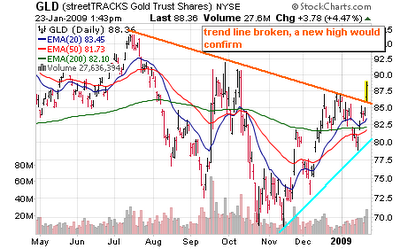
Last Friday we said gold might finally have it’s real breakout here [Jan 23: Could be the Real Breakout in Gold] I wrote:

Things to like:
1) a series of higher lows
2) the trendline of lower highs has been penetrated

Things to see for confirmation:
1) any pullback is bought
2) price prints over October 2008’s highs, signaling the end of “lower highs”

This was what the chart looked like at the time:
Now?
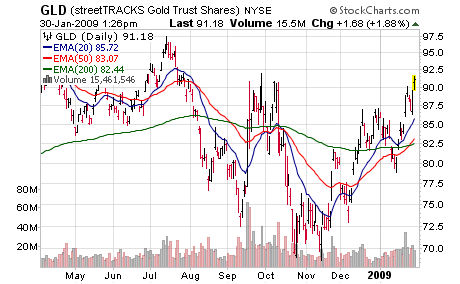
Without benefit of the orange line – you can see condition #1 has been fulfilled – we “backfilled”, tested the area we broke out of and people were eager to buy. On that, an aggressive trader would be buying. A reader mentioned this outcome last week.

For someone more conservative in orientation, you want to see #2 “a price point over October 2008’s highs” – then we end our half year of lower highs. We are withing spitting distance here with GLD at $91.40 and the October intraday high at $92.

It’s hard to get behind gold fully because there is no “earnings” behind it; it’s all about sentiment. But the theory is that as all the world’s troubled countries race to devalue their currencies (print, print,print) to “save the system,” a hard asset should retain its value. Silver is likewise breakout out, although silver has a lot of industrial uses as well.

I hate to chase a move, but from a technical set up, a lot of institutional money could be set to finally jump in here….

Now the question of what instrument to use – keep it simple or go with a miner? etc.

Disclosure: No position

=================================

My Note- Great call by Trader Makr but I have to ask, why no position Trader Mark? – jschulmansr

=================================

Catch the New Bull! – Buy Gold Online – Safely, quickly, and at low prices, guaranteed! Bullion Vault.com

=================================

Fed Monetizes Debt Leading Investors to Embrac Gold – Seeking Alpha

By: Boris Sobolev of Resource StockGuide.com

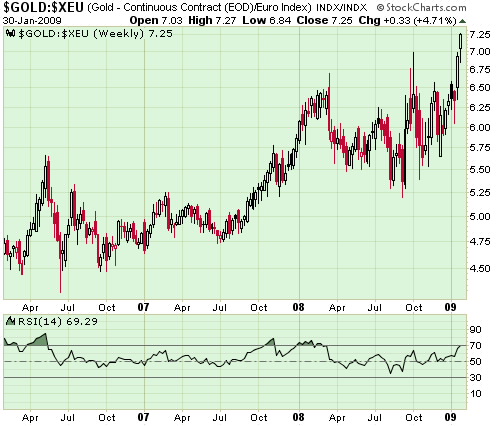
In January gold rose significantly against all major world currencies. In most currencies except in the US dollar and the Japanese yen, gold actually made an all-time-high.

January Performance

GOLD / USD 5.3%

GOLD / EUR 16.7%

GOLD / AUD 16.5%

GOLD / JPY 4.4%

GOLD / GBP 5.8%

GOLD / CHF 16.3%

10-Yr Yield 13.0%

click to enlarge
At the same time, most capital markets have been falling.

January performance

DOW -11.5%

S&P -11.4%

NASDAQ -9.0%

FTSE -6.4%

DAX -9.8%

Nikkei -9.8%

Shanghai -9.3%

The governments around the world are trying to take initiative while private capital is sitting on the sidelines, preferring the safety of government bonds and precious metals.

Investors typically do not trust the governments to implement any effective economic solutions. Moreover, this lack of faith in central planning continues to grow since the US government has no other plan of action than to save the old, compromised and untrustworthy financial system.

What the Federal Reserve together with the Department of Treasury has shown is that they will inject a vast amount of newly created money into a hugely ineffective financial system.

While in the fall of last year, in fear of devastating deflation, analysts were competing in downward projections for the price of gold, now the competition is to estimate the amount of losses incurred by the financial institutions around the world. The maximum assessment is now at $4 trillion, with Nouriel Roubini coming in close second at $3.6 trillion.

But the main problem is not so much in the amount of credit losses or the amount needed for recapitalization efforts but in that the new government is committed to continue to transfer huge capital into the hands of the same group of people who were largely responsible for the world financial crash in the first place. Wall Street, though transformed, will remain in control.

The lack of trust in the ability of insolvent financial institutions to run the modern financial system is moving investors into gold.

An even more important gold catalyst was the Federal Reserve. In comparing the two latest Fed statements, two things stand out. Here is the evolution in wording:

December Statement: “In light of the declines in the prices of energy and other commodities and the weaker prospects for economic activity, the Committee expects inflation to moderate further in coming quarters.”

January Statement: “In light of the declines in the prices of energy and other commodities in recent months and the prospects for considerable economic slack, the Committee expects that inflation pressures will remain subdued in coming quarters. Moreover, the Committee sees some risk that inflation could persist for a time below rates that best foster economic growth and price stability in the longer term.”

December Statement: “The Committee is also evaluating the potential benefits of purchasing longer-term Treasury securities.”

January Statement: “The Committee also is prepared to purchase longer-term Treasury securities if evolving circumstances indicate that such transactions would be particularly effective in improving conditions in private credit markets.”

First, the FOMC sees a threat of deflation and second it is prepared to counter this threat by purchasing longer-term treasuries.

Purchases of long term bonds is the most inflationary move that a central bank can undertake because it represents direct monetization of the government debt and hence an unconcealed debasement of national currency. (This is happening at the same time as the new Secretary of Treasury is chastising China – the main US creditor – for currency manipulation.)

Why did the Fed make such a determined statement, with one member even voting to begin long term treasury purchases immediately? First and foremost, the real estate market is not showing any signs of life. House prices are falling, time required to sell new homes is rising and most importantly, after a steep fall in December, average mortgage rates began to rise again, reaching 5.34% as of last Friday.

Since mortgage rates are closely tied to the 10-year treasury yield, the Fed stands ready to buy government debt and help make housing more affordable via low mortgage rates. The hope is that such action would help put an end to a decline in asset prices and stop the deflationary spiral.

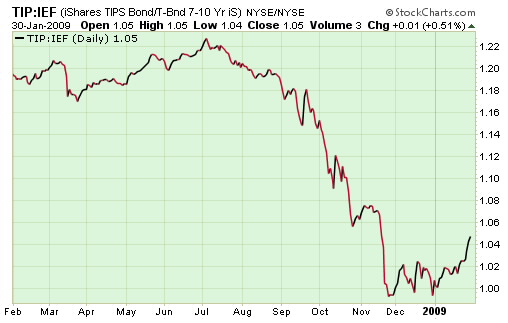
In fact, the latest Fed balance sheet showed that long term treasury purchases have already started, with around $1 billion in notes (5-10-year maturity) purchased for the week ended January 21st. This is a modest amount, but it is a statement that the Fed is ready to do more than just talk. Traders have indeed sensed this development and Treasury Inflation-Protected Securities (TIPS) (TIP) are also beginning to reflect greater inflation expectations.
Gold investors are also sniffing out the coming price reflation as they piled into the SPDR Gold Shares (GLD) at an increasing rate.
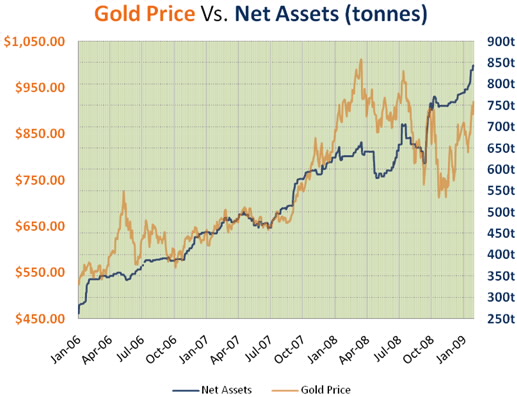
For the month of January, GLD gold holdings rose 8.2% or close to a record setting 63 tonnes. At this rate, GLD will soon surpass Switzerland in its gold holdings, thus becoming the world’s sixth largest gold owner after the US, Germany, the IMF, France and Italy.

If the Fed continues to purchase long term treasuries, it is clear that there is only one way for gold and gold stocks and it is up.

================================

Catch the New Bull! – Buy Gold Online – Safely, quickly, and at low prices, guaranteed! Bullion Vault.com

================================

Gold as Part of a Portfolio – Seeking Alpha

By: San Olesky of Olesky Capital Management

Many investors have been thinking about gold recently. Some have considered it because it has been a relatively strong performer with the iShares COMEX Gold Trust (IAU) closing up 5.4% in 2008. It’s up 2% year-to-date as of Wednesday’s close. The iShares S&P 500 Index ETF (IVV) was down 36.94% in 2008 and is down 6.17% year-to-date as of Wednesday’s close. Other investors or traders have bought or considered gold as a classic safe haven.

My inclination is to refute the efficacy of buying or holding gold for security either in the form of an ETF or, more so, in the case of gold bullion bars or gold coins. However, as the financial crisis became more severe last year, a couple of clients approached me about adding gold to their portfolios. Rather than diplomatically rejecting the proposal, I told them that I would investigate the historic effects of holding gold in a portfolio. Long story short, I found that adding a small, reasonable allocation to gold reduced portfolio volatility substantially and increased return slightly.

A simple diversified portfolio consisting of 1/3 S&P 500, 1/3 Real Estate Investment Trusts (REITs), and 1/3 10 year U.S. Treasuries would have produced a compound annual growth rate (CAGR) of 8.47% with 11.15% volatility (standard deviation – SD) from 1993 to 2008. For comparison, the S&P 500 produced a 6.67% CAGR with a 20.16% SD. Although few investors would implement this 1/3 – 1/3 – 1/3 allocation, diversification is proving its strengths here. All of these statistics incorporate rebalancing annually.

Let’s take the same 1/3 – 1/3 – 1/3 portfolio and alter it to include a relatively small allocation to gold. That allocation will be 30% S&P 500, 30% REITs, 30% Treasuries, and 10% gold. Over the same timeframe the portfolio with gold produced an 8.49% CAGR with a 9.86% SD. The portfolio with gold produced a slightly better CAGR with volatility that was 11.6% lower than the 1/3 – 1/3 – 1/3 portfolio. The diversified portfolio with gold produced a CAGR that was 27.3% higher than the S&P 500 and 51.1% less volatile than the S&P 500. The S&P 500 had 4 losing years with the worst being a loss of 37% last year. The 1/3 – 1/3 – 1/3 portfolio had 3 losing years with the worst being a loss of 18.15% last year. The portfolio with gold had only 2 losing years with the worst being 15.74% last year.

In constructing sound and productive portfolios we would like to include assets that have high returns, low volatility, and low correlation to the other assets in the portfolio. Looking at gold’s average annual returns, relative volatility, and relevant correlations, one should expect that gold would be a constructive addition to many portfolio allocations. In fact, gold even has a relatively low correlation with commodities in general (S&P Goldman Sachs Commodity Index). However, we should learn from the past but not expect it to repeat itself exactly. There is much to be learned from historic returns, volatilities, and correlations of asset classes. With all due respect to history and math, we must use reason when constructing portfolios. I view gold as a very narrow and idiosyncratic asset. So, I do not feel that it is wise to strategically allocate as much as 10% to the asset although the historic, mathematically optimal amount would be higher in the context of some portfolios.

What did I do? Based on my tests and observations, I bought a little gold last year for some of my clients. I have incorporated a small allocation to gold into their continuing strategic allocations.

====================================

My Note: This is great news even the Non Gold Bugs are become cautiously bullish!-jschulmansr

====================================

Catch the New Bull! – Buy Gold Online – Safely, quickly, and at low prices, guaranteed! Bullion Vault.com

====================================

Finally and extremely interesting article you want to read! Be sure to click on the chart links too…- jschulmansr

Economy Watch: What if Stocks Were Priced in Gold?- Seeking Alpha

By: Paco Ahlgren of Ahlgren Multiverse

“Everything has its limit — iron ore cannot be educated into gold.”

— Mark Twain

Several charts have been floating around the Internet for some time, showing the historical Dow Jones Industrial Average, priced in terms of gold. The simplest explanation entails thinking of the Dow divided by one ounce of gold; if the Dow is at 5000, and gold is at 500, then Dow-to-gold is 10. But it’s important to remember as you’re considering this ratio that the Dow is calculated in terms of dollars. So essentially, when we determine the Dow-to-gold ratio, it’s not just a simple ratio of gold to shares in the Dow, but rather it is a three-part ratio — Dow, expressed in dollars, to an ounce of gold.

Wouldn’t it just be easier to express gold in terms of dollars, or the Dow in terms of dollars? Well, those are certainly useful ratios — and we use them all the time — but what we’re really going after when we look at a historical Dow-to-gold chart is how well the Dow has performed, relative to the dollar, and relative to gold. What have inflationary pressures done to the Dow, in terms of gold and the dollar, over the past century? How have the three components moved in the various historical boom-bust scenarios? The results are interesting.

Let’s shift gears for a moment. Just off the top of your head, what would you expect stocks to do in periods of inflation? The dollar loses value rapidly, right? And that means prices of goods and services move higher, presumably with wages. So wouldn’t it stand to reason, intuitively, if corporations were making more money as prices increased, profits would increase too? And if profits increase, shouldn’t share prices go higher in response?

It turns out that inflationary price increases are bad for the stock market, and no period in history establishes this more concretely than the late 1970s and the early 1980s. Interest rates and prices soared, along with the price of gold, but stocks were flat. I want you to think about what I’m saying here: prices in general were going up, and yet the stock market was not. What this means is while stocks, in nominal terms, looked to be relatively stagnant, in real terms they were getting crushed. This is why the Dow-to-gold ratio is so significant as an indicator of relative value.

There is an elegant, simple truism that comprises every single transaction between buyers and sellers, and yet most people don’t even think about it: whenever you buy something, you are selling something else. When you buy corn, you are selling dollars. When you buy a Ford, you are selling dollars. If you are in Mexico and you buy a chicken, you are selling pesos. Of course, if you came from the U.S., you first sold dollars, bought pesos, and then sold pesos to buy the chicken. I know most of you already understand this concept, but I’m trying to emphasize that even when currency is used, every transaction is merely a trade; that is to say, the transaction is nothing more than negotiation that results in the exchange of two things — whether goods, services, or currency.

With that in mind, consider this: when prices rise because of inflation (printing of money), it isn’t so much that goods and services are getting more valuable — rather it’s much more accurate to say the currency is simply getting less valuable relative to everything else. If the dollar collapses, for instance, and the cost of a loaf of bread goes from $1 to $20 at the same time a share of Microsoft (MSFT) goes from $20 to $30, then Microsoft is severely under-performing — in inflation-adjusted dollars. A loaf of bread will cost you 20 times what it used to — not because it is more valuable, but because the dollar is less valuable. Meanwhile Microsoft is worth only 50% more. Relative to the dollar, shares of Microsoft are actually losing money — in a big way.

If you look at a chart of inflation from 1978 to 1982, you’ll notice a huge spike. If you look at a chart of the Dow Jones Industrial average during the same period, you’ll see that stocks traded sideways in a fairly well-defined range over the same period. But that doesn’t tell the whole story; if you adjust for the meteoric rise in prices during that five-year period, the stock market actually performed much worse than the nominal dollar fluctuations presented in the historical chart. In other words, the price of just about everything was going up dramatically, but stocks were not. So if you adjust prices back to “normal” levels, and adjust stocks accordingly, the picture for equities would have been horrible.

Now for the pièce de résistance…

Here is a series of charts of historical nominal gold prices (not adjusted for inflation), in several different currencies — the first of which is U.S. dollars. Take a look at the spike in the price of gold from 1977 to 1981. Now, if we go back to our original chart above, showing the Dow Jones Industrial Average, in direct relation to an ounce of gold (Dow-to-gold), you can see that the ratio went roughly 1:1 in 1980 — at the peak of the inflationary price surges. To clarify, the Dow was at about 750, as was gold.

But didn’t we say that, relative to rising prices, the Dow actually underperformed dramatically? So if you bought gold in the mid-1970s, not only was your investment skyrocketing, but the stock market — which was flat in nominal dollars — was actually doing very poorly relative to rising prices. Bear in mind that both the Dow and gold were priced in terms of nominal dollars at the time; they essentially “cancel out” — that is to say, relative to rising prices, gold also failed to perform as well as the nominal dollar-price. Still, it did offer an excellent hedge against rising prices, and even outperformed during the period.

What does all this mean? Well, for starters the average Dow-to-gold ratio over the last century has been about 9.5, and we are currently at about 8.5. So you’re probably thinking we’re oversold and due for a correction. In other words, the Dow-to-gold ratio is probably going higher, right? Well that was my first conclusion too, but actually on closer examination it turns out that’s probably not right at all.

For much of the last century the dollar was tied to gold, and while the relationship was never perfect — and the U.S. government betrayed the union many times, in many different ways — there was at least some relationship, which helped pull the ratio down. Eventually, excessive inflationary printing caught up with the government in the 1960s, and it became clear it wouldn’t be able to honor redemptions against the dollar at the price it had fixed. Nixon essentially defaulted on the U.S. promise to redeem dollars for gold by taking the U.S. off the standard in the 1970s — and this, more than anything else, allowed inflationary pressure to drive general prices into the stratosphere. This was the moment the Dow-to-gold ratio approached 1:1. To fight rising prices, Paul Volcker, the Fed Chairman at the time, pushed the Fed’s target interest rate past 20% and barely saved the U.S. economy from collapse.

For most of the next 20 years, gold fell and stock prices rose. Meanwhile, the U.S. government capitalized on the lie it had created and printed more and more money. Who really cared? Everyone was making money in the stock market, and prices remained relatively stable. In fact, every time prices failed to act “correctly,” the Fed simply changed the rate at which it would lend to banks. But the illusion of the monetary policy game couldn’t last forever; people used easy money printed by the government to buy assets they couldn’t afford throughout the economy — especially houses. Finally the pressure was just too much, and everything started unraveling in 2007. But the gold market seemed to understand the game couldn’t last, and around 2000 it started a slow, steady rise.

Relative to everything, the number of dollars in the system in early 2009 is almost incomprehensible. Once de-leveraging reaches its nadir — and it’s coming soon — those dollars are going to hit the economy and drive prices much higher.

What have we learned about stocks in such periods of rising prices? Not only do they fail to perform, but adjusted for inflationary price pressures, they actually under perform. General prices and unemployment will continue to rise. The consumer will continue to be unable to consume. Corporate earnings and dividends will continue to collapse as a result. Stocks are going lower — probably much lower.

And what about the price of gold? It will almost certainly continue to increase — not only because people will flock to its long historical stability and consistency, but also because there are simply so many more dollars (and yen, and rubles, and euros) in the world. Remember, the U.S. isn’t the only country printing innumerable sheets of currency. And in that context, remember also that inflationary price increases have almost nothing to do with increased demand, but rather they are the result of currency devaluation and destruction — through printing.

I just want to share two more charts with you. The first should give you a little perspective — it is a historical chart of gold, in both nominal and real dollars. Notice the real price of gold in 1980 (in 2007 dollars) was $2272 per ounce. If I’m correct about inflation and the fate of the dollar — and I’m confident I am — then we are nowhere near the historical high in gold. But I don’t think we’re merely going to re-test that high — I think we’re going to blow through it as the dollar loses value.

In the 1930s, as corporate earnings and dividends disintegrated, the Dow lost nearly 90% of its value from peak to trough. The U.S. was a creditor nation with a huge manufacturing base. The dollar was tied closely to gold. Since its peak in October 2007, the Dow has lost less than 50% of its value. The U.S. is a debtor nation with a relatively small manufacturing base. I can’t say it enough: we borrow profusely, we manufacture very little, and we consume gluttonously. Nonetheless, the consumer has now lost almost all his purchasing power, and corporate earnings and dividends are going to suffer massively as a result.

In 2007, the Dow peaked at about 14,150. To give you some perspective, an 85% drop in the Dow from peak to trough would put it at about 2100.

I know it’s easy to imagine the Fed has magical powers. I’ve fantasized about such things myself at times of extreme weakness — that maybe the Fed will “somehow” figure out a way to fight and defeat the unprecedented evil specter of inflation it is foisting on its unsuspecting children. Sometimes I do believe that our Lord and Savior Barack Obama will wave his charmed “unicorn horn of change” and all will be well again. Likewise, at times I feel like I could let Uncle Ben Bernanke take me just about anywhere in his helicopter of prosperity. My faith in the reverend John Maynard Keynes runs deep, as I hope, and hope, and hope. I find myself gleefully clicking my heels together and repeating, “the dollar is almighty, and the Stars and Stripes will prevail.” And when I am in this wonderful place, I have confidence that someday soon, we’ll all be buying houses with no money down, and with no jobs. Our driveways and backyards will once again overflow with boats, motorcycles, and sports cars.

Then I think about the 1930s. And suddenly I am wide-awake.

Let me ask you a simple question, and I want you to actually think about it. Do you really think we can’t get to the 1930s again? Do you really think that we’re going to return to the exuberant excess of the past few decades? If so, let me disabuse you of the notion: the United States was in much better shape, economically, going into the Great Depression than it is now. Prosperity is not coming back to the U.S. as we know it. We are in a lot of trouble.

Is a Dow-to-gold ratio of 1:1 so incomprehensible? Again, it has happened before — several times. But I’ll even take it a step further: what about a Dow-to-gold ratio of .5? Or less? I promise you, if the Fed fails to soak up all the dollars it’s putting in the system, that’s exactly where we’re going. And what, you may ask, does the Fed use to “soak up dollars?”

I’ll be glad to tell you that too. When the Fed needs to take dollars out of the system, it sells Treasuries (which means it buys dollars). The problem is, the U.S. debt-load is astronomical. Who, exactly, is going to buy that debt from the Fed? And at what interest rate? Remember, if the Fed is desperately trying to take dollars out of the system, there can be only one reason: it is scared of rising prices caused by inflation. But if the Fed floods the market with Treasuries, it will achieve exactly the opposite effect it’s looking for — it will cause rates to rise, probably dramatically. Do you really think the Chinese and the Japanese are going to buy Treasuries at a 2% yield if the Fed is panicking and trying to buy dollars to stop an inflationary price explosion? If so, you’re delusional. Chinese and Japanese people are smart. They’re not going to fund an inflationary dollar at 2%. Ever.

In the past it might have worked. Of course, in the past, the U.S. money supply was much smaller, and our ability to borrow was much stronger. But those days are gone.

As if I haven’t terrified you enough, the last thing I’m going to leave you with is really scary. It is a link to an excellent article by Mark J. Lundeen, whose insight into this economic catastrophe has been stupefying since long before all of this even started. Embedded in the article is a chart that shows historical dollars-in-circulation, relative to U.S. gold.

With that, I think I’ll let you do the rest of the math. Sleep well.

Disclosures: Paco is long gold.

Copyright 2009, Paco Ahlgren. All Rights Reserved.

==================================

If you have done the math…

Catch the New Bull! – Buy Gold Online – Safely, quickly, and at low prices, guaranteed! Bullion Vault.com

=================================

That’ it for now – Good Investing – Jschulmansr


Nothing in today’s post should be considered as an offer to buy or sell any securities or other investments, it is presented for informational purposes only. As a good investor, consult your Investment Advisor, Do Your Due Diligence, Read All Prospectus/s and related information carefully before you make any investments. –  jschulmansr

Share this:

  • Click to share on Reddit (Opens in new window) Reddit
  • Click to share on Facebook (Opens in new window) Facebook
  • Click to share on LinkedIn (Opens in new window) LinkedIn
  • More
  • Click to share on X (Opens in new window) X
  • Click to share on Pinterest (Opens in new window) Pinterest
  • Click to share on Tumblr (Opens in new window) Tumblr
  • Click to print (Opens in new window) Print
  • Click to email a link to a friend (Opens in new window) Email
Like Loading...

It’s Official- The New Gold Rally Has Begun!

30 Friday Jan 2009

Posted by jschulmansr in Austrian school, Bailout News, banking crisis, banks, bear market, capitalism, central banks, China, Comex, Copper, Currencies, currency, Currency and Currencies, deflation, dollar denominated, dollar denominated investments, economic, Economic Recovery, economic trends, economy, Federal Deficit, Finance, financial, Forex, futures, futures markets, gold, Gold Bullion, Gold Investments, gold miners, How To Invest, How To Make Money, India, inflation, Investing, investments, Junior Gold Miners, Latest News, Make Money Investing, market crash, Markets, mining companies, mining stocks, palladium, physical gold, platinum, platinum miners, precious metals, price manipulation, prices, producers, production, Prophecy, resistance, Siliver, silver, silver miners, spot, spot price, stagflation, Stocks, TARP, Today, U.S. Dollar

≈ Comments Off on It’s Official- The New Gold Rally Has Begun!

Tags

agricultural commodities, alternate energy, Austrian school, Bailout News, banking crisis, banks, bear market, Bollinger Bands, bull market, capitalism, central banks, China, Comex, commodities, communism, Copper, Currencies, currency, deflation, Dennis Gartman, depression, diamonds, dollar denominated, dollar denominated investments, economic, economic trends, economy, Federal Deficit, financial, Forex, futures, futures markets, gold, gold miners, hard assets, heating oil, India, inflation, investments, Keith Fitz-Gerald, Marc Faber, Mark Hulbert, market crash, Markets, mining companies, Moving Averages, natural gas, oil, palladium, Peter Brimelow, Peter Schiff, physical gold, platinum, platinum miners, precious metals, price, price manipulation, prices, producers, production, protection, rare earth metals, recession, risk, run on banks, safety, Saudi Arabia, Sean Rakhimov, silver, silver miners, socialism, sovereign, spot, spot price, stagflation, Technical Analysis, timber, U.S. Dollar, volatility, warrants, Water

As it write this Gold is up $22.50 oz to $929.00! It absolutely smashed thru the $920 resistance! If we hold here $950 -$975 is the next level.  Barrick Gold CEO Munk says China to be a big buyer of gold as confidence is lost in the U.S. Dollar. The treasuries bubble is starting to burst and money is pouring into gold!- Good Investing! – jschulmansr

====================================

Catch the New Bull! – Buy Gold Online – Safely, quickly, and at low prices, guaranteed! Bullion Vault.com

=========================================

Source: MineWeb.Com

 WORLD ECONOMIC FORUM

Munk forecasts currency, economy fears will send gold to new record highs

Whether it’s the currency effect or a reaction to a feeling of uncertainty, Barrick Gold Chairman Peter Munk says gold is more likely to go up than down.

Author: Barbara Lewis
Posted:  Friday , 30 Jan 2009

DAVOS, Switzerland (Reuters) – 

Gold is likely to hit new record highs, spurred by serious concern about the U.S. currency and doubt about the state of the world economy, the chairman of Barrick Gold Corp. said on Thursday.

There was even a possibility, although not a probability, central banks, including China’s, might start to switch from dollar holdings to gold, which could cause the metal’s price to treble or more.

From a gold producers’ perspective, one negative is that the cost of bringing on production has remained high, even as other raw materials, including base metals and energy, have slumped.

“Gold is at record levels in every currency except dollars. Even within dollar terms it is within a few percentage points of an all-time high at a time when all the other major commodities are falling,” Peter Munk told Reuters at the World Economic Forum meeting in Davos.

“Whether it’s the currency effect or a reaction to a feeling of uncertainty, gold in my opinion is more likely to go up than down,” the chairman and founder of the world’s largest gold mining company said.

Spot gold was at $902.80/904.80 at 1817 GMT. It hit a record high of $1,030.80 an ounce in March last year.

Munk stressed he was merely weighing the odds.

“It would be stupid to assume commodities prices can only go one way,” he said, adding physical demand for gold jewellery was not high during the economic downturn.

Gold has been one of the best-performing assets of late, rising in value by nearly 17 percent since late October.

Investors have bought heavily into physical bullion in the form of coins and bars and physically-backed assets such as exchange-traded funds as a safe store of value at a time of increased volatility in other asset prices.

Munk said downward pressure on the dollar, partly because of massive U.S. spending to stimulate the economy, would increase gold’s attractions as an investment further.

Gold usually moves in the opposite direction to the dollar, as it is often bought as a hedge against weakness in the U.S. currency.

“My personal feeling is that with the rescue packages calling for trillions, not billions… the value of the (U.S.) currency has to go down,” said Munk.

DUMB TO HEDGE

His company did not hedge its output for now — meaning it does not use derivatives to insure against a fall in price — and relied instead on the price climbing. In the past its successful hedging allowed it to make the acquisitions that helped to make it the world’s biggest gold miner.

“It would be dumb to hedge,” Munk said of the current climate.

His bullishness was underscored by the possibility central banks, including that of major dollar asset-holder China, might start buying gold.

“If they decide to diversify, we assume into gold, then we start to talk about a trebling or quadrupling of the gold price. It could be followed by Russia or Kuwait.

“I don’t think it’s likely, but it’s more likely. I would not have said it two years ago …I’m not a gold bug …but it’s more likely than it was two years ago.”

A strong price climate has meant ongoing investment in bringing on new gold, Munk said.

“In every other mining area, people are cancelling mines.”

But declines in other commodities have yet to have a major impact on cost.

“Marginally yes, but substantially no. For some reason cash costs are tending to continue to increase,” he said, when asked whether investment costs were falling.

“Energy costs have gone down. It does help, but labour costs are consistently increasing.”

The one way to reduce production costs is to invest in efficient new mines, Munk said, citing two major new projects in Nevada and the Dominican Republic and a smaller one in Tanzania.

(Reporting by Barbara Lewis, additional reporting by Jan Harvey in London; editing by Anthony Barker)

© Thomson Reuters 2009 All rights reserved

=============================

Catch the New Bull! – Buy Gold Online – Safely, quickly, and at low prices, guaranteed! Bullion Vault.com

=============================

Hedge Fund to Measure Returns in Gold Rather Than Currency – Seeking Alpha

By: Todd Sullivan of Value Plays

This is a pretty stunning move. What is even more alarming is the reasoning given.
From the FT:

A hedge fund has begun offering investors the chance to have their investment denominated in gold, as worries grow over governments debasing their currencies by printing money.

Osmium Capital Management, a $178m hedge fund manager based in Bermuda, is launching a new share class allowing investors to hold shares measured as troy ounces of the fund, rather than U.S. dollars, sterling or euros.

The move follows a surge in investor demand for small gold (GLD) bars and coins held by individuals and gold-backed exchange-traded funds that are holding a record amount of bullion.

Chris Kuchanny, Osmium chief executive and a former London ABN Amro trader, said he was putting almost all his personal wealth into the new share class: “Investors have voiced concerns that they’re overly exposed to the major fiat [paper] currencies in an environment where the fundamentals of those currencies are clearly deteriorating with governments assuming more debt and having lower revenue and more expenditure.

This shows a stunning lack of confidence in currencies. It also says that the fund is anticipating inflation to rear its ugly head in a scary way. When it does, the value of the currencies will plummet and gold will rise.

What is to watch now is whether or not other funds begin to follow. If this becomes a movement rather than an individual act, the crash in currencies could be expedited in a nasty way. Stay tuned…

Disclosure: No position in gold… yet.

====================================

Catch the New Bull! – Buy Gold Online – Safely, quickly, and at low prices, guaranteed! Bullion Vault.com

====================================

My Disclosure: Long Gold , Gold Etf’s, Gold Miners/Producers, Long Silver, Silver Miners/Producers, Platinum and Paladium Miners/Producers- jschulmansr

More to follow later today…

Nothing in today’s post should be considered as an offer to buy or sell any securities or other investments, it is presented for informational purposes only. As a good investor, consult your Investment Advisor, Do Your Due Diligence, Read All Prospectus/s and related information carefully before you make any investments. –  jschulmansr
Share this:

  • Click to share on Reddit (Opens in new window) Reddit
  • Click to share on Facebook (Opens in new window) Facebook
  • Click to share on LinkedIn (Opens in new window) LinkedIn
  • More
  • Click to share on X (Opens in new window) X
  • Click to share on Pinterest (Opens in new window) Pinterest
  • Click to share on Tumblr (Opens in new window) Tumblr
  • Click to print (Opens in new window) Print
  • Click to email a link to a friend (Opens in new window) Email
Like Loading...

Today’s Technical Corner – Gold Whats Next?

28 Wednesday Jan 2009

Posted by jschulmansr in agricultural commodities, Bailout News, banking crisis, banks, bear market, Bollinger Bands, bull market, capitalism, central banks, China, Comex, Copper, Currencies, currency, Currency and Currencies, deflation, depression, dollar denominated, dollar denominated investments, economic, Economic Recovery, economic trends, economy, Federal Deficit, Finance, financial, Forex, Fundamental Analysis, futures, futures markets, gold, Gold Bullion, Gold Investments, gold miners, hard assets, How To Invest, How To Make Money, India, inflation, Investing, investments, Jim Sinclair, Junior Gold Miners, Latest News, Make Money Investing, market crash, Markets, mining companies, mining stocks, Moving Averages, oil, palladium, physical gold, platinum, platinum miners, precious metals, price, price manipulation, prices, producers, production, silver, silver miners, small caps, spot, spot price, stagflation, Stimulus, Stocks, TARP, Technical Analysis, U.S. Dollar, Uncategorized

≈ 1 Comment

As I write Gold is currently down $10.80 at $886.90, taking a much needed breather from its recent upward thrust. If Gold can hold and consolidate around this level the next target will be $920 and then $950. Today’s post contains articles on how to trade gold for those who don’t like risk, much tecnical analysis and more… -jschulmansr

==============================================

Catch the New Bull! – Buy Gold Online – Safely, quickly, and at low prices, guaranteed! Bullion Vault.com

==================================================

A Guide To Buying Gold for the Risk Averse – Seeking Alpha

By: J Clinton Hill of Hillbent.com


Lately, there has been plenty of talk about gold and a growing consensus that favors bullish fundamentals. Here’s my take on gold based upon the Spyder Gold Trust ETF (GLD) and its most recent wave, i.e. from its 1-15-09 bottom at 78.87 to its 1-26-09 top at 90.19.


Catch the New Bull! – Buy Gold Online – Safely, quickly, and at low prices, guaranteed! Bullion Vault.com

================================================.

That’s it for today click on one of the subscribe buttons to receive all the latest news for Gold and Precious Metals, and much more!

Good Investing! – Jschulmansr


Nothing in today’s post should be considered as an offer to buy or sell any securities or other investments, it is presented for informational purposes only. As a good investor, consult your Investment Advisor, Do Your Due Diligence, Read All Prospectus/s and related information carefully before you make any investments. –  jschulmansr


Catch the New Bull! – Buy Gold Online – Safely, quickly, and at low prices, guaranteed! Bullion Vault.com

============================================

Hourly Action In Gold From Trader Dan

Source: Trader Dan Norcini of JRMineset

Gold appears to have run into resistance near the $920 level which is blocking its upward path for now. Since we know that the funds are purely technical traders and have been buying, both adding new longs and for those who were short, getting out by covering, while open interest has been steadily increasing, it is safe to say that the bullion banks are the ones blocking the upward trajectory. Nothing new there and it does not take much observation for those who have been watching gold the last 8 years to know this.

The inability of the mining shares to continue higher yesterday, even in the face of a much higher bullion price, gave some paper longs at the Comex a reason to cash in some profits and emboldened the bears to dig in their heels.

To show you how fickle these markets have become, do you remember when gold was following the equity markets around not all that long ago. They went down – it went down. They went up – it went up. It was all about the famous “risk aversion” or deleveraging trade. Now the exact opposite seems to be happening. The equities go up and gold goes down. Well guess what they have come up with to now explain this turn of events? Yes – risk aversion!

Here’s the latest – equities are going up because supposedly some of the news from the banking sector is not as dire as many have come to expect. The bearish sentiment in the equity markets is misplaced. Gold has been going up because of banking sector fears and currency risk. Ergo – gold should now go down as those fears are overblown because the risk averse psychology has become too excessive. In other words – all’s clear and the water is just lovely so dive on in!

I could not make this stuff up if I tried.

Had enough – how about this one?  – Gold has now broken its relation to the Dollar. The fact that the Dollar was being bid up was evidence of a panic into safety. Now that the Dollar is going down it means that the panic is subsiding. Therefore gold should go down as well which means the inverse relationship between gold and the Dollar has been severed.

Again, I am just repeating the latest mantra du jour.

Just wait and see – when gold starts going up as the Dollar starts going down the same guys who came up with the latest explanations will be singing how the historic relationship between gold and the Dollar has been restored once again. No matter what happens – they will have proven to be right! Geniuses all!

It reminds me of the global warming crowd. When droughts were springing up and record highs were being shattered it was called global warming. When record snowfalls suddenly showed up and record lows were being set as people all over the globe freezing their keisters off,  it morphed into climate change. No matter which way the temperatures go, that crowd will always be right! Shame on you climate destroyers for not cramming your family into something that more closely resembles a go-kart rather than an automobile on your assorted trips around town. If you had any concern for the planet you would be riding a horse to work. Then again that creature gives off methane gas which is actually being seriously considered as a pollutant and thus liable to be taxed by the idiots in Washington DC, so no matter what you do, you are royally screwed. It’s too bad that there remains no undiscovered country where freedom loving people who believe in honest money and limited government could sail off to and found a nation where the money changers and government control freaks would be banned from entering.

By the way, did you notice that the new President just signed the death sentence for the US automotive industry yesterday by mandating new mileage efficiency standards – all in the name of saving us from a problem that does not exist? Yep – nothing like telling an industry already on life support that their most profitable units, the bigger and safer vehicles, will have to go in favor of smaller, less profitable ones. Don’t touch the unions however whose demands have forced the US auto industry into concentrating their efforts on the more profitable lines (the larger vehicles) in an effort to offset the financial drain imposed upon them by the exorbitant salaries and benefits that they are forced to pay these same unionized workers.

Remember that big move up in Copper yesterday? Remember how the existing home sales number ran all the shorts out and pushed the market right into technical chart resistance threatening an upside breakout? Well, that is history today as it went “KERPLUNK”! To show you how utterly insane these markets have become and the farce that the hedge funds have turned them into, consider this – Copper closed at 1.4720 on Friday. On Monday it rallied sharply blasting upwards closing at 1.5865 reaching a high of 1.6310. Today it collapsed making a low of 1.4545 and closed at 1.4850, down 10 cents a pound. In other words, it went NO WHERE in TWO DAYS but in the process it careened all over the place blowing out upside buy stops before triggering a wave of downside sell stops today. And to think this hedge-fund created madness has become the price discovery mechanism by which commercial producers and end users are somehow supposed to be able to enter into contracts and hedge risk to ensure profitability. I have been watching these futures markets for more than 20 years and I have never seen such idiocy. This is what happens when computers have taken over trading decisions based on nothing but the latest price tick. I know it sounds excessive to some, but I honestly have come to believe that the entire futures industry is very close to being destroyed by these out of control hedge funds. A commercial entity simply cannot use these markets to hedge and without commercials these markets cannot survive since they will serve no useful purpose whatsoever as all that will be left is hedge funds trading their algorithms against the algorithms of other hedge funds with the commercials using forward contracts amongst themselves and bypassing the futures markets altogether.

Back to gold – technically gold still looks very good although it has stalled just below the $920 level. Ideally, it would hold support on any subsequent RE-test of the Downsloping trendline of the wedge formation on the weekly chart which is drawn off the July and October highs. That comes in near the $880 level. I would prefer to see it consolidate above the $880 level but would view an ability to hold above the $870 level as still friendly. Failure at $870 would give the shorts enough impetus to try to shove it back to $850- $840.

Upside resistance remains near $920 while more formidable resistance comes in near the $945-$950 region. That corresponds to both Downsloping trendline resistance drawn off the peak high made back in early 2008 and the July high which also happens to be the highs made back in October last year. Those are the parameters we are working with technically.

On the daily chart, all of the major moving averages, including the 100 day moving average are all now trending solidly upwards. The 10 day is close to making a bullish upside crossover of the 20 day which will give some trend following funds a reason to buy while the RSI remains below the 70 level. So we have room to run to the upside IF, and this is a big IF, the market can push through the bullion bank selling near $920. The inability of the mining shares to continue moving higher does concern me however. In an ideal bullish environment for gold, the shares move higher alongside the bullion price.

It looks to me like the weakness in crude oil today is contributing some downward pressure in gold as many of those fund algorithms use its price action as a factor in their selling or buying of commodities. Weaker crude oil prices give rise to the deflation scenario and that still leads some to sell gold because of misguided notions of how it will perform during periods of general price deflation. Again, gold is primarily a currency – not a commodity, and it will rise when faith in paper currencies falters, all of the arguments of the deflationists notwithstanding. When governments slash interest rates to NOTHING and issue more and more paper IOU’s, the sheer supply guarantees that they will lose value meaning that investors seeking wealth preservation are buying scraps of paper that pay zero return and lose any “value” that they might have once possessed. Gold thrives in such periods as it is solid, substantial and cannot be diluted by conniving Central Bankers. Which would you rather have in your hand during times of financial chaos and upheaval – a promise by a politician or a metal which has stood the test of 6,000 years? If you have any problem making a decision, I suggest you take a good look at the price chart of the British Pound and especially the price of gold in Sterling terms.

The HUI and the XAU were unable to manage strong closes above their former double tops make back in mid-December of last year and early January of this year in yesterday’s session meeting up with selling from the opening bell and never quite being able to shrug that off. Still, their charts look good as they are consolidating right around that former double top. I would like to see them hold above the 10 and 20 day moving averages near the 115 – 116 level in the XAU and 279 – 282 in the HUI.

Bonds finally saw an up day today which is to be expected given the beating that they have taken of late. The downdraft in bonds could be called “parabolic in reverse”. Jim likes to call it a “waterfall”, which is an apt description considering the fact that if one were long while this has occurred, they have indeed taken a bath in their trading accounts or better yet, drowned under a sea of red ink.

The Dollar is generally weaker today although it has bobbed back and forth between a small gain and a small loss. The charts still appear to show a technical failure near the 88 level. It is treading water above the 50 day moving average (barely) while the 100 day lies near the 83.50 level. A breach of that level and it should move back down to retest 80.

Click chart to enlarge today’s hourly action in Gold in PDF format with commentary from Trader Dan Norcini

January2709Gold1230pmCDT.jpg

===========================================================

1. Before 2009 is out the next major economic shock will become obvious. There is not one major funded retirement program intact thanks to the manufacturers and distributors of OTC derivatives. The unfunded ones are a total loss. Retirement in the future is totally out of the question. Many now retired will end up in the same situation as those trying to live off fixed income. Both categories are being culled from the human gene pool.
 
2. By my 68th birthday Obama will recognize his position as a bagged President, knowing then that the economic situation does not have any practical solution.
 
3. By July 4th, 2009 the rally in the US dollar will have become a simple hope for the lows to hold.
 
4. My long held targets of $1250 and $1650 for Gold that were once laughed at as outrageously high can now be laughed at for being painfully too low.
 
5. Only gold and related shares are insurance against the economic cataclysm now taking place.

Everyone is looking for where and when the top in gold will come. Will it be Jim’s $1650 or Alf Field’s $10,000 plus before it comes back down?
 
To put it nicely, you are all wrong. Gold is going up and STAYING up.
 
There is no top to look for because like all things people strive for, the top does not exist.
 
Gold will trade within $200 of a given point as a product of the Master of the Financial Universe, Paul Volcker, taking control when all this is totally out of control. He will instate the revitalized and modernized Federal Reserve Gold Certificate Ratio, not gold convertibility, and not tied to interest rates as an automaticity. Only then can Volcker put in place policy backed by the sitting administration that has a provable history of starting the change from deficit to surplus, his price of saving the world one more time.
 
The Gold mining business will then be the best business there is and the highest dividend paying monetary utility.
 
Respectfully yours,
Jim
=========================================================

Catch the New Bull! – Buy Gold Online – Safely, quickly, and at low prices, guaranteed! Bullion Vault.com

==================================================

The Resurgence of Junior Gold Miners – Seeking Alpha

Junior mining stocks were all the rage back in the early stages of the gold bull market. During the time frame of 2002-2006 many junior miners were putting in annual gains of 200%, 300% or more. Some junior miners like Seabridge Gold (SA) produced 3-year returns in excess of 1500%! It seemed like you could close your eyes and randomly point your finger at a list of junior gold miners, buy the stock and sell a few weeks later for a gain of 30% or more. No feasibility study, no permits, no management experience or path to production… no problem!

But volatile stocks are volatile in both directions and when the gold market corrected, junior miners lost all of those gains and then some. Amateur investors that were patting themselves on the back and recommending investments to their buddies based on their recent success were caught off-guard by the severity of the decline in the junior mining sector and suddenly found that they gave back most or all of their gains. To be sure, some booked profits and got out before the ship sank, but most were caught unsuspecting and unwilling to believe the party could be over so quickly. Many junior miners lost 80% or more of their market cap during the past year or two.

Precious metals investors have a sour taste in their mouth in regards to junior miners and have largely dismissed the entire sector as too risky. For many investors, junior miners have been removed from their portfolios, watch lists and consideration set for future investments. Newsletter writers and analysts that couldn’t contain their excitement over the next “5-bagger” rarely mention a word about juniors these days. While much of this condemnation is warranted, I think we should be careful not to throw the baby out with the bath water.

While I will acknowledge that 75% or more of junior mining companies are not good investments and many will go out of business with credit markets contracting, there are still quite a few impressive juniors that deserve a second look now that the dust has settled. Mine production is decreasing and the larger miners will need to acquire junior miners with quality properties in order to add to their pipeline and keep their production numbers growing. After a massive sell-off that brought the entire sector crashing down, some of the most promising juniors have finished a bottoming pattern, consolidated and have already began moving up very impressively. Cash-strapped investors and weak hands have been shaken free of their junior mining shares as the focus has shifted to more “safe” and liquid investments. Has this produced an opportunity for savvy precious metals investors to pick up quality mining companies at undervalued prices? Here are my main criteria for selecting which junior mining companies are worth my investment dollars.

  1. Already producing or moving toward production in the next 1-2 years
  2. Quality properties in politically-stable areas with necessary road access
  3. Proven and probable resources that justify a higher market cap
  4. Seasoned management that has a track record of bringing projects to production
  5. Healthy balance sheet with cash on hand and/or the ability to raise capital easily

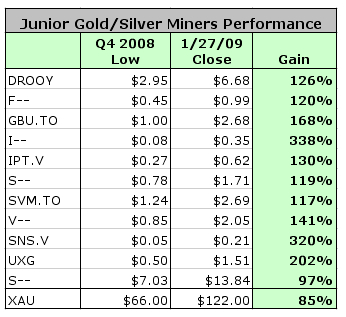
Many of the companies that meet most or all of the criteria above have already bottomed and are quietly posting exceptional gains that outpace those of the major producers. Even with today’s decline in gold equities, many of my favorite juniors are up 100% or more since their respective Q4 2008 lows. A few of these companies were recommended in the premium subscription service and have been masked out of respect to paying subscribers. All of the gains listed below were produced in just 1-3 months and illustrate the explosion in junior miners that most analysts and newsletter writers seem to be missing.

click to enlarge

As the entire gold and silver sector has done well over the time period, I have included the PHLX Gold and Silver Index (XAU) index at the bottom for comparison sake. While the XAU is up 85%, the average gain for the junior mining companies that we track over the same time period is 171% or double the gain of XAU. Junior miners are not only joining in this latest rally, they are leading the rally and gaining at twice the pace of the major gold mining companies.

Those that are comfortable with a higher risk/reward proposition might want to take a second look at junior mining companies during 2009. If the trend continues or accelerates as investors warm back up to juniors, we could see the return of another explosive few years for junior mining companies as gold pushes above $1,000 on its way towards its inflation-adjusted high of $2,300.

Catch the New Bull! – Buy Gold Online – Safely, quickly, and at low prices, guaranteed! Bullion Vault.com

===================================================

Now From One of the Masters’ Himself Jim Sinclair

Jim’s Outlook On 2009


First, to keep things in proper perspective, GLD has already appreciated 27% since Nov 12, 2008. Also, let us not forget that central banks have a perverted sense of humor and plenty of “funny money” and other diversionary tricks up their sleeves to defer the inevitable arrival of inflation. With this as our background, I will jump right into my strategic analysis for trading or investing in gold.

GLD hit resistance at 90.19, has retreated and appears headed to test support at 86.50 with the possibility of also filling a minor gap at the 85 level.

If support holds, the natural inclination is to buy (entry at 86.75 with a stop loss at 84.12 for -3% maximum loss). Assuming one is playing this trade for an exit at its most recent resistance, i.e. at 90.19, the risk to reward ratio is only at 1.33. In a fear-driven market environment, I am strongly inclined to pass on these odds (even with beer goggles).

Ideally, a trade with a minimum risk to reward ratio at 3 or 4 is much more seductive, even in interesting times like these. However, to find the ideal opportunity, one needs to be patient and think counter-intuitive to the buy low and sell high paradigm. Hypothetically (I only say “hypothetically” because I have been long GLD at 74.85 since Oct 29, 2008), I would wait for GLD to break above its resistance at 90.19 and buy at $90.50. This would confirm that there is additional demand and fresh support at this level.

Here is where the trade can get a little tricky. There is some resistance at the 92 level and one should probably anticipate a minor pullback and retest of the newly established level of support at the 90 area. However, if support is violated, I am willing to accept a stop loss at 89 for a -1.5% maximum loss of capital. In the majority of instances when support fails the “retest”, this signals a false breakout.

Now let’s get to the good part. If the breakout is legitimate, then GLD should run to the 97.50 area, which is its next level of major resistance and also where I would definitely be inclined to book some short-term profits or at least hedge my position with long puts and/or short calls. Under this scenario, this trade presents a much more attractive risk to reward ratio at 5.24.

Gold certainly has both technical and fundamental positives going for it. The short, intermediate, and long term are all trending upward while the monetary policies of global central banks reflect a desperate willingness to accept future inflation to avert the immediate threat of deflation. Another tail wind, also aiding gold’s bullish movement, is the recent weakness and apparent correction in the U.S. Dollar Index.

In summary, the example of the above trading strategy is an opinion on how to play gold for those who are risk averse and can ill afford to lose more capital. Otherwise, for those turned on by a fundamentally bullish or bearish bias towards the precious metal, assume the position (pun intended) and enjoy the ride along with all its ups and downs. Yeah Baby!!!

Disclosures: Hillbent.com, Inc. or its affiliates may own positions in the equities mentioned in our reports. We do not receive any compensation from any of the companies covered in our reports

=============================================

============================================

Share this:

  • Click to share on Reddit (Opens in new window) Reddit
  • Click to share on Facebook (Opens in new window) Facebook
  • Click to share on LinkedIn (Opens in new window) LinkedIn
  • More
  • Click to share on X (Opens in new window) X
  • Click to share on Pinterest (Opens in new window) Pinterest
  • Click to share on Tumblr (Opens in new window) Tumblr
  • Click to print (Opens in new window) Print
  • Click to email a link to a friend (Opens in new window) Email
Like Loading...
Newer posts →

Authors

  • jschulmansr's avatar jschulmansr
    • Free Crypto!
    • Free Crypto Currency
    • This is Blessed!
    • Trump Rally Charleston
    • Trump Rally Charleston

Blog at WordPress.com.

Privacy & Cookies: This site uses cookies. By continuing to use this website, you agree to their use.
To find out more, including how to control cookies, see here: Cookie Policy
  • Subscribe Subscribed
    • Dare Something Worthy Today Too!
    • Already have a WordPress.com account? Log in now.
    • Dare Something Worthy Today Too!
    • Subscribe Subscribed
    • Sign up
    • Log in
    • Report this content
    • View site in Reader
    • Manage subscriptions
    • Collapse this bar
 

Loading Comments...
 

    %d