• Recommended Sites & Links
  • About

Dare Something Worthy Today Too!

~ FreeCryptoBitCoins, Cryptocurrency, BitCoin, Ethereum, BitCoin Cash, Ethereum Classic, LiteCoin, DogeCoin, Gold & Precious Metals, Investing & Investments, Stocks and Stock Markets, Financial Markets & Market Timing, Technical Analysis, Oil and Energy Markets, Hard Assets Investing, BlockChain, Airdrops, Earn Free Bitcoin…

Dare Something Worthy Today Too!

Category Archives: market crash

It’s Official- The New Gold Rally Has Begun!

30 Friday Jan 2009

Posted by jschulmansr in Austrian school, Bailout News, banking crisis, banks, bear market, capitalism, central banks, China, Comex, Copper, Currencies, currency, Currency and Currencies, deflation, dollar denominated, dollar denominated investments, economic, Economic Recovery, economic trends, economy, Federal Deficit, Finance, financial, Forex, futures, futures markets, gold, Gold Bullion, Gold Investments, gold miners, How To Invest, How To Make Money, India, inflation, Investing, investments, Junior Gold Miners, Latest News, Make Money Investing, market crash, Markets, mining companies, mining stocks, palladium, physical gold, platinum, platinum miners, precious metals, price manipulation, prices, producers, production, Prophecy, resistance, Siliver, silver, silver miners, spot, spot price, stagflation, Stocks, TARP, Today, U.S. Dollar

≈ Comments Off on It’s Official- The New Gold Rally Has Begun!

Tags

agricultural commodities, alternate energy, Austrian school, Bailout News, banking crisis, banks, bear market, Bollinger Bands, bull market, capitalism, central banks, China, Comex, commodities, communism, Copper, Currencies, currency, deflation, Dennis Gartman, depression, diamonds, dollar denominated, dollar denominated investments, economic, economic trends, economy, Federal Deficit, financial, Forex, futures, futures markets, gold, gold miners, hard assets, heating oil, India, inflation, investments, Keith Fitz-Gerald, Marc Faber, Mark Hulbert, market crash, Markets, mining companies, Moving Averages, natural gas, oil, palladium, Peter Brimelow, Peter Schiff, physical gold, platinum, platinum miners, precious metals, price, price manipulation, prices, producers, production, protection, rare earth metals, recession, risk, run on banks, safety, Saudi Arabia, Sean Rakhimov, silver, silver miners, socialism, sovereign, spot, spot price, stagflation, Technical Analysis, timber, U.S. Dollar, volatility, warrants, Water

As it write this Gold is up $22.50 oz to $929.00! It absolutely smashed thru the $920 resistance! If we hold here $950 -$975 is the next level.  Barrick Gold CEO Munk says China to be a big buyer of gold as confidence is lost in the U.S. Dollar. The treasuries bubble is starting to burst and money is pouring into gold!- Good Investing! – jschulmansr

====================================

Catch the New Bull! – Buy Gold Online – Safely, quickly, and at low prices, guaranteed! Bullion Vault.com

=========================================

Source: MineWeb.Com

 WORLD ECONOMIC FORUM

Munk forecasts currency, economy fears will send gold to new record highs

Whether it’s the currency effect or a reaction to a feeling of uncertainty, Barrick Gold Chairman Peter Munk says gold is more likely to go up than down.

Author: Barbara Lewis
Posted:  Friday , 30 Jan 2009

DAVOS, Switzerland (Reuters) – 

Gold is likely to hit new record highs, spurred by serious concern about the U.S. currency and doubt about the state of the world economy, the chairman of Barrick Gold Corp. said on Thursday.

There was even a possibility, although not a probability, central banks, including China’s, might start to switch from dollar holdings to gold, which could cause the metal’s price to treble or more.

From a gold producers’ perspective, one negative is that the cost of bringing on production has remained high, even as other raw materials, including base metals and energy, have slumped.

“Gold is at record levels in every currency except dollars. Even within dollar terms it is within a few percentage points of an all-time high at a time when all the other major commodities are falling,” Peter Munk told Reuters at the World Economic Forum meeting in Davos.

“Whether it’s the currency effect or a reaction to a feeling of uncertainty, gold in my opinion is more likely to go up than down,” the chairman and founder of the world’s largest gold mining company said.

Spot gold was at $902.80/904.80 at 1817 GMT. It hit a record high of $1,030.80 an ounce in March last year.

Munk stressed he was merely weighing the odds.

“It would be stupid to assume commodities prices can only go one way,” he said, adding physical demand for gold jewellery was not high during the economic downturn.

Gold has been one of the best-performing assets of late, rising in value by nearly 17 percent since late October.

Investors have bought heavily into physical bullion in the form of coins and bars and physically-backed assets such as exchange-traded funds as a safe store of value at a time of increased volatility in other asset prices.

Munk said downward pressure on the dollar, partly because of massive U.S. spending to stimulate the economy, would increase gold’s attractions as an investment further.

Gold usually moves in the opposite direction to the dollar, as it is often bought as a hedge against weakness in the U.S. currency.

“My personal feeling is that with the rescue packages calling for trillions, not billions… the value of the (U.S.) currency has to go down,” said Munk.

DUMB TO HEDGE

His company did not hedge its output for now — meaning it does not use derivatives to insure against a fall in price — and relied instead on the price climbing. In the past its successful hedging allowed it to make the acquisitions that helped to make it the world’s biggest gold miner.

“It would be dumb to hedge,” Munk said of the current climate.

His bullishness was underscored by the possibility central banks, including that of major dollar asset-holder China, might start buying gold.

“If they decide to diversify, we assume into gold, then we start to talk about a trebling or quadrupling of the gold price. It could be followed by Russia or Kuwait.

“I don’t think it’s likely, but it’s more likely. I would not have said it two years ago …I’m not a gold bug …but it’s more likely than it was two years ago.”

A strong price climate has meant ongoing investment in bringing on new gold, Munk said.

“In every other mining area, people are cancelling mines.”

But declines in other commodities have yet to have a major impact on cost.

“Marginally yes, but substantially no. For some reason cash costs are tending to continue to increase,” he said, when asked whether investment costs were falling.

“Energy costs have gone down. It does help, but labour costs are consistently increasing.”

The one way to reduce production costs is to invest in efficient new mines, Munk said, citing two major new projects in Nevada and the Dominican Republic and a smaller one in Tanzania.

(Reporting by Barbara Lewis, additional reporting by Jan Harvey in London; editing by Anthony Barker)

© Thomson Reuters 2009 All rights reserved

=============================

Catch the New Bull! – Buy Gold Online – Safely, quickly, and at low prices, guaranteed! Bullion Vault.com

=============================

Hedge Fund to Measure Returns in Gold Rather Than Currency – Seeking Alpha

By: Todd Sullivan of Value Plays

This is a pretty stunning move. What is even more alarming is the reasoning given.
From the FT:

A hedge fund has begun offering investors the chance to have their investment denominated in gold, as worries grow over governments debasing their currencies by printing money.

Osmium Capital Management, a $178m hedge fund manager based in Bermuda, is launching a new share class allowing investors to hold shares measured as troy ounces of the fund, rather than U.S. dollars, sterling or euros.

The move follows a surge in investor demand for small gold (GLD) bars and coins held by individuals and gold-backed exchange-traded funds that are holding a record amount of bullion.

Chris Kuchanny, Osmium chief executive and a former London ABN Amro trader, said he was putting almost all his personal wealth into the new share class: “Investors have voiced concerns that they’re overly exposed to the major fiat [paper] currencies in an environment where the fundamentals of those currencies are clearly deteriorating with governments assuming more debt and having lower revenue and more expenditure.

This shows a stunning lack of confidence in currencies. It also says that the fund is anticipating inflation to rear its ugly head in a scary way. When it does, the value of the currencies will plummet and gold will rise.

What is to watch now is whether or not other funds begin to follow. If this becomes a movement rather than an individual act, the crash in currencies could be expedited in a nasty way. Stay tuned…

Disclosure: No position in gold… yet.

====================================

Catch the New Bull! – Buy Gold Online – Safely, quickly, and at low prices, guaranteed! Bullion Vault.com

====================================

My Disclosure: Long Gold , Gold Etf’s, Gold Miners/Producers, Long Silver, Silver Miners/Producers, Platinum and Paladium Miners/Producers- jschulmansr

More to follow later today…

Nothing in today’s post should be considered as an offer to buy or sell any securities or other investments, it is presented for informational purposes only. As a good investor, consult your Investment Advisor, Do Your Due Diligence, Read All Prospectus/s and related information carefully before you make any investments. –  jschulmansr

Share this:

  • Click to share on Reddit (Opens in new window) Reddit
  • Click to share on Facebook (Opens in new window) Facebook
  • Click to share on LinkedIn (Opens in new window) LinkedIn
  • More
  • Click to share on X (Opens in new window) X
  • Click to share on Pinterest (Opens in new window) Pinterest
  • Click to share on Tumblr (Opens in new window) Tumblr
  • Click to print (Opens in new window) Print
  • Click to email a link to a friend (Opens in new window) Email
Like Loading...

Are You Ready For This? – It’s Back and Ready To Rally!

29 Thursday Jan 2009

Posted by jschulmansr in Bailout News, banking crisis, banks, bear market, bull market, capitalism, central banks, China, Comex, commodities, Copper, Currencies, currency, Currency and Currencies, deflation, dollar denominated, dollar denominated investments, economic, Economic Recovery, economic trends, economy, Federal Deficit, Finance, financial, Forex, Fundamental Analysis, futures, futures markets, gold, Gold Bullion, Gold Investments, gold miners, How To Invest, How To Make Money, India, inflation, Investing, investments, Jim Rogers, Jim Sinclair, Latest News, Make Money Investing, Marc Faber, Mark Hulbert, market crash, Markets, mining companies, mining stocks, palladium, Peter Brimelow, physical gold, platinum, platinum miners, precious, precious metals, price, price manipulation, prices, producers, production, protection, run on banks, safety, Saudi Arabia, security, silver, silver miners, spot, spot price, stagflation, Stimulus, Stocks, TARP, Technical Analysis, Today, U.S. Dollar

≈ Comments Off on Are You Ready For This? – It’s Back and Ready To Rally!

Tags

agricultural commodities, alternate energy, Austrian school, Bailout News, banking crisis, banks, bear market, Bollinger Bands, bull market, capitalism, central banks, China, Comex, commodities, communism, Copper, Currencies, currency, deflation, Dennis Gartman, depression, diamonds, dollar denominated, dollar denominated investments, economic, economic trends, economy, Federal Deficit, financial, Forex, futures, futures markets, gold, gold miners, hard assets, heating oil, India, inflation, investments, Keith Fitz-Gerald, Marc Faber, Mark Hulbert, market crash, Markets, mining companies, Moving Averages, natural gas, oil, palladium, Peter Brimelow, Peter Schiff, physical gold, platinum, platinum miners, precious metals, price, price manipulation, prices, producers, production, protection, rare earth metals, recession, risk, run on banks, safety, Saudi Arabia, Sean Rakhimov, silver, silver miners, socialism, sovereign, spot, spot price, stagflation, Technical Analysis, timber, U.S. Dollar, volatility, warrants, Water

Are You Ready For This! You are asking yourself “am I ready for what?””What’s ready to Rally?” Gold my friend is the answer! As I write Gold is consolidating right around the $900 level. If you had listened to me you would be sitting on profits of $50- $100 oz. already! Well don’t worry Gold still has plenty of room to move as you will see in today’s post. – Good Investing! – jschulmansr

======================================

Catch the New Bull! – Buy Gold Online – Safely, quickly, and at low prices, guaranteed! Bullion Vault.com

=====================================

Gold Price Could Double – World Gold Council

Source: World Gold Council

The value of gold could soar due to increased demand following the global financial crisis, it has been suggested.

According to Citigroup, the price of gold could double by the summer, the Daily Mail reports.

“We continue to remain unequivocally bullish on the medium to long-term view on gold and still believe that we can ultimately see levels in excess of $2,000 (?1,398),” the firm told the paper.

Such levels would mean the price of gold would more than double its current value.

The paper notes that since September, the value of the precious metal has already risen by $122.

Citigroup added that price rises will either come via inflation following liquidity injections by governments around the world, or by continuing investment from those who view gold as a safe haven.

In related news, a recent poll conducted by Bloomberg showed that 28 of 31 traders, investors and analysts questioned said now is a good time to purchase gold.
=================================

Catch the New Bull! – Buy Gold Online – Safely, quickly, and at low prices, guaranteed! Bullion Vault.com

=================================

$850B Stimulus Plan Signals Gold Take-Off – Seking Alpha

By: Peter Cooper of Arabian Money.net

Last night the US passed its much anticipated $850 billion Obama stimulus package, representing another huge monetary expansion. Countries all around the world have been at it, and the volume of money in circulation is increasing at a record level.

Meantime, gold prices have been perky and past $900 earlier this week. Now gold has fallen back a little. The gold chart has completed an almost perfect inverse head-and-shoulders pattern which should mark the reversal of the falling trend that started at $1,050 an ounce last March.

Gold technicals

Aside from the technicals of the gold chart, let us also get back to fundamentals: the supply of gold and silver is pretty much fixed. Money supply is undergoing huge and unprecedented expansion.

At present, governments are printing money like fury and little is happening to their economies because banks, companies and individuals are hoarding cash. But eventually pulling on this string will work, and money will flood into the economy in an uncontrollable way.

It is at this point that gold prices will go ballistic. That should not be more than nine months to a year away based on past precedent.

However, before that golden age occurs there will be increasing speculation about the future of the gold (and silver) price. More and more investors will read articles like this one and be impressed by the argument – which is far sounder than trying to come up with a new bull market for equities, bonds or real estate.

Bond crash

Sometime soon the bond markets of the world are also going to weaken much further, and that will give precious metals another reason to rise in value as an alternative safe haven class.

For investors in precious metals then it is just a matter of holding on and taking advantage of price dips to stock up with bullion and shares, although it is surely arguable that the best buying opportunities are behind us now as the price trend is about to head back up.

Trying to time the market exactly or using borrowed money is not a clever approach in volatile markets, but a diversified precious metals portfolio is going to be a winner over the next two years.

===============================

Catch the New Bull! – Buy Gold Online – Safely, quickly, and at low prices, guaranteed! Bullion Vault.com

==============================

Gold $2200: What’s in a number? – Seeking Alpha

By: Adrian Ash of Bullion Vault

Gold must hit $2,200 an ounce to match its real peak of Jan. 1980. Or so everyone thinks…

WHAT’S IN A NUMBER…? Ignoring the day-to-day noise, more than a handful of gold dealers and analysts reckon gold will hit $2,200 an ounce before this bull market is done.

Why? Because that’s the peak of 1980 revisited and re-priced in today’s US dollars.

Which sounds simple enough. Too simple by half.

First, betwixt spreadsheet and napkin, there’s often a slip. Several targets you’ll find out here on the net put the old 1980 top nearer $2,000 in today’s money. Another Gold Coin dealer puts the figure way up at $2,400 an ounce.

Maybe they got the jump on this month’s Consumer Price data. Maybe $200 to $400 an ounce just won’t matter when the next big gold top arrives. But maybe, we guess here at BullionVault, an extra 20% gain (or 20% of missed profits) will always feel crucial when you’re looking to buy, sell or hold. Perhaps that’s the problem.

Either way, having crunched (and re-crunched) the numbers just now, even we can’t help but knock out a target…

To match its inflation-adjusted peak of $850 an ounce – as recorded by the London PM Gold Fix of 21st Jan. 1980 – the price of gold should now stand nearer $2,615.

Second, therefore, the lag between current Gold Prices and that old nominal high scarcely looks a good reason to start piling into gold today. “Ask the investor who rushed out to Buy Gold precisely 29 years ago, at $845 an ounce, about gold as an inflation hedge,” as Jon Nadler – senior analyst at Kitco Inc. of Montreal, the Canadian dealers and smelters – said on the 29th anniversary of gold’s infamous peak last week.

“They could sell it for about $845 today…[but] they would need to sell it for something near $2,200 just to break even, when adjusted for inflation.”

This lag, of course, can be turned any-which-way you like. For several big-name Gold Investment gurus, including Jim Rogers and Marc Faber, it mean gold has got plenty of room left to soar, compared at least with the last time investors began swapping paper for metal in a bid to defend their savings and wealth.

But for the much bigger anti-gold-buggery camp – that consensual mob of mainstream analysts, op-ed columnists, news-wire hacks and financial advisors – gold’s inflation-adjusted “big top” just as easily stands as a great reason not to Buy Gold. Ever.

“An investor in gold [buying at the end of 1980] experienced a reduction in purchasing power of 2.4% per annum,” notes Larry Swedroe, a financial services director at BAM Services in Missouri, writing at IndexUniverse.com and recommending Treasury inflation-protected TIPs instead.

“[That was] a cumulative loss of purchasing power of about 55%…Even worse, that does not consider the costs of investing in gold…[and] while gold has provided a slightly positive real return over the very long term, the price movement is far too volatile for gold to act as an effective hedge against inflation.”

Volatility in Gold can’t be denied. Indeed, it’s the only thing we ever promise to users of BullionVault. (They can judge our security, cost-efficiency and convenience for themselves.) Traditionally twice as volatile as the US stock market, the price of gold has become five times as wild since the financial crisis kicked off. But price volatility has also leapt everywhere else, not least in the S&P 500 index – now 8 times wilder from the start of 2008. The Euro/Dollar exchange rate is more than four times as volatile as it was back in Aug. ’07, when the banking meltdown began. Even Treasury bonds have gone crazy, making daily moves in their yield more vicious still than even the Gold Price or forex!

So putting sleepless nights to one side (you may need to ask your pharmacist), the key point at issue remains “long term” inflation.

This chart shows the value of Gold Bullion – measured in terms of purchasing power, as dictated by the official US consumer price index – since the data series begins, back in 1913. (Hat-tip to Fred at the St.Louis Fed; the current CPI calculations and headline rate might bear little resemblance to personal experience of retail inflation, but for long-run data where else can we go?)

Starting at 100, our little index of gold’s real long-term value has then averaged 97.8 over the following 96 years…pretty much right where it began. As you can see, however, that long-term stability includes wild swings and spikes. And whether gold is tied to official government currency (as it was pre-1971) or allowed to float freely on the world’s bullion market, volatility looks the only sure thing.

The starting-point, 1913, just happens to be when the Federal Reserve was first founded. It was given the easy-as-pie challenge of furnishing the United States with an “elastic currency”.

Okay, so it ain’t quite made of rubber just yet. But the Dollar’s own value in gold – by which it used to be backed, pre-1971 – just keeps brickling and bouncing around like it’s being used to play squash.

What the chart above offers, however, is a picture of gold’s real long-run value outside of Dollar-price fluctuations.

“With the right confluence of economic and geopolitical developments we should see gold break through $1,500 and then $2,000 and then possibly still higher round numbers in the next few years,” said Jeffrey Nichols, M.D. of American Precious Metals Advisors, at the 3rd Annual China Gold & Precious Metals Summit in Shanghai last month – “particularly if we get the type of buying frenzy or mania that often occurs late in the price cycles of financial and commodity markets.”

“This is hardly an audacious forecast when looked at relative to the upward march in consumer prices over the past 28 years. After all, the previous high of $875 an ounce in January 1980, when adjusted for inflation since then, is today equivalent to more than $2,200.”

Audacious or not, as Nichols points out, the thing to watch for would be a “buying frenzy” – a true “mania” amongst people now Ready to Buy Gold that sent not only its price but also its purchasing power shooting very much higher.

Because for gold to reach $2,200 an ounce in today’s money (if not $2,615…) would mean something truly remarkable in terms of its real long-run value.

  • Inflation-adjusted, that peak gold price of 21 Jan. 1980 saw the metal worth more than 5 times its purchasing power of 1913;
  • In March 2008, just as Bear Stearns collapsed and gold touched a new all-time peak of $1,032 in the spot market, the metal stood at its best level – in terms of US consumer purchasing power – since December 1982;
  • Touching $2,200 an ounce (without sharply higher inflation undermining that peak), gold would be worth almost 6 times as much as it was before the Federal Reserve was established in real terms of domestic US purchasing power.

“I own some gold,” said Jim Rogers, for instance, in an interview recently, “and if gold goes down I’ll buy some more…and if gold goes up I’ll buy some more.

“Gold during the course of the bull market, which has several more years to go, will go much higher.”

But “much higher” in nominal Dollar terms is not the same as “much higher” in terms of real purchasing power, however. More to the point, that previous peak of $850 an ounce – as recorded at the London PM Gold Fix on 21 Jan. 1980 – lasted hardly two hours.

Defending yourself with gold is one thing, in short. Assuming gold is the perfect inflation hedge is quite another. And taking peak profits in gold – as with any investable asset – is surely impossible for everyone but the single seller to mark that very top price.

That doesn’t diminish gold’s real long-term value to private investors however, as we’ll see in Part II – to follow.

Catch the New Bull! – Buy Gold Online – Safely, quickly, and at low prices, guaranteed! Bullion Vault.com

==============================

Is Gold Really Pausing? – MarketWatch

By: Peter Brimelow of MarketWatch.com

 Will Mark Hulbert’s recent column, pointing out that the Hulbert Gold Newsletter Sentiment Index (HGNSI) was over-extended, signal an important top? Or just a ripple? See Hulbert’s Jan. 27 column.

Either way, there will be a group of angry readers. Of the 220 comments about the column, as I write, the furious bulls outnumber the fanatical bears about 3 to 1.
But both sides are pretty riled up. This is only money, people!
Early Monday in New York, gold cleared $915. But Wednesday evening, it was down $30-plus from its high. And the US$ 5×3 point and figure chart kindly supplied by Australia’s The Privateer service has turned down. See chart.
There is a possibility that the action around the weekend was a false breakout.
If it turns out to be a bull trap, GoldMoney’s James Turk will turn out to have been wise in his latest Freemarket Gold & Money Report. Turk accepts the radical thesis that the price of gold is manipulated by an alliance of private and public sector actors.
He writes: “Gold must still contend with the gold cartel and its ongoing efforts to cap the gold price. It may try to ‘circle the wagons’ above $900, which would seem a logical point for them to make another stand now that $850 has been exceeded. If the gold cartel is successful in stopping gold for any length of time, new longs may get discouraged by the lack of progress and take profits. That selling, along with new shorts by the gold cartel, could begin a cycle of selling that gains momentum and drives gold back to its last level of support, which is $850.” See GoldMoney Web site.
Will gold stumble? In favor of the bears, oddly enough, is the section of Bill Murphy’s radical goldbug LeMetropoleCafe Web site that follows India. The Indians are definitely out of the world gold market, it appears. On downswings, their support is usually crucial. See LeMetropoleCafe Web site.
But the radical gold bugs think strange things are happening. Murphy’s site noted Tuesday that the extraordinary premiums being paid in the West for gold items did not go away on this month’s rise. And the Comex gyrations, closely examined, continue to suggest the presence of large, determined buyers.
For perspective on Mark Hulbert’s HGNSI, look at MarketVane’s Bullish Consensus for gold. This surveys futures traders. It peaked at 74% on Monday, and came in tonight at 72%.
Sometimes gold peaks do occur with this reading in the 70s. That happened at the turn of the year, and again last September.
But the normal behavior, especially before a big sell-off, is for the upper 80s at least to be reached. Last February/March, as gold attempted $1,000, the Bullish Consensus spent no less than four weeks in the 90s. See MarketVane Web site.
So the radical gold bugs conclude that gold may pause. But it’s not seen a major blow-off yet. End of Story
===============================
Catch the New Bull! – Buy Gold Online – Safely, quickly, and at low prices, guaranteed! Bullion Vault.com

===============================

Gold headed south for the short term?- MarketWatch

By: Mark Hulbert of MarketWatch.com

ANNANDALE, Va. (MarketWatch) — Gold certainly deserved a rest Wednesday.
After all, it had mounted an impressive rally over the previous two weeks, gaining some $100 per ounce. So we can definitely excuse gold bullion  for forfeiting $9 in Wednesday trading.
The more crucial question, however, is whether the decline was merely the pause that refreshes, or the beginning of a more serious drop.
Unfortunately for those hoping gold’s recent rally to continue, the conclusion of contrarian analysis is that the metal’s short-term trend is more likely to be down.
Consider the latest readings of the Hulbert Gold Newsletter Sentiment Index (HGNSI), which reflects the average recommended gold-market exposure among a subset of short-term gold-timing newsletters tracked by the Hulbert Financial Digest. As of Tuesday night, the HGNSI stood at 60.9%.
This is identical to where the HGNSI stood at the end of December, when I last devoted a column to gold sentiment. ( Read my Dec. 29 column.)
Over the two weeks following that column, of course, bullion dropped by around $70 an ounce.
Contrarian concern about gold’s short-term trend isn’t just based on this one data point, however. I have more than 25 years of daily data for the HGNSI, and rigorous econometric tests show that the inverse correlation between HGNSI levels and the gold market’s subsequent short-term direction is statistically significant at the 95% confidence level.
This is why the HGNSI’s current level is so ominous.
To put it in context, consider that this sentiment gauge’s average reading over the last five years has been 32.6%, only slightly more than half where it stands now. Over the last five years, furthermore, the HGNSI has been higher than where it is now just 13% of the time.
This does not mean gold can’t go higher from here. But it does suggest that the odds are against it doing so.
Lest I incur undeserved gold-bug wrath by writing that, let me hasten to add that this bearish conclusion applies to just the next several weeks. Sentiment affects the short-term trend of the market, not the long term.
So my conclusion is entirely consistent with gold being in a major, long-term bull market.
But even if it is, the implication of my contrarian analysis is that gold is not ready, at this very moment, to commence on that march upward. End of Story
Mark Hulbert is the founder of Hulbert Financial Digest in Annandale, Va. He has been tracking the advice of more than 160 financial newsletters since 1980.
=============================
My Note- While feeling that Gold price make take a breather here consolidate and maybe even drop a little, both Mark Hulbert and Peter Brimlow agree; Gold is in a long term Bull Market! Any dips in price should be taken as an opportunity to buy more gold!…

Catch the New Bull! – Buy Gold Online – Safely, quickly, and at low prices, guaranteed! Bullion Vault.com

That’s all for now, hit the subscribe button to keep up with all the latest Gold, Market News and more…Enjoy! – jschulmansr
Nothing in today’s post should be considered as an offer to buy or sell any securities or other investments, it is presented for informational purposes only. As a good investor, consult your Investment Advisor, Do Your Due Diligence, Read All Prospectus/s and related information carefully before you make any investments. –  jschulmansr

Share this:

  • Click to share on Reddit (Opens in new window) Reddit
  • Click to share on Facebook (Opens in new window) Facebook
  • Click to share on LinkedIn (Opens in new window) LinkedIn
  • More
  • Click to share on X (Opens in new window) X
  • Click to share on Pinterest (Opens in new window) Pinterest
  • Click to share on Tumblr (Opens in new window) Tumblr
  • Click to print (Opens in new window) Print
  • Click to email a link to a friend (Opens in new window) Email
Like Loading...

Today’s Technical Corner – Gold Whats Next?

28 Wednesday Jan 2009

Posted by jschulmansr in agricultural commodities, Bailout News, banking crisis, banks, bear market, Bollinger Bands, bull market, capitalism, central banks, China, Comex, Copper, Currencies, currency, Currency and Currencies, deflation, depression, dollar denominated, dollar denominated investments, economic, Economic Recovery, economic trends, economy, Federal Deficit, Finance, financial, Forex, Fundamental Analysis, futures, futures markets, gold, Gold Bullion, Gold Investments, gold miners, hard assets, How To Invest, How To Make Money, India, inflation, Investing, investments, Jim Sinclair, Junior Gold Miners, Latest News, Make Money Investing, market crash, Markets, mining companies, mining stocks, Moving Averages, oil, palladium, physical gold, platinum, platinum miners, precious metals, price, price manipulation, prices, producers, production, silver, silver miners, small caps, spot, spot price, stagflation, Stimulus, Stocks, TARP, Technical Analysis, U.S. Dollar, Uncategorized

≈ 1 Comment

As I write Gold is currently down $10.80 at $886.90, taking a much needed breather from its recent upward thrust. If Gold can hold and consolidate around this level the next target will be $920 and then $950. Today’s post contains articles on how to trade gold for those who don’t like risk, much tecnical analysis and more… -jschulmansr

==============================================

Catch the New Bull! – Buy Gold Online – Safely, quickly, and at low prices, guaranteed! Bullion Vault.com

==================================================

A Guide To Buying Gold for the Risk Averse – Seeking Alpha

By: J Clinton Hill of Hillbent.com


Lately, there has been plenty of talk about gold and a growing consensus that favors bullish fundamentals. Here’s my take on gold based upon the Spyder Gold Trust ETF (GLD) and its most recent wave, i.e. from its 1-15-09 bottom at 78.87 to its 1-26-09 top at 90.19.


Catch the New Bull! – Buy Gold Online – Safely, quickly, and at low prices, guaranteed! Bullion Vault.com

================================================.

That’s it for today click on one of the subscribe buttons to receive all the latest news for Gold and Precious Metals, and much more!

Good Investing! – Jschulmansr


Nothing in today’s post should be considered as an offer to buy or sell any securities or other investments, it is presented for informational purposes only. As a good investor, consult your Investment Advisor, Do Your Due Diligence, Read All Prospectus/s and related information carefully before you make any investments. –  jschulmansr


Catch the New Bull! – Buy Gold Online – Safely, quickly, and at low prices, guaranteed! Bullion Vault.com

============================================

Hourly Action In Gold From Trader Dan

Source: Trader Dan Norcini of JRMineset

Gold appears to have run into resistance near the $920 level which is blocking its upward path for now. Since we know that the funds are purely technical traders and have been buying, both adding new longs and for those who were short, getting out by covering, while open interest has been steadily increasing, it is safe to say that the bullion banks are the ones blocking the upward trajectory. Nothing new there and it does not take much observation for those who have been watching gold the last 8 years to know this.

The inability of the mining shares to continue higher yesterday, even in the face of a much higher bullion price, gave some paper longs at the Comex a reason to cash in some profits and emboldened the bears to dig in their heels.

To show you how fickle these markets have become, do you remember when gold was following the equity markets around not all that long ago. They went down – it went down. They went up – it went up. It was all about the famous “risk aversion” or deleveraging trade. Now the exact opposite seems to be happening. The equities go up and gold goes down. Well guess what they have come up with to now explain this turn of events? Yes – risk aversion!

Here’s the latest – equities are going up because supposedly some of the news from the banking sector is not as dire as many have come to expect. The bearish sentiment in the equity markets is misplaced. Gold has been going up because of banking sector fears and currency risk. Ergo – gold should now go down as those fears are overblown because the risk averse psychology has become too excessive. In other words – all’s clear and the water is just lovely so dive on in!

I could not make this stuff up if I tried.

Had enough – how about this one?  – Gold has now broken its relation to the Dollar. The fact that the Dollar was being bid up was evidence of a panic into safety. Now that the Dollar is going down it means that the panic is subsiding. Therefore gold should go down as well which means the inverse relationship between gold and the Dollar has been severed.

Again, I am just repeating the latest mantra du jour.

Just wait and see – when gold starts going up as the Dollar starts going down the same guys who came up with the latest explanations will be singing how the historic relationship between gold and the Dollar has been restored once again. No matter what happens – they will have proven to be right! Geniuses all!

It reminds me of the global warming crowd. When droughts were springing up and record highs were being shattered it was called global warming. When record snowfalls suddenly showed up and record lows were being set as people all over the globe freezing their keisters off,  it morphed into climate change. No matter which way the temperatures go, that crowd will always be right! Shame on you climate destroyers for not cramming your family into something that more closely resembles a go-kart rather than an automobile on your assorted trips around town. If you had any concern for the planet you would be riding a horse to work. Then again that creature gives off methane gas which is actually being seriously considered as a pollutant and thus liable to be taxed by the idiots in Washington DC, so no matter what you do, you are royally screwed. It’s too bad that there remains no undiscovered country where freedom loving people who believe in honest money and limited government could sail off to and found a nation where the money changers and government control freaks would be banned from entering.

By the way, did you notice that the new President just signed the death sentence for the US automotive industry yesterday by mandating new mileage efficiency standards – all in the name of saving us from a problem that does not exist? Yep – nothing like telling an industry already on life support that their most profitable units, the bigger and safer vehicles, will have to go in favor of smaller, less profitable ones. Don’t touch the unions however whose demands have forced the US auto industry into concentrating their efforts on the more profitable lines (the larger vehicles) in an effort to offset the financial drain imposed upon them by the exorbitant salaries and benefits that they are forced to pay these same unionized workers.

Remember that big move up in Copper yesterday? Remember how the existing home sales number ran all the shorts out and pushed the market right into technical chart resistance threatening an upside breakout? Well, that is history today as it went “KERPLUNK”! To show you how utterly insane these markets have become and the farce that the hedge funds have turned them into, consider this – Copper closed at 1.4720 on Friday. On Monday it rallied sharply blasting upwards closing at 1.5865 reaching a high of 1.6310. Today it collapsed making a low of 1.4545 and closed at 1.4850, down 10 cents a pound. In other words, it went NO WHERE in TWO DAYS but in the process it careened all over the place blowing out upside buy stops before triggering a wave of downside sell stops today. And to think this hedge-fund created madness has become the price discovery mechanism by which commercial producers and end users are somehow supposed to be able to enter into contracts and hedge risk to ensure profitability. I have been watching these futures markets for more than 20 years and I have never seen such idiocy. This is what happens when computers have taken over trading decisions based on nothing but the latest price tick. I know it sounds excessive to some, but I honestly have come to believe that the entire futures industry is very close to being destroyed by these out of control hedge funds. A commercial entity simply cannot use these markets to hedge and without commercials these markets cannot survive since they will serve no useful purpose whatsoever as all that will be left is hedge funds trading their algorithms against the algorithms of other hedge funds with the commercials using forward contracts amongst themselves and bypassing the futures markets altogether.

Back to gold – technically gold still looks very good although it has stalled just below the $920 level. Ideally, it would hold support on any subsequent RE-test of the Downsloping trendline of the wedge formation on the weekly chart which is drawn off the July and October highs. That comes in near the $880 level. I would prefer to see it consolidate above the $880 level but would view an ability to hold above the $870 level as still friendly. Failure at $870 would give the shorts enough impetus to try to shove it back to $850- $840.

Upside resistance remains near $920 while more formidable resistance comes in near the $945-$950 region. That corresponds to both Downsloping trendline resistance drawn off the peak high made back in early 2008 and the July high which also happens to be the highs made back in October last year. Those are the parameters we are working with technically.

On the daily chart, all of the major moving averages, including the 100 day moving average are all now trending solidly upwards. The 10 day is close to making a bullish upside crossover of the 20 day which will give some trend following funds a reason to buy while the RSI remains below the 70 level. So we have room to run to the upside IF, and this is a big IF, the market can push through the bullion bank selling near $920. The inability of the mining shares to continue moving higher does concern me however. In an ideal bullish environment for gold, the shares move higher alongside the bullion price.

It looks to me like the weakness in crude oil today is contributing some downward pressure in gold as many of those fund algorithms use its price action as a factor in their selling or buying of commodities. Weaker crude oil prices give rise to the deflation scenario and that still leads some to sell gold because of misguided notions of how it will perform during periods of general price deflation. Again, gold is primarily a currency – not a commodity, and it will rise when faith in paper currencies falters, all of the arguments of the deflationists notwithstanding. When governments slash interest rates to NOTHING and issue more and more paper IOU’s, the sheer supply guarantees that they will lose value meaning that investors seeking wealth preservation are buying scraps of paper that pay zero return and lose any “value” that they might have once possessed. Gold thrives in such periods as it is solid, substantial and cannot be diluted by conniving Central Bankers. Which would you rather have in your hand during times of financial chaos and upheaval – a promise by a politician or a metal which has stood the test of 6,000 years? If you have any problem making a decision, I suggest you take a good look at the price chart of the British Pound and especially the price of gold in Sterling terms.

The HUI and the XAU were unable to manage strong closes above their former double tops make back in mid-December of last year and early January of this year in yesterday’s session meeting up with selling from the opening bell and never quite being able to shrug that off. Still, their charts look good as they are consolidating right around that former double top. I would like to see them hold above the 10 and 20 day moving averages near the 115 – 116 level in the XAU and 279 – 282 in the HUI.

Bonds finally saw an up day today which is to be expected given the beating that they have taken of late. The downdraft in bonds could be called “parabolic in reverse”. Jim likes to call it a “waterfall”, which is an apt description considering the fact that if one were long while this has occurred, they have indeed taken a bath in their trading accounts or better yet, drowned under a sea of red ink.

The Dollar is generally weaker today although it has bobbed back and forth between a small gain and a small loss. The charts still appear to show a technical failure near the 88 level. It is treading water above the 50 day moving average (barely) while the 100 day lies near the 83.50 level. A breach of that level and it should move back down to retest 80.

Click chart to enlarge today’s hourly action in Gold in PDF format with commentary from Trader Dan Norcini

January2709Gold1230pmCDT.jpg

===========================================================

1. Before 2009 is out the next major economic shock will become obvious. There is not one major funded retirement program intact thanks to the manufacturers and distributors of OTC derivatives. The unfunded ones are a total loss. Retirement in the future is totally out of the question. Many now retired will end up in the same situation as those trying to live off fixed income. Both categories are being culled from the human gene pool.
 
2. By my 68th birthday Obama will recognize his position as a bagged President, knowing then that the economic situation does not have any practical solution.
 
3. By July 4th, 2009 the rally in the US dollar will have become a simple hope for the lows to hold.
 
4. My long held targets of $1250 and $1650 for Gold that were once laughed at as outrageously high can now be laughed at for being painfully too low.
 
5. Only gold and related shares are insurance against the economic cataclysm now taking place.

Everyone is looking for where and when the top in gold will come. Will it be Jim’s $1650 or Alf Field’s $10,000 plus before it comes back down?
 
To put it nicely, you are all wrong. Gold is going up and STAYING up.
 
There is no top to look for because like all things people strive for, the top does not exist.
 
Gold will trade within $200 of a given point as a product of the Master of the Financial Universe, Paul Volcker, taking control when all this is totally out of control. He will instate the revitalized and modernized Federal Reserve Gold Certificate Ratio, not gold convertibility, and not tied to interest rates as an automaticity. Only then can Volcker put in place policy backed by the sitting administration that has a provable history of starting the change from deficit to surplus, his price of saving the world one more time.
 
The Gold mining business will then be the best business there is and the highest dividend paying monetary utility.
 
Respectfully yours,
Jim
=========================================================

Catch the New Bull! – Buy Gold Online – Safely, quickly, and at low prices, guaranteed! Bullion Vault.com

==================================================

The Resurgence of Junior Gold Miners – Seeking Alpha

Junior mining stocks were all the rage back in the early stages of the gold bull market. During the time frame of 2002-2006 many junior miners were putting in annual gains of 200%, 300% or more. Some junior miners like Seabridge Gold (SA) produced 3-year returns in excess of 1500%! It seemed like you could close your eyes and randomly point your finger at a list of junior gold miners, buy the stock and sell a few weeks later for a gain of 30% or more. No feasibility study, no permits, no management experience or path to production… no problem!

But volatile stocks are volatile in both directions and when the gold market corrected, junior miners lost all of those gains and then some. Amateur investors that were patting themselves on the back and recommending investments to their buddies based on their recent success were caught off-guard by the severity of the decline in the junior mining sector and suddenly found that they gave back most or all of their gains. To be sure, some booked profits and got out before the ship sank, but most were caught unsuspecting and unwilling to believe the party could be over so quickly. Many junior miners lost 80% or more of their market cap during the past year or two.

Precious metals investors have a sour taste in their mouth in regards to junior miners and have largely dismissed the entire sector as too risky. For many investors, junior miners have been removed from their portfolios, watch lists and consideration set for future investments. Newsletter writers and analysts that couldn’t contain their excitement over the next “5-bagger” rarely mention a word about juniors these days. While much of this condemnation is warranted, I think we should be careful not to throw the baby out with the bath water.

While I will acknowledge that 75% or more of junior mining companies are not good investments and many will go out of business with credit markets contracting, there are still quite a few impressive juniors that deserve a second look now that the dust has settled. Mine production is decreasing and the larger miners will need to acquire junior miners with quality properties in order to add to their pipeline and keep their production numbers growing. After a massive sell-off that brought the entire sector crashing down, some of the most promising juniors have finished a bottoming pattern, consolidated and have already began moving up very impressively. Cash-strapped investors and weak hands have been shaken free of their junior mining shares as the focus has shifted to more “safe” and liquid investments. Has this produced an opportunity for savvy precious metals investors to pick up quality mining companies at undervalued prices? Here are my main criteria for selecting which junior mining companies are worth my investment dollars.

  1. Already producing or moving toward production in the next 1-2 years
  2. Quality properties in politically-stable areas with necessary road access
  3. Proven and probable resources that justify a higher market cap
  4. Seasoned management that has a track record of bringing projects to production
  5. Healthy balance sheet with cash on hand and/or the ability to raise capital easily

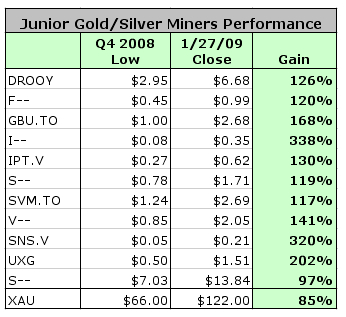
Many of the companies that meet most or all of the criteria above have already bottomed and are quietly posting exceptional gains that outpace those of the major producers. Even with today’s decline in gold equities, many of my favorite juniors are up 100% or more since their respective Q4 2008 lows. A few of these companies were recommended in the premium subscription service and have been masked out of respect to paying subscribers. All of the gains listed below were produced in just 1-3 months and illustrate the explosion in junior miners that most analysts and newsletter writers seem to be missing.

click to enlarge

As the entire gold and silver sector has done well over the time period, I have included the PHLX Gold and Silver Index (XAU) index at the bottom for comparison sake. While the XAU is up 85%, the average gain for the junior mining companies that we track over the same time period is 171% or double the gain of XAU. Junior miners are not only joining in this latest rally, they are leading the rally and gaining at twice the pace of the major gold mining companies.

Those that are comfortable with a higher risk/reward proposition might want to take a second look at junior mining companies during 2009. If the trend continues or accelerates as investors warm back up to juniors, we could see the return of another explosive few years for junior mining companies as gold pushes above $1,000 on its way towards its inflation-adjusted high of $2,300.

Catch the New Bull! – Buy Gold Online – Safely, quickly, and at low prices, guaranteed! Bullion Vault.com

===================================================

Now From One of the Masters’ Himself Jim Sinclair

Jim’s Outlook On 2009


First, to keep things in proper perspective, GLD has already appreciated 27% since Nov 12, 2008. Also, let us not forget that central banks have a perverted sense of humor and plenty of “funny money” and other diversionary tricks up their sleeves to defer the inevitable arrival of inflation. With this as our background, I will jump right into my strategic analysis for trading or investing in gold.

GLD hit resistance at 90.19, has retreated and appears headed to test support at 86.50 with the possibility of also filling a minor gap at the 85 level.

If support holds, the natural inclination is to buy (entry at 86.75 with a stop loss at 84.12 for -3% maximum loss). Assuming one is playing this trade for an exit at its most recent resistance, i.e. at 90.19, the risk to reward ratio is only at 1.33. In a fear-driven market environment, I am strongly inclined to pass on these odds (even with beer goggles).

Ideally, a trade with a minimum risk to reward ratio at 3 or 4 is much more seductive, even in interesting times like these. However, to find the ideal opportunity, one needs to be patient and think counter-intuitive to the buy low and sell high paradigm. Hypothetically (I only say “hypothetically” because I have been long GLD at 74.85 since Oct 29, 2008), I would wait for GLD to break above its resistance at 90.19 and buy at $90.50. This would confirm that there is additional demand and fresh support at this level.

Here is where the trade can get a little tricky. There is some resistance at the 92 level and one should probably anticipate a minor pullback and retest of the newly established level of support at the 90 area. However, if support is violated, I am willing to accept a stop loss at 89 for a -1.5% maximum loss of capital. In the majority of instances when support fails the “retest”, this signals a false breakout.

Now let’s get to the good part. If the breakout is legitimate, then GLD should run to the 97.50 area, which is its next level of major resistance and also where I would definitely be inclined to book some short-term profits or at least hedge my position with long puts and/or short calls. Under this scenario, this trade presents a much more attractive risk to reward ratio at 5.24.

Gold certainly has both technical and fundamental positives going for it. The short, intermediate, and long term are all trending upward while the monetary policies of global central banks reflect a desperate willingness to accept future inflation to avert the immediate threat of deflation. Another tail wind, also aiding gold’s bullish movement, is the recent weakness and apparent correction in the U.S. Dollar Index.

In summary, the example of the above trading strategy is an opinion on how to play gold for those who are risk averse and can ill afford to lose more capital. Otherwise, for those turned on by a fundamentally bullish or bearish bias towards the precious metal, assume the position (pun intended) and enjoy the ride along with all its ups and downs. Yeah Baby!!!

Disclosures: Hillbent.com, Inc. or its affiliates may own positions in the equities mentioned in our reports. We do not receive any compensation from any of the companies covered in our reports

=============================================

============================================

Share this:

  • Click to share on Reddit (Opens in new window) Reddit
  • Click to share on Facebook (Opens in new window) Facebook
  • Click to share on LinkedIn (Opens in new window) LinkedIn
  • More
  • Click to share on X (Opens in new window) X
  • Click to share on Pinterest (Opens in new window) Pinterest
  • Click to share on Tumblr (Opens in new window) Tumblr
  • Click to print (Opens in new window) Print
  • Click to email a link to a friend (Opens in new window) Email
Like Loading...

Is this the Move? Gold is Breaking Out!

26 Monday Jan 2009

Posted by jschulmansr in agricultural commodities, banking crisis, banks, bear market, bible, Bollinger Bands, bull market, capitalism, central banks, China, Comex, commodities, Copper, Currencies, currency, Currency and Currencies, deflation, Dennis Gartman, depression, dollar denominated, dollar denominated investments, economic, Economic Recovery, economic trends, economy, Federal Deficit, Finance, financial, Forex, Fundamental Analysis, futures, futures markets, gold, gold miners, hard assets, How To Invest, How To Make Money, id theft, India, inflation, Investing, investments, Latest News, Make Money Investing, market crash, Markets, mining companies, mining stocks, natural gas, oil, palladium, physical gold, platinum, platinum miners, precious, precious metals, price, price manipulation, prices, producers, production, silver, silver miners, small caps, spot, spot price, stagflation, Stimilus, Stimulus, Stocks, TARP, Technical Analysis, timber, Today, U.S. Dollar, Uncategorized, uranium, volatility

≈ Comments Off on Is this the Move? Gold is Breaking Out!

Tags

agricultural commodities, alternate energy, Austrian school, Bailout News, banking crisis, banks, bear market, Bollinger Bands, bull market, capitalism, central banks, China, Comex, commodities, communism, Copper, Currencies, currency, deflation, Dennis Gartman, depression, diamonds, dollar denominated, dollar denominated investments, economic, economic trends, economy, Federal Deficit, financial, Forex, futures, futures markets, gold, gold miners, hard assets, heating oil, India, inflation, investments, Keith Fitz-Gerald, Marc Faber, market crash, Markets, mining companies, Moving Averages, natural gas, oil, palladium, Peter Schiff, physical gold, platinum, platinum miners, precious metals, price, price manipulation, prices, producers, production, protection, rare earth metals, recession, risk, run on banks, safety, Saudi Arabia, Sean Rakhimov, silver, silver miners, socialism, sovereign, spot, spot price, stagflation, Technical Analysis, timber, U.S. Dollar, volatility, warrants, Water

As I write Gold currently is up another $9.30 oz today! Even more importantly it is well above the psychologically important price level of $900 oz. A new high will confirm the breakout and BANG! we’re off to the races. Todays past has some good articles detailing why could could be breaking out here. Enjoy and Good Investing!- jschulmansr

============================================

Here is a safe way for even a small investor to get in on the Gold Rush! You can buy quantities as little as 1 gram to 1000’s of oz. I personally use Bullion Vault for my physical metal purchases.

Catch the New Bull! – Buy Gold Online – Safely, quickly, and at low prices, guaranteed! Bullion Vault.com

============================================

Could There Be a Real Breakout In Gold?— Seeking Alpha

By: Trader Mark of Fund My Mutual Fund

After a series of head fakes much of the past half year, the most watched move in the market might finally be “real” this time. With all the world’s printing presses going on overdrive, and currencies being mocked – gold “should” have been rocketing. Many theories persist on why it hasn’t, but really it does not matter. The price action is all that matters and this type of movement will get the technicians very interested.

Things to like
1) a series of higher lows
2) the trendline of lower highs has been penetrated

Things to see for confirmation
1) any pullback is bought
2) price prints over October 2008’s highs, signaling the end of “lower highs”

When last we looked about 6 weeks ago [Dec 11: Dollar v Gold – Can we Trust this Change?] , it was just another headfake – this formation on the chart does look more promising.

These are 2 names; one in gold and one in silver we’ve had our eyes on.

Or just play it simple and go double long gold


==================================================

Happy Days For Gold? —Seeking Alpha

By: Jeff Pierce of Zen Trader

Gold was in the spotlight on Friday in a big way, nearly moving $39. Is this a hat tip to the big move that many goldbugs have been anticipating? Is all the money printing that the Federal Reserve finally catching up with the US Dollar? Should you have bought gold on Friday because it’s a straight line up from here? Let me preface my answers by saying that I’m a short term trader that will sometimes allow a trade to turn into a longer term trade but that doesn’t happen very often. I’m currently flat precious metals but will be looking for a good risk/reward, but for anybody reading this know that this analysis is from a momentum based perspective.

So the answers to the previous questions I believe are yes, yes, and no.

gld

I’m a big fan of gold for a number of reasons (fundamental, technical, historical) but I know from experience that it trades much different from a momentum point of view. It tends to sell off once it goes outside it’s upper bollinger band as seen by the arrows above. Just when it looks like gold is going to bust out and move to blue skies it seems to run out of buyers and reverses. As you can see GLD and many individual gold miners moved outside this indicator on Friday and I expect a small pullback before it begins a new wave up.

Judging by the negative divergence on the RSI you can easily see that momentum is waning. As the stock has been making higher highs, the RSI has not been confirming the move. We could possibly move up to the 92 level before profit taking hits, but I just don’t see a good entry at this point if you’re not already invested in these stocks. It would be more prudent to wait for a slight low volume pullback before entering. The only problem with this way of thinking is there could possibly be many with this outlook and that could actually propel gold to higher levels, but I’m willing to risk that because if it does move up even more, then that will confirm the strength and I’ll buy even more on the eventual dip.

If you are long from lower levels I would consider taking some profits off the table now to prevent yourself from giving up any of your gains.

“I made all my money selling to soon.” ~ JP Morgan

slv

I like silver’s chart a tad better from a technical aspect as the base that it’s been building since last September seems a little more stable. The RSI trendline has been steadily moving higher as the price has been trending higher which is very bullish. I think we’re a tad overbought here and will be looking to get long stocks such as PAAS, SLW, and SSRI when we pullback or move sideways for a week or two.

=================================================

Now- Some Commentary by Dennis Gartman

Dennis Gartman on Gold, Oil, Government and the Economy- Seeking Alpha

Source: The Gold Report

With a real roller-coaster year behind us, how would you characterize your macro overview of major economic trends for 2009?

Dennis Gartman: It’s abundantly clear that we have been in recession; we’re in a recession; and we’re likely to remain in a recession through the greatest portion of 2009. The monetary authorities around the world have done all the things they’re supposed to do, which is during a period of economic weakness throw liquidity in the system as abundantly, as swiftly, as manifestly as possible and expect the liquidity eventually to wend its way through the economy and strengthen economic circumstances. That may be sometime late in 2009. In the meantime, we’ll see continued bad economic data and continued increases in unemployment. It’s going to seem like things are really, really, really bad.

But let’s remember that things are always their worst at the bottom. By definition, recessions begin at the peak of economic activity when all economic data looks its best. So while things will start to look very bad through the rest of 2009, I bet that by late this year and early 2010 we will start to see economic strength coming at us because of the liquidity injections going on everywhere.

TGR: What will be the first signs that we’ve reached the bottom in terms of the recession and are starting to turn around?

DG: The signs of a turnaround will be that everybody believes that there are no signs of a turnaround. We’ll see Newsweek writing a series of cover stories talking about the end of Western civilization. The Financial Times of London headlines will read, “The Recession Seems Endless” and “Depression Is Upon Us.” Every day’s Wall Street Journal articles will be just manifestly bleak in nature. That’s what the signs will be.

And then all of a sudden, things shall begin to turn around. But the signs are always their worst at the bottom. That’s how things function.

TGR: So the popular press is in essence on a delay mode.

DG: Oh, it always is.

TGR: By three months, by six months, by a year?

DG: It’s probably a little less slow to react than it used to be, but let’s say three months.

TGR: So you like the fact that the monetary authorities have put liquidity into the system?

DG: Absolutely.

TGR: And it sounds as if you think it just takes time to work through the system.

DG: Always has; always will. That’s how these things go about. You have recessions because you had an economic advance where, in Greenspan’s terms, “irrational exuberance took over.” You have to dash that irrational exuberance and make it into irrational depression. Irrational, manifestly bleak, black philosophies have to make their way to the public. That’s just how these things happen; it’s happened time and time again.

The recession that I recall the most clearly is that of ’72-’74. We have to remember that unemployment was high up in double digits. We saw plenty of articles in the press about the new depression. If you go back and read articles from July through September of 1974, you will be convinced that we will never have an economic rebound in our lives again. Well, clearly, that’s just not the case.

TGR: What about the bearish people who say we’ve never seen worldwide conditions like this and that we’re in the “new era”?

DG: We probably haven’t seen the world going into recession at one time such as we are now. But I think that’s simply indicative of the fact that today’s communications are so much better. People in the United States or Canada or Europe really never would have known much about a recession in India 20 years ago, because the news media would not have covered it. Nothing told you about economic circumstances abroad. Now, with the Internet, information comes at you absolutely one-on-one.

All correlations have gone to one in this present environment. When stocks go down in the United States, they go down in India. When they go down in India, they go down in Vietnam. When they go down in Vietnam, they go down in Australia. That wasn’t the case 20 years ago; you didn’t have the small world united through communications that we have now. And now the correlations of emerging markets and large markets have all come together.

TGR: If that’s true, and worldwide financial markets are all tied together, could any given country “emerge” as a growth country while the rest remain in recession?

DG: Oh, it’s possible, but I don’t think we’ll call them “emerging markets” anymore. You’ll just find that one country pursued better economic policies, probably by cutting taxes or increasing government spending or doing away with some onerous legal circumstance that might have previously inhibited economic activity. The Chinese are doing any number of good things at this point, and that country may just have been more enlightened and it may come out of the recession faster than the others do. But now they won’t do it on their own, and anybody who does do it will be watched and understood much more swiftly than in the past. For example, did you ever know what was going on in Iceland 10 years ago? Of course not; but now you do.

TGR: Right. The only emerging markets we heard about were China and India. No one ever discussed South America.

DG: And now they’ve emerged. But now we understand. We hear news from Venezuela every day. Now we hear news from Sri Lanka every day if we want it; we can get it very easily. We couldn’t do that 10 years ago; 20 years ago clearly we couldn’t. That’s been the big change. Information travels so much more rapidly. That’s why all the correlations have gone to one. We are now one large economic machine that maybe one of the component parts does a little bit better, but it won’t shock anybody, and there won’t be anything “emerging.”

TGR: Back to the bear people. You referenced the ’72-’74 economy, but this time, many are pointing to the debt situation that the U.S. and probably a bunch of the world economies are in and the fact that we’re committing to billions—and in the U.S., trillions—of dollars more. Won’t that influx of new money have some kind of significant bear impact going forward?

DG: No, it will have a bullish impact. Unless all the rules of economics have been rescinded, money pushed into a system will push economic activity higher.

TGR: But it will also push inflation higher.

DG: Oh, that’s very likely to happen. The question is whether it will be inflation of 1%, 2%, 5%, or will it be a Zimbabwean-like inflation? The latter isn’t going to happen, and 1% isn’t likely going to happen. But 2% to 5% inflation? Yes, that’s likely to happen several years down the line.

TGR: Gold bugs are saying, “Buy gold now.” What would be your advice under these circumstances?

DG: I happen to be modestly bullish on the gold market, but not because of inflationary concerns. It’s more that I think gold has quietly moved up the ladder of reservable assets, a reservable asset being one that central banks are willing to keep on their balance sheets, all things being equal. Dollars are still the world’s dominant reservable asset. The Euro is next and gold is probably the third.

The Fed has thrown off a lot of other assets and taken on securities, debt instruments, mortgages and the like, but I think they’re doing exactly the right thing. Some central banks with a lot of U.S. government securities on the balance sheet may decide that going forward, they may buy more gold rather than more U.S. government securities if they’re running an imbalance of trade surplus. For instance, if I’m the Bank of China and I hold a minuscule sum of gold, maybe I should own a slightly larger minuscule sum.

TGR: That’s really diversifying your monetary assets.

DG: I think that’s all that will drive the gold prices quietly higher. I am not a gold bug; I don’t think the world’s coming to an end. I think the history of man is to progress. And yes, we have relatively large amounts of debt, but you can go back to the recession of 1974; you can go back to 1980-81; you can go back to the recession of 1907, and you will see the same arguments—that the world is too debt-laden. And the same arguments, the same language, the same verbiage was always written in exactly the same circumstances. Guess what? We moved on. This time might be different, but I’ll bet that it won’t be.

TGR: What would your recommendation for investors to do in gold? If they want to do any type of holding assets in monetary value, should they be looking at holding physical gold or buying ETFs or buying into the equity?

DG: For the past several years, I’ve told people that if they’re going to make the implied bet on gold, bet on gold. The gold bugs tell you that you have to own bullion. I say, no, you should really own the GLD, the ETF. It trades tick-for-tick with gold. If some truly untoward chaotic circumstance ran through the world’s banking system I guess maybe GLD and bullion would diverge at some point, but we’d have other problems long before that would occur. So if you’re going to make the implied bet on gold, bet on gold. Do the GLD.

TGR: But not physical gold?

DG: I do own some physical gold. But do I own a lot of it? No. And quite honestly, I hope I lose money on the physical gold I have. It’s an insurance policy. Nothing more than that.

TGR:: Are you looking at physical gold as the insurance policy or any investment in gold as an insurance policy?

DG: There’s the old saying, “Those aren’t eatin’ sardines; them is trading sardines.” Some gold I consider to be tradable, and that’s ETF-type stuff, and I have a small amount in the lockbox in the form of gold coins. That’s my insurance policy.

TGR: That would be what the typical investment broker might advise, 5% to 10% in gold.

DG: That’s it. Exactly, that’s it. Don’t get overwhelmed by it.

TGR: How about mining stocks?

DG: If you’re going to bet on gold, there’s nothing worse than being bullish on gold and owning some mine—especially in some junior fly-by-night—and walking in one morning and finding out that the mine you thought you had got flooded or all of your workers were unionized and walked off or management was somewhat derelict. You may have been right on the direction of gold, but your stock went down. So I’ve told people to stay away from the juniors; that’s a terrible bet on gold. If you’re going to bet on gold, bet on gold.

Maybe you’ll want to start punting on Barrick Gold Corporation (NYSE: ABX) or Newmont Mining Corp. (NYSE: NEM) or the real large names, rather than the juniors. There’s just too much risk in the juniors. Yes, everybody says, “I bought this junior at a nickel and now it’s at 15 cents.” Well, jolly for you, but you probably bought 15 others at a nickel, and they’re all bankrupt. If you’re going to bet on gold, bet on gold.

TGR: So you’re saying with that advice that if you want to bet on gold equity, bet on blue-chip gold equity stocks that have just been hammered down through the market.

DG: That’s correct, Agnico-Eagle Mines (TSX: AEM), ASA Ltd. (NYSE: ASA), the Newmonts, the Barricks, that sort of thing.

TGR: If we take that logic and look across the broad array of sectors, would you also recommend looking at other blue chips that have just been battered? Or do you think that some sectors will recover faster than others? Such as the financial sector, the energy sector, the housing sector, the precious metals sector?

DG: I’m really quite bullish on infrastructure—the movers and the makers of the things that if you drop them on your foot, it will hurt. I think I want to own steel and copper and railroads and tractors because I think we’re going to be building roads and bridges. That’s probably one of the things that probably will bring us out of the economic morass. Along those lines, I wouldn’t mind owning a little bit of gold at the same time.

TGR: Unlike gold that you can buy and own, if you look at steel and copper, are there specific companies and equities that are appealing to you?

DG: Again, as in gold, if I am going to buy gold equities, I’m going to buy the biggest names. If I’m going to buy steel, I’m going to buy the biggest names. U.S. Steel comes to mind. That’s the easiest; that’s the best; that’s where liquidity lives. It has been bashed down from the highs made last July; it’s down—what?—75% from its high. Recently it stopped going down and is in fact starting to go up now on bad news. So if you’re going to buy steel, buy the most obvious ones—U.S. Steel or buy Newcorp.

TGR: You talked about the energy market being weak in one of your recent newsletters. Do you see this weakness continuing or do you see a turnaround happening in ’09?

DG: The one thing that we can rest assured in the rest of the world is that OPEC chiefs cheat on each other—they always have and they always will. So when OPEC says that it’s cut production, that’s a lovely thing. No, they haven’t, and they don’t. Because the problem OPEC has is they’ve all raised their standards of living and the expectations of their people, and they all have cash flow requirements. You have to sell three times as much $50 crude oils as you sold $150 crude oil to meet the demands of your populace that you have increased. So the lovely thing from a North American perspective is that Chavez finds himself in a very uncomfortable position and needs to produce a lot more crude oil to keep his public happy. It’s rather comical, isn’t it, that Chavez was giving crude oil away to the Kennedy family to be distributed to people in the Northeastern United States until two weeks ago when he had to stop. He had to stop because he needs the crude oil on his own to sell, not to give away, to meet cash flow demands.

Iran is in exactly the same position. Isn’t it lovely to see that Putin, who was really feeling his military oats six months ago with $150 oil, has to pick fights with Ukraine and smaller countries now with crude at $45 a barrel? Where is crude going to go? I wouldn’t be surprised if we make new lows.

TGR: Will there be new lows for ’09? Are you buying into this whole peak oil argument that production eventually will be unable to meet demand?

DG: Do I believe that we’re going to run out of crude oil in the next 100 years? Not on your life. Sometime in the next 10,000 years we probably will run out of crude oil. In that instance, I am a peak oil believer. It’s not going to happen soon though. I remember they told me when I was in undergraduate school back in the late ’60s that we would be out of crude oil by 1984.

TGR: Do you mean out of oil? Or at a point where demand exceeds production?

DG: We would be out! Gone, done! There would be no more. Isn’t it interesting? We’ve pumped crude oil for 28 more years. This is an interesting statistic: We have either seven or eight times more proven reserves now than we had in 1969. And I think we have used a bit of crude oil between now and 1969.

TGR: Just a wee bit.

DG: A wee bit, and yet we have seven or eight times more proven reserves. Every year we have more proven reserves. So, yes, I’m a peak oil believer. Sometime in the next 10,000 years we will run out of crude.

TGR: With Obama now in office and talking about getting off our reliance on foreign oil, what’s your view of the future on all the alternative energies that are being so pushed by many people in the U.S. government?

DG: I think it’s wonderful job-creation programs, none of which will prove to be of much merit at all. All of the Birkenstock-wearing greens will feel very good about having their rooftops covered by solar panels, but is that going to resolve any energy problems we have? No. No. Nuclear power will do that. Maybe using the oceans will do that, but wind power, probably not. Solar power, probably not. It makes everybody feel good, but are we going to power our cars in the next 40 years with solar power? I doubt it. Do I expect some sort of material technological breakthrough in the next 100 years that will change what we use as energy? Oh, absolutely. Do I have any idea what it will be? Of course not.

TGR: If the price of oil if it remains low, is there a role for nuclear in the next 50 years?

DG: Oh, absolutely.

TGR: What will drive that?

DG: It’s absurd that we don’t use nuclear energy. Even the French derive 80% of their electricity from nuclear energy, cleanly, efficiently, without any problems whatsoever. Why we don’t do the same in the United States other than the left and the eco-radicals keeping us from doing it is really quite beyond me.

TGR: So, given that we still have eco-radicals and a big push toward alternative energies, do you see anything happening in the U.S. in nuclear in the near future?

DG: Yes, actually. It’s interesting. There are a lot of new nuclear facilities on the drawing boards, and they’re probably going to be approved. If there’s going to be one surprise by the Obama Administration, it will be that you don’t get nuclear energy advances under a right-wing government; you always get them under a left-wing government. Obama will be smart enough to understand that that’s the only way—that’s the best and cleanest methodology to use. And the left won’t argue with a fellow leftist pushing for nuclear energy. Only Nixon could go to China; only Obama can push nuclear energy.

TGR: And you think that he will?

DG: Oh, yeah, he’s smart enough to understand that.

TGR: Going back to your investment strategy, which big blue chip players in oil and nuclear would you point out as good investments?

DG: In oil, I’d want to take a look at companies such as ConocoPhillips (NYSE: COP), which dropped 70% from its highs. How can you go wrong with the Conocos and the Marathons and the large oil companies whose price-to-earnings multiples are down to at single digits and their dividend streams are 5%, 6%, and 7%? Why would you not want to own those? That’s the best investment.

And at the same time, the volatility indices on the stock market are so high that, gee, you can buy Conoco, get the dividend, and sell out of the money calls at very high premiums and ramp your dividend yield up. It’s like a gift; it’s like manna.

TGR: Well, what about in terms of the nuclear sector and uranium?

DG: I really don’t understand uranium. I don’t know where to go, and I don’t how to buy it yet. So I’ll just say there’s a future for it, but I don’t know what to do with it.

TGR: What other sectors should be looking at for 2009?

DG: Banks, banks.

TGR: They’re making a comeback. Do you think there will be more consolidations?

DG: There will be more consolidations; there has to be. But look at the yield curve—what a year to be a bank! The overnight Fed funds rate, the rate banks are going to pay depositors for their demand deposits or checking accounts is zero. And you’re going to be able to lend that out to hungry borrowers at 7%, 8%, 9%, 10% and 12%. The next three years will be the greatest three years banks have ever seen. Banks will just make money hand over bloody fist in the next three years.

TGR: Are you talking about the big boys?

DG: No, I’m talking about the regionals. The big boys have problems in toxic assets. I am not even sure there is a Peoples Bank & Trust in Rocky Mount, North Carolina, but a bank like that—or the First National Bank of Keokuk, Iowa or the First National, or the Peoples Bank & Trust of Park City, Utah—those are the banks that are going to make lots of money.

TGR: Do you see an explosion in regional banks? Will move of them come into the marketplace?

DG: I think we’ve probably got all we need. It’s just that they’re very cheap.

TGR: What will the role of the international banks be?

DG: Mopping up the disasters that they’ve created for themselves for the past decade, trying to survive, being envious of the decent regional banks that are going to be earning enormous yields on this positively sloped yield curve and wishing they were they.

TGR: Do you see a role long term for international banks?

DG: Oh, sure, of course. How could there not be? It’s a smaller world; it’s an international world; it’s a global world. International banks will be back in full force a decade from now. They’ve got some wound-licking to do, and they’ll do it.

TGR: In addition to regional banks as being a great play to look at for ’09, ’10, any other interesting plays to bring up?

DG: You want to own food and grains again.

TGR: Are you talking about grains or food producers like Nabisco?

DG: No, I think you want to own grains. If you’re going to make a speculation, I think you want to own on the grain markets again.

TGR: Grain for human consumption or grain for livestock consumption?

DG: Yes and yes.

TGR: Are you looking at buying that on the commodities market?

DG: You can actually buy that on ETFs now. The wonderful world of ETFs is just extraordinary. You can actually buy a grain ETF now. DBA (DB Agriculture Fund) is one; JJG (iPath Grains) is another. Those are basically long positions in the grain market. Wonderful things to use.

TGR: You like ETFs; but the naysayers will say that ETFs could be encumbered and there’s actually no guarantee that they hold any assets.

DG: That’s true; that’s correct.

TGR: But you’re comfortable that people should go into an ETF for grains?

DG: I didn’t say that. What I said is if you wish to trade in grain, there are ETFs that will do that. Do I know for sure that they will all perform perfectly and that if the world were to come to a chaotic banking circumstance that there wouldn’t be problems? I don’t know that. Does that bother me? No. It doesn’t bother me even slightly.

Should you worry about [not trading] an ETF just because there might be some problem under an untoward economic environment? No, it’s illogical. And shame on those people who say those sorts of things or who tell you not to use them because they ETF may not function properly if there is some total breakdown in the banking system. Well, if that happens, we have other problems.

TGR: And what’s your projection for the overall investment market? We’ve been hearing speculation that it will rise through April, bottom out even deeper than it is today, and then a slow climb in 2010.

DG: Gee, I have no idea. I just think that stock prices will be higher six months from now than they are now, much higher 12 months than they will be six months from now, and higher still in 24 months than they will be 12 months from now. But where will they be in April? Golly, I don’t know. I think the worst is far behind us and better circumstances lie ahead. And that’s the first time in a loooonnnng while that I’ve said that.

TGR: Yeah, now if the media will just catch up with you, we can enjoy watching it again.

DG: It won’t. Watch the news; it will just get bleaker and bleaker as the year goes on. And watch the unemployment rate; it’s going to be a lot higher.

TGR: Other than Barack Obama saying we’re going to start building infrastructure, do you anticipate any dramatic changes in the U.S.? Right now we’re a services country, and we need to move back to being a manufacturing country.

DG: We’ll never move back to being a manufacturing country. Won’t happen. Here’s an interesting bit of data. Do you know what year that we had the absolute high number—not just as a percentage of population—but the absolute high number of manufacturing jobs was in the United States?

TGR: Somewhere around the World War II era.

DG: Very good, 1943. We have lost manufacturing jobs since 1943. I think that’s a fairly well-established trend.

TGR: Is there a future for the services sector, though? That’s the key.

DG: It will be larger. And so what? It’s like saying we need more farmers. No. We need fewer farmers. We have one-hundredth as many farmers as we had at the turn of the 20th century. We now 500 times more grain? Seems to me every time we lose a small farmer, we get better. So, we need fewer farmers. And we need fewer manufacturing jobs.

TGR: But doesn’t that put the onus on the United States as the economic world leader? Considering the fact that, as you mentioned, information now is instantly available everywhere, just in terms of worldwide confidence; it seems like every time we hiccup, the planet hears it?

DG: There is probably some truth to that fact. But it is probably not us that will lead; it’s probably Australia or New Zealand or the Baltic States or some smaller country that actually changes policies and frees up markets and cuts taxes, and all of a sudden their economy starts to turn around. Then people elsewhere will say, “Oh, look! That’s the right thing to do. Let’s us go do that.”

TGR: Really? Economic recovery worldwide will not come from the United States?

DG: Well, if we don’t recover, the rest of the world won’t, but we won’t be the first. What I am saying is that some smaller country will do the right things faster than we do.

TGR: Isn’t what Australia does irrelevant to what the U.S. needs to do?

DG: No, it’s dramatically relevant. If Australia starts to do things properly—if Australia were to suddenly come out and slash taxes and go to a flat tax and cut paperwork by 50% and it’s economy starts to turn higher, wouldn’t that be a good incentive for us to do the same thing?

TGR: But that implies that every country should use the same economic strategy; that we’re all basically at the same state in our economic development. That what will work for Zimbabwe or China will work for the U.S.

DG: I think anywhere in the world that you have smaller government, lesser taxes—every time you do that, that economy, no matter where it is, does better. It does better. And anywhere you put higher taxes and more government, that economy usually does worse. It does; it just does.

TGR: You’re looking at it from a macro point of view.

DG: I’m looking at it just from an economic point of view, whether macro or micro. Look at Ireland, for example. Why was Ireland for many years the “Celtic Tiger” of Europe? Their tax regime was lower than the rest of Continental Europe. The Germans and the French, who are statists, who are collectivists, instead of emulating the Irish, kept trying to drag Ireland down to their level. Now, that was stupid, wasn’t it? That didn’t work.

My favorite example is New Zealand back in the 1980s. Every year from the 1970s through the 1980s, New Zealand ran a budget deficit and a trade deficit. Every year the IMF said, “You must raise your taxes and cut the value of your currency to try to balance your budget and run a trade surplus.” So New Zealand would do that, and every year the deficit got worse and their trade imbalance grew larger. They did this for five or six years and it got worse every time they did it—every time they followed the IMF tactic of raising taxes and cutting the value of the currency.

Finally New Zealand Treasury Secretary Graham Scott (Secretary from 1986–93) told the IMF, “Don’t ever come back here. Everything you’ve told us to do has proven to be utterly worthless. We’re going the other way. We’re slashing taxes.” From I think a 75% marginal tax rate, over the course of five years, they cut it to like 18%. And every year they took in more money—more money—every time they cut taxes they took in more money. And when they strengthened their currency, their exports picked up; as their currency got stronger, they exported more stuff. Isn’t it fascinating?

TGR: That’s the paradox.

DG: It got to be so interesting—it wasn’t Gordon Campbell—I’m trying to remember; I just went blank for his name. But he passed the baton on to a woman by the name of Ruth Richardson, who was a little more leftwing than her predecessor—the tax rate was down to a flat 18%. They asked her if she was going to cut it again, and she said, “You know, I don’t think I can cut it any more; I can’t spend the revenue I am taking in now.” It’s a classic line. So, what does she do? They actually started raising the tax rates again, and what happened? Tax revenues fell.

But New Zealand had taught a lot of people that cutting taxes and strengthening your currency is the best thing you can do. And as they were cutting taxes, they kept cutting prohibitions and regulations; they kept chopping them back. They were the real precursors of the Free Market Movement that developed in the early ’90s and the early ’00s.

TGR: Let’s hope the United States learns from that. Obama announced his tax cuts; we’ll see what comes of that.

DG: He said entitlements are even on the table. Can you imagine a Republican ever making that statement? They would boo him. But here’s a leftist who puts it on the table. He can say that.

Irreverent, outspoken, entertaining, sardonic and—in his own words, a “glib S-O-B,” Dennis Gartman has been producing The Gartman Letter for more than 20 years. His daily commentary on global capital markets as well as short- and long-term perspectives on political, economic and technical circumstances goes to leading banks, brokerage firms, hedge funds, mutual funds, energy companies and grain traders around the world.

A 1972 graduate of the University of Akron (Ohio), he undertook graduate studies at North Carolina State University in Raleigh (where he remains involved as a member of the Investment Committee.

Before devoting himself full-time to The Gartman Letter, Dennis analyzed cotton supply and demand in the U.S. textile industry as an economist for Cotton, Inc.; traded foreign exchange and money market instruments at North Carolina National Bank, went to Chicago to serve as A.G. Becker & Company’s Chief Financial Futures Analyst and then become an independent member of the Chicago Board of Trade, dealing in treasury bonds and notes and GNMA futures contracts; and moved to Virginia to run Virginia National Bank’s futures brokerage operation.

In addition to publishing The Gartman Letter, Dennis delivers speeches to audiences around the world (including central banks, finance ministries, and trade groups), teaches classes on derivatives for the Federal Reserve Bank’s School for Bank Examiners, and makes frequent guest appearances on CNBC, ROB-TV and Bloomberg television.

==============================================

Finally for the Technical Analysis Junkies (like me!) here is an awesome article!

===============================================

Market Leaders Hesitate on Stimulus Plan— Seeking Alpha

By: Chris Ciovacco of Ciovacco Capital Management

Proposed Economic Stimulus Plan May Not Stimulate Much

The new administration is proposing an $825 billion “stimulus” plan. Most of the package is geared toward helping existing or expanded programs such as unemployment assistance, law enforcement, food stamps, etc. Much of this spending will “save” existing jobs or keep existing programs already in place. This may help prevent things from getting worse, but it will offer little in the way of providing new stimulation for the economy. Another large portion of the stimulus plan is in the form of tax cuts. While depreciation incentives may spur some new business spending, credits to individuals may offer little incentive to spend given the state of their balance sheets and concerns about employment. After all the hype about infrastructure spending, only about 25% of the package is geared toward this area.

Tug of War Between Liquidity and Economic Weakness

The chart below was created on the website of the Federal Reserve Bank of St. Louis. It shows the eye-popping expansion of the money supply as financial institutions have swapped securities and other “assets” for cash via borrowing from the Federal Reserve. Borrowing prior to this crisis is barely visible on the graph. Recent borrowing is an extreme example of the term “spike” on a graph. Despite the never before seen tapping of the Fed, financial assets show little evidence of reflation taking place.

Borrowing From FEDU.S. Stocks: Downtrend Remains In Place

If you compare the long S&P 500 ETF (SPY) to the short S&P 500 ETF (SH), it is clear the short side of the market is in better shape. There is little in the way of fundamentals, except hope of government bailouts, to expect any change to these trends.
S&P 500 ETF - SPY - LongRecent weakness in the S&P 500 Index leaves open the possibility that we will revisit the November 2008 lows around 740 (intraday). If those lows do not hold, a move back toward 600 becomes quite possible. On Friday (1/23/09) the S&P 500 closed at 832. A drop back to 740 is a loss of 11%. A move back to 600 would be a drop of 28%. These figures along with the current downtrend highlight the importance of principal protection and hedging strategies. SH, the short S&P 500 ETF, can be used to protect long positions or to play the short side of the market.

2009 Investing Deflation Inflation Outlook StrategyGold & Gold Stocks Still Face Hurdles

Friday’s big moves in gold (GLD) and gold mining stocks (GDX) have some calling a new uptrend. While recent moves have been impressive some hurdles remain.

Gold At Important LevelsGold stocks (GDX) look a little stronger than gold, but any entry in the market should be modest in size. If $38.88 can be exceeded, our confidence would increase and possibly our exposure.

2009 Investing Deflation Inflation Outlook StrategyRun In Treasuries Is Long In The Tooth

Investments with the highest probability of success are those with positive fundamentals and positive technicals. Conversely, the least attractive investments have poor fundamentals and poor technicals. With the U.S. government issuing new bonds at an alarming rate, a continued deterioration in the technicals could signal the end of the Treasury bubble.

2009 Investing Deflation Inflation Outlook StrategyTBT offers a way to possibly profit from the negative forces aligning against U.S. Treasury bonds.

2009 Investing Deflation Inflation Outlook StrategyStrength In Bonds Shows Little Fear of Price Inflation

The government’s policies are attempting to stem the tide of falling asset prices. They hope to reinflate economic activity along with asset prices. The charts here show:

  •  
    • A weak stock market (see SPY above), and
    • An improvement in many fixed income investments (below: LQD, AGG, BMT, PHK, and AWF).

Weak stocks and stronger bonds tell us the government’s reflation efforts are thus far not working. If concerns about deflation remain more prevalent than concerns about inflation, fixed income assets may offer us an apportunity. With money markets, CDs, and Treasuries paying next to nothing, we may be able to find improved yields in the following:

  •  
    • LQD – Investment Grade Corporate Bonds
    • AGG – Investment Grade Bonds – Diversified
    • BMT – Insured Municipal Bonds
    • PHK – High Yield Bonds
    • AWF – Emerging Market Government Bonds

With the economy in a weakened and fragile state, we need to tread carefully in these markets. Some key levels which may improve the odds of success are shown in the charts below. Erring on the side of not taking positions is still prudent. The markets remain in a “prove it to me” mode where we would like to see the markets move through key levels before putting capital at risk.

2009 Investing Deflation Inflation Outlook Strategy 2009 Investing Deflation Inflation Outlook Strategy 2009 Investing Deflation Inflation Outlook Strategy 2009 Investing Deflation Inflation Outlook Strategy 2009 Investing Deflation Inflation Outlook StrategyU.S. Dollar Remains Firm

From a technical perspective, the dollar continues to look strong. Its strength supports the continuation of concerns about deflation, rather than inflation.

2009 Investing Deflation Inflation Outlook StrategyDisclosure: Ciovacco Capital Management (CCM) and their clients hold positions in SH, GLD, and PHK. CCM may take long positions in GDX, TBT, LQD, AGG, BMT, and AWF.

=============================================

Catch the New Bull! – Buy Gold Online – Safely, quickly, and at low prices, guaranteed! Bullion Vault.com

=============================================

Nothing in today’s post should be considered as an offer to buy or sell any securities or other investments, it is presented for informational purposes only. As a good investor, consult you Investment Advisor,  Do Your Due Diligence, Read All Prospectus/s and related information before you make any investments. – jschulmansr

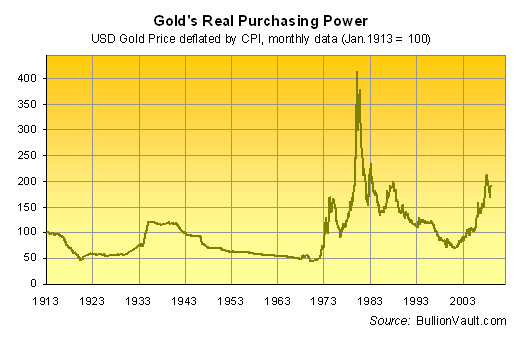
Share this:

  • Click to share on Reddit (Opens in new window) Reddit
  • Click to share on Facebook (Opens in new window) Facebook
  • Click to share on LinkedIn (Opens in new window) LinkedIn
  • More
  • Click to share on X (Opens in new window) X
  • Click to share on Pinterest (Opens in new window) Pinterest
  • Click to share on Tumblr (Opens in new window) Tumblr
  • Click to print (Opens in new window) Print
  • Click to email a link to a friend (Opens in new window) Email
Like Loading...

Scary, they’re actually Going to Pass This?

24 Saturday Jan 2009

Posted by jschulmansr in Austrian school, Bailout News, banking crisis, banks, Barack Obama, bear market, capitalism, central banks, Comex, commodities, Copper, Currencies, currency, Currency and Currencies, dollar denominated, dollar denominated investments, economic, Economic Recovery, economic trends, economy, Federal Deficit, Finance, financial, Forex, Fundamental Analysis, futures, futures markets, gold, gold miners, hard assets, How To Invest, How To Make Money, inflation, Investing, investments, Latest News, Make Money Investing, market crash, Markets, mining companies, mining stocks, platinum, platinum miners, precious, price, price manipulation, prices, producers, production, recession, risk, run on banks, safety, silver, silver miners, small caps, sovereign, spot, spot price, stagflation, Stimilus, Stimulus, Stocks, TARP, Technical Analysis, U.S. Dollar, volatility

≈ Comments Off on Scary, they’re actually Going to Pass This?

Tags

agricultural commodities, alternate energy, Austrian school, Bailout News, banking crisis, banks, bear market, Bollinger Bands, bull market, bullion, capitalism, central banks, China, Comex, commodities, communism, Copper, Currencies, currency, deflation, depression, diamonds, dollar denominated, dollar denominated investments, economic, Economic Recovery, Economic Stimulus, economic trends, economy, Federal Deficit, financial, Forex, futures, futures markets, gold, gold bars, gold coins, gold miners, goldbugs, hard assets, heating oil, hyper-inflation, India, inflation, Investing In Gold, investments, Keith Fitz-Gerald, Marc Faber, market crash, Markets, mining companies, Moving Averages, natural gas, oil, palladium, Peter Schiff, physical gold, platinum, platinum miners, precious metals, Precious Metals Investments, price, price manipulation, prices, producers, production, protection, rare earth metals, recession, risk, run on banks, safety, Saudi Arabia, Sean Rakhimov, silver, silver miners, socialism, sovereign, spot, spot price, stagflation, Stimulus, TARP, Technical Analysis, timber, U.S. Dollar, volatility, volatility index, warrants, Water

Curious?… to find out what I am talking about? Read On… Congress shouldn’t be allowed to do this! Not only am going to include the TIME magazine article, I am including the actual link to the bill itself, the press release version. The coming runaway Inflation Train and what to do to protect yourself! Read Below…Good Investing! – jschulmansr

*********************************************************************

First Here are the links…

The American Recovery and Reinvestment Bill of 2009

The American Recovery and Reinvestment Bill of 2009 Press Summary

*********************************************************************

A Guide to Reading the America Recover and Reinvestment Bill- TIME MAGAZINE

Source: Time Magazine

Brendan McDermid / Reuters

Brendan McDermid / Reuters

“Madness is to think of too many things in succession too fast, or of one thing too exclusively” — Voltaire

The American Recovery and Reinvestment Bill of 2009 should be required reading for every citizen from billionaires to the average person. It was issued by The Committee On Appropriations and is the road map for the $825 billion that the Congress and Administration intend to put into the U.S. economy to jumpstart the economy out of the recession.

The most important part of the document may be the description of how the country was dragged into the worst economic period in its history. ( See pictures of the Top 10 scared traders.)

At the beginning of the bill, the authors write: “Since 2001, as worker productivity went up, 96% of the income growth in this country went to the wealthiest 10% of society. While they were benefiting from record high worker productivity, the remaining 90% of Americans were struggling to sustain their standard of living. They sustained it by borrowing … and borrowing … and borrowing, and when they couldn’t borrow anymore, the bottom fell out.”

If that analysis is true, then two other things must be accurate. The first is that the cause of the recession was Americans becoming overextended in their use of credit. The other one, which is a consequence of the first, is that if the government can facilitate future consumer borrowing, the economy will be righted again in short order. That would mean that more complex methods of solving the problems of the recession, such as spending money on infrastructure, would be unnecessary. It would be simpler to take $825 billion and make it available for home equity loans, enlarge credit card lines, and auto loans.

But, the authors of the bill are not willing to follow their own logic, so they have crafted another plan. The first assumption of what the program will do, and among the most important of its goals, is only mentioned in passing. “This package is the first crucial step in a concerted effort to create and save 3 to 4 million jobs.” This is a little twist on what is being said in public.

The general assumption about job creation under the program is that it will add 3 to 4 million jobs. But in the introduction to the bill the assumptions about job loss are laid out quite clearly: “Credit is frozen, consumer purchasing power is in decline, in the last four months the country has lost 2 million jobs and we are expected to lose another 3 to 5 million in the next year.”

The mathematics of the two sets of employment analysis taken together would show then that no new jobs would be created. The three million or so jobs which will be lost in 2009 will simply be replaced by three million new ones. The jobs lost late in 2008 will not be replaced in this program, leaving a two million job deficit Joblessness will stay at about 7.2%

Other than those details, the money will be well spent.

The states need help, and the federal government means to provide it: A sum of $79 billion in state fiscal relief will be provided to prevent cutbacks to key services

After the plans to help the states, cut taxes, and provide new infrastructure for the nation, the programs get a little off track.

The bill means to spend $44 million to repair the U.S. Department of Agriculture’s headquarters. About $400 million will go to repairing national monuments in Washington, which are somehow considered essential to national infrastructure.

Additionally, Congress plans to pay out $200 million to provide financial incentives for teachers and principals to do their jobs better. Another $100 million will be used to establish a set of grants to provide $100 to local governments and nonprofit organizations to remove lead-based paint hazards in low-income housing.

Perhaps the best investment in the bill is for $80 million to ensure that worker protection laws are enforced as recovery infrastructure investments are carried out. In other words, there will be a police system set up to make sure that no one with a new job working on national infrastructure with money provided by the government will have his or her rights violated.

The bill calls for over one hundred programs which Congress plans to enact. These include addressing problems as diverse as community block grants, upgrading the forestry service, bridge removal, and NASA research funding. The remarkable thing about the legislation is that almost every program is ill-defined and subject to broad interpretation and a wide variation as to how it might be enacted.

In a sentence, The American Recovery and Reinvestment Bill of 2009 will have to build a bureaucracy larger than any ever created by the US government in order to manage its many parts.

The first sentence of the bill reads “The economy is in a crisis not seen since the Great Depression.” If it requires all of these plans to get America back on the road to recovery, the process will take a decade.

— Douglas A. McIntyre

See pictures of the global financial crisis.

For constant business updates, go to 24/7wallst.com.

=========================================================

*** My Cure for the coming runaway inflation train? Read below…

=========================================================

Gold Will Shine Again in 2009 – Seeking Alpha  Part 1

By: Sean Hyman of mywealth.com

I think this one may be a shocker to many…that gold is going to be much higher at the end of 2009 than it is right now. I think it will take out its highs just above $1,000 an ounce and will head for at least $1,250 an ounce. (Gold is presently trading around $853 an ounce.)

When I was a stock broker, I hated gold. To me it was the dumbest investment on the planet. Of course I worked as a broker when gold was in a multi-year bear market.

But the more that volatile booms and busts have caused the need for more government intervention, the more of a believer I’ve become in gold.

Let’s look at several of the dynamics that have helped to form my view for gold in 2009.

South Africa is home to some of the biggest gold mines in the world. In 2008, their gold output shrank as exploding input costs caused them to close some of their most expensive mines. (Produce less of the metal and the speed of the supply shrinks which helps to support the price.)

This has been one dynamic that has helped to support prices in 2008 and that has kept gold in an 8 year bull market. Even in 2005 and 2008 when the dollar rallied, gold still held its ground. This shows a lot of strength for the metal since the dollar and gold largely trade somewhat opposite of each other (being that gold is denominated in dollars and when the dollar is rising, it tends to calm the fears for the currency which typically dulls the demand for the precious metal).

In fact, had it not been for tons of hedge fund failures and liquidations, I think gold would actually be much higher than it is right now.

Helicopter Ben & Obama will do their part to help gold out!

With the credit crisis in full swing, the Fed has responded by turning on the printing presses at full speed. This enormous increase in the money supply (which is temporarily clogged up in the banks) will eventually be unleashed on the economy. Once this happens, you will quickly see deflation erased and we may actually move into a period of hyper-inflation.

Why would I go so far as to think that? Heck, the Obama administration may print as much as a few trillion dollars to help out the banks according to former central banker Volcker.

We’ve also got another stimulus package coming within weeks according to the Obama administration.

Another reason why I feel that a huge bout of inflation will return is because of interest rates. If you’ll remember, Congress got pretty harsh with Alan Greenspan for taking rates down to 1%. They even went so far as to accuse him of causing the recent bubbles in the economy, which he denies.

Well, if the “1% cheap money” inflated things into the stratosphere, what do you think will happen with Ben Bernanke’s interest rate range of 0% to 0.25%? Could you say it would have any less of an effect? No, it will have an even greater “bubble effect” in time as the cheap money actually is released out into the economy.

Tomorrow, I’ll continue with “Part 2” of this “gold story”… So stay tuned!

Gold Will Shine Again in 2009 Part 2

by Sean Hyman

Get ready for the “economic pipes” to be unclogged and for a tidal wave of inflation to head our way!

I assure you that Obama’s economic advisors will be the “drain-o” that gets the pipes unclogged. When this happens, the Fed knows that it will have to “mop up” this excessive liquidity in the financial system.

However, here’s what I predict will happen: The Fed, while it wants to be a forecaster of the economy really just ends up becoming a “responder” after the fact to what’s going on in the economy. Therefore, between the time that the Fed starts to see the inflationary signs in the economy and starts the process of draining the excess liquidity from the economy, it will be too late. The hyper inflationary effects will already be in play. They will be “late to the ball game” yet again.

When all of this starts to happen (and possibly a bit beforehand), savvy gold investors will sense it coming and will buy up gold ahead of time…positioning themselves like a surfer that gets out ahead of the coming wave that will propel him forward.

The Fed will do its best at that point to drain the money supply and hike rates, but there are delays from when they start to act and when it actually starts to effect the economy. This “lag time” will cause a huge return of inflation in a big way that will propel gold ever higher and will eventually dilute the dollar as well.

You see, when there’s more of something in existence, it begins to hold less value. So as the money supply is quickly increasing, the dollar will eventually feel the effects of it. Remember, there’s that delayed “lagging” period which is why it hasn’t already been felt even now.

However, as sure as the sun is coming up tomorrow…it’s coming. So get prepared ahead of time. For, the key to successful investing is to buy just ahead of the massive move. This requires an investor to “think ahead”. You can’t just see what’s happening at present and prosper like you should in your investing. It requires one to be “forward looking” and thus “forward thinking”.

When all of this unfolds, investors will buy gold (which is essentially exchanging their dollars for gold) as they seek safety, liquidity and an “insurance policy” against runaway inflation.

Gold production will continue to shrink and Central Banks will hold onto their gold in 2009!

So with the economy deeply damaged, unemployment claims hitting almost 600k as of this writing, there’s not going to be a huge incentive for investors to sell gold. That’s why gold has only come off of its top by 17.9% and stocks have been 40+% off of their highs on average. You can see its underlying strength just in that fact alone.

Also, remember that gold supplies will continue to tighten in 2009 just as they did in 2008. Why? Africa’s production of gold sank 14% which was the lowest levels since 1899. That’s serious! But it’s not just a South Africa story. U.S. gold production fell 2% last year. While China (which has now become the world’s biggest producer of gold) had their production rise 3% last year, the “net” result collectively among all countries is a net slowdown in gold production.

Central bank selling in gold was down a full 42% last year. And you’d be an idiot of a central banker to sell a bunch of gold in 2009 with the U.S. and global economy still hobbling along. Therefore, you can count on these guys not adding to the selling.

Therefore, get ready to buy gold, sell dollars and buy foreign currencies like the euro and especially the Aussie dollar which is greatly helped by rising gold and other commodity prices.

Most of the increase in gold and selling of dollars may come more in the 2nd half of the year than the 1st half due to the delayed effect of Fed policy and as the Obama administration starts to get its feet wet in tackling the economic woes.

But be aware and watch for the change just in case it happens even a bit sooner than I think.

Gold consolidates its multi-year gains as it catches its breath and prepares to run “ever higher” in 2009!

=========================================================

2009 Gold Outlook

2009 Gold Outlook

How To Invest in Gold in 2009

By Luke Burgess
Monday, January 5th, 2009

The investment markets are yielding to the fact that the global economy will remain weak for the better part of 2009.

As a result, investors will continue to seek safe havens.

Under normal conditions, these safe haven investments would include land and real estate. These assets have intrinsic value; or in other words, their value will never fall to zero. But with falling prices, investing in real estate is out of the question for most people right now. And there’s little doubt that investors will look elsewhere for safety against financial crisis.

The best safe haven asset in the world right now is still gold because it is never considered to be a liability.

And we believe that safe haven investment demand will drive gold prices during 2009. With this in mind, we would like to present a broad overview of Gold World‘s 2009 gold outlook. But before we get into that, let’s review what happened to gold prices in 2008.

Gold Was One of the Best Investments of 2008

In March 2008, gold prices hit a record high of $1,033 an ounce as the gold bull market entered its seventh year of life. This was followed by a normal 18% correction, which drove gold prices back down to $850 an ounce.

Gold prices subsequently rebounded and were once again closing in on the $1,000 level in mid-July. At the same time, however, the fundamental and psychological effects of the slowing housing and credit markets were just beginning to devalue significantly the investment markets across the board.

As a result, many long gold positions had to be sold in order to cover losses from investments in other markets. Over the next several months, this forced selling pressure pushed gold prices down.

Gold prices were also held down during the second half of 2008 as the U.S. dollar enjoyed a +20% rally. Foreign governments, institutions, and banks began buying the U.S. dollar, which despite a legion of problems continues to be the world’s most important reserve currency, as a hedge against domestic economic turmoil.

20090105_2009_gold_outlook.png

These factors contributed to a significant drop in the price of gold, which officially bottomed out for the year at an intraday low of $683 an ounce in October 2008.

Gold prices have subsequently bounced off of the $700 level as major selling has dried up, and fresh buying has come into the market.

Despite three 20% corrections and serious deflation in the market, gold exited 2008 with a positive 5.4% gain for the year. Although subtle, this gain outperformed every major equity index and commodity in the world. Here are just a few examples…

Index/Commodity
Percent Change During 2008
Dow Jones
-34%
NASDAQ
-41%
S&P 500
-39%
TSX -35%
TSX Venture -74%
Oil
-55%
Silver
-23%
Copper
-54%
Gold
+5%

This made gold one of the best investments of 2008.

And the 2009 gold outlook looks just as strong.

Despite a bit of downside in the immediate future, we expect gold to have a stellar year.

Global economic turmoil and deflation will undoubtedly continue to influence gold prices in the near-term. A short-term pullback in gold prices from current levels to $800—maybe even a bit lower—before a recovery is not out of the question. However, we expect gold prices to break new records during 2009.

For our current perspective, we expect gold prices to reach as high as $1,300 during 2009, which would be a profit of over 50% from current levels.

Gold prices in 2009 will be supported more heavily by supply/demand fundamentals than in the previous years of this gold bull market.

As we’ve previously discussed, during the third quarter of 2008, world gold demand outstripped supply by 10.5 million ounces. This deficit was worth $8.5 billion and was the largest supply/demand deficit since the gold bull market of the 1970s.

Official 4Q 2008 world gold supply/demand figures will be calculated and reported later this month. Gold World will report them to you when the data is released.

In the meantime, though, all estimates suggest that there will be another very large deficit in world gold supplies from the fourth-quarter, with investment demand continuing to drive the market.

We expect that a continuing surge in investment demand could push gold prices as high as $1,300 at one point during 2009.

There will likely be a bit more volatility in the gold market in 2009 as more and more speculators come into the market. It is likely that the gold market will experience three or four price peaks (selling points) during 2009.

How to Invest in Gold for 2009

As we expect a near-term drop in gold prices as a result of continuing deflation, we are advising our readers to hold off on any physical gold buying for the immediate future. As previously mentioned, gold prices could dip back down to $800 before recovering again.

Nevertheless, we expect 2009 to be another great year for gold investors.

Good Investing,

Luke Burgess and the Gold World Research Team
www.GoldWorld.com

==========================================================

Tomorrow we’ll check on what’s the latest on the Obama eligibility issue.

Be Blessed and Remember: Dare Something Today Too!


Share this:

  • Click to share on Reddit (Opens in new window) Reddit
  • Click to share on Facebook (Opens in new window) Facebook
  • Click to share on LinkedIn (Opens in new window) LinkedIn
  • More
  • Click to share on X (Opens in new window) X
  • Click to share on Pinterest (Opens in new window) Pinterest
  • Click to share on Tumblr (Opens in new window) Tumblr
  • Click to print (Opens in new window) Print
  • Click to email a link to a friend (Opens in new window) Email
Like Loading...

Latest Obama News and The Ad “They” Don’t Want You To See!

10 Saturday Jan 2009

Posted by jschulmansr in 2008 Election, Barack Obama, communism, Conservative, Conservative Resistance, Currencies, currency, Currency and Currencies, dollar denominated, dollar denominated investments, economic, economic trends, economy, Electoral College, Finance, financial, Free Speech, Fundamental Analysis, futures, futures markets, id theft, inflation, Investing, investments, Latest News, market crash, Markets, Presidential Election, resistance, socialism, Today, u.s. constitution, U.S. Dollar, Uncategorized

≈ 2 Comments

Tags

2008 Election, Barack Dunham, Barack Hussein Obama, Barack Obama, Barry Dunham, Barry Soetoro, capitalism, Chicago Tribune, Columbia University, Currency and Currencies, D.c. press club, Electoral College, Electors, Finance, fraud, Free Speech, gold, Harvard Law School, hawaii, id theft, Indonesia, Indonesian Citizenship, Investing, investments, Joe Biden, John McCain, Latest News, legal documents, Markets, name change, natural born citizen, Oath of Allegiance of the President of the United State, Occidental College, Phillip Berg, Politics, poser, Presidential Election, Sarah Palin, socialism, Stocks, Today, treason, u.s. constitution, U.S. Dollar, Uncategorized, voter fraud, we the people foundation

Why are the major news networks refusing to allow the Obama ad below? Yes, even Fox News has refused to sell airtime to run the ad- Why? The cases and lawsuits keep trickling their way to the Supreme Court, so his “eligibility” issues will continue even after he is inaugurated. Obama- “Please just show us the Birth Certificate as any patriotic citizen would do when asked.” Why are you hiring teams at last count (3) different legal teams to prevent your birth certificate from being produced? What is Obama hiding? Could it truly be he is not eligible to be the President of The United States? Fellow citizens is our Constitution no longer important or relevant? You decide- read below…- jschulmansr

Eligibility Issue to Follow Obama into the Oval Office – World Net Daily

By Bob Unruh
© 2009 WorldNetDaily

A legal challenge that alleges Barack Obama isn’t a “natural born” citizen and therefore constitutionally ineligible to be president of the United States will follow the Democrat into the Oval Office, with a U.S. Supreme Court conference on the dispute set after the Jan. 20 inauguration.
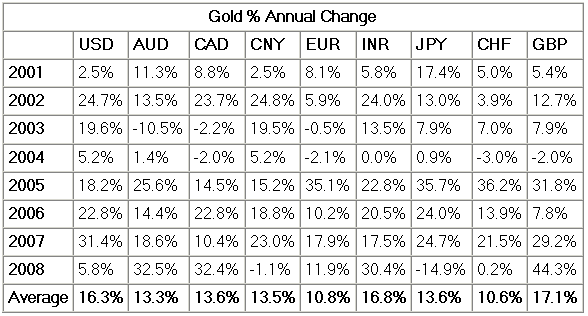
The court’s website today announced that a fourth case on the issue will be reviewed by justices Jan. 23.

The court previously heard two cases in conference – private meetings at which justices consider which cases to accept – and denied both Cort Wrotnowski and Leo Donofrio full hearings.

The court now has a conference scheduled Friday on a case raised by attorney Philip Berg, with another conference on a matter related to the same Berg case on Jan. 16. Then today the court website revealed the case Gail Lightfoot et al v. Debra Bowen, California Secretary of State, will be heard in conference Jan. 23.

The case initially appeared at the Supreme Court Dec. 12 but was rejected. It then was submitted to Chief Justice John Roberts, and today’s notice confirmed it was distributed for the Jan. 23 conference.

Orly Taitz, the California attorney handling the case, said, “The timing of this decision by the chief justice of the Supreme Court, John Roberts, is absolutely remarkable. On January 7, one day before the January 8 vote by Congress and Senate whether to approve or object to the electoral vote of Barack Hussein Obama, aka Barry Soetoro, as president of the United States, Chief Justice Roberts is sending a message to them: ‘Hold on, not so fast, there is value in this case, read it.'”

She noted the available procedure during congressional review for a member of Congress to object to the Electoral College results and demand documentation regarding Obama’s citizenship.

Join the campaign to urge the Supreme Court to take the eligibility question seriously by FedExing the justices.

“Each and every member of the U.S. Congress and Senate owes it to 320 million American citizens to do his due diligence and demand all necessary records,” she said.

Members of Congress, she said, “can spend a day or two of their time defending this Constitution, reviewing necessary documents, in order to see if Barack Hussein Obama is a natural born citizen…

“This is the message that the chief justice of the Supreme Court is sending to them. … (The) truth will come out, no matter how many millions Obama is spending to hide it,” she said.

The plaintiffs in the case include a vice presidential candidate on the California election ballot, four electors and two others.

She said her case was rejected by the California Supreme Court with a single-word decision, “Denied.” And she said her arguments rest on precedents from both the California Supreme Court, which years ago removed a candidate for president from the ballot because he was only 34, while the Constitution requires candidates to be 35, and the U.S. Supreme Court’s affirmation of that ruling.

“We’ll see what happens,” she told WND. “This is not going to go away.”

WND has reported extensively on questions raised about Obama’s eligibility, and the resulting lawsuits. The Taitz case is the fourth to earn a hearing at a Supreme Court conference.

Twice before the justices have heard the questions, in cases brought by Wrotnowski and Donofrio, and twice before they’ve decided to ignore them.

The result is that the questions remain unanswered and cloud the impending presidency of a man whose relatives have reported he was born in Kenya and who has decided, for whatever reason, not to release a bona fide copy of his original birth certificate in its complete form.

The lawsuits allege Obama does not meet the “natural born citizen” clause of the U.S. Constitution, Article 2, Section 1, which reads, “No Person except a natural born Citizen, or a Citizen of the United States, at the time of the Adoption of this Constitution, shall be eligible to the Office of President.”

Some allege his birth took place in Kenya and his mother was a minor at the time of his birth – too young to confer American citizenship. They report Obama’s father, Barack Obama Sr., was a Kenyan citizen subject to the jurisdiction of the United Kingdom at the time, and would have handed down British citizenship.

Where’s the proof Barack Obama was born in the U.S. or that he fulfills the “natural-born American” clause in the Constitution? If you still want to see it, join more than 200,000 others and sign the petition demanding proof of eligibility now!

There also are questions raised about Obama’s move to Indonesia when he was a child and his attendance at school there when only Indonesian citizens were allowed in that nation’s schools and his travel to Pakistan in the ’80s when such travel was forbidden to American citizens.

On Friday the justices will consider Philip J. Berg’s Petition for Writ of Certiorari.

“This is a historic occasion that will impact the office of the president of the United States as never before. No one has ever brought an action against a president-elect candidate challenging his eligibility to serve based on the ‘natural born’ citizen requirement provided in the United States Constitution, Article II Section 1,” said a statement on Berg’s ObamaCrimes.com website.

Berg suggested if Obama “is allowed to be sworn in as president of the United States, there will be substantial and irrevocable harm to the stability of the United States of America and to its citizens.”

“Because Barack Obama is not a ‘natural born’ citizen as required by the United States Constitution, then all of his actions as president would be null and void,” Berg said.

Last month, WND reported similar concerns raised in a separate lawsuit filed in California.

“Should Senator Obama be discovered, after he takes office, to be ineligible for the Office of President of the United States of America and, thereby, his election declared void,” argues a case brought on behalf of Ambassador Alan Keyes, also a presidential candidate. “Americans will suffer irreparable harm in that (a) usurper will be sitting as the President of the United States, and none of the treaties, laws, or executive orders signed by him will be valid or legal.”

Because of the high stakes, WND earlier launched a letter campaign to contact Electoral College members and urge them to review the controversy.

That followed a campaign that sent more than 60,000 letters by overnight delivery to the U.S. Supreme Court when one case contesting Obama’s eligibility for the Oval Office was pending.

A separate petition, already signed by more than 200,000 also is ongoing asking authorities in the election to seek proof Obama was born in the U.S. or that he fulfills the “natural-born American” clause in the Constitution.

WND senior reporter Jerome Corsi went to both Kenya and Hawaii prior to the election to investigate issues surrounding Obama’s birth. But his research and discoveries only raised more questions.

The biggest question was why, if a Hawaii birth certificate exists as his campaign has stated, Obama hasn’t simply ordered it made available to settle the rumors.

The governor’s office in Hawaii said there is a valid certificate but rejected requests for access and left ambiguous its origin: Does the certificate on file with the Department of Health indicate a Hawaii birth or was it generated after the Obama family registered a Kenyan birth in Hawaii?

Join the campaign to urge the Supreme Court to take the eligibility question seriously by FedExing the justices.

===============================================

Watch The Obama commercial they don’t want you to see- FOX, CNN, MSNBC questioning Barak’s Eligibility refuse ads

Source: World Net Daily

Barack Obama’s campaign officials and transition office repeatedly have rejected reporters’ requests for comment on questions raised over his lack of documentation regarding his birth and the resulting concerns over his eligibility to be president. Now a number of media organizations apparently don’t want questions raised either.

WND columnist Janet Porter told WND she found that out when her organization, Faith2Action.org, tried to purchase airtime to publicize information about the eligibility concerns.

She told WND that national networks that refused to sell her time for a 60-second commercial included CNBC, MSNBC, Headline News, CNN and Fox. Washington, D.C., outlets for the same organizations did the same.

“With the date for congressional approval (of the Electoral College today), we wanted them to have access to the facts,” she told WND. “Congress is sworn to uphold the Constitution.”

She said the donors who contributed the funding that was to be used for the ads were being contacted to find out whether they wanted to reach another direction in the media.

The ad to be broadcast already is available on YouTube, and also is embedded here:

“Heard rumors about Barack Obama’s citizenship? These are the facts,” the ad states.

It cites a statement from the president-elect’s paternal grandmother that she was present at his birth in Kenya, his refusal to release his original birth certificate, his attendance at school in Indonesia “as Barry Soetoro when only Indonesia citizens were permitted to attend,” and Obama’s travel to Pakistan in 1981 “when it was illegal to enter as a U.S. citizen.”

Join the campaign to urge the Supreme Court to take the eligibility question seriously by FedExing the justices.

It concludes, “Our Constitution still matters.”

“As requested, we backed up every sentence of this ad, and still it was rejected,” Porter said. “What does that say about freedom of speech when we not only cannot count on the media to cover the story, but we can’t even buy time to publicize what may be the biggest story of the century.”

She raised several questions about the issue in her recent column.

“What if an impostor from another country ran for the presidency and won?” she asks. “What if the media blocked any news of his birthplace and citizenship? What if the media censorship even blocked paid advertising which tried to expose it?

“What if no one had the courage to challenge or verify it? What if he was inaugurated illegally? What if the military had to answer to a commander in chief who was illegitimate? What if every law he signed was invalid?”

And, she wonders, “What if it all happened on our watch?”

WND reported the U.S. Supreme Court has scheduled Friday a conference – a private meeting at which justices consider whether to take individual cases – on a lawsuit challenging Obama’s eligibility.

Twice before the justices have heard the questions, and twice before they’ve decided to ignore them.

The lingering questions continue to leave a cloud over the impending presidency of a man whose relatives have reported he was born in Kenya and who has decided, for whatever reason, not to release a bona fide copy of his original birth certificate in its complete form.

Multiple lawsuits have been filed around the nation alleging Obama does not meet the “natural born citizen” clause of the U.S. Constitution, Article 2, Section 1, which reads, “No Person except a natural born Citizen, or a Citizen of the United States, at the time of the Adoption of this Constitution, shall be eligible to the Office of President.”

Some of the legal challenges have alleged Obama was not born in Hawaii, as he insists, but in Kenya. The woman identified by Obama as his American mother, the suits contend, was too young at the time of his birth to confer American citizenship to her son under the law at the time – especially if it took place in a foreign country and the man identified as his father, Barack Obama Sr., was a Kenyan citizen.

Where’s the proof Barack Obama was born in the U.S. or that he fulfills the “natural-born American” clause in the Constitution? If you still want to see it, join more than 200,000 others and sign the petition demanding proof of eligibility now!

Other challenges also have focused on Obama’s citizenship through his father, a Kenyan subject to the jurisdiction of the United Kingdom at the time of his birth, thus making him a dual citizen. Such cases contend the framers of the Constitution excluded dual citizens from qualifying as natural born.

Several details of Obama’s past have added twists to the question of his eligibility and citizenship, including his family’s move to Indonesia when he was a child, his travel to Pakistan in the ’80s when such travel was forbidden to American citizens and conflicting reports from Obama’s family about his place of birth.

On Friday the justices will consider Philip J. Berg’s Petition for Writ of Certiorari.

“This is a historic occasion that will impact the office of the president of the United States as never before. No one has ever brought an action against a president-elect candidate challenging his eligibility to serve based on the ‘natural born’ citizen requirement provided in the United States Constitution, Article II Section 1,” said a statement on Berg’s ObamaCrimes.com website.

Berg suggested if Obama “is allowed to be sworn in as president of the United States, there will be substantial and irrevocable harm to the stability of the United States of America and to its citizens.”

“Because Barack Obama is not a ‘natural born’ citizen as required by the United States Constitution, then all of his actions as president would be null and void,” Berg said.

Last month, WND reported similar concerns raised in a lawsuit filed in California.

“Should Senator Obama be discovered, after he takes office, to be ineligible for the Office of President of the United States of America and, thereby, his election declared void,” argues a case brought on behalf of Ambassador Alan Keyes, also a presidential candidate. “Americans will suffer irreparable harm in that (a) usurper will be sitting as the President of the United States, and none of the treaties, laws, or executive orders signed by him will be valid or legal.”

Berg, who has another case on the issue pending on behalf of a retired military officer, earlier stated, “I am determined, on behalf of the 320 million citizens in the United States, to see that ‘our U.S. Constitution’ is followed. Specifically, in the case of Soetoro a/k/a Obama, does he meet the constitutional qualifications for president?

“I am appalled that the mainstream media continue to ignore this issue as we are headed to a ‘constitutional crisis.’ There is nothing more important than our U.S. Constitution and it must be enforced,” he said.

The Supreme Court also has another hearing on an issue raised by Berg for Jan. 16, and the Supreme Court just confirmed today yet another conference is scheduled Jan. 23 on a separate case, this one handled by California attorney Orly Taitz, challenging Obama’s eligibility.

Because of the high stakes, WND earlier launched a letter campaign to contact Electoral College members and urge them to review the controversy.

That followed a campaign that sent more than 60,000 letters by overnight delivery to the U.S. Supreme Court when one case contesting Obama’s eligibility for the Oval Office was pending.

A separate petition, already signed by more than 200,000 also is ongoing asking authorities in the election to seek proof Obama was born in the U.S. or that he fulfills the “natural-born American” clause in the Constitution.

WND senior reporter Jerome Corsi went to both Kenya and Hawaii prior to the election to investigate issues surrounding Obama’s birth. But his research and discoveries only raised more questions.

The biggest question was why, if a Hawaii birth certificate exists as his campaign has stated, Obama hasn’t simply ordered it made available to settle the rumors

The governor’s office in Hawaii said there is a valid certificate but rejected requests for access and left ambiguous its origin: Does the certificate on file with the Department of Health indicate a Hawaii birth or was it generated after the Obama family registered a Kenyan birth in Hawaii?

====================================================

Join The Resistance

This group is not intended to encourage animosity or malice toward President Obama or to bolster personal, ad hominem attacks so often used in political discourse.

On the contrary, it is imperative that conservatives maintain a love for country and respect for our institutions as we defend this nation against the threats posed by the Obama Administration. Our disagreements with President Obama must be based on ideology and public policy, not personal attacks. From this firm foundation, we can mount a patriotic, resilient, conservative resistances to Obama’s agenda.

Specifically we resist:
• Wealth distribution and higher taxes
• Government takeover of more and more of our lives
• Open borders, amnesty and undermining of our uniquely American culture
• Taxpayer-funded abortions and a radical anti-life agenda
• The weakening of our military and retreat in the War on Terror
• Socialized health care
• The end of marriage and the exaltation of LGBT rights
• International taxation and submitting our nation to the ideals of “global citizenship”
• The Courts stacked with leftist judges who betray our Constitution
• Weakening of the 2nd Amendment through unconstitutional gun laws that take away our firearms and our ability to defend our family, property, and ourselves

Sign The Petition and Find Out More


Share this:

  • Click to share on Reddit (Opens in new window) Reddit
  • Click to share on Facebook (Opens in new window) Facebook
  • Click to share on LinkedIn (Opens in new window) LinkedIn
  • More
  • Click to share on X (Opens in new window) X
  • Click to share on Pinterest (Opens in new window) Pinterest
  • Click to share on Tumblr (Opens in new window) Tumblr
  • Click to print (Opens in new window) Print
  • Click to email a link to a friend (Opens in new window) Email
Like Loading...

Has World War III Started?

09 Friday Jan 2009

Posted by jschulmansr in agricultural commodities, alternate energy, Austrian school, banking crisis, banks, Barack Obama, bear market, Bollinger Bands, bull market, capitalism, central banks, China, Comex, commodities, communism, Copper, Currencies, currency, Currency and Currencies, deflation, depression, diamonds, dollar denominated, dollar denominated investments, economic, economic trends, economy, Finance, financial, Forex, Fundamental Analysis, futures, futures markets, gold, gold miners, hard assets, heating oil, How To Invest, How To Make Money, India, inflation, Investing, investments, Keith Fitz-Gerald, Latest News, Make Money Investing, Marc Faber, market crash, Markets, mining companies, mining stocks, Moving Averages, natural gas, Nuclear Weapons, oil, palladium, Peter Schiff, physical gold, platinum, platinum miners, precious metals, price, price manipulation, prices, producers, production, protection, rare earth metals, recession, risk, run on banks, safety, Saudi Arabia, Sean Rakhimov, Siliver, silver, silver miners, small caps, socialism, sovereign, spot, spot price, stagflation, Stocks, Technical Analysis, timber, Today, U.S. Dollar, uranium, volatility, warrants, Water

≈ Comments Off on Has World War III Started?

Tags

agricultural commodities, alternate energy, Austrian school, banking crisis, banks, bear market, Bollinger Bands, bull market, capitalism, central banks, China, Comex, commodities, communism, Copper, Currencies, currency, deflation, depression, diamonds, dollar denominated, dollar denominated investments, economic, economic trends, economy, financial, Forex, futures, futures markets, gold, gold miners, hard assets, heating oil, India, inflation, investments, Keith Fitz-Gerald, Marc Faber, market crash, Markets, mining companies, Moving Averages, natural gas, oil, palladium, Peter Schiff, physical gold, platinum, platinum miners, precious metals, price, price manipulation, prices, producers, production, protection, rare earth metals, recession, risk, run on banks, safety, Saudi Arabia, Sean Rakhimov, silver, silver miners, socialism, sovereign, spot, spot price, stagflation, Technical Analysis, timber, U.S. Dollar, volatility, warrants, Water

Has World War III already started? According to Marc Faber it has! Check out his interview. Next do you think the government can lose? According to this pundit not only will it lose it is going to lose big! Finally, for years now China has been coming to the rescue by buying Treasuries and US Debt, what will happen when they and other countries stop? Continuation of series from yesterday’s post. Just In! Peter Schiff Interviwed on Russian TV- Get Prepared!  adjust your portfolios and if you own Precious Metals hang on for the ride of your life!- Good Investing!- jschulmansr

Marc Faber on the Economy, Gold, WWIII – Seeking alpha

By: Tim Iacono of Iacono Research

Another good interview with Dr. Marc Faber, this one over at Bloomberg where he’s been a regular for many years (recent appearances at the likes of CNBC are somewhat unusual as he tends to go against conventional wisdom, something that abounds at CNBC).
IMAGE

Click to play in a new window

There’s lots of good stuff in this one – the outlook for the global economy, oil, gold, base metals, natural resource stocks, World War III having already started…

On the subject of alternatives to the government solutions for the current problems, he was asked how he expected the populace to stand for the government doing nothing?

That’s the problem of society. If people can not accept the downside to capitalism, then they should become socialists and then they have a planned economy. They should go to eastern Europe twenty years ago and to Russia and China for the last 70 years.

How do you tell that to somebody in Detroit who’s losing his home today?


Why is he losing his home? Because of government intervention. The government – the Federal Reserve – kept interest rates artificially low and created the biggest housing bubble, not just in the U.S. but worldwide. That is what I’d explain to the worker in Detroit.

============================================

How the Federal Government will Lose in 2009 – Seeking Alpha

By: Rob Viglione of The Freedom Factory

Through a combination of incompetence and greed, the federal government has placed itself in a position of checkmate. There is no way to finance its budget deficits without devaluing the dollar or causing interest rates to rise. With $10.6 trillion in debt, $8.5 trillion in new money created or given away in 2008, and multiple years of trillion dollar deficits planned by Obama, government has no way to fund its extravagances without either printing a lot more money or borrowing unprecedented sums.

This means that either Treasury bonds will crash, or the dollar will suffer significant devaluation relative to foreign exchange or precious metals, especially gold.

TV Does Great Interview With Peter Schiff (Russian TV, That Is)

=====================================================

Remember Dare Something Worthy Today Too!


Market forces are telling the world to shed unproductive assets and shrink capacity, yet central banks and governments around the world, in particular the U.S., are refusing to listen. Rather than allow markets to snap back to sustainable equilibrium from previously artificial highs, the federal government clings to the notion that forcibly shuffling resources, propping up asset prices, and diluting the money supply will magically save the day.

There are consequences to everything. The consequences of shuffling resources (taxing productive ventures and doling out those resources to failing ones, i.e. bailouts) are stunted growth for good businesses and propagation of bad ones. Artificially propping up asset prices means that those who are generally less competent remain the custodians of society’s capital, and diluting the money supply inflates aways everyone’s wealth over time, particularly harming the poor and middle class.

For decades the federal government has gotten away with this reshuffle and inflate game, but the pawns are drowning, the rooks helpless, and the knights ready to turn on the King. Perhaps this is overly dramatic. Clearly, I doubt the capability of the Federal Reserve, Congress, and Obama to “fix” the economy; rather, I strongly believe they are destroying it by forcing us all to drink this Keynesian Kool-Aid. However, whether or not the economy recovers amidst this historic central government action, there are two phenomena we can exploit to our advantage:

  • Short the US dollar
  • Short US Treasuries

In “When will the great Treasury unwinding begin?” I show how government debt has been bid to unsustainable levels and will likely fall. The one concern I see stated all too often is that the Federal Reserve will keep buying Treasuries to artificially depress interest rates. This will, it is claimed, keep bond prices inflated. The one undeniable counter to this is that government must somehow fund its $1.2 trillion estimated 2009 deficit. It cannot do this by issuing and then buying the same bonds. It can only raise revenue by selling bonds to other parties, or by diluting the money supply by cranking up the printing presses. There are no other options. There you have it – we have the government in checkmate!

The likely outcome is that they will try to do both. That is why I am heavily shorting both 30-Year Treasury bonds and the dollar. Both assets will likely lose as the government becomes increasingly desperate and the world’s biggest buyers realize there are better alternatives available. Make your bets now before it becomes treasonous to bet against Big Brother!

Disclosure: Long UDN, short TLT, long GLD.

==============================================

Five New Forces to Drive Gold Higher – Seeking Alpha

By: James West of The Midas Letter

Gold naysayers habitually point to the relatively weak performance of gold relative to the broader market over the last 5 years. Given the market today, that argument is increasingly wrong, and the naysayers are soon to either admit their mistake, or pretend that they were never naysayers at all. That’s because during the last 3 months, five major new forces have emerged to compound the previous strong drivers of the gold price up to now.

These new forces are as follows:

  1. China has stopped buying U.S. debt.
    An interesting piece in the New York Times today signals that China, up until now the biggest buyer of U.S. Treasuries and bonds issued by Fannie and Freddie, is moving towards an end to that policy. China holds over US$1 trillion of such paper, and as interest rates collapse, there is less and less incentive for them to buy American.China has made several adjustments to programs that used to give banks and other financial institutions within the country incentive to buy U.S. assets, which means essentially that these same customers for assets will now be looking for Chinese products.The effect this will have on gold is two-fold. In the first place, reduced demand for U.S. debt will hamper Obama’s plans to keep printing money, because the one limiting factor that still seems to be respected in terms of how much paper can be printed, is the idea that there must be a counterparty to every issuance of T-Bills to warrant continued printing. Theoretically, less demand for T-Bills will force a rise in interest rates to attract investors. But that does not appear forthcoming, which will make the U.S. dollar weak relative to other currencies – especially gold.The second effect is that by eliminating incentives for Chinese banks to acquire U.S. denominated assets, investors there will divert more funds to holding gold as a hedge against their current U.S. dollar holdings, which will be diminishing in value.
  2. Future discoveries of gold deposits will diminish dramatically.
    The biggest source of gold ounce inventory for major gold producers is the discoveries made by the several thousand juniors who scour the earth in search of favorable geology. With the collapse in base metals prices, many of these juniors are under increasing pressure to consolidate and downsize, and many more will disappear altogether.That means less money going into gold exploration, and that means the number of new discoveries that can be acquired by majors is going to go down sharply in the coming years. In theory, as gold continues to outperform all other asset classes, there will be a rush back into junior gold exploration, but that won’t happen until gold is taken much higher and investment demand for it soars.
  3. Existing by-product gold production will fall sharply
    In copper, zinc and other base metals mines around the world, gold occurs in metallic deposits as a by-product of some other dominant mineral. In the United States, 15 percent of gold production is derived from mining copper, lead and zinc ores.With the collapse in prices for these metals, the by-product production of gold is most often insufficient to justify the continued operation of the mine profitably, and it is likely that a significant amount of this by-product gold production will cease along with the shutdown of these operations. The result will be less gold production from existing operations, contributing to the now even faster growing gap between supply and demand.
  4. Gold is becoming mainstream
    One of the biggest contributors to gold’s unpopularity as a main street investment is that it has been mercilessly derided and ridiculed by mainstream investment media and institutions. There is very little opportunity for an investment advisor to insinuate himself into a gold purchase transaction, since most anybody who wants to hold the metal can visit their local bullion exchange or mint and buy as much as they’d like. Because the massive investment institutions that dominate the investment advisory business can’t make a fee out of advising you to buy gold, they try to convince you to purchase other asset classes which their firm has either originated or is a participant in a syndication of investment banks selling such products.Thanks to the widespread coverage of the questionable integrity of these complex securities, and since many main street investors have been burned by their investment advisors (they feel), there is increasing main street advice being doled out to buy gold. One need only search Google news on any given day to discover that headlines critical of gold are now replaced with headlines singing its praises.
  5. Gold is the best performing asset class of the decade
    Now that the global financial meltdown has got up a head of steam, investors are hard pressed to find any investment that has performed well over the last ten years as consistently as gold. The chart below outlines this performance and appears here courtesy of James Turk’s GoldMoney.com.
Gold Performance: 2001-2008 (click to enlarge)
Gold Performance 2001 - 2008

As you can see, any investment still returning an average of 10 – 17 percent is a winner, compared to everything else you can generate a chart for. As this intelligence permeates the none-too-quick popular investment imagination, and, combined with the other 4 factors, gold is going to be where the world’s next crop of millionaires is minted.

===========================================

Share this:

  • Click to share on Reddit (Opens in new window) Reddit
  • Click to share on Facebook (Opens in new window) Facebook
  • Click to share on LinkedIn (Opens in new window) LinkedIn
  • More
  • Click to share on X (Opens in new window) X
  • Click to share on Pinterest (Opens in new window) Pinterest
  • Click to share on Tumblr (Opens in new window) Tumblr
  • Click to print (Opens in new window) Print
  • Click to email a link to a friend (Opens in new window) Email
Like Loading...
Newer posts →

Authors

  • jschulmansr's avatar jschulmansr
    • Free Crypto!
    • Free Crypto Currency
    • This is Blessed!
    • Trump Rally Charleston
    • Trump Rally Charleston

Blog at WordPress.com.

Privacy & Cookies: This site uses cookies. By continuing to use this website, you agree to their use.
To find out more, including how to control cookies, see here: Cookie Policy
  • Subscribe Subscribed
    • Dare Something Worthy Today Too!
    • Already have a WordPress.com account? Log in now.
    • Dare Something Worthy Today Too!
    • Subscribe Subscribed
    • Sign up
    • Log in
    • Report this content
    • View site in Reader
    • Manage subscriptions
    • Collapse this bar
%d