• Recommended Sites & Links
  • About

Dare Something Worthy Today Too!

~ FreeCryptoBitCoins, Cryptocurrency, BitCoin, Ethereum, BitCoin Cash, Ethereum Classic, LiteCoin, DogeCoin, Gold & Precious Metals, Investing & Investments, Stocks and Stock Markets, Financial Markets & Market Timing, Technical Analysis, Oil and Energy Markets, Hard Assets Investing, BlockChain, Airdrops, Earn Free Bitcoin…

Dare Something Worthy Today Too!

Category Archives: oil

Share the Wealth / Wealth Redistibution – A New Definition!

27 Monday Oct 2008

Posted by jschulmansr in 2008 Election, Barack Obama, commodities, deflation, Finance, gold, hard assets, inflation, Investing, investments, Joe Biden, John McCain, Jschulmansr, Markets, mining stocks, oil, Politics, precious metals, Presidential Election, psychology, Sarah Palin, silver, U.S. Dollar, Uncategorized

≈ Comments Off on Share the Wealth / Wealth Redistibution – A New Definition!

Tags

agricultural commodities, alternate energy, Austrian school, banking crisis, banks, bear market, bear stearns, Biden, bull market, capitalism, central banks, commodities, communism, Copper, deflation, depression, diamonds, dollar denominated, dollar denominated investments, economic, economic trends, economy, Election 2008, financial, futures, futures markets, gold, gold miners, hard assets, heating oil, inflation, investments, market crash, Markets, mccain, mining companies, natural gas, obama, oil, Palin, palladium, physical gold, platinum, platinum miners, precious metals, Presidential Election, price, price manipulation, prices, producers, production, protection, recession, risk, run on banks, safety, Share The Wealth, silver, silver miners, socialism, sovereign, spot, spot price, stagflation, timber, U.S. Dollar, volatility, Water, wealth, Wealth Redistribution

Subject: Redistribution of Wealth

Today on my way to lunch I passed a homeless guy with a sign that read
“Vote Obama, I need the money.”… I laughed.
   

Once in the restaurant my server had on a “Obama 08” tie, again I laughed
as he had given away his political preference… just imagine the coincidence.
When the bill came I paid cash but decided not to tip the server and explained
to him that I was exploring the Obama redistribution of wealth concept. He stood
there in disbelief while I told him that I was going to redistribute his tip to someone
who I deemed more in need (the homeless guy outside).
The server angrily stormed from my sight.
I went outside, gave the homeless guy $10 and told him to thank the server inside
as I decided you could use the money more than him. The homeless guy was happy…
and I felt like a successful politician.
 At the end of my rather unscientific redistribution experiment I realized
the homeless guy was grateful for the money he did not earn,
but the waiter was pretty angry that I gave away the money he did earn
even though the recipient clearly needed money more than him.


I guess redistribution of wealth is easier to swallow in concept than in
practical application!


LOL TOO FUNNY! – jschulmansr

Share this:

  • Click to share on Reddit (Opens in new window) Reddit
  • Click to share on Facebook (Opens in new window) Facebook
  • Click to share on LinkedIn (Opens in new window) LinkedIn
  • More
  • Click to share on X (Opens in new window) X
  • Click to share on Pinterest (Opens in new window) Pinterest
  • Click to share on Tumblr (Opens in new window) Tumblr
  • Click to print (Opens in new window) Print
  • Click to email a link to a friend (Opens in new window) Email
Like Loading...

Ten Reasons Why Gold Isn’t Above $1,000 – Seeking Alpha

27 Monday Oct 2008

Posted by jschulmansr in commodities, Copper, deflation, Finance, gold, hard assets, inflation, Investing, investments, Latest News, Markets, mining stocks, oil, precious metals, silver, U.S. Dollar

≈ Comments Off on Ten Reasons Why Gold Isn’t Above $1,000 – Seeking Alpha

Tags

agricultural commodities, alternate energy, Austrian school, banking crisis, banks, bear market, bear stearns, bull market, capitalism, central banks, commodities, communism, Copper, deflation, depression, diamonds, dollar denominated, dollar denominated investments, economic, economic trends, economy, financial, futures, futures markets, gold, gold miners, hard assets, heating oil, inflation, investments, market crash, Markets, mining companies, natural gas, oil, palladium, physical gold, platinum, platinum miners, precious metals, price, price manipulation, prices, producers, production, protection, recession, risk, run on banks, safety, silver, silver miners, socialism, sovereign, spot, spot price, stagflation, timber, U.S. Dollar, volatility, Water

Ten Reasons Why Gold Isn’t Above $1,000 – Seeking Alpha

By Michael Zielinski, 8 Stock Portfolio

Gold reached its all time high price above $1,000 per ounce a few days after the shocking Bear Stearns bailout. In the following months, gold often experienced sharp declines and has stubbornly refused to reattain the key $1,000 level despite more shocking bailouts, bank failures, and bankruptcies.

Reporters, analysts, and bloggers have cited a variety of reasons why gold has not exploded higher amidst the ongoing turmoil. Some of the reasons are more valid than others, but all are worth examining. Without further ado, the Gold and Silver Blog brings you the Top Ten Reasons Gold Is Not Above $1,000:

1) Dollar Strength

Against nearly every world currency, the US dollar has been strengthening. The dollar’s path higher has accelerated in recent weeks. Gold is thought of as a weak dollar play. With the dollar strengthening, selling gold is simply the other side of the trade.

2) Commodity Collapse

Since the summer months, commodities have been on the rapid decline. Oil has fallen by more than half from its peak price of $147. Base metals and precious metals have experienced similar if not more drastic declines. While gold has been holding up well on a relative basis, the weakness in commodities may be keeping any price appreciation at bay.

3) Deleveraging

After years of using excessive leverage in an attempt to maximize returns, firms are rediscovering the notion of risk. Massive deleveraging is taking place as firms sell any asset available to pay down debt. As an asset class, gold is not immune to such sales.

4) Speculative Selling

With the dollar rallying and gold breaching key technical levels, traders may be taking speculative short positions in gold, anticipating that prices will continue to move lower. This speculative selling compounds the impact of selling taking place for other reasons.

5) Recession

Fears of a worldwide economic slowdown and deep domestic recession will have a big impact on consumer discretionary purchases. This would likely hold especially true for luxury items such as jewelry.  Since jewelry production is the largest non-investment use for gold, any slowdown would put a drag on demand.

6) Deflation

While some fear inflation, others fear deflation. If prices decline across the board, some believe that all asset classes will be dragged down, including gold. Notably some people take the exact opposite position about gold and deflation.

7) Hedge Funds and Mutual Funds

Some people feel that hedge funds had a hand in driving the price of gold from below $300 to above $1,000. Now that fortunes have turned for their other investments, hedge funds are being forced to unmercifully liquidate large positions in gold. Mutual funds are also being forced to liquidate positions in gold to meet redemptions.

8) “George Costanza Trade”

On Seinfeld, George Costanza realized that every decision he ever made has been wrong. He discovered if he did the exact opposite of what his instincts told him to do, he would be successful. In relation to investing, when everyone believes that a certain trade or investment philosophy is certain to work, oftentimes with uncanny precision the exact opposite happens. This year, a growing number of people began to believe with absolute certainty that gold would move higher. While the opinion was far from universal, was the opinion widespread enough to invoke George Costanza?

9) Government Manipulation

There is a growing camp which believes that the primary reason that gold has not moved higher in a big way is due to government manipulation. If gold prices skyrocketed, the public at large would lose faith in fiat currencies and start to panic. It would be in the government’s best interests if this did not happen.

10) These Things Take Time

Some of the forces mentioned above are going head to head with the economic realities that should be driving the price of gold higher. Eventually we will reach a tipping point when demand for physical gold is enough to overwhelm all other factors. Once we reach that point, the price of gold will rise in leaps and bounds.

Share this:

  • Click to share on Reddit (Opens in new window) Reddit
  • Click to share on Facebook (Opens in new window) Facebook
  • Click to share on LinkedIn (Opens in new window) LinkedIn
  • More
  • Click to share on X (Opens in new window) X
  • Click to share on Pinterest (Opens in new window) Pinterest
  • Click to share on Tumblr (Opens in new window) Tumblr
  • Click to print (Opens in new window) Print
  • Click to email a link to a friend (Opens in new window) Email
Like Loading...

From The Vault: The Special Case For Gold – Features and Interviews – Hard Assets Investor

24 Friday Oct 2008

Posted by jschulmansr in Alternate Fuel Sources, commodities, Copper, deflation, Finance, gold, Green Energy, hard assets, inflation, Investing, investments, Latest News, Markets, oil, precious metals, silver, U.S. Dollar, Uncategorized, Water

≈ Comments Off on From The Vault: The Special Case For Gold – Features and Interviews – Hard Assets Investor

Tags

agricultural commodities, alternate energy, Austrian school, banking crisis, banks, bear market, bear stearns, bull market, capitalism, central banks, commodities, communism, Copper, deflation, depression, diamonds, dollar denominated, dollar denominated investments, economic, economic trends, economy, financial, futures, futures markets, gold, gold miners, hard assets, heating oil, inflation, investments, market crash, Markets, mining companies, natural gas, oil, palladium, physical gold, platinum, platinum miners, precious metals, price, price manipulation, prices, producers, production, protection, recession, risk, run on banks, safety, silver, silver miners, socialism, sovereign, spot, spot price, stagflation, timber, U.S. Dollar, volatility, Water

From The Vault: The Special Case For Gold – Features and Interviews – Hard Assets Investor

Written by Tom Vulcan   
Friday, 24 October 2008 10:18
Page 1 of 2


[Editor’s Note: From The Vault is a new HAI feature that periodically highlights some of the best and most timeless content on our site. In light of recent market turmoil, Tom Vulcan’s gold piece seemed appropriate.] 


“Water is best, but, shining like fire blazing in the night, gold stands out supreme of lordly wealth.”

                            Pindar – First Olympian Ode


Since the Greek poet Pindar described gold in these glowing terms in 476 BCE, its identification with wealth has changed very little over the ages.

Indeed, priced as it is now and viewed against both the increasingly ragged backdrop of the U.S. economy and current credit crunch, its association with wealth, secure (or “lordly”) wealth, is particularly strong.

Why Buy Gold?

Three of the most fundamental reasons for buying gold are the following:

  • For economic security
  • For physical security
  • Against contingencies


For Economic Security

Gold is an excellent long-term hedge against inflation.

In the very long term, and despite sometimes quite significant short-term price fluctuations, gold has been shown to maintain its store of value in terms of real purchasing power.1 In other words, as the value, i.e., purchasing power, of the dollar falls (and inflation goes up), so the price of gold rises.

Unlike any of the world’s currencies, each of which represents debt incurred by the relevant issuing government, gold is not a liability. And since it is not a liability, it can neither be repudiated, nor its value undermined by inflation. This stands in stark contrast to the world’s paper currencies that, printed as they are, by “fiat,” always lose value in the long term (this can, and does, also happen in the short term.)

In addition, gold has been shown not only to provide a strong hedge against a declining dollar2 (when gold is traded throughout the world it is always bought and sold in U.S. dollars, i.e., it is nominally priced in U.S. dollars), but also to be a better hedge against the dollar than other commodities.3

For Physical Security

Gold is a secure asset.

In the past, when there was a gold standard, governments banned individuals from holding gold – preventing those individuals, in effect, from holding (and preserving) their wealth beyond the control of government. As the young Alan Greenspan put it in 1966: “In the absence of the gold standard, there is no way to protect savings from confiscation through inflation. There is no safe store of value. If there were, the government would have to make its holding illegal, as was done in the case of gold.” Now, however, it can be freely held.

Held as an asset, not only is gold liquid, but it is also subject neither to the freezes nor to the imposition of exchange controls that can, at times, threaten other asset classes and currencies. As, once again, Mr. Greenspan put it back in 1966: “It [gold] stands as a protector of property rights.”4 It has a physical security not associated with any number of other assets.


Against Contingencies

Gold is an excellent “crisis” hedge.

Undisputed worldwide as a store of value, gold can be a form of “insurance” both in times of crisis and when there are extreme untoward movements in other asset classes. For example, during the period of hyperinflation in Germany from 1918-24, gold maintained its purchasing power while the value of bonds and stocks were catastrophically diminished.

Set apart as it is from other commodities because of its acceptability, portability, homogeneity and indestructibility, the market in gold is both universal and highly liquid. You can buy and sell gold around the globe. Even James Bond in “From Russia with Love,” traveled with some 50 British gold sovereigns hidden in his briefcase – just in case!

What Place Should It Have In My Portfolio?

Holding gold as a strategic asset can help you diversify your portfolio.

A long-term asset portfolio needs to be diversified. Diversification helps reduce both risk and volatility. The key to diversification is a choice of assets with returns as little correlated to each other as possible. Essentially, each of your asset classes needs to march to a different tune: Movement in one should be reflected as little as possible in the movement of any other.

Since there is little correlation (it is, in fact, low to negative) between the returns on gold and on financial assets, such as equities, gold can help provide just such diversification (i.e., when financial markets fall, the price of gold tends to rise, and vice versa).

Recent research5 into the difference between gold and other assets has demonstrated that, in the long term, there is no important correlation between changes in inflation, interest rates and GDP and the returns on gold. In contrast, such macroeconomic variables are strongly correlated with returns on such financial assets as bonds and equities.

The same research has also shown that changes in such macroeconomic variables have a much greater effect on the returns on other commodities (particularly non-ferrous metals and oil) than they do on gold.

A general market decline, therefore, will not be reflected in a general decline in the price of gold. Gold will, in fact, provide protection against such declines.

In addition to reducing risk, improving a portfolio’s diversification will also help to reduce its volatility. Reducing its volatility will, in turn, often result in higher compound rates of return.

While it is more usual to look at different asset classes when building a portfolio, in the case of gold, it is certainly worth considering it as an asset class in and of itself (rather than as an individual security within the commodities asset class) and, consequently, investing in it directly.

How much gold you should add to your portfolio, however, will depend upon the risk profile of your portfolio. If, on the one hand, you have a low-risk portfolio, the inclusion of gold can help enhance its performance. On the other hand, if you have a high-risk, high-return portfolio, gold’s strong lack of correlation to the equity and bond markets could help bring stability in times of either economic turmoil or falling markets.


Conclusion

Since timing the market is impossible and your investment in gold is for the long run, the important thing – many people believe – is that you buy it, not when you buy it.

While the recent surge in gold prices has brought speculators into the market, and has increased the short-term correlation between equities and gold, it has done little to rattle the long-term position of the metal as a good portfolio diversifier and a safe store of value.


NEXT UP: Base Metals

Precious metals are pretty, but base metals are where the real action happens.  Or see below…


ENDNOTES

1. Harmston, S. (1998) Gold as a Store of Value, London, World Gold Council.
2. Capie, F., Mills, T. & Woods, G. (2004) Gold as a Hedge against the US Dollar, London, World Gold Council
3. Kavalis, N., (2006) Commodity Prices and the Influence of the US Dollar, London, GFMS Limited
4. Greenspan, A. (1966) Gold and Economic Freedom, The Objectivist.
5. Lawrence, C. (2003) Why is gold different from other assets? An empirical investigation, London, World Gold Council.


LINKS FOR MORE INFORMATION
Doug Casey: The Case For Gold
Resource Investor
Gold Investing 101

Industrial Metals
Written by HardAssetsInvestor.com   
Sunday, 04 November 2007 13:13
Gold and silver may get all the glory, and look pretty, but when you want to build an economy, it’s the industrial (or base) metals that steal the show. As such, base metals have emerged as a key way for investors to tap into the rapid development of emerging economies like China. As China builds new apartment buildings and factories, it needs iron for the trusses, copper for the pipes and aluminum for the appliances.For investors just getting started, here are the most widely used base metals in the world, in order of global consumption.Steel (Iron)

The granddaddy of metals for most of the last millennium has been iron. Iron, by itself and as the major component in steel, is the most widely used metal in the world.

That would make it a great tool for investors interested in tapping into economic growth, except for one thing: There is no direct way to trade it. Unless you want to buy a few freight cars’ worth of I-beams, there’s no direct way to get exposure. This is likely to change, as the London Metal Exchange (LME) is currently working on plans for futures and OTC contracts tied to steel, but there are serious hurdles to overcome.

For starters, there are a huge variety of steel types in the market. What kinds of steel would the contracts cover? Carbon or alloy? Galvanized sheets? Cut plates? Fine grain? Atmospheric resistance? Fundamentally, a futures contract has to be based on a commodity definition that will be useful to suppliers and customers … and steel producers have been dead set against the development of a steel futures contract.

Until the LME and the producers figure it out, the best way for investors to access the steel markets is through steel-producing equities. Key players include Rio Tinto (RTP), Cia Vale do Rio Doce (RIO), Mittal Steel (MT) and Nucor (NUE).

Investors can also access the broad steel equities market through the Market Vectors – Steel (AMEX: SLX) ETF, which tracks the AMEX Steel Index, which includes 36 steel-related stocks.

Aluminum

After steel, aluminum is the most widely used metal on the planet. It is one of the key ingredients in the rapid expansion of infrastructure around the world, and demand for aluminum is growing.

What is aluminum? It’s light, pliable, rust-resistant and has high conductivity. Those features make it an incredibly important metal for industrial use, particularly for the transportation industry. Your car is mostly aluminum (and plastic), from the body to the axles and maybe even the engine. And that airplane you flew on your last business trip? Without aluminum, you wouldn’t have gotten off the ground. Even those cans of soda and beer the flight attendants passed around (if you were lucky) were made from aluminum: almost a full quarter of the aluminum produced today goes into those handy little containers.

Primary aluminum is mined out of the ground as bauxite ore, changed into alumina or aluminum oxide, and then finally smelted into aluminum. Bauxite deposits are mainly found in Australia, Guinea, Brazil and Jamaica. (At least, that was the order of production in 2000, the most recently available data.) The whole process is hugely energy-intensive, which means that the price of aluminum has some tie to the price of energy. Typically, smelters are located in areas with cheap energy.

Primary (new) aluminum trades on the New York Mercantile Exchange (NYMEX) with the ticker “AL,” and on the London Metals Exchange (LME) as “Primary Aluminum.” Recycled aluminum is traded as “Aluminum Alloy.”

Many investors, however, find it easier to access this market through equity plays. Key players include Alcoa (AA), Aluminum Corp. of China Ltd. (ACH), Kaiser Aluminum Corp (KALU).

Copper

Our friend copper has been around for ages. Everyone from the early Egyptians to your neighborhood plumber has relied on copper to make the world work. Today, copper is everywhere, from the coins in your pocket to the plumbing in your house to the power lines and the electrical plant down the way. Even the cell phone in your pocket relies on copper for its intricate circuit board.

The largest market for copper is building construction (pipes and wires), followed by electronics and electrical products, transportation, industrial machinery and consumer products. Because of the huge demand from construction, copper prices tend to fluctuate on economic indicators such as U.S. housing starts, Chinese GDP growth and other macroeconomic reports. In 2006, China accounted for about 20% of the world’s consumption1 of copper, and that percentage is expected to grow. In other words, reports from The Wall St. Journal of even the smallest shifts in Asian economies can push copper prices around substantially.

Where’s it come from? Chile is the big dog, producing four times the volume in copper of the No. 2 group, the United States. Peru, Australia, Indonesia, Russia are also big players, but more than anything, you need to think about Chile.2 In 2006, global mine production was less than expected because of production problems and labor disruptions in Chile, and this kept copper at record highs. Hiccups like this are increasingly being offset by recycling, but even with the U.S. pulling 30% of its copper from recycling plants, copper futures remain hugely volatile.3 Copper spot prices rose from $0.75/lb in March 2002 to over $3/lb in March 2007.

Plastic pipes anyone?

Copper trades under the ticker “HG” on the NYMEX.

Substitutions/Copper: Aluminum can be used for electrical equipment, power cables and automobile radiators. For heat exchangers, titanium and steel are used. In plumbing applications, plastics are the common substitute.4

Key Players:

Freeport McMoran Copper and Gold (FCX), BHP Billiton (BHP)

Zinc

The fourth most popular metal in the world’s industrial beauty pageant is zinc. Like aluminum, zinc comes in two flavors: primary (coming from mines, about two-thirds of what’s used) and secondary (scrap and residues).

Most zinc is used as a galvanizing agent to prevent corrosion in iron and steel – those rough gray nails you used to put down your deck, your galvanized steel fishing boat, etc. The rest of the zinc (about 25 percent) is used as zinc compounds in all sorts of other stuff: paint, agricultural products, plastics, rubber and as a raw chemical in medicines and supplements. That “copper” penny in your pocket is, at least if it was minted after 1982, mostly zinc.

Really, zinc is a condiment in the industrial metals world, like salt in the kitchen. It hardly ever gets used by itself, but it spices up other metals and makes them better. Because of that, it has historically followed the price fluctuations of base metals at large, particularly copper. That may, however, be changing: In 2006, zinc saw rapid price increases due to low stocks at the LME, increased world demand and tight world supply.

China, which exports a great deal of zinc, continues to wield the big stick in the market, followed by Australia, Peru and North America. Zinc can be traded on the NYMEX (LZ), at the LME (Zinc) and (as of March 26, 2007) at the Shanghai Futures Exchange (TA).

Substitutions/Zinc: When looking at substitutions for zinc, you’re looking to replace what zinc helps make. Plastics, steel & aluminum substitute for galvanized sheet. For corrosion protection, paint, plastic coatings and other alloy coatings are used. There are many elements that substitute for zinc in the chemical, electronic and pigment fields.

Key Players:

BHP Billiton (BHP), Teck Cominco Ltd. (TCK).

LeadLead, as anyone who’s picked up a car battery knows, is very heavy and dense. It is also a soft and corrosion-resistant metal. While it’s been abandoned in many applications due to environmental and health concerns, it’s still a major metal in global industry. The greatest use of lead is in Sealed-Lead-Acid batteries, which has seen continued growth, particularly in uses such as uninterruptible power supplies for computer applications and in machinery (like your car). Lead is also used in lots of smaller applications: ammunition, oxides for glass and ceramics, casting metals, sheet lead, solders, coverings and caulkings.

Lead was the best-performing commodity through the first nine months of 2007.

Nickel

Behind lead is nickel. Nickel’s primary use is as an additive to make stainless steel. The aerospace and power generation industries use it in combustion turbines because of its corrosion resistance, and it finds a home in batteries, coins and other applications as well.

Nickel has been much in the news recently due to sharply rising prices and supply constraints at the LME. The LME actually intervened in the nickel markets in 2006 when supplies got too tight to meet demand, a rare occurrence for any well-functioning market. Surging demand for stainless steel in China has caused the Chinese to fire up nickel pig iron processors, which (at a relatively high cost) can create stainless steel without true nickel.

Tin

Lastly, there’s lowly tin. Tin’s been around forever and is mined around the world, but almost half of what’s used now comes from Southeast Asia. Tin is used mostly as an alloy with other metals, but also has uses as a protective coating.

Tin hit an 18-year high on the LME in 2007, as rising demand and slow-growing supply caused a classic short squeeze on the markets. The tin market continues to be tight.

Accessing The MarketsAside from buying the futures or individual company stocks, there are a few approaches investors can take to the base metals market. For steel, there’s the aforementioned Steel ETF (AMEX: SLX) from Van Eck. For aluminum and the rest, European investors can buy individual commodities futures ETFs from ETF Securities, or baskets of base metal securities as well.

Stateside, investors have an increasing number of choices as well. The best-established base metals futures basket is the PowerShares DB Base Metals ETF (AMEX: DBB), which includes exposure to copper, aluminum and zinc. Newer iPath ETNs offer focused exposure to Copper (AMEX: JJC), Nickel (AMEX: JJN) or a basket of industrial metals (AMEX: JJM), including copper, aluminum, zinc and nickel. The ELEMENTS Rogers International Commodity Index ETN (RJZ) offers the most diversified basket of coverage, combining precious and base metals in an ETN and holding aluminum, palladium, tin, nickel, platinum, copper, gold, zinc, silver and lead.

On the equities side, the SPDR Metals & Mining ETF (AMEX: XME) lumps in everything from steel to aluminum, gold, energy, manufacturing and other issues. The top holdings are U.S. Steel, Freeport McMoran Copper and Gold, Titanium Metals and Consol Energy.

Conclusion

Base metals aren’t glamorous. They don’t make headlines outside of the commodities markets, and aside from Jim Rogers, you aren’t going to hear pundits on CNBC talking about what a great investment lead is. But here’s the dirty little secret about base metals: They have been by far the best-performing sector of the commodities markets over the past three, five and 10 years. Best by a mile.

NEXT UP: Agricultural Commodities

Exploring the softer side of the commodities market.

LINKS FOR MORE INFORMATION

The argument for base metals
The argument against base metals
How iron works
Copper Development Network
All About Aluminum
Lead Soldiers On

Agricultural Markets

Timber Markets: Strong As An Oak

Water: The Ultimate Commodity

Alternative Energy: Can It Compete?

Share this:

  • Click to share on Reddit (Opens in new window) Reddit
  • Click to share on Facebook (Opens in new window) Facebook
  • Click to share on LinkedIn (Opens in new window) LinkedIn
  • More
  • Click to share on X (Opens in new window) X
  • Click to share on Pinterest (Opens in new window) Pinterest
  • Click to share on Tumblr (Opens in new window) Tumblr
  • Click to print (Opens in new window) Print
  • Click to email a link to a friend (Opens in new window) Email
Like Loading...

The Favorable Outlook for Gold – Seeking Alpha

24 Friday Oct 2008

Posted by jschulmansr in Copper, deflation, Finance, gold, hard assets, inflation, Investing, investments, Latest News, Markets, oil, precious metals, security, silver, U.S. Dollar, Uncategorized

≈ 1 Comment

Tags

Austrian school, banking crisis, banks, bear market, bear stearns, bull market, capitalism, central banks, commodities, communism, Copper, deflation, depression, diamonds, dollar denominated, dollar denominated investments, economic, economic trends, economy, financial, futures, futures markets, gold, gold miners, hard assets, heating oil, inflation, investments, market crash, Markets, mining companies, natural gas, oil, palladium, physical gold, platinum, platinum miners, precious metals, price, price manipulation, prices, producers, production, protection, recession, risk, run on banks, safety, silver, silver miners, socialism, sovereign, spot, spot price, stagflation, U.S. Dollar, volatility

The Favorable Outlook for Gold – Seeking Alpha

By: J. Christoph Amberger

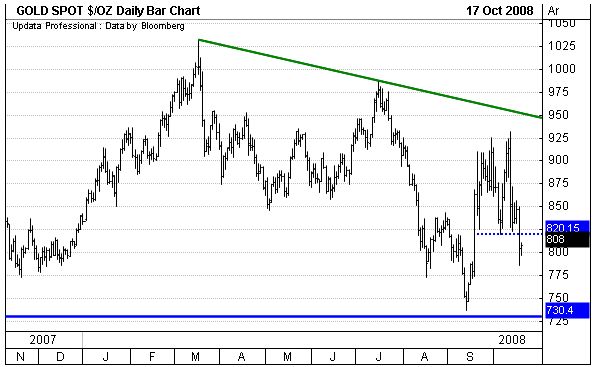
Spot gold prices bounced off a $700 low yesterday morning. “Gold’s recent slump bewilders investors,” headlines MarketWatch.

“An ugly, unmitigated disaster, this,” writes Jon Nadler of Golbug Central Kitco.com.

Despite of valuation drops that seem to rival those of certain emerging markets, some die-hards still see the glass as half full.

Adrian Ash actually found a ratio that makes gold look good:

You might like to know, if you put store by such things, that the US stock market just sank to a 14-year low against gold. (…) So the Dow/Gold Ratio – which simply divides the one by the other, thus pricing the Dow Jones Industrial Average in ounces of gold – fell to a little above ten, making the 30 stocks of the DJIA cheaper in Gold Bullion terms than at any time since January 1995.

Jim Turk celebrates new gold price records — “against the Australian dollar, Canadian dollar, Indian rupee, South African rand and British pound.” Not against the U.S. dollar, mind you, the currency gold is supposed to hedge against. But against the currencies that hard money internationalists considered the Dr. Jekyll to the greenback’s Hyde just eight weeks ago!

O quae mutatio rerum… how things have changed, as the German student song bitter-sweetly complains.

The Daily Reckoning‘s Bill Bonner wrote yesterday morning:

Money is pouring into the gold coin market. Apparently, dealers can’t keep up with the demand. Of course, financial analysts tend to view the gold coin market as a place for nuts and kooks. ‘If the world really does fall apart, you’d be better off buying ammunition,’ said one analyst. But it depends on how apart the world falls. If commerce were still done peaceably, gold coins would be a good thing to have in your pocket. But, he’s right; when things really fall apart, you’d be better off packing heat than Krugerrands. But we’re not worried about that kind of world — it is too wild and too unpredictable.

Big Gold‘s Jeff Clack goes futuristic in his outlook, writing an article from the vantage point of “a news release I brought back with me from the future that reveals the price of gold”: “It’s with nothing but unabashed excitement that I republish an article that I saw cross the AP wires on January 21, 2012….Gold rockets past $5,000 in heavy trading.”

Those of us stuck in the here and now, however, breathed a sigh of relief as gold clawed back to $720.

What is going on?

As far as Doomsday predictions go, it’s hard to imagine anything that could beat a 30% drop in the Dow to fuel panicked gold buying.

And let’s make no mistake about it: People are buying gold like there’s no tomorrow. Shout “Fire!” at a gold bug convention, and people will ooze toward the exits like garlic butter from escargot as their pockets are weighed down with pounds of precious metals. One expert wrote, “At the London Gold Bullion Traders Conference in Kyoto, I was amazed to find the magnitude of the shortage of gold and silver coins. In Germany, they aren’t having the crisis we’re having here, but Germans were lining up to buy gold. They have gold in the kilo bars. Everything is sold as soon as they get it.”

With dollars, pounds, euros and yen already pouring into physical gold at humongous premiums… what could possibly be the catalyst for that long-overdue break-out that heaves gold past $1,000?

During the gold bull market, gold investors liked to point at China as the looming demand catalyst. To them, ancient concepts of wealth would turn China into a virtual hotbed of aurophilia. (Apparently, 50 years of Communisms, the Cultural Revolution, and the VW Jetta (the #1 selling car in China in January 2008!) had no effect on Chinese perceptions at all.)

But how much can we really expect from Beijing?

“Due to a lack of gold reserves, it will be very difficult for China to respond to any proposal put forward for reconstructing the Bretton Woods system,” wrote Xu Yisheng of ChinaStakes.com just yesterday morning. And the Chinese consumer? Chinaview.cn says that per-capita disposable income was recorded at 4,140 yuan (605.6 U.S. dollars) in rural areas. According to Forbes.com, per-capita disposable income of urban residents was 13,786 yuan. Less than $2,000. Per year. Per capita.

Even at $700 an ounce, the nouveau riche Chinese may have other ideas to spend that money than converting it on rapidly depreciating gold coins. Maybe on a down payment for a Jetta, a Buick Excelle (#4 best-selling car), or the Ford Focus (#9)… a solar electricity unity for hot shower water… or rice and pork in case he happens to be one of the tens of thousands Chinese who’ve been laid off by shuttered factories.

How about those gung-ho gold buyers in India? Those who “traditionally” see gold as a store of value? Here’s a sound-byte straight out of India. “The global crisis has definitely affected the sale of gold and silver. Though I do not have the exact figure, but the business has been 50 per cent of what it was last year,” the president of the Ahmedabad Jewelers’ Association, Shanti Patel, said on OutlookMoney.com yesterday morning.

What I find most concerning at this point is that Indians aren’t buying right now. Think about it. Gold is selling at a 30% “discount” from its 2008 high. Hard money advisories are urging readers to use this “last opportunity to buy below $1,000”. Gold should be a back-up-the-truck bargain right now.

But the deferral of buying in India means only one thing:

Prospective buyers expect prices to fall even further!

One reason for this is the epic trend reversal in the U.S. dollar. The euro is now trading below $1.30 for the first time since February 2007. The British pound fell to the weakest level against the dollar in five years. The U.S. economy make be in no great shakes right now… but neither is anyone else’s. Worse, the liquidation of foreign assets and portfolios has sparked a veritable rush into greenbacks.

“The fact that gold did not head higher during the current leg of the crisis seems to reflect a combination of the rise in the dollar, deleveraging of commodity positions, sales to meet margin calls, and the unwinding of the long gold, short dollar trade,” wrote Natalie Dempster, an analyst at the WGC, in a research report released yesterday.

In my humble opinion, we cannot look to Asian or American buying to create a strong, sustained bullish catalyst for bullion. To make things even worse, crude oil prices keep falling — increasing the downside pressure on gold. Even the prospect of an output cut in by OPEC cartel, was only good to raise light sweet crude for December delivery to $69.05 dollars per barrel, after oil had traded as low as 65.90 dollars — a level last seen on June 13, 2007.

Brent North Sea crude for December had hit a low of $63.96 Wednesday, a price level last seen in March 2007. Amateur speculators have abandoned oil at this point. With the bubble pressure gone, nothing is standing in the way of another 50% drop in crude oil prices!

Here’s my Holiday Season prediction: Oil will go up to $65 thanks to Turkey Day automotive traffic by late November. Gold will be trading below $700 by Halloween. The dollar will be trading at $1.20 per euro by the time they’re turning on the Christmas lights on the Washington Monument in Downtown Baltimore.

If you hold any gold in your portfolio — especially if you bought even an ounce of gold since 2004 — it is high time to buy some insurance against this rout! My colleagues and I have put together a simple investment strategy that translates gold’s current downside into cold, hard profits for you… without you having to sell as much as a single Krügerrand!


My Note: My opinion/recomednation is keep slowly adding to your precious metals positions both mining stocks and physical gold. Protect yourself by purchasing some cheap put options in case market goes down even further. This way if we do get a blow up in the middle east or elswhere you’ll be positioned at or close to the bottom. I think we’ll have stiff resistance or a floor at $650-$675 for gold. -jschulmansr

Share this:

  • Click to share on Reddit (Opens in new window) Reddit
  • Click to share on Facebook (Opens in new window) Facebook
  • Click to share on LinkedIn (Opens in new window) LinkedIn
  • More
  • Click to share on X (Opens in new window) X
  • Click to share on Pinterest (Opens in new window) Pinterest
  • Click to share on Tumblr (Opens in new window) Tumblr
  • Click to print (Opens in new window) Print
  • Click to email a link to a friend (Opens in new window) Email
Like Loading...

Roubini Sees Crisis Worsening, Hurting Emerging Markets- Bloomberg

23 Thursday Oct 2008

Posted by jschulmansr in commodities, Copper, deflation, diamonds, Finance, gold, hard assets, inflation, Investing, investments, Latest News, Markets, oil, precious metals, silver, Today, U.S. Dollar, Uncategorized

≈ Comments Off on Roubini Sees Crisis Worsening, Hurting Emerging Markets- Bloomberg

Tags

Austrian school, banking crisis, banks, bear market, bear stearns, bull market, capitalism, central banks, commodities, communism, Copper, deflation, depression, diamonds, dollar denominated, dollar denominated investments, economic, economic trends, economy, financial, futures, futures markets, gold, gold miners, hard assets, heating oil, inflation, investments, market crash, Markets, mining companies, natural gas, oil, palladium, physical gold, platinum, platinum miners, precious metals, price, price manipulation, prices, producers, production, protection, recession, risk, run on banks, safety, silver, silver miners, socialism, sovereign, spot, spot price, stagflation, U.S. Dollar, volatility

 Roubini Sees Crisis Worsening, Hurting Emerging Markets October 23 (Bloomberg) — Nouriel Roubini, the New York University economics professor who two years ago predicted the financial crisis, speaks at a conference in London about the prospect of further market turmoil and the risk of a protracted global recession. (Source: Bloomberg)

This is the guy who correctly predicted the financial crisis two years ago – Definitely worth a listen/view


To watch the whole report go here Bloomberg  click on the watch now link to story.

Share this:

  • Click to share on Reddit (Opens in new window) Reddit
  • Click to share on Facebook (Opens in new window) Facebook
  • Click to share on LinkedIn (Opens in new window) LinkedIn
  • More
  • Click to share on X (Opens in new window) X
  • Click to share on Pinterest (Opens in new window) Pinterest
  • Click to share on Tumblr (Opens in new window) Tumblr
  • Click to print (Opens in new window) Print
  • Click to email a link to a friend (Opens in new window) Email
Like Loading...

When Inflation Erupts, Gold Will Take Off!

22 Wednesday Oct 2008

Posted by jschulmansr in commodities, deflation, Finance, gold, inflation, Investing, investments, Latest News, Markets, oil, precious metals, security, silver, Uncategorized

≈ Comments Off on When Inflation Erupts, Gold Will Take Off!

Tags

Austrian school, banking crisis, banks, bear market, bear stearns, bull market, capitalism, central banks, commodities, communism, deflation, depression, diamonds, dollar denominated, dollar denominated investments, economic, economic trends, economy, financial, futures, futures markets, gold, gold miners, hard assets, heating oil, inflation, investments, market crash, Markets, mining companies, natural gas, oil, palladium, physical gold, platinum, platinum miners, precious metals, price, price manipulation, prices, producers, production, protection, recession, risk, run on banks, safety, silver, silver miners, socialism, sovereign, spot, spot price, stagflation, U.S. Dollar, volatility

Frank Holmes: “When Inflation Erupts, Gold Will

Take Off!”


Source: The Gold Report  10/21/2008


Expect short-term hesitancy in the upward movement of the gold price until liquidity returns to the markets, says Frank Holmes, CEO and chief investment officer at U. S. Global Investors and co-author of the new book “The Goldwatcher:Demystifying Gold Investing” (John Wiley & Sons). In this exclusive interview with the Gold Report, he predicts gold will go to $1,000, even $2,000, over the next two years. A growing money supply due to a change in government policies will help lift some juniors out of their misery, too. Holmes advises selective nibbling until conditions improve and names a few companies to consider.

TGR: Can you start off by telling us what’s going on?

FH: Based solely on global economic indicators, commodities should be in a cyclical bear market with no bottom in sight. But there’s intense pressure on policymakers to fill the deflationary vacuum that’s been created by both Main Street and Wall Street. Main Street’s plummeting housing prices stretched the limits of the financial system, but lawmakers in an election year will find it easier to blame Wall Street than Main Street.

TGR: Both sides are at fault.

FH: The abuse of leveraging is the biggest culprit. Mike Milken spoke at a conference I attended last week in Hong Kong. He said that at the height of his career he was leveraged 4-to-1. Goldman Sachs now is leveraged 20 times, so a 5% mistake would wipe them out. The combined impact of Sarbanes-Oxley, FAS 157 (mark-to-market regulations) and leverage abuse has cost New York its position as the world’s financial capital. No one expected this escalation of write-downs.

When Warren Buffett bought General Re Insurance in 2002 he warned about notional valuations because he tried to sell some of the derivatives, and lost billions of dollars. He called derivatives “weapons of mass financial destruction.” Everyone ignored him, and the derivative market increased 500% in five years.

TGR: Wow.

FH: If you make a 2% mistake in the $500 trillion derivative market, that’s $10 trillion. What’s $10 trillion? Well, the world’s total GDP is $50 trillion. The total amount of U. S. dollars in circulation is roughly $15 trillion. A 2% mistake wipes out 20% of the world’s GDP.

We’re actually experiencing huge deflation—in housing and on Wall Street. It’s not inflationary yet. The Paulson package is a stopgap measure that could lead to inflation. This meltdown is just like 1974 or the Depression of the 1930s, not the 1987 quick crash. It continues to destroy confidence. Another thing that propelled this meltdown to more disastrous proportions was the rule that removed the uptick rule for short-selling.

TGR: What will fix this situation?

FH: That’s a good question. Adding untested regulations is dangerous, and the law of unexpected consequences is often negative. The combination of Sarbanes-Oxley, FAS 157 and the no uptick rule for shorting basically became toxic and led to the destruction of Lehman Brothers and Bear Stearns. Also, “ideas” like printing more money and the debasement of currency do not solve the credit crisis and are not good long-term solutions.

The dollar’s not going to collapse due to loss of Asian support. All countries will support the dollar. The reason is that they can’t afford for it to fall too far because then suddenly the U. S. would be exporting products and not importing. All the currencies will slowly debase themselves against gold and keep the dollar as the currency for global trade.

It appears we are now going through that inflection point moving from deflationary forces to an inflationary cycle. We had a little bit of run-up in inflation when oil ran to $150 a barrel, which was very excessive. What didn’t make sense was the fact that gold didn’t rise along with oil. On the historic 10-to-1 ratio, gold should have gone to $1400 to $1500. That leads to suspicions that a few people were manipulating the price of oil because gold failed at $1,000 per ounce. On another note, it is important to remember policymakers will do everything in their power to create liquidity and, historically, liquidity is bullish for commodities. However, our research suggests it’ll take several quarters before this will affect commodity prices.

TGR: Will the market stagnate until this liquidity flows through and moves the commodities up?

FH: You’ll have to be a very selective buyer for another couple of quarters. The price correction should lose downward momentum and create a “U” shaped bottom as the capital markets begin to reflect the policies being implemented.

TGR: When you say the price correction will lose its downward momentum, do you mean this wholesale sell-off of everything?

FH: Right.

TGR: We saw yesterday that Goldcorp (TSX:G) (NYSE:GG) was down 16%.

FH: That downward momentum will start to slow.

TGR: When you say commodities, do you mean gold?

FH: Asian economic activity has a big influence on the purchase of gold. At the London Gold Bullion Traders Conference in Kyoto, I was amazed to find the magnitude of the shortage of gold and silver coins. In Germany, they aren’t having the crisis we’re having here, but Germans were lining up to buy gold.

TGR: Do they have supplies?

FH: No, but they have gold in the kilo bars. Everything is sold as soon as they get it.

TGR: I tried to buy some Swiss 20 Francs today and couldn’t find any.

FH: People are paying a large premium for small coins, and the purchase of safety deposit boxes is on the rise. People have been actually stuffing dollars in them, along with gold. It’s not really a 1980-style mainstream panic. People are continuing to buy. The growth of gold ETFs attests to that. Now let me try to explain some of these huge price swings in commodities, equities and emerging markets.

Your readers might be interested to know that banks all have this software called VAR, or Value At Risk. It triggers an alarm indicating a need for more capital due to escalating debt defaults. You’d think that banks would go to their prime brokerage arm and rein in hedge funds trading mortgages and de-leverage them because that’s where the risk is. Your business model says, “I have defaulting mortgages, so I need to be sure our hedge fund and prime brokers aren’t having similar problems.”

TGR: Right.

FH: Well, the banks reacted by calling every hedge fund and de-leveraging all asset classes, equities, banks and commodities. So, starting August 12, 2007, some of the S&P stocks moved 15% in a day internally. This same margin call has now taken place about four times this past year. U.S. banks in Japan yanked loans to small cap companies, so those guys were scrambling to replace those loans. Situations like that are happening everywhere and they illustrate the long reach of this credit crisis.

A lot of emerging marketing investors got their noses bloodied when the U.S. called for its loans to be repaid. They will not be so quick to repeat that mistake. This ripple effect is hurting businesses. That is a concern that I heard over and over. Fortunately, the governments of emerging markets have huge surpluses and are better equipped to handle this crisis than they were in the 1990s.

All of this is good for commodities and gold rises in step with commodities. When inflation erupts everywhere, then gold will take off on its own with a bigger move.

TGR: When will that happen exactly?

FH: Over the next two years gold will be well over a $1,000, maybe running up to $2,000. The number-one Asian analyst, Chris Wood, is advocating a 30% gold exposure to institutions. Now, this is the number-one brokerage firm in Asia and their research is excellent.

TGR: What’s the name of the firm?

FH: CLSA-Asia Pacific Markets. It recommends a portfolio allocation of 30% gold:15% gold bullion and 15% unhedged gold stocks. When an analyst of his stature advises putting 30% of your portfolio into gold, you have to take note. We tell our clients to put a maximum of 5% into bullion and no more than 5% toward gold equities.

TGR: Doug Casey’s latest missive rounded it up to 30% too.

FH: The significance here is that the institutional side is getting on board with gold. That’s a big deal.

TGR: Because the gold market is so small compared to the market caps these institutions deal with, even a small change in percentage would make a huge difference.

FH: All the brokers are getting their marching orders simultaneously. What happens is that non-correlated assets begin to correlate as people seek liquidity. So everyone’s saying, “I have to get cash.” It’s important to remember that brokers were leveraged 20 times and low-income house buyers were leveraged 99 times. This creates a chain reaction and knocks down the commodities. Several of these hedge funds have blown up, and if our holdings are similar to theirs, they’ve hurt us.

We went into this correction with a big cash position back in June, and we never expected such a huge correction, but our models were showing that it should be 20% to 25% cash. Then we start to nibble as things get clobbered, but they continue to get clobbered.

TGR: Yes.

FH: Last week the markets hammered every stock with liquidity. Many funds have been hit by this problem. Margin calls are driving this. It has nothing to do with the demand for gold or the supply and discoveries.

TGR: But that should work itself out fairly quickly by the end of the year.

FH: It was estimated that by the end of the year there would be $22 billion of resource stocks coming out.

TGR: Do you mean coming out of the hedge funds?

FH: Yes. Hedge funds have been forced to shut down. It’s really interesting to look at the TSE Venture Index. When the asset-backed paper problems happened last summer, retail sponsorship dropped dramatically. The U. S. went through something similar in February when suddenly the small caps and mid-caps started losing liquidity. What we noticed was that the auction rate paper is exactly ten times the size of Canada’s asset build paper crisis—$330 billion versus $33 billion. It was just before tax season, so a lot of American investors had to scramble for cash by redeeming their equity funds to pay their taxes.

TGR: Do you follow Richard Russell’s Dow Theory Letters?

FH: You mean regarding the relationship between the Transports and the Dow Industrials?

TGR: Yesterday both were down so Dow Theory now confirms that we are in a bear market.

FH: Yes.

TGR: What happens to gold stocks in a bear market?

FH: Whether you have big deflation or big inflation driving the bear market, gold does well. If it’s just a normal cyclical inventory recession or whenever interest rates are above the CPI rate, gold doesn’t do well. Today, the Fed’s funds are below the CPI rate and the printing presses are busy.

TGR: So, what are we in now?

FH: I think we’re at the tipping point moving from deflation to inflation.

TGR: So, we’ve been on the negative side of that.

FH: We saw gold run to $1,000 twice because of deflation, not inflation. Massive liquidations are deflationary. Collapsing housing prices are deflationary. The price of oil running up was inflationary but it was triggered by the dollar deflation and gold moved with it. In the ’30s, when you had a big deflationary cycle, gold was the best asset class. In the ’70s, when you had a big inflationary cycle, gold was the best asset class.

TGR: Right.

FH: In the ’90s when there was no big inflation or deflation, gold just meandered along.

TGR: So when do you think we will reach that tipping point from deflation to inflation?

FH: The money supply has basically been flat for the past three months. The correlation of commodity price action and emerging market money supply has an R-squared value over 80—highly correlative. We track the G-7 countries versus the E-7 (the seven most populated emerging countries in the world with available data) and track their money supply. The money supply has not been growing rapidly. We need to get the money supply up and this will happen with the $700 billion bailout. So, we’re going through a transition over the next couple of months.

TGR: When will gold respond?

FH: There’s been a six-week lag with the money supply, the same with NASDAQ. If the money supply spikes, there’s a 70% probability that within six weeks the NASDAQ will start to rise.

TGR: Why would an increase in the money supply impact NASDAQ?

FH: People have more cash to spend.

TGR: So they’re moving into the NASDAQ?

FH: Yes. The money supply has one of the highest correlations to the gold commodity as a whole. When you look at stocks individually, the number-one driver is the production per share growth. After that, it’s cash flow, and then reserves. You can eliminate 80% to 90% of all the noise by calculating production and the cash flow.

TGR: What would you tell someone who has just inherited a million dollars?

FH: I’d put 5% into gold bullion and 5% into unhedged gold stocks.

TGR: Unhedged producers?

FH: Yes, and if you want to go down to the smaller caps like Jaguar (JAG. TO), that’s where you get your biggest potential returns.

TGR: Can you share a few names on your list of unhedged gold producers?

FH: We like companies that have a royalty business, such as Royal Gold (RGLD). We also look at those with the strongest per-share-growth rates coming over the next 12 – 18 months. That list includes Agnico-Eagle Mines (TSX:AEM), Kinross Gold (KGC-NYSE; K-TSX), and Goldcorp—all of which have very healthy growth profiles relative to the Newmonts of the world. Goldcorp isn’t a pure gold play, because it also produces a high percentage of base metals. But we expect that within two years those base metals will really start taking off.

TGR: Is that prediction based on anticipated growth in China?

FH: Yes. China has structurally gone through a quiet phase, but the government has policies in place that are designed to invigorate growth. As that growth starts to pick up steam over the next six months, you’re going to see increased demand for the basic commodities. Of course, the economy is spending a lot of money for infrastructure right now, and that might put a temporary lag on commodities.

TGR: But you believe China’s growth will drive the commodities market higher?

FH: Yes. The credit crunch created by the collapse of U. S. financial institutions will slow things down for a while, but ultimately, China will grow.

TGR: What other companies do you like?

FH: Unless they have two grams of gold (per ton) or a million ounces, junior explorers have been drifting lower and lower. Historically in situ reserves have traded at one-tenth of an ounce of gold. So, if gold is $600, then your reserves are worth $60 per ounce. When gold was $300, they were worth $30. That was the model for determining a fair market cap for junior explorers. With gold at $850, these companies should be worth $85 per ounce of reserves, but they’re not. This amazes us. And when one of these companies is bought out, it’s usually paid more than the ten times ratio. But valuations are now drifting down to $40 and $35 per ounce. So the market is basically valuing a company that has 8 million ounces as if it had only 4 million ounces.

TGR: This is a short-term phenomenon, right?

FH: Yes.

TGR: So, when this situation changes, how quickly will producers and majors start buying up the juniors?

FH: That’s a different point. The seniors are going to buy only those juniors that have two grams of gold per ton or a million ounces. The other juniors will just work their way out of the system or go bankrupt.

TGR: What other criteria do you use to evaluate juniors?

FH: We ask some simple questions:Is the CEO technically competent? That is, is he a geologist? If not, that may be okay, but does he have a broad network to make up for that lack of technical knowledge? Does he know the newsletter writers, like Doug Casey, for instance? Does he know the investment bankers?

We’ve found that if the CEO does not know the Street, and doesn’t know the newsletter writers, it doesn’t matter if he’s a geologist or an engineer. There’s going to be no liquidity in the company’s stock, unless there is a multimillion ounce discovery with a grade of greater than 2 grams per ton. But if you have a company whose CEO knows lots of newsletter writers, gets lots of coverage, knows the value in the Street and gets research for it, that company is going to have a higher price-to-book valuation, which makes it a much more attractive investment.

TGR: Anything else you look for?

FH: Financing is crucial. Companies that are rapidly spending money are going to run out of cash in about six months. The market undervalues them until they have financing in place.

TGR: Can you give us a few companies on your list that meet your criteria?

FH: Moto Goldmines (TSX:MGL), which is in the Congo, is in that category, though they face geopolitical risks. The company has more than 10 million ounces and more than five grams per ton. Another one is Gabriel Resources (GBU:TO), which has a large asset in Romania.

TGR: Both of these companies have some geopolitical risks associated with them.

FH: They do. But if they satisfy the criteria, these are the ones that the big mining companies will be acquiring.


To learn more about investing in natural resources, you might want to take a look at industry veteran Frank Holmes’ new book, The Goldwatcher: Demystifying Gold Investing. Holmes is CEO and Chief Investment Officer of U.S. Global Investors, Inc., a registered investment adviser that managed more than $5 billion in 13 no-load mutual funds and for other advisory clients as of June 30, 2008. U.S. Global specializes in the natural resources, emerging markets and global infrastructure sectors. Its funds have received numerous awards and honors during Holmes’ tenure, including more than two dozen Lipper Fund Awards and certificates. Holmes is a much-sought-after keynote speaker at national and international investment conferences. He is also a regular commentator on the financial television networks CNBC and Bloomberg, and has been profiled by Fortune, Barron’s, The Financial Times and other publications. In addition, Holmes was selected as the 2006 mining fund manager of the year by Mining Journal, a leading publication for the global natural resources industry.

Share this:

  • Click to share on Reddit (Opens in new window) Reddit
  • Click to share on Facebook (Opens in new window) Facebook
  • Click to share on LinkedIn (Opens in new window) LinkedIn
  • More
  • Click to share on X (Opens in new window) X
  • Click to share on Pinterest (Opens in new window) Pinterest
  • Click to share on Tumblr (Opens in new window) Tumblr
  • Click to print (Opens in new window) Print
  • Click to email a link to a friend (Opens in new window) Email
Like Loading...

Why Oil and Gold Are Headed Much Higher

20 Monday Oct 2008

Posted by jschulmansr in commodities, deflation, Finance, gold, hard assets, inflation, Investing, investments, Latest News, Markets, oil, precious metals, silver, Uncategorized

≈ Comments Off on Why Oil and Gold Are Headed Much Higher

Tags

Austrian school, banking crisis, banks, bear market, bear stearns, bull market, central banks, commodities, deflation, depression, dollar denominated, dollar denominated investments, economic, economic trends, economy, financial, futures, futures markets, gold, gold miners, hard assets, heating oil, inflation, investments, market crash, Markets, mining companies, natural gas, oil, palladium, physical gold, platinum, platinum miners, precious metals, price, price manipulation, prices, producers, production, protection, recession, risk, run on banks, safety, silver, silver miners, sovereign, spot, spot price, stagflation, U.S. Dollar, volatility

Friday, October 17th, 2008

Oil is Headed for $150 a Barrel, Gold for $1,500 an Ounce, Merrill Analysts Predict

By William Patalon III
Executive Editor
Money Morning/The Money Map Report

Gold could reach $1,500 an ounce, since the worldwide plans to bail out the global financial industry are certain to fuel inflation, analysts led by Francisco Blanch at Merrill Lynch & Co. Inc. (MER) wrote in a research report.

The Merrill Lynch analysts also predicted that oil would reach $150 a barrel.

In the research note released earlier this week, the analysts said “the unintended consequence of the ongoing financial bailout will be inflationary pressures to the commodity markets.”

The analysts provided no timetable for their predictions.

The $700 billion U.S. bailout – plus the billions of dollars in capital infusions that have been put in place by governments and central banks all over the world – will be highly inflationary, analysts say. Historically, this type of move has been very bad for the U.S. dollar and highly bullish for oil prices.

“This is a very interesting projection,” said Money Morning Investment Director Keith Fitz-Gerald. “I have no idea what they’re basing their numbers on. But I certainly wouldn’t dismiss it based on everything I know about global trends, and my own proprietary calculations – which continue to suggest far higher prices for oil and hard assets than even Merrill is predicting.”

While Fitz-Gerald said that doesn’t mean there won’t be a continued near-term drop in gold and oil prices, he continues to believe the long-term outlook is for much-higher prices.

Currently, Fitz-Gerald has a multi-year target price of $225 a barrel for oil prices.

Typically, Fitz-Gerald says, analysts put a more-specific timetable on such predictions. But the unprecedented worldwide capital infusions that are part and parcel of the central banks’ bailout plans are dramatically skewing what are normally relatively predictable calculations, he said.

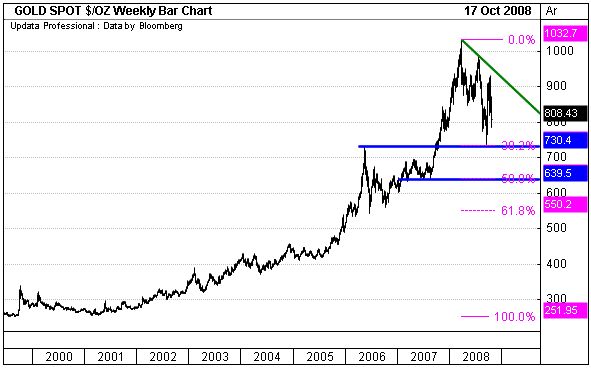
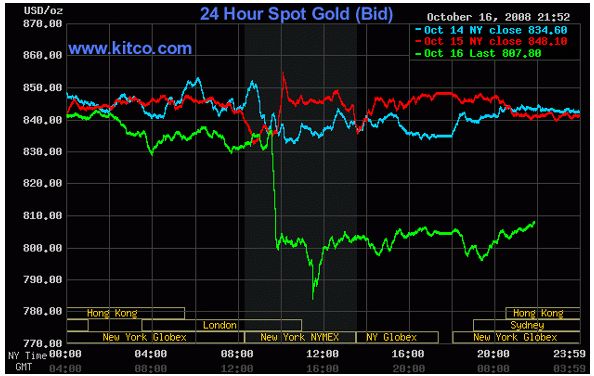
Since peaking at an all-time record of $1,032 an ounce on St. Patrick’s Day, gold has seen its price skid about 19%. Gold futures tumbled more than 4% yesterday (Thursday) to their lowest level in a month, as nervous investors sold futures contracts to raise cash, Marketwatch reported. Gold for December delivery fell $34.50, or 4.1%, to end at $804.50 an ounce on the Comex division of the New York Mercantile Exchange (CME), the lowest closing level since Sept. 17. Earlier, it had fallen more than 5% to $791 an ounce.

Some hedge funds were forced to liquidate their positions to cover losses in stocks and other markets, economists at research firm Action Economics told MarketWatch.

“For the moment, the weight of the deep funk felt in the global markets is keeping gold on the defensive, while would-be buyers … find more comfort sitting on the piles of cash,” Jon Nadler, a senior analyst at Kitco Bullion Dealers, told the financial news service.

Crude oil fell below $70 a barrel, reaching its lowest level since June 2007, and gasoline prices tumbled after a U.S. Department of Energy report showed that stockpiles advanced twice as much as forecast, Bloomberg News reported.

Crude oil for November delivery fell $4.37 a barrel, or 5.9%, to reach $70.17 a barrel, at midday yesterday on the NYMEX. The “black gold” fell as low as $68.57 a barrel, the lowest since June 27 of last year. Prices are down 20% from a year ago. Crude oil peaked at $147.27 on July 11.

Oil prices also dropped on doubts that the bank rescue plan will bolster global economic growth – and with it, fuel use. The Organization of the Petroleum Exporting Countries (OPEC) moved the meeting it had planned for November up to Oct. 24 after the oil-price decline.

“The DOE numbers just added to the downward pressure on the oil market,” Brad Samples, a commodity analyst for Summit Energy Inc. in Louisville, K.Y., told Bloomberg. “The weak economy is translating into rising inventories because nobody wants to burn the stuff.”

Money Morning Contributing Editor Martin Hutchinson – who last October correctly predicted that gold would make a run for record highs – this spring said that gold could reach $1,500 an ounce. At the time, Hutchinson listed three factors, one of which – related to the bailout plans – has moved front and center:

  • Monetary policy: More than for any other investment, gold’s price depends primarily on the world’s monetary policy. When monetary policy is loose, as it was in the 1970s, gold prices soar. When it is tight, as in the 1980s, prices decline sharply. With the global bailout in place, monetary policy is about as loose as it’s ever been.
  • Global Supply and Demand: For most commodities, price rises have an effect on supply and demand; a higher price increases supply and reduces demand, in “price elasticity.” With oil, for example, a 10% rise in price reduces demand by about 1% to 1.5%, meaning that oil has a price elasticity of 0.1 to 0.15.  But oil is priced in dollars, and when the dollar drops, OPEC tends to boost oil prices to keep its revenue steady. The flood of dollars the global bailout plans are going to send washing through the financial system won’t be good for the greenback – meaning the dollar-based price of oil can only go higher. That will more than offset any decline in demand in the near term; in the long run, growing economies in such markets as China, India and other emergent markets will create millions of new consumers who will demand luxuries ranging from jewelry to automobiles.

The upshot: Global demand for oil and gold will escalate – as will their prices.

  • Comparison with past peaks: If gold had increased in price since 1997 by the same percentage as world dollar reserves, it would currently be trading at around $1,280 per ounce, Hutchinson says. And the current speculative appeal of gold, compared to its inactivity 10 years ago, suggests it could go higher than this: The 1980 gold price peak of $875 per ounce intraday is equivalent to more than $2,200 per ounce when inflation is taken into account, he said recently.

Commenting on Merrill Lynch’s gold-and-oil predictions, Dividend.com analysts Tom Reese and Paul Rubillo, this week wrote that “we think the Merrill call is based on solid reasoning, but we’ll wait and see if the market agrees. So far during the meltdown, gold has shown flashes of running but has not broken out.”

They said that the “obvious trade on paper [which isn’t] so obvious to the market at this point” is Newmont Mining Corp. (NEM), which is “sitting just above a 52-week low.” Newmont’s shares, which closed yesterday at $28.85 each, have traded between $27.25 and $57.55 in the last 12 months.


Share this:

  • Click to share on Reddit (Opens in new window) Reddit
  • Click to share on Facebook (Opens in new window) Facebook
  • Click to share on LinkedIn (Opens in new window) LinkedIn
  • More
  • Click to share on X (Opens in new window) X
  • Click to share on Pinterest (Opens in new window) Pinterest
  • Click to share on Tumblr (Opens in new window) Tumblr
  • Click to print (Opens in new window) Print
  • Click to email a link to a friend (Opens in new window) Email
Like Loading...

Silver Could Explode, Says Analyst

20 Monday Oct 2008

Posted by jschulmansr in commodities, deflation, Finance, gold, hard assets, inflation, Investing, investments, Latest News, Markets, oil, precious metals, silver, Uncategorized

≈ Comments Off on Silver Could Explode, Says Analyst

Tags

Austrian school, banking crisis, banks, bear market, bear stearns, bull market, central banks, commodities, deflation, depression, dollar denominated, dollar denominated investments, economic, economic trends, economy, financial, futures, futures markets, gold, gold miners, hard assets, heating oil, inflation, investments, market crash, Markets, mining companies, natural gas, oil, palladium, physical gold, platinum, platinum miners, precious metals, price, price manipulation, prices, producers, production, protection, recession, risk, run on banks, safety, silver, silver miners, sovereign, spot, spot price, stagflation, U.S. Dollar, volatility

SILVER COULD EXPLODE, SAYS ANALYST                          

Hard Assets Investor

By Ted Butler (Butler Research)

Ted Butler is one of the better-known silver analysts (and longtime silver bulls) in the world. The founder of Butler Research, a monthly publication focused on precious metals, Butler has been pounding the table on silver since way back when it was trading for $4/ounce.

For many years now, Butler has been among a vocal cadre of silver bulls who have argued that a select number of Wall Street banks were deliberately manipulating the silver market.

In September, the Commodities Futures Trading Commission confirmed it was formally investigating these accusations. It had previously examined the case, and in May, published a report suggesting that there was not manipulation in the market, and that banks taking short positions were simply acting as legitimate market makers. This summer, however, CFTC data showed that two U.S. banks boosted their short positions in silver futures by 450%, controlling 25% of the open interest, according to The Wall Street Journal. That led to new accusations from the silver bulls, and the SEC agreed to reopen the investigation.

Interestingly, the investigation has shifted from the oversight division to the enforcement division of the CFTC. According to the Journal: “The oversight division performs overall market surveillance. The enforcement division looks at activities in a specific time period.”

Butler wrote about the CFTC investigation in late September; that analysis is printed below. He also spoke briefly with HardAssetsInvestor.com about the latest developments in the silver space.

The editors at HardAssetsInvestor.com don’t necessarily agree with Butler’s views. However, it’s a real theme and discussion in the marketplace, and is worth airing publicly.

Interview With Ted Butler

HardAssetsInvestor.com (HAI): What does the CFTC’s investigation mean for silver?

Ted Butler, Butler Research (Butler): That we’ll only know in time. It should mean, at a minimum, that they think the allegations are credible enough to warrant them looking at it again. I suppose if they thought the allegations were baseless, they would say so and dismiss the subject.

HAI: What’s the likelihood that they’ll take real action in the market?

Butler: That’s anyone’s guess. But if my allegations are accurate, as I believe them to be, the question of them taking action becomes moot. That’s because if the silver retail shortage keeps growing and morphs into a wholesale shortage, the market itself will do what the CFTC has refused to do. Any downward manipulation must, inevitably, end in a shortage. I think they may recognize this.

HAI: What exactly are they looking at?

Butler: That, you will have to ask them, but if they are not looking at the one or two U.S. banks that sold short the equivalent of 20% of the world’s annual production of silver, they are not looking at the right thing.

HAI: Why do you think they finally decided to investigate this situation?

Butler: Because the evidence was clear in the August Bank Participation Report, which I disclosed in my “Smoking Gun” article, that it should be impossible not to see the manipulation.

HAI: What is your overall take on the silver market right now?

Butler: It is structured to explode in price, especially after the recent decline to $12 an ounce.

HAI: Should investors allocate to silver over the next year or two?

Butler: They should allocate now, without delay.

—Butler Research Article from 9/29/08, Reprinted With Permission—

It’s hard to imagine now, but there were times when I worried about having anything fresh to write about silver. Lately it has been choosing from many different topics. This week, the choice was easy. Amid the continuing swirl of major financial crises, one issue rose to the top.

On Thursday, September 25, The Wall Street Journal carried an article announcing that the Commodity Futures Trading Commission (CFTC) had opened a new investigation into allegations of manipulation in the silver market.

Furthermore, on that same day, Commissioner Bart Chilton e-mailed a copy of the Journal story, along with his own comments confirming the investigation, to those who wrote to him about the issue. Both the article and Chilton’s e-mail made special note that the silver investigation was being conducted by the Division of Enforcement, and not the Division of Market Oversight, which had previously investigated the silver market. In simple terms, Enforcement is the muscle.

Whether an entire market, like silver (or gold), is manipulated or not is a matter of utmost importance. In fact, nothing could possibly be more important. Market manipulation is a violation of law and a serious crime. Market manipulation damages everyone in the long run.

Because market manipulation is the number one priority of the CFTC, any revelation that they might be investigating a manipulation in any commodity is big news. So big, in fact, that such investigations are almost always kept strictly confidential while the facts are determined. This is usually so as not to disturb the market. That the CFTC has chosen to openly reveal this silver investigation is almost unprecedented.

Moreover, what makes this silver investigation a rare event is that the allegations are of a manipulation in progress. To my knowledge, all past investigations were revealed after the manipulation itself was concluded. Not only is it rare for the CFTC (or any government agency) to reveal a serious active investigation, it is unheard of to reveal an investigation of a potential crime in progress. If a regulator suspects a crime in progress you would assume the regulator would first end the suspected crime and then finish the investigation. If the regulator didn’t think there was a sufficient evidence of an ongoing crime, then why reveal that an investigation has been opened?

I think this is why there is universal expectation (including by me) that the silver investigation will be a whitewash. I know that silver is manipulated, and I’m glad to see the CFTC investigate. But I can’t help but feel suspicious of their objectivity, because they have adamantly denied such a manipulation for more than 20 years. How can they conduct a fair investigation and not be influenced by their past findings? I have been here and done this many times, and I don’t feel like getting fooled again.

EXPLANATION, NOT INVESTIGATION

Why the CFTC is investigating a silver manipulation is somewhat of a mystery to me. I certainly didn’t ask for an investigation. I did ask you to ask for them to explain the data in their August Bank Participation Report, in my “Smoking Gun” article. This is the report that is directly responsible for the investigation. This is the report at the heart of the matter. But there is a difference between explanation and investigation.

When I first uncovered the data in this report, a little more than a month ago, I couldn’t believe my eyes. I had studied the data in previous Bank Participation Reports for years, but that’s because I’m a silver data junkie. This is usually a nothing report. In all the years I studied this data, it seemed like a waste of time. It was an obscure report that I never heard anyone ever refer to before. But the data in the August report was so disturbing that, in order to make sure I wasn’t imagining things, I asked two trusted associates, Izzy Friedman and Carl Loeb, to review the data with no advance suggestion from me as to its meaning. I wanted their unvarnished opinion.

When they confirmed that this was the clearest case of manipulation possible, I faced a new dilemma. I was inclined to believe that the data was in error. I suspected the CFTC would retract the data. So I was worried about being publicly embarrassed for making a big deal out of what may have been a clerical error. But the more I matched this data against the weekly Commitment of Traders Report (COT) data, I could see the data was accurate. Certainly, if the data was incorrect, the CFTC would have said so by now.

The data is clear – one or two U.S. banks sold short the equivalent of 140 million ounces of silver in one month. That’s more than 20% of world annual mine production. Less than three U.S, banks sold more than 10% of world annual mine production of gold simultaneously. The price of silver and gold then collapsed by an historic amount. These same banks have used the sell-off as an opportunity to buy back as many of their short positions at a giant profit. Those are the facts.

It is important to put these numbers into perspective, in order to appreciate their significance. One way to do that is by comparing what just took place in silver to other commodities. If one or two U.S. banks sold short, in a period of one month, the equivalent of 20% of world annual production of corn, that would equal one million futures contracts. (25 billion bushels x 20% divided by 5000 bushels). Since the entire open interest in corn futures is one million contracts, a sudden short sale of that amount would crush the price.

If one or two U.S. banks sold short 20% of the world annual production of crude oil, that would be the equivalent of 6 million NYMEX futures contracts. (30 billion barrels x 20% divided by 1000 barrels). Since the entire open interest on the NYMEX is around 1 million contracts, a sudden sale of 6 times that amount would drive the price of oil to ten cents a barrel. It would also be market manipulation beyond question.

The CFTC doesn’t need to investigate. They only need to explain why their own data fails to prove manipulation in silver and gold. Save the taxpayer some money and all of us some time. This needn’t take days, weeks, or months. This should take, literally, minutes. Why maintain and publish the data in the Bank Participation Reports if the CFTC won’t recognize an obvious manipulation that is a crime in progress.

THE COTs

The latest COTs confirmed the one thing I was hoping and expecting them to confirm, namely, that the biggest shorts continued to cover their short positions in gold and silver. What makes their short covering most noteworthy is that the buybacks in the most recent report occurred on a sharp rise in price, some $3 in silver and $120 in gold for the reporting week. This tells me that the big short, the U.S. bank(s), is serious about getting out of as much of its massive silver short position as it can.

From the time of the August Bank Participation Report, the big shorts have now covered nearly all of the gold short position put on during July. Therefore, the manipulation in gold was a complete success. In silver, while the manipulation must be considered a success, because the big short has covered an impressive amount, it has not covered all of its manipulative short position. In looking at the structure of the COTs, it does not appear to me that much further liquidation can occur to the downside. To say that the COTs are structured bullishly, would be a gross understatement.

IMAGINE

My mentor, Izzy Friedman, recently asked me to turn the clock back to a year ago, and then try to imagine that we would have a severe retail silver shortage. A shortage that now seems to be spreading to gold. It’s a powerful and profound thought process.

This silver retail shortage is completely underappreciated. I don’t think there could be more clear proof that silver has been manipulated in price. The talk that it’s “only” a retail shortage and not a wholesale shortage is silly. The silver retail shortage is so widespread in scope, it’s only a matter of time before it spreads to the wholesale sector. That’s especially true considering the record inflows into the silver ETFs. When the wholesale silver shortage hits, it will make a mockery of any CFTC investigation into manipulation.

The reason I believe the retail shortage is not truly appreciated is because of the boiling frog syndrome. Put a frog into a pot of cold water and increase the heat gradually to a boil and he won’t jump out. Because the silver retail shortage has been so persistent and gradual for the past year, we have grown accustomed to it. Most dealers have little to sell. Nowadays, it’s news when a dealer gets in a supply of silver, which is invariably sold out quickly. Guess what? That’s not normal, and just because it has been a gradual development doesn’t make it normal.

In fact, the growing and persistent physical silver shortage promises to be with us for a long time. Look around at the financial world. Do you see anything better to hold than real silver? Can you imagine owners of real silver rushing to dump their metal at depressed prices. To do what with the proceeds? Rush to put them in a failing bank?

It pains me to see so much financial peril around. Regular readers know I prefer supply/demand considerations and analysis of market structure. I’ve always considered the flight to quality aspect of silver as a bonus. But I see signs of that flight to quality in the current physical shortage. I don’t think that is going away any time soon. How many reasons does one need to load the boat with silver?

Digg – Silver Could Explode, Says Analyst

Share this:

  • Click to share on Reddit (Opens in new window) Reddit
  • Click to share on Facebook (Opens in new window) Facebook
  • Click to share on LinkedIn (Opens in new window) LinkedIn
  • More
  • Click to share on X (Opens in new window) X
  • Click to share on Pinterest (Opens in new window) Pinterest
  • Click to share on Tumblr (Opens in new window) Tumblr
  • Click to print (Opens in new window) Print
  • Click to email a link to a friend (Opens in new window) Email
Like Loading...

Gold: Beware the Bucking Bull

20 Monday Oct 2008

Posted by jschulmansr in commodities, deflation, Finance, hard assets, inflation, Investing, investments, Latest News, Markets, oil, precious metals

≈ Comments Off on Gold: Beware the Bucking Bull

Tags

Austrian school, banking crisis, banks, bear market, bear stearns, bull market, central banks, commodities, deflation, depression, dollar denominated, dollar denominated investments, economic, economic trends, economy, financial, futures, futures markets, gold, gold miners, hard assets, heating oil, inflation, investments, market crash, Markets, mining companies, natural gas, oil, palladium, physical gold, platinum, platinum miners, precious metals, price, price manipulation, prices, producers, production, protection, recession, risk, run on banks, safety, silver, silver miners, sovereign, spot, spot price, stagflation, U.S. Dollar, volatility

GOLD: BEWARE THE BUCKING BULL

By: Fat Prophets

In our most recent report on gold we recommended accumulating some of the larger gold miners (Newcrest Mining (NCMGY.PK), LGL Group, Newmont Mining (NEM)). Big gold producers are incredibly cheap and given the weakness in the Aussie dollar (and rising Aussie dollar gold price) and pullback in energy prices, profitability should begin improving while most other companies’ margins will come under pressure.

However, recent developments in the gold market point to the potential for near term volatility that Members should be aware of.

The short term outlook for gold appeared positive while the yellow metal was trading above US$820 an ounce. However, in New York trading on Thursday, gold was hit with a wave of short term selling.

The green line in the chart below shows that gold plummeted just after the New York trading session began, falling nearly US$40 in a very short space of time. More selling pressure emerged soon after but in early Asian trade Friday, gold has recovered some of its gains.

From a purely technical perspective, the break below US$820 indicates the likelihood of near term weakness. It shifts the focus back to the US$735/US$734 support region and away from the potential for a push above $931.84.

The $820 to $860 region now becomes resistance. While prices remain below this region, the risk is that prices will break below $734 and retreat toward the $650/$640 region. This marks the 50% retracement of the entire 1999-2008 advance, plus the next major price support/congestion region on the charts, shown below.

However, such a move is only a possibility, and should prices once again move into the US$820/US$860 region, the near term outlook would improve again.

We remain committed long term bulls on gold. The stimulus being thrown at the global economy is unprecedented and has not yet even begun to work its way through the financial system. The Fed’s program to purchase commercial paper does not get underway until 27 October. The transmission of this money through the system will take some time.

The Fed’s balance sheet expanded another $245 billion last week to $1.7 trillion. Its important to note that the Fed has not sterilised any of the cash injections it has made in the last month or so. Credit had jumped from $880 billion to $1.7 trillion and none of the Fed’s holdings of Treasury securities have been sold to offset the cash injection. Instead, poor quality assets have been added to the balance sheet.

But in the short term gold can do anything, as we witnessed recently when the yellow metal plummeted below US$750, only to reverse that move a few weeks later with an $80 single surge to the upside.

So Members riding the bull should prepare for more short term volatility. Any cowboy will tell you that riding the bull for the full 8 seconds is a very difficult task. This bull market will be no different, but if we’re prepared, we can tighten our grip.

Share this:

  • Click to share on Reddit (Opens in new window) Reddit
  • Click to share on Facebook (Opens in new window) Facebook
  • Click to share on LinkedIn (Opens in new window) LinkedIn
  • More
  • Click to share on X (Opens in new window) X
  • Click to share on Pinterest (Opens in new window) Pinterest
  • Click to share on Tumblr (Opens in new window) Tumblr
  • Click to print (Opens in new window) Print
  • Click to email a link to a friend (Opens in new window) Email
Like Loading...
Newer posts →

Authors

  • jschulmansr's avatar jschulmansr
    • Free Crypto!
    • Free Crypto Currency
    • This is Blessed!
    • Trump Rally Charleston
    • Trump Rally Charleston

Blog at WordPress.com.

Privacy & Cookies: This site uses cookies. By continuing to use this website, you agree to their use.
To find out more, including how to control cookies, see here: Cookie Policy
  • Subscribe Subscribed
    • Dare Something Worthy Today Too!
    • Already have a WordPress.com account? Log in now.
    • Dare Something Worthy Today Too!
    • Subscribe Subscribed
    • Sign up
    • Log in
    • Report this content
    • View site in Reader
    • Manage subscriptions
    • Collapse this bar
%d