• Recommended Sites & Links
  • About

Dare Something Worthy Today Too!

~ FreeCryptoBitCoins, Cryptocurrency, BitCoin, Ethereum, BitCoin Cash, Ethereum Classic, LiteCoin, DogeCoin, Gold & Precious Metals, Investing & Investments, Stocks and Stock Markets, Financial Markets & Market Timing, Technical Analysis, Oil and Energy Markets, Hard Assets Investing, BlockChain, Airdrops, Earn Free Bitcoin…

Dare Something Worthy Today Too!

Category Archives: safety

Are You Ready To Rock?

17 Tuesday Mar 2009

Posted by jschulmansr in ANV, Austrian school, AUY, Bailout News, banking crisis, banks, bear market, Bollinger Bands Saudi Arabia, Brian Tang, bull market, CDE, CEF, central banks, China, Comex, commodities, Copper, Currencies, currency, deflation, Dennis Gartman, depression, DGP, dollar denominated, dollar denominated investments, Doug Casey, economic, economic trends, economy, EGO, Federal Deficit, financial, Forex, FRG, futures, futures markets, gata, GDX, GG, GLD, gold, gold miners, GTU, hard assets, HL, hyper-inflation, IAU, India, inflation, investments, Jeffrey Nichols, Jim Rogers, John Embry, Keith Fitz-Gerald, majors, Marc Faber, market crash, Markets, Michael Zielinski, mid-tier, mining companies, monetization, Moving Averages, NAK, NGC, NXG, PAL, palladium, Peter Grandich, Peter Schiff, physical gold, platinum, platinum miners, precious metals, price, price manipulation, prices, producers, production, protection, recession, risk, run on banks, safety, Sean Rakhimov, silver, silver miners, SLW, small caps, sovereign, spot, spot price, stagflation, SWC, Technical Analysis, TIPS, U.S., U.S. Dollar, volatility, warrants, XAU

≈ Comments Off on Are You Ready To Rock?

Tags

ANV, Austrian school, AUY, Bailout News, banking crisis, banks, bear market, Bollinger Bands Saudi Arabia, Brian Tang, bull market, CDE, CEF, central banks, China, Comex, commodities, Copper, Currencies, currency, deflation, Dennis Gartman, depression, DGP, dollar denominated, dollar denominated investments, Doug Casey, economic, economic trends, economy, EGO, Federal Deficit, financial, Forex, FRG, futures, futures markets, gata, GDX, GG, GLD, gold, gold miners, GTU, hard assets, HL, hyper-inflation, IAU, India, inflation, investments, Jeffrey Nichols, Jim Rogers, John Embry, Keith Fitz-Gerald, majors, Marc Faber, market crash, Markets, Michael Zielinski, mid-tier, mining companies, monetization, Moving Averages, NAK, NGC, NXG, PAL, palladium, Peter Grandich, Peter Schiff, physical gold, platinum, platinum miners, precious metals, price, price manipulation, prices, producers, production, protection, recession, risk, run on banks, safety, Sean Rakhimov, silver, silver miners, SLW, small caps, sovereign, spot, spot price, stagflation, SWC, Technical Analysis, TIPS, U.S., U.S. Dollar, volatility, warrants, XAU

As I have mentioned before, we are going to see the calls that the stock market bottom is in place and everybody is going to give up on precious metals. Yesterday, I showed you proof of my predictions on the Stock Market side, today’s articles include proof of the hasty exit of all the so called “Gold Bulls”. Being a contrarian by nature this is a heaven sent gift! So I ask are You, yes You! Ready To Rock? This is the time to BUY, BUY, Buy! Gold, Silver, Platinum and Paladium. Oh- don’t forget to start putting in your positions in Oil too! By the end of the year as I said yesterday, $1250 – $2000 Gold, $25-$75 Silver, I think approximately $250 – $400 Paladium, and Platinum $2250 -$3000. Dare Something Wiorthy Today Too! Buy Precious metals and Oil , all forms from Stocks, to Bullion, to Coins, and to Etf’s. Each one will truly bring you returns you’ll be able to brag about to your children, grandchildren, and great-grandchildren. Plus even if they all don’t rise so high you still have yourself a nice little hedge against the Hyper maybe even Stagflation! Get in with at least 10% – 30% of your portfolio dollars, cost average if you like, the important thing is to get in and get in now! Are You Ready To Rock? As Always, Good Investing! – jschulmansr

=========================================================

Claim a gram of FREE GOLD today, plus a special 18-page PDF report; Exposed! Five Myths of the Gold Market and find out:

·        Who’s been driving this record bull-run in gold?

·        What Happens When Inflation Kicks In?

·        Why most investors are WRONG about gold…

·        When and How to buy gold — at low cost with no hassle!

Get this in-depth report now, plus a gram of free gold, at BullionVault

=========================================================

 A new site that is in pre-launch state that will become a virtual world – chat, shop, play, videos, etc. Anyways they are giving free shares (that should become actual company shares) to anyone who signs up and more shares if you refer people.

=========================================================

Follow Me on Twitter and be notified whenever I make a new post!


Schedule automatic tweets, Thankyou for following me messages and much more! Be More Productive- Free signup… TweetLater.com


=========================================================

Gold Timers are Running for the exits, which is a good sign – MarketWatch

By: Mark Hulbert of MarketWatch

ANNANDALE, Va. (MarketWatch) — Call it the retreat of the gold bugs.


Over the past three weeks, the editor of the average gold timing newsletter I monitor has hastily jumped off the bullish bandwagon. And a not insignificant number have taken the occasion to furthermore jump onto the bearish bandwagon.
At least from the point of view of contrarian analysis, this is good news for gold.
           Chart of 38099902
Consider the Hulbert Gold Newsletter Sentiment Index (HGNSI), which reflects the average recommended gold market exposure among a subset of short-term gold timing newsletters tracked by the Hulbert Financial Digest. The HGNSI’s latest reading is minus 16.5%, which means that the editor of the average gold timing newsletter is recommending that his subscribers allocate 16.5% of their gold portfolios to shorting the market.
Three weeks ago, in contrast, the HGNSI stood at 60.9%. So in just 15 trading sessions, the average recommended gold market exposure has fallen by more than 77 percentage points.
What sins did gold bullion  commit to elicit this huge of a reaction? Failing to rise convincingly above the psychologically important $1,000 barrier, apparently: Spot gold in the futures market was able to close above that level for just one day (Feb. 20), and only barely at that ($1,001.70). And it then dropped.
Still, gold didn’t fall off a cliff. It’s currently just 8% below its Feb. 20 close, after all. Declines of that magnitude typically do not lead to such marked shifts in sentiment from bulls to bears.
Just take sentiment in the stock market. The Dow Jones Industrial Average ($INDU:

To be sure, the 4.5 percentage point drop in recommended stock market exposure is itself surprisingly modest, which is one of the reasons that contrarians suspect that the bear market is not yet over. (Read my March 2 column.)
But the plunge in gold sentiment has been as exaggerated as the drop in stock sentiment has been muted. Contrarians therefore believe that gold’s recent decline is more likely to prove a correction within a longer-term up move than the beginning of a major bear market. End of Story
Mark Hulbert is the founder of Hulbert Financial Digest in Annandale, Va. He has been tracking the advice of more than 160 financial newsletters since 1980.
=========================================================
My Note: Are You Ready To Rock? Now for Silver…
Gold bullishly buoyed by news: – Got Gold Report- Stockhouse.com
By: Gene Arensberg of Gold Newsletter.com

Silver taking cues from gold

ATLANTA — Whether or not gold actually responds to it short term, potentially bullish news surfaced for gold and silver this past week. The Swiss National Bank stunned the European capital and forex markets, hammering their own currency in the first salvo of probable competitive currency debasement across the pond. Who would have thought the Swiss – Switzerland! – would fire the first shot in the battle to weaken their own currency?

Apparently the price of chocolate and fine watches is going up in Zurich.  

Swiss currency intervention, along with the U.K. currency printing presses in overdrive are sure to lend more, not fewer investors to seek a safe haven from the paper currencies of the world. Swiss devaluation of the franc is an open invitation to other central banks in Europe to follow suit. 

Sooner or later the purchasing power of government paper of all descriptions should be taking a back seat to gold on such news. Gold, the one pure “currency” and always trusted measure of value for over four millennia, cannot be printed by fiat and can’t be produced fast enough to flood the market with too much of it, no matter the price.       

To add supreme insult to injury, the Swiss are also apparently capitulating to international pressure and will now relax their formerly air-tight bank secrecy regulations to the great consternation of anyone who holds funds there in special, formerly uber-secret, numbered accounts.

China Syndrome meets “Rollover”  

This past week Wen Jiabao, China Prime Minister, reportedly said in remarks following his annual press conference, “We have lent a massive amount of capital to the United States, and of course we are concerned about the security of our assets.” 

So the Chinese prime minister is publicly voicing the obvious. China probably now wishes it had invested a bit larger portion of its nearly $2 trillion in forex reserves in gold metal rather than in government paper promises. Rumors of Chinese gold buying are already crawling around the internet. With statements like that from high Chinese officials those rumors will grow wings.  

Jiabao continued, “To speak truthfully, I do indeed have some worries… I would like, through you (the press), to once again request America to maintain their credit worthiness, keep their promise and guarantee the safety of Chinese assets.” 

China certainly knows that if it were to sell off their U.S. bonds too quickly they would only be hurting themselves, but isn’t it rather bullish for gold to know that the Chinese are openly worried about their approximately $1.4 trillion in U.S. debt instruments? Is it more or less likely that China will be adding a higher percentage of gold to their now tiny reserves knowing that? It won’t be all that much of a wonder should gold seem to have a firmer bid under it for some time to come under the circumstances.

Moving on to other anecdotal news, think people are not changing their behavior during this global financial crises? Well, consider that according to news reports gun sales in the United States are at 20-year highs and some types of ammunition have become scarce as people become more fearful of the potential for civil unrest. We have a bullet bull market underway. 

Among other gold bullish news, last week we saw a confrontation in international waters between a U.S. intelligence gathering ship and the Chinese navy. In yet another test of the new U.S. president Russia provocatively said they “could use bases in Cuba and Venezuela” for their long-range strategic bombers and that’s just a taste of what the wire services were serving up. 

Gold and silver more or less moved sideways over the past week. The Big Markets staged an old fashioned bear market short covering rally up from way-oversold, but the news sure seemed more, not less supportive for precious metals since the last Got Gold Report. It makes one want to dive into the indicators to see what they are, well, indicating.     

Gold ETFs 

Gold once again tested the $890s and was once again repelled upward from that zone. That is the third time in six weeks that gold has tested the $890s and bounced. As we note that, we also have to take note that cash prices turned in a lower high for the week and a slightly lower low. The $890s have now become the gold bull’s defensive zone and the bear’s prime target. (See the gold chart linked below for more technical commentary.)  

SPDR Gold Shares, [GLD], the largest gold ETF, added another 27.83 tonnes of allocated gold bars to its gold holdings over the past week. So far this year GLD has added a stunning 276.59 tonnes of gold to show 1,056.82 tonnes of gold bars held for its investors by a custodian in London. As of the Friday 3/13 close the metal held by the trust was worth $31.5 billion.

Source for data SPDR Gold Trust

Repeating from the last full report two weeks ago: “Clearly the majority of GLD investors are not convinced there is material weakness ahead for gold – at least not yet.”

Indeed, as gold retraced from the $1,000 mark to the $890s, instead of abundant selling pressure forcing GLD to redeem shares and sell gold, we have to take note of the opposite. It is quite clear that investors have so far taken advantage of the dip in gold prices to add more GLD, not less.    

So that the price of each share of GLD tracks very closely with the price of 1/10 ounce of gold (less accumulated fees), authorized market participants (AMPs) have to add metal and increase the shares in the trading float when buying pressure strongly outstrips selling pressure. The reverse occurs when selling pressure overwhelms buying pressure.

Barclay’s iShares COMEX Gold Trust [IAU] gold holdings declined a small 0.92 tonnes to 66.86 tonnes of gold held for its investors. Gold holdings for the U.K. equivalent to GLD, Gold Bullion Securities, Ltd. added 1.23 tonnes over the past week, to show 130.89 tonnes of gold held as of Friday, reversing a similar reduction the week prior. 

All of the gold ETFs sponsored by the World Gold Council showed a collective increase of 29.54 tonnes to their gold holdings to 1,229.42 tonnes worth $36.7 billion USD as of the Friday 3/13 cash market close.

SLV Metal Holdings

Silver consolidated its downward thrust, turning in an “inside week” with a slightly lower high ($13.41) and a slightly higher low ($12.48), while bouncing neatly off the popular 50-day moving average which is currently rising through the $12.40s. The white metal closed the week on an advance with a last Friday 3/13 trade of $13.20 on the cash market. (See the silver chart linked below).  

For the week metal holdings for Barclay’s iShares Silver Trust [SLV], the U.S. silver ETF, held steady at 7,898.37 tonnes of silver metal held for its investors by custodians in London. SLV reported a reduction in metal holdings of 159.42 tonnes the prior week.   

Source for data Barclay’s iShares Silver Trust.

Still no new custodian for SLV

As of Friday, March 13, SLV still had not filed an amendment either naming an additional custodian or increasing the amount of silver storage available under the current custodian agreement with JP Morgan Chase London. 

We remain vigilant, because there is very little “room” under the current custodian agreement for SLV to add additional silver as we reported in the last Got Gold Report. There is no doubt ample silver available in London (for now) from one of the other London Bullion Market Association (LBMA) members with large metal holdings in London warehouses, but so far we don’t know whom SLV will name as the additional custodian or sub-custodian and we don’t know how much silver “storage” that new custodian will be able to provide.    

U.S. banks dominate the COMEX  

While those of us with a long bias can take some comfort in the larger reductions of net short positioning by the commercial traders (covered in the full Got Gold Report), we need to remember that as of right now the short side of the market is literally dominated by just two big U.S. banks. When the regulators, the Commodities Futures Trading Commission (CFTC) and the Securities and Exchange Commission (SEC), consent to allow just two traders to take overly large positioning on either side of a particular market, it leads to mistrust and angst among the public and market commentators. Such overwhelmingly large positioning also provides ammunition to conspiracy-minded commentators who constantly blame price movements of silver (and gold) on deliberate action by sinister members of a secretive “cartel” intent on suppressing the price of gold and silver.

Some of the individuals advancing the notion of a conspiracy to suppress precious metals prices are bright, articulate and bring compelling evidence and research to the discussion regularly. We’ll undoubtedly have much more about that in future reports, but for now it has become increasingly difficult for the industry and regulators to ignore the so-called “conspiracy camp” and its growing legions of members.     

Regardless if one believes in menacing cartel theories, and regardless of whether or not one takes the opposite view, (that most or all of the very large net short positioning of the two very large U.S. banks in silver futures are actually legitimate hedges offsetting long positions in OTC markets on behalf of the various clients of the banks), the current positioning by the two banks in COMEX silver futures is an example of an enormously concentrated futures position.  

According to the latest Bank Participation in Futures and Options Markets report, as of March 3, 2009, two U.S. banks held zero long and 30,838 contracts short with silver then at $12.83 and with 93,051 COMEX 5,000-ounce contracts open. So, just two banks held net short positions equal to 33.14% of all the open contracts on the largest futures bourse in the world.      The chart below shows the net positioning of the U.S. banks relative to the total number of all open contracts for silver on the COMEX, division of NYMEX. 

According to CFTC COT reports, during that 3/3 reporting week all COMEX commercial traders as a group – all of them – were collectively net short a total of 38,704 contracts, so just two very large U.S. banks held a shocking 79.68% of all the commercial net short positioning on the COMEX. The graph below shows the two U.S. banks net short positioning relative to all COMEX commercials net short positioning since 2006. 


               One potential problem with allowing overly-large positioning by just a few players is the potential for those elite traders to get into the position of having to trade in a particular direction in order to protect their position. The incentive for a trader running 1,000 contracts to try to move the market with the weight of his own trading would certainly be much less than a trader (or two traders in this case) with 30,000 contracts of one-way exposure.   

Sure, the COMEX is not the only market for silver in the world, but trading on the COMEX does indeed influence the trading for silver on all the other world markets, including the larger OTC markets based primarily in London. And sure, if silver were to be man-handled too low for too long buyers, acting in their own self interest, would step in and buy it back up to reality over time. Haven’t they already done exactly that in the real physical silver markets given the insanely high premiums for most physical silver products? 

One could argue the silver market is relatively small, and therefore prone to manipulation because it doesn’t take all that much capital to move the futures markets. Perhaps over short periods of time it actually is. But, this report leans toward the idea that the silver market is global and deep enough to discourage even the larger players from messing around with it too much or too long. 

On the other side of that silver coin, we also believe that the amount of physical silver available for investment by new investors is rapidly approaching a critical inflection point in the not-too-distant future. If we know it, anyone who would short the market knows it even better. We have to conclude that anyone who would consistently attempt to manipulate the silver market downward in the face of obvious and material supply constriction is either very stupid or is a phantom of coincidence.    

With that in mind, in an era when regulators allowed the Bernard Madoff scam to go unchecked for many years, even though they were handed the scamster on a silver platter by others in the same business eight or nine years ago, a scam ruining hundreds or thousands of innocent investors; in a period when ANY silver product being sold on the street carries with it extremely high premiums due to overwhelming public demand; in a period when investors have had their confidence severely shaken in all markets; can the COMEX continue to allow such one-sided and concentrated trading action to continue? Perhaps more to the point, shouldn’t the COMEX explain publicly why it has allowed that very concentrated short positioning by just two U.S. banks? 

Perhaps with more clarity would come more confidence.  

Got Gold Report Charts

2-year weekly gold

2-year weekly silver

3-year weekly HUI

2-year weekly Gold:HUI ratio

That’s it for this excerpt of the full Got Gold Report. GoldNewsletter.com subscribers enjoy access to all the Got Gold Report technical analysis and commentary as well as Brien Lundin’s timely advice and analysis of specific resource companies.

Until next time, as always, MIND YOUR STOPS. 

The above contains opinion and commentary of the author. Each person should study the issues carefully and, as always, make their own informed decisions.

Disclosure: The author currently holds a long position in iShares Silver Trust, net long SPDR Gold Shares and holds various long positions in mining and exploration companies.  


Are You Ready To Rock? – Good Investing! – jschulmansr
=========================================================

Follow Me on Twitter and be notified whenever I make a new post!

Schedule automatic tweets, Thankyou for following me messages and much more! Be More Productive- Free signup… TweetLater.com

A new site that is in pre-launch state that will become a virtual world – chat, shop, play, videos, etc. Anyways they are giving free shares (that should become actual company shares) to anyone who signs up and more shares if you refer people.

=========================================================

Nothing in today’s post should be considered as an offer to buy or sell any securities or other investments; it is presented for informational purposes only. As a good investor, consult your Investment Advisor/s, Do Your Due Diligence, Read All Prospectus/s and related information carefully before you make any investing decisions and/or investments. –  jschulmansr


Claim a gram of FREE GOLD today, plus a special 18-page PDF report; Exposed! Five Myths of the Gold Market and find out:

·        Who’s been driving this record bull-run in gold?

·        What Happens When Inflation Kicks In?

·        Why most investors are WRONG about gold…

·        When and How to buy gold — at low cost with no hassle!

Get this in-depth report now, plus a gram of free gold, at BullionVault

=========================================================


Dow Jones Industrial Average

$INDU 7,225.89, +8.92, +0.1%) dropped a comparable amount — 8%– between Feb. 26 and March 9. But the average recommended stock market exposure among short-term stock market timing newsletters fell over this period by a grand total of just 4.5 percentage points. That’s a far cry from the 77 percentage points by which gold sentiment fell during its recent 8% decline.

=========================================================

Share this:

  • Click to share on Reddit (Opens in new window) Reddit
  • Click to share on Facebook (Opens in new window) Facebook
  • Click to share on LinkedIn (Opens in new window) LinkedIn
  • More
  • Click to share on X (Opens in new window) X
  • Click to share on Pinterest (Opens in new window) Pinterest
  • Click to share on Tumblr (Opens in new window) Tumblr
  • Click to print (Opens in new window) Print
  • Click to email a link to a friend (Opens in new window) Email
Like Loading...

How to Catch A Fool

16 Monday Mar 2009

Posted by jschulmansr in ANV, Austrian school, AUY, Bailout News, banking crisis, banks, bear market, Bollinger Bands Saudi Arabia, Brian Tang, bull market, CDE, CEF, central banks, China, Comex, commodities, Copper, Currencies, currency, Dan Norcini, deflation, Dennis Gartman, depression, DGP, dollar denominated, dollar denominated investments, Doug Casey, economic, economic trends, economy, EGO, Federal Deficit, financial, follow the news, Forex, FRG, Fundamental Analysis, futures, futures markets, gata, GDX, GG, GLD, gold, Gold Bullion, Gold Investments, gold miners, GTU, hard assets, HL, How To Invest, How To Make Money, hyper-inflation, IAU, India, inflation, Investing, investments, Jeffrey Nichols, Jim Rogers, Jim Sinclair, Joe Foster, John Embry, Jschulmansr, Junior Gold Miners, Keith Fitz-Gerald, Latest News, majors, Make Money Investing, Marc Faber, market crash, Markets, Michael Zielinski, mid-tier, mining companies, mining stocks, monetization, Moving Averages, NAK, NGC, NXG, oil, PAL, palladium, Peter Grandich, Peter Schiff, physical gold, platinum, platinum miners, precious metals, price, price manipulation, prices, producers, production, protection, recession, risk, run on banks, safety, Sean Rakhimov, silver, silver miners, SLW, small caps, sovereign, spot, spot price, stagflation, Stimulus, Stocks, SWC, TARP, Technical Analysis, Ted Bultler, TIPS, Today, U.S., U.S. Dollar, volatility, warrants, XAU

≈ Comments Off on How to Catch A Fool

Tags

ANV, Austrian school, AUY, Bailout News, banking crisis, banks, bear market, Bollinger Bands Saudi Arabia, Brian Tang, bull market, CDE, CEF, central banks, China, Comex, commodities, Copper, Currencies, currency, deflation, Dennis Gartman, depression, DGP, dollar denominated, dollar denominated investments, Doug Casey, economic, economic trends, economy, EGO, Federal Deficit, financial, Forex, FRG, futures, futures markets, gata, GDX, GG, GLD, gold, gold miners, GTU, hard assets, HL, hyper-inflation, IAU, India, inflation, investments, Jeffrey Nichols, Jim Rogers, Joe Foster, John Embry, Keith Fitz-Gerald, majors, Marc Faber, market crash, Markets, Michael Zielinski, mid-tier, mining companies, monetization, Moving Averages, NAK, NGC, NXG, PAL, palladium, Peter Grandich, Peter Schiff, physical gold, platinum, platinum miners, precious metals, price, price manipulation, prices, producers, production, protection, recession, risk, run on banks, safety, Sean Rakhimov, silver, silver miners, SLW, small caps, sovereign, spot, spot price, stagflation, SWC, Technical Analysis, TIPS, U.S., U.S. Dollar, volatility, warrants, XAU

A new week and I have a new warning… What I mentioned before in previous posts is starting to happen. We are now starting to hear the “bottom” is coming in place for Stocks and the Economy, everyone from Benanke to many “name” financial advisors are starting to jump on the bandwagon. Sure enough this morning the “sheeple” started to put their money back into stocks. The Dow is currently up 70 points and Gold was down $13.00. Nasdaq hasn’t ever gotten out of the negative yet today. This is how I see it- we will probably have a nice rally at least this morning as smaill investors pile in thinking “we are close to the bottom or at it so lets get in now so we won’t miss it!” My key resistance points for the Dow, are around 7300- 7320 and the S&P 500, 770-775. If those are cleared we have the potential for a really big up day. However if the markets can not successfully get above those points, Bang! the Bear Trap is sprung!. Be careful out there and Buy Gold now while you can still catch the market before we run to $1050, and later by end of year $1250-$1500, maybe even higher as inflation will really be clicking in from all the money flooding the world economies now. I especially like the Precious Metals producers as a whole many good bargains to be found out there. Even bullion bought now should produce minimum $100+ oz. gain over the next few months. Be a wise and prudent investor – not a “fool”. Remember a “fool” and his money are soon parted! Good Investing- jschulmansr 

=========================================================

Claim a gram of FREE GOLD today, plus a special 18-page PDF report; Exposed! Five Myths of the Gold Market and find out:

·        Who’s been driving this record bull-run in gold?

·        What Happens When Inflation Kicks In?

·        Why most investors are WRONG about gold…

·        When and How to buy gold — at low cost with no hassle!

Get this in-depth report now, plus a gram of free gold, at BullionVault

=========================================================

A new site that is in pre-launch state that will become a virtual world – chat, shop, play, videos, etc. Anyways they are giving free shares (that should become actual company shares) to anyone who signs up and more shares if you refer people.

=========================================================


Follow Me on Twitter and be notified whenever I make a new post!Schedule automatic tweets, Thankyou for following me messages and much more! Be More Productive- Free signup… TweetLater.com


=========================================================

Guru’s Say Bottom Near – Financial Times

Source: Financial Times

Gurus say bottom near

By Pauline Skypala

Published: March 15 2009 09:36 | Last updated: March 15 2009 09:36


He said much the same in October last year, so in a video interview, FTfm asked why he thought he was right this time. Opening with the remark that it is “very difficult” to get market timing right, Mr Bolton said he looked at three factors: the history of bull and bear market cycles; sentiment – how investors are behaving and thinking; and valuations. Those reached an extreme back in November that he thought might have marked the final low, and again in the first week of March.

“That is why I think we are pretty near the end of this pretty awful bear market,” he said.

He is not talking about a bear market rally, he added, but the start of a new bull market. Mr Bolton, and Fidelity International, generally advise against trying to time markets. Investors should hold on through thick and thin to avoid missing out on the best days that often come when the market turns, they have frequently said.

Mr Bolton now appears to be timing markets. He admits to being “a bit foolhardy going against my own advice” but remains consistent in putting out the message that it is hard to time markets and most private investors should employ a buy and hold strategy.

He believes all risk assets are now attractive, not just equities. The only one that looks less attractive is government bonds, where there could be a bubble building, he says.

He is not alone in his assessment. Jeremy Grantham, co-founder of GMO, told clients in a newsletter last week to adopt a reinvestment plan and stick to it.

GMO made one very large reinvestment move in October and has a schedule for further moves contingent on future market declines, he says, in the belief that a few large steps are better than many small ones.

Mr Grantham is not brimming with confidence but says it is vital to have a battle plan, otherwise paralysis sets in. He points out that in June 1933 the US market rallied 105 per cent in six months long before all the bad news had played out. Similarly, in 1974, the UK market jumped by 148 per cent in five months. “How would you have felt then with your large and beloved cash reserves?” he asks.

In common with Mr Bolton, he advises the market is a powerful discounting mechanism. Investors who wait for light at the end of the tunnel will miss the upturn.

The market turns “when all looks black, but just a subtle shade less black than the day before”.

Copyright The Financial Times Limited 2009

=========================================================

Fed’s Bernanke sees recession ending ‘this year’ – Market Watch

Source: Market Watch

Calls health of banks key, but worries about lack of ‘political will’

By Jeffry Bartash, MarketWatch
WASHINGTON (MarketWatch) — The chairman of the Federal Reserve said in a rare interview televised Sunday that the U.S. recession will come to an end “probably this year,” but he also warned that the nation’s 8.1% unemployment rate will continue to rise.
Appearing on the CBS network’s “60 Minutes,” Fed Chairman Ben Bernanke told correspondent Scott Pelley that concerted efforts by the government likely averted a depression similar to the 1930s. He also said the nation’s largest banks are solvent and that he doesn’t expect any of them to fail.
At the same time, Bernanke expressed concern the U.S. might lack the political will to take further measures to shore up the financial system. Although he said he believes the largest banks are solvent and that “they are not going to fail,” Bernanke said a full recovery won’t take place until the system is stabilized.
“The lesson of history is that you do not get a sustained economic recovery as long as the financial system is in crisis,” he said. Bernanke noted that banks are unable to raise cash from private investors as is normally the case because of fears about their solvency.
The 15-month recession, which began in December 2007, is set to become the longest in the post-World War II era. The downturn took a sharp turn for the worst last September after the collapse of the Wall Street brokerage Lehman Brothers.
“Lehman proved that you cannot let a large internationally active firm fail in the middle of a financial crisis,” Bernanke said.
The same error was made 80 years ago when the U.S. government let thousands of banks fail, contributing to the Great Depression, said Bernanke, a former economics professor who’s extensively studied the 1930s. Another big mistake the Fed made back then was to let the supply of money contract, he said.
Since the crisis exploded last fall, Bernanke has sought to avoid both mistakes. The Fed and Treasury have committed hundreds of billons to the bailouts of banks, insurers, mortgage lenders and other entities. While Bernanke said he understood the public’s outrage at the cost, he said they were necessary to prevent a more severe contraction and steeper job losses.
Bernanke also pointed out the bailout aid doesn’t come directly from taxpayers and is “more akin to printing money than it is borrowing.” He said the Fed can adopt that approach because the economy is very weak and inflation is low.
Once the economy begins to recover, Bernanke said, the Fed will have to raise interest rates and reduce the supply of money to “make sure we have a recovery that does not involve inflation.”
The Fed chairman said the recovery won’t begin until early 2010 and will take time to gather steam. He reiterated his call for an overhaul of the nation’s financial regulations — the first in decades — to prevent similar financial conflagrations.
Bernanke is the first sitting Fed chairman to conduct a television interview in 20 years. End of Story
Jeffry Bartash is a reporter for MarketWatch in Washington.
=======================================================
What Do Those Who Called The Downturn Think? – MarketWatch
Source: MarketWatch
OUTSIDE THE BOX

A few who got it right

Commentary: What do those who called the

downturn think?

By Howard Gold
ORLANDO, Fla. (MarketWatch) — The financial markets are littered with the broken reputations of so-called “experts” who failed to anticipate the global financial crisis, or the recession and bear market that have followed.
Finance ministers, central bankers, Wall Street strategists, famed economists, hotshot hedge-fund bosses, former star mutual fund managers and, yes, journalists and cable-television bloviators all dropped the ball big time in the years leading up to the current meltdown.
But a handful of brave souls got it right. Economist Nouriel Roubini, analyst Meredith Whitney and some others have gone on to fame and fortune for warning about the disaster to come.
They weren’t alone. Economist Gary Shilling, options specialist Larry McMillan, strategist Sandy Jadeja and market technician Dan Sullivan all saw a big bear market ahead and advised moving money to the sidelines before the roof collapsed. We caught up with them in the midst of this week’s rally to get their take on what’s ahead.
Most believe we’re getting pretty close to a market bottom, but we’ll have to go through more pain before we get there. None thinks the current rally is for real.
Shilling, a longtime Cassandra and publisher of “Insight,” has warned about the housing and credit bubbles for years and repeatedly predicted that the current recession would be deep. His 13 predictions for 2008 were right on the money.
Excess housing
And guess what? He’s still bearish on housing. Shilling estimates there’s excess inventory of 2.4 million homes on the market and “it’s taking a long time to work that [down.]”
That’s why home prices have a way to go before they bottom: He’s looking for a peak-to- trough decline of 40% in housing prices nationwide. As of the fourth quarter, the 20-city Standard & Poor’s/Case-Shiller home price index had fallen 27% from its high in 2006.
At the bottom, Shilling expects some 25 million borrowers will be underwater on their mortgages. That’s half of all mortgages and one-third of all owned houses in the U.S. Similarly, he doesn’t think the current recession will end until at least early 2010. That would make this the longest recession by far since World War II.
He thinks the market might actually bottom some time this summer at around 600 on the S&P 500 – at 15 times estimated earnings of $40 — six months or so before the economy does. But he doesn’t see prosperity just around the corner.
“It took about 30 years to build up the credit bubble,” he says. “My guess is, five to ten years to unwind this.”
“What it probably means,” he explains, “is longer and deeper recessions and shorter recoveries — and reflecting that, shorter, less exuberant rallies and more frequent and deeper bear markets.”
Thanks, Gary.
Short-term concerns
Options specialist Larry McMillan, president of McMillan Analysis Corp., typically looks at trading patterns over weeks and months rather than years. But he still doesn’t like what he sees.
“I don’t see a bottom in this leg here,” he says. “I find this market to be strangely calm. People have not panicked. All the pros are picking the bottom.”
That, he argues, means investors haven’t capitulated yet, the true sign of a market bottom.
McMillan has been cautious since late 2007, although he has traded in and out of rallies. He can’t say where the ultimate bottom will be. “I don’t have a target,” he says. “I’m looking for a spike in volatility that washes this thing out.”
He’s waiting for the Chicago Board Options Exchange’s volatility index, or VIX, to shoot up into the 60s from the 40s and 50s now, and then fall back. “That to me would be capitulation,” he says.
Until then, he advises being out of the market — or staying short.
Market projections
Technical analyst Sandy Jadeja, chief market strategist for ODL Markets in London, did have a target: 6425 in the Dow Jones Industrial Average. On March 9, the Dow hit 6440 at one point before Tuesday’s massive rally.
He thinks Wednesday’s higher close for the Dow is a good sign for the short run. The Dow was up nicely Thursday morning on retail sales data that were slightly better than expected. He’s looking for a rally that would take the Dow back up to 8300.
But don’t count on much more than that, he cautions.
He says 6400 is “a critical level going back to 1987, the 1930s and the 2002 lows.” He expects it to be retested, and if the market can’t hold that support level, then it could go a lot lower.
He thinks the bear market could hit bottom in 2010 or even 2011 or 2012. “5300 is the most probable low,” he says. But Fibonacci and Elliot Wave analysis — tools used by technical analysts — may point toward 3700-3800 as the ultimate bottom. Ouch.
Less gloomy
Another prominent technician isn’t quite that gloomy. Dan Sullivan, who has published “The Chartist” newsletter for four decades and has beaten the market consistently over the last 25 years, according to the “Hulbert Financial Digest,” advised clients to go 100% into cash as early as January 2008.
He, too, is looking for a 15%-20% rally that would take us into the 800s on the S&P 500, but then he says we’ll retest Monday’s S&P close of around 676.
“I think it’s a bear-market rally, so I’m advising subscribers to sell into the rally [or stay on the sidelines],” he tells me.
Like Shilling, he expects to see a market bottom or new buy signal some time during the summer. But for now, he says, “this is not a good time to buy.”
That’s my take, too. Although the Dow and S&P have lost more than half their value — no doubt the lion’s share of what we’re going to see in this bear market — I think we have more to go on the down side in view of the knotty problems we face.
So, if you’re young and saving for a distant retirement, this isn’t a bad time to make regular contributions to a 401 (k) plan.
But if you’ll need that money sooner, I’d keep my powder dry, and wait for those who really got it right to change their minds.
Howard R. Gold is executive editor of MoneyShow.com. The opinions expressed here are his own. End of Story
=======================================================

Joe Foster: Chemistry Is Good For Gold – Seeking Alpha

Source: SeekingAlpha and The Gold Report


In this exclusive interview with The Gold Report, geologist Joseph M. Foster—a Van Eck Associates portfolio manager who also leads its International Investors Gold Fund—sees nothing but good news for gold in the months and years to come. Joe isn’t holding his breath for mania to set in, but he does see a mix blending that will get gold “firing on all cylinders.” Once a declining dollar, increasing inflation and an improving economy fill the combustion chamber, all it will take is a sustained spark of optimism for gold to forge ahead.
The Gold Report: We appreciate the opportunity to talk with you fresh from site visits in Mexico and the BMO Global Metals & Mining Conference in Florida. What do you see for gold in ’09 and ’10?
Joe Foster: Our outlook is quite favorable. We’re into a new phase of this bull market that’s been going on since 2001. The credit crisis, everything that’s happening to the global economy and the reaction of the governments and the monetary authorities set up a very, very positive environment for gold, not only in the near term, but going out many, many years.
TGR:What launched this the new phase?

JF: Earlier in the cycle, it was more an inverse dollar play. We’ve had a bull market in gold. The dollar had embarked on a bear market and gold reacted to the inverse of that. What’s changed is that the level of risk to the financial system has elevated dramatically and we’ve come into an environment where even if we have a strong dollar, we can also have a strong gold price. Investors are genuinely frightened and it’s brought a whole new dynamic to the gold market.

TGR:Where do you see this taking gold?

JF: I’d have to split it into a near-term and a longer-term outlook. First of all, looking at the near term, gold is finding support now because we are in crisis mode. The financial system has not been fixed yet. The economy is in decline. In that environment, investors are seeking gold as a safe haven. They’re also seeking out the U.S. dollar as a safe haven. So that’s creating investment demand for the metal.

Jewelry demand, however, has fallen off a cliff—it’s almost non-existent right now and a lot of scrap is coming into the market. Two dynamics in the gold market are pulling against each other: strong investment demand and very weak jewelry demand. I would see gold somewhat range-bound as long as we’re in crisis mode, being pulled by these two factors. We test $1,000, we pulled back, we’re sitting here around $940 an ounce. It wouldn’t surprise me to see it range-bound between $800 and $1,100 an ounce for the next six months or so until we see some sort of resolution to the situation.

As we look further out, you have to wonder if everything the government is doing will work and whether the laws of unintended consequences play out down the road. Will all this stimulus create inflationary pressure looking out into 2010 and beyond as the economy starts to get back on track? I happen to think it will. At some point, it will come time for the government to withdraw the liquidity they’ve put in the system. However, I think we’ll be in a slow-growth environment that will make that very, very difficult.

We won’t have the access to credit that we had in the past. Credit creation fueled a lot of the growth over the last decade. That will be missing in the next growth phase, so I think we’ll be faced with a low-growth environment that will make it difficult for the Fed to raise rates and rein in liquidity. As the velocity of money begins to pick up when the economy starts to grow a bit, I think we will see some serious inflationary pressures. That will give gold the next leg to stand on and lift it to the next level, which I think will be much higher than what we’ve seen so far.

TGR: In essence, aren’t we going back to an inverse play based on the U.S. dollar? That was the first phase. Now we’re in this crisis phase. As we move into an inflationary era, aren’t we just hedging against the dollar at that point?

JF: Yes, that’s another aspect of what I’m talking about, too. How does the dollar play out in this scenario? As long as we’re in crisis mode, people think of the dollar as a safe haven. As soon as we see a bit of light at the end of the tunnel, equities and other investments will begin to attract investment dollars. At that point, I think money flows out of the dollar. So the dollar could resume its downward trend with a better economic outlook and that would be positive for the gold market.

TGR:So we’d go back to dollar going down, gold going up.

JF: Yes, back to that situation. And then when you layer some inflationary expectations on that, you get gold firing on all cylinders.

TGR:Is that when we begin to see mania or is that the next phase?

JF: As markets go, there probably will be a mania in the gold market as well, but I would guess that’s a number of years off. Who knows? But at least several years off.

TGR: What will trigger the mania? If we’ve made it through the banking and financial and economic crises, and are looking for money to fly back into equities and devalue the dollar, why is mania several years off? Why wouldn’t it be happening as these other shifts begin to occur?

JF: The economy needs to be doing better. Money is too tight. I just don’t think there’s enough liquidity, frankly, to support a mania in the current environment. We need a more positive economic environment to get a true mania going and pull everybody from mom and pop up to the high net worth investors to the institutions, everybody jumping in with both feet. I don’t think there’s enough liquidity in the system at this point, or perhaps it’s all on the sidelines.

TGR: How interesting. So maybe fear won’t spark the mania. You’re almost saying the mania will start when there’s a little bit more optimism.

JF:That’s right, if it happens it will probably occur with more optimism and more entrenched inflationary expectations.

TGR:When you talk about gold, are you talking about bullion or gold stocks?

JF: I’m talking about both, definitely. There’s a different dynamic playing out with the gold stocks because we have to look at earnings and operating risk and political risk and all these other things, but historically there’s been a very high correlation between gold and the gold shares, and I expect that to continue throughout this market.

TGR:Will we see more of that in inflation or in crisis mode?

JF: As far as gold shares go, their crisis was the second half of 2008. They got caught up in the downdraft of the credit crisis and the equities collapse. The stocks have roughly doubled since they bottomed in October of 2008. Gold is up roughly 25% to 30% and we’re seeing money come into the gold sector. A lot of equity financing amongst the gold companies lately tells you there are investment dollars available to the sector. So I think the gold market and gold equities are out of crisis mode. They’re being recognized as an alternative, as a safe-haven hedge.

TGR:And an inflation play, I imagine.

JF: Yeah. The inflation play, or at least a flavor of it, will be with us. People see the Fed printing money to support the financial system, which creates a level of inflationary fear already—and it’s very, very early days. Then the next phase will be if and when we get evidence that inflation is actually taking place, when we see various economic measures telling us that inflation is starting to pick up. Those fears will intensify then. Even though we’re in a deflationary environment at the moment, the seeds of inflation it are already there.

TGR:How do you see silver reacting relative to gold?

JF: Looking at its performance over the last three or four months, I think it’s shown itself to be a currency hedge and a currency alternative like gold. Silver had a tough time last year. It tumbled with the base metals. But again, since October, the performance has been good and we’re seeing high demand for the silver ETF, a shortage of coins and bars. So it’s acting as a currency alternative just like gold now.

TGR:What do you make of the shortage of the coins and the premiums to the spot price?

JF: It’s a small but growing corner of the market, so to me it’s an indicator of investor sentiment. It’s not that big a demand driver. When you look at the tonnage, it’s modest. But it tells me that the sentiment among investors, especially individuals, is very positive. From what I hear, it’s mainly high net worth individuals who are buying the stuff up with a long-term view. It’s quite a leap to go out and invest in physical gold. If a few are actually doing it, then many, many more are probably considering it.

TGR:Would you like to talk about some companies you currently own and think other investors should be considering?

JF:

Growth is a common theme among the larger companies that we overweight. We like a growth story because good news flow comes with growth. Hopefully, we can find managements that can deliver the growth and meet expectations for production and costs. Among the large caps, one of our favorites in that category would be

Goldcorp

(GG). They’re mining mainly throughout the Americas. Most of their mines are in politically safe areas. They’re great operators and are developing some deposits—one in Mexico, called Penasquito; and the other one in a JV with

Barrick Gold Corporation

(ABX) in the Dominican Republic, called Pueblo Viejo. They’re going to drive Goldcorp’s growth for the next several years, and we see some good numbers coming out of Goldcorp looking forward.

TGR:And moving down the ladder?

JF:Going down into the mid-tier group, I guess Randgold Resources Ltd. (GOLD) would be our favorite in that category. Their operations are in West Africa. Randgold’s growth has come organically, which is really the best kind of growth. They discovered the properties where they’re mining and developing, and that’s the cheapest way to add ounces to the portfolio. Currently they’ve got a developing property in Senegal, which is early days but we see it turning in to a significant mine. Perhaps looking out three or four years, that will add significantly to their bottom line. It’s another internal discovery, so very cheap ounces coming on line for that company. Also, we’ve been to West Africa and Randgold is probably the best connected, knows the Continent probably better than any other company out there. So they’re one of our top mid-tier companies.

Going down to the small caps, we’re seeing exciting plays in several areas with the small caps, mainly in the Americas, particularly Canada. There’s been a resurgence of activity in Canada in some of the old mining camps. We’re seeing new discoveries and new developments that we’re very excited about. Mexico and other parts of Latin America look very favorable to us as well.

In Canada, one of the emerging producers would be Lake Shore Gold Corp (LSGGF.PK). In the Timmins camp, they’ve made a discovery where nobody thought to look before. And Timmins is historically one of the largest producing camps in North America, so there’s still gold to be found there. Lake Shore is developing an underground mine there that we think will be very profitable and should come on line over the next couple of years.

Another Canada small cap is Osisko Mining Corp (OSKFF.PK). They’re in the Val d’Or camp, an old mining camp. They’ve found a very large low-grade deposit that they’re developing there and I guess it will be the first large-scale, low-grade, world-class deposit that’s been developed in Val d’Or. The company just raised enough money to develop it. It’s going to be expensive, costing north of a half a billion dollars, but investors have shown confidence in the company and that they raised over $300 million just this month to build it. They’re well on their way to becoming the next gold producer.

TGR:Does Osisko have a 43-101 on that Val d’Or property?

JF: Yes, it has. After going through several iterations of their resource estimate, more recently they found a new zone they call the Barnett Zone. It’s higher grade than what they’ve found in the past, so it appears to be shaping as a sweetener that will enable them to get a more rapid payback once they begin production. The project is getting better as it moves along.

TGR:Does your website list the stocks you’re invested in?

JF: We publish the full portfolio twice a year with our semi-annual and annual reporting, so for the most recent you’d have to pull up our December 2008 report. Also, our website publishes our top 10 every month.

TGR:Do we do that through the site or we can find that on the site?

JF:Just go to vaneck.com and you can bring up a PDF. (http://vaneck.com/sld/vaneck//offerings/factsheets/IIG_Factsheet.pdf )

=======================================================
Be cautious out there, especially if going back into Stocks (even mining stocks), do your due diligence and stay tuned for more of the best news and views personally handpicked for my most valued readers! – Good Investing! – jschulmansr

=========================================================
Claim a gram of FREE GOLD today, plus a special 18-page PDF report; Exposed! Five Myths of the Gold Market and find out:

·        Who’s been driving this record bull-run in gold?

·        What Happens When Inflation Kicks In?

·        Why most investors are WRONG about gold…

·        When and How to buy gold — at low cost with no hassle!

Get this in-depth report now, plus a gram of free gold, at BullionVault
=========================================================

Follow Me on Twitter and be notified whenever I make a new post!


=========================================================

A new site that is in pre-launch state that will become a virtual world – chat, shop, play, videos, etc. Anyways they are giving free shares (that should become actual company shares) to anyone who signs up and more shares if you refer people.


Schedule automatic tweets, Thankyou for following me messages and much more! Be More Productive- Free signup… TweetLater.com


Nothing in today’s post should be considered as an offer to buy or sell any securities or other investments; it is presented for informational purposes only. As a good investor, consult your Investment Advisor/s, Do Your Due Diligence, Read All Prospectus/s and related information carefully before you make any investing decisions and/or investments. –  jschulmansr


Investment gurus are lining up to call the bottom of the market. Anthony Bolton of Fidelity International did so last week, telling delegates at a pensions conference markets were at or near lows.

Share this:

  • Click to share on Reddit (Opens in new window) Reddit
  • Click to share on Facebook (Opens in new window) Facebook
  • Click to share on LinkedIn (Opens in new window) LinkedIn
  • More
  • Click to share on X (Opens in new window) X
  • Click to share on Pinterest (Opens in new window) Pinterest
  • Click to share on Tumblr (Opens in new window) Tumblr
  • Click to print (Opens in new window) Print
  • Click to email a link to a friend (Opens in new window) Email
Like Loading...

And the Winner Is…

13 Friday Mar 2009

Posted by jschulmansr in 10 year Treasuries, agricultural commodities, alternate energy, Bailout News, banking crisis, banks, Barack, Barack Hussein Obama, Barack Obama, bear market, bull market, capitalism, CDE, CEF, central banks, China, Comex, Contrarian, Copper, Currencies, currency, Currency and Currencies, deflation, depression, DGP, dollar denominated, dollar denominated investments, economic, Economic Recovery, economic trends, economy, Fed Fund Rate, Federal Deficit, Finance, financial, follow the news, Forex, Fundamental Analysis, futures, futures markets, gata, GDX, GLD, gold, Gold Bullion, Gold Investments, gold miners, GTU, hard assets, How To Invest, How To Make Money, hyper-inflation, IAU, IMF, India, inflation, Investing, investments, John Embry, Jschulmansr, Latest News, majors, Make Money Investing, market crash, Markets, mid-tier, mining companies, mining stocks, NAK, oil, palladium, physical gold, platinum, platinum miners, precious metals, price, prices, producers, production, rare earth metals, recession, risk, safety, Saudi Arabia, silver, silver miners, Silver Price Manipulation, spot, spot price, stagflation, Stimulus, Stocks, TARP, Technical Analysis, The Fed, Tier 1, Tier 2, Tier 3, TIPS, Today, U.S. Dollar, uranium, Uranium Miners, XAU

≈ Comments Off on And the Winner Is…

Tags

ANV, Austrian school, AUY, Bailout News, banking crisis, banks, bear market, Bollinger Bands Saudi Arabia, Brian Tang, bull market, CDE, CEF, central banks, China, Comex, commodities, Copper, Currencies, currency, deflation, Dennis Gartman, depression, DGP, dollar denominated, dollar denominated investments, Doug Casey, economic, economic trends, economy, EGO, Federal Deficit, financial, Forex, FRG, futures, futures markets, gata, GDX, GG, GLD, gold, gold miners, GTU, hard assets, HL, hyper-inflation, IAU, India, inflation, investments, Jeffrey Nichols, Jim Rogers, John Embry, Keith Fitz-Gerald, majors, Marc Faber, market crash, Markets, Michael Zielinski, mid-tier, mining companies, monetization, Moving Averages, NAK, NGC, NXG, PAL, palladium, Peter Grandich, Peter Schiff, physical gold, platinum, platinum miners, precious metals, price, price manipulation, prices, producers, production, protection, recession, risk, run on banks, safety, Sean Rakhimov, silver, silver miners, SLW, small caps, sovereign, spot, spot price, stagflation, SWC, Technical Analysis, TIPS, U.S., U.S. Dollar, volatility, warrants, XAU

Wow! again what a week in all of the markets. Gold is continuing to slowly build into a major rally, look for $1050 to go down this time! We have seen the retracement in the stocks (normal retracement) in a very bear marketas I also mentioned earlier. I still have my 720 Sp 500 puts and look for a nice pop before next weeks expiration. Continue to accumulate more mining stocks and I hope you got in to DGP when I did and let you know via twitter on Monday. The winner if you haven’t guessed is Gold! We have a new player entering into the melee. Crude Oil has finally flashed it’s first buy signal in 18 months. Look for strong resistance at the $50 mark. If it clears then we’re back to $80 minimum, probably $100 in the first leg. I would play this one slowly as there still is a huge pool sitting out there in tankers to be used up first before we can get into a serious rally in Crude Oil and distillates. One thing to mention is our President Obama, at least he waited until the close of markets before speaking yesterday, it almost seems he is determined to drive the stock markets down. If the Dow doesn’t hold here then the 5000 range for the Dow is not out of the question in fact a very real possibility; a full 70% retracement would actually take us down to the 4500 level. Protect yourself and Buy Gold any form and BUY it NOW! Good Investing! jschulmansr

Follow Me on Twitter and be notified whenever I make a new post!


Schedule automatic tweets, Send Automatic Thankyou for following me messages, and much more! Be More Productive- Free signup… TweetLater.com


Claim a gram of FREE GOLD today, plus a special 18-page PDF report; Exposed! Five Myths of the Gold Market and find out:

·        Who’s been driving this record bull-run in gold?

·        What Happens When Inflation Kicks In?

·        Why most investors are WRONG about gold

·        When and How to buy gold — at low cost with no hassle

Get this in-depth report now, plus a gram of free gold, at BullionVault here…

===========================================================

A new site that is in pre-launch state that will become a virtual world – chat, shop, play, videos, etc. Anyways they are giving free shares (that should become actual company shares) to anyone who signs up and more shares if you refer people. me2everyone.com

=========================================================


Can the U.S. survive $80 crude oil?- INO.COM
 

Source: INO.com

For the first time since September of 2007, the crude oil (NYME_CL) market has flashed a positive signal that it is headed higher. This is the first buy signal that we have seen in over 18 months in the energy markets. 


The big question is, if crude oil is headed higher, how much of a price increase can the US economy afford and withstand?

Here is a raw commodity that is used by everyone and the US has no control over. This key commodity to commerce just happens to be in areas that are normally hostile to the US. If we see a hiccup in the supply chain that changes this market dynamic, even for a short time period, we could see oil move back to the $80/barrel range in a heart beat.

So how will this affect the US equity markets? If crude oil heads back to the $75-$80 range, I expect that the major indices will head south. I call it the 551 syndrome. 5000 on the Dow, 500 on the S&P 500, and finally 1000 on the NASDAQ.

In this short video I will share with you the potential target zones we could see in the next 6 to 12 months in crude oil.

So with the trend in crude oil in a positive trajectory and the trend in the US equity markets in a negative trajectory, I think the two will feed off themselves. Look for traders and hedge funds to move aggressively in both these areas with abandon.

Lastly with no reinstatement of the up-tick rule, expect stocks to once again get pummeled to oblivion.

Enjoy the video and all the best in trading,

Adam Hewison
President, INO.com
Co-founder, MarketClub

 =============================================================

Sell the Swiss Franc, Buy Gold- Seeking Alpha 

Source: FP Trading Desk

“Forceful relaxation” – it brings to mind a trader at a Mexican beach resort, not Swiss monetary policy, but that is exactly what the Swiss National Bank (SNB) announced in its Monetary Policy Assessment Wednesday, joining a growing chorus of central banks engaging in quantitative easing. Sell the franc and buy gold.

The SNB cut its target range for three-month Libor by 25 basis points to a range of 0–0.75% and announced plans to purchase domestic bonds from the private sector and sell francs in the open market. The resulting biggest ever one-day drop in the franc versus the euro and dollar is likely to be followed by franc depreciation over the next year.

Swiss lending to foreigners brings new meaning to Lord Polonius’s advice to Laertes to “neither a borrower nor a lender be.” The Swiss risk losing more than the friendship of the Hungarians who borrowed extensively in Swiss Franc between 2006 and 2008. They also risk losing their money as Eastern Europe struggles under a mountain of debt. All told, Swiss banks claims on foreigners rose from five times Swiss GDP in 2000 to roughly eight times GDP in mid-2007, according to the Bank for International Settlements (BIS).

The majority of these claims are denominated in US dollars, and that factor will continue to put pressure on the franc versus the dollar over the next year. Swiss banks’ net US dollar books approached $300 billion by mid-2007, according to the BIS.

Now that the SNB is actively trying to push the franc down to raise inflation expectations in Switzerland, watch out. This policy raises the prospects for franc depreciation and increases the case for owning gold versus all reserve currencies.

=====================================================================

Related: This is one of a multitude of reasons to Buy Gold-see next article below – jschulmansr

Swiss Action sparks talk of ‘Currency War’ – Financial Times

Source: Financial Times

By Peter Garnham in London

Published: March 12 2009 20:14 | Last updated: March 12 2009 20:14

The Swiss National Bank moved to weaken the Swiss franc on Thursday, the first time a big central bank has intervened in the foreign exchange markets since Japan sought to weaken the yen in 2004.

The bank’s move, which sparked fears that other countries could follow suit, comes as the value of the Swiss franc has soared as investors seek a haven from the recent market turmoil. In October, after the collapse of Lehman Brothers, it rose to a record high of about SFr1.43 against the euro, a level it has come close to again in recent weeks.


But it fell to its lowest level this year on Thursday after the SNB said the currency’s strength represented an “inappropriate tightening of monetary conditions” as it battled against a slowdown in the Swiss economy.

“In view of this development, the SNB has decided to purchase foreign currency on the foreign exchange market to prevent any further appreciation of the Swiss franc against the euro,” the central bank said.

The Swiss franc dropped 2.6 per cent to SFr1.5192 against the euro and dropped 3.2 per cent to $1.1894 against the dollar.

Analysts said the move was likely to increase talk that countries were set to engage in a bout of competitive devaluation.

“Let the currency wars begin,” said Chris Turner at ING Financial Markets.

Countries around the world faced with the constraint of zero interest rate levels might feel it was acceptable to intervene to weaken their currencies in order to ease monetary conditions, he said, adding that other export-dependent economies such as Japan would “probably be at the head of the queue”.

Michael Woolfolk at Bank of New York Mellon agreed.

“Market intervention by a major central bank such as the SNB opens up the door for other central banks, namely the Bank of Japan, to follow suit,” he said. “The yen is widely perceived in Japan to be overvalued.”

The SNB also cut its interest rates by 25 basis points, taking its three-month Libor target range down to zero to 0.75 per cent, and announced plans to adopt a quantitative easing approach to monetary policy.

Analysts said the move towards quantitative easing was sparked by a drastic revision to the central bank’s forecast for growth, which is now expected to fall between 2.5 and 3 per cent in 2009, much worse than its previous forecast of a drop of between 0.5 and 1 per cent.

The SNB said economic conditions had deteriorated sharply since its last policy meeting in December and that there was a risk of deflation over the next three years.

“Decisive action is thus called for, to forcefully relax monetary conditions,” the central bank said.

Additional reporting by Haig Simonian in Zurich

Copyright The Financial Times Limited 2009

====================================================

John Embry: Gold and Silver Are the Ultimate Insurance Policy- Seeking Alpha

By: Andrew Mickey of Q1 Publishing

John Embry: Exclusive Interview with Canada’s Foremost Gold Investor

Is gold the next “hot” investment? Or will it never break through the $1,000 threshold?

Some of the world’s leading investors are currently placing their bets.

For instance, hedge fund manager David Einhorn recently bet big on gold. Einhorn manages $6 billion at Greenlight Capital and has averaged a 20% annualized return by booking only one losing year since 1996 (last year). His fund recently bought more than $200 million of SPDR Gold Trust ETF (NYSE:GLD) and more than $75 million worth of Market Vectors Gold Miner ETF (NYSE:GDX).

On top of that, the big money managers have already pumped billions of dollars directly into gold mining companies to fund takeovers and new mines and expansion.

It’s looking like a lot of smart and big money is betting on gold. And as the financial markets, economy, and future outlook worsen, gold is holding up as a last bastion of hope for many investors.

How can you get in on it? Is it just gold? What about silver? Where are the real values to be had? What about other hard assets – water, agriculture, etc.?

It’s best to start getting prepared now.

Most recently, Q1 Publishing’s own Andrew Mickey, editor of the Prosperity Dispatch, had a private one-on-one conversation with John Embry, one of the leading gold investors in the world.

Embry has been following the gold sector for 35 years (that’s since the early 1970’s) and is one of the leading authorities on gold. Embry is currently the Chief Investment Strategist for Sprott Asset Management – a legendary name to long-time gold investors.

Prior to joining Sprott, Embry oversaw more than $5 billion in assets including the Royal Precious Metal Fund as VP, Equities and Portfolio Manager for RBC, a top-tier Canadian bank. Under his watch, the Royal Precious Metals Fund returned 153% in 2002 and was ranked #1 across all funds in Canada (remember 2002 was a horrible year for stocks as tech stocks continued to fall).

Andrew Mickey: Precious metals have been getting a lot of attention lately. But it seems like there has been a divergence between gold and silver. We’ve been watching the gold to silver ratio (the number of ounces of silver which can be bought for an ounce of gold) get wider and wider. Gold to platinum too. Do you see the divergence tied to the industrial aspect of metals like platinum and silver, gold is the supreme precious metal, or is there something else going on behind the scenes?

John Embry: No – it’s a very strong manipulative aspect at work. If you go to the COMEX and look at the trading patterns and the short positions and such, clearly the prices are being messed around with.

Silver is a smaller market and can be messed around with more easily. I think silver probably has a bit more upside potential because the price is so far behind where it should be.

Andrew Mickey: So do you see silver as one of the bright spots?

John Embry: Oh yeah, it’s an extreme bright spot. I could easily see it three times where it is now in the not-that-distant future.

Andrew Mickey: As far as gold supply, there is one period in the world gold supply where gold production kind of crested around 2007 or 2008. Are we facing a “Peak Gold” kind of situation?

John Embry: Yeah, we have most assuredly crested in terms of mine supply without question.

Andrew Mickey: So, when you look at five, ten years out…let’s say in a world where gold is $2000 or $3000 or higher, how much more gold can realistically be produced in a year?

John Embry: Zero, I think. In fact, I think you probably need a lot more lead time – maybe five to ten years.

Just look at what happened in the ‘70s. The gold price went from $35 to $800 and, believe it or not, gold production was at a lower level worldwide after that 10-year period.

Now, the big question is what will happen this time? Number one, a lot of the existing mines are being depleted quite rapidly. Number two, when the gold price goes up a lot, mines generally tend to sort of drop the grade they mine because they can make a lot of money with lower grade and they can keep the good stuff for the bad times.

So by definition, they will be mining in the same number of tons but they will be taking the gold grade out of it, so collectively they will be mining less gold. They will make more money because the price is up but they will be mining less.

The other problem is that so many of the new interesting deposits that may or may not be developed in the future are located in these God-awful third world countries. They are having a real battle now with the governments, getting permitting, deciding who makes the money out of the mine, environmental issues etc. The gold deposits are all over the place and the governments are going to delay projects.

Say you find an ore body today. It would probably take a minimum of five years before the gold hits the market with all the attendant problems there are getting it into production. So all that’s already baked in the cake. The gold price could be doing anything it wanted for the next four or five years…gold production isn’t going to increase much – if any – at all.

Andrew Mickey: Amazing, gold production declining in the last great bull market for gold. So what does this mean for gold stocks, from your perspective? Where should we focus our investments across the whole range – from explorers all the way up to the majors?

John Embry: Right now, I think the majors are reasonably priced compared to the overall list. People have sort of focused on liquidity so they have gone after the majors and they bid them up aggressively and left a lot of the more illiquid situations behind.

That will all change. As gold becomes more popular and the price rises, at that point, money will filter down the food chain from the larger companies and they will go looking for the good quality smaller ones.

I particularly like some of the smaller producers now for a lot of reasons.

For one, they are going to make a ton of money in the current environment, particularly if they are producing outside the United States. Like some of the ones that are producing in Canada. The gold price yesterday was I believe $1,230 Canadian.

Another reason is because all of the costs of gold mining are dropping right now. Energy costs, steel prices, and all the things that went up so much and really hurt gold miners’ profitability. They are all going the other way now and at the same time the price of gold is going up. So I think that people are going to be pleasantly surprised going forward by the profitability of some of these mines, which have struggled up until recently.

So I am pretty bullish on small producers and anybody who has got a legitimate ore body that can be exploited sometime within the foreseeable future. I think they are going to be viewed positively too.

But the key thing to focus on is when their production will begin. If they don’t have to worry about getting through the environmental hurdles and getting the finance and et cetera, et cetera, they are going to make a lot of money.

Andrew Mickey: What do you see as the potential risks of politics and environmental concerns preventing anyone from starting production?

John Embry: They are not necessarily preventing a company from going into production, but they are certainly delaying it.

My favorite example is that probably the best ore body that’s been discovered in the last 10 years is Aurelian’s in Ecuador; which was subsequently acquired by Kinross (KGC). But the fact is, as long as the current government in Ecuador stays in power…I just don’t see the thing entering production.

So that’s what I am talking about. It’s such a fabulous mine if it were in a good geopolitical environment. It would be being built as we speak, but there is no progress towards building it at this point.

Andrew Mickey: The gold ETF (like the GLD) has been the number one recommended way to invest in gold in the U.S.

It’s a hot subject of debate by those who are new to gold and those which have been following it for while. The new people to gold always recommend the GLD. What are your thoughts?

John Embry: Well, they are just plain wrong in my opinion.

I think gold and silver are the ultimate insurance policy. When things got really bad in the system you want to make sure the vehicle you own has the gold and silver that it allegedly is supposed to have.

Now, I may buy gold and have it in my own possession. I know I have it. And then there are other gold and silver vehicles like Central Fund of Canada (NYSE:CEF) or Central Gold-Trust (NYSE:GTU), to cite a couple, where the gold is allocated. It’s in a vault and there are regular audits to prove everything that’s behind the vehicle is in fact there. So you are getting what you pay for.

Now, in the case of the ETF I am not totally sure. I mean if you read their prospectuses closely enough you’ll see there is some wiggle room. What they are trying to do is just track the gold price so you don’t necessarily need the physical gold. They could be using paper derivative types of products to back the stock.

What really made me kind of uncomfortable recently, was there was this dramatic ramp up in the amount of money going into the GLD ETF in particular. I looked around and I am going like, where is gold coming from?

As you know, the gold market is acknowledged by virtually everybody to be tight. I know mine supply is falling, I know that – I didn’t see any appreciable change in any of the inventory levels or any of the recognized exchanges like COMEX etc., and there was no particular acceleration in the Central Bank dispositions. So my question is, if suddenly all this new buying appeared because of the ETF having to sort of stock up, where did the gold come from?

I am not sure it bought any gold. I think they might have gone to COMEX and just bought a paper contract.

I don’t know. I just think there are better vehicles than ETFs.

Andrew Mickey: Switching gears a little bit here, let’s talk about the big picture. Everyone wants to know what’s going on.

It’s a crazy time. What’s your take? What going on in the general markets and where are we headed?

John Embry: I think we are probably headed for the worst economic debacle since the Depression – if not worse than that.

And the response for that by governments around the world is going to be, I think, a blizzard of paper money creation. They will run massive deficits, trying to prop up these economies.

So I think the major development is going to be ongoing issues of currency debasement. The value of paper money against real tangible assets is going to fall considerably. Right now, we are going through this deflationary scare. It won’t last. It will change into a hyperinflationary environment in the not too distant future.

Andrew Mickey: A kind of stagflationary situation like we saw in the 1970’s?

John Embry: No, worse than that. I think the inflation would be more intense. The decline in economic activity will probably be worse.

Andrew Mickey: What are the kinds of conditions that bring us to that state? Is it avoidable?

John Embry: Basically, we have already put the conditions in place. We ran economies with constantly too much leverage and debt.

Eventually, you reach a certain point where you can’t really add any more debt because the capacity for the system to handle it has been exhausted. Once it reverses, it’s very hard to change. They are going to try to change it by simply debasing the money.

Andrew Mickey: You seem to focus on the debasement of currencies as a government “solution” – for lack of a better term – to the problem. What are some of the best ways to protect ourselves from this situation? Which are you employing?

John Embry: Our strategy is pretty simple. What we really like is the monetary precious metals gold and silver. We don’t like anything in the financial sphere at this time. The companies that we like are the more solid companies providing basic services and what have you. We like the ones which don’t have overly leveraged balance sheets.

Andrew Mickey: What about other real asset classes. There are other sectors I know you follow outside of precious metals like agriculture. That’s the one thing that I’ve been completely excited about for years, but had to turn and run from over the summer. What’s your take on it now? Is it time to wade back in?

John Embry: Well, I am with you on agriculture. It’s a necessity that we must eat.

I guess one of the positive aspects of global growth is that the third world became a bit more affluent. Improvement in their diets put more demand into the world for basic food stuffs. Now that’s slowed down a bit.

I think the real arbiter in the short run might be the climate. I see a lot of industry people bringing this up, changing sunspots. These changes in the sunspots suggest that we may be facing drought conditions in a lot of the world all at the same time.

If that’s the case, I think you are going to see massive food shortages which would underrate a considerable price appreciation in the food because there will be a real fight for it.

Andrew Mickey: So, I don’t want to get too technical with this subject, I assume that you’re referring to increasing activity in sunspots?

John Embry: Yes, there is increasing activity in sunspots; which apparently, sort of cools the world out. It’s really interesting because there has always been, as you know, there is debate about global warming.

I do believe that all this carbon release is creating global warming, but at the same time, we have this mass of long cycles in nature which sort of move from the ice age then back to a period where it gets too hot. In that cycle, we are headed towards cooling again and the sunspot is just one aspect of it.

Andrew Mickey: Can the sunspots cause some of the farming areas to change?

John Embry: Yes, they do. They have a role – for whatever reason – they have a major impact on increasing odds of getting hit by a drought. We have a lot of droughts going on in the world currently. There are droughts in Australia, South America, Northern China and Africa. But Africa has always had a drought.

There is a lot of food supply interruption. If a drought were to strike North America then that would really create a problem. I have seen some work suggesting that we are due for a drought based on certain cycle work.

Andrew Mickey: Okay, this is more or less an agricultural cycle that you are referring to I imagine. How long is this kind of agriculture cycle? Is it like an 80-year almost Dust Bowl scenario type?

John Embry: Well, yes…I hesitate to go there because…it’s like Murphy’s Law, “everything goes wrong at the same time.” And with the financial world right now in a mess the last thing we need is a sort of replay of the ‘30s in the agricultural space.

The pessimists among us think that there is a good probability that drought conditions could strike North America, and that would be the last thing I want to see.

Andrew Mickey: What about farmland then? It’s an asset class which has had extremely consistent returns over the past 50 to 60 years. But, we’ve been waiting for a time like this.

John Embry: Farmland prices have fallen off a cliff. I just saw a guy in Minneapolis; again, he was saying that farmland is on offer everywhere right now.

This is a great thing. I am now in favor of buying farmland at the right price and that price is probably – as we are cleaning this whole mess up – the right price is going to be reached.

Andrew Mickey: The same is true for all kinds of natural resources. Oil, natural gas, copper, iron ore, uranium, etc. They’re all over the world and the government s which control them are in position to really inhibit or assist private companies who want to exploit them.

Recent US policy changes favor certain alternative energies. The one that really concerns me is uranium. In your opinion, when we look at uranium, should we look at it as declining uranium supply from current mines and or how new power plants can come on line if they can’t get it? Which is the real problem? Or is it both?

John Embry: Excellent question. I do think there is a problem. The Cigar Lake up in Northern Saskatchewan has gone through all sorts of problems. Another major problem area is with the Olympic Dam mine in Australia. It has been having problems too.

So again, there’s an issue with existing production.

In that light, I think that’s going to make new discoveries. Quality discoveries in uranium which are really worthwhile and the problem, again, is how long it’s going to take to exploit them. There just aren’t too many good deposits. We had that huge run in uranium a couple of years ago, but a lot of the deposits were really junky.

The great advantage in uranium is that the true cost of producing the power, is in building the reactor. So, there’s a lot of flexibility there. They don’t care about what they have to pay for uranium just as long as they can get it.

So I think that’s one of the aspects I like about uranium. The price is sort of inelastic in that sense. Just because the price goes up doesn’t mean it’s going to start to reduce demand.

Andrew Mickey: With respect to potash, nitrogen and phosphate, where do you see opportunities there? Most people are familiar with potash, the high capital costs to build a mine and the like. Are there any opportunities in nitrogen and phosphate because it’s too easy, how do you guys kind of look at those

John Embry: Well, we actually – we meaning our Sprott Resource Corp – have been looking around for interesting opportunities in phosphate and what have you. We believe that as this whole agricultural thing unfolds that it will be a good business.

But right now, farmers are having trouble getting money like everybody else is. So really, there is a bit of a low in the fertilizer business. Looking for longer term opportunities, the short term is going to be a little problematic.

Andrew Mickey: Are there any other things that you think individual investors should keep in mind as this is the first time in a long time that any of us had to go through a downturn like this?

John Embry: Well, it’s downright ugly out there. I was born in United States and I am a huge admirer of the U.S. I think what’s happened is tragic. Consequently, people are looking to protect themselves and I really do think that precious metals in particular and solid commodity opportunities are going to be one way that’s going to pay off in the end.

Andrew Mickey: What’s your take on all the stimulus packages and infrastructure building and everything that’s going on there?

We have been really bearish on infrastructure companies. How can the government support these businesses which are mostly private?

John Embry: I think that you are right. Typically, the market overacts to these things and obviously the infrastructure spending is partly implied; because, it’s been neglected to such a great extent in North America.

We have the same problem in Canada. Our roads are falling apart. Really, they could spend a ton of money in the sector. Problem is, they don’t have the money. They are going to have to create it out of thin air.

Andrew Mickey: One last thing. Are you currently looking at or investing in water? If so, would you be looking into water rights or a pipe manufacturer for example?

John Embry: We haven’t done as much as we should have. I think water is going to be a major issue going forward.

As for ways to invest in water, I’m more interested in water rights. The good thing about Canada is, there is lots of water up here. The problem is going to be down in the U.S., particularly in Southwest and other areas. I just look at that and I shake my head.

Andrew Mickey: Well, thanks very much for spending some time with us. Is there anything else that you would like to add?

John Embry: Just that I think that it’s important that your readers know all this. The world is a lot different than it was 10 years ago.

Andrew Mickey: And probably it will be a lot different in another 10 years.

John Embry: Well, it would be a lot different looking back from five years from now too, you bet, but I think we will be stood in good stead, certainly being in precious metals and end products, I think those are the two that I like the best.

Andrew Mickey: Well, thanks for your time, I appreciate it.

John Embry: My pleasure. Anytime.

===========================================================
Claim a gram of FREE GOLD today, plus a special 18-page PDF report; Exposed! Five Myths of the Gold Market and find out:

·        Who’s been driving this record bull-run in gold?

·        What Happens When Inflation Kicks In?

·        Why most investors are WRONG about gold

·        When and How to buy gold — at low cost with no hassle

Get this in-depth report now, plus a gram of free gold, at BullionVault here…

===========================================================

Have a Great Weekend!-jschulmansr

Follow Me on Twitter and be notified whenever I make a new post!


Schedule automatic tweets, Thankyou for following me message and much more! Be More Productive- Free signup… TweetLater.com


===============================================================


Nothing in today’s post should be considered as an offer to buy or sell any securities or other investments; it is presented for informational purposes only. As a good investor, consult your Investment Advisor/s, Do Your Due Diligence, Read All Prospectus/s and related information carefully before you make any investing decisions and/or investments. –  jschulmansr

Share this:

  • Click to share on Reddit (Opens in new window) Reddit
  • Click to share on Facebook (Opens in new window) Facebook
  • Click to share on LinkedIn (Opens in new window) LinkedIn
  • More
  • Click to share on X (Opens in new window) X
  • Click to share on Pinterest (Opens in new window) Pinterest
  • Click to share on Tumblr (Opens in new window) Tumblr
  • Click to print (Opens in new window) Print
  • Click to email a link to a friend (Opens in new window) Email
Like Loading...

Is the Glitter Fading?

25 Wednesday Feb 2009

Posted by jschulmansr in Austrian school, Bailout News, banking crisis, banks, bear market, bull market, capitalism, China, Comex, commodities, Contrarian, Copper, Currencies, currency, Currency and Currencies, deflation, depression, DGP, dollar denominated, dollar denominated investments, Doug Casey, economic, Economic Recovery, economic trends, economy, Fed Fund Rate, Federal Deficit, federal reserve, Finance, financial, Forex, futures, futures markets, GDX, GLD, gold, Gold Bubble, Gold Bullion, Gold Investments, gold miners, Gold Price Manipulation, hard assets, How To Invest, How To Make Money, hyper-inflation, IAU, India, inflation, Investing, investments, Jschulmansr, Junior Gold Miners, Latest News, majors, Make Money Investing, Market Bubble, market crash, Markets, mid-tier, mining companies, mining stocks, monetization, oil, palladium, physical gold, platinum, platinum miners, precious, precious metals, price, price manipulation, prices, producers, production, run on banks, safety, silver, silver miners, Silver Price Manipulation, spot, spot price, stagflation, Stimulus, Stocks, TARP, Technical Analysis, The Fed, Tier 1, Tier 2, Tier 3, Today, U.S., u.s. constitution, U.S. Dollar, volatility, warrants, XAU

≈ 1 Comment

Tags

ANV, Austrian school, AUY, Bailout News, banking crisis, banks, bear market, Bollinger Bands Saudi Arabia, Brian Tang, bull market, CDE, central banks, China, Comex, commodities, Copper, Currencies, currency, deflation, Dennis Gartman, depression, DGP, dollar denominated, dollar denominated investments, Doug Casey, economic, economic trends, economy, EGO, Federal Deficit, financial, Forex, FRG, futures, futures markets, gata, GDX, GG, GLD, gold, gold miners, hard assets, HL, hyper-inflation, IAU, India, inflation, investments, Jeffrey Nichols, Jim Rogers, Keith Fitz-Gerald, majors, Marc Faber, market crash, Markets, Michael Zielinski, mid-tier, mining companies, monetization, Moving Averages, NGC, NXG, PAL, palladium, Peter Grandich, Peter Schiff, physical gold, platinum, platinum miners, precious metals, price, price manipulation, prices, producers, production, protection, recession, risk, run on banks, safety, Sean Rakhimov, silver, silver miners, SLW, small caps, sovereign, spot, spot price, stagflation, Technical Analysis, TIPS, U.S., U.S. Dollar, volatility, warrants, XAU

     As I write Gold is down $3.00 at $966 (nearest futures month). It is still holding around the $960 to $965 support levels. However, I want to assert this, Gold is in a long term upward trend. The only thing that would change my thinking would be a close under the $880 which represents the bottom level of the long term uprward channel. We may however in the short term see a correction downward to even as low as $900 to $910. I will be watching very closely as this may be a “bear trap” in an upward market. One thing however I am somewhat of a contrarian. Last week almost every analyst under the sun was touting Gold as the ONLY investment. When I see that I get very nervous and know that a correction is about to happen.  For those who remember the day silver hit $50 oz., Walter Cronkite announced on his evening new that “It’s time for everyone to go out and buy some silver”! The very next day the silver market tanked like a lead balloon. So a little downside action here will be a good thing to shake out the “nervous nellies” and “johnny come lately’s” out of the market. Because I have seen it time and time again as soon as that happens “Kaboom” the market takes of and does not look back. I will be watching very carefully here and will let you (those who have subscribed to this blog and are following me on twitter), when I get out of the DGP trade. I got in at $890 oz and think a little patience here will pay off.  Given the current state of things Gold could still easily hit $1050 this week as well as have a price correction. Be sure to subscibe in the top right corner and/or follow me on twitter to be kept up to date…

     The best investment in my opinion right now is to continue accumulating the Junior and Mid-tier Gold and Precious Metals mining companies. Once again there are many still selling at or near book value levels. Remember to choose companies who currently have production or are about to start producing. One exception might be those companies who have made some big strikes,  are sitting on huge “proven” reserves, and have plenty of cash and financing to bring those reserves into production in the future. Another play is to investigate “Warrants” which give you the right to buy a stock at a given price for a certain timeframe. There are many out there which could give your portfolio a couple of “home runs” gains of 2-3000%. Either way do your own good due diligence, check the companies out, their balance sheets, prospectus/s  and consult your own financial advisors before making any trades.- Good Investing! -jschulmansr

==========================

Follow Me on Twitter and be notified whenever I make a new post!


Catch the New Bull! – Buy Gold Online – Get 1 gram free just for opening account– just click here and then again on the Gold Bar!, no minimums – Buy Safely, quickly, and at low prices, guaranteed! – Bullion Vault.com

=============================

Panic=Gold – Seeking Alpha

Source: Hard Assets Investors

It’s axiomatic that gold has a role as safe haven for many investors. That this is largely a matter of collective psychology is irrelevant – it has worked for centuries, and it’s unlikely to stop working tomorrow.

 But lately, gold been more than a mere market hedge; it’s been a panic hedge.

Current Gold

Gold briefly nudged over the $1,000 mark to $1006.43 on Friday, February 20, before settling back down to close at $993.25. It was the first time since last March that gold crossed the insignificant but satisfyingly round $1k level. Technical geeks would point out that it’s still below the high of $1012.55 hit March 18th, but that’s splitting hairs.
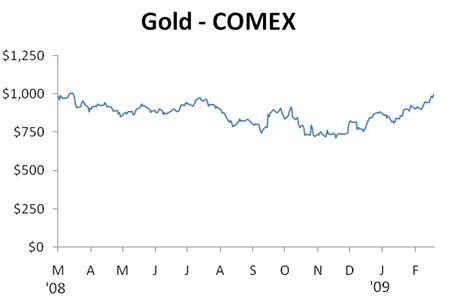
Of course, gold didn’t stay above $1,000/ounce for long last March; it quickly reversed course and traded down all year, before bottoming at $712.41 on November 20th. Since then, gold has risen 39.4%; it was up 13.4% in January alone.

The last time I wrote about gold (Demanding Gold) was just before that November bottom. Back then I discussed the underlying demand for gold – because one of the great things about commodities is that ultimately, they’re always about supply and demand. And with the gold-bug’s most important supply and demand report out for 2008, it’s the perfect time to revisit the subject. (The full link to the World Gold Council’s Supply and Demand Statistics for Q4 and Full Year 2008 report is here.)

Looking At Demand

Gold demand can be broken into three main areas of interest – jewellery, which accounted for roughly 58% of identifiable demand in 2008, industrial and dentistry demand, and finally identifiable investment demand.

On the whole, gold saw demand grow 4% from 2007 to 2008, but the picture is a bit more complex than just that.

Not everything was rosy for gold in 2008. As we predicted, jewellery demand was down significantly. In 2007 around 68% of gold demand was attributed to jewellery consumption. In 2008, that number dropped to 58%.

At the end of December, The World Gold Council released a report entitled “What Women Want: Global Discretionary Spending Report 2008“. In it, the WGC details the values and significance different countries attribute to gold jewellery and why people buy it. One new thing the study uncovered is that gold jewellery is now competing with items such as cell phones and other everyday items for discretionary spending.

The report also states that “confidence that gold will hold its value has waned,” reflecting in part the volatility gold prices have experienced in the past year. With gold rising and falling by 30% in a single year, it’s no wonder people are feeling less comfortable with it as a store of value.

Demand on the jewelry front appears to be price elastic. In India, the largest consumer of gold jewellery, demand in the fourth quarter more than doubled compared to Q4 of 2007. While this would seem to buck the year-long numbers, it’s likely due to the fact that lower gold prices occurred precisely at the time of the Diwali festival – a peak gold-buying time in India. In 2007, gold prices were high during the festival, which depressed demand. For the full year of 2008, jewellery demand in India dropped 15%.

China was one of the only countries that posted an increase in demand for jewellery, up 8% from 2007. Much of this demand was for 24-karat jewelry, which commonly implies jewellery purchases that are doubling as investments.

The Big Stick: Gold Bugs

According to the World Gold Council report, gold demand for investment rose from 663.7 tonnes in 2007 to 1090.7 tonnes in 2008 – a somewhat staggering year-on-year increase of 64.3%. Retail investment – things like bar hoarding, official coins, medals/imitation coins and other kinds of retail investment – almost doubled, going from 410.3 tonnes in 2007 to 769.3 tonnes in 2008. That gives some credence to the wide scale anecdotal evidence throughout the year that gold coins were virtually impossible to obtain in many countries.

Exchange-traded funds and similar products also showed a large increase, from 253.3 tonnes to 321.4 tonnes (a 26.9% increase). This trend has continued into 2009. The SPDR Gold ETF (NYSE: GLD) – the largest physical gold trust – now has 1,028.98 tonnes in its vaults. This is a trust that started 2009 with 780.23 tonnes, meaning its gold horde has risen 31.9% in less than two months. To put that in perspective, 249 tonnes is over 10% of the total amount of gold mined in all of 2008. This acceleration happened almost entirely in a dramatic surge mid-February.

Net-net, however, if you offset the huge rush in gold investments with the significant drop in jewelry demand, the net gain in tonnage terms was just 4%.

There is, however, another way to look at things. When viewed through the (occasionally depressing) lens of the dollar, gold demand seems endless:

Gold Supply in Flux

With the demand part of the picture in hand, it’s time to turn to supply. The third quarter of 2008 saw a huge supply deficit with demand far outreaching supply. In the fourth quarter, supply rose 19%, almost entirely due to an increase in gold scrap. Yes, that’s right: Those late night commercials offering to buy your old tangled gold necklaces were on to something, and people were selling.

Scrap sales for 2008 ended up 17% higher than 2007, and that along with slightly higher total mine supply just about offset lower central banks sales so that in the end, 2008 ended the year with only 1% less total supply than 2007 – practically even.

The moral of the story is simple: supply and demand remain incontrovertible laws. The unbelievable demand vs. the stagnant (mine) and dwindling (central bank) supply created a vacuum, and a new source came on line to fill the need. Thus, at least indirectly, gold went from the scrap heap into brand new shiny gold coins, just when the market needed them the most.

Which brings up the question: how long can consumers fill their own demand through scrap? And what price level is needed to support the tremendous scrap levels already in place?

=================================

Catch the New Bull! – Buy Gold Online – Get 1 gram free just for opening account– just click here and then again on the Gold Bar!, no minimums – Buy Safely, quickly, and at low prices, guaranteed! – Bullion Vault.com

==================================

 Five Weeks of Silver Backwardation – Seeking Alpha

By: Trace Mayer of Run to Gold.com

During an interview with Contrary Investors Cafe on 24 February 2009 I discussed both gold backwardation and silver backwardation. After the interview I was asked why more commentators are not discussing this issue. I do not know.

Regarding money there are two competing views: (1) money is determined by the market or (2) chartalism which asserts that ‘money is a creature of law.’ Governments can only manage money if they create it. Obviously, the market determines money because money existed before governments were created.

Regarding gold there are two competing paradigms: (1) gold is a commodity and (2) gold is money. Paradigm (1) asserts that gold is a hedge against inflation and there is no monetary demand for gold. On the other hand, paradigm (2) asserts that gold is a hedge against currency collapse and the primary demand for gold is monetary. I subscribe to the second paradigm and assert that at all times and in all circumstances gold remains money.

WHAT IS SILVER’S ROLE

Under which paradigm does silver fall? Is silver a commodity or is silver money? For a commodity to be money its primary demand must be monetary.

Like gold, for thousands of years silver functioned as money in the market. The term dollar, as used in Article 1 Section 9 Clause 1 and the Seventh Amendment of the US Constitution, is defined as 371.25 grains of fine silver under Section 9 of the Coinage Act of 1792. Governments stockpiled billions and billions of ounces. However, on 24 June 1968 the United States government defaulted on their silver certificates. Over the decades, silver, like gold, has been demonetized in ordinary daily transactions. Supposedly there are large stockpiles of gold in central bank vaults. Unlike gold there are no reported large above ground stockpiles of silver stashed in central bank vaults. Additionally, a large portion of silver demand is industrial as it is used in cell phones, refrigerators, dental equipment, computers, etc.

Therefore, it appears that silver is confused about its role. In other words, silver functions as a commodity and as quasi-money.

FIVE WEEKS OF SILVER BACKWARDATION

While similar, there are differences between future and forward contracts. For example, future contracts are traded on exchanges, use margin and are marked to market daily. In contrast, forward contracts are generally traded over-the-counter (OTC derivatives) and are not marked to market. Therefore, forward contracts are subject to greater counter-party risk than future contracts.

Because the primary reason backwardation arises is counter-party risk and because forward contracts are impregnated with greater counter-party risk than future contracts, therefore it is highly likely that backwardation would appear in the forwards markets before the futures markets.

This is precisely what has happened. While the COMEX silver futures contract have not been in backwardation the LBMA Silver Forward Mid Rates have been in backwardation for five consecutive weeks. Of particular interest is the 6 month contract.

SO WHAT?

What does all this mean? Well, I think the backwardation reflects the market’s uncertainty of silver’s role as money. The chronic silver backwardation began on 8 December 2009, the same day I wrote about gold in backwardation, and silver was priced about $9.60. Currently silver is trading about $13.82. Predictably, the gold/silver ratio is narrowing. If the backwardation persists it will be interesting to see if silver’s price in illusory FRN$ continues rising.

In my opinion, as the great credit contraction grinds on and intensifies, the commodity silver will reassert itself as money and eventually currency. As I mentioned during the interview with Contrary Investors Cafe what would be really interesting is if the central banks decide to start hoarding silver!

In the meantime it may behoove those who are bullish towards silver to increase the pressure on physical silver delivery. For example, I purchased some beautiful Austrian philharmonics at the Cambridge House Investment Conference and Silver Summit over the weekend. The beautiful coin cost $20 which was an amazing $5.50 over spot.

While there are cheaper ways to purchase physical silver bullion, like GoldMoney, these huge premiums over spot beg the question: What is the real silver price? With the specter of counter-party risk driving silver into backwardation if there is a failure to deliver then it will likely cause the silver price to shift from the COMEX just like a failure to deliver would cause the gold price to shift from the COMEX.

Bottom line: Do not get caught with your paradigms down!

===============================

Catch the New Bull! – Buy Gold Online – Get 1 gram free just for opening account– just click here and then again on the Gold Bar!, no minimums – Buy Safely, quickly, and at low prices, guaranteed! – Bullion Vault.com

================================

Doug Casey: What to Do in “The Greater Depression” — Seeking Alpha

Source: The Gold Report


Bullion and oil appear in the lineup of power players that Doug Casey thinks investors can count on as the world slips deeper and deeper into what he calls the “Greater Depression.” Despite the raging economic storm and Doug’s doubts that Western civilization’s governments will take the actions needed to quell it, though, the Chairman of Casey Research is nowhere close to calling the game. In fact, he sees silver lining in the clouds of crisis—opportunity—and expresses optimism that technological advances, coupled with capital rebuilding once over-consumption runs its course, will prevail eventually. The Gold Report caught up with the peripatetic author, publisher and professional international investor between polo matches in New Zealand, one of several nation-states he calls home from time to time.


The Gold Report: You’ve been discussing what you’re calling “crisis and opportunity,” and in fact have a summit by that same name coming up in Las Vegas next month. Could you give us a high-level overview of what you foresee?

Doug Casey: We’ve definitely entered what I describe as the Greater Depression. It’s not coming; it’s here. It’s going to get much, much worse as far as I’m concerned and unfortunately, it’s going to last a long time. It doesn’t have to last a long time, but the root cause is government intervention in the economy and everything they’re doing now is not just the wrong thing, it’s the opposite of what they should be doing. It’s almost perverse.

The distortions and misallocations of capital and the uneconomic patterns of production and consumption that have been going on for over a generation need to be liquidated and changed, but everything the government’s doing is trying to maintain these patterns. So it’s going to be horrible. In addition, the government is necessarily directing more power toward itself with all of its actions. If I were you, I’d rig for stormy running for a good long time.

TGR: By “a long time,” do you mean a couple of years, a decade, a generation?

DC: This is, in some ways, uncharted territory. Let me say that for the long run I’m very optimistic. Why? Two things act as the mainsprings of progress. Number one is technology and that’s going to keep advancing, so that’s very good. Second is capital and savings. Individuals will solve their own problems and, therefore, they will stop consuming more than they produce, which is what they’ve been doing for years, and they’ll again start producing more than they consume. The difference is savings; that builds capital.

So technology and capital are going to solve the depression. But the government can do all kinds of stupid things to make it worse. Look at the Soviet Union. They suffered a depression that lasted 70 years from its founding. Look at China. The whole reign of Mao was one long economic depression. That could certainly happen in the U.S., too, where the government misallocates capital in such a way that technology doesn’t advance as it could and people can’t build individual capital the way they would. I’m optimistic, but anything can happen.

TGR: But didn’t China and the Soviet Union have governmental structures very different from those in Western Europe and the U.S., and those structures allowed for more intervention? Are you projecting that we might slip into an era where Western civilization will allow their government to run themselves like the Soviet Union and China did?

DC: It seems to be going in that direction. Of course, Europe is going to be hurt much worse than the U.S. Europeans are much more heavily taxed and much more heavily regulated. The average European is much more reliant upon the state psychologically as well as economically. So it’s all over for Europe and this doesn’t even count the problems that they’re going to have in the continuing war against Islam, which are much more serious for Europe than they are for the U.S. So, no, Europe is fated to be nothing but a source of houseboys and maids for the Chinese in the next generation.

TGR: So do you think that societies in Western Europe—and even the U.S.—will allow themselves to be governed in the same fashion as the Soviet Union and China were during their depressions?

DC: Oh, totally. I don’t see why that would not be the case. Even Newsweek says we’re all socialists now. That seems to be the reigning ideology. In addition, psychologically, the average American—just like the average European—looks to the government to solve things. This is very bad. Most people are unaware that Homeland Security, which is one agency that should be abolished post-haste, is building a 400-acre campus in southeast Washington, D.C., where initially they’re going to put 25,000 employees. That’s as many as the Pentagon has and with 400 acres, Homeland Security has a lot more room to grow. Ironically, the property is at the site of St. Elizabeth’s Hospital, the first federal insane asylum in the United States. Once a bureaucracy has a piece of real estate and builds buildings, it’s game over. They’re just going to accrete and grow and grow, so that’s one indication. The trend is clearly in motion.

It’s all over for the U.S. In fact, let me say this. America doesn’t exist anymore. What is left is not even these United States. That was decided in the 1860s. It’s the United States. America, which is basically an idea, a concept, is dead and gone. The United States is just another of 200 awful little nation-states that have spread across the face of the earth like a skin disease. There’s no longer any difference that I can tell between the U.S. and any other country.

TGR: How would you describe the concept that America was based on that is now gone? And is there another country in the world embracing that concept? Will there be a new America?

DC: No, there is no other place. I’ve been to 175 countries and lived in 12. My feeling is that the best thing that you can do is set your life up so that you’re not to be considered the property of any one government. You might have a passport or several passports and, therefore, that government thinks they own you. But if you don’t spend time in a country, practically speaking, there’s nothing they can do about it.

So, no, there is no real haven for freedom in the world today. The best you can do is go where the governments are so unorganized that they can’t control you effectively. That’s one reason I like to spend time in Argentina. They have an incredibly stupid government, but they’re also very inefficient and ineffective. So it’s wonderful as a place to live. I also spend time in Uruguay, because it’s a tiny little country with no ambitions to conquer the world. The nice thing about New Zealand, where I am now, is that it’s a small country, only 4 million people, lots of open land. It’s got some severe problems, but it’s pleasant. I think the U.S. is going to be the epicenter of a lot of problems in the years to come.

TGR: Few of our readers are probably in positions where they could live in 12 different countries, but they have amassed assets here in the United States. What advice would you give them to safeguard those assets?

DC: The key is to remember that we’re going to have a long and deep depression, so most things that worked well over the last 20 years are unlikely to work well in the future. I’d been predicting the real estate collapse for a long time. It’s still got a way to go, too, because a lot of real estate debt remains that has to be liquidated. There’s a lot of leverage out there and there’s been a huge amount of overbuilding. So it’s far too early to get into real estate, at least in North America or Europe.

It’s also way too early to get into the general stock market, for all kinds of reasons. Dividend yields are still extremely low. Earnings are going to collapse. Government bonds are perhaps the worst single thing to be in, because with the government printing up money literally by the bushel basket, the dollar is going to start losing value radically and interest rates are going to start going up radically at some point. So you have to rule out most stocks.

I’m afraid that the most intelligent thing you can do is to own a lot of gold, preferably gold coins in your own possession. And I think speculation in gold stocks makes sense at this point, because gold stocks are about as cheap as they’ve ever been relative to other assets, really, in history. Now is an excellent time to do that as well. But that’s in terms of speculation.

Investment risk is tough enough, but the biggest problem is political risk. That’s what you have to watch out for. That means you have to diversify internationally. This is harder for most people, harder psychologically, and it takes more assets to make international diversification viable. But if you’re in a position to do it, it’s the most important thing you can do.

TGR: Since you mentioned having coins in your own possession, should we assume you’re not a big fan of the ETFs or some of these other paper gold promises, if you will?

DC: ETFs are okay for the convenience that they offer and for significant amounts of money, but gold coins should be first on your list, no question about that. If you’re only talking about $50,000 or $100,000, or $200,000, coins are fine to keep in your own possession. They won’t take up much room and you can put them in some safe place (which, incidentally, is not a bank safe deposit box).

TGR: Are you recommending putting all of your investment in gold into the bullion or are you also recommending some portion in producing junior and explorations?

DC: Both, but look at the stocks as being speculative. Most of your money should be in gold with a bit of silver, too. Silver is basically an industrial metal, but it has monetary characteristics. Now is the time to be very overweight in the metals and I think owning gold stocks is a good idea. They’re very cheap.

TGR: Anything else investors can do to preserve whatever may remain of their wealth?

DC: Owning real estate in some foreign countries is a very good idea—from a lifestyle point of view, an asset diversification point of view, and a possible capital gains point of view, too. They can’t make you repatriate foreign real estate. Having some U.S. dollar cash while we’re going through this deflationary period is very wise as well, but that’s not going to last. Eventually the U.S. dollar is going to reach its intrinsic value.

TGR: Not that you have a crystal ball, but how would you see the rest of ’09 playing out?

DC: Nothing goes straight up or straight down, but it seems that ’09 is going to see much higher gold prices and much lower stock prices and much lower bond prices, too. But remember, the worst is yet to come.

You haven’t heard an awful lot about people losing their pensions yet, but that’s going to happen because what are pensions invested in? They’re mostly invested in stocks and bonds and commercial real estate. All three of those things are disaster areas, and bonds are the big disaster area yet to come. So I think it’s going to be nothing but bad news in 2009. What happened in 2008 was just an overture to what I think is going to happen in ’09 and ’10.

TGR: Even into 2010?

DC: Yes. This isn’t going to be cured overnight, mainly because of what the government’s doing. As I said, it’s perversely exactly the opposite of what they should be doing, which is abolishing all the agencies and freeing up the economy. They’re passing lots of new regulations, they’re going to have to raise lots of taxes eventually, and they’re inflating the currency. So it has to last, at least into 2010. It’s going to be quite dismal, actually.

TGR: And what happens with the unfunded Medicare liabilities?

DC: They’re not going to be funded. They’re going to be defaulted on and, actually, that’s the best thing that could happen. That’s one of the things that should be done now; the U.S. government should default on its debt. This is shocking for people to hear, but it wouldn’t be the first time the U.S. government has done that. It did that almost at its founding in continental days.

This debt represents a tax liability that’s being foisted off on the next generations who have no moral obligation to pay and should not pay. I think as an ethical point, the U.S. should default on this debt. It’s impossible to pay it back, and it won’t be paid back. It’s more honest to acknowledge that bankruptcy now as opposed to pretend it’s going to be paid back. Defaulting even might forestall runaway inflation in the dollar, which would be a catastrophe of the first order. So it’s the smart and moral thing to do, and it’s going to happen eventually anyway. All the real wealth will still be here; a lot of it will just change ownership. The big losers will be those who lent to the State, thereby enabling its depredations, and they deserve to be punished.

But even a default tomorrow will do no good unless you put the U.S. government into reverse and disband all of these ridiculous, destructive agencies that have grown like a cancer for years. Taxes should be cut 50% to start with, just out of hand. And the defense establishment—it’s a misnomer; it’s not defense at all but rather foments wars around the world—should be cut hugely. Not with a butcher knife; but a chain saw. But none of this is going to happen; in fact, just the opposite. That’s why I’m so pessimistic now that the tipping point’s finally been reached.

TGR: Are we at the tipping point?

DC: Yes, we’ve absolutely gone over the edge. The consumer is no longer in a position to consume. Everybody is going to cut consumption to the bone and hopefully find something to produce instead. It would be better for people to start viewing themselves as producers than consumers. That would be a step in the right direction to get them psychologically more in line with reality.

TGR: In last fall’s meltdown, gold held up, but the stocks didn’t. Quite a few producers and soon-to-be producers, and some companies making discoveries, seem to have bottomed out in November and December. But worry persists in the market. Suppose another shoe drops or another black swan appears? Richard Russell (Dow Theory Letters) and others have been talking about the Dow going down to 5,000. What would that do to the gold stocks?

DC: Gold stocks are also stocks, and the best environment for gold stocks historically has always been when both gold and the stock market are going up. But since the last gold stock bull market came to an end, I think it’s entirely possible to see a bubble develop in gold stocks with all the money being created. I certainly hope so. I’m actually optimistic for gold stocks just because they’re so cheap relative to everything else.

TGR: They have been beaten down.

DC: Yes. And that fact, along with the waves of money being printed around the world and the much higher gold prices we are going to see, could cause a speculative mania to develop in the gold stocks. Nobody’s even thinking about that possibility right now, because they’re so battered. But this is the time to get into the right ones because it’s likely to happen in the future.

TGR: The ’29 crash—which was really the preamble, because ’30, ’31, ’32 and ’33 were certainly bigger—is when gold stocks such as Homestake did their best. How do you see that playing out this time around? Is it different this time or do you expect a similar pattern?

DC: You know what they say, “History doesn’t repeat itself, but it rhymes.” I think that, first of all, the gold mining industry is a much worse industry now than it’s ever been in the past, because just as all the easily defined light sweet oil basically has been discovered, all the easy-to-find high-grade gold basically has been discovered. Most mines that are going into production are low-grade, which means that you have to move a lot of dirt, which means that they’re much more capital-intensive than in the past. So gold mining’s a worse industry from that point of view.

Also, politically speaking, with the rise of the green movement, there are people who don’t want any oil burned, any dirt moved, any trees cut. They don’t want to see anything happen. This makes it much harder to do gold from a permitting and political point of view. We’re in a much higher tax environment than in the past. So it’s a tough industry. It really is. It’s just a 19th century choo-choo train type of industry that interests me only as a speculative vehicle. You’ll notice that gold went from lows of about $300 to highs of about $900 and none of these gold companies are making any money because their costs actually went up faster than the price of gold. So I’m not saying gold mining is a great business. It’s not. It’s a crappy business. Still, we could have a bubble in the stocks. I’m hoping we do.

TGR: Aren’t we going to see a change in that in ’09? Oil, which is one of the large components of that cost, has come down dramatically. A lot of these producers must be locking in oil at these lower prices. Won’t that translate into year-over-year earnings increases for the gold producers?

DC: That’s possible. The producers actually may show increases for the next couple of years. I don’t doubt that. But I don’t think oil will stay where it is. I think oil’s eventually headed back to $150 a barrel or more.

TGR: So why wouldn’t you own oil as well as gold?

DC: It’s a good idea, but we weren’t really talking about oil. I’d say that oil is a good thing to own. Oil is a real buy now. It’s as good a buy at $40 as gold is at $900 right now. Maybe a better buy; who knows?

TGR: If we go into worldwide depression, will oil continue to be a good buy or will it self-regulate around this $40 a barrel?

DC: I am bullish on oil. Although I’m philosophically not very sympathetic to the peak oil theory, I think it’s a geological fact. Also, China and India and the other developing parts of the world don’t use a whole lot of oil now. As they develop, they will to want—and almost need—to use a lot more oil. That’s going to keep pressure up on the demand side. But the supply side actually finally is constrained, so it’s going to mean higher prices. In a depression-type environment, U.S. and Western oil consumption could drop a lot, but the third world would take up most of that slack. So I have to be bullish on oil.

TGR: Are you bullish on any other sectors or commodities?

DC: I’m bullish on agricultural commodities. They ran way up last year and then collapsed again. I think a good case can be made that most of the soft commodities are quite cheap and will go higher, so I’d look at those, too. I think gold definitely, oil in the years to come has the potential to go much, much higher, and the agricultural commodities have a lot of potential.

TGR: Gold appears to be uncoupling from the dollar. Historically, when the dollar was strong, gold would be weak. But we’ve had a couple of recent instances in which both the dollar and gold have been strong. Obviously, we’ve seen a total decoupling of gold from oil. It used to be when oil was running, gold was running and vice versa, but that no longer seems to be the case. Is that just an old wives’ tale or is something going on?

DC: I’ve never seen any necessary relationship between gold and oil, just like there’s no necessary relationship between rice and natural gas, or nickel and soybeans. All these commodities tend to move together, all the currencies tend to move together and stock markets tend to move together, but they all have their own dynamics. I think it makes sense to compare the relative prices of various commodities and see what may be cheap or dear relative to other things based on the fundamentals.

On any given day, somebody may have to buy or somebody may have to sell a huge amount of almost anything. It’s unpredictable and you can’t tell what constraints are out there in the market. I don’t even pay attention to day-to-day fluctuations because they’re just random noise. I watch the big trend. It’s been shown that if you just made one correct trade and stuck with it at the beginning of every decade for the last four decades, you would have realized something like 1,000 times on your money. To me, this is the proper approach to the markets, not to try to second-guess from day-to-day what’s going to happen. That’s foolish because you get chewed up with commissions and bid-ask spreads and double-thinking your own psychology and so forth.

I really just like to look at long-term trends. In terms of long-term trends, you’ve got to be long gold, long silver, long oil; you’ve got to be short bonds. I think that’s really all you need to know. The other things we mentioned such as agricultural commodities and so forth are worthy of attention. But, as I said, I’m not a day-to-day trader. I think that’s very foolish.

TGR: Are these the themes that you and your group of speakers will focus on in Las Vegas?

DC: They are. I certainly want to invite anybody who reads this interview to join us. We put on very small, very classy seminars. They’re not gigantic mob scenes, so it’s possible to get to know individual speakers and fellow attendees in a very collegial atmosphere. I think it’s something that anybody who’s seriously interested in these kinds of things should consider.

The Casey Research Crisis & Opportunity Summit, will be held March 20 – 22, 2009, at the Four Seasons Resort in Las Vegas.

A citizen of the world in more ways than most of us can imagine, Doug Casey, Chairman of Casey Research, LLC, is the international investor personified. He’s spent substantial time in about 200 different countries so far in his lifetime, living in 12 of them (currently New Zealand and Argentina). And Doug’s the one who literally wrote the book on crisis investing. In fact, he’s done it twice. After The International Man: The Complete Guidebook to the World’s Last Frontiers in 1976, Doug came out with Crisis Investing: Opportunities and Profits in the Coming Great Depression in 1979. His sequel to this groundbreaking book, which anticipated the collapse of the savings-and-loan industry and rewarded readers who followed his recommendations with spectacular returns, came in 1993, with Crisis Investing for the Rest of the Nineties. In between, his Strategic Investing: How to Profit from the Coming Inflationary Depression (Simon & Shuster, 1982) broke records for the largest advance ever paid for a financial book. Bill Bonner (The Daily Reckoning) describes Doug as “smart, hard-working, and extremely knowledgeable” with “an instinct about investments that has made him and many of those around him very rich.”

 Doug, who now spends more time as an expatriate than he does on American soil, has appeared on NBC News, CNN and National Public Radio. He’s been a guest of David Letterman, Larry King, Merv Griffin, Charlie Rose, Phil Donahue, Regis Philbin and Maury Povich. He’s been the topic of numerous features in periodicals such as Time, Forbes, People, US, Barron’s and the Washington Post – not to mention countless articles he’s written for his own various websites, publications and subscribers.

 ==================================

Catch the New Bull! – Buy Gold Online – Get 1 gram free just for opening account– just click here and then again on the Gold Bar!, no minimums – Buy Safely, quickly, and at low prices, guaranteed! – Bullion Vault.com

That’s all for Today- Enjoy! jschulmansr

Follow Me on Twitter and be notified whenever I make a new post!

================================== 

Nothing in today’s post should be considered as an offer to buy or sell any securities or other investments; it is presented for informational purposes only. As a good investor, consult your Investment Advisor/s, Do Your Due Diligence, Read All Prospectus/s and related information carefully before you make any investing decisions and/or investments. –  jschulmansr



Share this:

  • Click to share on Reddit (Opens in new window) Reddit
  • Click to share on Facebook (Opens in new window) Facebook
  • Click to share on LinkedIn (Opens in new window) LinkedIn
  • More
  • Click to share on X (Opens in new window) X
  • Click to share on Pinterest (Opens in new window) Pinterest
  • Click to share on Tumblr (Opens in new window) Tumblr
  • Click to print (Opens in new window) Print
  • Click to email a link to a friend (Opens in new window) Email
Like Loading...

Wake Up Call!

16 Monday Feb 2009

Posted by jschulmansr in 10 year Treasuries, 20 yr Treasuries, Bailout News, banks, Barack Obama, bear market, bull market, capitalism, central banks, China, Comex, commodities, Copper, Currencies, currency, Currency and Currencies, depression, dollar denominated, dollar denominated investments, economic, Economic Recovery, economic trends, economy, Federal Deficit, federal reserve, Finance, financial, Forex, Fundamental Analysis, futures markets, GDX, GLD, gold, Gold Bullion, Gold Investments, gold miners, hard assets, How To Invest, How To Make Money, hyper-inflation, inflation, Investing, investments, Japan, Jschulmansr, Junior Gold Miners, Latest News, majors, Make Money Investing, market crash, Markets, mid-tier, mining companies, mining stocks, monetization, palladium, Peter Brimelow, physical gold, platinum, platinum miners, precious metals, price, prices, producers, production, rare earth metals, recession, resistance, risk, run on banks, safety, Saudi Arabia, silver, silver miners, small caps, spot, spot price, stagflation, Stimulus, Stocks, The Fed, TIPS, Today, U.S. Dollar, uranium

≈ 1 Comment

Tags

Austrian school, Bailout News, banking crisis, banks, bear market, Bollinger Bands Saudi Arabia, Brian Tang, bull market, central banks, China, Comex, commodities, Copper, Currencies, currency, deflation, Dennis Gartman, depression, dollar denominated, dollar denominated investments, Doug Casey, economic, economic trends, economy, Federal Deficit, financial, Forex, futures, futures markets, gata, GDX, GLD, gold, gold miners, hard assets, hyper-inflation, India, inflation, investments, Jeffrey Nichols, Jim Rogers, Keith Fitz-Gerald, majors, Marc Faber, market crash, Markets, Michael Zielinski, mid-tier, mining companies, monetization, Moving Averages, palladium, Peter Grandich, Peter Schiff, physical gold, platinum, platinum miners, precious metals, price, price manipulation, prices, producers, production, protection, recession, risk, run on banks, safety, Sean Rakhimov, silver, silver miners, small caps, sovereign, spot, spot price, stagflation, Technical Analysis, TIPS, U.S., U.S. Dollar, volatility, warrants, XAU

The U.S. Markets are closed today yet something very interesting is starting to happen. Can you sense it? The shift from deflation to inflation. The “smart money” big investors are sensing it and starting to jump into Gold in a big way! Gold Prices are holding steady overseas above the $935 support level. Todays articles show the why and how of this move by big money into Gold, read on… and Good Investing! – jschulmansr

==============================

 Something still stirring in precious-metals pond – Market Watch

By: Peter Brimelow of Market Watch

With some wild swings, gold gained about 3% on the week, closing Friday at $941. The Phx Gold Silver Index (XAU:

Technicians were impressed. Long-term chartist Martin Pring is deflationary-minded at present. Two weeks ago, he remarked that if certain trend lines were broken, “I would be dragged kicking and screaming into the bullish camp”. But now he simply says in his recent weekly Intermarket Review: “Not much to add to my recent bullish comments. Both the metals and shares recently broke out of giant patterns … With our Global Gold Index at a new all-time high – enjoy the ride!”
Pring also flags a powerful conceptual reason for the gold move. Discussing a chart of the inflation proofed Treasuries, and using the iShares:Lehm TIPS TIPT as a proxy, Pring says: “Here we see the inflation protected bonds, or TIPs. Who needs these in a deflation? But look, the price just broke to the upside … and volume is expanding! When we look at the longer term we see it’s still in a primary bear market … However this week’s breakout suggests a turn is likely.”
In other words, the bond market is getting seriously concerned about inflation. See Website
The Privateer, being Australian, is even more direct in its weekly remarks: “Why is gold going up? It is certainly not in spite of the global mania for bailout programs now sweeping the world. It is because of these programs. The more ‘liquid’ the global financial powers that be make their money — by creating it in ever larger swathes — the more they run the risk that the world starts to look elsewhere for a viable and trustworthy way to exchange goods and services.”
The Privateer’s invaluable $US 5X3 point and figure chart has now broken above its last downtrend, although its proprietor would like more progress: “This week the chart got up to and just above the second of the two downtrends. The ‘poke’ above the line which came with Gold’s close above $U.S. 945 on Feb. 12 is not yet decisive, a close above $U.S. 960 would be.” See Website
Silver, which I reported last week was exciting the gold bugs by showing unusual leadership characteristics, persisted — rising 3.5% on the week, including on Friday despite gold’s fall, and pushing the Gold/Silver ratio to 68.9 from last week’s 69.5.
But the star of the week was the reported bullion holdings of Spdr Gold Trust. (GLD:
GLD is regarded with deep suspicion by the radical gold bugs who think the metal’s price is manipulated. But at the least it has to been seen as a measure of the Western Hemisphere investment appetite for gold.
In contrast, Le Metropole Cafe monitors Indian gold imports and reports that, unusual in the past few years, the world’s largest gold consumer is standing aside for now. See Website
Interestingly, two sentiment indicators did not react much this past week. Mark Hulbert’s HGNSI on Friday stood unchanged at 60.90%. MarketVane’s Bullish Consensus actually lost a point on Friday to 78%, gaining only 3 points on the week. See Website
In serious gold moves, MarketVane excursions into the 90s are reportedly common.
===================================

Here is where I buy my Bullion, get one free gram of Gold just for opening an account! Catch the New Bull! – Buy Gold Online – Get 1 gram free! – Buy Safely, quickly, and at low prices, guaranteed! – Bullion Vault.com

===================================
Major Investors Piling into Gold – Seeking Alpha
By: James West of Midas Letter

Endeavour Financial Corp (TSX:EDV) closed a $100 million equity offering last week, and several other “bought deal” financings point to a strengthening trend: major investors are piling into gold.

The Offering was underwritten by a syndicate co-led by GMP Securities L.P. and Canaccord Capital Corporation (the “Underwriters”). Endeavour will use the funds to support its investment activity in the mining sector with an emphasis in the short term on precious metals.

The first quarter of 2009 has seen well over $1 billion flow into near term and existing mining companies, which is a reflection of the strong gold price amid safe haven demand. With estimates of U.S. government spending reaching as high as $2 trillion, large value investors are increasingly deterred by U.S. Treasury related securities in favour of precious metals.

  • Newmont Mining (NYSE:NEM), one of the world’s largest gold mining companies, raised US$1.7 billion in a combined common share/convertible debt deal which it will use primarily to fund the acquisition of the remaining 33.33% interest in the Boddington project in Western Australia that it does not already own and the additional capital expenditures that will result from its increased ownership in the Boddington project, as well as for general corporate purposes. Citigroup Global Markets and J.P. Morgan Securities led the placement.
  • Freeport McMoran Copper and Gold (NYSE:FCX) raised US$740 million through the issuance of 26.8 million common shares at $28 per share;
  • Kinross Gold Corporation (KGC) announced a “bought deal” financing for US$360 through the issuance of 24,035,000 million common shares US$17.25 per common share. The underwriters were led by UBS Securities Canada Inc.;
  • Osisko Mining Corporation (OSKFF.PK) entered into another “bought deal” led by Thomas Weisel Partners and BMO Capital Markets. The offering of 77 million units at $CA4.55 a share will gross CA$350.4 million. Osisko is developing the 6.28 million ounce Canadian Malartic Project Quebec.

Smaller deals are becoming more common for junior emerging gold companies as well. Among the recent actions:

  • Centamin Egypt (CELTF.PK) raised $CA69 million through the issuance of 106.2 million shares at CA$0.65 per share for development and construction of the Sukari Project in Egypt. This financing was led by Thomas Weisel Partners and Cormark Securities.
  • Romarco Minerals Inc. (TSX.V:R) announced a bought deal Friday worth $20 million for the development of the Haile Gold Mine in South Carolina. Romarco issued 54 million units at $0.38 each. The financing was led by a syndicate of underwriters led by Macquarie Capital Markets Canada Ltd. and including Paradigm Capital Inc. and GMP Securities L.P.
  • International Tower Hill Mines (THM) sold 2 million common shares at $2.50 per share for gross proceeds of CA$5 million, which will be directed towards further development of its projects in Alaska and Nevada. The placement was a “bought deal” led by a syndicate of underwriters led by Canaccord Capital Corporation and including Genuity Capital Markets and GMP Securities L.P.
  • Exeter Resource Corporation (AMEX:XRA) raised CA$25.2 million at $2.40 a share for development of its assets in Argentina and Chile.

And it isn’t just gold that is attracting big financing. On February 10th, Uranium One (SXRZF.PK) announced a $270 million investment by a Japanese Consortium comprised of Tokyo Electric Power Company, Incorporated (TKECF.PK), Toshiba Corporation (TOSBF.PK), and The Japan Bank for International Cooperation.

Concurrently with the execution of the subscription agreement, Uranium One has also entered into a long-term off-take agreement and a strategic relationship agreement with the Japanese consortium, both of which will become effective upon closing of the private placement.

The off-take agreement provides the consortium with an option to purchase, on industry-standard terms, up to 20% of Uranium One’s available production from assets in respect of which Uranium One has the marketing rights.

Junior Uranium company First Uranium Corp. (FURAF.PK) was also the beneficiary of a bought deal financing led by Macquarie Capital Markets this week, which saw First Uranium place 20.5 million units of its shares at $3.00 per unit for gross proceeds of $61.5 million. First Uranium will direct the funds towards the development of the Ezulwini Mine in South Africa.

Endeavour Financial is followed by many analysts and newsletter writers for its robust project pipeline.

Brien Lundin, who publishes the Gold Newsletter, says one of the main reasons he follows Endeavour Financials is because of management – especially Mr. Frank Giustra. He says this team now senses a market bottom, as they are raising capital to go after assets that now cost a fraction of what they did last year, or even six months ago. He intimates strongly that his subscribers should do the same, using Endeavour as their proxy. A mix of entrepreneurial expertise and value investing, he outlines what the smart money is doing now.

=============================

Here is where I buy my Bullion, get one free gram of Gold just for opening an account! Catch the New Bull! – Buy Gold Online – Get 1 gram free! – Buy Safely, quickly, and at low prices, guaranteed! – Bullion Vault.com

====================================

Gold: Now Demonstrating Trust in Obama – Seeking Alpha

By: Boris Sobolev of Resource Stock Guide

Gold is Starting to Believe the Obama Administration

Despite making loud headlines about stimulating the economy, the US government has been unable to raise the level of optimism among the general public, while the stock market seemed to drop into a deep state of apathy.  


Last week we received the long-awaited economic stimulus packet as well as the so-called plan for the rescue of the US financial system. We have already voiced our skepticism regarding the structure of the stimulus and its potential effect on the economy in a prior article.


As far as the size of the $787 billion package, it is clear that it is too small and too spread out into 2010 and beyond to be called a stimulus. $787 billion is just 5.6% of the GDP and when spread over two years will account for just 2.8% at a time when many industrial economies around the world are contracting by 5-10% per year. It can only be called a life support package, not a stimulus.

Japan, which got into a deflationary spiral as a result of a real estate bust, spent much more than 100% of its GDP since 1991 just to see its economy stagnate. Construction related investment alone ate up $6.3 trillion of public funds over the 17 years since 1991. Infrastructure spending accounted for $350 billion to $400 billion per year for the first half of the 1990s for an economy half the size of the United States.

The results of the Japanese fiscal stimulus were unimpressive, although it could be argued that without this stimulus, it could have been much worse.

With the United States facing similar post bubble dynamics as Japan did twenty years ago, how can we expect greater effectiveness of the Obama stimulus plan when it is insufficient and much of is clearly misdirected?

In reality, this economic stimulus package has to be viewed as only the first one of many yet to come. By having the US dollar as a world reserve currency, the US government can be much more effective than its Japanese counterpart in printing its own currency.

We will soon be quantifying the size of the government stimulus plans in trillions rather than in billions. Within the next 3 to 4 years, government spending can easily reach $10 trillion, doubling the size of the US government debt.

One of the main problems with this crisis is that the majority of the debt bubble is related to residential real estate, which does not produce cash flow, but only seems to eat it up. As home prices decline and unemployment rises, debt serviceability is worsening dramatically.

In order to avoid social unrest and to maintain popularity, the Democratic majority will face two realistic options which could begin to address the economic disaster:

  1. Forgive portions of mortgage debt which cannot be serviced. But who will pay for the losses – clearly not the weak banks. Uncle Sam would pick up the tab by printing more currency.
  2. Print new dollars to increase the nominal income of the indebted population through tax cuts, job creation, jobless benefits and various social spending.

There is no other politically possible way out of this mess other than to run the printing press. The way of the free market via bankruptcies is not popular so there is no sense to even discuss it.

Within hours President Obama will sign the stimulus into law, but we are sure that this is just the beginning of the government spending campaign.

As far as the US banks, the new US Treasury Secretary seems to be mimicking his predecessor, Hank Paulson. The essence of the announced “plan” is as follows: “We are absolutely sure that we will save our banking system, but are yet unsure of how we will do so. We will find out very soon, however. Stay tuned”.

While not knowing what to do with the banking system, the government is trying to temporarily act as one. The only specific point in Geithner’s announcement is the plan to increase the Term Asset-Backed Securities Loan Facility (TALF) facility from $200 billion to $1 trillion. This joint initiative with the Federal Reserve expands the resources of the previously announced, but not yet implemented TALF.

In essence, TALF will support the purchase of loans by providing the financing to private investors. In theory, this should help unfreeze and lower interest rates for auto, small business, credit card and other consumer and business credit. Treasury will use $100 billion to leverage $1 trillion of lending from the Federal Reserve. The TALF, which will potentially have greater effect than the stimulus plan, passed in a blink of an eye without any debate.

The markets around the world have deteriorated in deep state of indifference to the first round of actions of the new US government. Only gold is starting to demonstrate its trust in the Democratic majority. Since the inauguration, investors poured $6 billion into gold purchases through GLD alone. This is an increase of 210 tonnes in gold holdings or 24% in less than a month.

click to enlarge

Huge investment demand around the world has put an end to a steep gold correction of the second half of 2008. Most intermediate and long term technical indicators for gold have turned decisively bullish. A test of new highs by gold is very probable this spring.

In sum, gold investors are starting to believe that the Obama Administration sees one way out of economic problems which will for sure resurrect inflation.

================================

My Note: Did you catch that? They’re believing alright, not that Obama will get the situation fixed, just that he will cause inflation; yes even hyper-inflation , maybe even stagflation! Jump into Gold now before it’s too late… -jschulmansr


Here is where I buy my Bullion, get one free gram of Gold just for opening an account! Catch the New Bull! – Buy Gold Online – Get 1 gram free! – Buy Safely, quickly, and at low prices, guaranteed! – Bullion Vault.com

====================================

Moody’s, S&P Dole Out Global Downgrades – Time to Go Gold? – Seeking Alpha

By: Mark O’Byrne of Gold and Silver Investments

 Gold rose again on Thursday, briefly rising above $950/oz and was up 0.6% on the day. Determined selling on the open in Asia saw gold fall and profit taking has seen gold fall in Asia and in early trading in London. This is to be expected as gold had risen by more than 15% in less than a month.


US, UK Credit Ratings Look Set to Be Downgraded

The credit rating agency Moody’s has said that the UK and US credit ratings were being “tested”. In a novel and somewhat bizarre departure, Moody’s has split various “AAA” sovereign countries into three categories based on their strength in weathering the economic storm, denoting Ireland and Spain as the weakest, with the UK and US somewhere in the middle and Germany, France, Canada and the Scandinavian nations at the top.

This will in time be seen as gimmickry. Standard and Poor’s have already downgraded Spain to AA+ and did not create sub grades within the credit rating system.

Some have criticized Moody’s for being “unfair” to Ireland, Spain, the UK and US and have argued that these agencies previously gave almost everybody good ratings, and underestimated risks, but were now going to the other extreme.

This is errant nonsense and the unfortunate fact is that Moody’s, the other credit rating agencies and the vested interests in the financial services industry continue to underestimate risks, as they have done for months and years.

Given the massive deterioration in the public finances and economies of these nations, by right they should be downgraded and unfortunately in the coming months they will inevitably be downgraded.

But Moody’s and all the rating agencies realize that this would compound an already disastrous financial and economic crisis. Many pension funds internationally have mandates or investment guidelines to only invest in “AAA” rated government bonds and if these countries bonds were downgraded, they would be forced to sell those bonds en masse. This would likely see a crash in the already very overvalued government bond markets and see long term interest rates rise quickly and sharply.

The creditors of the US in Russia and China have rightly criticized the ratings agencies for their highly irresponsible practices in recent years and are increasingly nervous about their US denominated assets.

Ratings agency Standard and Poor’s in January downgraded Spain’s sovereign debt rating to “AA+” from “AAA” in January, citing insufficient means to deal with weak growth and a ballooning budget deficit. As they did the sovereign rating of New Zealand. The fiscal position in the UK and US is arguably much worse than in these two countries (Martin Wolf of the Financial Times recently said that major US banks, with their humongous Wall Street liabilities, are insolvent) and thus it seems inevitable that the UK and US will be downgraded in the coming months.

If the US is downgraded, then in effect the reserve currency of the world is being downgraded and this has huge implications for the international monetary system. Not surprisingly there have been op-ed pieces in the Financial Times and the Wall Street Journal calling for a return to some form of gold standard.

The governments of the world are nationalizing and socializing the meltdown in the shadow banking system and the international system with potentially disastrous consequences for us all.

Conditions are set to get markedly worse before they get better and the experience of Argentina and other previously wealthy South American countries may be instructive. The IMF is called in and there are structural adjustments, social services are affected or discontinued, banks nationalized, savings inaccessible, food and energy insecurity rise.

This is a potential reality for large western economies, especially if governments keep trying to inflate their way out of the current crisis. This is leading to massive currency debasement and will potentially lead to very significant stagflation and maybe even what could be called hyper stagflation.

Now more than ever, it is essential that individual savers and investors, companies, pension funds and sovereign wealth funds have an allocation to and directly own actual physical gold bullion. Paper exchange traded funds with all the attendant counter party, custodian, sub custodian, auditing and indemnification risk are speculative trading vehicles and not physical gold.

In these unprecedented economic times, it is irresponsible and extremely high risk not to have an allocation to gold bullion in an investment portfolio.

Disclosure: no positions

==========================================

My Note: No Positions??? Mr. O’Byrne I think you need to follow your own advice above! Here is where I buy my Bullion, get one free gram of Gold just for opening an account! Catch the New Bull! – Buy Gold Online – Get 1 gram free! – Buy Safely, quickly, and at low prices, guaranteed! – Bullion Vault.com

==========================================

Is Gold the only salvation from this Financial Armageddon? – MineWeb

Source: MineWeb

Indications are that the global financial situation could yet get far worse before it starts getting better – particularly in Europe – and gold may again prove to be the only real way of protecting wealth in a continuing global financial meltdown.

Author: Lawrence Williams
Posted:  Monday , 16 Feb 2009
LONDON – 


“It ain’t over ’til its over” is one of the best known quotations from baseball catcher and coach Yogi Berra and as the global financial crisis unwinds it is very apposite yet again.  We ain’t anywhere near the end yet and possibly the worst is yet to come as far as European banks in particular are concerned.  Markets have breathed sighs of relief as various banks have been bailed out and stimulation packages are being approved if not already implemented. 


But, one gets the feeling that any relief is premature.  The debt situation in a huge number of debtor nations – virtually the whole of Eastern Europe falls into this category – is dire and has not really yet fallen into the sights of the investment world – but bankers must be quaking in their shoes as surely they are aware of the potential financial Armageddon that still lies ahead. 

And this time it is the already shaky Western European banking sector that is most at risk.  US Banks, accused of starting this all, maybe far less vulnerable to the times ahead.  True the US financial sector may have got us into this mess, but European bankers followed suit and, in the event, may be shown to have behaved far more recklessly than their American counterparts.  It would seem that some of the potential shortfalls being faced would be beyond the financial ability of Central Banks, Governments and transnational agencies like the IMF to sort out.  The system is like a house of cards.  One major failure could bring the whole house tumbling down. 

This is the kind of situation that leads to global nightmares – wars even.  Radical extremists get elected to positions of power – as with the rise of National Socialism in Germany after the crash of the Weimar Republic with its hyperinflation.  We could be in for a very sticky time ahead as the real implications, and depth, of the financial meltdown catch up with us. 

The problems ahead may not be beyond the wit of man to devise a solution which can ‘save the world’, but that is unlikely to come from UK Prime Minister Gordon Brown who appears to have laid claim to this cachet in a freudian moment of rhetorical madness.  Don’t forget this is the same Gordon Brown who decimated the UK’s gold reserves by selling half of them off (395 tonnes) at gold’s low points from 1999-2002 – amounting to some $12bn at today’s prices – a sum the UK treasury would give its eye teeth for in the current financial crisis, although this is small beer relative to the sums squandered by the UK banks.  But it is an indicator of Gordon Brown’s acumen, or lack of it, in dealing with global financial trends. 

Indeed Gordon Brown’s thinking is probably echoed by many others in the European and perhaps the US financial hierarchy which doesn’t bode well for any rescue package that will actually work to stem the flow of toxic debt which has built up all around the world and may almost certainly amount in total to a greater sum than all the world’s financial reserves combined,  But then that is the nature of banking.  It only takes a run on almost any bank to bring the whole institution crashing down, and to allow any country to fail – and there are signs that the European Central Bankers may let some Eastern European states go under, thus triggering a domino effect of defaults worldwide, to bring the world banking system to its knees – or worse.  There are even fears that past high flyers like the Irish Republic could be forced to default on its debts, and undoubtedly the situation for, say, the Baltic states is far worse still. 

What solution is there out there.  Printing money on an unprecedented scale will expose the world to huge inflationary pressures for years to come, but this may be the only way forward using more conventional solutions.  Perhaps a huge revaluation in the price of gold could help bolster some treasuries and bring some confidence back into the system.  And, as with any bank run it is confidence which is needed to stem the tide, not necessarily actual money! 

But where does all this leave the investor?  Not in a happy position.  The logic of further financial collapses and bank failures would be to knock the markets down and down, which in turn takes wealth out of the system and decimates pensions upon which an increasingly aging society is dependent. 

Buy gold may be an answer to protect oneself, but as we saw last year, gold too can be vulnerable as in times  of reduced liquidity funds and individuals have to sell any liquid assets to cover their positions.  But then gold is probably not as vulnerable as other assets – again as we have seen over the past year.  Those who were invested in gold at the beginning of 2008, for example, and did not sell during the year, at least maintained the value of their holdings while virtually all other investment options crashed, although this was not true of most gold stocks. 

Now we are seeing professional and institutional investors moving into gold in a big way just to try and protect their, and their clients’  wealth.  As we have pointed out here frequently, gold ETFs are seeing an unprecedented inflow of funds, although there are those out there who would say it is better to hold physical gold than any form of paper gold because of a growing distrust of financial institutions and paper solutions. 

And perhaps rather gold than other precious metals – notably silver.  Silver would be sure to be dragged up on gold’s coattails, but perhaps not as much  this time – even though history tells us that silver’s volatility leads it to perform better than gold in percentage terms on the upside and worse on the downside.  We are in a different situation with silver not really a monetary metal any longer.  Industrial demand pressures on silver may well mitigate any price rises here. 

Gold’s performance, though, is perhaps also dependent on investment demand outstripping a fall off in the jewellery market and an increase in liquidation of such holdings into the scrap sector.  If the big Asian economies like India and China, where mark-ups on gold jewellery are minuscule compared with the West, falter significantly then reduced demand and increased supply from this sector will need to be soaked up by the investment sector.  At the moment this seems to be capable of doing this hence the recent gold price strength, but unless sentiment changes in India in particular, where buyers seem to be waiting for lower prices, the fall in gold purchases there may limit global gold price growth.  If liquidity becomes a problem in the North American markets again, this could also dent upward movement. 

But overall, physical gold, gold ETFs and selected gold stocks would seem to be the best wealth protectors out there.  As commentators have pointed out, prices may remain relatively volatile, but currently the overall price trend tends to be upwards movement, followed by stabilisation, before the next upwards resistance levels are tested.  Gold does look to be steadily climbing back towards the psychological $1,000 an ounce level but it has had trouble sustaining increases beyond this level in the past.  Perhaps it will be third time lucky for the gold bulls.

=================================

My Note: Prudence dictates at least 10% of your portfolio should be in Gold. Personally, I have that and also a lot of my discretionary funds invested in precious metals Stocks, ETF’s, Bullion…jschulmansr

Here is where I buy my Bullion, get one free gram of Gold just for opening an account! Catch the New Bull! – Buy Gold Online – Get 1 gram free! – Buy Safely, quickly, and at low prices, guaranteed! – Bullion Vault.com

=======================================

Nothing in today’s post should be considered as an offer to buy or sell any securities or other investments; it is presented for informational purposes only. As a good investor, consult your Investment Advisor, Do Your Due Diligence, Read All Prospectus/s and related information carefully before you make any investments. –  jschulmansr


GLD

GLD, , ) GLD . These rocketed a startling 13.7% to 985 tonnes, setting records each day.

XAU

Delayed quote dataHUI, , ) added 1.36% to 311.16. The stock market, in case you missed it, lost ground.

Commentary: Gold’s gains for week catch bugs’ interest

By Peter Brimelow, MarketWatch
NEW YORK (MarketWatch) — Something was indeed stirring in the precious metals pond, as I reported a week ago. Key investment letters say it still is. See Feb. 8 column


Here is where I buy my Bullion, get one free gram of Gold just for opening an account! Catch the New Bull! – Buy Gold Online – Get 1 gram free! – Buy Safely, quickly, and at low prices, guaranteed! – Bullion Vault.com


==================================

Share this:

  • Click to share on Reddit (Opens in new window) Reddit
  • Click to share on Facebook (Opens in new window) Facebook
  • Click to share on LinkedIn (Opens in new window) LinkedIn
  • More
  • Click to share on X (Opens in new window) X
  • Click to share on Pinterest (Opens in new window) Pinterest
  • Click to share on Tumblr (Opens in new window) Tumblr
  • Click to print (Opens in new window) Print
  • Click to email a link to a friend (Opens in new window) Email
Like Loading...

Shock and Awe! – Doug Casey

12 Thursday Feb 2009

Posted by jschulmansr in 10 year Treasuries, 20 yr Treasuries, Bailout News, banking crisis, banks, Barack Obama, bear market, Bollinger Bands Saudi Arabia, Brian Tang, bull market, capitalism, central banks, China, Comex, commodities, Contrarian, Copper, Credit Default, Currencies, currency, Currency and Currencies, Dennis Gartman, depression, DGP, dollar denominated, dollar denominated investments, Doug Casey, economic, Economic Recovery, economic trends, economy, Fed Fund Rate, Federal Deficit, federal reserve, Finance, financial, Forex, Fundamental Analysis, futures, futures markets, gata, GDX, GLD, gold, Gold Bullion, Gold Investments, gold miners, hard assets, how to change, How To Invest, How To Make Money, hyper-inflation, IMF, India, inflation, Investing, investments, Jeffrey Nichols, Jim Rogers, Jschulmansr, Keith Fitz-Gerald, Latest News, Long Bonds, majors, Make Money Investing, Marc Faber, market crash, Markets, Michael Zielinski, mid-tier, mining companies, mining stocks, monetization, Moving Averages, palladium, Peter Grandich, Peter Schiff, physical gold, platinum, platinum miners, precious, precious metals, price, price manipulation, prices, producers, production, protection, rare earth metals, recession, resistance, risk, run on banks, safety, Sean Rakhimov, SEO, Short Bonds, silver, silver miners, small caps, sovereign, spot, spot price, stagflation, Stimulus, Stocks, TARP, Technical Analysis, The Fed, TIPS, U.S., U.S. Dollar, uranium, volatility, warrants, XAU

≈ Comments Off on Shock and Awe! – Doug Casey

Tags

Bailout News, Bollinger Bands Saudi Arabia, Brian Tang, China, Comex, commodities, Copper, Currencies, currency, Dennis Gartman, dollar denominated, dollar denominated investments, Doug Casey, Federal Deficit, Forex, futures, futures markets, gata, GDX, GLD, gold miners, hard assets, hyper-inflation, India, investments, Jeffrey Nichols, Jim Rogers, Keith Fitz-Gerald, majors, Marc Faber, Michael Zielinski, mid-tier, mining companies, monetization, Moving Averages, palladium, Peter Grandich, Peter Schiff, physical gold, platinum, platinum miners, precious metals, price, price manipulation, prices, producers, production, protection, recession, risk, run on banks, safety, Sean Rakhimov, silver, silver miners, small caps, sovereign, spot, spot price, stagflation, Technical Analysis, TIPS, U.S., U.S. Dollar, volatility, warrants, XAU

Late Breaking: I came across this from the Contrarian Master Himself- Mr. Doug Casey. Here is his take for 2009 a must read for investors- especially Gold Bugs! Enjoy and Good Investing! – jschulmansr

================================

Catch the New Bull! – Buy Gold Online – Get 1 gram free! – Buy Safely, quickly, and at low prices, guaranteed! – Bullion Vault.com

====================================

2009: Another Year of Shock and Awe – Seeking Alpha

By: Jeff Clark of Casey Research


In their annual forecast edition, the editors of BIG GOLD asked Casey Research Chairman and contrarian investor Doug Casey to provide his predictions and thoughts on issues everyone’s thinking about these days. Read what he has to say on the economy, deficits, inflation, and gold…


The $1.1 Trillion Budget Deficit


My reaction is that the people in the government are totally out of control. A poker player would say the government is “on tilt,” placing wild, desperate bets in the hope of getting rescued by good luck.


The things they’re doing are not only unproductive, they’re the exact opposite of what should be done. The country got into this mess by living beyond its means for more than a generation. That’s the message from the debt that’s burdening so many individuals; debt is proof that you’re living above your means. The solution is for people to significantly reduce their standard of living for a while and start building capital. That’s what saving is about, producing more than you consume. The government creating funny money – money out of nothing – doesn’t fix anything. All it does is prolong the problem and make it worse by destroying the currency.

Over several generations, huge distortions and misallocations of capital have been cranked into the economy, inviting levels of consumption that are unsustainable. In fact, Americans refer to themselves as consumers. That’s degrading and ridiculous. You should be first and foremost a producer, and a consumer only as a consequence.

In any event, the government is going to destroy the currency, which will be a mega-disaster. And they’re making the depression worse by holding interest rates at artificially low levels, which discourages savings – the exact opposite of what’s needed. They’re trying to prop up a bankrupt system. And, at this point, it’s not just economically bankrupt, but morally and intellectually bankrupt. What they should be doing is recognize that they’re bankrupt and then start rebuilding. But they’re not, so it’s going to be a disaster.

The U.S. Economy in 2009

My patented answer, when asked what it will be like, is that this is going to be so bad, it will be worse than even I think it’s going to be. I think all the surprises are going to be on the downside; don’t expect friendly aliens to land on the roof of the White House and present the government with a magic solution. We’re still very early in this thing. It’s not going to just blow away like other post-war recessions. One reason that it’s going to get worse is that the biggest shoe has yet to drop… interest rates are now at all-time lows, and the bond market is much, much bigger than the stock market. What’s inevitable is much higher interest rates. And when they go up, that will be the final nail in the coffins of the stock and real estate markets, and it will wipe out a huge amount of capital in the bond market. And higher interest rates will bring on more bankruptcies.

The bankruptcies will be painful, but a good thing, incidentally. We can’t hope to see the bottom until interest rates go high enough to encourage people to save. The way you become wealthy is by producing more than you consume, not consuming more than you produce.

Deflation vs. Inflation

First of all, deflation is a good thing. Its bad reputation is just one of the serious misunderstandings that most people have. In deflation, your money becomes worth more every year. It’s a good thing because it encourages people to save, it encourages thrift. I’m all for deflation. The current episode of necessary and beneficial deflation will, however, be cut short because Bernanke, as he’s so eloquently pointed out, has a printing press and will use it to create as many dollars as needed.

So at this point I would start preparing for inflation, and I wouldn’t worry too much about deflation. The only question is the timing.

It’s too early to buy real estate right now, although a fixed-rate mortgage could go a long way toward offsetting bad timing. It would let you make your money on the depreciation of the mortgage, as opposed to the appreciation of the asset. Still, I wouldn’t touch housing with a 10-foot pole – there’s been immense overbuilding, immense inventory. And people forget: a house isn’t an investment, it’s a consumer good. It’s like a toothbrush, suit of clothes, or a car; it just lasts a little bit longer. An investment – say, a factory – can create new wealth. Houses are strictly expense items. Forget about buying the things for the unpaid mortgage; before this is over, you’ll buy them for back taxes. But then you’ll have to figure out how to pay the utilities and maintenance. The housing bear market has a long way to run.

The U.S. Dollar and the Day of Reckoning

It’s very hard to predict the timing on these things. The financial markets and the economy itself are going up and down like an elevator with a lunatic at the controls. My feeling is that the fate of the dollar is sealed. People forget that there are 6 or 8 trillion dollars – who knows how many – outside of the United States, and they’re hot potatoes. Foreigners are going to recognize that the dollar is an unbacked smiley-face token of a bankrupt government. My advice is to get out of dollars. In fact, take advantage of the ultra-low interest rates; borrow as many dollars as you can long-term and at a fixed rate and put the money into something tangible, because the dollar is going to reach its intrinsic value.

The Recession

This isn’t a recession, it’s a depression. A depression is a period when most people’s standard of living falls significantly. It can also be defined as a time when distortions and misallocations of capital are liquidated, as well as a time when the business cycle climaxes. We don’t have time here, unfortunately, to explore all that in detail. But this is the real thing. And it’s going to drag on much longer than most people think. It will be called the Greater Depression, and it’s likely the most serious thing to happen to the country since its founding. And not just from an economic point of view, but political, sociological, and military.

For a number of reasons, wars usually occur in tough economic times. Governments always like to find foreigners to blame for their problems, and that includes other countries blaming the U.S. In the end, I wouldn’t be surprised to see violence, tax revolt, or even parts of the country trying to secede. I don’t think I can adequately emphasize how serious this thing is likely to get. Nothing is certain, but it seems to me the odds are very, very high for an absolutely world-class disaster.

Gold’s Performance in 2008

The big surprise to me is how low gold is right now. It’s well known that even if we use the government’s statistics, gold would have to reach $2,500 an ounce to match its 1980 high. I don’t necessarily buy the theories that the government and some bullion banks are suppressing the price of gold. Of course, with everything else going on, the last thing the powers-that-be want is a stampede into gold. That would be the equivalent of shooting a gun in a crowded theater; it could set off a real panic. But at the same time, I don’t see how they can effectively suppress the price. Either way, the good news is that gold is about the cheapest thing out there. Remember, it’s the only financial asset that’s not simultaneously someone else’s liability. So I would take advantage of today’s price and buy more gold. I know I’m doing just that.

Gold Volatility

Gold will remain volatile but trend upward. I don’t pay attention to daily fluctuations, which can be caused by any number of trivial things. Gold is going to the moon in the next couple of years.

Gold Stocks

Last year, it seemed to me that we were still climbing the Wall of Worry and that the next stage would be the Mania. But what I failed to read was the public’s indirect involvement through the $2 trillion in hedge funds. On top of that, while the prices of gold stocks weren’t that high, the number of shares out and the number of companies were increasing dramatically. Finally, the costs of mining and exploration rose immensely, which limited their profitability.

The good news is that relative to the price of gold, gold stocks are at their cheapest level in history. I still have my gold stocks and the fact is, I’m buying more. I’m not selling, because I think we’re starting another bull market. And this one is going to be much steeper and much quicker than the last one. I’m not a perma-bull on any asset class, but in this case I’m forced to go into the gold stocks. They’re the cheapest asset class out there, and the one with the highest potential.
=========================================


Catch the New Bull! – Buy Gold Online – Get 1 gram free! – Buy Safely, quickly, and at low prices, guaranteed! – Bullion Vault.com


=========================================

Enjoy and Good Investing – jschulmansr


Nothing in today’s post should be considered as an offer to buy or sell any securities or other investments; it is presented for informational purposes only. As a good investor, consult your Investment Advisor, Do Your Due Diligence, Read All Prospectus/s and related information carefully before you make any investments. –  jschulmansr


Share this:

  • Click to share on Reddit (Opens in new window) Reddit
  • Click to share on Facebook (Opens in new window) Facebook
  • Click to share on LinkedIn (Opens in new window) LinkedIn
  • More
  • Click to share on X (Opens in new window) X
  • Click to share on Pinterest (Opens in new window) Pinterest
  • Click to share on Tumblr (Opens in new window) Tumblr
  • Click to print (Opens in new window) Print
  • Click to email a link to a friend (Opens in new window) Email
Like Loading...

Are You Ready For This? – It’s Back and Ready To Rally!

29 Thursday Jan 2009

Posted by jschulmansr in Bailout News, banking crisis, banks, bear market, bull market, capitalism, central banks, China, Comex, commodities, Copper, Currencies, currency, Currency and Currencies, deflation, dollar denominated, dollar denominated investments, economic, Economic Recovery, economic trends, economy, Federal Deficit, Finance, financial, Forex, Fundamental Analysis, futures, futures markets, gold, Gold Bullion, Gold Investments, gold miners, How To Invest, How To Make Money, India, inflation, Investing, investments, Jim Rogers, Jim Sinclair, Latest News, Make Money Investing, Marc Faber, Mark Hulbert, market crash, Markets, mining companies, mining stocks, palladium, Peter Brimelow, physical gold, platinum, platinum miners, precious, precious metals, price, price manipulation, prices, producers, production, protection, run on banks, safety, Saudi Arabia, security, silver, silver miners, spot, spot price, stagflation, Stimulus, Stocks, TARP, Technical Analysis, Today, U.S. Dollar

≈ Comments Off on Are You Ready For This? – It’s Back and Ready To Rally!

Tags

agricultural commodities, alternate energy, Austrian school, Bailout News, banking crisis, banks, bear market, Bollinger Bands, bull market, capitalism, central banks, China, Comex, commodities, communism, Copper, Currencies, currency, deflation, Dennis Gartman, depression, diamonds, dollar denominated, dollar denominated investments, economic, economic trends, economy, Federal Deficit, financial, Forex, futures, futures markets, gold, gold miners, hard assets, heating oil, India, inflation, investments, Keith Fitz-Gerald, Marc Faber, Mark Hulbert, market crash, Markets, mining companies, Moving Averages, natural gas, oil, palladium, Peter Brimelow, Peter Schiff, physical gold, platinum, platinum miners, precious metals, price, price manipulation, prices, producers, production, protection, rare earth metals, recession, risk, run on banks, safety, Saudi Arabia, Sean Rakhimov, silver, silver miners, socialism, sovereign, spot, spot price, stagflation, Technical Analysis, timber, U.S. Dollar, volatility, warrants, Water

Are You Ready For This! You are asking yourself “am I ready for what?””What’s ready to Rally?” Gold my friend is the answer! As I write Gold is consolidating right around the $900 level. If you had listened to me you would be sitting on profits of $50- $100 oz. already! Well don’t worry Gold still has plenty of room to move as you will see in today’s post. – Good Investing! – jschulmansr

======================================

Catch the New Bull! – Buy Gold Online – Safely, quickly, and at low prices, guaranteed! Bullion Vault.com

=====================================

Gold Price Could Double – World Gold Council

Source: World Gold Council

The value of gold could soar due to increased demand following the global financial crisis, it has been suggested.

According to Citigroup, the price of gold could double by the summer, the Daily Mail reports.

“We continue to remain unequivocally bullish on the medium to long-term view on gold and still believe that we can ultimately see levels in excess of $2,000 (?1,398),” the firm told the paper.

Such levels would mean the price of gold would more than double its current value.

The paper notes that since September, the value of the precious metal has already risen by $122.

Citigroup added that price rises will either come via inflation following liquidity injections by governments around the world, or by continuing investment from those who view gold as a safe haven.

In related news, a recent poll conducted by Bloomberg showed that 28 of 31 traders, investors and analysts questioned said now is a good time to purchase gold.
=================================

Catch the New Bull! – Buy Gold Online – Safely, quickly, and at low prices, guaranteed! Bullion Vault.com

=================================

$850B Stimulus Plan Signals Gold Take-Off – Seking Alpha

By: Peter Cooper of Arabian Money.net

Last night the US passed its much anticipated $850 billion Obama stimulus package, representing another huge monetary expansion. Countries all around the world have been at it, and the volume of money in circulation is increasing at a record level.

Meantime, gold prices have been perky and past $900 earlier this week. Now gold has fallen back a little. The gold chart has completed an almost perfect inverse head-and-shoulders pattern which should mark the reversal of the falling trend that started at $1,050 an ounce last March.

Gold technicals

Aside from the technicals of the gold chart, let us also get back to fundamentals: the supply of gold and silver is pretty much fixed. Money supply is undergoing huge and unprecedented expansion.

At present, governments are printing money like fury and little is happening to their economies because banks, companies and individuals are hoarding cash. But eventually pulling on this string will work, and money will flood into the economy in an uncontrollable way.

It is at this point that gold prices will go ballistic. That should not be more than nine months to a year away based on past precedent.

However, before that golden age occurs there will be increasing speculation about the future of the gold (and silver) price. More and more investors will read articles like this one and be impressed by the argument – which is far sounder than trying to come up with a new bull market for equities, bonds or real estate.

Bond crash

Sometime soon the bond markets of the world are also going to weaken much further, and that will give precious metals another reason to rise in value as an alternative safe haven class.

For investors in precious metals then it is just a matter of holding on and taking advantage of price dips to stock up with bullion and shares, although it is surely arguable that the best buying opportunities are behind us now as the price trend is about to head back up.

Trying to time the market exactly or using borrowed money is not a clever approach in volatile markets, but a diversified precious metals portfolio is going to be a winner over the next two years.

===============================

Catch the New Bull! – Buy Gold Online – Safely, quickly, and at low prices, guaranteed! Bullion Vault.com

==============================

Gold $2200: What’s in a number? – Seeking Alpha

By: Adrian Ash of Bullion Vault

Gold must hit $2,200 an ounce to match its real peak of Jan. 1980. Or so everyone thinks…

WHAT’S IN A NUMBER…? Ignoring the day-to-day noise, more than a handful of gold dealers and analysts reckon gold will hit $2,200 an ounce before this bull market is done.

Why? Because that’s the peak of 1980 revisited and re-priced in today’s US dollars.

Which sounds simple enough. Too simple by half.

First, betwixt spreadsheet and napkin, there’s often a slip. Several targets you’ll find out here on the net put the old 1980 top nearer $2,000 in today’s money. Another Gold Coin dealer puts the figure way up at $2,400 an ounce.

Maybe they got the jump on this month’s Consumer Price data. Maybe $200 to $400 an ounce just won’t matter when the next big gold top arrives. But maybe, we guess here at BullionVault, an extra 20% gain (or 20% of missed profits) will always feel crucial when you’re looking to buy, sell or hold. Perhaps that’s the problem.

Either way, having crunched (and re-crunched) the numbers just now, even we can’t help but knock out a target…

To match its inflation-adjusted peak of $850 an ounce – as recorded by the London PM Gold Fix of 21st Jan. 1980 – the price of gold should now stand nearer $2,615.

Second, therefore, the lag between current Gold Prices and that old nominal high scarcely looks a good reason to start piling into gold today. “Ask the investor who rushed out to Buy Gold precisely 29 years ago, at $845 an ounce, about gold as an inflation hedge,” as Jon Nadler – senior analyst at Kitco Inc. of Montreal, the Canadian dealers and smelters – said on the 29th anniversary of gold’s infamous peak last week.

“They could sell it for about $845 today…[but] they would need to sell it for something near $2,200 just to break even, when adjusted for inflation.”

This lag, of course, can be turned any-which-way you like. For several big-name Gold Investment gurus, including Jim Rogers and Marc Faber, it mean gold has got plenty of room left to soar, compared at least with the last time investors began swapping paper for metal in a bid to defend their savings and wealth.

But for the much bigger anti-gold-buggery camp – that consensual mob of mainstream analysts, op-ed columnists, news-wire hacks and financial advisors – gold’s inflation-adjusted “big top” just as easily stands as a great reason not to Buy Gold. Ever.

“An investor in gold [buying at the end of 1980] experienced a reduction in purchasing power of 2.4% per annum,” notes Larry Swedroe, a financial services director at BAM Services in Missouri, writing at IndexUniverse.com and recommending Treasury inflation-protected TIPs instead.

“[That was] a cumulative loss of purchasing power of about 55%…Even worse, that does not consider the costs of investing in gold…[and] while gold has provided a slightly positive real return over the very long term, the price movement is far too volatile for gold to act as an effective hedge against inflation.”

Volatility in Gold can’t be denied. Indeed, it’s the only thing we ever promise to users of BullionVault. (They can judge our security, cost-efficiency and convenience for themselves.) Traditionally twice as volatile as the US stock market, the price of gold has become five times as wild since the financial crisis kicked off. But price volatility has also leapt everywhere else, not least in the S&P 500 index – now 8 times wilder from the start of 2008. The Euro/Dollar exchange rate is more than four times as volatile as it was back in Aug. ’07, when the banking meltdown began. Even Treasury bonds have gone crazy, making daily moves in their yield more vicious still than even the Gold Price or forex!

So putting sleepless nights to one side (you may need to ask your pharmacist), the key point at issue remains “long term” inflation.

This chart shows the value of Gold Bullion – measured in terms of purchasing power, as dictated by the official US consumer price index – since the data series begins, back in 1913. (Hat-tip to Fred at the St.Louis Fed; the current CPI calculations and headline rate might bear little resemblance to personal experience of retail inflation, but for long-run data where else can we go?)

Starting at 100, our little index of gold’s real long-term value has then averaged 97.8 over the following 96 years…pretty much right where it began. As you can see, however, that long-term stability includes wild swings and spikes. And whether gold is tied to official government currency (as it was pre-1971) or allowed to float freely on the world’s bullion market, volatility looks the only sure thing.

The starting-point, 1913, just happens to be when the Federal Reserve was first founded. It was given the easy-as-pie challenge of furnishing the United States with an “elastic currency”.

Okay, so it ain’t quite made of rubber just yet. But the Dollar’s own value in gold – by which it used to be backed, pre-1971 – just keeps brickling and bouncing around like it’s being used to play squash.

What the chart above offers, however, is a picture of gold’s real long-run value outside of Dollar-price fluctuations.

“With the right confluence of economic and geopolitical developments we should see gold break through $1,500 and then $2,000 and then possibly still higher round numbers in the next few years,” said Jeffrey Nichols, M.D. of American Precious Metals Advisors, at the 3rd Annual China Gold & Precious Metals Summit in Shanghai last month – “particularly if we get the type of buying frenzy or mania that often occurs late in the price cycles of financial and commodity markets.”

“This is hardly an audacious forecast when looked at relative to the upward march in consumer prices over the past 28 years. After all, the previous high of $875 an ounce in January 1980, when adjusted for inflation since then, is today equivalent to more than $2,200.”

Audacious or not, as Nichols points out, the thing to watch for would be a “buying frenzy” – a true “mania” amongst people now Ready to Buy Gold that sent not only its price but also its purchasing power shooting very much higher.

Because for gold to reach $2,200 an ounce in today’s money (if not $2,615…) would mean something truly remarkable in terms of its real long-run value.

  • Inflation-adjusted, that peak gold price of 21 Jan. 1980 saw the metal worth more than 5 times its purchasing power of 1913;
  • In March 2008, just as Bear Stearns collapsed and gold touched a new all-time peak of $1,032 in the spot market, the metal stood at its best level – in terms of US consumer purchasing power – since December 1982;
  • Touching $2,200 an ounce (without sharply higher inflation undermining that peak), gold would be worth almost 6 times as much as it was before the Federal Reserve was established in real terms of domestic US purchasing power.

“I own some gold,” said Jim Rogers, for instance, in an interview recently, “and if gold goes down I’ll buy some more…and if gold goes up I’ll buy some more.

“Gold during the course of the bull market, which has several more years to go, will go much higher.”

But “much higher” in nominal Dollar terms is not the same as “much higher” in terms of real purchasing power, however. More to the point, that previous peak of $850 an ounce – as recorded at the London PM Gold Fix on 21 Jan. 1980 – lasted hardly two hours.

Defending yourself with gold is one thing, in short. Assuming gold is the perfect inflation hedge is quite another. And taking peak profits in gold – as with any investable asset – is surely impossible for everyone but the single seller to mark that very top price.

That doesn’t diminish gold’s real long-term value to private investors however, as we’ll see in Part II – to follow.

Catch the New Bull! – Buy Gold Online – Safely, quickly, and at low prices, guaranteed! Bullion Vault.com

==============================

Is Gold Really Pausing? – MarketWatch

By: Peter Brimelow of MarketWatch.com

 Will Mark Hulbert’s recent column, pointing out that the Hulbert Gold Newsletter Sentiment Index (HGNSI) was over-extended, signal an important top? Or just a ripple? See Hulbert’s Jan. 27 column.

Either way, there will be a group of angry readers. Of the 220 comments about the column, as I write, the furious bulls outnumber the fanatical bears about 3 to 1.
But both sides are pretty riled up. This is only money, people!
Early Monday in New York, gold cleared $915. But Wednesday evening, it was down $30-plus from its high. And the US$ 5×3 point and figure chart kindly supplied by Australia’s The Privateer service has turned down. See chart.
There is a possibility that the action around the weekend was a false breakout.
If it turns out to be a bull trap, GoldMoney’s James Turk will turn out to have been wise in his latest Freemarket Gold & Money Report. Turk accepts the radical thesis that the price of gold is manipulated by an alliance of private and public sector actors.
He writes: “Gold must still contend with the gold cartel and its ongoing efforts to cap the gold price. It may try to ‘circle the wagons’ above $900, which would seem a logical point for them to make another stand now that $850 has been exceeded. If the gold cartel is successful in stopping gold for any length of time, new longs may get discouraged by the lack of progress and take profits. That selling, along with new shorts by the gold cartel, could begin a cycle of selling that gains momentum and drives gold back to its last level of support, which is $850.” See GoldMoney Web site.
Will gold stumble? In favor of the bears, oddly enough, is the section of Bill Murphy’s radical goldbug LeMetropoleCafe Web site that follows India. The Indians are definitely out of the world gold market, it appears. On downswings, their support is usually crucial. See LeMetropoleCafe Web site.
But the radical gold bugs think strange things are happening. Murphy’s site noted Tuesday that the extraordinary premiums being paid in the West for gold items did not go away on this month’s rise. And the Comex gyrations, closely examined, continue to suggest the presence of large, determined buyers.
For perspective on Mark Hulbert’s HGNSI, look at MarketVane’s Bullish Consensus for gold. This surveys futures traders. It peaked at 74% on Monday, and came in tonight at 72%.
Sometimes gold peaks do occur with this reading in the 70s. That happened at the turn of the year, and again last September.
But the normal behavior, especially before a big sell-off, is for the upper 80s at least to be reached. Last February/March, as gold attempted $1,000, the Bullish Consensus spent no less than four weeks in the 90s. See MarketVane Web site.
So the radical gold bugs conclude that gold may pause. But it’s not seen a major blow-off yet. End of Story
===============================
Catch the New Bull! – Buy Gold Online – Safely, quickly, and at low prices, guaranteed! Bullion Vault.com

===============================

Gold headed south for the short term?- MarketWatch

By: Mark Hulbert of MarketWatch.com

ANNANDALE, Va. (MarketWatch) — Gold certainly deserved a rest Wednesday.
After all, it had mounted an impressive rally over the previous two weeks, gaining some $100 per ounce. So we can definitely excuse gold bullion  for forfeiting $9 in Wednesday trading.
The more crucial question, however, is whether the decline was merely the pause that refreshes, or the beginning of a more serious drop.
Unfortunately for those hoping gold’s recent rally to continue, the conclusion of contrarian analysis is that the metal’s short-term trend is more likely to be down.
Consider the latest readings of the Hulbert Gold Newsletter Sentiment Index (HGNSI), which reflects the average recommended gold-market exposure among a subset of short-term gold-timing newsletters tracked by the Hulbert Financial Digest. As of Tuesday night, the HGNSI stood at 60.9%.
This is identical to where the HGNSI stood at the end of December, when I last devoted a column to gold sentiment. ( Read my Dec. 29 column.)
Over the two weeks following that column, of course, bullion dropped by around $70 an ounce.
Contrarian concern about gold’s short-term trend isn’t just based on this one data point, however. I have more than 25 years of daily data for the HGNSI, and rigorous econometric tests show that the inverse correlation between HGNSI levels and the gold market’s subsequent short-term direction is statistically significant at the 95% confidence level.
This is why the HGNSI’s current level is so ominous.
To put it in context, consider that this sentiment gauge’s average reading over the last five years has been 32.6%, only slightly more than half where it stands now. Over the last five years, furthermore, the HGNSI has been higher than where it is now just 13% of the time.
This does not mean gold can’t go higher from here. But it does suggest that the odds are against it doing so.
Lest I incur undeserved gold-bug wrath by writing that, let me hasten to add that this bearish conclusion applies to just the next several weeks. Sentiment affects the short-term trend of the market, not the long term.
So my conclusion is entirely consistent with gold being in a major, long-term bull market.
But even if it is, the implication of my contrarian analysis is that gold is not ready, at this very moment, to commence on that march upward. End of Story
Mark Hulbert is the founder of Hulbert Financial Digest in Annandale, Va. He has been tracking the advice of more than 160 financial newsletters since 1980.
=============================
My Note- While feeling that Gold price make take a breather here consolidate and maybe even drop a little, both Mark Hulbert and Peter Brimlow agree; Gold is in a long term Bull Market! Any dips in price should be taken as an opportunity to buy more gold!…

Catch the New Bull! – Buy Gold Online – Safely, quickly, and at low prices, guaranteed! Bullion Vault.com

That’s all for now, hit the subscribe button to keep up with all the latest Gold, Market News and more…Enjoy! – jschulmansr
Nothing in today’s post should be considered as an offer to buy or sell any securities or other investments, it is presented for informational purposes only. As a good investor, consult your Investment Advisor, Do Your Due Diligence, Read All Prospectus/s and related information carefully before you make any investments. –  jschulmansr

Share this:

  • Click to share on Reddit (Opens in new window) Reddit
  • Click to share on Facebook (Opens in new window) Facebook
  • Click to share on LinkedIn (Opens in new window) LinkedIn
  • More
  • Click to share on X (Opens in new window) X
  • Click to share on Pinterest (Opens in new window) Pinterest
  • Click to share on Tumblr (Opens in new window) Tumblr
  • Click to print (Opens in new window) Print
  • Click to email a link to a friend (Opens in new window) Email
Like Loading...

Scary, they’re actually Going to Pass This?

24 Saturday Jan 2009

Posted by jschulmansr in Austrian school, Bailout News, banking crisis, banks, Barack Obama, bear market, capitalism, central banks, Comex, commodities, Copper, Currencies, currency, Currency and Currencies, dollar denominated, dollar denominated investments, economic, Economic Recovery, economic trends, economy, Federal Deficit, Finance, financial, Forex, Fundamental Analysis, futures, futures markets, gold, gold miners, hard assets, How To Invest, How To Make Money, inflation, Investing, investments, Latest News, Make Money Investing, market crash, Markets, mining companies, mining stocks, platinum, platinum miners, precious, price, price manipulation, prices, producers, production, recession, risk, run on banks, safety, silver, silver miners, small caps, sovereign, spot, spot price, stagflation, Stimilus, Stimulus, Stocks, TARP, Technical Analysis, U.S. Dollar, volatility

≈ Comments Off on Scary, they’re actually Going to Pass This?

Tags

agricultural commodities, alternate energy, Austrian school, Bailout News, banking crisis, banks, bear market, Bollinger Bands, bull market, bullion, capitalism, central banks, China, Comex, commodities, communism, Copper, Currencies, currency, deflation, depression, diamonds, dollar denominated, dollar denominated investments, economic, Economic Recovery, Economic Stimulus, economic trends, economy, Federal Deficit, financial, Forex, futures, futures markets, gold, gold bars, gold coins, gold miners, goldbugs, hard assets, heating oil, hyper-inflation, India, inflation, Investing In Gold, investments, Keith Fitz-Gerald, Marc Faber, market crash, Markets, mining companies, Moving Averages, natural gas, oil, palladium, Peter Schiff, physical gold, platinum, platinum miners, precious metals, Precious Metals Investments, price, price manipulation, prices, producers, production, protection, rare earth metals, recession, risk, run on banks, safety, Saudi Arabia, Sean Rakhimov, silver, silver miners, socialism, sovereign, spot, spot price, stagflation, Stimulus, TARP, Technical Analysis, timber, U.S. Dollar, volatility, volatility index, warrants, Water

Curious?… to find out what I am talking about? Read On… Congress shouldn’t be allowed to do this! Not only am going to include the TIME magazine article, I am including the actual link to the bill itself, the press release version. The coming runaway Inflation Train and what to do to protect yourself! Read Below…Good Investing! – jschulmansr

*********************************************************************

First Here are the links…

The American Recovery and Reinvestment Bill of 2009

The American Recovery and Reinvestment Bill of 2009 Press Summary

*********************************************************************

A Guide to Reading the America Recover and Reinvestment Bill- TIME MAGAZINE

Source: Time Magazine

Brendan McDermid / Reuters

Brendan McDermid / Reuters

“Madness is to think of too many things in succession too fast, or of one thing too exclusively” — Voltaire

The American Recovery and Reinvestment Bill of 2009 should be required reading for every citizen from billionaires to the average person. It was issued by The Committee On Appropriations and is the road map for the $825 billion that the Congress and Administration intend to put into the U.S. economy to jumpstart the economy out of the recession.

The most important part of the document may be the description of how the country was dragged into the worst economic period in its history. ( See pictures of the Top 10 scared traders.)

At the beginning of the bill, the authors write: “Since 2001, as worker productivity went up, 96% of the income growth in this country went to the wealthiest 10% of society. While they were benefiting from record high worker productivity, the remaining 90% of Americans were struggling to sustain their standard of living. They sustained it by borrowing … and borrowing … and borrowing, and when they couldn’t borrow anymore, the bottom fell out.”

If that analysis is true, then two other things must be accurate. The first is that the cause of the recession was Americans becoming overextended in their use of credit. The other one, which is a consequence of the first, is that if the government can facilitate future consumer borrowing, the economy will be righted again in short order. That would mean that more complex methods of solving the problems of the recession, such as spending money on infrastructure, would be unnecessary. It would be simpler to take $825 billion and make it available for home equity loans, enlarge credit card lines, and auto loans.

But, the authors of the bill are not willing to follow their own logic, so they have crafted another plan. The first assumption of what the program will do, and among the most important of its goals, is only mentioned in passing. “This package is the first crucial step in a concerted effort to create and save 3 to 4 million jobs.” This is a little twist on what is being said in public.

The general assumption about job creation under the program is that it will add 3 to 4 million jobs. But in the introduction to the bill the assumptions about job loss are laid out quite clearly: “Credit is frozen, consumer purchasing power is in decline, in the last four months the country has lost 2 million jobs and we are expected to lose another 3 to 5 million in the next year.”

The mathematics of the two sets of employment analysis taken together would show then that no new jobs would be created. The three million or so jobs which will be lost in 2009 will simply be replaced by three million new ones. The jobs lost late in 2008 will not be replaced in this program, leaving a two million job deficit Joblessness will stay at about 7.2%

Other than those details, the money will be well spent.

The states need help, and the federal government means to provide it: A sum of $79 billion in state fiscal relief will be provided to prevent cutbacks to key services

After the plans to help the states, cut taxes, and provide new infrastructure for the nation, the programs get a little off track.

The bill means to spend $44 million to repair the U.S. Department of Agriculture’s headquarters. About $400 million will go to repairing national monuments in Washington, which are somehow considered essential to national infrastructure.

Additionally, Congress plans to pay out $200 million to provide financial incentives for teachers and principals to do their jobs better. Another $100 million will be used to establish a set of grants to provide $100 to local governments and nonprofit organizations to remove lead-based paint hazards in low-income housing.

Perhaps the best investment in the bill is for $80 million to ensure that worker protection laws are enforced as recovery infrastructure investments are carried out. In other words, there will be a police system set up to make sure that no one with a new job working on national infrastructure with money provided by the government will have his or her rights violated.

The bill calls for over one hundred programs which Congress plans to enact. These include addressing problems as diverse as community block grants, upgrading the forestry service, bridge removal, and NASA research funding. The remarkable thing about the legislation is that almost every program is ill-defined and subject to broad interpretation and a wide variation as to how it might be enacted.

In a sentence, The American Recovery and Reinvestment Bill of 2009 will have to build a bureaucracy larger than any ever created by the US government in order to manage its many parts.

The first sentence of the bill reads “The economy is in a crisis not seen since the Great Depression.” If it requires all of these plans to get America back on the road to recovery, the process will take a decade.

— Douglas A. McIntyre

See pictures of the global financial crisis.

For constant business updates, go to 24/7wallst.com.

=========================================================

*** My Cure for the coming runaway inflation train? Read below…

=========================================================

Gold Will Shine Again in 2009 – Seeking Alpha  Part 1

By: Sean Hyman of mywealth.com

I think this one may be a shocker to many…that gold is going to be much higher at the end of 2009 than it is right now. I think it will take out its highs just above $1,000 an ounce and will head for at least $1,250 an ounce. (Gold is presently trading around $853 an ounce.)

When I was a stock broker, I hated gold. To me it was the dumbest investment on the planet. Of course I worked as a broker when gold was in a multi-year bear market.

But the more that volatile booms and busts have caused the need for more government intervention, the more of a believer I’ve become in gold.

Let’s look at several of the dynamics that have helped to form my view for gold in 2009.

South Africa is home to some of the biggest gold mines in the world. In 2008, their gold output shrank as exploding input costs caused them to close some of their most expensive mines. (Produce less of the metal and the speed of the supply shrinks which helps to support the price.)

This has been one dynamic that has helped to support prices in 2008 and that has kept gold in an 8 year bull market. Even in 2005 and 2008 when the dollar rallied, gold still held its ground. This shows a lot of strength for the metal since the dollar and gold largely trade somewhat opposite of each other (being that gold is denominated in dollars and when the dollar is rising, it tends to calm the fears for the currency which typically dulls the demand for the precious metal).

In fact, had it not been for tons of hedge fund failures and liquidations, I think gold would actually be much higher than it is right now.

Helicopter Ben & Obama will do their part to help gold out!

With the credit crisis in full swing, the Fed has responded by turning on the printing presses at full speed. This enormous increase in the money supply (which is temporarily clogged up in the banks) will eventually be unleashed on the economy. Once this happens, you will quickly see deflation erased and we may actually move into a period of hyper-inflation.

Why would I go so far as to think that? Heck, the Obama administration may print as much as a few trillion dollars to help out the banks according to former central banker Volcker.

We’ve also got another stimulus package coming within weeks according to the Obama administration.

Another reason why I feel that a huge bout of inflation will return is because of interest rates. If you’ll remember, Congress got pretty harsh with Alan Greenspan for taking rates down to 1%. They even went so far as to accuse him of causing the recent bubbles in the economy, which he denies.

Well, if the “1% cheap money” inflated things into the stratosphere, what do you think will happen with Ben Bernanke’s interest rate range of 0% to 0.25%? Could you say it would have any less of an effect? No, it will have an even greater “bubble effect” in time as the cheap money actually is released out into the economy.

Tomorrow, I’ll continue with “Part 2” of this “gold story”… So stay tuned!

Gold Will Shine Again in 2009 Part 2

by Sean Hyman

Get ready for the “economic pipes” to be unclogged and for a tidal wave of inflation to head our way!

I assure you that Obama’s economic advisors will be the “drain-o” that gets the pipes unclogged. When this happens, the Fed knows that it will have to “mop up” this excessive liquidity in the financial system.

However, here’s what I predict will happen: The Fed, while it wants to be a forecaster of the economy really just ends up becoming a “responder” after the fact to what’s going on in the economy. Therefore, between the time that the Fed starts to see the inflationary signs in the economy and starts the process of draining the excess liquidity from the economy, it will be too late. The hyper inflationary effects will already be in play. They will be “late to the ball game” yet again.

When all of this starts to happen (and possibly a bit beforehand), savvy gold investors will sense it coming and will buy up gold ahead of time…positioning themselves like a surfer that gets out ahead of the coming wave that will propel him forward.

The Fed will do its best at that point to drain the money supply and hike rates, but there are delays from when they start to act and when it actually starts to effect the economy. This “lag time” will cause a huge return of inflation in a big way that will propel gold ever higher and will eventually dilute the dollar as well.

You see, when there’s more of something in existence, it begins to hold less value. So as the money supply is quickly increasing, the dollar will eventually feel the effects of it. Remember, there’s that delayed “lagging” period which is why it hasn’t already been felt even now.

However, as sure as the sun is coming up tomorrow…it’s coming. So get prepared ahead of time. For, the key to successful investing is to buy just ahead of the massive move. This requires an investor to “think ahead”. You can’t just see what’s happening at present and prosper like you should in your investing. It requires one to be “forward looking” and thus “forward thinking”.

When all of this unfolds, investors will buy gold (which is essentially exchanging their dollars for gold) as they seek safety, liquidity and an “insurance policy” against runaway inflation.

Gold production will continue to shrink and Central Banks will hold onto their gold in 2009!

So with the economy deeply damaged, unemployment claims hitting almost 600k as of this writing, there’s not going to be a huge incentive for investors to sell gold. That’s why gold has only come off of its top by 17.9% and stocks have been 40+% off of their highs on average. You can see its underlying strength just in that fact alone.

Also, remember that gold supplies will continue to tighten in 2009 just as they did in 2008. Why? Africa’s production of gold sank 14% which was the lowest levels since 1899. That’s serious! But it’s not just a South Africa story. U.S. gold production fell 2% last year. While China (which has now become the world’s biggest producer of gold) had their production rise 3% last year, the “net” result collectively among all countries is a net slowdown in gold production.

Central bank selling in gold was down a full 42% last year. And you’d be an idiot of a central banker to sell a bunch of gold in 2009 with the U.S. and global economy still hobbling along. Therefore, you can count on these guys not adding to the selling.

Therefore, get ready to buy gold, sell dollars and buy foreign currencies like the euro and especially the Aussie dollar which is greatly helped by rising gold and other commodity prices.

Most of the increase in gold and selling of dollars may come more in the 2nd half of the year than the 1st half due to the delayed effect of Fed policy and as the Obama administration starts to get its feet wet in tackling the economic woes.

But be aware and watch for the change just in case it happens even a bit sooner than I think.

Gold consolidates its multi-year gains as it catches its breath and prepares to run “ever higher” in 2009!

=========================================================

2009 Gold Outlook

2009 Gold Outlook

How To Invest in Gold in 2009

By Luke Burgess
Monday, January 5th, 2009

The investment markets are yielding to the fact that the global economy will remain weak for the better part of 2009.

As a result, investors will continue to seek safe havens.

Under normal conditions, these safe haven investments would include land and real estate. These assets have intrinsic value; or in other words, their value will never fall to zero. But with falling prices, investing in real estate is out of the question for most people right now. And there’s little doubt that investors will look elsewhere for safety against financial crisis.

The best safe haven asset in the world right now is still gold because it is never considered to be a liability.

And we believe that safe haven investment demand will drive gold prices during 2009. With this in mind, we would like to present a broad overview of Gold World‘s 2009 gold outlook. But before we get into that, let’s review what happened to gold prices in 2008.

Gold Was One of the Best Investments of 2008

In March 2008, gold prices hit a record high of $1,033 an ounce as the gold bull market entered its seventh year of life. This was followed by a normal 18% correction, which drove gold prices back down to $850 an ounce.

Gold prices subsequently rebounded and were once again closing in on the $1,000 level in mid-July. At the same time, however, the fundamental and psychological effects of the slowing housing and credit markets were just beginning to devalue significantly the investment markets across the board.

As a result, many long gold positions had to be sold in order to cover losses from investments in other markets. Over the next several months, this forced selling pressure pushed gold prices down.

Gold prices were also held down during the second half of 2008 as the U.S. dollar enjoyed a +20% rally. Foreign governments, institutions, and banks began buying the U.S. dollar, which despite a legion of problems continues to be the world’s most important reserve currency, as a hedge against domestic economic turmoil.

20090105_2009_gold_outlook.png

These factors contributed to a significant drop in the price of gold, which officially bottomed out for the year at an intraday low of $683 an ounce in October 2008.

Gold prices have subsequently bounced off of the $700 level as major selling has dried up, and fresh buying has come into the market.

Despite three 20% corrections and serious deflation in the market, gold exited 2008 with a positive 5.4% gain for the year. Although subtle, this gain outperformed every major equity index and commodity in the world. Here are just a few examples…

Index/Commodity
Percent Change During 2008
Dow Jones
-34%
NASDAQ
-41%
S&P 500
-39%
TSX -35%
TSX Venture -74%
Oil
-55%
Silver
-23%
Copper
-54%
Gold
+5%

This made gold one of the best investments of 2008.

And the 2009 gold outlook looks just as strong.

Despite a bit of downside in the immediate future, we expect gold to have a stellar year.

Global economic turmoil and deflation will undoubtedly continue to influence gold prices in the near-term. A short-term pullback in gold prices from current levels to $800—maybe even a bit lower—before a recovery is not out of the question. However, we expect gold prices to break new records during 2009.

For our current perspective, we expect gold prices to reach as high as $1,300 during 2009, which would be a profit of over 50% from current levels.

Gold prices in 2009 will be supported more heavily by supply/demand fundamentals than in the previous years of this gold bull market.

As we’ve previously discussed, during the third quarter of 2008, world gold demand outstripped supply by 10.5 million ounces. This deficit was worth $8.5 billion and was the largest supply/demand deficit since the gold bull market of the 1970s.

Official 4Q 2008 world gold supply/demand figures will be calculated and reported later this month. Gold World will report them to you when the data is released.

In the meantime, though, all estimates suggest that there will be another very large deficit in world gold supplies from the fourth-quarter, with investment demand continuing to drive the market.

We expect that a continuing surge in investment demand could push gold prices as high as $1,300 at one point during 2009.

There will likely be a bit more volatility in the gold market in 2009 as more and more speculators come into the market. It is likely that the gold market will experience three or four price peaks (selling points) during 2009.

How to Invest in Gold for 2009

As we expect a near-term drop in gold prices as a result of continuing deflation, we are advising our readers to hold off on any physical gold buying for the immediate future. As previously mentioned, gold prices could dip back down to $800 before recovering again.

Nevertheless, we expect 2009 to be another great year for gold investors.

Good Investing,

Luke Burgess and the Gold World Research Team
www.GoldWorld.com

==========================================================

Tomorrow we’ll check on what’s the latest on the Obama eligibility issue.

Be Blessed and Remember: Dare Something Today Too!


Share this:

  • Click to share on Reddit (Opens in new window) Reddit
  • Click to share on Facebook (Opens in new window) Facebook
  • Click to share on LinkedIn (Opens in new window) LinkedIn
  • More
  • Click to share on X (Opens in new window) X
  • Click to share on Pinterest (Opens in new window) Pinterest
  • Click to share on Tumblr (Opens in new window) Tumblr
  • Click to print (Opens in new window) Print
  • Click to email a link to a friend (Opens in new window) Email
Like Loading...

Has World War III Started?

09 Friday Jan 2009

Posted by jschulmansr in agricultural commodities, alternate energy, Austrian school, banking crisis, banks, Barack Obama, bear market, Bollinger Bands, bull market, capitalism, central banks, China, Comex, commodities, communism, Copper, Currencies, currency, Currency and Currencies, deflation, depression, diamonds, dollar denominated, dollar denominated investments, economic, economic trends, economy, Finance, financial, Forex, Fundamental Analysis, futures, futures markets, gold, gold miners, hard assets, heating oil, How To Invest, How To Make Money, India, inflation, Investing, investments, Keith Fitz-Gerald, Latest News, Make Money Investing, Marc Faber, market crash, Markets, mining companies, mining stocks, Moving Averages, natural gas, Nuclear Weapons, oil, palladium, Peter Schiff, physical gold, platinum, platinum miners, precious metals, price, price manipulation, prices, producers, production, protection, rare earth metals, recession, risk, run on banks, safety, Saudi Arabia, Sean Rakhimov, Siliver, silver, silver miners, small caps, socialism, sovereign, spot, spot price, stagflation, Stocks, Technical Analysis, timber, Today, U.S. Dollar, uranium, volatility, warrants, Water

≈ Comments Off on Has World War III Started?

Tags

agricultural commodities, alternate energy, Austrian school, banking crisis, banks, bear market, Bollinger Bands, bull market, capitalism, central banks, China, Comex, commodities, communism, Copper, Currencies, currency, deflation, depression, diamonds, dollar denominated, dollar denominated investments, economic, economic trends, economy, financial, Forex, futures, futures markets, gold, gold miners, hard assets, heating oil, India, inflation, investments, Keith Fitz-Gerald, Marc Faber, market crash, Markets, mining companies, Moving Averages, natural gas, oil, palladium, Peter Schiff, physical gold, platinum, platinum miners, precious metals, price, price manipulation, prices, producers, production, protection, rare earth metals, recession, risk, run on banks, safety, Saudi Arabia, Sean Rakhimov, silver, silver miners, socialism, sovereign, spot, spot price, stagflation, Technical Analysis, timber, U.S. Dollar, volatility, warrants, Water

Has World War III already started? According to Marc Faber it has! Check out his interview. Next do you think the government can lose? According to this pundit not only will it lose it is going to lose big! Finally, for years now China has been coming to the rescue by buying Treasuries and US Debt, what will happen when they and other countries stop? Continuation of series from yesterday’s post. Just In! Peter Schiff Interviwed on Russian TV- Get Prepared!  adjust your portfolios and if you own Precious Metals hang on for the ride of your life!- Good Investing!- jschulmansr

Marc Faber on the Economy, Gold, WWIII – Seeking alpha

By: Tim Iacono of Iacono Research

Another good interview with Dr. Marc Faber, this one over at Bloomberg where he’s been a regular for many years (recent appearances at the likes of CNBC are somewhat unusual as he tends to go against conventional wisdom, something that abounds at CNBC).
IMAGE

Click to play in a new window

There’s lots of good stuff in this one – the outlook for the global economy, oil, gold, base metals, natural resource stocks, World War III having already started…

On the subject of alternatives to the government solutions for the current problems, he was asked how he expected the populace to stand for the government doing nothing?

That’s the problem of society. If people can not accept the downside to capitalism, then they should become socialists and then they have a planned economy. They should go to eastern Europe twenty years ago and to Russia and China for the last 70 years.

How do you tell that to somebody in Detroit who’s losing his home today?


Why is he losing his home? Because of government intervention. The government – the Federal Reserve – kept interest rates artificially low and created the biggest housing bubble, not just in the U.S. but worldwide. That is what I’d explain to the worker in Detroit.

============================================

How the Federal Government will Lose in 2009 – Seeking Alpha

By: Rob Viglione of The Freedom Factory

Through a combination of incompetence and greed, the federal government has placed itself in a position of checkmate. There is no way to finance its budget deficits without devaluing the dollar or causing interest rates to rise. With $10.6 trillion in debt, $8.5 trillion in new money created or given away in 2008, and multiple years of trillion dollar deficits planned by Obama, government has no way to fund its extravagances without either printing a lot more money or borrowing unprecedented sums.

This means that either Treasury bonds will crash, or the dollar will suffer significant devaluation relative to foreign exchange or precious metals, especially gold.

TV Does Great Interview With Peter Schiff (Russian TV, That Is)

=====================================================

Remember Dare Something Worthy Today Too!


Market forces are telling the world to shed unproductive assets and shrink capacity, yet central banks and governments around the world, in particular the U.S., are refusing to listen. Rather than allow markets to snap back to sustainable equilibrium from previously artificial highs, the federal government clings to the notion that forcibly shuffling resources, propping up asset prices, and diluting the money supply will magically save the day.

There are consequences to everything. The consequences of shuffling resources (taxing productive ventures and doling out those resources to failing ones, i.e. bailouts) are stunted growth for good businesses and propagation of bad ones. Artificially propping up asset prices means that those who are generally less competent remain the custodians of society’s capital, and diluting the money supply inflates aways everyone’s wealth over time, particularly harming the poor and middle class.

For decades the federal government has gotten away with this reshuffle and inflate game, but the pawns are drowning, the rooks helpless, and the knights ready to turn on the King. Perhaps this is overly dramatic. Clearly, I doubt the capability of the Federal Reserve, Congress, and Obama to “fix” the economy; rather, I strongly believe they are destroying it by forcing us all to drink this Keynesian Kool-Aid. However, whether or not the economy recovers amidst this historic central government action, there are two phenomena we can exploit to our advantage:

  • Short the US dollar
  • Short US Treasuries

In “When will the great Treasury unwinding begin?” I show how government debt has been bid to unsustainable levels and will likely fall. The one concern I see stated all too often is that the Federal Reserve will keep buying Treasuries to artificially depress interest rates. This will, it is claimed, keep bond prices inflated. The one undeniable counter to this is that government must somehow fund its $1.2 trillion estimated 2009 deficit. It cannot do this by issuing and then buying the same bonds. It can only raise revenue by selling bonds to other parties, or by diluting the money supply by cranking up the printing presses. There are no other options. There you have it – we have the government in checkmate!

The likely outcome is that they will try to do both. That is why I am heavily shorting both 30-Year Treasury bonds and the dollar. Both assets will likely lose as the government becomes increasingly desperate and the world’s biggest buyers realize there are better alternatives available. Make your bets now before it becomes treasonous to bet against Big Brother!

Disclosure: Long UDN, short TLT, long GLD.

==============================================

Five New Forces to Drive Gold Higher – Seeking Alpha

By: James West of The Midas Letter

Gold naysayers habitually point to the relatively weak performance of gold relative to the broader market over the last 5 years. Given the market today, that argument is increasingly wrong, and the naysayers are soon to either admit their mistake, or pretend that they were never naysayers at all. That’s because during the last 3 months, five major new forces have emerged to compound the previous strong drivers of the gold price up to now.

These new forces are as follows:

  1. China has stopped buying U.S. debt.
    An interesting piece in the New York Times today signals that China, up until now the biggest buyer of U.S. Treasuries and bonds issued by Fannie and Freddie, is moving towards an end to that policy. China holds over US$1 trillion of such paper, and as interest rates collapse, there is less and less incentive for them to buy American.China has made several adjustments to programs that used to give banks and other financial institutions within the country incentive to buy U.S. assets, which means essentially that these same customers for assets will now be looking for Chinese products.The effect this will have on gold is two-fold. In the first place, reduced demand for U.S. debt will hamper Obama’s plans to keep printing money, because the one limiting factor that still seems to be respected in terms of how much paper can be printed, is the idea that there must be a counterparty to every issuance of T-Bills to warrant continued printing. Theoretically, less demand for T-Bills will force a rise in interest rates to attract investors. But that does not appear forthcoming, which will make the U.S. dollar weak relative to other currencies – especially gold.The second effect is that by eliminating incentives for Chinese banks to acquire U.S. denominated assets, investors there will divert more funds to holding gold as a hedge against their current U.S. dollar holdings, which will be diminishing in value.
  2. Future discoveries of gold deposits will diminish dramatically.
    The biggest source of gold ounce inventory for major gold producers is the discoveries made by the several thousand juniors who scour the earth in search of favorable geology. With the collapse in base metals prices, many of these juniors are under increasing pressure to consolidate and downsize, and many more will disappear altogether.That means less money going into gold exploration, and that means the number of new discoveries that can be acquired by majors is going to go down sharply in the coming years. In theory, as gold continues to outperform all other asset classes, there will be a rush back into junior gold exploration, but that won’t happen until gold is taken much higher and investment demand for it soars.
  3. Existing by-product gold production will fall sharply
    In copper, zinc and other base metals mines around the world, gold occurs in metallic deposits as a by-product of some other dominant mineral. In the United States, 15 percent of gold production is derived from mining copper, lead and zinc ores.With the collapse in prices for these metals, the by-product production of gold is most often insufficient to justify the continued operation of the mine profitably, and it is likely that a significant amount of this by-product gold production will cease along with the shutdown of these operations. The result will be less gold production from existing operations, contributing to the now even faster growing gap between supply and demand.
  4. Gold is becoming mainstream
    One of the biggest contributors to gold’s unpopularity as a main street investment is that it has been mercilessly derided and ridiculed by mainstream investment media and institutions. There is very little opportunity for an investment advisor to insinuate himself into a gold purchase transaction, since most anybody who wants to hold the metal can visit their local bullion exchange or mint and buy as much as they’d like. Because the massive investment institutions that dominate the investment advisory business can’t make a fee out of advising you to buy gold, they try to convince you to purchase other asset classes which their firm has either originated or is a participant in a syndication of investment banks selling such products.Thanks to the widespread coverage of the questionable integrity of these complex securities, and since many main street investors have been burned by their investment advisors (they feel), there is increasing main street advice being doled out to buy gold. One need only search Google news on any given day to discover that headlines critical of gold are now replaced with headlines singing its praises.
  5. Gold is the best performing asset class of the decade
    Now that the global financial meltdown has got up a head of steam, investors are hard pressed to find any investment that has performed well over the last ten years as consistently as gold. The chart below outlines this performance and appears here courtesy of James Turk’s GoldMoney.com.
Gold Performance: 2001-2008 (click to enlarge)
Gold Performance 2001 - 2008

As you can see, any investment still returning an average of 10 – 17 percent is a winner, compared to everything else you can generate a chart for. As this intelligence permeates the none-too-quick popular investment imagination, and, combined with the other 4 factors, gold is going to be where the world’s next crop of millionaires is minted.

===========================================

Share this:

  • Click to share on Reddit (Opens in new window) Reddit
  • Click to share on Facebook (Opens in new window) Facebook
  • Click to share on LinkedIn (Opens in new window) LinkedIn
  • More
  • Click to share on X (Opens in new window) X
  • Click to share on Pinterest (Opens in new window) Pinterest
  • Click to share on Tumblr (Opens in new window) Tumblr
  • Click to print (Opens in new window) Print
  • Click to email a link to a friend (Opens in new window) Email
Like Loading...
Newer posts →

Authors

  • jschulmansr's avatar jschulmansr
    • Free Crypto!
    • Free Crypto Currency
    • This is Blessed!
    • Trump Rally Charleston
    • Trump Rally Charleston

Blog at WordPress.com.

Privacy & Cookies: This site uses cookies. By continuing to use this website, you agree to their use.
To find out more, including how to control cookies, see here: Cookie Policy
  • Subscribe Subscribed
    • Dare Something Worthy Today Too!
    • Already have a WordPress.com account? Log in now.
    • Dare Something Worthy Today Too!
    • Subscribe Subscribed
    • Sign up
    • Log in
    • Report this content
    • View site in Reader
    • Manage subscriptions
    • Collapse this bar
%d