• Recommended Sites & Links
  • About

Dare Something Worthy Today Too!

~ FreeCryptoBitCoins, Cryptocurrency, BitCoin, Ethereum, BitCoin Cash, Ethereum Classic, LiteCoin, DogeCoin, Gold & Precious Metals, Investing & Investments, Stocks and Stock Markets, Financial Markets & Market Timing, Technical Analysis, Oil and Energy Markets, Hard Assets Investing, BlockChain, Airdrops, Earn Free Bitcoin…

Dare Something Worthy Today Too!

Category Archives: spot

Scary, they’re actually Going to Pass This?

24 Saturday Jan 2009

Posted by jschulmansr in Austrian school, Bailout News, banking crisis, banks, Barack Obama, bear market, capitalism, central banks, Comex, commodities, Copper, Currencies, currency, Currency and Currencies, dollar denominated, dollar denominated investments, economic, Economic Recovery, economic trends, economy, Federal Deficit, Finance, financial, Forex, Fundamental Analysis, futures, futures markets, gold, gold miners, hard assets, How To Invest, How To Make Money, inflation, Investing, investments, Latest News, Make Money Investing, market crash, Markets, mining companies, mining stocks, platinum, platinum miners, precious, price, price manipulation, prices, producers, production, recession, risk, run on banks, safety, silver, silver miners, small caps, sovereign, spot, spot price, stagflation, Stimilus, Stimulus, Stocks, TARP, Technical Analysis, U.S. Dollar, volatility

≈ Comments Off on Scary, they’re actually Going to Pass This?

Tags

agricultural commodities, alternate energy, Austrian school, Bailout News, banking crisis, banks, bear market, Bollinger Bands, bull market, bullion, capitalism, central banks, China, Comex, commodities, communism, Copper, Currencies, currency, deflation, depression, diamonds, dollar denominated, dollar denominated investments, economic, Economic Recovery, Economic Stimulus, economic trends, economy, Federal Deficit, financial, Forex, futures, futures markets, gold, gold bars, gold coins, gold miners, goldbugs, hard assets, heating oil, hyper-inflation, India, inflation, Investing In Gold, investments, Keith Fitz-Gerald, Marc Faber, market crash, Markets, mining companies, Moving Averages, natural gas, oil, palladium, Peter Schiff, physical gold, platinum, platinum miners, precious metals, Precious Metals Investments, price, price manipulation, prices, producers, production, protection, rare earth metals, recession, risk, run on banks, safety, Saudi Arabia, Sean Rakhimov, silver, silver miners, socialism, sovereign, spot, spot price, stagflation, Stimulus, TARP, Technical Analysis, timber, U.S. Dollar, volatility, volatility index, warrants, Water

Curious?… to find out what I am talking about? Read On… Congress shouldn’t be allowed to do this! Not only am going to include the TIME magazine article, I am including the actual link to the bill itself, the press release version. The coming runaway Inflation Train and what to do to protect yourself! Read Below…Good Investing! – jschulmansr

*********************************************************************

First Here are the links…

The American Recovery and Reinvestment Bill of 2009

The American Recovery and Reinvestment Bill of 2009 Press Summary

*********************************************************************

A Guide to Reading the America Recover and Reinvestment Bill- TIME MAGAZINE

Source: Time Magazine

Brendan McDermid / Reuters

Brendan McDermid / Reuters

“Madness is to think of too many things in succession too fast, or of one thing too exclusively” — Voltaire

The American Recovery and Reinvestment Bill of 2009 should be required reading for every citizen from billionaires to the average person. It was issued by The Committee On Appropriations and is the road map for the $825 billion that the Congress and Administration intend to put into the U.S. economy to jumpstart the economy out of the recession.

The most important part of the document may be the description of how the country was dragged into the worst economic period in its history. ( See pictures of the Top 10 scared traders.)

At the beginning of the bill, the authors write: “Since 2001, as worker productivity went up, 96% of the income growth in this country went to the wealthiest 10% of society. While they were benefiting from record high worker productivity, the remaining 90% of Americans were struggling to sustain their standard of living. They sustained it by borrowing … and borrowing … and borrowing, and when they couldn’t borrow anymore, the bottom fell out.”

If that analysis is true, then two other things must be accurate. The first is that the cause of the recession was Americans becoming overextended in their use of credit. The other one, which is a consequence of the first, is that if the government can facilitate future consumer borrowing, the economy will be righted again in short order. That would mean that more complex methods of solving the problems of the recession, such as spending money on infrastructure, would be unnecessary. It would be simpler to take $825 billion and make it available for home equity loans, enlarge credit card lines, and auto loans.

But, the authors of the bill are not willing to follow their own logic, so they have crafted another plan. The first assumption of what the program will do, and among the most important of its goals, is only mentioned in passing. “This package is the first crucial step in a concerted effort to create and save 3 to 4 million jobs.” This is a little twist on what is being said in public.

The general assumption about job creation under the program is that it will add 3 to 4 million jobs. But in the introduction to the bill the assumptions about job loss are laid out quite clearly: “Credit is frozen, consumer purchasing power is in decline, in the last four months the country has lost 2 million jobs and we are expected to lose another 3 to 5 million in the next year.”

The mathematics of the two sets of employment analysis taken together would show then that no new jobs would be created. The three million or so jobs which will be lost in 2009 will simply be replaced by three million new ones. The jobs lost late in 2008 will not be replaced in this program, leaving a two million job deficit Joblessness will stay at about 7.2%

Other than those details, the money will be well spent.

The states need help, and the federal government means to provide it: A sum of $79 billion in state fiscal relief will be provided to prevent cutbacks to key services

After the plans to help the states, cut taxes, and provide new infrastructure for the nation, the programs get a little off track.

The bill means to spend $44 million to repair the U.S. Department of Agriculture’s headquarters. About $400 million will go to repairing national monuments in Washington, which are somehow considered essential to national infrastructure.

Additionally, Congress plans to pay out $200 million to provide financial incentives for teachers and principals to do their jobs better. Another $100 million will be used to establish a set of grants to provide $100 to local governments and nonprofit organizations to remove lead-based paint hazards in low-income housing.

Perhaps the best investment in the bill is for $80 million to ensure that worker protection laws are enforced as recovery infrastructure investments are carried out. In other words, there will be a police system set up to make sure that no one with a new job working on national infrastructure with money provided by the government will have his or her rights violated.

The bill calls for over one hundred programs which Congress plans to enact. These include addressing problems as diverse as community block grants, upgrading the forestry service, bridge removal, and NASA research funding. The remarkable thing about the legislation is that almost every program is ill-defined and subject to broad interpretation and a wide variation as to how it might be enacted.

In a sentence, The American Recovery and Reinvestment Bill of 2009 will have to build a bureaucracy larger than any ever created by the US government in order to manage its many parts.

The first sentence of the bill reads “The economy is in a crisis not seen since the Great Depression.” If it requires all of these plans to get America back on the road to recovery, the process will take a decade.

— Douglas A. McIntyre

See pictures of the global financial crisis.

For constant business updates, go to 24/7wallst.com.

=========================================================

*** My Cure for the coming runaway inflation train? Read below…

=========================================================

Gold Will Shine Again in 2009 – Seeking Alpha  Part 1

By: Sean Hyman of mywealth.com

I think this one may be a shocker to many…that gold is going to be much higher at the end of 2009 than it is right now. I think it will take out its highs just above $1,000 an ounce and will head for at least $1,250 an ounce. (Gold is presently trading around $853 an ounce.)

When I was a stock broker, I hated gold. To me it was the dumbest investment on the planet. Of course I worked as a broker when gold was in a multi-year bear market.

But the more that volatile booms and busts have caused the need for more government intervention, the more of a believer I’ve become in gold.

Let’s look at several of the dynamics that have helped to form my view for gold in 2009.

South Africa is home to some of the biggest gold mines in the world. In 2008, their gold output shrank as exploding input costs caused them to close some of their most expensive mines. (Produce less of the metal and the speed of the supply shrinks which helps to support the price.)

This has been one dynamic that has helped to support prices in 2008 and that has kept gold in an 8 year bull market. Even in 2005 and 2008 when the dollar rallied, gold still held its ground. This shows a lot of strength for the metal since the dollar and gold largely trade somewhat opposite of each other (being that gold is denominated in dollars and when the dollar is rising, it tends to calm the fears for the currency which typically dulls the demand for the precious metal).

In fact, had it not been for tons of hedge fund failures and liquidations, I think gold would actually be much higher than it is right now.

Helicopter Ben & Obama will do their part to help gold out!

With the credit crisis in full swing, the Fed has responded by turning on the printing presses at full speed. This enormous increase in the money supply (which is temporarily clogged up in the banks) will eventually be unleashed on the economy. Once this happens, you will quickly see deflation erased and we may actually move into a period of hyper-inflation.

Why would I go so far as to think that? Heck, the Obama administration may print as much as a few trillion dollars to help out the banks according to former central banker Volcker.

We’ve also got another stimulus package coming within weeks according to the Obama administration.

Another reason why I feel that a huge bout of inflation will return is because of interest rates. If you’ll remember, Congress got pretty harsh with Alan Greenspan for taking rates down to 1%. They even went so far as to accuse him of causing the recent bubbles in the economy, which he denies.

Well, if the “1% cheap money” inflated things into the stratosphere, what do you think will happen with Ben Bernanke’s interest rate range of 0% to 0.25%? Could you say it would have any less of an effect? No, it will have an even greater “bubble effect” in time as the cheap money actually is released out into the economy.

Tomorrow, I’ll continue with “Part 2” of this “gold story”… So stay tuned!

Gold Will Shine Again in 2009 Part 2

by Sean Hyman

Get ready for the “economic pipes” to be unclogged and for a tidal wave of inflation to head our way!

I assure you that Obama’s economic advisors will be the “drain-o” that gets the pipes unclogged. When this happens, the Fed knows that it will have to “mop up” this excessive liquidity in the financial system.

However, here’s what I predict will happen: The Fed, while it wants to be a forecaster of the economy really just ends up becoming a “responder” after the fact to what’s going on in the economy. Therefore, between the time that the Fed starts to see the inflationary signs in the economy and starts the process of draining the excess liquidity from the economy, it will be too late. The hyper inflationary effects will already be in play. They will be “late to the ball game” yet again.

When all of this starts to happen (and possibly a bit beforehand), savvy gold investors will sense it coming and will buy up gold ahead of time…positioning themselves like a surfer that gets out ahead of the coming wave that will propel him forward.

The Fed will do its best at that point to drain the money supply and hike rates, but there are delays from when they start to act and when it actually starts to effect the economy. This “lag time” will cause a huge return of inflation in a big way that will propel gold ever higher and will eventually dilute the dollar as well.

You see, when there’s more of something in existence, it begins to hold less value. So as the money supply is quickly increasing, the dollar will eventually feel the effects of it. Remember, there’s that delayed “lagging” period which is why it hasn’t already been felt even now.

However, as sure as the sun is coming up tomorrow…it’s coming. So get prepared ahead of time. For, the key to successful investing is to buy just ahead of the massive move. This requires an investor to “think ahead”. You can’t just see what’s happening at present and prosper like you should in your investing. It requires one to be “forward looking” and thus “forward thinking”.

When all of this unfolds, investors will buy gold (which is essentially exchanging their dollars for gold) as they seek safety, liquidity and an “insurance policy” against runaway inflation.

Gold production will continue to shrink and Central Banks will hold onto their gold in 2009!

So with the economy deeply damaged, unemployment claims hitting almost 600k as of this writing, there’s not going to be a huge incentive for investors to sell gold. That’s why gold has only come off of its top by 17.9% and stocks have been 40+% off of their highs on average. You can see its underlying strength just in that fact alone.

Also, remember that gold supplies will continue to tighten in 2009 just as they did in 2008. Why? Africa’s production of gold sank 14% which was the lowest levels since 1899. That’s serious! But it’s not just a South Africa story. U.S. gold production fell 2% last year. While China (which has now become the world’s biggest producer of gold) had their production rise 3% last year, the “net” result collectively among all countries is a net slowdown in gold production.

Central bank selling in gold was down a full 42% last year. And you’d be an idiot of a central banker to sell a bunch of gold in 2009 with the U.S. and global economy still hobbling along. Therefore, you can count on these guys not adding to the selling.

Therefore, get ready to buy gold, sell dollars and buy foreign currencies like the euro and especially the Aussie dollar which is greatly helped by rising gold and other commodity prices.

Most of the increase in gold and selling of dollars may come more in the 2nd half of the year than the 1st half due to the delayed effect of Fed policy and as the Obama administration starts to get its feet wet in tackling the economic woes.

But be aware and watch for the change just in case it happens even a bit sooner than I think.

Gold consolidates its multi-year gains as it catches its breath and prepares to run “ever higher” in 2009!

=========================================================

2009 Gold Outlook

2009 Gold Outlook

How To Invest in Gold in 2009

By Luke Burgess
Monday, January 5th, 2009

The investment markets are yielding to the fact that the global economy will remain weak for the better part of 2009.

As a result, investors will continue to seek safe havens.

Under normal conditions, these safe haven investments would include land and real estate. These assets have intrinsic value; or in other words, their value will never fall to zero. But with falling prices, investing in real estate is out of the question for most people right now. And there’s little doubt that investors will look elsewhere for safety against financial crisis.

The best safe haven asset in the world right now is still gold because it is never considered to be a liability.

And we believe that safe haven investment demand will drive gold prices during 2009. With this in mind, we would like to present a broad overview of Gold World‘s 2009 gold outlook. But before we get into that, let’s review what happened to gold prices in 2008.

Gold Was One of the Best Investments of 2008

In March 2008, gold prices hit a record high of $1,033 an ounce as the gold bull market entered its seventh year of life. This was followed by a normal 18% correction, which drove gold prices back down to $850 an ounce.

Gold prices subsequently rebounded and were once again closing in on the $1,000 level in mid-July. At the same time, however, the fundamental and psychological effects of the slowing housing and credit markets were just beginning to devalue significantly the investment markets across the board.

As a result, many long gold positions had to be sold in order to cover losses from investments in other markets. Over the next several months, this forced selling pressure pushed gold prices down.

Gold prices were also held down during the second half of 2008 as the U.S. dollar enjoyed a +20% rally. Foreign governments, institutions, and banks began buying the U.S. dollar, which despite a legion of problems continues to be the world’s most important reserve currency, as a hedge against domestic economic turmoil.

20090105_2009_gold_outlook.png

These factors contributed to a significant drop in the price of gold, which officially bottomed out for the year at an intraday low of $683 an ounce in October 2008.

Gold prices have subsequently bounced off of the $700 level as major selling has dried up, and fresh buying has come into the market.

Despite three 20% corrections and serious deflation in the market, gold exited 2008 with a positive 5.4% gain for the year. Although subtle, this gain outperformed every major equity index and commodity in the world. Here are just a few examples…

Index/Commodity
Percent Change During 2008
Dow Jones
-34%
NASDAQ
-41%
S&P 500
-39%
TSX -35%
TSX Venture -74%
Oil
-55%
Silver
-23%
Copper
-54%
Gold
+5%

This made gold one of the best investments of 2008.

And the 2009 gold outlook looks just as strong.

Despite a bit of downside in the immediate future, we expect gold to have a stellar year.

Global economic turmoil and deflation will undoubtedly continue to influence gold prices in the near-term. A short-term pullback in gold prices from current levels to $800—maybe even a bit lower—before a recovery is not out of the question. However, we expect gold prices to break new records during 2009.

For our current perspective, we expect gold prices to reach as high as $1,300 during 2009, which would be a profit of over 50% from current levels.

Gold prices in 2009 will be supported more heavily by supply/demand fundamentals than in the previous years of this gold bull market.

As we’ve previously discussed, during the third quarter of 2008, world gold demand outstripped supply by 10.5 million ounces. This deficit was worth $8.5 billion and was the largest supply/demand deficit since the gold bull market of the 1970s.

Official 4Q 2008 world gold supply/demand figures will be calculated and reported later this month. Gold World will report them to you when the data is released.

In the meantime, though, all estimates suggest that there will be another very large deficit in world gold supplies from the fourth-quarter, with investment demand continuing to drive the market.

We expect that a continuing surge in investment demand could push gold prices as high as $1,300 at one point during 2009.

There will likely be a bit more volatility in the gold market in 2009 as more and more speculators come into the market. It is likely that the gold market will experience three or four price peaks (selling points) during 2009.

How to Invest in Gold for 2009

As we expect a near-term drop in gold prices as a result of continuing deflation, we are advising our readers to hold off on any physical gold buying for the immediate future. As previously mentioned, gold prices could dip back down to $800 before recovering again.

Nevertheless, we expect 2009 to be another great year for gold investors.

Good Investing,

Luke Burgess and the Gold World Research Team
www.GoldWorld.com

==========================================================

Tomorrow we’ll check on what’s the latest on the Obama eligibility issue.

Be Blessed and Remember: Dare Something Today Too!


Share this:

  • Click to share on Reddit (Opens in new window) Reddit
  • Click to share on Facebook (Opens in new window) Facebook
  • Click to share on LinkedIn (Opens in new window) LinkedIn
  • More
  • Click to share on X (Opens in new window) X
  • Click to share on Pinterest (Opens in new window) Pinterest
  • Click to share on Tumblr (Opens in new window) Tumblr
  • Click to print (Opens in new window) Print
  • Click to email a link to a friend (Opens in new window) Email
Like Loading...

Are You Invested In Gold Miners?

23 Friday Jan 2009

Posted by jschulmansr in bull market, Comex, commodities, Copper, Currency and Currencies, economic trends, economy, Fundamental Analysis, futures, futures markets, gold, gold miners, hard assets, How To Invest, How To Make Money, inflation, Investing, investments, Latest News, Make Money Investing, Markets, mining companies, mining stocks, palladium, physical gold, platinum, platinum miners, precious, precious metals, price, price manipulation, prices, producers, production, rare earth metals, silver, silver miners, small caps, spot, spot price, stagflation, Stocks, Technical Analysis, Today, U.S. Dollar

≈ Comments Off on Are You Invested In Gold Miners?

Tags

agricultural commodities, alternate energy, Austrian school, Bailout News, banking crisis, banks, bear market, Bollinger Bands, bull market, capitalism, central banks, China, Comex, commodities, communism, Copper, Currencies, currency, deflation, depression, diamonds, dollar denominated, dollar denominated investments, economic, economic trends, economy, Federal Deficit, financial, Forex, futures, futures markets, gold, gold miners, hard assets, heating oil, India, inflation, investments, Keith Fitz-Gerald, Marc Faber, market crash, Markets, mining companies, Moving Averages, natural gas, oil, palladium, Peter Schiff, physical gold, platinum, platinum miners, precious metals, price, price manipulation, prices, producers, production, protection, rare earth metals, recession, risk, run on banks, safety, Saudi Arabia, Sean Rakhimov, silver, silver miners, socialism, sovereign, spot, spot price, stagflation, Technical Analysis, timber, U.S. Dollar, volatility, warrants, Water

Good Morning, As I am writing this post Gold is up another $17 to $876/ oz. It would appear barring sudden dollar strength, we have succesfully broken the upper resistance level of $860 to $870; if we hold here $900+ will be the next level. Are You Invested In Gold Miners? If so, today’s post is a must read. – Good Investing!- Remember to Dare Something Worthy Today Too! – jschulmansr

ETF vs. Mutual Fund: Two Ways to Invest in Gold Miners – Seeking Alpha

By: Don Dion of Fidelity Independent Advisor

Whether saddled to mutual funds like Fidelity Select Gold (FSAGX) or ETFs like Van Eck’s Gold Miners Index (GDX), gold investors have experienced a wild ride over the last year. While the recent volatility in gold prices is certainly enough to give investors pause, a good argument exists for the presence of a gold ETF or mutual fund in a well-diversified portfolio. Both FSAGX and GDX help investors mitigate the pitfalls of falling currencies and economic slowdowns. Since gold is a physical asset, it tends to maintain its value over time, giving wary investors an added measure of security as time-tested institutions vanish in the face of economic crisis.

FSAGX and GDX both invest assets in companies that are primarily engaged in the exploration, mining, processing and dealing of gold. As of FSAGX’s semiannual report in November 2008, the fund held seven out of ten of the same top ten holdings. While GDX tracks the NYSE Arca Gold Miners Index, comprising 32 small, medium and large companies incorporated in any gold index, FSAGX is managed by Joe Wickwire and is composed of 69 holdings. The similarities between the two funds are striking, but some investors prefer having a human, rather than an index, at the helm. The larger number of holdings in FSAGX also means a smaller concentration of assets in top holdings, reducing the exposure that investors have to any one portfolio component.

The top component for both FSAGX and GDX is Barrick Gold Corp. (ABX), constituting 13.77% of GDX’s portfolio as of January 13 and 9.5% of FSAGX’s portfolio as of late November 2008. The Toronto-based exploration company holds interests in a variety of gold resources in South America, Africa and Australia. At the end of 2007, ABX had 124.6 million ounces of proven and probable gold reserves, 1.03 billion ounces of contained silver within gold reserves, and 6.2 billion pounds of copper.

Goldcorp (GG), the second-largest holding for both GDX and FSAGX, saw shares battered with a series of downgrades and target price reductions in early January, after releasing lower guidance for 2009. Some analysts, however, have dismissed the tarnish to Goldcorp’s shares as an overstatement of the reality of an industry-wide slowdown. In GG’s latest report, the adjusted forecast calls for 50% growth in production through 2013—only 5% lower than analysts’ estimates. In 2008, GG produced a hefty 2.3 million ounces of gold, achieving low margins on a scale larger than those of other competitors such as Yamana Gold (AUY) and Agnico-Eagle Mines (AEM).

While the most obvious difference in deciding between an ETF and mutual fund is the fees associated with the two different investments, investors should consider several factors when choosing FSAGX or GDX. Even though the expense ratios of both funds are well below the category average—FSAGX is 0.86% while the ratio for GDX is 0.59%—many investors have gravitated to the ETF fund in recent years for the additional edge.

Investors who own FSAGX will have to hold shares of the fund for longer than 30 days in order to avoid a 0.75% redemption fee—a nerve-racking setback for nervous investors who prefer the option of getting in and out of investments quickly. As opposed to the once-a-day pricing method of mutual funds, ETFs like GDX trade continuously throughout the trading day, but this flexibility also brings an increased measure of volatility. ETFs tend to be more affected by changing news events than mutual funds are, causing surges and dips in price avoided by comparatively steadier mutual funds.

The differences between GDX and FSAGX are more apparent when comparing fund performance in recent months. GDX dropped more than 63% from July 14, 2008, to October 28, 2008, but it has since recovered 35%. FSAGX, however, fell only 60% from July 14 to October 28 and has recovered 36% in the period since. While their price movement is relatively similar, investors fearing intraday volatility may feel more comfortable with FSAGX than GDX, especially given its longer track record.

While putting assets into gold could prove to be a profitable move for many investors, it is important for prospective GDX and FSAGX buyers to keep the role of this commodity in perspective. With the ultimate success of gold investments weighing heavily on continuing inflation concerns, placing a bet on gold—or any narrow sector—could whipsaw investors as the inflation battle takes shape under the new administration. For those investors seeking the added security that gold could add to their portfolios in 2009, both GDX and FSAGX, with their solid track records and investor interest, are good places to start.

==============================================

My Note: Mutual Funds (and there are many in addition to the above), are a good way to get a nice spread (basket) of different Gold Miners. In addition, I personally like to have holdings in Individual Companies too! I have 2 different Mutual Funds, in addition to holdings in many of the above mentioned companies. I also like a lot of the mid tier and junior Gold Miners too. I generally try to invest in companies that have production (or about to produce), with a lot of cash on hand (due to financing difficulties for comapnies). The whole sector has been beaten down in prices and if you look carefully, you can find many companies right now that are selling at or for less than actual book value. Personally, I am loading up! As always, do your due diligence and read all the prospectuses; and/or consult your investment advisor.

==================================================

Kinross Raises More Capital; Gold Miners Look Strong – Seeking Alpha

By: Marc Courtenay of Check The Markets.com

Kinross Gold (NYSE:KGC), one of the world’s best performing gold stocks, announced a public equity offering of 20.9 million common shares at $17.25 per share, with gross proceeds of about $360.5 million, to enhance the company’s capital position following the funding of recent acquisitions.

In 2008, the gold and silver miner bought Aurelian Resources for around $809 million. Since that time, the shares of stock have had average daily volume of over 11 million shares on the NYSE and traded in a 52-week range of $6.85-$27.40.

The Canada-based company has also granted the group of underwriters, led by UBS Securities Canada Inc., an overallotment option to purchase up to an additional 3.135 million common shares at the offering price. This option is available for 30 days after the offering closes. If this option is excercised in full, it will bump up the total proceeds to about $414.6 million.

The offering is scheduled to close on or around February 5, 2009. The company has 665 million shares outstanding.

Kinross ranks as number one global gold pick among a number of analysts and investors. Production for the group is anticipated to grow around 30% this year to around 2.45 million ounces.

The new money now being raised is targeted for general corporate purposes after recent acquisitions depleted around $180 million of Kinross’s existing cash. Just two months ago, Kinross shelled out $250 million on a 6 million ounce gold deposit in Chile.

The last quarter’s earnings growth was up an impressive 64% year-over-year, the balance sheet looks better than average with a total debt-to-equity ratio of just .017 and total cash of over $720 million.

The Kinross acquisition may have upped the tone for other gold miners. Harmony Gold (NYSE:HMY), the world’s fifth biggest gold miner by ounces produced, on December 22 announced the raising of R979 million before costs, by placing 10.5 million shares at an average price of R93.20 each between November 25 and December 19 2008.

The fresh capital is earmarked mainly to further pay down Harmony’s debt, which is targeted, on a net basis, to be around zero by mid-2009.

Among other capital raisings, during November, Agnico-Eagle Mines (NYSE:AEM), a leading Tier II gold digger, raised $252 million in a seemingly effortless offering.

Overall, when it comes to healthy, proactive and well-managed gold mining companies, the offerings are “in response to strong investor demand.”

Although right now I have both a long and a short position with KGC, I won’t be buying any more until the price per share corrects at least 20% below present levels. But I’m impressed with both the fundamentals of Kinross and the way the investment community views them so favorably.

KGC, along with Goldcorp (NYSE:GG), Barrick Gold (NYSE:ABX), Yamana Gold (NYSE:AUY) and IAM Gold (NYSE:IAG) are shares I want to be accumulating for the year ahead.

The market volatility should help us to buy at lower prices, but the whiff of future inflation and the popularity of gold as a monetary alternative may keep share prices from falling as low as I would like. Patience though, is usually rewarded.

Disclosure: Author holds both a long and short position in KGC

==================================================

Next – Do we have a potential Takeover or Meger Forming? – Read this next article… 

Flush Kinross Likely Looking for a Deal with Yamana-Credit Suisse- Seeking Alpha

Source: Financial Post Trading Desk

If Kinross Gold Corp. (KGC) had $705-million in cash at the end of the third quarter, why did it decide to raise another $360-million in a bought deal offering of 20.9 million common shares at $17.25 each?

The company said it will use the money to bolster its capital position and for general corporate purposes, but investors are surely wondering if any acquisitions are in the making.

An over-allotment option of 3.14 million shares would bring total proceeds from the offering to $415-million. Credit Suisse analyst Anita Soni also noted that Kinross is expected to have another $541-million in operating cash flow in 2009 (based on $700 per ounce gold), while it has $700-million in obligations this year (including capex of $460M).

“Kinross is well funded with its current cash and cash flow position and does not require additional funds for its current pipeline of growth,” she told clients, adding that the company is strengthening its coffers to capitalize on acquisition opportunities to shore up its growth profile.

Ms. Soni said “tack on” acquisitions like the Lobo Marte gold project deal with Teck Cominco Ltd. (TCK) for about $250-million, plus a royalty, in November, are possible. However, she also said a larger transaction in the senior or mid-tier space could surface, with Yamana Gold Inc. (AUY) and Teck’s Pogo mine as likely candidates.

Ms. Soni said:

Yamana has a good project pipeline but it does not have the near-term capital to fund that growth. An acquisition of Yamana would deliver a project pipeline and growth from 2009-2011 even using our conservative forecasts for Yamana. It is also likely that Kinross would be able to realize additional ounces beyond what we forecast for Yamana given Kinross’s ability to fund growth.

Yamana’s current multiple based on metal and share prices is around 1.2x, while Kinross is at 1.5x.

The analyst added that Agnico-Eagle Mines Ltd. (AEM) is too expensive, while Goldcorp Inc. (GG) and Barrick Gold Corp. (ABX) are too big in terms of market capitalization.

==================================================

That’s it for today, Gold now up $19 at $878/oz! – Good Investing- jschulmansr

Dare Something Worthy Today!

Share this:

  • Click to share on Reddit (Opens in new window) Reddit
  • Click to share on Facebook (Opens in new window) Facebook
  • Click to share on LinkedIn (Opens in new window) LinkedIn
  • More
  • Click to share on X (Opens in new window) X
  • Click to share on Pinterest (Opens in new window) Pinterest
  • Click to share on Tumblr (Opens in new window) Tumblr
  • Click to print (Opens in new window) Print
  • Click to email a link to a friend (Opens in new window) Email
Like Loading...

Has World War III Started?

09 Friday Jan 2009

Posted by jschulmansr in agricultural commodities, alternate energy, Austrian school, banking crisis, banks, Barack Obama, bear market, Bollinger Bands, bull market, capitalism, central banks, China, Comex, commodities, communism, Copper, Currencies, currency, Currency and Currencies, deflation, depression, diamonds, dollar denominated, dollar denominated investments, economic, economic trends, economy, Finance, financial, Forex, Fundamental Analysis, futures, futures markets, gold, gold miners, hard assets, heating oil, How To Invest, How To Make Money, India, inflation, Investing, investments, Keith Fitz-Gerald, Latest News, Make Money Investing, Marc Faber, market crash, Markets, mining companies, mining stocks, Moving Averages, natural gas, Nuclear Weapons, oil, palladium, Peter Schiff, physical gold, platinum, platinum miners, precious metals, price, price manipulation, prices, producers, production, protection, rare earth metals, recession, risk, run on banks, safety, Saudi Arabia, Sean Rakhimov, Siliver, silver, silver miners, small caps, socialism, sovereign, spot, spot price, stagflation, Stocks, Technical Analysis, timber, Today, U.S. Dollar, uranium, volatility, warrants, Water

≈ Comments Off on Has World War III Started?

Tags

agricultural commodities, alternate energy, Austrian school, banking crisis, banks, bear market, Bollinger Bands, bull market, capitalism, central banks, China, Comex, commodities, communism, Copper, Currencies, currency, deflation, depression, diamonds, dollar denominated, dollar denominated investments, economic, economic trends, economy, financial, Forex, futures, futures markets, gold, gold miners, hard assets, heating oil, India, inflation, investments, Keith Fitz-Gerald, Marc Faber, market crash, Markets, mining companies, Moving Averages, natural gas, oil, palladium, Peter Schiff, physical gold, platinum, platinum miners, precious metals, price, price manipulation, prices, producers, production, protection, rare earth metals, recession, risk, run on banks, safety, Saudi Arabia, Sean Rakhimov, silver, silver miners, socialism, sovereign, spot, spot price, stagflation, Technical Analysis, timber, U.S. Dollar, volatility, warrants, Water

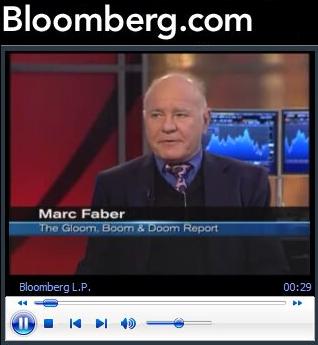
Has World War III already started? According to Marc Faber it has! Check out his interview. Next do you think the government can lose? According to this pundit not only will it lose it is going to lose big! Finally, for years now China has been coming to the rescue by buying Treasuries and US Debt, what will happen when they and other countries stop? Continuation of series from yesterday’s post. Just In! Peter Schiff Interviwed on Russian TV- Get Prepared!  adjust your portfolios and if you own Precious Metals hang on for the ride of your life!- Good Investing!- jschulmansr

Marc Faber on the Economy, Gold, WWIII – Seeking alpha

By: Tim Iacono of Iacono Research

Another good interview with Dr. Marc Faber, this one over at Bloomberg where he’s been a regular for many years (recent appearances at the likes of CNBC are somewhat unusual as he tends to go against conventional wisdom, something that abounds at CNBC).
IMAGE

Click to play in a new window

There’s lots of good stuff in this one – the outlook for the global economy, oil, gold, base metals, natural resource stocks, World War III having already started…

On the subject of alternatives to the government solutions for the current problems, he was asked how he expected the populace to stand for the government doing nothing?

That’s the problem of society. If people can not accept the downside to capitalism, then they should become socialists and then they have a planned economy. They should go to eastern Europe twenty years ago and to Russia and China for the last 70 years.

How do you tell that to somebody in Detroit who’s losing his home today?


Why is he losing his home? Because of government intervention. The government – the Federal Reserve – kept interest rates artificially low and created the biggest housing bubble, not just in the U.S. but worldwide. That is what I’d explain to the worker in Detroit.

============================================

How the Federal Government will Lose in 2009 – Seeking Alpha

By: Rob Viglione of The Freedom Factory

Through a combination of incompetence and greed, the federal government has placed itself in a position of checkmate. There is no way to finance its budget deficits without devaluing the dollar or causing interest rates to rise. With $10.6 trillion in debt, $8.5 trillion in new money created or given away in 2008, and multiple years of trillion dollar deficits planned by Obama, government has no way to fund its extravagances without either printing a lot more money or borrowing unprecedented sums.

This means that either Treasury bonds will crash, or the dollar will suffer significant devaluation relative to foreign exchange or precious metals, especially gold.

TV Does Great Interview With Peter Schiff (Russian TV, That Is)

=====================================================

Remember Dare Something Worthy Today Too!


Market forces are telling the world to shed unproductive assets and shrink capacity, yet central banks and governments around the world, in particular the U.S., are refusing to listen. Rather than allow markets to snap back to sustainable equilibrium from previously artificial highs, the federal government clings to the notion that forcibly shuffling resources, propping up asset prices, and diluting the money supply will magically save the day.

There are consequences to everything. The consequences of shuffling resources (taxing productive ventures and doling out those resources to failing ones, i.e. bailouts) are stunted growth for good businesses and propagation of bad ones. Artificially propping up asset prices means that those who are generally less competent remain the custodians of society’s capital, and diluting the money supply inflates aways everyone’s wealth over time, particularly harming the poor and middle class.

For decades the federal government has gotten away with this reshuffle and inflate game, but the pawns are drowning, the rooks helpless, and the knights ready to turn on the King. Perhaps this is overly dramatic. Clearly, I doubt the capability of the Federal Reserve, Congress, and Obama to “fix” the economy; rather, I strongly believe they are destroying it by forcing us all to drink this Keynesian Kool-Aid. However, whether or not the economy recovers amidst this historic central government action, there are two phenomena we can exploit to our advantage:

  • Short the US dollar
  • Short US Treasuries

In “When will the great Treasury unwinding begin?” I show how government debt has been bid to unsustainable levels and will likely fall. The one concern I see stated all too often is that the Federal Reserve will keep buying Treasuries to artificially depress interest rates. This will, it is claimed, keep bond prices inflated. The one undeniable counter to this is that government must somehow fund its $1.2 trillion estimated 2009 deficit. It cannot do this by issuing and then buying the same bonds. It can only raise revenue by selling bonds to other parties, or by diluting the money supply by cranking up the printing presses. There are no other options. There you have it – we have the government in checkmate!

The likely outcome is that they will try to do both. That is why I am heavily shorting both 30-Year Treasury bonds and the dollar. Both assets will likely lose as the government becomes increasingly desperate and the world’s biggest buyers realize there are better alternatives available. Make your bets now before it becomes treasonous to bet against Big Brother!

Disclosure: Long UDN, short TLT, long GLD.

==============================================

Five New Forces to Drive Gold Higher – Seeking Alpha

By: James West of The Midas Letter

Gold naysayers habitually point to the relatively weak performance of gold relative to the broader market over the last 5 years. Given the market today, that argument is increasingly wrong, and the naysayers are soon to either admit their mistake, or pretend that they were never naysayers at all. That’s because during the last 3 months, five major new forces have emerged to compound the previous strong drivers of the gold price up to now.

These new forces are as follows:

  1. China has stopped buying U.S. debt.
    An interesting piece in the New York Times today signals that China, up until now the biggest buyer of U.S. Treasuries and bonds issued by Fannie and Freddie, is moving towards an end to that policy. China holds over US$1 trillion of such paper, and as interest rates collapse, there is less and less incentive for them to buy American.China has made several adjustments to programs that used to give banks and other financial institutions within the country incentive to buy U.S. assets, which means essentially that these same customers for assets will now be looking for Chinese products.The effect this will have on gold is two-fold. In the first place, reduced demand for U.S. debt will hamper Obama’s plans to keep printing money, because the one limiting factor that still seems to be respected in terms of how much paper can be printed, is the idea that there must be a counterparty to every issuance of T-Bills to warrant continued printing. Theoretically, less demand for T-Bills will force a rise in interest rates to attract investors. But that does not appear forthcoming, which will make the U.S. dollar weak relative to other currencies – especially gold.The second effect is that by eliminating incentives for Chinese banks to acquire U.S. denominated assets, investors there will divert more funds to holding gold as a hedge against their current U.S. dollar holdings, which will be diminishing in value.
  2. Future discoveries of gold deposits will diminish dramatically.
    The biggest source of gold ounce inventory for major gold producers is the discoveries made by the several thousand juniors who scour the earth in search of favorable geology. With the collapse in base metals prices, many of these juniors are under increasing pressure to consolidate and downsize, and many more will disappear altogether.That means less money going into gold exploration, and that means the number of new discoveries that can be acquired by majors is going to go down sharply in the coming years. In theory, as gold continues to outperform all other asset classes, there will be a rush back into junior gold exploration, but that won’t happen until gold is taken much higher and investment demand for it soars.
  3. Existing by-product gold production will fall sharply
    In copper, zinc and other base metals mines around the world, gold occurs in metallic deposits as a by-product of some other dominant mineral. In the United States, 15 percent of gold production is derived from mining copper, lead and zinc ores.With the collapse in prices for these metals, the by-product production of gold is most often insufficient to justify the continued operation of the mine profitably, and it is likely that a significant amount of this by-product gold production will cease along with the shutdown of these operations. The result will be less gold production from existing operations, contributing to the now even faster growing gap between supply and demand.
  4. Gold is becoming mainstream
    One of the biggest contributors to gold’s unpopularity as a main street investment is that it has been mercilessly derided and ridiculed by mainstream investment media and institutions. There is very little opportunity for an investment advisor to insinuate himself into a gold purchase transaction, since most anybody who wants to hold the metal can visit their local bullion exchange or mint and buy as much as they’d like. Because the massive investment institutions that dominate the investment advisory business can’t make a fee out of advising you to buy gold, they try to convince you to purchase other asset classes which their firm has either originated or is a participant in a syndication of investment banks selling such products.Thanks to the widespread coverage of the questionable integrity of these complex securities, and since many main street investors have been burned by their investment advisors (they feel), there is increasing main street advice being doled out to buy gold. One need only search Google news on any given day to discover that headlines critical of gold are now replaced with headlines singing its praises.
  5. Gold is the best performing asset class of the decade
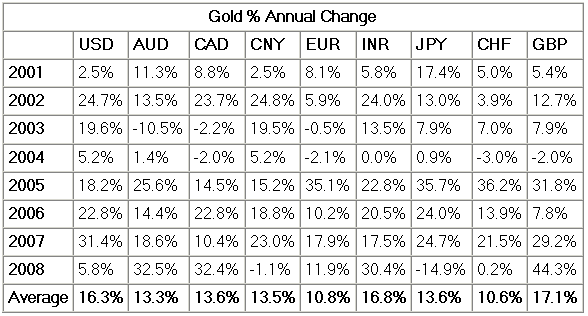
    Now that the global financial meltdown has got up a head of steam, investors are hard pressed to find any investment that has performed well over the last ten years as consistently as gold. The chart below outlines this performance and appears here courtesy of James Turk’s GoldMoney.com.
Gold Performance: 2001-2008 (click to enlarge)
Gold Performance 2001 - 2008

As you can see, any investment still returning an average of 10 – 17 percent is a winner, compared to everything else you can generate a chart for. As this intelligence permeates the none-too-quick popular investment imagination, and, combined with the other 4 factors, gold is going to be where the world’s next crop of millionaires is minted.

===========================================

Share this:

  • Click to share on Reddit (Opens in new window) Reddit
  • Click to share on Facebook (Opens in new window) Facebook
  • Click to share on LinkedIn (Opens in new window) LinkedIn
  • More
  • Click to share on X (Opens in new window) X
  • Click to share on Pinterest (Opens in new window) Pinterest
  • Click to share on Tumblr (Opens in new window) Tumblr
  • Click to print (Opens in new window) Print
  • Click to email a link to a friend (Opens in new window) Email
Like Loading...
Newer posts →

Authors

  • jschulmansr's avatar jschulmansr
    • Free Crypto!
    • Free Crypto Currency
    • This is Blessed!
    • Trump Rally Charleston
    • Trump Rally Charleston

Blog at WordPress.com.

Privacy & Cookies: This site uses cookies. By continuing to use this website, you agree to their use.
To find out more, including how to control cookies, see here: Cookie Policy
  • Subscribe Subscribed
    • Dare Something Worthy Today Too!
    • Already have a WordPress.com account? Log in now.
    • Dare Something Worthy Today Too!
    • Subscribe Subscribed
    • Sign up
    • Log in
    • Report this content
    • View site in Reader
    • Manage subscriptions
    • Collapse this bar
%d