• Recommended Sites & Links
  • About

Dare Something Worthy Today Too!

~ FreeCryptoBitCoins, Cryptocurrency, BitCoin, Ethereum, BitCoin Cash, Ethereum Classic, LiteCoin, DogeCoin, Gold & Precious Metals, Investing & Investments, Stocks and Stock Markets, Financial Markets & Market Timing, Technical Analysis, Oil and Energy Markets, Hard Assets Investing, BlockChain, Airdrops, Earn Free Bitcoin…

Dare Something Worthy Today Too!

Category Archives: volatility

Is the Glitter Fading?

25 Wednesday Feb 2009

Posted by jschulmansr in Austrian school, Bailout News, banking crisis, banks, bear market, bull market, capitalism, China, Comex, commodities, Contrarian, Copper, Currencies, currency, Currency and Currencies, deflation, depression, DGP, dollar denominated, dollar denominated investments, Doug Casey, economic, Economic Recovery, economic trends, economy, Fed Fund Rate, Federal Deficit, federal reserve, Finance, financial, Forex, futures, futures markets, GDX, GLD, gold, Gold Bubble, Gold Bullion, Gold Investments, gold miners, Gold Price Manipulation, hard assets, How To Invest, How To Make Money, hyper-inflation, IAU, India, inflation, Investing, investments, Jschulmansr, Junior Gold Miners, Latest News, majors, Make Money Investing, Market Bubble, market crash, Markets, mid-tier, mining companies, mining stocks, monetization, oil, palladium, physical gold, platinum, platinum miners, precious, precious metals, price, price manipulation, prices, producers, production, run on banks, safety, silver, silver miners, Silver Price Manipulation, spot, spot price, stagflation, Stimulus, Stocks, TARP, Technical Analysis, The Fed, Tier 1, Tier 2, Tier 3, Today, U.S., u.s. constitution, U.S. Dollar, volatility, warrants, XAU

≈ 1 Comment

Tags

ANV, Austrian school, AUY, Bailout News, banking crisis, banks, bear market, Bollinger Bands Saudi Arabia, Brian Tang, bull market, CDE, central banks, China, Comex, commodities, Copper, Currencies, currency, deflation, Dennis Gartman, depression, DGP, dollar denominated, dollar denominated investments, Doug Casey, economic, economic trends, economy, EGO, Federal Deficit, financial, Forex, FRG, futures, futures markets, gata, GDX, GG, GLD, gold, gold miners, hard assets, HL, hyper-inflation, IAU, India, inflation, investments, Jeffrey Nichols, Jim Rogers, Keith Fitz-Gerald, majors, Marc Faber, market crash, Markets, Michael Zielinski, mid-tier, mining companies, monetization, Moving Averages, NGC, NXG, PAL, palladium, Peter Grandich, Peter Schiff, physical gold, platinum, platinum miners, precious metals, price, price manipulation, prices, producers, production, protection, recession, risk, run on banks, safety, Sean Rakhimov, silver, silver miners, SLW, small caps, sovereign, spot, spot price, stagflation, Technical Analysis, TIPS, U.S., U.S. Dollar, volatility, warrants, XAU

     As I write Gold is down $3.00 at $966 (nearest futures month). It is still holding around the $960 to $965 support levels. However, I want to assert this, Gold is in a long term upward trend. The only thing that would change my thinking would be a close under the $880 which represents the bottom level of the long term uprward channel. We may however in the short term see a correction downward to even as low as $900 to $910. I will be watching very closely as this may be a “bear trap” in an upward market. One thing however I am somewhat of a contrarian. Last week almost every analyst under the sun was touting Gold as the ONLY investment. When I see that I get very nervous and know that a correction is about to happen.  For those who remember the day silver hit $50 oz., Walter Cronkite announced on his evening new that “It’s time for everyone to go out and buy some silver”! The very next day the silver market tanked like a lead balloon. So a little downside action here will be a good thing to shake out the “nervous nellies” and “johnny come lately’s” out of the market. Because I have seen it time and time again as soon as that happens “Kaboom” the market takes of and does not look back. I will be watching very carefully here and will let you (those who have subscribed to this blog and are following me on twitter), when I get out of the DGP trade. I got in at $890 oz and think a little patience here will pay off.  Given the current state of things Gold could still easily hit $1050 this week as well as have a price correction. Be sure to subscibe in the top right corner and/or follow me on twitter to be kept up to date…

     The best investment in my opinion right now is to continue accumulating the Junior and Mid-tier Gold and Precious Metals mining companies. Once again there are many still selling at or near book value levels. Remember to choose companies who currently have production or are about to start producing. One exception might be those companies who have made some big strikes,  are sitting on huge “proven” reserves, and have plenty of cash and financing to bring those reserves into production in the future. Another play is to investigate “Warrants” which give you the right to buy a stock at a given price for a certain timeframe. There are many out there which could give your portfolio a couple of “home runs” gains of 2-3000%. Either way do your own good due diligence, check the companies out, their balance sheets, prospectus/s  and consult your own financial advisors before making any trades.- Good Investing! -jschulmansr

==========================

Follow Me on Twitter and be notified whenever I make a new post!


Catch the New Bull! – Buy Gold Online – Get 1 gram free just for opening account– just click here and then again on the Gold Bar!, no minimums – Buy Safely, quickly, and at low prices, guaranteed! – Bullion Vault.com

=============================

Panic=Gold – Seeking Alpha

Source: Hard Assets Investors

It’s axiomatic that gold has a role as safe haven for many investors. That this is largely a matter of collective psychology is irrelevant – it has worked for centuries, and it’s unlikely to stop working tomorrow.

 But lately, gold been more than a mere market hedge; it’s been a panic hedge.

Current Gold

Gold briefly nudged over the $1,000 mark to $1006.43 on Friday, February 20, before settling back down to close at $993.25. It was the first time since last March that gold crossed the insignificant but satisfyingly round $1k level. Technical geeks would point out that it’s still below the high of $1012.55 hit March 18th, but that’s splitting hairs.

Of course, gold didn’t stay above $1,000/ounce for long last March; it quickly reversed course and traded down all year, before bottoming at $712.41 on November 20th. Since then, gold has risen 39.4%; it was up 13.4% in January alone.

The last time I wrote about gold (Demanding Gold) was just before that November bottom. Back then I discussed the underlying demand for gold – because one of the great things about commodities is that ultimately, they’re always about supply and demand. And with the gold-bug’s most important supply and demand report out for 2008, it’s the perfect time to revisit the subject. (The full link to the World Gold Council’s Supply and Demand Statistics for Q4 and Full Year 2008 report is here.)

Looking At Demand

Gold demand can be broken into three main areas of interest – jewellery, which accounted for roughly 58% of identifiable demand in 2008, industrial and dentistry demand, and finally identifiable investment demand.

On the whole, gold saw demand grow 4% from 2007 to 2008, but the picture is a bit more complex than just that.

Not everything was rosy for gold in 2008. As we predicted, jewellery demand was down significantly. In 2007 around 68% of gold demand was attributed to jewellery consumption. In 2008, that number dropped to 58%.

At the end of December, The World Gold Council released a report entitled “What Women Want: Global Discretionary Spending Report 2008“. In it, the WGC details the values and significance different countries attribute to gold jewellery and why people buy it. One new thing the study uncovered is that gold jewellery is now competing with items such as cell phones and other everyday items for discretionary spending.

The report also states that “confidence that gold will hold its value has waned,” reflecting in part the volatility gold prices have experienced in the past year. With gold rising and falling by 30% in a single year, it’s no wonder people are feeling less comfortable with it as a store of value.

Demand on the jewelry front appears to be price elastic. In India, the largest consumer of gold jewellery, demand in the fourth quarter more than doubled compared to Q4 of 2007. While this would seem to buck the year-long numbers, it’s likely due to the fact that lower gold prices occurred precisely at the time of the Diwali festival – a peak gold-buying time in India. In 2007, gold prices were high during the festival, which depressed demand. For the full year of 2008, jewellery demand in India dropped 15%.

China was one of the only countries that posted an increase in demand for jewellery, up 8% from 2007. Much of this demand was for 24-karat jewelry, which commonly implies jewellery purchases that are doubling as investments.

The Big Stick: Gold Bugs

According to the World Gold Council report, gold demand for investment rose from 663.7 tonnes in 2007 to 1090.7 tonnes in 2008 – a somewhat staggering year-on-year increase of 64.3%. Retail investment – things like bar hoarding, official coins, medals/imitation coins and other kinds of retail investment – almost doubled, going from 410.3 tonnes in 2007 to 769.3 tonnes in 2008. That gives some credence to the wide scale anecdotal evidence throughout the year that gold coins were virtually impossible to obtain in many countries.

Exchange-traded funds and similar products also showed a large increase, from 253.3 tonnes to 321.4 tonnes (a 26.9% increase). This trend has continued into 2009. The SPDR Gold ETF (NYSE: GLD) – the largest physical gold trust – now has 1,028.98 tonnes in its vaults. This is a trust that started 2009 with 780.23 tonnes, meaning its gold horde has risen 31.9% in less than two months. To put that in perspective, 249 tonnes is over 10% of the total amount of gold mined in all of 2008. This acceleration happened almost entirely in a dramatic surge mid-February.

Net-net, however, if you offset the huge rush in gold investments with the significant drop in jewelry demand, the net gain in tonnage terms was just 4%.

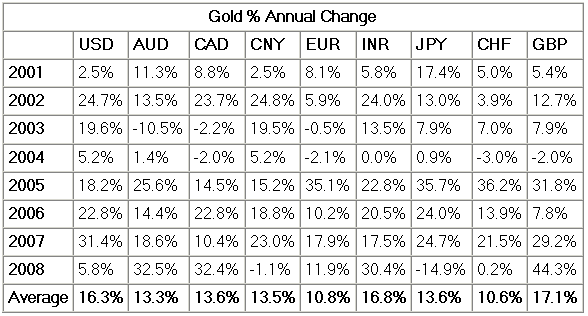
There is, however, another way to look at things. When viewed through the (occasionally depressing) lens of the dollar, gold demand seems endless:

Gold Supply in Flux

With the demand part of the picture in hand, it’s time to turn to supply. The third quarter of 2008 saw a huge supply deficit with demand far outreaching supply. In the fourth quarter, supply rose 19%, almost entirely due to an increase in gold scrap. Yes, that’s right: Those late night commercials offering to buy your old tangled gold necklaces were on to something, and people were selling.

Scrap sales for 2008 ended up 17% higher than 2007, and that along with slightly higher total mine supply just about offset lower central banks sales so that in the end, 2008 ended the year with only 1% less total supply than 2007 – practically even.

The moral of the story is simple: supply and demand remain incontrovertible laws. The unbelievable demand vs. the stagnant (mine) and dwindling (central bank) supply created a vacuum, and a new source came on line to fill the need. Thus, at least indirectly, gold went from the scrap heap into brand new shiny gold coins, just when the market needed them the most.

Which brings up the question: how long can consumers fill their own demand through scrap? And what price level is needed to support the tremendous scrap levels already in place?

=================================

Catch the New Bull! – Buy Gold Online – Get 1 gram free just for opening account– just click here and then again on the Gold Bar!, no minimums – Buy Safely, quickly, and at low prices, guaranteed! – Bullion Vault.com

==================================

 Five Weeks of Silver Backwardation – Seeking Alpha

By: Trace Mayer of Run to Gold.com

During an interview with Contrary Investors Cafe on 24 February 2009 I discussed both gold backwardation and silver backwardation. After the interview I was asked why more commentators are not discussing this issue. I do not know.

Regarding money there are two competing views: (1) money is determined by the market or (2) chartalism which asserts that ‘money is a creature of law.’ Governments can only manage money if they create it. Obviously, the market determines money because money existed before governments were created.

Regarding gold there are two competing paradigms: (1) gold is a commodity and (2) gold is money. Paradigm (1) asserts that gold is a hedge against inflation and there is no monetary demand for gold. On the other hand, paradigm (2) asserts that gold is a hedge against currency collapse and the primary demand for gold is monetary. I subscribe to the second paradigm and assert that at all times and in all circumstances gold remains money.

WHAT IS SILVER’S ROLE

Under which paradigm does silver fall? Is silver a commodity or is silver money? For a commodity to be money its primary demand must be monetary.

Like gold, for thousands of years silver functioned as money in the market. The term dollar, as used in Article 1 Section 9 Clause 1 and the Seventh Amendment of the US Constitution, is defined as 371.25 grains of fine silver under Section 9 of the Coinage Act of 1792. Governments stockpiled billions and billions of ounces. However, on 24 June 1968 the United States government defaulted on their silver certificates. Over the decades, silver, like gold, has been demonetized in ordinary daily transactions. Supposedly there are large stockpiles of gold in central bank vaults. Unlike gold there are no reported large above ground stockpiles of silver stashed in central bank vaults. Additionally, a large portion of silver demand is industrial as it is used in cell phones, refrigerators, dental equipment, computers, etc.

Therefore, it appears that silver is confused about its role. In other words, silver functions as a commodity and as quasi-money.

FIVE WEEKS OF SILVER BACKWARDATION

While similar, there are differences between future and forward contracts. For example, future contracts are traded on exchanges, use margin and are marked to market daily. In contrast, forward contracts are generally traded over-the-counter (OTC derivatives) and are not marked to market. Therefore, forward contracts are subject to greater counter-party risk than future contracts.

Because the primary reason backwardation arises is counter-party risk and because forward contracts are impregnated with greater counter-party risk than future contracts, therefore it is highly likely that backwardation would appear in the forwards markets before the futures markets.

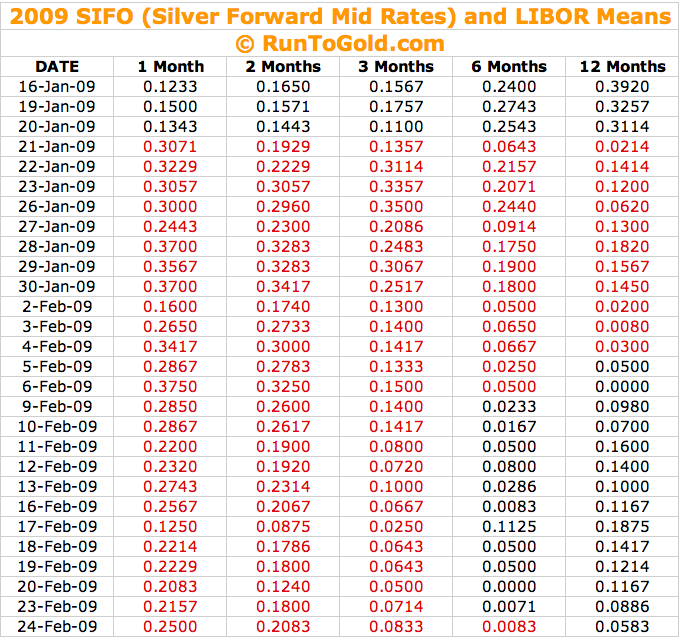
This is precisely what has happened. While the COMEX silver futures contract have not been in backwardation the LBMA Silver Forward Mid Rates have been in backwardation for five consecutive weeks. Of particular interest is the 6 month contract.

SO WHAT?

What does all this mean? Well, I think the backwardation reflects the market’s uncertainty of silver’s role as money. The chronic silver backwardation began on 8 December 2009, the same day I wrote about gold in backwardation, and silver was priced about $9.60. Currently silver is trading about $13.82. Predictably, the gold/silver ratio is narrowing. If the backwardation persists it will be interesting to see if silver’s price in illusory FRN$ continues rising.

In my opinion, as the great credit contraction grinds on and intensifies, the commodity silver will reassert itself as money and eventually currency. As I mentioned during the interview with Contrary Investors Cafe what would be really interesting is if the central banks decide to start hoarding silver!

In the meantime it may behoove those who are bullish towards silver to increase the pressure on physical silver delivery. For example, I purchased some beautiful Austrian philharmonics at the Cambridge House Investment Conference and Silver Summit over the weekend. The beautiful coin cost $20 which was an amazing $5.50 over spot.

While there are cheaper ways to purchase physical silver bullion, like GoldMoney, these huge premiums over spot beg the question: What is the real silver price? With the specter of counter-party risk driving silver into backwardation if there is a failure to deliver then it will likely cause the silver price to shift from the COMEX just like a failure to deliver would cause the gold price to shift from the COMEX.

Bottom line: Do not get caught with your paradigms down!

===============================

Catch the New Bull! – Buy Gold Online – Get 1 gram free just for opening account– just click here and then again on the Gold Bar!, no minimums – Buy Safely, quickly, and at low prices, guaranteed! – Bullion Vault.com

================================

Doug Casey: What to Do in “The Greater Depression” — Seeking Alpha

Source: The Gold Report


Bullion and oil appear in the lineup of power players that Doug Casey thinks investors can count on as the world slips deeper and deeper into what he calls the “Greater Depression.” Despite the raging economic storm and Doug’s doubts that Western civilization’s governments will take the actions needed to quell it, though, the Chairman of Casey Research is nowhere close to calling the game. In fact, he sees silver lining in the clouds of crisis—opportunity—and expresses optimism that technological advances, coupled with capital rebuilding once over-consumption runs its course, will prevail eventually. The Gold Report caught up with the peripatetic author, publisher and professional international investor between polo matches in New Zealand, one of several nation-states he calls home from time to time.


The Gold Report: You’ve been discussing what you’re calling “crisis and opportunity,” and in fact have a summit by that same name coming up in Las Vegas next month. Could you give us a high-level overview of what you foresee?

Doug Casey: We’ve definitely entered what I describe as the Greater Depression. It’s not coming; it’s here. It’s going to get much, much worse as far as I’m concerned and unfortunately, it’s going to last a long time. It doesn’t have to last a long time, but the root cause is government intervention in the economy and everything they’re doing now is not just the wrong thing, it’s the opposite of what they should be doing. It’s almost perverse.

The distortions and misallocations of capital and the uneconomic patterns of production and consumption that have been going on for over a generation need to be liquidated and changed, but everything the government’s doing is trying to maintain these patterns. So it’s going to be horrible. In addition, the government is necessarily directing more power toward itself with all of its actions. If I were you, I’d rig for stormy running for a good long time.

TGR: By “a long time,” do you mean a couple of years, a decade, a generation?

DC: This is, in some ways, uncharted territory. Let me say that for the long run I’m very optimistic. Why? Two things act as the mainsprings of progress. Number one is technology and that’s going to keep advancing, so that’s very good. Second is capital and savings. Individuals will solve their own problems and, therefore, they will stop consuming more than they produce, which is what they’ve been doing for years, and they’ll again start producing more than they consume. The difference is savings; that builds capital.

So technology and capital are going to solve the depression. But the government can do all kinds of stupid things to make it worse. Look at the Soviet Union. They suffered a depression that lasted 70 years from its founding. Look at China. The whole reign of Mao was one long economic depression. That could certainly happen in the U.S., too, where the government misallocates capital in such a way that technology doesn’t advance as it could and people can’t build individual capital the way they would. I’m optimistic, but anything can happen.

TGR: But didn’t China and the Soviet Union have governmental structures very different from those in Western Europe and the U.S., and those structures allowed for more intervention? Are you projecting that we might slip into an era where Western civilization will allow their government to run themselves like the Soviet Union and China did?

DC: It seems to be going in that direction. Of course, Europe is going to be hurt much worse than the U.S. Europeans are much more heavily taxed and much more heavily regulated. The average European is much more reliant upon the state psychologically as well as economically. So it’s all over for Europe and this doesn’t even count the problems that they’re going to have in the continuing war against Islam, which are much more serious for Europe than they are for the U.S. So, no, Europe is fated to be nothing but a source of houseboys and maids for the Chinese in the next generation.

TGR: So do you think that societies in Western Europe—and even the U.S.—will allow themselves to be governed in the same fashion as the Soviet Union and China were during their depressions?

DC: Oh, totally. I don’t see why that would not be the case. Even Newsweek says we’re all socialists now. That seems to be the reigning ideology. In addition, psychologically, the average American—just like the average European—looks to the government to solve things. This is very bad. Most people are unaware that Homeland Security, which is one agency that should be abolished post-haste, is building a 400-acre campus in southeast Washington, D.C., where initially they’re going to put 25,000 employees. That’s as many as the Pentagon has and with 400 acres, Homeland Security has a lot more room to grow. Ironically, the property is at the site of St. Elizabeth’s Hospital, the first federal insane asylum in the United States. Once a bureaucracy has a piece of real estate and builds buildings, it’s game over. They’re just going to accrete and grow and grow, so that’s one indication. The trend is clearly in motion.

It’s all over for the U.S. In fact, let me say this. America doesn’t exist anymore. What is left is not even these United States. That was decided in the 1860s. It’s the United States. America, which is basically an idea, a concept, is dead and gone. The United States is just another of 200 awful little nation-states that have spread across the face of the earth like a skin disease. There’s no longer any difference that I can tell between the U.S. and any other country.

TGR: How would you describe the concept that America was based on that is now gone? And is there another country in the world embracing that concept? Will there be a new America?

DC: No, there is no other place. I’ve been to 175 countries and lived in 12. My feeling is that the best thing that you can do is set your life up so that you’re not to be considered the property of any one government. You might have a passport or several passports and, therefore, that government thinks they own you. But if you don’t spend time in a country, practically speaking, there’s nothing they can do about it.

So, no, there is no real haven for freedom in the world today. The best you can do is go where the governments are so unorganized that they can’t control you effectively. That’s one reason I like to spend time in Argentina. They have an incredibly stupid government, but they’re also very inefficient and ineffective. So it’s wonderful as a place to live. I also spend time in Uruguay, because it’s a tiny little country with no ambitions to conquer the world. The nice thing about New Zealand, where I am now, is that it’s a small country, only 4 million people, lots of open land. It’s got some severe problems, but it’s pleasant. I think the U.S. is going to be the epicenter of a lot of problems in the years to come.

TGR: Few of our readers are probably in positions where they could live in 12 different countries, but they have amassed assets here in the United States. What advice would you give them to safeguard those assets?

DC: The key is to remember that we’re going to have a long and deep depression, so most things that worked well over the last 20 years are unlikely to work well in the future. I’d been predicting the real estate collapse for a long time. It’s still got a way to go, too, because a lot of real estate debt remains that has to be liquidated. There’s a lot of leverage out there and there’s been a huge amount of overbuilding. So it’s far too early to get into real estate, at least in North America or Europe.

It’s also way too early to get into the general stock market, for all kinds of reasons. Dividend yields are still extremely low. Earnings are going to collapse. Government bonds are perhaps the worst single thing to be in, because with the government printing up money literally by the bushel basket, the dollar is going to start losing value radically and interest rates are going to start going up radically at some point. So you have to rule out most stocks.

I’m afraid that the most intelligent thing you can do is to own a lot of gold, preferably gold coins in your own possession. And I think speculation in gold stocks makes sense at this point, because gold stocks are about as cheap as they’ve ever been relative to other assets, really, in history. Now is an excellent time to do that as well. But that’s in terms of speculation.

Investment risk is tough enough, but the biggest problem is political risk. That’s what you have to watch out for. That means you have to diversify internationally. This is harder for most people, harder psychologically, and it takes more assets to make international diversification viable. But if you’re in a position to do it, it’s the most important thing you can do.

TGR: Since you mentioned having coins in your own possession, should we assume you’re not a big fan of the ETFs or some of these other paper gold promises, if you will?

DC: ETFs are okay for the convenience that they offer and for significant amounts of money, but gold coins should be first on your list, no question about that. If you’re only talking about $50,000 or $100,000, or $200,000, coins are fine to keep in your own possession. They won’t take up much room and you can put them in some safe place (which, incidentally, is not a bank safe deposit box).

TGR: Are you recommending putting all of your investment in gold into the bullion or are you also recommending some portion in producing junior and explorations?

DC: Both, but look at the stocks as being speculative. Most of your money should be in gold with a bit of silver, too. Silver is basically an industrial metal, but it has monetary characteristics. Now is the time to be very overweight in the metals and I think owning gold stocks is a good idea. They’re very cheap.

TGR: Anything else investors can do to preserve whatever may remain of their wealth?

DC: Owning real estate in some foreign countries is a very good idea—from a lifestyle point of view, an asset diversification point of view, and a possible capital gains point of view, too. They can’t make you repatriate foreign real estate. Having some U.S. dollar cash while we’re going through this deflationary period is very wise as well, but that’s not going to last. Eventually the U.S. dollar is going to reach its intrinsic value.

TGR: Not that you have a crystal ball, but how would you see the rest of ’09 playing out?

DC: Nothing goes straight up or straight down, but it seems that ’09 is going to see much higher gold prices and much lower stock prices and much lower bond prices, too. But remember, the worst is yet to come.

You haven’t heard an awful lot about people losing their pensions yet, but that’s going to happen because what are pensions invested in? They’re mostly invested in stocks and bonds and commercial real estate. All three of those things are disaster areas, and bonds are the big disaster area yet to come. So I think it’s going to be nothing but bad news in 2009. What happened in 2008 was just an overture to what I think is going to happen in ’09 and ’10.

TGR: Even into 2010?

DC: Yes. This isn’t going to be cured overnight, mainly because of what the government’s doing. As I said, it’s perversely exactly the opposite of what they should be doing, which is abolishing all the agencies and freeing up the economy. They’re passing lots of new regulations, they’re going to have to raise lots of taxes eventually, and they’re inflating the currency. So it has to last, at least into 2010. It’s going to be quite dismal, actually.

TGR: And what happens with the unfunded Medicare liabilities?

DC: They’re not going to be funded. They’re going to be defaulted on and, actually, that’s the best thing that could happen. That’s one of the things that should be done now; the U.S. government should default on its debt. This is shocking for people to hear, but it wouldn’t be the first time the U.S. government has done that. It did that almost at its founding in continental days.

This debt represents a tax liability that’s being foisted off on the next generations who have no moral obligation to pay and should not pay. I think as an ethical point, the U.S. should default on this debt. It’s impossible to pay it back, and it won’t be paid back. It’s more honest to acknowledge that bankruptcy now as opposed to pretend it’s going to be paid back. Defaulting even might forestall runaway inflation in the dollar, which would be a catastrophe of the first order. So it’s the smart and moral thing to do, and it’s going to happen eventually anyway. All the real wealth will still be here; a lot of it will just change ownership. The big losers will be those who lent to the State, thereby enabling its depredations, and they deserve to be punished.

But even a default tomorrow will do no good unless you put the U.S. government into reverse and disband all of these ridiculous, destructive agencies that have grown like a cancer for years. Taxes should be cut 50% to start with, just out of hand. And the defense establishment—it’s a misnomer; it’s not defense at all but rather foments wars around the world—should be cut hugely. Not with a butcher knife; but a chain saw. But none of this is going to happen; in fact, just the opposite. That’s why I’m so pessimistic now that the tipping point’s finally been reached.

TGR: Are we at the tipping point?

DC: Yes, we’ve absolutely gone over the edge. The consumer is no longer in a position to consume. Everybody is going to cut consumption to the bone and hopefully find something to produce instead. It would be better for people to start viewing themselves as producers than consumers. That would be a step in the right direction to get them psychologically more in line with reality.

TGR: In last fall’s meltdown, gold held up, but the stocks didn’t. Quite a few producers and soon-to-be producers, and some companies making discoveries, seem to have bottomed out in November and December. But worry persists in the market. Suppose another shoe drops or another black swan appears? Richard Russell (Dow Theory Letters) and others have been talking about the Dow going down to 5,000. What would that do to the gold stocks?

DC: Gold stocks are also stocks, and the best environment for gold stocks historically has always been when both gold and the stock market are going up. But since the last gold stock bull market came to an end, I think it’s entirely possible to see a bubble develop in gold stocks with all the money being created. I certainly hope so. I’m actually optimistic for gold stocks just because they’re so cheap relative to everything else.

TGR: They have been beaten down.

DC: Yes. And that fact, along with the waves of money being printed around the world and the much higher gold prices we are going to see, could cause a speculative mania to develop in the gold stocks. Nobody’s even thinking about that possibility right now, because they’re so battered. But this is the time to get into the right ones because it’s likely to happen in the future.

TGR: The ’29 crash—which was really the preamble, because ’30, ’31, ’32 and ’33 were certainly bigger—is when gold stocks such as Homestake did their best. How do you see that playing out this time around? Is it different this time or do you expect a similar pattern?

DC: You know what they say, “History doesn’t repeat itself, but it rhymes.” I think that, first of all, the gold mining industry is a much worse industry now than it’s ever been in the past, because just as all the easily defined light sweet oil basically has been discovered, all the easy-to-find high-grade gold basically has been discovered. Most mines that are going into production are low-grade, which means that you have to move a lot of dirt, which means that they’re much more capital-intensive than in the past. So gold mining’s a worse industry from that point of view.

Also, politically speaking, with the rise of the green movement, there are people who don’t want any oil burned, any dirt moved, any trees cut. They don’t want to see anything happen. This makes it much harder to do gold from a permitting and political point of view. We’re in a much higher tax environment than in the past. So it’s a tough industry. It really is. It’s just a 19th century choo-choo train type of industry that interests me only as a speculative vehicle. You’ll notice that gold went from lows of about $300 to highs of about $900 and none of these gold companies are making any money because their costs actually went up faster than the price of gold. So I’m not saying gold mining is a great business. It’s not. It’s a crappy business. Still, we could have a bubble in the stocks. I’m hoping we do.

TGR: Aren’t we going to see a change in that in ’09? Oil, which is one of the large components of that cost, has come down dramatically. A lot of these producers must be locking in oil at these lower prices. Won’t that translate into year-over-year earnings increases for the gold producers?

DC: That’s possible. The producers actually may show increases for the next couple of years. I don’t doubt that. But I don’t think oil will stay where it is. I think oil’s eventually headed back to $150 a barrel or more.

TGR: So why wouldn’t you own oil as well as gold?

DC: It’s a good idea, but we weren’t really talking about oil. I’d say that oil is a good thing to own. Oil is a real buy now. It’s as good a buy at $40 as gold is at $900 right now. Maybe a better buy; who knows?

TGR: If we go into worldwide depression, will oil continue to be a good buy or will it self-regulate around this $40 a barrel?

DC: I am bullish on oil. Although I’m philosophically not very sympathetic to the peak oil theory, I think it’s a geological fact. Also, China and India and the other developing parts of the world don’t use a whole lot of oil now. As they develop, they will to want—and almost need—to use a lot more oil. That’s going to keep pressure up on the demand side. But the supply side actually finally is constrained, so it’s going to mean higher prices. In a depression-type environment, U.S. and Western oil consumption could drop a lot, but the third world would take up most of that slack. So I have to be bullish on oil.

TGR: Are you bullish on any other sectors or commodities?

DC: I’m bullish on agricultural commodities. They ran way up last year and then collapsed again. I think a good case can be made that most of the soft commodities are quite cheap and will go higher, so I’d look at those, too. I think gold definitely, oil in the years to come has the potential to go much, much higher, and the agricultural commodities have a lot of potential.

TGR: Gold appears to be uncoupling from the dollar. Historically, when the dollar was strong, gold would be weak. But we’ve had a couple of recent instances in which both the dollar and gold have been strong. Obviously, we’ve seen a total decoupling of gold from oil. It used to be when oil was running, gold was running and vice versa, but that no longer seems to be the case. Is that just an old wives’ tale or is something going on?

DC: I’ve never seen any necessary relationship between gold and oil, just like there’s no necessary relationship between rice and natural gas, or nickel and soybeans. All these commodities tend to move together, all the currencies tend to move together and stock markets tend to move together, but they all have their own dynamics. I think it makes sense to compare the relative prices of various commodities and see what may be cheap or dear relative to other things based on the fundamentals.

On any given day, somebody may have to buy or somebody may have to sell a huge amount of almost anything. It’s unpredictable and you can’t tell what constraints are out there in the market. I don’t even pay attention to day-to-day fluctuations because they’re just random noise. I watch the big trend. It’s been shown that if you just made one correct trade and stuck with it at the beginning of every decade for the last four decades, you would have realized something like 1,000 times on your money. To me, this is the proper approach to the markets, not to try to second-guess from day-to-day what’s going to happen. That’s foolish because you get chewed up with commissions and bid-ask spreads and double-thinking your own psychology and so forth.

I really just like to look at long-term trends. In terms of long-term trends, you’ve got to be long gold, long silver, long oil; you’ve got to be short bonds. I think that’s really all you need to know. The other things we mentioned such as agricultural commodities and so forth are worthy of attention. But, as I said, I’m not a day-to-day trader. I think that’s very foolish.

TGR: Are these the themes that you and your group of speakers will focus on in Las Vegas?

DC: They are. I certainly want to invite anybody who reads this interview to join us. We put on very small, very classy seminars. They’re not gigantic mob scenes, so it’s possible to get to know individual speakers and fellow attendees in a very collegial atmosphere. I think it’s something that anybody who’s seriously interested in these kinds of things should consider.

The Casey Research Crisis & Opportunity Summit, will be held March 20 – 22, 2009, at the Four Seasons Resort in Las Vegas.

A citizen of the world in more ways than most of us can imagine, Doug Casey, Chairman of Casey Research, LLC, is the international investor personified. He’s spent substantial time in about 200 different countries so far in his lifetime, living in 12 of them (currently New Zealand and Argentina). And Doug’s the one who literally wrote the book on crisis investing. In fact, he’s done it twice. After The International Man: The Complete Guidebook to the World’s Last Frontiers in 1976, Doug came out with Crisis Investing: Opportunities and Profits in the Coming Great Depression in 1979. His sequel to this groundbreaking book, which anticipated the collapse of the savings-and-loan industry and rewarded readers who followed his recommendations with spectacular returns, came in 1993, with Crisis Investing for the Rest of the Nineties. In between, his Strategic Investing: How to Profit from the Coming Inflationary Depression (Simon & Shuster, 1982) broke records for the largest advance ever paid for a financial book. Bill Bonner (The Daily Reckoning) describes Doug as “smart, hard-working, and extremely knowledgeable” with “an instinct about investments that has made him and many of those around him very rich.”

 Doug, who now spends more time as an expatriate than he does on American soil, has appeared on NBC News, CNN and National Public Radio. He’s been a guest of David Letterman, Larry King, Merv Griffin, Charlie Rose, Phil Donahue, Regis Philbin and Maury Povich. He’s been the topic of numerous features in periodicals such as Time, Forbes, People, US, Barron’s and the Washington Post – not to mention countless articles he’s written for his own various websites, publications and subscribers.

 ==================================

Catch the New Bull! – Buy Gold Online – Get 1 gram free just for opening account– just click here and then again on the Gold Bar!, no minimums – Buy Safely, quickly, and at low prices, guaranteed! – Bullion Vault.com

That’s all for Today- Enjoy! jschulmansr

Follow Me on Twitter and be notified whenever I make a new post!

================================== 

Nothing in today’s post should be considered as an offer to buy or sell any securities or other investments; it is presented for informational purposes only. As a good investor, consult your Investment Advisor/s, Do Your Due Diligence, Read All Prospectus/s and related information carefully before you make any investing decisions and/or investments. –  jschulmansr


Share this:

  • Click to share on Reddit (Opens in new window) Reddit
  • Click to share on Facebook (Opens in new window) Facebook
  • Click to share on LinkedIn (Opens in new window) LinkedIn
  • More
  • Click to share on X (Opens in new window) X
  • Click to share on Pinterest (Opens in new window) Pinterest
  • Click to share on Tumblr (Opens in new window) Tumblr
  • Click to print (Opens in new window) Print
  • Click to email a link to a friend (Opens in new window) Email
Like Loading...

Need A Second Chance?

19 Thursday Feb 2009

Posted by jschulmansr in 10 year Treasuries, 20 yr Treasuries, Bailout News, banking crisis, bull market, capitalism, China, Comex, commodities, Copper, Credit Default, Currencies, currency, Currency and Currencies, deflation, depression, DGP, dollar denominated, dollar denominated investments, economic, Economic Recovery, economic trends, economy, Fed Fund Rate, Federal Deficit, federal reserve, Finance, financial, Forex, Fundamental Analysis, futures markets, gata, GDX, GLD, gold, Gold Bullion, Gold Investments, gold miners, hard assets, How To Invest, How To Make Money, hyper-inflation, IAU, IMF, India, inflation, Investing, investments, Iran, Israel, Jschulmansr, Junior Gold Miners, Keith Fitz-Gerald, Latest News, majors, Make Money Investing, market crash, Markets, mid-tier, mining companies, mining stocks, palladium, physical gold, platinum, platinum miners, precious metals, price, price manipulation, prices, producers, production, recession, risk, silver, silver miners, spot, spot price, stagflation, Stimulus, Stocks, TARP, Technical Analysis, The Fed, Tier 1, Tier 2, Tier 3, Today, U.S., U.S. Dollar, volatility

≈ Comments Off on Need A Second Chance?

Tags

ANV, Austrian school, AUY, Bailout News, banking crisis, banks, bear market, Bollinger Bands Saudi Arabia, Brian Tang, bull market, CDE, central banks, China, Comex, commodities, Copper, Currencies, currency, deflation, Dennis Gartman, depression, DGP, dollar denominated, dollar denominated investments, Doug Casey, economic, economic trends, economy, EGO, Federal Deficit, financial, Forex, FRG, futures, futures markets, gata, GDX, GG, GLD, gold, gold miners, hard assets, HL, hyper-inflation, IAU, India, inflation, investments, Jeffrey Nichols, Jim Rogers, Keith Fitz-Gerald, majors, Marc Faber, market crash, Markets, Michael Zielinski, mid-tier, mining companies, monetization, Moving Averages, NGC, NXG, PAL, palladium, Peter Grandich, Peter Schiff, physical gold, platinum, platinum miners, precious metals, price, price manipulation, prices, producers, production, protection, recession, risk, run on banks, safety, Sean Rakhimov, silver, silver miners, SLW, small caps, sovereign, spot, spot price, stagflation, Technical Analysis, TIPS, U.S., U.S. Dollar, volatility, warrants, XAU

Gold today is trading on Feb Contract between $975 – $985 oz, a little more consolidation and base building before the launch to $1000+.  Currently Gold is up $3.80 at $982.00. The push to $1000 could come as early as today. Do you need a second chance? Well here it is- get into Gold now or you’ll be kicking yourself later.  If Gold breaks the $1003 all time high then we’ll see at least $1050 gold, if it breaks that we have a straight shot to $1100 – $1250. This is without any major news, such as Israel attacking Iran nuclear facilities, or China moving in and taking back the disputed territories in India, or a major terrorist attack event like 911. If any of those happen then $1500 or greater. True Inflation Rate while still roughly 7-8% could easily jump to 12 – 18% or higher, as the printing presses around the world are spinning out of control around the world. This eventually will lead to even more devaluation of all the currencies as Governments are madly trying to stop Deflation. The Gold market is saying the stimulus packages around the world are failing. Buy a wheelbarrow to haul your cash around and Gold to preserve the buying power of your Dollars. Even if you only allocate 10% of your portfolio- BUY GOLD NOW! As Always Good Investing – jschulmansr

Here is where I buy my Bullion, get one free gram of Gold just for opening an account! Catch the New Bull! – Buy Gold Online – Get 1 gram free just for opening account!, no minimums – Buy Safely, quickly, and at low prices, guaranteed! – Bullion Vault.com

==========================================

Gold Continues to Climb as Economic Catastrophe Looms – Seeking Alpha

By: John Browne of Euro Pacific Capital


Last week, when Congress passed its $787 billion stimulus package, the size of the plan caused many observers to forget the water that has already passed under the bridge. Fewer still are wondering what havoc will erupt when all this liquidity eventually washes ashore.


With gold prices only 7% away from their record highs and the main equity indices 45-50% below their highs, an analysis of the equity/gold ratio is amid the many rationalizations for prolonged gains in the precious metal. The equity/gold ratio highlights a commonly used measure of corporate market value versus a decades-long measure of real asset value. Gold is known as a measure of real assets value because of its ability to preserve value during inflationary times. But during these disinflationary times, the current global growth/demand landscape also supports the notion of too many dollars chasing too few gold ounces.


The questions can be separated into three general topics: Corporate, Projects, and Capital.


  • How did the company get started?
  • What are the company’s near-term, mid-term, and long-term goals?
  • How much experience does the management, board of directors, and technical team have in achieving the company’s goals? Is there a past history of success?
  • How does management plan to market and promote the company? Does the company plan to go on road shows? Do they plan to do newsletter, magazine, or website advertising?
  • How much of experience does management have in promotion?

Projects

  • How many gold projects does the company have? Are all of the gold projects considered assets?
  • Where are they located? Are they located in geopolitically safe regions? Are they easily accessible? Is there a labor force nearby? Is there easy access to power and water?
  • What stage is each property in: Grassroots? Exploration? Development? Production?
  • For grassroots stage projects, why does the company wish to pursue exploration? Has there been any historic evidence of gold on or near the projects? What does the company have planned for the future of its grassroots projects?
  • For exploration stage projects, what kind of exploration progress have been made so far? How much has the company drilled? What have been the results? What kind of exploration is planned for the future? Is there currently a resource estimate? Will there be one in the future?
  • For development stage projects, what is the status of development? When will the project become a gold producing mine?
  • For production stage projects, how much gold does the mine produce? What are the future production and revenue expectations? How long is the life of the mine?
  • What is the resource or reserve status of each property?
  • What, if any, royalties are or will be due?

Capital

  • What is the company’s cash flow, if any?
  • What is the company’s cash position?
  • Does the company have any debt? How much and what kind of debt does the company have?
  • Will the company need to raise new capital for future projects? How much money will the company need to raise? How much experience does management have in raising new capital?
  • How much capital will the company need to reach its 12-month goals? How will they get the money?
  • What is the company’s monthly burn rate? Are they being responsible spending it?
  • How many shares of the company’s stock are issued and outstanding?
  • How many shares of the company’s stock are there fully diluted? At what price are the warrants and options set?

This is not a stock-specific list, so these questions are best used as a guideline to form your own questions for investor relations.

This is also not a complete list, but should definitely be enough to get you started. If you like a company’s answers to the questions above, it should be more seriously considered as a position in your junior gold stock portfolio.

Good Investing,

Luke Burgess and the Gold World Staff

P.S. The opportunities in the gold market have already proven to be huge winners for readers of our Mining Speculator advisory service. As a matter of fact, for five years running the Mining Speculator portfolio had an average gain of 212%! Most of these gains can be attributed to Greg McCoach’s expertise in picking junior gold mining stocks, which, as we’ve just discussed, are getting ready to explode. And we’re expecting even bigger gains from the gold mining stocks in the Mining Speculator portfolio over the next 24 months. That means there’s never been a better time to become a member of Mining Speculator and get in on the tips and information for which some people invest millions of dollars with hedge funds. Click here to find out how you can join us in the Mining Speculator for as little as $25.  

========================================

EGO: A Particularly Healthy Gold Stock – Hard Assets Investor

By: Brad Zigler of Hard Assets Investor

Real-time Inflation Indicator (per annum): 7.5%

We wrote about gold stocks last week (“Whither Gold Stocks”) , waving a $38 red cape for the Market Vectors Gold Miners ETF (NYSE Arca: GDX) in front of a four-month-old bull market. Yesterday, as gold picked up $10, GDX’s horns got close. Very close.

 Intraday, the ETF traded as high as $37.80 before falling back to close at $37. The fund is working itself into the target area nicely, thankyewverymuch. One of GDX’s better-performing component stocks, in fact, might be a herald of the fund’s future.

 El Dorado Gold Corp. (NYSE Alternext: EGO) has risen 11.4% this year, just barely ahead of the 9.2% gain posted by GDX. Oh sure, a 2.2% performance difference may seem significant now, but given the relatively low volatility in both securities, the spread seems unlikely to widen much. Barring something unforeseen, of course.


Gold Miners ETF (GDX vs. El Dorado Gold (EGO)

 GDX Graph

The good news for EGO and, indirectly, GDX, is EGO’s cost structure. For fiscal 2008, EGO’s cash cost of gold is only $257 an ounce. Volatility in bullion prices is least likely to impact EGO,  compared to its peers.

E-G-O could spell peerless performance for GDX. 

=====================================

My Disclosure: Long EGO (El Dorado Gold)- jschulmansr

===============================

Gold Breaks from Traditional Trading Versus Oil and USD, Looks Strong – Seeking Alpha

Source: Financial Post Trading Desk

Safe haven demand and a lack of investment alternatives continues to help gold break from its traditional trading relationships, rising despite a strong U.S. dollar and weak crude oil prices. In fact, analysts at Genuity Capital noted that gold is more than $200 per ounce above its normal value relative to the greenback.

Meanwhile, sustained investor interest in gold throughout 2008 helped push dollar demand for bullion to $102-billion, a 29% annual increase, according to World Gold Council’s Gold Demand Trends. The organization also said identifiable investment demand for gold, which incorporates exchange traded funds (ETFs), bars and coins, rose 64% last year. This is equivalent to an additional inflow of $15-billion.

Genuity also pointed out that the opportunity cost of holding bullion has diminished, with treasury yields at record lows and demand fundamentals deteriorating in the broader commodity and equity markets.

Concerns about the stability of the global banking system and credit rating of the U.S. Treasury has been a major driver of physical demand for gold. Until clear evidence of stabilization in the global financial system emerges, analysts at Genuity expect this trend to continue.

“If the U.S. dollar weakening resumes in the medium term, as we believe it shall, and oil prices improve, gold should continue to prosper,” they said in a research note. As a result, Genuity continue to recommend gold over base metals in the near term.

Aram Shishmanian, CEO of World Gold Council, said:

The economic downturn and uncertainty in the global markets, that has affected us all, is unlikely to abate in the short term. Consequently, I anticipate that gold, as a unique asset class, will continue to play a vital role in providing stability to both household and professional investors around the world.

North American gold equities have risen more than twice as much as gold itself in the past month, showing stronger than typical leverage. Silver has also begun to outperform.

Genuity highlighted Silver Wheaton Corp. (SLW) was a name that provides leverage to the metal and has the potential for a re-rating.

The firm’s top gold picks in the intermediate space are Allied Nevada Gold Corp. (ANV), IAMGOLD Corp. (IAG) and Northgate Minerals Corp. (NXG). It also favours seniors Goldcorp Inc. (GG) and Yamana Gold Inc. (AUY). The firm also raised its target prices for gold stocks by an average of 28% to reflect higher price assumptions for the metal.

Genuity said:

While our target multiples are now mainly near the top of the typical valuation range (1.0x to 1.7x), we believe that continuing positive momentum in the gold price should support further outperformance from the gold equities.

With the arrival of fourth quarter and year-end earnings season, one area of reporting that will see additional focus is the updates on gold reserves.

RBC Capital Markets expects gold producers to increase the gold price assumption used to calculate reserves from the previous range of $550-$575 per ounce to $675-$725. This will better match the three-year historical gold price as suggested for use by the SEC.

“With this increase, we expect most producers should be able to more than replace gold reserves mined during 2008, and show net gains from the end of 2007,” RBC analysts told clients.

===========================================

My Disclosure: Long AUY, NXG, SLW – jschulmansr

Need a Second Chance? – Well Here It Is – Buy Gold and Invest In Yourself…

Good Trading! -jschulmansr

Catch the New Bull! – Buy Gold Online – Get 1 gram free just for opening account!, no minimums – Buy Safely, quickly, and at low prices, guaranteed! – Bullion Vault.com

=====================================


Nothing in today’s post should be considered as an offer to buy or sell any securities or other investments; it is presented for informational purposes only. As a good investor, consult your Investment Advisor/s, Do Your Due Diligence, Read All Prospectus/s and related information carefully before you make any investing decisions and/or investments. –  jschulmansr


Gold prices are quickly on their way to breaking another all-time high this year.


“uhhh…yeah…sure….this is investor relations” 

In whatever form you find investor relations, they should be able to give you all of the most up-to-date information. Or they should at least be able to tell you where to find any information they don’t have.

To help you get the most out of speaking to investor relations of junior gold companies, Gold World has made a basic list of questions that you should be sure ask.

And an expected parabolic rise in investment demand will throw the gold bull market into the long-awaited mania buying phase, which should last between 6 and 12 months and could push gold prices as high as $3,000 to $5,000 an ounce, maybe higher.

That means right now is the time to start seriously researching and buying back all those quality junior gold stocks that have collapsed over the past few months.

How To Pick the Right Junior Gold Stocks

The best place to start research on a company is its website. There, you’ll generally find most of the information that you need. However, more often than not, you won’t be able to find all of the detailed information. And that’s when you need to call the company’s investor relations department.

Investor relations for junior gold companies are sometimes one or two in-house employees of the company. Other times investor relations is contracted out to a third party. Or sometimes it will be a member of management. And sometimes there is no formal investor relations at all; sometimes investor relations is just whoever picks up the phone…


Corporate


click to enlarge


The equity/gold ratio (using the Dow or S&P500) has fallen about 85% from its 1999 peak, which occurred when gold stood at 20-year lows and equities reached their highs at the top of the dot-com bubble. Since the 1920s, the equity/gold ratio has peaked twice at nearly 35-year intervals: 1929 to 1965, and 1965 to 1999. After each of those three peaks, stocks descended in multiyear sell-offs, accompanied by a rally in gold. But the converse was not true when stocks recovered in 2003-2007. As the above chart shows, the 2002-3 start of the commodity-wide bull market failed to prevent the equity/gold rally from extending its decline.

The 100 years of equity/gold analysis indicate each peak in the ratio was followed by a full retracement back to the preceding lows. The emerging fundamentals indicate a recurrence of this trend and the equity/gold ratio has further declines ahead until a possible recapture of the 1980 lows. In 2002-2007, the falling ratio emerged on a rally in both equities and gold, albeit a faster appreciation in the latter. From 2008 to the present, the persistent decline in the ratio emerged on a combination of a divergence in the pace of declines (slower fall in gold than in equity indices) or divergence in the direction (rising gold and falling/neutral equities).

In assessing the interaction between gold and monetary assets, it is worth weighing in on the current gold rally by comparing the amount of gold available versus the creation of monetary assets. Just as the equity/gold ratio stands at 18-year lows, the ratio of total financial assets to physical gold is near the low end of its historical range. Additionally, The world’s available gold stock stands at a mere 5-6% of total global stock and bond market valuation, which is about 4 times lower than in the 1980s. It is no coincidence that the difference between today’s gold/equity ratio and that of the 1980 low was also 6 times greater.

The Road Ahead

A return in the equity/gold ratio towards the cyclical lows of 1980 is highly plausible. Rather than simply arguing this point on the basis of further declines in equities (see Tuesday’s note in my website on long term equity cycles), the prospects for prolonged gold rallies are emboldened by the refuge towards the metal as a yield substitute resulting from emerging depreciation in the secular value of currencies. And as we have seen in 2005-7, returning rate hikes pose no challenge to gold.

Instead, higher rates are accompanied by improved global growth, resurging demand for industrial commodities and a broader backdrop for the precious metal. The all time lows of 1980 in the Dow/gold and S&P500/gold ratios stood at 1.33 and 0.18 respectively, compared to the current levels of 7.8 and 0.81. Assuming a return in the ratios to their 1980 lows, these would have to fall by another 75%-80%. Taking a more conservative scenario of a 50% decline in the equity/gold ratio and a target gold price of $1,250-1,300/ounce, the implied value of the Dow and the S&P500 would stand at 4,500-5000 and 500-520 respectively.

=====================================

How To Pick Junior Gold Stocks – GoldWorld

Source: GoldWorld.com


The latest spending, signed into law yesterday by President Obama, came on top of $300 billion committed to Citigroup (C), $700 billion for TARP 1, $300 billion for the FHA, $200 billion for TAF and some $300 billion for Fannie (FNM) and Freddy (FRE). Just over the last six months, which excludes the initial Bush stimulus and several massive, unfunded Federal guarantees, nearly $5 trillion has been committed by the government to the financial industry. Rational observers cannot be faulted for concluding, despite Administration claims to the contrary, that the government is merely throwing money at the problem.

Although the rhetoric has managed to convince many observers of the possibility of success, the gold market appears to clearly understand the implications of this unprecedented spending.

The feeling that the government has no idea how to proceed has created palpable panic. In response, pragmatic investors are seeking the ultimate store of wealth. In 2009, as has occurred countless times throughout history, that store will be stocked with gold. Thus, whether the Federal government’s interventions will succeed or fail will be anticipated by the price of gold. Right now, the market is screaming failure.

Prior to the latest round of Federal spending, the Federal government had committed $4 trillion to postpone bank collapses and to lay the groundwork for subsequent restructuring. But has any of this activity actually rescued the banking system? In light of the evidence of deepening recession, is it likely that the additional $787 billion in the latest stimulus will instill enough confidence to restore economic growth? If not, what damage will it do to the eventual recovery?

Congressional rescue packages rarely work. Nevertheless, Congress is turning up the heat with previously unimaginable increases of government debt to fund stimulus and rescue packages. Senator McCain rightly describes the scheme as “generational theft”. Each package of debt will encumber many future generations, halt restructuring and also threaten latent hyperinflation.

While Congress claims that the seriously over-leveraged economy is in desperate need of restructuring, it appears blind to the fact that deleveraging will encourage such restructuring. Instead, Congressional leaders actively seek to increase leverage and add debt. They warn of fire, while pouring petrol on the flames.

The seriousness of the situation is magnified by the rapidly increasing scale of the problem. Just today, the release of the latest minutes of the Federal Reserve confirmed that even that bastion of eternal optimism is sobering. The American economy, which shrank by 3.8 percent in the last quarter of 2008, is forecast to decline by some 5.5 percent in the first quarter of this year. In some pockets, the unemployment rate is already in double figures. Despite massive Government spending on rescue and stimulus, the American consumer clearly is becoming increasingly nervous, and the credit markets show few signs of recovery.

With bad news only getting worse, investment markets are turning into quagmires. The Dow Jones Average is testing new lows, and the commodities markets show few signs of life. In such times, the price of gold should fall along with the prices of other assets and commodities. But, the reverse has occurred. In the past two months, gold has staged a remarkable rally. This is despite the activity of price-depressants such as official gold sales by the IMF and official ‘approval’ for massive naked short positions to be opened by new ‘bullion’ banks.

Not only have gold spot prices risen in the face of such selling pressure, but the price of physical gold is now some $20 to $40 per ounce above spot. This would indicate that investors are now so nervous that they are insisting on taking physical delivery.

Make no mistake, the economy will not turn around soon. When the recovery fails to materialize, look for governments around the world, and especially in the U.S., to send another massive wave of liquidity downriver. When it does, the value of nearly everything, except for gold, will diminish. Don’t be intimidated by the recent spike in gold. Buy now while you still can.

======================================

As I have been saying Buy Gold Now! – jschulmansr

Catch the New Bull! – Buy Gold Online – Get 1 gram free just for opening account!, no minimums – Buy Safely, quickly, and at low prices, guaranteed! – Bullion Vault.com

=====================================

Equity / Gold Ratio’s 40 Year Cycle – Seeking Alpha

By: Ashraf Laidi of AshrafLaidi.com

Share this:

  • Click to share on Reddit (Opens in new window) Reddit
  • Click to share on Facebook (Opens in new window) Facebook
  • Click to share on LinkedIn (Opens in new window) LinkedIn
  • More
  • Click to share on X (Opens in new window) X
  • Click to share on Pinterest (Opens in new window) Pinterest
  • Click to share on Tumblr (Opens in new window) Tumblr
  • Click to print (Opens in new window) Print
  • Click to email a link to a friend (Opens in new window) Email
Like Loading...

Shock and Awe! – Doug Casey

12 Thursday Feb 2009

Posted by jschulmansr in 10 year Treasuries, 20 yr Treasuries, Bailout News, banking crisis, banks, Barack Obama, bear market, Bollinger Bands Saudi Arabia, Brian Tang, bull market, capitalism, central banks, China, Comex, commodities, Contrarian, Copper, Credit Default, Currencies, currency, Currency and Currencies, Dennis Gartman, depression, DGP, dollar denominated, dollar denominated investments, Doug Casey, economic, Economic Recovery, economic trends, economy, Fed Fund Rate, Federal Deficit, federal reserve, Finance, financial, Forex, Fundamental Analysis, futures, futures markets, gata, GDX, GLD, gold, Gold Bullion, Gold Investments, gold miners, hard assets, how to change, How To Invest, How To Make Money, hyper-inflation, IMF, India, inflation, Investing, investments, Jeffrey Nichols, Jim Rogers, Jschulmansr, Keith Fitz-Gerald, Latest News, Long Bonds, majors, Make Money Investing, Marc Faber, market crash, Markets, Michael Zielinski, mid-tier, mining companies, mining stocks, monetization, Moving Averages, palladium, Peter Grandich, Peter Schiff, physical gold, platinum, platinum miners, precious, precious metals, price, price manipulation, prices, producers, production, protection, rare earth metals, recession, resistance, risk, run on banks, safety, Sean Rakhimov, SEO, Short Bonds, silver, silver miners, small caps, sovereign, spot, spot price, stagflation, Stimulus, Stocks, TARP, Technical Analysis, The Fed, TIPS, U.S., U.S. Dollar, uranium, volatility, warrants, XAU

≈ Comments Off on Shock and Awe! – Doug Casey

Tags

Bailout News, Bollinger Bands Saudi Arabia, Brian Tang, China, Comex, commodities, Copper, Currencies, currency, Dennis Gartman, dollar denominated, dollar denominated investments, Doug Casey, Federal Deficit, Forex, futures, futures markets, gata, GDX, GLD, gold miners, hard assets, hyper-inflation, India, investments, Jeffrey Nichols, Jim Rogers, Keith Fitz-Gerald, majors, Marc Faber, Michael Zielinski, mid-tier, mining companies, monetization, Moving Averages, palladium, Peter Grandich, Peter Schiff, physical gold, platinum, platinum miners, precious metals, price, price manipulation, prices, producers, production, protection, recession, risk, run on banks, safety, Sean Rakhimov, silver, silver miners, small caps, sovereign, spot, spot price, stagflation, Technical Analysis, TIPS, U.S., U.S. Dollar, volatility, warrants, XAU

Late Breaking: I came across this from the Contrarian Master Himself- Mr. Doug Casey. Here is his take for 2009 a must read for investors- especially Gold Bugs! Enjoy and Good Investing! – jschulmansr

================================

Catch the New Bull! – Buy Gold Online – Get 1 gram free! – Buy Safely, quickly, and at low prices, guaranteed! – Bullion Vault.com

====================================

2009: Another Year of Shock and Awe – Seeking Alpha

By: Jeff Clark of Casey Research


In their annual forecast edition, the editors of BIG GOLD asked Casey Research Chairman and contrarian investor Doug Casey to provide his predictions and thoughts on issues everyone’s thinking about these days. Read what he has to say on the economy, deficits, inflation, and gold…


The $1.1 Trillion Budget Deficit


My reaction is that the people in the government are totally out of control. A poker player would say the government is “on tilt,” placing wild, desperate bets in the hope of getting rescued by good luck.


The things they’re doing are not only unproductive, they’re the exact opposite of what should be done. The country got into this mess by living beyond its means for more than a generation. That’s the message from the debt that’s burdening so many individuals; debt is proof that you’re living above your means. The solution is for people to significantly reduce their standard of living for a while and start building capital. That’s what saving is about, producing more than you consume. The government creating funny money – money out of nothing – doesn’t fix anything. All it does is prolong the problem and make it worse by destroying the currency.

Over several generations, huge distortions and misallocations of capital have been cranked into the economy, inviting levels of consumption that are unsustainable. In fact, Americans refer to themselves as consumers. That’s degrading and ridiculous. You should be first and foremost a producer, and a consumer only as a consequence.

In any event, the government is going to destroy the currency, which will be a mega-disaster. And they’re making the depression worse by holding interest rates at artificially low levels, which discourages savings – the exact opposite of what’s needed. They’re trying to prop up a bankrupt system. And, at this point, it’s not just economically bankrupt, but morally and intellectually bankrupt. What they should be doing is recognize that they’re bankrupt and then start rebuilding. But they’re not, so it’s going to be a disaster.

The U.S. Economy in 2009

My patented answer, when asked what it will be like, is that this is going to be so bad, it will be worse than even I think it’s going to be. I think all the surprises are going to be on the downside; don’t expect friendly aliens to land on the roof of the White House and present the government with a magic solution. We’re still very early in this thing. It’s not going to just blow away like other post-war recessions. One reason that it’s going to get worse is that the biggest shoe has yet to drop… interest rates are now at all-time lows, and the bond market is much, much bigger than the stock market. What’s inevitable is much higher interest rates. And when they go up, that will be the final nail in the coffins of the stock and real estate markets, and it will wipe out a huge amount of capital in the bond market. And higher interest rates will bring on more bankruptcies.

The bankruptcies will be painful, but a good thing, incidentally. We can’t hope to see the bottom until interest rates go high enough to encourage people to save. The way you become wealthy is by producing more than you consume, not consuming more than you produce.

Deflation vs. Inflation

First of all, deflation is a good thing. Its bad reputation is just one of the serious misunderstandings that most people have. In deflation, your money becomes worth more every year. It’s a good thing because it encourages people to save, it encourages thrift. I’m all for deflation. The current episode of necessary and beneficial deflation will, however, be cut short because Bernanke, as he’s so eloquently pointed out, has a printing press and will use it to create as many dollars as needed.

So at this point I would start preparing for inflation, and I wouldn’t worry too much about deflation. The only question is the timing.

It’s too early to buy real estate right now, although a fixed-rate mortgage could go a long way toward offsetting bad timing. It would let you make your money on the depreciation of the mortgage, as opposed to the appreciation of the asset. Still, I wouldn’t touch housing with a 10-foot pole – there’s been immense overbuilding, immense inventory. And people forget: a house isn’t an investment, it’s a consumer good. It’s like a toothbrush, suit of clothes, or a car; it just lasts a little bit longer. An investment – say, a factory – can create new wealth. Houses are strictly expense items. Forget about buying the things for the unpaid mortgage; before this is over, you’ll buy them for back taxes. But then you’ll have to figure out how to pay the utilities and maintenance. The housing bear market has a long way to run.

The U.S. Dollar and the Day of Reckoning

It’s very hard to predict the timing on these things. The financial markets and the economy itself are going up and down like an elevator with a lunatic at the controls. My feeling is that the fate of the dollar is sealed. People forget that there are 6 or 8 trillion dollars – who knows how many – outside of the United States, and they’re hot potatoes. Foreigners are going to recognize that the dollar is an unbacked smiley-face token of a bankrupt government. My advice is to get out of dollars. In fact, take advantage of the ultra-low interest rates; borrow as many dollars as you can long-term and at a fixed rate and put the money into something tangible, because the dollar is going to reach its intrinsic value.

The Recession

This isn’t a recession, it’s a depression. A depression is a period when most people’s standard of living falls significantly. It can also be defined as a time when distortions and misallocations of capital are liquidated, as well as a time when the business cycle climaxes. We don’t have time here, unfortunately, to explore all that in detail. But this is the real thing. And it’s going to drag on much longer than most people think. It will be called the Greater Depression, and it’s likely the most serious thing to happen to the country since its founding. And not just from an economic point of view, but political, sociological, and military.

For a number of reasons, wars usually occur in tough economic times. Governments always like to find foreigners to blame for their problems, and that includes other countries blaming the U.S. In the end, I wouldn’t be surprised to see violence, tax revolt, or even parts of the country trying to secede. I don’t think I can adequately emphasize how serious this thing is likely to get. Nothing is certain, but it seems to me the odds are very, very high for an absolutely world-class disaster.

Gold’s Performance in 2008

The big surprise to me is how low gold is right now. It’s well known that even if we use the government’s statistics, gold would have to reach $2,500 an ounce to match its 1980 high. I don’t necessarily buy the theories that the government and some bullion banks are suppressing the price of gold. Of course, with everything else going on, the last thing the powers-that-be want is a stampede into gold. That would be the equivalent of shooting a gun in a crowded theater; it could set off a real panic. But at the same time, I don’t see how they can effectively suppress the price. Either way, the good news is that gold is about the cheapest thing out there. Remember, it’s the only financial asset that’s not simultaneously someone else’s liability. So I would take advantage of today’s price and buy more gold. I know I’m doing just that.

Gold Volatility

Gold will remain volatile but trend upward. I don’t pay attention to daily fluctuations, which can be caused by any number of trivial things. Gold is going to the moon in the next couple of years.

Gold Stocks

Last year, it seemed to me that we were still climbing the Wall of Worry and that the next stage would be the Mania. But what I failed to read was the public’s indirect involvement through the $2 trillion in hedge funds. On top of that, while the prices of gold stocks weren’t that high, the number of shares out and the number of companies were increasing dramatically. Finally, the costs of mining and exploration rose immensely, which limited their profitability.

The good news is that relative to the price of gold, gold stocks are at their cheapest level in history. I still have my gold stocks and the fact is, I’m buying more. I’m not selling, because I think we’re starting another bull market. And this one is going to be much steeper and much quicker than the last one. I’m not a perma-bull on any asset class, but in this case I’m forced to go into the gold stocks. They’re the cheapest asset class out there, and the one with the highest potential.
=========================================


Catch the New Bull! – Buy Gold Online – Get 1 gram free! – Buy Safely, quickly, and at low prices, guaranteed! – Bullion Vault.com


=========================================

Enjoy and Good Investing – jschulmansr


Nothing in today’s post should be considered as an offer to buy or sell any securities or other investments; it is presented for informational purposes only. As a good investor, consult your Investment Advisor, Do Your Due Diligence, Read All Prospectus/s and related information carefully before you make any investments. –  jschulmansr


Share this:

  • Click to share on Reddit (Opens in new window) Reddit
  • Click to share on Facebook (Opens in new window) Facebook
  • Click to share on LinkedIn (Opens in new window) LinkedIn
  • More
  • Click to share on X (Opens in new window) X
  • Click to share on Pinterest (Opens in new window) Pinterest
  • Click to share on Tumblr (Opens in new window) Tumblr
  • Click to print (Opens in new window) Print
  • Click to email a link to a friend (Opens in new window) Email
Like Loading...

Is this the Move? Gold is Breaking Out!

26 Monday Jan 2009

Posted by jschulmansr in agricultural commodities, banking crisis, banks, bear market, bible, Bollinger Bands, bull market, capitalism, central banks, China, Comex, commodities, Copper, Currencies, currency, Currency and Currencies, deflation, Dennis Gartman, depression, dollar denominated, dollar denominated investments, economic, Economic Recovery, economic trends, economy, Federal Deficit, Finance, financial, Forex, Fundamental Analysis, futures, futures markets, gold, gold miners, hard assets, How To Invest, How To Make Money, id theft, India, inflation, Investing, investments, Latest News, Make Money Investing, market crash, Markets, mining companies, mining stocks, natural gas, oil, palladium, physical gold, platinum, platinum miners, precious, precious metals, price, price manipulation, prices, producers, production, silver, silver miners, small caps, spot, spot price, stagflation, Stimilus, Stimulus, Stocks, TARP, Technical Analysis, timber, Today, U.S. Dollar, Uncategorized, uranium, volatility

≈ Comments Off on Is this the Move? Gold is Breaking Out!

Tags

agricultural commodities, alternate energy, Austrian school, Bailout News, banking crisis, banks, bear market, Bollinger Bands, bull market, capitalism, central banks, China, Comex, commodities, communism, Copper, Currencies, currency, deflation, Dennis Gartman, depression, diamonds, dollar denominated, dollar denominated investments, economic, economic trends, economy, Federal Deficit, financial, Forex, futures, futures markets, gold, gold miners, hard assets, heating oil, India, inflation, investments, Keith Fitz-Gerald, Marc Faber, market crash, Markets, mining companies, Moving Averages, natural gas, oil, palladium, Peter Schiff, physical gold, platinum, platinum miners, precious metals, price, price manipulation, prices, producers, production, protection, rare earth metals, recession, risk, run on banks, safety, Saudi Arabia, Sean Rakhimov, silver, silver miners, socialism, sovereign, spot, spot price, stagflation, Technical Analysis, timber, U.S. Dollar, volatility, warrants, Water

As I write Gold currently is up another $9.30 oz today! Even more importantly it is well above the psychologically important price level of $900 oz. A new high will confirm the breakout and BANG! we’re off to the races. Todays past has some good articles detailing why could could be breaking out here. Enjoy and Good Investing!- jschulmansr

============================================

Here is a safe way for even a small investor to get in on the Gold Rush! You can buy quantities as little as 1 gram to 1000’s of oz. I personally use Bullion Vault for my physical metal purchases.

Catch the New Bull! – Buy Gold Online – Safely, quickly, and at low prices, guaranteed! Bullion Vault.com

============================================

Could There Be a Real Breakout In Gold?— Seeking Alpha

By: Trader Mark of Fund My Mutual Fund

After a series of head fakes much of the past half year, the most watched move in the market might finally be “real” this time. With all the world’s printing presses going on overdrive, and currencies being mocked – gold “should” have been rocketing. Many theories persist on why it hasn’t, but really it does not matter. The price action is all that matters and this type of movement will get the technicians very interested.

Things to like
1) a series of higher lows
2) the trendline of lower highs has been penetrated

Things to see for confirmation
1) any pullback is bought
2) price prints over October 2008’s highs, signaling the end of “lower highs”

When last we looked about 6 weeks ago [Dec 11: Dollar v Gold – Can we Trust this Change?] , it was just another headfake – this formation on the chart does look more promising.

These are 2 names; one in gold and one in silver we’ve had our eyes on.

Or just play it simple and go double long gold


==================================================

Happy Days For Gold? —Seeking Alpha

By: Jeff Pierce of Zen Trader

Gold was in the spotlight on Friday in a big way, nearly moving $39. Is this a hat tip to the big move that many goldbugs have been anticipating? Is all the money printing that the Federal Reserve finally catching up with the US Dollar? Should you have bought gold on Friday because it’s a straight line up from here? Let me preface my answers by saying that I’m a short term trader that will sometimes allow a trade to turn into a longer term trade but that doesn’t happen very often. I’m currently flat precious metals but will be looking for a good risk/reward, but for anybody reading this know that this analysis is from a momentum based perspective.

So the answers to the previous questions I believe are yes, yes, and no.

gld

I’m a big fan of gold for a number of reasons (fundamental, technical, historical) but I know from experience that it trades much different from a momentum point of view. It tends to sell off once it goes outside it’s upper bollinger band as seen by the arrows above. Just when it looks like gold is going to bust out and move to blue skies it seems to run out of buyers and reverses. As you can see GLD and many individual gold miners moved outside this indicator on Friday and I expect a small pullback before it begins a new wave up.

Judging by the negative divergence on the RSI you can easily see that momentum is waning. As the stock has been making higher highs, the RSI has not been confirming the move. We could possibly move up to the 92 level before profit taking hits, but I just don’t see a good entry at this point if you’re not already invested in these stocks. It would be more prudent to wait for a slight low volume pullback before entering. The only problem with this way of thinking is there could possibly be many with this outlook and that could actually propel gold to higher levels, but I’m willing to risk that because if it does move up even more, then that will confirm the strength and I’ll buy even more on the eventual dip.

If you are long from lower levels I would consider taking some profits off the table now to prevent yourself from giving up any of your gains.

“I made all my money selling to soon.” ~ JP Morgan

slv

I like silver’s chart a tad better from a technical aspect as the base that it’s been building since last September seems a little more stable. The RSI trendline has been steadily moving higher as the price has been trending higher which is very bullish. I think we’re a tad overbought here and will be looking to get long stocks such as PAAS, SLW, and SSRI when we pullback or move sideways for a week or two.

=================================================

Now- Some Commentary by Dennis Gartman

Dennis Gartman on Gold, Oil, Government and the Economy- Seeking Alpha

Source: The Gold Report

With a real roller-coaster year behind us, how would you characterize your macro overview of major economic trends for 2009?

Dennis Gartman: It’s abundantly clear that we have been in recession; we’re in a recession; and we’re likely to remain in a recession through the greatest portion of 2009. The monetary authorities around the world have done all the things they’re supposed to do, which is during a period of economic weakness throw liquidity in the system as abundantly, as swiftly, as manifestly as possible and expect the liquidity eventually to wend its way through the economy and strengthen economic circumstances. That may be sometime late in 2009. In the meantime, we’ll see continued bad economic data and continued increases in unemployment. It’s going to seem like things are really, really, really bad.

But let’s remember that things are always their worst at the bottom. By definition, recessions begin at the peak of economic activity when all economic data looks its best. So while things will start to look very bad through the rest of 2009, I bet that by late this year and early 2010 we will start to see economic strength coming at us because of the liquidity injections going on everywhere.

TGR: What will be the first signs that we’ve reached the bottom in terms of the recession and are starting to turn around?

DG: The signs of a turnaround will be that everybody believes that there are no signs of a turnaround. We’ll see Newsweek writing a series of cover stories talking about the end of Western civilization. The Financial Times of London headlines will read, “The Recession Seems Endless” and “Depression Is Upon Us.” Every day’s Wall Street Journal articles will be just manifestly bleak in nature. That’s what the signs will be.

And then all of a sudden, things shall begin to turn around. But the signs are always their worst at the bottom. That’s how things function.

TGR: So the popular press is in essence on a delay mode.

DG: Oh, it always is.

TGR: By three months, by six months, by a year?

DG: It’s probably a little less slow to react than it used to be, but let’s say three months.

TGR: So you like the fact that the monetary authorities have put liquidity into the system?

DG: Absolutely.

TGR: And it sounds as if you think it just takes time to work through the system.

DG: Always has; always will. That’s how these things go about. You have recessions because you had an economic advance where, in Greenspan’s terms, “irrational exuberance took over.” You have to dash that irrational exuberance and make it into irrational depression. Irrational, manifestly bleak, black philosophies have to make their way to the public. That’s just how these things happen; it’s happened time and time again.

The recession that I recall the most clearly is that of ’72-’74. We have to remember that unemployment was high up in double digits. We saw plenty of articles in the press about the new depression. If you go back and read articles from July through September of 1974, you will be convinced that we will never have an economic rebound in our lives again. Well, clearly, that’s just not the case.

TGR: What about the bearish people who say we’ve never seen worldwide conditions like this and that we’re in the “new era”?

DG: We probably haven’t seen the world going into recession at one time such as we are now. But I think that’s simply indicative of the fact that today’s communications are so much better. People in the United States or Canada or Europe really never would have known much about a recession in India 20 years ago, because the news media would not have covered it. Nothing told you about economic circumstances abroad. Now, with the Internet, information comes at you absolutely one-on-one.

All correlations have gone to one in this present environment. When stocks go down in the United States, they go down in India. When they go down in India, they go down in Vietnam. When they go down in Vietnam, they go down in Australia. That wasn’t the case 20 years ago; you didn’t have the small world united through communications that we have now. And now the correlations of emerging markets and large markets have all come together.

TGR: If that’s true, and worldwide financial markets are all tied together, could any given country “emerge” as a growth country while the rest remain in recession?

DG: Oh, it’s possible, but I don’t think we’ll call them “emerging markets” anymore. You’ll just find that one country pursued better economic policies, probably by cutting taxes or increasing government spending or doing away with some onerous legal circumstance that might have previously inhibited economic activity. The Chinese are doing any number of good things at this point, and that country may just have been more enlightened and it may come out of the recession faster than the others do. But now they won’t do it on their own, and anybody who does do it will be watched and understood much more swiftly than in the past. For example, did you ever know what was going on in Iceland 10 years ago? Of course not; but now you do.

TGR: Right. The only emerging markets we heard about were China and India. No one ever discussed South America.

DG: And now they’ve emerged. But now we understand. We hear news from Venezuela every day. Now we hear news from Sri Lanka every day if we want it; we can get it very easily. We couldn’t do that 10 years ago; 20 years ago clearly we couldn’t. That’s been the big change. Information travels so much more rapidly. That’s why all the correlations have gone to one. We are now one large economic machine that maybe one of the component parts does a little bit better, but it won’t shock anybody, and there won’t be anything “emerging.”

TGR: Back to the bear people. You referenced the ’72-’74 economy, but this time, many are pointing to the debt situation that the U.S. and probably a bunch of the world economies are in and the fact that we’re committing to billions—and in the U.S., trillions—of dollars more. Won’t that influx of new money have some kind of significant bear impact going forward?

DG: No, it will have a bullish impact. Unless all the rules of economics have been rescinded, money pushed into a system will push economic activity higher.

TGR: But it will also push inflation higher.

DG: Oh, that’s very likely to happen. The question is whether it will be inflation of 1%, 2%, 5%, or will it be a Zimbabwean-like inflation? The latter isn’t going to happen, and 1% isn’t likely going to happen. But 2% to 5% inflation? Yes, that’s likely to happen several years down the line.

TGR: Gold bugs are saying, “Buy gold now.” What would be your advice under these circumstances?

DG: I happen to be modestly bullish on the gold market, but not because of inflationary concerns. It’s more that I think gold has quietly moved up the ladder of reservable assets, a reservable asset being one that central banks are willing to keep on their balance sheets, all things being equal. Dollars are still the world’s dominant reservable asset. The Euro is next and gold is probably the third.

The Fed has thrown off a lot of other assets and taken on securities, debt instruments, mortgages and the like, but I think they’re doing exactly the right thing. Some central banks with a lot of U.S. government securities on the balance sheet may decide that going forward, they may buy more gold rather than more U.S. government securities if they’re running an imbalance of trade surplus. For instance, if I’m the Bank of China and I hold a minuscule sum of gold, maybe I should own a slightly larger minuscule sum.

TGR: That’s really diversifying your monetary assets.

DG: I think that’s all that will drive the gold prices quietly higher. I am not a gold bug; I don’t think the world’s coming to an end. I think the history of man is to progress. And yes, we have relatively large amounts of debt, but you can go back to the recession of 1974; you can go back to 1980-81; you can go back to the recession of 1907, and you will see the same arguments—that the world is too debt-laden. And the same arguments, the same language, the same verbiage was always written in exactly the same circumstances. Guess what? We moved on. This time might be different, but I’ll bet that it won’t be.

TGR: What would your recommendation for investors to do in gold? If they want to do any type of holding assets in monetary value, should they be looking at holding physical gold or buying ETFs or buying into the equity?

DG: For the past several years, I’ve told people that if they’re going to make the implied bet on gold, bet on gold. The gold bugs tell you that you have to own bullion. I say, no, you should really own the GLD, the ETF. It trades tick-for-tick with gold. If some truly untoward chaotic circumstance ran through the world’s banking system I guess maybe GLD and bullion would diverge at some point, but we’d have other problems long before that would occur. So if you’re going to make the implied bet on gold, bet on gold. Do the GLD.

TGR: But not physical gold?

DG: I do own some physical gold. But do I own a lot of it? No. And quite honestly, I hope I lose money on the physical gold I have. It’s an insurance policy. Nothing more than that.

TGR:: Are you looking at physical gold as the insurance policy or any investment in gold as an insurance policy?

DG: There’s the old saying, “Those aren’t eatin’ sardines; them is trading sardines.” Some gold I consider to be tradable, and that’s ETF-type stuff, and I have a small amount in the lockbox in the form of gold coins. That’s my insurance policy.

TGR: That would be what the typical investment broker might advise, 5% to 10% in gold.

DG: That’s it. Exactly, that’s it. Don’t get overwhelmed by it.

TGR: How about mining stocks?

DG: If you’re going to bet on gold, there’s nothing worse than being bullish on gold and owning some mine—especially in some junior fly-by-night—and walking in one morning and finding out that the mine you thought you had got flooded or all of your workers were unionized and walked off or management was somewhat derelict. You may have been right on the direction of gold, but your stock went down. So I’ve told people to stay away from the juniors; that’s a terrible bet on gold. If you’re going to bet on gold, bet on gold.

Maybe you’ll want to start punting on Barrick Gold Corporation (NYSE: ABX) or Newmont Mining Corp. (NYSE: NEM) or the real large names, rather than the juniors. There’s just too much risk in the juniors. Yes, everybody says, “I bought this junior at a nickel and now it’s at 15 cents.” Well, jolly for you, but you probably bought 15 others at a nickel, and they’re all bankrupt. If you’re going to bet on gold, bet on gold.

TGR: So you’re saying with that advice that if you want to bet on gold equity, bet on blue-chip gold equity stocks that have just been hammered down through the market.

DG: That’s correct, Agnico-Eagle Mines (TSX: AEM), ASA Ltd. (NYSE: ASA), the Newmonts, the Barricks, that sort of thing.

TGR: If we take that logic and look across the broad array of sectors, would you also recommend looking at other blue chips that have just been battered? Or do you think that some sectors will recover faster than others? Such as the financial sector, the energy sector, the housing sector, the precious metals sector?

DG: I’m really quite bullish on infrastructure—the movers and the makers of the things that if you drop them on your foot, it will hurt. I think I want to own steel and copper and railroads and tractors because I think we’re going to be building roads and bridges. That’s probably one of the things that probably will bring us out of the economic morass. Along those lines, I wouldn’t mind owning a little bit of gold at the same time.

TGR: Unlike gold that you can buy and own, if you look at steel and copper, are there specific companies and equities that are appealing to you?

DG: Again, as in gold, if I am going to buy gold equities, I’m going to buy the biggest names. If I’m going to buy steel, I’m going to buy the biggest names. U.S. Steel comes to mind. That’s the easiest; that’s the best; that’s where liquidity lives. It has been bashed down from the highs made last July; it’s down—what?—75% from its high. Recently it stopped going down and is in fact starting to go up now on bad news. So if you’re going to buy steel, buy the most obvious ones—U.S. Steel or buy Newcorp.

TGR: You talked about the energy market being weak in one of your recent newsletters. Do you see this weakness continuing or do you see a turnaround happening in ’09?

DG: The one thing that we can rest assured in the rest of the world is that OPEC chiefs cheat on each other—they always have and they always will. So when OPEC says that it’s cut production, that’s a lovely thing. No, they haven’t, and they don’t. Because the problem OPEC has is they’ve all raised their standards of living and the expectations of their people, and they all have cash flow requirements. You have to sell three times as much $50 crude oils as you sold $150 crude oil to meet the demands of your populace that you have increased. So the lovely thing from a North American perspective is that Chavez finds himself in a very uncomfortable position and needs to produce a lot more crude oil to keep his public happy. It’s rather comical, isn’t it, that Chavez was giving crude oil away to the Kennedy family to be distributed to people in the Northeastern United States until two weeks ago when he had to stop. He had to stop because he needs the crude oil on his own to sell, not to give away, to meet cash flow demands.

Iran is in exactly the same position. Isn’t it lovely to see that Putin, who was really feeling his military oats six months ago with $150 oil, has to pick fights with Ukraine and smaller countries now with crude at $45 a barrel? Where is crude going to go? I wouldn’t be surprised if we make new lows.

TGR: Will there be new lows for ’09? Are you buying into this whole peak oil argument that production eventually will be unable to meet demand?

DG: Do I believe that we’re going to run out of crude oil in the next 100 years? Not on your life. Sometime in the next 10,000 years we probably will run out of crude oil. In that instance, I am a peak oil believer. It’s not going to happen soon though. I remember they told me when I was in undergraduate school back in the late ’60s that we would be out of crude oil by 1984.

TGR: Do you mean out of oil? Or at a point where demand exceeds production?

DG: We would be out! Gone, done! There would be no more. Isn’t it interesting? We’ve pumped crude oil for 28 more years. This is an interesting statistic: We have either seven or eight times more proven reserves now than we had in 1969. And I think we have used a bit of crude oil between now and 1969.

TGR: Just a wee bit.

DG: A wee bit, and yet we have seven or eight times more proven reserves. Every year we have more proven reserves. So, yes, I’m a peak oil believer. Sometime in the next 10,000 years we will run out of crude.

TGR: With Obama now in office and talking about getting off our reliance on foreign oil, what’s your view of the future on all the alternative energies that are being so pushed by many people in the U.S. government?

DG: I think it’s wonderful job-creation programs, none of which will prove to be of much merit at all. All of the Birkenstock-wearing greens will feel very good about having their rooftops covered by solar panels, but is that going to resolve any energy problems we have? No. No. Nuclear power will do that. Maybe using the oceans will do that, but wind power, probably not. Solar power, probably not. It makes everybody feel good, but are we going to power our cars in the next 40 years with solar power? I doubt it. Do I expect some sort of material technological breakthrough in the next 100 years that will change what we use as energy? Oh, absolutely. Do I have any idea what it will be? Of course not.

TGR: If the price of oil if it remains low, is there a role for nuclear in the next 50 years?

DG: Oh, absolutely.

TGR: What will drive that?

DG: It’s absurd that we don’t use nuclear energy. Even the French derive 80% of their electricity from nuclear energy, cleanly, efficiently, without any problems whatsoever. Why we don’t do the same in the United States other than the left and the eco-radicals keeping us from doing it is really quite beyond me.

TGR: So, given that we still have eco-radicals and a big push toward alternative energies, do you see anything happening in the U.S. in nuclear in the near future?

DG: Yes, actually. It’s interesting. There are a lot of new nuclear facilities on the drawing boards, and they’re probably going to be approved. If there’s going to be one surprise by the Obama Administration, it will be that you don’t get nuclear energy advances under a right-wing government; you always get them under a left-wing government. Obama will be smart enough to understand that that’s the only way—that’s the best and cleanest methodology to use. And the left won’t argue with a fellow leftist pushing for nuclear energy. Only Nixon could go to China; only Obama can push nuclear energy.

TGR: And you think that he will?

DG: Oh, yeah, he’s smart enough to understand that.

TGR: Going back to your investment strategy, which big blue chip players in oil and nuclear would you point out as good investments?

DG: In oil, I’d want to take a look at companies such as ConocoPhillips (NYSE: COP), which dropped 70% from its highs. How can you go wrong with the Conocos and the Marathons and the large oil companies whose price-to-earnings multiples are down to at single digits and their dividend streams are 5%, 6%, and 7%? Why would you not want to own those? That’s the best investment.

And at the same time, the volatility indices on the stock market are so high that, gee, you can buy Conoco, get the dividend, and sell out of the money calls at very high premiums and ramp your dividend yield up. It’s like a gift; it’s like manna.

TGR: Well, what about in terms of the nuclear sector and uranium?

DG: I really don’t understand uranium. I don’t know where to go, and I don’t how to buy it yet. So I’ll just say there’s a future for it, but I don’t know what to do with it.

TGR: What other sectors should be looking at for 2009?

DG: Banks, banks.

TGR: They’re making a comeback. Do you think there will be more consolidations?

DG: There will be more consolidations; there has to be. But look at the yield curve—what a year to be a bank! The overnight Fed funds rate, the rate banks are going to pay depositors for their demand deposits or checking accounts is zero. And you’re going to be able to lend that out to hungry borrowers at 7%, 8%, 9%, 10% and 12%. The next three years will be the greatest three years banks have ever seen. Banks will just make money hand over bloody fist in the next three years.

TGR: Are you talking about the big boys?

DG: No, I’m talking about the regionals. The big boys have problems in toxic assets. I am not even sure there is a Peoples Bank & Trust in Rocky Mount, North Carolina, but a bank like that—or the First National Bank of Keokuk, Iowa or the First National, or the Peoples Bank & Trust of Park City, Utah—those are the banks that are going to make lots of money.

TGR: Do you see an explosion in regional banks? Will move of them come into the marketplace?

DG: I think we’ve probably got all we need. It’s just that they’re very cheap.

TGR: What will the role of the international banks be?

DG: Mopping up the disasters that they’ve created for themselves for the past decade, trying to survive, being envious of the decent regional banks that are going to be earning enormous yields on this positively sloped yield curve and wishing they were they.

TGR: Do you see a role long term for international banks?

DG: Oh, sure, of course. How could there not be? It’s a smaller world; it’s an international world; it’s a global world. International banks will be back in full force a decade from now. They’ve got some wound-licking to do, and they’ll do it.

TGR: In addition to regional banks as being a great play to look at for ’09, ’10, any other interesting plays to bring up?

DG: You want to own food and grains again.

TGR: Are you talking about grains or food producers like Nabisco?

DG: No, I think you want to own grains. If you’re going to make a speculation, I think you want to own on the grain markets again.

TGR: Grain for human consumption or grain for livestock consumption?

DG: Yes and yes.

TGR: Are you looking at buying that on the commodities market?

DG: You can actually buy that on ETFs now. The wonderful world of ETFs is just extraordinary. You can actually buy a grain ETF now. DBA (DB Agriculture Fund) is one; JJG (iPath Grains) is another. Those are basically long positions in the grain market. Wonderful things to use.

TGR: You like ETFs; but the naysayers will say that ETFs could be encumbered and there’s actually no guarantee that they hold any assets.

DG: That’s true; that’s correct.

TGR: But you’re comfortable that people should go into an ETF for grains?

DG: I didn’t say that. What I said is if you wish to trade in grain, there are ETFs that will do that. Do I know for sure that they will all perform perfectly and that if the world were to come to a chaotic banking circumstance that there wouldn’t be problems? I don’t know that. Does that bother me? No. It doesn’t bother me even slightly.

Should you worry about [not trading] an ETF just because there might be some problem under an untoward economic environment? No, it’s illogical. And shame on those people who say those sorts of things or who tell you not to use them because they ETF may not function properly if there is some total breakdown in the banking system. Well, if that happens, we have other problems.

TGR: And what’s your projection for the overall investment market? We’ve been hearing speculation that it will rise through April, bottom out even deeper than it is today, and then a slow climb in 2010.

DG: Gee, I have no idea. I just think that stock prices will be higher six months from now than they are now, much higher 12 months than they will be six months from now, and higher still in 24 months than they will be 12 months from now. But where will they be in April? Golly, I don’t know. I think the worst is far behind us and better circumstances lie ahead. And that’s the first time in a loooonnnng while that I’ve said that.

TGR: Yeah, now if the media will just catch up with you, we can enjoy watching it again.

DG: It won’t. Watch the news; it will just get bleaker and bleaker as the year goes on. And watch the unemployment rate; it’s going to be a lot higher.

TGR: Other than Barack Obama saying we’re going to start building infrastructure, do you anticipate any dramatic changes in the U.S.? Right now we’re a services country, and we need to move back to being a manufacturing country.

DG: We’ll never move back to being a manufacturing country. Won’t happen. Here’s an interesting bit of data. Do you know what year that we had the absolute high number—not just as a percentage of population—but the absolute high number of manufacturing jobs was in the United States?

TGR: Somewhere around the World War II era.

DG: Very good, 1943. We have lost manufacturing jobs since 1943. I think that’s a fairly well-established trend.

TGR: Is there a future for the services sector, though? That’s the key.

DG: It will be larger. And so what? It’s like saying we need more farmers. No. We need fewer farmers. We have one-hundredth as many farmers as we had at the turn of the 20th century. We now 500 times more grain? Seems to me every time we lose a small farmer, we get better. So, we need fewer farmers. And we need fewer manufacturing jobs.

TGR: But doesn’t that put the onus on the United States as the economic world leader? Considering the fact that, as you mentioned, information now is instantly available everywhere, just in terms of worldwide confidence; it seems like every time we hiccup, the planet hears it?

DG: There is probably some truth to that fact. But it is probably not us that will lead; it’s probably Australia or New Zealand or the Baltic States or some smaller country that actually changes policies and frees up markets and cuts taxes, and all of a sudden their economy starts to turn around. Then people elsewhere will say, “Oh, look! That’s the right thing to do. Let’s us go do that.”

TGR: Really? Economic recovery worldwide will not come from the United States?

DG: Well, if we don’t recover, the rest of the world won’t, but we won’t be the first. What I am saying is that some smaller country will do the right things faster than we do.

TGR: Isn’t what Australia does irrelevant to what the U.S. needs to do?

DG: No, it’s dramatically relevant. If Australia starts to do things properly—if Australia were to suddenly come out and slash taxes and go to a flat tax and cut paperwork by 50% and it’s economy starts to turn higher, wouldn’t that be a good incentive for us to do the same thing?

TGR: But that implies that every country should use the same economic strategy; that we’re all basically at the same state in our economic development. That what will work for Zimbabwe or China will work for the U.S.

DG: I think anywhere in the world that you have smaller government, lesser taxes—every time you do that, that economy, no matter where it is, does better. It does better. And anywhere you put higher taxes and more government, that economy usually does worse. It does; it just does.

TGR: You’re looking at it from a macro point of view.

DG: I’m looking at it just from an economic point of view, whether macro or micro. Look at Ireland, for example. Why was Ireland for many years the “Celtic Tiger” of Europe? Their tax regime was lower than the rest of Continental Europe. The Germans and the French, who are statists, who are collectivists, instead of emulating the Irish, kept trying to drag Ireland down to their level. Now, that was stupid, wasn’t it? That didn’t work.

My favorite example is New Zealand back in the 1980s. Every year from the 1970s through the 1980s, New Zealand ran a budget deficit and a trade deficit. Every year the IMF said, “You must raise your taxes and cut the value of your currency to try to balance your budget and run a trade surplus.” So New Zealand would do that, and every year the deficit got worse and their trade imbalance grew larger. They did this for five or six years and it got worse every time they did it—every time they followed the IMF tactic of raising taxes and cutting the value of the currency.

Finally New Zealand Treasury Secretary Graham Scott (Secretary from 1986–93) told the IMF, “Don’t ever come back here. Everything you’ve told us to do has proven to be utterly worthless. We’re going the other way. We’re slashing taxes.” From I think a 75% marginal tax rate, over the course of five years, they cut it to like 18%. And every year they took in more money—more money—every time they cut taxes they took in more money. And when they strengthened their currency, their exports picked up; as their currency got stronger, they exported more stuff. Isn’t it fascinating?

TGR: That’s the paradox.

DG: It got to be so interesting—it wasn’t Gordon Campbell—I’m trying to remember; I just went blank for his name. But he passed the baton on to a woman by the name of Ruth Richardson, who was a little more leftwing than her predecessor—the tax rate was down to a flat 18%. They asked her if she was going to cut it again, and she said, “You know, I don’t think I can cut it any more; I can’t spend the revenue I am taking in now.” It’s a classic line. So, what does she do? They actually started raising the tax rates again, and what happened? Tax revenues fell.

But New Zealand had taught a lot of people that cutting taxes and strengthening your currency is the best thing you can do. And as they were cutting taxes, they kept cutting prohibitions and regulations; they kept chopping them back. They were the real precursors of the Free Market Movement that developed in the early ’90s and the early ’00s.

TGR: Let’s hope the United States learns from that. Obama announced his tax cuts; we’ll see what comes of that.

DG: He said entitlements are even on the table. Can you imagine a Republican ever making that statement? They would boo him. But here’s a leftist who puts it on the table. He can say that.

Irreverent, outspoken, entertaining, sardonic and—in his own words, a “glib S-O-B,” Dennis Gartman has been producing The Gartman Letter for more than 20 years. His daily commentary on global capital markets as well as short- and long-term perspectives on political, economic and technical circumstances goes to leading banks, brokerage firms, hedge funds, mutual funds, energy companies and grain traders around the world.

A 1972 graduate of the University of Akron (Ohio), he undertook graduate studies at North Carolina State University in Raleigh (where he remains involved as a member of the Investment Committee.

Before devoting himself full-time to The Gartman Letter, Dennis analyzed cotton supply and demand in the U.S. textile industry as an economist for Cotton, Inc.; traded foreign exchange and money market instruments at North Carolina National Bank, went to Chicago to serve as A.G. Becker & Company’s Chief Financial Futures Analyst and then become an independent member of the Chicago Board of Trade, dealing in treasury bonds and notes and GNMA futures contracts; and moved to Virginia to run Virginia National Bank’s futures brokerage operation.

In addition to publishing The Gartman Letter, Dennis delivers speeches to audiences around the world (including central banks, finance ministries, and trade groups), teaches classes on derivatives for the Federal Reserve Bank’s School for Bank Examiners, and makes frequent guest appearances on CNBC, ROB-TV and Bloomberg television.

==============================================

Finally for the Technical Analysis Junkies (like me!) here is an awesome article!

===============================================

Market Leaders Hesitate on Stimulus Plan— Seeking Alpha

By: Chris Ciovacco of Ciovacco Capital Management

Proposed Economic Stimulus Plan May Not Stimulate Much

The new administration is proposing an $825 billion “stimulus” plan. Most of the package is geared toward helping existing or expanded programs such as unemployment assistance, law enforcement, food stamps, etc. Much of this spending will “save” existing jobs or keep existing programs already in place. This may help prevent things from getting worse, but it will offer little in the way of providing new stimulation for the economy. Another large portion of the stimulus plan is in the form of tax cuts. While depreciation incentives may spur some new business spending, credits to individuals may offer little incentive to spend given the state of their balance sheets and concerns about employment. After all the hype about infrastructure spending, only about 25% of the package is geared toward this area.

Tug of War Between Liquidity and Economic Weakness

The chart below was created on the website of the Federal Reserve Bank of St. Louis. It shows the eye-popping expansion of the money supply as financial institutions have swapped securities and other “assets” for cash via borrowing from the Federal Reserve. Borrowing prior to this crisis is barely visible on the graph. Recent borrowing is an extreme example of the term “spike” on a graph. Despite the never before seen tapping of the Fed, financial assets show little evidence of reflation taking place.

Borrowing From FEDU.S. Stocks: Downtrend Remains In Place

If you compare the long S&P 500 ETF (SPY) to the short S&P 500 ETF (SH), it is clear the short side of the market is in better shape. There is little in the way of fundamentals, except hope of government bailouts, to expect any change to these trends.

S&P 500 ETF - SPY - LongRecent weakness in the S&P 500 Index leaves open the possibility that we will revisit the November 2008 lows around 740 (intraday). If those lows do not hold, a move back toward 600 becomes quite possible. On Friday (1/23/09) the S&P 500 closed at 832. A drop back to 740 is a loss of 11%. A move back to 600 would be a drop of 28%. These figures along with the current downtrend highlight the importance of principal protection and hedging strategies. SH, the short S&P 500 ETF, can be used to protect long positions or to play the short side of the market.

2009 Investing Deflation Inflation Outlook StrategyGold & Gold Stocks Still Face Hurdles

Friday’s big moves in gold (GLD) and gold mining stocks (GDX) have some calling a new uptrend. While recent moves have been impressive some hurdles remain.

Gold At Important LevelsGold stocks (GDX) look a little stronger than gold, but any entry in the market should be modest in size. If $38.88 can be exceeded, our confidence would increase and possibly our exposure.

2009 Investing Deflation Inflation Outlook StrategyRun In Treasuries Is Long In The Tooth

Investments with the highest probability of success are those with positive fundamentals and positive technicals. Conversely, the least attractive investments have poor fundamentals and poor technicals. With the U.S. government issuing new bonds at an alarming rate, a continued deterioration in the technicals could signal the end of the Treasury bubble.

2009 Investing Deflation Inflation Outlook StrategyTBT offers a way to possibly profit from the negative forces aligning against U.S. Treasury bonds.

2009 Investing Deflation Inflation Outlook StrategyStrength In Bonds Shows Little Fear of Price Inflation

The government’s policies are attempting to stem the tide of falling asset prices. They hope to reinflate economic activity along with asset prices. The charts here show:

  •  
    • A weak stock market (see SPY above), and
    • An improvement in many fixed income investments (below: LQD, AGG, BMT, PHK, and AWF).

Weak stocks and stronger bonds tell us the government’s reflation efforts are thus far not working. If concerns about deflation remain more prevalent than concerns about inflation, fixed income assets may offer us an apportunity. With money markets, CDs, and Treasuries paying next to nothing, we may be able to find improved yields in the following:

  •  
    • LQD – Investment Grade Corporate Bonds
    • AGG – Investment Grade Bonds – Diversified
    • BMT – Insured Municipal Bonds
    • PHK – High Yield Bonds
    • AWF – Emerging Market Government Bonds

With the economy in a weakened and fragile state, we need to tread carefully in these markets. Some key levels which may improve the odds of success are shown in the charts below. Erring on the side of not taking positions is still prudent. The markets remain in a “prove it to me” mode where we would like to see the markets move through key levels before putting capital at risk.

2009 Investing Deflation Inflation Outlook Strategy 2009 Investing Deflation Inflation Outlook Strategy 2009 Investing Deflation Inflation Outlook Strategy 2009 Investing Deflation Inflation Outlook Strategy 2009 Investing Deflation Inflation Outlook StrategyU.S. Dollar Remains Firm

From a technical perspective, the dollar continues to look strong. Its strength supports the continuation of concerns about deflation, rather than inflation.

2009 Investing Deflation Inflation Outlook StrategyDisclosure: Ciovacco Capital Management (CCM) and their clients hold positions in SH, GLD, and PHK. CCM may take long positions in GDX, TBT, LQD, AGG, BMT, and AWF.

=============================================

Catch the New Bull! – Buy Gold Online – Safely, quickly, and at low prices, guaranteed! Bullion Vault.com

=============================================

Nothing in today’s post should be considered as an offer to buy or sell any securities or other investments, it is presented for informational purposes only. As a good investor, consult you Investment Advisor,  Do Your Due Diligence, Read All Prospectus/s and related information before you make any investments. – jschulmansr

Share this:

  • Click to share on Reddit (Opens in new window) Reddit
  • Click to share on Facebook (Opens in new window) Facebook
  • Click to share on LinkedIn (Opens in new window) LinkedIn
  • More
  • Click to share on X (Opens in new window) X
  • Click to share on Pinterest (Opens in new window) Pinterest
  • Click to share on Tumblr (Opens in new window) Tumblr
  • Click to print (Opens in new window) Print
  • Click to email a link to a friend (Opens in new window) Email
Like Loading...

Scary, they’re actually Going to Pass This?

24 Saturday Jan 2009

Posted by jschulmansr in Austrian school, Bailout News, banking crisis, banks, Barack Obama, bear market, capitalism, central banks, Comex, commodities, Copper, Currencies, currency, Currency and Currencies, dollar denominated, dollar denominated investments, economic, Economic Recovery, economic trends, economy, Federal Deficit, Finance, financial, Forex, Fundamental Analysis, futures, futures markets, gold, gold miners, hard assets, How To Invest, How To Make Money, inflation, Investing, investments, Latest News, Make Money Investing, market crash, Markets, mining companies, mining stocks, platinum, platinum miners, precious, price, price manipulation, prices, producers, production, recession, risk, run on banks, safety, silver, silver miners, small caps, sovereign, spot, spot price, stagflation, Stimilus, Stimulus, Stocks, TARP, Technical Analysis, U.S. Dollar, volatility

≈ Comments Off on Scary, they’re actually Going to Pass This?

Tags

agricultural commodities, alternate energy, Austrian school, Bailout News, banking crisis, banks, bear market, Bollinger Bands, bull market, bullion, capitalism, central banks, China, Comex, commodities, communism, Copper, Currencies, currency, deflation, depression, diamonds, dollar denominated, dollar denominated investments, economic, Economic Recovery, Economic Stimulus, economic trends, economy, Federal Deficit, financial, Forex, futures, futures markets, gold, gold bars, gold coins, gold miners, goldbugs, hard assets, heating oil, hyper-inflation, India, inflation, Investing In Gold, investments, Keith Fitz-Gerald, Marc Faber, market crash, Markets, mining companies, Moving Averages, natural gas, oil, palladium, Peter Schiff, physical gold, platinum, platinum miners, precious metals, Precious Metals Investments, price, price manipulation, prices, producers, production, protection, rare earth metals, recession, risk, run on banks, safety, Saudi Arabia, Sean Rakhimov, silver, silver miners, socialism, sovereign, spot, spot price, stagflation, Stimulus, TARP, Technical Analysis, timber, U.S. Dollar, volatility, volatility index, warrants, Water

Curious?… to find out what I am talking about? Read On… Congress shouldn’t be allowed to do this! Not only am going to include the TIME magazine article, I am including the actual link to the bill itself, the press release version. The coming runaway Inflation Train and what to do to protect yourself! Read Below…Good Investing! – jschulmansr

*********************************************************************

First Here are the links…

The American Recovery and Reinvestment Bill of 2009

The American Recovery and Reinvestment Bill of 2009 Press Summary

*********************************************************************

A Guide to Reading the America Recover and Reinvestment Bill- TIME MAGAZINE

Source: Time Magazine

Brendan McDermid / Reuters

Brendan McDermid / Reuters

“Madness is to think of too many things in succession too fast, or of one thing too exclusively” — Voltaire

The American Recovery and Reinvestment Bill of 2009 should be required reading for every citizen from billionaires to the average person. It was issued by The Committee On Appropriations and is the road map for the $825 billion that the Congress and Administration intend to put into the U.S. economy to jumpstart the economy out of the recession.

The most important part of the document may be the description of how the country was dragged into the worst economic period in its history. ( See pictures of the Top 10 scared traders.)

At the beginning of the bill, the authors write: “Since 2001, as worker productivity went up, 96% of the income growth in this country went to the wealthiest 10% of society. While they were benefiting from record high worker productivity, the remaining 90% of Americans were struggling to sustain their standard of living. They sustained it by borrowing … and borrowing … and borrowing, and when they couldn’t borrow anymore, the bottom fell out.”

If that analysis is true, then two other things must be accurate. The first is that the cause of the recession was Americans becoming overextended in their use of credit. The other one, which is a consequence of the first, is that if the government can facilitate future consumer borrowing, the economy will be righted again in short order. That would mean that more complex methods of solving the problems of the recession, such as spending money on infrastructure, would be unnecessary. It would be simpler to take $825 billion and make it available for home equity loans, enlarge credit card lines, and auto loans.

But, the authors of the bill are not willing to follow their own logic, so they have crafted another plan. The first assumption of what the program will do, and among the most important of its goals, is only mentioned in passing. “This package is the first crucial step in a concerted effort to create and save 3 to 4 million jobs.” This is a little twist on what is being said in public.

The general assumption about job creation under the program is that it will add 3 to 4 million jobs. But in the introduction to the bill the assumptions about job loss are laid out quite clearly: “Credit is frozen, consumer purchasing power is in decline, in the last four months the country has lost 2 million jobs and we are expected to lose another 3 to 5 million in the next year.”

The mathematics of the two sets of employment analysis taken together would show then that no new jobs would be created. The three million or so jobs which will be lost in 2009 will simply be replaced by three million new ones. The jobs lost late in 2008 will not be replaced in this program, leaving a two million job deficit Joblessness will stay at about 7.2%

Other than those details, the money will be well spent.

The states need help, and the federal government means to provide it: A sum of $79 billion in state fiscal relief will be provided to prevent cutbacks to key services

After the plans to help the states, cut taxes, and provide new infrastructure for the nation, the programs get a little off track.

The bill means to spend $44 million to repair the U.S. Department of Agriculture’s headquarters. About $400 million will go to repairing national monuments in Washington, which are somehow considered essential to national infrastructure.

Additionally, Congress plans to pay out $200 million to provide financial incentives for teachers and principals to do their jobs better. Another $100 million will be used to establish a set of grants to provide $100 to local governments and nonprofit organizations to remove lead-based paint hazards in low-income housing.

Perhaps the best investment in the bill is for $80 million to ensure that worker protection laws are enforced as recovery infrastructure investments are carried out. In other words, there will be a police system set up to make sure that no one with a new job working on national infrastructure with money provided by the government will have his or her rights violated.

The bill calls for over one hundred programs which Congress plans to enact. These include addressing problems as diverse as community block grants, upgrading the forestry service, bridge removal, and NASA research funding. The remarkable thing about the legislation is that almost every program is ill-defined and subject to broad interpretation and a wide variation as to how it might be enacted.

In a sentence, The American Recovery and Reinvestment Bill of 2009 will have to build a bureaucracy larger than any ever created by the US government in order to manage its many parts.

The first sentence of the bill reads “The economy is in a crisis not seen since the Great Depression.” If it requires all of these plans to get America back on the road to recovery, the process will take a decade.

— Douglas A. McIntyre

See pictures of the global financial crisis.

For constant business updates, go to 24/7wallst.com.

=========================================================

*** My Cure for the coming runaway inflation train? Read below…

=========================================================

Gold Will Shine Again in 2009 – Seeking Alpha  Part 1

By: Sean Hyman of mywealth.com

I think this one may be a shocker to many…that gold is going to be much higher at the end of 2009 than it is right now. I think it will take out its highs just above $1,000 an ounce and will head for at least $1,250 an ounce. (Gold is presently trading around $853 an ounce.)

When I was a stock broker, I hated gold. To me it was the dumbest investment on the planet. Of course I worked as a broker when gold was in a multi-year bear market.

But the more that volatile booms and busts have caused the need for more government intervention, the more of a believer I’ve become in gold.

Let’s look at several of the dynamics that have helped to form my view for gold in 2009.

South Africa is home to some of the biggest gold mines in the world. In 2008, their gold output shrank as exploding input costs caused them to close some of their most expensive mines. (Produce less of the metal and the speed of the supply shrinks which helps to support the price.)

This has been one dynamic that has helped to support prices in 2008 and that has kept gold in an 8 year bull market. Even in 2005 and 2008 when the dollar rallied, gold still held its ground. This shows a lot of strength for the metal since the dollar and gold largely trade somewhat opposite of each other (being that gold is denominated in dollars and when the dollar is rising, it tends to calm the fears for the currency which typically dulls the demand for the precious metal).

In fact, had it not been for tons of hedge fund failures and liquidations, I think gold would actually be much higher than it is right now.

Helicopter Ben & Obama will do their part to help gold out!

With the credit crisis in full swing, the Fed has responded by turning on the printing presses at full speed. This enormous increase in the money supply (which is temporarily clogged up in the banks) will eventually be unleashed on the economy. Once this happens, you will quickly see deflation erased and we may actually move into a period of hyper-inflation.

Why would I go so far as to think that? Heck, the Obama administration may print as much as a few trillion dollars to help out the banks according to former central banker Volcker.

We’ve also got another stimulus package coming within weeks according to the Obama administration.

Another reason why I feel that a huge bout of inflation will return is because of interest rates. If you’ll remember, Congress got pretty harsh with Alan Greenspan for taking rates down to 1%. They even went so far as to accuse him of causing the recent bubbles in the economy, which he denies.

Well, if the “1% cheap money” inflated things into the stratosphere, what do you think will happen with Ben Bernanke’s interest rate range of 0% to 0.25%? Could you say it would have any less of an effect? No, it will have an even greater “bubble effect” in time as the cheap money actually is released out into the economy.

Tomorrow, I’ll continue with “Part 2” of this “gold story”… So stay tuned!

Gold Will Shine Again in 2009 Part 2

by Sean Hyman

Get ready for the “economic pipes” to be unclogged and for a tidal wave of inflation to head our way!

I assure you that Obama’s economic advisors will be the “drain-o” that gets the pipes unclogged. When this happens, the Fed knows that it will have to “mop up” this excessive liquidity in the financial system.

However, here’s what I predict will happen: The Fed, while it wants to be a forecaster of the economy really just ends up becoming a “responder” after the fact to what’s going on in the economy. Therefore, between the time that the Fed starts to see the inflationary signs in the economy and starts the process of draining the excess liquidity from the economy, it will be too late. The hyper inflationary effects will already be in play. They will be “late to the ball game” yet again.

When all of this starts to happen (and possibly a bit beforehand), savvy gold investors will sense it coming and will buy up gold ahead of time…positioning themselves like a surfer that gets out ahead of the coming wave that will propel him forward.

The Fed will do its best at that point to drain the money supply and hike rates, but there are delays from when they start to act and when it actually starts to effect the economy. This “lag time” will cause a huge return of inflation in a big way that will propel gold ever higher and will eventually dilute the dollar as well.

You see, when there’s more of something in existence, it begins to hold less value. So as the money supply is quickly increasing, the dollar will eventually feel the effects of it. Remember, there’s that delayed “lagging” period which is why it hasn’t already been felt even now.

However, as sure as the sun is coming up tomorrow…it’s coming. So get prepared ahead of time. For, the key to successful investing is to buy just ahead of the massive move. This requires an investor to “think ahead”. You can’t just see what’s happening at present and prosper like you should in your investing. It requires one to be “forward looking” and thus “forward thinking”.

When all of this unfolds, investors will buy gold (which is essentially exchanging their dollars for gold) as they seek safety, liquidity and an “insurance policy” against runaway inflation.

Gold production will continue to shrink and Central Banks will hold onto their gold in 2009!

So with the economy deeply damaged, unemployment claims hitting almost 600k as of this writing, there’s not going to be a huge incentive for investors to sell gold. That’s why gold has only come off of its top by 17.9% and stocks have been 40+% off of their highs on average. You can see its underlying strength just in that fact alone.

Also, remember that gold supplies will continue to tighten in 2009 just as they did in 2008. Why? Africa’s production of gold sank 14% which was the lowest levels since 1899. That’s serious! But it’s not just a South Africa story. U.S. gold production fell 2% last year. While China (which has now become the world’s biggest producer of gold) had their production rise 3% last year, the “net” result collectively among all countries is a net slowdown in gold production.

Central bank selling in gold was down a full 42% last year. And you’d be an idiot of a central banker to sell a bunch of gold in 2009 with the U.S. and global economy still hobbling along. Therefore, you can count on these guys not adding to the selling.

Therefore, get ready to buy gold, sell dollars and buy foreign currencies like the euro and especially the Aussie dollar which is greatly helped by rising gold and other commodity prices.

Most of the increase in gold and selling of dollars may come more in the 2nd half of the year than the 1st half due to the delayed effect of Fed policy and as the Obama administration starts to get its feet wet in tackling the economic woes.

But be aware and watch for the change just in case it happens even a bit sooner than I think.

Gold consolidates its multi-year gains as it catches its breath and prepares to run “ever higher” in 2009!

=========================================================

2009 Gold Outlook

2009 Gold Outlook

How To Invest in Gold in 2009

By Luke Burgess
Monday, January 5th, 2009

The investment markets are yielding to the fact that the global economy will remain weak for the better part of 2009.

As a result, investors will continue to seek safe havens.

Under normal conditions, these safe haven investments would include land and real estate. These assets have intrinsic value; or in other words, their value will never fall to zero. But with falling prices, investing in real estate is out of the question for most people right now. And there’s little doubt that investors will look elsewhere for safety against financial crisis.

The best safe haven asset in the world right now is still gold because it is never considered to be a liability.

And we believe that safe haven investment demand will drive gold prices during 2009. With this in mind, we would like to present a broad overview of Gold World‘s 2009 gold outlook. But before we get into that, let’s review what happened to gold prices in 2008.

Gold Was One of the Best Investments of 2008

In March 2008, gold prices hit a record high of $1,033 an ounce as the gold bull market entered its seventh year of life. This was followed by a normal 18% correction, which drove gold prices back down to $850 an ounce.

Gold prices subsequently rebounded and were once again closing in on the $1,000 level in mid-July. At the same time, however, the fundamental and psychological effects of the slowing housing and credit markets were just beginning to devalue significantly the investment markets across the board.

As a result, many long gold positions had to be sold in order to cover losses from investments in other markets. Over the next several months, this forced selling pressure pushed gold prices down.

Gold prices were also held down during the second half of 2008 as the U.S. dollar enjoyed a +20% rally. Foreign governments, institutions, and banks began buying the U.S. dollar, which despite a legion of problems continues to be the world’s most important reserve currency, as a hedge against domestic economic turmoil.

20090105_2009_gold_outlook.png

These factors contributed to a significant drop in the price of gold, which officially bottomed out for the year at an intraday low of $683 an ounce in October 2008.

Gold prices have subsequently bounced off of the $700 level as major selling has dried up, and fresh buying has come into the market.

Despite three 20% corrections and serious deflation in the market, gold exited 2008 with a positive 5.4% gain for the year. Although subtle, this gain outperformed every major equity index and commodity in the world. Here are just a few examples…

Index/Commodity
Percent Change During 2008
Dow Jones
-34%
NASDAQ
-41%
S&P 500
-39%
TSX -35%
TSX Venture -74%
Oil
-55%
Silver
-23%
Copper
-54%
Gold
+5%

This made gold one of the best investments of 2008.

And the 2009 gold outlook looks just as strong.

Despite a bit of downside in the immediate future, we expect gold to have a stellar year.

Global economic turmoil and deflation will undoubtedly continue to influence gold prices in the near-term. A short-term pullback in gold prices from current levels to $800—maybe even a bit lower—before a recovery is not out of the question. However, we expect gold prices to break new records during 2009.

For our current perspective, we expect gold prices to reach as high as $1,300 during 2009, which would be a profit of over 50% from current levels.

Gold prices in 2009 will be supported more heavily by supply/demand fundamentals than in the previous years of this gold bull market.

As we’ve previously discussed, during the third quarter of 2008, world gold demand outstripped supply by 10.5 million ounces. This deficit was worth $8.5 billion and was the largest supply/demand deficit since the gold bull market of the 1970s.

Official 4Q 2008 world gold supply/demand figures will be calculated and reported later this month. Gold World will report them to you when the data is released.

In the meantime, though, all estimates suggest that there will be another very large deficit in world gold supplies from the fourth-quarter, with investment demand continuing to drive the market.

We expect that a continuing surge in investment demand could push gold prices as high as $1,300 at one point during 2009.

There will likely be a bit more volatility in the gold market in 2009 as more and more speculators come into the market. It is likely that the gold market will experience three or four price peaks (selling points) during 2009.

How to Invest in Gold for 2009

As we expect a near-term drop in gold prices as a result of continuing deflation, we are advising our readers to hold off on any physical gold buying for the immediate future. As previously mentioned, gold prices could dip back down to $800 before recovering again.

Nevertheless, we expect 2009 to be another great year for gold investors.

Good Investing,

Luke Burgess and the Gold World Research Team
www.GoldWorld.com

==========================================================

Tomorrow we’ll check on what’s the latest on the Obama eligibility issue.

Be Blessed and Remember: Dare Something Today Too!


Share this:

  • Click to share on Reddit (Opens in new window) Reddit
  • Click to share on Facebook (Opens in new window) Facebook
  • Click to share on LinkedIn (Opens in new window) LinkedIn
  • More
  • Click to share on X (Opens in new window) X
  • Click to share on Pinterest (Opens in new window) Pinterest
  • Click to share on Tumblr (Opens in new window) Tumblr
  • Click to print (Opens in new window) Print
  • Click to email a link to a friend (Opens in new window) Email
Like Loading...

Are We Getting Ripped Off? Latest Bailout and Gold News

21 Wednesday Jan 2009

Posted by jschulmansr in agricultural commodities, alternate energy, Austrian school, Bailout News, banking crisis, banks, Barack Obama, bear market, bull market, capitalism, central banks, Comex, commodities, communism, Copper, Currencies, Currency and Currencies, deflation, depression, dollar denominated, dollar denominated investments, economic, economic trends, economy, Federal Deficit, Finance, financial, Forex, Fundamental Analysis, futures, futures markets, gold, gold miners, How To Invest, How To Make Money, inflation, Investing, investments, Latest News, Make Money Investing, Markets, mining companies, mining stocks, Moving Averages, oil, palladium, physical gold, platinum, platinum miners, Politics, precious, precious metals, price, price manipulation, prices, producers, production, rare earth metals, recession, Religion, silver, silver miners, spot price, stagflation, Stocks, Technical Analysis, Today, U.S. Dollar, volatility, warrants

≈ 3 Comments

Tags

agricultural commodities, alternate energy, Austrian school, Bailout News, banking crisis, banks, bear market, Bollinger Bands, bull market, capitalism, central banks, China, Comex, commodities, communism, Copper, Currencies, currency, deflation, depression, diamonds, dollar denominated, dollar denominated investments, economic, economic trends, economy, Federal Deficit, financial, Forex, futures, futures markets, gold, gold miners, hard assets, heating oil, India, inflation, investments, Keith Fitz-Gerald, Marc Faber, market crash, Markets, mining companies, Moving Averages, natural gas, oil, palladium, Peter Schiff, physical gold, platinum, platinum miners, precious metals, price, price manipulation, prices, producers, production, protection, rare earth metals, recession, risk, run on banks, safety, Saudi Arabia, Sean Rakhimov, silver, silver miners, socialism, sovereign, spot, spot price, stagflation, Technical Analysis, timber, U.S. Dollar, volatility, warrants, Water

Are We Getting Ripped Off? Read Today’s Post dealing with the Bailout, Gold Price Manipulation and more. I’m back, we have a new President, what does this mean for your investments… Read On and Good Investing! – jschulmansr

Preventing The Greates Heist In History- Seeking Alpha

By: Whitney Tilson of Value Investing

There’s currently an idea to fix the financial system that’s getting quite a bit of traction: an RTC-type program whereby the government would buy $1 trillion of troubled assets from struggling U.S. banks, with the goal of restoring them to health so they can begin lending again, leading to an economic recovery.


The problem with this idea (let’s call it “New RTC”) is that either the government will pay market prices for the toxic assets – in which case, it will simply accelerate the collapse of our financial system – or pay above-market prices, in which case taxpayers will likely suffer big losses.


De-Leveraging Is Not Deflation-Seeking Alpha

By: Paco Ahigren of Ahigren Multiverse

“Inflation, as this term was always used everywhere and especially in this country, means increasing the quantity of money and bank notes in circulation and the quantity of bank deposits subject to check. But people today use the term `inflation’ to refer to the phenomenon that is an inevitable consequence of inflation, that is the tendency of all prices and wage rates to rise. The result of this deplorable confusion is that there is no term left to signify the cause of this rise in prices and wages.”

— Ludwig von Mises

It’s true that just about every asset class is coming down in price right now. This, however, is not deflation — as I have said so many times recently, much to many readers’ unqualified chagrin. To the contrary, these declines are the products of de-leveraging — not deflation — and the distinction is nearly incalculably important, although the subtlety seems to elude even the most astute these days.

If the previous premise is true (which it is), any removal of money from the economy would eventually result in an increase in the value of our currency, relative to everything else. And that, in turn, would eventually translate into lower prices in dollars. But that’s clearly not what is happening. No, the Fed is printing money, sending the amount in the economy higher than ever seen in U.S. history. That’s not deflationary. That’s inflationary.

Just so you’ll know, here’s the definition of inflation I’m using. And before you pooh-pooh it with too much eagerness, remember that one of its authors, F.A. Hayek, won the Nobel Prize in economics in 1974.

Look, the thing we should be worried about is relative value, not “inflation,” per se. It’s not about the growth of M0, or M1, or M2 (or even M3, if you keep up with shadowstats.com), so much as it is about what the money supply is doing relative to everything else that is happening. I know assets are falling in price — believe me, I get no shortage of reminders every single day. But the amount of money in the system — not just M0 — is increasing at a tremendous rate. I won’t argue that the relative value of things like real estate and equities are going to continue to drop — maybe even dramatically, and for a long time — in terms of demand (or lack thereof). No, what I’m most concerned about is that demand will stay extremely low, and yet prices will rise anyway because of the increase in the amount of money in the system.

But it’s not just money; it’s also Treasuries. The Fed has specifically stated that its objective is to stimulate “inflation” (by its definition). It wants prices to rise, and it’s going to do everything it can to find success. But the amount of money in the system is unprecedented. When the Treasury bubble starts to collapse, yields are going to explode. Yes, the Fed will probably print more money to buy down the long-end of the curve, but how long will that work? Some people say years, but how? Do you really think the Chinese and the Japanese are going to keep funding that sort of behavior? Or even more importantly, do you think they’re just going to sit on their current holdings? Probably not, and if they start dumping Treasuries, yields are going much higher.

It’s not a matter of if this is going to happen. Yields can’t stay where they are for any sustained amount of time, and once they start rising, so will prices. But will demand for, say, houses have increased? No. Cars? No. Boats? Televisions? No. Why? The American consumer is tapped out.

Credit card companies are tightening limits prodigiously. Teaser rates are all but gone. Home equity has dried up. The consumer has driven two-thirds of our economy for at least the last few decades, and now the consumer is dead. There’s another aspect to this that I won’t go too deep into: the American consumer protects his or her credit score for one reason — to obtain future credit. But the consumer also knows that loans have dried up — not just today, but for the very distant future as well. You know these consumers have to be thinking about defaulting; if they can’t get loans anyway, why would they not default on thousands of dollars in unsecured credit card debt? I plan on writing more about this in future articles, but suffice it to say, I think credit card companies are going to give us the next blow to our collective stomach, and it’s going to hurt.

So here we have a situation in which demand is gone, and yet prices and rates are rising — because of inflation (printing money) and the Treasury collapse. And that’s the point: it’s not going to come from just one source. It’s not just going to be inflation (printing money). It’s not just going to be the collapse in Treasuries. It’s not just going to be the nearly unfathomable costs of the stimulus packages that are coming online in the next two years. It’s going to be the confluence of all of it. And if I’m right about the continued deterioration in credit markets, things will be even worse.

You think it’s not different this time? Add it all up, in real dollars — the staggering amount of debt, the parabolic rise of currency in the system, the annihilation of real-estate investment, and the demise of the consumer. $8.5 trillion committed to bailouts and stimulus packages. Oh, yes it is different this time. It’s very different.

Credit cards didn’t even exist in 1930, and the dollar was backed by gold. Credit cards barely existed in 1973. Nixon had just taken us off the gold standard, and look what happened? Volcker was immensely lucky to have stopped hyperinflation, and look at the extreme measures he had to employ to do it.

Of course, every time I bring all of this up — which is a lot lately — somebody starts talking about the velocity of money. And pretty soon after that, somebody starts talking about the multiplier effect.

Yes, the U.S. employs a fractional reserve system, and while that system certainly lends to rising prices and yields, the amplifier effect is not inflation. Like the printing of money, the fractional reserve system is only one ingredient in the poison that lends to the ultimate catastrophe inspired by central banks: rising prices and increased costs of borrowing.

And then there’s velocity…

While I am eternally grateful to my critics for forcing me to defend the theories I hold dear, I sometimes fatigue of the incessant snapping at my heels by people who want me to know that the velocity of money has slowed down. I know the velocity of money has slowed. It doesn’t matter. It’s not going to stay this low for long, and when it starts speeding up, it’s not going to be a “good thing.” Treasuries are going to break, rates and prices are going to rise, and all that money pressing against the dam is going to find a crack. Why? It has to. People will flee from dollars that are losing value. They will extract all the dollars sloshing around the system, and they will buy commodities and durables in order to preserve the value of their wealth.

Remember, just because the dollar is losing value does not mean that the concomitant subsequent rise in certain asset classes necessarily means that demand for all assets has increased dramatically — as it did during previous eras of easy money. Demand for assets economy-wide can continue to wane even as people spend dollars as fast as they can get them in the midst of rising prices. And this is a very important distinction: prices can rise because of demand, but prices can also rise because of excessive increases in the amount of money in the system. If prices are rising without a simultaneous increase in demand, well, I can’t think of a more dangerous economic environment to be in.

You don’t believe it can happen? You think there’s a huge demand for houses, cars, and boats in Zimbabwe? Prices there are rising exponentially, but there is very little demand for assets — other than staples, of course. What do you think their velocity of money is?

The other day I wrote that Treasuries and the dollar are not “safer” than gold, and for my efforts I was heckled by several readers. Ultimately, however, flight-to-quality will seek the true risk-free rate of return, and this is yet another factor that will contribute to the imminent ferocity of the move that’s coming. Once Treasuries unwind, people and institutions will scramble to find a place to put the money they had once placed in the “safety” of U.S. government debt. And unless you know of a medium whose historical consistency and safety surpasses gold’s, that will be the place investors find haven.

Just for future reference: when I say the dollar’s going to fail (which it is), and you’re hovering over your keyboard, poised like some bird-of-prey, ready to strike me with all the ire of God-upon-Sodom, will you try to remember that I acknowledge velocity is, at least for the time-being, near zero. Will you also try to remember that I don’t believe the massive increase in currency alone will not be responsible for imminent rising rates and prices? In fact, I think Treasuries are going to play a greater role in the beginning.

Also, I agree with many of you that my timing may be a bit premature, and I exited my TBT after the last run-up. Unfortunately, today the stock market and Treasuries are getting crushed as gold rallies. I wouldn’t want to declare myself “right” based just on the behavior of these markets in recent days. That would be stupid. And yet I sit here and watch TBT move higher, wondering if getting out was even more stupid.

To add to my trepidation, some sort of manager in the South Korean finance ministry came out over the weekend and announced that the time has come to sell U.S. Treasuries. How do you think that made my stomach feel? Of course, Bernanke keeps promising to do battle with the long end of the curve, so maybe he’ll make good on his threat and I can find a point to get back in comfortably.

Of course, if I miss the move because I listened to some of you cynics. Well, at least I still own gold.

Disclosures: Paco is no longer short U.S. Treasuries (although he hopes to be again soon). He is long physical gold, and the Proshares Ultra long gold ETF (ticker: UGL).

Copyright 2009, Paco Ahlgren. All Rights Reserved.

================================================

On Gold Price and Market Manipulation 

Questions Begging Answers- GoldSeek.Com

By: Rob Kirby of Kirby Analytics

To say that markets have been behaving “strangely” recently is an understatement.  In recent weeks and months we’ve been witness to historic lows in sovereign interest rates in-the-face-of record amounts of debt being issued by governments?  We’ve seen the price of gold behave counter intuitively by “not rising” in-the-face-of unprecedented systemic global economic malaise?  Last, but not least, we’ve witnessed a “complete flip-flop” in the traditional pricing of Brent Crude Oil [IPE-London] versus West Texas Intermediate [NYMEX-N.Y.]?  


So we have the price of gold, the price of crude oil and interest rates – three items vital to the integrity of the U.S. Dollar – ALL trading in total disregard for their underlying fundamentals?


The following is a thought provoking analysis with commentary:


The Situation In Gold


First and foremost it is imperative that everyone realize and understand that Gold “is” Money.  We know that gold is money because every Central Bank in the world carries gold on their balance sheets as ‘an official reserve asset’.


With that in mind, folks would do well to read one of James Turk’s latest articles titled, The Fed’s blueprint for market intervention .  In this article, Turk offers commentary on a recently unearthed 1961 document from the archives of the late, long-time former Chairman of the Federal Reserve, William McChesney Martin Jr. which details in the Fed’s own pen; their plans to intervene surreptitiously in the currency and gold markets to support the dollar and to conceal, obscure, and falsify U.S. government records so that the intervention would not be discovered.  In Turk’s words,


“In short, [the newly unearthed document] lays out what the Treasury and Federal Reserve needed to do in order to begin intervening in the foreign exchange markets, but there is even more. This document plainly shows what happens when government operates behind closed doors. It also makes clear the motivations of the operators of dollar policy long described by the Gold Anti-Trust Action Committee and its supporters — namely, that the government would pursue intervention rather than a policy of free markets unfettered by government activity. The run to redeem dollars for gold had put the government at a crossroads, forcing it to make a decision about the future course of dollar policy. This paper describes what the government would need to do by choosing the interventionist alternative.

This document provides primary, original source supporting evidence that GATA has been right all along.” 


In Feb. 2007 here’s what the Royal Bank of Canada’s Chairman, Tony Fell had to say, confirming unequivocally that gold is money,


“At Royal Bank of Canada, we trade gold bullion off our foreign exchange desks rather than our commodity desks,” says Anthony S. Fell, chairman of RBC Capital Markets, “because that’s what it is – a global currency, the only one that is freely tradable and unencumbered by vast quantities of sovereign debt and prior obligations.
“It is also the one investment and long-term store of value that cannot be adversely impacted by corrupt corporate management or incompetent politicians,” he adds – “each of which is in ample supply on a global basis.”


In short, says Fell, “don’t measure the Dollar against the Euro, or the Euro against the Yen, but measure all paper currencies against gold, because that’s the ultimate test.”


Fell’s admission coupled with the recently unearthed account of the Fed’s game plan shows that gold “is” and always has been feared as competition for the U.S. Dollar and a game plan has long been in place to thwart it.  This explains why economic data has been falsified and the price of gold has been surrepticiously managed and interfered with by the United States Treasury and the Federal Reserve.


The mounting evidence is this regard is so compelling that from this point forward any ‘economist’ attempting to explain our current situation without prefacing their explanation with an EXPLICIT ACKNOWLEDGEMENT that our capital markets are not free and are in fact RIGGED by officialdom – their analysis is not worth the time to read it.  In this regard, perhaps never have more prescient words been uttered than GATA’s Chris Powell in Washington in April, 2008 – when he opined, There are no markets anymore, just interventions.


The recent decoupling in price of gold as measured by the spread between the futures price and the cost to obtain physical ounces is a stark reminder that smart money is beginning to repudiate fiat money by seeking tangible ownership of goods perceived to posses value instead of derivative ‘promises’ to deliver the same.


The Oil Picture


Back in June, 2007, Market Watch reported,


Normally, Brent crude costs $1-$2 less than WTI crude, according to James Williams, an economist at WTRG Economics. At its peak, the price spread between the two topped $5, according to his data.


The article went on to explain,


WTI usually trades at a premium to Brent “because of the slightly higher quality, and the extra journey” oil tankers have to take to get the oil to the U.S., according to Amanda Lee, a strategist at Deutsche Bank. So “WTI minus dated Brent should be roughly equal to the freight rate,” she said. Indeed, “crude-oil prices usually depend on two things: quality and location,” said Williams. “The greater the distance from the major exporters, the greater the price.”


But here’s what’s happened recently in the global crude oil market:


Brent Crude trading at a 7 Dollar premium to West Texas Intermediate is like the SUN rising in the west and setting in the east – and no-one asking any questions why?


Thanks to the unearthing of the Fed’s Playbook Document, referenced above, along with cumulative knowledge of the existence of the President’s Working Group On Financial Markets [aka the Plunge Protection Team]; we know that interference in strategic markets with national security implications is now practiced commonly by the Government and the Fed working together.  No other explanation for this distortion is plausible other than NYMEX regulators like the Commodities Futures Trading Corp. [CFTC – Plunge Protection Team members] are more brazen and actively complicit in market rigging of strategic commodities than their London counterparts. This manipulation is all being done in desperation; to preserve U.S. Dollar hegemony by perpetuating the illusion that inflation is being held at bay.  Ample anecdotal evidence exists in a host of articles – particularly relating to derelict CFTC oversight of COMEX gold and silver futures – archived at kirbyanalytics.com to support this position.


Spiking VLCC Rates Reflect “The Movement to Tangibles”


The “unusual” premium for Brent Crude is even more perplexing given that crude oil shipping rates [unlike their dry goods shipping counterparts, as depicted by the Baltic Dry Index] for VLCCs [very large crude carriers] have, as recently as Dec. 2008, been enjoying robust and improving charter rates,


Last week the spot rate for Suezmax tankers was in the low $40k per day range. Yesterday, I check the rates and they have popped to over $90k this week! VLCC (very large crude carriers, i.e. supertankers) rates have not jumped as much but appear to be following the trend. So what is the deal here? Oil prices are falling and so is the apparent global demand for oil. Are not oil tankers just sitting around idle like the dry bulk carriers?
The answer is somewhat counter intuitive. The spike in spot tanker rates is actually the result of the low oil prices. Many tankers are being leased on the spot market as storage tanks. Oil producers, for whatever reason, do not want to significantly slow their oil production, but at the same time do not want to sell it for $45 a barrel. So they are leasing tankers to store oil in the hope or belief that oil prices will recover shortly. Two names in news articles that I have read doing this are Royal Dutch Shell and Iran. The majority of the planet’s oil production is owned by national oil companies that have policy and employment as well as financial reasons to keep the oil flowing. So at least in the short term, the current low oil prices are a boon for tanker owners.


Oil tanker companies, like their dry cargo brethren, can sign their ships to either long term, multi-year leases or charter them on the spot market where they are leased for a single voyage at the current spot rate.


The fact that “smart money” is now paying elevated prices to lease very large crude carriers [to store physical crude for later sale] is further evidence that faith in fiat money is waning simply because – you can do the same “trade” on paper – utilizing futures – without the bother and nuisance of leasing ships and handling the physical.  Ask yourself why smart money has recently become engaged in buying ‘relatively illiquid’ physical crude oil, in a world allegedly awash in the stuff, for resale at a later date – instead of playing futures, accepting promises and holding cash?


Smart money is in the process of losing confidence in cash.


Interest Rates


It is vital that everyone understand that the function of interest rates in a system of usury is to solemnly act as the efficient arbiter of capital – rising to restrict money / credit growth when the economy overheats and falling to create the opposite when the economy cools.


Interest rates no longer serve this function.


As deceitfully disastrous as the surreptitious interventions in the crude oil and gold markets has been – they pale in comparison to the travesty which has been perpetrated through the premeditated hobbling of usury. 


The roots of this most wicked experiment are traceable to the appointment of Alan Greenspan as Chairman of the Federal Reserve and then to academia – Harvard – where Robert Barsky and Lawrence Summers co-authored an academic research paper in the 1980s titled, Gibson’s Paradox and the Gold Standard.  The “elevator speech” of what the paper examined was the co-relation between bond prices, inflation and the price of gold and, by extension, theorized that interest rates could be driven down [or kept low] – without sacrificing the currency – in the face of and despite profligate monetary policy so long as gold prices declined or did not rise.


After a stint as Chief Economist at the World Bank, Mr. Summers brought this “theory” to Washington mid-way through the first Clinton Administration [late1993] as Under Secretary of Treasury to Robert Rubin where he began laying the groundwork – with co-conspirators Greenspan, Rubin and Clinton – for the implementation of his “theoretical research”:


Gold price suppression began in earnest concurrently with changes in how the Office of the Comptroller of the Currency [OCC] begins records the mushrooming growth of derivatives [mostly interest rate swaps which – absent end user demand – only create artificial demand for government bonds]:


The Federal Reserve acting in cahoots with the U.S. Treasury utilizing the futures pits in N.Y. [COMEX] and the obscenity that has become J.P. Morgan’s Derivatives Book – the Fed / Treasury combo seized control of both the gold price and interest rates.  The mechanics of how interest rate swaps were utilized to suppress interest rates is chronicled and explained in detail at Kirbyanalytics.com in a paper titled, The Elephant in the Room.


Subscribers are reading about the logical implications, and what comes next, as a result of the market manipulations outlined above as well as actionable suggestions to help insulate your investment portfolio from the inevitable fallout.

====================================================

Gata’s Tenth Anniversary: Gold Manipulation Evidence Mounts-Gold Seek.Com

By: Bill Murphy of LeMetropole Cafe 

“Faced with the choice between changing one’s mind and proving that there is no need to do so, almost everyone gets busy on the proof.” … John Kenneth Galbraith

“An error does not become truth by reason of multiplied propagation, nor does truth become error because nobody sees it.” … Mahatma Gandhi


GO 


GATA!


This week marks GATA’s tenth anniversary of our efforts to expose the manipulation of the gold market. In another few weeks we will mark the tenth anniversary of my appearance on CNBC (interviewed by Ron Insana) … the first and last GATA appearance on the US TV media to date … for once they heard what GATA had to say, we have been blackballed ever since. It also marks a shameful period for the US financial market press, which is now clamoring for answers as to how we ever got in the financial market/banking mess we are presently facing. For that answer they ought to first look at themselves and their dismal way of kowtowing to the rich and powerful, and banning those who are willing to challenge the Orwellian grip on what Americans are allowed to hear and know.

America is facing quite a dichotomy at the moment. We are on the Inaugural Eve of our first black President, with all the hopes and dreams he is envisioning for our country. At the same time we are enduring the most horrific financial crisis since the Great Depression.

President-elect Obama, a superb orator, is calling for Americans to pull together to effect the CHANGE he called for in his campaign, and for all of us to contribute individually to make that change happen. He has wisely warned of the tough times ahead while going all-out to ready policies ASAP which he believes are the correct way to remedy the growing economic problems of the day.

He has also assembled an economic team of advisors which are acclaimed and generally very highly regarded … including Robert Rubin, Lawrence Summers, Timothy Geithner and Paul Volker. Unfortunately for the GATA camp, they are the ALL-PROS of the gold price suppression scheme. It is almost like our worst nightmare. On paper it represents anything but change as far as US gold policy is concerned, and has the potential to make our investment lives miserable for years to come. After all…

*Robert Rubin coined the phrase “US Strong Dollar Policy,” and flaunted the phrase. Rigging the price of gold was that policy’s lynchpin. What else was there? Steve Forbes was on Fox News Saturday talking about how important he believes it is for America to MAKE the dollar strong again. He talked sheepishly about gold in vague terms and referred to Rubin.

Robert Rubin hatched the gold price suppression scheme while running Goldman Sachs’ operations in London. This was many years ago, when interest rates were very high (say from 6 to 12% in the US). Rubin had Goldman Sachs borrowed gold from the central banks at about a 1% interest rate. Then he sold the gold into the physical market, using the proceeds to fund their basic operations. This was like FREE money, as long as the price of gold did not rise to any sustained degree for any length of time.

He continued his innovative money ploy as CEO of Goldman Sachs in New York and then put his Strong Dollar Policy ploy on steroids as Treasury Secretary under President Clinton.*Lawrence Summers followed Rubin as Clinton’s Treasury Secretary, and who could be more qualified to continue Rubin’s gold price suppression scheme than him? After all, while at Harvard he co-authored a paper, “Gibson’s Paradox and The Gold Standard.” The bottom line of Summers’ analysis is that “gold prices in a free market should move inversely to real interest rates.” Control gold and it will help to control interest rates.

Obama has designated Mr. Summers to be the Director of the U.S. National Economic Council.

*Which brings us to Timothy Geithner, who is President-elect Obama’s nominee to be U. S. Treasury Secretary. Geithner was named president and chief executive officer of the Federal Reserve Bank of New York on November 17, 2003. In that capacity, he serves as the Vice Chairman and a permanent member of the Federal Open Market Committee, the group responsible for formulating the nation’s monetary policy.

Mr. Geithner joined the Department of Treasury in 1988 and worked in three administrations for five Secretaries of the Treasury in a variety of positions. He served as Under Secretary of the Treasury for International Affairs from 1999 to 2001 under Secretaries Robert Rubin and Lawrence Summers.

Geithner is also happens to be a member of the Bank for International Settlements and since 2005 has been Chairman of the Committee on Payment and Settlement Systems. You might want to see what The CPSS undertakes “at their own discretion” as listed here:

http://www.bis.org/cpss/index.htmLike outgoing Treasury Secretary Hank Paulson, Tim Geithner is a graduate of Dartmouth College. Talk about knowledge of the gold price suppression scheme!

*And then there is the venerable Paul Volcker, who so effectively brought down runaway inflation in the US, starting in 1980. His one regret:

“Joint intervention in gold sales to prevent a steep rise in the price of gold (in the 1970s), however, was not undertaken. That was a mistake.” … Former Federal Reserve Chairman Paul Volcker (writing in his memoirs).

All-Pros? All-World is more like it when it comes to devotees of suppressing the price of gold. Outside of Volcker, the other three are those most responsible for making it happen in the first place.

So what’s the point? To get us all depressed over what lies ahead? NO, just the opposite.

On December 18th, on GATA’s behalf, I met with Bart Chilton, a CFTC commissioner who showed interest in hearing what we had to say. There were three others from the CFTC in attendance, including Elizabeth L. Ritter, Deputy General Counsel of that organization.

From my MIDAS commentary later in that afternoon…

Bart listened intently and took notes, as did one of the others, and asked numerous questions. Basically, I laid out our GATA presentation as I explained in the Sunday Midas. I am not going to get into all the details of what they said, as we will see what takes place in the months to come … except to say that I chuckled when saying to them if they really wanted to comprehend what the real gold price suppression scheme is all about, all they have to do is go to their new proposed Chairman … at the right time. No one knows what is going on better than he does.

(Insert- Gary Gensler was nominated that day to be the new chairman of the CFTC. Gensler was Undersecretary of the Treasury (1999-2001) and Assistant Secretary of the Treasury (1997-1999).

Gensler spent 18 years at Goldman Sachs, one of the ringleaders of The Gold Cartel, making partner when he was 30, becoming head of the company’s fixed income and currency operations in Tokyo by the mid-90’s.

As the Treasury Department’s undersecretary for domestic finance in the last two years of the Clinton administration, Gensler found himself in the position of overseeing policies in the areas of U.S. financial markets, debt management, financial services, and community development. Gensler advocated the passage of the Commodity Futures Modernization Act of 2000, which exempted credit default swaps and other derivatives from regulation.

Could The Gold Cartel have recruited a better ALL-PRO/ALL-WORLD man for their team? It is also important to keep in mind that chairman of the CFTC is one of the four members of the President’s Working Group on Financial Markets. Now why does a bureaucrat need to participate with the President and US Treasury Secretary on the markets? I thought the CFTC was supposed to regulate them, not be a part of policy.)

I did not hold back and said the main culprit of The Gold Cartel was our own government (their own boss), who has been in league with bullion banks like JP Morgan Chase, and others, to suit their own hidden agenda….

I was very impressed with Bart Chilton (very sharp guy) and he mentioned that my trip to D.C. would not be in vain.

***

What I stressed most at the meeting was that the gold price suppression scheme would not survive another four years, over the length of Obama’s elected term … and presented lengthy documentation to prove my point … meaning The Gold Cartel would run out of enough available central bank gold to meet a growing annual supply/demand deficit over the next four years. The bottom line was that Obama could stop the gold price manipulation scheme now and allow the price of gold to trade freely, thereby letting the Bush Administration be the fall guy; or he could let his economic team persuade him to carry on the status quo, in which case the price of gold will blow sky high in the years ahead, and he would have to take the blame for the resulting ramifications … especially when the gold scandal becomes a huge public ordeal.

What better way for Obama himself to understand the true gold situation than to ask his top economic advisors what the real deal is. If GATA is correct, and we have been on target for years, the U.S. has a BIG problem when it comes to its gold reserves (how much of it has been encumbered and is therefore GONE?) That is an essay unto itself, with many variables to be discussed, and for another time. All Obama has to do is get the five above-mentioned gentlemen in a room and get right to the nitty-gritty. They can start with the extensive package I handed to Bart Chilton, who is a member of the Obama transition team, and someone who once worked for Tom Daschle, formerly the Democratic leader in the Senate for ten years, and is now Obama’s Secretary of Health and Human Services nominee.

What Bart Chilton does with what I gave to him is his business, but since he told me my visit would not be in vain, I assume GATA’s extensive presentation did not go into the dumpster.

Meanwhile, in GATA’s tenth anniversary year, we are making our own call for CHANGE, and are pressing on. Obama has stated over and over again he wants THE PEOPLE to be represented and asked us to give him input. Who has more pertinent input go get to him than our camp? Therefore, we are asking everyone interested in a free gold market to make a renewed effort to further disseminate our decade’s worth of evidence of gold market manipulation into the public domain by contacting the financial market media and to others in the Obama transition team (if you have any contacts).

I know how frustrating it has been to get the jaded financial market media to listen to, and then acknowledge, what we have to say, but that was yesterday and perhaps times have changed due to the growing financial market crisis, and yearning to understand how we got here. After all President-elect Obama is urging for “government accountability” and “transparency.”

This call to arms has been instigated by the dramatic and sudden discovery of an important document buried in the Federal Reserve’s archives by writer and researcher Elaine Supkis. This document is posted on her blog at:

http://emsnews2.wordpress.com/2009/01/15/1961-top-
secret-fed-reserve-gold-exchange-report/

The document, which is marked “Confidential,” is from the papers of William McChesney Martin, Jr., and this collection is held by the Missouri Historical Society. A scanned image of the original document is posted by the Federal Reserve Bank of St. Louis at the following link:

http://fraser.stlouisfed.org/docs/histor ical/martin/23_06_19610405.pdf

Most importantly, GATA consultant James Turk has brilliantly dissected this document in an essay titled, “The Federal Reserve’s Blueprint for Market Intervention,” which has been served at The Matisse Table and at www.GATA.org…

http://www.gata.org/node/7095The title of this confidential report is:

Confidential – – (F.R.)
U.S. Foreign Exchange Operations: Needs and Methods


James Turk notes:

In short, it lays out what the Treasury and Federal Reserve needed to do in order to begin intervening in the foreign exchange markets, but there is even more. This document plainly shows what happens when government operates behind closed doors. It also makes clear the motivations of the operators of dollar policy long described by the Gold Anti-Trust Action Committee and its supporters — namely, that the government would pursue intervention rather than a policy of free markets unfettered by government activity. The run to redeem dollars for gold had put the government at a crossroads, forcing it to make a decision about the future course of dollar policy. This paper describes what the government would need to do by choosing the interventionist alternative.

This document provides primary, original source supporting evidence that GATA has been right all along.

I have long hoped that a “confidential” document like this one would eventually emerge. There are no doubt countless more like it, as evidenced by the Federal Reserve’s and the Treasury’s refusal to provide all the documents requested by GATA under its recent Freedom of Information Act request. Maybe those documents will eventually see the light of day too.

***

James makes a key point regarding one of the assertions of this report…

“The basic purpose of such operations would be to maintain confidence in the dollar.”


James T notes…

“This statement confirms one of the basic planks of much of the work by me and others that has been published by GATA over the years. The efforts to cap the gold price have one aim. It is to make the dollar look worthy of being the world’s reserve currency when in fact it is not.”

***

This significant report was written some 48 years ago, yet could have been written at any time in the past 10 years during which GATA has discovered blatant manipulation of the prices of gold and silver … as well as noted ludicrous counterintuitive dollar market action, which has been most noticeable in recent days, as our hysterical financial crisis in the US intensifies.

James Turk’s title says it all: it is a blueprint for the gold price and financial market manipulation so prevalent now. Ironically, there is a common misconception out there that the US is in the financial market mess it is in today because of too much deregulation. To some extent that is very true, as the likes of Secretary Paulson and Gary Gensler urged Congress to allow the US investment banks to increase the allowable debt/credit on their books from 12:1 to 40:1.

Yet, just as big a problem was the secretive interference in the US financial markets which allowed credit and risk issues to go completely out of control in America … meaning too much secretive market manipulation … and in a hidden way, too much regulation. Had the gold market not been artificially suppressed and allowed to trade freely, the price would have soared these past years, interest rates would have risen dramatically, and there would have not been the reckless investment bank shenanigans that have put our financial system in such peril. Simplistically, it is generally acknowledged that if gold had been allowed to keep up with inflation for the past 28 years, the price would be over $2,000+ per ounce. The GATA camp knows why it is not there RIGHT NOW!

Had the Plunge Protection Team (Working Group on Financial Markets) not stepped up their constant Hail Mary play activity after 9/11 to drive the DOW mysteriously higher in the last hour of trading on the New York Stock Exchange, the market probably would have broken down much earlier than it did and given the investing public more of a clue that something was wrong, instead of the misleading Stepford Wives drill that “Everything is fine.”

What is profoundly disturbing about the discovery of this confidential document is it fits in with much grander conspiracy theories than where GATA is coming from. Since this document, based on what has happened, really is a blueprint for market manipulation since 1961, it feeds into the worst fears of those who are constantly on the case about the Bilderbergers, Council on Foreign Relations, Trilateral Commission, and so on. This document to William McChesney Martin, Jr. is EXACTLY what I have been seeing and reporting over the past decade … not that much different than those who pointed out the Madoff Ponzi scheme during the same period of time. To learn that this market deception and manipulation was conceived when I was a freshman in high school is almost beyond comprehension, especially since the Wall Street crowd hasn’t permitted a serious discussion about it ALL THIS TIME! Nor has our government allowed a true independent audit of US gold reserves since the Eisenhower Administration in 1955.

It also feeds right into the scary notion revealed in a famed President Clinton comment that goes something like … “I didn’t realize I wouldn’t be in control here when I became President.” … meaning there were far more powerful background forces pulling the strings and on how he must operate.

GATA doesn’t want to go there, but based on this new discovery, it certainly opens up further comments for fair game, even for some of GATA’s Board of Directors. Adrian Douglas (an oil industry consultant who is presently off to Angola) sent the following email to James Turk:

James,
Congratulations. This was an excellent analysis. What a stunning document! Real dynamite.

It got me thinking as to whether the heist they have pulled is bigger than we think. The BIS as we know, and as mentioned in this memo, is the organization that allows for cooperation behind the scenes of the Central banks. We know they went private to prevent any need for public disclosure seeding the opportunity for Reg Howe’s lawsuit. We have plenty of evidence that Central Bank gold holdings have been depleted. We keep saying that the gold is “gone”. But what do we mean by “the gold is gone”? Gold is not like crude oil, expensive wine, even silver… it does not get consumed. It has not “gone”; it has changed ownership. The Central Banks leased out gold to the bullion banks. Now who did the the bullion banks sell the gold to? We know that the bullion banks can’t get the gold back. If the central banks ask for the gold back the bullion banks can declare bankruptcy or settle in cash. How convenient! The Central bank gold has gone into someone else’s hands that are unknown and the loss will eventually be written off. We know that Central Banks are owned or controlled by some of the richest families and/or entities in the world. Is it possible that these “bankers” can benefit from a fiat Ponzi scheme while it can be maintained AND still end up with the gold in which case they can benefit from a return to a gold standard and when the gold standard eventually gets abused and abandoned in the future they will play the whole fiat game over again? It would certainly require cooperation between central banks to pull off such a heist.

It would be great to have the whole world sitting in a room and ask those who own more than 10 million ozs of gold to raise their hands!

The crime may be more than manipulating the price of gold to “defend the US dollar” and concealing the evidence from the public. The Cartel may well have aided and abetted embezzlement of the citizens’ gold of the Western world. And who ever has it, they bought it perfectly legally from the bullion banks with fiat currency.

This seems to make sense because Central bankers and the “elitists” (Rockefellers, Rothchilds, Morgans, Mellons, Carnegies, Vanderbilts etc etc) are not stupid. They must know gold is real money. They can study monetary history too. The fiat money game in this context is a decoy for the theft of sovereign gold.

It is not without precedent, the great inflationist, John Law, was arrested escaping with a coach loaded with gold and silver!

Is this a bridge too far in conspiracy theory?
Cheers
Adrian

Which provoked this reply from another GATA Board member, Catherine Austin Fitts (Assistant Secretary of Housing/Federal Housing Commissioner at the United States Department of Housing and Urban Development in the first Bush Administration)…

Adrian:
My hypothesis since 2001 is that the NWO is shifting assets out of sovereign governments and shifting liabilities back in. The goal is to reengineer global governance into the hands of private banks and corporations in a manner that dramatically centralizes control. This is why the creation of a genetically controlled seed and food supply, etc.
To achieve such centralization requires the centralization of the gold and silver stores. Whoever has the gold has the most powerful financial asset. So if you want a new centralized currency, you need a monopoly on gold and silver. I think part of the end game is to shift back to something involving some kind of gold standard.


If you use fiat currency to acquire ownership and control of all the real assets on the planet, then you need a gold standard to make sure you keep them.


So, it would not surprise me to see G8 and GATA start to move into alignment, strange as it may sound.
Catherine


Neither opinions are official GATA viewpoints, but they are intriguing, eye-opening and worth pondering.

When I met with Bart Chilton I said GATA’s high command is just a bunch of proud Americans who have stumbled across a profoundly disturbing situation. I showed the four CFTC individuals in attendance GATA’s full-page color ad in the Wall Street Journal on January 31, 2008. It was titled, “Anybody Seen Our Gold?” …

http://www.gata.org/node/wallstreetjournalSome of you are very familiar with this copy in the ad…

“The objective of this manipulation is to conceal the mismanagement of the US dollar so that it might retain its function as the world’s reserve currency. But to suppress the price of gold is to disable the barometer of the international financial system so that all markets may be more easily manipulated. This manipulation has been a primary cause of the catastrophic excesses in the markets that now threaten the whole world.”

… and then…

“Surreptitious market manipulation by government is leading the world to disaster.”

The DOW was a little below 13,000 at the time. I mean how right could we have been? Yet the US financial market press completely ignored this very visible ad. There was not even a query of what we were talking about and why we would spend $264,400 to make such a warning.

So now we are fast forwarding virtually a year later and the US financial markets and economy ARE in chaos. If soon to be President Obama really wants CHANGE and TRUTH, we will give him critical input on one way he can effect what he says he is looking to do.

To increase the likelihood that what GATA has discovered actually reaches him, GATA is asking all who read this, and agree with GATA, to make some small effort to get this commentary to the financial market media in the world, especially the US financial market press.

That means contacting writers and media outlets such as the Wall Street Journal, Washington Post, Washington Times, New York Times, Forbes, Fortune, CNBC, CNN, Reuters, Bloomberg, the AP, Fox News, Newsweek, Time, etc. In addition, sending this Tenth Anniversary GATA commentary to widely-followed internet bloggers would also be helpful; perhaps stirring up so many out there who are searching for the reasons behind what has happened financially and economically in the US and why.

In such troubling times, Obama’s coming Presidency has given optimism and hope to many. For that to occur there must be true change, the desires for which have swept him into office. President-elect had some army. And GATA has its army.

Please take a little time and make just a small effort to help Obama help himself, even if our issue is the last one he is thinking about at the moment. Funnily enough, it ought to be one of the first, as it is one of the most prominent ones which got us into the financial market/economic nightmare we are in today. After all, it is many of the same bullion banks/investment houses our government is bailing out that were so instrumental in the gold price suppression scheme. Our mission is to let him know, via all sources possible, what the heck has happened and continues to go on.

Bill Murphy
Chairman
Gold Anti-Trust Action Committee

Copyright (c) 1999 – 2009

Le Metropole Cafe, Inc

================================================

John Doody: A Winning Situation For Gold Stocks- Seeking Alpha

Source: The Gold Report

By: John Doody of The Gold Stock Analyst

Heralded as “the best of today’s best,” John Doody, author and publisher of the highly regarded Gold Stock Analyst newsletter, brings a unique perspective to gold stock analysis. In this exclusive interview with The Gold Report, Doody ponders the efficacy of the Keynesian approach, makes a case for gold equities and explains how the GSA Top 10 Stocks portfolio has outperformed every other gold investment vehicle since 1994.

The Gold Report: John, you’ve stated in your newsletter, Gold Stock Analyst: “It’s clear the U.S. is going down a Keynesian approach to get out of this recession/depression.” I am curious on your viewpoint. Will the Keynesian approach actually work, or will they need to eventually move over to the Chicago School of Free Markets?

John Doody: A free market approach of letting the crisis resolve itself would work, but would cause too much damage; we’d probably lose our auto industry, and it would take too much time. As Keynes said: “In the long run we’re all dead,” so the government is trying to get a faster resolution. The Treasury is pursuing his fiscal policy idea of deficit spending. They’re borrowing the money to bail out the banks. When Obama’s plan is implemented, which could be another $700 billion in stimulus, it will be funded with more borrowings.

Bernanke and the Fed are pursuing a loose monetary policy with a now 0% interest rate. There’s actually no way we can not end up with inflation. This is much bigger than ‘The New Deal’ under Roosevelt. And I think that the market disarray over the last several months has confused investors; but when the markets settle down, it’s clear to me that it will be up for gold and gold stocks.

TGR: Is there any economic scenario that you wouldn’t see gold going up in?

JD: Basically, we’re pumping money into the system, but it’s just sitting there. It’s not being put to work, so there are those who think that we are going to enter a deflationary era. But I can’t see that. Some don’t like Bernanke, but I think there’s probably nobody better prepared to be in his role.

Bernanke is a student of the Great Depression and knows the mistakes the Fed made then, such as forcing banks to upgrade the quality of loans on their balance sheets. His approach is to buy the banks’ low quality loans, enabling them to make new loans. They haven’t done much of the latter yet, which is probably a fault of the Fed not requiring the funds received for the junk to be redeployed, but they ultimately will lend more as that’s how banks make money.

He knows in the early 1930s we went into a deflationary period of falling prices. For three or four years prices were down about 10% annually. He fully understands the risks of that, one of which is the increased burden of existing debt payments on falling incomes. The debt burden is lighter in an inflationary environment and that’s his target. Long term, he knows he can cure inflation; Volker showed us how with high interest rates in the 1980s. But there’s no sure way to cure deflation, and so Bernanke’s doing everything possible to avoid a falling price level. And I think that, because this is a service-driven economy, companies won’t lower prices to sell more goods—they will just lay off more workers, as we’re seeing now. I don’t think we’ll get the price deflation of the ’30s, and I’m sure Bernanke is going to do everything to prevent it.

TGR: But aren’t we already in a deflationary period?

JD: Well, we may be to an extent; you can get a better buy on a car. But, to put it in the simplest terms, has your yard guy lowered his price, or your pool guy, or even your webmaster?

TGR: Yes, but people opt to do things themselves versus paying other people to do it.

JD: Maybe, but if they do, it won’t show up in prices—it will show up in the unemployment statistics. So if the yard guy, pool guy or webmaster don’t lower prices and their clients become do-it-yourselfers, the effect will show up in unemployment, not inflation data.

TGR: So if every major country in the world is increasing their monetary supply, we would expect inflation. Will there be any currency that comes out of this to be considered the new base currency, sort of like the U.S. dollar is now?

JD: Well, that’s the $64,000 question. We don’t really know and, because there’s no totally obvious currency, that is why the dollar is doing well of late. But the dollar is in a long-term downtrend, in part because interest rates in Europe remain higher than here. Higher interest rates, as you know, act like a magnet in attracting investment money, which first has to be converted to the higher interest currency and that bids up its value versus the dollar.

The Euro represents an economy about the size of the U.S., so there may be some safety there. You could argue for the Swiss Franc maybe, but you know the Swiss banks (Credit Suisse, for example) have had some problems, so we’re not quite sure how that’s going.

So, to me, the only clear money that’s going to survive all this and go up, because everything else is going to go down, is gold.

TGR: What’s your view of holding physical gold versus gold equities?

JD: I only hold gold equities. They’re more readily tradable; when gold goes up, the equities tend to go up by a factor of two or three times. Of course, that works to the reverse, as we know. As gold went down, the equities went down more. But because you hold them in a government-guaranteed SIPC account, it provides ease of trading—you don’t have the worries of physical gold. . .insurance, storage or whatever. You may want to hold a few coins, but that would be about it in my opinion.

TGR: On your website, your approach to investing in gold equities is to choose a portfolio of 10 companies that have the opportunity to double in an 18- to 24-month period with the current gold price.

JD: Yes. We don’t really look forward more than 18 or 24 months; but within that timeframe, say a year from now, we could reassess and raise our targets so that, in the following 18 to 24 months, the stocks, while having gone up, could go up more still. There are lots of opportunities to stay in the same stocks as long as they continue to perform well. We’re not a trading newsletter, and as you probably know, the way we define an undervalued stock is based on two metrics.

One is market cap per ounce. The market capitalization of a company is the number of shares times its price. You divide that by its ounces of production and its ounces of proven and probable reserves, and you see how the company’s data compares to the industry’s weighted averages.

Second, we look at operating cash flow multiples. Take the difference between the gold price and the cash cost to produce an ounce, multiply that by the company’s production per year, and you get operating cash flow. Divide that into its market capitalization and you get its operating cash flow multiple. We look at that this much the same as one looks at earnings per share multiples in other industries.

For reference, we last calculated the industry averages on December 29, 2008 for the 50+ gold miners we follow, which is everyone of significance. At that time, the average market cap for an ounce of production was $3,634, an ounce of proven and probable reserves was $194, and the average operating cash flow multiple on forecast 2009 production, assuming $900/oz gold, was 7.4X.

We focus companies that are below the averages and try to figure out why. An ounce of gold is an ounce of gold, it doesn’t matter who mined it. If you’re going to buy an ounce of gold from a coin dealer, you want to get the cheapest price. Well, if you’re going to buy an ounce of gold in the stock market, you should want to get those at the cheapest price, too. It’s oversimplified, as there are other factors to be considered, but this is a primary screening tool to determine which stocks merit further study. The method works, as the GSA Top 10 Stocks portfolio has outperformed every other gold investment vehicle since we began in 1994.

TGR: Are all the companies in your coverage producers or have 43-101’s??

JD: Yes, all are producing or near-producing. They may be in the money-raising stage to build a mine, but they’ve got an independently determined reserve. And that part of the market has done better than the explorers because it has more data to underpin the stocks’ prices.

TGR: And you focus in on having 10 just because, as you point out in your materials, it allows you to maximum upside at minimum risk (i.e., if one of the 10 goes down 50%, you will only lose 5% of your money). Is your portfolio always at 10 or does it ever expand more than that?

JD: No, earlier in 2008 we were 40% cash, so it was six stocks. For a couple of months later in 2008 it was 11 stocks. But 90% of the time it’s at 10.

TGR: What prompted you to be 40% in cash?

JD: That was when Bear Stearns was rescued in March and gold went to $1000; we were just uncomfortable with that whole scenario. And actually we put the 40% in the gold ETF; so it wasn’t true cash.

TGR: Okay. And as you’re looking at these undervalued companies, are you finding that there are certain qualifications? Are they typically in a certain area, certain size?

JD: While we follow Barrick Gold Corporation (NYSE:ABX) and Newmont Mining Corp. (NYSE:NEM) and they’ve both been Top 10 in the past, neither is now. We’re currently looking further down the food chain. There’s one with over two million ounces growing to four million a year. Another has a million growing to two million. So, some are still pretty good sized. And then there are others further down that are either developing mines or are very cheap on a market cap per ounce basis.

Earlier, one of the Top 10 was selling at its “cash in the bank” price. We’ve had a nice little rally since October and this stock has doubled, but it’s still cheap. It has 9 million ounces of reserves at three mine sites in European Community nations, and it’s not Gabriel in Romania. It has no major troubles with permitting its mines and it was selling at its cash/share. Then the chairman of the board bought 5 million more shares. It was already top 10, but I pointed this out to subscribers as great buy signal. It’s doubled since and will double again, in our opinion.

TGR: Can you share with us some of the ones that are in your top 10?

JD: Well, the astute investor would probably recognize Goldcorp (NYSE:GG) as the one at two million ounces growing to four million ounces. Their tremendous new mine in Mexico, Penasquito, which I have been to and written about, is going to average half a million ounces of gold and 30 million ounces of silver a year. It’s going to be the biggest producing silver mine in the world, momentarily anyway, and will produce huge quantities of lead and zinc. At current prices, it’s going to be a billion-dollar-a-year revenues mine, which is enormous. And because of by-products, and even at current prices, the 500,000 ounces of gold per year will be produced at a negative cash cost per ounce.

TGR: Wow. Because of the credits?

JD: Because of the by-product credits. Another one would be Yamana Gold Inc. (NYSE:AUY), which is growing from a million ounces to two million ounces. Both Yamana and Goldcorp are in politically safe areas—no Bolivia, no Ecuador, no Romania—none of the places where you have to take political risk. I think we’ve learned enough from the Crystallex International Corp. (KRY) and Gold Reserve Inc. (NYSE:GRZ) situation in Venezuela, where they’re both on portions of the same huge deposit that is probably 25 million ounces or more. It looks to me that the government is going to take it away from them. So, I would just as soon not be involved in that kind of political risk scenario. There’s enough risk in gold just from the mining aspects of it that you don’t have to take chances on the politics too, as in some nations that’s impossible to assess.

TGR: Yes, another one that is really doing quite well is Royal Gold Inc. (Nasdaq:RGLD). Can you speak about that company?

JD: Yes. Royal Gold has been GSA Top 10 for 18 months now. We put it on in part because of the Penasquito deposit that I mentioned earlier. Royal has a 2% royalty on that, and 2% of a billion dollars is $20 million a year. Royal is unique in that they haven’t prostituted themselves by selling shares on a continuous basis. They only have 34 million shares outstanding and they will have royalty income this year of about $100 million. Penasquito is just coming on line, so its $20 million per year won’t be fully seen until late 2010.

Plus Royal pays a dividend. I think it could pay $1.00/share ($0.32 now). Dividend-paying gold stocks typically trade at a 1% yield. A $1.00/share dividend would make Royal a potential $100 stock. That’s my crystal ball down-the-road target.

Royal is a great play on gold price because they don’t have the aggravation of mining. They have a portfolio of mine royalties, plus a small corporate office. Royal employs 16 people, has $150 million in the bank and over $100 million a year income, which is about $3.00 per share pre-tax. Their biggest cost is taxes.

TGR: I see also that Franco Nevada Corp. (FNV.TO) has had quite a rise, though they have been kind of tumultuous between November and December.

JD: Franco is also a stock we like. About half of its royalties are from oil, so that’s why it’s suffered. The original Franco Nevada, as you know, was merged into Newmont for five years, and then they came public again in December ’07. I think it’s a good way to play gold and oil, and I think everybody agrees that oil is not going to stay in the $40 range for long.

TGR: John, can you give us a few more?

JD: A couple of smaller ones we like are Northgate Minerals Corp. (AMEX:NXG) and Golden Star Resources Ltd. [TSX:GSC]. Northgate is a misunderstood producer. Everybody thinks it’s going out of business when the Kemess Mine closes after 2011, but it’s actually not. It has 200,000 ounces a year from two mines in Australia and has a potential new mine in Ontario where they’ve just announced a 43-101 with over three million ounces. That’s potentially another 200,000 ounces a year, so we think they’ll remain at 400,000 ounces a year from Canada and Australia, both of which are countries we like. Cheap on our market cap per ounce of production and reserves metrics, it’s trading at an operating cash flow multiple under 2.0X.

Golden Star has several nearby mines in Ghana with production targeted at about 500,000 ounces in 2009. They’ve been ramping up to this rate for the past year and cash costs have run much higher than plan. If costs can be controlled and production goals met, it’s a takeover candidate for someone already in the country, such as Newmont or Gold Fields Ltd. (NYSE:GFI).

One thing I think readers should bear in mind is that gold mining will be one of the few industries doing well in 2009. Their key cost is oil, which is about 25% of the cost of running a mine. Oil’s price, as we know, is down about 75% in the $147/barrel high last July. At the average $400 cash cost per ounce mine, that’s a cut of about $75/oz off their costs. That result alone is going to give them an uptick in future earnings versus what they showed for third quarter 2008.

Something else people may not recognize is that currencies are also falling; many are down 20% to 40% versus the U.S. dollar. All the commodity nation currencies—the Canadian dollar, the Australian dollar, the South African Rand, the Brazilian Real, the Mexican Peso—they’re all down 20% to 40%. When your mining costs in those countries are translated back into U.S. dollars, they’ll be 20% to 40% lower.

So, the miners are going to have falling cash costs and even if the gold price remains exactly where it is now profits are going to soar. This will be unique in 2009. I can’t think of any other industry in which people are going to be able to point to and say, “These guys are making a lot more money.” I think the increasing profits will get the gold mining industry recognition that it isn’t getting now. Of course I’m a bull on gold because of the macroeconomic picture. When you put falling costs of production together with a rising gold price, you’ve got a winning combination for the stocks in 2009.

TGR: I was wondering if you could give us something on Silver Wheaton Corp. (NYSE:SLW).

JD: Well, Silver Wheaton is another royalty company; it’s not a producer. It gets its profit royalties by paying a cash sum up front and $4/ounce on an ongoing basis. It captures the difference between the silver price and $4 an ounce; if silver is $10 and it pays $4, it makes a $6 an ounce profit; at $20 silver, its profit would be $16. Aside from no pure silver miner actually producing ounces as low as $4.00, there’s a lot of leverage to silver price. I am not a silver bull, but because I’m a gold bull I think silver will follow gold higher.

Silver Wheaton is one of those companies that doesn’t have the issues of actually doing the mining. It has a portfolio of mines that it gets production from, and it owns 25% of the production from Goldcorp’s Penasquito mine that it buys at $4 an ounce, and will average about 8 million ounces a year. It’s just starting up now, but it will really get going in 2010. Silver Wheaton’s share of the total mineralization at Penasquito is 1 billion ounces. There’s 4 billion total ounces of silver there and it bought 25%. So, for a long time—the mine life of Penasquito is over 30 years—it’s going to be a big producing mine for Silver Wheaton.

TGR: Isn’t there a twin sister to Silver Wheaton in the gold area?

JD: Well, there’s Gold Wheaton Gold Corp. [TSX.V:GLW]. It’s based on the premise that some companies have a gold by-product. With their primary production in some other kind of metal, some might like to lay off the gold for a $400 an ounce on-going payment and an up-front purchase amount. Yes, some of the same guys are involved. I’m not convinced it’s going to do as well because it’s already got a lot of shares outstanding, and I just don’t like the capital structure as much. I wouldn’t bet against these guys but I’m not a believer.

TGR: And you said you’re not a silver bull. Why is that?

JD: We do cover about 15 silver miners, but reason number one for not being a bull is that it’s a by-product. Few mines are built to get just silver; 70% to 80% of silver comes as a by-product to copper, zinc, gold or some other metal. If you’re producing copper, you’re more interested in the copper price than you are in the silver price and you tend to just dump the silver onto the market.

And second, it’s not a monetary commodity. It is poor man’s gold—but it doesn’t have the universal monetary acceptance that gold does. It has a growing list of industrial uses, but it’s not growing at any rate that’s going to offset the falling use in photography. So, the overall demand for silver is not growing at any great rate. It’s not going to go from 800 million ounces a year to 1.6 billion ounces a year; it may get there in 20 years or 30 years, but that’s not our investment time horizon.

I think silver just follows gold along; but, in fact, it hasn’t been following gold along because right now silver is trading at a discount to gold. The ratio of gold to silver price, which normally runs around 50–55, is now around 80, so silver might have a little bit of a pop-up if the discount closes. But there are a lot of new silver mines coming on line and maybe that’s why the discount exists. Penasquito is one and Silver Standard Resources Inc. (Nasdaq:SSRI) has a big one starting in 2009. Coeur d’Alene Mines Corp. (NYSE:CDE) has now one ramping up and Apex Silver Mines Ltd. (AMEX:SIL) San Cristobal is now on line at 20+ million ounces per year as a zinc by-product. There’s potentially more silver coming to market than the world really needs. We do recommend Silver Wheaton, but that’s our single play.

TGR: Can you give us any comments on Minefinders Corporation (AMEX:MFN)?

JD: Well, you know, it’s in the uncertainty phase as to whether or not the new Delores mine in Mexico is going to work. Now built, it’s just starting up. We like the stock as we think it’s going to work. The question is: will it? Two mines in the area—Mulatos, owned by Alamos Gold Inc. [TSX:AGI], and Ocampo owned by Gammon Gold Inc. (GRS) did not start up smoothly. The market is betting against Delores starting smoothly, but this is the last of the three mines to come on line, and the first two mines—Alamos’ and Gammon’s—did get fixed and are now running okay. So, I think Minefinders has probably learned from the experience of the others, and the mine should start up all right. But, you know, the proof will be in the pudding. If you take its market cap per ounce on the forecast 185,000 ounces of production in 2009, or its almost 5 million ounces of reserves, and compare it to the industry averages we calculate, it’s potentially a double or triple from here.

TGR: So, the start-up issues of the other two mines, were they politically related?

JD: No, it was metal related. Processing facilities aren’t like televisions; you don’t just turn them on. It’s more like buying a new fancy computer system that needs to be twiddled and tweaked and loaded with the right programs. And you know, all geology is different, so things seldom start up properly; and, given the long teething problems at the other two mines, that’s sort of been a curse. If Minefinders can beat it and start up on plan, it’s an easy winner in 2009.

TGR: So, John do you have a prediction on where you think gold will go in ‘09?

JD: People talk about $2,000 or $5,000—it’s all pie in the sky, you know. Gold might get there; but the bigger question is: what’s the timeframe? Will I be around when gold is $5,000? I doubt it. Will it get there? Probably.

But we look for undervalued situations no matter what the gold price. And in the ‘90s—you know we’ve been writing Gold Stock Analyst since 1994—in the mid-90s gold did nothing for three years, it traded between $350 and $400. With our methods of selecting undervalued stocks, we had a couple of years of the Top 10 portfolio up 60% and 70% but gold was flat. Until mid-2008 the GSA Top 10 was up almost 800% in the current gold bull market. When gold does go up, the stocks go up more; but, in general, even if gold does nothing, we can still find good buys. Royal Gold is an example of finding winners in a tough market. Made a Top 10 stock at $23 in mid-2007, it gained 60% in 2008 and has doubled over the past 18 months.

We don’t follow the explorers, in part because there is no data to analyze beyond drill hole results, which are a long way from showing a mine can be built and operated at a profit. For us, the pure explorers are too much like lottery tickets. The producers do exploration and you can get your discovery upside from them. Bema Gold (acquired by Kinross Gold in February 2007) was a Top 10 stock with 100,000 ounces per year of production when it found Cerro Casale and it did very nicely on the back of that find. So, with the smaller producers you can get plenty of exploration upside. You don’t need to focus on the greenfield explorers because it’s just too hard to tell who’s going to win and who’s going to lose.


John Doody brings a unique perspective to gold stock analysis. With a BA in Economics from Columbia and an MBA in Finance from Boston University, where he also did his Ph.D.-Economics course work, Doody has no formal “rock” studies beyond “Introductory Geology” at Columbia University’s School of Mines.

An Economics Professor for almost two decades, Doody became interested in gold due to an innate distrust of politicians. In order to serve those that elected them, politicians always try to get nine slices out of an eight slice pizza. How do they do this? They debase the currency via inflationary economic policies.

Success with his method of finding undervalued gold mining stocks led Doody to leave teaching and start the Gold Stock Analyst newsletter late in 1994. The newsletter covers only producers or near-producers that have an independent feasibility study validating their their reserves are economical to produce.

==============================================

***All Posts are  not  to be considered Investment Advice, the articles/posts are presented for Informational Purposes. Consult Your Own Investment Advisors and Carefully Research and Read the Prospectus’s before making any Investment.*** jschulmannsr

As Always Bringing You The Must Have Information for Today’s Gold Markets and Hard Assets Investing- Dare Something Worthy Today Too!  Brought To You By:- jschulmansr


 There is another option, however, which involves debt holders taking a share of the losses. If steps are not taken to ensure that this happens, the greatest heist in history will have occurred: at least $1 trillion will be transferred from taxpayers to debt holders of failed financial institutions. This must not be allowed to happen.

 Mark-to-Market vs. Real Losses

To understand the government’s dilemma, one must realize that the great majority of the not-yet-recognized losses in our financial system are not short-term, mark-to-market losses that will someday be reversed, but permanent losses. This is a huge misunderstanding that many people, especially those in Washington, seem to be suffering from.

 To understand why the losses are real, consider this simple example: imagine a bank that lent someone $750,000 via an Option ARM mortgage to buy a McMansion in California at the peak of the bubble less than two years ago. Virtually all homeowners with this type of loan will default, thanks to declining home prices, the structure of the loan, and the fact that 70-80% of Option ARMs were liar’s loans. If we assume the house is only worth $400,000 today, then there’s been an actual loss of $350,000. That money will never be recovered. If one considers the millions of toxic loans made during the bubble – subprime, Alt-A, Option ARM and second mortgages, home equity lines of credit, commercial real estate, leveraged loans, credit cards, etc. – it easily adds up to at least $1 trillion in additional, unrecognized very real losses.

 Imagine that New RTC buys this loan for $400,000. In this case, it might not lose money, but then the bank (or the structured finance pool) holding the loan has to immediately realize the loss of $350,000 – and it is certain that the U.S. (and world) financial system has not even come close to marking these assets to what they’re really worth, which explains why they won’t lend, even when given new money. Thus, if New RTC buys these assets at fair value, then the financial institutions suffer the losses – but this would bankrupt many of them. Yet if New RTC pays the inflated prices they’re marked at today, then it (and taxpayers) will suffer huge losses.

Who Should Bear the Losses?

To save our financial system, somebody’s going to have bear these losses – the only question is, who? Some fraction of this will certainly have to be taxpayer money, but all of it needn’t be if the government would stop bailing out all of the debt holders.

 Government policy has been all over the map. Among the large financial institutions that have run into trouble (in chronological order, Bear Stearns, IndyMac, Fannie & Freddie, Lehman, AIG, WaMu, Citigroup and Bank of America), in some cases the equity was somewhat protected, while in others was wiped out, and likewise with the debt. Most likely due to the chaos that ensued after Lehman filed for bankruptcy, the current policy, as reflected in the most recent cases of Citi and BofA, is to at least partially protect the shareholders and, incredibly, 100% protect all debt holders, even junior/unsecured/subordinated debt holders.

 The result is at least a $1 trillion transfer of wealth from taxpayers to debt holders. This makes no sense from a financial, fairness or moral hazard perspective. While there’s an argument that the government should protect senior debt holders to preserve confidence in the system (even though they knowingly took risk – after all, they could have bought Treasuries), the junior debt holders got paid even higher interest in exchange for knowingly taking even more risk by being subordinate in the capital structure (of course, equity and preferred equity holders are the most junior). These investors made bad decisions, buying junior positions in highly leveraged companies that made bad decisions, so why should they be protected?

 Moreover, the reckless behavior of debt investors was a major contributor to the bubble. It was low-cost debt with virtually no strings attached that allowed borrowers, especially the world’s major financial institutions, to become massively overleveraged, fueling the greatest asset bubble in history. This was not an equity bubble – unlike the internet bubble, for example, stock market valuations never got crazy – it was a debt bubble, so it would be particularly perverse and ironic if government bailouts allowed equity holders to take a beating, yet fully protected debt holders.

 Case Study: Bank of America

Let’s look at Bank of America (BAC), which effectively went bankrupt last week (disclosure: we are short the stock). The cost to taxpayers of avoiding this outcome wasn’t the headline $20 billion, but far more – the government is going to take a bath on the $120 billion that it guaranteed – and it’s likely that this is just the beginning of the losses.

 Consider this: as of the end of 2008, BofA had $1.82 trillion in assets ($1.72 trillion excluding goodwill and intangibles), supported by a mere $86.6 billion in tangible equity – 5.0% of tangible assets or 20:1 leverage – and $48.9 billion of tangible common equity – 2.8% of tangible assets or 35:1 leverage (common equity excludes the TARP injection of capital in the form of preferred stock, which has characteristics of both debt and equity). (All data from BofA’s earnings release on 1/16/09; note that these figures include Countrywide, but not Merrill Lynch)

 At such leverage levels, it only takes tiny losses to plunge a company into insolvency. It’s impossible to know with precision what BofA’s ultimate losses will be, but among the company’s loans are many in areas of great stress including $342.8 billion of commercial loans ($6.5 billion of which is nonperforming, up from $2.2 billion a year earlier), $253.5 billion of residential mortgages ($7.0 billion of which is nonperforming, up from $2.0 billion a year earlier), $152.5 billion of home equity loans (HELOCs; about $33 billion of which were Countrywide’s), and $18.2 billion of Option ARMs (on top of the $253.5 billion of residential mortgages; all of which were from Countrywide, which reported that as of June 30, 2008, 72% were negatively amortizing and 83% had been underwritten with low or no doc).

 BofA is acknowledging a significant increase in losses, but its reserving has actually become more aggressive over the past year. From the end of 2007 to the end of 2008, nonperforming assets more than tripled from $5.9 billion to $18.2 billion, yet the allowance for credit losses didn’t even double, from $12.1 billion to $23.5 billion. As a result, the allowance for loan and lease losses as a percentage of total nonperforming loans and leases declined from 207% to 141%.

 So BofA had big problems on its own and then made two very ill-advised acquisitions, the result of which effectively wiped out the company, causing the government to come in and bail it out, at a huge cost to taxpayers. So what price is being paid? NONE! The architect of this debacle, Ken Lewis, is still in place, as is the board that approved everything he did. Ditto with Citi. These banks are just getting do-overs, with the management, boards and debt holders not being touched – the only losers are the common shareholders (to some extent) and taxpayers (to a huge extent).

 Since big losses from Merrill Lynch triggered last week’s bailout of BofA, why are all of its debt holders ($5.3 billion of junior subordinated notes, $31.2 billion of short-term debt and $206.6 billion of long-term debt) being protected 100%, while taxpayers are taking a bath eating Merrill’s losses from its reckless, greedy behavior?! This is madness.

A Better Solution

So what’s a better solution? I’m not arguing that BofA (or Citi or WaMu or Fannie or Freddie or AIG or Bear) should have been allowed to go bankrupt – we all saw the chaos that ensued when Lehman went bankrupt. Rather, if a company blows up (and can’t find a buyer), the following things should happen:

1) The government seizes it and puts it into conservatorship (as Fannie, Freddie, IndyMac and AIG effectively were, to one degree or another);

2) Equity is wiped out (again, as with Fannie, Freddie, IndyMac and AIG);

3) However, unlike Fannie, Freddie, IndyMac and AIG (and certainly Citi and BofA), everything in the capital structure except maybe the senior debt is at risk and absorbs losses as they are realized; the government would only provide a backstop above a certain level. This is what happened in the RTC bailout;

4) Over time, in conservatorship, while the businesses continue to operate (no mass layoffs, distressed sales, etc.), the government disposes of the companies in a variety of ways (just as the RTC did via runoff, selling the entire company or piece-by-piece, etc.), depending on the circumstances (as it’s doing with AIG and IndyMac, for example – these are good examples, except that the debt holders were protected).

Counter-Arguments

One counter-argument to my proposal is that we don’t want the government to nationalize banks. I don’t like it either, but the alternative – inject hundreds of billions of dollars of taxpayer money and not take control – is even less palatable. There should certainly be urgency in disposing of the companies, but also the recognition that it could take years, as with the RTC.

 Another counter-argument is Lehman: nobody wants a repeat of the chaos that ensued when the company went under and debt holders were wiped out. But the mistake here wasn’t the failure to protect the debt, but rather allowing the company to go bankrupt, which not only impacted Lehman’s equity and debt holders, but also stiffed Lehman’s countless clients and counterparties. It’s the latter that caused the true chaos. Lehman should have been seized and put into conservatorship, so that all of Lehman’s clients and counterparties could have relied on Lehman (as was done with AIG) – but debt holders would have taken losses as they were realized (which is not being done with AIG).

A final argument for protecting the debt is the fear of contagion effects: for example, other financial institutions who own the debt might become insolvent (this was probably why Fannie and Freddie subdebt was saved). Also, debt markets might freeze up such that even currently healthy banks might not be able to access debt and collapse.

 Regarding the former, the debt is owned by a wide range of institutions all over the world: sovereign wealth funds, pension funds, endowments, insurance companies and, to be sure, other banks. Some of them would no doubt be hurt if they take losses on the debt they hold in troubled financial institutions – but that’s no reason to protect all of them 100% with taxpayer money.

 As for the latter concern that debt markets might freeze up, causing even healthy banks to collapse, it’s important to understand that right now there is no junior debt available to any financial institution with even a hint of weakness – there’s very high cost equity and government-guaranteed debt. Neither of these will be affected if legacy debt holders are forced to bear some of the cost of the failure of certain institutions.

 Conclusion

The new Obama administration needs to understand that the greatest heist in history is underway – at least $1 trillion is being transferred from taxpayers to debt holders of failed financial institutions – and take steps to stop it before taxpayers suffer further unnecessary losses.

=================================================

Share this:

  • Click to share on Reddit (Opens in new window) Reddit
  • Click to share on Facebook (Opens in new window) Facebook
  • Click to share on LinkedIn (Opens in new window) LinkedIn
  • More
  • Click to share on X (Opens in new window) X
  • Click to share on Pinterest (Opens in new window) Pinterest
  • Click to share on Tumblr (Opens in new window) Tumblr
  • Click to print (Opens in new window) Print
  • Click to email a link to a friend (Opens in new window) Email
Like Loading...

Has World War III Started?

09 Friday Jan 2009

Posted by jschulmansr in agricultural commodities, alternate energy, Austrian school, banking crisis, banks, Barack Obama, bear market, Bollinger Bands, bull market, capitalism, central banks, China, Comex, commodities, communism, Copper, Currencies, currency, Currency and Currencies, deflation, depression, diamonds, dollar denominated, dollar denominated investments, economic, economic trends, economy, Finance, financial, Forex, Fundamental Analysis, futures, futures markets, gold, gold miners, hard assets, heating oil, How To Invest, How To Make Money, India, inflation, Investing, investments, Keith Fitz-Gerald, Latest News, Make Money Investing, Marc Faber, market crash, Markets, mining companies, mining stocks, Moving Averages, natural gas, Nuclear Weapons, oil, palladium, Peter Schiff, physical gold, platinum, platinum miners, precious metals, price, price manipulation, prices, producers, production, protection, rare earth metals, recession, risk, run on banks, safety, Saudi Arabia, Sean Rakhimov, Siliver, silver, silver miners, small caps, socialism, sovereign, spot, spot price, stagflation, Stocks, Technical Analysis, timber, Today, U.S. Dollar, uranium, volatility, warrants, Water

≈ Comments Off on Has World War III Started?

Tags

agricultural commodities, alternate energy, Austrian school, banking crisis, banks, bear market, Bollinger Bands, bull market, capitalism, central banks, China, Comex, commodities, communism, Copper, Currencies, currency, deflation, depression, diamonds, dollar denominated, dollar denominated investments, economic, economic trends, economy, financial, Forex, futures, futures markets, gold, gold miners, hard assets, heating oil, India, inflation, investments, Keith Fitz-Gerald, Marc Faber, market crash, Markets, mining companies, Moving Averages, natural gas, oil, palladium, Peter Schiff, physical gold, platinum, platinum miners, precious metals, price, price manipulation, prices, producers, production, protection, rare earth metals, recession, risk, run on banks, safety, Saudi Arabia, Sean Rakhimov, silver, silver miners, socialism, sovereign, spot, spot price, stagflation, Technical Analysis, timber, U.S. Dollar, volatility, warrants, Water

Has World War III already started? According to Marc Faber it has! Check out his interview. Next do you think the government can lose? According to this pundit not only will it lose it is going to lose big! Finally, for years now China has been coming to the rescue by buying Treasuries and US Debt, what will happen when they and other countries stop? Continuation of series from yesterday’s post. Just In! Peter Schiff Interviwed on Russian TV- Get Prepared!  adjust your portfolios and if you own Precious Metals hang on for the ride of your life!- Good Investing!- jschulmansr

Marc Faber on the Economy, Gold, WWIII – Seeking alpha

By: Tim Iacono of Iacono Research

Another good interview with Dr. Marc Faber, this one over at Bloomberg where he’s been a regular for many years (recent appearances at the likes of CNBC are somewhat unusual as he tends to go against conventional wisdom, something that abounds at CNBC).
IMAGE

Click to play in a new window

There’s lots of good stuff in this one – the outlook for the global economy, oil, gold, base metals, natural resource stocks, World War III having already started…

On the subject of alternatives to the government solutions for the current problems, he was asked how he expected the populace to stand for the government doing nothing?

That’s the problem of society. If people can not accept the downside to capitalism, then they should become socialists and then they have a planned economy. They should go to eastern Europe twenty years ago and to Russia and China for the last 70 years.

How do you tell that to somebody in Detroit who’s losing his home today?


Why is he losing his home? Because of government intervention. The government – the Federal Reserve – kept interest rates artificially low and created the biggest housing bubble, not just in the U.S. but worldwide. That is what I’d explain to the worker in Detroit.

============================================
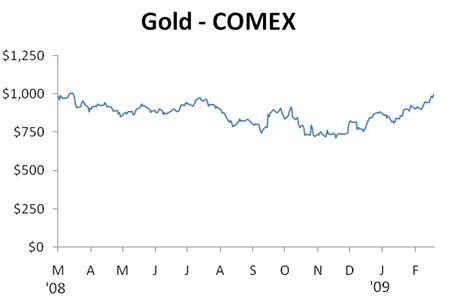
How the Federal Government will Lose in 2009 – Seeking Alpha

By: Rob Viglione of The Freedom Factory

Through a combination of incompetence and greed, the federal government has placed itself in a position of checkmate. There is no way to finance its budget deficits without devaluing the dollar or causing interest rates to rise. With $10.6 trillion in debt, $8.5 trillion in new money created or given away in 2008, and multiple years of trillion dollar deficits planned by Obama, government has no way to fund its extravagances without either printing a lot more money or borrowing unprecedented sums.

This means that either Treasury bonds will crash, or the dollar will suffer significant devaluation relative to foreign exchange or precious metals, especially gold.

TV Does Great Interview With Peter Schiff (Russian TV, That Is)

=====================================================

Remember Dare Something Worthy Today Too!


Market forces are telling the world to shed unproductive assets and shrink capacity, yet central banks and governments around the world, in particular the U.S., are refusing to listen. Rather than allow markets to snap back to sustainable equilibrium from previously artificial highs, the federal government clings to the notion that forcibly shuffling resources, propping up asset prices, and diluting the money supply will magically save the day.

There are consequences to everything. The consequences of shuffling resources (taxing productive ventures and doling out those resources to failing ones, i.e. bailouts) are stunted growth for good businesses and propagation of bad ones. Artificially propping up asset prices means that those who are generally less competent remain the custodians of society’s capital, and diluting the money supply inflates aways everyone’s wealth over time, particularly harming the poor and middle class.

For decades the federal government has gotten away with this reshuffle and inflate game, but the pawns are drowning, the rooks helpless, and the knights ready to turn on the King. Perhaps this is overly dramatic. Clearly, I doubt the capability of the Federal Reserve, Congress, and Obama to “fix” the economy; rather, I strongly believe they are destroying it by forcing us all to drink this Keynesian Kool-Aid. However, whether or not the economy recovers amidst this historic central government action, there are two phenomena we can exploit to our advantage:

  • Short the US dollar
  • Short US Treasuries

In “When will the great Treasury unwinding begin?” I show how government debt has been bid to unsustainable levels and will likely fall. The one concern I see stated all too often is that the Federal Reserve will keep buying Treasuries to artificially depress interest rates. This will, it is claimed, keep bond prices inflated. The one undeniable counter to this is that government must somehow fund its $1.2 trillion estimated 2009 deficit. It cannot do this by issuing and then buying the same bonds. It can only raise revenue by selling bonds to other parties, or by diluting the money supply by cranking up the printing presses. There are no other options. There you have it – we have the government in checkmate!

The likely outcome is that they will try to do both. That is why I am heavily shorting both 30-Year Treasury bonds and the dollar. Both assets will likely lose as the government becomes increasingly desperate and the world’s biggest buyers realize there are better alternatives available. Make your bets now before it becomes treasonous to bet against Big Brother!

Disclosure: Long UDN, short TLT, long GLD.

==============================================

Five New Forces to Drive Gold Higher – Seeking Alpha

By: James West of The Midas Letter

Gold naysayers habitually point to the relatively weak performance of gold relative to the broader market over the last 5 years. Given the market today, that argument is increasingly wrong, and the naysayers are soon to either admit their mistake, or pretend that they were never naysayers at all. That’s because during the last 3 months, five major new forces have emerged to compound the previous strong drivers of the gold price up to now.

These new forces are as follows:

  1. China has stopped buying U.S. debt.
    An interesting piece in the New York Times today signals that China, up until now the biggest buyer of U.S. Treasuries and bonds issued by Fannie and Freddie, is moving towards an end to that policy. China holds over US$1 trillion of such paper, and as interest rates collapse, there is less and less incentive for them to buy American.China has made several adjustments to programs that used to give banks and other financial institutions within the country incentive to buy U.S. assets, which means essentially that these same customers for assets will now be looking for Chinese products.The effect this will have on gold is two-fold. In the first place, reduced demand for U.S. debt will hamper Obama’s plans to keep printing money, because the one limiting factor that still seems to be respected in terms of how much paper can be printed, is the idea that there must be a counterparty to every issuance of T-Bills to warrant continued printing. Theoretically, less demand for T-Bills will force a rise in interest rates to attract investors. But that does not appear forthcoming, which will make the U.S. dollar weak relative to other currencies – especially gold.The second effect is that by eliminating incentives for Chinese banks to acquire U.S. denominated assets, investors there will divert more funds to holding gold as a hedge against their current U.S. dollar holdings, which will be diminishing in value.
  2. Future discoveries of gold deposits will diminish dramatically.
    The biggest source of gold ounce inventory for major gold producers is the discoveries made by the several thousand juniors who scour the earth in search of favorable geology. With the collapse in base metals prices, many of these juniors are under increasing pressure to consolidate and downsize, and many more will disappear altogether.That means less money going into gold exploration, and that means the number of new discoveries that can be acquired by majors is going to go down sharply in the coming years. In theory, as gold continues to outperform all other asset classes, there will be a rush back into junior gold exploration, but that won’t happen until gold is taken much higher and investment demand for it soars.
  3. Existing by-product gold production will fall sharply
    In copper, zinc and other base metals mines around the world, gold occurs in metallic deposits as a by-product of some other dominant mineral. In the United States, 15 percent of gold production is derived from mining copper, lead and zinc ores.With the collapse in prices for these metals, the by-product production of gold is most often insufficient to justify the continued operation of the mine profitably, and it is likely that a significant amount of this by-product gold production will cease along with the shutdown of these operations. The result will be less gold production from existing operations, contributing to the now even faster growing gap between supply and demand.
  4. Gold is becoming mainstream
    One of the biggest contributors to gold’s unpopularity as a main street investment is that it has been mercilessly derided and ridiculed by mainstream investment media and institutions. There is very little opportunity for an investment advisor to insinuate himself into a gold purchase transaction, since most anybody who wants to hold the metal can visit their local bullion exchange or mint and buy as much as they’d like. Because the massive investment institutions that dominate the investment advisory business can’t make a fee out of advising you to buy gold, they try to convince you to purchase other asset classes which their firm has either originated or is a participant in a syndication of investment banks selling such products.Thanks to the widespread coverage of the questionable integrity of these complex securities, and since many main street investors have been burned by their investment advisors (they feel), there is increasing main street advice being doled out to buy gold. One need only search Google news on any given day to discover that headlines critical of gold are now replaced with headlines singing its praises.
  5. Gold is the best performing asset class of the decade
    Now that the global financial meltdown has got up a head of steam, investors are hard pressed to find any investment that has performed well over the last ten years as consistently as gold. The chart below outlines this performance and appears here courtesy of James Turk’s GoldMoney.com.
Gold Performance: 2001-2008 (click to enlarge)
Gold Performance 2001 - 2008

As you can see, any investment still returning an average of 10 – 17 percent is a winner, compared to everything else you can generate a chart for. As this intelligence permeates the none-too-quick popular investment imagination, and, combined with the other 4 factors, gold is going to be where the world’s next crop of millionaires is minted.

===========================================

Share this:

  • Click to share on Reddit (Opens in new window) Reddit
  • Click to share on Facebook (Opens in new window) Facebook
  • Click to share on LinkedIn (Opens in new window) LinkedIn
  • More
  • Click to share on X (Opens in new window) X
  • Click to share on Pinterest (Opens in new window) Pinterest
  • Click to share on Tumblr (Opens in new window) Tumblr
  • Click to print (Opens in new window) Print
  • Click to email a link to a friend (Opens in new window) Email
Like Loading...
Newer posts →

Authors

  • jschulmansr's avatar jschulmansr
    • Free Crypto!
    • Free Crypto Currency
    • This is Blessed!
    • Trump Rally Charleston
    • Trump Rally Charleston

Blog at WordPress.com.

Privacy & Cookies: This site uses cookies. By continuing to use this website, you agree to their use.
To find out more, including how to control cookies, see here: Cookie Policy
  • Subscribe Subscribed
    • Dare Something Worthy Today Too!
    • Already have a WordPress.com account? Log in now.
    • Dare Something Worthy Today Too!
    • Subscribe Subscribed
    • Sign up
    • Log in
    • Report this content
    • View site in Reader
    • Manage subscriptions
    • Collapse this bar
%d