• Recommended Sites & Links
  • About

Dare Something Worthy Today Too!

~ FreeCryptoBitCoins, Cryptocurrency, BitCoin, Ethereum, BitCoin Cash, Ethereum Classic, LiteCoin, DogeCoin, Gold & Precious Metals, Investing & Investments, Stocks and Stock Markets, Financial Markets & Market Timing, Technical Analysis, Oil and Energy Markets, Hard Assets Investing, BlockChain, Airdrops, Earn Free Bitcoin…

Dare Something Worthy Today Too!

Tag Archives: Dennis Gartman

Gold Taking a Breather but Fundamentals are Stronger!

02 Monday Feb 2009

Posted by jschulmansr in 10 year Treasuries, 20 yr Treasuries, banking crisis, banks, bear market, bull market, capitalism, central banks, China, commodities, Copper, Currencies, currency, Currency and Currencies, dollar denominated, dollar denominated investments, economic, Economic Recovery, economic trends, economy, Fed Fund Rate, Federal Deficit, federal reserve, Finance, financial, Forex, Fundamental Analysis, futures, futures markets, gold, Gold Bullion, Gold Investments, gold miners, hard assets, How To Invest, How To Make Money, India, inflation, Investing, investments, Junior Gold Miners, Latest News, Long Bonds, Make Money Investing, market crash, Markets, mining companies, mining stocks, Moving Averages, palladium, physical gold, platinum, platinum miners, precious, precious metals, price, price manipulation, prices, producers, production, SEO, Short Bonds, silver, silver miners, spot, spot price, stagflation, Stimilus, Stimulus, Stocks, TARP, The Fed, U.S. Dollar, Uncategorized

≈ Comments Off on Gold Taking a Breather but Fundamentals are Stronger!

Tags

agricultural commodities, alternate energy, Austrian school, Bailout News, banking crisis, banks, bear market, Bollinger Bands, bull market, capitalism, central banks, China, Comex, commodities, communism, Copper, Currencies, currency, deflation, Dennis Gartman, depression, diamonds, dollar denominated, dollar denominated investments, economic, economic trends, economy, Federal Deficit, financial, Forex, futures, futures markets, gold, gold miners, hard assets, heating oil, India, inflation, investments, Keith Fitz-Gerald, Marc Faber, Mark Hulbert, market crash, Markets, mining companies, Moving Averages, natural gas, oil, palladium, Peter Brimelow, Peter Schiff, physical gold, platinum, platinum miners, precious metals, price, price manipulation, prices, producers, production, protection, rare earth metals, recession, risk, run on banks, safety, Saudi Arabia, Sean Rakhimov, silver, silver miners, socialism, sovereign, spot, spot price, stagflation, Technical Analysis, timber, U.S. Dollar, volatility, warrants, Water

Currently Gold is down $14-$15 dollars per oz. around the $914 level. As I wrote in my last post if we hold this level then $950 will be our next target. If it fails here then we may have a test back to $885 – $890. Either way I’m taking the opportunity to buy on dips since long term inflation is certainly due to happen and Gold is where you want to be when that happens.  Personally, I think $900 to $925 is the new base and we have avery real possibility of $1000+ Gold price before the summer truly begins.- Good Investing – Jschulmansr

==============================

Catch the New Bull! – Buy Gold Online – Safely, quickly, and at low prices, guaranteed! Bullion Vault.com

==================================

Update on the Gold Trade – Seeking Alpha

By: Trader Mark of My Mutual Fund

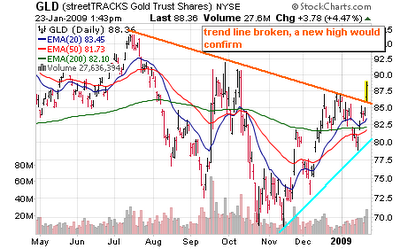
Last Friday we said gold might finally have it’s real breakout here [Jan 23: Could be the Real Breakout in Gold] I wrote:

Things to like:
1) a series of higher lows
2) the trendline of lower highs has been penetrated

Things to see for confirmation:
1) any pullback is bought
2) price prints over October 2008’s highs, signaling the end of “lower highs”

This was what the chart looked like at the time:
Now?
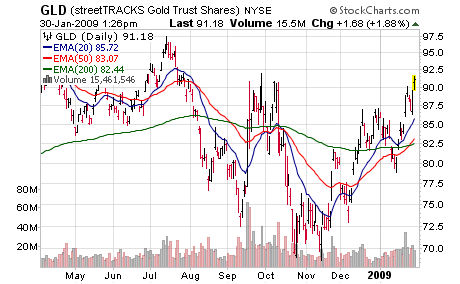
Without benefit of the orange line – you can see condition #1 has been fulfilled – we “backfilled”, tested the area we broke out of and people were eager to buy. On that, an aggressive trader would be buying. A reader mentioned this outcome last week.

For someone more conservative in orientation, you want to see #2 “a price point over October 2008’s highs” – then we end our half year of lower highs. We are withing spitting distance here with GLD at $91.40 and the October intraday high at $92.

It’s hard to get behind gold fully because there is no “earnings” behind it; it’s all about sentiment. But the theory is that as all the world’s troubled countries race to devalue their currencies (print, print,print) to “save the system,” a hard asset should retain its value. Silver is likewise breakout out, although silver has a lot of industrial uses as well.

I hate to chase a move, but from a technical set up, a lot of institutional money could be set to finally jump in here….

Now the question of what instrument to use – keep it simple or go with a miner? etc.

Disclosure: No position

=================================

My Note- Great call by Trader Makr but I have to ask, why no position Trader Mark? – jschulmansr

=================================

Catch the New Bull! – Buy Gold Online – Safely, quickly, and at low prices, guaranteed! Bullion Vault.com

=================================

Fed Monetizes Debt Leading Investors to Embrac Gold – Seeking Alpha

By: Boris Sobolev of Resource StockGuide.com

In January gold rose significantly against all major world currencies. In most currencies except in the US dollar and the Japanese yen, gold actually made an all-time-high.

January Performance

GOLD / USD 5.3%

GOLD / EUR 16.7%

GOLD / AUD 16.5%

GOLD / JPY 4.4%

GOLD / GBP 5.8%

GOLD / CHF 16.3%

10-Yr Yield 13.0%

click to enlarge
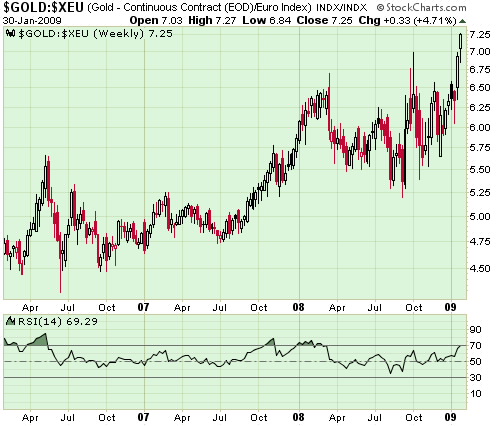
At the same time, most capital markets have been falling.

January performance

DOW -11.5%

S&P -11.4%

NASDAQ -9.0%

FTSE -6.4%

DAX -9.8%

Nikkei -9.8%

Shanghai -9.3%

The governments around the world are trying to take initiative while private capital is sitting on the sidelines, preferring the safety of government bonds and precious metals.

Investors typically do not trust the governments to implement any effective economic solutions. Moreover, this lack of faith in central planning continues to grow since the US government has no other plan of action than to save the old, compromised and untrustworthy financial system.

What the Federal Reserve together with the Department of Treasury has shown is that they will inject a vast amount of newly created money into a hugely ineffective financial system.

While in the fall of last year, in fear of devastating deflation, analysts were competing in downward projections for the price of gold, now the competition is to estimate the amount of losses incurred by the financial institutions around the world. The maximum assessment is now at $4 trillion, with Nouriel Roubini coming in close second at $3.6 trillion.

But the main problem is not so much in the amount of credit losses or the amount needed for recapitalization efforts but in that the new government is committed to continue to transfer huge capital into the hands of the same group of people who were largely responsible for the world financial crash in the first place. Wall Street, though transformed, will remain in control.

The lack of trust in the ability of insolvent financial institutions to run the modern financial system is moving investors into gold.

An even more important gold catalyst was the Federal Reserve. In comparing the two latest Fed statements, two things stand out. Here is the evolution in wording:

December Statement: “In light of the declines in the prices of energy and other commodities and the weaker prospects for economic activity, the Committee expects inflation to moderate further in coming quarters.”

January Statement: “In light of the declines in the prices of energy and other commodities in recent months and the prospects for considerable economic slack, the Committee expects that inflation pressures will remain subdued in coming quarters. Moreover, the Committee sees some risk that inflation could persist for a time below rates that best foster economic growth and price stability in the longer term.”

December Statement: “The Committee is also evaluating the potential benefits of purchasing longer-term Treasury securities.”

January Statement: “The Committee also is prepared to purchase longer-term Treasury securities if evolving circumstances indicate that such transactions would be particularly effective in improving conditions in private credit markets.”

First, the FOMC sees a threat of deflation and second it is prepared to counter this threat by purchasing longer-term treasuries.

Purchases of long term bonds is the most inflationary move that a central bank can undertake because it represents direct monetization of the government debt and hence an unconcealed debasement of national currency. (This is happening at the same time as the new Secretary of Treasury is chastising China – the main US creditor – for currency manipulation.)

Why did the Fed make such a determined statement, with one member even voting to begin long term treasury purchases immediately? First and foremost, the real estate market is not showing any signs of life. House prices are falling, time required to sell new homes is rising and most importantly, after a steep fall in December, average mortgage rates began to rise again, reaching 5.34% as of last Friday.

Since mortgage rates are closely tied to the 10-year treasury yield, the Fed stands ready to buy government debt and help make housing more affordable via low mortgage rates. The hope is that such action would help put an end to a decline in asset prices and stop the deflationary spiral.

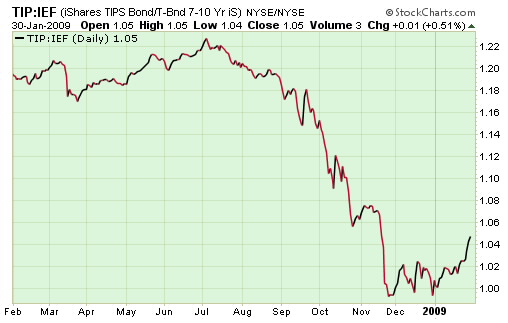
In fact, the latest Fed balance sheet showed that long term treasury purchases have already started, with around $1 billion in notes (5-10-year maturity) purchased for the week ended January 21st. This is a modest amount, but it is a statement that the Fed is ready to do more than just talk. Traders have indeed sensed this development and Treasury Inflation-Protected Securities (TIPS) (TIP) are also beginning to reflect greater inflation expectations.
Gold investors are also sniffing out the coming price reflation as they piled into the SPDR Gold Shares (GLD) at an increasing rate.
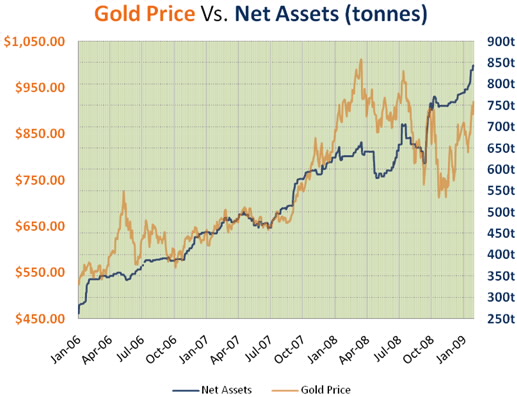
For the month of January, GLD gold holdings rose 8.2% or close to a record setting 63 tonnes. At this rate, GLD will soon surpass Switzerland in its gold holdings, thus becoming the world’s sixth largest gold owner after the US, Germany, the IMF, France and Italy.

If the Fed continues to purchase long term treasuries, it is clear that there is only one way for gold and gold stocks and it is up.

================================

Catch the New Bull! – Buy Gold Online – Safely, quickly, and at low prices, guaranteed! Bullion Vault.com

================================

Gold as Part of a Portfolio – Seeking Alpha

By: San Olesky of Olesky Capital Management

Many investors have been thinking about gold recently. Some have considered it because it has been a relatively strong performer with the iShares COMEX Gold Trust (IAU) closing up 5.4% in 2008. It’s up 2% year-to-date as of Wednesday’s close. The iShares S&P 500 Index ETF (IVV) was down 36.94% in 2008 and is down 6.17% year-to-date as of Wednesday’s close. Other investors or traders have bought or considered gold as a classic safe haven.

My inclination is to refute the efficacy of buying or holding gold for security either in the form of an ETF or, more so, in the case of gold bullion bars or gold coins. However, as the financial crisis became more severe last year, a couple of clients approached me about adding gold to their portfolios. Rather than diplomatically rejecting the proposal, I told them that I would investigate the historic effects of holding gold in a portfolio. Long story short, I found that adding a small, reasonable allocation to gold reduced portfolio volatility substantially and increased return slightly.

A simple diversified portfolio consisting of 1/3 S&P 500, 1/3 Real Estate Investment Trusts (REITs), and 1/3 10 year U.S. Treasuries would have produced a compound annual growth rate (CAGR) of 8.47% with 11.15% volatility (standard deviation – SD) from 1993 to 2008. For comparison, the S&P 500 produced a 6.67% CAGR with a 20.16% SD. Although few investors would implement this 1/3 – 1/3 – 1/3 allocation, diversification is proving its strengths here. All of these statistics incorporate rebalancing annually.

Let’s take the same 1/3 – 1/3 – 1/3 portfolio and alter it to include a relatively small allocation to gold. That allocation will be 30% S&P 500, 30% REITs, 30% Treasuries, and 10% gold. Over the same timeframe the portfolio with gold produced an 8.49% CAGR with a 9.86% SD. The portfolio with gold produced a slightly better CAGR with volatility that was 11.6% lower than the 1/3 – 1/3 – 1/3 portfolio. The diversified portfolio with gold produced a CAGR that was 27.3% higher than the S&P 500 and 51.1% less volatile than the S&P 500. The S&P 500 had 4 losing years with the worst being a loss of 37% last year. The 1/3 – 1/3 – 1/3 portfolio had 3 losing years with the worst being a loss of 18.15% last year. The portfolio with gold had only 2 losing years with the worst being 15.74% last year.

In constructing sound and productive portfolios we would like to include assets that have high returns, low volatility, and low correlation to the other assets in the portfolio. Looking at gold’s average annual returns, relative volatility, and relevant correlations, one should expect that gold would be a constructive addition to many portfolio allocations. In fact, gold even has a relatively low correlation with commodities in general (S&P Goldman Sachs Commodity Index). However, we should learn from the past but not expect it to repeat itself exactly. There is much to be learned from historic returns, volatilities, and correlations of asset classes. With all due respect to history and math, we must use reason when constructing portfolios. I view gold as a very narrow and idiosyncratic asset. So, I do not feel that it is wise to strategically allocate as much as 10% to the asset although the historic, mathematically optimal amount would be higher in the context of some portfolios.

What did I do? Based on my tests and observations, I bought a little gold last year for some of my clients. I have incorporated a small allocation to gold into their continuing strategic allocations.

====================================

My Note: This is great news even the Non Gold Bugs are become cautiously bullish!-jschulmansr

====================================

Catch the New Bull! – Buy Gold Online – Safely, quickly, and at low prices, guaranteed! Bullion Vault.com

====================================

Finally and extremely interesting article you want to read! Be sure to click on the chart links too…- jschulmansr

Economy Watch: What if Stocks Were Priced in Gold?- Seeking Alpha

By: Paco Ahlgren of Ahlgren Multiverse

“Everything has its limit — iron ore cannot be educated into gold.”

— Mark Twain

Several charts have been floating around the Internet for some time, showing the historical Dow Jones Industrial Average, priced in terms of gold. The simplest explanation entails thinking of the Dow divided by one ounce of gold; if the Dow is at 5000, and gold is at 500, then Dow-to-gold is 10. But it’s important to remember as you’re considering this ratio that the Dow is calculated in terms of dollars. So essentially, when we determine the Dow-to-gold ratio, it’s not just a simple ratio of gold to shares in the Dow, but rather it is a three-part ratio — Dow, expressed in dollars, to an ounce of gold.

Wouldn’t it just be easier to express gold in terms of dollars, or the Dow in terms of dollars? Well, those are certainly useful ratios — and we use them all the time — but what we’re really going after when we look at a historical Dow-to-gold chart is how well the Dow has performed, relative to the dollar, and relative to gold. What have inflationary pressures done to the Dow, in terms of gold and the dollar, over the past century? How have the three components moved in the various historical boom-bust scenarios? The results are interesting.

Let’s shift gears for a moment. Just off the top of your head, what would you expect stocks to do in periods of inflation? The dollar loses value rapidly, right? And that means prices of goods and services move higher, presumably with wages. So wouldn’t it stand to reason, intuitively, if corporations were making more money as prices increased, profits would increase too? And if profits increase, shouldn’t share prices go higher in response?

It turns out that inflationary price increases are bad for the stock market, and no period in history establishes this more concretely than the late 1970s and the early 1980s. Interest rates and prices soared, along with the price of gold, but stocks were flat. I want you to think about what I’m saying here: prices in general were going up, and yet the stock market was not. What this means is while stocks, in nominal terms, looked to be relatively stagnant, in real terms they were getting crushed. This is why the Dow-to-gold ratio is so significant as an indicator of relative value.

There is an elegant, simple truism that comprises every single transaction between buyers and sellers, and yet most people don’t even think about it: whenever you buy something, you are selling something else. When you buy corn, you are selling dollars. When you buy a Ford, you are selling dollars. If you are in Mexico and you buy a chicken, you are selling pesos. Of course, if you came from the U.S., you first sold dollars, bought pesos, and then sold pesos to buy the chicken. I know most of you already understand this concept, but I’m trying to emphasize that even when currency is used, every transaction is merely a trade; that is to say, the transaction is nothing more than negotiation that results in the exchange of two things — whether goods, services, or currency.

With that in mind, consider this: when prices rise because of inflation (printing of money), it isn’t so much that goods and services are getting more valuable — rather it’s much more accurate to say the currency is simply getting less valuable relative to everything else. If the dollar collapses, for instance, and the cost of a loaf of bread goes from $1 to $20 at the same time a share of Microsoft (MSFT) goes from $20 to $30, then Microsoft is severely under-performing — in inflation-adjusted dollars. A loaf of bread will cost you 20 times what it used to — not because it is more valuable, but because the dollar is less valuable. Meanwhile Microsoft is worth only 50% more. Relative to the dollar, shares of Microsoft are actually losing money — in a big way.

If you look at a chart of inflation from 1978 to 1982, you’ll notice a huge spike. If you look at a chart of the Dow Jones Industrial average during the same period, you’ll see that stocks traded sideways in a fairly well-defined range over the same period. But that doesn’t tell the whole story; if you adjust for the meteoric rise in prices during that five-year period, the stock market actually performed much worse than the nominal dollar fluctuations presented in the historical chart. In other words, the price of just about everything was going up dramatically, but stocks were not. So if you adjust prices back to “normal” levels, and adjust stocks accordingly, the picture for equities would have been horrible.

Now for the pièce de résistance…

Here is a series of charts of historical nominal gold prices (not adjusted for inflation), in several different currencies — the first of which is U.S. dollars. Take a look at the spike in the price of gold from 1977 to 1981. Now, if we go back to our original chart above, showing the Dow Jones Industrial Average, in direct relation to an ounce of gold (Dow-to-gold), you can see that the ratio went roughly 1:1 in 1980 — at the peak of the inflationary price surges. To clarify, the Dow was at about 750, as was gold.

But didn’t we say that, relative to rising prices, the Dow actually underperformed dramatically? So if you bought gold in the mid-1970s, not only was your investment skyrocketing, but the stock market — which was flat in nominal dollars — was actually doing very poorly relative to rising prices. Bear in mind that both the Dow and gold were priced in terms of nominal dollars at the time; they essentially “cancel out” — that is to say, relative to rising prices, gold also failed to perform as well as the nominal dollar-price. Still, it did offer an excellent hedge against rising prices, and even outperformed during the period.

What does all this mean? Well, for starters the average Dow-to-gold ratio over the last century has been about 9.5, and we are currently at about 8.5. So you’re probably thinking we’re oversold and due for a correction. In other words, the Dow-to-gold ratio is probably going higher, right? Well that was my first conclusion too, but actually on closer examination it turns out that’s probably not right at all.

For much of the last century the dollar was tied to gold, and while the relationship was never perfect — and the U.S. government betrayed the union many times, in many different ways — there was at least some relationship, which helped pull the ratio down. Eventually, excessive inflationary printing caught up with the government in the 1960s, and it became clear it wouldn’t be able to honor redemptions against the dollar at the price it had fixed. Nixon essentially defaulted on the U.S. promise to redeem dollars for gold by taking the U.S. off the standard in the 1970s — and this, more than anything else, allowed inflationary pressure to drive general prices into the stratosphere. This was the moment the Dow-to-gold ratio approached 1:1. To fight rising prices, Paul Volcker, the Fed Chairman at the time, pushed the Fed’s target interest rate past 20% and barely saved the U.S. economy from collapse.

For most of the next 20 years, gold fell and stock prices rose. Meanwhile, the U.S. government capitalized on the lie it had created and printed more and more money. Who really cared? Everyone was making money in the stock market, and prices remained relatively stable. In fact, every time prices failed to act “correctly,” the Fed simply changed the rate at which it would lend to banks. But the illusion of the monetary policy game couldn’t last forever; people used easy money printed by the government to buy assets they couldn’t afford throughout the economy — especially houses. Finally the pressure was just too much, and everything started unraveling in 2007. But the gold market seemed to understand the game couldn’t last, and around 2000 it started a slow, steady rise.

Relative to everything, the number of dollars in the system in early 2009 is almost incomprehensible. Once de-leveraging reaches its nadir — and it’s coming soon — those dollars are going to hit the economy and drive prices much higher.

What have we learned about stocks in such periods of rising prices? Not only do they fail to perform, but adjusted for inflationary price pressures, they actually under perform. General prices and unemployment will continue to rise. The consumer will continue to be unable to consume. Corporate earnings and dividends will continue to collapse as a result. Stocks are going lower — probably much lower.

And what about the price of gold? It will almost certainly continue to increase — not only because people will flock to its long historical stability and consistency, but also because there are simply so many more dollars (and yen, and rubles, and euros) in the world. Remember, the U.S. isn’t the only country printing innumerable sheets of currency. And in that context, remember also that inflationary price increases have almost nothing to do with increased demand, but rather they are the result of currency devaluation and destruction — through printing.

I just want to share two more charts with you. The first should give you a little perspective — it is a historical chart of gold, in both nominal and real dollars. Notice the real price of gold in 1980 (in 2007 dollars) was $2272 per ounce. If I’m correct about inflation and the fate of the dollar — and I’m confident I am — then we are nowhere near the historical high in gold. But I don’t think we’re merely going to re-test that high — I think we’re going to blow through it as the dollar loses value.

In the 1930s, as corporate earnings and dividends disintegrated, the Dow lost nearly 90% of its value from peak to trough. The U.S. was a creditor nation with a huge manufacturing base. The dollar was tied closely to gold. Since its peak in October 2007, the Dow has lost less than 50% of its value. The U.S. is a debtor nation with a relatively small manufacturing base. I can’t say it enough: we borrow profusely, we manufacture very little, and we consume gluttonously. Nonetheless, the consumer has now lost almost all his purchasing power, and corporate earnings and dividends are going to suffer massively as a result.

In 2007, the Dow peaked at about 14,150. To give you some perspective, an 85% drop in the Dow from peak to trough would put it at about 2100.

I know it’s easy to imagine the Fed has magical powers. I’ve fantasized about such things myself at times of extreme weakness — that maybe the Fed will “somehow” figure out a way to fight and defeat the unprecedented evil specter of inflation it is foisting on its unsuspecting children. Sometimes I do believe that our Lord and Savior Barack Obama will wave his charmed “unicorn horn of change” and all will be well again. Likewise, at times I feel like I could let Uncle Ben Bernanke take me just about anywhere in his helicopter of prosperity. My faith in the reverend John Maynard Keynes runs deep, as I hope, and hope, and hope. I find myself gleefully clicking my heels together and repeating, “the dollar is almighty, and the Stars and Stripes will prevail.” And when I am in this wonderful place, I have confidence that someday soon, we’ll all be buying houses with no money down, and with no jobs. Our driveways and backyards will once again overflow with boats, motorcycles, and sports cars.

Then I think about the 1930s. And suddenly I am wide-awake.

Let me ask you a simple question, and I want you to actually think about it. Do you really think we can’t get to the 1930s again? Do you really think that we’re going to return to the exuberant excess of the past few decades? If so, let me disabuse you of the notion: the United States was in much better shape, economically, going into the Great Depression than it is now. Prosperity is not coming back to the U.S. as we know it. We are in a lot of trouble.

Is a Dow-to-gold ratio of 1:1 so incomprehensible? Again, it has happened before — several times. But I’ll even take it a step further: what about a Dow-to-gold ratio of .5? Or less? I promise you, if the Fed fails to soak up all the dollars it’s putting in the system, that’s exactly where we’re going. And what, you may ask, does the Fed use to “soak up dollars?”

I’ll be glad to tell you that too. When the Fed needs to take dollars out of the system, it sells Treasuries (which means it buys dollars). The problem is, the U.S. debt-load is astronomical. Who, exactly, is going to buy that debt from the Fed? And at what interest rate? Remember, if the Fed is desperately trying to take dollars out of the system, there can be only one reason: it is scared of rising prices caused by inflation. But if the Fed floods the market with Treasuries, it will achieve exactly the opposite effect it’s looking for — it will cause rates to rise, probably dramatically. Do you really think the Chinese and the Japanese are going to buy Treasuries at a 2% yield if the Fed is panicking and trying to buy dollars to stop an inflationary price explosion? If so, you’re delusional. Chinese and Japanese people are smart. They’re not going to fund an inflationary dollar at 2%. Ever.

In the past it might have worked. Of course, in the past, the U.S. money supply was much smaller, and our ability to borrow was much stronger. But those days are gone.

As if I haven’t terrified you enough, the last thing I’m going to leave you with is really scary. It is a link to an excellent article by Mark J. Lundeen, whose insight into this economic catastrophe has been stupefying since long before all of this even started. Embedded in the article is a chart that shows historical dollars-in-circulation, relative to U.S. gold.

With that, I think I’ll let you do the rest of the math. Sleep well.

Disclosures: Paco is long gold.

Copyright 2009, Paco Ahlgren. All Rights Reserved.

==================================

If you have done the math…

Catch the New Bull! – Buy Gold Online – Safely, quickly, and at low prices, guaranteed! Bullion Vault.com

=================================

That’ it for now – Good Investing – Jschulmansr


Nothing in today’s post should be considered as an offer to buy or sell any securities or other investments, it is presented for informational purposes only. As a good investor, consult your Investment Advisor, Do Your Due Diligence, Read All Prospectus/s and related information carefully before you make any investments. –  jschulmansr
Share this:

  • Click to share on Reddit (Opens in new window) Reddit
  • Click to share on Facebook (Opens in new window) Facebook
  • Click to share on LinkedIn (Opens in new window) LinkedIn
  • More
  • Click to share on X (Opens in new window) X
  • Click to share on Pinterest (Opens in new window) Pinterest
  • Click to share on Tumblr (Opens in new window) Tumblr
  • Click to print (Opens in new window) Print
  • Click to email a link to a friend (Opens in new window) Email
Like Loading...

It’s Official- The New Gold Rally Has Begun!

30 Friday Jan 2009

Posted by jschulmansr in Austrian school, Bailout News, banking crisis, banks, bear market, capitalism, central banks, China, Comex, Copper, Currencies, currency, Currency and Currencies, deflation, dollar denominated, dollar denominated investments, economic, Economic Recovery, economic trends, economy, Federal Deficit, Finance, financial, Forex, futures, futures markets, gold, Gold Bullion, Gold Investments, gold miners, How To Invest, How To Make Money, India, inflation, Investing, investments, Junior Gold Miners, Latest News, Make Money Investing, market crash, Markets, mining companies, mining stocks, palladium, physical gold, platinum, platinum miners, precious metals, price manipulation, prices, producers, production, Prophecy, resistance, Siliver, silver, silver miners, spot, spot price, stagflation, Stocks, TARP, Today, U.S. Dollar

≈ Comments Off on It’s Official- The New Gold Rally Has Begun!

Tags

agricultural commodities, alternate energy, Austrian school, Bailout News, banking crisis, banks, bear market, Bollinger Bands, bull market, capitalism, central banks, China, Comex, commodities, communism, Copper, Currencies, currency, deflation, Dennis Gartman, depression, diamonds, dollar denominated, dollar denominated investments, economic, economic trends, economy, Federal Deficit, financial, Forex, futures, futures markets, gold, gold miners, hard assets, heating oil, India, inflation, investments, Keith Fitz-Gerald, Marc Faber, Mark Hulbert, market crash, Markets, mining companies, Moving Averages, natural gas, oil, palladium, Peter Brimelow, Peter Schiff, physical gold, platinum, platinum miners, precious metals, price, price manipulation, prices, producers, production, protection, rare earth metals, recession, risk, run on banks, safety, Saudi Arabia, Sean Rakhimov, silver, silver miners, socialism, sovereign, spot, spot price, stagflation, Technical Analysis, timber, U.S. Dollar, volatility, warrants, Water

As it write this Gold is up $22.50 oz to $929.00! It absolutely smashed thru the $920 resistance! If we hold here $950 -$975 is the next level.  Barrick Gold CEO Munk says China to be a big buyer of gold as confidence is lost in the U.S. Dollar. The treasuries bubble is starting to burst and money is pouring into gold!- Good Investing! – jschulmansr

====================================

Catch the New Bull! – Buy Gold Online – Safely, quickly, and at low prices, guaranteed! Bullion Vault.com

=========================================

Source: MineWeb.Com

 WORLD ECONOMIC FORUM

Munk forecasts currency, economy fears will send gold to new record highs

Whether it’s the currency effect or a reaction to a feeling of uncertainty, Barrick Gold Chairman Peter Munk says gold is more likely to go up than down.

Author: Barbara Lewis
Posted:  Friday , 30 Jan 2009

DAVOS, Switzerland (Reuters) – 

Gold is likely to hit new record highs, spurred by serious concern about the U.S. currency and doubt about the state of the world economy, the chairman of Barrick Gold Corp. said on Thursday.

There was even a possibility, although not a probability, central banks, including China’s, might start to switch from dollar holdings to gold, which could cause the metal’s price to treble or more.

From a gold producers’ perspective, one negative is that the cost of bringing on production has remained high, even as other raw materials, including base metals and energy, have slumped.

“Gold is at record levels in every currency except dollars. Even within dollar terms it is within a few percentage points of an all-time high at a time when all the other major commodities are falling,” Peter Munk told Reuters at the World Economic Forum meeting in Davos.

“Whether it’s the currency effect or a reaction to a feeling of uncertainty, gold in my opinion is more likely to go up than down,” the chairman and founder of the world’s largest gold mining company said.

Spot gold was at $902.80/904.80 at 1817 GMT. It hit a record high of $1,030.80 an ounce in March last year.

Munk stressed he was merely weighing the odds.

“It would be stupid to assume commodities prices can only go one way,” he said, adding physical demand for gold jewellery was not high during the economic downturn.

Gold has been one of the best-performing assets of late, rising in value by nearly 17 percent since late October.

Investors have bought heavily into physical bullion in the form of coins and bars and physically-backed assets such as exchange-traded funds as a safe store of value at a time of increased volatility in other asset prices.

Munk said downward pressure on the dollar, partly because of massive U.S. spending to stimulate the economy, would increase gold’s attractions as an investment further.

Gold usually moves in the opposite direction to the dollar, as it is often bought as a hedge against weakness in the U.S. currency.

“My personal feeling is that with the rescue packages calling for trillions, not billions… the value of the (U.S.) currency has to go down,” said Munk.

DUMB TO HEDGE

His company did not hedge its output for now — meaning it does not use derivatives to insure against a fall in price — and relied instead on the price climbing. In the past its successful hedging allowed it to make the acquisitions that helped to make it the world’s biggest gold miner.

“It would be dumb to hedge,” Munk said of the current climate.

His bullishness was underscored by the possibility central banks, including that of major dollar asset-holder China, might start buying gold.

“If they decide to diversify, we assume into gold, then we start to talk about a trebling or quadrupling of the gold price. It could be followed by Russia or Kuwait.

“I don’t think it’s likely, but it’s more likely. I would not have said it two years ago …I’m not a gold bug …but it’s more likely than it was two years ago.”

A strong price climate has meant ongoing investment in bringing on new gold, Munk said.

“In every other mining area, people are cancelling mines.”

But declines in other commodities have yet to have a major impact on cost.

“Marginally yes, but substantially no. For some reason cash costs are tending to continue to increase,” he said, when asked whether investment costs were falling.

“Energy costs have gone down. It does help, but labour costs are consistently increasing.”

The one way to reduce production costs is to invest in efficient new mines, Munk said, citing two major new projects in Nevada and the Dominican Republic and a smaller one in Tanzania.

(Reporting by Barbara Lewis, additional reporting by Jan Harvey in London; editing by Anthony Barker)

© Thomson Reuters 2009 All rights reserved

=============================

Catch the New Bull! – Buy Gold Online – Safely, quickly, and at low prices, guaranteed! Bullion Vault.com

=============================

Hedge Fund to Measure Returns in Gold Rather Than Currency – Seeking Alpha

By: Todd Sullivan of Value Plays

This is a pretty stunning move. What is even more alarming is the reasoning given.
From the FT:

A hedge fund has begun offering investors the chance to have their investment denominated in gold, as worries grow over governments debasing their currencies by printing money.

Osmium Capital Management, a $178m hedge fund manager based in Bermuda, is launching a new share class allowing investors to hold shares measured as troy ounces of the fund, rather than U.S. dollars, sterling or euros.

The move follows a surge in investor demand for small gold (GLD) bars and coins held by individuals and gold-backed exchange-traded funds that are holding a record amount of bullion.

Chris Kuchanny, Osmium chief executive and a former London ABN Amro trader, said he was putting almost all his personal wealth into the new share class: “Investors have voiced concerns that they’re overly exposed to the major fiat [paper] currencies in an environment where the fundamentals of those currencies are clearly deteriorating with governments assuming more debt and having lower revenue and more expenditure.

This shows a stunning lack of confidence in currencies. It also says that the fund is anticipating inflation to rear its ugly head in a scary way. When it does, the value of the currencies will plummet and gold will rise.

What is to watch now is whether or not other funds begin to follow. If this becomes a movement rather than an individual act, the crash in currencies could be expedited in a nasty way. Stay tuned…

Disclosure: No position in gold… yet.

====================================

Catch the New Bull! – Buy Gold Online – Safely, quickly, and at low prices, guaranteed! Bullion Vault.com

====================================

My Disclosure: Long Gold , Gold Etf’s, Gold Miners/Producers, Long Silver, Silver Miners/Producers, Platinum and Paladium Miners/Producers- jschulmansr

More to follow later today…

Nothing in today’s post should be considered as an offer to buy or sell any securities or other investments, it is presented for informational purposes only. As a good investor, consult your Investment Advisor, Do Your Due Diligence, Read All Prospectus/s and related information carefully before you make any investments. –  jschulmansr

Share this:

  • Click to share on Reddit (Opens in new window) Reddit
  • Click to share on Facebook (Opens in new window) Facebook
  • Click to share on LinkedIn (Opens in new window) LinkedIn
  • More
  • Click to share on X (Opens in new window) X
  • Click to share on Pinterest (Opens in new window) Pinterest
  • Click to share on Tumblr (Opens in new window) Tumblr
  • Click to print (Opens in new window) Print
  • Click to email a link to a friend (Opens in new window) Email
Like Loading...

Are You Ready For This? – It’s Back and Ready To Rally!

29 Thursday Jan 2009

Posted by jschulmansr in Bailout News, banking crisis, banks, bear market, bull market, capitalism, central banks, China, Comex, commodities, Copper, Currencies, currency, Currency and Currencies, deflation, dollar denominated, dollar denominated investments, economic, Economic Recovery, economic trends, economy, Federal Deficit, Finance, financial, Forex, Fundamental Analysis, futures, futures markets, gold, Gold Bullion, Gold Investments, gold miners, How To Invest, How To Make Money, India, inflation, Investing, investments, Jim Rogers, Jim Sinclair, Latest News, Make Money Investing, Marc Faber, Mark Hulbert, market crash, Markets, mining companies, mining stocks, palladium, Peter Brimelow, physical gold, platinum, platinum miners, precious, precious metals, price, price manipulation, prices, producers, production, protection, run on banks, safety, Saudi Arabia, security, silver, silver miners, spot, spot price, stagflation, Stimulus, Stocks, TARP, Technical Analysis, Today, U.S. Dollar

≈ Comments Off on Are You Ready For This? – It’s Back and Ready To Rally!

Tags

agricultural commodities, alternate energy, Austrian school, Bailout News, banking crisis, banks, bear market, Bollinger Bands, bull market, capitalism, central banks, China, Comex, commodities, communism, Copper, Currencies, currency, deflation, Dennis Gartman, depression, diamonds, dollar denominated, dollar denominated investments, economic, economic trends, economy, Federal Deficit, financial, Forex, futures, futures markets, gold, gold miners, hard assets, heating oil, India, inflation, investments, Keith Fitz-Gerald, Marc Faber, Mark Hulbert, market crash, Markets, mining companies, Moving Averages, natural gas, oil, palladium, Peter Brimelow, Peter Schiff, physical gold, platinum, platinum miners, precious metals, price, price manipulation, prices, producers, production, protection, rare earth metals, recession, risk, run on banks, safety, Saudi Arabia, Sean Rakhimov, silver, silver miners, socialism, sovereign, spot, spot price, stagflation, Technical Analysis, timber, U.S. Dollar, volatility, warrants, Water

Are You Ready For This! You are asking yourself “am I ready for what?””What’s ready to Rally?” Gold my friend is the answer! As I write Gold is consolidating right around the $900 level. If you had listened to me you would be sitting on profits of $50- $100 oz. already! Well don’t worry Gold still has plenty of room to move as you will see in today’s post. – Good Investing! – jschulmansr

======================================

Catch the New Bull! – Buy Gold Online – Safely, quickly, and at low prices, guaranteed! Bullion Vault.com

=====================================

Gold Price Could Double – World Gold Council

Source: World Gold Council

The value of gold could soar due to increased demand following the global financial crisis, it has been suggested.

According to Citigroup, the price of gold could double by the summer, the Daily Mail reports.

“We continue to remain unequivocally bullish on the medium to long-term view on gold and still believe that we can ultimately see levels in excess of $2,000 (?1,398),” the firm told the paper.

Such levels would mean the price of gold would more than double its current value.

The paper notes that since September, the value of the precious metal has already risen by $122.

Citigroup added that price rises will either come via inflation following liquidity injections by governments around the world, or by continuing investment from those who view gold as a safe haven.

In related news, a recent poll conducted by Bloomberg showed that 28 of 31 traders, investors and analysts questioned said now is a good time to purchase gold.
=================================

Catch the New Bull! – Buy Gold Online – Safely, quickly, and at low prices, guaranteed! Bullion Vault.com

=================================

$850B Stimulus Plan Signals Gold Take-Off – Seking Alpha

By: Peter Cooper of Arabian Money.net

Last night the US passed its much anticipated $850 billion Obama stimulus package, representing another huge monetary expansion. Countries all around the world have been at it, and the volume of money in circulation is increasing at a record level.

Meantime, gold prices have been perky and past $900 earlier this week. Now gold has fallen back a little. The gold chart has completed an almost perfect inverse head-and-shoulders pattern which should mark the reversal of the falling trend that started at $1,050 an ounce last March.

Gold technicals

Aside from the technicals of the gold chart, let us also get back to fundamentals: the supply of gold and silver is pretty much fixed. Money supply is undergoing huge and unprecedented expansion.

At present, governments are printing money like fury and little is happening to their economies because banks, companies and individuals are hoarding cash. But eventually pulling on this string will work, and money will flood into the economy in an uncontrollable way.

It is at this point that gold prices will go ballistic. That should not be more than nine months to a year away based on past precedent.

However, before that golden age occurs there will be increasing speculation about the future of the gold (and silver) price. More and more investors will read articles like this one and be impressed by the argument – which is far sounder than trying to come up with a new bull market for equities, bonds or real estate.

Bond crash

Sometime soon the bond markets of the world are also going to weaken much further, and that will give precious metals another reason to rise in value as an alternative safe haven class.

For investors in precious metals then it is just a matter of holding on and taking advantage of price dips to stock up with bullion and shares, although it is surely arguable that the best buying opportunities are behind us now as the price trend is about to head back up.

Trying to time the market exactly or using borrowed money is not a clever approach in volatile markets, but a diversified precious metals portfolio is going to be a winner over the next two years.

===============================

Catch the New Bull! – Buy Gold Online – Safely, quickly, and at low prices, guaranteed! Bullion Vault.com

==============================

Gold $2200: What’s in a number? – Seeking Alpha

By: Adrian Ash of Bullion Vault

Gold must hit $2,200 an ounce to match its real peak of Jan. 1980. Or so everyone thinks…

WHAT’S IN A NUMBER…? Ignoring the day-to-day noise, more than a handful of gold dealers and analysts reckon gold will hit $2,200 an ounce before this bull market is done.

Why? Because that’s the peak of 1980 revisited and re-priced in today’s US dollars.

Which sounds simple enough. Too simple by half.

First, betwixt spreadsheet and napkin, there’s often a slip. Several targets you’ll find out here on the net put the old 1980 top nearer $2,000 in today’s money. Another Gold Coin dealer puts the figure way up at $2,400 an ounce.

Maybe they got the jump on this month’s Consumer Price data. Maybe $200 to $400 an ounce just won’t matter when the next big gold top arrives. But maybe, we guess here at BullionVault, an extra 20% gain (or 20% of missed profits) will always feel crucial when you’re looking to buy, sell or hold. Perhaps that’s the problem.

Either way, having crunched (and re-crunched) the numbers just now, even we can’t help but knock out a target…

To match its inflation-adjusted peak of $850 an ounce – as recorded by the London PM Gold Fix of 21st Jan. 1980 – the price of gold should now stand nearer $2,615.

Second, therefore, the lag between current Gold Prices and that old nominal high scarcely looks a good reason to start piling into gold today. “Ask the investor who rushed out to Buy Gold precisely 29 years ago, at $845 an ounce, about gold as an inflation hedge,” as Jon Nadler – senior analyst at Kitco Inc. of Montreal, the Canadian dealers and smelters – said on the 29th anniversary of gold’s infamous peak last week.

“They could sell it for about $845 today…[but] they would need to sell it for something near $2,200 just to break even, when adjusted for inflation.”

This lag, of course, can be turned any-which-way you like. For several big-name Gold Investment gurus, including Jim Rogers and Marc Faber, it mean gold has got plenty of room left to soar, compared at least with the last time investors began swapping paper for metal in a bid to defend their savings and wealth.

But for the much bigger anti-gold-buggery camp – that consensual mob of mainstream analysts, op-ed columnists, news-wire hacks and financial advisors – gold’s inflation-adjusted “big top” just as easily stands as a great reason not to Buy Gold. Ever.

“An investor in gold [buying at the end of 1980] experienced a reduction in purchasing power of 2.4% per annum,” notes Larry Swedroe, a financial services director at BAM Services in Missouri, writing at IndexUniverse.com and recommending Treasury inflation-protected TIPs instead.

“[That was] a cumulative loss of purchasing power of about 55%…Even worse, that does not consider the costs of investing in gold…[and] while gold has provided a slightly positive real return over the very long term, the price movement is far too volatile for gold to act as an effective hedge against inflation.”

Volatility in Gold can’t be denied. Indeed, it’s the only thing we ever promise to users of BullionVault. (They can judge our security, cost-efficiency and convenience for themselves.) Traditionally twice as volatile as the US stock market, the price of gold has become five times as wild since the financial crisis kicked off. But price volatility has also leapt everywhere else, not least in the S&P 500 index – now 8 times wilder from the start of 2008. The Euro/Dollar exchange rate is more than four times as volatile as it was back in Aug. ’07, when the banking meltdown began. Even Treasury bonds have gone crazy, making daily moves in their yield more vicious still than even the Gold Price or forex!

So putting sleepless nights to one side (you may need to ask your pharmacist), the key point at issue remains “long term” inflation.

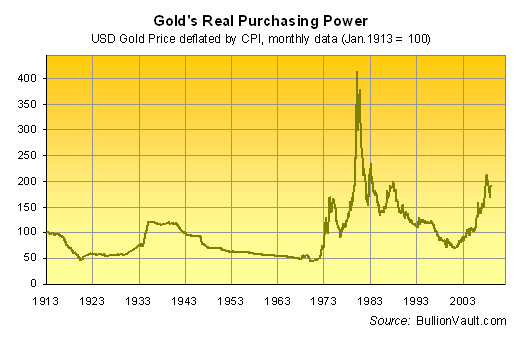
This chart shows the value of Gold Bullion – measured in terms of purchasing power, as dictated by the official US consumer price index – since the data series begins, back in 1913. (Hat-tip to Fred at the St.Louis Fed; the current CPI calculations and headline rate might bear little resemblance to personal experience of retail inflation, but for long-run data where else can we go?)

Starting at 100, our little index of gold’s real long-term value has then averaged 97.8 over the following 96 years…pretty much right where it began. As you can see, however, that long-term stability includes wild swings and spikes. And whether gold is tied to official government currency (as it was pre-1971) or allowed to float freely on the world’s bullion market, volatility looks the only sure thing.

The starting-point, 1913, just happens to be when the Federal Reserve was first founded. It was given the easy-as-pie challenge of furnishing the United States with an “elastic currency”.

Okay, so it ain’t quite made of rubber just yet. But the Dollar’s own value in gold – by which it used to be backed, pre-1971 – just keeps brickling and bouncing around like it’s being used to play squash.

What the chart above offers, however, is a picture of gold’s real long-run value outside of Dollar-price fluctuations.

“With the right confluence of economic and geopolitical developments we should see gold break through $1,500 and then $2,000 and then possibly still higher round numbers in the next few years,” said Jeffrey Nichols, M.D. of American Precious Metals Advisors, at the 3rd Annual China Gold & Precious Metals Summit in Shanghai last month – “particularly if we get the type of buying frenzy or mania that often occurs late in the price cycles of financial and commodity markets.”

“This is hardly an audacious forecast when looked at relative to the upward march in consumer prices over the past 28 years. After all, the previous high of $875 an ounce in January 1980, when adjusted for inflation since then, is today equivalent to more than $2,200.”

Audacious or not, as Nichols points out, the thing to watch for would be a “buying frenzy” – a true “mania” amongst people now Ready to Buy Gold that sent not only its price but also its purchasing power shooting very much higher.

Because for gold to reach $2,200 an ounce in today’s money (if not $2,615…) would mean something truly remarkable in terms of its real long-run value.

  • Inflation-adjusted, that peak gold price of 21 Jan. 1980 saw the metal worth more than 5 times its purchasing power of 1913;
  • In March 2008, just as Bear Stearns collapsed and gold touched a new all-time peak of $1,032 in the spot market, the metal stood at its best level – in terms of US consumer purchasing power – since December 1982;
  • Touching $2,200 an ounce (without sharply higher inflation undermining that peak), gold would be worth almost 6 times as much as it was before the Federal Reserve was established in real terms of domestic US purchasing power.

“I own some gold,” said Jim Rogers, for instance, in an interview recently, “and if gold goes down I’ll buy some more…and if gold goes up I’ll buy some more.

“Gold during the course of the bull market, which has several more years to go, will go much higher.”

But “much higher” in nominal Dollar terms is not the same as “much higher” in terms of real purchasing power, however. More to the point, that previous peak of $850 an ounce – as recorded at the London PM Gold Fix on 21 Jan. 1980 – lasted hardly two hours.

Defending yourself with gold is one thing, in short. Assuming gold is the perfect inflation hedge is quite another. And taking peak profits in gold – as with any investable asset – is surely impossible for everyone but the single seller to mark that very top price.

That doesn’t diminish gold’s real long-term value to private investors however, as we’ll see in Part II – to follow.

Catch the New Bull! – Buy Gold Online – Safely, quickly, and at low prices, guaranteed! Bullion Vault.com

==============================

Is Gold Really Pausing? – MarketWatch

By: Peter Brimelow of MarketWatch.com

 Will Mark Hulbert’s recent column, pointing out that the Hulbert Gold Newsletter Sentiment Index (HGNSI) was over-extended, signal an important top? Or just a ripple? See Hulbert’s Jan. 27 column.

Either way, there will be a group of angry readers. Of the 220 comments about the column, as I write, the furious bulls outnumber the fanatical bears about 3 to 1.
But both sides are pretty riled up. This is only money, people!
Early Monday in New York, gold cleared $915. But Wednesday evening, it was down $30-plus from its high. And the US$ 5×3 point and figure chart kindly supplied by Australia’s The Privateer service has turned down. See chart.
There is a possibility that the action around the weekend was a false breakout.
If it turns out to be a bull trap, GoldMoney’s James Turk will turn out to have been wise in his latest Freemarket Gold & Money Report. Turk accepts the radical thesis that the price of gold is manipulated by an alliance of private and public sector actors.
He writes: “Gold must still contend with the gold cartel and its ongoing efforts to cap the gold price. It may try to ‘circle the wagons’ above $900, which would seem a logical point for them to make another stand now that $850 has been exceeded. If the gold cartel is successful in stopping gold for any length of time, new longs may get discouraged by the lack of progress and take profits. That selling, along with new shorts by the gold cartel, could begin a cycle of selling that gains momentum and drives gold back to its last level of support, which is $850.” See GoldMoney Web site.
Will gold stumble? In favor of the bears, oddly enough, is the section of Bill Murphy’s radical goldbug LeMetropoleCafe Web site that follows India. The Indians are definitely out of the world gold market, it appears. On downswings, their support is usually crucial. See LeMetropoleCafe Web site.
But the radical gold bugs think strange things are happening. Murphy’s site noted Tuesday that the extraordinary premiums being paid in the West for gold items did not go away on this month’s rise. And the Comex gyrations, closely examined, continue to suggest the presence of large, determined buyers.
For perspective on Mark Hulbert’s HGNSI, look at MarketVane’s Bullish Consensus for gold. This surveys futures traders. It peaked at 74% on Monday, and came in tonight at 72%.
Sometimes gold peaks do occur with this reading in the 70s. That happened at the turn of the year, and again last September.
But the normal behavior, especially before a big sell-off, is for the upper 80s at least to be reached. Last February/March, as gold attempted $1,000, the Bullish Consensus spent no less than four weeks in the 90s. See MarketVane Web site.
So the radical gold bugs conclude that gold may pause. But it’s not seen a major blow-off yet. End of Story
===============================
Catch the New Bull! – Buy Gold Online – Safely, quickly, and at low prices, guaranteed! Bullion Vault.com

===============================

Gold headed south for the short term?- MarketWatch

By: Mark Hulbert of MarketWatch.com

ANNANDALE, Va. (MarketWatch) — Gold certainly deserved a rest Wednesday.
After all, it had mounted an impressive rally over the previous two weeks, gaining some $100 per ounce. So we can definitely excuse gold bullion  for forfeiting $9 in Wednesday trading.
The more crucial question, however, is whether the decline was merely the pause that refreshes, or the beginning of a more serious drop.
Unfortunately for those hoping gold’s recent rally to continue, the conclusion of contrarian analysis is that the metal’s short-term trend is more likely to be down.
Consider the latest readings of the Hulbert Gold Newsletter Sentiment Index (HGNSI), which reflects the average recommended gold-market exposure among a subset of short-term gold-timing newsletters tracked by the Hulbert Financial Digest. As of Tuesday night, the HGNSI stood at 60.9%.
This is identical to where the HGNSI stood at the end of December, when I last devoted a column to gold sentiment. ( Read my Dec. 29 column.)
Over the two weeks following that column, of course, bullion dropped by around $70 an ounce.
Contrarian concern about gold’s short-term trend isn’t just based on this one data point, however. I have more than 25 years of daily data for the HGNSI, and rigorous econometric tests show that the inverse correlation between HGNSI levels and the gold market’s subsequent short-term direction is statistically significant at the 95% confidence level.
This is why the HGNSI’s current level is so ominous.
To put it in context, consider that this sentiment gauge’s average reading over the last five years has been 32.6%, only slightly more than half where it stands now. Over the last five years, furthermore, the HGNSI has been higher than where it is now just 13% of the time.
This does not mean gold can’t go higher from here. But it does suggest that the odds are against it doing so.
Lest I incur undeserved gold-bug wrath by writing that, let me hasten to add that this bearish conclusion applies to just the next several weeks. Sentiment affects the short-term trend of the market, not the long term.
So my conclusion is entirely consistent with gold being in a major, long-term bull market.
But even if it is, the implication of my contrarian analysis is that gold is not ready, at this very moment, to commence on that march upward. End of Story
Mark Hulbert is the founder of Hulbert Financial Digest in Annandale, Va. He has been tracking the advice of more than 160 financial newsletters since 1980.
=============================
My Note- While feeling that Gold price make take a breather here consolidate and maybe even drop a little, both Mark Hulbert and Peter Brimlow agree; Gold is in a long term Bull Market! Any dips in price should be taken as an opportunity to buy more gold!…

Catch the New Bull! – Buy Gold Online – Safely, quickly, and at low prices, guaranteed! Bullion Vault.com

That’s all for now, hit the subscribe button to keep up with all the latest Gold, Market News and more…Enjoy! – jschulmansr
Nothing in today’s post should be considered as an offer to buy or sell any securities or other investments, it is presented for informational purposes only. As a good investor, consult your Investment Advisor, Do Your Due Diligence, Read All Prospectus/s and related information carefully before you make any investments. –  jschulmansr

Share this:

  • Click to share on Reddit (Opens in new window) Reddit
  • Click to share on Facebook (Opens in new window) Facebook
  • Click to share on LinkedIn (Opens in new window) LinkedIn
  • More
  • Click to share on X (Opens in new window) X
  • Click to share on Pinterest (Opens in new window) Pinterest
  • Click to share on Tumblr (Opens in new window) Tumblr
  • Click to print (Opens in new window) Print
  • Click to email a link to a friend (Opens in new window) Email
Like Loading...

Is this the Move? Gold is Breaking Out!

26 Monday Jan 2009

Posted by jschulmansr in agricultural commodities, banking crisis, banks, bear market, bible, Bollinger Bands, bull market, capitalism, central banks, China, Comex, commodities, Copper, Currencies, currency, Currency and Currencies, deflation, Dennis Gartman, depression, dollar denominated, dollar denominated investments, economic, Economic Recovery, economic trends, economy, Federal Deficit, Finance, financial, Forex, Fundamental Analysis, futures, futures markets, gold, gold miners, hard assets, How To Invest, How To Make Money, id theft, India, inflation, Investing, investments, Latest News, Make Money Investing, market crash, Markets, mining companies, mining stocks, natural gas, oil, palladium, physical gold, platinum, platinum miners, precious, precious metals, price, price manipulation, prices, producers, production, silver, silver miners, small caps, spot, spot price, stagflation, Stimilus, Stimulus, Stocks, TARP, Technical Analysis, timber, Today, U.S. Dollar, Uncategorized, uranium, volatility

≈ Comments Off on Is this the Move? Gold is Breaking Out!

Tags

agricultural commodities, alternate energy, Austrian school, Bailout News, banking crisis, banks, bear market, Bollinger Bands, bull market, capitalism, central banks, China, Comex, commodities, communism, Copper, Currencies, currency, deflation, Dennis Gartman, depression, diamonds, dollar denominated, dollar denominated investments, economic, economic trends, economy, Federal Deficit, financial, Forex, futures, futures markets, gold, gold miners, hard assets, heating oil, India, inflation, investments, Keith Fitz-Gerald, Marc Faber, market crash, Markets, mining companies, Moving Averages, natural gas, oil, palladium, Peter Schiff, physical gold, platinum, platinum miners, precious metals, price, price manipulation, prices, producers, production, protection, rare earth metals, recession, risk, run on banks, safety, Saudi Arabia, Sean Rakhimov, silver, silver miners, socialism, sovereign, spot, spot price, stagflation, Technical Analysis, timber, U.S. Dollar, volatility, warrants, Water

As I write Gold currently is up another $9.30 oz today! Even more importantly it is well above the psychologically important price level of $900 oz. A new high will confirm the breakout and BANG! we’re off to the races. Todays past has some good articles detailing why could could be breaking out here. Enjoy and Good Investing!- jschulmansr

============================================

Here is a safe way for even a small investor to get in on the Gold Rush! You can buy quantities as little as 1 gram to 1000’s of oz. I personally use Bullion Vault for my physical metal purchases.

Catch the New Bull! – Buy Gold Online – Safely, quickly, and at low prices, guaranteed! Bullion Vault.com

============================================

Could There Be a Real Breakout In Gold?— Seeking Alpha

By: Trader Mark of Fund My Mutual Fund

After a series of head fakes much of the past half year, the most watched move in the market might finally be “real” this time. With all the world’s printing presses going on overdrive, and currencies being mocked – gold “should” have been rocketing. Many theories persist on why it hasn’t, but really it does not matter. The price action is all that matters and this type of movement will get the technicians very interested.

Things to like
1) a series of higher lows
2) the trendline of lower highs has been penetrated

Things to see for confirmation
1) any pullback is bought
2) price prints over October 2008’s highs, signaling the end of “lower highs”

When last we looked about 6 weeks ago [Dec 11: Dollar v Gold – Can we Trust this Change?] , it was just another headfake – this formation on the chart does look more promising.

These are 2 names; one in gold and one in silver we’ve had our eyes on.

Or just play it simple and go double long gold


==================================================

Happy Days For Gold? —Seeking Alpha

By: Jeff Pierce of Zen Trader

Gold was in the spotlight on Friday in a big way, nearly moving $39. Is this a hat tip to the big move that many goldbugs have been anticipating? Is all the money printing that the Federal Reserve finally catching up with the US Dollar? Should you have bought gold on Friday because it’s a straight line up from here? Let me preface my answers by saying that I’m a short term trader that will sometimes allow a trade to turn into a longer term trade but that doesn’t happen very often. I’m currently flat precious metals but will be looking for a good risk/reward, but for anybody reading this know that this analysis is from a momentum based perspective.

So the answers to the previous questions I believe are yes, yes, and no.

gld

I’m a big fan of gold for a number of reasons (fundamental, technical, historical) but I know from experience that it trades much different from a momentum point of view. It tends to sell off once it goes outside it’s upper bollinger band as seen by the arrows above. Just when it looks like gold is going to bust out and move to blue skies it seems to run out of buyers and reverses. As you can see GLD and many individual gold miners moved outside this indicator on Friday and I expect a small pullback before it begins a new wave up.

Judging by the negative divergence on the RSI you can easily see that momentum is waning. As the stock has been making higher highs, the RSI has not been confirming the move. We could possibly move up to the 92 level before profit taking hits, but I just don’t see a good entry at this point if you’re not already invested in these stocks. It would be more prudent to wait for a slight low volume pullback before entering. The only problem with this way of thinking is there could possibly be many with this outlook and that could actually propel gold to higher levels, but I’m willing to risk that because if it does move up even more, then that will confirm the strength and I’ll buy even more on the eventual dip.

If you are long from lower levels I would consider taking some profits off the table now to prevent yourself from giving up any of your gains.

“I made all my money selling to soon.” ~ JP Morgan

slv

I like silver’s chart a tad better from a technical aspect as the base that it’s been building since last September seems a little more stable. The RSI trendline has been steadily moving higher as the price has been trending higher which is very bullish. I think we’re a tad overbought here and will be looking to get long stocks such as PAAS, SLW, and SSRI when we pullback or move sideways for a week or two.

=================================================

Now- Some Commentary by Dennis Gartman

Dennis Gartman on Gold, Oil, Government and the Economy- Seeking Alpha

Source: The Gold Report

With a real roller-coaster year behind us, how would you characterize your macro overview of major economic trends for 2009?

Dennis Gartman: It’s abundantly clear that we have been in recession; we’re in a recession; and we’re likely to remain in a recession through the greatest portion of 2009. The monetary authorities around the world have done all the things they’re supposed to do, which is during a period of economic weakness throw liquidity in the system as abundantly, as swiftly, as manifestly as possible and expect the liquidity eventually to wend its way through the economy and strengthen economic circumstances. That may be sometime late in 2009. In the meantime, we’ll see continued bad economic data and continued increases in unemployment. It’s going to seem like things are really, really, really bad.

But let’s remember that things are always their worst at the bottom. By definition, recessions begin at the peak of economic activity when all economic data looks its best. So while things will start to look very bad through the rest of 2009, I bet that by late this year and early 2010 we will start to see economic strength coming at us because of the liquidity injections going on everywhere.

TGR: What will be the first signs that we’ve reached the bottom in terms of the recession and are starting to turn around?

DG: The signs of a turnaround will be that everybody believes that there are no signs of a turnaround. We’ll see Newsweek writing a series of cover stories talking about the end of Western civilization. The Financial Times of London headlines will read, “The Recession Seems Endless” and “Depression Is Upon Us.” Every day’s Wall Street Journal articles will be just manifestly bleak in nature. That’s what the signs will be.

And then all of a sudden, things shall begin to turn around. But the signs are always their worst at the bottom. That’s how things function.

TGR: So the popular press is in essence on a delay mode.

DG: Oh, it always is.

TGR: By three months, by six months, by a year?

DG: It’s probably a little less slow to react than it used to be, but let’s say three months.

TGR: So you like the fact that the monetary authorities have put liquidity into the system?

DG: Absolutely.

TGR: And it sounds as if you think it just takes time to work through the system.

DG: Always has; always will. That’s how these things go about. You have recessions because you had an economic advance where, in Greenspan’s terms, “irrational exuberance took over.” You have to dash that irrational exuberance and make it into irrational depression. Irrational, manifestly bleak, black philosophies have to make their way to the public. That’s just how these things happen; it’s happened time and time again.

The recession that I recall the most clearly is that of ’72-’74. We have to remember that unemployment was high up in double digits. We saw plenty of articles in the press about the new depression. If you go back and read articles from July through September of 1974, you will be convinced that we will never have an economic rebound in our lives again. Well, clearly, that’s just not the case.

TGR: What about the bearish people who say we’ve never seen worldwide conditions like this and that we’re in the “new era”?

DG: We probably haven’t seen the world going into recession at one time such as we are now. But I think that’s simply indicative of the fact that today’s communications are so much better. People in the United States or Canada or Europe really never would have known much about a recession in India 20 years ago, because the news media would not have covered it. Nothing told you about economic circumstances abroad. Now, with the Internet, information comes at you absolutely one-on-one.

All correlations have gone to one in this present environment. When stocks go down in the United States, they go down in India. When they go down in India, they go down in Vietnam. When they go down in Vietnam, they go down in Australia. That wasn’t the case 20 years ago; you didn’t have the small world united through communications that we have now. And now the correlations of emerging markets and large markets have all come together.

TGR: If that’s true, and worldwide financial markets are all tied together, could any given country “emerge” as a growth country while the rest remain in recession?

DG: Oh, it’s possible, but I don’t think we’ll call them “emerging markets” anymore. You’ll just find that one country pursued better economic policies, probably by cutting taxes or increasing government spending or doing away with some onerous legal circumstance that might have previously inhibited economic activity. The Chinese are doing any number of good things at this point, and that country may just have been more enlightened and it may come out of the recession faster than the others do. But now they won’t do it on their own, and anybody who does do it will be watched and understood much more swiftly than in the past. For example, did you ever know what was going on in Iceland 10 years ago? Of course not; but now you do.

TGR: Right. The only emerging markets we heard about were China and India. No one ever discussed South America.

DG: And now they’ve emerged. But now we understand. We hear news from Venezuela every day. Now we hear news from Sri Lanka every day if we want it; we can get it very easily. We couldn’t do that 10 years ago; 20 years ago clearly we couldn’t. That’s been the big change. Information travels so much more rapidly. That’s why all the correlations have gone to one. We are now one large economic machine that maybe one of the component parts does a little bit better, but it won’t shock anybody, and there won’t be anything “emerging.”

TGR: Back to the bear people. You referenced the ’72-’74 economy, but this time, many are pointing to the debt situation that the U.S. and probably a bunch of the world economies are in and the fact that we’re committing to billions—and in the U.S., trillions—of dollars more. Won’t that influx of new money have some kind of significant bear impact going forward?

DG: No, it will have a bullish impact. Unless all the rules of economics have been rescinded, money pushed into a system will push economic activity higher.

TGR: But it will also push inflation higher.

DG: Oh, that’s very likely to happen. The question is whether it will be inflation of 1%, 2%, 5%, or will it be a Zimbabwean-like inflation? The latter isn’t going to happen, and 1% isn’t likely going to happen. But 2% to 5% inflation? Yes, that’s likely to happen several years down the line.

TGR: Gold bugs are saying, “Buy gold now.” What would be your advice under these circumstances?

DG: I happen to be modestly bullish on the gold market, but not because of inflationary concerns. It’s more that I think gold has quietly moved up the ladder of reservable assets, a reservable asset being one that central banks are willing to keep on their balance sheets, all things being equal. Dollars are still the world’s dominant reservable asset. The Euro is next and gold is probably the third.

The Fed has thrown off a lot of other assets and taken on securities, debt instruments, mortgages and the like, but I think they’re doing exactly the right thing. Some central banks with a lot of U.S. government securities on the balance sheet may decide that going forward, they may buy more gold rather than more U.S. government securities if they’re running an imbalance of trade surplus. For instance, if I’m the Bank of China and I hold a minuscule sum of gold, maybe I should own a slightly larger minuscule sum.

TGR: That’s really diversifying your monetary assets.

DG: I think that’s all that will drive the gold prices quietly higher. I am not a gold bug; I don’t think the world’s coming to an end. I think the history of man is to progress. And yes, we have relatively large amounts of debt, but you can go back to the recession of 1974; you can go back to 1980-81; you can go back to the recession of 1907, and you will see the same arguments—that the world is too debt-laden. And the same arguments, the same language, the same verbiage was always written in exactly the same circumstances. Guess what? We moved on. This time might be different, but I’ll bet that it won’t be.

TGR: What would your recommendation for investors to do in gold? If they want to do any type of holding assets in monetary value, should they be looking at holding physical gold or buying ETFs or buying into the equity?

DG: For the past several years, I’ve told people that if they’re going to make the implied bet on gold, bet on gold. The gold bugs tell you that you have to own bullion. I say, no, you should really own the GLD, the ETF. It trades tick-for-tick with gold. If some truly untoward chaotic circumstance ran through the world’s banking system I guess maybe GLD and bullion would diverge at some point, but we’d have other problems long before that would occur. So if you’re going to make the implied bet on gold, bet on gold. Do the GLD.

TGR: But not physical gold?

DG: I do own some physical gold. But do I own a lot of it? No. And quite honestly, I hope I lose money on the physical gold I have. It’s an insurance policy. Nothing more than that.

TGR:: Are you looking at physical gold as the insurance policy or any investment in gold as an insurance policy?

DG: There’s the old saying, “Those aren’t eatin’ sardines; them is trading sardines.” Some gold I consider to be tradable, and that’s ETF-type stuff, and I have a small amount in the lockbox in the form of gold coins. That’s my insurance policy.

TGR: That would be what the typical investment broker might advise, 5% to 10% in gold.

DG: That’s it. Exactly, that’s it. Don’t get overwhelmed by it.

TGR: How about mining stocks?

DG: If you’re going to bet on gold, there’s nothing worse than being bullish on gold and owning some mine—especially in some junior fly-by-night—and walking in one morning and finding out that the mine you thought you had got flooded or all of your workers were unionized and walked off or management was somewhat derelict. You may have been right on the direction of gold, but your stock went down. So I’ve told people to stay away from the juniors; that’s a terrible bet on gold. If you’re going to bet on gold, bet on gold.

Maybe you’ll want to start punting on Barrick Gold Corporation (NYSE: ABX) or Newmont Mining Corp. (NYSE: NEM) or the real large names, rather than the juniors. There’s just too much risk in the juniors. Yes, everybody says, “I bought this junior at a nickel and now it’s at 15 cents.” Well, jolly for you, but you probably bought 15 others at a nickel, and they’re all bankrupt. If you’re going to bet on gold, bet on gold.

TGR: So you’re saying with that advice that if you want to bet on gold equity, bet on blue-chip gold equity stocks that have just been hammered down through the market.

DG: That’s correct, Agnico-Eagle Mines (TSX: AEM), ASA Ltd. (NYSE: ASA), the Newmonts, the Barricks, that sort of thing.

TGR: If we take that logic and look across the broad array of sectors, would you also recommend looking at other blue chips that have just been battered? Or do you think that some sectors will recover faster than others? Such as the financial sector, the energy sector, the housing sector, the precious metals sector?

DG: I’m really quite bullish on infrastructure—the movers and the makers of the things that if you drop them on your foot, it will hurt. I think I want to own steel and copper and railroads and tractors because I think we’re going to be building roads and bridges. That’s probably one of the things that probably will bring us out of the economic morass. Along those lines, I wouldn’t mind owning a little bit of gold at the same time.

TGR: Unlike gold that you can buy and own, if you look at steel and copper, are there specific companies and equities that are appealing to you?

DG: Again, as in gold, if I am going to buy gold equities, I’m going to buy the biggest names. If I’m going to buy steel, I’m going to buy the biggest names. U.S. Steel comes to mind. That’s the easiest; that’s the best; that’s where liquidity lives. It has been bashed down from the highs made last July; it’s down—what?—75% from its high. Recently it stopped going down and is in fact starting to go up now on bad news. So if you’re going to buy steel, buy the most obvious ones—U.S. Steel or buy Newcorp.

TGR: You talked about the energy market being weak in one of your recent newsletters. Do you see this weakness continuing or do you see a turnaround happening in ’09?

DG: The one thing that we can rest assured in the rest of the world is that OPEC chiefs cheat on each other—they always have and they always will. So when OPEC says that it’s cut production, that’s a lovely thing. No, they haven’t, and they don’t. Because the problem OPEC has is they’ve all raised their standards of living and the expectations of their people, and they all have cash flow requirements. You have to sell three times as much $50 crude oils as you sold $150 crude oil to meet the demands of your populace that you have increased. So the lovely thing from a North American perspective is that Chavez finds himself in a very uncomfortable position and needs to produce a lot more crude oil to keep his public happy. It’s rather comical, isn’t it, that Chavez was giving crude oil away to the Kennedy family to be distributed to people in the Northeastern United States until two weeks ago when he had to stop. He had to stop because he needs the crude oil on his own to sell, not to give away, to meet cash flow demands.

Iran is in exactly the same position. Isn’t it lovely to see that Putin, who was really feeling his military oats six months ago with $150 oil, has to pick fights with Ukraine and smaller countries now with crude at $45 a barrel? Where is crude going to go? I wouldn’t be surprised if we make new lows.

TGR: Will there be new lows for ’09? Are you buying into this whole peak oil argument that production eventually will be unable to meet demand?

DG: Do I believe that we’re going to run out of crude oil in the next 100 years? Not on your life. Sometime in the next 10,000 years we probably will run out of crude oil. In that instance, I am a peak oil believer. It’s not going to happen soon though. I remember they told me when I was in undergraduate school back in the late ’60s that we would be out of crude oil by 1984.

TGR: Do you mean out of oil? Or at a point where demand exceeds production?

DG: We would be out! Gone, done! There would be no more. Isn’t it interesting? We’ve pumped crude oil for 28 more years. This is an interesting statistic: We have either seven or eight times more proven reserves now than we had in 1969. And I think we have used a bit of crude oil between now and 1969.

TGR: Just a wee bit.

DG: A wee bit, and yet we have seven or eight times more proven reserves. Every year we have more proven reserves. So, yes, I’m a peak oil believer. Sometime in the next 10,000 years we will run out of crude.

TGR: With Obama now in office and talking about getting off our reliance on foreign oil, what’s your view of the future on all the alternative energies that are being so pushed by many people in the U.S. government?

DG: I think it’s wonderful job-creation programs, none of which will prove to be of much merit at all. All of the Birkenstock-wearing greens will feel very good about having their rooftops covered by solar panels, but is that going to resolve any energy problems we have? No. No. Nuclear power will do that. Maybe using the oceans will do that, but wind power, probably not. Solar power, probably not. It makes everybody feel good, but are we going to power our cars in the next 40 years with solar power? I doubt it. Do I expect some sort of material technological breakthrough in the next 100 years that will change what we use as energy? Oh, absolutely. Do I have any idea what it will be? Of course not.

TGR: If the price of oil if it remains low, is there a role for nuclear in the next 50 years?

DG: Oh, absolutely.

TGR: What will drive that?

DG: It’s absurd that we don’t use nuclear energy. Even the French derive 80% of their electricity from nuclear energy, cleanly, efficiently, without any problems whatsoever. Why we don’t do the same in the United States other than the left and the eco-radicals keeping us from doing it is really quite beyond me.

TGR: So, given that we still have eco-radicals and a big push toward alternative energies, do you see anything happening in the U.S. in nuclear in the near future?

DG: Yes, actually. It’s interesting. There are a lot of new nuclear facilities on the drawing boards, and they’re probably going to be approved. If there’s going to be one surprise by the Obama Administration, it will be that you don’t get nuclear energy advances under a right-wing government; you always get them under a left-wing government. Obama will be smart enough to understand that that’s the only way—that’s the best and cleanest methodology to use. And the left won’t argue with a fellow leftist pushing for nuclear energy. Only Nixon could go to China; only Obama can push nuclear energy.

TGR: And you think that he will?

DG: Oh, yeah, he’s smart enough to understand that.

TGR: Going back to your investment strategy, which big blue chip players in oil and nuclear would you point out as good investments?

DG: In oil, I’d want to take a look at companies such as ConocoPhillips (NYSE: COP), which dropped 70% from its highs. How can you go wrong with the Conocos and the Marathons and the large oil companies whose price-to-earnings multiples are down to at single digits and their dividend streams are 5%, 6%, and 7%? Why would you not want to own those? That’s the best investment.

And at the same time, the volatility indices on the stock market are so high that, gee, you can buy Conoco, get the dividend, and sell out of the money calls at very high premiums and ramp your dividend yield up. It’s like a gift; it’s like manna.

TGR: Well, what about in terms of the nuclear sector and uranium?

DG: I really don’t understand uranium. I don’t know where to go, and I don’t how to buy it yet. So I’ll just say there’s a future for it, but I don’t know what to do with it.

TGR: What other sectors should be looking at for 2009?

DG: Banks, banks.

TGR: They’re making a comeback. Do you think there will be more consolidations?

DG: There will be more consolidations; there has to be. But look at the yield curve—what a year to be a bank! The overnight Fed funds rate, the rate banks are going to pay depositors for their demand deposits or checking accounts is zero. And you’re going to be able to lend that out to hungry borrowers at 7%, 8%, 9%, 10% and 12%. The next three years will be the greatest three years banks have ever seen. Banks will just make money hand over bloody fist in the next three years.

TGR: Are you talking about the big boys?

DG: No, I’m talking about the regionals. The big boys have problems in toxic assets. I am not even sure there is a Peoples Bank & Trust in Rocky Mount, North Carolina, but a bank like that—or the First National Bank of Keokuk, Iowa or the First National, or the Peoples Bank & Trust of Park City, Utah—those are the banks that are going to make lots of money.

TGR: Do you see an explosion in regional banks? Will move of them come into the marketplace?

DG: I think we’ve probably got all we need. It’s just that they’re very cheap.

TGR: What will the role of the international banks be?

DG: Mopping up the disasters that they’ve created for themselves for the past decade, trying to survive, being envious of the decent regional banks that are going to be earning enormous yields on this positively sloped yield curve and wishing they were they.

TGR: Do you see a role long term for international banks?

DG: Oh, sure, of course. How could there not be? It’s a smaller world; it’s an international world; it’s a global world. International banks will be back in full force a decade from now. They’ve got some wound-licking to do, and they’ll do it.

TGR: In addition to regional banks as being a great play to look at for ’09, ’10, any other interesting plays to bring up?

DG: You want to own food and grains again.

TGR: Are you talking about grains or food producers like Nabisco?

DG: No, I think you want to own grains. If you’re going to make a speculation, I think you want to own on the grain markets again.

TGR: Grain for human consumption or grain for livestock consumption?

DG: Yes and yes.

TGR: Are you looking at buying that on the commodities market?

DG: You can actually buy that on ETFs now. The wonderful world of ETFs is just extraordinary. You can actually buy a grain ETF now. DBA (DB Agriculture Fund) is one; JJG (iPath Grains) is another. Those are basically long positions in the grain market. Wonderful things to use.

TGR: You like ETFs; but the naysayers will say that ETFs could be encumbered and there’s actually no guarantee that they hold any assets.

DG: That’s true; that’s correct.

TGR: But you’re comfortable that people should go into an ETF for grains?

DG: I didn’t say that. What I said is if you wish to trade in grain, there are ETFs that will do that. Do I know for sure that they will all perform perfectly and that if the world were to come to a chaotic banking circumstance that there wouldn’t be problems? I don’t know that. Does that bother me? No. It doesn’t bother me even slightly.

Should you worry about [not trading] an ETF just because there might be some problem under an untoward economic environment? No, it’s illogical. And shame on those people who say those sorts of things or who tell you not to use them because they ETF may not function properly if there is some total breakdown in the banking system. Well, if that happens, we have other problems.

TGR: And what’s your projection for the overall investment market? We’ve been hearing speculation that it will rise through April, bottom out even deeper than it is today, and then a slow climb in 2010.

DG: Gee, I have no idea. I just think that stock prices will be higher six months from now than they are now, much higher 12 months than they will be six months from now, and higher still in 24 months than they will be 12 months from now. But where will they be in April? Golly, I don’t know. I think the worst is far behind us and better circumstances lie ahead. And that’s the first time in a loooonnnng while that I’ve said that.

TGR: Yeah, now if the media will just catch up with you, we can enjoy watching it again.

DG: It won’t. Watch the news; it will just get bleaker and bleaker as the year goes on. And watch the unemployment rate; it’s going to be a lot higher.

TGR: Other than Barack Obama saying we’re going to start building infrastructure, do you anticipate any dramatic changes in the U.S.? Right now we’re a services country, and we need to move back to being a manufacturing country.

DG: We’ll never move back to being a manufacturing country. Won’t happen. Here’s an interesting bit of data. Do you know what year that we had the absolute high number—not just as a percentage of population—but the absolute high number of manufacturing jobs was in the United States?

TGR: Somewhere around the World War II era.

DG: Very good, 1943. We have lost manufacturing jobs since 1943. I think that’s a fairly well-established trend.

TGR: Is there a future for the services sector, though? That’s the key.

DG: It will be larger. And so what? It’s like saying we need more farmers. No. We need fewer farmers. We have one-hundredth as many farmers as we had at the turn of the 20th century. We now 500 times more grain? Seems to me every time we lose a small farmer, we get better. So, we need fewer farmers. And we need fewer manufacturing jobs.

TGR: But doesn’t that put the onus on the United States as the economic world leader? Considering the fact that, as you mentioned, information now is instantly available everywhere, just in terms of worldwide confidence; it seems like every time we hiccup, the planet hears it?

DG: There is probably some truth to that fact. But it is probably not us that will lead; it’s probably Australia or New Zealand or the Baltic States or some smaller country that actually changes policies and frees up markets and cuts taxes, and all of a sudden their economy starts to turn around. Then people elsewhere will say, “Oh, look! That’s the right thing to do. Let’s us go do that.”

TGR: Really? Economic recovery worldwide will not come from the United States?

DG: Well, if we don’t recover, the rest of the world won’t, but we won’t be the first. What I am saying is that some smaller country will do the right things faster than we do.

TGR: Isn’t what Australia does irrelevant to what the U.S. needs to do?

DG: No, it’s dramatically relevant. If Australia starts to do things properly—if Australia were to suddenly come out and slash taxes and go to a flat tax and cut paperwork by 50% and it’s economy starts to turn higher, wouldn’t that be a good incentive for us to do the same thing?

TGR: But that implies that every country should use the same economic strategy; that we’re all basically at the same state in our economic development. That what will work for Zimbabwe or China will work for the U.S.

DG: I think anywhere in the world that you have smaller government, lesser taxes—every time you do that, that economy, no matter where it is, does better. It does better. And anywhere you put higher taxes and more government, that economy usually does worse. It does; it just does.

TGR: You’re looking at it from a macro point of view.

DG: I’m looking at it just from an economic point of view, whether macro or micro. Look at Ireland, for example. Why was Ireland for many years the “Celtic Tiger” of Europe? Their tax regime was lower than the rest of Continental Europe. The Germans and the French, who are statists, who are collectivists, instead of emulating the Irish, kept trying to drag Ireland down to their level. Now, that was stupid, wasn’t it? That didn’t work.

My favorite example is New Zealand back in the 1980s. Every year from the 1970s through the 1980s, New Zealand ran a budget deficit and a trade deficit. Every year the IMF said, “You must raise your taxes and cut the value of your currency to try to balance your budget and run a trade surplus.” So New Zealand would do that, and every year the deficit got worse and their trade imbalance grew larger. They did this for five or six years and it got worse every time they did it—every time they followed the IMF tactic of raising taxes and cutting the value of the currency.

Finally New Zealand Treasury Secretary Graham Scott (Secretary from 1986–93) told the IMF, “Don’t ever come back here. Everything you’ve told us to do has proven to be utterly worthless. We’re going the other way. We’re slashing taxes.” From I think a 75% marginal tax rate, over the course of five years, they cut it to like 18%. And every year they took in more money—more money—every time they cut taxes they took in more money. And when they strengthened their currency, their exports picked up; as their currency got stronger, they exported more stuff. Isn’t it fascinating?

TGR: That’s the paradox.

DG: It got to be so interesting—it wasn’t Gordon Campbell—I’m trying to remember; I just went blank for his name. But he passed the baton on to a woman by the name of Ruth Richardson, who was a little more leftwing than her predecessor—the tax rate was down to a flat 18%. They asked her if she was going to cut it again, and she said, “You know, I don’t think I can cut it any more; I can’t spend the revenue I am taking in now.” It’s a classic line. So, what does she do? They actually started raising the tax rates again, and what happened? Tax revenues fell.

But New Zealand had taught a lot of people that cutting taxes and strengthening your currency is the best thing you can do. And as they were cutting taxes, they kept cutting prohibitions and regulations; they kept chopping them back. They were the real precursors of the Free Market Movement that developed in the early ’90s and the early ’00s.

TGR: Let’s hope the United States learns from that. Obama announced his tax cuts; we’ll see what comes of that.

DG: He said entitlements are even on the table. Can you imagine a Republican ever making that statement? They would boo him. But here’s a leftist who puts it on the table. He can say that.

Irreverent, outspoken, entertaining, sardonic and—in his own words, a “glib S-O-B,” Dennis Gartman has been producing The Gartman Letter for more than 20 years. His daily commentary on global capital markets as well as short- and long-term perspectives on political, economic and technical circumstances goes to leading banks, brokerage firms, hedge funds, mutual funds, energy companies and grain traders around the world.

A 1972 graduate of the University of Akron (Ohio), he undertook graduate studies at North Carolina State University in Raleigh (where he remains involved as a member of the Investment Committee.

Before devoting himself full-time to The Gartman Letter, Dennis analyzed cotton supply and demand in the U.S. textile industry as an economist for Cotton, Inc.; traded foreign exchange and money market instruments at North Carolina National Bank, went to Chicago to serve as A.G. Becker & Company’s Chief Financial Futures Analyst and then become an independent member of the Chicago Board of Trade, dealing in treasury bonds and notes and GNMA futures contracts; and moved to Virginia to run Virginia National Bank’s futures brokerage operation.

In addition to publishing The Gartman Letter, Dennis delivers speeches to audiences around the world (including central banks, finance ministries, and trade groups), teaches classes on derivatives for the Federal Reserve Bank’s School for Bank Examiners, and makes frequent guest appearances on CNBC, ROB-TV and Bloomberg television.

==============================================

Finally for the Technical Analysis Junkies (like me!) here is an awesome article!

===============================================

Market Leaders Hesitate on Stimulus Plan— Seeking Alpha

By: Chris Ciovacco of Ciovacco Capital Management

Proposed Economic Stimulus Plan May Not Stimulate Much

The new administration is proposing an $825 billion “stimulus” plan. Most of the package is geared toward helping existing or expanded programs such as unemployment assistance, law enforcement, food stamps, etc. Much of this spending will “save” existing jobs or keep existing programs already in place. This may help prevent things from getting worse, but it will offer little in the way of providing new stimulation for the economy. Another large portion of the stimulus plan is in the form of tax cuts. While depreciation incentives may spur some new business spending, credits to individuals may offer little incentive to spend given the state of their balance sheets and concerns about employment. After all the hype about infrastructure spending, only about 25% of the package is geared toward this area.

Tug of War Between Liquidity and Economic Weakness

The chart below was created on the website of the Federal Reserve Bank of St. Louis. It shows the eye-popping expansion of the money supply as financial institutions have swapped securities and other “assets” for cash via borrowing from the Federal Reserve. Borrowing prior to this crisis is barely visible on the graph. Recent borrowing is an extreme example of the term “spike” on a graph. Despite the never before seen tapping of the Fed, financial assets show little evidence of reflation taking place.

Borrowing From FEDU.S. Stocks: Downtrend Remains In Place

If you compare the long S&P 500 ETF (SPY) to the short S&P 500 ETF (SH), it is clear the short side of the market is in better shape. There is little in the way of fundamentals, except hope of government bailouts, to expect any change to these trends.

S&P 500 ETF - SPY - LongRecent weakness in the S&P 500 Index leaves open the possibility that we will revisit the November 2008 lows around 740 (intraday). If those lows do not hold, a move back toward 600 becomes quite possible. On Friday (1/23/09) the S&P 500 closed at 832. A drop back to 740 is a loss of 11%. A move back to 600 would be a drop of 28%. These figures along with the current downtrend highlight the importance of principal protection and hedging strategies. SH, the short S&P 500 ETF, can be used to protect long positions or to play the short side of the market.

2009 Investing Deflation Inflation Outlook StrategyGold & Gold Stocks Still Face Hurdles

Friday’s big moves in gold (GLD) and gold mining stocks (GDX) have some calling a new uptrend. While recent moves have been impressive some hurdles remain.

Gold At Important LevelsGold stocks (GDX) look a little stronger than gold, but any entry in the market should be modest in size. If $38.88 can be exceeded, our confidence would increase and possibly our exposure.

2009 Investing Deflation Inflation Outlook StrategyRun In Treasuries Is Long In The Tooth

Investments with the highest probability of success are those with positive fundamentals and positive technicals. Conversely, the least attractive investments have poor fundamentals and poor technicals. With the U.S. government issuing new bonds at an alarming rate, a continued deterioration in the technicals could signal the end of the Treasury bubble.

2009 Investing Deflation Inflation Outlook StrategyTBT offers a way to possibly profit from the negative forces aligning against U.S. Treasury bonds.

2009 Investing Deflation Inflation Outlook StrategyStrength In Bonds Shows Little Fear of Price Inflation

The government’s policies are attempting to stem the tide of falling asset prices. They hope to reinflate economic activity along with asset prices. The charts here show:

  •  
    • A weak stock market (see SPY above), and
    • An improvement in many fixed income investments (below: LQD, AGG, BMT, PHK, and AWF).

Weak stocks and stronger bonds tell us the government’s reflation efforts are thus far not working. If concerns about deflation remain more prevalent than concerns about inflation, fixed income assets may offer us an apportunity. With money markets, CDs, and Treasuries paying next to nothing, we may be able to find improved yields in the following:

  •  
    • LQD – Investment Grade Corporate Bonds
    • AGG – Investment Grade Bonds – Diversified
    • BMT – Insured Municipal Bonds
    • PHK – High Yield Bonds
    • AWF – Emerging Market Government Bonds

With the economy in a weakened and fragile state, we need to tread carefully in these markets. Some key levels which may improve the odds of success are shown in the charts below. Erring on the side of not taking positions is still prudent. The markets remain in a “prove it to me” mode where we would like to see the markets move through key levels before putting capital at risk.

2009 Investing Deflation Inflation Outlook Strategy 2009 Investing Deflation Inflation Outlook Strategy 2009 Investing Deflation Inflation Outlook Strategy 2009 Investing Deflation Inflation Outlook Strategy 2009 Investing Deflation Inflation Outlook StrategyU.S. Dollar Remains Firm

From a technical perspective, the dollar continues to look strong. Its strength supports the continuation of concerns about deflation, rather than inflation.

2009 Investing Deflation Inflation Outlook StrategyDisclosure: Ciovacco Capital Management (CCM) and their clients hold positions in SH, GLD, and PHK. CCM may take long positions in GDX, TBT, LQD, AGG, BMT, and AWF.

=============================================

Catch the New Bull! – Buy Gold Online – Safely, quickly, and at low prices, guaranteed! Bullion Vault.com

=============================================

Nothing in today’s post should be considered as an offer to buy or sell any securities or other investments, it is presented for informational purposes only. As a good investor, consult you Investment Advisor,  Do Your Due Diligence, Read All Prospectus/s and related information before you make any investments. – jschulmansr

Share this:

  • Click to share on Reddit (Opens in new window) Reddit
  • Click to share on Facebook (Opens in new window) Facebook
  • Click to share on LinkedIn (Opens in new window) LinkedIn
  • More
  • Click to share on X (Opens in new window) X
  • Click to share on Pinterest (Opens in new window) Pinterest
  • Click to share on Tumblr (Opens in new window) Tumblr
  • Click to print (Opens in new window) Print
  • Click to email a link to a friend (Opens in new window) Email
Like Loading...
Newer posts →

Authors

  • jschulmansr's avatar jschulmansr
    • Free Crypto!
    • Free Crypto Currency
    • This is Blessed!
    • Trump Rally Charleston
    • Trump Rally Charleston

Blog at WordPress.com.

Privacy & Cookies: This site uses cookies. By continuing to use this website, you agree to their use.
To find out more, including how to control cookies, see here: Cookie Policy
  • Subscribe Subscribed
    • Dare Something Worthy Today Too!
    • Already have a WordPress.com account? Log in now.
    • Dare Something Worthy Today Too!
    • Subscribe Subscribed
    • Sign up
    • Log in
    • Report this content
    • View site in Reader
    • Manage subscriptions
    • Collapse this bar
 

Loading Comments...
 

    %d