TIME TO BUY PRECIOUS METALS? – DARE SOMETHING WORTHY TODAY TOO!
Gold and Silver: Backwardation and Manipulation – Seeking Alpha
By: Jake Towne of Yet Another Champion Of The Constitution
In this article we will take a look at some alternate but constructive views of Fekete’s recent articles on gold backwardation, covered in earlier articles in this series. I want to note it appears to be a perfect storm shaping up, although it not yet outside the grasp of short-term government manipulation, especially if there is the hint of a panic, or “gold fever” developing. The price of gold and silver are both up over the past week as both metals are in (temporary for now) backwardation, but the price does not have a high degree of relevance. All eyes are on the gold basis will probably drive the price which you can learn about by reading the below mini-series.
Part I: “The End for the Dollar and all Fiat Currencies (1/5)“Part II: “The Next Bubble to Pop! (2/4)“Part III: “On Gold and Market Manipulation (3/5)“Part IV: “The Significance of Gold Backwardation Explained (4/5)“Supplement to explain futures market basics and backwardation: “The Money Matrix – What the Heck Are Derivatives? (PART 10/15)“
Now some news. Three-month Treasuries slipped negative for the first time ever on December 9 per Bloomberg. The UBS banker “analyst” cheerleading the masses towards buying Treasuries sounds like he is smoking crack. “Everyone wants to be in bills going into year-end. Buy now while the opportunity is still there.” Let’s see, no interest and I will actually lose money by buying? No thanks! Even gold’s naysayers realize holding paper cash is smarter.
A wild rumor of the IMF* dumping 3,000 metric tons of gold around December 10 was unleashed at the gold world on December 8. This is probably just a hoax similar to many prior IMF scares, though the size of it is shocking; the last hoax** was 400 tons, but the IMF only claims to have 3,217 total tons. However:
- The IMF (for all intents and purposes a US puppet) does not have the required Congressional permission to sell (although the recently discovered bailout principle spells out this could happen quickly),
- The IMF probably does not have that much gold, or perhaps any gold per the research and correspondence with the stalwart yet “fringe” GATA (Gold Anti-Trust Action Committee),
- The IMF itself has criticized its own fallacious accounting practices, and
- There is a huge difference between the IMF selling on the open market, or completing an international transaction with China, which would be dollar-bearish and gold-bullish, respectively. [FYI, China is ALWAYS rumored to be searching for… you guessed it! 3,000 tons of gold! See this 2005 article from the nation’s mouthpiece, the People’s Daily and this November 2008 article from HK’s The Standard.]
*[Under the IMF’s Articles of Agreement Schedule C, item 1 (p49/85), linking of a member’s currency (its “par value” or face value) to gold is prohibited. This means that the IMF is in direct violation of the Constitution of the United States of America (which actually also forbids the existence of the doomed Federal Reserve Note) by stating in Article 1, Section 10 that our country can not “make any Thing but gold and silver Coin a Tender in Payment of Debts.” Today’s Keynesian economists and investors should read these documents. The IMF Articles of Agreement is a relic of a bygone age (1970s) plagued by its refusal to acknowledge gold as money. For instance, note iron reporting rules required of members in Section 5(a), p19-20, are morbidly focused on monitoring and controlling gold. (Why? Gold is Money.) The Constitution is a shining if neglected example of how the government’s role in a free market economy (last seen in the early 1900s) is confined to an honest monetary system and setting up anti-fraud laws.]
**[An example of a hoax and blatant attempt “The International Monetary Fund will probably sell 5-10 million ounces of gold to fund a program of debt relief, but will not disrupt the markets with its sales.” ex-Goldman Sachs, ex-Citigroup, ex-Secretary of Treasury, now close Obama advisor Robert E. Rubin, on March 17, 1999. No gold was sold, although the market price of gold sure suffered! Rubin is Director and Senior Counselor of Citigroup (C), where he was the “architect” of Citigroup’s strategy of taking on more risk in debt markets, which by the end of 2008 led the firm to the brink of collapse and an eventual government rescue. From November to December 2007, he served temporarily as Chairman of Citigroup. From 1999 to present, he earned $115 million in pay at Citigroup. Obama: “Change” We Can Believe In.]
(Sources for the above: IMF Articles of Agreement (1978) and Gold Wars by ex-Rothschild Swiss banker Ferdinand Lips (2001), pages 135 and 178.)
Ex-Chase Manhattan banker and owner of goldmoney.com, James Turk issued a helpful letter, stating what the Reader should already realize from this series. “Backwardations are no big deal in most commodities, but they are indeed a very big deal for gold.”
Turk uses the London Bullion Market Association’s Gold Offered Forward (GOFO) rates here to determine technical backwardation, while Fekete was looking at intraday trading sessions. My thoughts are that it’s ok to disagree, but geez guys, the overall message is the same. Analyst Rob Kirby understands this as well and issued an article “Backwardation: Facts from Fiction” that may be useful to the Reader.
[For the Reader, NYMEX Gold Session Futures chart, Silver Session Futures chart. Gold spot price chart. Silver spot price chart. When the spot price is greater than the futures price, backwardation exists.]
Trader Dan Norcini of jsmineset.com also reviewed Fekete’s note and issued a statement and charts here on December 5. Again gold is unlike wheat or copper, it has a fixed supply of bars mined from the earth for the past 6,000 years plus new supply from the mines at 1-2% of the total and are just traded back-and-forth on the COMEX. People do not save wheat; they eat it. People do not save copper; they use it for electrical conduits and other industrial uses. People DO save gold. Norcini explains why for gold backwardation is unusual:
If spot gold is trading at $750 and the futures market is trading at $745, that is a $5.00 per ounce risk free profit just sitting there waiting for a type of arbitrage. One could immediately sell his physical gold at the $750 price and immediately buy it at $745 in the futures market with the intent of taking delivery to meet his contractual obligations and pocket $5.00 ounce for however many ounces one wished. Buy 5 million ounces of gold at $745 and sell that same amount of gold for $750 and you have gotten yourself a cool $25 million profit less the delivery expenses, etc. Not bad. That is why such a thing does not occur very often nor does it last for long. Too many would jump on the chance for a no-risk trade of such nature. Why then are they not doing so? Antal has answered that question they are not willing to part with their gold for paper profits! That is what makes this development so noteworthy.
If you prefer talking heads, here is a Business News Network video where the analyst concluded that the reason behind the “desire of protection of wealth.” [Note: This YouTube user “GoldtotheMoon” has an incredible amount of goldbug videos, many helpful.]
Now for more on the alleged market manipulation of both gold and silver. For gold, the authority is the Gold Anti-Trust Action Committee (GATA). You can visit their site here. On silver, use the silverseek.com link below; the chief source I follow is Theodore Butler. Although I take exception to details (so picky!), I have bought into both overall theories since August, which was when global physical coin markets starting going haywire. No other explanation made any sense then or now. Since then, of course, the cover on government intervention in the economy has blown off for all to see, to put it mildly. As I wrote in “A Money Matrix Addendum: Citigroup and GATA Call for an End to the Suppression of the Gold Market“:
Fiat currency is a scheme perpetrated by central banks and the tacit (or is it helpless?) permission from their governments. Fiat currency is almost completely worthless and has no intrinsic value. Ultimately electronic and paper fiat money will be worthless. All of the world’s fiat money is actually a form of debt, and it results in never-ending currency debasement, of which one way is expanding the money supply, aka “printing more money,” aka inflation. To make their scheme work, they intervene in the precious metal markets to manipulate the prices of silver and especially gold. By keeping the prices of real honest money suppressed, they try to make their fiat currency look stronger.
I want to highlight an enlightening article that supports the above theory from Gene Arensberg of www.resourceinvestor.com. In his article “‘On the Fly’ Gold and Silver COT Information” on December 10, Arensberg has done a masterful job of demonstrating the control of the gold and silver markets. [COT stands for “Commitments of Traders” which report open interest and trading positions for the futures and options markets in the US. The reports are issued by the US Commodity Futures Trading Commission (CFTC), a government agency. The CFTC’s mission is “to protect market users and the public from fraud, manipulation, and abusive practices related to the sale of commodity and financial futures and options, and to foster open, competitive, and financially sound futures and option markets.” As you will shortly see, they are doing a horrible job, similar to the SEC missing the Madoff collapse. Here is why the CFTC motto is: “NOTHING TO SEE HERE! Please disperse!”
On gold, Gene Arensberg writes:
As of December 2, as gold closed at $783.39, the CFTC reported that 3 U.S. banks had a net short positioning for gold on the COMEX, division of NYMEX, of 63,818 contracts. The CFTC also reported that as of the same date all traders classed by the CFTC as commercial held a collective net short positioning of 95,288 contracts. That means that justthree U.S. banks accounted for 66.97% of all the commercial net short positioning on the COMEX for gold futures. Here’s what the three U.S. banks’ positioning looks like on a graph: (chart courtesy Arensberg)

Arensberg then concludes with the revelation that the current short position totals over twice the contents of the COMEX warehouses. Do they really have this gold and why is the “market” concentrated in the hands of so few banks? [Here we learned short positions are the “deliverers” or sellers of gold, while the longs are the “receivers” or buyers.] My comment is to look at the dip into the “long” side by these banks in roughly June 2008. See how the price fell? Nothing to see here! Disperse, disperse!
Let’s look at silver: Arensberg continues:
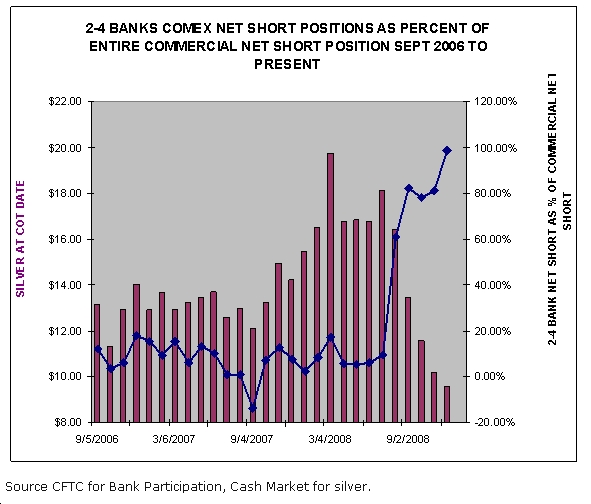
For silver, it’s even more startling. On December 2, as silver closed at $9.57, exactly 2 U.S. banks held a net short positioning of 24,555 contracts. The CFTC reports that as of the same date all traders classed as commercial held a net short positioning of 24,894 contracts. So, the 2 U.S. banks, with one particular Fed member bank probably holding almost all of it, held a sickening 98.64% of all the collective commercial net short positioning on the COMEX, division of NYMEX in New York. (chart courtesy Arensberg)

Arensberg comments that these two banks’ (cough JP Morgan Chase cough those-damn-corporate-raiders-from-the-Great-Depression cough cough) “net short positioning is equal to about 153% of the amount of deliverable silver in ALL the COMEX members’ accounts.” Sure looks like total control to me! The above is a big reason why the gold and silver markets are so tight now. Who in the right mind would enter the market to play with these giants? Again, where is their silver? So the silvers futures market is not a real “market.” More like a banker’s paradise!
Arensberg also has a section on the coin market in terms of the premium paid. Historically speaking, the premiums have been within a few percentage points of the spot value. Not anymore, gold is about 6%, and the silver premium is pretty amazing, roughly 50% over spot! Try using the law of supply and demand to explain that!
Let me finish with a respectable opinion to the contrary from Mish Shedlock’s blog. Try “No Fever Like Gold Fever: Response“, “Nonsense About Gold Backwardation, Ameros,Yuan Devaluations, etc.“, “Double Standard in Gold Hedging?“. I already laced into these articles in the comments field in Part 4, but decide for yourself. Feel free to leave any comments or questions below.
[Update 12/14 – Fekete just posted another update entitled “Backwardation that Shook the World.”]
My Note: It is time to load up the applecart – Buy Gold and Silver Now!- jschulmansr
================================================
The Significance of Gold Backwardation
By Jake Towne of Nolan Chart
I’ve written a short series on what is, in my opinion, the major economic event of gold going into backwardation and what this will mean. Due to recent interest, particularly email comments, in this article I would like to further describe this event and in the next part share links to more gold and silver news on this topic with you (as well as some objective criticism of Fekete).
I think it is also important to note that I am no expert. I fully realize I could be wrong for now, or misjudge how the government forces will intervene. It is far from clear whether this backwardation will become permanent. That said, I do believe that the resistance shackling gold and silver will be eventually be overwhelmed; it’s just a question of when. In the final analysis, Gold is the world’s greatest chance at economic liberty and a world with far less war.
Part I: “The End for the Dollar and all Fiat Currencies (1/5)” Part II: “The Next Bubble to Pop! (2/4)” Part III: “On Gold and Market Manipulation (3/5)” Supplement to explain futures market basics and backwardation: “The Money Matrix – What the Heck Are Derivatives? (PART 10/15)” Part V: “More on Gold and Silver Backwardation and Manipulation (5/5)”
Let’s return to the rice example I used in an earlier article, which is traded on commodity futures markets in a similar fashion as gold and silver are today. Let’s say I absolutely must have 1000 bushels of rice 1 month from today. At the futures market, I have two options – I can buy a 1-month futures contract and take delivery right before I need it, or I can buy at the immediate market price (or spot price) and store it for a month.
Now, let’s say rice goes into backwardation. This means that the spot price is more expensive than the 1-month futures price. So, normally I would buy the futures contract since it is cheaper and the storage cost is borne by the other party. And if enough people did this, backwardation would quickly disappear. Now why would I buy at spot price?
I would buy at spot only if I feared that within a month the other party would not have any rice to deliver. Now the strange thing is that for backwardation to continue to exist, all rice traders at the market need to believe the same thing. Why?
If other traders holds surplus rice and do not need it for a month, and believe they will get delivery 1 month later, they will release this stock into the market (driving the spot price down and the futures price up) and take delivery in a month’s time, which would give a tidy basis profit (spot price minus the futures price), plus the savings of not storing the rice for a month.
So therefore, backwardation is the sign of a very tight market, and a market that will be tight for sometime into the future – either 1) current supply is very tight, 2) future supply is projected to be very tight, or 3) there is a severe distrust in counterparties – that the short positions can deliver the goods on time per the contract, or vice versa that the long positions will not have the cash.
That said, backwardation in seasonable, weather-dependent perishable commodities like rice or corn is certainly not unheard of. It even sometimes occurs with industrial commodities like lead or copper. Sometimes it can even be the natural state of the market.
However, gold futures are completely unlike these other commodity markets. Gold is mostly traded solely as a “store of value”; the jewelry or electronics or dentistry demand pales in comparison to the quantities of the yellow metal traded as a store of value (even an “anti-dollar” if you wish). In other words, gold is not a consumable market.
And here is the final piece to the above from South African Daan Joubert, quoted at lemetropolecafe.com. Gold backwardation can only mean that either “a) There are enough people so concerned about non-delivery that they will pay a large premium to get their hands on gold right now” or “b) There are no large holders of gold who have sufficient faith in the futures exchange to exploit the [backwardation].”
Dr. Fekete has issued two recent updates, “Has the Curtain Fallen on the Last Contango in Washington” and “There’s No Fever Like Gold Fever.” I consider both must-reads, especially the conclusion to the “Gold Fever” article. I will freely admit to you that for some of the reasons Fekete mentions in the “Gold Fever” article I considered not writing this series under my own name (perhaps I may later regret it) but there is something about sharing the truth as I see it that forbids me what ultimately amounts to cowardice. Anyways, here is the intro to “Gold Fever”:
Here is an update on the backwardation in gold that started on December 2 at an annualized discount rate of 1.98% and 0.14% to spot in the December and February contracts. It continued and worsened on December 8, 9, and 10 as shown by the corresponding rates widening to 3.5% and 0.65%. It is nothing short of awesome. This is a premonition of a coming gold fever of unprecedented dimensions that will overwhelm the world as soon as its significance is fully digested by the doubting Thomases.
Keynesian economist John Keynes once pessimistically noted, “In the long run, we are all dead.”
I say, YES, the day when gold or silver breaks the COMEX IS death.
Death to the Keynesians for all the havoc they have wrought.
===============================================
Is The Second Great Depression Imminent?
By: Lionel Badal
The world is currently facing the most serious financial and economic crisis since the Great Depression of 1929. How have countries responded to the crisis? Well as we know it, by lending huge amounts of money through bailouts and other tax cuts. So while the current crisis was caused by excessive lending, such as the subprimes, the only answer our governments and financial elites found was lending even more and making money out of nothing.
My Note: Wake Up Indeed! Time To Buy Gold and Silver- Ya Think???-jschulmansr
Dollar Down, Gold Up
By: Dr. Duru of Dr. Duru’s One Twenty
I have been and remain a bear on the dollar. Back in mid-August, I conceded that the gathering momentum in the dollar trade would postpone the weak dollar scenario until 2009. I was wrong on a few of my reasons for expecting continued strength in the dollar, but a stronger dollar is what we have.
I know a lot of dour folks have explained why they expect America’s “well-intentioned” borrowing and printing binge to lead to rampant inflation in the future (Peter Schiff is one of many examples). I have also tried to make the case. The main crux of my current opinion is that America will win its fight against deflation, sooner rather than later, and will be too slow to remove the monetary (and fiscal) injections into the economy to stave off the high inflation we will get as our reward.
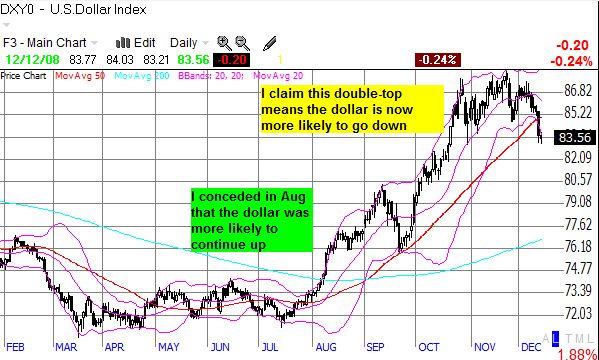
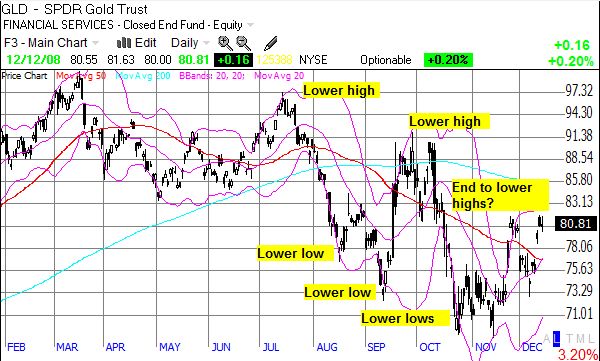
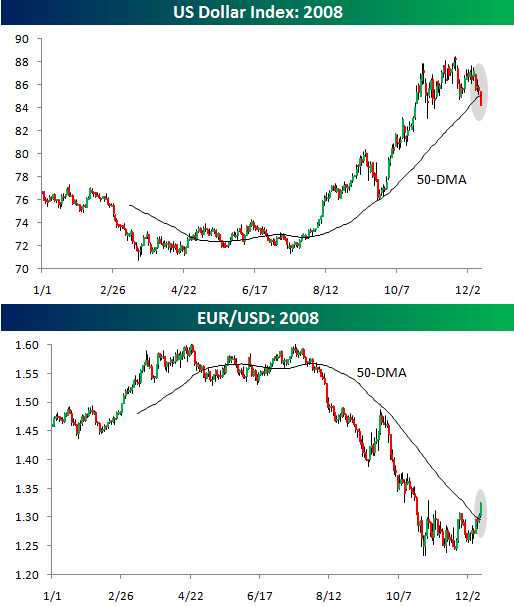
The first signs of fresh dollar weakness are finally showing up. The chart below (click to enlarge) shows a potential double-top in the dollar. Some technicians may prefer to call it a head-and-shoulders pattern.
It is at these kinds of critical transition points that people who want to cling to the former trend will proclaim the loudest that all is well. Dollar bulls surely believe that the fundamentals of the currency have never been better given the world’s belief that the dollar represents a safe place to park in a world of turmoil. Maybe major global governments borrow and print even faster and harder than we are doing. If that happens, I will have to like gold even more since its global supply will not increase nearly as fast as the supply of global money. Regardless, we should all know by now what results when a massive crowd jams into one side of a trade – short-term Treasuries represent the powder keg du jour.
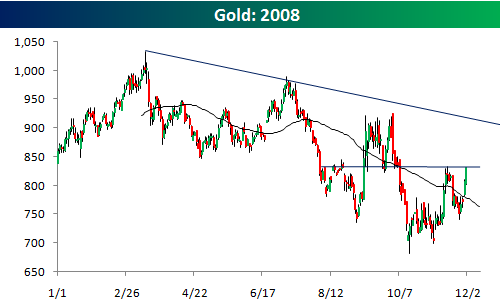
Until recently, it has been difficult to play commodities in anticipation of reflation given prevailing downtrends. Gold has held up better than most but it too is still caught in a downtrend of lower lows and lower highs. The recent weakness in the dollar has perked gold back up, and I am sticking to it as one of my favorite places to be for 2009.
*All charts created using TeleChart: 
The dollar down, gold up scenario gets delayed again if the dollar manages to make a new high above the recent double-top and gold makes another lower low.
Be careful out there!
Full disclosure: long GLD. For other disclaimers click here.
==============================================
Will We See A Big Upward Move in Gold?
By: Mark Courtenay of Check The Markets.com
Did you know that the Federal Reserve Bank owns gold certificates? Mounting evidence suggests the Fed intervenes in and participates in the gold and silver markets on a regular basis.
Interviewed Monday last week on the “Trading Day” program of Business News Network in Canada, former Federal Reserve Governor Lyle Gramley hinted that a big upward revaluation of gold may figure heavily in the Fed’s attempt to rescue the U.S. economy.
The program’s guest host, Niall Ferguson, an author and history professor at Harvard, asked Gramley, now senior adviser at Stanford Group in Houston, about the seemingly grotesque expansion of the Fed’s balance sheet in recent months.
Ferguson asked: “I’ve heard it said that the Fed has turned into a government-owned hedge fund, leveraged at 50 to 1. Do you feel nervous about what this might actually do to the Fed’s reputation?”
Gramley replied: “I think you have to reckon with the fact that one of the Fed’s assets is gold certificates, which are priced, as I remember, at $42 an ounce, and if we were to price them at market prices, the Fed’s leverage would look a lot less than it is now.”
While valuing the U.S. government’s claimed gold reserves at today’s Comex closing price of around $822 per ounce instead of the government antique bookkeeping entry of $42.22 per ounce would indeed vastly expand the government’s monetary assets, it might not be enough to offset the liabilities and guarantees the government lately has taken on.
But the job might be done by revaluing the gold to $5,000 or $10,000 per ounce, as the British economist Peter Millar speculated two years ago might be necessary to prevent debt deflation: yet this is admittedly speculation.
What did Gramley mean by “…the Fed’s leverage”? That would suggest that the Fed not only owns “gold certificates” but also future contracts and options on futures. They might be big benefactors in a gold squeeze.
Speaking of a gold squeeze, I read another report from the Gold Anti-Trust Actioin committee (GATA) saying that the Comex is warning brokers of a December gold squeeze.
Yes, the Comex is alerting various futures firms about the potential of a squeeze on the December contract and is advising the $840 December shorts to exit their positions. That is the remaining open position.
There have been 12,636 notices of delivery. The shorts have until December 31 to make delivery. Normally they deliver early to take in cash and earn the interest. They must be delaying.
As I understand the situation, that represents about 40 percent of the gold available at the Comex, and of course someone could enter the scene late, buy February gold, and then spread into December, which would stun the shorts.
My broker friend said his back office said this sort of alert is highly unusual and that the concern is real, not only for gold, but for other commodities too, like copper and palladium, as there is a good deal of talk of taking deliveries there too. But gold is the one for which the advice to cover went out.
This is an extremely productive development and could spur the price of gold up quickly as word spreads. As we all know, buying Comex gold and silver (the cheapest way to buy precious metals) makes all the sense in the world in this financial environment.
This might just be reason enough to begin “stocking up” on some of the ETFs that would be beneficiaries like (GLD), (SLV) and The PowerShares DB Commodity Index Tracking Fund (DBC). The 1-year chart below is instructive.
Some interesting names in the copper business to keep an eye on and begin accumulating on any meaningful pullbacks are Freeport McMoran (FCX), Southern Copper Corp (PCU) which as of this writing still pays a dividend, unlike FCX, and Sterlite Industries (SLT) which is India’s bigger copper producer and is poised to benefit from any resurgence of copper demand in Asia.
It might be one of those “ready, get set, not yet” approaches to what an investor should do. The economic news and the relapsing into the next and possible worse phase of this credit crisis, great-recession, and deflationary mess might delay the upside potential on commodities.
But if you’re a trader (a.k.a. “gambler”) there might be a short-term pop in at least gold over the next couple of weeks…maybe spilling into January 2009 where quick profits could be made….as well as some quick and disappointing losses.
Are you an investor, a short-term gambler, or both? No matter what the answer, if you know yourself well then you know how you might respond to all this news and the rumor mill. Best of luck!
When FCX dipped back down near $16 after the suspension of their dividend I decided to pick up a few shares for a quick trade. I’m fortunate that it worked out.
I firmly believe that there will be a trading range for all the better commodity stocks and ETFs that will give us several chances to buy low and sell high over the months directly ahead. Your comments on that will be appreciated. Happy holidays to you all.
Disclosure: Long GLD, SLV, FCX, SLT.
All of these measures will have an impact on economies, no doubt on that. Before the end of 2009 an –artificial- recovery will take place. Good news you may think? Not at all…
In parallel to the recovery, global oil demand will increase next year as mentioned recently by the IEA. This is where the collapse will occur. Global oil production is about to decline, as major oil fields in Mexico and the North Sea have passed their peak… the rate of decline is staggering (check the latest IEA annual report).
Additional energies and non-conventional oils which should have been here do not exist; why? Very simple to understand, with the financial crisis and oil prices back to the low 40s, major energy investments are either cancelled or postponed (they no longer look profitable). In short, when the demand will go up, oil production will be declining; logically prices will explode. Dr. Faith Birol, IEA’s Chief-Economist, well aware of the seriousness of the situation declared on Peak Oil:
What I can tell you is that one day global conventional oil will peak… I think it is going to peak very soon. The main problem here is that the existing fields, many mature fields, are declining.
While you may have found this explanation shaky or over-pessimistic, as early as 2005 the geologist Dr. Colin Campbell (founder of the Association for the Study of Peak Oil-ASPO) declared:
Expansion becomes impossible without abundant cheap energy. So I think that the debt of the world is going bad. That speaks of a financial crisis, unseen, probably equalling the Great Depression of 1930; it’s probable we face the Second Great Depression. It would be a chain reaction, one bank would fail, and another one would fail, industries will close…
What is commonly known as Peak Oil, a decline in global oil production is about to happen: you can ignore it, fight it, but to be sure, you will not escape from it. I will not enter into the details of the Peak Oil debate, an endless one. Nevertheless, here are statements on Peak Oil held by some of the most authoritative groups:
Peak oil is at hand with low availability growth for the next 5 to 10 years. Once worldwide petroleum production peaks, geopolitics and market economics will result in even more significant price increases and security risks. To guess where this is all going to take us is would be too speculative.
The end-of-the-fossil-hydrocarbons scenario is not a doom-and-gloom picture painted by pessimistic end-of-the-world prophets, but a view of scarcity in the coming years and decades that must be taken seriously.
Deutsche Bank (December, 2004)
More recently, a British Industry Taskforce (e.g. Shell (RDS.A), Yahoo (YHOO), Virgin, and Solarcentury) conducted a vast study on oil production. They concluded that, “peak oil is more of an immediate threat to the economy and people’s lives than climate change, grave as that threat is too” and added “the risks to UK society from peak oil are far greater than those that tend to occupy the Government’s risk-thinking, including terrorism” before asking the government to urgently take action.
Here is the “recipe” for the greatest disaster ever. What cheap and abundant oil created, Peak Oil will destroy; our failure to invest in alternatives 10 or 20 years ago is about to fall on us. Michael Meacher, a former British Environment Minister and current Labour MP similarly declared on what is coming:
This is an apocalyptic scenario. In terms of industrial production, in terms of the food supply but above all in the terms of the transportation sector, we cannot continue as we now are.
Like in 1929, this Second Great Depression, caused by hyperinflation (within 3 years) will have dramatic political consequences:
As oil prices rise, it will be millions who suffer, millions of ordinary people who are just trying to get on with their lives, millions of ordinary decent people will be forced into states of anxiety, depression, fear and anger.
Voters take to new ideas, even radically new ideas when the system that they have trusted, worked with, admired and felt comfortable with falls apart.
Peak Oil may well be an important catalyst that helps us to win political power because we are the ones talking about it now.
The British National Party and its leader Nick Griffin are well aware of the seriousness of the coming crisis, yet for them it is seen a unique opportunity. History is here to remind us that dramatic changes can happen so fast that we don’t even see them until they have happened. Nick Griffin, who is passionate about Peak Oil as one of the BNP permanent staff member told me, is also a racist, holocaust denier. Make no mistake, in a post-Peak Oil world Mr. Griffin and his look-a-likes throughout the world will do all they can to apply their heinous political agenda.
The process has started and once again Europe will face its old demons, fuelled by populism, unemployment and incompetence from mainstream leaders. As mentioned in a recent Newsweek article, un-favourable views on Jews has climbed from 20% in 2004 to 25% today in Germany, in France from 11% to 20% and in Spain from nearly 21% in 2005 to about 50% today[16]. Yet the worst of the crisis is just a few years away and nobody seems to perceive the seriousness of the situation. In fact, the current crisis will soon be seen as no more than a gentle prelude or the “good old days”. Denis MacShane the author of the Newsweek article similarly observed that “the BNP was now the fastest growing political party in Britain”[17].
Wake up!
================================================

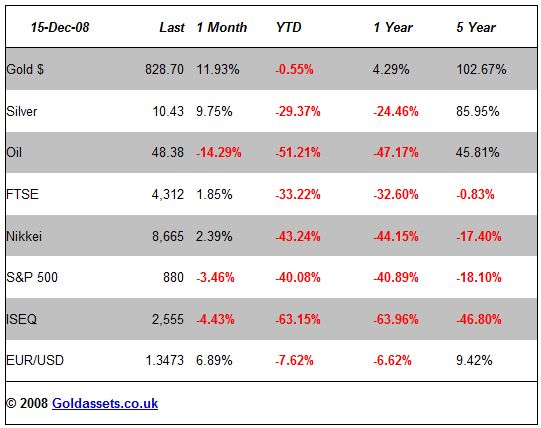
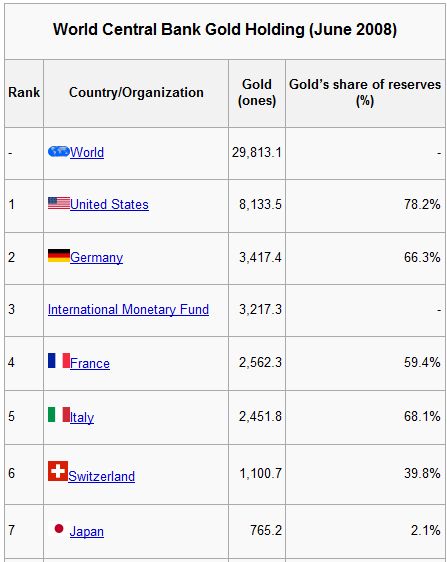
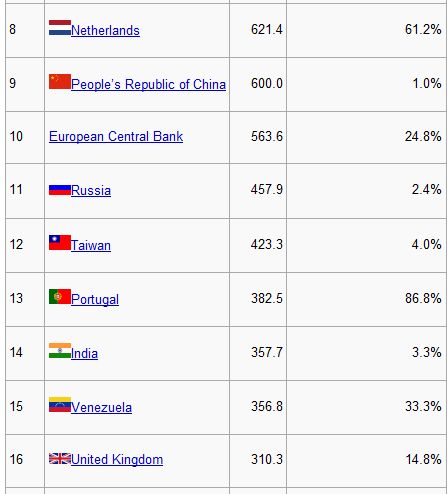
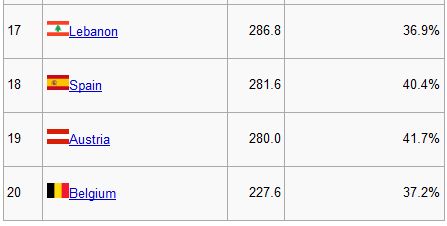

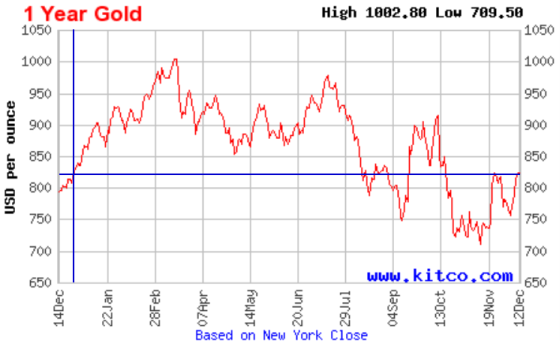
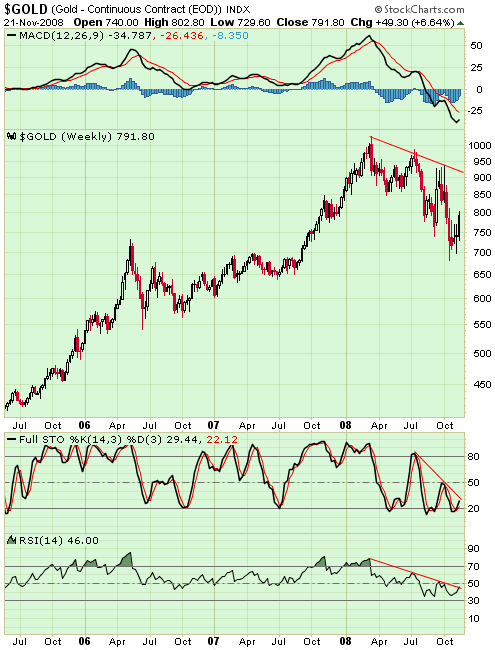
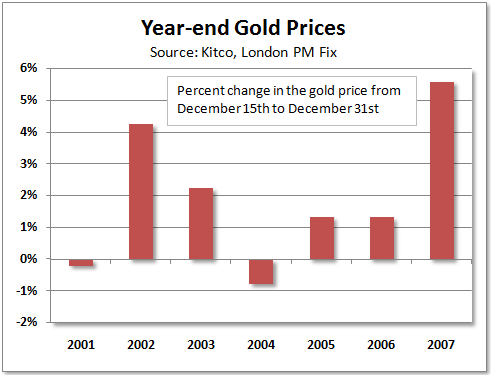 Just an average gain between now and New Year’s Day would put the price at around $860 an ounce, still down more than 15 percent from the high seen in the spring, but quite a good result, all things considered.







 Dare Something Worthy Today Too!