• Recommended Sites & Links
  • About

Dare Something Worthy Today Too!

~ FreeCryptoBitCoins, Cryptocurrency, BitCoin, Ethereum, BitCoin Cash, Ethereum Classic, LiteCoin, DogeCoin, Gold & Precious Metals, Investing & Investments, Stocks and Stock Markets, Financial Markets & Market Timing, Technical Analysis, Oil and Energy Markets, Hard Assets Investing, BlockChain, Airdrops, Earn Free Bitcoin…

Dare Something Worthy Today Too!

Tag Archives: price manipulation

The Dollar Gets Slammed+Understanding Warrants

11 Thursday Dec 2008

Posted by jschulmansr in Uncategorized

≈ Comments Off on The Dollar Gets Slammed+Understanding Warrants

Tags

agricultural commodities, alternate energy, Austrian school, banking crisis, banks, bear market, Bollinger Bands, bull market, capitalism, central banks, China, Comex, commodities, communism, Copper, Currencies, currency, deflation, depression, diamonds, dollar denominated, dollar denominated investments, economic, economic trends, economy, financial, Forex, futures, futures markets, gold, gold miners, hard assets, heating oil, India, inflation, investments, Keith Fitz-Gerald, market crash, Markets, mining companies, Moving Averages, natural gas, oil, palladium, Peter Schiff, physical gold, platinum, platinum miners, precious metals, price, price manipulation, prices, producers, production, protection, rare earth metals, recession, risk, run on banks, safety, Saudi Arabia, Sean Rakhimov, silver, silver miners, socialism, sovereign, spot, spot price, stagflation, Technical Analysis, timber, U.S. Dollar, volatility, warrants, Water

The Dollar Gets Slammed – Seeking Alpha

Source: Bespoke Investment Group

While investors have been focused on the S&P 500 and its attempt to break through its 50-day moving average, the Dollar had no problems breaking through its 50-day. Unfortunately, the break was to the downside. With a decline of 1.5% today, the US Dollar index traded below its 50-day moving average for the first time since late July.

At the same time the Dollar has been falling, the Euro has been rallying, as it broke above its 50-day moving average for the first time in months. Was the negative yield on the three month T-Bill a wake up call to foreign investors that holding cash in Dollars is not a very attractive option?

click to enlarge

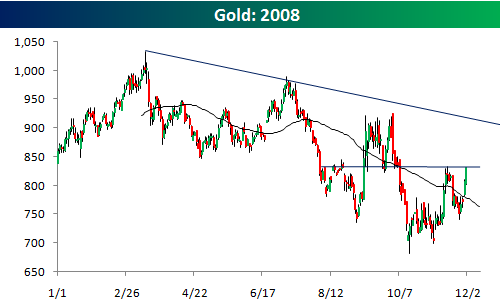
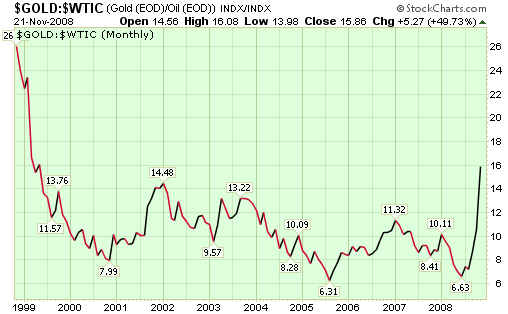
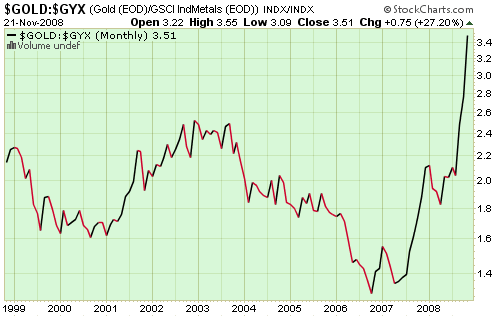
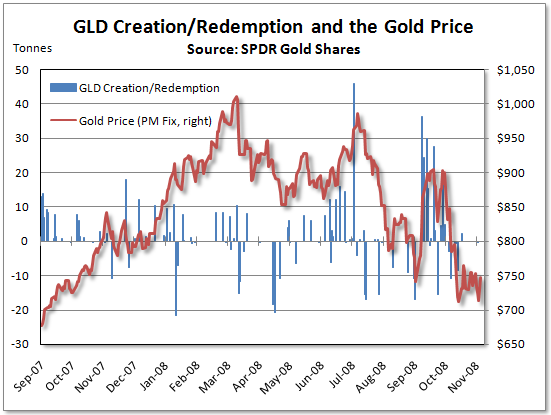
Not surprisingly, Gold is benefiting from the Dollar’s weakness with a gain of 3% today. A look at this chart shows that the commodity is still nowhere near breaking its downtrend. However, it is currently trading right at a short-term resistance level of around $830. How it acts in the weeks and months ahead will be a good indication of how concerned the market is regarding inflation.

==============================================

Confused About Warrants? Using Goldcorp To Explain

By: Dudley Baker of Precious Metals Warrants.com

Warrants are being mentioned more and more in the traditional media as the U.S. government moves to receive warrants in connection with some of the bailout/rescue plans for the Big Three auto manufactures and also with AIG back in September.

Warrants have a long history going back into the 1920s, but the average investor has absolutely no idea what this investment vehicle is all about.

So let’s make this simple and provide you with a brief understanding of warrants and why you should perhaps consider warrants in your investment plans. (After all, this is not rocket science!)

Warrants are a security issued by a company usually in connection with a financing arrangement or a public offering of shares giving the holder the right, but not the obligation, to acquire the underlying security at a specific price and expiring on a specific date in the future. Sounds a lot like a call option, doesn’t it? Yes, very similar but with a few important differences, namely, how they are issued and how they are traded.

While understanding the term warrants is essential, the next most important question is a warrant on what? The underlying company is of utmost importance because if the company does not perform, execute on its business plans and thus the shares price rising in the markets, then the warrants can not be expected to go up and we are all about making money.

A common question from investors is why would I buy a warrant when I just want to own the common shares of the company? Good question and we have a very easy answer. An investor would purchase a warrant because of the expectation of a greater gain than purchasing the common shares and this term is usually referred to as leverage. See our analysis below on Goldcorp (GG). We would normally suggest investors attempt to seek a leverage of 2 to 1, meaning if the common shares rise by 100% we would expect the warrants to increase by 200%. Another benefit of buying the warrant is that it will cost you much less money thus lowering your investment cost and potentially increasing your return on your investment.

Perhaps a detailed example would clarify any questions you may still have on warrants.

Let’s say you are a believer in the return of the long term bull market in the precious metals and commodity sector and you are aware that one of the major gold producers is Goldcorp which trades on the NYSE and the TSX. As you hear many analysts commenting on Goldcorp, you are thinking maybe this would be a good addition to your portfolio. You do some more research (due diligence) and find that Goldcorp, a Canadian company headquartered in Vancouver, Canada, employs more than 9,000 people worldwide has has 16 world class operations and development projects focused throughout the Americas with over 70% of reserves in low risk NAFTA and they do not hedge or sell forward its gold production.

Now you are excited. You have found that Goldcorp meets all of your criteria and you see the potential for the shares to rise perhaps to $70 to $100 due to your bullish views on the precious metals markets within the next 2 years.

This is where we encourage investors, before purchasing the common shares, to ask the question, does Goldcorp (or any other company you are considering in your portfolio) have a long-term warrant which is trading which may provide me with a better return on my investment? We know that Goldcorp does in fact have a warrant which is trading and the issue now becomes, what is the exercise price, when does the warrant expire and does this warrant offer me great upside leverage as the common shares increase in price?

As of the close on Friday, December the 5th, Goldcorp common shares were at C$27.85 and the warrants at C$7.34. The warrants have an exercise price of C$45.75 and will expire on June 9, 2011. At a projected share price of $100 you would have a gain of 259% and with the common at $100, the warrants would have a minimum gain of 639% for a leverage of 2.5 times.

We would like to stress that this is an example and not a recommendation of the Goldcorp warrants. However with the warrant trading on Goldcorp if the answers to your questions are answered satisfactorily the warrant should then be purchased in lieu of the common shares after performing your due diligence and consulting with one’s investment advisor.

Currently there are warrants trading on some of the large producers as well as many of the smaller junior mining companies with expiration dates of 2011 and out to 2017 providing investors with some incredible opportunities

More Info on Warrant Can Be Found Here

============================================

What Does Backwardisation Mean For Gold & Silver Prices?

By: Peter Cooper of Arabian Money.net

Antal E. Fekete, a professor at Intermountain Institute of Science and Applied Mathematics, and frequent writer on precious metals, answers a timely question:

Q: People from around the world keep asking me what advance warning for the collapse of our international monetary system, based as it is on irredeemable promises to pay, they should be looking for.

A: My answer invariably is: ‘watch for the last contango in silver’.

It takes a little bit of explaining what this cryptic message means. Contango is that condition whereby more distant futures prices are at a premium over the nearby. The opposite is called backwardation which obtains when the nearby futures sell at a premium and the more distant futures are at a discount.

When contango gives way to backwardation in all contract spreads, never again to return, it is a foolproof indication that no deliverable monetary silver exists.

Silver price hike

Thank you professor! This is really an extension of the argument on this website dating back to before the summer rout of precious metal prices.

Physical stocks are low and the futures price has been distorted by big hedge fund forced-sales – now we are coming to the day of reckoning when the physical shortage starts to determine the spot price, and not the futures market.

The upside – which should have been there all along – will now come back with a vengeance and smash the few remaining shorts. This is likely to be spectacular – but after the culling of bulls recently not all precious metal fans will be there to benefit.


Backwardation means BIG GOLD Price Rally Coming!

By: Peter Cooper of Arabian Money.Net

Please forgive this late contribution – I have been distracted by the delights of ancient Egypt in Luxor – but this is highly significant.

Professor Emeritus of Mathematics Antal E. Fekete says that Dec 2nd. marked the beginning of the end for paper currencies and wealth based on such currencies.

Since at least 1972, the price of gold futures has been higher than the spot price. But on December 2nd, the futures price went below the spot price – and has stayed there for several days.

Fekete argues that this means that gold owners are hoarding their gold because (1) they’re not confident that they’ll be able to buy it back in the future, and (2) they have lost all faith in paper currency. He says:

Back to the future

‘Once entrenched, backwardation in gold means that the cancer of the dollar has reached its terminal stages. The  progressively evaporating trust in the value of the irredeemable dollar can no longer be stopped.

Negative basis (backwardation) means that people controlling the supply of monetary gold cannot be persuaded to part with it, regardless of the bait. These people are no speculators. They are neither Scrooges nor Shylocks.

They are highly capable businessmen with a conservative frame of mind. They are determined to preserve their capital come hell or high water, for saner times, so they can re-deploy it under a saner government and a saner monetary system.

Their instrument is the ownership of monetary gold. They blithely ignore the siren song promising risk-free profits. Indeed, they could sell their physical gold in the spot market and buy it back at a discount in the futures market for delivery in 30 days.

In any other commodity, traders controlling supply would jump at the opportunity. The lure of risk-free profits would be irresistible. Not so in the case of gold. Owners refuse to be coaxed out of their gold holdings, however large the bait may be. Why?

Well, they don’t believe that the physical gold will be there and available for delivery in 30 days’ time. They don’t want to be stuck with paper gold, which is useless for their purposes of capital preservation.’

A big change

PhD economist James Conrad confirms the backwardation of gold:

‘Backwardation is always the first sign that a huge price rise is about to happen. In the absence of backwardation, there is no rational explanation as to why HSBC, Bank of Nova Scotia(BNS), Goldman Sachs, and others are forcing COMEX to make large deliveries.

Things … are changing fast … the first major mini-panic among COMEX gold short sellers happened last Friday. As of Wednesday morning, about 11,500 delivery demands for 100 ounce ingots were made at COMEX, which represents about 5% of the previous open interest.

Another 2,000 contracts are still open, and a large percentage of those will probably demand delivery. These demands compare to the usual ½ to 1% of all contracts.

European central banks no longer want to sell gold. China wants to buy 360 tons of it as soon as humanly possible, and as soon as it can be done without sending the price into the stratosphere. A close look at the Federal Reserve balance sheet tells us that Ben Bernanke eventually intends to devalue the U.S. dollar against gold.

Anyone who reads the written works of our Fed Chairman knows that Bernanke’s long term plan involves devaluing the dollar against gold. This is the exact opposite of most prior Fed Chairmen. He has overtly stated his intentions toward gold, many times, in various articles, speeches and treatises written before he became Fed Chairman.

He often extols the virtues of former President Franklin Roosevelt’s gold revaluation/dollar devaluation, back in 1934, and credits it with saving he nation from the Great Depression. According to Bernanke, devaluation of the dollar against gold was so effective in stimulating economic activity that the stock market rose sharply in 1934, immediately thereafter. That is something that the Fed wants to see happen again.

Huge international banking firms normally do not take metal deliveries from futures markets. They normally buy on the London spot market. The fact that they are demanding delivery from COMEX means one of two things. Either the London bullion exchanges have run out of gold, or these firms are finding it cheaper to buy gold as a ‘future’ than as a spot exchange.

Smart traders at big firms may be              buying on COMEX to sell into the spot market, for a profit. This pricing condition is known as backwardation.’

==============================================


Share this:

  • Click to share on Reddit (Opens in new window) Reddit
  • Click to share on Facebook (Opens in new window) Facebook
  • Click to share on LinkedIn (Opens in new window) LinkedIn
  • More
  • Click to share on X (Opens in new window) X
  • Click to share on Pinterest (Opens in new window) Pinterest
  • Click to share on Tumblr (Opens in new window) Tumblr
  • Click to print (Opens in new window) Print
  • Click to email a link to a friend (Opens in new window) Email
Like Loading...

Kinross Gold Leads Gold Sector Rebound – Seeking Alpha

10 Wednesday Dec 2008

Posted by jschulmansr in Bollinger Bands, commodities, Copper, Currency and Currencies, diamonds, Finance, Fundamental Analysis, gold, hard assets, inflation, Investing, investments, Latest News, Markets, mining stocks, oil, precious metals, silver, small caps, Stocks, Technical Analysis, Today, U.S. Dollar, uranium

≈ Comments Off on Kinross Gold Leads Gold Sector Rebound – Seeking Alpha

Tags

agricultural commodities, alternate energy, Austrian school, banking crisis, banks, bear market, Bollinger Bands, bull market, capitalism, central banks, China, Comex, commodities, communism, Copper, Currencies, currency, deflation, depression, diamonds, dollar denominated, dollar denominated investments, economic, economic trends, economy, financial, Forex, futures, futures markets, gold, gold miners, hard assets, heating oil, India, inflation, investments, Keith Fitz-Gerald, market crash, Markets, mining companies, Moving Averages, natural gas, oil, palladium, Peter Schiff, physical gold, platinum, platinum miners, precious metals, price, price manipulation, prices, producers, production, protection, rare earth metals, recession, risk, run on banks, safety, Saudi Arabia, Sean Rakhimov, silver, silver miners, socialism, sovereign, spot, spot price, stagflation, Technical Analysis, timber, U.S. Dollar, volatility, warrants, Water

Kinross Gold Leads Gold Sector Rebound – Seeking Alpha

By: Sam Kirtley of Gold-prices.biz

Sam Kirtley has been involved in investment in the financial markets for a number of years and has experience in stock investment and analysis as well as options trading. He is now a writer and analyst for various websites including uranium-stocks.net, gold-prices.biz, and silver-prices.net.

Gold stocks have been bouncing back recently, but few can challenge the extraordinary recovery of Kinross Gold (KGC), which has more than doubled since its low below $7. This is a sign that KGC is indeed one of the best gold mining companies in the world, since it has bounced back the furthest and the fastest.

(click to enlarge)

Technically some good signs from KGC are that the Relative Strength Index is moving higher having bounced up off the oversold zone at 30. Similarly, the MACD is trending northwards and is now in positive territory, but can still rise a lot further before giving an oversold signal.

If one is to have favourite shares, Kinross Gold Corp would certainly be one of ours, as it has been a holding of ours for years now, although we have traded the ups and downs when the opportunities presented themselves.

Having originally acquired Kinross at $10.08, after a large rally Kinross then went through a bit of a pull back so we signalled to our readers to “Add To Holdings” at discounted levels of around $11.66. We also gave another ‘Kinross Gold BUY’ signal when we purchased more of this stock on the 20th August 2007 for $11.48. On 31st January, 2008, we reduced our exposure to this stock when we sold about 50% of our holding for an average price of $21.96 locking in a profit of about 93.60%. On the 24th July, 2008, we doubled our holding with a purchase at $18.28 giving us a new average purchase price of $14.50.

As well as trading the stock, we have also dabbled in options contracts with Kinross, buying call options in KGC on the 16th June, 2008, paying $2.68 per contract and selling them on the 28th June 2008 for $5.30 per contract generating a 100% profit in two weeks. We then re-purchased them after they dropped for $2.50, and we are still holding them, although at a significant paper loss.

The reason we like Kinross Gold Corp so much is that it fits our criteria almost perfectly. When we look for a gold stock to buy, we are looking for solid fundamentals, a stable geopolitical situation and most importantly, leverage to the gold price itself.

As far as the fundamentals go, Kinross is a mid to large cap gold producer with a market cap of $9.47 billion. Some may consider this too large a company to offer decent leverage to the gold price, but as shown by the recent performance of the stock price, Kinross is definitely providing that leverage.

As well as leverage to rising gold prices, Kinross is also growing well as a company in its own right. Having made a gross profit of $390.40M in 2006 and then $501.80M in 2007 and with the Sep 08 quarterly profits at $269.80M, Kinross appears to be on track for another good year of record profits. There is also something in the financials that is particularly helpful in the present credit environment. In the last report from KGC, out of the $1284.80M in current assets, Kinross has a massive $322.90M in cash. This means it is well positioned to face any liquidity issues and will not be forced to try and raise money in the current difficult credit conditions.

Therefore, we continue to like Kinross and maintain our stock and option position in the company. Kinross Gold Corp is not only well positioned to benefit from rising gold price, but it is also a great company in its own right, with good growth potential. A full list of the stocks we cover can be found in our free online portfolio at http://www.gold-prices.biz.biz.

=============================================

Goldcorp Expected to Get 40% Gold and Silver Reserve Boost at Penasquito

Source: Financial Post Trading Desk

By: Jonathan Ratner

 Goldcorp provided an update for the Penasquito project in Mexico on Monday, a day ahead of its tour for analysts and shareholders.

The miner said its capital cost estimate is less than 10% higher than the original estimate of US$1.494-billion and construction continues to progress well.

When engineering work is complete, Goldcorp expects an approximate increase of 30% in gold reserves and a 15% to 20% increase in silver, lead and zinc reserves for year-end reporting.

There is also the potential for initial resources to be declared for bulk mineable and high-grade underground zones, as well as the Noche Buena property nearby, noted Canaccord Adams analyst Steven Butler. He assumes reserve additions will be roughly 40% for gold and silver and around 16% for lead and zinc.

Concentrate shipments are scheduled to being in the fourth quarter of 2009 and commercial production is expected for the following quarter. Meanwhile, shipments of large trial lots are anticipated in 2009 now that concentrate samples have been provided to select smelters, Mr. Butler said in a research note.

The analyst also noted that Goldcorp’s optimization efforts are underway. They include the possibility of recovering precious metals from low-grade lead ore that was previously considered uneconomic, the potential for underground bulk mining beneath currently defined open pits, and the possibility of cheaper power from a dedicated facility through a partnership with an independent provider.

Canaccord rates Goldcorp a “buy” with a price target of US$32 per share.

Jonathan Ratner 

<!–
–>========================================

The Fed Still Manipulates Gold and The Markets

By: Jake Towne of Yet Another Champion of the Constitution

In a dynamic duo of articles published last weekend, I predicted the fall of the Dollar via a Gold-based perspective, and a US Treasury-based perspective. I want to round off and perhaps even reinforce my theory with a few more opinions and thoughts, which of course may be faulty as the major decisions are still at the mercy and discretion of the Fed, whom I have learned to never underestimate. To be a real “expert” in economics today requires one to be an “expert” in predicting government interventions, so it is all guesswork unless one is an insider. I am highly interested if there are any crucial facts I am missing by the way, please leave any counterarguments below.

I own some gold and if gold goes down I’ll buy some more and if gold goes up I’ll buy some more. Gold during the course of the bull market, which has several more years to go, will go much higher. – Jim Rogers, famed commodities trader, last week

I have written previously how the Fed creates and destroys money, but the example I used of open market operations (OMOs) has changed dramatically in 2008. The Fed is, on a daily basis, still altering its Treasury holdings, but more importantly propping up other assets by buying them, such as mortgage-based securities, Citigroup (C), AIG, etc. The Fed balance sheets have plunged from its historical levels of ~95% Treasury securities to less than 32% Treasuries, which hampers OMOs since the assets purchased will likely find no willing buyer on the market.

It may seem like the Fed is creating lots of money (and they are) but remember that $7.76 trillion, $8.5 trillion, WHATEVER the new number will be by the end of this week, pales in comparison to the amount of financial derivatives in existence, which per the BIS at last count (and just over-the-counter!) was $684 trillion. I am not sure if I ever wrote this phrase in this column before, but I’ve always viewed the financial crisis as a “Triple-D” crisis. Dollar. Debt. Derivatives.

There is another method of money destruction that I have not overlooked and want to mention. In an economic “disintegration” or a monster of a recession, money can also be destroyed by corporate, government and private bankruptcies.

In the debt-based world we live in, I think money destruction could be seen in shocking scales far exceeding the imaginations of the Keynesian-economics-based minds of the Fed and other central bankers. For instance, comparatively there has been much less noise in the commercial mortgage markets. However, if a lot of businesses fail, which has been known to happen in any recession, how do you suppose those mortgages will be repaid to the banks? In such a scenario, central bankers have just two options: create replacement money to re-inflate supply, or revalue the currency to an asset (very likely gold, after all central bankers do not hold at least some gold for their collective health, the yellow stuff is nice life insurance for fiat currency, ain’t it?).

In this eye-popping December 4 essay by James Conrad, he reasons the central bankers will revalue to some sort of a gold standard to escape oblivion, and the price of gold will go from $750 per ounce to $7500-9000. [Remember the “price” is not REALLY going up, after all 1 ounce of gold is the same from day to day. What it really means is that all fiat currencies are going to be massively devalued as the worthless scraps of paper and electrons they really are!]

There is a legal requirement that, in every futures contract that promises to deliver a physical commodity, the short seller must be 90% covered by either a stockpile of the commodity or appropriate forward contracts with primary producers… Things, however, are changing fast. As previously stated, the first major mini-panic among COMEX gold short sellers happened last Friday. As of Wednesday morning, about 11,500 delivery demands for 100 ounce ingots were made at COMEX, which represents about 5% of the previous open interest. Another 2,000 contracts are still open, and a large percentage of those will probably demand delivery. These demands compare to the usual ½ to 1% of all contracts.

Time for Captain Calculator! On December 5, the open interest was 264,796 contracts (at 100 troy ounces per bar). This equates to 823 tonnes, a very significant amount equal to about 10% of the total gold reserves claimed by the United States, the world’s largest holder. There are 26.5 million ounces in contracts and only 2.9 million ounces in COMEX warehouses to cover deliveries as Dr. Fekete notes here. Over 40% of the warehouse totals will be delivered before January 1.

Where is the gold to cover the rest of the contracts? In the ground? In central bank vaults? At the GLD London vault? I do not know the answer, but I agree with Fekete’s comment on gold’s recent backwardation and Conrad, the traders requesting delivery are skeptical there is enough.

Conrad then proceeds to outline a very convincing (to me) proof that ends with:

It is only a matter of time before gold is allowed to rise to its natural level. Assuming that about half of the current increase in Fed credit is eventually neutralized, the monetized value of gold should be allowed to rise to between $7,500 and $9,000 per ounce as the world goes back to some type of gold standard. In the nearer term, gold will rise to about $2,000 per ounce, as the Fed abandons a hopeless campaign to support COMEX short sellers, in favor of saving the other, more productive, functions of the various banks and insurers.

Revaluation of gold, and a return to the gold standard, is the only way that hyperinflation can be avoided while large numbers of paper currency units are released into the economy. This is because most of the rise in prices can be filtered into gold. As the asset value of gold rises, it will soak up excess dollars, euros, pounds, etc., while the appearance of an increased number of currency units will stimulate investor psychology, and lending and economic output will increase, all over the world. Ben Bernanke and the other members of the FOMC Committee must know this, because it is basic economics.


Hyperinflation is nasty stuff. I first wrote about it in my July article “Calling All Wheelbarrows: Hyperinflation in America? (Part 2/2)” and a fellow Nolan Chart columnist, Republicae, with far more experience than I wrote “The Hyper-Inflationary Trigger.”

Jim Sinclair, precious metals expert, comments here:

I recently completed the same mathematics that helped me so much in 1980 to determine the price that would be required to balance the international balance sheet of the US.

Balancing the international balance sheet is gold’s mission in times of crisis.

I recently did the math again and was sadly shocked to see what the price of gold would have to be to balance the international balance sheet of the USA today. That price for gold is more than twice Alf’s projected maximum gold price.


Alf Field’s maximum projection is $6,000 per troy ounce. Wow, guess Captain Calculator can take a vacation! On that note I would like to end with a reminder to the republican, Republican, and the third person who is reading this:

“We renew our allegiance to the principle of the gold standard and declare our confidence in the wisdom of the legislation of the Fifty-sixth Congress, by which the parity of all our money and the stability of our currency upon a gold basis has been secured.”

– Republican National Platform, 1900

“We believe it to be the duty of the Republican Party to uphold the gold standard and the integrity and value of our national currency.”

– Republican National Platform, 1904

“The Republican Party established and will continue to uphold the gold standard and will oppose any measure, which will undermine the government’s credit or impair the integrity of our national currency. Relief by currency inflation is unsound and dishonest in results.”

– Republican National Platform, 1932 [Above are sourced from H.L. Mencken, A New Dictionary of Quotations on Historical Principles from Ancient and Modern Sources (1985, p. 471)

“We must make military medicine the gold standard for advances in prosthetics and the treatment of trauma and eye injuries.”

– the only mention of gold in the Republican National Platform, 2008. Try searching for ‘gold’ or ‘dollar’ here.

Well, the Gold Standard ended in the US in 1914 when the first unbacked and “unsound” Federal Reserve Notes were printed. Ok, I hate the Fed, but fellow columnist Gene DeNardo phrased it best in his intriguing article “MV=PT A Classic Equation and Monetary Policy“:

When the economy grows in a healthy way, we all share in the profit as our currency becomes stronger and is able to purchase more.

========================================

Inflation on Sale as Deflation Dominates Markets

By:  Eric Roseman of  The Sovereign Society

The time to start building fresh positions in oil, gold, silver and TIPs has arrived. Even distressed real estate should be accumulated if credit can be secured.

Over the next 6-12 months the United States, Europeans, Japanese and Chinese will eventually arrest deflation. And long before that materializes, hard assets will begin a major reversal following months of crippling losses.

Since peaking in July, the entire gamut of inflation assets has collapsed amid a growing threat of deflation or an environment of accelerated price declines. The last deflation in the United States occurred in the 1930s, purging household balance sheets, corporations, states, municipalities and even the government following two New Deals.

Thus far, U.S. CPI or the consumer price index has not turned negative year-over-year. Yet as oil prices continue to lose altitude and other commodities have been crushed, input costs and price pressures continue to decline dramatically since October. The only major component of CPI that continues to post modest year-over-year gains is wages. And with unemployment now rising aggressively this quarter it’s highly likely wage demands will also come to a screeching halt.

Plunging Bond Yields Discount Danger

In the span of just six months, foreign currencies (except the yen), commodities, stocks, non-Treasury debt, real estate and art have all declined sharply in value in the worst panic-related sell-off in decades. More than $10 trillion dollars’ worth of asset value has been lost worldwide in 2008.

What’s working since July? U.S. Treasury bonds and the U.S. dollar as investors scramble for safety and liquidity.

On December 5, 30-day and 60-day T-bills yielded just 0.01% – the lowest since the 1930s while the benchmark 10-year T-bond traded below 2.55% – its lowest yield since Eisenhower was president in 1955. Even 30-year bonds have surged as the yield recently dropped below 3% for the first time in more than four decades.

The market is now pricing a severe recession and – possibly – another Great Depression. Despite a series of formidable regular market interventions by central banks since August 2007, the credit crisis is still alive and kicking. The authorities have not won the battle …at least not yet.

Heightened inter-bank lending rates, soaring credit default swaps for sovereign government debt and plunging Treasury yields all confirm that the primary trend is still deflation.

To be sure, credit markets worldwide have improved markedly since the dark days of early October. Investment-grade corporate debt is rallying, commercial-paper is flowing again and companies are starting to issue debt once more – but only the highest and most liquid of companies. For the most part, banks are still hoarding cash and borrowers can’t obtain credit.

The real economy is now feeling the bite as consumption falls off a cliff, foreclosures soar and the unemployment rate surges higher. These primary trends are deflationary as broad consumption is severely curtailed, with consumers preparing for the worst economy since 1981 and rebuilding devastated household balance sheets.

But at some point over the next 12 months, the market might transition from outright deflation or negative consumer prices to some sort of disinflation or at least an environment of stable prices. That’s when inflation assets should start rallying again.

Inflate or Die: The Name of the Game in 2009

The battle now being waged by global central banks, including the Federal Reserve is an outright attack on deflation. Through the massive expansion of credit, the Fed and her overseas colleagues are on course to print money like there’s no tomorrow to finance bulging fiscal spending plans, bailouts, tax cuts and anything else that helps to alleviate economic stress.

Earlier in November, the Fed announced it would target “quantitative easing” and “monetization,” unorthodox monetary policy tools rarely or never used in the post-WW II era.

Without getting too technical, the term “quantitative easing” means the Fed will act as the buyer of last resort to monetize Treasury debt and other government agency paper in an attempt to bring interest rates down. Quantitative easing aims to flood the financial system with liquidity and absorb excess cash through monetization or purchasing of government securities.

Through monetary policy, the Fed controls short-term lending rates but cannot influence long-term rates that are largely set by the markets; the Fed now hopes it can influence long-term rates through quantitative easing. And since its announcement two weeks ago, long-term fixed mortgage rates have declined sharply.

These and other open market operations directed by the Fed and Treasury will eventually arrest the broad-based deflation engulfing asset prices. It will take time. Inflation is the desired goal and is the preferred evil to deflation, a monetary phenomenon that threatens to destroy or seriously compromise the financial system. Policy-makers have studied the Great Depression, including Fed Chairman Bernanke, and the consequences of failed central bank and government intervention in times of severe economic duress are unthinkable.

Ravenous Monetary Expansion

According to Federal Reserve Board data, the Fed is now embarking on a spectacular expansion of credit unseen in the history of modern financial markets.

Lichtensteins Banner

The total amount of Federal Reserve bank credit has increased from $800 billion dollars to $2.2 trillion dollars (or from 6% to 15% of gross domestic product) as the central bank expands its various liquidity facilities in an attempt to preserve normal functioning of the financial system.

The Fed’s ongoing operations to arrest falling prices are targeted namely at housing – the epicenter of this financial crisis. It is highly unlikely that the United States economy will bottom until housing prices find a floor. Quantitative easing hopes to stabilize this market.

Buy Gold Now

Relative to other assets in 2008, gold prices have declined far less. The ongoing liquidity squeeze has forced investors to dump assets, including gold to raise dollars. I suspect this short-term phenomenon will end in 2009 once the ongoing panic subsides and credit markets become largely functional again.

Gold should be accumulated now ahead of market stabilization. As the financial system gradually comes back to life over the next several months or sooner, the dollar should commence another period of weakness; there will be little incentive to hold dollars with short-term rates at or close to zero percent. The Fed will be in no hurry to raise lending rates.

Still, the Japanese experience in the 1990s warns investors of the travails of long-term deflation.

The Japanese, unlike the United States, only started to seriously attack falling prices in the economy in 1998 through massive fiscal spending. In contrast, the U.S. is already throwing everything at the crisis after just 17 months.

I expect the United States to print its way out of misery and, over time, and conquer deflation. But the cost will be humungous and at the expense of the dollar, U.S. financial hegemony and calls for a new monetary system anchored by gold.

It’s literally “inflate or die” for global central banks. Inflation will win.

My Note: If you haven’t START BUYING PRECIOUS METALS NOW! Especially GOLD -I AM!    jschulmansr


Share this:

  • Click to share on Reddit (Opens in new window) Reddit
  • Click to share on Facebook (Opens in new window) Facebook
  • Click to share on LinkedIn (Opens in new window) LinkedIn
  • More
  • Click to share on X (Opens in new window) X
  • Click to share on Pinterest (Opens in new window) Pinterest
  • Click to share on Tumblr (Opens in new window) Tumblr
  • Click to print (Opens in new window) Print
  • Click to email a link to a friend (Opens in new window) Email
Like Loading...

Gold (H)edges Gold Stocks + New CBOE Gold and Silver Options

09 Tuesday Dec 2008

Posted by jschulmansr in capitalism, commodities, Copper, Currency and Currencies, deflation, Finance, Fundamental Analysis, gold, hard assets, inflation, Investing, investments, Latest News, Markets, mining stocks, oil, precious metals, silver, small caps, Stocks, Technical Analysis, U.S. Dollar, Uncategorized, uranium

≈ Comments Off on Gold (H)edges Gold Stocks + New CBOE Gold and Silver Options

Tags

agricultural commodities, alternate energy, Austrian school, banking crisis, banks, bear market, Bollinger Bands, bull market, capitalism, central banks, China, Comex, commodities, communism, Copper, Currencies, currency, deflation, depression, diamonds, dollar denominated, dollar denominated investments, economic, economic trends, economy, financial, Forex, futures, futures markets, gold, gold miners, hard assets, heating oil, India, inflation, investments, Keith Fitz-Gerald, market crash, Markets, mining companies, Moving Averages, natural gas, oil, palladium, Peter Schiff, physical gold, platinum, platinum miners, precious metals, price, price manipulation, prices, producers, production, protection, rare earth metals, recession, risk, run on banks, safety, Saudi Arabia, Sean Rakhimov, silver, silver miners, socialism, sovereign, spot, spot price, stagflation, Technical Analysis, timber, U.S. Dollar, volatility, warrants, Water

Gold (H)edges Gold Stocks – Features and Interviews – Hard Assets Investor

By: Brad Zigler of Hard Assets Investor

This is an excellent teaching article- jschulmansr

I suppose I shouldn’t have been surprised by the number of visitors to the San Francisco Hard Assets Conference who wanted to talk about wrestling the risk of their gold stock investments. After all, 2008 has turned out brutal for gold miners. Witness the AMEX Gold Miners Index off by 46% for the year.

Some of the conferees have been puzzling over their hedging options. And there are plenty of them: options, futures and exchange-traded notes, to name a few. This array leaves many wondering which hedge is optimal.

If you’re pondering that question yourself, you first have to ask yourself just what risk you want to hedge. In a so-called “perfect” hedge, price risk is completely checked, effectively locking in the present value of an asset until the hedge is lifted.

Is that what you really want, though?

A less-than-perfect hedge neutralizes only a portion of the risk subsumed within an investment. Gold stocks, for example, provide exposure to both the gold and equity markets. Hedging a gold stock with an instrument that derives its value solely from gold may dampen the volatility impact of the metal market upon your portfolio, but leaves you with equity risk. This may be perfectly acceptable if you feel stocks in general – and your issues in particular – are likely to appreciate. Hedge out the gold exposure and you’re more likely to see the value that the company’s management adds. If any.

We touched on this subject in recent Desktop columns (see “Gold Hedging: Up Close And Personal” and “More On Hedging Gold Stocks“).

More than one Desktop reader asked why the articles proposed a hedge strategy employing inverse gold exchange-traded notes – namely, the PowerShares DB Gold Double Short ETN (NYSE Arca: DZZ) – instead of stock-based derivatives such as options on the Market Vectors Gold Miners ETF (NYSE Arca: GDX).

Well, we’ve mentioned one of the advantages of a gold-based hedge already, but the question deserves a more detailed answer. Let’s suppose, for illustrative purposes, you hold 1,000 shares of a gold mining issue now trading at $50 and are concerned about future downside volatility. [Note: The prices shown in the illustrations below are derived from actual market values.]

AMEX Gold Miners Index And ETF

The AMEX Gold Miners Index is a modified market-capitalization-weighted benchmark comprised of 33 publicly traded gold and silver mining companies.

While price movements in the index are generally correlated with the fluctuations of its components and other mining issues, the relationship isn’t perfect. Close, but not perfect. The Gold Miners Index represents the market risk, or beta, specific to gold equities. Any hedge that employs an index-based derivative will need to be beta-adjusted to compensate for any differences in the securities’ volatilities.

You have to consider the proper index-based derivative to be used in the hedge. The GDX exchange-traded fund could be shorted, but that would require the use of margin, something that some investors might abhor.

If you’re not put off by margin, you’ll first need to size your hedge. And for that, you’ll need a beta coefficient for your stock. A quick-and-dirty beta can be approximated by taking the quotient of the securities’ volatilities or standard deviations (you can get a stock’s standard deviation through Web sites such as Morningstar and SmartMoney, or you can derive a beta more formally through a spreadsheet program such as Excel).

Gold Stock Volatility ÷ ETF Volatility = 94.8% ÷ 81.8% = 1.16

The ratio tells you how to calculate the dollar size of your hedge. If your stock is trading at $50, your $50,000 position would require $58,000 worth of GDX shares sold short. If GDX is $23 a copy, that means you‘ll need to short 2,522 shares.

Once hedged, you’ll still carry residual risk. The volatility correlation could shift over the life of the trade, leaving you over- or underhedged. So you’ll need to monitor the position for possible adds or subtractions. Hedging is not a “get it and forget it” proposition.

You’ll also need fresh capital to place and maintain the hedge. There’s the initial cash requirement of $29,000 (50% of $58,000) and possibly more if you hold your hedge through significant rises in GDX’s price.

GDX Options

You can avoid margin altogether by using certain GDX options instead of a short sale. Purchasing puts on GDX, for example, gives you open-ended hedge protection against declines in gold equities like a GDX short sale but with a clearly defined and limited risk. There’s no margin required, but you’ll have to pay a cash premium to buy the insurance protection. And, like an insurance contract, the coverage is time-limited.

Let’s say you can purchase a one-month option that permits you to sell 100 GDX shares, at $22 a copy, for a premium of $245. Keep in mind that the put conveys a right, not an obligation. You’re not required to sell GDX shares. At any time before expiration, you can instead sell your put to realize its current value, or you can allow the option to expire if it’s not worth selling.

Just how does the put protect you? Let’s imagine that, just before expiration, GDX shares have fallen to $10. Your put guarantees you the right to sell GDX shares at a price that’s now $12 better than the current market. That’s what your option should be worth: $12 a share, or $1,200. If you sell it now, you’d realize a $955 gain that can be used to offset any concomitant losses on your gold stock.

To figure out how many puts are necessary to fully hedge your stock position, you’ll need to extend the ratio math used previously.

Option prices only move in lockstep with their underlying stocks when they’re “in the money” like the put illustrated above. The expected change in an option premium is expressed in the delta coefficient. If the delta of the $22 put, when GDX is $23, is .40, the option premium is expected to appreciate by 40 cents for every $1 GDX loses.

The arithmetic used to construct the full hedge is:

[Stock Value ÷ (Delta x 100 Shares)] x Beta = [$50,000 ÷ (.40 x 100)] x 1.16 = 1,450 puts

Here’s where the efficacy of the GDX options hedge really breaks down. GDX’s high price volatility has inflated the cost of hedge protection to impractical levels. The hedge would cost $245 x 1,450, or $355,250; much more than the potential loss that would be incurred if you remained unprotected. Clearly, the cost of hedging gold equity market risk, like the cost of insurance after a catastrophe, has been puffed up to protect the insurer.

Of course, you can elect to hedge only a portion of your stock position, but the high premium necessitates a large “deductible” on your market risk.

Wrapping Up

You’ll note that some gold mining issues have options themselves. Using these as hedges in the current market presents another set of problems.

Given that the volatilities for individual issues are higher than that of GDX, the stock contracts are even more expensive than index options. Using stock options, too, would hedge away management alpha. Individual options, as well, are inefficient if you hold multiple mining issues in portfolio.

Now, consider the contrasting benefits attached to using the DZZ double inverse gold notes in your hedge: 1) no overpriced insurance cover, 2) you get to keep your stock’s equity and management risk; you’re only hedging out gold’s volatility, 3) a single purchase can hedge any number of mining issues in portfolio, and 4) your insurance doesn’t expire.

Seems to me that DZZ has the edge.

===============================================

Today’s Grab Bag- Brad Ziegler Hard Assets Investor

Cheaper Oil and Silver + Gold Options 

Real-time Inflation Indicator (per annum): 7.9%

A couple of quick items for your consideration this morning.

Merry New Year from the EIA

The U.S. Energy Information Administration (EIA) has issued its monthly short-term forecasts for oil prices. In the words of this little corner of sunshine in the Department of Energy:

 “The current global economic slowdown is now projected to be more severe and longer than in last month’s Outlook, leading to further reductions of global energy demand and additional declines in crude oil and other energy prices.”

The EIA has set an average price forecast for West Texas Intermediate (WTI) crude oil at $100 per barrel. That’s the average for all of 2008. Keep in mind that, year-to-date, WTI has traded at an average barrel price of about $104. Now, we’ve only got 15 trading days left in 2008. To bring the current average price down $4 in that time, the sell-off pace has to quicken some.

In essence, the EIA – if you put any faith in its forecasts – is telling you to short oil. And this while the quarterly NYMEX oil contango has ballooned to a record $7.21 a barrel (need background on contango? See “Oil Demand Perking Or Peaking?”).

 NYMEX Crude Oil Quarterly Contango 

NYMEX Crude Oil Quarterly Contango

Back in November, the EIA eyed a $112 average price for 2008. Do I need to tell you that they missed the mark on that one?

Looking ahead, the EIA thinks WTI crude will average $51 a barrel in 2009.

Never let it be said that your stingy government didn’t give you something for the holidays.

And now, ladies and gentlemen, SLV options

Frustrated that you haven’t been able to play your favorite option trades in the silver market? Be vexed no longer. The Chicago Board Options Exchange (CBOE) has come to your rescue. Yesterday, CBOE launched option trading on two metals grantor trusts, the iShares COMEX Gold Trust (NYSE Arca: IAU) and the iShares Silver Trust (NYSE Arca: SLV). Both trusts hold physical metals.

This is both a first and a “two-fer” for the options bourse. Back in June, CBOE inaugurated trading in the SPDR Gold Shares Trust (NYSE Arca: GLD); options on a silver grantor trust haven’t been traded on an organized exchange before.

The American-style options will trade on the January expiration cycle, initially with contracts maturing in December, January, April and July.

Share this:

  • Click to share on Reddit (Opens in new window) Reddit
  • Click to share on Facebook (Opens in new window) Facebook
  • Click to share on LinkedIn (Opens in new window) LinkedIn
  • More
  • Click to share on X (Opens in new window) X
  • Click to share on Pinterest (Opens in new window) Pinterest
  • Click to share on Tumblr (Opens in new window) Tumblr
  • Click to print (Opens in new window) Print
  • Click to email a link to a friend (Opens in new window) Email
Like Loading...

Time to Revise Our Gold Expectations – Seeking Alpha

08 Monday Dec 2008

Posted by jschulmansr in Bollinger Bands, capitalism, commodities, Copper, Currency and Currencies, deflation, Finance, Fundamental Analysis, gold, hard assets, Investing, investments, Latest News, Markets, mining stocks, precious metals, silver, small caps, Stocks, Technical Analysis, Today, U.S. Dollar, uranium

≈ Comments Off on Time to Revise Our Gold Expectations – Seeking Alpha

Tags

agricultural commodities, alternate energy, Austrian school, banking crisis, banks, bear market, Bollinger Bands, bull market, capitalism, central banks, China, Comex, commodities, communism, Copper, Currencies, currency, deflation, depression, diamonds, dollar denominated, dollar denominated investments, economic, economic trends, economy, financial, Forex, futures, futures markets, gold, gold miners, hard assets, heating oil, India, inflation, investments, Keith Fitz-Gerald, market crash, Markets, mining companies, Moving Averages, natural gas, oil, palladium, Peter Schiff, physical gold, platinum, platinum miners, precious metals, price, price manipulation, prices, producers, production, protection, rare earth metals, recession, risk, run on banks, safety, Saudi Arabia, Sean Rakhimov, silver, silver miners, socialism, sovereign, spot, spot price, stagflation, Technical Analysis, timber, U.S. Dollar, volatility, warrants, Water

Time to Revise Our Gold Expectations – Seeking Alpha

Source: FP Trading Desk

The price of gold is showing signs of stability after gold stocks got crushed in the commodity sell-off early this fall. However, we are clearly not in the $1000-plus gold price environment many had anticipated under these dire economic conditions, nor have traditional multiples returned, says Credit Suisse analyst Anita Soni.

Apart from a brief period earlier this year, when gold hit an all-time high above $1030 an ounce, the yellow metal has not performed true to course. The first quarter advance proved to be a bubble with large-scale institutional speculators driving the price sharply higher… and then sharply lower over the next seven months, according to Jeffrey Nichols, managing director at American Precious Metals Advisors.

Mr. Nichols told the China Gold & Precious Metals Summit in Shanghai on Thursday:

In spite of the lack of direction and day-to-day price volatility in the gold market this year, at least we can say that no other asset class has held its value quite so well.

“Clearly the standard 1 to 2 times price-to-net asset value [NAV] paradigm no longer applies, particularly for the more junior stocks,” Ms. Soni said in a research note, adding that exposure to base metal by-products is no longer a guarantee of lower cash costs. For senior producers, P/NAV multiples are around 0.5 times, while they range for 0.66x for mid-tier names and as much as 1x for small market cap companies.

Until longer-term valuation fundamentals matter again, Ms. Soni believes she has determined an appropriate near-term basis for valuing gold equities. It uses spot commodity prices plus 10% to determine net asset values: $850 per ounce for gold, $10.50 for silver, $1.80 per pound of copper and $0.58 for zinc.

This produces returns between 30% and 60%, which she considers a reasonable near-term basis for valuation until gold moves upward again. Ms. Soni has also produced target prices and net asset values for the long term, with an extra 10% for gold again, or $930, a level she said is “imminently achievable.”

As a result of these changes, Credit Suisse has upgraded its rating on Kinross Gold Corp. (KGC) to “outperform,” while Yamana Gold Inc. (AUY) and Northgate Minerals Corp. (NXG) have been downgraded to “neutral.” Target price reductions for the miners it covers range from 18% to 80%.

“The issues in the mid-tier space are those of operational risk and to a lesser extent, the spectre of potential funding shortfall,” Ms. Soni said. Yamana’s recent production and cost revisions have not been well-received, sending its share price multiple from near-senior levels to the discounted mid-tier level.

She cited several other near-term issues that could weigh on the stock. Its production ramp-up will likely be slower than expected and the market may show a lack of patience with this.

Yamana’s capital program funding could get very tight if current market conditions and commodity prices persist, which may make it very hard for the company to resist issuing equity given the success Agnico-Eagle Mines Ltd. (AEM) and Red Back Mining Inc. (RBIFF.PK) have had with their recent financings.

Cut-backs to preserve capital will hurt its value in terms of adding exploration and growth opportunities, and Yamana currently has significant exposure to copper.

And while Ms. Soni suggested that Yamana is perhaps the best candidate for a takeover given its low valuation and a few very good assets, particularly El Penon in Chile, she says this is not enough to recommend it as an “outperform.”

Share this:

  • Click to share on Reddit (Opens in new window) Reddit
  • Click to share on Facebook (Opens in new window) Facebook
  • Click to share on LinkedIn (Opens in new window) LinkedIn
  • More
  • Click to share on X (Opens in new window) X
  • Click to share on Pinterest (Opens in new window) Pinterest
  • Click to share on Tumblr (Opens in new window) Tumblr
  • Click to print (Opens in new window) Print
  • Click to email a link to a friend (Opens in new window) Email
Like Loading...

IAMGOLD: Expect a Move Higher – Seeking Alpha

08 Monday Dec 2008

Posted by jschulmansr in capitalism, commodities, Copper, Currency and Currencies, Finance, Fundamental Analysis, gold, hard assets, inflation, Investing, investments, Latest News, Markets, mining stocks, Moving Averages, precious metals, silver, small caps, Stocks, Technical Analysis, Today, U.S. Dollar, Uncategorized

≈ 1 Comment

Tags

agricultural commodities, alternate energy, Austrian school, banking crisis, banks, bear market, Bollinger Bands, bull market, capitalism, central banks, China, Comex, commodities, communism, Copper, Currencies, currency, deflation, depression, diamonds, dollar denominated, dollar denominated investments, economic, economic trends, economy, financial, Forex, futures, futures markets, gold, gold miners, hard assets, heating oil, India, inflation, investments, Keith Fitz-Gerald, market crash, Markets, mining companies, Moving Averages, natural gas, oil, palladium, Peter Schiff, physical gold, platinum, platinum miners, precious metals, price, price manipulation, prices, producers, production, protection, rare earth metals, recession, risk, run on banks, safety, Saudi Arabia, Sean Rakhimov, silver, silver miners, socialism, sovereign, spot, spot price, stagflation, Technical Analysis, timber, U.S. Dollar, volatility, warrants, Water

IAMGOLD: Expect a Move Higher – Seeking Alpha

By: Glenn Cutler of The Winners Forum.com

IAMGOLD Corp (IAG) is a Canadian based mining company that participates in worldwide exploration and development of mineral resources and produces roughly 1 million ounces of gold annually from eight property locations on three continents: North America, South America and Africa. The company boasts the largest cash flow ratio on investment in the entire industry and is second among top mining companies in terms of achieving earnings per $1000 invested. Revenue, adjusted net earnings and cash flow have all risen sharply through the first 9 months of 2008.

IAG MAINTAINS STRONG FINANCIAL POSITION

Given recent concerns about the economy and in particular, debt and leverage, stocks which are most likely to attract investor attention are those of companies that have bullet proof balance sheets, stable or growing cash flow and access to capital. IAG is a gold star candidate, with a low Debt/Equity Ratio and recent liquid assets as published in their 2008 TWP Presentation document as follows:

  • CASH and CASH EQUIVALENTS – $153 million
  • GOLD BULLION (at market value) – $154 million
  • 5-YEAR UNDRAWN CREDIT FACILITY – $140 million
  • TOTAL FUNDS AVAILABLE – $447 million
  • YTD 9 MONTH OPERATING CASH FLOW – $189 million

GOLD PRODUCTION/GEOGRAPHIC DIVERSIFICATION – This company produced 253,000 ounces, a 5% increase in the latest quarter. They are on track to produce 950,000 ounces in 2008. Production costs are $476/ounce slightly below the estimated $480-490 range. Geographic diversification is another important factor for investors. IAG has production at 8 different facilities which breaks down as 51% (Africa), 30% (Suriname) and 19% (Quebec). Its current goal is to double total production to 1.8 million ounces in 2012.

RESERVES and RESOURCES

Mines Proven & Probable Measured & Indicated* Inferred
Rosebel 3,233,000 8,283,000 79,000
Doyon Division* 206,000 662,000 576,000
Mupane 311,000 792,000 7,000
Tarkwa 2,307,000 2,752,000 733,000
Sadiola 394,000 1,609,000 325,000
Yatela 200,000 234,000 103,000
Damang 274,000 468,000 266,000
Total 6,925,000 14,800,000 2,089,000

IAMGOLD Acquires 71.6% of EURO RESSOURCES S. A. (EUR.TO) for $1.20 / Reopens Offer

On December 3rd, IAMGOLD Corp announced results of its $1.20/share tender offer for French company Euro Ressources S.A. That company’s principal asset is a 10% royalty interest in the Rosebel Gold Mine in Suriname which is operated by IAMGOLD. This mine which is estimated to have 10 million ounces, achieved record throughput and the $44 million expansion and optimization project in on target for completion in early 2009. According to the CEO of IAMGOLD, this strategic purchase will reduce cash costs by about $45 per ounce produced at this specific property.

With the recent decline in the foreign exchange rate of the Euro currency, IAG was able to move quickly to purchase Euros and lock in the transaction cost at an average rate of 1.27, approximately 15% below the 1.47 exchange rate the date they announced the deal. Regulations require the offer be reopened for an additional 10 days at the same price, until December 17th.

IAG STOCK – Recent Price Activity

Typical of most mining stocks, IAG has been in a steady downtrend over the past year. Shares were banging around $10 when the year began and then gradually declined. The price stair-stepped its way down, spending time in each support zone before breaking down to the next area where buyers would regroup. The $5-6 range held from April through most of September, and then when financial markets cracked the price tumbled hard and fast to print a recent new low around $2.22 a share. Shares have been trending modestly higher since hitting their lows, and it’s possible we could see a new pattern of higher lows and higher highs on a recovery.

Given its outstanding balance sheet and strong positive cash flow, downside investment risk is small. Technical patterns indicate a high probability for shares to move up into their recent congestion zone between $5.50 and $6.50, where there will be overhead supply to work through before the stock could continue higher. As with all mining stocks, performance relates directly to how the underlying precious metals perform, so it’s critical that gold move in either a sideways manner where mining stocks can consolidate and base build or trend modestly higher. Or, if the gold market can rally strong, there is no doubt shares of mining stocks will also rise nicely.

Based on a multi-decade chart of gold, there is reason to believe a move higher is not far off. A more detailed discussion of the technical outlook for gold is available in a published report at TheWinnersForum.com – Cutler’s Stock Market Blog.

OTHER FUNDAMENTAL FACTORS – Considerations for Investment

UNDERVALUED MARKET VALUATION VERSUS PEERS – The slide in the share price to below $4 now values the entire company at $1.2 billion, which is now only 1.5x trailing 12-month revenue, far below industry peers. To compare: Agnico-Eagle Mines (AEM) trades at 10x, Kinross Gold (KGC) trades at 6.5x, Newmont Mining (NEM) trades at 2.2x and Barrick Gold (ABX) trades at nearly 3x revenue.

RECENT ACQUISITION OF DOYON ROYALTY – In July, with a focus on reducing cash costs, the firm acquired the participation royalty in the Doyon/Westwood Property located in Quebec from Barrick Gold for $13 million. The acquisition eliminated royalty payments which was 25% of gold prices above $375 an ounce. The savings was about $140 an ounce. The participation royalty also extended to the Westwood Development Project, about 2 kilometers from the Doyon mine. Westwood production was also freed from royalty obligations.

Other Mining Activities / Projects

Niobium Mine in Quebec – Through its Niobec Mine in Quebec the company mines a lesser known metal called Niobium. Originally known as Columbium, this 41st element is a paramagnetic metal which has a high melting point and low density. One of its noteworthy characteristics is that it is corrosion resistant. It has superconductivity properties. It is used as an alloy in the steel industry because it increases the toughness strength and weldability of steel. It is also used in producing commemorative coins. According the company, the addition of $4 of niobium can reduce the weight of mid-sized cars by 100kg which save .05l/100 km in fuel consumption. It is also used in construction and land based turbine and jet engines. They company forecast to produce 4300 tons in 2008.

Quimsacocha gold Project in Ecuador – A new constitution took effect in Ecuador in October which received 64% of a referendum vote. This is a positive development that will enable a new mining law to allow responsible mining in the country. The 100% owned 3.5 million ounce Quimsacocha Project will complete its feasibility study in 2009.

Share this:

  • Click to share on Reddit (Opens in new window) Reddit
  • Click to share on Facebook (Opens in new window) Facebook
  • Click to share on LinkedIn (Opens in new window) LinkedIn
  • More
  • Click to share on X (Opens in new window) X
  • Click to share on Pinterest (Opens in new window) Pinterest
  • Click to share on Tumblr (Opens in new window) Tumblr
  • Click to print (Opens in new window) Print
  • Click to email a link to a friend (Opens in new window) Email
Like Loading...

My Obama Watch – Jschulmansr- More Than 60K letters delivered to the Supremes!

05 Friday Dec 2008

Posted by jschulmansr in Uncategorized

≈ 1 Comment

Tags

2008 Election, agricultural commodities, alternate energy, Austrian school, banking crisis, banks, Barack Dunham, Barack Hussein Obama, Barack Obama, Barry Dunham, Barry Soetoro, bear market, Bollinger Bands, bull market, capitalism, central banks, Chicago Tribune, China, Columbia University, Comex, commodities, communism, Copper, Currencies, currency, Currency and Currencies, D.c. press club, deflation, depression, diamonds, dollar denominated, dollar denominated investments, economic, economic trends, economy, Electoral College, Electors, Finance, financial, Forex, fraud, Free Speech, futures, futures markets, gold, gold miners, hard assets, Harvard Law School, hawaii, heating oil, id theft, India, Indonesia, Indonesian Citizenship, inflation, Investing, investments, Joe Biden, John McCain, Keith Fitz-Gerald, Latest News, legal documents, market crash, Markets, mining companies, Moving Averages, name change, natural born citizen, natural gas, Oath of Allegiance of the President of the United State, Occidental College, oil, palladium, Peter Schiff, Phillip Berg, physical gold, platinum, platinum miners, Politics, poser, precious metals, Presidential Election, price, price manipulation, prices, producers, production, protection, rare earth metals, recession, risk, run on banks, safety, Sarah Palin, Saudi Arabia, Sean Rakhimov, silver, silver miners, socialism, sovereign, spot, spot price, stagflation, Stocks, Technical Analysis, timber, Today, treason, u.s. constitution, U.S. Dollar, Uncategorized, volatility, voter fraud, warrants, Water, we the people foundation

WND readers deliver urgent requests to review Obama citizenship issue! Over 60,000 Letters Sent

+ Bonus More Peter Schiff  (Bottom of Post New Video!)

By Chelsea Schilling
© 2008 WorldNetDaily

The Supreme Court will soon receive urgent requests to determine whether Barack Obama meets natural-born citizenship requirements under the U.S. Constitution
–  in the form of more 60,138 letters.

 The shipment includes 6,682 FedEx packages of nine letters each that will be delivered before the court reviews a case Friday challenging the eligibility of Barack Obama under Article 2, Section 1 of the Constitution, which stipulates the position can only be filled by “a natural born citizen.” 

“If we didn’t do everything possible to let the Supreme Court justices know what a concern this is to millions of Americans, I would feel like I was letting down the Constitution and the men who framed it – not to mention every citizen of the United States living now and in the future,” said Joseph Farah, WND’s founder and editor. “This constitutional eligibility test has become a key issue with me because if the plain language of the Constitution is no longer taken seriously by our nation’s controlling legal authorities, we have become an outlaw nation – no longer under the rule of law but under the rule of men.”

Farah personally drafted the letter that has been sent to the justices above the name and address of participants in the program.

Farah launched a petition drive on WND three weeks ago that calls on all controlling legal authorities to ensure the Constitution is followed on the question of eligibility and for full public disclosure of the facts of Obama’s birthplace and parentage. More than 153,000 people have signed on to the petition so far.

Obama has claimed in his autobiography and elsewhere that he was born in Hawaii in 1961 to parents Barack Hussein Obama Sr., a Kenyan national, and Stanley Ann Dunham, a minor. But details about which hospital handled the birth and other details provided on the complete birth certificate have been withheld by Obama despite lawsuits and public demands for release.

The letters have been individually addressed to each justice over the names and addresses of those who take part in the limited-time program. The body of the letter reads:

Dear Associate Justice ______: If the Constitution doesn’t mean precisely what it says, then America is no longer a nation under the rule of law. A nation no longer under the rule of law is, by definition, under the rule of men. Article 2, Section 1 of the Constitution clearly stipulates “No person except a natural born Citizen” shall be eligible to serve as president of the United States. That statement has clear meaning, and the Supreme Court of the United States is one of the controlling legal authorities in ensuring that the Constitution is enforced – even if doing so may prove awkward.

With the Electoral College set to make its determination Dec. 15 that Barack Hussein Obama Jr. be the next president of the United States, the Supreme Court is holding a conference Friday to review a case challenging his eligibility for the office based on Article 2, Section 1.

I urge you to take this matter most seriously – and judge it only on the clear, unambiguous words of the Constitution: A president must, at the very least, be a “natural born citizen” of the United States.

If you agree that this clear constitutional requirement still matters, the Supreme Court must use its authority to establish, beyond any shadow of a doubt, that Barack Hussein Obama Jr. qualifies for the office under that standard.

There is grave, widespread and rapidly growing concern throughout the American public that this constitutional requirement is being overlooked and enforcement neglected by state and federal election authorities. It’s up to the Supreme Court to dispel all doubt that America’s next president is truly a natural born citizen of the United States.

I urge you to honor the Constitution in this matter and uphold the public trust.

Sincerely,

Sender’s name

Sender’s address

==============================


 Weatherman Terrorists: Obama’s Centrism a “Smokescreen” 

 By Aaron Klein
© 2008 WorldNetDaily 

President-elect Barack Obama is “feigning” a centrist position on some issues so he can ultimately push through a radical agenda, including universal healthcare and trimming the military, according to analysis by a founder of the Weathermen terror group, Mark Rudd, who has ties to Obama mentors. 

Another top former Weathermen terrorist with ties to Obama mentors, Jeff Jones, concurred the president-elect will attempt major change, including “redistributing financial resources downward.” He called Obama’s “centrist” appointments a “smokescreen” to “co-opt the moderate center,” declaring, “even Lenin would be impressed!”

In an article on the radical leftist Rag Blog, Rudd commented, “Obama plays basketball. I’m not much of an athlete, barely know the game, but one thing I do know is that you have to be able to look like you’re doing one thing but do another. That’s why all these conservative appointments are important: the strategy is feint to the right, move left. Any other strategy invites sure defeat. It would be stupid to do otherwise in this environment.”

Rudd stressed what he called Obama’s second-tier appointments to various agencies, claiming those individuals are far more “progressive.”

“Cheney was extremely effective at controlling policy by putting his people in at second-level positions,” noted Rudd.

The terror group founder outlined what he believes is Obama’s domestic agenda:

“What he’s doing now is moving on the most popular issues – the environment, health care and the economy. He’ll be progressive on the environment because that has broad popular support; health care will be extended to children, then made universal, but the medical, pharmaceutical, and insurance corporations will stay in place. … The economic agenda will stress stimulation from the bottom sometimes and handouts to the top at other times. It will be pragmatic.”

He said Obama ultimately seeks to shrink the military but cannot make that goal public for some time.

Find out all about Barack Obama’s links to Weather Underground leader Bill Ayers and his entire agenda for “change” in Brad O’Leary’s “The Audacity of Deceit,” the virtual blueprint for the next administration’s radical prescriptions.

“Leave the military alone because they’re way too powerful,” writes Rudd. “For now, until enough momentum is raised. By the second or third year of this recession, when stimulus is needed at the bottom, people may begin to discuss cutting the military budget if security is being increased through diplomacy and application of nascent international law.”

On the same blog, former Weatherman terrorist Jones wrote Obama is “really SMART.”

“His centrist appointments are a smokescreen; they co-opt the moderate center, but he’s still the commander in chief. Even Lenin would be impressed!” he declared.

Jones wrote that Obama’s various initiatives, “which will collectively set the nation on a path towards energy independence, ending the war and redistributing financial resources downward, are presented as unconnected pieces of legislation, but actually they are interlocking components of Obama’s coherent multi-layered agenda.”

Both Jones and Rudd were active in Progressives for Obama, an independent organization acting to ensure the Illinois senator’s election. The group includes among its ranks many former members of the 1960s radical organization Students for a Democratic Society, or SDS, from which the Weathermen splintered, as well as current and former members of other radical organizations, such as the Communist Party USA and the Black Radical Congress.

Jones, according to his own website, was “elected, along with (Weathermen terrorist) Bill Ayers and Mark Rudd, to the SDS national office. Then, in the spring of 1970, he disappeared. As a leader of the Weather Underground, Jeff evaded an intense FBI manhunt for more than a decade. In 1981, they finally got him. Twenty special agents battered down the door of the Bronx apartment where he was living with his wife and four-year-old son.”

Jones’ site says he traveled to Cambodia in 1966 to meet with high-level leaders of the anti-American National Liberation Front. In 1967 and 1968 he served as an SDS regional organizer for New York City.

Rudd, a petition supporter as well as a main signatory to the Progressives for Obama group, was one of the main founders of the Weathermen terrorist organization. A biography published on his website explains Rudd worked to form the Weathermen as a radical alternative to the SDS and for white Americans to eject their “white skin privilege” and begin “armed struggle” against the U.S. government.

Rudd went underground in 1970 when a bomb exploded in a townhouse in Greenwich Village in New York City, killing three of his comrades. He lived for seven and a half years in hiding as a fugitive, finally surrendering in 1977 and facing only low-level state charges after federal charges against Weathermen leaders had been dropped. He resurfaced as a teacher in New Mexico.

As late as 2005, Rudd wrote an editorial in the Los Angeles Times lamenting the state of the anti-war movement in the U.S.

“What’s hard to understand – given the revelations about the rush to war, the use of torture and the loss of more than 2,000 soldiers – is why the antiwar movement isn’t further along than it is,” he wrote. “Given that President Bush is now talking about Iraq as only one skirmish in an unlimited struggle against a global Islamic enemy, a struggle comparable to the titanic, 40-year Cold War against communism, shouldn’t a massive critique of the global war on terrorism already be underway?”

In the piece, Rudd condemned the Weathermen’s decision to embark on an “armed-struggle,” calling it “stupid” since the violent acts led to the group’s demise. But he didn’t condemn the terrorism itself, only its contribution to the downfall of the Weathermen.

The New Zeal blog noted both Rudd and Jones have connections to Obama through the radical Movement for a Democratic Society, where the two serve on the board alongside former Weathermen Ayers and Bernardine Dohrn, whose deep connections to Obama sparked controversy during the presidential campaign.

=================================================

Dare Something Worthy Today – Bonus!

More Peter Schiff

Peter Schiff Gets Cut Off

By Jason Hamlin of Gold Stock Bull

I am surprised the networks even allow Peter Schiff on the air, with his propensity to speak the truth and not repeat the same party lines about how the bailouts are necessary and the government can fix everything. Mr. Schiff has been right time after time about the direction of the economy. Shortly after he rightfully placed some of the blame on the Federal Reserve, he gets cut off by CNN due to “technical difficulties.” Yeah right. Summary and video are below.

– The only good decision was letting Lehman Brothers fail
– We are in this mess because of government spending and too much debt
– We don’t have any money and need China and Japan to lend it to us
– If Obama’s advisers think the economy needs more stimulus, they should not be in these jobs
– American’s need to make things, go to work and save their money
– The government has to get out of the way and let the phony economy collapse
– How can we let Citigroup executives pay themselves millions of dollars when the companies are broke?
– Capitalism is not about propping up failed companies
– Behind it all is the Federal Reserve, which intervened in the market and poured the alcohol that got Wall Street drunk
– It is not fair that everyone holding U.S. dollars has to pay because of bad bets made on Wall Street
– There is no question that we are facing awfully difficult times for Americans for a long time


Share this:

  • Click to share on Reddit (Opens in new window) Reddit
  • Click to share on Facebook (Opens in new window) Facebook
  • Click to share on LinkedIn (Opens in new window) LinkedIn
  • More
  • Click to share on X (Opens in new window) X
  • Click to share on Pinterest (Opens in new window) Pinterest
  • Click to share on Tumblr (Opens in new window) Tumblr
  • Click to print (Opens in new window) Print
  • Click to email a link to a friend (Opens in new window) Email
Like Loading...

Gold Report: Sean Rakhimov: Stock Market Will Recover; Economic Crisis Far from Over

02 Tuesday Dec 2008

Posted by jschulmansr in commodities, Copper, Currency and Currencies, Finance, Fundamental Analysis, gold, hard assets, inflation, Investing, investments, Latest News, Markets, mining stocks, precious metals, silver, Stocks, Technical Analysis, Today, U.S. Dollar, Uncategorized

≈ Comments Off on Gold Report: Sean Rakhimov: Stock Market Will Recover; Economic Crisis Far from Over

Tags

agricultural commodities, alternate energy, Austrian school, banking crisis, banks, bear market, Bollinger Bands, bull market, capitalism, central banks, China, Comex, commodities, communism, Copper, Currencies, currency, deflation, depression, diamonds, dollar denominated, dollar denominated investments, economic, economic trends, economy, financial, Forex, futures, futures markets, gold, gold miners, hard assets, heating oil, India, inflation, investments, Keith Fitz-Gerald, market crash, Markets, mining companies, Moving Averages, natural gas, oil, palladium, Peter Schiff, physical gold, platinum, platinum miners, precious metals, price, price manipulation, prices, producers, production, protection, rare earth metals, recession, risk, run on banks, safety, Saudi Arabia, Sean Rakhimov, silver, silver miners, socialism, sovereign, spot, spot price, stagflation, Technical Analysis, timber, U.S. Dollar, volatility, warrants, Water

Gold Report: Sean Rakhimov Stock Market Will Recover; Economic Crisis Far From Over

Souce: The Gold Report

By: Sean Rakhimov of Silver Strategies.Com


As SilverStrategies.com editor Sean Rakhimov tells us in this exclusive interview with The Gold Report, the economic crisis may go on for a generation but the market is a separate animal that will stir back to life sooner. He expects physical gold and silver to lead the parade, with base metals lagging 12-18 months behind, followed by share price recovery for the majors and on down the line. When picking stocks to buy now, he says investors have to decide for themselves whether a company will survive the washout; it may be tough going from here to there, but sticking with survivors should prove beneficial in the long run.The Gold Report: Let’s start with your take on where are we today, what has happened, and where we’re going from here.

Sean Rakhimov: Basically we’re in a situation that we’ve long expected. We all anticipated a big financial crisis, all sorts of problems, an end-of-the-world type of scenario—not literally, but the world as we know it. And I think we’re there. This is the big one and it’s for real. Where we go from here is largely a function of what the powers-that-be will do. We have some idea of what they will do; they will do all the things that will make it worse. I go by the theory that they will always do the right thing, but only after they exhaust all other options.

TGR: When you say the big one, how much further are you expecting both the markets and the international financials to erode?

SR: The markets are a separate story. Don’t confuse what the markets will do with the general crisis or economic situation. Markets are a different animal; they can do all kinds of things that do not fit into your thinking or should not have happened given the economy or the political situation, or what-have-you. I want to be clear on that so that people don’t assume that if I say, “Oh, this is going to last a while, that automatically means the market is going to not recover for a long time.” The economic crisis, I think, is going to last for a generation. I foresee a twofold crisis here, or maybe three stages. The first one is what we’re going through right now – a debt crisis.

At some point down the line we’re going to have a currency crisis, where the dollar will stop being the reserve currency of the world. I don’t know how long before that happens. It’s a matter of whoever runs first to the door, basically. I was just reading some articles. Iran is converting their foreign exchange reserves into gold. China is trying to do some of that. It only takes a few of these until there’s a domino effect and when that happens, things should play out quickly.

TGR: What do you mean “play out quickly”?

SR: This crisis, I think, has been a good example, where within three months we ended up in a completely different environment. If the dollar stops being the reserve currency of the world tomorrow, I expect things to happen quickly. It may take a decade until it gets started, but once it starts, I expect things to unravel quickly. The reason for that is we have maybe 20 to 30 major players in the world that can make a difference. I’m talking about countries and maybe some other entities such as sovereign funds. And I believe it’s going to be very difficult to bring everybody to the table and get them to agree on a plan that everybody would sign on to. Even if they did sign on, I think it’s going to be very difficult to make sure everybody sticks with it.


As soon as they break ranks, I think within six months the whole thing is going to break apart. Whatever accord they come up with, if it’s going to be Russia or China or somebody of that size, things are going to happen even quicker. If it’s going to be a smaller player like Iran or Venezuela, that may take a bit longer. The significance of it may be downplayed for a period of time. But ultimately I think most people understand the dire straits we’re in. At some point it’s going to be “everybody for themselves” and that’s when I think the current system is going to fall apart.

TGR: You’re suggesting the dollar will stop being the world currency and countries will make some attempt to come together to create the new world currency. Might that be gold or precious metals?

SR: I don’t think the adoption of gold or a derivative thereof as a reserve currency is going to come from governments, at least not voluntarily. Eventually, I think they will be forced to.

TGR: Wasn’t that the original part of the Bretton Woods agreement?

SR: Yes, it was, where the U.S. dollar was as good as gold and was convertible to gold, but we know how that ended.

TGR: You said this crisis could go on for a generation. That’s a long time.

SR: I foresee maybe several stages of this crisis unraveling and that’s why I say it’s going to take about a generation. As I said, the first one is the big debt crisis we have now. Maybe an extension of it will be some sort of a currency crisis. It’s not just a dollar that won’t be worth anything, but most other currencies as well. And then I believe what’s going to really, really change the environment and exacerbate the situation will be an oil crisis. I do expect oil to hit a new all-time high, say, by 2011. So within two to three years I would think that’s going to happen.

TGR: How low will we see oil go this time around?

SR: I don’t have a number on that because I don’t “buy these prices” on anything. These prices are largely a function of paper transactions, and yes, some transactions are taking place at these prices. Look at your Blackberry; a pound of copper is a brick that size. How much work, how much effort, how much energy goes into that and you can buy it for $1.50 or something in that range. Think to yourself, what else can you buy for $1.50? I was in Europe a few weeks ago. You can buy a bottle of water for €3, which is about $4. A cup of coffee costs that or more. I don’t know what you can get for $1.50 anymore; whereas you can get a piece of copper the size of your Blackberry for $1.61 today. The prices today are completely, absolutely bogus. Companies have to mine and sell their products at these prices. But if you recall our conversation in the last go-round, I said at some point I expect a complete reevaluation of most things, but commodities in particular. (Go to http://seekingalpha.com/article/84220-sean-rakhimov-3-digit-silver-ahead)

TGR: When you say commodities, are you doing base metals, precious metals?

SR: Everything. Everything that has an intrinsic value. Here’s the situation. Suppose three of us represent countries. One has oil, the other has wheat, and I have copper. If I want to buy your oil, I go back to my printer and print up as much money as I can and buy your oil. Well, the one with the wheat will do the same thing, print up as much money as possible and try to buy your oil. At some point people will stop accepting these currencies, whatever they are, because there’s no limit to them. Money is printed like leaflets. There’s no backing to it. When we get to the stage where there isn’t enough to go around—like you go to a gas station and you can’t get all the gas you need—the reevaluation will be forced on the market and will be forced on all the players. So, unless you have something else to offer, something of substance other than your paper money, I don’t think you’re going to get any of whatever it is you’re looking for.

So I do expect some time in the next decade that the oil market will fall apart. Whenever the deficit between production and consumption reaches a level where it’s going to start to have severe impact on availability and price, I think countries will go to direct contracts. That would be nothing new; such markets exist today, say, in uranium, where direct contracts are the main market and the futures market is basically an addendum. It’s more of a financial management tool for participants, rather than the market that determines anything significant.

TGR: At what level might the supply deficit trigger direct contract transactions in oil?

SR: Right now the supply and demand is about 85 million barrels a day supply against 87 million roughly in consumption. Suppose those numbers get to 90 and 95 (million barrels a day of consumption). At some point the shortage will become so severe that it’s going to wreak havoc in the marketplace. Those who have the oil will start to choose who they sell it to and in exchange for what. And I don’t think it’s going to be paper. That’s my longer term outlook.

TGR: What should investors be doing?

SR: It depends on the timeframe. If you’re talking about stocks, investors should take a hard look at their portfolios and ask themselves one question. Go through each stock and say, “Is this company going to be around on the other side of this financial crisis?” It may take six months; it may take three years for all I know. But if the company survives this current situation, I believe the benefits are going to be tremendous. Unfortunately, getting from here to there will be tough. It is already very, very difficult to get any kind of financing. And as we know, the mining (exploration) sector lives by it for the most part. A lot of these projects require large capital expenditure, either for exploration or development. Otherwise, they can’t do it.

TGR: Have you gone through your grid and come up with a list of companies that make the grade?

SR: I would be reluctant to discuss specific companies, particularly because investing is about the investor. If you want a simple version, stick with the major blue chips—but even then, survival is not a given. For instance, a company like Teck Cominco Ltd. (TSX:TCK.A) (TSX:TCK.B) (NYSE:TCK) is in a serious situation and the stock has plunged dramatically; it’s been one of the blue chips for the longest time and they’re a very conservative company.

TGR: Any other suggestions?

SR: If you need a guideline, the way I expect the market to play out going forward is for gold and silver to come back first. Base metals will probably lag behind by about a year to 18 months. When I say “come back,” I mean this downtrend in their price in the marketplace will reverse. Within two or three quarters after that, majors such as Newmont Mining Corp. (NYSE:NEM) and Barrick Gold Corp. (NYSE:ABX) will start making profits, good profits, large profits. Through that, I think their share price will come back and then they will turn around and buy juniors that survive this crisis on the cheap to justify those share prices. That’s the basic scenario I’m going by.

TGR: So you say first the bullion itself.

SR: First the bullion itself. You can never go wrong with that.

TGR: Despite the pullback we’ve encountered? Both gold and silver suffered during this asset devaluation.

SR: Well, yes and no. In retrospect in a perfect world it would have been wise to sell our gold and silver and their stocks and go into cash and try to buy them later on the cheap. In the real world, it doesn’t work like that. One thing to remember is gold and silver are the only markets that are driven by fear. We saw a good manifestation of that a couple of months ago, when gold shot up $90 in one day. We’ll see more days like that. In fact, it could be tomorrow for all I know, or the day after.

TGR: Do you see a specific catalyst for this?

SR: Not specific. It can be anything—war with Iran; some big banks going under; another country defaulting on its obligations. It can be a major investor like a sovereign wealth fund going to 50% gold or something. It can be absolutely anything. Now the trick here is gold and silver markets are not based on large amounts of buying. Let’s say tomorrow Warren Buffet says he’s going to buy $10 billion worth of gold. Immediately the supply is going to dry up. People who have gold will say, “Wait a minute, we’re not selling. The price is going up.” So the effect of a single event like that in the gold and silver space can reach far beyond what it would in any other market.

It is important to remember you don’t want to be in and out of assets of this type on a whim. Even if it takes a year, even if you have corrections like this, for my investment strategy I do not believe that gold and silver are amenable to buying and selling as are assets in other markets. Better to treat them like insurance, where you have it in good times and bad times. It won’t take a lot of buying to push these metals back up. And even though the metal prices have come down, if anything, demand for gold and silver has increased.

TGR: Evidenced by trying to find some coins.

SR: Absolutely and on any level. A week or two ago I was talking to a gentleman in London who runs a business that basically allows people to invest in gold. He told me that the gold he has in storage for his investors has reached some 11.5 tons in about 2.5 years. This is just one market participant out of who-knows-how-many and he deals mostly with retail investors. I believe the demand is there now and is only going to increase. Our current situation is going to add to that, not subtract from it.

Today’s metals prices are absolutely bogus, as is the price for oil. Yes, you can buy it at that price, but that is not what it’s worth. Right now oil is trading much, much cheaper than water, maybe one-third of the price of water. It should not be possible. I don’t believe in the rational market theory. I think the market is always wrong in the short term.

TGR: If people are looking at rolling money back into investments once the craziness stops, you say a logical sequence is to put some in bullion first and wait a little bit, buy some majors and wait a little bit, and then look at the juniors?

SR: That’s always been the theory. My views have not changed. If you asked me a year ago, I would have told you the exact same thing, so this is not trying to adjust my position based on current developments in the market. But in my opinion, that progression is how the market is going to move forward.

TGR: Doug Casey’s current philosophy is one-third cash, one-third bullion, one-third stocks. Would you agree, or are you saying to get it all in bullion for right now? Let’s say you have a high tolerance for speculation, risk taking. Where would you be?

SR: If you can get bullion at anything close to spot prices, you should buy as much as you plan to buy. I don’t endorse investors paying 50% premium, but I do believe in percentage terms the premiums will shrink at some point.

TGR: So would you buy Central Fund of Canada (AMEX:CEF)? Maybe half physical and half stock?

SR: Yes, I would, absolutely. And as far as stocks are concerned, it goes back to asking yourself that one question: “Is this company going to be around on the other side of this financial crisis?” If it is, by all means, buy some. I would recommend—as always, this is nothing new for me—dollar cost averaging. Whether you want to buy 1,000 shares or 10,000 shares, split it into five or six segments and buy one part every month or so.

The other thing is to reexamine your outlook or your investment horizon. You have to be prepared to not make any money for maybe about three years at least. I’m not saying that’s what’s going to happen, but you have to be prepared for that. Going in, you have to believe in this. I often use marriage as an example. You marry for the rest of your life, even if you end up getting divorced next year.

TGR: Things can change.

SR: Things can change. You can learn things you didn’t know. You may have other factors to deal with that don’t have to do with your position. But ultimately you have to believe in the company or the investment you’re making, and you have to give yourself at least three years to sit on it and maybe take some severe losses.

TGR: Speaking of severe losses, seeing billions evaporate this year has been a humbling experience.

SR: It is and it isn’t.

TGR: Tell us about the “isn’t.” We know about the “is.”

SR: The “isn’t” part is we all knew big problems would be coming down the line. And we knew why. Some of us discussed doomsday scenarios. I think where we went wrong is we did not prepare accordingly. A couple of months ago I wrote an article to that effect. It was called The Trouble with Forecasting. Basically the argument I was making is we knew that things would get bad, really bad. We should have believed our own predictions. There would have been no downside if we had been more conservative, more careful.

TGR: Can you give us any names based on various categories—senior producers, junior producers, exploration?

SR: I can flip that and tell you which companies I own. I own a good position in Pan American Silver Corp. (Nasdaq:PAAS) (TSX:PAA). I own a position in Silver Wheaton Corp. (NYSE:SLW), Hecla Mining. Those three I am comfortable will survive this crisis. One step down in terms of size and presence in the market, I own shares of First Majestic, IMPACT Silver and Minera Andes. Then if you go one step down below from that, companies with no production, I own shares of Esperanza and Silvercrest. I’ll leave it at that. Obviously, I own a lot of other different stocks, but I am trying to protect potential investors so I’m trying to be conservative here.

TGR: Tell us first about the one you mentioned last. What do you like about Silvercrest Mines Inc. (TSX.V:SVL)?

SR: The best thing about Silvercrest is management. And they do have a sizeable deposit, something on the order of 100 million ounces in Mexico. They have advanced studies, including, I believe, a feasibility study. They do need to build a mine. I don’t think it’s going to be an overly expensive mine and they don’t need too much lead time. They probably can be in production sometime in 2010, or maybe even sooner. But management is the key. I did buy that stock at well over $1. It’s probably half that today, maybe lower. But this is the type of company I believe will survive this crisis, come out on the other side and be one of the beneficiaries of whatever turnaround we see.

TGR: Esperanza Silver Corp. (TSX.V:EPZ)?

SR: Esperanza is a similar story. I like the management, very conservative. This is a pure exploration company. They do not plan to be in production, not that I know of. They have discovered two deposits: one in Peru and one in Mexico. I think the deposit in Mexico is about a million ounces of gold. In Peru, which should be roughly three quarters of a million ounces of gold, they have a JV with Silver Standard. That one is a higher grade. This is a grassroots exploration company, they like finding deposits. They found two in the recent past, so I expect more good things from them.

TGR: Minera Andes Inc. (TSX:MAI) (OTCBB:MNEAF)?

SR: Minera Andes is one of the companies that doesn’t have a high profile, but one of my favorites. It’s been my favorite for about five years now. Again, very good management, very low key. They focus on getting things done and not talking big, not too promotional. They have a mine in production that’s joint-ventured with Hochschild Mining (LSE:HOC) (which is a large silver producer) in Argentina. They have another project that they recently put out a resource calculation for—a copper project, which is a joint venture with Xstrata. Xstrata is a very large company, so this is another team that knows how to come up with good assets. I think they’ll also survive this crisis and will benefit from whatever upside in the future.

TGR: What about Minera Andes makes it one of your favorites?

SR: The management. Again, the management is very conservative, very low key, very non-promotional, very down to business. You just get a feeling for people; you see them so many times, talk to them, see how they go about their business and how they deliver. If they get where they plan to get and what they do to get there, it gives you a level of comfort. Minera Andes is one of those that has been through thick and thin and I think they’re definitely out of the woods in terms of whether they’re going to survive.

TGR: IMPACT Silver (TSX.V: IPT). What’s the story there?

SR: I should mention that I am somewhat biased, in that I am a consultant to the company. But on the flip side, I like them for reasons other than that. It’s one of my largest silver holdings. They’re in production in Mexico, very conservative management. They have a good cash position, one of the lowest costs of production. It’s a small producer, at this time. They produce about a million ounces of silver equivalent. But management is seasoned, been around for quite some time and they know how to operate a mine. Their motto is: “a business has to make money, otherwise it’s a hobby”. They bought an old mine in Mexico, and been profitable from day one. They’re still profitable, even in this environment, and I also believe they are going to be one of the ones that will come through this.

TGR: I’ve been hearing a lot about First Majestic (TSX:FR) (PK SHEET:FRMSF).

SR: First Majestic, I think, is one that has the highest chances of surviving this crash or this downturn, however you want to call it. I also think this is one that will get bigger, either through acquisitions or organic growth. I know the gentleman who started this company, Keith Neumeyer, very well, known him for years. Very ambitious and aggressive in executing his business plan. This company should produce on the order of about 5 million ounces of silver equivalent this year, maybe just under that. This has been accomplished in about four years. It’s no small task to get from zero to 5 million ounces in about four years. I also like First Majestic’s other principal, Ramon Davila, who is the most dynamic mining executive I’ve seen by far. He is the one who oversees the operations in Mexico, and is the one who built up Mexican operations for Pan American Silver in the past.

TGR: He’s got experience.

SR: Experience, knowledge and contacts; a very, very successful mining executive. First Majestic is going to be around for quite some time unless, of course, it’s going to be taken over by a major, which would be a compliment to get to a point where you are an attractive target to a major. For juniors that’s often of the ultimate goal. I’m not saying that’s the goal for First Majestic, but it’s like Rick Rule says, you build a company to keep and somebody else will want it. So I think First Majestic is going places.

TGR: And they’ve got the capital to weather the storm.

SR: I believe they have about $26 million in the bank. It’s a well established company in terms of production and operations. They have about 300 million ounces in resources. They’ve done their drilling, they’ve got four mines in production right now. They’re undertaking a major expansion at one of the projects in Northern Mexico. They’re basically going about their business according to plan. Maybe they’re making some minor adjustments to cut costs here and there, but ultimately this company is going to grow.

TGR: What’s going on with Hecla Mining Company (NYSE:HL)? Is it just silver and the industrial metal and, therefore, demand is off and prices are off?

SR: All of the above, but I think one of the reasons that is not well understood is that Hecla is one of the very few companies in this space that’s listed on the New York Stock Exchange. So it’s one of the more visible ones and I think they take it on the chin harder than the rest, particularly because of that listing. The way mainstream investors work is, “Everything is going down, so let’s short commodities. What do we have to play with?” And Hecla inevitably pops up on that list. I think that’s part of the reason it’s been beaten down so badly. Hecla is one of the best underground mine operators, so I think they will survive. The company’s been around for 100 years, so I’m sure they can weather this one—at least that’s the way I’m betting. If I’m wrong, then so be it.

This is why I am reluctant to discuss specific companies. If you’re investing in the mining sector, you have to be prepared to make mistakes and you will definitely make mistakes in many of them. The question is, of course, in the grand scheme of things, are you making progress or not, are you making money or not. So long as your portfolio is growing, you could do much, much worse than Hecla.

TGR: Wouldn’t you think the darling of the sector would hold up better?

SR: It works both ways. It would have been darling in good times and I think it will be again. At some point they will benefit from that New York Stock Exchange listing. But in bad times, they take it on the chin harder than the rest.

TGR: Another company that’s getting some conversation is Silver Recycling Company(TSX.V:TSR), which is a different play than mining. What do you know about them?

SR: Silver Recycling has been another favorite of mine. The businesses they currently control are profitable and they’re still doing okay. This has been one of the attractions when we first looked at it. Unfortunately, they’ve been one of the victims of the current credit environment. While they do have self-sustaining operations, they need to raise capital to make acquisitions. If they are successful in that task, and I have to believe they will be, it’s going to be a very, very pleasant surprise. It’s beaten down with the rest of the sector right now, but the business plan is sound. I am still optimistic about this company. In fact, I’m trying to help them get through this. By the way, chances are you can buy some silver from them because they’ve responded to the market demand and produce 100-ounce silver bars and silver rounds, which they sell to investors.

TGR: Right. At a premium to spot, right?

SR: Yes, at a premium to spot, I bought some myself, so I don’t think the premiums are outrageous at all or out of line with the market.

Not all of Sean Rakhimov’s dot-com dabblings paid off, with at least one important exception. He traces his interested in financial markets to that era, when he joined a software development company in 1996. In the years that followed, he designed financial systems to support different areas of the investment banking business. He seized the opportunity to learn about options trading, securities lending, payments processing, clearing and settlement, fixed income securities and margin transactions. He’s not only been putting those learnings to work ever since, but also sharing them with others, with writings published on such internet portals as Le Metropole Café, 321Gold.com, SilverMiners.com and—of course—The Gold Report. Sean, who has been involved in a number of research projects for renowned silver guru and newsletter writer David Morgan, now publishes and edits his own website, SilverStrategies.com.

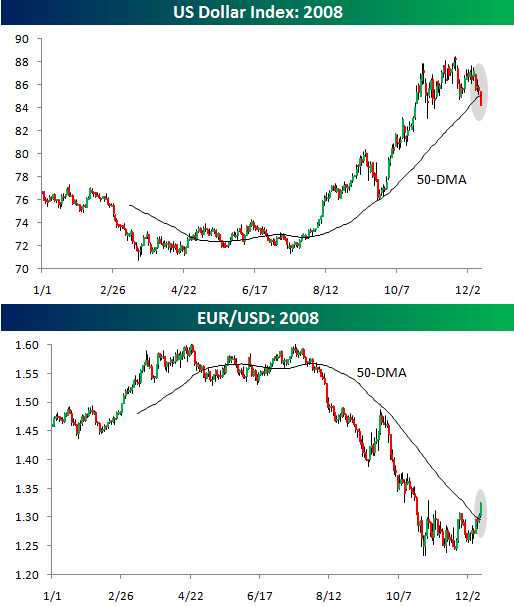
Share this:

  • Click to share on Reddit (Opens in new window) Reddit
  • Click to share on Facebook (Opens in new window) Facebook
  • Click to share on LinkedIn (Opens in new window) LinkedIn
  • More
  • Click to share on X (Opens in new window) X
  • Click to share on Pinterest (Opens in new window) Pinterest
  • Click to share on Tumblr (Opens in new window) Tumblr
  • Click to print (Opens in new window) Print
  • Click to email a link to a friend (Opens in new window) Email
Like Loading...

GoldMoney – Alert!

02 Tuesday Dec 2008

Posted by jschulmansr in Bollinger Bands, capitalism, commodities, Copper, Currency and Currencies, deflation, Finance, Fundamental Analysis, gold, inflation, Investing, investments, Latest News, Markets, mining stocks, Moving Averages, oil, precious, precious metals, silver, Stocks, Technical Analysis, Today, U.S. Dollar, Uncategorized

≈ 1 Comment

Tags

agricultural commodities, alternate energy, Austrian school, banking crisis, banks, bear market, Bollinger Bands, bull market, capitalism, central banks, China, Comex, commodities, communism, Copper, Currencies, currency, deflation, depression, diamonds, dollar denominated, dollar denominated investments, economic, economic trends, economy, financial, Forex, futures, futures markets, gold, gold miners, hard assets, heating oil, India, inflation, investments, James Turk, Keith Fitz-Gerald, market crash, Markets, mining companies, Moving Averages, natural gas, oil, palladium, Peter Schiff, physical gold, platinum, platinum miners, precious metals, price, price manipulation, prices, producers, production, protection, rare earth metals, recession, risk, run on banks, safety, Saudi Arabia, silver, silver miners, socialism, sovereign, spot, spot price, stagflation, Technical Analysis, timber, U.S. Dollar, volatility, warrants, Water

GoldMoney – Alert!

James Turk

A Successful Test of Support

In the last alert I referred to “the growing body of evidence” indicating that “the correction in gold that began after making a new record high in March above $1020 is ending.” Importantly, this point is confirmed by the following monthly chart presenting gold’s rate of exchange against the US dollar.

To explain this key development in technical terms, after making a new record high this past March, gold retraced back toward its previous record (marked in the above chart by the dashed line). Gold did the same thing back in 1978 after breaking above $200 in July that year (marked by the red circle), its previous record high. Gold climbed another 17% through October 1978, and then corrected the following month by testing $200. Support at that level held.

From there gold never looked back. It began a stellar advance that took it to $681.50, its month-end close in January 1980, the level that was just successfully tested.

The big difference between now and back then is the time needed to re-test support. The correction lasted only one month in 1978, but is now already eight months old. There are a number of reasons for this different result, but one is not the gold cartel. It was active back in the late 1970s too, dishoarding 775 tonnes from the International Monetary Fund in a vain and useless attempt to make the dollar look better by trying to cap the gold price.

The clear conclusion is that governments, even when they coordinate their effort, cannot in the end stop the market from bidding up the price of gold. So it is logical to expect a new record high for gold soon against the US dollar. It is noteworthy that gold closed this past month at new record highs against the British pound, Canadian dollar, Indian rupee and South African rand.

The driving force to exit national currencies and to buy gold is the same now as it was in the 1970s. Gold is better money than national currencies.


Published by GoldMoney
Copyright © 2008. All rights reserved.
Edited by James Turk, alert@goldmoney.com

Share this:

  • Click to share on Reddit (Opens in new window) Reddit
  • Click to share on Facebook (Opens in new window) Facebook
  • Click to share on LinkedIn (Opens in new window) LinkedIn
  • More
  • Click to share on X (Opens in new window) X
  • Click to share on Pinterest (Opens in new window) Pinterest
  • Click to share on Tumblr (Opens in new window) Tumblr
  • Click to print (Opens in new window) Print
  • Click to email a link to a friend (Opens in new window) Email
Like Loading...

Don’t Give Up on Gold Just Yet!+ Peter Schiff Bonus!

02 Tuesday Dec 2008

Posted by jschulmansr in capitalism, commodities, Copper, Currency and Currencies, deflation, Finance, Fundamental Analysis, gold, hard assets, inflation, Investing, investments, Latest News, Markets, mining stocks, Moving Averages, oil, precious metals, silver, Stocks, Technical Analysis, Today, U.S. Dollar, Uncategorized

≈ Comments Off on Don’t Give Up on Gold Just Yet!+ Peter Schiff Bonus!

Tags

agricultural commodities, alternate energy, Austrian school, banking crisis, banks, bear market, Bollinger Bands, bull market, capitalism, central banks, China, Comex, commodities, communism, Copper, Currencies, currency, deflation, depression, diamonds, dollar denominated, dollar denominated investments, economic, economic trends, economy, financial, Forex, futures, futures markets, gold, gold miners, hard assets, heating oil, India, inflation, investments, Keith Fitz-Gerald, market crash, Markets, mining companies, Moving Averages, natural gas, oil, palladium, Peter Schiff, physical gold, platinum, platinum miners, precious metals, price, price manipulation, prices, producers, production, protection, rare earth metals, recession, risk, run on banks, safety, Saudi Arabia, silver, silver miners, socialism, sovereign, spot, spot price, stagflation, Technical Analysis, timber, U.S. Dollar, volatility, warrants, Water

Don’t Give Up on Gold Just Yet – Seeking Alpha

By: Keith Fitz-Gerald of Monday Morning

If you were counting on gold to boost your returns this year, chances are you’ve been cruelly disappointed. In fact, when it comes to gold-related investments, virtually every category is down, making this one of the worst years in history for gold investors.

So, why is it that the largest of the large futures traders have some of the lowest net short positions in years? And what does this tell us about gold prices in the near future?

I’ll get to that in a minute. But first …

What Went Wrong?

In my analysis, I’ve identified the three missteps most investors made. First, investors did what they’d been told to do. But in their panic, they flocked to gold on the assumption that the yellow metal would perform as advertised. They forgot the “safety first” strategy that we’ve emphasized this year – one that included a safer, more-conservative way of buying gold.

Strike one.

Adding insult to injury, very few investors (Money Morning readers aside) failed to understand that the massive “de-leveraging” process that’s been part and parcel of the global financial crisis would put downward pressure on virtually every asset class at the same time. And that includes gold. As we’ve seen in the last few months, during times of global panic, investors around the world want the safety of U.S. dollars – and a lot of them – even more than they want gold right now.

Strike two.

But, above all else, most investors failed to realize that gold, just like any other asset, produces the best returns when it is attractively priced. So most investors made the classic mistake of piling in on the basis of performance. In other words, they bought in at the top.
Strike three.

What’s Changed?

During times of crisis, investors have been taught to latch onto those asset classes with the highest relative stability – including gold and precious metals. More often than not, investors who have followed these time-proven practices have been handsomely rewarded for doing so.

This time around, however, the parameters have changed, as the increased use of such “derivative” securities as “credit default swaps” has exacerbated the fallout from the global financial crisis, and touched off the aforementioned de-leveraging process. As asset markets have melted down, hedge funds, financial institutions worldwide, and even government-controlled sovereign wealth funds have taken heavy losses, forcing them to deal with unprecedented margin calls and redemption requests. Because this has never before been part of their crisis-management process, institutional investors have engaged in a massive, concerted effort to sell anything that’s at all liquid – including gold.

Making matters worse, the so-called “carry trade” unwound with a vengeance, forcing offshore investors to buy U.S. dollars in order to offset the sell-off of dollar-denominated assets. In contrast to what you’re hearing on the news, this really is not a sign that the dollar is any stronger than other currencies. Instead it signifies that the greenback is still the global currency of choice – much to the chagrin of Russia, Venezuela and others who begrudgingly tie themselves to it.

It also highlights something that most investors forget, or perhaps never knew in the first place. For better or worse, the dollar is the most liquid of the world’s reserve currencies. Part of that’s because many assets – especially oil – are still predominately traded in dollars.

The problem is that the dollar’s healthy appearance may be just that – an appearance that covers up an inner ill health. These still-hidden maladies have been worsened by the recent machinations of “Bailout Ben” – U.S. Federal Reserve Chairman Ben S. Bernanke – and U.S. Treasury Secretary Henry M. “Hank” Paulson Jr., whose fix-it programs have created a financial Frankenstein that will chase American taxpayers for years.

When the dollar was rallying back in May, and many experts were lauding the move as a turnaround in the making for the long-languishing U.S. currency, we warned investors not to be taken in by the market’s head fake. There were just too many underlying problems for the dollar’s rally to be sustainable. Ultimately, that rally sputtered, and the dollar reversed course and continued its decline.

This time, we again suspect that the dollar is rising too far too fast and that the spike we’ve seen in recent months may be nothing more than a flameout in the making.

However, given the relationship between the greenback and the yellow metal, this leads us to believe that gold could move higher next year if investors lose faith that the dollar merits their nearly exclusive attention right now.

Two pieces of closely related information appear to support this theory:

First, even though gold prices have tanked – a reality that under ordinary circumstances would mean more supply is available – dealers of gold bullion have experienced widespread physical shortages during the third quarter, according to the World Gold Council, a top trade association for the gold-mining industry. That, in turn, led dealers to both charge more and pay more than the spot price would indicate. Particularly strong demand was noted in China, India and the Middle East.

According to a Nov. 19 press release, the World Gold Council also noted that identifiable investment demand for gold in the third quarter was up $10.7 billion to 382 tons – double the levels of a year ago. At the same time, retail investment demand rose 121% to 232 tons, with especially for gold bars and gold coins reported in the Swiss, German and U.S. markets.

At the same time, the SPDR Gold Trust (GLD) – the largest exchange-traded fund (ETF) that invests in the yellow metal – noted that it now holds 755.06 tons of gold in trust, up 6.12 tons from the prior week. This is significant because authorized market participants like GLD have to add metal and increase their trading float when buying pressure is higher than selling pressure. This suggests that gold may be reaching the end of its downside run and that it may behave more like investors expect it to in the months ahead.

Second, we find it especially interesting that the largest of the commercial futures traders now hold the smallest net short positions they have held in several years. According to the U.S. Commodities Futures Trading Commission (CFTC), large commercial traders combined net short positions reflect only 71,116 contracts net short, one of the lowest net short positions the CFTC has reported since January 2006.

Historically, low net short positions have proven to be bullish influences. And net short levels of less than 30% total open interest have proven to be especially bullish.

The wild card here, of course, is that the markets are working through a de-leveraging process that’s far from over, meaning that normal supply and demand relationships are out of whack. Longer-term, however, everything we know about those relationships still appears to be intact.

That’s why we suggest that investors make gold a part of their investment program – if for no other reason than we are approaching levels typically associated with higher, rather than lower, returns.

But we can’t just pile in.

Short-term market conditions will transform anything other than a measured approach into a hazardous foray.

That’s why, when it comes to gold, we’ve repeatedly recited the market mantra: “Gold works over time, but not all the time.” [For insights on actual gold-investing strategies, check out the Money Morning special investment research report, “The Best Way to Use Gold to Protect Your Portfolio and Profit.” The report is free of charge.]

[Editor’s Note: Money Morning Investment Director Keith Fitz-Gerald is one of the top investment commentators in the global marketplace today. A noted columnist and a highly sought after speaker, Fitz-Gerald is also a gifted forecaster. Indeed, he’s especially distinguished himself during the current financial crisis, having told investors to expect historic levels of market volatility and having accurately predicted such crisis “aftershocks” as the big spike in energy and commodity prices that took place earlier this year. A new Money Morning report identifies five such aftershocks that are still to come, and explains how savvy investors can employ such “trigger events” as potential gateways to major profits. To read this report, which details all five of the aftershocks to expect, please click here. And don’t forget to check out Fitz-Gerald’s recently published 2009 stock market forecast, part of Money Morning’s ongoing “Outlook 2009” economic forecast series.]

=====================================================

Dare Something Worthy Today Too! Bonus! Peter Schiff

Peter Schiff Was Right!

Peter Schiff Analogies


$2000 Gold in 2009 says Peter Schiff

Share this:

  • Click to share on Reddit (Opens in new window) Reddit
  • Click to share on Facebook (Opens in new window) Facebook
  • Click to share on LinkedIn (Opens in new window) LinkedIn
  • More
  • Click to share on X (Opens in new window) X
  • Click to share on Pinterest (Opens in new window) Pinterest
  • Click to share on Tumblr (Opens in new window) Tumblr
  • Click to print (Opens in new window) Print
  • Click to email a link to a friend (Opens in new window) Email
Like Loading...

Golden Choice For Bailout Inflation Protection – Forbes.com

28 Friday Nov 2008

Posted by jschulmansr in Bollinger Bands, capitalism, commodities, Copper, Currency and Currencies, deflation, Finance, gold, hard assets, inflation, Investing, investments, Latest News, Markets, mining stocks, Moving Averages, oil, precious metals, silver, small caps, Stocks, Technical Analysis, Today, U.S. Dollar, Uncategorized

≈ 1 Comment

Tags

agricultural commodities, alternate energy, Austrian school, banking crisis, banks, bear market, Bollinger Bands, bull market, capitalism, central banks, China, Comex, commodities, communism, Copper, Currencies, currency, deflation, depression, diamonds, dollar denominated, dollar denominated investments, economic, economic trends, economy, financial, Forex, futures, futures markets, gold, gold miners, hard assets, heating oil, India, inflation, investments, market crash, Markets, mining companies, Moving Averages, natural gas, oil, palladium, physical gold, platinum, platinum miners, precious metals, price, price manipulation, prices, producers, production, protection, rare earth metals, recession, risk, run on banks, safety, Saudi Arabia, silver, silver miners, socialism, sovereign, spot, spot price, stagflation, Technical Analysis, timber, U.S. Dollar, volatility, warrants, Water

Golden Choice For Bailout Inflation Protection – Forbes.com

John Dobosz, 11.26.08, 11:50 AM EST

Gold and gold miners have taken flight in recent days as the world begins to focus on an inflationary future.

Since the problems associated with the current financial crisis began to take on a particular menace last summer, the response of our monetary institutions has involved moves that most students of economics would call inflationary, like aggressive reduction in targeted short-term lending rates and credit creation at a feverish pace.

Thanks to the deflationary forces that accompanied the unwinding of leverage in the financial system and in the flagging economy at large, the dollar actually rallied and gold suffered big time. From a post Jimmy Carter high of $1,011 in March, spot gold tumbled 30% down to $712 an ounce.

Now, however, investors seem to be awakening to the inflationary impact of the moves by the Federal Reserve and the Treasury Department. Over the past three weeks, gold has staged a rally, and over just the past week, it has looked more like a lift-off. Spot gold was above $830 for much of this holiday-shortened trading week, a gain of more than 15% from lows earlier this month, with most of that coming just since Thursday.

Moving higher more rapidly than gold bullion itself are shares of gold miners. The Philadelphia Gold and Silver Mining Index (XAU) added nearly 43% in just the past three days. This could indicate simply that the miners were more deeply oversold, or, if it persists, it could mean that investors are looking for escalating gold prices down the line. Either way, it looks like gold and the miners are staging a decent rally that could last until the first quarter of next year, according to Curt Hesler, editor of Professional Timing Service.

Hesler has several mining stocks that he likes for playing the new buoyancy in gold shares, from blue chips like Goldcorp (nyse: (GG) – news – people ) to smaller names like Yamana Gold (nyse: (AUY) – news – people ) and the tiny like US Gold Corp. (amex: (UXG) – news – people ). For smaller investors, perhaps it’s best to buy a basket of miners and jump on the train.

A great way to get into gold miners is through the Fidelity Select Gold (FSAGX) fund, a diversified grab bag that holds a small amount of gold bullion and a long roster of mining companies. Its biggest holdings are in Barrick Gold (nyse: (ABX) – news – people ), Goldcorp and Newmont Mining (nyse: (NEM) – news – people ) and Agnico Eagle (nyse: (AEM) – news – people ).

The expense ratio of FSAGX is one of the things to like most about this fund. At 0.81% it’s nearly half the 1.47% charged by most precious metals funds. Another nice feature is that it trades throughout the day, and you can get in and out when you like and even use limit orders when buying.

Lately the fund has been volatile, but it’s going in the right direction for the bulls. It’s up 40% in the past month. Of course, prior to that, it lost half of its value from late September through late October, overshooting even the steep correction in gold. Many advisers recommend an allocation of 5% to 10% in your portfolio to inflation hedges, like gold.

Click here to sign up to receive Stock of the Week next Monday morning.

Share this:

  • Click to share on Reddit (Opens in new window) Reddit
  • Click to share on Facebook (Opens in new window) Facebook
  • Click to share on LinkedIn (Opens in new window) LinkedIn
  • More
  • Click to share on X (Opens in new window) X
  • Click to share on Pinterest (Opens in new window) Pinterest
  • Click to share on Tumblr (Opens in new window) Tumblr
  • Click to print (Opens in new window) Print
  • Click to email a link to a friend (Opens in new window) Email
Like Loading...

Ten investing rules that will help you weather this stormy market – MarketWatch

28 Friday Nov 2008

Posted by jschulmansr in capitalism, commodities, Currency and Currencies, deflation, Finance, Fundamental Analysis, gold, inflation, Investing, investments, Latest News, Markets, mining stocks, Moving Averages, precious metals, small caps, Stocks, Technical Analysis, Today, U.S. Dollar, Uncategorized

≈ Comments Off on Ten investing rules that will help you weather this stormy market – MarketWatch

Tags

10 Rules of Investing, agricultural commodities, alternate energy, Austrian school, banking crisis, banks, bear market, Bollinger Bands, bull market, capitalism, central banks, China, Comex, commodities, communism, Copper, Currencies, currency, deflation, depression, diamonds, dollar denominated, dollar denominated investments, economic, economic trends, economy, financial, Forex, futures, futures markets, gold, gold miners, hard assets, heating oil, India, inflation, investments, market crash, Markets, mining companies, Moving Averages, natural gas, oil, palladium, physical gold, platinum, platinum miners, precious metals, price, price manipulation, prices, producers, production, protection, rare earth metals, recession, risk, run on banks, safety, Saudi Arabia, silver, silver miners, socialism, sovereign, spot, spot price, stagflation, Technical Analysis, timber, U.S. Dollar, volatility, warrants, Water

Ten investing rules that will help you weather this stormy market – MarketWatch

By Jonathan Burton, MarketWatch

LIFE SAVINGS

Learn a lesson — before you get one

Ten rules to remember about investing in the stock market

Especially now. Investment rules are tailor-made for tough times, allowing you to stick to a plan just when you need it most. Indeed, a rulebook is important in any market climate, but it tends to get tossed when stocks are soaring. That’s why sage investors warn people not to confuse a bull market with brains.
So with the economy looking more and more like the oil-shocked, stagflation-strapped 1970s, and stocks recoiling from rising unemployment, record energy prices and falling home values, it makes sense to dust off the old playbook and see how it applies today.
One of the most relevant lists of rules, from a legendary Wall Street veteran, is also among the least known. Beginning in the late 1950s, Bob Farrell pioneered technical analysis, which rates a stock not only on a company’s financial strength or business line but also on the strong patterns and line charts reflected in the shares’ trading history. Farrell also broke new ground using investor sentiment figures to better understand how markets and individual stocks might move.
Over several decades at brokerage giant Merrill Lynch & Co., Farrell had a front-row seat to the go-go markets of the late 1960s, mid-1980s and late 1990s, the brutal bear market of 1973-74, and October 1987’s crash. Out of those and other experiences came Farrell’s 10 “Market Rules to Remember.”
These days, Farrell lives in Florida, and efforts to contact him were unsuccessful. Still, the following rules he advocated resonate during volatile markets such as this:
1. Markets tend to return to the mean over time…
By “return to the mean,” Farrell means that when stocks go too far in one direction, they come back. If that sounds elementary, then remember that both euphoric and pessimistic markets can cloud people’s heads.
“It’s so easy to get caught up in the heat of the moment and not have perspective,” says Bob Doll, global chief investment officer for equities at money manager BlackRock Inc. “Those that have a plan and stick to it tend to be more successful.”
2. Excesses in one direction will lead to an opposite excess in the other direction…
Think of the market as a constant dieter who struggles to stay within a desired weight range but can’t always hit the mark.
“In the 1990s when we were advancing by 20% per year, we were heading for disappointment,” says Sam Stovall, chief investment strategist at Standard & Poor’s Inc. “Sooner or later, you pay it back.”
3. There are no new eras — excesses are never permanent…
This harkens to the first two rules. Many investors try to find the latest hot sector, and soon a fever builds that “this time it’s different.” Of course, it never really is. When that sector cools, individual shareholders are usually among the last to know and are forced to sell at lower prices.
“It’s so hard to switch and time the changes from one sector to another,” says John Buckingham, editor of The Prudent Speculator newsletter. “Find a strategy that you believe in and stay put.”
4. Exponential rapidly rising or falling markets usually go further than you think, but they do not correct by going sideways…
This is Farrell’s way of saying that a popular sector can stay hot for a long while, but will fall hard when a correction comes. Chinese stocks not long ago were market darlings posting parabolic gains, but investors who came late to this party have been sorry.
5. The public buys the most at the top and the least at the bottom…
Sure, and if they didn’t, contrarian-minded investors would have nothing to crow about. Accordingly, many market technicians use sentiment indicators to gauge investor pessimism or optimism, then recommend that investors head in the opposite direction.
Some closely watched indicators have been mixed lately. At Investors Intelligence, an investment service that measures the mood of more than 100 investment newsletter writers, bullish sentiment rose last week to 44.8% from 37.9% the week before. Bearish sentiment slipped to 31.1% from 32.2%. Meanwhile, the American Association of Individual Investors survey was less positive, with bearish sentiment at 45.8% and bulls at 31.4% .
Learn a lesson — before you get one!
6. Fear and greed are stronger than long-term resolve…
Investors can be their own worst enemy, particularly when emotions take hold.
Stock market gains “make us exuberant; they enhance well-being and promote optimism,” says Meir Statman, a finance professor at Santa Clara University in California who studies investor behavior. “Losses bring sadness, disgust, fear, regret. Fear increases the sense of risk and some react by shunning stocks.”
After grim trading days like Friday’s nearly 400-point tumble, coming after months of downward pressure on stocks, it’s easy to think you’re the patsy at this card table. To counter those insecure feelings, practice self-control and keep long-range portfolio goals in perspective. That will help you to be proactive instead of reactive.
“It’s critical for investors to understand how they’re cut,” says the Prudent Speculator’s Buckingham. “If you can’t handle a 15% or 20% downturn, you need to rethink how you invest.”
7. Markets are strongest when they are broad and weakest when they narrow to a handful of blue-chip names…
Markets and individual sectors can move in powerful waves that take all boats up or down in their wake. There’s strength in numbers, and such broad momentum is hard to stop, Farrell observes. In these conditions you either lead, follow or get out of the way.
When momentum channels into a small number of stocks, it means that many worthy companies are being overlooked and investors essentially are crowding one side of the boat. That’s what happened with the “Nifty 50” stocks of the early 1970s, when much of the U.S. market’s gains came from the 50 biggest companies on the New York Stock Exchange. As their price-to-earnings ratios climbed to unsustainable levels, these “one-decision” stocks eventually sunk.
Chart of SPX
8. Bear markets have three stages — sharp down, reflexive rebound and a drawn-out fundamental downtrend…
Is this a bear market? That depends on where you draw the starting line. With Friday’s close, the S&P 500 Index (SPX):
(SPX) 896.24, +8.56, +1.0%) is down 13.1% since its October 9 peak. Not the 20%-plus decline that typically marks a bear, but a vicious encounter nonetheless.
Where are we now? A chart of the S&P 500 shows a couple of sharp downs and subsequent rebounds in the past six months, with a tighter trading range since April. It remains to be seen if we can avoid a tortured period of the kind seen from 2000 to 2002, when sporadic rallies couldn’t snap a slow, protracted decline.
9. When all the experts and forecasts agree — something else is going to happen…
As Stovall, the S&P investment strategist, puts it: “If everybody’s optimistic, who is left to buy? If everybody’s pessimistic, who’s left to sell?”
Going against the herd as Farrell repeatedly suggests can be very profitable, especially for patient buyers who raise cash from frothy markets and reinvest it when sentiment is darkest.
10. Bull markets are more fun than bear markets (unless you are shorting the markets)…
No kidding!
DARE SOMETHING WORTHY TODAY TOO! Bonus: Top Performing Precious Metals Mutual Funds
TOP PERFORMING PRECIOUS METALS FUNDS
FUND 1-Month
Return
1-Year
Return
3-Year
Return
ProFunds Precious Metals (PMPIX)

42.6%

-68.8

-21.6%

Fidelity Select Gold (FSAGX)

35.4

-42.4

0.5

American Century Global Gold (BGEIX)

34.8

-48.5

-4.2

OCM Gold Fund (OCMGX)

34.1

-45.6

1.4

Evergreen Precious Metals (EKWBX)
32.5

-43.5

2.4

Franklin Gold and Precious Metals (FKRCX)

32.0

-50.6

-2.6

Van Eck Intl Investors Gold (INIVX)

31.9

-49.4

2.3

USAA Precious Metals & Minerals (USAGX)

31.6

-47.4

3.0

GAMCO Gold AAA (GOLDX)

31.6

-48.6

-1.4

DWS Gold & Precious Metals (SCGDX)

31.1

-49.8

-3.5


Through 11/24/08. Source: Morningstar.com


Share this:

  • Click to share on Reddit (Opens in new window) Reddit
  • Click to share on Facebook (Opens in new window) Facebook
  • Click to share on LinkedIn (Opens in new window) LinkedIn
  • More
  • Click to share on X (Opens in new window) X
  • Click to share on Pinterest (Opens in new window) Pinterest
  • Click to share on Tumblr (Opens in new window) Tumblr
  • Click to print (Opens in new window) Print
  • Click to email a link to a friend (Opens in new window) Email
Like Loading...

Smart Money Is Starting to Pour into Gold Stocks- Seeking Alpha

24 Monday Nov 2008

Posted by jschulmansr in commodities, Copper, Currency and Currencies, deflation, Finance, gold, hard assets, inflation, Investing, investments, Latest News, Markets, mining stocks, precious metals, silver, U.S. Dollar, Uncategorized

≈ 1 Comment

Tags

agricultural commodities, alternate energy, Austrian school, banking crisis, banks, bear market, Bollinger Bands, bull market, capitalism, central banks, China, Comex, commodities, communism, Copper, Currencies, currency, deflation, depression, diamonds, dollar denominated, dollar denominated investments, economic, economic trends, economy, financial, Forex, futures, futures markets, gold, gold miners, hard assets, heating oil, India, inflation, investments, market crash, Markets, mining companies, Moving Averages, natural gas, oil, palladium, physical gold, platinum, platinum miners, precious metals, price, price manipulation, prices, producers, production, protection, rare earth metals, recession, risk, run on banks, safety, Saudi Arabia, silver, silver miners, socialism, sovereign, spot, spot price, stagflation, Technical Analysis, timber, U.S. Dollar, volatility, warrants, Water

Smart Money Is Starting to Pour into Gold Stocks- Seeking Alpha 

By: Boris Sobolev of Resource Stock Guide.com

In our last update, we expected short term weakness in gold followed by an upward reversal.

In the short term, in order to avoid seeing gold close below $700, it must move above resistances of $780-810 relatively quickly and stabilize close to that range.

And we got exactly what was needed, although the metal is yet to stabilize near the $800s. Gold briefly touched $699, making a higher low, and continued to consolidate between $720 and $750. On Friday, gold spiked 57 points or almost 8% to its first resistance of $800.

While there is some resistance near $825-$850 for the short term, the weekly chart for gold is starting to look promising. But before the downtrend line (now between $900 and $920) is penetrated, we cannot say that the correction in gold is over and that the new stage of the gold bull market has begun.

Fundamentals remain exceptionally bullish on all fronts. Real interest rates are negative while inflation expectations have little room to go lower. A huge wave of fiscal stimulus is on the way.

The independent research house GFMS Ltd. had the following to say about gold demand:

Dollar demand for gold reached an all-time quarterly record of US$32bn in the third quarter of 2008. Tonnage demand was also 18 percent higher than a year earlier.

Identifiable investment demand, which incorporates demand for gold through exchange traded funds (ETFs), bars and coins, was the biggest contributor to overall demand during the quarter; it was up to US$10.7bn (382 tonnes), double the amount from a year earlier.

Retail investment demand rose 121 percent to 232 tonnes in Q3, with strong bar and coin buying reported in Swiss, German and US markets. The quarter also witnessed widespread reports of gold shortages among bullion dealers across the globe, as investors searched for a safe haven. During the quarter, Europe reached an all-time record 51 tonnes of bar and coin buying and France became a net investor in gold for the first time since the early 1980s.

Consumer demand for gold jewellery was also at a record with buyers coming back in to the market at lower price levels than previously, around and below $800. India (traditionally the world’s largest gold jewellery consumer, with an average over the past five years of 21% of world jewellery demand), staged a strong recovery during the quarter, with the dollar value of gold in jewellery rising by 65% year-on-year.

These changes in “identifiable demand” were offset by outflows in “inferred investment”. With recessionary fears looming, hedge funds liquidated investment positions in gold as they were forced to raise cash, and institutions liquidated commodity index investments, including gold. The trend largely reflects gold’s better performance relative to other assets and also explains why the gold price did not perform better during the quarter in the face of very strong demand.

Gold sales by central banks are at their lowest levels since 1999.

Total global gold production contracted 0.4% in 2007, to an eleven-year low. In the last four months, several companies have announced that they are curtailing production or delaying projects, and all companies are at least reviewing their spending plans. Randgold Resources (GOLD) expects global gold production to decline by between 15% and 20% in the next three or four years, as unprofitable operations are squeezed out and difficult market conditions delay the development of new mines.

While this is a difficult process, the whole PM industry will come out of this slump stronger and more resilient. Companies that survive will do exceptionally well.

Unlike most stock indices which made lower lows last week, all gold indices made higher lows. This positive divergence gives us reason to believe that smart money is starting to pour funds into gold stocks – pointing to the evidence of the first sector rotation in this bear market.

Friday saw one of the biggest up-days on HUI, which climbed 46 points or 27.5%. Gold was by far the best performing sector in the entire stock market. We believe that these are all signs that the sector rotation to precious metals and related stocks is underway.

If gold continues to hold up strongly and the stock market rebounds or at least stabilizes, the $HUI index could quickly recover to 275-325 levels.

However, gold stocks continue to underperform the metal. In order for the bullish scenario outlined above to come to fruition, we need to see the downtrend line in the $HUI & Gold ratio be taken out to the upside.

We believe that this should happen in the coming days or weeks. This point of view is based on the fact that the Gold/Oil ratio and the Gold/Industrial Metals ratio have soared to the best levels for gold producers in the past 10 years. This allows us to expect substantial reduction in costs of production and capital expenditures for most mining companies.

Paired with the strong gold price, margins for gold producers should start to improve. We do not know of any other sector in the equity market which is expected to see increases in profit margins.

While the above is directly beneficial for the producers, for juniors, the latest round of acquisition activity gives us reason to believe that the juniors are finally bottoming out.

From a negative point of view, continuing tax selling pressure before the year end could temporarily weaken these positives.

Those investors who are considering putting money in the gold sector should consider the following low-risk, cash generating producers: See RSG Newsletter.

Share this:

  • Click to share on Reddit (Opens in new window) Reddit
  • Click to share on Facebook (Opens in new window) Facebook
  • Click to share on LinkedIn (Opens in new window) LinkedIn
  • More
  • Click to share on X (Opens in new window) X
  • Click to share on Pinterest (Opens in new window) Pinterest
  • Click to share on Tumblr (Opens in new window) Tumblr
  • Click to print (Opens in new window) Print
  • Click to email a link to a friend (Opens in new window) Email
Like Loading...

Demanding Gold – Hard Assets Investor

24 Monday Nov 2008

Posted by jschulmansr in capitalism, commodities, Copper, Currency and Currencies, deflation, Finance, Fundamental Analysis, gold, hard assets, inflation, Investing, investments, Latest News, Markets, mining stocks, precious metals, silver, Technical Analysis, Today, U.S. Dollar, Uncategorized

≈ Comments Off on Demanding Gold – Hard Assets Investor

Tags

agricultural commodities, alternate energy, Austrian school, banking crisis, banks, bear market, Bollinger Bands, bull market, capitalism, central banks, China, Comex, commodities, communism, Copper, Currencies, currency, deflation, depression, diamonds, dollar denominated, dollar denominated investments, economic, economic trends, economy, financial, Forex, futures, futures markets, gold, gold miners, hard assets, heating oil, India, inflation, investments, market crash, Markets, mining companies, Moving Averages, natural gas, oil, palladium, physical gold, platinum, platinum miners, precious metals, price, price manipulation, prices, producers, production, protection, rare earth metals, recession, risk, run on banks, safety, Saudi Arabia, silver, silver miners, socialism, sovereign, spot, spot price, stagflation, Technical Analysis, timber, U.S. Dollar, volatility, warrants, Water

Demanding Gold – Hard Assets Investor

Written by Julian Murdoch of Hard Assets Investor 

Friday night’s headlines were straightforward: “Gold surges to top $800 on safe-haven buying.” And most of the analysis followed a familiar pattern:

  • The price of gold has declined as a result of liquidity selling
  • Once everyone sells the gold, the market will stabilize
  • The price will rally as investors seek a safe haven in the face of monster money-printing by the U.S. government

It’s a convenient story, and one that makes some prima-facie sense. But like any Monday morning quarterbacking (including my own), there’s rarely a way to actually know exactly why something goes up and down. Except, of course, for supply and demand. It’s always about supply and demand.

Which is why I was planning on writing about gold this week even before we saw the metal pop almost 6% Friday, to close at $801.60 (NY Spot), and before we saw the big gold miners like Barrick have monster days, with that company closing up 31%. Pops like that are enough to make anyone sit up and take notice, despite our general concerns about buying miners vs. metals.

Hence my plan to cover gold. The third week in November, you see, is when the World Gold Council releases the supply-and-demand numbers that carry us through the end of the year. And the astonishing thing isn’t so much the numbers, but that they seem to have gone largely unnoticed by the press in describing the rally. Let’s take a look at the charts.


There are a few points to note here. First, this measures demand in tonnes, not in dollars. We’ll get to dollars in a second.

But the big thing to note here is that the 2008 number is an estimate that we’ve created by applying last year’s Q3-to-Q4 trends to 2008. From Q3 to Q4 2007, gold demand dropped an unexpected 15% on a tonnage basis. The chart above suggests that, even if gold demand falls again, total tonnage demand for 2008 will equal 2007. If Q4’08 demand instead remains steady heading into the end of the year, total 2008 demand will be the biggest in the last five years.

Regardless, however, the strong continued demand, particularly from the investment community, is even more dramatic in dollar terms.


Gold Demand ($, Billions


In dollar terms, gold is experiencing tremendous demand growth. There’s no rocket science here: The average price of gold in 2007 was just under $700. The average price of gold in 3Q 2008 was $871, down from the first-quarter average of $924. All that means is that that same physical demand is coming at a time of rising prices (or a weak dollar, depending on your perspective).

Gold - London PM Fix 2000 - present


To put the demand in perspective, here’s the juicy tidbit direct from the World Gold Council press release:


“Dollar demand for gold reached an all-time quarterly record of US$32bn in the third quarter of 2008 as investors around the world sought refuge from the global financial meltdown, and jewelry buyers returned to the market in droves on a lower gold price. This figure was 45% higher than the previous record in Q2 2008. Tonnage demand was also 18% higher than a year earlier.”


This dollar demand is driven almost entirely by increased demand from exchange-traded funds and physical coin investments, offsetting a decline in jewelry demand.


Gold Demand (Share)


To be fair, this continued demand wasn’t entirely unexpected, nor was it completely unreported. Most of the weekend paper hyperbole about the gold rally did pay homage to demand, albeit without citing the nice hard figures we have from the World Gold Council. But what seems really underreported is that the actual supply demand deficit is frankly staggering.


Gold Surplus/Deficit

The reasons for this deficit are fairly straightforward: The quarterly demand is high, and one of the major sources of supply over the last few years has dried up – sales by central banks. The Central Bank Gold Agreement, which set limits on gold sales in 1999 to stabilize the market after the foundation of the euro, is set to run its course in 2009, but the 2008 limits on CBGA sales (500 tonnes per year) aren’t even close to being reached, and the reality is that European central banks may simply be done offloading their excess gold reserves.

If true, that means a major source of supply is simply going away. It’s easy to visualize a pathway from the central banks into the hands of investors-a shift in ownership. But that shift in ownership may be complete, and thus, if investor demand continues, it will rely on other traditional sources of gold-namely mines-to get at the stuff.

That would set the stage for continued deficits, higher prices and busy miners. It strikes me that that’s the real story of last week’s rallies.

MY NOTE: Inother simpler words, demand up and increasing = prices increasing!

Disclosure: Long Precious Metals and Stocks

jschulmansr

Share this:

  • Click to share on Reddit (Opens in new window) Reddit
  • Click to share on Facebook (Opens in new window) Facebook
  • Click to share on LinkedIn (Opens in new window) LinkedIn
  • More
  • Click to share on X (Opens in new window) X
  • Click to share on Pinterest (Opens in new window) Pinterest
  • Click to share on Tumblr (Opens in new window) Tumblr
  • Click to print (Opens in new window) Print
  • Click to email a link to a friend (Opens in new window) Email
Like Loading...

Peter Schiff on Fast Money Calls $2,000 Gold in 2009–Gold Stock Bull

24 Monday Nov 2008

Posted by jschulmansr in capitalism, commodities, Copper, Currency and Currencies, deflation, Finance, Fundamental Analysis, gold, hard assets, inflation, Investing, investments, Latest News, Markets, mining stocks, precious metals, silver, Technical Analysis, Today, U.S. Dollar, Uncategorized

≈ Comments Off on Peter Schiff on Fast Money Calls $2,000 Gold in 2009–Gold Stock Bull

Tags

agricultural commodities, alternate energy, Austrian school, banking crisis, banks, bear market, Bollinger Bands, bull market, capitalism, central banks, China, Comex, commodities, communism, Copper, Currencies, currency, deflation, depression, diamonds, dollar denominated, dollar denominated investments, economic, economic trends, economy, financial, Forex, futures, futures markets, gold, gold miners, hard assets, heating oil, India, inflation, investments, market crash, Markets, mining companies, Moving Averages, natural gas, oil, palladium, physical gold, platinum, platinum miners, precious metals, price, price manipulation, prices, producers, production, protection, rare earth metals, recession, risk, run on banks, safety, Saudi Arabia, silver, silver miners, socialism, sovereign, spot, spot price, stagflation, Technical Analysis, timber, U.S. Dollar, volatility, warrants, Water

Peter Schiff on Fast Money Calls $2,000 Gold in 2009–Gold Stock Bull

By Jason Hamlin of Gold Stock Bull
 
Mr. Schiff was mocked for calling the market collapse before it happened, correctly predicted that gold would reach $1,000 in 2008 and recently schooled the CNBC crew at Fast Money as he predicts the market has much further to drop and gold will hit $2,000 in 2009. If you’ve been a subscriber to Gold Stock Bull for a while, you know we have been making similar calls and are aligned with his views. 2008 may prove to be the last time you will be able to get gold under $1,000 or silver under $10. The liquidation and deleveraging has created a short-term buying opportunity across all commodities and for precious metals in particular. Get some while you still can because when the floor falls out from beneath the dollar, the party is over.


Share this:

  • Click to share on Reddit (Opens in new window) Reddit
  • Click to share on Facebook (Opens in new window) Facebook
  • Click to share on LinkedIn (Opens in new window) LinkedIn
  • More
  • Click to share on X (Opens in new window) X
  • Click to share on Pinterest (Opens in new window) Pinterest
  • Click to share on Tumblr (Opens in new window) Tumblr
  • Click to print (Opens in new window) Print
  • Click to email a link to a friend (Opens in new window) Email
Like Loading...

Peter Schiff: Gold Will Rise, Dollar Will Collapse – Hard Assets Investors

19 Wednesday Nov 2008

Posted by jschulmansr in commodities, Copper, Currency and Currencies, deflation, Finance, gold, hard assets, inflation, Investing, investments, Latest News, Markets, mining stocks, precious metals, silver, U.S. Dollar, Uncategorized

≈ Comments Off on Peter Schiff: Gold Will Rise, Dollar Will Collapse – Hard Assets Investors

Tags

agricultural commodities, alternate energy, Austrian school, banking crisis, banks, bear market, Bollinger Bands, bull market, capitalism, central banks, China, Comex, commodities, communism, Copper, Currencies, currency, deflation, depression, diamonds, dollar denominated, dollar denominated investments, economic, economic trends, economy, financial, Forex, futures, futures markets, gold, gold miners, hard assets, heating oil, India, inflation, investments, market crash, Markets, mining companies, Moving Averages, natural gas, oil, palladium, physical gold, platinum, platinum miners, precious metals, price, price manipulation, prices, producers, production, protection, rare earth metals, recession, risk, run on banks, safety, Saudi Arabia, silver, silver miners, socialism, sovereign, spot, spot price, stagflation, Technical Analysis, timber, U.S. Dollar, volatility, warrants, Water

Peter Schiff: Gold Will Rise, Dollar Will Collapse – Features and Interviews – Hard Assets Investors 

Written by Administrator –  Hard Assets Investor


Norman: Let’s see the performance from this point forward; we’ll look back at this again and we’ll revisit this issue.

Let’s talk about something else, something that you have also … and I just mentioned it … the U.S. dollar. You were very, very negative. In the last month, we have seen unprecedented actions by the U.S. Fed in terms of expansion of the monetary basis; in other words, printing money … what you call printing money … and despite that, the dollar has remained incredibly strong.

How do you explain that according to your logic?

Schiff: Everything the government is doing is inherently negative for the dollar, and all of this…

Norman: It’s not playing out that way.

Schiff: It will; you’ve got to give it time.

I remember when I was on television talking about the subprime and people were telling me it’s no big deal, and I said, just wait a while; give it time.
Look, everything that we’re doing – all the bailouts, all the stimulus packages – this is all being financed by inflation. It’s inherently terrible for the dollar.

Norman: But you just said yourself that everything is deflating.

Schiff: But right now, Mike, you’re getting this de-leveraging, and this is benefitting the dollar, so despite the horrific fundamentals for the dollar, it’s going up anyway.
But ultimately, when this phony rally runs out of steam, the dollar is going to collapse, and that’s when we’re going to have a much greater crisis because now you’re going to have a collapsing dollar, which is going to push long-term interest rates up, commodity prices up.

Norman: I still don’t understand why the dollar is going to collapse. So you’re saying that the Fed is just going to allow … or leave this enormous amount of liquidity in there, that at some point down the road, if we recover, they’re not going Scto take it out?

Schiff: Look, they have no control over it. The Fed is trying to artificially reflate our phony economy, right?

We had this economy that was based on Americans borrowing money and then spending it on products. We have this huge debt finance bubble which is collapsing, and it’s being supported by foreigners.

But when this artificial demand for Treasuries goes away, the Fed is going to try to print a lot of money and the dollar is going to get killed.

Norman: All right; I’m going to ask you to hold on. Folks, check back because we’re going to do the second part of my interview with Peter Schiff, so check back to this site. This is Mike Norman; bye for now.

Mike Norman, HardAssetsInestor.com (Norman): Hello everybody, and welcome back for another installment of HardAssetsInvestor.com’s interview series. I’m Mike Norman, your host. Well, he’s back. Mr. Doom and Gloom is here … Peter Schiff, president of Euro Pacific Capital and author of the new book just out, “Bull Moves in Bear Markets.”Peter Schiff, president of Euro Pacific Capital (Schiff): “The Little Book …”Norman: “The Little Book …”; it’s in The Little Book Series. Well look … the last time you were here, things were kind of going your way, but it looks like things have turned upside down.
All kidding aside, I know your big thing over the last seven or eight years has been gold. We’re very supportive of gold on this show; we think that probably people should have some gold as part of their overall portfolio mix. But let’s just look at what happened.Several weeks ago, the U.S. stock market had its worst week in history … even going back to the 1930s … worst week in history. I saw a breakdown of various assets – all assets really – stocks, bonds, gold, commodities, oil. Gold was at the bottom of the list. The top-performing asset, and something that you hate, was the U.S dollar.So how do you explain that? If we are going through the worst economic and financial crisis in history – precisely what gold is supposed to protect against – why would it perform so bad?Schiff: Well, I think it will perform very well; you got to give it a little bit more time.Norman: More time or more decimation?

Schiff: No, what’s happening right now, Mike, is just de-leveraging, and so gold is going down for the same reason a lot of stocks are going down, a lot of commodities are going down. There’s a lot of leverage in this system, there’s a lot of margin calls, a lot of liquidation; a lot of people are having to sell whatever they own to pay off their debts.

Norman: But look at where the money is going … the money is going into U.S. sovereigns, Treasuries … it’s going into the U.S. dollar.

Schiff: For now.

Norman: Why for now?

Schiff: Right now there’s some perception of safety there, but it’s the opposite of the leveraging. If you’re selling your assets, you’re accumulating dollars; but ultimately right now, it’s like there’s been this gigantic nuclear explosion in the United States, and everybody is running toward the blast. Pretty soon they’re going to figure out they’re going in the wrong direction.

Norman: You always talk about gold as a currency, and we have seen currencies appreciate – the yen, for example, the dollar tremendously, for example, but gold has not held up.

Schiff: Well, if you actually look at gold versus other currencies, in the last couple of weeks gold has made new record highs in terms of the South African rand, the Canadian and Australian dollars … so gold was not doing as poorly as many of the currencies, and I think this is all short term.

I think you’re going to see a lot of money moving into gold, and if you look at how much gold has gone down from the peak, the peak was about a thousand … it’s off about 25%. Stocks are off 40%. Gold is still up during this year against the Dow.

Stay Tuned for Part II<!—-> of our interview with Peter Schiff.
 

Share this:

  • Click to share on Reddit (Opens in new window) Reddit
  • Click to share on Facebook (Opens in new window) Facebook
  • Click to share on LinkedIn (Opens in new window) LinkedIn
  • More
  • Click to share on X (Opens in new window) X
  • Click to share on Pinterest (Opens in new window) Pinterest
  • Click to share on Tumblr (Opens in new window) Tumblr
  • Click to print (Opens in new window) Print
  • Click to email a link to a friend (Opens in new window) Email
Like Loading...

Can a Dubai Silver ETF Send Global Spot Prices Higher?

18 Tuesday Nov 2008

Posted by jschulmansr in capitalism, commodities, Copper, Currency and Currencies, deflation, Finance, gold, hacking, inflation, Investing, investments, Latest News, Markets, precious metals, silver, Today, U.S. Dollar, Uncategorized

≈ Comments Off on Can a Dubai Silver ETF Send Global Spot Prices Higher?

Tags

agricultural commodities, alternate energy, Austrian school, banking crisis, banks, bear market, Bollinger Bands, bull market, capitalism, central banks, China, Comex, commodities, communism, Copper, Currencies, currency, deflation, depression, diamonds, dollar denominated, dollar denominated investments, economic, economic trends, economy, financial, Forex, futures, futures markets, gold, gold miners, hard assets, heating oil, India, inflation, investments, market crash, Markets, mining companies, Moving Averages, natural gas, oil, palladium, physical gold, platinum, platinum miners, precious metals, price, price manipulation, prices, producers, production, protection, rare earth metals, recession, risk, run on banks, safety, Saudi Arabia, silver, silver miners, socialism, sovereign, spot, spot price, stagflation, Technical Analysis, timber, U.S. Dollar, volatility, warrants, Water

Can a Dubai Silver ETF Send Global Spot Prices Higher? – Seeking Alpha

By: Peter Cooper of  Arabian Money.net

The Dubai Multi Commodities Center is understood to be putting the finishing touches to an exchange traded fund for silver with a launch likely next month as demand for silver has surged in the past six months.

Local bullion dealers are having to fly heavy silver bullion bars in from around the globe to meet demand as traditional sources closer to Dubai have been exhausted. The DMCC has successfully established itself as a regional hub for commodities trading over the past few years, and has its own swanky new business park with its gold, silver and diamond towers.

City of Gold

Around 20 per cent of the world’s physical gold trade is conducted through Dubai which used to be the epicenter of gold smuggling to India thirty years ago when import taxes were sky high. Nowadays Dubai is a convenient logistics center for commodities traders and still tax free.

The details of the silver ETF are being kept under wraps for the launch but plans seem advanced. Local jewelers have long used silver in a 25:75 amalgam with gold to create white-gold which is popular with consumers.

But clearly the ETF is an strictly an investment product, and demand for the shiniest of metals has been rising strongly, as evidenced by the high premiums now being paid on coins and bullion locally.

ETF price advantage

The latter also gives the ETF a natural advantage. Its price will be closely linked to the lower spot price for physical silver, and not be inflated by the high premiums now paid on physical silver.

Investors will no doubt appreciate this keen pricing advantage, and hope to also profit from the leverage silver offers to the gold price. In previous gold price booms silver has outperformed the yellow metal, and the gold-to-silver price ratio has fallen sharply.

Will the new Dubai silver ETF have a big enough impact on the tiny global silver market to send prices higher like the Hunt Brothers did in the late 1970s when they cornered the market? Well, nothing succeeds like success and a silver ETF in Dubai looks like being the right product in the right place at the right time.

My Note: A Word to the Wise is sufficient!

See My Ealier Post from Today: All The Gold In Saudi Arabia, if they buy as much Silver as they have Gold – Look Out…

My Disclosure: I am long all Precious Metals, Mining Companies, Etf’s, and in my opinion you should be too! – jschulmansr 

Share this:

  • Click to share on Reddit (Opens in new window) Reddit
  • Click to share on Facebook (Opens in new window) Facebook
  • Click to share on LinkedIn (Opens in new window) LinkedIn
  • More
  • Click to share on X (Opens in new window) X
  • Click to share on Pinterest (Opens in new window) Pinterest
  • Click to share on Tumblr (Opens in new window) Tumblr
  • Click to print (Opens in new window) Print
  • Click to email a link to a friend (Opens in new window) Email
Like Loading...

Dudley Baker: “It’s either the end of the world or a fabulous buying opportunity”

18 Tuesday Nov 2008

Posted by jschulmansr in commodities, Copper, deflation, Finance, gold, hard assets, inflation, Investing, investments, Latest News, Markets, mining stocks, precious metals, silver, Uncategorized

≈ Comments Off on Dudley Baker: “It’s either the end of the world or a fabulous buying opportunity”

Tags

agricultural commodities, alternate energy, Austrian school, banking crisis, banks, bear market, bear stearns, Bollinger Bands, bull market, capitalism, central banks, China, Comex, commodities, communism, Copper, Currencies, currency, deflation, depression, diamonds, dollar denominated, dollar denominated investments, economic, economic trends, economy, financial, Forex, futures, futures markets, gold, gold miners, hard assets, heating oil, India, inflation, investments, market crash, Markets, mining companies, Moving Averages, natural gas, oil, palladium, physical gold, platinum, platinum miners, precious metals, price, price manipulation, prices, producers, production, protection, rare earth metals, recession, risk, run on banks, safety, Saudi Arabia, silver, silver miners, socialism, sovereign, spot, spot price, stagflation, Technical Analysis, timber, U.S. Dollar, volatility, warrants, Water

Dudley Baker: “It’s either the end of the world or a fabulous buying opportunity”

Source: The Gold Report  11/18/2008


His pitch is irresistible: “Buy a basket of juniors with warrants and it could be the easiest 500% you’ll ever make.” In this exclusive look at one of the most overlooked and misunderstood investment vehicles, Dudley Baker of PreciousMetalsWarrants.com explains to The Gold Report exactly what warrants are and how they increase the odds of winning vastly higher returns. With a little arm-twisting, Baker even reveals some of his most prized “unbelievable” opportunities.”

The Gold Report: Could you start by explaining what a warrant is and how it differs from a futures contract?

Dudley Baker: A warrant is basically a security. It gives the holder the right, but not the obligation, to purchase the underlying stock at a specific price within a specific period of time. It sounds very similar to a call option except that it really is a security and a warrant will trade in much the same way as common shares. A warrant is assigned a symbol and will trade on the exchange or, in the U.S., it will have U.S.-assigned symbol where it can be traded over-the-counter.

TGR: Are all the warrants traded in the over-the-counter market?

DB: No, no. Most will always be private. Many precious metals investors know ‘warrants’ because they are frequently issued in a private placement. But most of those warrants never trade on any exchange and they’re not transferable. On my website only cover those warrants that are trading, the ones you and I could go out and buy. For example, Warren Buffet conducted a private transaction with General Electric and Goldman Sachs. There will never be a market for those. That’s the distinction, whether it’s a warrant with a private placement or an initial public offering. In rare cases a company can get the warrants listed if they were issued in connection with a private placement.

TGR: So Buffet purchases the stock and then is awarded the warrants. Is it GE or Buffet who decides to make those warrants transferable?

DB: In this case it probably would be Buffet. Since he actually owns those warrants it’s his decision.

TGR: Let’s to back to the private placement example. Aren’t warrants used as a sweetener for a private placement investment? In that case, who makes the decision as to whether those warrants are transferable?

DB: The company will make that decision. In Warren Buffet’s case, let’s say that he’s the only holder of the Goldman Sachs and GE warrants. Even if the company said we want these to trade, there’s nobody to trade them because there’s only one guy, Buffet, who owns them and he’s probably not going to trade them. The chances are that he would just convert the warrants or the company would buy them back at some point. But in the case of the private placement of a mining company, there may be hundreds or even a thousand participants. If the company decides to list those warrants, those 500 to 1,000 individuals could decide to trade them. So now we’ve got some liquidity. And we always need that liquidity. So there are a lot of opportunities even for the bigger companies that have warrants trading.

TGR: So when warrants are initially issued, they could be privately placed, or publicly traded.

DB: Right.

TGR: Are most of the warrants that are publicly traded related to financial transactions other than mergers?

DB: They could be issued in connection with the financing for an initial public offering. A lot of warrants start with the private placements, the initial public offerings, and mergers. So warrants that are trading come about through a number of different circumstances.

TGR: Given the current stock market and the merger and acquisition environment, would you expect increased interest in the purchase of warrants?

DB: You mean what is the future for warrants?

TGR: Yes.

DB: Let’s put it this way. The most important thing is to have a solid understanding of the underlying fundamentals of the company. Do they have a good story? Is there potential for the stock to greatly increase in value? And then we have to ask, maybe before we buy the commons shares: will trading a warrant give us a lot more leverage? If so, what is the remaining life of that warrant? It is especially important in this environment to have as long a life on a warrant as possible. Many of the warrants in our database have three years or more of a remaining life, which is really great. Some of them have four or five years. One actually has an 8-1/2 years going out to 2017. I see great opportunities going forward.

Are we going to blast off in a rally this week, next week, next month? I don’t know. But I’m very confident that in the coming months and years that gold and the junior mining shares are going much, much higher. So I’m very comfortable buying warrants in the juniors. It is critical to have as long a life as possible. I cannot stress enough how important it is to look at that underlying common stock. If the company’s common stock does not go up, there’s no way the warrants are going up. So we have to be confident that the company will be able to execute its business plan. Then we hope for a skyrocketing market here in the coming months and years.

TGR: So the real advantage of a warrant as opposed to the common shares is the leverage.

DB: Exactly and that’s why we’d start looking at a warrant. It gives us a lot more bang for our buck, a lot more leverage. I’m always looking for a minimum of two times the leverage. So if we’re looking for a common stock to go up 100%, I’m leveraged to make at least 200% by buying the warrant.

TGR: How would you compare a warrant to a call option?

DB: Good question. A call option is just going to trade on the Chicago Board Options Exchange, whereas a warrant is actually going to trade like a common stock on the TSX. The main difference we’ve got is time and we always want as much time as possible. There are so many call options out there on the mining shares, but maybe they’ve got 90 days or 180 days, one year at most. That’s not enough time for me. In this treacherous market environment that we’ve had over the last two years, options are really just speculating. I like to think that if we can find a long-term warrant on a good company that has a two-year minimum life—if not three years or more— now we’re investing. This way, time is on my side. On my website I’ve got some examples of my trades and the common denominator of those that generated roughly 1,000% or more return was the fact that all of those warrants had over a three year remaining life when I bought them. Time is the key to my success with warrants.

TGR: I would think time really plays very well right now with the market being at 52-week, if not 5-year, if not 30-year lows.

DB: Incredible, yes.

TGR: It probably can’t go much lower in the next three years.

DB: That’s exactly how I see it. You can make a blanket statement that nearly all of the juniors and warrants are off by at least 90% in value. Either you believe this is the end of the world and the game is over or this is just a fabulous buying opportunity. I was buying this morning. I’ve usually do several transactions each week, so I just continue to build inventory, accumulate mining shares and warrants, which I’ll sell in the future at substantially higher prices. So, if we can find a warrant that, say, has a three-year or longer remaining life, it’s going to be hard to imagine how high it might go in a few years. It used to be that if a stock were trading for less than 10 cents, you’d be crazy to consider it. In this environment, a lot of juniors are selling for less than 10 cents; good companies with cash in the bank. The opportunities out there today are truly incredible.

TGR: You have some mid-market producers trading under a dollar and they have cash flow.

DB: It’s just unbelievable. I’m probably one of the more optimistic guys. I am very positive about where we’re going. It may not be next week, but in the coming two to five years it’s going to be a totally different game. We are just building inventory getting set here for what’s coming.

TGR: How do our readers discover what warrants are out there, particularly in precious metals?

DB: I would suggest that they visit my website, PreciousMetalsWarrants.com. I’ve put together a learning center over the last several months. After I created the database listing all of the companies in the natural resource sector that have warrants trading in the U.S. and in Canada, I realized that a lot of people don’t even know what warrants are. So I built the learning center to answer a lot of basic questions.

Warrants actually go back to the 1920s, so they’ve been around for a long time. Options and futures have gotten all the publicity in the past five to ten years. I’m dusting off the term ‘warrants’ again and bringing it back into play so that investors can see the possibilities. Now that Warren Buffet has reintroduced the word ‘warrant’, it’s great for me. The more people we educate about warrants, the better it is for all of us.

TGR: More liquidity, more traders.

DB: Exactly, exactly.

TGR: Can you share with us some of the companies that you particularly like who are trading warrants?

DB: Let me start with some that are your sponsors. I’m not too knowledgeable about the companies and the leverage fluctuates, so we always have to take a look. I like to think that’s why subscribers need me. I’ve got some special leverage calculations that I do. What may be a good deal tomorrow is not necessarily a good deal next week. I calculate the pricing and the relationship of the warrant to the common shares.

Franco Nevada Corp. (FNV.TO), a royalty and investment company, has a warrant extending to 2012. I’m not suggesting that you run out and buy this warrant, but it does look interesting. Do your own due diligence. See what the leverage looks like and whether you want to get involved. Another one—I don’t know of another analyst that follows this and I have minimal knowledge myself—is Colossus Minerals Inc. (TSX:CSI). It has a warrant out to 2011. So that’s quite a few years. They have gold properties in Brazil. The situation looks interesting.

I like Piedmont Mining Co. (OTCBB :PIED). It’s a small junior exploration company and all of its properties are in Nevada. Robert Shields is president and I feel very comfortable with the management. The price has been decimated, as has most of the sector. But I believe it will be a great opportunity. Another one that you don’t hear much about is Vangold Resources (TSX.V:VAN). It is amazing. I’ve got a small position in it myself. It’s got gold, oil and gas, and beryllium. Again it’s selling literally for pennies and you’ve just got to scratch your head and ask how can this be. A lot of your sponsors are great companies and I just have to believe that virtually all of them present buying opportunities.

The last one is Great Panther Resources (TSX.V:GPR). I love the company and its location. I live in Mexico – just outside of Guadalajara, so it’s about a 3-1/2 hour drive from my home. This is one of my favorite silver companies. I’ve visited Bob Archer, the president, several times and have seen the properties. They’re going to be mining silver way after all of us are gone from this planet. It’s a great operation selling for 10% of its all time high. There are so many wonderful stories out there that will become incredible opportunities in the coming months and years. You just hope that investors realize what they’re looking at because it’s going to be unbelievable. I always say buying a basket of the juniors today or a basket of the long-term warrants is probably the easiest 500% you’ll ever make in your life.

TGR: I liked the idea that warrants allow a company the time to grow because no one really knows when to call the bottom. Is it going to be this quarter, next quarter; will it turn around in 2009? But everyone’s saying in a couple of years we’re going to look back and say, wow, that was cheap back then.

DB: There’s one warrant that just started trading. I bought it for 10 cents. It has over a 4-1/2 year remaining life. I plan on selling it for dollars, many dollars. It’s almost like a giveaway. Maybe it’s just my attitude. I have such strong beliefs about where we’re going. Yes, the draw down that we’ve got right now bothers me, but I’m focused on the longer term. So this is just giving us opportunities to continue to buy at these ridiculously low prices.

TGR: Can you share with us this ridiculously low-priced warrant you bought today?

DB: You’re going to put me on the spot, huh? Okay, the name is Gold Wheaton Gold Corp. (GLWGF) (TSX.V:GLW). Everybody knows Silver Wheaton. This is a totally different company with totally different management but essentially the same business model. Gold Wheaton stock is probably trading around 33 cents. The exercise price is one dollar.

So you ask why in the world would I want to buy this warrant that has a one-dollar exercise price when the common stock is now selling for, say, 30 to 35 cents? The reason is that we’ve got a 4-1/2 year remaining life and the leverage is going to return much better than a 2:1. I have my database and I’ve got leverage calculations on another spreadsheet showing different price points going forward. This is how I look at a warrant. I ask how is this warrant going to perform if the common stock doubles, triples, quadruples, or goes up ten times? I’m looking at the underlying leverage. Is that going to give me my 2:1 or better opportunity? So this morning the Gold Wheaton warrant just started trading. It looks good to me. Who knows? It could go down a little bit more from where what it started trading. But we’re somewhere around the 10 to12 cents range, which just sounds unbelievable when we’ve got a 4-1/2 years or more remaining life. So you buy it, you put it away, and know it’s going to be easy money.

TGR: Dudley, this has been very interesting.

The Gold Report has worked out a special deal with Dudley Baker of Precious MetalsWarrants.com to offer our readers a free 30-day look at his database—full access to his personal portfolio—or what he calls a “Look Over My Shoulder.” You can see everything he owns and get an email any time he does a transaction. Sign up now.

Share this:

  • Click to share on Reddit (Opens in new window) Reddit
  • Click to share on Facebook (Opens in new window) Facebook
  • Click to share on LinkedIn (Opens in new window) LinkedIn
  • More
  • Click to share on X (Opens in new window) X
  • Click to share on Pinterest (Opens in new window) Pinterest
  • Click to share on Tumblr (Opens in new window) Tumblr
  • Click to print (Opens in new window) Print
  • Click to email a link to a friend (Opens in new window) Email
Like Loading...

Precious Metals Will Depose Cash from Its Temporary Throne

18 Tuesday Nov 2008

Posted by jschulmansr in capitalism, commodities, Copper, Currency and Currencies, deflation, Finance, Fundamental Analysis, gold, hard assets, inflation, Investing, investments, Latest News, Markets, mining stocks, precious metals, silver, Technical Analysis, Today, U.S. Dollar, Uncategorized

≈ 2 Comments

Tags

agricultural commodities, alternate energy, Austrian school, banking crisis, banks, bear market, bear stearns, Bollinger Bands, bull market, capitalism, central banks, China, Comex, commodities, communism, Copper, Currencies, currency, deflation, depression, diamonds, dollar denominated, dollar denominated investments, economic, economic trends, economy, financial, Forex, futures, futures markets, gold, gold miners, hard assets, heating oil, India, inflation, investments, market crash, Markets, mining companies, Moving Averages, natural gas, oil, palladium, physical gold, platinum, platinum miners, precious metals, price, price manipulation, prices, producers, production, protection, rare earth metals, recession, risk, run on banks, safety, Saudi Arabia, silver, silver miners, socialism, sovereign, spot, spot price, stagflation, Technical Analysis, timber, U.S. Dollar, volatility, Water

Precious Metals Will Depose Cash from Its Temporary Throne

By: Peter Cooper of  Arabian Money.net

‘We have just been in Bahrain and everybody is cashed up!’ one banker told me today. My reply was that if everybody is now in cash, then it just has to be the wrong place to be. There are some very good reasons to worry about a large cash position.

Quite apart from the contrarian argument that the crowd is always wrong, you have to consider what is happening to the supply of cash. We know that with the sell-offs in global capital markets there is plenty of demand for cash, but what about the supply?

Money supply out of control

Another banker today showed me a chart of US money supply growth over the past few months, and highlighted a 111% increase. This compared with something like 15% money supply growth in the early 1930s as the US authorities grappled with the Great Depression.

There is an absolute tsunami of money coming into the system. What happens when the supply of something exceeds the demand? The price drops. And that is exactly what is going to happen to the US dollar – the authorities are about to inflate away their debt problem.

It is so simple: The debt stays at the same nominal amount, you print more money and the real value of the debt falls. Of course, in the real world that also means a bond market collapse as inflation will make both the coupon and real value fall.

I wonder how long it will be until cash is deposed as king of the investment world? My guess is that it will not be long after the sell-off ends. How long will that take? It could be at the end of the year as the hedge funds attempt to square their positions, or it might be next spring after another lurch downwards in stock prices.

The bottom for stocks will be the top for cash and treasury bonds. Then inflation will start to emerge and depose cash from its temporary throne. Who will be the new king?

Gold and silver

Step forward precious metals to take a bow. Everybody knows that gold is inversely correlated to the US dollar and that silver is leveraged against the gold price. But why have precious metals taken so long to claim their crown in this financial meltdown?

The straight answer is that hedge funds have been selling assets across the board and turning gold into dollars, or at least the paper gold of futures contracts into greenbacks. The physical demand for gold and silver has been growing strongly all the time, hence the silver coin shortage and the $3.5 billion Saudi gold purchase.

Once the hedge funds stop selling (you always do eventually run out of assets to sell), then gold and silver prices will rally, and the rush out of cash and into precious metals will do something pretty spectacular to the price. Gold and silver stocks, languishing at a 40-year low, should jump and deliver phenomenal performance for new investors and repay the patience of long-term holders.


This article has 9 comments:

  •  
    0 0
    • socrateazz
    • 7 Comments

    Nov 17 08:31 AM

    storms are brewing in the finacial markets. The gales have produced a few waves and troughs. I think the real storm is coming! Unfortunately I think the actions seen so far have mostly added steam to the storm! I see folks finding safe harbor or riding the waves. I see little effort in actually weakening the storm. to weaken the storm one must weaken the cause. What caused the current financial situation? Is it the same things which made life soo good for so long? was it the laziness of many? Was it ignorance of those who think they know? was it greed of those with wealth? was it greed of those who wanted the wealth? was it ignorance of truth? Was it ignorance in beliefs? Was it power abuse? Was it abuse of force? was it special intererest abuse? was it general interest abuse? I could go on A small part ofan ovious problem has been recieving enormous thought while most of the problem is ignored with little concideration of the reasons which can not be blamed on somebody else.
    Reply |Report abuse
  •  
    0 0
    • Diabolo
    • 8 Comments

    Nov 17 08:56 AM

    i think we’ve already seen the worst – from now on, we wont have more high-profile bank failures – already had bear, lehman with merrill, aig, fnme, fdmc saved…

    Reply |Report abuse

    the govt will need to keep pumping these with cash – which at some point will lead to hyperinflation – gold is a great long-term investment… as for short-run, im still bullish dollars… when shit hits the fan, investors flock to dollar and yen!


  •  
    0 0
    • bobbobwhite
    • 44 Comments

    Nov 17 12:20 PM

    Gold and platinum are great longer term investments, but most people want more liquidity and shorter term results. However, we are harshly finding out that it is difficult to impossible to gain both at the same time in the same vehicle, but people still seek that nearly impossible(and lazy) dream and lose countless billions in the process.

    Reply |Report abuse

    My advice is to never, ever try to get the same investment advantages in one investment vehicle. Does not work. Have one for one purpose, one for another, etc. For example, gold and cash; stocks, gold and cash; bonds, cash and real estate, real estate, stocks and cash, etc., etc. in many combinations that work right for you(Cash means CD’s or MMF).

  •  
    0 0
    • OilyGasMiner
    • 43 Comments
    • My Website

    Nov 17 01:36 PM

    Peter, it seems our thoughts appear to align very well. Is it no surprise that the money supply is up over 100% over the past few months? According to Obama, TARP has already spent some $300B of the $750B. Hence money is being pumped at a RAPID pace into our withering economy.

    Reply |Report abuse

    I fully agree that this action coupled with the US debt increasing each day, will only result in furthe devaluation of the US. Dollar.

    We must recall that the massive sell offs in hedge funds aren’t usually voluntary and fund managers are being FORCED to sell because many investors believe that they are forced to sell. For example in Canada, investors with RRIFs, must pay taxes on at least $10,000 of their investment. However this value was determined at the start of the year, and with some portfolio’s down by over 50%. They are now actually paying taxes on 20% of their current portfolio. Due to the lack of transparent investment advice, we will continue to sell these massive sell offs take its toll on already undervalued equities. It is only a matter of months IMO before we see a commodity correction.

    And as we know “Concurrently, the U.S. Government runs large operating deficits in circumstances where its National Debt approximated $9.6 trillion at July 31, 2008, up from $9 trillion at December 31, 2007 and $6.2 trillion at December 31, 2006.”
    Quote Source: www.stockresearchporta…/

    The question is with the money supply increasing, debt increasing, unemployment increasing, foreclosures increasing, consumer confidence on the decline. How worse can things really get?

  •  
    0 0
    • User 30121
    • 269 Comments

    Nov 17 02:00 PM

    Sonofabitch! An article that TELLS IT LIKE IT IS! Oohhh, are you gonna catch hell from the nay sayers (anti-goldbugs). Thanks for saying it!
    Reply |Report abuse
  •  
    0 -1
    • Pangaea
    • 71 Comments

    Nov 17 02:13 PM

    A couple of problems with this article.

    Reply |Report abuse

    “The bottom for stocks will be the top for cash and treasury bonds.”

    At that eventual point, it might indeed be good for gold, but by definition it would also be attractive for stocks.

    Also, by any measure of money supply that I follow, it has been stagnant in recent months, not growing at all. This is what the Fed is trying to fight – shrinkage in the supply and velocity of money.

    research.stlouisfed.or…

    www.nowandfutures.com/…

    So until these trends end (money supply stagnation with deflation in all asset classes plus USD and Treasury strength), cash will remain king.


  •  
    0 0
    • theoilwizard
    • 1 Comment
    • My Website

    Nov 17 03:49 PM

    “In my opinion, commodity prices can possibly hit new lows in the upcoming months as the recession is still going on. There are a lot of uncertainties that are still at bay and till they have been cleared up, the economy will still be going downhill. Questions pertaining to increasing unemployment? Will the Govt bailout the US Automakers? How much are Corp taxes going to increase next year when Obama is in power? These uncertainties need to be solved before the market actually is stable for investors.

    Reply |Report abuse

    Hopefully you had found my insight helpful, I usually use the following website as a tool to gather all my data. Best of luck to all investors:
    www.stockresearchporta…;

  •  
    0 0
    • Marc Courtenay
    • 66 Comments
    • My Website

    Nov 17 09:16 PM

    We enjoy your articles and more importantly they help us keep things in their proper perspective. Keep them coming Peter, and thank you!!
    Reply |Report abuse
  •  
    0 0
    • huskerbob
    • 49 Comments

    Nov 18 02:18 AM

    pangaea: the coming bottom in the stock market doesn’t necessarily mean a bull market for equities.  The market could bounce along the bottom for the next decade or two (as it did before the last great bull market) while we deal with the consequences of this mess.
    And the Fed and it’s European counterpart are openly trying to weaken their respective currencies. It’s a struggle right now, but they will succeed mightily at some point!
    Gold is the enemy of inflation, and the gold market recognizes this. That is why central banks and their allies continue to fight the gold price, as all central banks must.
    Do yourself a favor and buy some artificially cheap gold. Get out of dollars while the gettin’s good!
    Reply |Report abuse

Share this:

  • Click to share on Reddit (Opens in new window) Reddit
  • Click to share on Facebook (Opens in new window) Facebook
  • Click to share on LinkedIn (Opens in new window) LinkedIn
  • More
  • Click to share on X (Opens in new window) X
  • Click to share on Pinterest (Opens in new window) Pinterest
  • Click to share on Tumblr (Opens in new window) Tumblr
  • Click to print (Opens in new window) Print
  • Click to email a link to a friend (Opens in new window) Email
Like Loading...

All the Gold in Saudi Arabia – Seeking Alpha

18 Tuesday Nov 2008

Posted by jschulmansr in commodities, Currency and Currencies, deflation, Finance, gold, hard assets, inflation, Investing, investments, Latest News, Markets, mining stocks, precious metals, silver, Today, U.S. Dollar, Uncategorized

≈ Comments Off on All the Gold in Saudi Arabia – Seeking Alpha

Tags

agricultural commodities, alternate energy, Austrian school, banking crisis, banks, bear market, bear stearns, Bollinger Bands, bull market, capitalism, central banks, China, Comex, commodities, communism, Copper, Currencies, currency, deflation, depression, diamonds, dollar denominated, dollar denominated investments, economic, economic trends, economy, financial, Forex, futures, futures markets, gold, gold miners, hard assets, heating oil, India, inflation, investments, market crash, Markets, mining companies, Moving Averages, natural gas, oil, palladium, physical gold, platinum, platinum miners, precious metals, price, price manipulation, prices, producers, production, protection, rare earth metals, recession, risk, run on banks, safety, Saudi Arabia, silver, silver miners, socialism, sovereign, spot, spot price, stagflation, Technical Analysis, timber, U.S. Dollar, volatility, Water

All the Gold in Saudi Arabia – Seeking Alpha

By: Tim Iacono

Tim’s blog: The Mess That Greenspan Made

There was a story out last week in the Gulf News about unprecedented gold buying in Saudi Arabia during the first half of November. According to the report, 13 billion Saudi riyals worth of the metal have been purchased in recent weeks – about $3.5 billion or roughly 140 tonnes at today’s prices.

A quick check of the SPDR Gold Shares ETF (NYSEArca:GLD) shows no similar buying over this time. In fact, the world’s most popular gold ETF has been noticeably quiet during this period, with just 0.3 tonnes exiting the trust earlier in the month, barely noticeable in the chart below.

It also looks like there’s another little wedge pattern forming at around $740 an ounce.
IMAGEThis report by Peter Cooper at ArabianMoney.net, which also appears at Seeking Alpha, lends some credibility to the story in the Gulf News, one of the leading English-language newspapers in the region:

I cannot verify the source but all I can say is that this has the hallmarks of a genuine story, based on my 25 years in financial journalism. First, it was buried on an inside page and the amount was given in UAE currency later in the story – hardly the action of somebody looking to manipulate the gold price, more an indication that the sub-editors did not understand the importance of this story.

Second, this is how the best stories emerge from Saudi Arabia – the market is not very transparent but insiders do notice big changes and pass this information on, and it surfaces as well sourced rumor. I am afraid this is about as good as it gets in the Middle East.

With local stock markets faltering badly and the property market in Dubai and elsewhere beginning what might be a truly spectacular fall, it makes sense that wealthy individuals would seek out more secure assets during this time of uncertainty.

Curious to see what this two-week purchase would look like when laid up against the inventory at the Gold ETF which, incidentally, just celebrated its four year anniversary, the chart below was created with the recent Saudi purchases indicated in yellow.
IMAGE

The 140 tonnes recently purchased in Saudi Arabia amount to about one-fifth the inventory that took four years to accumulate at the Gold ETF.

That’s a lot of gold in a very short period of time.

Full Disclosure: Long GLD at time of writing

Share this:

  • Click to share on Reddit (Opens in new window) Reddit
  • Click to share on Facebook (Opens in new window) Facebook
  • Click to share on LinkedIn (Opens in new window) LinkedIn
  • More
  • Click to share on X (Opens in new window) X
  • Click to share on Pinterest (Opens in new window) Pinterest
  • Click to share on Tumblr (Opens in new window) Tumblr
  • Click to print (Opens in new window) Print
  • Click to email a link to a friend (Opens in new window) Email
Like Loading...

Five Ways to Invest in Bottom-Basement Gold – Seeking Alpha

17 Monday Nov 2008

Posted by jschulmansr in commodities, Copper, Currency and Currencies, deflation, Finance, gold, hard assets, inflation, Investing, investments, Latest News, Markets, mining stocks, oil, precious metals, silver, Technical Analysis, Today, U.S. Dollar, Uncategorized

≈ 1 Comment

Tags

agricultural commodities, alternate energy, Austrian school, banking crisis, banks, bear market, bear stearns, Bollinger Bands, bull market, capitalism, central banks, China, Comex, commodities, communism, Copper, Currencies, currency, deflation, depression, diamonds, dollar denominated, dollar denominated investments, economic, economic trends, economy, financial, Forex, futures, futures markets, gold, gold miners, hard assets, heating oil, India, inflation, investments, market crash, Markets, mining companies, Moving Averages, natural gas, oil, palladium, physical gold, platinum, platinum miners, precious metals, price, price manipulation, prices, producers, production, protection, rare earth metals, recession, risk, run on banks, safety, silver, silver miners, socialism, sovereign, spot, spot price, stagflation, Technical Analysis, timber, U.S. Dollar, volatility, Water

Five Ways to Invest in Bottom-Basement Gold – Seeking Alpha

By Mike Caggeso  of Monday Morning

By Mike Caggeso

Gold hit two historic milestones in 2008.

First, in early March, the “yellow metal” hit its all-time high of $1,030 an ounce.

Just three months later, the price of gold for December delivery had plummeted to $681 an ounce, a 21-month low and 33.9% drop from its record high.

Most gold bugs were equal parts puzzled and brokenhearted. The world’s stock markets tanked, as did some of its biggest economies. In such an environment, they thought, gold should have risen. After all, gold is widely considered to be a safe-haven investment when everything else is spiraling south. 

However, Money Morning Contributing Editor Martin Hutchinson understood perfectly what other investors did not.

“Gold is not a safe haven against recession,” said Hutchinson. “It’s a safe haven against inflation.”

In the past year, commodities prices skyrocketed – across the board. That was especially true of oil, which hit a record high $147 a barrel. Corn, wheat, and soybeans all hit record highs, as well.

That price escalation tightened household and corporate budgets, and was a primary reason why the U.S. economy posted a gross-domestic product (GDP) decline of 0.3%. With that negative growth, the third quarter was the beginning of what many experts believe will be the nation’s first recession since 2001.

However, the inflation epidemic has waned significantly, as global demand for raw materials has plummeted. Price for such staple foods as corn, soybeans and wheat have all come down from their record highs – in near-lockstep fashion.

Corn futures are down nearly 50% from their summer high of $8 per bushel. The same is true of soybeans and wheat, with each having lost roughly half their value. In fact, wheat hit a 16-month low in mid-October.

As most of us noticed, gas prices have fallen 48% from their July 17 high of $4.114 a gallon.

And not coincidentally, gold has fallen 22% in that same time frame.

However, this report examines the pending commodities rebound – a projected slow-and-steady increase in commodity prices that will reverse the breakneck plunge below fair value that commodities have experienced for much of this year.

Our objective now: To chart the expected path of gold prices in the New Year.

This report also reveals another wild card inflationary indicator that Hutchinson believes will carry gold prices to $1,500 an ounce by the end of 2009.

Two Catalysts For Gold’s Climb

The U.S. Department of Agriculture’s Oct. 10 Crop Production Report said acreage for a handful of staple food commodities has shrunk:

  • Corn acreage fell 1.2%.
  • Soybean acreage dropped 1.4%.
  • Canola acreage dropped 1.9%.
  • Sunflower acreage shrank 0.8%.
  • And acreage of dry edible beans fell 0.7%.

That naturally translates to higher prices because it squeezes the supply of the particular commodity. And it does so at a time when demand continues to escalate from populations in China, India and Latin America. And higher prices equal inflation.

But Hutchinson – who correctly predicted this last run-up in gold prices – says there’s another catalyst that’s right now inherent in the U.S. economy that could help vault gold prices to $1,500 an ounce by the end of 2009. And it has to do with the much-ballyhooed $700 billion rescue plan.

The philosophy behind the rescue plan is elegantly simple: By providing a portion of the $700 billion to foundering U.S banks, the Treasury Department believed it could provide banks with badly needed capital, and get them to start lending money once again – jump-starting the economy in the process.

Since September 2007, U.S. Federal Reserve policymakers have cut the benchmark Federal Funds target rate nine times – from 5.25% down to the current 1.0% rate – to increase bank-to-bank lending and bank-to-consumer lending.

“The government is pumping money in so many banks, and that money has to come out somewhere,” Hutchinson said.

Right now, banks aren’t boosting lending. Instead, they are using the cash to finance buyouts of other banks. Even so, that money will “come out” into the economy in the form of higher stock prices for banks. That will make consumer/investors wealthier, and could make them more confident in the economy. If they’re more confident, they will spend. As that happens, food prices should begin ticking upward, adding another set of thrusters to gold prices.

“Everybody thinks that because we’re having a horrible recession, we’re not going to have inflation. I think that’s probably wrong,” Hutchinson said. “I think gold has quite good hidden-store value.”

As gold prices increase, count on more investors leaving the sidelines to invest, too, causing the surge in gold prices to accelerate and steepen.

“As gold goes up, it gets more popular and investors start piling into it,” Hutchinson said.  

And if gold gets anywhere near the $1,500 mark, sell. Prices that high will likely fall back or plateau as the Federal Reserve begins raising interest rates and strengthening the U.S. dollar, Hutchinson said.

Five Ways to Play Bottom-Basement Gold

Before we get too far ahead of ourselves, let’s first look at five ways to play bargain-basement gold prices.

The SPDR Gold Trust ETF (GLD) – formerly StreetTracks Gold – is a fund whose shares are intended to parallel the movement of gold prices. Since gold prices started falling along with gas prices, SPDR Gold Trust has stayed within a 0.5% margin of gold prices. This exchange-traded fund (ETF) eliminates any investor concern over storage and delivery while giving them exactly what they want – gold.

Toronto-based Barrick Gold Corp. (ABX) has 27 mines, mostly in North America and South America, and is developing or exploring 11 more. With a market cap of more than $20 billion, it has considerably more liquidity than most mining companies. Barrick is primarily a gold miner, but it also has copper and zinc mining operations. As far as investors are concerned, there are two ways to look at that: It’s not a pure play, per se, but then again, this is a company stock, not a bar of bullion. Also, having operations other than gold can help stabilize the company’s bottom line in case problems arise at a gold mine.

Denver-based Newmont Mining Corp. (NEM) is primarily a gold producer with operations in the United States, Australia, Peru, Indonesia, Canada, New Zealand and Mexico. Its reserves are hovering around 86.5 million ounces. Like Barrick, this is a mining stock play, and is subject to market swings – as well as fluctuations in gold prices. That can be a significant tailwind, especially if you believe the stock market has bottomed out or is close to doing so. Hutchinson – forever a value-oriented investor – warned that Newmont might be a little too pricey now. Investors may want to wait for the company’s stock price to settle before getting in.

Hutchinson thinks the best value for a gold mining stock can be found in Yamana Gold Inc. (AUY), another Toronto-based company that’s small now, but has rapidly expanding production. 

But for investors who just want gold – not an ETF or stock – the best avenue is an EverBank Select Metals Account: EverBank accounts has a minimum deposit that is 98% lower than its competitors, and its commission costs are up to 86% lower than other metals’ brokers and bullion banks. It offers two types of gold accounts: Unallocated (your purchased gold is pooled with that of other investors, eliminating storage and maintenance costs; the minimum deposit is $5,000), and Allocated (you directly own the gold you purchase, held in your own private account; $7,500 is the minimum deposit here).

Both types of accounts can be set up 24/7 online. But if you prefer the phone, call 866-326-6241, and be sure to give them the code 12608 when setting up an account.

We should point out that the publisher of Money Morning has a marketing relationship with EverBank, but that’s because its products are among the best in class.

Original post

Share this:

  • Click to share on Reddit (Opens in new window) Reddit
  • Click to share on Facebook (Opens in new window) Facebook
  • Click to share on LinkedIn (Opens in new window) LinkedIn
  • More
  • Click to share on X (Opens in new window) X
  • Click to share on Pinterest (Opens in new window) Pinterest
  • Click to share on Tumblr (Opens in new window) Tumblr
  • Click to print (Opens in new window) Print
  • Click to email a link to a friend (Opens in new window) Email
Like Loading...
← Older posts
Newer posts →

Authors

  • jschulmansr's avatar jschulmansr
    • Free Crypto!
    • Free Crypto Currency
    • This is Blessed!
    • Trump Rally Charleston
    • Trump Rally Charleston

Blog at WordPress.com.

Privacy & Cookies: This site uses cookies. By continuing to use this website, you agree to their use.
To find out more, including how to control cookies, see here: Cookie Policy
  • Subscribe Subscribed
    • Dare Something Worthy Today Too!
    • Already have a WordPress.com account? Log in now.
    • Dare Something Worthy Today Too!
    • Subscribe Subscribed
    • Sign up
    • Log in
    • Report this content
    • View site in Reader
    • Manage subscriptions
    • Collapse this bar
%d