
• Recommended Sites & Links
  • About

Dare Something Worthy Today Too!

~ FreeCryptoBitCoins, Cryptocurrency, BitCoin, Ethereum, BitCoin Cash, Ethereum Classic, LiteCoin, DogeCoin, Gold & Precious Metals, Investing & Investments, Stocks and Stock Markets, Financial Markets & Market Timing, Technical Analysis, Oil and Energy Markets, Hard Assets Investing, BlockChain, Airdrops, Earn Free Bitcoin…

Dare Something Worthy Today Too!

Category Archives: Water

Has World War III Started?

09 Friday Jan 2009

Posted by jschulmansr in agricultural commodities, alternate energy, Austrian school, banking crisis, banks, Barack Obama, bear market, Bollinger Bands, bull market, capitalism, central banks, China, Comex, commodities, communism, Copper, Currencies, currency, Currency and Currencies, deflation, depression, diamonds, dollar denominated, dollar denominated investments, economic, economic trends, economy, Finance, financial, Forex, Fundamental Analysis, futures, futures markets, gold, gold miners, hard assets, heating oil, How To Invest, How To Make Money, India, inflation, Investing, investments, Keith Fitz-Gerald, Latest News, Make Money Investing, Marc Faber, market crash, Markets, mining companies, mining stocks, Moving Averages, natural gas, Nuclear Weapons, oil, palladium, Peter Schiff, physical gold, platinum, platinum miners, precious metals, price, price manipulation, prices, producers, production, protection, rare earth metals, recession, risk, run on banks, safety, Saudi Arabia, Sean Rakhimov, Siliver, silver, silver miners, small caps, socialism, sovereign, spot, spot price, stagflation, Stocks, Technical Analysis, timber, Today, U.S. Dollar, uranium, volatility, warrants, Water

≈ Comments Off on Has World War III Started?

Tags

agricultural commodities, alternate energy, Austrian school, banking crisis, banks, bear market, Bollinger Bands, bull market, capitalism, central banks, China, Comex, commodities, communism, Copper, Currencies, currency, deflation, depression, diamonds, dollar denominated, dollar denominated investments, economic, economic trends, economy, financial, Forex, futures, futures markets, gold, gold miners, hard assets, heating oil, India, inflation, investments, Keith Fitz-Gerald, Marc Faber, market crash, Markets, mining companies, Moving Averages, natural gas, oil, palladium, Peter Schiff, physical gold, platinum, platinum miners, precious metals, price, price manipulation, prices, producers, production, protection, rare earth metals, recession, risk, run on banks, safety, Saudi Arabia, Sean Rakhimov, silver, silver miners, socialism, sovereign, spot, spot price, stagflation, Technical Analysis, timber, U.S. Dollar, volatility, warrants, Water

Has World War III already started? According to Marc Faber it has! Check out his interview. Next do you think the government can lose? According to this pundit not only will it lose it is going to lose big! Finally, for years now China has been coming to the rescue by buying Treasuries and US Debt, what will happen when they and other countries stop? Continuation of series from yesterday’s post. Just In! Peter Schiff Interviwed on Russian TV- Get Prepared!  adjust your portfolios and if you own Precious Metals hang on for the ride of your life!- Good Investing!- jschulmansr

Marc Faber on the Economy, Gold, WWIII – Seeking alpha

By: Tim Iacono of Iacono Research
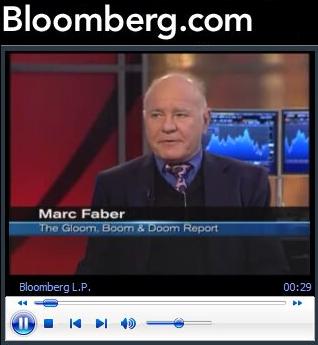
Another good interview with Dr. Marc Faber, this one over at Bloomberg where he’s been a regular for many years (recent appearances at the likes of CNBC are somewhat unusual as he tends to go against conventional wisdom, something that abounds at CNBC).
IMAGE

Click to play in a new window

There’s lots of good stuff in this one – the outlook for the global economy, oil, gold, base metals, natural resource stocks, World War III having already started…

On the subject of alternatives to the government solutions for the current problems, he was asked how he expected the populace to stand for the government doing nothing?

That’s the problem of society. If people can not accept the downside to capitalism, then they should become socialists and then they have a planned economy. They should go to eastern Europe twenty years ago and to Russia and China for the last 70 years.

How do you tell that to somebody in Detroit who’s losing his home today?


Why is he losing his home? Because of government intervention. The government – the Federal Reserve – kept interest rates artificially low and created the biggest housing bubble, not just in the U.S. but worldwide. That is what I’d explain to the worker in Detroit.

============================================

How the Federal Government will Lose in 2009 – Seeking Alpha

By: Rob Viglione of The Freedom Factory

Through a combination of incompetence and greed, the federal government has placed itself in a position of checkmate. There is no way to finance its budget deficits without devaluing the dollar or causing interest rates to rise. With $10.6 trillion in debt, $8.5 trillion in new money created or given away in 2008, and multiple years of trillion dollar deficits planned by Obama, government has no way to fund its extravagances without either printing a lot more money or borrowing unprecedented sums.

This means that either Treasury bonds will crash, or the dollar will suffer significant devaluation relative to foreign exchange or precious metals, especially gold.

TV Does Great Interview With Peter Schiff (Russian TV, That Is)

=====================================================

Remember Dare Something Worthy Today Too!


Market forces are telling the world to shed unproductive assets and shrink capacity, yet central banks and governments around the world, in particular the U.S., are refusing to listen. Rather than allow markets to snap back to sustainable equilibrium from previously artificial highs, the federal government clings to the notion that forcibly shuffling resources, propping up asset prices, and diluting the money supply will magically save the day.

There are consequences to everything. The consequences of shuffling resources (taxing productive ventures and doling out those resources to failing ones, i.e. bailouts) are stunted growth for good businesses and propagation of bad ones. Artificially propping up asset prices means that those who are generally less competent remain the custodians of society’s capital, and diluting the money supply inflates aways everyone’s wealth over time, particularly harming the poor and middle class.

For decades the federal government has gotten away with this reshuffle and inflate game, but the pawns are drowning, the rooks helpless, and the knights ready to turn on the King. Perhaps this is overly dramatic. Clearly, I doubt the capability of the Federal Reserve, Congress, and Obama to “fix” the economy; rather, I strongly believe they are destroying it by forcing us all to drink this Keynesian Kool-Aid. However, whether or not the economy recovers amidst this historic central government action, there are two phenomena we can exploit to our advantage:

  • Short the US dollar
  • Short US Treasuries

In “When will the great Treasury unwinding begin?” I show how government debt has been bid to unsustainable levels and will likely fall. The one concern I see stated all too often is that the Federal Reserve will keep buying Treasuries to artificially depress interest rates. This will, it is claimed, keep bond prices inflated. The one undeniable counter to this is that government must somehow fund its $1.2 trillion estimated 2009 deficit. It cannot do this by issuing and then buying the same bonds. It can only raise revenue by selling bonds to other parties, or by diluting the money supply by cranking up the printing presses. There are no other options. There you have it – we have the government in checkmate!

The likely outcome is that they will try to do both. That is why I am heavily shorting both 30-Year Treasury bonds and the dollar. Both assets will likely lose as the government becomes increasingly desperate and the world’s biggest buyers realize there are better alternatives available. Make your bets now before it becomes treasonous to bet against Big Brother!

Disclosure: Long UDN, short TLT, long GLD.

==============================================

Five New Forces to Drive Gold Higher – Seeking Alpha

By: James West of The Midas Letter

Gold naysayers habitually point to the relatively weak performance of gold relative to the broader market over the last 5 years. Given the market today, that argument is increasingly wrong, and the naysayers are soon to either admit their mistake, or pretend that they were never naysayers at all. That’s because during the last 3 months, five major new forces have emerged to compound the previous strong drivers of the gold price up to now.

These new forces are as follows:

  1. China has stopped buying U.S. debt.
    An interesting piece in the New York Times today signals that China, up until now the biggest buyer of U.S. Treasuries and bonds issued by Fannie and Freddie, is moving towards an end to that policy. China holds over US$1 trillion of such paper, and as interest rates collapse, there is less and less incentive for them to buy American.China has made several adjustments to programs that used to give banks and other financial institutions within the country incentive to buy U.S. assets, which means essentially that these same customers for assets will now be looking for Chinese products.The effect this will have on gold is two-fold. In the first place, reduced demand for U.S. debt will hamper Obama’s plans to keep printing money, because the one limiting factor that still seems to be respected in terms of how much paper can be printed, is the idea that there must be a counterparty to every issuance of T-Bills to warrant continued printing. Theoretically, less demand for T-Bills will force a rise in interest rates to attract investors. But that does not appear forthcoming, which will make the U.S. dollar weak relative to other currencies – especially gold.The second effect is that by eliminating incentives for Chinese banks to acquire U.S. denominated assets, investors there will divert more funds to holding gold as a hedge against their current U.S. dollar holdings, which will be diminishing in value.
  2. Future discoveries of gold deposits will diminish dramatically.
    The biggest source of gold ounce inventory for major gold producers is the discoveries made by the several thousand juniors who scour the earth in search of favorable geology. With the collapse in base metals prices, many of these juniors are under increasing pressure to consolidate and downsize, and many more will disappear altogether.That means less money going into gold exploration, and that means the number of new discoveries that can be acquired by majors is going to go down sharply in the coming years. In theory, as gold continues to outperform all other asset classes, there will be a rush back into junior gold exploration, but that won’t happen until gold is taken much higher and investment demand for it soars.
  3. Existing by-product gold production will fall sharply
    In copper, zinc and other base metals mines around the world, gold occurs in metallic deposits as a by-product of some other dominant mineral. In the United States, 15 percent of gold production is derived from mining copper, lead and zinc ores.With the collapse in prices for these metals, the by-product production of gold is most often insufficient to justify the continued operation of the mine profitably, and it is likely that a significant amount of this by-product gold production will cease along with the shutdown of these operations. The result will be less gold production from existing operations, contributing to the now even faster growing gap between supply and demand.
  4. Gold is becoming mainstream
    One of the biggest contributors to gold’s unpopularity as a main street investment is that it has been mercilessly derided and ridiculed by mainstream investment media and institutions. There is very little opportunity for an investment advisor to insinuate himself into a gold purchase transaction, since most anybody who wants to hold the metal can visit their local bullion exchange or mint and buy as much as they’d like. Because the massive investment institutions that dominate the investment advisory business can’t make a fee out of advising you to buy gold, they try to convince you to purchase other asset classes which their firm has either originated or is a participant in a syndication of investment banks selling such products.Thanks to the widespread coverage of the questionable integrity of these complex securities, and since many main street investors have been burned by their investment advisors (they feel), there is increasing main street advice being doled out to buy gold. One need only search Google news on any given day to discover that headlines critical of gold are now replaced with headlines singing its praises.
  5. Gold is the best performing asset class of the decade
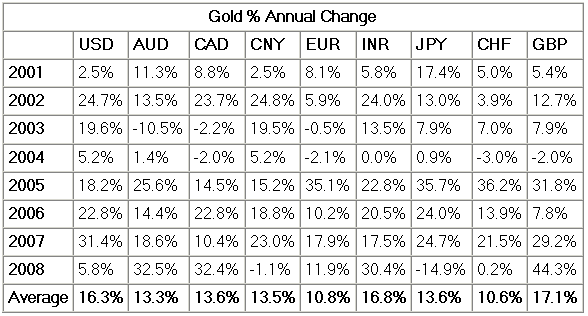
    Now that the global financial meltdown has got up a head of steam, investors are hard pressed to find any investment that has performed well over the last ten years as consistently as gold. The chart below outlines this performance and appears here courtesy of James Turk’s GoldMoney.com.
Gold Performance: 2001-2008 (click to enlarge)
Gold Performance 2001 - 2008

As you can see, any investment still returning an average of 10 – 17 percent is a winner, compared to everything else you can generate a chart for. As this intelligence permeates the none-too-quick popular investment imagination, and, combined with the other 4 factors, gold is going to be where the world’s next crop of millionaires is minted.

===========================================
Share this:

  • Click to share on Reddit (Opens in new window) Reddit
  • Click to share on Facebook (Opens in new window) Facebook
  • Click to share on LinkedIn (Opens in new window) LinkedIn
  • More
  • Click to share on X (Opens in new window) X
  • Click to share on Pinterest (Opens in new window) Pinterest
  • Click to share on Tumblr (Opens in new window) Tumblr
  • Click to print (Opens in new window) Print
  • Click to email a link to a friend (Opens in new window) Email
Like Loading...

Simple Moving Averages Make Trends Stand Out

17 Monday Nov 2008

Posted by jschulmansr in Bollinger Bands, commodities, Copper, Currency and Currencies, deflation, Finance, gold, hard assets, inflation, Investing, investments, Latest News, Markets, mining stocks, Moving Averages, oil, precious metals, silver, Technical Analysis, Today, U.S. Dollar, Uncategorized, uranium, Water

≈ Comments Off on Simple Moving Averages Make Trends Stand Out

Tags

agricultural commodities, alternate energy, Austrian school, banking crisis, banks, bear market, bear stearns, Bollinger Bands, bull market, capitalism, central banks, China, Comex, commodities, communism, Copper, Currencies, currency, deflation, depression, diamonds, dollar denominated, dollar denominated investments, economic, economic trends, economy, financial, Forex, futures, futures markets, gold, gold miners, hard assets, heating oil, India, inflation, investments, market crash, Markets, mining companies, Moving Averages, natural gas, oil, palladium, physical gold, platinum, platinum miners, precious metals, price, price manipulation, prices, producers, production, protection, rare earth metals, recession, risk, run on banks, safety, silver, silver miners, socialism, sovereign, spot, spot price, stagflation, Technical Analysis, timber, U.S. Dollar, volatility, Water

Simple Moving Averages Make Trends Stand Out

By: John Devcic of BK TRADER FX    The 5 Things That Move The Currency Market

Moving averages are one of the most popular and often-used technical indicators. The moving average is easy to calculate and, once plotted on a chart, is a powerful visual trend-spotting tool. You will often hear about three types of moving average: simple, exponential and linear. The best place to start is by understanding the most basic: the simple moving average (SMA). Let’s take a look at this indicator and how it can help traders follow trends toward greater profits.

Trendlines
There can be no complete understanding of moving averages without an understanding of trends. A trend is simply a price that is continuing to move in a certain direction. There are only three real trends that a security can follow:

  • An uptrend, or bullish trend, means that the price is moving higher. 
  • A downtrend, or bearish trend, means the price is moving lower.  
  • A sideways trend, where the price is moving sideways.

The important thing to remember about trends is that prices rarely move in a straight line. Therefore, moving-average lines are used to help a trader more easily identify the direction of the trend. (For more advanced reading on this topic, see The Basics Of Bollinger Bands and Moving Average Envelopes: Refining A Popular Trading Tool.)

Moving Average Construction
The textbook definition of a moving average is an average price for a security using a specified time period. Let’s take the very popular 50-day moving average as an example. A 50-day moving average is calculated by taking the closing prices for the last 50 days of any security and adding them together. The result from the addition calculation is then divided by the number of periods, in this case 50. In order to continue to calculate the moving average on a daily basis, replace the oldest number with the most recent closing price and do the same math.

No matter how long or short of a moving average you are looking to plot, the basic calculations remain the same. The change will be in the number of closing prices you use. So, for example, a 200-day moving average is the closing price for 200 days summed together and then divided by 200. You will see all kinds of moving averages, from two-day moving averages to 250-day moving averages.

It is important to remember that you must have a certain number of closing prices to calculate the moving average. If a security is brand new or only a month old, you will not be able to do a 50-day moving average because you will not have a sufficient number of data points.

Also, it is important to note that we’ve chosen to use closing prices in the calculations, but moving averages can be calculated using monthly prices, weekly prices, opening prices or even intraday prices. (For more, see our Moving Averages tutorial.)

Figure 1: A simple moving average in Google Inc.
Source: StockCharts.com

Figure 1 is an example of a simple moving average on a stock chart of Google Inc. (Nasdaq:GOOG). The blue line represents a 50-day moving average. In the example above, you can see that the trend has been moving lower since late 2007. The price of Google shares fell below the 50-day moving average in January of 2008 and continued downward.

When the price crosses below a moving average, it can be used as a simple trading signal. A move below the moving average (as shown above) suggests that the bears are in control of the price action and that the asset will likely move lower. Conversely, a cross above a moving average suggests that the bulls are in control and that the price may be getting ready to make a move higher. (Read more in Track Stock Prices With Trendlines.)

Other Ways to Use Moving Averages           
Moving averages are used by many traders to not only identify a current trend but also as an entry and exit strategy. One of the simplest strategies relies on the crossing of two or more moving averages. The basic signal is given when the short-term average crosses above or below the longer term moving average. Two or more moving averages allow you to see a longer term trend compared to a shorter term moving average; it is also an easy method for determining whether the trend is gaining strength or if it is about to reverse. (For more on this method, read A Primer On The MACD.)

Figure 2: A long-term and shorter term moving average in Google Inc.
Source: StockCharts.com

Figure 2 uses two moving averages, one long-term (50-day, shown by the blue line) and the other shorter term (15-day, shown by the red line). This is the same Google chart shown in Figure 1, but with the addition of the two moving averages to illustrate the difference between the two lengths.

You’ll notice that the 50-day moving average is slower to adjust to price changes, because it uses more data points in its calculation. On the other hand, the 15-day moving average is quick to respond to price changes, because each value has a greater weighting in the calculation due to the relatively short time horizon. In this case, by using a cross strategy, you would watch for the 15-day average to cross below the 50-day moving average as an entry for a short position.

Figure 3: A three-month
Source: StockCharts.com

The above is a three-month chart of United States Oil (AMEX:USO) with two simple moving averages. The red line is the shorter, 15-day moving average, while the blue line represents the longer, 50-day moving average. Most traders will use the cross of the short-term moving average above the longer-term moving average to initiate a long position and identify the start of a bullish trend. (Learn more about applying this strategy in Trading The MACD Divergence.)

Support and Resistance
Support and resistance, or ceilings and floors, refer to the same thing in technical analysis.

  • Support is established when a price is trending downward. There is a point at which the selling pressure subsides and buyers are willing to step in. In other words, a floor is established.  
  • Resistance happens when a price is trending upward. There comes a point when the buying strength diminishes and the sellers step in. This would establish a ceiling. (For more explanation, read Support & Resistance Basics.)

In either case, a moving average may be able to signal an early support or resistance level. For example, if a security is drifting lower in an established uptrend, then it wouldn’t be surprising to see the stock find support at a long-term 200-day moving average. On the other hand, if the price is trending lower, many traders will watch for the stock to bounce off the resistance of major moving averages (50-day, 100-day, 200-day SMAs). (For more on using support and resistance to identify trends, read Trend-Spotting With The Accumulation/Distribution Line.)

Conclusion
Moving averages are powerful tools. A simple moving average is easy to calculate, which allows it to be employed fairly quickly and easily. A moving average’s greatest strength is its ability to help a trader identify a current trend or spot a possible trend reversal. Moving averages can also identify a level of support or resistance for the security, or act as a simple entry or exit signal. How you choose to use moving averages is entirely up to you.

For further reading on moving averages, check out Simple Moving Averages And Volume Rate-Of-Change and Basics Of Weighted Moving Averages.

by John Devcic, (Contact Author | Biography)

John Devcic is a freelance writer, market historian and private speculator. After investing in a mutual fund right out of high school and losing his initial investment of $350, Devcic began to believe he could do better with his money then the so-called experts could. Over the years a healthy and sometimes unhealthy obsession with how the markets work and how they worked in the past has made Devcic a true market historian. He reminds himself at all times that the market – while ever-changing – always seems to repeat itself.

Share this:

  • Click to share on Reddit (Opens in new window) Reddit
  • Click to share on Facebook (Opens in new window) Facebook
  • Click to share on LinkedIn (Opens in new window) LinkedIn
  • More
  • Click to share on X (Opens in new window) X
  • Click to share on Pinterest (Opens in new window) Pinterest
  • Click to share on Tumblr (Opens in new window) Tumblr
  • Click to print (Opens in new window) Print
  • Click to email a link to a friend (Opens in new window) Email
Like Loading...

From The Vault: The Special Case For Gold – Features and Interviews – Hard Assets Investor

24 Friday Oct 2008

Posted by jschulmansr in Alternate Fuel Sources, commodities, Copper, deflation, Finance, gold, Green Energy, hard assets, inflation, Investing, investments, Latest News, Markets, oil, precious metals, silver, U.S. Dollar, Uncategorized, Water

≈ Comments Off on From The Vault: The Special Case For Gold – Features and Interviews – Hard Assets Investor

Tags

agricultural commodities, alternate energy, Austrian school, banking crisis, banks, bear market, bear stearns, bull market, capitalism, central banks, commodities, communism, Copper, deflation, depression, diamonds, dollar denominated, dollar denominated investments, economic, economic trends, economy, financial, futures, futures markets, gold, gold miners, hard assets, heating oil, inflation, investments, market crash, Markets, mining companies, natural gas, oil, palladium, physical gold, platinum, platinum miners, precious metals, price, price manipulation, prices, producers, production, protection, recession, risk, run on banks, safety, silver, silver miners, socialism, sovereign, spot, spot price, stagflation, timber, U.S. Dollar, volatility, Water

From The Vault: The Special Case For Gold – Features and Interviews – Hard Assets Investor

Written by Tom Vulcan   
Friday, 24 October 2008 10:18
Page 1 of 2


[Editor’s Note: From The Vault is a new HAI feature that periodically highlights some of the best and most timeless content on our site. In light of recent market turmoil, Tom Vulcan’s gold piece seemed appropriate.] 


“Water is best, but, shining like fire blazing in the night, gold stands out supreme of lordly wealth.”

                            Pindar – First Olympian Ode


Since the Greek poet Pindar described gold in these glowing terms in 476 BCE, its identification with wealth has changed very little over the ages.

Indeed, priced as it is now and viewed against both the increasingly ragged backdrop of the U.S. economy and current credit crunch, its association with wealth, secure (or “lordly”) wealth, is particularly strong.

Why Buy Gold?

Three of the most fundamental reasons for buying gold are the following:

  • For economic security
  • For physical security
  • Against contingencies


For Economic Security

Gold is an excellent long-term hedge against inflation.

In the very long term, and despite sometimes quite significant short-term price fluctuations, gold has been shown to maintain its store of value in terms of real purchasing power.1 In other words, as the value, i.e., purchasing power, of the dollar falls (and inflation goes up), so the price of gold rises.

Unlike any of the world’s currencies, each of which represents debt incurred by the relevant issuing government, gold is not a liability. And since it is not a liability, it can neither be repudiated, nor its value undermined by inflation. This stands in stark contrast to the world’s paper currencies that, printed as they are, by “fiat,” always lose value in the long term (this can, and does, also happen in the short term.)

In addition, gold has been shown not only to provide a strong hedge against a declining dollar2 (when gold is traded throughout the world it is always bought and sold in U.S. dollars, i.e., it is nominally priced in U.S. dollars), but also to be a better hedge against the dollar than other commodities.3

For Physical Security

Gold is a secure asset.

In the past, when there was a gold standard, governments banned individuals from holding gold – preventing those individuals, in effect, from holding (and preserving) their wealth beyond the control of government. As the young Alan Greenspan put it in 1966: “In the absence of the gold standard, there is no way to protect savings from confiscation through inflation. There is no safe store of value. If there were, the government would have to make its holding illegal, as was done in the case of gold.” Now, however, it can be freely held.

Held as an asset, not only is gold liquid, but it is also subject neither to the freezes nor to the imposition of exchange controls that can, at times, threaten other asset classes and currencies. As, once again, Mr. Greenspan put it back in 1966: “It [gold] stands as a protector of property rights.”4 It has a physical security not associated with any number of other assets.


Against Contingencies

Gold is an excellent “crisis” hedge.

Undisputed worldwide as a store of value, gold can be a form of “insurance” both in times of crisis and when there are extreme untoward movements in other asset classes. For example, during the period of hyperinflation in Germany from 1918-24, gold maintained its purchasing power while the value of bonds and stocks were catastrophically diminished.

Set apart as it is from other commodities because of its acceptability, portability, homogeneity and indestructibility, the market in gold is both universal and highly liquid. You can buy and sell gold around the globe. Even James Bond in “From Russia with Love,” traveled with some 50 British gold sovereigns hidden in his briefcase – just in case!

What Place Should It Have In My Portfolio?

Holding gold as a strategic asset can help you diversify your portfolio.

A long-term asset portfolio needs to be diversified. Diversification helps reduce both risk and volatility. The key to diversification is a choice of assets with returns as little correlated to each other as possible. Essentially, each of your asset classes needs to march to a different tune: Movement in one should be reflected as little as possible in the movement of any other.

Since there is little correlation (it is, in fact, low to negative) between the returns on gold and on financial assets, such as equities, gold can help provide just such diversification (i.e., when financial markets fall, the price of gold tends to rise, and vice versa).

Recent research5 into the difference between gold and other assets has demonstrated that, in the long term, there is no important correlation between changes in inflation, interest rates and GDP and the returns on gold. In contrast, such macroeconomic variables are strongly correlated with returns on such financial assets as bonds and equities.

The same research has also shown that changes in such macroeconomic variables have a much greater effect on the returns on other commodities (particularly non-ferrous metals and oil) than they do on gold.

A general market decline, therefore, will not be reflected in a general decline in the price of gold. Gold will, in fact, provide protection against such declines.

In addition to reducing risk, improving a portfolio’s diversification will also help to reduce its volatility. Reducing its volatility will, in turn, often result in higher compound rates of return.

While it is more usual to look at different asset classes when building a portfolio, in the case of gold, it is certainly worth considering it as an asset class in and of itself (rather than as an individual security within the commodities asset class) and, consequently, investing in it directly.

How much gold you should add to your portfolio, however, will depend upon the risk profile of your portfolio. If, on the one hand, you have a low-risk portfolio, the inclusion of gold can help enhance its performance. On the other hand, if you have a high-risk, high-return portfolio, gold’s strong lack of correlation to the equity and bond markets could help bring stability in times of either economic turmoil or falling markets.


Conclusion

Since timing the market is impossible and your investment in gold is for the long run, the important thing – many people believe – is that you buy it, not when you buy it.

While the recent surge in gold prices has brought speculators into the market, and has increased the short-term correlation between equities and gold, it has done little to rattle the long-term position of the metal as a good portfolio diversifier and a safe store of value.


NEXT UP: Base Metals

Precious metals are pretty, but base metals are where the real action happens.  Or see below…


ENDNOTES

1. Harmston, S. (1998) Gold as a Store of Value, London, World Gold Council.
2. Capie, F., Mills, T. & Woods, G. (2004) Gold as a Hedge against the US Dollar, London, World Gold Council
3. Kavalis, N., (2006) Commodity Prices and the Influence of the US Dollar, London, GFMS Limited
4. Greenspan, A. (1966) Gold and Economic Freedom, The Objectivist.
5. Lawrence, C. (2003) Why is gold different from other assets? An empirical investigation, London, World Gold Council.


LINKS FOR MORE INFORMATION
Doug Casey: The Case For Gold
Resource Investor
Gold Investing 101

Industrial Metals
Written by HardAssetsInvestor.com   
Sunday, 04 November 2007 13:13
Gold and silver may get all the glory, and look pretty, but when you want to build an economy, it’s the industrial (or base) metals that steal the show. As such, base metals have emerged as a key way for investors to tap into the rapid development of emerging economies like China. As China builds new apartment buildings and factories, it needs iron for the trusses, copper for the pipes and aluminum for the appliances.For investors just getting started, here are the most widely used base metals in the world, in order of global consumption.Steel (Iron)

The granddaddy of metals for most of the last millennium has been iron. Iron, by itself and as the major component in steel, is the most widely used metal in the world.

That would make it a great tool for investors interested in tapping into economic growth, except for one thing: There is no direct way to trade it. Unless you want to buy a few freight cars’ worth of I-beams, there’s no direct way to get exposure. This is likely to change, as the London Metal Exchange (LME) is currently working on plans for futures and OTC contracts tied to steel, but there are serious hurdles to overcome.

For starters, there are a huge variety of steel types in the market. What kinds of steel would the contracts cover? Carbon or alloy? Galvanized sheets? Cut plates? Fine grain? Atmospheric resistance? Fundamentally, a futures contract has to be based on a commodity definition that will be useful to suppliers and customers … and steel producers have been dead set against the development of a steel futures contract.

Until the LME and the producers figure it out, the best way for investors to access the steel markets is through steel-producing equities. Key players include Rio Tinto (RTP), Cia Vale do Rio Doce (RIO), Mittal Steel (MT) and Nucor (NUE).

Investors can also access the broad steel equities market through the Market Vectors – Steel (AMEX: SLX) ETF, which tracks the AMEX Steel Index, which includes 36 steel-related stocks.

Aluminum

After steel, aluminum is the most widely used metal on the planet. It is one of the key ingredients in the rapid expansion of infrastructure around the world, and demand for aluminum is growing.

What is aluminum? It’s light, pliable, rust-resistant and has high conductivity. Those features make it an incredibly important metal for industrial use, particularly for the transportation industry. Your car is mostly aluminum (and plastic), from the body to the axles and maybe even the engine. And that airplane you flew on your last business trip? Without aluminum, you wouldn’t have gotten off the ground. Even those cans of soda and beer the flight attendants passed around (if you were lucky) were made from aluminum: almost a full quarter of the aluminum produced today goes into those handy little containers.

Primary aluminum is mined out of the ground as bauxite ore, changed into alumina or aluminum oxide, and then finally smelted into aluminum. Bauxite deposits are mainly found in Australia, Guinea, Brazil and Jamaica. (At least, that was the order of production in 2000, the most recently available data.) The whole process is hugely energy-intensive, which means that the price of aluminum has some tie to the price of energy. Typically, smelters are located in areas with cheap energy.

Primary (new) aluminum trades on the New York Mercantile Exchange (NYMEX) with the ticker “AL,” and on the London Metals Exchange (LME) as “Primary Aluminum.” Recycled aluminum is traded as “Aluminum Alloy.”

Many investors, however, find it easier to access this market through equity plays. Key players include Alcoa (AA), Aluminum Corp. of China Ltd. (ACH), Kaiser Aluminum Corp (KALU).

Copper

Our friend copper has been around for ages. Everyone from the early Egyptians to your neighborhood plumber has relied on copper to make the world work. Today, copper is everywhere, from the coins in your pocket to the plumbing in your house to the power lines and the electrical plant down the way. Even the cell phone in your pocket relies on copper for its intricate circuit board.

The largest market for copper is building construction (pipes and wires), followed by electronics and electrical products, transportation, industrial machinery and consumer products. Because of the huge demand from construction, copper prices tend to fluctuate on economic indicators such as U.S. housing starts, Chinese GDP growth and other macroeconomic reports. In 2006, China accounted for about 20% of the world’s consumption1 of copper, and that percentage is expected to grow. In other words, reports from The Wall St. Journal of even the smallest shifts in Asian economies can push copper prices around substantially.

Where’s it come from? Chile is the big dog, producing four times the volume in copper of the No. 2 group, the United States. Peru, Australia, Indonesia, Russia are also big players, but more than anything, you need to think about Chile.2 In 2006, global mine production was less than expected because of production problems and labor disruptions in Chile, and this kept copper at record highs. Hiccups like this are increasingly being offset by recycling, but even with the U.S. pulling 30% of its copper from recycling plants, copper futures remain hugely volatile.3 Copper spot prices rose from $0.75/lb in March 2002 to over $3/lb in March 2007.

Plastic pipes anyone?

Copper trades under the ticker “HG” on the NYMEX.

Substitutions/Copper: Aluminum can be used for electrical equipment, power cables and automobile radiators. For heat exchangers, titanium and steel are used. In plumbing applications, plastics are the common substitute.4

Key Players:

Freeport McMoran Copper and Gold (FCX), BHP Billiton (BHP)

Zinc

The fourth most popular metal in the world’s industrial beauty pageant is zinc. Like aluminum, zinc comes in two flavors: primary (coming from mines, about two-thirds of what’s used) and secondary (scrap and residues).

Most zinc is used as a galvanizing agent to prevent corrosion in iron and steel – those rough gray nails you used to put down your deck, your galvanized steel fishing boat, etc. The rest of the zinc (about 25 percent) is used as zinc compounds in all sorts of other stuff: paint, agricultural products, plastics, rubber and as a raw chemical in medicines and supplements. That “copper” penny in your pocket is, at least if it was minted after 1982, mostly zinc.

Really, zinc is a condiment in the industrial metals world, like salt in the kitchen. It hardly ever gets used by itself, but it spices up other metals and makes them better. Because of that, it has historically followed the price fluctuations of base metals at large, particularly copper. That may, however, be changing: In 2006, zinc saw rapid price increases due to low stocks at the LME, increased world demand and tight world supply.

China, which exports a great deal of zinc, continues to wield the big stick in the market, followed by Australia, Peru and North America. Zinc can be traded on the NYMEX (LZ), at the LME (Zinc) and (as of March 26, 2007) at the Shanghai Futures Exchange (TA).

Substitutions/Zinc: When looking at substitutions for zinc, you’re looking to replace what zinc helps make. Plastics, steel & aluminum substitute for galvanized sheet. For corrosion protection, paint, plastic coatings and other alloy coatings are used. There are many elements that substitute for zinc in the chemical, electronic and pigment fields.

Key Players:

BHP Billiton (BHP), Teck Cominco Ltd. (TCK).

LeadLead, as anyone who’s picked up a car battery knows, is very heavy and dense. It is also a soft and corrosion-resistant metal. While it’s been abandoned in many applications due to environmental and health concerns, it’s still a major metal in global industry. The greatest use of lead is in Sealed-Lead-Acid batteries, which has seen continued growth, particularly in uses such as uninterruptible power supplies for computer applications and in machinery (like your car). Lead is also used in lots of smaller applications: ammunition, oxides for glass and ceramics, casting metals, sheet lead, solders, coverings and caulkings.

Lead was the best-performing commodity through the first nine months of 2007.

Nickel

Behind lead is nickel. Nickel’s primary use is as an additive to make stainless steel. The aerospace and power generation industries use it in combustion turbines because of its corrosion resistance, and it finds a home in batteries, coins and other applications as well.

Nickel has been much in the news recently due to sharply rising prices and supply constraints at the LME. The LME actually intervened in the nickel markets in 2006 when supplies got too tight to meet demand, a rare occurrence for any well-functioning market. Surging demand for stainless steel in China has caused the Chinese to fire up nickel pig iron processors, which (at a relatively high cost) can create stainless steel without true nickel.

Tin

Lastly, there’s lowly tin. Tin’s been around forever and is mined around the world, but almost half of what’s used now comes from Southeast Asia. Tin is used mostly as an alloy with other metals, but also has uses as a protective coating.

Tin hit an 18-year high on the LME in 2007, as rising demand and slow-growing supply caused a classic short squeeze on the markets. The tin market continues to be tight.

Accessing The MarketsAside from buying the futures or individual company stocks, there are a few approaches investors can take to the base metals market. For steel, there’s the aforementioned Steel ETF (AMEX: SLX) from Van Eck. For aluminum and the rest, European investors can buy individual commodities futures ETFs from ETF Securities, or baskets of base metal securities as well.

Stateside, investors have an increasing number of choices as well. The best-established base metals futures basket is the PowerShares DB Base Metals ETF (AMEX: DBB), which includes exposure to copper, aluminum and zinc. Newer iPath ETNs offer focused exposure to Copper (AMEX: JJC), Nickel (AMEX: JJN) or a basket of industrial metals (AMEX: JJM), including copper, aluminum, zinc and nickel. The ELEMENTS Rogers International Commodity Index ETN (RJZ) offers the most diversified basket of coverage, combining precious and base metals in an ETN and holding aluminum, palladium, tin, nickel, platinum, copper, gold, zinc, silver and lead.

On the equities side, the SPDR Metals & Mining ETF (AMEX: XME) lumps in everything from steel to aluminum, gold, energy, manufacturing and other issues. The top holdings are U.S. Steel, Freeport McMoran Copper and Gold, Titanium Metals and Consol Energy.

Conclusion

Base metals aren’t glamorous. They don’t make headlines outside of the commodities markets, and aside from Jim Rogers, you aren’t going to hear pundits on CNBC talking about what a great investment lead is. But here’s the dirty little secret about base metals: They have been by far the best-performing sector of the commodities markets over the past three, five and 10 years. Best by a mile.

NEXT UP: Agricultural Commodities

Exploring the softer side of the commodities market.

LINKS FOR MORE INFORMATION

The argument for base metals
The argument against base metals
How iron works
Copper Development Network
All About Aluminum
Lead Soldiers On

Agricultural Markets

Timber Markets: Strong As An Oak

Water: The Ultimate Commodity

Alternative Energy: Can It Compete?

Share this:

  • Click to share on Reddit (Opens in new window) Reddit
  • Click to share on Facebook (Opens in new window) Facebook
  • Click to share on LinkedIn (Opens in new window) LinkedIn
  • More
  • Click to share on X (Opens in new window) X
  • Click to share on Pinterest (Opens in new window) Pinterest
  • Click to share on Tumblr (Opens in new window) Tumblr
  • Click to print (Opens in new window) Print
  • Click to email a link to a friend (Opens in new window) Email
Like Loading...

Dare Something Worthy Today! – Why aren’t We Using This Technology Now?

19 Tuesday Jun 2007

Posted by jschulmansr in Alternate Fuel Sources, Dare, joyner, Jschulmansr, Something, Today, Water, Worthy

≈ Comments Off on Dare Something Worthy Today! – Why aren’t We Using This Technology Now?

Dare Something Worthy Today! – Why aren’t We Using This Technology Now?

This was sent to me from my good friend Mark Joyner.
Mark Joyner’s Atomic Mind Bombs Blog: See his blog post yesterday June 18th 2007:
http://www.markjoyner.name/logs/

I too ask the question if it is as easy as this and it has been proven,
then why aren’t we using this technology now?

Check Out these 2 Videos:

The First Video a toy car and 100% water for fuel…

Now, you should know that there are a great many full-size hydrogen fuel cell cars already in existence, but there are “problems.”

First, the cars are ridiculously-expensive.

Next, many of the hydrogen-based fuel initiatives right now rely on fossil fuels as a source for harvesting the hydrogen from water. (Yeah, I know.)

Finally, there is the issue of distilling the water required for hydrogen production. The fuelling station I have requires distilled water. Tap water will destroy it.

Are these limitations too difficult to surmount?

I don’t think so …

The cost of the cars, obviously, can be brought down radically with mass production.

As for where to get the hydrogen, why don’t we create a massive network of renewable energy generators (solar, wind, hydroelectric, geothermal, etc …), start mass producing hydrogen, and store it?

If you think about it, we could have solar panels on our roofs that are constantly generating hydrogen and storing it. Then your home could run off a fuel cell, too.

As for the distilled water, well, solar powered water distillation technology already exists.

So, what’s the hold up?

Why aren’t we aggressively switching over to a new infrastructure immediately?

I mean – immediately. Not “maybe in 10 years or so …”

The Second Video: Man Runs Normal Car on 50% Water Based Fuel…

Again Source: Mark Joyner’s Atomic Mind Bombs Blog: May 13th 2007:
http://www.markjoyner.name/logs/

I would like to get opinions from as many people as possible about this before commenting further (please pass it on). Please leave replies below:

To head off a few questions …

1. No, I have no financial interest in this company whatsoever (I wish I did!). I heard about them through a local news program and decided to investigate for myself. In the course of getting to know each other we’ve all become fast friends (really cool, super-intelligent, and laid-back guys).

2. Yes, I know this experiment was not ideal, but it’s the best I could do on short notice. We’ll be doing it again in the near future under more controlled conditions (at an ASTM certified lab in the U.S.).

As Mark put it “So, what’s the hold up?

Why aren’t we aggressively switching over to a new infrastructure immediately?”

I mean – immediately. Not “maybe in 10 years or so …”

“Is it the cost?”

“Surely we can all re-allocate some of our “defense” budgets to the creation of an infrastructure that will remove one of the root causes of war?”

“Ah, that’s just crazy talk.”

Not So Crazy if you ask me! – jschulmansr

***This is something I too will keep you updated on in the future!***
jschulmansr

Dare Something Worthy Today – Call for Increased Mainstream Hydrgen Fuel Cell Use!

As Always,Be Blessed,Stay Blessed,Share Your Blessings with All!

Dare Something Worthy Today!

JSchulmansr

Share this:

  • Click to share on Reddit (Opens in new window) Reddit
  • Click to share on Facebook (Opens in new window) Facebook
  • Click to share on LinkedIn (Opens in new window) LinkedIn
  • More
  • Click to share on X (Opens in new window) X
  • Click to share on Pinterest (Opens in new window) Pinterest
  • Click to share on Tumblr (Opens in new window) Tumblr
  • Click to print (Opens in new window) Print
  • Click to email a link to a friend (Opens in new window) Email
Like Loading...

Authors

  • jschulmansr's avatar jschulmansr
    • Free Crypto!
    • Free Crypto Currency
    • This is Blessed!
    • Trump Rally Charleston
    • Trump Rally Charleston

Blog at WordPress.com.

Privacy & Cookies: This site uses cookies. By continuing to use this website, you agree to their use.
To find out more, including how to control cookies, see here: Cookie Policy
  • Subscribe Subscribed
    • Dare Something Worthy Today Too!
    • Already have a WordPress.com account? Log in now.
    • Dare Something Worthy Today Too!
    • Subscribe Subscribed
    • Sign up
    • Log in
    • Report this content
    • View site in Reader
    • Manage subscriptions
    • Collapse this bar
%d