• Recommended Sites & Links
  • About

Dare Something Worthy Today Too!

~ FreeCryptoBitCoins, Cryptocurrency, BitCoin, Ethereum, BitCoin Cash, Ethereum Classic, LiteCoin, DogeCoin, Gold & Precious Metals, Investing & Investments, Stocks and Stock Markets, Financial Markets & Market Timing, Technical Analysis, Oil and Energy Markets, Hard Assets Investing, BlockChain, Airdrops, Earn Free Bitcoin…

Dare Something Worthy Today Too!

Category Archives: small caps

Are You Invested In Gold Miners?

23 Friday Jan 2009

Posted by jschulmansr in bull market, Comex, commodities, Copper, Currency and Currencies, economic trends, economy, Fundamental Analysis, futures, futures markets, gold, gold miners, hard assets, How To Invest, How To Make Money, inflation, Investing, investments, Latest News, Make Money Investing, Markets, mining companies, mining stocks, palladium, physical gold, platinum, platinum miners, precious, precious metals, price, price manipulation, prices, producers, production, rare earth metals, silver, silver miners, small caps, spot, spot price, stagflation, Stocks, Technical Analysis, Today, U.S. Dollar

≈ Comments Off on Are You Invested In Gold Miners?

Tags

agricultural commodities, alternate energy, Austrian school, Bailout News, banking crisis, banks, bear market, Bollinger Bands, bull market, capitalism, central banks, China, Comex, commodities, communism, Copper, Currencies, currency, deflation, depression, diamonds, dollar denominated, dollar denominated investments, economic, economic trends, economy, Federal Deficit, financial, Forex, futures, futures markets, gold, gold miners, hard assets, heating oil, India, inflation, investments, Keith Fitz-Gerald, Marc Faber, market crash, Markets, mining companies, Moving Averages, natural gas, oil, palladium, Peter Schiff, physical gold, platinum, platinum miners, precious metals, price, price manipulation, prices, producers, production, protection, rare earth metals, recession, risk, run on banks, safety, Saudi Arabia, Sean Rakhimov, silver, silver miners, socialism, sovereign, spot, spot price, stagflation, Technical Analysis, timber, U.S. Dollar, volatility, warrants, Water

Good Morning, As I am writing this post Gold is up another $17 to $876/ oz. It would appear barring sudden dollar strength, we have succesfully broken the upper resistance level of $860 to $870; if we hold here $900+ will be the next level. Are You Invested In Gold Miners? If so, today’s post is a must read. – Good Investing!- Remember to Dare Something Worthy Today Too! – jschulmansr

ETF vs. Mutual Fund: Two Ways to Invest in Gold Miners – Seeking Alpha

By: Don Dion of Fidelity Independent Advisor

Whether saddled to mutual funds like Fidelity Select Gold (FSAGX) or ETFs like Van Eck’s Gold Miners Index (GDX), gold investors have experienced a wild ride over the last year. While the recent volatility in gold prices is certainly enough to give investors pause, a good argument exists for the presence of a gold ETF or mutual fund in a well-diversified portfolio. Both FSAGX and GDX help investors mitigate the pitfalls of falling currencies and economic slowdowns. Since gold is a physical asset, it tends to maintain its value over time, giving wary investors an added measure of security as time-tested institutions vanish in the face of economic crisis.

FSAGX and GDX both invest assets in companies that are primarily engaged in the exploration, mining, processing and dealing of gold. As of FSAGX’s semiannual report in November 2008, the fund held seven out of ten of the same top ten holdings. While GDX tracks the NYSE Arca Gold Miners Index, comprising 32 small, medium and large companies incorporated in any gold index, FSAGX is managed by Joe Wickwire and is composed of 69 holdings. The similarities between the two funds are striking, but some investors prefer having a human, rather than an index, at the helm. The larger number of holdings in FSAGX also means a smaller concentration of assets in top holdings, reducing the exposure that investors have to any one portfolio component.

The top component for both FSAGX and GDX is Barrick Gold Corp. (ABX), constituting 13.77% of GDX’s portfolio as of January 13 and 9.5% of FSAGX’s portfolio as of late November 2008. The Toronto-based exploration company holds interests in a variety of gold resources in South America, Africa and Australia. At the end of 2007, ABX had 124.6 million ounces of proven and probable gold reserves, 1.03 billion ounces of contained silver within gold reserves, and 6.2 billion pounds of copper.

Goldcorp (GG), the second-largest holding for both GDX and FSAGX, saw shares battered with a series of downgrades and target price reductions in early January, after releasing lower guidance for 2009. Some analysts, however, have dismissed the tarnish to Goldcorp’s shares as an overstatement of the reality of an industry-wide slowdown. In GG’s latest report, the adjusted forecast calls for 50% growth in production through 2013—only 5% lower than analysts’ estimates. In 2008, GG produced a hefty 2.3 million ounces of gold, achieving low margins on a scale larger than those of other competitors such as Yamana Gold (AUY) and Agnico-Eagle Mines (AEM).

While the most obvious difference in deciding between an ETF and mutual fund is the fees associated with the two different investments, investors should consider several factors when choosing FSAGX or GDX. Even though the expense ratios of both funds are well below the category average—FSAGX is 0.86% while the ratio for GDX is 0.59%—many investors have gravitated to the ETF fund in recent years for the additional edge.

Investors who own FSAGX will have to hold shares of the fund for longer than 30 days in order to avoid a 0.75% redemption fee—a nerve-racking setback for nervous investors who prefer the option of getting in and out of investments quickly. As opposed to the once-a-day pricing method of mutual funds, ETFs like GDX trade continuously throughout the trading day, but this flexibility also brings an increased measure of volatility. ETFs tend to be more affected by changing news events than mutual funds are, causing surges and dips in price avoided by comparatively steadier mutual funds.

The differences between GDX and FSAGX are more apparent when comparing fund performance in recent months. GDX dropped more than 63% from July 14, 2008, to October 28, 2008, but it has since recovered 35%. FSAGX, however, fell only 60% from July 14 to October 28 and has recovered 36% in the period since. While their price movement is relatively similar, investors fearing intraday volatility may feel more comfortable with FSAGX than GDX, especially given its longer track record.

While putting assets into gold could prove to be a profitable move for many investors, it is important for prospective GDX and FSAGX buyers to keep the role of this commodity in perspective. With the ultimate success of gold investments weighing heavily on continuing inflation concerns, placing a bet on gold—or any narrow sector—could whipsaw investors as the inflation battle takes shape under the new administration. For those investors seeking the added security that gold could add to their portfolios in 2009, both GDX and FSAGX, with their solid track records and investor interest, are good places to start.

==============================================

My Note: Mutual Funds (and there are many in addition to the above), are a good way to get a nice spread (basket) of different Gold Miners. In addition, I personally like to have holdings in Individual Companies too! I have 2 different Mutual Funds, in addition to holdings in many of the above mentioned companies. I also like a lot of the mid tier and junior Gold Miners too. I generally try to invest in companies that have production (or about to produce), with a lot of cash on hand (due to financing difficulties for comapnies). The whole sector has been beaten down in prices and if you look carefully, you can find many companies right now that are selling at or for less than actual book value. Personally, I am loading up! As always, do your due diligence and read all the prospectuses; and/or consult your investment advisor.

==================================================

Kinross Raises More Capital; Gold Miners Look Strong – Seeking Alpha

By: Marc Courtenay of Check The Markets.com

Kinross Gold (NYSE:KGC), one of the world’s best performing gold stocks, announced a public equity offering of 20.9 million common shares at $17.25 per share, with gross proceeds of about $360.5 million, to enhance the company’s capital position following the funding of recent acquisitions.

In 2008, the gold and silver miner bought Aurelian Resources for around $809 million. Since that time, the shares of stock have had average daily volume of over 11 million shares on the NYSE and traded in a 52-week range of $6.85-$27.40.

The Canada-based company has also granted the group of underwriters, led by UBS Securities Canada Inc., an overallotment option to purchase up to an additional 3.135 million common shares at the offering price. This option is available for 30 days after the offering closes. If this option is excercised in full, it will bump up the total proceeds to about $414.6 million.

The offering is scheduled to close on or around February 5, 2009. The company has 665 million shares outstanding.

Kinross ranks as number one global gold pick among a number of analysts and investors. Production for the group is anticipated to grow around 30% this year to around 2.45 million ounces.

The new money now being raised is targeted for general corporate purposes after recent acquisitions depleted around $180 million of Kinross’s existing cash. Just two months ago, Kinross shelled out $250 million on a 6 million ounce gold deposit in Chile.

The last quarter’s earnings growth was up an impressive 64% year-over-year, the balance sheet looks better than average with a total debt-to-equity ratio of just .017 and total cash of over $720 million.

The Kinross acquisition may have upped the tone for other gold miners. Harmony Gold (NYSE:HMY), the world’s fifth biggest gold miner by ounces produced, on December 22 announced the raising of R979 million before costs, by placing 10.5 million shares at an average price of R93.20 each between November 25 and December 19 2008.

The fresh capital is earmarked mainly to further pay down Harmony’s debt, which is targeted, on a net basis, to be around zero by mid-2009.

Among other capital raisings, during November, Agnico-Eagle Mines (NYSE:AEM), a leading Tier II gold digger, raised $252 million in a seemingly effortless offering.

Overall, when it comes to healthy, proactive and well-managed gold mining companies, the offerings are “in response to strong investor demand.”

Although right now I have both a long and a short position with KGC, I won’t be buying any more until the price per share corrects at least 20% below present levels. But I’m impressed with both the fundamentals of Kinross and the way the investment community views them so favorably.

KGC, along with Goldcorp (NYSE:GG), Barrick Gold (NYSE:ABX), Yamana Gold (NYSE:AUY) and IAM Gold (NYSE:IAG) are shares I want to be accumulating for the year ahead.

The market volatility should help us to buy at lower prices, but the whiff of future inflation and the popularity of gold as a monetary alternative may keep share prices from falling as low as I would like. Patience though, is usually rewarded.

Disclosure: Author holds both a long and short position in KGC

==================================================

Next – Do we have a potential Takeover or Meger Forming? – Read this next article… 

Flush Kinross Likely Looking for a Deal with Yamana-Credit Suisse- Seeking Alpha

Source: Financial Post Trading Desk

If Kinross Gold Corp. (KGC) had $705-million in cash at the end of the third quarter, why did it decide to raise another $360-million in a bought deal offering of 20.9 million common shares at $17.25 each?

The company said it will use the money to bolster its capital position and for general corporate purposes, but investors are surely wondering if any acquisitions are in the making.

An over-allotment option of 3.14 million shares would bring total proceeds from the offering to $415-million. Credit Suisse analyst Anita Soni also noted that Kinross is expected to have another $541-million in operating cash flow in 2009 (based on $700 per ounce gold), while it has $700-million in obligations this year (including capex of $460M).

“Kinross is well funded with its current cash and cash flow position and does not require additional funds for its current pipeline of growth,” she told clients, adding that the company is strengthening its coffers to capitalize on acquisition opportunities to shore up its growth profile.

Ms. Soni said “tack on” acquisitions like the Lobo Marte gold project deal with Teck Cominco Ltd. (TCK) for about $250-million, plus a royalty, in November, are possible. However, she also said a larger transaction in the senior or mid-tier space could surface, with Yamana Gold Inc. (AUY) and Teck’s Pogo mine as likely candidates.

Ms. Soni said:

Yamana has a good project pipeline but it does not have the near-term capital to fund that growth. An acquisition of Yamana would deliver a project pipeline and growth from 2009-2011 even using our conservative forecasts for Yamana. It is also likely that Kinross would be able to realize additional ounces beyond what we forecast for Yamana given Kinross’s ability to fund growth.

Yamana’s current multiple based on metal and share prices is around 1.2x, while Kinross is at 1.5x.

The analyst added that Agnico-Eagle Mines Ltd. (AEM) is too expensive, while Goldcorp Inc. (GG) and Barrick Gold Corp. (ABX) are too big in terms of market capitalization.

==================================================

That’s it for today, Gold now up $19 at $878/oz! – Good Investing- jschulmansr

Dare Something Worthy Today!

Share this:

  • Click to share on Reddit (Opens in new window) Reddit
  • Click to share on Facebook (Opens in new window) Facebook
  • Click to share on LinkedIn (Opens in new window) LinkedIn
  • More
  • Click to share on X (Opens in new window) X
  • Click to share on Pinterest (Opens in new window) Pinterest
  • Click to share on Tumblr (Opens in new window) Tumblr
  • Click to print (Opens in new window) Print
  • Click to email a link to a friend (Opens in new window) Email
Like Loading...

Has World War III Started?

09 Friday Jan 2009

Posted by jschulmansr in agricultural commodities, alternate energy, Austrian school, banking crisis, banks, Barack Obama, bear market, Bollinger Bands, bull market, capitalism, central banks, China, Comex, commodities, communism, Copper, Currencies, currency, Currency and Currencies, deflation, depression, diamonds, dollar denominated, dollar denominated investments, economic, economic trends, economy, Finance, financial, Forex, Fundamental Analysis, futures, futures markets, gold, gold miners, hard assets, heating oil, How To Invest, How To Make Money, India, inflation, Investing, investments, Keith Fitz-Gerald, Latest News, Make Money Investing, Marc Faber, market crash, Markets, mining companies, mining stocks, Moving Averages, natural gas, Nuclear Weapons, oil, palladium, Peter Schiff, physical gold, platinum, platinum miners, precious metals, price, price manipulation, prices, producers, production, protection, rare earth metals, recession, risk, run on banks, safety, Saudi Arabia, Sean Rakhimov, Siliver, silver, silver miners, small caps, socialism, sovereign, spot, spot price, stagflation, Stocks, Technical Analysis, timber, Today, U.S. Dollar, uranium, volatility, warrants, Water

≈ Comments Off on Has World War III Started?

Tags

agricultural commodities, alternate energy, Austrian school, banking crisis, banks, bear market, Bollinger Bands, bull market, capitalism, central banks, China, Comex, commodities, communism, Copper, Currencies, currency, deflation, depression, diamonds, dollar denominated, dollar denominated investments, economic, economic trends, economy, financial, Forex, futures, futures markets, gold, gold miners, hard assets, heating oil, India, inflation, investments, Keith Fitz-Gerald, Marc Faber, market crash, Markets, mining companies, Moving Averages, natural gas, oil, palladium, Peter Schiff, physical gold, platinum, platinum miners, precious metals, price, price manipulation, prices, producers, production, protection, rare earth metals, recession, risk, run on banks, safety, Saudi Arabia, Sean Rakhimov, silver, silver miners, socialism, sovereign, spot, spot price, stagflation, Technical Analysis, timber, U.S. Dollar, volatility, warrants, Water

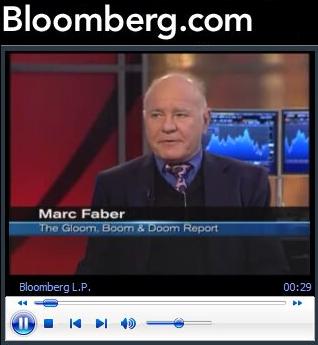
Has World War III already started? According to Marc Faber it has! Check out his interview. Next do you think the government can lose? According to this pundit not only will it lose it is going to lose big! Finally, for years now China has been coming to the rescue by buying Treasuries and US Debt, what will happen when they and other countries stop? Continuation of series from yesterday’s post. Just In! Peter Schiff Interviwed on Russian TV- Get Prepared!  adjust your portfolios and if you own Precious Metals hang on for the ride of your life!- Good Investing!- jschulmansr

Marc Faber on the Economy, Gold, WWIII – Seeking alpha

By: Tim Iacono of Iacono Research

Another good interview with Dr. Marc Faber, this one over at Bloomberg where he’s been a regular for many years (recent appearances at the likes of CNBC are somewhat unusual as he tends to go against conventional wisdom, something that abounds at CNBC).
IMAGE

Click to play in a new window

There’s lots of good stuff in this one – the outlook for the global economy, oil, gold, base metals, natural resource stocks, World War III having already started…

On the subject of alternatives to the government solutions for the current problems, he was asked how he expected the populace to stand for the government doing nothing?

That’s the problem of society. If people can not accept the downside to capitalism, then they should become socialists and then they have a planned economy. They should go to eastern Europe twenty years ago and to Russia and China for the last 70 years.

How do you tell that to somebody in Detroit who’s losing his home today?


Why is he losing his home? Because of government intervention. The government – the Federal Reserve – kept interest rates artificially low and created the biggest housing bubble, not just in the U.S. but worldwide. That is what I’d explain to the worker in Detroit.

============================================

How the Federal Government will Lose in 2009 – Seeking Alpha

By: Rob Viglione of The Freedom Factory

Through a combination of incompetence and greed, the federal government has placed itself in a position of checkmate. There is no way to finance its budget deficits without devaluing the dollar or causing interest rates to rise. With $10.6 trillion in debt, $8.5 trillion in new money created or given away in 2008, and multiple years of trillion dollar deficits planned by Obama, government has no way to fund its extravagances without either printing a lot more money or borrowing unprecedented sums.

This means that either Treasury bonds will crash, or the dollar will suffer significant devaluation relative to foreign exchange or precious metals, especially gold.

TV Does Great Interview With Peter Schiff (Russian TV, That Is)

=====================================================

Remember Dare Something Worthy Today Too!


Market forces are telling the world to shed unproductive assets and shrink capacity, yet central banks and governments around the world, in particular the U.S., are refusing to listen. Rather than allow markets to snap back to sustainable equilibrium from previously artificial highs, the federal government clings to the notion that forcibly shuffling resources, propping up asset prices, and diluting the money supply will magically save the day.

There are consequences to everything. The consequences of shuffling resources (taxing productive ventures and doling out those resources to failing ones, i.e. bailouts) are stunted growth for good businesses and propagation of bad ones. Artificially propping up asset prices means that those who are generally less competent remain the custodians of society’s capital, and diluting the money supply inflates aways everyone’s wealth over time, particularly harming the poor and middle class.

For decades the federal government has gotten away with this reshuffle and inflate game, but the pawns are drowning, the rooks helpless, and the knights ready to turn on the King. Perhaps this is overly dramatic. Clearly, I doubt the capability of the Federal Reserve, Congress, and Obama to “fix” the economy; rather, I strongly believe they are destroying it by forcing us all to drink this Keynesian Kool-Aid. However, whether or not the economy recovers amidst this historic central government action, there are two phenomena we can exploit to our advantage:

  • Short the US dollar
  • Short US Treasuries

In “When will the great Treasury unwinding begin?” I show how government debt has been bid to unsustainable levels and will likely fall. The one concern I see stated all too often is that the Federal Reserve will keep buying Treasuries to artificially depress interest rates. This will, it is claimed, keep bond prices inflated. The one undeniable counter to this is that government must somehow fund its $1.2 trillion estimated 2009 deficit. It cannot do this by issuing and then buying the same bonds. It can only raise revenue by selling bonds to other parties, or by diluting the money supply by cranking up the printing presses. There are no other options. There you have it – we have the government in checkmate!

The likely outcome is that they will try to do both. That is why I am heavily shorting both 30-Year Treasury bonds and the dollar. Both assets will likely lose as the government becomes increasingly desperate and the world’s biggest buyers realize there are better alternatives available. Make your bets now before it becomes treasonous to bet against Big Brother!

Disclosure: Long UDN, short TLT, long GLD.

==============================================

Five New Forces to Drive Gold Higher – Seeking Alpha

By: James West of The Midas Letter

Gold naysayers habitually point to the relatively weak performance of gold relative to the broader market over the last 5 years. Given the market today, that argument is increasingly wrong, and the naysayers are soon to either admit their mistake, or pretend that they were never naysayers at all. That’s because during the last 3 months, five major new forces have emerged to compound the previous strong drivers of the gold price up to now.

These new forces are as follows:

  1. China has stopped buying U.S. debt.
    An interesting piece in the New York Times today signals that China, up until now the biggest buyer of U.S. Treasuries and bonds issued by Fannie and Freddie, is moving towards an end to that policy. China holds over US$1 trillion of such paper, and as interest rates collapse, there is less and less incentive for them to buy American.China has made several adjustments to programs that used to give banks and other financial institutions within the country incentive to buy U.S. assets, which means essentially that these same customers for assets will now be looking for Chinese products.The effect this will have on gold is two-fold. In the first place, reduced demand for U.S. debt will hamper Obama’s plans to keep printing money, because the one limiting factor that still seems to be respected in terms of how much paper can be printed, is the idea that there must be a counterparty to every issuance of T-Bills to warrant continued printing. Theoretically, less demand for T-Bills will force a rise in interest rates to attract investors. But that does not appear forthcoming, which will make the U.S. dollar weak relative to other currencies – especially gold.The second effect is that by eliminating incentives for Chinese banks to acquire U.S. denominated assets, investors there will divert more funds to holding gold as a hedge against their current U.S. dollar holdings, which will be diminishing in value.
  2. Future discoveries of gold deposits will diminish dramatically.
    The biggest source of gold ounce inventory for major gold producers is the discoveries made by the several thousand juniors who scour the earth in search of favorable geology. With the collapse in base metals prices, many of these juniors are under increasing pressure to consolidate and downsize, and many more will disappear altogether.That means less money going into gold exploration, and that means the number of new discoveries that can be acquired by majors is going to go down sharply in the coming years. In theory, as gold continues to outperform all other asset classes, there will be a rush back into junior gold exploration, but that won’t happen until gold is taken much higher and investment demand for it soars.
  3. Existing by-product gold production will fall sharply
    In copper, zinc and other base metals mines around the world, gold occurs in metallic deposits as a by-product of some other dominant mineral. In the United States, 15 percent of gold production is derived from mining copper, lead and zinc ores.With the collapse in prices for these metals, the by-product production of gold is most often insufficient to justify the continued operation of the mine profitably, and it is likely that a significant amount of this by-product gold production will cease along with the shutdown of these operations. The result will be less gold production from existing operations, contributing to the now even faster growing gap between supply and demand.
  4. Gold is becoming mainstream
    One of the biggest contributors to gold’s unpopularity as a main street investment is that it has been mercilessly derided and ridiculed by mainstream investment media and institutions. There is very little opportunity for an investment advisor to insinuate himself into a gold purchase transaction, since most anybody who wants to hold the metal can visit their local bullion exchange or mint and buy as much as they’d like. Because the massive investment institutions that dominate the investment advisory business can’t make a fee out of advising you to buy gold, they try to convince you to purchase other asset classes which their firm has either originated or is a participant in a syndication of investment banks selling such products.Thanks to the widespread coverage of the questionable integrity of these complex securities, and since many main street investors have been burned by their investment advisors (they feel), there is increasing main street advice being doled out to buy gold. One need only search Google news on any given day to discover that headlines critical of gold are now replaced with headlines singing its praises.
  5. Gold is the best performing asset class of the decade
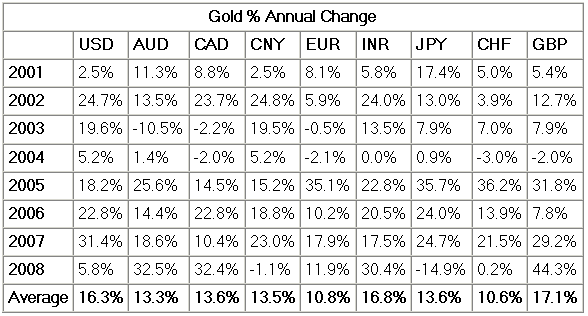
    Now that the global financial meltdown has got up a head of steam, investors are hard pressed to find any investment that has performed well over the last ten years as consistently as gold. The chart below outlines this performance and appears here courtesy of James Turk’s GoldMoney.com.
Gold Performance: 2001-2008 (click to enlarge)
Gold Performance 2001 - 2008

As you can see, any investment still returning an average of 10 – 17 percent is a winner, compared to everything else you can generate a chart for. As this intelligence permeates the none-too-quick popular investment imagination, and, combined with the other 4 factors, gold is going to be where the world’s next crop of millionaires is minted.

===========================================

Share this:

  • Click to share on Reddit (Opens in new window) Reddit
  • Click to share on Facebook (Opens in new window) Facebook
  • Click to share on LinkedIn (Opens in new window) LinkedIn
  • More
  • Click to share on X (Opens in new window) X
  • Click to share on Pinterest (Opens in new window) Pinterest
  • Click to share on Tumblr (Opens in new window) Tumblr
  • Click to print (Opens in new window) Print
  • Click to email a link to a friend (Opens in new window) Email
Like Loading...

The U.S. Dollar and Deficit-Gold Relationships

08 Thursday Jan 2009

Posted by jschulmansr in Bollinger Bands, capitalism, commodities, Copper, Currency and Currencies, deflation, Finance, Fundamental Analysis, gold, hard assets, How To Invest, How To Make Money, Investing, investments, Latest News, Make Money Investing, Markets, mining companies, mining stocks, Moving Averages, oil, platinum, precious metals, silver, small caps, Stocks, Technical Analysis, Today, U.S. Dollar, Uncategorized

≈ Comments Off on The U.S. Dollar and Deficit-Gold Relationships

Tags

agricultural commodities, alternate energy, Austrian school, banking crisis, banks, bear market, Bollinger Bands, bull market, capitalism, central banks, China, Comex, commodities, communism, Copper, Currencies, currency, deflation, depression, diamonds, dollar denominated, dollar denominated investments, economic, economic trends, economy, financial, Forex, futures, futures markets, gold, gold miners, hard assets, heating oil, India, inflation, investments, Keith Fitz-Gerald, market crash, Markets, mining companies, Moving Averages, natural gas, oil, palladium, Peter Schiff, physical gold, platinum, platinum miners, precious metals, price, price manipulation, prices, producers, production, protection, rare earth metals, recession, risk, run on banks, safety, Saudi Arabia, Sean Rakhimov, silver, silver miners, socialism, sovereign, spot, spot price, stagflation, Technical Analysis, timber, U.S. Dollar, volatility, warrants, Water

My Note- Gold came roaring back today and being beaten down yesterday, currently Gold is up $15 at $856+ and holding above the $850 level. Today’s articles explore the relationship of the U.S. Dollar, the Deficit and National Debt; and their relationship to Gold prices. If you are not alarmed by the current deficit you should be! Now with Obama predicting a yearly deficit of over 1 Trillion dollars what does this mean for the Economy, the Dollar and the price of Gold? Read On and Find Out… Good Investing – jschulmansr

Things We Don’t Talk About (But Should); National Debt and the $2 Trillion Deficits- Seeking Alpha

By: Jonathan O’Shaughnessy of Emerginvest Blog & Emerginvest 

It has been around for decades, and has been ignored by many for just as long. However, the US national debt stands to finally be thrown into the forefront of political discussion as the record for a single-year deficit looks to be beaten – by threefold.

According to the government-run TreasuryDirect.gov, US national debt is the largest it has been in history at $10.6 trillion, or $10,638,425,746,293.80. This is at a time when the US is facing the worst economic crisis since the Great Depression, which requires record-shattering government spending to stabilize the faltering economy. In addition, global demand for US national debt is waning as countries world-wide are implementing their own financial stimulus packages. Yet economists are virtually unanimously advocating for radical government spending to stabilize the economy, which leaves future generations of Americans holding extremely large amounts of national debt.

The problem for the average American is twofold: national debt doesn’t seemingly affect their daily lives and $10.6 trillion is a hard number to conceptualize. After a certain point, the human brain stops comprehending the magnitude of a given number, and simply categorizes it as “extremely large.” Subsequently, there is little public outrage or discussion when the US has run up a few hundred billion dollar deficit in years past. It doesn’t seem to affect their lives, no government projects are cut, and adding $0.2T onto $10.6T seems relatively insignificant.

However, when viewed in another light, the enormity of the national debt is astonishing. According to the 2007 United States budget, and TreasuryDirect.gov, the interest alone on national debt is approximately $460 billion. It accounts for the second-highest expenditure on the US budget and if the US could forgo paying that interest on national debt for one year, the United States government could:

1) Pay for the entire education budget of the United States six times over

2) Reduce federal taxes by 33% for all Americans, or

3) Write a check to every man, woman, and child in the United States for $1,500.

Yet, that $460 billion in annual interest looks to grow substantially with looming deficits in the years to come.

A New York Times article entitled “Obama Warns of Prospect for Trillion-Dollar Deficits,” stated: “President-elect Barack Obama on Tuesday braced Americans for the unparalleled prospect of ‘trillion-dollar deficits for years to come.’” President-elect Obama did not give details about the size of the deficit, but projections place the proposed deficit at close to $1.2 trillion for 2009, shattering the record from President Bush last year at $455B.

That is not counting the proposed $800B 2-year stimulus package which could easily raise the deficit into the $1.7 trillion range – bringing the national debt to roughly $12.3 trillion by the end of 2009. Assuming deficits run at approximately $1 trillion per year for the next two years, which may or may not be conservative, the US could see its national debt as high as $15 trillion in three years.

Subsequently, Obama added emphasis on tighter government regulation, quoted in the NYTimes article as saying: “’ We’re not going to be able to expect the American people to support this critical effort unless we take extraordinary steps to ensure that the investments are made wisely and managed well.’” In correlation, he created a new position, chief performance officer, in charge of eradicating government inefficiencies.

This comes at a time however, when global demand for US debt is falling sharply. A prime example is China, one of the largest creditors to the US, which has heavily curtailed its purchases of US debt in light of the recent financial crisis. Another NYTimes article entitled: “China Losing Taste for Debt from U.S.,” states that: “China’s foreign reserves will increase by $177 billion this year — a large number, but down sharply from an estimated $415 billion last year.” The Chinese government is dealing with their own economic woes – a stock market which has shed two thirds of its value in the last year – and is attempting to implement their own economic stimulus package. Furthermore, the sharp outflow of foreign direct investment in China has further complicated the issue. The situation is similar across the world, as the Emerginvest heat map shows the damage from the past quarter (click to enlarge):

The lack of global demand for US national debt could put severe pressure on US interest rates in the years to come if demand continues to shrink drastically. However, there is a political buffer, as the article stated that: “China’s leadership is likely to avoid any complete halt to purchases of Treasuries for fear of appearing to be torpedoing American chances for an economic recovery at a vulnerable time, said Paul Tang, the chief economist at the Bank of East Asia. ‘This is a political decision,’ he said. ‘This is not purely an investment decision.’”

Yet even in the face of significant strain on government debt and sagging global demand, economists are virtually unanimous in calling for exorbitant amounts of government spending to stabilize the economy. Yet another NYTimes article entitled: “A Crisis Trumps Constraint,” states that: “To a degree that would have been unimaginable two years ago, economists and politicians from across the political spectrum have put aside calls for fiscal restraint and decided that Congress should spend whatever it takes to rescue the economy,” in addition to: “’It pains me to say that because I am a fiscal conservative who dislikes budget deficits and increases in government spending,’ Mr. Feldstein told the lawmakers. But he said, ‘Reviving the economy requires major fiscal stimulus from tax cuts and increased government spending.’”

Therefore, it looks as if the U.S. is inexorably tied to unparalleled government spending in the short term, nearly guaranteeing a national debt of over $14 trillion within a few years. The Obama administration has hinted at overhauling Medicare and Social Security as ways of dampening the gargantuan deficits, but the method, and certainly the net effect of such an undertaking remains ambiguous until the budget is revealed. It seems as if, in the interest of short term self-preservation, future generations of Americans will be inevitably saddled with incomparable amounts of national debt which will heavily shape future American fiscal policy for decades.

Disclosure: Emerginvest is an international finance portal, providing analysis and data on 120+ world markets to help individuals find investments from around the world. Emerginvest provides impartial information about world stock markets, and does not have any holdings in foreign equities.

===============================================

Government Panic Could Herald Dollar Panic – Seeking Alpha

Source: John Browne of Euro Pacific Capital

One of the few things more troubling for an economy than government intervention is government intervention driven by panic. Time and again, history has shown that when governments rush to engineer solutions to pressing problems, unintended difficulties arise.

In the current crisis, there is growing evidence that Washington is in a state of increasing panic. Despite its massive cash injections, market manipulations and ‘rescue’ plans, the recession is clearly deepening and spreading. With little to show thus far, politicians don’t know if they should redouble past efforts, break ground on new initiatives, or both. However all agree, unfortunately, that the consequences of doing too little far outweigh the consequences of doing too much.

Although there are many parallels between the current crisis and the Crash of 1929, one key difference is the global profile of the U.S. dollar. In 1929, the dollar was on the rise, and would soon eclipse the British Pound Sterling as the world’s ‘reserve’ currency. Furthermore, the American economy was fundamentally so strong that in 1934 America was the only major nation able to maintain a currency tied to gold.

Ever since, the U.S. dollar’s privileged ‘reserve’ status has been a principal factor in America’s continued prosperity. The dollar’s unassailable position has enabled successive American governments to disguise the vast depletion of America’s wealth and to successfully increase U.S. Treasury debt to where the published debt now accounts for some 100 percent of GDP. The total of U.S. government debt, including IOU’s and unfunded programs, now stands at a staggering $50 trillion, or five times GDP! If the dollar were just another currency, this never would have been possible.

In today’s crisis however, the dollar is likely making its last star turn as the leading man in the global financial drama. Other stronger, less burdened currencies are waiting in the wings for the old gent to take his final bows.

The dollar’s demise is being catalyzed by the neglect of the Federal government. Instead of enacting policies that would restructure the U.S. economy, and restore productive, non-inflationary wealth creation, Congress is simply financing the old crumbling edifice.

Faced with the growing realization that America is not doing the work necessary to right its economic ship, it will not be long before America’s primary creditors begin to seriously question the nation’s ability to service, let alone repay, its debts.

There is now the prospect (inconceivable until recently), that America could lose its prestigious ‘triple-A’ credit rating. In today’s risk adverse market, this could cost the Treasury one percent in interest on long bonds. Each additional percentage point of interest would cost America some $10 billion a year on each trillion dollars of new debt, or some $300 billion over the life of a 30-year bond.

Many of the foreign governments who hold huge amounts of U.S. dollar Treasury debt, such as China and Japan, have announced plans to spend money on their own ailing economies. Should these foreign central banks divert to domestic initiatives some of the funds used to buy U.S. Treasuries, serious upward pressure on U.S. interest rates will result. Should they actually sell parts or all of their holdings they will likely put serious downward pressure on the U.S. dollar. Last week, a Chinese official claimed the U.S. dollar should be phased out as the world’s ‘reserve’ currency.

In the short term, as dollar ‘carry-trades’ continue to be unwound and questions of political will and falling interest rates haunt the Euro and some other currencies, the U.S. dollar may be the recipient of some upward appreciation. But with the American government appearing increasingly to be in panic mode, a run on the U.S. dollar could develop rapidly into cascading devaluation. Even if no such panic run materializes the long-term outlook for the U.S. dollar is one of high risk and low return. This beckons major upward pressure on precious metals.

========================================

What is Going On With Gold? – Seeking Alpha

Source: The Pragmatic Capitalist

Gold (ETF:GLD) is one of the most fascinating and talked about assets on the planet. There are more conspiracy theories and story lines behind gold than just about anything on earth. Heck, the followers of the asset even have their own club: the goldbugs. You can’t go a day without seeing a commercial about gold. If you google “buy gold” you get almost as many results as if you search “buy real estate” (15.4MM vs 16MM).

But gold has been acting funny lately. The conspiracy theories have been running even crazier than usual (from government conspiracy to backwardation) and the goldbugs are angry. As the world economy deteriorates and the U.S. prints money like it’s going out of style, gold has not appreciated. If you had told me in December of 2007 that the global stock market would fall 40% in 2008 I would have told you to buy gold and nothing else because of its safehaven characteristics. But a funny thing happened on the way to the demise of the global economy: Gold fell.

After rallying into the second quarter of 2008, gold went on a gut wrenching 6 month decline of over 30% – all in the midst of one of the greatest financial collapses ever. It was, if nothing else, quite a paradox. Even crazier, the US dollar stabilized and then rallied into the end of 2008. Why did this happen? How could gold fall in such an environment?

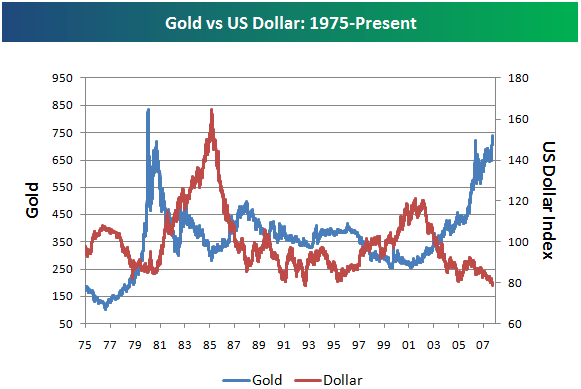
Gold remains an anti-dollar investment. It’s as simple as that. When you buy gold you’re essentially buying a hard asset currency with the hope that one day it will become the world’s choice of currency again. If the dollar (UUP) weakens or one day fails the likelihood of a gold based currency increases. In essence, buying gold is a way of betting against the greenback and U.S. economic dominance. You can argue the extent of my argument, but you can’t really argue with the inverse correlation in the two assets:

Click to enlarge

The correlation is clear. If you’re betting on a rise in gold you’re betting on a falling dollar. I’ve been banking on a higher dollar for over 6 months for one reason: it’s the best currency in a bad lot. Jim Cramer should change his area of expertise to currencies, because while there isn’t always a bull market in stocks and commodities, there is always a bull market somewhere in the currency market. Trades are paired in Forex and unfortunately, it’s hard at this time to make an argument in favor of other currencies over the greenback. And as long as the greenback remains strong it’s unlikely that gold will make any sustainable run.

So why is the dollar the best of the worst? It’s quite simple in my mind. Two major currencies on the planet now effectively bear zero interest: the dollar and the Yen. Of the two, the U.S. is the far superior economy. In essence, neither country can really devalue their currency all that much more unless they decide to print money to the point of insanity and although I believe the U.S. is printing wildly I am not incredibly alarmed as of yet simply because the destructive deflationary forces at work are so much greater than the inflationary response by the Fed. Inflation is certain to rear its ugly head in the coming years, but I suspect it will be relatively mild as the economic rebound is slow and the overall monetary destruction of this deflationary phase proves to be incredible.

So, getting back to the greenback – the U.S. was first to enter a recession and it now looks like the world is catching pneumonia from our cold. Unfortunately Europe and Asia still have relatively high interest rates (read: room for currency devaluation) and simply don’t carry the same status as the U.S. – we are the reserve currency and the only true AAA nation. Yes, you can certainly make the argument that the U.S. is no longer a AAA rated country, but if we’re AA then what does that make Japan (the world’s second largest economy) or Germany? Much worse, in my opinion.

So what we’re seeing is essentially a flight to quality in a time of financial distress? Yes, that’s right, the U.S. dollar is a higher quality asset right now than just about any currency on the planet. And if you’re a U.S. citizen you should be thanking your lucky stars it’s THE reserve currency because this crisis would likely be even worse if that wasn’t the case.

So, before you go placing bets on gold it might be better to research the greenback first.

==================================================

Not Time To Exit Commodity Positions – Seeking Alpha

By: J.D. Steinhilber of Agile Investing

Diversified commodities have suffered approximately the same one-year decline as stocks, but the descent has been more violent since broad commodity indexes peaked in the middle of 2008, whereas most stock indexes peaked in October 2007. Just as it is not the time to abandon stock market commitments, this is certainly not the time to exit commodity positions in the context of a diversified multi-asset portfolio.

Cyclical commodities are not a valuable hedge to a stock portfolio in a deflationary bust and a liquidity crisis such as we have seen, but those conditions are not likely to persist over any investment horizon measured in years rather than months. Massive government reflation and stimulus efforts will support hard assets in 2009. Infrastructure spending is bullish for commodity prices, and tighter credit conditions, along with lower prices, puts pressure on the supply of commodities as suppliers curtail production.

Gold finished the year on a very strong note and managed to produce another year of positive returns in 2008. Gold has the most attractive three and five year annualized returns of all the asset classes we track. Gold will continue to be whip-sawed by the volatility in the currency markets.

We hold Gold (GLD) in our portfolios as an insurance policy against financial crisis and paper currency devaluation. The opportunity cost of holding gold, which produces no dividend or interest income, is now very low given that the Federal Reserve has cut the official U.S. overnight lending rate to zero to 0.25%, and has stated that “weak economic conditions are likely to warrant exceptionally low levels of the federal funds rate for some time.”

[click to enlarge]


===================================================

How Will Obama’s “Trillion Dollar Deficits” Affect the Markets? – Seeking Alpha

By: Simit Patel of Informed Trades.com

The New York Times has an article this week reporting on US President-elect Barack Obama’s warning that there will be ‘trillion-dollar deficits for years to come.” What does that mean for the markets?

The first line of recourse will be the issuance of Treasury bonds; in other words, the US government will look to borrow money, offering to pay it back with interest. The key question, though, is to what extent buyers of Treasuries will be easily found. As we have discussed previously, the very low yield on bonds coupled with the fact that the economic pains are being felt all around the world suggest one of two possibilities: bond rates will have to go up or the Federal Reserve will have to “monetize the debt” — meaning it will simply have to print more money.

I have stated and continue to believe that the result of increased deficit spending, due largely to government bailouts, in this environment will be debt monetization (even if there is a rate hike, that will only increase the future debt, and thus will only delay and exacerbate debt monetization). I believe this will prove to be inflationary, that it will devalue the US dollar, and that this is the real way the bailouts will be paid for; not via a direct tax, but rather a tax through inflation. Economist Mike Shedlock, however, offers a counter viewpoint:

The Fed at some point will resort to out and out monetization, and that will have the inflationists screaming at the top of their lungs. However, banks will still be reluctant to lend, and consumers and businesses will be reluctant to borrow. In addition, I expect the velocity of money printed to be close to zero and for the savings rate to rise. In aggregate, these are not hyperinflationary things. Heck, they are not even inflationary things.

Admittedly, I am one of those inflationists who will be screaming at the top of my lungs.

There are two reasons I believe debt monetization will be inflationary:

  1. I disagree with the notion that banks won’t lend and consumers won’t borrow. As I recently noted, we are seeing a declining TED spread as well as an increase in many money supply metrics (M1, M2, MZM). And even in this environment, we have seen companies like Verizon be able to secure a massive $17 billion loan.
  2. Even if lending is reduced due to the economic climate, debt monetization increases the likelihood that foreigners will not only stop buying Treasuries, but that they will sell the ones they have, and will dump US dollar holdings out of a concern of dollar devaluation by the part of the Federal Reserve. This suggests there will be a “run on the currency,” similar to what was seen in Argentina. See our previous article on the similiarities between the US economic crisis and the Argentinian crisis of 2001 for more on this subject.

How to Trade This Scenario

Timing is the key issue for trading this; we are currently seeing a rally in the market, though I expect that at some point in the second half of 2009 we will see the concerns about the Treasury market begin to manifest. As a trend-following trader I look for momentum that corresponds to my fundamental viewpoint, with the exception of precious metals, which I treat as buy and hold type investments.

With that in mind, here are the conclusions I am making based on the trillion dollar deficit scenario:

  1. US dollar will fall in value. For stock market traders, UDN is an ETF to watch.
  2. Dollar hedges like gold and silver will rise. GLD and SLV are corresponding ETFs.
  3. Both monetization of debt as well as a hike in interest rates will send bond prices falling, as a rate hike devalues all bonds previously issued at a lower rate while monetization of debt introduces inflation concerns and the possiblity of the bond being paid back with a currency that is worth less.
  4. A rate hike, which I think is increasingly unlikely given the Fed’s behavior though still possible, will be bearish for US stocks. DOG and SH are inverse ETFs worth considering in such a scenario.

Disclosure: Long gold and silver; currently short US dollar against Australian dollar.

==============================================

My Note: Whether as “Portfolio Insurance”, or as a Speculative Investment, I think now is the time to buy and Invest in  Gold and Precious Metals in any form. I am calling for $1000 to $1250 Gold later this year and even higher if the Middle East Situation disintergrates and gets worse. Other factors are mentioned in detail above, don’t kick yourself later, buy Precious Metals and Miners at these ridiculously low levels NOW!

My- Disclosure: I am long Physical Precious Metals, Etf’s, and Mining/Producer Stocks. I.e. my money is where my mouth is! Remember to do your own Due Diligence and read all Prospectus’s before making any investment. -jschulmansr

Share this:

  • Click to share on Reddit (Opens in new window) Reddit
  • Click to share on Facebook (Opens in new window) Facebook
  • Click to share on LinkedIn (Opens in new window) LinkedIn
  • More
  • Click to share on X (Opens in new window) X
  • Click to share on Pinterest (Opens in new window) Pinterest
  • Click to share on Tumblr (Opens in new window) Tumblr
  • Click to print (Opens in new window) Print
  • Click to email a link to a friend (Opens in new window) Email
Like Loading...

Gold-History Repeating Itself?

06 Tuesday Jan 2009

Posted by jschulmansr in Bollinger Bands, capitalism, commodities, Copper, Currency and Currencies, Finance, Fundamental Analysis, gold, hard assets, How To Invest, How To Make Money, inflation, Investing, investments, Jschulmansr, Latest News, Make Money Investing, Markets, mining stocks, Moving Averages, oil, precious metals, silver, small caps, Stocks, Technical Analysis, Today, U.S. Dollar, Uncategorized

≈ Comments Off on Gold-History Repeating Itself?

Tags

agricultural commodities, alternate energy, Austrian school, banking crisis, banks, bear market, Bollinger Bands, bull market, capitalism, central banks, China, Comex, commodities, communism, Copper, Currencies, currency, deflation, depression, diamonds, dollar denominated, dollar denominated investments, economic, economic trends, economy, financial, Forex, futures, futures markets, gold, gold miners, hard assets, heating oil, India, inflation, investments, Keith Fitz-Gerald, market crash, Markets, mining companies, Moving Averages, natural gas, oil, palladium, Peter Schiff, physical gold, platinum, platinum miners, precious metals, price, price manipulation, prices, producers, production, protection, rare earth metals, recession, risk, run on banks, safety, Saudi Arabia, silver, silver miners, socialism, sovereign, spot, spot price, stagflation, Technical Analysis, timber, U.S. Dollar, volatility, warrants, Water

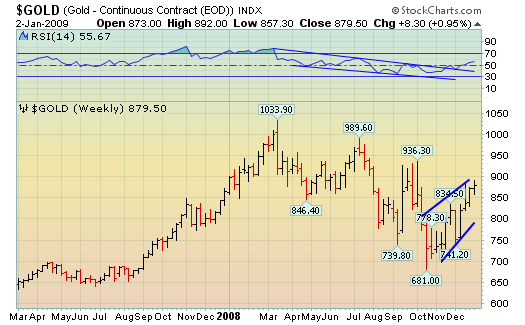
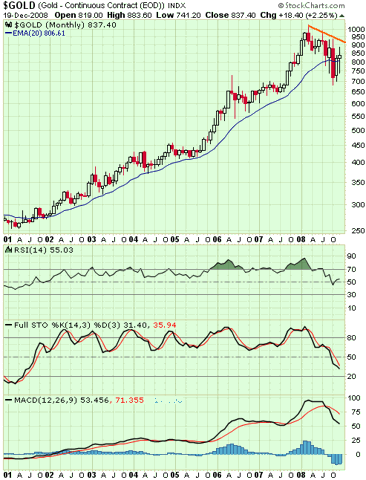
Today’s action: Gold opened down by a few dollars and now has reversed itself and is cusrrently up $7-10 oz. Based off of chart formations it would appear that  Gold is breaking out to the upside and getting ready to challenge the $900 level, If it can break that then we are set up for a test of the $950-$975 level. If it fails here, a pullback to the $800 level (support base) will probably occur. Today’s articles include one about a new 2yr gold price cycle that appears to be forming. Next some questions answered about the markets for 2009. Finally a special report from Gold World about Gold Backed Banking. Enjoy and good investing! – jschulmansr

Gold’s 2-year cycle – MineWeb

A Mineweb reader has noticed a recent two-year cycle for gold price behaviour which, if it continues will likely give some guidance to price movements this year and next.

By: Joseph Cafariello

EDMONTON, CANADA –

There seems to be a two-year cycle in the gold price which has been repeating itself since about 2004.  The even years follow one pattern, while the odd years follow another pattern.  The even years tend to reach exaggerated extremes to the upside and to the downside on a percentage basis, while the odd years tend to be a little calmer with less volatility.

For example, 2008 went very much like 2006, with exaggerated highs reached in the spring of each year, and a late start to the traditional autumn-winter-spring upswing, which began around October/November of 06 and 08.  On the odd-number side, 2007 went much like 2005, with moderate highs reached in May of each year, and an early start to the traditional autumn-winter-spring upswing, which began around August/September of 05 and 07.

If this is indeed a reliable cycle, we can expect 2009 to be much like 2005 and 2007 all throughout the year.  The first half of 2009 should see gold follow the same pattern as the first halves of 2005 and 2007.  In the springs of 05 and 07, gold kept hitting its head against the previous year’s high all throughout the spring.  More than once during the spring of 2007, gold topped out at about $690, coming to within about 5% of the 2006 high of $735.  Similarly, the spring of 09 should see gold hitting its head against 2008’s high of $1,035, coming to within 5% of it, or up to about $985.  That will be the high for the first half of 2009 at around the beginning of May, though this will not be the high for 2009 as a whole.

Given the odd-number year pattern, we might also expect the back half of 2009 to be much like the back halves of 2005 and 2007.  In both 2005 and 2007, the summertime pull-backs were modest, and the autumn-winter-spring upswings started early, at around August/September of 05 and 07.  The latter half of 2009, then, should see a modest summer-time pull-back of about 5% to 7% of its spring 09 high, taking gold down from $985 in May 09 to about $925 by August 09.  However, the low for 2009 will still be the upcoming January low of $800, which is now only about a week or two away.  The lows of January 2005 and January 2007 were also “the” or “close to the” annual lows for those years.  So the low of 2009 will be at around $800 in January.

The high for 2009 will come in December.  The traditional autumn-winter-spring upswing in 2009-10 will be much as it was in 2005-06 and 2007-08, with an early start.  The year-end run for 09 will begin around August or the beginning of September, jumping from about $925 in Aug/Sep 09 and rising steadily until the end of December 09.  The annual highs for 2005 and 2007 were hit in or near December of each year, and each high was about 20% higher than the average of their first halves.  Thus, the annual high of 2009 will be hit in or near December, and will be 20% higher than the average of its first half, putting the 2009 high at about $1,150 in December.

The traditional autumn-winter-spring upswing, however, will certainly not end in 2009, but will spill over into the spring of 2010 much as it did in the springs of 2006 and 2008.  The high in the spring of 2008 was about 40% higher than high in the spring of 2006.  Hence, the high in the spring of 2010 will be about 40% higher than 2008’s high of $1,035, putting gold at about $1,450 in the spring of 2010.  Then, the summertime pull back of 2010 will be just as stark as were the summertime pullbacks of 2006 and 2008.

And so the two-year cycle will continue, where even-number years follow a pattern of extremes, while the odd-number years are calmer, but with a nice upward kick at the end.  This two-year cycle with even-number years on the extreme side and odd-number years on the moderate side will continue until the commodity boom is over (say around the year 2030, when the populations of China and India finally achieve a 75% middle-class), and until the US dollar recovers at around the same year (2030), when the rest of the world will be looking to the US as a nice place to shop given its then-to-be dirt-cheap dollar.

The above comment was contributed by Mineweb reader Joseph Cafariello who describes himself as “A raving gold bug and proud of it”

==========================================

2009 Market Q&A: Four Questions Answered – Seeking Alpha

Source: Eric Roseman of The Sovereign Society

By Eric Roseman

Over the last several weeks I’ve received numerous questions from Sovereign Society subscribers, including individuals who frequent our daily blog.

As we start 2009, I thought this would be an ideal forum to collect some of these important questions and attempt to give you my best conclusions. I can’t reprint all of these inquiries; but I’ve compiled several excellent questions from our members.

Overall, I don’t like forecasting. I generally believe it’s a total waste of time and most consensus estimates ahead of 2008 ended in the basement with the majority of analysts dead wrong about the economy, the market and just about everything else.

I have to admit that I never expected the markets to crash, the banking system to go bust or the dollar to skyrocket in the midst of the worst financial crisis in 75 years. To be fair, I think most pros failed to make accurate predictions.

Question: I’m a retired investor living on income. Prior to the big rally in Treasury bonds, I held most of my savings in short-term Treasury’s and bank term deposits. But with short-term rates under 1% and government bonds yielding a pittance, I’m nervous. What should I do to supplement my income?

Comment: This is perhaps the most challenging environment for retirees in more than a generation. With money-market funds yielding almost nothing, Treasury bonds yielding around 2% and bank CDs paying under 1%, retirees must supplement their income.

My advice is to take a small portion of your savings, say 20%, and scatter that sum across a dozen or more investment grade corporate bonds. I emphasize “investment grade” and not junk debt. Investment grade debt includes anything rated BBB or better in my book and, to make it easier, I would stick to issues rated A- or higher.

The Dow Jones Corporate Bond Index now yields 6.90% – down from its post-crash high yield of 8.87% in early $100 bill imageOctober. Still, investors can tap into non-financial bonds like IBM, Johnson & Johnson (JNJ), Wal-Mart (WMT) and Kraft Foods (KFT) – all paying 5.5% or more. Or, look at corporate bonds issued by America’s largest banks, including JPMorgan Chase (JPM), Goldman Sachs (GS), Wells Fargo (WFC) and US Bancorp (USB). These banks won’t default.

A good strategy to keep things simple is to buy a laddered portfolio of corporate bonds ranging from two years all the way to seven years. This should at least give your nest egg a boost and if you feel comfortable with this formula, then increase your position to say 35% of your portfolio. But remember, don’t go whole-hog; at some point over the next 12 months, perhaps later, Treasury bond prices will get smashed and long-term rates will head higher as the government expands credit to the moon. Keep your powder dry.

Question: Do you think we’ll avoid another Great Depression? Despite all the money thrown at the markets since late 2007 we’re still in the midst of a severe credit contraction and the global economy has literally fallen off a cliff since October.

Comment: I think we’ll avoid another Great Depression but only because government will nationalize or partially nationalize key industries. Without government intervention, the free market would have resulted in massive failures and a total collapse of the banking system and the broader global economy. There’s no doubt in my mind that the government made a big mistake not rescuing Lehman Brothers last September. Once you’re bailing out major banks, then do it right. But in all honesty, we don’t know what transpires behind the Fed’s walls or the Treasury’s. There’s some crazy buddy system in progress with special interests influencing government policy. The government doesn’t give a damn about you or me. What they care about is protecting their interests. That’s why we must protect our assets and, in the end, I believe gold will triumph above all paper money, especially against the dollar.

I don’t advocate government intervention; but these are not normal times and the consequences might have resulted in the death of capitalism and perhaps the emergence of a new social order, similar to what occurred in post-Weimar Germany in the 1920s. Harsh economic times usually result in a new socio-economic regime. If the Fed and Treasury fail to rescue the credit system, then we might face similar consequences. The world as we know it will come to an end.

It’s hard to know exactly what goes on behind the Federal Reserve’s closed doors and at the Treasury’s. Thus far, government efforts have been bold since the October crash, including major central banks worldwide. Major credit indicators have indeed improved since November but the housing market – the crux of the crisis – is still in a freefall. Housing must stabilize before this severe recession ends.

In my eyes, it seems that bailouts and backstops are not addressing the real problem; most TARP money is ending up in bank coffers again and, in most cases, these institutions aren’t lending. The core of this credit crisis lies with the consumer and with housing. If you’re going to fork out several trillion dollars to fix or remedy this crisis then give the money to the consumer – not the banks. The consumer is in a severe bear market with personal assets plummeting over the last 18 months, including real estate, stocks, most bonds and now, possibly his or her job might be next on the chopping block.

Give consumer households $50,000 or more and allow them to clean-up their busted balance sheets, keep their homes (service mortgages) and pay off installment debt. You might not agree with me and, in all fairness, it’s against the tenets of the Sovereign Individual; but what good will all this money do if it’s basically squandered by government and ending up in the pockets of reckless bankers again? I have serious doubts about how the government is dealing with this crisis and I don’t think Obama’s spending package will help much at all despite perhaps growing the economy for a few quarters.

Question: What about the banks? With governments now standing behind their biggest financial institutions, is the worst over?

Comment: The global banking system, for all intents and purposes, is effectively bust or bankrupt. This is especially the case in the United States, Europe and, to a lesser extent, in Japan. More than a dozen emerging market banks are totally bust, including Iceland, the Baltics, Hungary, Romania, Bolivia, Ukraine, Ecuador, Argentina, etc. Not a pretty picture.

I think we’re more than 75% through the worst at this juncture. Governments now stand behind the largest banks in each country and, in some cases, even guarantee entire deposits until 2010 (e.g. European Union). I wouldn’t worry about the largest banks failing at this point. The worst is now behind us.

Question: I know you’re a big gold bug, but isn’t the euro a strong currency and do you think it’s a better hedge against the dollar than gold? Is it too late to purchase gold coins and, if not, where would you suggest I buy coins?

Comment: I have absolutely zero faith in the U.S. dollar and other currencies, including the euro or yen. In the end, all currencies will decline vis-à-vis gold and, in fact, since 2005 the world’s currencies have been losing their relative value to gold bullion. Despite big moves by the yen and euro over the last several years, they pale against gold.

Increasingly, the average man in the street will realize that paper money is not protecting his purchasing power and will revolt against fiat money. At The Sovereign Society, we’ve driven home this message since our first year of publication in 1997. Gold is the only asset in this world that isn’t someone else’s liability; with U.S. interest rates effectively at 0%, paper money now competes with gold, which also pays 0% interest. In a zero percent world, which asset would you rather own? I think the answer is obvious.

The government’s enormous spending plans to rescue the financial system and bailout almost every ailing industry Gold Coin Imageassures dollar destruction because the Fed is now on course to print money like never before to quash deflation. We all better hope and prey that the Fed can drain excess bank liquidity very quickly when this credit crisis ends. If not, we’ll have some serious inflation – much worse than what we saw prior to July 2008.

I think every investor should hold at least 10% of his assets in physical gold. This means coins, wafers or bars. Getting gold coins today is difficult because the U.S. Mint has stopped selling Eagles since last summer while other dealers are complaining about tight supplies amid booming investor demand. I suggest KITCO or First Federal Coin Corporation.

Also, I would not hold or store all of my physical gold at my home domicile. I strongly suggest parking some of your gold in Switzerland, too. Remember, you must report assets outside of the United States and Canada.

I’m convinced we’ll see some sort of government confiscation of gold again just like we did in the 1930s. Back then, FDR did allow Americans to hold a maximum of 100 ounces. I’m not so sure the next confiscation will be so generous.

I hope you found this helpful.

===============================================

2009 Gold Outlook – Gold World

How To Invest in Gold in 2009

By Luke Burgess

The investment markets are yielding to the fact that the global economy will remain weak for the better part of 2009.

As a result, investors will continue to seek safe havens.

Under normal conditions, these safe haven investments would include land and real estate. These assets have intrinsic value; or in other words, their value will never fall to zero. But with falling prices, investing in real estate is out of the question for most people right now. And there’s little doubt that investors will look elsewhere for safety against financial crisis.

The best safe haven asset in the world right now is still gold because it is never considered to be a liability.

And we believe that safe haven investment demand will drive gold prices during 2009. With this in mind, we would like to present a broad overview of Gold World‘s 2009 gold outlook. But before we get into that, let’s review what happened to gold prices in 2008.

Gold Was One of the Best Investments of 2008

In March 2008, gold prices hit a record high of $1,033 an ounce as the gold bull market entered its seventh year of life. This was followed by a normal 18% correction, which drove gold prices back down to $850 an ounce.

Gold prices subsequently rebounded and were once again closing in on the $1,000 level in mid-July. At the same time, however, the fundamental and psychological effects of the slowing housing and credit markets were just beginning to devalue significantly the investment markets across the board.

As a result, many long gold positions had to be sold in order to cover losses from investments in other markets. Over the next several months, this forced selling pressure pushed gold prices down.

Gold prices were also held down during the second half of 2008 as the U.S. dollar enjoyed a +20% rally. Foreign governments, institutions, and banks began buying the U.S. dollar, which despite a legion of problems continues to be the world’s most important reserve currency, as a hedge against domestic economic turmoil.

20090105_2009_gold_outlook.png

These factors contributed to a significant drop in the price of gold, which officially bottomed out for the year at an intraday low of $683 an ounce in October 2008.

Gold prices have subsequently bounced off of the $700 level as major selling has dried up, and fresh buying has come into the market.

Despite three 20% corrections and serious deflation in the market, gold exited 2008 with a positive 5.4% gain for the year. Although subtle, this gain outperformed every major equity index and commodity in the world. Here are just a few examples…

Index/Commodity
Percent Change During 2008
Dow Jones
-34%
NASDAQ
-41%
S&P 500
-39%
TSX -35%
TSX Venture -74%
Oil
-55%
Silver
-23%
Copper
-54%
Gold
+5%

This made gold one of the best investments of 2008.

And the 2009 gold outlook looks just as strong.

Gold’s 2009 Outlook

Despite a bit of downside in the immediate future, we expect gold to have a stellar year.

Global economic turmoil and deflation will undoubtedly continue to influence gold prices in the near-term. A short-term pullback in gold prices from current levels to $800—maybe even a bit lower—is not out of the question. However, we expect gold prices to break new records during 2009.

For our current perspective, we expect gold prices to reach as high as $1,300 during 2009, which would be a profit of over 50% from current levels.

Gold prices in 2009 will be supported more heavily by supply/demand fundamentals than in the previous years of this gold bull market.

As we’ve previously discussed, during the third quarter of 2008, world gold demand outstripped supply by 10.5 million ounces. This deficit was worth $8.5 billion and was the largest supply/demand deficit since the gold bull market of the 1970s.

Official 4Q 2008 world gold supply/demand figures will be calculated and reported later this month. Gold World will report them to you when the data is released.

In the meantime, though, all estimates suggest that there will be another very large deficit in world gold supplies from the fourth-quarter, with investment demand continuing to drive the market.

We expect that a continuing surge in investment demand could push gold prices as high as $1,300 at one point during 2009.

There will likely be a bit more volatility in the gold market in 2009 as more and more speculators come into the market. It is likely that the gold market will experience three or four price peaks (selling points) during 2009.

How to Invest in Gold for 2009

As we expect a near-term drop in gold prices as a result of continuing deflation, we are advising our readers to hold off on any physical gold buying for the immediate future. As previously mentioned, gold prices could dip back down to $800 before recovering again.

Nevertheless, we expect 2009 to be another great year for gold investors.

Good Investing,

Luke Burgess and the Gold World Research Team
www.GoldWorld.com

=================================================

Gold World Special Report – Gold Backed Banking

Special Report – Here’s How To Get Your Own Copy – Simply Subscribe

January, 2009

Gold Backed Banking

It’s a wonder Americans aren’t rioting in the streets.

Not including the $700 billion blank check issued to the banks and signed by the US taxpayer, the sum of liabilities assumed by the US government from the finance industry in the past 6 months alone exceeds 50% of the GDP.

Despite this unprecedented government intervention, the solvency of other every commercial and investment bank is still at stake!

Recognize this all-but-forgotten quote?

“The central bank is an institution of the most deadly hostility existing against the Principles and form of our Constitution. I am an Enemy to all banks discounting bills or notes for anything but Coin. If the American People allow private banks to control the issuance of their currency, first by inflation and then by deflation, the banks and corporations that will grow up around them will deprive the People of all their Property until their Children will wake up homeless on the continent their Fathers conquered.”
— Thomas Jefferson, Founding Father, Third President of the United States, and the principal author of the US Declaration of Independence

How bout a drink from the cup of truth…

The Bush administration’s $700 billion bailout plan may keep some banks afloat for the time being. But fundamental problems are still deeply rooted within the financial markets that threaten to bring down the whole system.

The hard truth is that there is no 100% safe place to keep your money.

Physical cash and gold are the safest places to hold your wealth right now. Anyone who tells you otherwise has either a motive or no clue.

Those with the means to do so should be holding at least some physical cash and gold.

Of course, people will debate why you should hold these assets…

Gold is the ultimate in hedging against financial turmoil. But as it stands today, it’s quite rare to find someone willing to trade a product or service for gold. In other words, it’s difficult to spend gold like money, which has been a criticism of owning physical gold for decades.

Today’s digital age allows consumers to move electronic fiat money around at speeds exponentially faster than ever before. This morning I paid my cable bill with my check card. The entire transaction was completed within 5 minutes. Had I paid by mailing a check, it could have taken up 1-2 days to reach the cable company and 3-5 days to clear my account.

So what if there was a way gold could be used as easily as electronic money?

The World’s Only “100% Backed-by-Gold Bank”

You might have a hard time believing this, but you can actually put yourself on a personal gold standard with a new kind of currency, and it’s rapidly growing among gold bugs.

Understand first, this new currency is not legal tender issued by any government. That means there’s no debt, inflation, geopolitical turmoil, or any other considerations normally associated with government-issued currency.

The currency comes in electronic form, but can be used like any other currency in the world today to pay for goods and services, and even settle debt. But there’s one major difference that sets this currency apart from every other in the world:

It’s 100% backed by gold.

In fact, in most cases you can instantly exchange this currency for physical gold at any time… a feature taken away from the US dollar decades ago.

This currency has a new system fully established, making it as easy to use as the current banking industry’s electronic money. Right now, in fact, there are already over 3,000 outfits—and climbing—in which you can pay online using this currency.

How the “Gold Bank” Works

Customers transfer funds from traditional bank accounts into these unique gold-backed bank accounts, and earn interest on their funds prior to placing an order.

Meanwhile, for customers already holding gold and silver in secured (and insured) vaults, their metals are insured and held in specialized bullion vaults. Their metals assets go through an annual audit, and are fully reported to customers.

Once customers’ funds are in the database, customers’ orders are made through its secure online system. Database servers record all transactions and store currency and metal balances.

The Advantages of Using this Currency?

Being backed by gold, the purchasing power of this currency fluctuates in relation to the price of gold.

This means that as the price of gold increases, the purchasing power of the account increases. On the flip side, however, if the price of gold falls, so does the value of the account. Nonetheless, the risk of significant price fluctuation in gold is small compared to the risk of value fluctuations among fiat currencies, especially the US dollar.

And despite a short-term correction, the price of gold has increased significantly over the past five years. So this factor has worked out to the advantage of anyone holding this currency over that period. And with +$2,000 gold on the horizon, holders of this currency should do quite well in the future.

Now you should know that I’m in no way affiliated with this service, nor do I receive any compensation from it. That said…

I Recently Put the Final Touches on my New Research Report…

This report shares all the details about the new gold-backed electronic currency, and it’s yours free after you take a risk-free trial of the Mining Speculator service.

It’s your chance to get in on the biggest and best buying opportunity in junior gold and silver stocks… ever.

That’s right. The junior gold market is about to blast off, after a brutal beat-down sparked by the financial crisis. Truth is, it’s pushed many gold and silver stocks to new lows…

… Which is why you don’t want to wait a minute longer to position yourself in the Mining Speculator’s mining and precious metals portfolio. Our team of analysts scour the earth for opportunities in gold, as protection against the financial uncertainties engulfing the U.S. and world markets.

It’s the ultimate opportunity in a period of great crisis.

You see, as our government continues to lose control of its ability to manage and prop up markets, gold and silver will undoubtedly make meteoric moves that will stun the populace.

And just in case you still harbor doubts about gold, consider this… reported last week in the Financial Times…

“… Investors in gold are demanding ‘unprecedented’ amounts of bullion bars and coins and moving them into their own vaults as fears about the health of the global financial system deepen.”

And since gold bullion is getting harder and harder to come by, more investors are looking for the next best alternative, and that’s…

Precious Metals Mining Stocks

Bottom line: Junior mining stocks will begin to make major moves to the upside, rewarding those who got in early and held on… and those who get in now at what are, frankly, bargain share prices.

You see, nothing can keep gold from doubling up and hitting $2,000 an ounce… causing shares in our mining exploration companies to skyrocket.

I’m talking about junior mining stocks with the potential to double, triple—even quadruple!

Of course, many people have trouble accepting gold as an investment—even now that they’ve witnessed a financial upheaval that’s shaken our country by the shoulders.

But I also know that those who have heard me out-and followed through with my research and recommendations-have made extraordinary, life-altering returns.

Which is why I maintain…

There’s never been a better time-a more crucial time-to protect your portfolio with gold and precious metals.

And for a brief time, we’re making it easy to do just that… for as little as $25.

To get immediate inside access to the junior mining companies poised for major run-ups – the ones I’ve visited firsthand and carefully selected after exhaustive research and quality controls – simply take a trial of my Mining Speculator advisory.

When you sign up for Mining Speculator, I will immediately send you the free report on the new gold-backed currency mentioned in this editorial.

So, for only $25 you’ll begin to receive my Mining Speculator junior stock advisory… one that held an average 212% gain over five years… plus you’ll get our new special report on “The World’s Only 100% Backed-by-Gold Bank.”

All you have to do is click here to get started.

Good investing,

Greg McCoach, Investment Director, Mining Speculator
Luke Burgess, Editor, Gold World

====================================================

My Note: I do not receive any renumeration or commissions for recommending either the Gold backed banking or the Mining Speculator. As Always be sure to do your own due diligence and read the prospectus before making any investments or deposits into financial institutions.-jschulmansr

Share this:

  • Click to share on Reddit (Opens in new window) Reddit
  • Click to share on Facebook (Opens in new window) Facebook
  • Click to share on LinkedIn (Opens in new window) LinkedIn
  • More
  • Click to share on X (Opens in new window) X
  • Click to share on Pinterest (Opens in new window) Pinterest
  • Click to share on Tumblr (Opens in new window) Tumblr
  • Click to print (Opens in new window) Print
  • Click to email a link to a friend (Opens in new window) Email
Like Loading...

A Lesson In Geo-Political Energy + Gold News

05 Monday Jan 2009

Posted by jschulmansr in Bollinger Bands, capitalism, commodities, Copper, Currency and Currencies, deflation, diamonds, Finance, Fundamental Analysis, gold, hard assets, How To Invest, How To Make Money, inflation, Investing, investments, Latest News, Make Money Investing, Markets, mining stocks, Moving Averages, oil, Politics, precious metals, silver, small caps, Stocks, Technical Analysis, Today, U.S. Dollar

≈ 1 Comment

Tags

agricultural commodities, alternate energy, Austrian school, banking crisis, banks, bear market, Bollinger Bands, bull market, capitalism, central banks, China, Comex, commodities, communism, Copper, Currencies, currency, deflation, depression, diamonds, dollar denominated, dollar denominated investments, economic, economic trends, economy, financial, Forex, futures, futures markets, gold, gold miners, hard assets, heating oil, India, inflation, investments, Keith Fitz-Gerald, market crash, Markets, mining companies, Moving Averages, natural gas, oil, palladium, Peter Schiff, physical gold, platinum, platinum miners, precious metals, price, price manipulation, prices, producers, production, protection, rare earth metals, recession, risk, run on banks, safety, Saudi Arabia, silver, silver miners, socialism, sovereign, spot, spot price, stagflation, Technical Analysis, timber, U.S. Dollar, volatility, warrants, Water

My Note- Today I present an interesting article about the Geo-Political ramifications of the Battle for the Caspian Seas, plus some of the latest Gold News. Gold today is making a much needed correction in prices, if Gold can hold here and/or we have any increase in tensions of the Middle East; I think the next leg will take prices into the $900-$950 range.- jschulmansr

Geopolitical Energy Centered on the Caspian Sea – Seeking Alpha

By: Michael Fitzsimmons of Musings From the Fitzman

I’ve just finished reading a fascinating book authored by Lutz Kleveman entitled The New Great Game. The book is about Kleveman’s visits to all countries surrounding the Caspian Sea and to the countries involved in actual and proposed oil and gas pipeline routes required to bring Caspian Sea energy assets to the world market. He interviews an amazing cast of intriguing characters along the way.

The investigative journalist delves deeply into the geopolitical implications of world powers struggling to control Caspian Sea energy reserves – some of the largest remaining oil and gas fields in the world. It is fitting the game of chess was invented by the Persians. It is worth purchasing The New Great Game just to gaze at the maps on the inside and backside covers…each central Asian country being ruled by a government or dictator who one minute moves diagonally like a bishop, only years later to morph into a rook and move horizontally and vertically like a knight, and every once in awhile going hay-wire and imitating the unorthodox movement of a knight. Who will win the great game? What will OPEC’s response be to non-OPEC oil production in the Caspian Sea region? How will China and Russia respond to American military might in the region? Only time will tell.

The map below shows the countries surrounding the Caspian Sea which are Russia, Kazakhstan, Turkmenistan, Iran, and Azerbaijan.

Most people are fairly familiar with the oil history of Baku, Azerbaijan dating back to Russian oil discovery and production in the early 1870s. Kleveman relates an interesting story of Swede Robert Nobel who was the older brother of factory owners Ludwig and Alfred Nobel who had become very wealthy producing arms and dynamite. Robert had been sent to Baku with 25,000 rubles to purchase Russian walnut to make rifle butts. Instead, he caught Baku oil fever and bought a small refinery. After only a few years, the Nobel Brothers Petroleum Producing Company vaulted over Rockefeller’s Standard Oil as the largest oil producer in the world. Later, the Nobel’s invented the first oil tanker in a story well told in Daniel Yergin’s The Prize, for which, ironically, Yergin won the Nobel Prize for non-fiction literature in 1992. And yes, the prize is named after the same Nobel family as those men seeking walnut wood for rifle butts in Azerbaijan.

Fast forward to today: Baku Azeri oil is being shipped to the Mediterranean Sea and world markets via the so-called BTC (Baku-Tbilisi-Ceyhan) pipeline. The picture below shows the pipeline’s route from Baku, Azerbaijan through Tbilisi Georgia, and finally to the Mediterranean Turkish port of Ceyhan.

This pipeline was hailed as the “Contract of the Century” by Azeri officials very much interested in getting their oil to market independent of Iranian and Russian involvement. Of course, the US was more than mildly interested in this solution as well. The pipeline is owned by a consortium of energy companies, among them:

  • British Petroleum (BP): 30.1%
  • State Oil Company of Azerbaijan (SOCAR): 25%
  • Chevron (CVX): 8.9%
  • StatOil (STO): 8.71%
  • ConocoPhillips (COP): 2.5%

BP is the BTC pipeline operator.

The big question in today’s energy riddle is how to route the large energy assets of the Caspian Sea to the world market and thereby offer America an alternative to OPEC supplies. Take the giant Tengiz oil field, discovered of the coast of Kazakhstan, as an example. Estimated at up to 24 billion barrels of oil Tengiz is the sixth largest oil field in the world. It is one of the largest oil discoveries in recent history. The Tengizchevroil (TCO) joint venture has developed the field since the early 1990’s. The partners are:

  • Chevron: 50%
  • ExxonMobil (XOM): 25%
  • KazMunayGas (Kazakhstan): 20%
  • LukArco (Russia): 5%

Chevron has predicted that Tengiz could potentially produce up to 700,000 barrels of oil per day by 2010. The field also contains large reserves of natural gas. On the downside, the oil is very high in sulfur content, once reason western technology was so desperately required. Currently the oil from the Tengiz field is piped from Kazakhstan through Russia to the Russian Black Sea port of Novorossiysk via the CPC (Caspian Pipeline Consortium). The BTC pipeline is a competing option, preferred by the US to bypass Russia, but is expensive: the oil must first be tanked across the Caspian Sea from Tengiz to Baku, and then offloaded into the BTC pipeline infrastructure. French energy giant Total is interested in developing a common sense alternative pipeline through Iran which everyone knows is obviously the most economically viable solution, withstanding the geopolitical climate in Iran. Of course the US does not favor this route at all.

The US’s long favored route for Caspian Sea energy was first suggested and studied by Unocal (now part of Chevron). This countries involved in this route are highlighted in color in the picture below.

This so-called Central Asian pipeline was to begin with a natural gas pipeline from huge Turkmenistan gas fields through western Afghanistan to the Pakistani deep water port of Gwadar on the Gulf of Oman (Indian Ocean). The natural gas pipeline was to be followed by an oil pipeline along the same route, serving not only the energy starved countries of Pakistan and India, but the world energy markets as well. The US believes this route, bypassing Russia and Iran, as well as the congested Straits of Hormuz, is in the strategic interest of the US as a secure non-OPEC source of oil.

But the key word in the last sentence was “secure”. Unilateral policy decisions by the US in Iraq and elsewhere have instigated a tide of central Asian anti-American resentment. The Taliban, once supported and funded by the US, are now in control of the pipeline’s route. The pipeline project has been delayed until “control” and “security” has been established. Anti-American opposition in Pakistan is also a problem, regardless of that countries dire need for the energy and potential income the pipeline could deliver.

The US’s oil centric foreign policy agenda is apparently to irritate the two major powers in the Caspian Sea region: Russia and Iran. With the USSR’s disintegration in 1991, all the former Soviet states in the region were being eyed for their energy reserves. At the same time, Russia still considers these former states as within their “sphere of influence”.

Instead of joining with the Russians in mutually beneficial energy projects, technology transfers, and contracts, the US instead decided to take the opposite approach: it first propped up a government in Georgia irritating the Russians. Then the US supported NATO membership for former USSR countries Ukraine and Georgia. The US also proposed missile defense systems on Russia’s western borders, further infuriating the Russians. Russia finally had enough and acted in Georgia as George Bush was attending the Olympics in China. Russian actions put exclamation points on the obvious – it can take out the BTC pipeline any time it wants, and is resentful of American military meddling in its backyard.

The prior secret agreements between Putin and Bush to fight the mutual “terrorists” foes appear to be in the distant past. Recent activities involving Russian natural gas transports through Ukraine underscore the vulnerability of Europe’s energy supplies. Europe currently imports some 40% of its natural gas from Russia, and this amount is bound to increase in the future. This further complicates the puzzle by placing US actions at odds with supposed allies in Europe.

With respect to Iran, the US has military forces in Iraq, Afghanistan, Uzbekistan, Kyrgyzstan and elsewhere in the region – completely surrounding Iran. The US has further tried to isolate Iran (to the dismay of the Europeans who vitally need Iranian energy) by imposing economic sanctions on the country. Iran was one of three countries with distinguished membership in George Bush’s “Axis of Evil”. These US actions have left the Iranians no choice but to develop nuclear weapons in order to protect themselves against the same kind of American aggression they have witnessed elsewhere in the region.

Meantime, flawed US/Israeli policy, combined with Israel’s recent activities in the Gaza strip and the powerful Jewish lobbying efforts in the US for military action in Iran, seem to increase the odds for more conflict in the region.

Have US foreign policy moves in Central Asia been successful? Yes and no.

One bright spot is Iraq. Iraq was always the priority in “the war on terror”, not because the terrorists were there (they are now…) but because Iraq holds the world’s second largest oil reserves after Saudi Arabia. Many of Iraq’s oil fields also have the important advantages of being sweet crude (high quality), are shallow, and are under pressure, making Iraqi production costs very low – in the neighborhood of $10/barrel. For those who actually believe the US government’s marketing job of WMDs, “freedom”, etc. as a pretext for invading Iraq, please note the recent announced that Iraq’s oil resources are now “open for business” and up for bidding. Western oil companies such as BP, ExxonMobil, Chevron, and Royal Dutch Shell (RDS.A) stand to benefit handsomely in Iraq while at the same time boosting the country’s oil production by some 2-3 million barrels over the new few year. So, Iraq can be considered a US success story assuming security is maintained and the oil can reach the market. A big if, but time will tell.

The BTC can also be considered a success. It has operated fairly reliably, and has shown to be a fairly secure source of Caspian Sea oil. This was a huge project, and many people in the oil business doubted its success and completion. But it’s up and running today and survived Russia’s recent invasion of Georgia. That said, the BTC’s continued success is extremely dependent on maintaining security in the area.

Now it’s time to head to Afghanistan and take care of business over there. Boy-oh-boy is that going to be one tough nut to crack. The Afghan/Pakistani issue is so deep I can’t even begin to cover it in enough detail to do the subject justice. Those who believe the US motives in Afghanistan are simply “terrorism” or “freedom” should take note that the US fully supported and funded the Taliban when it was decided they were the best option with respect to getting the Central Asian pipeline built. Unocal sponsored the Taliban on trips to Houston to stay at 5-star hotels and visits to NASA. It was only later when the Taliban wouldn’t “play ball” that the US stopped their support and labeled the Taliban terrorists. Even the US installed Afghani President Hamid Karzai worked as an advisor and consultant to Unocal during the initial Central Asian pipeline feasibility studies.

So, US policies have had some successes in the region as far as oil is concerned. From a humanitarian aspect, well, I’ll leave that up to the reader to figure out on his or her own. From an economic standpoint, one would have to make a detailed analysis of military spending versus the economic benefits in order to come to any conclusions. Perhaps I will write an article on this some day, but for now, I’ll sidestep that question as well.

For the US, I am not such an idealist to think for one minute the symbiotic “Pentagon-Petroleum” relationship will change anytime soon. Further, as a realist, I also understand how important the game being played in Central Asia is. I am aware of the actions the US and other world powers are taking in Central Asia in order to acquire the energy reserves they need to power their economies. My eyes are wide open.

What I continue to struggle with is why the US directs so many resources and dollars toward these overseas strategies while at the same time almost completely ignoring what steps could be taken to reduce our foreign oil requirements by adopting some fairly simple and obvious policy changes. It, quite simply baffles me. Even a cock-sure trader hedges his bets now and again. The most amateur investor knows some diversification is prudent. So, why does the US continue oil centric policies which are certain to lead to more conflict, more debt, more trade deficits, and a weaker economy and currency?

Most readers are very familiar with my proposed energy policy, but I will add the link yet again in the hopes that someday, someone out there with a bit of power and influence will read it and make it happen.

So what does all this have to do with investing you ask? In a word: everything. Where can US investors put their money these days? Financials? Consumer cyclicals? Auto makers? I think not. Despite current low oil prices, the recent strength in the US dollar, and the subject matter of this article, I continue to believe the best opportunity for US investors is to participate in energy companies and to buy gold. Now, I know that some of you who read my articles earlier in the year and went out and bought my recommended stocks got a hurt, and hurt bad, right along with me and everyone else. I’m truly sorry, and feel bad if my advice caused you any pain (at least realize I felt the pain as well!). That said, let’s look at the 2008 returns for some of my picks:

  • British Petroleum (BP): -36.1%
  • Chevron (CVX): -20.7%
  • ConocoPhillips (COP): -41.3%
  • ExxonMobil (XOM): -14.8%
  • Schlumberger (SLB): -57%

Not awfully bad, considering these returns (from this weekend’s WSJ) do not include the nice dividends some of these companies’ payout and the S&P500 was down 38.5% in 2008, its worst year since 1931. At the same time gold held up rather well, gaining 7% in the course of the year.

The bad news was some of my theme picks didn’t do well at all. Energy services, which at one point in 2008 were my “number one investment pick”, simply got hammered. Likewise, my advice to get into strategic metals via Vanguard Precious Metals (VGPMX) was a disaster as the stocks in this fund were sold off big time during the great leverage unwinding.

Making matters worse was the huge distribution VGPMX made at the end of the year which just infuriated me. I actually called Vanguard and asked them how a fund which lost over 60% for the year could possibly justify making a year end taxable distribution that equaled roughly 12% of the fund’s entire NAV?! I mean, if you sold enough to make such huge gains, why the hell is the fund down 60%? If you didn’t sell, and watched the stocks go down, why not sell the losers so that the losers and gainers cancel each other out so that no taxable distribution takes place? I was told I simply “didn’t understand”. They were right, I don’t! Seems to me even a moron could manage a fund better than that. The loss in the fund’s NAV I can understand. The huge year end distribution is simply inexcusable.

What I learned during the year is this: if a person wants to invest in precious metals, buy gold, take personal delivery of it, and bury it in the backyard and forget about it. Sure, people flock to the US dollar in times of crisis, but did anyone see the action in US treasuries last Thursday and Friday, as well as the headline in Barron’s this weekend? The financial mismanagement by the US government, Treasury, and Federal Reserve combined with the lack of a strategic long-term comprehensive energy policy must lead to a long-term weakening of the US currency. So, buy oil, buy gold. When inflation comes back, it will come back very quickly and these hard assets will once again take off like a rocket. I mean, how can the economy not re-inflate with the Federal Reserve printing US dollars as fast as the presses will print them?

My picks for 2009 are as follows: XOM, BP, CVX, COP, SLB and gold bullion, in particular American Eagles and Canadian Maple Leafs.

Goodbye 2008! Indeed, very soon we will be saying goodbye to George W. Bush as well. Let’s all hope that 2009 will be better than 2008. It won’t take much! Let’s also hope that the new administration hedges its foreign policies bets with a bet on the American people and what we can do at home by enacting a strategic long-term comprehensive energy policy. In the meantime, buy Kleveman’s book The New Great Game, enjoy, and learn. The last paragraph of the book sums up my feelings perfectly.

========================================

Get The Book: The New Great Game – by: Lutz Kleveman

========================================

Gold Due for a Pullback; Silver Approaching Resistance- Seeking Alpha

By: Jeff Pierce of Zen Trader

I like gold here as an investment going forward- I just liked it a whole lot better a few weeks ago. I think we at the top of this wedge formation and due for a pullback and the RSI could come back to the previous high around 50. That would be very constructive and bullish allowing this metal to bust through 900 on its next run. While I don’t have a specific price target for where I think it will correct to, the 20-day moving average seems like a reasonable guess.

Obviously if tensions heat up in the Middle East this could fuel another rise in gold and all bets are off. However I’ve learned in the past not to underestimate gold’s ability to correct quickly so I took my profits on Friday and will enter on a pullback. I wanted to be flat going into next week as anything can happen when all the fund managers get back from vacation.

gold

Silver has been up 6 straight days and is fast approaching resistance. I would rather it pause here and gather some strength to possibly break through the 11.75 area instead of shooting straight up using up all it’s firepower. Use any further strength to unload positions and wait for a pullback to add or establish new positions.

slv

=============================================

Profiting From Bernanke’s Super-Fed and Obama’s Newer Deal – Seeking Alpha

By: Naufal Sanaullah of The Gotham Fund and Dorm Room Derivatives

The historic wealth destruction of 2008 was obviously deflationary. Defaults strip away wealth. Institutions respond by selling assets to raise capital. Widespread deleveraging leads to supply expansion in assets and contraction in money and credit (i.e. deflation).

Nevertheless, the response has been unprecedented in its own merit. Government debt held by the public was $5.51 trillion when September began; by the end of 2008, it had risen to $6.37 trillion. The more than $1 trillion expansion in Treasury borrowing surely partially serves to offset the $438 billion budget deficit. But what about the additional half a trillion dollars?

On September 17, the Treasury announced the creation of the the “Supplementary Financing Account” in the Federal Reserve. This is a capital reserve in Fed financed by the Treasury selling new debt and it greatly expands the Federal Reserve’s balance sheet, albeit stealthily. The excess capital is trapped in this Fed account and does not reach currency in circulation. As of January 2, $259 billion is in this Treasury-financed cash pool and counting the Treasury’s “General Account” with the Fed, there is a total of $365 billion sitting at the Fed. The capital itself is money borrowed by the public, so its immediate net effect is deflationary.

On top of that, the Fed in an unprecedented gesture has started incentivizing excess bank reserve deposits by issuing interest on these holdings. Rather than being lent out, liquidity provided to banks by the Fed is thus trapped as it earns interest deposited at the Fed. The Fed is essentially issuing debt, and banks are engaging in what amounts to be a dollar-based Fed vs. interbank carry trade. Banks borrow money from the Fed, deposit them back into the Fed (use borrowed dollars to purchase Fed debt), and profit from the differential between the fed funds and overnight rates (profit off of the difference between the interest rates offered by Federal Reserve and other banks).

Less than $40 billion a year ago, the excess reserve deposits held by the Federal Reserve has ballooned to $860 billion. The banks can also deposit printed money into a Fed category called “Deposits with Federal Reserve Banks, other than reserve balances,” which is what the Supplementary Financing and General Accounts also fall under.

The “Other” subsection of these deposit accounts, which can be construed to represent bank deposits, has increased from $281 million in September to $15 billion today. Both the reserve and non-reserve deposits comprise another huge pool of excess liquidity on the Fed’s balance sheet that doesn’t immediately affect circulated currency.

Another Fed-induced cash trap has been in the form of increased reverse repurchase agreements, which are up to $88 billion. Reverse repurchase agreements are the offering of collateral in exchange for a cash loan. The Fed has utilized reverse repurchase agreements in its liquification of banks. It buys off toxic defaulting assets in exchange for cash and immediately reclaims the cash by selling the banks T-bills. The Fed printed money to pay for these T-bills, so there is excess liquidity that is trapped in time-sensitive debt. But why would the Fed be taking liquidity away from the system?

The Fed’s balance sheet suggests it has been cranking the printing presses like mad. Fed liabilities have expanded to $2.26 trillion, up over 140% since September. However, currency in circulation is up only 7% in that same time period. Where is this “trapped” $1.37 trillion? The answer is the Fed has confined it into temporary cash pools, whether in the Supplementary Financing Account or excess reserve deposits or in time-sensitive T-bills. The Federal Reserve seems to be sequestering all of this cash to buy time for the Treasury to finish its funding activities. What is scary is this wave of future bailout funding is probably not even close to what will be needed for Obama’s infrastructure and stimulus spending, which will be comparable only to FDR’s and will be liquidity injected directly into the economy.

But who is going to keep funding this expansion Treasury debt issuance? The American public is broke and cannot offer its capital in return for terrible yields. Foreign nations don’t have the means or will to continue financing our debt. Commodity prices have collapsed, cutting deeply into foreigners’ export revenues. Oil is down from highs around $150/barrel this past summer to around $40/barrel now.

According to the CIA World Factbook, China has a $6 billion budget surplus. However, it announced a $585 billion economic stimulus package in early November to be invested by the end of 2010. The Chinese government agreed to provide only $170 billion of the the funds, in an effort to prevent an unreconcilable deficit. How will China raise the other $415 billion for continuous use until the end of 2010? Surely, local governments and private banks and businesses can’t finance such a large package in the midst of a historic recession.

The only reserve China can tap into to finance its stimulus package is its $1.9 trillion foreign exchange reserves, $585 billion of which is in US Treasury securities. Also, according to the Guangzhou Daily, in mid November, the People’s Bank of China began an effort to increase its gold reserves from 600 tons to 4500 tons to diversify risk held by its huge dollar debt reserves. Financing its stimulus package and gold purchases would require selling Treasury securities, but becoming a net seller of US debt could have disastrous economic, political, and even militaristic consequences for China, so it will be interesting to see how events unfold. What seems for certain, however, is that China can no longer purchase more American debt to finance the US Treasury (and consequently the Fed).

This is a problem echoed by the rest of the big creditor nations. After China, the biggest holders of American debt securities are Japan, the UK, Caribbean banking centers, and OPEC nations. Japan is facing enormous headwinds as its quality-focused exports are suffering massive demand destruction as its consumers abroad lose wealth at epic proportions in the economic crisis. Japan was a net seller of US Treasuries in 2008 and with the current wealth destruction, it is highly unlikely it will switch to a net buyer of American debt. The British demand for American debt represented Middle Eastern oil-financed investment, but with oil prices collapsing, it will be next to impossible for this proxy demand from the UK to rise and finance additional debt.

The demand for US debt by Caribbean banking centers is because of their tax laws and because of the dollar’s status as the international reserve currency. As the credit crunch leads to liquidity destruction in Caribbean banks and the dollar slowly loses its reserve status, these tax haven banking centers will no longer be able to buy additional US debt. OPEC nations’ US debt demand, similar to the UK’s, is tied to Middle Eastern oil revenues financing American consumption (of their oil exports). As oil prices tank, as will OPEC nations’ economies and they too will have no wealth to buy up more American debt.

Bernie Madoff is well-recognized as the biggest Ponzi scheme in history, at $50 billion. I beg to differ with that claim. The United States has financed debt with debt since the late 80s, when its external debt/GDP broke the 0 mark. Since then, it has risen to over 100% of its GDP (which in itself is quite artificially inflated because of manipulated hedonics-adjusted inflation figures), and now stands at $13 trillion. That is what’s called a debt bubble. Bernie who?

But the debt bubble appears ready to collapse. The literal pyramid scheme is finally running out of investors, and many Treasury ETFs (like SHY, TLT, IEF, and IEI) are showing classic parabolic topping patterns and the next few weeks should confirm or deny my suspicions. Interest rates are at an obvious floor at zero, so there is nowhere to go but up. That means bond prices have nowhere to go but down, and the way bubbles burst, the falling prices will cascade into more selling until the debt bubble deflates and all the spending is financed by quantitative easing. The minute the Treasury finishes its current funding activity, the debt bubble will begin its collapse. Judging by gold backwardation (discussed later) and the bearish charts on the bubbly debt ETFs, I think the debt monetization and dollar devaluation will begin within the next six weeks.

With an insolvent public and no foreign demand for Treasuries, the Federal Reserve will monetize debt to finance its continued bailouts and economic stimulus. This is purely created capital pumped right into the system. This is not anything new for the Fed– for the past two decades, it has kept interest rates artificially low and created massive artificial wealth in the form of malinvestment and debt-financing. In the past, the Fed has been able to funnel the inflationary effects of its expansionary monetary policy into equity values with its low rates, which discourage saving, causing bubble after bubble, in the form of techs, real estate, and commodities. The excess liquidity (the artificial capital lent and spent because of low interest rates and debt financing) was soaked up by the stock market, which gave the appearance of economic growth and production. With inflation being funneled into equity and real estate over the last two decades, illusionary wealth was created and the public remained oblivious to the inflationary risk and the much lower real returns than nominal.

Now that the “artificial wealth bubble” being inflated for the past two decades is finally collapsing, one of two scenarios can occur: capital destruction or purchasing power destruction. Capital destruction occurs when the monetary supply decreases as individuals and institutions sell assets to pay off debts and defaults and savings starts growing at the expense of consumption. This is deflation and the public immediately sees and feels its effect, as checking accounts, equity funds, and wages start declining. Deflation serves no benefit to the Federal Reserve, as declining prices spur positive-feedback panic selling and bank runs, and debt repayments in nominal terms under deflation cause real losses.

Purchasing power destruction is much more desirable by the Fed. Its effects are “hidden” to a certain extent, as the public doesn’t see any nominal losses and only feels wealth destruction in unmanageable price inflation. It breeds perceptions of illusionary strength rather than deflation’s exaggerated weakness. The typical taxpayer will panic when his or her mutual fund goes down 20% but will probably not react to an expansion of monetary supply unless it reaches 1970s price inflationary levels. In addition, the government can pay back its public debt with devalued nominal dollars, which transfers wealth from the taxpayers to the government to pay its debt. Inflation is essentially a regressive consumption tax, which the government wants and the Fed attempts to “hide”. Not only is the Treasury’s debt burden reduced, but the government’s tax revenues inherently increase.

The Fed, in an effort to minimize inflationary perception, has for the last two decades supported naked COMEX gold shorts to keep gold prices artificially low. The Fed, as well as European central banks, unconditionally supported these naked shorts to deflate prices and stave off inflationary perception, as gold prices stay artificially low. This caused gold shorts to be “guaranteed” eventual profit, by Western central banks offering huge artificial supply whenever necessary, causing long positions in gold to be wiped out by margin calls and losses.

Now that the economy is contracting, the Fed won’t be able to funnel the excess liquidity into equities or other similar assets. It also can’t allow the excess liquidity of today, which is different in both its size (already $1.37 trillion) and nature (it is printed “counterfeit” money and not malinvested leveraged and debt-financed capital), to be directly injected into the economy. That would prove to be immediately very inflationary, as more than three times the money is chasing the same amount of goods, technically leading to 300% price inflation. These figures are strictly based on monetization of the Fed’s current liabilities, not including any future deficit spending (which is sure to dramatically increase, especially with Barack Obama’s policies), the American external debt, or unfunded social programs that need payment as Baby Boomers retire.

In order to funnel the excess liquidity into a less harmful asset, the Fed appears to be abandoning its support for gold naked shorts, causing shorts to suffer their own margin calls and cause rapid price expansion in gold. On December 2, for the first time in history, gold reached backwardation. Gold is not an asset that is consumed but rather it is stored, so it is traditionally in what is called a contango market. Contango means the price for future delivery is higher than the spot price (which is for immediate settlement). This is sensible because gold has a carrying cost, in the form of storage, insurance, and financing, which is reflected in the time premium for its futures. Backwardation is the opposite of contango, representing a situation in which the spot price is higher than the price for future delivery.

On December 2, COMEX spot prices for gold were 1.99% higher than December gold futures, which are for December 31 delivery. This is highly unusual and it provides strong evidence to the theory that the Fed is abandoning its support for gold shorts. Backwardation represents a perceived lack of supply (in this case, the artificial supply the Fed would always issue at strategic times no longer existed), causing investors to pay a premium for guaranteed delivery. On May 21, when crude oil futures reached contango, I started waiting patiently for the charts to offer a short sell trigger because the contango represented a supply glut relative to perception and current pricing. Oil was priced at $133/barrel at that time and six weeks later, on July 11, oil topped at $147, and six days later crude broke its 50DMA on volume and triggered a large bearish position against commodities that resulted in some of my most profitable trades last year.

I consider gold’s backwardation as a similar leading indicator to the opposite effect—a dramatic increase in prices. Crude began its most recent backwardation in August 2007 at around $75/barrel and increased dramatically over the next nine months to $133/barrel at contango levels. Backwardation, especially in the case of gold prices, reflects a lack of supply at current prices and is very bullish.

But why would the Fed abandon its support for naked COMEX shorts? What makes gold such a desirable asset to attempt to direct excess liquidity into? The unique nature of gold and precious metals provides its desirability in this Fed operation. Gold has little utility outside of store of value, unlike most commodities (like oil, which is consumed as quickly as it’s extracted and refined), so its supply/demand schedule has unusual traits. Most commodities and assets go down in price as the public loses capital, because the public has less to consume with and that is reflected in demand destruction that leads to price deflation. Gold is not directly consumed and its industrial use and consumer demand (jewelry) is at a lower ratio to its financial/investment demand than almost any other asset in the world.

As a result, gold is relatively “recession-proof,” as evidenced by its relative strength in 2008. Gold prices rose 1.7% last year, which is quite spectacular considering equity values went down 39.3%, real estate values went down 21.8%, and commodity prices went down 45.0% in the same period (as determined by the S&P 500, Case-Shiller Composite, and S&P Goldman Sachs Commodity Indices, respectively). Because gold is not easily influenced by consumer spending, highly inflationary gold prices don’t do any direct damage to the public and are a good way to funnel excess liquidity without economic destruction.

Federal Reserve Chairman Ben Bernanke is a staunch proponent of dollar devaluation against gold and is very supportive of President Franklin D. Roosevelt’s decision to do so in 1934. In the past, manipulating gold prices to artificially low levels was beneficial because it prevented capital flight into a non-productive asset like gold and kept production, investment, and consumption high (even if it were malinvestment and unfunded consumption).

Bernanke’s continued active support of gold price suppression would lead to widespread deflation that would collapse equity values and cause pervasive insolvencies and bankruptcies. Insolvency in insurers removes all emergency “backups” to irresponsible lending and spending, which would surely ruin the economy. Bernanke’s plan seems to be to devalue the dollar against gold with huge monetary expansion, causing equity values to rise and economic stabilization. I’ve heard estimates of 7500 and 8000 in the Dow Jones Industrial Average as being minimum support levels that would cause insurers and banks to realize massive losses, causing widespread insolvencies in them and other weak sectors like commercial real estate that would irreversibly collapse the economy.

This gold price expansion, set off by the massive short squeeze, will continue until gold prices reflect gold supply and Federal Reserve liabilities in circulation. The “intrinsic” value of gold today (called the Shadow Gold Price), calculated dividing total Fed liabilities by official gold holdings, is about $9600/oz, compared to around $865/oz today. This gold price calculation essentially assumes dollar-gold convertibility, as is mandated by the US Constitution and was utilized at various periods of American history. The near-term price expansion in gold, mainly led by abandonment of gold shorts and the first traces of inflationary risk, should show $2000/oz by the end of this year. As the leveraged deals from the pre-crash credit craze mature, with the majority of them maturing in 2011-2014, there will be more monetary expansion for debt repayment, which will structurally weaken the US Dollar (which is inherently bullish for gold) and will also provide new excess liquidity to be funneled into precious metals. This leads me to believe gold will be worth $10,000/oz by 2012.

The US Dollar’s strength as the equity and commodity markets collapsed was due to deleveraging and an effect of the Fed’s temporary sequestration of dollars, taking dollars out of supply. That is over. Oil seems to be putting in a bottom on strong volume, no one is left to buy any more negative real yield securities the Treasury is issuing, and gold has started looking very bullish.

But a good speculator always considers all situations. Even if deflation is to occur, which I see as next to impossible, gold prices should still rise to $1500/oz levels next year, because it has shown relative strength as one of the most viable assets left to invest in. In addition, the short squeeze occurring in gold will provide substantial technical price expansion, even in the absence of dollar devaluation. Because of this, I suggest gold as an investment cornerstone for the foreseeable future.

I see the market breaking down from these levels to about the November lows, starting on Monday. Commercial real estate stocks like Simon Property Group (SPG), Vornado Realty Trust (VNO), and Boston Property Group (BXP) should lead the down move, as well as insurers like Allstate (ALL), Prudential (PRU), and Hartford (HIG), banks like Goldman Sachs (GS) and Morgan Stanley (MS), and retailers like Sears Holdings (SHLD). I recommend short positions (including leveraged bearish ETFs like SRS and FAZ) and buying puts against these stocks for the very near term. If the market indeed breaks down but shows bouncing/strength around 7500-8000 in the Dow Jones, that would confirm to me that the Fed is able and willing to inflate its way out of this crisis and I will sell my bearish positions and buy into bullish gold positions.

Because in inflation the dollar is devalued, I am a proponent of owning bullion and avoiding gold ETFs, but I do believe gold and gold miner stocks will provide great returns over the next few years. Royal Gold (RGLD), Iamgold (IAG), Jaguar Mining (JAG), Anglogold Ashanti (AU), Newmont Mining (NEM), Randgold (GOLD), Goldcorp (GG), and Barricks (ABX) are among my favorite gold equities at this early stage in the process. Their charts are all quite bullish and look to see much more upside. I believe gold will pullback for a few weeks as the market continues lower and deleveraging occurs, but like I said, I don’t believe the Fed will allow the markets to breach its November lows. If indeed deflation wins out and the Fed can’t prevent equity value collapse, I will just hold on to my aforementioned bearish positions and trade in particularly those securities for the foreseeable future, and I suggest you to do the same.

Literally the only thing that I find suspicious in all of this is the fact that I see so many inflationists out there and I even see commercials on TV about precious metals. I usually like to stay contrarian to the public, which I consider irrational and wholly incompetent. But this enormous debt and monetary expansion is a structural problem that common sense may provide better insight for than the most complex of models and theories.

I leave you with this, a quote from Fed Chairman Ben Bernanke about President Franklin D. Roosevelt’s 1934 Gold Reserve Act, which was the greatest theft of wealth I’ve aware of in American history:

“The finding that leaving the gold standard was the key to recovery from the Great Depression was certainly confirmed by the U.S. experience. One of the first actions of President Roosevelt was to eliminate the constraint on U.S. monetary policy created by the gold standard, first by allowing the dollar to float and then by resetting its value at a significantly lower level … With the gold standard constraint removed and the banking system stabilized, the money supply and the price level began to rise. Between Roosevelt’s coming to power in 1933 and the recession of 1937-38, the economy grew strongly.”

My predictions: gold at $2000/oz by the end of the year and $10,000/oz by 2012 and silver at $30/oz by the end of the year and $130/oz by 2012.

Disclosure: Long SRS, SRS calls, TBT, TBT calls, gold bullion.

===============================================

Please Feel Free To Comment on any of these articles! – jschulmansr

Dare Something Worthy Today Too!

Share this:

  • Click to share on Reddit (Opens in new window) Reddit
  • Click to share on Facebook (Opens in new window) Facebook
  • Click to share on LinkedIn (Opens in new window) LinkedIn
  • More
  • Click to share on X (Opens in new window) X
  • Click to share on Pinterest (Opens in new window) Pinterest
  • Click to share on Tumblr (Opens in new window) Tumblr
  • Click to print (Opens in new window) Print
  • Click to email a link to a friend (Opens in new window) Email
Like Loading...

A Golden Opportunity For 2009

31 Wednesday Dec 2008

Posted by jschulmansr in Bollinger Bands, capitalism, commodities, Copper, Currency and Currencies, deflation, Finance, Fundamental Analysis, gold, hard assets, How To Invest, How To Make Money, inflation, Investing, investments, Latest News, Make Money Investing, Markets, mining stocks, Moving Averages, oil, precious metals, silver, small caps, Stocks, Technical Analysis, Today, U.S. Dollar

≈ Comments Off on A Golden Opportunity For 2009

Tags

agricultural commodities, alternate energy, Austrian school, banking crisis, banks, bear market, Bollinger Bands, bull market, capitalism, central banks, China, Comex, commodities, communism, Copper, Currencies, currency, deflation, depression, diamonds, dollar denominated, dollar denominated investments, economic, economic trends, economy, financial, Forex, futures, futures markets, gold, gold miners, hard assets, heating oil, India, inflation, investments, Keith Fitz-Gerald, market crash, Markets, mining companies, Moving Averages, natural gas, oil, palladium, Peter Schiff, physical gold, platinum, platinum miners, precious metals, price, price manipulation, prices, producers, production, protection, rare earth metals, recession, risk, run on banks, safety, Saudi Arabia, Sean Rakhimov, silver, silver miners, socialism, sovereign, spot, spot price, stagflation, Technical Analysis, timber, U.S. Dollar, volatility, warrants, Water

2008 What a Year! So what does 2009 have in store? In today’s post we explore a “Golden Opportunity” Imagine re couping your 2008 losses and more! Everything is lining up in place for our “Golden Opportunity”, read on and find out how you can benefit in 2009- jschulmansr

Portfolio Advice for 2009: Stick to Gold, Stay Away From Stocks- Seeking Alpha

Source: Sovereign Society- Eric Roseman

Records were broken in 2008 – money-losing records from an investor’s perspective.

U.S. stocks will record their worst calendar year since 1931. As measured by the S&P 500 Index, the broader market tanked 40% this year while the Dow Jones Industrials fell 36%.

U.S. stocks are already “dead money” since 1996. They’ve shown no net gain at all – including dividends. The ongoing market environment is eerily similar to another period of dismal returns – from 1966 to 1982. During those 16 years, the Dow and S&P 500 Index posted zero profits. Adjusted for soaring inflation, the markets actually recorded a loss.

Global equities as measured by the MSCI World Index posted its worst year since inception in 1969. International equities fared even worse with European and Japanese stocks down more than 45% and the MSCI Emerging Markets Index clobbered – down 53% in 2008.

World Markets Got Trashed in 2008

Gold Stocks and Oil Chart

For stocks, the ongoing bear market has resulted in record mutual fund outflows as investors continue to dump their holdings and run for cover into money market funds.

Unfortunately, money market funds are now paying barely any yield at all since the Fed slashed interest rates to effectively 0% on December 16.

Only Treasury bonds, European and Japanese government bonds yielded a profit for investors in a wickedly harsh year for investors. As a currency investor, naturally you already know that the Japanese yen was also a winner against the dollar and euro as the “carry-trade” came to a crushing halt.

So Much for “Diversification”

With the exception of super-safe and low yielding U.S. Treasury bonds, yen and gold, the entire gamut of assets from stocks to non-Treasury bonds all plummeted in 2008.

Commodities, certain currencies, fine art and hedge funds all succumbed to brutal price declines. Overall, 2008 was the first losing year for U.S. and global stocks since 2002 and the worst period to be invested in financial and hard assets in more than 75 years.

Stop-losses rang out like pinball machines in 2008. Diversification across sectors, industries, countries and currencies proved futile. Almost everything was pummeled. By October 10, a panic gripped world markets as the threat of systemic collapse threatened the viability of the banking system.

Chaos to the Rescue

In late 2007, I introduced the TSI Chaos Portfolio to my Sovereign Society readers. It’s a U.S.-based portfolio of six equally-weighted investments, including short-term Treasury bonds, gold, Japanese yen and reverse-index funds that bet against the S&P 500 Index. Recently I added a seventh safe-haven – short-term German government bonds.

This cost-effective strategy dominated my recommendations in 2008 rising more than 17%, including dividends.

For growth investors, hedging your market exposure is vital in a secular bear market. I continue to like the TSI Chaos Portfolio in 2009 even though the stock market has probably suffered the bulk of its declines at this point.

Volatility will remain rampant in an uncertain economic environment marked by growing consumer credit woes, massive government bond issuance to support gargantuan fiscal spending plans and weak corporate earnings. Investors must hold downside market protection.

Short Most Commodities, But Stock Up on Gold/Silver

Starting in October 2007, I recommended my Commodity Trend Alert (CTA) subscribers begin to bet against oil and gas stocks as a way to hedge against the energy sector. At the time, oil prices were racing to US$100 a barrel and the oil stocks were in the midst of a multi-year bull market. We all know how that story fared in 2008.

Since peaking in July, the benchmark CRB Index has crashed more than 50% as the entire commodities complex continues to aggressively deflate in a rapidly slowing global economy.

To protect our natural resource exposure in CTA, I immediately issued a series of reverse-index purchases betting against commodities. We were most successful betting against industrial metals or base metals, as copper and other metals collapsed. That position, still open, has gained a cumulative 80% since August 2008.

And since September, CTA has been riding a broad commodity index to the basement as part of our reverse index strategy – up more than 60%. We also maintain hedges against gold, oil, gas and long-term Treasury bonds.

Gold has also been a strong performer compared to most other assets in 2008. Significantly, gold is the only asset that is completely outside the credit system and the only asset that has no liability.

In 2008, spot gold prices gained a modest 1% – not much in absolute terms but certainly impressive compared to other plunging assets. Silver, more of an industrial metal and therefore more vulnerable to broad economic trends, declined 18%.

Looking ahead to 2009, growth investors will only reluctantly return to stocks. Losses have been massive for investors since late 2007 as mutual fund redemptions hit records.

Stocks might indeed offer better values compared to mid-2007 after plummeting more than 40% from their highs. But domestic consumption in the United States, Japan and Europe is depressed and likely to remain under threat as unemployment rises and savings rates begin to rise again.

The correlation between a higher savings rate and corporate earnings is negative. It’s difficult to be bullish on earnings when the world’s largest economy will remain mired in a period of sluggish growth, debt retrenchment and rising job losses. The same is true for Japan and Germany – the second and third largest economies, respectively.

This is not the time to be aggressively buying stocks. Odds are prices will get cheaper again following any bear market rally. That’s certainly been the case every time stocks have rallied off their lows since October 2007.

Instead, make sure your portfolio includes gold, portfolio hedging strategies and income from high quality investment-grade corporate bonds in 2009.

==================================================

Predictions For 2009: Who Will Be the Winners and Losers? – Seeking Alpha

Source: Tony Daitorio of Oxbury Publishing

Visit: Investing Answers

Visit: Bourbon and Bayonets

The year 2008 is coming to a close. Good riddance! 2008 will be remembered as the year that the chickens came home to roost for America’s brand of “elitist capitalism” and will long be remembered as the year where the greed of so few penalized so many.

In 2008, the vast majority of pension plans and retirement accounts incurred losses of one quarter to one half of their value because of the greed of Wall Street. To me what is most sad is that Wall Street’s greed not only devastated the savings of a generation of Americans but has also shackled future generations of Americans with the bondage of enormous amounts of debt.

Echoes of History

Human greed and financial bubbles are, of course, nothing new. History has many examples of manias and bubbles such as the South Sea Bubble. To me, most striking is the parallel between today’s hedge funds and the investment trusts of the 1920s.

Investment trusts used leverage as do hedge funds. Investment trusts were able to get away with revealing little about their portfolios because the equity bubble of the 1920s conferred an aura of omniscience on their managers. Sound familiar? Their managers, by the way, were also very highly compensated.

Reputations inflated in the bubble of the 1920s promptly evaporated in the 1929 crash and the 1930s bear market. The 1930s bear market also exposed numerous outright swindles by Wall Street. Some of the swindles were all too reminiscent of Bernie Mad(e)off and his Ponzi scheme. I believe that, as in the 1930s, many lofty Wall Street reputations will be washed away.

Recently, the Financial Times had an interesting article about 19th century Victorian England and its literature. Financial crises were part of everyday life at that time, which greatly affected their literature. The article spoke of authors such as Charles Dickens, Anthony Trollope, Elizabeth Gaskell, and William Makepeace Thackeray.

A character in Charles Dickens’ Little Dorrit – Mr. Merdle – whose schemes initially offered his investors huge returns before wiping them out definitely reminds me of Bernie Merdle, I mean Madoff. The literature of those times definitely echoes in our times.

A Penny for My Thoughts?

Obviously, at the end of last year no one predicted the dire straits that we would face in 2008. This just reinforces in my mind one thought. Why does anyone still watch CNBC and listen to what any of those shills has to say? The only person on CNBC that has some brains is my paisano – Rick Santelli. The rest of the people on CNBC are absolutely worthless.

Since at the start of a new year everyone seems to like to make predictions, I thought I would throw my two cents out there for readers to ponder. Please contact Oxbury Publishing for your comments on my predictions or feel free to make your own predictions about the upcoming new year.

The Biggest Loser(s)

Picking the biggest losers for 2009 is relatively easy. You simply find the assets that have the most fat. I believe that in 2009 we will actually have two biggest losers. Which asset classes?

As I said – where the fat is. The fat is where the Wall Street money managers have run to hide and cower in fear for their jobs. That is, of course, the US Treasury Market! As I stated in my previous article – the HMS Treasuries – the “pirates” of Wall Street have loaded all of their ill-gotten booty onto the ship called the HMS Treasuries. I firmly believe that this ship will follow its predecessor, the HMS Titanic, into history and sink below the waves. Remember – both ships were considered to be ultra-safe and “unsinkable”.

A close second ‘biggest loser’ will be the US dollar. The US dollar has been strong in 2008 because of the perverse reaction of Wall Street money managers. An analogy I used in previous articles was that a nuclear blast went off right in the middle of Wall Street.

Even a rudimentary knowledge of science would dictate that you get as far away as possible from the blast. Yet, Wall Street money managers ran full speed toward the nuclear blast – nobody said that Wall Street money managers were smart. Most of them sold all of their assets overseas and moved the assets into dollars.

I believe that this move will prove to be “radioactive” in 2009, as overseas investors seem to be waking up to the fact that the US will need many trillions of dollars to bail out the US economy. Overseas investors may not sell the US dollar outright, but they will not be anxious to add to their positions.

Predictions

My first prediction is that in 2009, ‘bombs’ will continue to go off up and down Wall Street. I predict that the Bernie Madoff $50 billion Ponzi scheme will be just the first of many such major swindles that will be revealed on Wall Street.

I predict that the government will be forced to inject many more trillions of dollars into the black hole laughingly called bank balance sheets, inflating our government’s deficit to levels undreamed of only a few years ago.

However, I also predict that the amount of money sunk into banks will be miniscule in comparison to the amount of money that will be created out of thin air by the Federal Reserve in 2009. This money creation will puncture the balloon of the deflationists.

In astronomy, when talking about the distance between stars, astronomers don’t measure the distance in trillions of miles. Astronomers use light-years as a convenient measure of distance. So instead of trillions of dollars, perhaps some similar measuring stick will be adopted as a measure of how fast the Federal Reserve will be create funny money.

I can hear it now – “yes, in the last light-second the Fed just created $10 trillion of funny money”. Instead of the Big Bang Theory, perhaps there will be the Fed’s Big Buck Theory. This theory will describe how out of deflationary nothingness, the Federal Reserve created a rapidly expanding inflationary economic universe.

Winners?

Will there be any winners in 2009? I guess I have to predict some winners, huh? Which asset classes?

I am looking at the asset classes most beaten down by the forced liquidations of hedge funds and other Wall Street fools.

One such asset class is corporate bonds. Corporate bonds are priced right now by the Wall Street numbskulls for conditions to become worse than the 1930s and a 25% default rate. I predict that corporate bonds will have a very good year.

Another asset that has been sold off by the Wall Street numbskulls who have bought fully into the deflation myth are TIPS or Treasury Inflation Protected Securities. When the Fed’s Big Buck Theory becomes apparent, I predict that TIPS will be a huge winner.

I also predict that most commodities will stage a decent comeback. I believe that gold will have a decent year and re-visit the $1000 per ounce level. I also believe that oil will rebound to a more fundamentally sound price of between $71 and $87 per barrel.

I also predict that the best of bad equity markets will be in the countries that actually have cash and/or assets and do not have to borrow enormous amounts of money. Sovereign debt will become two words that are not spoken in mixed company. I don’t believe it’s a wise economic policy for a nation to rely on the kindness of strangers. Examples of the “better-off” countries would be China and Brazil.

================================================

Will the New GCC Single Currency Include Gold? – Seeking Alpha

Source: Peter Cooper of Arabian Money.Net

Gulf Cooperation Council leaders yesterday concluded their 29th annual summit meeting in Muscat, Oman with a final approval for the creation of a single currency for the six-nation economic bloc, still targeted for 2010.

Saudi Arabia is the largest economy in the GCC and boasts substantial gold reserves. But whether gold will be included in the currency basket has not yet been decided.

Golden opportunity

GCC assistant secretary-general Mohammad Al Mazroui told Gulf News: ‘We first have to decide on the location of the Central Bank, then the Central Bank and Monetary Council will have to decide on the gold reserves for the Central Bank’.

The creation of the GCC single currency – likely to be known as the Khaleeji which means Gulf in Arabic – is a major gold event for two reasons.

First, the breaking of their dollar pegs by the Gulf Arab nations is clearly dollar negative. Secondly, any inclusion of gold either as a part of the monetary basket, or in the reserves of the new GCC Central Bank will create additional demand for the precious metal.

2009 deadline

The project is gathering pace, and no lesser a figure than Saudi Arabia’s King Abdullah has directed that GCC economic integration committees speed up their work and complete the whole exercise by September 2009.

It is only a couple of months since a group of Saudi businessmen allegedly bought $3.5 billion worth of gold, believed to be the largest ever single transaction for the precious metal. Perhaps in 2009 it will be gold rather than local currencies which become of interest to speculators about monetary reform in the GCC.

Gulf countries are keen to break away from the link with the US dollar because it ties them to inappropriate monetary policies that exaggerate the boom-to-bust cycle in their economies.

==================================================

Don’t Miss The Coming Gold Bull- Seeking Alpha

By: Naufai Sanaullah of Dorm Room Derivatives

With the massive monetary expansion experienced in recent months and the promise for unprecedented levels of money and credit supply increase in coming months, the United States Federal Reserve looks on paper to be sending America straight into hyperinflation. Germany’s post-World War I Weimar Republic, post-World War II Hungary, 2001 Argentina, and present day Zimbabwe are all analogous examples of massive debt monetization, which all led to hyperinflationary disaster. Never before has the entire world’s economy been linked to one nation’s, however, as is the case today with the United States.

In a case of economic mutually assured destruction, foreign creditor nations and their central banks can’t afford to spark a run on the US Dollar, because it would kill their own export-based economies, as well as devalue their debt repayments and foreign exchange reserves. But the United States has been financing consumption through debt for decades and has resorted to monetary expansion to finance its debt and deficit spending, which is only going to increase with Barack Obama’s infrastructure and social programs. The Troubled Assets Relief Program (TARP) itself amounts to $700B, all of which will essentially be “printed.” Foreign demand for US debt is all but gone, as creditor nations are now attempting to unwind their USD positions. Huge creditor nations like China and Iran were net sellers of US Treasuries in recent months, attesting to the weakening of the American debt bubble. So where’s all this excess liquidity go?

The answer is gold, and it is the only way to prevent the hyperinflationary scenarios referenced above from materializing in the United States.

The Fed has been on a money printing binge of unprecedented proportions, but has been able to thus far “trap” the excess liquidity from reaching the consumer level, which is what causes price inflation. It started a massive foreign currency sale this summer through the Exchange Stabilization Fund (ESF) that led to a supply increase of Euros and suppression of dollar usage. It has been liquifying troubled banks by issuing them T-bills financed through monetization in exchange for toxic assets by utilizing reverse repurchase agreements. And it has used the recent deleveraging and commodity collapse (partially caused by credit defaults in many of the overleveraged institutions that were supporting the commodity bull) to supply the temporary demand for US Dollars and feeding its own foreign exchange reserves.

But the excess liquidity thus far is trapped in time-sensitive and manipulated instruments now, and without a demand for American debt, it has to go somewhere. As T-bills expire and the stock market descends further, actual currency is going to be released out of sequestration into the economy. The Fed cannot allow the market to breach below its November lows, unless it wants widespread insolvency in insurers and banks, which are legally required to halt operations in the event of insolvency. I’ve heard estimates of 7500 and 8000 in the Dow as being minimum support levels that, if broken for an extended time, would lead to economic collapse in America as financials would all go under. To prevent this and to finance Obama’s deficit spending, actual dollars will have to be injected into the system and they will be.

Weakness in the dollar causes strength in gold, which is something the Fed (through America’s banks) has been suppressing for years. COMEX shorts dominate this suppression of gold prices, but this act will be discontinued to prevent economic collapse. Allowing gold’s price to rise to current fair levels (and then rise further to represent gold’s rising fundamentals) will soak up much of the excess liquidity, preventing hyperinflationary price increases in consumer goods. Gold reached backwardation this month, signifying the big gold market manipulators are abandoning their short positions.

Ben Bernanke is a proponent of dollar devaluation against gold and is a staunch advocate of Frank D. Roosevelt’s decision to do so in 1934 during the Great Depression. Dollar devaluation is one of the government’s most prized tools, as it allows debts to be paid back in devalued nominal terms, transferring risk and purchasing power destruction to American taxpayers, who have no clue what is going on. Inflation is a tax on the people and with a fiat currency, a power-limitless Fed can (and has) tax the hell out of the American people.

The dollar, and fiat currency as a whole, faces collapse now, however, as the artificial wealth created and used in the past few decades is now showing its nature as being just that– artificial. The global monetary system will have to return to some sort of precious metal backing, directly or indirectly, and surging gold prices is essential for this to occur.

Rising gold prices represents the excess liquidity being soaked up and also causes nominal equity values to rise without dramatic rises in consumer goods. Gold has little utility outside of store of value, which is why its price hasn’t collapsed at nearly the same rate other commodities, like oil and natural gas, have. As crude and steel suffered demand destruction from consumers losing wealth quickly, gold was barely touched at all and in fact probably would have shown even more strength hadn’t it been for the aforementioned manipulations of the Fed and the global deleveraging of financial institutions.

Creditor nations like China and Iran are buying as much gold as is possible without dramatically disturbing prices, and Iran has said it wants to convert the majority of its foreign exchange reserves into bullion. Gold-buying sentiment is getting stronger as the massive seigniorage of the Fed, and with gold shorts being abandoned by the Fed, the huge demand is finally going to surface into price expansion.

Technically, gold appears poised to break out of its countertrend down move in its primary bull, leading to much higher prices soon. It broke out of its 50DMA on strong volume recently and is approaching a 200DMA breakout. With backwardation occuring this month, all indicators point to gold surging in the coming months.

Gold and gold miner stocks are also looking quite bullish. I recommend Royal Gold (RGLD), which recently broke out of a great long-term base, as well as El Dorado Gold (EGO), Goldcorp (GG), Iamgold Corp (IAG), Barrick Gold (ABX), Randgold Resources (GOLD), Jaguar Mining (JAG), Anglogold Ashanti (AU), Agnico-Eagle Mines (AEM), and Newpont Mining (NEM) for the coming year. Also, look into buying the Ultrashort 30-year Treasury Bond ETF (TBT) as the US debt bubble collapses and debt monetization starts to show up in the Fed’s balance sheets. I do suggest buying lots of bullion, however, as stock market returns are in nominal dollar-denominated terms.

The American total credit market debt to GDP ratio is at unprecedented highs, well above 350%, and this with ridiculously manipulated inflation numbers artificially deflated through hedonics. The government deficit could top $2 trillion next year. And the Fed is going to print money to pay for it all. The only way to prevent hyperinflation is to return to some sold of hard asset-backed monetary system and to allow gold’s price to rise dramatically.

My prediction: gold breaks $2000/oz in 2009 and $10,000/oz by 2012.

Disclosure: Long gold bullion; no positions in stocks.

================================================

Gold Bugs Have Fed to Thank for Recent Rally

Source: Monday Morning

By Don Miller

The currency markets reaction to the Federal Reserve’s recent interest rate cuts has ignited a rally in gold, as investors weigh the benefits of owning the yellow metal versus U.S. Treasuries and the dollar.

As a result, gold has started to shine again as a stable source of value at a time when the dollar and other commodities – like oil and copper – have fallen hard. The spot price of gold has climbed above $870 an ounce on the New York Mercantile Exchange, up about 20% from its October lows.

Gold has been on roller coaster ride in 2008, moving from its all time high of $1035 in March, to as low as $681 an ounce. Some of that decline occurred during the recent stock market plunge. Many investors were forced to liquidate profitable gold positions in order to raise money to cover their paper losses.

Its decline was then accelerated by the recent onslaught of financial bailouts, as many investors held a preference for liquidity and safety in the form of cash holdings guaranteed by the U.S. government.  That was reflected in the skyrocketing prices of government bonds and investments in government-backed banks, which also lowered yields.
But with the Fed’s recent decision to cut its target interest rate to a range of 0% to 0.25%, the dollar has suffered a significant decline. Suddenly, foreign investors who were scooping up dollars have cut back on their flight to safety, knocking the dollar index (NYBOT: DX) down 10% in the last month.  The index reflects the dollar’s value against the Euro, Japanese Yen, British Pound, Canadian Dollar, Swedish Krona, and Swiss Franc.

The Fed’s interest rate cut may also have given gold a comparative boost in the eyes of investors. Gold, which never pays interest, suddenly doesn’t look so bad when compared to T-bills, which also are paying zero interest lately.

Volatility has risen this year compared to previous years, and the last few months have been the most volatile of all – an indication of investor ambivalence. But any uncertainty about the increasing price of gold may have been waylaid by the Fed’s recent rate cut and its dampening effect on the dollar and Treasuries.

Consequently, don’t expect this rally to be short-lived. As we pointed out in our 2009 Outlook Report on Gold, the fundamentals in the market hold the promise of more gains ahead.

It appears unlikely central bankers around the world will stop stimulating economies, printing money and doing whatever it takes until growth and confidence are restored – even if the cost is rampant inflation.

Consider these wild card inflation indicators that Money Morning Contributing Editor Martin Hutchinson believes will carry gold prices to $1,500 an ounce by the end of 2009:

  • Over $7 trillion of freshly minted U.S. dollars are now in circulation with the aim of saving the global financial system.
  • The incoming Obama administration has promised another $1 trillion or so stimulus package is on the way.
  • It’s likely the Fed’s interest rate cuts will soon be followed by central banks around the world.

These economic stimuli are designed to do one thing – get the consumer spending again. 

The bailout of the banks was the first step, but the banks are still keeping a tight rein on credit. Now the government is trying to get easily available, cheap money back into the hands of the consumer by running the printing presses around the clock.

“The government is pumping money in so many banks, and that money has to come out somewhere,” said Hutchinson.

Some of that money will “come out” into the economy in the form of higher stock prices. That will make consumers wealthier, and could give them more confidence in the economy. More confidence means more spending. As that happens, prices for goods should begin ticking upward, giving another booster shot to gold prices.

For instance some of that money is already going into gold bars and coins. In fact, the U.S. Mint was forced to suspend sales of the popular American Eagle and Buffalo gold coins for extended periods twice in the last year. The mint was unable to secure enough gold blanks from suppliers to match demand.  

“I’ve never seen a case where demand was so high and supply was so short,” Chicago coin dealer Harlan Berk told the Associated Press. 

With massive amounts of capital floating around, the time it takes to re-inflate the global economy will be far shorter than most analysts expect. Governments fear deflation more than anything.  It appears they will only fight inflation when they are assured they have won the first battle, which is growth at any cost.

When inflation kicks in, the dollar’s buying power will suffer long-term.  In fact, we expect a decline in all the world’s paper money, over time.  Historically, investors in gold have prospered during periods of weakening fiat currencies.

That leaves gold as a bright light in the investment world, making it an odds-on favorite to open a new leg of a long-term uptrend
. 
News and Related Story Links:

  • Fortis Metals:
    Fortis Metals Monthly – December 2008
  • Associated Press:
    Woes on Wall Street coincide with gold coin rush
  • Money Morning:
    Five Ways to Play Gold’s Rebound to $1,500 an Ounce

Share this:

  • Click to share on Reddit (Opens in new window) Reddit
  • Click to share on Facebook (Opens in new window) Facebook
  • Click to share on LinkedIn (Opens in new window) LinkedIn
  • More
  • Click to share on X (Opens in new window) X
  • Click to share on Pinterest (Opens in new window) Pinterest
  • Click to share on Tumblr (Opens in new window) Tumblr
  • Click to print (Opens in new window) Print
  • Click to email a link to a friend (Opens in new window) Email
Like Loading...

Warning! Info The Central Banks and the IMF Does Not Want You To Know

30 Tuesday Dec 2008

Posted by jschulmansr in Bollinger Bands, capitalism, commodities, Copper, Currency and Currencies, deflation, Finance, Fundamental Analysis, gold, hard assets, inflation, Investing, investments, Latest News, Markets, mining stocks, oil, precious metals, silver, small caps, Stocks, Technical Analysis, Today, U.S. Dollar, Uncategorized

≈ Comments Off on Warning! Info The Central Banks and the IMF Does Not Want You To Know

Tags

agricultural commodities, alternate energy, Austrian school, banking crisis, banks, bear market, Bollinger Bands, bull market, capitalism, central banks, China, Comex, commodities, communism, Copper, Currencies, currency, deflation, depression, diamonds, dollar denominated, dollar denominated investments, economic, economic trends, economy, financial, Forex, futures, futures markets, gold, gold miners, hard assets, heating oil, India, inflation, investments, Keith Fitz-Gerald, Marc Faber, market crash, Markets, mining companies, Moving Averages, natural gas, oil, palladium, Peter Schiff, physical gold, platinum, platinum miners, precious metals, price, price manipulation, prices, producers, production, protection, rare earth metals, recession, risk, run on banks, safety, Saudi Arabia, Sean Rakhimov, silver, silver miners, socialism, sovereign, spot, spot price, stagflation, Technical Analysis, timber, U.S. Dollar, volatility, warrants, Water

Warning! Today’s post includes information the Central Banks and The IMF DO NOT Want you to Know! New Peter Schiff on Gold and more… If everyone would start taking delivery on their Gold and Silver Contracts we could create the “rumored” Short Squeeze since there s not enough physical Gold and Silver available to cover all of the Open Short Contracts; and at the same time sustain new buying. The same thing would also apply to taking delivery of Stock Certs in the Precious Metals Mining Companies. Such actions would create massive buying and become a self fulfillingprophecy unto itself. Enjoy! – jschulmansr

President of Euro Pacific Capital On Gold and the Dollar – Peter Schiff–Seeking Alpha

Source: Hard Assests Investor

Mike Norman, HardAssetsInvestor.com (Norman): Well, he’s back. Mr. Doom and Gloom is here … Peter Schiff, president of Euro Pacific Capital and author of the new book just out, “Bull Moves in Bear Markets.”

Peter Schiff, president of Euro Pacific Capital (Schiff): “The Little Book …”

Norman: “The Little Book …”; it’s in The Little Book Series. Well look … the last time you were here, things were kind of going your way, but it looks like things have turned upside down.


All kidding aside, I know your big thing over the last seven or eight years has been gold. We’re very supportive of gold on this show; we think that probably people should have some gold as part of their overall portfolio mix. But let’s just look at what happened.

Several weeks ago, the U.S. stock market had its worst week in history … even going back to the 1930s … worst week in history. I saw a breakdown of various assets – all assets really – stocks, bonds, gold, commodities, oil. Gold was at the bottom of the list. The top-performing asset, and something that you hate, was the U.S dollar.

So how do you explain that? If we are going through the worst economic and financial crisis in history – precisely what gold is supposed to protect against – why would it perform so bad?

Schiff: Well, I think it will perform very well; you got to give it a little bit more time.

Norman: More time or more decimation?

Schiff: No, what’s happening right now, Mike, is just de-leveraging, and so gold is going down for the same reason a lot of stocks are going down, a lot of commodities are going down. There’s a lot of leverage in this system, there’s a lot of margin calls, a lot of liquidation; a lot of people are having to sell whatever they own to pay off their debts.

Norman: But look at where the money is going … the money is going into U.S. sovereigns, Treasuries … it’s going into the U.S. dollar.

Schiff: For now.

Norman: Why for now?

Schiff: Right now there’s some perception of safety there, but it’s the opposite of the leveraging. If you’re selling your assets, you’re accumulating dollars; but ultimately right now, it’s like there’s been this gigantic nuclear explosion in the United States, and everybody is running toward the blast. Pretty soon they’re going to figure out they’re going in the wrong direction.

Norman: You always talk about gold as a currency, and we have seen currencies appreciate – the yen, for example, the dollar tremendously, for example, but gold has not held up.

Schiff: Well, if you actually look at gold versus other currencies, in the last couple of weeks gold has made new record highs in terms of the South African rand, the Canadian and Australian dollars … so gold was not doing as poorly as many of the currencies, and I think this is all short term.

I think you’re going to see a lot of money moving into gold, and if you look at how much gold has gone down from the peak, the peak was about a thousand … it’s off about 25%. Stocks are off 40%. Gold is still up during this year against the Dow.

Norman: Let’s see the performance from this point forward; we’ll look back at this again and we’ll revisit this issue.

Let’s talk about something else, something that you have also … and I just mentioned it … the U.S. dollar. You were very, very negative. In the last month, we have seen unprecedented actions by the U.S. Fed in terms of expansion of the monetary basis; in other words, printing money … what you call printing money … and despite that, the dollar has remained incredibly strong.

How do you explain that according to your logic?

Schiff: Everything the government is doing is inherently negative for the dollar, and all of this…

Norman: It’s not playing out that way.

Schiff: It will; you’ve got to give it time.

I remember when I was on television talking about the subprime and people were telling me it’s no big deal, and I said, just wait a while; give it time.

Look, everything that we’re doing – all the bailouts, all the stimulus packages – this is all being financed by inflation. It’s inherently terrible for the dollar.

Norman: But you just said yourself that everything is deflating.

Schiff: But right now, Mike, you’re getting this de-leveraging, and this is benefitting the dollar, so despite the horrific fundamentals for the dollar, it’s going up anyway.

But ultimately, when this phony rally runs out of steam, the dollar is going to collapse, and that’s when we’re going to have a much greater crisis because now you’re going to have a collapsing dollar, which is going to push long-term interest rates up, commodity prices up.

Norman: I still don’t understand why the dollar is going to collapse. So you’re saying that the Fed is just going to allow … or leave this enormous amount of liquidity in there, that at some point down the road, if we recover, they’re not going Scto take it out?

Schiff: Look, they have no control over it. The Fed is trying to artificially reflate our phony economy, right?

We had this economy that was based on Americans borrowing money and then spending it on products. We have this huge debt finance bubble which is collapsing, and it’s being supported by foreigners.

But when this artificial demand for Treasuries goes away, the Fed is going to try to print a lot of money and the dollar is going to get killed.

Norman: All right; I’m going to ask you to hold on. Folks, check back because we’re going to do the second part of my interview with Peter Schiff, so check back to this site. This is Mike Norman; bye for now.

=============================================

The Manipulation of Gold and Silver Prices – Seeking Alpha

By Peter De Graaf of Pdegraff.com

Here is an article you may want to forward to your favorite mining CEO.

This article deals with the blatant manipulation that has been occurring in the gold and silver markets, and offers a solution. While this scandal has been going on for many years, at last more and more people are becoming aware that it is going on.

One of the first people to document the ongoing attempts to suppress the gold price was Frank Veneroso. Next was Bill Murphy of GATA.org. GATA continues to press the issue. Gata has discovered that the IMF instructed its member banks to treat gold that had been leased to bullion banks and sold into the market as if it were still in the vault! Imagine if an entrepreneur was running his business in this underhanded manner – how long would the government allow that?

A few years ago John Embry, while he was Portfolio Manager at RBC Global Investment Fund – a multi-billion dollar resource fund at the Royal Bank – prepared a memo for the bank’s clients that detailed the manipulation in the gold market.

Ted Butler has written extensively on the manipulation in the silver market.

This is something I have observed first hand since I became interested in silver in the mid-1960’s. It seemed that every time silver reached a peak, an invisible hand came out of nowhere and knocked the price back down to the starting point again. I wrote an article about this titled: ‘Once upon a time, in Never-Never Land.’

Every time a geo-political event, or a serious economic happening, such as the collapse of Bear-Stearns, causes gold to rise, (as it would be expected to do since it has always been a ‘safe haven investment’), the price immediately gets trounced, and investors and producers accept this new price as ‘THE price,’ since the new event has now been discounted.

Whenever common sense tells you something is happening that should cause a rise in the price of gold and silver, you can count on intervention to cap the price. As a result, millions of investors and mining companies have lost billions of dollars that they would have earned if these markets had been allowed to run their normal course.

The manipulation is obvious in the following charts:

click to enlarge

This chart shows steady buying interest that took price from the low at 955.00 on July 14th to 985.00 the next day. The buying took place in Asia, then Europe, and carried over for about an hour in New York, when suddenly, in the space of minutes, an unseen entity dumped gold in the form of futures contracts (green line), without any attempt to obtain the best price possible. In about 5 minutes the gold price was down by 15.00, and the rise was over, as price drifted sideways for the rest of the day.

It was discovered later that several large banks, suspected to be HSBC (HBC) and JPMorgan Chase (JPM) and possibly one other bank, had switched from being ‘net long’ 5,381 gold contracts at the beginning of July 2008, to being ‘net short’ 87,609 gold contracts by the end of July. That is a 94,000 contract ‘turnaround’ and smacks of blatant interference in the market place, since these banks do not produce gold, nor are they likely to be hedging against that much gold in the vaults, since they do not own physical gold. Such a dramatic switch without any change in fundamentals is beyond reason.

Featured is the daily gold chart from October 13th. The blue line shows steady demand followed by consolidation early on Oct 14th, as recorded via the red line. Then a mysterious seller showed up shortly after the COMEX began trading in New York, and in the space of minutes the price was knocked down by 30.00. This is totally illogical, since the seller has no interest in obtaining the best price. His only interest is to destroy the price.

“In 1980 we neglected to control the price of gold. That was a mistake.” Paul Volcker.

“Central banks are ready to lease gold, should the price rise.” Alan Greenspan during Congressional testimony July 24/1998).

Featured is the price action right after the COMEX began trading in New York on October 16th. Within a few minutes the price was knocked down by 35.00 (green line), after the price had established a solid trading range between 830.00 and 850.00 during the previous two days (red and blue lines). This illogical dumping of gold contracts caused margin related selling to bring the price down another 15.00 before bargain hunters were able to level the price around the 800.00 mark.

These are just some of the examples of ‘irrational behavior’ on the part of several large traders on the COMEX, whose actions are not being controlled by the people who oversee the COMEX. While this article deals primarily with gold, the same manipulation exists in the silver markets. To repeat an earlier comment, ‘millions of investors (including miners), have lost billions of dollars because of the manipulation.’ The US government is able to interfere in the markets by way of the Exchange Stabilization Fund which is run by the Federal Reserve and the Treasury Department. The size of the manipulation referred to in this article could not take place without the encouragement that is very likely provided by people who are highly placed in government.

CAUSE AND EFFECT

The effect of this manipulation in the gold and silver markets is an artificial low price. In view of the fact that bullish events are not being allowed to permit prices to rise, nevertheless these events will eventually have a positive effect on the price. The cause is real, but the effect is delayed. The steam in the kettle continues to boil, despite the lid being clamped down. The artificial low price stops the development of mining projects that would have been profitable at the higher price. The artificial low price also cuts into profit margins at every producing mine, making it more difficult to obtain funding for exploration to increase resources. Every mine in the world is at all times a ‘depleting asset’ and needs exploration to postpone the day when the last ounce is mined.

THE MANIPULATORS ONLY HAVE TWO WEAPONS

The ammunition used by the manipulators is provided by two sources: Central banks (including the IMF), and the COMEX. While there is nothing anyone can do about the gold selling that originates with the central banks, there are ways to choke off the amount of precious metal that flows into the COMEX warehouses.
Those of us who are tired of the manipulators picking our pockets need to become active.
In 1978 – 1979 it was a rising silver price that caused gold to rise – silver was the leader. It makes sense therefore to concentrate on silver, especially since the central banks do not have hoards of silver.

A SOLUTION!

Mining companies that supply silver to the COMEX need to find a way to turn their silver into small bars (1 oz to 100 oz), and 1 oz rounds and sell these to the public. Already some mines are doing this by selling from their website, and they are obtaining a hefty premium over the spot price. If your production is limited, join forces with a mine that is already merchandising silver products, or form a sales organization with other small mines. Hire some cracker-jack salespeople; there is a big market out there! Starve the COMEX if you want to see silver sell to realistic prices. Adjusted for inflation, the silver price of 48.00 that we saw in February of 1980, is trading at 4.00 today. (In 1980’s dollars, silver is now selling for 4.00 an ounce!)

Next, (and still communicating to mining CEO’s), instead of keeping money in the bank, or in various kinds of short-term notes, store up silver, and show us that you believe in the product you are producing. Instead of cash on hand, buy futures contracts, and keep rolling them over.

Coin dealers and wholesalers need to buy 5,000 oz bars from the COMEX, take delivery, and contact a refiner who will turn the silver into retail products. If your operation is not large enough for a 5,000 oz purchase then buy silver from people like Jason Hommel, who was smart enough to start doing this on a large scale.

Investors who can afford to spend $55,000.00 should consider buying a silver contract from the COMEX and taking delivery. James Sinclair at JSMineset.com will show you how to go about that.

Finally, anyone who holds any kind of a certificate that promises to deliver silver, needs to make sure that the bank or institution that stores the silver, is willing to provide bar numbers. Otherwise when the day comes to collect, you may find that the silver does not exist. On my website you will find an article that I wrote about a fund that stores gold and silver at a bank in Western Canada. They invite auditors twice a year to audit the inventory.

Cartoon courtesy Gary Varvel, Indy Star.

The Madoff scheme is but one example of the lack of oversight on the part of people who have been placed in the position of protecting the public. In the US Congress, two of the people responsible for the mess that was created by Freddie Mac (FRE) and Fannie Mae (FNM): Congressman Barney Franks and Senator Chris Dodd, are now part of the group that is trying to ‘fix’ the problem. The foxes are in the henhouse! It was Franks and Dodd, who for years received money from Fannie and Freddie, while they stood in the way of people who wanted to tighten the lending standard at these two mortgage lending institutions. Whatever happened to responsibility? Where is the outrage?

Featured is the weekly gold chart. Price is ready to breakout on the upside. The supporting indicators are positive (green dashed arrows). The 7 – 8 week cycles have been short (twice at 6 weeks). We are due for a longer cycle. A close above the blue arrow will indicate that week #4 is the start of a run up to the green arrow. Once 925.00 is reached, then 975 is next. Since Labor day, the Federal Reserve’s assets (including huge amounts of toxic assets), have increased from 905.7 billion to 2.3 trillion dollars. This, along with the increase in the monetary base is going to add to price inflation and will cause a lot of investment money to enter the gold market. The gold rally that started in November has only just begun.

Featured is the weekly silver chart. Price has been rising since late October. The supporting indicators are positive (green dashed arrows). A close above the blue arrow sets up a target at the green arrow.

Thanks to Eric Hommelberg for the idea to use ‘historic spot charts’ to make my case. I applied the 11th commandment: “Thou shalt use every good idea thou comest upon.”

=====================================================

Noteworthy Pundit: Marc Faber’s 2009 Predictions

Source: Tim Iacono of Iacono Research

Despite the stumbling introduction by Joe Kernen and some bizarre in-studio camera work on what appears to be a very old picture of Dr. Doom, this is a pretty good interview.

==================================================

Share this:

  • Click to share on Reddit (Opens in new window) Reddit
  • Click to share on Facebook (Opens in new window) Facebook
  • Click to share on LinkedIn (Opens in new window) LinkedIn
  • More
  • Click to share on X (Opens in new window) X
  • Click to share on Pinterest (Opens in new window) Pinterest
  • Click to share on Tumblr (Opens in new window) Tumblr
  • Click to print (Opens in new window) Print
  • Click to email a link to a friend (Opens in new window) Email
Like Loading...

All That Glitters! – Gold is Looking Good!

22 Monday Dec 2008

Posted by jschulmansr in Bollinger Bands, capitalism, commodities, Copper, Currency and Currencies, Finance, Fundamental Analysis, gold, hard assets, inflation, Investing, investments, Latest News, Markets, mining stocks, precious metals, silver, small caps, Stocks, Technical Analysis, Today, U.S. Dollar, Uncategorized

≈ Comments Off on All That Glitters! – Gold is Looking Good!

Tags

agricultural commodities, alternate energy, Austrian school, banking crisis, banks, bear market, Bollinger Bands, bull market, capitalism, central banks, China, Comex, commodities, communism, Copper, Currencies, currency, deflation, depression, diamonds, dollar denominated, dollar denominated investments, economic, economic trends, economy, financial, Forex, futures, futures markets, gold, gold miners, hard assets, heating oil, India, inflation, investments, Keith Fitz-Gerald, market crash, Markets, mining companies, Moving Averages, natural gas, oil, palladium, Peter Schiff, physical gold, platinum, platinum miners, precious metals, price, price manipulation, prices, producers, production, protection, rare earth metals, recession, risk, run on banks, safety, Saudi Arabia, Sean Rakhimov, silver, silver miners, socialism, sovereign, spot, spot price, stagflation, Technical Analysis, timber, U.S. Dollar, volatility, warrants, Water

My Note: The Charts are looking great for Gold and Silver. Included in today’s post, the latest from Peter Schiff on Gold, An overview of the Charts for Gold and Silver. Finally, a very interesting article on Comex and a short squeeze, what could happen? My Disclosure Long Precious Metals and Stocks and more… Get aboard the Gold Train now… Last Call! – jschulmansr

Peter Schiff: Outlook for The Gold Market

By: Peter Schiff of Euro Pacific Capital

The Wall Street Transcript recently interviewed Peter Schiff, President and Chief Global Strategist of Euro Pacific Capital, Inc., on his outlook for the gold market. Key excerpts follow:

TWST: These are somewhat trying times. What has this meant so far for the gold market and where do we go from here?

Mr. Schiff: Gold has actually held up very well compared to other asset classes. If you look at the price of gold relative to its peak, it’s only off about 25%, whereas if you look at stock markets around the world, most are off 50% or more, certainly if you price them in US dollars. If you look at how gold has held up relative to industrial metals, relative to energy, relative to agriculture, gold has done extremely well. I think the fact that it has gone down in dollars has caused a lot of people to assume that gold is not performing in this correction whereas, in fact, it has. Also if you look at gold in terms of other currencies, recently you’ve seen all-time record highs in the price of gold in South African rand, in Australian dollars, in Canadian dollars. So gold has actually had a very strong, stealth move when viewed from the prism of something other than the US dollar.

TWST: Why does everybody key in on the US dollar side of the equation?

Mr. Schiff: Because gold was priced in dollars, it’s traded in dollars and so we all look at it as the dollar price, and the fact that gold has not made a new high in dollars during this economic crisis has led some to believe that maybe it’s lost its luster, it’s not a safe haven. But this rise of the dollar is very suspicious to me, I don’t think it’s justified. But it’s been the unlikely beneficiary of all the problems. You’ve got the problem centered in the US economy; the epicenter of the financial crisis is in America. The reason that the world is in trouble is mainly because of bad loans made to Americans and it’s our economy that I think is a complete facade, a house of cards that has now collapsed, so this dollar rally actually makes no sense.

And especially in light of the monetary policies that we pursued over the course of the last six months, the bailouts, the stimulus, all of the things that are likely to happen with Barack Obama saying that the sky is the limit on budget deficits, we’re going to print money until we run out of trees. Everything that we are doing is so negative for the dollar, yet the dollar has managed to rally. So I think temporarily the fundamentals are on hold, but I think once the dollar really resumes its decline, you’re going to see gold really shine again not only in terms of the dollar. It will continue to do well against other currencies, but it will do particularly well against the dollar.

TWST: Isn’t gold normally the “safe haven” that investors seek?

Mr. Schiff: I think it’s a safe haven. A lot of people are seeking safety right now in the US dollar, but that makes no sense to me. That’s like jumping out of the frying pan into the fire. I think the dollar is a fundamentally flawed currency that is doomed to collapse, and temporarily it’s benefiting from the fact that it’s seen as the alternative to everything else. People are worried about all asset classes, nobody wants to own anything and somehow by default, the dollar is the opposite of owning other things. People are keeping score in terms of dollars and I’d certainly think that some of the most impaired financial institutions are in the United States. I think some of the losses are very heavy here and that has made a lot of American institutions — investment banks, hedge funds, mutual funds —liquidate assets all around the world, many assets in other countries; those institutions require the liquidation of those currencies to repatriate the dollars necessary to meet their margin calls, to fund their redemptions, and so that might also be temporarily propping up the dollar.

TWST: Has the supply/demand situation in gold changed at this point because of the problems with the hedge funds?

Mr. Schiff: Yes, I think that the credit crunch has certainly put the screws on a lot of gold exploration. A lot of the junior miners are basically on the verge of going bankrupt right now. I’m sure a lot of projects are on hold; a lot of exploration is simply not going to get funded. This is simply improving the supply and demand imbalances that have favored gold for some time and other commodities too. Certainly in industrial metals, in the energy complex, a lot of exploration, a lot of development projects have been cancelled or are never going to see the light of day for many, many years because of the credit crunch and because of the fear of falling prices, which I think is unwarranted. But even when prices start to recover, I think there will be a lot of suspicion of the rally. So people are going to be reluctant to commit capital to a market they have no confidence in.

So I think the supply and demand imbalances for commodities are going to continue, and that commodities themselves are still one of the best asset classes around the world to own. As for the commodity producers, it all depends on their balance sheets. Some of them are going to be spectacular buys. Looking at the gold complex, I think one positive development I’ve seen has been the strength of the South African miners, which seem to have bottomed first. They started to decline before the overall sector; when many of the Canadian miners were making new highs, the South African stocks were falling. But it seems like the South Africans have bottomed here. They’ve made significant rallies, some of them have even doubled from their lows and they seem to be stronger. So they topped out first; maybe the fact that they have bottomed first is a positive sign. Maybe they are going to lead on the way up just like they led on the way down.

TWST: How about on the political side of the equation? What’s going to be the position of central banks now relative to gold?

Mr. Schiff: The Bank of Canada just slashed rates down to 1.5%. Central banks all around the world are reducing interest rates. It’s the most inflationary monetary policy globally that we have ever experienced and ever will experience in our lifetime. That’s a very favorable market for gold. When central banks are just putting the pedal to the metal on the printing presses and driving interest rates down to nothing, how can you not own gold? Gold is money, the supply of gold is going to grow very slowly over time, and the supply of all fiat currencies is going to grow rapidly. You’re looking at maybe 10%, 20% per year or more annual increases in money supply in every country in the world, and then they pay you next to nothing for holding it. If you want to take currency that is rapidly being debased and you want to deposit it someplace, you are barely getting interest, so why not own gold instead? Even though gold doesn’t pay interest, at least it’s not being debased.

TWST: What about the central banks selling gold? Are they going to back off now due to the financial crisis?

Mr. Schiff: At some point, the central bank selling is going to turn into buying. Who are these guys kidding? They need to have real reserves behind their currencies. They can’t simply hold the US dollars and say our currency has real value because it’s backed by the dollar. When the dollar is backed by nothing and being rapidly debased and paying no interest — our rates are down to 1% and likely to head lower. What’s the justification for foreign central banks holding dollar deposits rather than gold, when the dollar yields next to nothing? It doesn’t make any sense. So I think central banks are going to become buyers and the central banks that own the most gold are going to have the most influence, the strongest currencies, etc. I think people are going to see that and right now, if you look at the percentage of gold owned by central banks, it’s at the lowest it’s ever been.

TWST: Silver and platinum have come down much more than gold. Is that because of supply/demand or just because of what’s going on in the market?

Mr. Schiff: I think there are more industrial uses for those metals and so more of this whole idea that the global economy is going to collapse and no one is going to buy anything is hurting those metals relative to gold. I think gold is more of a pure monetary metal. Sure there’s some jewelry demand for gold, but it’s not used as much in industry, and I think it’s more of a monetary metal, a safe haven metal and so, because of that function, it is holding on to its value. I think there are a number of individuals around the world who understand the difference between gold and fiat money, and I think a lot of people are worried and want to protect their wealth. There is a minority of investors who see through the smokescreen and are not buying US Treasuries, they are buying gold. At some point, the people who are doing that are going to be the ones who are going to be vindicated as gold prices ultimately make new highs, and I still think that we could hit $2,000 an ounce next year in the price of gold.

ps- Peter Schiff has been very accurate recently!-jschulmansr

============================================

Great Looking Precious Metals Charts

By: Jeff Pierce of Zen Trader

I’ve had mixed results trading gold stocks in the past but those stocks have some of the best looking charts in the market pointing to higher prices very soon. I’m not going to speculate on why they’re rising when you consider how much money has been printed by the US and the inflation/deflation debate, but the fact is, they are rising and have the right price/volume action you want to see for near term price appreciation.

While I am near term cautious on the overall markets, I do have a buy signal on the gold/silver stocks as they have the capability to rise even when the general markets are falling.

aipc

While SLV didn’t rebound like the individual stocks in the silver sector did on Friday, it does look poised to move higher after a retest of the higher trendline of the triangle formation below.

aipc

============================================

Gold and Precious Metals Likely to Improve in 2009

By: Boris Sobolev of Resource Stock Guide


In this short update we focus on the long term technical picture for gold and precious metals stocks since the fundamentals have not changed and remain bullish. The technical picture, however, is getting very interesting.

Gold price action in the past half a year can best be characterized (especially after the recent rally) as consolidation. Such a consolidation is reasonable after a huge spike last year into early 2008, where gold exploded from $650 to over $1000 per ounce.

The long term monthly chart is encouraging. There is the clearly evident higher lows pattern, the RSI has bottomed and the MACD histogram is starting to curve higher.

Most importantly the 20-month Exponential Moving Average (EMA) is turning up, reversing a first-time-in-eight-years bearish turn downward. It is very important to see gold close above the 20-month EMA two months in a row; this would give further evidence of a bullish reversal.

The bull market in gold will resume in full force after gold penetrates its downtrend line which is currently at around $930.

Another bullish factor for gold is the renewed investment demand by the StreetTRACKS Gold Shares (GLD). Gold holdings have now reached an all-time-high of 775 tonnes.

On the monthly charts of a Gold Bugs Index ($HUI), highly significant buy signals have been generated. There have been successively higher lows for three months in a row, the RSI has bottomed and started moving higher, the stochastic indicator reversed from a very low level (a rare signal) and the MACD histogram is starting to curve.

Chart15

These long term reversals in indicators are highly reliable and rarely fail. There is a good probability that 2009 will turn out to be a complete opposite of the brutal 2008 for the precious metal stocks.

As stated several times before, we are starting to accumulate precious metals stocks having low exposure to base metals, with high gold and silver grade deposits, healthy balance sheets and prospects for internal growth.

===============================================

Will Comex Default on Gold and Silver?

By: Avery Goodman

Avery B. Goodman is a licensed attorney concentrating in securities law related cases. He holds a B.A. in history from Emory University, and a Juris Doctorate from the University of California at Los Angeles Law School. He is a member of the roster of neutral arbitrators of the National Futures Association (NFA) and the Financial Industry Regulatory Authority (FINRA).


With investment advisors like the former NASDAQ Chairman Bernard Madoff being prosecuted for fraud, it is natural for people to begin to seek stores of wealth that are not subject to counterparty risk. The precious metals have been relatively safe stores of wealth for the past 10,000 years. Many people are going back to basics, turning back to the precious metals, as places to put their money, in these uncertain times.

Gold and silver were once the most stable of all goods. Extreme volatility, however, is now a part of their nature. It comes from being made a part of the commodities casino, known as the American futures market, where speculators are allowed to use margin to control 14 times as much metal as they actually have money to buy. When the price drops a little, the “stop loss” orders of these leveraged players are triggered, and that amplifies the price move such that the price collapses on the futures market. Similarly, when gold fever begins, the prices can shoot into the sky, as the leveraged longs begin buying again. That is why the price for futures based gold and silver is still very low compared to March, 2008, even though the real world investment demand for both metals is higher than it was, back then (higher than ever before in history, actually), mining supply for gold is down by 5%, and the mine based supply of silver has utterly collapsed.

It should be noted that precious metal volatility is a short and sometimes medium term phenomenon. Since 1913, when the Federal Reserve was created, the dollar has depreciated by 97% against gold. The dollar has depreciated by about 90% against silver in that same 95 year time period. Gold has also appreciated tremendously in price as compared to 8 years ago, 2.5 times against the Euro and 3 times against the dollar. Rational people, therefore, cannot deny that, using a multi-year or, even more, a century long point of view, gold and silver are the best stores of wealth. When looking at long term family legacies, therefore, a large position in gold and silver should be a part of every estate plan. That is especially true now, given that demand currently substantially exceeds supply, the imbalance has every likelihood of becoming more severe in the near future, and the “futures” exchange prices are now very low compared to the real market.

In the last decade, central banks selling and leasing made up the long time shortfall between supply and demand. But, given the financial crisis, and the fear that the U.S. dollar will eventually collapse, central banks no longer want to hold all their exchange reserves in U.S. dollar cash, U.S. dollar denominated bonds and other investments. They are also unwilling to hold everything in other paper currencies, like the Euro. Some governments, including those in Europe and the USA, still have large gold hoards. But, China wants to buy 3,600 tons of additional gold for its reserves. The only way that this demand can be fulfilling without exploding the price is through a “privately negotiated” off-market sale of IMF gold. European banks don’t want to continue selling what gold hoards they still have left, after 20 to 30 years of participation of selling and leasing gold.

In the case of silver, almost all government stockpiles are now gone. The only ones left are in Russia and China, and China restricted the export of silver last year. The U.S.A., for example, has already expended every last ounce of its strategic silver reserves years ago. The U.K. and all other western nations exhausted their supplies even before the U.S.A. Newly mined supplies have never been sufficient, and demand continues to increase. The imbalance between supply and demand is becoming especially severe, and, in the case of silver, is going to increasingly be a difficult industrial use issue in the next few years.

Because of the severe shortages, retail dealers are charging hefty premiums for both gold and silver. This is dissuading many people from buying, but it shouldn’t, because there are ways to buy the metals without paying any premium at all. Gold and silver are selling cheaply, without premiums, on the American futures markets. Most futures contracts allow buyers to demand delivery of the metal, so the futures market is an excellent way to obtain comparatively cheap precious metals. This has already been noticed by astute investors. In the past, most traders used futures markets solely for purposes of speculation. Normally, delivery demands average less than 1% each month. Now, however, because of the premiums available in the real market, buying a futures contract and demanding physical delivery upon maturity has become a cheap method of obtaining substantial quantities of physical gold and silver. With respect to the December contract, for example, exchange records show that more than 5% of people holding open standard sized (100 ounce) gold futures contracts, and about 10% holding open silver futures contracts (5,000 ounce) demanded delivery. The delivery demands are happening even more often among deliverable mini-contracts (33.2 ounce gold/1,000 ounce silver) purchased on the NYSE-Liffe exchange.

Some speculate that clearing members of the exchanges, who have sold gold and silver short on the futures market, will eventually be bankrupted by these delivery demands. According to these skeptics, the gold and silver consists mostly of fake claims to vaulted supplies that do not exist. They say that futures contracts are nothing more than “fake paper gold” and most refuse to buy on the futures markets, opting, instead, to pay huge premiums at retail gold and silver dealers. The skeptics may be right about the failure to keep adequate supplies of vaulted metal, but it doesn’t really matter. If you buy gold and silver on the futures exchanges, you will get your metal, whether or not the short sellers are trying to defraud you, and I’ll now explain why.

The Commodities Futures Trading Commission is charged with the responsibility to monitor and regulate American futures markets. In spite of this, the futures markets have morphed from a legitimate place to hedge the risk of commodities, into a worldwide casino, which has a gaming commission that claims all of games of chance are really “investing”. This is nonsense. The exchanges are mostly used as gambling halls, with banks as casino operators, and speculators serving in the role of casino guests. All types of bets, from taking odds on interest rates to taking odds on the volatility of the stock markets (with no underlying security except the VIX!) are allowed, and are available to anyone who enjoys games of chance. If the CFTC ever bothered to enforce its own enabling act, and associated regulations, most of these games of chance would be quickly closed. For example, CFTC regulations require 90% of all deliverable commodity contracts (including gold and silver) to be covered by stockpiles of the real commodity, and/or real forward contracts from real producers (like miners). In practice, however, CFTC has never done a spot audit of even one vault. We really have no idea whether or not short sellers really have the gold or silver that they claim to have. We can assume that they probably don’t, given that the number of futures contracts issued has often exceeded the entire known supply of silver, for example, in the entire world.

Indeed, in spite of rampant speculation as to their identity, in truth, we don’t even know who the short sellers are. Other countries, like Japan, have full disclosure of identities and positioning, in open and transparent futures markets, but this is not true of the much larger futures markets based in America. American futures markets are mostly opaque, because the CFTC keeps the information secret. Lack of transparency always is a recipe for fraud and corruption. The likelihood of widespread violations, occurring at exchanges regulated by CFTC, is very high. Logical people, therefore, can make some reasonable assumptions. It is quite likely that the sellers on COMEX do not have 90% of their silver contracts, for example, backed by stockpiles of the metal.

Yet, adherence to Federal regulation is an implicit provision in the terms and conditions of every futures contract. If COMEX and/or NYSE-Liffe short sellers are entering into naked short contracts, they are violating market rules, falsely presenting their contracts to the public, and doing all this with a premeditated intent to defraud buyers. Knowingly making false assertions and promises is fraud in the inducement. Violation of the market rules is also “fraud upon the market”, and a federal and state felony level crime that can result in a long jail sentence. The vast majority of short positions in gold and silver appear to be held by only 2 – 3 American banks, so, it would be extraordinarily easy to pinpoint the perpetrators. Potentially, they could be prosecuted for market manipulation, common law fraud, state and federal RICO actions, as well as other counts.

In other words, a large scale default on COMEX or NYSE-Liffe would not only trigger the paying of money damages, but would also involve criminal liability. Even if a few individuals within the federal government are complicit, as has been alleged, and the U.S. Justice Department refused to prosecute, there are enough politically ambitious state prosecutors to take up the baton. Futures market short sellers would pay a heavy price if there were ever a big default. Because of this, they will spend whatever money is needed to make sure it never happens.

If a clearing member of an exchange fails to deliver, the futures exchanges are legally liable on the debt. If a clearing member goes bankrupt, performance becomes the obligation of the exchange. If a short position holder cannot or does not deliver, the exchange must either deliver, or pay in an amount equal to the difference between the contract price, and the amount of money needed to buy the physical commodity in the open market. Generally speaking, contract holders are allowed to purchase silver or gold on the spot market in a reasonably prompt manner, and all costs of doing so must be reimbursed.

Contrary to the claims of some sincere but misguided metal aficionados, while gold and silver may be occasionally in so called “backwardation”, both are readily available at the right price. That price, of course, may be considerably higher than the reported prices on futures markets. Precious metal will continue to be available so long as the price is “right”. If short sellers on COMEX are really as naked as some claim, the only result of technical “default” at the COMEX will be a huge “short squeeze”, sending precious metals prices to the roof. During this squeeze, movement of the U.S. dollar, up or down, will be irrelevant. If delivery demands exceed supplies in futures market warehouses, metal will be purchased on the spot market. Short sellers or the exchange will be forced to make good on whatever price is paid.

Here’s how it would work. Let’s say you buy a futures contract for February delivery of 100 ounces of gold at $800 per ounce in December. In February, spot gold is selling for $1,000 per ounce, and you deposit the full cash cost of your futures contract into your account, instructing your broker to issue a demand for delivery. The counterparty can’t deliver because the COMEX warehouse runs out of “registered” metal. There is a huge short squeeze as short sellers run around the world physical market, trying to buy gold. The short seller misses the last day to deliver. Because everyone starts hearing about the missed deliveries, by the next day after the last possible delivery date, spot gold in London starts selling for $1,359 per ounce. Your commodities broker must take the money you deposited and buy the commodity on the spot market for $1,359. The broker will be reimbursed by the short seller and/or the exchange in the amount of $55,900, plus any expenses you incurred in buying physical gold on the spot market. In the end, you get your gold or silver at the price you paid for the futures contract, regardless of the default.

A number of well intentioned, but misinformed, precious metal commentators have claimed that exchanges will escape from this obligation by a declaring a co-called “force majeure” event. Force majeure is a legal doctrine which says that compliance with a contract is excused if an “act of God” makes it impossible to comply. Formal force majeure provisions exist in many NYMEX contracts, including gas and oil contracts, for example. After recent hurricanes in Louisiana, a NYMEX committee declared force majeure, and an extension of time for delivery of natural gas pursuant to the contracts. Unlike gas, however, which is produced from the ground, or must be moved long distances under sometimes difficult conditions, gold and silver are commodities that normally reside in vaults, and are easily transported. It should be noted that, as of this date, no formal written force majeure provision exists in the specifications of COMEX gold and silver contracts. Admittedly, force majeure is a legal doctrine that is implied in every contract, and need not be written down. However, higher gold prices and/or failure to comply with the 90% cover rule are not acts of God and will not excuse contract performance.

Let’s say, as some claim, that short sellers have enmeshed themselves in a web of fake contracts, wherein third parties are contracted to deliver metal to them, even though both the short sellers and the third parties know that these contracts are fake, and there really is no metal to deliver. This web of lies assumedly is designed to protect against claims that they are selling “naked” shorts. The existence of such contracts doesn’t matter to the concept of force majeure. The obligation to deliver cannot be changed by a mere failure of “third” parties to deliver. Failure of contracts owed to short sellers are not acts of God. Failure of third parties to honor their contracts does not excuse performance of the short seller’s obligation to deliver to the final contract holder. It certainly does not alter the obligation of the exchange to guarantee delivery.

Some are still skeptical. What if the entire COMEX and NYSE-Liffe exchanges fail? I doubt that will happen. First, let me say that I do not agree with bailouts. Companies, whether in the financial district or in Detroit, should fend for themselves. No one should be allowed to become parasites who feed on the taxpayers, as the big banks and automakers have now become. If companies make mistakes, behaving in an inefficient and/or outright stupid manner, they and their executives should pay the price. The process of creative destruction is essential to prosperity in a capitalist system. Bad actors and inefficient operators should be swept away to make room for innovation and steadier hands. But, my views are not shared by the U.S. government or most other governments around the world. A large number of the clearing members of both COMEX and NYSE-Liffe have already been bailed out by their respective governments. Huge institutions like JP Morgan (JPM), Citigroup (C), Morgan Stanley (MS), Merrill Lynch (MER), Goldman Sachs (GS), Bank of America (BAC), UBS and Credit Suisse (CS) are considered “too big to fail.”

Can you imagine the exchanges not being too big to fail, when their individual members are? What chance do you think there is of the Federal Reserve allowing the entire COMEX or NYSE-Liffe exchange going bankrupt? In my opinion, the chance is close to zero. A massive failure to deliver is highly unlikely, but, if it did happen, and if the exchanges were unable to comply with their legally binding guarantee, the government will step in and provide gold from Fort Knox and enough money to buy silver in the open market, no matter what the price. The end result will merely be a huge price increase, and an end to the assumed legitimacy of futures market prices, not a default.

Summing things up, if you want to buy gold and silver, but don’t want to pay high premiums, buy them on futures exchanges. First, open a futures account with a commodities broker. Make sure it is a real commodities broker and not an imitation. Stock brokers, like Interactive Brokers, ThinkorSwim, MBTrading, and a number of others claim to be “futures brokers.” In truth, they are not. They can only offer you speculation, and not hedging services. They will not deliver, and will forcibly sell you out of your positions, even at great loss to you, if it comes too close to the delivery date. So, instead, make certain that you open your account with a real commodities broker, like RJOFutures.com, PFGBest, lind-waldock.com, MF Global, e-futures.com or any other broker willing to arrange deliveries. You can speculate just as easily, using a commodities broker, as you can using a stock broker that dabbles in futures. But, if you want delivery, you must have a real commodities broker. Steer clear of stock brokers unless you want to buy stocks.

Middle class families, looking for safety in precious metals, but who don’t have enough money to buy 100 ounce contracts, can buy deliverable mini-gold and mini-silver contracts on the NYSE-Liffe futures exchange. The mini-contracts require delivery of as little as 33.2 ounces of gold and 1,000 ounces of silver. If you want delivery, however, make sure you do not buy COMEX based miNY gold and/or miNY silver contracts. These COMEX mini-contracts are cash settled. The standard contracts, however, on both the COMEX and the NYSE-Liffe (consisting of 100 ounces of gold and 5,000 ounces of silver) are all deliverable.

The highly leveraged nature of gold and silver futures contracts create high levels of volatility. That should be kept in mind when you decide to put a large portion of your investment assets into precious metal. Big price rises and deep dips are commonplace. Most of these market movements occur without much regard for the forces of supply and demand in the real world market. If you need the money tomorrow, steer clear. But, if you want to preserve your family legacy with something that will take you safely through depressions and hyperinflations, over years and decades, gold and silver are good choices.

If you demand delivery and just put your bars in a safe place, you don’t need to worry about the volatility. The price is sure to rise in the longer term because of the fundamentals. Remember, as you watch the dizzying roller coaster of so-called “official spot” prices, that you are buying for the long term and/or for emergency use. Day to day price fluctuations should be ignored.

By way of disclosure, I hold interests in GLD, IAU and SLV as well as
physical gold.

================================================

Final Note: The more buyers who take delivery on their Gold or Silver contracts, the greater the chance of a “short squeeze”- jschulmansr

Share this:

  • Click to share on Reddit (Opens in new window) Reddit
  • Click to share on Facebook (Opens in new window) Facebook
  • Click to share on LinkedIn (Opens in new window) LinkedIn
  • More
  • Click to share on X (Opens in new window) X
  • Click to share on Pinterest (Opens in new window) Pinterest
  • Click to share on Tumblr (Opens in new window) Tumblr
  • Click to print (Opens in new window) Print
  • Click to email a link to a friend (Opens in new window) Email
Like Loading...

Market Alert! Gold and Silver and More…

19 Friday Dec 2008

Posted by jschulmansr in commodities, Copper, Currency and Currencies, Finance, Fundamental Analysis, gold, hard assets, inflation, Investing, investments, Jschulmansr, Markets, mining stocks, Moving Averages, oil, precious metals, silver, small caps, Stocks, Technical Analysis, U.S. Dollar

≈ Comments Off on Market Alert! Gold and Silver and More…

Tags

agricultural commodities, alternate energy, Austrian school, banking crisis, banks, bear market, Bollinger Bands, bull market, capitalism, central banks, China, Comex, commodities, communism, Copper, Currencies, currency, deflation, depression, diamonds, dollar denominated, dollar denominated investments, economic, economic trends, economy, financial, Forex, futures, futures markets, gold, gold miners, hard assets, heating oil, India, inflation, investments, Keith Fitz-Gerald, market crash, Markets, mining companies, Moving Averages, natural gas, oil, palladium, Peter Schiff, physical gold, platinum, platinum miners, precious metals, price, price manipulation, prices, producers, production, protection, rare earth metals, recession, risk, run on banks, safety, Saudi Arabia, Sean Rakhimov, silver, silver miners, socialism, sovereign, spot, spot price, stagflation, Technical Analysis, timber, U.S. Dollar, volatility, warrants, Water

My Note: Gold is testing it’s new base of $825 to $840 level, if Gold Hold here then our next target will be $900-$940. After it clears that and yes I am bold enough  to make that prediction, then watch out! I have heard predictions of $1000, $1200, $1600, even $2000 and above. On a seasonal basis Gold usually makes it’s low in Nov. and then has a great rally through the 1st and even 2nd quarters of the following year. My prediction is that we should see Gold somewhere in the $1250 range on this next leg of the rally. Next, the Gold to Silver Ratio is 80-1, historically it has been averaging 50-1. If the ration tightens only to 60-1, then at $1250 gold we should see $25 silver. Platinum, not to be forgotten will resume it’s normal premium to Gold level (see article below) and I think with $1250 Gold we will see $2200 to $2500 Platinum. Bottom line if you haven’t gotten in (invested), NOW would be an excellent time! Now for the latest news… Enjoy! – jschulmansr

Gold and Silver Forcaster Market Alert!

By: Julian D. Phillips of Gold/ Silver Forcaster.com- Global Alert!

Gold has now entered the next and major leg of the long-term gold bull market after correcting down from $1,035.   We believe it is now targeting $1,000, initially.   This will be achieved with pullbacks and periods of consolidation.


We believe, too, that gold shares will benefit to a greater extent than gold itself, in the next moves up.  In particular, we feel that soundly based gold “Junior” mining companies will benefit strongly.


Please refer to our latest issues for our preferred shares.


The move has been triggered by the clear signal from the Fed that the deflationary spiral gripping the global economy is far more serious than realized until now.   The initial impact has already been seen in the precipitous fall of the U.S.$ to over $1.41 so far.   As repeated attempts to re-invigorate the flow of liquidity have failed, the U.S. Federal Reserve had to do more, much more. 


q       The Fed’s interest rate cuts and ‘Quantative Easing” will soon be followed by central banks across the world.  

q       The swamping of the global economy with liquidity will stem deflation, but will also badly damage confidence in the world’s monetary system and give rise to explosive inflation.  

q       The time it takes to reflate the global economy will be far shorter than most commentators expect.  

q       The strains that the world will now feel, particularly in the different world economies, will become in many instances, unbearable, so we expect to see restrictive local action in those economies to manage the huge capital flows that will be experienced.  


All of these prospects are very positive for gold.


We last issued a similar Alert early in September in 2007.   History shows how correct we were!     


This alert is to prompt you to act now before the market really takes off.

====================================================

Gold Stock On The Move

By: Brad Zigler of Hard Assets Investor / Brad’s Desktop

Real-time Inflation Indicator (per annum): 10.5%

====================================================

Why The Bull Market is Far From Over

Source: Gold Forecaster.com


Some talk of the end of the credit crunch. Some say that the gold bull market has suffered severe damage, which will affect its long-term prospects. If we were to accept these statements then it would appear that the gold ‘bull’ market is over. But are these statements acceptable and do they reflect the true picture underlying the gold [and silver] markets?

To get the proper perspective let’s stand back
and look at the ‘BIG’ picture.


Is the Worst Over?
Credit Crunch Not according to the I.M.F. An assessment by the International Monetary Fund says potential losses as a result of the credit crisis could exceed US$1 trillion. The assessment includes warnings that further losses and write-downs on prime mortgages, commercial real estate, leveraged loans, and consumer finance were likely. The IMF’s Global Financial Stability report put credit market losses at USD945bn, as of mid-March, with more losses expected for months to come.
The report also stressed the fact that the credit crisis was impacting the full spectrum of the financial market in one way or another, with losses distributed between banks, insurance companies, pension funds, hedge funds, and other investors. We note that credit card finance alonside car finance has been included in assets acceptable to the Fed as collateral, which tells us it is not over by a long shot.

U.S. Trade Deficit February recorded a Trade deficit of $62.3 billion against a January deficit of $59.0. This still looks like a $720 billion deficit to us and with oil prices now at over $120 a barrel and Chinese imports still cheaper than local products and flooding in, the prospects are for a worse annual Trade deficit than ever before. And there is no real sign that this deficit is dropping.


Oil Prices With OPEC talking of a potential oil price of $200 a barrel something has to be done to stop more than a decline in the $; a stop must be put to the massive global scramble for resources by a combination of the developed world and the emerging world, because prices will continue to rise until they are so high that some will have to do without. This problem is about the massive rises in demand with far greater ones to come.
 
So are there solutions in the pipeline? It seems that the only solutions available to the authorities are existing market controls and proposed market controls on all types of markets, but not on a globally coordinated front. Unless there is global coordination such control will be completely inadequate.

Control of the Markets
Little has been published on the proposed actions by the Treasury department, the Fed and the G-7. But they are actions that will attempt to place important markets under the control of monetary authorities of the G-7. They do not, however, include the interests of the emerging nations on important fronts.

The plan of Treasury Secretary Paulson to overhaul the financial system included a crucial proposal: it would officially transform the Federal Reserve into a “market stability regulator.” The U.S. Treasury has indicated that the Fed could use proposed new regulatory powers to stop, “credit and asset market excesses from reaching the point where they threaten economic stability.” David Nason, assistant secretary for financial institutions, said the Fed could even use its proposed “macro-prudential” authority to order banks, hedge funds and other entities to curtail strategies that put financial stability at risk.

Treasury wants to merge the Securities and Exchange Commission, the US markets watchdog, with the Commodity Futures Trading Commission that is charged with overseeing the activities of the nation’s futures market. A conceptual model for an “optimal” regulatory framework focused was being put forward to achieve three objectives: market stability, safety and soundness with government backing, and business conduct.

A working group was being established between Britain and the United States to sketch out the best way to tackle financial market turmoil. The British government said that it wants to work closer with the US and our other major international partners in dealing with the global financial turbulence. This is a global issue that requires a global response, it said. While it appears the intentions are noble, they are without a doubt ways and means to control markets as the Fed deems fit, inside the USA and the UK.

“The G-7 group of nations agreed to “calm markets showing irrational moves”. But this message did not have enough emphasis or was it ignored as a threat? To reinforce the statement, Jean-Claude Juncker, Luxembourg’s premier and the chair of Europe’s finance ministers, announced on April 23 “financial markets and other actors [had not] correctly and entirely understood the message of the [recent] G7 meeting.” In other words, markets were put on notice that the world authorities may [will and are?] take action to halt the collapse of the US$ and undercut commodity speculation by hedge funds.”

“French Finance Minister Christine Lagarde likened the recent G-7 stance to the 1985 Plaza Accord when the industrialized nations agreed to “coordinated intervention” to drive down the US$.

“Could this be a joint effort by the States and Europe to try to impose a tight trading range on the €: $ movements in the future? We think it is as the €: $ exchange rate moves of the last few weeks have shown [trading between $1.54 and $1.59 against the €]. Much as Central Banks don’t want to ‘intervene’ in foreign exchange markets, it seems that they will do so. Threats will be ignored until turned into action.

“Now we have food crises; governments in the emerging world are proposing other market controls. The issue of food inflation has led some governments to contemplate provocative strategies to lower food prices. India is reported to be considering a ban on trading in food futures, a move designed to stifle what the Indian government regard the speculative influence of hedge funds and financial market traders in the recent surge in commodities prices. As food shortages build up food protectionism is starting in some nations, curtailing exports of food needed internally. This type of control has to become more widespread as food prices hurt nation after nation going forward. With food as well as resource prices running up dramatically action to restrain them will have to be taken on a national basis, which we do not see being followed through on an international front.


“It seems inevitable that more and more controls will have to be imposed on more and more markets. It is inevitable that global movements of capital will have to be retrained at national levels. The world just cannot afford to have the huge wealth funds and trade surpluses running through constrained exchange rates, spreading inflation through higher prices, until local capital and trade markets demand drastic exchange controls. Attempts at intervening in foreign exchange markets to contain exchange rates will attract the switching of huge surpluses into currencies other than the US$. US-based funds can be controlled for sure, but can Asian and Middle Eastern ones? History well testifies that it takes the full impact of a crisis to give good political cause to trigger draconian measures, such as Capital and Exchange Controls.

The Impact on Gold and Silver Prices
While monetary authorities may not be happy to see a resurgence of global demand for gold and silver, those who are able to, will see these mounting controls as a threat to the true measurement of value, which currencies have provided since the last world war. As the dangers become more apparent, the $: € exchange rate will not serve as a determinant of the gold and silver prices, but the falling macro-confidence, fear of more instability, doubts about the value of global currencies, both ‘hard’ and ‘soft’ and uncertainty on a broad global front, will prompt a broadening of the type of global investors attracted to these metals to reflect these fears over time, to ensure that the gold and silver prices reflect global values and counter those measured against controlled values [managed currencies] in other markets.

Certainly, the ‘bull’ market in gold and silver is far from over. The market is metamorphosizing into a new phase promising far higher prices than we even contemplate now.

What prices will gold and silver have then?

“The actual prices of gold and silver will become simply academic.”

============================================================

Gold Marks Two Important Milestones!

By: Martin Zielinski of 8 Stock Portfolio.com

In the past week, gold quietly marked two important milestones.

First, as of Monday the price of gold is now showing a gain for the year. The closing price of gold on December 31, 2007 was $833.75. The price of gold today is $854.60. That makes gold up 2.5% for the year to date. If gold can hang onto this gain into the end of the year, this will also mark the eighth year in a row that gold has had a positive return. For the year and for this decade, gold has humbled its naysayers and rewarded its investors.

Second, on Tuesday the price of gold exceeded the price of platinum. The two metals now trade within a few dollars of each other with gold at $854.60 and platinum at $858. This is a big change from earlier in the year when platinum was trading over $2,200 per ounce, more than double the price of gold. If I’m not mistaken, the price of platinum has been higher than the price of gold for this entire decade. Not since the 1990s has gold been more expensive than platinum. Considering that platinum is thirty times scarcer than gold, this makes a strong statement about the demand for gold.

Disclosure: Author is long physical gold and platinum

=====================================================

A New Place For Investors To Find Silver

By: David Morgan of Silver Investor.com

received a phone call from Tarek Saab, a former finalist on Donald Trump’s television show, The Apprentice. At first I was a bit suspicious because, believe it or not, there are a few flakes floating around the gold and silver arena, and having someone claim to be associated with The Donald did send up warning flags. I must state, however, that perhaps to an outsider, all gold and silver bugs probably seem nuts!

Tarek’s call was followed by an e-mail and this gentleman sounded as bullish on the precious metals as anyone I have met. In fact he began something that many of my friends and associates have talked about for years. He began a peer-to-peer network where buyers and sellers can find true price discovery and deal in physical silver and gold.

His company, GoldandSilverNow.com, is helping solve a “shortage” problem in the precious metals market by linking buyers and seller directly. In a previous article, I mentioned that one of my colleagues in Belgium has put together a method of tracking eBay (EBAY) prices; see Precious Metals Price Discovery.

The current situation is a huge spread between the paper derivative price on COMEX and the actual price paid for silver and gold by retail investors. This was discussed in my article “Silver Arbitrage.” People can take advantage of a price differential between two or more markets, striking a combination of matching deals that capitalize upon the imbalance, the profit being the difference between the market prices.

There is without a doubt a price differential between retail silver product, such as 100-troy-ounce silver bars, and the spot price for silver on the Futures Exchange. In fact, this presents a very good arbitrage opportunity for those willing to take the risk. This is accomplished by selling lots of 1000 troy ounces in 100-ounce-bar increments and locking in the 1000-oz. COMEX bars for delivery. This process is achievable and, as with all arbitrage situations, will find some market participants willing to take advantage of this opportunity.

But GoldandSilvernow.com is not an auction house. The company, described by Saab as a “virtual bullion dealer,” has a simple transaction process: A seller registers and sends a picture of his inventory. The buyer, who must purchase a minimum of 500 ounces silver and 10 ounces gold, wires funds directly to the company, which acts as escrow. When the funds clear, the seller ships his bullion via registered mail, according to strict packing instructions.

Now it must be impressed that this seems to be a rather simple idea, and in fact it is, but to my knowledge it is just beginning to be implemented. Saab’s is not the only one, however; we are seeing more and more Web sites pop up that are selling precious metals.

There is another Web site that has begun business recently that is known as seekbullion.com and has some of the expertise from goldseek.com and silverseek.com. The founder of goldseek.com came to one of my first appearances at the Wealth Protection Conference in Phoenix, Arizona, and we have been friends ever since.

According to their Web site, “SeekBullion.com™ is an online precious metals/bullion auction Web site that deals with trusted pre-screened authorized dealers (sellers). SeekBullion.com™ is a division of GoldSeek.com and SilverSeek.com, Gold Seek LLC, founded in 1995. SeekBullion.com™ aims to create a new marketplace for bullion products at competitive rates, whereas other auction Web sites will charge several percent on auctioned products which increases the cost to both parties. SeekBullion.com™ aims to greatly reduce the cost of bullion auctions with the trust and integrity of Gold Seek LLC, the premier global leader in precious metals information and financial truth.”

A third Internet site that deals in silver is FlettExchange.com. According to its Press Release:

Flett Exchange LLC is introducing a new silver market. 100 oz and 1,000 oz silver bars are now listed on Flett Exchange, LLC, to buy and sell. For hundreds of years silver has been recognized as a superior form of monetary currency and is internationally accepted. It has retained its intrinsic value by backing paper currencies and has many versatile industrial uses. Our 100 oz and 1,000 oz silver bar markets will allow participants to convert cash into silver and silver into cash.

100 oz and 1,000 oz silver bars are proficient way for investors to gain access to a growing silver market. These premium bars are easily shipped, conveniently stored, uniformly stacked and are dependable forms of financial liquidity. Our silver bar markets are live, anonymous, two-way market determined by Flett Exchange, LLC, users. Customer price-negotiation eliminates the premium buyers pay and the discount sellers incur, when transacting with major bullion houses and other auction platforms.

These are just three of the recent websites that have seen an opportunity and capitalized upon it. To be clear I have not personally dealt with any of them, so I am not necessarily endorsing any of them but do find it interesting that market participants and proving the free market still exists. In closing, this will be the last weekly article in the public domain as we are working overtime on the January issue which is by far the largest issue of the year. Those interested in viewing our work in full can click here.

Some readers outside of the U.S. have asked us where can I buy without huge premiums and one place that works with industrial size bars can be found by clicking here.

So, in closing out another year, I wish everyone Peace in the New Year

My Note: If you go to these websites please due your due diligence and check them out before investing or buying- A word to the wise!- jschulmansr

=====================================================

In light of what I just mentioned above, here are some tips-jschulmansr
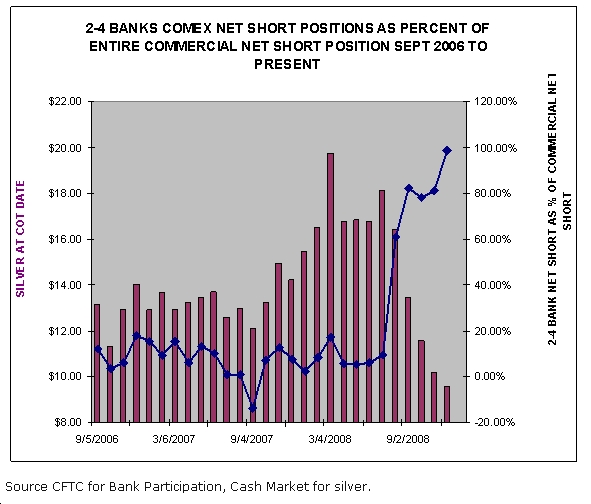
Ponzi Red Flags!

By: Andy Abraham My Investors Place

It is front page news that Bernie Madoff created one of the largest Ponzi schemes ever….How could sharp investors get sucked in… it is really unbelievable…The question is what can you do to protect yourself…Here are some of my quick thoughts…as well open the floor to all to add their thoughts..

1.Avoid managers who are unknown, or unregulated, or come without good referrals, or haven’t been in the industry long.
2.Look out for an investment manager who wants complete control of your money and does not fully detail what EXACTLY he does… it has to be simple enough that anyone could understand.
3.Check Finra (I added the link-jschulmansr)
4. Understand the EXACT strategy
5. Don’t rely on black box ideas
6. If the returns are too good to be true…( it goes without saying)
7.Have a broker dealer have custody and get copies of your statements directly from the broker.
8.Ask for recent audits…and make sure the accounting firm is a reliable entity…

Some of these basic ideas would have kept you from investing with Madoff… but with consistent 10% returns for years… it almost becomes a self fullfilling prophecy…and as other investors plow money into the idea… the safer you might feel… but look at this list…and I would like to hear your opinions as well…

Andy


===================================================
Have a Great Weekend! –jschulmansr
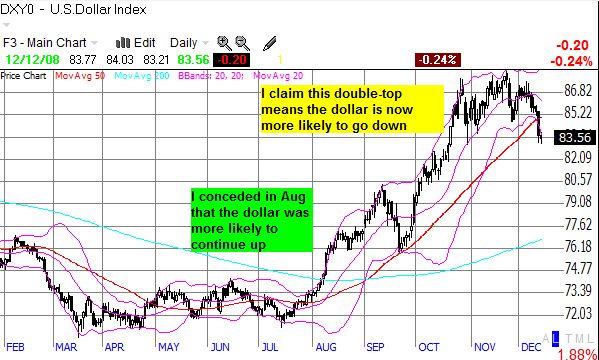
DARE SOMETHING WORTHY TODAY TOO!


Noticed something? Take a look at the inflation number in the subhead. The indicator’s gone into double digits as the result of the Fed’s recent move to cheapen the dollar. Gold, not surprisingly, responded with a gap-higher opening Wednesday and a fill-in trading session Thursday.

February COMEX gold has set itself up for a test of the $880 level, a price visited but not held on Tuesday. A close above $880 would be convincing evidence of bullish resolve to work toward the October reaction highs above $900. On the other hand, a close below $803 would indicate that a short-term top is in.


COMEX Gold (Feb. ’08)


It’s that “other hand” stuff that’s so worrisome to gold aficionados.

There’s been a lot more enthusiasm for gold stocks recently. Over the past trading week, mining issues proxied by the Market Vectors Gold Miners ETF (NYSE Arca: GDX) have gained 6.5%, while bullion has risen just 4%. The performance edge, in fact, has been held by gold equities for more than a month as bullion formed a base and started working higher. That can be visualized by comparing the relative performance of the SPDR Gold Shares Trust (NYSE Arca: GLD) to the Market Vectors portfolio. The bullion trust’s price multiple has fallen from 4.1 to 2.8 since late November.


Bullion (GLD)/Gold Equities (GDX) Ratio


Of the Market Vectors ETF’s three dozen components, Royal Gold Inc. (Nasdaq: RGLD) has been the strongest. And for good reason. Denver-based Royal Gold acquires and manages royalty interests in a variety of production, development and exploration stage projects worldwide. Strong fundamentals such as industry-beating cash flow-to-sales and current ratios, together with a steady dividend stream, have attracted interest in the stock. So much so that Royal Gold shares have appreciated nearly 38% for the year, with 20% less volatility than the Market Vectors portfolio.


Royal Gold Inc. (RGLD)


So, the big question remains:. If Royal Gold has been noticed by investors, is its stock now fully valued?

If you’re a “glass half empty” investor, you’d have reason to be concerned. After all, a 38% return in a market like 2008’s is a gift. The “glass half full” folks, though, are looking at a short-term price objective of $51, another 18% in upside potential.

You can either raise your half-empty glass to bid farewell to 2008 or toast the new year with your half-full glass.

Enjoy your holidays.

Share this:

  • Click to share on Reddit (Opens in new window) Reddit
  • Click to share on Facebook (Opens in new window) Facebook
  • Click to share on LinkedIn (Opens in new window) LinkedIn
  • More
  • Click to share on X (Opens in new window) X
  • Click to share on Pinterest (Opens in new window) Pinterest
  • Click to share on Tumblr (Opens in new window) Tumblr
  • Click to print (Opens in new window) Print
  • Click to email a link to a friend (Opens in new window) Email
Like Loading...

TIME TO BUY PRECIOUS METALS? – DARE SOMETHING WORTHY TODAY TOO!

15 Monday Dec 2008

Posted by jschulmansr in commodities, Copper, Currency and Currencies, Fundamental Analysis, gold, hard assets, inflation, Investing, investments, Latest News, Markets, mining stocks, oil, precious metals, silver, small caps, Stocks, Technical Analysis, Today, U.S. Dollar
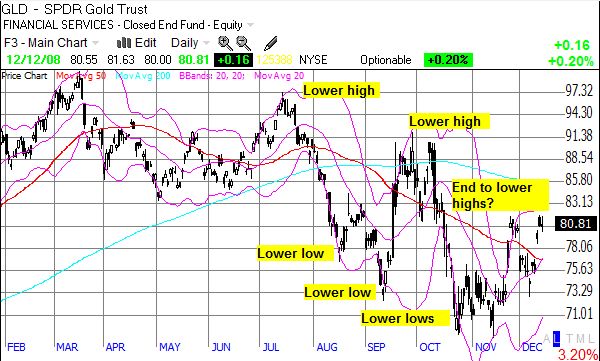
≈ Comments Off on TIME TO BUY PRECIOUS METALS? – DARE SOMETHING WORTHY TODAY TOO!

Tags

agricultural commodities, alternate energy, Austrian school, banking crisis, banks, bear market, Bollinger Bands, bull market, capitalism, central banks, China, Comex, commodities, communism, Copper, Currencies, currency, deflation, depression, diamonds, dollar denominated, dollar denominated investments, economic, economic trends, economy, financial, Forex, futures, futures markets, gold, gold miners, hard assets, heating oil, India, inflation, investments, Keith Fitz-Gerald, market crash, Markets, mining companies, Moving Averages, natural gas, oil, palladium, Peter Schiff, physical gold, platinum, platinum miners, precious metals, price, price manipulation, prices, producers, production, protection, rare earth metals, recession, risk, run on banks, safety, Saudi Arabia, Sean Rakhimov, silver, silver miners, socialism, sovereign, spot, spot price, stagflation, Technical Analysis, timber, U.S. Dollar, volatility, warrants, Water

TIME TO BUY PRECIOUS METALS? – DARE SOMETHING WORTHY TODAY TOO!

Gold and Silver: Backwardation and Manipulation – Seeking Alpha

By: Jake Towne of Yet Another Champion Of The Constitution

In this article we will take a look at some alternate but constructive views of Fekete’s recent articles on gold backwardation, covered in earlier articles in this series. I want to note it appears to be a perfect storm shaping up, although it not yet outside the grasp of short-term government manipulation, especially if there is the hint of a panic, or “gold fever” developing. The price of gold and silver are both up over the past week as both metals are in (temporary for now) backwardation, but the price does not have a high degree of relevance. All eyes are on the gold basis will probably drive the price which you can learn about by reading the below mini-series.

Part I: “The End for the Dollar and all Fiat Currencies (1/5)“Part II: “The Next Bubble to Pop! (2/4)“Part III: “On Gold and Market Manipulation (3/5)“Part IV: “The Significance of Gold Backwardation Explained (4/5)“Supplement to explain futures market basics and backwardation: “The Money Matrix – What the Heck Are Derivatives? (PART 10/15)“

Now some news. Three-month Treasuries slipped negative for the first time ever on December 9 per Bloomberg. The UBS banker “analyst” cheerleading the masses towards buying Treasuries sounds like he is smoking crack. “Everyone wants to be in bills going into year-end. Buy now while the opportunity is still there.” Let’s see, no interest and I will actually lose money by buying? No thanks! Even gold’s naysayers realize holding paper cash is smarter.

A wild rumor of the IMF* dumping 3,000 metric tons of gold around December 10 was unleashed at the gold world on December 8. This is probably just a hoax similar to many prior IMF scares, though the size of it is shocking; the last hoax** was 400 tons, but the IMF only claims to have 3,217 total tons. However:

  1. The IMF (for all intents and purposes a US puppet) does not have the required Congressional permission to sell (although the recently discovered bailout principle spells out this could happen quickly),
  2. The IMF probably does not have that much gold, or perhaps any gold per the research and correspondence with the stalwart yet “fringe” GATA (Gold Anti-Trust Action Committee),
  3. The IMF itself has criticized its own fallacious accounting practices, and
  4. There is a huge difference between the IMF selling on the open market, or completing an international transaction with China, which would be dollar-bearish and gold-bullish, respectively. [FYI, China is ALWAYS rumored to be searching for… you guessed it! 3,000 tons of gold! See this 2005 article from the nation’s mouthpiece, the People’s Daily and this November 2008 article from HK’s The Standard.]

*[Under the IMF’s Articles of Agreement Schedule C, item 1 (p49/85), linking of a member’s currency (its “par value” or face value) to gold is prohibited. This means that the IMF is in direct violation of the Constitution of the United States of America (which actually also forbids the existence of the doomed Federal Reserve Note) by stating in Article 1, Section 10 that our country can not “make any Thing but gold and silver Coin a Tender in Payment of Debts.” Today’s Keynesian economists and investors should read these documents. The IMF Articles of Agreement is a relic of a bygone age (1970s) plagued by its refusal to acknowledge gold as money. For instance, note iron reporting rules required of members in Section 5(a), p19-20, are morbidly focused on monitoring and controlling gold. (Why? Gold is Money.) The Constitution is a shining if neglected example of how the government’s role in a free market economy (last seen in the early 1900s) is confined to an honest monetary system and setting up anti-fraud laws.]

**[An example of a hoax and blatant attempt “The International Monetary Fund will probably sell 5-10 million ounces of gold to fund a program of debt relief, but will not disrupt the markets with its sales.” ex-Goldman Sachs, ex-Citigroup, ex-Secretary of Treasury, now close Obama advisor Robert E. Rubin, on March 17, 1999. No gold was sold, although the market price of gold sure suffered! Rubin is Director and Senior Counselor of Citigroup (C), where he was the “architect” of Citigroup’s strategy of taking on more risk in debt markets, which by the end of 2008 led the firm to the brink of collapse and an eventual government rescue. From November to December 2007, he served temporarily as Chairman of Citigroup. From 1999 to present, he earned $115 million in pay at Citigroup. Obama: “Change” We Can Believe In.]

(Sources for the above: IMF Articles of Agreement (1978) and Gold Wars by ex-Rothschild Swiss banker Ferdinand Lips (2001), pages 135 and 178.)

Ex-Chase Manhattan banker and owner of goldmoney.com, James Turk issued a helpful letter, stating what the Reader should already realize from this series. “Backwardations are no big deal in most commodities, but they are indeed a very big deal for gold.”

Turk uses the London Bullion Market Association’s Gold Offered Forward (GOFO) rates here to determine technical backwardation, while Fekete was looking at intraday trading sessions. My thoughts are that it’s ok to disagree, but geez guys, the overall message is the same. Analyst Rob Kirby understands this as well and issued an article “Backwardation: Facts from Fiction” that may be useful to the Reader.

[For the Reader, NYMEX Gold Session Futures chart, Silver Session Futures chart. Gold spot price chart. Silver spot price chart. When the spot price is greater than the futures price, backwardation exists.]

Trader Dan Norcini of jsmineset.com also reviewed Fekete’s note and issued a statement and charts here on December 5. Again gold is unlike wheat or copper, it has a fixed supply of bars mined from the earth for the past 6,000 years plus new supply from the mines at 1-2% of the total and are just traded back-and-forth on the COMEX. People do not save wheat; they eat it. People do not save copper; they use it for electrical conduits and other industrial uses. People DO save gold. Norcini explains why for gold backwardation is unusual:

If spot gold is trading at $750 and the futures market is trading at $745, that is a $5.00 per ounce risk free profit just sitting there waiting for a type of arbitrage. One could immediately sell his physical gold at the $750 price and immediately buy it at $745 in the futures market with the intent of taking delivery to meet his contractual obligations and pocket $5.00 ounce for however many ounces one wished. Buy 5 million ounces of gold at $745 and sell that same amount of gold for $750 and you have gotten yourself a cool $25 million profit less the delivery expenses, etc. Not bad. That is why such a thing does not occur very often nor does it last for long. Too many would jump on the chance for a no-risk trade of such nature. Why then are they not doing so? Antal has answered that question they are not willing to part with their gold for paper profits! That is what makes this development so noteworthy.

If you prefer talking heads, here is a Business News Network video where the analyst concluded that the reason behind the “desire of protection of wealth.” [Note: This YouTube user “GoldtotheMoon” has an incredible amount of goldbug videos, many helpful.]

Now for more on the alleged market manipulation of both gold and silver. For gold, the authority is the Gold Anti-Trust Action Committee (GATA). You can visit their site here. On silver, use the silverseek.com link below; the chief source I follow is Theodore Butler. Although I take exception to details (so picky!), I have bought into both overall theories since August, which was when global physical coin markets starting going haywire. No other explanation made any sense then or now. Since then, of course, the cover on government intervention in the economy has blown off for all to see, to put it mildly. As I wrote in “A Money Matrix Addendum: Citigroup and GATA Call for an End to the Suppression of the Gold Market“:

Fiat currency is a scheme perpetrated by central banks and the tacit (or is it helpless?) permission from their governments. Fiat currency is almost completely worthless and has no intrinsic value. Ultimately electronic and paper fiat money will be worthless. All of the world’s fiat money is actually a form of debt, and it results in never-ending currency debasement, of which one way is expanding the money supply, aka “printing more money,” aka inflation. To make their scheme work, they intervene in the precious metal markets to manipulate the prices of silver and especially gold. By keeping the prices of real honest money suppressed, they try to make their fiat currency look stronger.

I want to highlight an enlightening article that supports the above theory from Gene Arensberg of www.resourceinvestor.com. In his article “‘On the Fly’ Gold and Silver COT Information” on December 10, Arensberg has done a masterful job of demonstrating the control of the gold and silver markets. [COT stands for “Commitments of Traders” which report open interest and trading positions for the futures and options markets in the US. The reports are issued by the US Commodity Futures Trading Commission (CFTC), a government agency. The CFTC’s mission is “to protect market users and the public from fraud, manipulation, and abusive practices related to the sale of commodity and financial futures and options, and to foster open, competitive, and financially sound futures and option markets.” As you will shortly see, they are doing a horrible job, similar to the SEC missing the Madoff collapse. Here is why the CFTC motto is: “NOTHING TO SEE HERE! Please disperse!”

On gold, Gene Arensberg writes:

As of December 2, as gold closed at $783.39, the CFTC reported that 3 U.S. banks had a net short positioning for gold on the COMEX, division of NYMEX, of 63,818 contracts. The CFTC also reported that as of the same date all traders classed by the CFTC as commercial held a collective net short positioning of 95,288 contracts. That means that justthree U.S. banks accounted for 66.97% of all the commercial net short positioning on the COMEX for gold futures. Here’s what the three U.S. banks’ positioning looks like on a graph: (chart courtesy Arensberg)

gold


Arensberg then concludes with the revelation that the current short position totals over twice the contents of the COMEX warehouses. Do they really have this gold and why is the “market” concentrated in the hands of so few banks? [Here we learned short positions are the “deliverers” or sellers of gold, while the longs are the “receivers” or buyers.] My comment is to look at the dip into the “long” side by these banks in roughly June 2008. See how the price fell? Nothing to see here! Disperse, disperse!

Let’s look at silver: Arensberg continues:

For silver, it’s even more startling. On December 2, as silver closed at $9.57, exactly 2 U.S. banks held a net short positioning of 24,555 contracts. The CFTC reports that as of the same date all traders classed as commercial held a net short positioning of 24,894 contracts. So, the 2 U.S. banks, with one particular Fed member bank probably holding almost all of it, held a sickening 98.64% of all the collective commercial net short positioning on the COMEX, division of NYMEX in New York. (chart courtesy Arensberg)

silver

Arensberg comments that these two banks’ (cough JP Morgan Chase cough those-damn-corporate-raiders-from-the-Great-Depression cough cough) “net short positioning is equal to about 153% of the amount of deliverable silver in ALL the COMEX members’ accounts.” Sure looks like total control to me! The above is a big reason why the gold and silver markets are so tight now. Who in the right mind would enter the market to play with these giants? Again, where is their silver? So the silvers futures market is not a real “market.” More like a banker’s paradise!

Arensberg also has a section on the coin market in terms of the premium paid. Historically speaking, the premiums have been within a few percentage points of the spot value. Not anymore, gold is about 6%, and the silver premium is pretty amazing, roughly 50% over spot! Try using the law of supply and demand to explain that!

Let me finish with a respectable opinion to the contrary from Mish Shedlock’s blog. Try “No Fever Like Gold Fever: Response“, “Nonsense About Gold Backwardation, Ameros,Yuan Devaluations, etc.“, “Double Standard in Gold Hedging?“. I already laced into these articles in the comments field in Part 4, but decide for yourself. Feel free to leave any comments or questions below.

[Update 12/14 – Fekete just posted another update entitled “Backwardation that Shook the World.”]

My Note: It is time to load up the applecart – Buy Gold and Silver Now!- jschulmansr

================================================

The Significance of Gold Backwardation

By Jake Towne of Nolan Chart

I’ve written a short series on what is, in my opinion, the major economic event of gold going into backwardation and what this will mean. Due to recent interest, particularly email comments, in this article I would like to further describe this event and in the next part share links to more gold and silver news on this topic with you (as well as some objective criticism of Fekete).

I think it is also important to note that I am no expert. I fully realize I could be wrong for now, or misjudge how the government forces will intervene. It is far from clear whether this backwardation will become permanent. That said, I do believe that the resistance shackling gold and silver will be eventually be overwhelmed; it’s just a question of when. In the final analysis, Gold is the world’s greatest chance at economic liberty and a world with far less war.

Part I: “The End for the Dollar and all Fiat Currencies (1/5)” Part II: “The Next Bubble to Pop! (2/4)” Part III: “On Gold and Market Manipulation (3/5)” Supplement to explain futures market basics and backwardation: “The Money Matrix – What the Heck Are Derivatives? (PART 10/15)” Part V: “More on Gold and Silver Backwardation and Manipulation (5/5)”

Let’s return to the rice example I used in an earlier article, which is traded on commodity futures markets in a similar fashion as gold and silver are today. Let’s say I absolutely must have 1000 bushels of rice 1 month from today. At the futures market, I have two options – I can buy a 1-month futures contract and take delivery right before I need it, or I can buy at the immediate market price (or spot price) and store it for a month.

Now, let’s say rice goes into backwardation. This means that the spot price is more expensive than the 1-month futures price. So, normally I would buy the futures contract since it is cheaper and the storage cost is borne by the other party. And if enough people did this, backwardation would quickly disappear. Now why would I buy at spot price?

I would buy at spot only if I feared that within a month the other party would not have any rice to deliver. Now the strange thing is that for backwardation to continue to exist, all rice traders at the market need to believe the same thing. Why?

If other traders holds surplus rice and do not need it for a month, and believe they will get delivery 1 month later, they will release this stock into the market (driving the spot price down and the futures price up) and take delivery in a month’s time, which would give a tidy basis profit (spot price minus the futures price), plus the savings of not storing the rice for a month.

So therefore, backwardation is the sign of a very tight market, and a market that will be tight for sometime into the future – either 1) current supply is very tight, 2) future supply is projected to be very tight, or 3) there is a severe distrust in counterparties – that the short positions can deliver the goods on time per the contract, or vice versa that the long positions will not have the cash.

That said, backwardation in seasonable, weather-dependent perishable commodities like rice or corn is certainly not unheard of. It even sometimes occurs with industrial commodities like lead or copper. Sometimes it can even be the natural state of the market.

However, gold futures are completely unlike these other commodity markets. Gold is mostly traded solely as a “store of value”; the jewelry or electronics or dentistry demand pales in comparison to the quantities of the yellow metal traded as a store of value (even an “anti-dollar” if you wish). In other words, gold is not a consumable market.

And here is the final piece to the above from South African Daan Joubert, quoted at lemetropolecafe.com. Gold backwardation can only mean that either “a) There are enough people so concerned about non-delivery that they will pay a large premium to get their hands on gold right now” or “b) There are no large holders of gold who have sufficient faith in the futures exchange to exploit the [backwardation].”

Dr. Fekete has issued two recent updates, “Has the Curtain Fallen on the Last Contango in Washington” and “There’s No Fever Like Gold Fever.” I consider both must-reads, especially the conclusion to the “Gold Fever” article. I will freely admit to you that for some of the reasons Fekete mentions in the “Gold Fever” article I considered not writing this series under my own name (perhaps I may later regret it) but there is something about sharing the truth as I see it that forbids me what ultimately amounts to cowardice. Anyways, here is the intro to “Gold Fever”:


Here is an update on the backwardation in gold that started on December 2 at an annualized discount rate of 1.98% and 0.14% to spot in the December and February contracts. It continued and worsened on December 8, 9, and 10 as shown by the corresponding rates widening to 3.5% and 0.65%. It is nothing short of awesome. This is a premonition of a coming gold fever of unprecedented dimensions that will overwhelm the world as soon as its significance is fully digested by the doubting Thomases.


Keynesian economist John Keynes once pessimistically noted, “In the long run, we are all dead.”

I say, YES, the day when gold or silver breaks the COMEX IS death.

Death to the Keynesians for all the havoc they have wrought.

===============================================

Is The Second Great Depression Imminent?

By: Lionel Badal

The world is currently facing the most serious financial and economic crisis since the Great Depression of 1929. How have countries responded to the crisis? Well as we know it, by lending huge amounts of money through bailouts and other tax cuts. So while the current crisis was caused by excessive lending, such as the subprimes, the only answer our governments and financial elites found was lending even more and making money out of nothing.
My Note: Wake Up Indeed! Time To Buy Gold and Silver- Ya Think???-jschulmansr

Dollar Down, Gold Up

By: Dr. Duru of Dr. Duru’s One Twenty 

I have been and remain a bear on the dollar. Back in mid-August, I conceded that the gathering momentum in the dollar trade would postpone the weak dollar scenario until 2009. I was wrong on a few of my reasons for expecting continued strength in the dollar, but a stronger dollar is what we have.

I know a lot of dour folks have explained why they expect America’s “well-intentioned” borrowing and printing binge to lead to rampant inflation in the future (Peter Schiff is one of many examples). I have also tried to make the case. The main crux of my current opinion is that America will win its fight against deflation, sooner rather than later, and will be too slow to remove the monetary (and fiscal) injections into the economy to stave off the high inflation we will get as our reward.

The first signs of fresh dollar weakness are finally showing up. The chart below (click to enlarge) shows a potential double-top in the dollar. Some technicians may prefer to call it a head-and-shoulders pattern.

Dollar double-top

It is at these kinds of critical transition points that people who want to cling to the former trend will proclaim the loudest that all is well. Dollar bulls surely believe that the fundamentals of the currency have never been better given the world’s belief that the dollar represents a safe place to park in a world of turmoil. Maybe major global governments borrow and print even faster and harder than we are doing. If that happens, I will have to like gold even more since its global supply will not increase nearly as fast as the supply of global money. Regardless, we should all know by now what results when a massive crowd jams into one side of a trade – short-term Treasuries represent the powder keg du jour.

Until recently, it has been difficult to play commodities in anticipation of reflation given prevailing downtrends. Gold has held up better than most but it too is still caught in a downtrend of lower lows and lower highs. The recent weakness in the dollar has perked gold back up, and I am sticking to it as one of my favorite places to be for 2009.

Gold

*All charts created using TeleChart:
The dollar down, gold up scenario gets delayed again if the dollar manages to make a new high above the recent double-top and gold makes another lower low.

Be careful out there!

Full disclosure: long GLD. For other disclaimers click here.

==============================================

Will We See A Big Upward Move in Gold?

By: Mark Courtenay of  Check The Markets.com

Did you know that the Federal Reserve Bank owns gold certificates? Mounting evidence suggests the Fed intervenes in and participates in the gold and silver markets on a regular basis.

Interviewed Monday last week on the “Trading Day” program of Business News Network in Canada, former Federal Reserve Governor Lyle Gramley hinted that a big upward revaluation of gold may figure heavily in the Fed’s attempt to rescue the U.S. economy.

The program’s guest host, Niall Ferguson, an author and history professor at Harvard, asked Gramley, now senior adviser at Stanford Group in Houston, about the seemingly grotesque expansion of the Fed’s balance sheet in recent months.

Ferguson asked: “I’ve heard it said that the Fed has turned into a government-owned hedge fund, leveraged at 50 to 1. Do you feel nervous about what this might actually do to the Fed’s reputation?”

Gramley replied: “I think you have to reckon with the fact that one of the Fed’s assets is gold certificates, which are priced, as I remember, at $42 an ounce, and if we were to price them at market prices, the Fed’s leverage would look a lot less than it is now.”

While valuing the U.S. government’s claimed gold reserves at today’s Comex closing price of around $822 per ounce instead of the government antique bookkeeping entry of $42.22 per ounce would indeed vastly expand the government’s monetary assets, it might not be enough to offset the liabilities and guarantees the government lately has taken on.

But the job might be done by revaluing the gold to $5,000 or $10,000 per ounce, as the British economist Peter Millar speculated two years ago might be necessary to prevent debt deflation: yet this is admittedly speculation.

What did Gramley mean by “…the Fed’s leverage”? That would suggest that the Fed not only owns “gold certificates” but also future contracts and options on futures. They might be big benefactors in a gold squeeze.

Speaking of a gold squeeze, I read another report from the Gold Anti-Trust Actioin committee (GATA) saying that the Comex is warning brokers of a December gold squeeze.

Yes, the Comex is alerting various futures firms about the potential of a squeeze on the December contract and is advising the $840 December shorts to exit their positions. That is the remaining open position.

There have been 12,636 notices of delivery. The shorts have until December 31 to make delivery. Normally they deliver early to take in cash and earn the interest. They must be delaying.

As I understand the situation, that represents about 40 percent of the gold available at the Comex, and of course someone could enter the scene late, buy February gold, and then spread into December, which would stun the shorts.

My broker friend said his back office said this sort of alert is highly unusual and that the concern is real, not only for gold, but for other commodities too, like copper and palladium, as there is a good deal of talk of taking deliveries there too. But gold is the one for which the advice to cover went out.

This is an extremely productive development and could spur the price of gold up quickly as word spreads. As we all know, buying Comex gold and silver (the cheapest way to buy precious metals) makes all the sense in the world in this financial environment.

This might just be reason enough to begin “stocking up” on some of the ETFs that would be beneficiaries like (GLD), (SLV) and The PowerShares DB Commodity Index Tracking Fund (DBC). The 1-year chart below is instructive.//seekingalpha.com/symbol/dbc' title='More opinion and analysis of DBC'>DBC</a>)

Some interesting names in the copper business to keep an eye on and begin accumulating on any meaningful pullbacks are Freeport McMoran (FCX), Southern Copper Corp (PCU) which as of this writing still pays a dividend, unlike FCX, and Sterlite Industries (SLT) which is India’s bigger copper producer and is poised to benefit from any resurgence of copper demand in Asia.

It might be one of those “ready, get set, not yet” approaches to what an investor should do. The economic news and the relapsing into the next and possible worse phase of this credit crisis, great-recession, and deflationary mess might delay the upside potential on commodities.

But if you’re a trader (a.k.a. “gambler”) there might be a short-term pop in at least gold over the next couple of weeks…maybe spilling into January 2009 where quick profits could be made….as well as some quick and disappointing losses.

Are you an investor, a short-term gambler, or both? No matter what the answer, if you know yourself well then you know how you might respond to all this news and the rumor mill. Best of luck!

When FCX dipped back down near $16 after the suspension of their dividend I decided to pick up a few shares for a quick trade. I’m fortunate that it worked out.

I firmly believe that there will be a trading range for all the better commodity stocks and ETFs that will give us several chances to buy low and sell high over the months directly ahead. Your comments on that will be appreciated. Happy holidays to you all.

Disclosure: Long GLD, SLV, FCX, SLT.


All of these measures will have an impact on economies, no doubt on that. Before the end of 2009 an –artificial- recovery will take place. Good news you may think? Not at all…

In parallel to the recovery, global oil demand will increase next year as mentioned recently by the IEA. This is where the collapse will occur. Global oil production is about to decline, as major oil fields in Mexico and the North Sea have passed their peak… the rate of decline is staggering (check the latest IEA annual report).

Additional energies and non-conventional oils which should have been here do not exist; why? Very simple to understand, with the financial crisis and oil prices back to the low 40s, major energy investments are either cancelled or postponed (they no longer look profitable). In short, when the demand will go up, oil production will be declining; logically prices will explode. Dr. Faith Birol, IEA’s Chief-Economist, well aware of the seriousness of the situation declared on Peak Oil:

What I can tell you is that one day global conventional oil will peak… I think it is going to peak very soon. The main problem here is that the existing fields, many mature fields, are declining.

While you may have found this explanation shaky or over-pessimistic, as early as 2005 the geologist Dr. Colin Campbell (founder of the Association for the Study of Peak Oil-ASPO) declared:

Expansion becomes impossible without abundant cheap energy. So I think that the debt of the world is going bad. That speaks of a financial crisis, unseen, probably equalling the Great Depression of 1930; it’s probable we face the Second Great Depression. It would be a chain reaction, one bank would fail, and another one would fail, industries will close…

What is commonly known as Peak Oil, a decline in global oil production is about to happen: you can ignore it, fight it, but to be sure, you will not escape from it. I will not enter into the details of the Peak Oil debate, an endless one. Nevertheless, here are statements on Peak Oil held by some of the most authoritative groups:

Peak oil is at hand with low availability growth for the next 5 to 10 years. Once worldwide petroleum production peaks, geopolitics and market economics will result in even more significant price increases and security risks. To guess where this is all going to take us is would be too speculative.

US Army, Corps of Engineers (September, 2005)

The end-of-the-fossil-hydrocarbons scenario is not a doom-and-gloom picture painted by pessimistic end-of-the-world prophets, but a view of scarcity in the coming years and decades that must be taken seriously.

Deutsche Bank (December, 2004)

More recently, a British Industry Taskforce (e.g. Shell (RDS.A), Yahoo (YHOO), Virgin, and Solarcentury) conducted a vast study on oil production. They concluded that, “peak oil is more of an immediate threat to the economy and people’s lives than climate change, grave as that threat is too” and added “the risks to UK society from peak oil are far greater than those that tend to occupy the Government’s risk-thinking, including terrorism” before asking the government to urgently take action.

Here is the “recipe” for the greatest disaster ever. What cheap and abundant oil created, Peak Oil will destroy; our failure to invest in alternatives 10 or 20 years ago is about to fall on us. Michael Meacher, a former British Environment Minister and current Labour MP similarly declared on what is coming:

This is an apocalyptic scenario. In terms of industrial production, in terms of the food supply but above all in the terms of the transportation sector, we cannot continue as we now are.

Like in 1929, this Second Great Depression, caused by hyperinflation (within 3 years) will have dramatic political consequences:

As oil prices rise, it will be millions who suffer, millions of ordinary people who are just trying to get on with their lives, millions of ordinary decent people will be forced into states of anxiety, depression, fear and anger.

Voters take to new ideas, even radically new ideas when the system that they have trusted, worked with, admired and felt comfortable with falls apart.

Peak Oil may well be an important catalyst that helps us to win political power because we are the ones talking about it now.

The British National Party and its leader Nick Griffin are well aware of the seriousness of the coming crisis, yet for them it is seen a unique opportunity. History is here to remind us that dramatic changes can happen so fast that we don’t even see them until they have happened. Nick Griffin, who is passionate about Peak Oil as one of the BNP permanent staff member told me, is also a racist, holocaust denier. Make no mistake, in a post-Peak Oil world Mr. Griffin and his look-a-likes throughout the world will do all they can to apply their heinous political agenda.

The process has started and once again Europe will face its old demons, fuelled by populism, unemployment and incompetence from mainstream leaders. As mentioned in a recent Newsweek article, un-favourable views on Jews has climbed from 20% in 2004 to 25% today in Germany, in France from 11% to 20% and in Spain from nearly 21% in 2005 to about 50% today[16]. Yet the worst of the crisis is just a few years away and nobody seems to perceive the seriousness of the situation. In fact, the current crisis will soon be seen as no more than a gentle prelude or the “good old days”. Denis MacShane the author of the Newsweek article similarly observed that “the BNP was now the fastest growing political party in Britain”[17].

Wake up!

================================================

Share this:

  • Click to share on Reddit (Opens in new window) Reddit
  • Click to share on Facebook (Opens in new window) Facebook
  • Click to share on LinkedIn (Opens in new window) LinkedIn
  • More
  • Click to share on X (Opens in new window) X
  • Click to share on Pinterest (Opens in new window) Pinterest
  • Click to share on Tumblr (Opens in new window) Tumblr
  • Click to print (Opens in new window) Print
  • Click to email a link to a friend (Opens in new window) Email
Like Loading...

Gold Supply and Demand + Troubling Questions For Obama

12 Friday Dec 2008

Posted by jschulmansr in 2008 Election, Barack Obama, capitalism, commodities, Copper, Currency and Currencies, deflation, Electoral College, Finance, Free Speech, Fundamental Analysis, gold, hard assets, id theft, inflation, Investing, investments, Markets, mining stocks, oil, Politics, precious metals, Presidential Election, silver, small caps, socialism, Stocks, Technical Analysis, Today, u.s. constitution, U.S. Dollar, Uncategorized

≈ Comments Off on Gold Supply and Demand + Troubling Questions For Obama

Tags

2008 Election, agricultural commodities, alternate energy, Austrian school, banking crisis, banks, Barack Dunham, Barack Hussein Obama, Barack Obama, Barry Dunham, Barry Soetoro, bear market, Bollinger Bands, bull market, capitalism, central banks, Chicago Tribune, China, Columbia University, Comex, commodities, communism, Copper, Currencies, currency, Currency and Currencies, D.c. press club, deflation, depression, diamonds, dollar denominated, dollar denominated investments, economic, economic trends, economy, Electoral College, Electors, Finance, financial, Forex, fraud, Free Speech, futures, futures markets, gold, gold miners, hard assets, Harvard Law School, hawaii, heating oil, id theft, India, Indonesia, Indonesian Citizenship, inflation, Investing, investments, Joe Biden, John McCain, Keith Fitz-Gerald, Latest News, legal documents, market crash, Markets, mining companies, Moving Averages, name change, natural born citizen, natural gas, Oath of Allegiance of the President of the United State, Occidental College, oil, palladium, Peter Schiff, Phillip Berg, physical gold, platinum, platinum miners, Politics, poser, precious metals, Presidential Election, price, price manipulation, prices, producers, production, protection, rare earth metals, recession, risk, run on banks, safety, Sarah Palin, Saudi Arabia, Sean Rakhimov, silver, silver miners, socialism, sovereign, spot, spot price, stagflation, Stocks, Technical Analysis, timber, Today, treason, u.s. constitution, U.S. Dollar, Uncategorized, volatility, voter fraud, warrants, Water, we the people foundation

Gold Supply and Demand

By Luke Burgess of  Gold World

Jesse Lauriston Livermore is perhaps the most famous stock trader of the early 20th century.

Famous for amassing and subsequently losing several multi-million dollar fortunes, Livermore also shorted the stock market heavily during the crashes of 1907 and 1929.

Livermore, who was also known as the Boy Plunger, is famed for making—and losing—several multi-million dollar fortunes and short selling during the stock market crashes in 1907 and 1929.

One of Livermore’s core trading rules was…

Be Right and Sit Tight

It’s simple…

Invest in a growing trend and have the courage to hold long-term for really big gains.

Clearly, the gold bull market is one such growing trend. And investors who “sit tight” will undoutbly see big gains by owning the precious metal now.

Buy Gold Now

The bull market has already pushed gold prices over 300% higher since 2001. And now with the world’s demand for gold is starting to significantly outpace supplies, even higher prices are on the horizon.

During the third-quarter there was a colossal 10.5 million ounce deficit (worth $8.5 billion) in world’s supply and demand of gold. World gold demand increased over 50% since the second-quarter while supplies dropped 64% year-on-year.

Gold demand, particularly in the investment sector, is currently at all-time highs. But estimates suggest that the world will only produce 76.8 million troy ounces during 2008. This represents a 9% decline in world gold production since 2001.

20081208_world_gold_production.png

Gold Mine Supplies to Continue Falling

The world financial meltdown has forced the shut down of hundreds of gold mines around the world and slashed exploration and development budgets across the board. And the near-term future of new investment still looks pretty grim.

The effects of these budget cutbacks won’t be felt in the gold market for several months to years. But the lack of investment money going into gold mines right now-and probably for over the next several months-will certainly have an effect on global gold supplies in the future.


And the lack of these supplies will positively affect gold prices.

The global economic crisis has motivated miners of all metals to cut back on exploration and development activities. Below is a just partial list of mine closures and delays that have been announced over the past several weeks:

August 21
HudBay Minerals [TSX: HBM] closes its Balmat zinc mine and concentrator.

October 13
Intrepid Mines [TSX: IAU, ASX: IAU] postpones the development of the Mines Casposo gold/silver project.

October 20
Polymetal, Russia’s largest silver miner, cuts its production forecast and says it will consider revising its investment plan for next year.

October 20
First Nickel [TSX: FNI] suspends production at its Lockerby nickel mine.

October 21
Freeport-McMoRan Copper & Gold [NYSE: FCX] announced that the company will defer mine expansions and put off restarting at least one operation.

October 21
North American Palladium [AMEX: PAL, TSX: PDL] temporarily closes its Lac des Iles platinum-group metals mine.

November 6
Thompson Creek Metals [NYSE: TC, TSX: TCM] postpones the development of its Davidson molybdenum mine.

November 10
Rio Tinto [NYSE: RTP, LON: RIO] cut its Australian iron-ore production by about 10%.

November 10
Freeport-McMoRan Copper & Gold [NYSE: FCX] cut molybdenum production at its Henderson mine by 25%.

November 10
Platinum and chrome producer Xstrata Alloys and its South African joint-venture partner, Merafe Resources, temporarily suspends six furnaces of the Xstrata-Merafe chrome venture.

November 11
Arehada Mining [TSX: AHD] temporarily shut down of operations at its zinc/lead/silver mine and plant.

November 11
Frontera Copper [TSX: FCC] suspends mining activities at its Piedras Verdes operation.

November 13
Lundin Mining [NYSE: LMC, TSX: LUN] suspends zinc production from its Neves-Corvo copper/zinc mine, and put another operation, Aljustrel, on care and maintenance until metal prices recover.

November 13
Anvil Mining [TSX: AVM, ASX: AVM] suspends the fabrication and construction works for its Kinsevere Stage II solvent extraction-electrowinning plant.

November 14
Geovic Mining [TSX: GMC] delays construction and financing for its Nkamouna cobalt project.

November 17
Teal Exploration & Mining [TSX: TL] cut output at the Lupoto copper project’s small-scale mining operation

November 18
Stillwater Mining [NYSE: SWC] scales down operations at its East Boulder mine, reduces capital expenditure and cut jobs.

November 18
The world’s third-largest platinum-miner, Lonmin, announces the closure of South African mines, and says it will halt growth projects.

November 19

First Majestic Silver [TSX: FR] temporarily suspends all activities at its Cuitaboca project.

November 19
Weatherly International [LON: WTI] announces the closing two of its copper mining projects in Namibia.

November 20
Hochschild Mining [LON: HOC] announces that the company will delay its San Felipe zinc project.

November 21
Katanga Mining [TSX: KAT] temporarily halts mining operations at the Tilwezembe open pit and ore processing at its Kolwezi concentrator.

Novmeber 21
Apogee Minerals [TSX-V: APE] halts production at its La Solucion silver/lead/zinc mine, in Bolivia.

November 24
Norilsk Nickel put its Waterloo and Silver Swan underground mines into care and maintenance.

November 26
Bindura Nickel announces the closure of two nickel mines, and its smelter and refinery operations.

December 1
The Xstrata-Merafe joint venture suspends operations at another five ferrochrome furnaces, bringing the company’s offline capacity to 906,000 tonnes per year, or more than half of its annual production capability.

December 3
BHP Billiton [NYSE: BHP, ASX: BHP] reduces manganese and alloy production.

December 8
Companhia Vale do Rio Doce, the world’s biggest iron-ore producer, has suspended operations at two pellet plants.

With demand soaring and supplies plummeting, there’s never been a better time to own gold. Gold prices could go to as high as $5,000 once this gold bull market plays out.

Be right and sit tight.

Buy gold.

Good Investing,

Luke Burgess
Managing Editor, Gold World

P.S. It’s simple, really. Demand is soaring. Supplies are plummeting. And if you don’t buy gold now, you may not get the chance to later.

==============================================

Troubling Questions For Obama Team

By: Linda Chavez of GOPUSA

A corruption scandal in President-elect Obama’s backyard is the last thing this country needs. But like it or not, that’s exactly what we have in the unfolding drama of Illinois Gov. Rod Blagojevich’s arrest earlier this week for trying to sell Barack Obama’s Senate seat. The federal prosecutor in the case — Patrick Fitzgerald, the man whose investigation of the Valerie Plame leak case nearly paralyzed the Bush White House for a time — has made it clear that nothing ties Obama directly to the Blagojevich scheme. But the timing of Fitzgerald’s announcement raises some serious questions.

Apparently, Fitzgerald knew that Blagojevich was trolling for bidders for the Obama seat in the waning days of the general election. Before the first votes were counted to elect Obama president, Blagojevich was so confident in Obama’s victory he was already soliciting bids for the seat. And Fitzgerald already had substantial evidence that Blagojevich was engaged in major corruption before the governor put a “for sale” sign on the Senate seat. So why didn’t the federal prosecutor act prior to the election? Had he done so, of course, it could have damaged Obama.

Many would argue that bringing down another Illinois Democrat before the election would have smelled like a dirty trick. The federal prosecutor, after all, was a Republican appointee, and the McCain campaign had already run ads trying to tie Obama to political corruption in Chicago. One of Obama’s early financial supporters, land developer Tony Rezko, was convicted on corruption charges earlier this year, and Rezko figures prominently in the Blagojevich scandal. Had Blagojevich been forced to do a perp walk before Election Day, voters might have asked why Obama had endorsed Blagojevich just two years earlier, considering the governor was at that time under investigation for taking bribes. The endorsement would have been yet another example of Obama’s bad judgment in his associations from Rezko to the Rev. Wright to Bill Ayers.

But even if Fitzgerald acted fairly and prudently by not moving against Blagojevich in the heat of a political campaign, why did he decide to act this week? His explanation was that he was trying to stop “a political corruption crime spree.” Under existing Illinois law, the governor has final authority to appoint someone to fill a vacant U.S. Senate seat and wiretaps suggest Blagojevich was about to do just that. According to the criminal complaint, Blagojevich had found at least one bidder — identified only as Senate Candidate 5 — who offered to raise the governor $500,000 and another $1 million if he got the appointment. Perhaps Fitzgerald simply wanted to go public before Blagojevich sealed the deal.

But there are other possible explanations. Fitzgerald’s hand may have been forced by the Chicago Tribune, which reported Dec. 5 that Blagojevich’s phone lines were being tapped. This information signaled everyone — the governor and anyone talking to the governor or his aides — that they could become ensnared in a huge criminal investigation leading to indictments.

President-elect Obama has emphatically denied that he ever talked to Blagojevich about his Senate replacement. And certainly Fitzgerald has done everything he can to confirm that Obama is not implicated in any way. But there are a number of unanswered questions about what contact members of the president-elect’s team might have had with the governor or his aides, directly or through intermediaries. A number of aides, including the incoming White House Chief of Staff, Rahm Emmanuel, and former campaign leader David Axelrod, have long-standing ties to Blagojevich. And Axelrod has already had to revise his earlier assertion that Obama had spoken with Blagojevich about candidates to replace him in the Senate.

The president-elect has said “I want to gather all the facts about any staff contact that may have taken place. We’ll have those in the next few days and we’ll present them.”

The president-elect’s credibility is on the line. For the good of the country, we must all hope this scandal doesn’t infect anyone in the new administration. The best way to ensure that is for the president-elect and his aides to be forthcoming quickly.

—

Linda Chavez is the author of “An Unlikely Conservative: The Transformation of an Ex-Liberal.”

COPYRIGHT 2008 CREATORS SYNDICATE, INC.

============================================

Chicago Politics Stains Obama 

By: Michael Barone of US News And World Report

I have not seen it recorded whether John F. Kennedy, after he was elected president in 1960, held conversations with Massachusetts Gov. Foster Furcolo as to who would be appointed to fill his seat in the Senate. History does record that Furcolo, just nine days before turning the governorship over to the Republican elected to succeed him, appointed one Benjamin A. Smith II, a college roommate of Kennedy’s and former mayor of Gloucester, who chose not to seek the seat in the next election in 1962, which happened to be the year in which Edward Kennedy turned 30 and was therefore old enough to run for it.

Memory tells me that there was little fuss made of this at the time. Ambassador Joseph P. Kennedy obviously wanted someone appointed to keep the seat warm for Teddy, and so it was done. And Edward Kennedy has turned out to be an able and accomplished senator.

That was a different tableau from the one we have seen unfold in Chicago this past week. Furcolo was an intelligent man, disappointed to have failed to win the state’s other Senate seat and destined not to win elective office again. But he knew that it would not pay to buck the Kennedys.

Rod Blagojevich, the governor who under Illinois statute has the power to appoint a senator to fill out the remaining two years of Barack Obama’s Senate term, is made of different stuff. He was arrested last Tuesday, and the U.S. attorney filed a criminal complaint and made public tapes of Blagojevich seeking personal favors in return for the Senate seat.

Obama denied having conversations with Blagojevich about his choice, though his political strategist David Axelrod said last month that Obama had. Obama declined further comment when asked whether his staff members had discussed the matter with the governor, but he then promised to reveal the details later.

In the ordinary course of things, there would be nothing wrong with such conversations (did Foster Furcolo decide on Benjamin A. Smith II without prompting?). And the construction of the evidence most negative to Obama one can currently make is that someone in Team Obama suggested nominating Obama insider Valerie Jarrett, Blagojevich simply refused or asked for something improper in return and Team Obama promptly broke off communications. Any impropriety in this version was on Blagojevich’s part, not on Obama’s.

Still, these are not headlines the Obama transition team wants. So far, the president-elect has won wide approval for his performance since the election, with poll numbers significantly higher than George W. Bush or Bill Clinton got in their transition periods. His leading foreign, defense and economic appointments have won high praise from all sides, in some cases more from conservatives than liberals. And in a time of financial crisis and foreign threats, he has seemed to keep a clear head and a steady hand.

He has appeared to avoid all but small mistakes, and his theme of unifying the nation — muted perhaps necessarily in the adversary environment of the campaign — has come forth loud and clear.

From all this the Blagojevich scandal is an unwanted distraction. It is a reminder that, for all his inspirational talk of hope and change, Obama, like Blagojevich, are both products of Chicago Democratic politics, which is capable of producing leaders both sublime and sordid.

Obama has not always avoided the latter. For 20 years he attended the church of the Rev. Jeremiah Wright, now thrown under the bus, and for more than a decade engaged in mutually beneficial exchanges political and financial with the political fixer Tony Rezko, now in federal custody.

Blagojevich, never a close political ally, has now been thrown under the bus, too, and seems likely to share Rezko’s fate. Obama fans can point out, truthfully, that other revered presidents had seamy associates and made common cause on their way up with men who turned out to be scoundrels. Franklin Roosevelt happily did business with Chicago Mayor Ed Kelly, though warned that he was skimming off money from federal contracts. John Kennedy no more thought to deny a request from the Mayor Daley of his day than Obama has thought to buck the Mayor Daley of his.

But as Kennedy supposedly said of a redolent Massachusetts politician, “Sometimes party loyalty asks too much.” The man in question was the Democratic nominee for governor and was not elected. Until Patrick Fitzgerald released his tapes, Barack Obama never said the same of Rod Blagojevich.

Obama has profited greatly from his careful climb through Chicago politics. But there is an old saying that in politics nothing is free — there is just some question about when you pay the price. Obama is paying it now.

To read more political analysis by Michael Barone, visit http://www.usnews.com/baroneblog

COPYRIGHT 2008 U.S. NEWS AND WORLD REPORT

DISTRIBUTED BY CREATORS SYNDICATE INC.

Share this:

  • Click to share on Reddit (Opens in new window) Reddit
  • Click to share on Facebook (Opens in new window) Facebook
  • Click to share on LinkedIn (Opens in new window) LinkedIn
  • More
  • Click to share on X (Opens in new window) X
  • Click to share on Pinterest (Opens in new window) Pinterest
  • Click to share on Tumblr (Opens in new window) Tumblr
  • Click to print (Opens in new window) Print
  • Click to email a link to a friend (Opens in new window) Email
Like Loading...

Kinross Gold Leads Gold Sector Rebound – Seeking Alpha

10 Wednesday Dec 2008

Posted by jschulmansr in Bollinger Bands, commodities, Copper, Currency and Currencies, diamonds, Finance, Fundamental Analysis, gold, hard assets, inflation, Investing, investments, Latest News, Markets, mining stocks, oil, precious metals, silver, small caps, Stocks, Technical Analysis, Today, U.S. Dollar, uranium

≈ Comments Off on Kinross Gold Leads Gold Sector Rebound – Seeking Alpha

Tags

agricultural commodities, alternate energy, Austrian school, banking crisis, banks, bear market, Bollinger Bands, bull market, capitalism, central banks, China, Comex, commodities, communism, Copper, Currencies, currency, deflation, depression, diamonds, dollar denominated, dollar denominated investments, economic, economic trends, economy, financial, Forex, futures, futures markets, gold, gold miners, hard assets, heating oil, India, inflation, investments, Keith Fitz-Gerald, market crash, Markets, mining companies, Moving Averages, natural gas, oil, palladium, Peter Schiff, physical gold, platinum, platinum miners, precious metals, price, price manipulation, prices, producers, production, protection, rare earth metals, recession, risk, run on banks, safety, Saudi Arabia, Sean Rakhimov, silver, silver miners, socialism, sovereign, spot, spot price, stagflation, Technical Analysis, timber, U.S. Dollar, volatility, warrants, Water

Kinross Gold Leads Gold Sector Rebound – Seeking Alpha

By: Sam Kirtley of Gold-prices.biz

Sam Kirtley has been involved in investment in the financial markets for a number of years and has experience in stock investment and analysis as well as options trading. He is now a writer and analyst for various websites including uranium-stocks.net, gold-prices.biz, and silver-prices.net.

Gold stocks have been bouncing back recently, but few can challenge the extraordinary recovery of Kinross Gold (KGC), which has more than doubled since its low below $7. This is a sign that KGC is indeed one of the best gold mining companies in the world, since it has bounced back the furthest and the fastest.

(click to enlarge)

Technically some good signs from KGC are that the Relative Strength Index is moving higher having bounced up off the oversold zone at 30. Similarly, the MACD is trending northwards and is now in positive territory, but can still rise a lot further before giving an oversold signal.

If one is to have favourite shares, Kinross Gold Corp would certainly be one of ours, as it has been a holding of ours for years now, although we have traded the ups and downs when the opportunities presented themselves.

Having originally acquired Kinross at $10.08, after a large rally Kinross then went through a bit of a pull back so we signalled to our readers to “Add To Holdings” at discounted levels of around $11.66. We also gave another ‘Kinross Gold BUY’ signal when we purchased more of this stock on the 20th August 2007 for $11.48. On 31st January, 2008, we reduced our exposure to this stock when we sold about 50% of our holding for an average price of $21.96 locking in a profit of about 93.60%. On the 24th July, 2008, we doubled our holding with a purchase at $18.28 giving us a new average purchase price of $14.50.

As well as trading the stock, we have also dabbled in options contracts with Kinross, buying call options in KGC on the 16th June, 2008, paying $2.68 per contract and selling them on the 28th June 2008 for $5.30 per contract generating a 100% profit in two weeks. We then re-purchased them after they dropped for $2.50, and we are still holding them, although at a significant paper loss.

The reason we like Kinross Gold Corp so much is that it fits our criteria almost perfectly. When we look for a gold stock to buy, we are looking for solid fundamentals, a stable geopolitical situation and most importantly, leverage to the gold price itself.

As far as the fundamentals go, Kinross is a mid to large cap gold producer with a market cap of $9.47 billion. Some may consider this too large a company to offer decent leverage to the gold price, but as shown by the recent performance of the stock price, Kinross is definitely providing that leverage.

As well as leverage to rising gold prices, Kinross is also growing well as a company in its own right. Having made a gross profit of $390.40M in 2006 and then $501.80M in 2007 and with the Sep 08 quarterly profits at $269.80M, Kinross appears to be on track for another good year of record profits. There is also something in the financials that is particularly helpful in the present credit environment. In the last report from KGC, out of the $1284.80M in current assets, Kinross has a massive $322.90M in cash. This means it is well positioned to face any liquidity issues and will not be forced to try and raise money in the current difficult credit conditions.

Therefore, we continue to like Kinross and maintain our stock and option position in the company. Kinross Gold Corp is not only well positioned to benefit from rising gold price, but it is also a great company in its own right, with good growth potential. A full list of the stocks we cover can be found in our free online portfolio at http://www.gold-prices.biz.biz.

=============================================

Goldcorp Expected to Get 40% Gold and Silver Reserve Boost at Penasquito

Source: Financial Post Trading Desk

By: Jonathan Ratner

 Goldcorp provided an update for the Penasquito project in Mexico on Monday, a day ahead of its tour for analysts and shareholders.

The miner said its capital cost estimate is less than 10% higher than the original estimate of US$1.494-billion and construction continues to progress well.

When engineering work is complete, Goldcorp expects an approximate increase of 30% in gold reserves and a 15% to 20% increase in silver, lead and zinc reserves for year-end reporting.

There is also the potential for initial resources to be declared for bulk mineable and high-grade underground zones, as well as the Noche Buena property nearby, noted Canaccord Adams analyst Steven Butler. He assumes reserve additions will be roughly 40% for gold and silver and around 16% for lead and zinc.

Concentrate shipments are scheduled to being in the fourth quarter of 2009 and commercial production is expected for the following quarter. Meanwhile, shipments of large trial lots are anticipated in 2009 now that concentrate samples have been provided to select smelters, Mr. Butler said in a research note.

The analyst also noted that Goldcorp’s optimization efforts are underway. They include the possibility of recovering precious metals from low-grade lead ore that was previously considered uneconomic, the potential for underground bulk mining beneath currently defined open pits, and the possibility of cheaper power from a dedicated facility through a partnership with an independent provider.

Canaccord rates Goldcorp a “buy” with a price target of US$32 per share.

Jonathan Ratner 

<!–
–>========================================

The Fed Still Manipulates Gold and The Markets

By: Jake Towne of Yet Another Champion of the Constitution

In a dynamic duo of articles published last weekend, I predicted the fall of the Dollar via a Gold-based perspective, and a US Treasury-based perspective. I want to round off and perhaps even reinforce my theory with a few more opinions and thoughts, which of course may be faulty as the major decisions are still at the mercy and discretion of the Fed, whom I have learned to never underestimate. To be a real “expert” in economics today requires one to be an “expert” in predicting government interventions, so it is all guesswork unless one is an insider. I am highly interested if there are any crucial facts I am missing by the way, please leave any counterarguments below.

I own some gold and if gold goes down I’ll buy some more and if gold goes up I’ll buy some more. Gold during the course of the bull market, which has several more years to go, will go much higher. – Jim Rogers, famed commodities trader, last week

I have written previously how the Fed creates and destroys money, but the example I used of open market operations (OMOs) has changed dramatically in 2008. The Fed is, on a daily basis, still altering its Treasury holdings, but more importantly propping up other assets by buying them, such as mortgage-based securities, Citigroup (C), AIG, etc. The Fed balance sheets have plunged from its historical levels of ~95% Treasury securities to less than 32% Treasuries, which hampers OMOs since the assets purchased will likely find no willing buyer on the market.

It may seem like the Fed is creating lots of money (and they are) but remember that $7.76 trillion, $8.5 trillion, WHATEVER the new number will be by the end of this week, pales in comparison to the amount of financial derivatives in existence, which per the BIS at last count (and just over-the-counter!) was $684 trillion. I am not sure if I ever wrote this phrase in this column before, but I’ve always viewed the financial crisis as a “Triple-D” crisis. Dollar. Debt. Derivatives.

There is another method of money destruction that I have not overlooked and want to mention. In an economic “disintegration” or a monster of a recession, money can also be destroyed by corporate, government and private bankruptcies.

In the debt-based world we live in, I think money destruction could be seen in shocking scales far exceeding the imaginations of the Keynesian-economics-based minds of the Fed and other central bankers. For instance, comparatively there has been much less noise in the commercial mortgage markets. However, if a lot of businesses fail, which has been known to happen in any recession, how do you suppose those mortgages will be repaid to the banks? In such a scenario, central bankers have just two options: create replacement money to re-inflate supply, or revalue the currency to an asset (very likely gold, after all central bankers do not hold at least some gold for their collective health, the yellow stuff is nice life insurance for fiat currency, ain’t it?).

In this eye-popping December 4 essay by James Conrad, he reasons the central bankers will revalue to some sort of a gold standard to escape oblivion, and the price of gold will go from $750 per ounce to $7500-9000. [Remember the “price” is not REALLY going up, after all 1 ounce of gold is the same from day to day. What it really means is that all fiat currencies are going to be massively devalued as the worthless scraps of paper and electrons they really are!]

There is a legal requirement that, in every futures contract that promises to deliver a physical commodity, the short seller must be 90% covered by either a stockpile of the commodity or appropriate forward contracts with primary producers… Things, however, are changing fast. As previously stated, the first major mini-panic among COMEX gold short sellers happened last Friday. As of Wednesday morning, about 11,500 delivery demands for 100 ounce ingots were made at COMEX, which represents about 5% of the previous open interest. Another 2,000 contracts are still open, and a large percentage of those will probably demand delivery. These demands compare to the usual ½ to 1% of all contracts.

Time for Captain Calculator! On December 5, the open interest was 264,796 contracts (at 100 troy ounces per bar). This equates to 823 tonnes, a very significant amount equal to about 10% of the total gold reserves claimed by the United States, the world’s largest holder. There are 26.5 million ounces in contracts and only 2.9 million ounces in COMEX warehouses to cover deliveries as Dr. Fekete notes here. Over 40% of the warehouse totals will be delivered before January 1.

Where is the gold to cover the rest of the contracts? In the ground? In central bank vaults? At the GLD London vault? I do not know the answer, but I agree with Fekete’s comment on gold’s recent backwardation and Conrad, the traders requesting delivery are skeptical there is enough.

Conrad then proceeds to outline a very convincing (to me) proof that ends with:

It is only a matter of time before gold is allowed to rise to its natural level. Assuming that about half of the current increase in Fed credit is eventually neutralized, the monetized value of gold should be allowed to rise to between $7,500 and $9,000 per ounce as the world goes back to some type of gold standard. In the nearer term, gold will rise to about $2,000 per ounce, as the Fed abandons a hopeless campaign to support COMEX short sellers, in favor of saving the other, more productive, functions of the various banks and insurers.

Revaluation of gold, and a return to the gold standard, is the only way that hyperinflation can be avoided while large numbers of paper currency units are released into the economy. This is because most of the rise in prices can be filtered into gold. As the asset value of gold rises, it will soak up excess dollars, euros, pounds, etc., while the appearance of an increased number of currency units will stimulate investor psychology, and lending and economic output will increase, all over the world. Ben Bernanke and the other members of the FOMC Committee must know this, because it is basic economics.


Hyperinflation is nasty stuff. I first wrote about it in my July article “Calling All Wheelbarrows: Hyperinflation in America? (Part 2/2)” and a fellow Nolan Chart columnist, Republicae, with far more experience than I wrote “The Hyper-Inflationary Trigger.”

Jim Sinclair, precious metals expert, comments here:

I recently completed the same mathematics that helped me so much in 1980 to determine the price that would be required to balance the international balance sheet of the US.

Balancing the international balance sheet is gold’s mission in times of crisis.

I recently did the math again and was sadly shocked to see what the price of gold would have to be to balance the international balance sheet of the USA today. That price for gold is more than twice Alf’s projected maximum gold price.


Alf Field’s maximum projection is $6,000 per troy ounce. Wow, guess Captain Calculator can take a vacation! On that note I would like to end with a reminder to the republican, Republican, and the third person who is reading this:

“We renew our allegiance to the principle of the gold standard and declare our confidence in the wisdom of the legislation of the Fifty-sixth Congress, by which the parity of all our money and the stability of our currency upon a gold basis has been secured.”

– Republican National Platform, 1900

“We believe it to be the duty of the Republican Party to uphold the gold standard and the integrity and value of our national currency.”

– Republican National Platform, 1904

“The Republican Party established and will continue to uphold the gold standard and will oppose any measure, which will undermine the government’s credit or impair the integrity of our national currency. Relief by currency inflation is unsound and dishonest in results.”

– Republican National Platform, 1932 [Above are sourced from H.L. Mencken, A New Dictionary of Quotations on Historical Principles from Ancient and Modern Sources (1985, p. 471)

“We must make military medicine the gold standard for advances in prosthetics and the treatment of trauma and eye injuries.”

– the only mention of gold in the Republican National Platform, 2008. Try searching for ‘gold’ or ‘dollar’ here.

Well, the Gold Standard ended in the US in 1914 when the first unbacked and “unsound” Federal Reserve Notes were printed. Ok, I hate the Fed, but fellow columnist Gene DeNardo phrased it best in his intriguing article “MV=PT A Classic Equation and Monetary Policy“:

When the economy grows in a healthy way, we all share in the profit as our currency becomes stronger and is able to purchase more.

========================================

Inflation on Sale as Deflation Dominates Markets

By:  Eric Roseman of  The Sovereign Society

The time to start building fresh positions in oil, gold, silver and TIPs has arrived. Even distressed real estate should be accumulated if credit can be secured.

Over the next 6-12 months the United States, Europeans, Japanese and Chinese will eventually arrest deflation. And long before that materializes, hard assets will begin a major reversal following months of crippling losses.

Since peaking in July, the entire gamut of inflation assets has collapsed amid a growing threat of deflation or an environment of accelerated price declines. The last deflation in the United States occurred in the 1930s, purging household balance sheets, corporations, states, municipalities and even the government following two New Deals.

Thus far, U.S. CPI or the consumer price index has not turned negative year-over-year. Yet as oil prices continue to lose altitude and other commodities have been crushed, input costs and price pressures continue to decline dramatically since October. The only major component of CPI that continues to post modest year-over-year gains is wages. And with unemployment now rising aggressively this quarter it’s highly likely wage demands will also come to a screeching halt.

Plunging Bond Yields Discount Danger

In the span of just six months, foreign currencies (except the yen), commodities, stocks, non-Treasury debt, real estate and art have all declined sharply in value in the worst panic-related sell-off in decades. More than $10 trillion dollars’ worth of asset value has been lost worldwide in 2008.

What’s working since July? U.S. Treasury bonds and the U.S. dollar as investors scramble for safety and liquidity.

On December 5, 30-day and 60-day T-bills yielded just 0.01% – the lowest since the 1930s while the benchmark 10-year T-bond traded below 2.55% – its lowest yield since Eisenhower was president in 1955. Even 30-year bonds have surged as the yield recently dropped below 3% for the first time in more than four decades.

The market is now pricing a severe recession and – possibly – another Great Depression. Despite a series of formidable regular market interventions by central banks since August 2007, the credit crisis is still alive and kicking. The authorities have not won the battle …at least not yet.

Heightened inter-bank lending rates, soaring credit default swaps for sovereign government debt and plunging Treasury yields all confirm that the primary trend is still deflation.

To be sure, credit markets worldwide have improved markedly since the dark days of early October. Investment-grade corporate debt is rallying, commercial-paper is flowing again and companies are starting to issue debt once more – but only the highest and most liquid of companies. For the most part, banks are still hoarding cash and borrowers can’t obtain credit.

The real economy is now feeling the bite as consumption falls off a cliff, foreclosures soar and the unemployment rate surges higher. These primary trends are deflationary as broad consumption is severely curtailed, with consumers preparing for the worst economy since 1981 and rebuilding devastated household balance sheets.

But at some point over the next 12 months, the market might transition from outright deflation or negative consumer prices to some sort of disinflation or at least an environment of stable prices. That’s when inflation assets should start rallying again.

Inflate or Die: The Name of the Game in 2009

The battle now being waged by global central banks, including the Federal Reserve is an outright attack on deflation. Through the massive expansion of credit, the Fed and her overseas colleagues are on course to print money like there’s no tomorrow to finance bulging fiscal spending plans, bailouts, tax cuts and anything else that helps to alleviate economic stress.

Earlier in November, the Fed announced it would target “quantitative easing” and “monetization,” unorthodox monetary policy tools rarely or never used in the post-WW II era.

Without getting too technical, the term “quantitative easing” means the Fed will act as the buyer of last resort to monetize Treasury debt and other government agency paper in an attempt to bring interest rates down. Quantitative easing aims to flood the financial system with liquidity and absorb excess cash through monetization or purchasing of government securities.

Through monetary policy, the Fed controls short-term lending rates but cannot influence long-term rates that are largely set by the markets; the Fed now hopes it can influence long-term rates through quantitative easing. And since its announcement two weeks ago, long-term fixed mortgage rates have declined sharply.

These and other open market operations directed by the Fed and Treasury will eventually arrest the broad-based deflation engulfing asset prices. It will take time. Inflation is the desired goal and is the preferred evil to deflation, a monetary phenomenon that threatens to destroy or seriously compromise the financial system. Policy-makers have studied the Great Depression, including Fed Chairman Bernanke, and the consequences of failed central bank and government intervention in times of severe economic duress are unthinkable.

Ravenous Monetary Expansion

According to Federal Reserve Board data, the Fed is now embarking on a spectacular expansion of credit unseen in the history of modern financial markets.

Lichtensteins Banner

The total amount of Federal Reserve bank credit has increased from $800 billion dollars to $2.2 trillion dollars (or from 6% to 15% of gross domestic product) as the central bank expands its various liquidity facilities in an attempt to preserve normal functioning of the financial system.

The Fed’s ongoing operations to arrest falling prices are targeted namely at housing – the epicenter of this financial crisis. It is highly unlikely that the United States economy will bottom until housing prices find a floor. Quantitative easing hopes to stabilize this market.

Buy Gold Now

Relative to other assets in 2008, gold prices have declined far less. The ongoing liquidity squeeze has forced investors to dump assets, including gold to raise dollars. I suspect this short-term phenomenon will end in 2009 once the ongoing panic subsides and credit markets become largely functional again.

Gold should be accumulated now ahead of market stabilization. As the financial system gradually comes back to life over the next several months or sooner, the dollar should commence another period of weakness; there will be little incentive to hold dollars with short-term rates at or close to zero percent. The Fed will be in no hurry to raise lending rates.

Still, the Japanese experience in the 1990s warns investors of the travails of long-term deflation.

The Japanese, unlike the United States, only started to seriously attack falling prices in the economy in 1998 through massive fiscal spending. In contrast, the U.S. is already throwing everything at the crisis after just 17 months.

I expect the United States to print its way out of misery and, over time, and conquer deflation. But the cost will be humungous and at the expense of the dollar, U.S. financial hegemony and calls for a new monetary system anchored by gold.

It’s literally “inflate or die” for global central banks. Inflation will win.

My Note: If you haven’t START BUYING PRECIOUS METALS NOW! Especially GOLD -I AM!    jschulmansr


Share this:

  • Click to share on Reddit (Opens in new window) Reddit
  • Click to share on Facebook (Opens in new window) Facebook
  • Click to share on LinkedIn (Opens in new window) LinkedIn
  • More
  • Click to share on X (Opens in new window) X
  • Click to share on Pinterest (Opens in new window) Pinterest
  • Click to share on Tumblr (Opens in new window) Tumblr
  • Click to print (Opens in new window) Print
  • Click to email a link to a friend (Opens in new window) Email
Like Loading...

Gold (H)edges Gold Stocks + New CBOE Gold and Silver Options

09 Tuesday Dec 2008

Posted by jschulmansr in capitalism, commodities, Copper, Currency and Currencies, deflation, Finance, Fundamental Analysis, gold, hard assets, inflation, Investing, investments, Latest News, Markets, mining stocks, oil, precious metals, silver, small caps, Stocks, Technical Analysis, U.S. Dollar, Uncategorized, uranium

≈ Comments Off on Gold (H)edges Gold Stocks + New CBOE Gold and Silver Options

Tags

agricultural commodities, alternate energy, Austrian school, banking crisis, banks, bear market, Bollinger Bands, bull market, capitalism, central banks, China, Comex, commodities, communism, Copper, Currencies, currency, deflation, depression, diamonds, dollar denominated, dollar denominated investments, economic, economic trends, economy, financial, Forex, futures, futures markets, gold, gold miners, hard assets, heating oil, India, inflation, investments, Keith Fitz-Gerald, market crash, Markets, mining companies, Moving Averages, natural gas, oil, palladium, Peter Schiff, physical gold, platinum, platinum miners, precious metals, price, price manipulation, prices, producers, production, protection, rare earth metals, recession, risk, run on banks, safety, Saudi Arabia, Sean Rakhimov, silver, silver miners, socialism, sovereign, spot, spot price, stagflation, Technical Analysis, timber, U.S. Dollar, volatility, warrants, Water

Gold (H)edges Gold Stocks – Features and Interviews – Hard Assets Investor

By: Brad Zigler of Hard Assets Investor

This is an excellent teaching article- jschulmansr

I suppose I shouldn’t have been surprised by the number of visitors to the San Francisco Hard Assets Conference who wanted to talk about wrestling the risk of their gold stock investments. After all, 2008 has turned out brutal for gold miners. Witness the AMEX Gold Miners Index off by 46% for the year.

Some of the conferees have been puzzling over their hedging options. And there are plenty of them: options, futures and exchange-traded notes, to name a few. This array leaves many wondering which hedge is optimal.

If you’re pondering that question yourself, you first have to ask yourself just what risk you want to hedge. In a so-called “perfect” hedge, price risk is completely checked, effectively locking in the present value of an asset until the hedge is lifted.

Is that what you really want, though?

A less-than-perfect hedge neutralizes only a portion of the risk subsumed within an investment. Gold stocks, for example, provide exposure to both the gold and equity markets. Hedging a gold stock with an instrument that derives its value solely from gold may dampen the volatility impact of the metal market upon your portfolio, but leaves you with equity risk. This may be perfectly acceptable if you feel stocks in general – and your issues in particular – are likely to appreciate. Hedge out the gold exposure and you’re more likely to see the value that the company’s management adds. If any.

We touched on this subject in recent Desktop columns (see “Gold Hedging: Up Close And Personal” and “More On Hedging Gold Stocks“).

More than one Desktop reader asked why the articles proposed a hedge strategy employing inverse gold exchange-traded notes – namely, the PowerShares DB Gold Double Short ETN (NYSE Arca: DZZ) – instead of stock-based derivatives such as options on the Market Vectors Gold Miners ETF (NYSE Arca: GDX).

Well, we’ve mentioned one of the advantages of a gold-based hedge already, but the question deserves a more detailed answer. Let’s suppose, for illustrative purposes, you hold 1,000 shares of a gold mining issue now trading at $50 and are concerned about future downside volatility. [Note: The prices shown in the illustrations below are derived from actual market values.]

AMEX Gold Miners Index And ETF

The AMEX Gold Miners Index is a modified market-capitalization-weighted benchmark comprised of 33 publicly traded gold and silver mining companies.

While price movements in the index are generally correlated with the fluctuations of its components and other mining issues, the relationship isn’t perfect. Close, but not perfect. The Gold Miners Index represents the market risk, or beta, specific to gold equities. Any hedge that employs an index-based derivative will need to be beta-adjusted to compensate for any differences in the securities’ volatilities.

You have to consider the proper index-based derivative to be used in the hedge. The GDX exchange-traded fund could be shorted, but that would require the use of margin, something that some investors might abhor.

If you’re not put off by margin, you’ll first need to size your hedge. And for that, you’ll need a beta coefficient for your stock. A quick-and-dirty beta can be approximated by taking the quotient of the securities’ volatilities or standard deviations (you can get a stock’s standard deviation through Web sites such as Morningstar and SmartMoney, or you can derive a beta more formally through a spreadsheet program such as Excel).

Gold Stock Volatility ÷ ETF Volatility = 94.8% ÷ 81.8% = 1.16

The ratio tells you how to calculate the dollar size of your hedge. If your stock is trading at $50, your $50,000 position would require $58,000 worth of GDX shares sold short. If GDX is $23 a copy, that means you‘ll need to short 2,522 shares.

Once hedged, you’ll still carry residual risk. The volatility correlation could shift over the life of the trade, leaving you over- or underhedged. So you’ll need to monitor the position for possible adds or subtractions. Hedging is not a “get it and forget it” proposition.

You’ll also need fresh capital to place and maintain the hedge. There’s the initial cash requirement of $29,000 (50% of $58,000) and possibly more if you hold your hedge through significant rises in GDX’s price.

GDX Options

You can avoid margin altogether by using certain GDX options instead of a short sale. Purchasing puts on GDX, for example, gives you open-ended hedge protection against declines in gold equities like a GDX short sale but with a clearly defined and limited risk. There’s no margin required, but you’ll have to pay a cash premium to buy the insurance protection. And, like an insurance contract, the coverage is time-limited.

Let’s say you can purchase a one-month option that permits you to sell 100 GDX shares, at $22 a copy, for a premium of $245. Keep in mind that the put conveys a right, not an obligation. You’re not required to sell GDX shares. At any time before expiration, you can instead sell your put to realize its current value, or you can allow the option to expire if it’s not worth selling.

Just how does the put protect you? Let’s imagine that, just before expiration, GDX shares have fallen to $10. Your put guarantees you the right to sell GDX shares at a price that’s now $12 better than the current market. That’s what your option should be worth: $12 a share, or $1,200. If you sell it now, you’d realize a $955 gain that can be used to offset any concomitant losses on your gold stock.

To figure out how many puts are necessary to fully hedge your stock position, you’ll need to extend the ratio math used previously.

Option prices only move in lockstep with their underlying stocks when they’re “in the money” like the put illustrated above. The expected change in an option premium is expressed in the delta coefficient. If the delta of the $22 put, when GDX is $23, is .40, the option premium is expected to appreciate by 40 cents for every $1 GDX loses.

The arithmetic used to construct the full hedge is:

[Stock Value ÷ (Delta x 100 Shares)] x Beta = [$50,000 ÷ (.40 x 100)] x 1.16 = 1,450 puts

Here’s where the efficacy of the GDX options hedge really breaks down. GDX’s high price volatility has inflated the cost of hedge protection to impractical levels. The hedge would cost $245 x 1,450, or $355,250; much more than the potential loss that would be incurred if you remained unprotected. Clearly, the cost of hedging gold equity market risk, like the cost of insurance after a catastrophe, has been puffed up to protect the insurer.

Of course, you can elect to hedge only a portion of your stock position, but the high premium necessitates a large “deductible” on your market risk.

Wrapping Up

You’ll note that some gold mining issues have options themselves. Using these as hedges in the current market presents another set of problems.

Given that the volatilities for individual issues are higher than that of GDX, the stock contracts are even more expensive than index options. Using stock options, too, would hedge away management alpha. Individual options, as well, are inefficient if you hold multiple mining issues in portfolio.

Now, consider the contrasting benefits attached to using the DZZ double inverse gold notes in your hedge: 1) no overpriced insurance cover, 2) you get to keep your stock’s equity and management risk; you’re only hedging out gold’s volatility, 3) a single purchase can hedge any number of mining issues in portfolio, and 4) your insurance doesn’t expire.

Seems to me that DZZ has the edge.

===============================================

Today’s Grab Bag- Brad Ziegler Hard Assets Investor

Cheaper Oil and Silver + Gold Options 

Real-time Inflation Indicator (per annum): 7.9%

A couple of quick items for your consideration this morning.

Merry New Year from the EIA

The U.S. Energy Information Administration (EIA) has issued its monthly short-term forecasts for oil prices. In the words of this little corner of sunshine in the Department of Energy:

 “The current global economic slowdown is now projected to be more severe and longer than in last month’s Outlook, leading to further reductions of global energy demand and additional declines in crude oil and other energy prices.”

The EIA has set an average price forecast for West Texas Intermediate (WTI) crude oil at $100 per barrel. That’s the average for all of 2008. Keep in mind that, year-to-date, WTI has traded at an average barrel price of about $104. Now, we’ve only got 15 trading days left in 2008. To bring the current average price down $4 in that time, the sell-off pace has to quicken some.

In essence, the EIA – if you put any faith in its forecasts – is telling you to short oil. And this while the quarterly NYMEX oil contango has ballooned to a record $7.21 a barrel (need background on contango? See “Oil Demand Perking Or Peaking?”).

 NYMEX Crude Oil Quarterly Contango 

NYMEX Crude Oil Quarterly Contango

Back in November, the EIA eyed a $112 average price for 2008. Do I need to tell you that they missed the mark on that one?

Looking ahead, the EIA thinks WTI crude will average $51 a barrel in 2009.

Never let it be said that your stingy government didn’t give you something for the holidays.

And now, ladies and gentlemen, SLV options

Frustrated that you haven’t been able to play your favorite option trades in the silver market? Be vexed no longer. The Chicago Board Options Exchange (CBOE) has come to your rescue. Yesterday, CBOE launched option trading on two metals grantor trusts, the iShares COMEX Gold Trust (NYSE Arca: IAU) and the iShares Silver Trust (NYSE Arca: SLV). Both trusts hold physical metals.

This is both a first and a “two-fer” for the options bourse. Back in June, CBOE inaugurated trading in the SPDR Gold Shares Trust (NYSE Arca: GLD); options on a silver grantor trust haven’t been traded on an organized exchange before.

The American-style options will trade on the January expiration cycle, initially with contracts maturing in December, January, April and July.

Share this:

  • Click to share on Reddit (Opens in new window) Reddit
  • Click to share on Facebook (Opens in new window) Facebook
  • Click to share on LinkedIn (Opens in new window) LinkedIn
  • More
  • Click to share on X (Opens in new window) X
  • Click to share on Pinterest (Opens in new window) Pinterest
  • Click to share on Tumblr (Opens in new window) Tumblr
  • Click to print (Opens in new window) Print
  • Click to email a link to a friend (Opens in new window) Email
Like Loading...

Time to Revise Our Gold Expectations – Seeking Alpha

08 Monday Dec 2008

Posted by jschulmansr in Bollinger Bands, capitalism, commodities, Copper, Currency and Currencies, deflation, Finance, Fundamental Analysis, gold, hard assets, Investing, investments, Latest News, Markets, mining stocks, precious metals, silver, small caps, Stocks, Technical Analysis, Today, U.S. Dollar, uranium

≈ Comments Off on Time to Revise Our Gold Expectations – Seeking Alpha

Tags

agricultural commodities, alternate energy, Austrian school, banking crisis, banks, bear market, Bollinger Bands, bull market, capitalism, central banks, China, Comex, commodities, communism, Copper, Currencies, currency, deflation, depression, diamonds, dollar denominated, dollar denominated investments, economic, economic trends, economy, financial, Forex, futures, futures markets, gold, gold miners, hard assets, heating oil, India, inflation, investments, Keith Fitz-Gerald, market crash, Markets, mining companies, Moving Averages, natural gas, oil, palladium, Peter Schiff, physical gold, platinum, platinum miners, precious metals, price, price manipulation, prices, producers, production, protection, rare earth metals, recession, risk, run on banks, safety, Saudi Arabia, Sean Rakhimov, silver, silver miners, socialism, sovereign, spot, spot price, stagflation, Technical Analysis, timber, U.S. Dollar, volatility, warrants, Water

Time to Revise Our Gold Expectations – Seeking Alpha

Source: FP Trading Desk

The price of gold is showing signs of stability after gold stocks got crushed in the commodity sell-off early this fall. However, we are clearly not in the $1000-plus gold price environment many had anticipated under these dire economic conditions, nor have traditional multiples returned, says Credit Suisse analyst Anita Soni.

Apart from a brief period earlier this year, when gold hit an all-time high above $1030 an ounce, the yellow metal has not performed true to course. The first quarter advance proved to be a bubble with large-scale institutional speculators driving the price sharply higher… and then sharply lower over the next seven months, according to Jeffrey Nichols, managing director at American Precious Metals Advisors.

Mr. Nichols told the China Gold & Precious Metals Summit in Shanghai on Thursday:

In spite of the lack of direction and day-to-day price volatility in the gold market this year, at least we can say that no other asset class has held its value quite so well.

“Clearly the standard 1 to 2 times price-to-net asset value [NAV] paradigm no longer applies, particularly for the more junior stocks,” Ms. Soni said in a research note, adding that exposure to base metal by-products is no longer a guarantee of lower cash costs. For senior producers, P/NAV multiples are around 0.5 times, while they range for 0.66x for mid-tier names and as much as 1x for small market cap companies.

Until longer-term valuation fundamentals matter again, Ms. Soni believes she has determined an appropriate near-term basis for valuing gold equities. It uses spot commodity prices plus 10% to determine net asset values: $850 per ounce for gold, $10.50 for silver, $1.80 per pound of copper and $0.58 for zinc.

This produces returns between 30% and 60%, which she considers a reasonable near-term basis for valuation until gold moves upward again. Ms. Soni has also produced target prices and net asset values for the long term, with an extra 10% for gold again, or $930, a level she said is “imminently achievable.”

As a result of these changes, Credit Suisse has upgraded its rating on Kinross Gold Corp. (KGC) to “outperform,” while Yamana Gold Inc. (AUY) and Northgate Minerals Corp. (NXG) have been downgraded to “neutral.” Target price reductions for the miners it covers range from 18% to 80%.

“The issues in the mid-tier space are those of operational risk and to a lesser extent, the spectre of potential funding shortfall,” Ms. Soni said. Yamana’s recent production and cost revisions have not been well-received, sending its share price multiple from near-senior levels to the discounted mid-tier level.

She cited several other near-term issues that could weigh on the stock. Its production ramp-up will likely be slower than expected and the market may show a lack of patience with this.

Yamana’s capital program funding could get very tight if current market conditions and commodity prices persist, which may make it very hard for the company to resist issuing equity given the success Agnico-Eagle Mines Ltd. (AEM) and Red Back Mining Inc. (RBIFF.PK) have had with their recent financings.

Cut-backs to preserve capital will hurt its value in terms of adding exploration and growth opportunities, and Yamana currently has significant exposure to copper.

And while Ms. Soni suggested that Yamana is perhaps the best candidate for a takeover given its low valuation and a few very good assets, particularly El Penon in Chile, she says this is not enough to recommend it as an “outperform.”

Share this:

  • Click to share on Reddit (Opens in new window) Reddit
  • Click to share on Facebook (Opens in new window) Facebook
  • Click to share on LinkedIn (Opens in new window) LinkedIn
  • More
  • Click to share on X (Opens in new window) X
  • Click to share on Pinterest (Opens in new window) Pinterest
  • Click to share on Tumblr (Opens in new window) Tumblr
  • Click to print (Opens in new window) Print
  • Click to email a link to a friend (Opens in new window) Email
Like Loading...

IAMGOLD: Expect a Move Higher – Seeking Alpha

08 Monday Dec 2008

Posted by jschulmansr in capitalism, commodities, Copper, Currency and Currencies, Finance, Fundamental Analysis, gold, hard assets, inflation, Investing, investments, Latest News, Markets, mining stocks, Moving Averages, precious metals, silver, small caps, Stocks, Technical Analysis, Today, U.S. Dollar, Uncategorized

≈ 1 Comment

Tags

agricultural commodities, alternate energy, Austrian school, banking crisis, banks, bear market, Bollinger Bands, bull market, capitalism, central banks, China, Comex, commodities, communism, Copper, Currencies, currency, deflation, depression, diamonds, dollar denominated, dollar denominated investments, economic, economic trends, economy, financial, Forex, futures, futures markets, gold, gold miners, hard assets, heating oil, India, inflation, investments, Keith Fitz-Gerald, market crash, Markets, mining companies, Moving Averages, natural gas, oil, palladium, Peter Schiff, physical gold, platinum, platinum miners, precious metals, price, price manipulation, prices, producers, production, protection, rare earth metals, recession, risk, run on banks, safety, Saudi Arabia, Sean Rakhimov, silver, silver miners, socialism, sovereign, spot, spot price, stagflation, Technical Analysis, timber, U.S. Dollar, volatility, warrants, Water

IAMGOLD: Expect a Move Higher – Seeking Alpha

By: Glenn Cutler of The Winners Forum.com

IAMGOLD Corp (IAG) is a Canadian based mining company that participates in worldwide exploration and development of mineral resources and produces roughly 1 million ounces of gold annually from eight property locations on three continents: North America, South America and Africa. The company boasts the largest cash flow ratio on investment in the entire industry and is second among top mining companies in terms of achieving earnings per $1000 invested. Revenue, adjusted net earnings and cash flow have all risen sharply through the first 9 months of 2008.

IAG MAINTAINS STRONG FINANCIAL POSITION

Given recent concerns about the economy and in particular, debt and leverage, stocks which are most likely to attract investor attention are those of companies that have bullet proof balance sheets, stable or growing cash flow and access to capital. IAG is a gold star candidate, with a low Debt/Equity Ratio and recent liquid assets as published in their 2008 TWP Presentation document as follows:

  • CASH and CASH EQUIVALENTS – $153 million
  • GOLD BULLION (at market value) – $154 million
  • 5-YEAR UNDRAWN CREDIT FACILITY – $140 million
  • TOTAL FUNDS AVAILABLE – $447 million
  • YTD 9 MONTH OPERATING CASH FLOW – $189 million

GOLD PRODUCTION/GEOGRAPHIC DIVERSIFICATION – This company produced 253,000 ounces, a 5% increase in the latest quarter. They are on track to produce 950,000 ounces in 2008. Production costs are $476/ounce slightly below the estimated $480-490 range. Geographic diversification is another important factor for investors. IAG has production at 8 different facilities which breaks down as 51% (Africa), 30% (Suriname) and 19% (Quebec). Its current goal is to double total production to 1.8 million ounces in 2012.

RESERVES and RESOURCES

Mines Proven & Probable Measured & Indicated* Inferred
Rosebel 3,233,000 8,283,000 79,000
Doyon Division* 206,000 662,000 576,000
Mupane 311,000 792,000 7,000
Tarkwa 2,307,000 2,752,000 733,000
Sadiola 394,000 1,609,000 325,000
Yatela 200,000 234,000 103,000
Damang 274,000 468,000 266,000
Total 6,925,000 14,800,000 2,089,000

IAMGOLD Acquires 71.6% of EURO RESSOURCES S. A. (EUR.TO) for $1.20 / Reopens Offer

On December 3rd, IAMGOLD Corp announced results of its $1.20/share tender offer for French company Euro Ressources S.A. That company’s principal asset is a 10% royalty interest in the Rosebel Gold Mine in Suriname which is operated by IAMGOLD. This mine which is estimated to have 10 million ounces, achieved record throughput and the $44 million expansion and optimization project in on target for completion in early 2009. According to the CEO of IAMGOLD, this strategic purchase will reduce cash costs by about $45 per ounce produced at this specific property.

With the recent decline in the foreign exchange rate of the Euro currency, IAG was able to move quickly to purchase Euros and lock in the transaction cost at an average rate of 1.27, approximately 15% below the 1.47 exchange rate the date they announced the deal. Regulations require the offer be reopened for an additional 10 days at the same price, until December 17th.

IAG STOCK – Recent Price Activity

Typical of most mining stocks, IAG has been in a steady downtrend over the past year. Shares were banging around $10 when the year began and then gradually declined. The price stair-stepped its way down, spending time in each support zone before breaking down to the next area where buyers would regroup. The $5-6 range held from April through most of September, and then when financial markets cracked the price tumbled hard and fast to print a recent new low around $2.22 a share. Shares have been trending modestly higher since hitting their lows, and it’s possible we could see a new pattern of higher lows and higher highs on a recovery.

Given its outstanding balance sheet and strong positive cash flow, downside investment risk is small. Technical patterns indicate a high probability for shares to move up into their recent congestion zone between $5.50 and $6.50, where there will be overhead supply to work through before the stock could continue higher. As with all mining stocks, performance relates directly to how the underlying precious metals perform, so it’s critical that gold move in either a sideways manner where mining stocks can consolidate and base build or trend modestly higher. Or, if the gold market can rally strong, there is no doubt shares of mining stocks will also rise nicely.

Based on a multi-decade chart of gold, there is reason to believe a move higher is not far off. A more detailed discussion of the technical outlook for gold is available in a published report at TheWinnersForum.com – Cutler’s Stock Market Blog.

OTHER FUNDAMENTAL FACTORS – Considerations for Investment

UNDERVALUED MARKET VALUATION VERSUS PEERS – The slide in the share price to below $4 now values the entire company at $1.2 billion, which is now only 1.5x trailing 12-month revenue, far below industry peers. To compare: Agnico-Eagle Mines (AEM) trades at 10x, Kinross Gold (KGC) trades at 6.5x, Newmont Mining (NEM) trades at 2.2x and Barrick Gold (ABX) trades at nearly 3x revenue.

RECENT ACQUISITION OF DOYON ROYALTY – In July, with a focus on reducing cash costs, the firm acquired the participation royalty in the Doyon/Westwood Property located in Quebec from Barrick Gold for $13 million. The acquisition eliminated royalty payments which was 25% of gold prices above $375 an ounce. The savings was about $140 an ounce. The participation royalty also extended to the Westwood Development Project, about 2 kilometers from the Doyon mine. Westwood production was also freed from royalty obligations.

Other Mining Activities / Projects

Niobium Mine in Quebec – Through its Niobec Mine in Quebec the company mines a lesser known metal called Niobium. Originally known as Columbium, this 41st element is a paramagnetic metal which has a high melting point and low density. One of its noteworthy characteristics is that it is corrosion resistant. It has superconductivity properties. It is used as an alloy in the steel industry because it increases the toughness strength and weldability of steel. It is also used in producing commemorative coins. According the company, the addition of $4 of niobium can reduce the weight of mid-sized cars by 100kg which save .05l/100 km in fuel consumption. It is also used in construction and land based turbine and jet engines. They company forecast to produce 4300 tons in 2008.

Quimsacocha gold Project in Ecuador – A new constitution took effect in Ecuador in October which received 64% of a referendum vote. This is a positive development that will enable a new mining law to allow responsible mining in the country. The 100% owned 3.5 million ounce Quimsacocha Project will complete its feasibility study in 2009.

Share this:

  • Click to share on Reddit (Opens in new window) Reddit
  • Click to share on Facebook (Opens in new window) Facebook
  • Click to share on LinkedIn (Opens in new window) LinkedIn
  • More
  • Click to share on X (Opens in new window) X
  • Click to share on Pinterest (Opens in new window) Pinterest
  • Click to share on Tumblr (Opens in new window) Tumblr
  • Click to print (Opens in new window) Print
  • Click to email a link to a friend (Opens in new window) Email
Like Loading...

Golden Choice For Bailout Inflation Protection – Forbes.com

28 Friday Nov 2008

Posted by jschulmansr in Bollinger Bands, capitalism, commodities, Copper, Currency and Currencies, deflation, Finance, gold, hard assets, inflation, Investing, investments, Latest News, Markets, mining stocks, Moving Averages, oil, precious metals, silver, small caps, Stocks, Technical Analysis, Today, U.S. Dollar, Uncategorized

≈ 1 Comment

Tags

agricultural commodities, alternate energy, Austrian school, banking crisis, banks, bear market, Bollinger Bands, bull market, capitalism, central banks, China, Comex, commodities, communism, Copper, Currencies, currency, deflation, depression, diamonds, dollar denominated, dollar denominated investments, economic, economic trends, economy, financial, Forex, futures, futures markets, gold, gold miners, hard assets, heating oil, India, inflation, investments, market crash, Markets, mining companies, Moving Averages, natural gas, oil, palladium, physical gold, platinum, platinum miners, precious metals, price, price manipulation, prices, producers, production, protection, rare earth metals, recession, risk, run on banks, safety, Saudi Arabia, silver, silver miners, socialism, sovereign, spot, spot price, stagflation, Technical Analysis, timber, U.S. Dollar, volatility, warrants, Water

Golden Choice For Bailout Inflation Protection – Forbes.com

John Dobosz, 11.26.08, 11:50 AM EST

Gold and gold miners have taken flight in recent days as the world begins to focus on an inflationary future.

Since the problems associated with the current financial crisis began to take on a particular menace last summer, the response of our monetary institutions has involved moves that most students of economics would call inflationary, like aggressive reduction in targeted short-term lending rates and credit creation at a feverish pace.

Thanks to the deflationary forces that accompanied the unwinding of leverage in the financial system and in the flagging economy at large, the dollar actually rallied and gold suffered big time. From a post Jimmy Carter high of $1,011 in March, spot gold tumbled 30% down to $712 an ounce.

Now, however, investors seem to be awakening to the inflationary impact of the moves by the Federal Reserve and the Treasury Department. Over the past three weeks, gold has staged a rally, and over just the past week, it has looked more like a lift-off. Spot gold was above $830 for much of this holiday-shortened trading week, a gain of more than 15% from lows earlier this month, with most of that coming just since Thursday.

Moving higher more rapidly than gold bullion itself are shares of gold miners. The Philadelphia Gold and Silver Mining Index (XAU) added nearly 43% in just the past three days. This could indicate simply that the miners were more deeply oversold, or, if it persists, it could mean that investors are looking for escalating gold prices down the line. Either way, it looks like gold and the miners are staging a decent rally that could last until the first quarter of next year, according to Curt Hesler, editor of Professional Timing Service.

Hesler has several mining stocks that he likes for playing the new buoyancy in gold shares, from blue chips like Goldcorp (nyse: (GG) – news – people ) to smaller names like Yamana Gold (nyse: (AUY) – news – people ) and the tiny like US Gold Corp. (amex: (UXG) – news – people ). For smaller investors, perhaps it’s best to buy a basket of miners and jump on the train.

A great way to get into gold miners is through the Fidelity Select Gold (FSAGX) fund, a diversified grab bag that holds a small amount of gold bullion and a long roster of mining companies. Its biggest holdings are in Barrick Gold (nyse: (ABX) – news – people ), Goldcorp and Newmont Mining (nyse: (NEM) – news – people ) and Agnico Eagle (nyse: (AEM) – news – people ).

The expense ratio of FSAGX is one of the things to like most about this fund. At 0.81% it’s nearly half the 1.47% charged by most precious metals funds. Another nice feature is that it trades throughout the day, and you can get in and out when you like and even use limit orders when buying.

Lately the fund has been volatile, but it’s going in the right direction for the bulls. It’s up 40% in the past month. Of course, prior to that, it lost half of its value from late September through late October, overshooting even the steep correction in gold. Many advisers recommend an allocation of 5% to 10% in your portfolio to inflation hedges, like gold.

Click here to sign up to receive Stock of the Week next Monday morning.

Share this:

  • Click to share on Reddit (Opens in new window) Reddit
  • Click to share on Facebook (Opens in new window) Facebook
  • Click to share on LinkedIn (Opens in new window) LinkedIn
  • More
  • Click to share on X (Opens in new window) X
  • Click to share on Pinterest (Opens in new window) Pinterest
  • Click to share on Tumblr (Opens in new window) Tumblr
  • Click to print (Opens in new window) Print
  • Click to email a link to a friend (Opens in new window) Email
Like Loading...

Ten investing rules that will help you weather this stormy market – MarketWatch

28 Friday Nov 2008

Posted by jschulmansr in capitalism, commodities, Currency and Currencies, deflation, Finance, Fundamental Analysis, gold, inflation, Investing, investments, Latest News, Markets, mining stocks, Moving Averages, precious metals, small caps, Stocks, Technical Analysis, Today, U.S. Dollar, Uncategorized

≈ Comments Off on Ten investing rules that will help you weather this stormy market – MarketWatch

Tags

10 Rules of Investing, agricultural commodities, alternate energy, Austrian school, banking crisis, banks, bear market, Bollinger Bands, bull market, capitalism, central banks, China, Comex, commodities, communism, Copper, Currencies, currency, deflation, depression, diamonds, dollar denominated, dollar denominated investments, economic, economic trends, economy, financial, Forex, futures, futures markets, gold, gold miners, hard assets, heating oil, India, inflation, investments, market crash, Markets, mining companies, Moving Averages, natural gas, oil, palladium, physical gold, platinum, platinum miners, precious metals, price, price manipulation, prices, producers, production, protection, rare earth metals, recession, risk, run on banks, safety, Saudi Arabia, silver, silver miners, socialism, sovereign, spot, spot price, stagflation, Technical Analysis, timber, U.S. Dollar, volatility, warrants, Water

Ten investing rules that will help you weather this stormy market – MarketWatch

By Jonathan Burton, MarketWatch

LIFE SAVINGS

Learn a lesson — before you get one

Ten rules to remember about investing in the stock market

Especially now. Investment rules are tailor-made for tough times, allowing you to stick to a plan just when you need it most. Indeed, a rulebook is important in any market climate, but it tends to get tossed when stocks are soaring. That’s why sage investors warn people not to confuse a bull market with brains.
So with the economy looking more and more like the oil-shocked, stagflation-strapped 1970s, and stocks recoiling from rising unemployment, record energy prices and falling home values, it makes sense to dust off the old playbook and see how it applies today.
One of the most relevant lists of rules, from a legendary Wall Street veteran, is also among the least known. Beginning in the late 1950s, Bob Farrell pioneered technical analysis, which rates a stock not only on a company’s financial strength or business line but also on the strong patterns and line charts reflected in the shares’ trading history. Farrell also broke new ground using investor sentiment figures to better understand how markets and individual stocks might move.
Over several decades at brokerage giant Merrill Lynch & Co., Farrell had a front-row seat to the go-go markets of the late 1960s, mid-1980s and late 1990s, the brutal bear market of 1973-74, and October 1987’s crash. Out of those and other experiences came Farrell’s 10 “Market Rules to Remember.”
These days, Farrell lives in Florida, and efforts to contact him were unsuccessful. Still, the following rules he advocated resonate during volatile markets such as this:
1. Markets tend to return to the mean over time…
By “return to the mean,” Farrell means that when stocks go too far in one direction, they come back. If that sounds elementary, then remember that both euphoric and pessimistic markets can cloud people’s heads.
“It’s so easy to get caught up in the heat of the moment and not have perspective,” says Bob Doll, global chief investment officer for equities at money manager BlackRock Inc. “Those that have a plan and stick to it tend to be more successful.”
2. Excesses in one direction will lead to an opposite excess in the other direction…
Think of the market as a constant dieter who struggles to stay within a desired weight range but can’t always hit the mark.
“In the 1990s when we were advancing by 20% per year, we were heading for disappointment,” says Sam Stovall, chief investment strategist at Standard & Poor’s Inc. “Sooner or later, you pay it back.”
3. There are no new eras — excesses are never permanent…
This harkens to the first two rules. Many investors try to find the latest hot sector, and soon a fever builds that “this time it’s different.” Of course, it never really is. When that sector cools, individual shareholders are usually among the last to know and are forced to sell at lower prices.
“It’s so hard to switch and time the changes from one sector to another,” says John Buckingham, editor of The Prudent Speculator newsletter. “Find a strategy that you believe in and stay put.”
4. Exponential rapidly rising or falling markets usually go further than you think, but they do not correct by going sideways…
This is Farrell’s way of saying that a popular sector can stay hot for a long while, but will fall hard when a correction comes. Chinese stocks not long ago were market darlings posting parabolic gains, but investors who came late to this party have been sorry.
5. The public buys the most at the top and the least at the bottom…
Sure, and if they didn’t, contrarian-minded investors would have nothing to crow about. Accordingly, many market technicians use sentiment indicators to gauge investor pessimism or optimism, then recommend that investors head in the opposite direction.
Some closely watched indicators have been mixed lately. At Investors Intelligence, an investment service that measures the mood of more than 100 investment newsletter writers, bullish sentiment rose last week to 44.8% from 37.9% the week before. Bearish sentiment slipped to 31.1% from 32.2%. Meanwhile, the American Association of Individual Investors survey was less positive, with bearish sentiment at 45.8% and bulls at 31.4% .
Learn a lesson — before you get one!
6. Fear and greed are stronger than long-term resolve…
Investors can be their own worst enemy, particularly when emotions take hold.
Stock market gains “make us exuberant; they enhance well-being and promote optimism,” says Meir Statman, a finance professor at Santa Clara University in California who studies investor behavior. “Losses bring sadness, disgust, fear, regret. Fear increases the sense of risk and some react by shunning stocks.”
After grim trading days like Friday’s nearly 400-point tumble, coming after months of downward pressure on stocks, it’s easy to think you’re the patsy at this card table. To counter those insecure feelings, practice self-control and keep long-range portfolio goals in perspective. That will help you to be proactive instead of reactive.
“It’s critical for investors to understand how they’re cut,” says the Prudent Speculator’s Buckingham. “If you can’t handle a 15% or 20% downturn, you need to rethink how you invest.”
7. Markets are strongest when they are broad and weakest when they narrow to a handful of blue-chip names…
Markets and individual sectors can move in powerful waves that take all boats up or down in their wake. There’s strength in numbers, and such broad momentum is hard to stop, Farrell observes. In these conditions you either lead, follow or get out of the way.
When momentum channels into a small number of stocks, it means that many worthy companies are being overlooked and investors essentially are crowding one side of the boat. That’s what happened with the “Nifty 50” stocks of the early 1970s, when much of the U.S. market’s gains came from the 50 biggest companies on the New York Stock Exchange. As their price-to-earnings ratios climbed to unsustainable levels, these “one-decision” stocks eventually sunk.
Chart of SPX
8. Bear markets have three stages — sharp down, reflexive rebound and a drawn-out fundamental downtrend…
Is this a bear market? That depends on where you draw the starting line. With Friday’s close, the S&P 500 Index (SPX):
(SPX) 896.24, +8.56, +1.0%) is down 13.1% since its October 9 peak. Not the 20%-plus decline that typically marks a bear, but a vicious encounter nonetheless.
Where are we now? A chart of the S&P 500 shows a couple of sharp downs and subsequent rebounds in the past six months, with a tighter trading range since April. It remains to be seen if we can avoid a tortured period of the kind seen from 2000 to 2002, when sporadic rallies couldn’t snap a slow, protracted decline.
9. When all the experts and forecasts agree — something else is going to happen…
As Stovall, the S&P investment strategist, puts it: “If everybody’s optimistic, who is left to buy? If everybody’s pessimistic, who’s left to sell?”
Going against the herd as Farrell repeatedly suggests can be very profitable, especially for patient buyers who raise cash from frothy markets and reinvest it when sentiment is darkest.
10. Bull markets are more fun than bear markets (unless you are shorting the markets)…
No kidding!
DARE SOMETHING WORTHY TODAY TOO! Bonus: Top Performing Precious Metals Mutual Funds
TOP PERFORMING PRECIOUS METALS FUNDS
FUND 1-Month
Return
1-Year
Return
3-Year
Return
ProFunds Precious Metals (PMPIX)

42.6%

-68.8

-21.6%

Fidelity Select Gold (FSAGX)

35.4

-42.4

0.5

American Century Global Gold (BGEIX)

34.8

-48.5

-4.2

OCM Gold Fund (OCMGX)

34.1

-45.6

1.4

Evergreen Precious Metals (EKWBX)
32.5

-43.5

2.4

Franklin Gold and Precious Metals (FKRCX)

32.0

-50.6

-2.6

Van Eck Intl Investors Gold (INIVX)

31.9

-49.4

2.3

USAA Precious Metals & Minerals (USAGX)

31.6

-47.4

3.0

GAMCO Gold AAA (GOLDX)

31.6

-48.6

-1.4

DWS Gold & Precious Metals (SCGDX)

31.1

-49.8

-3.5


Through 11/24/08. Source: Morningstar.com


Share this:

  • Click to share on Reddit (Opens in new window) Reddit
  • Click to share on Facebook (Opens in new window) Facebook
  • Click to share on LinkedIn (Opens in new window) LinkedIn
  • More
  • Click to share on X (Opens in new window) X
  • Click to share on Pinterest (Opens in new window) Pinterest
  • Click to share on Tumblr (Opens in new window) Tumblr
  • Click to print (Opens in new window) Print
  • Click to email a link to a friend (Opens in new window) Email
Like Loading...
Newer posts →

Authors

  • jschulmansr's avatar jschulmansr
    • Free Crypto!
    • Free Crypto Currency
    • This is Blessed!
    • Trump Rally Charleston
    • Trump Rally Charleston

Blog at WordPress.com.

Privacy & Cookies: This site uses cookies. By continuing to use this website, you agree to their use.
To find out more, including how to control cookies, see here: Cookie Policy
  • Subscribe Subscribed
    • Dare Something Worthy Today Too!
    • Already have a WordPress.com account? Log in now.
    • Dare Something Worthy Today Too!
    • Subscribe Subscribed
    • Sign up
    • Log in
    • Report this content
    • View site in Reader
    • Manage subscriptions
    • Collapse this bar
%d